Vienna, 30 July 2024
I mentioned briefly in my last post that our grandson had spent some time with us. Wonderful! But tiring. After we had waved him and his parents goodbye, my wife and I headed into the Austrian Alps for a few days of well-deserved R&R. Specifically, we went to a place called Schruns, which – for those readers who are interested – lies in the Austrian province of Vorarlberg. But provincial boundaries – or any boundaries, really – are just lines in our heads, abstractions we impose on the landscape which surrounds us. It would be better to say that Schruns sits in the lower part of the valley of the river Ill, a river that starts its course at the head of the high Alpine valley of Ochsental, up on the slopes of the Piz Buin (Ox Peak in the local Rhaeto-Romance language), the highest peak in Voralberg, and then runs through the 40-km long Montafon valley.
Sorry, let me immediately be clear that this post is not going to be a rant about the foolishness of borders. I just got carried away a bit as I wrote that last paragraph. No, it is actually the result of a hike that my wife and I did high up above Schruns, at 2300 m, on a beautiful, sunny day. Here we are at the top, looking down at Schruns in the Montafon valley below.

In case any readers are wondering, we did not hike up the 1600 metres up to the top of the mountain from Schruns. Dedicated hikers we may be, but not fanatics. We took a gondola lift up 1200 metres and then hiked up the rest of the way. In that climb, we passed through a huge field of dwarf rhododendron.

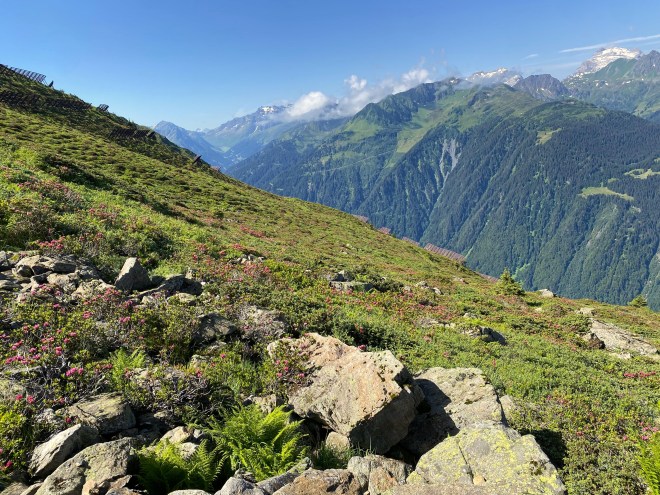


I have to say that, although the sight was very pretty, my heart sank when I saw those rhododendrons. You see, I was under the impression that all rhododendrons originally came from the Himalayas, that I was in front of an introduced species, and – based on something I had read somewhere – that rhododendrons in Europe were now an invasive species, a topic I have written about in several posts. I was biased towards this thinking by my sighting, the previous day, on a hike along the river Ill of thick stands of Himalayan Balsam, which as I’ve reported in an earlier post is indeed an invasive species here in Europe. So it was with a certain grimness that I photographed another patch of rhododendrons on a hillside in front of where we had lunch on the edges of a small Alpine pond.

Well, I’m glad to report that I was completely wrong. Yes, the Himalayas do host a large number of rhododendron species, as – surprisingly to my mind – do Papua New Guinea and Borneo. But there are a number of rhododendron species native to North America, and – key to this post – a few rhododendron species native to Europe. I am extremely glad to tell readers that two of these, closely related to each other, are native to the Alps, so no invasive species on our hike! They are the alpenrose, Rhododendron ferrugineum

and the hairy alpenrose, R. hirsutum.

I think readers will agree that there doesn’t seem to be much difference between the two. The biggest difference seems to be in the leaves. The undersides of the alpenrose’s leaves are covered in rust-brown spots, while the hairy alpenrose’s leaves have hairy edges. The pH of the soil is a prime decider of what Alp they will grow on, with the alpenrose favouring acidic soils and the hairy alpenrose alkaline soils. I suspect that once upon a time the two were one and the same species, and then they began to diverge as they adapted to different soils. They are still close enough so that they will hybridise where their ranges overlap. Since I have absolutely no idea what the pH of the soil is in the mountains above Schruns, I have correspondingly no idea which of the two alpenroses my wife and I were looking at on our hike. And I certainly didn’t get down on my knees to have a closer look at their leaves.
But where did I get this idea that rhododendrons are an invasive species? I can’t have dreamed it. Well, it turns out that there is another European species, the common or pontic rhododendron, R. ponticum, which is indeed invasive. Actually, as in the case of the alpenroses, there are two closely related species. One, the subspecies ponticum, is found around the southern Black Sea basin (hence its name) and all the way to Georgia and the northern Caucasus, with a presence also in Lebanon.

The other, subspecies baeticum, is found in a few damp valleys in a couple of mountain ranges in central and southern Portugal and southern Spain.
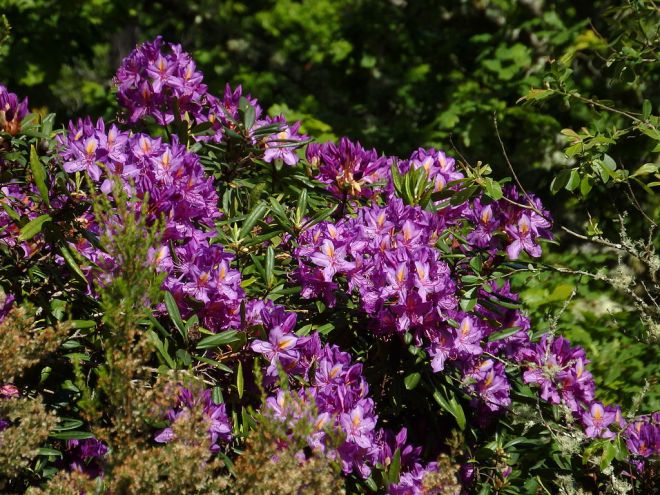
It is this latter subspecies that has become an invasive species in the UK and more generally in Western Europe. Its story is typical of the period when Europeans went around the world hunting for “pretty plants”, plants which simply gave pleasure because of their flowers, foliage, shape, or other characteristics. This started in the early 18th century; of course, the global trade in plants had started several centuries earlier, immediately after Europe’s discovery of the Americas, but in those earlier centuries people were interested only in plants that were commercially interesting. The common rhododendron ssp. baeticum was an early example of this massive movement of pretty plants around the world. It seems that it was brought to England in 1763 through that British foothold on the Iberian peninsula, Gibraltar, which is located quite close to its natural range. A new plant nursery in Hackney, run by a German émigré by the name of Joachim Conrad Loddiges, was the first to make the common rhododendron’s seeds available. One of the early buyers from Loddiges was the 2nd Marquess of Rockingham, who had the distinction of being British Prime Minister twice.

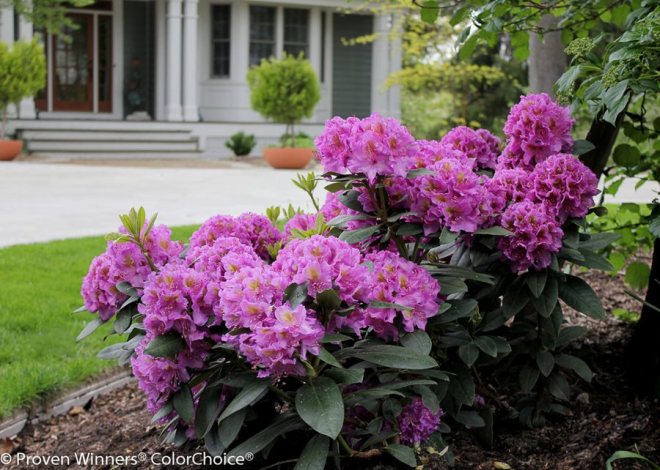
As readers can imagine, in those days, when Respect for one’s Betters was much more engrained, where such a Distinguished Personage went others were sure to follow. The result was that the planting of common rhododendrons in posh and then not so posh gardens quickly spread. Of course, it helped that it had a really pretty flower. But then most rhododendrons do. The craze for rhododendrons expanded as new species of rhododendrons, from North America and then from Asia, poured into the UK and Europe more generally. Rhododendrons hybridise quite easily, which added to the excitement as gardeners hybridised rhododendrons with abandon to create plants with ever more glamorous flowers. Often, to speed things up, new species were grafted onto the rootstock of common rhododendrons; the latter were tough and often there already, so it made for a quick way to turn your garden into a splendid glade of multi-hued rhododendrons. I throw in here photos of some modern examples of such dazzling displays of rhododendrons. The first, fittingly, is from Wentworth House in Yorkshire, one of two country houses that our friend the 2nd Marquess of Rockingham once owned.


Just to remind ourselves that it’s not just grand gardens that have rhododendrons, here’s one – maybe a common rhododendron, but you can’t tell, what with all the hybrids around – in someone’s back garden.
Alas! As far as the common rhododendron was concerned, it all turned out to be too good to be true. By the 1970s if not before, people had realised that it was a horribly invasive species. Primarily because of its huge production of seeds, it quite easily “hops over” garden fences and – if the soil and climate on the other side is welcoming – it goes feral. Then, once the plant has rooted, the roots send up suckers, which in no time at all grow into new bushes. The branches of all these bushes layer tightly together, blocking out sunlight and stopping anything else from growing. And to cap it all, many of the rhododendrons which were grafted onto the rootstock of common rhododendrons reverted to common rhododendrons if they weren’t looked after, creating yet more common rhododendron plants ready to hop over garden fences. The net result was thick stands of common rhododendrons taking over large swathes of land.

Here, a stand of common rhododendron is slowly engulfing a bus stop.

Well, who cares about a bus stop? But the common rhododendrons are choking stream beds and the understory of woods. They also carry a family of pathogens that can kill certain species of trees. This map shows the distribution of the common rhododendron, both inside gardens and out, throughout the UK and Ireland in the early 1970s.

Readers will notice dense patches of dots in many places in the UK, as well as in Ireland. Western Scotland and Snowdonia in Wales have been especially badly affected. Eradication programmes are underway. But it’s hard (and therefore expensive) work.
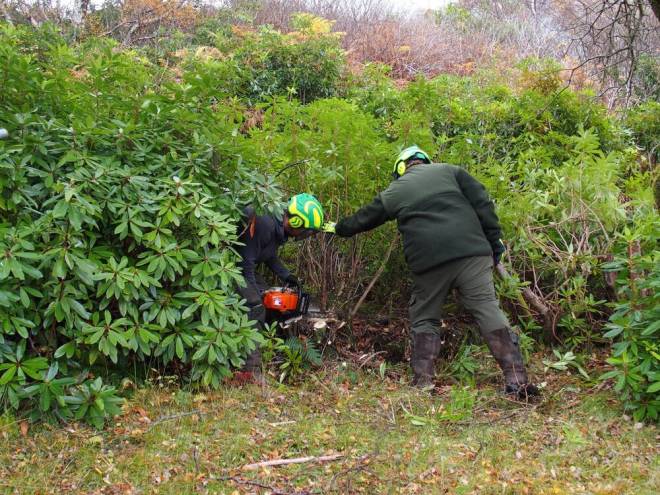

And you have to come back for at least five years after you’ve cleared a patch, to ensure that no roots were left which have thrown up suckers and no seeds were left which have sprouted. And now scientists have discovered that after you’ve cleared a patch it’s not a given that the cleared land will revert back to its original composition of plants; the balance has been disturbed and some plants may move back in faster than others and stop the slower movers from recolonising the land. So more work will be required to ensure that the original plant composition returns.
There is something really quite ironic about the common rhododendron letting rip and taking over large swathes of British, and other European, countryside. Back in the Iberian peninsula, where the plant came from originally, it is hanging on by its fingernails. It is a relict population from the the original laurissilva forests which covered the Iberian peninsula 66 million years ago, It is no longer suited to the dry climate in Iberia and has retreated into a few damp valleys. Reproduction is largely confined to the roots sending out suckers as the climate is now too dry for seedlings to survive. With climate change turning the southern part of the Iberian peninsula into a semi-desert, I suspect it will expire there. But, luckily for it, and unluckily for other plants, a bunch of ignorant plant traders brought it into an ecological niche where it just thrives, thank you very much! Of course, we can’t really blame the people who back in 1763 carried the plant to the UK, no-one then had the knowledge of what impacts there can be from moving plants around the planet. But now we do know, and yet we still do it. Are we stupid or what?!
Sorry, I can sense another rant coming on, time to stop. But if any of my readers have common rhododendrons in their gardens I beg them to rip them out without delay. If they really want rhododendrons, there are many, many equally pretty rhododendrons which do not “go forth and multiply”, as the Bible has it.

 the heart thrills
One thought on “THE COMMON RHODODENDRON – PRETTY FLOWER, INVASIVE SPECIES”