For some time now, I’ve been intrigued by this tree, which I see fairly regularly in gardens at our seaside place in Liguria. I see this particular example when we walk along the main road that runs through the village.
My photo
While another one, along the road to Recco, has long caught my eye.
My photo
I find the tree’s rigorous symmetry very pleasant to the eye, while the upward tilt of its fronds is most arresting – it looks like a pine tree growing upside down.
Up till now, my half-hearted attempts to identify it have been a failure. However, my wife recently discovered a plant identification service on our iPhone cameras. You take a photo of a plant and you will be told what the plant’s name is – not every time, I’ve discovered, but often enough to make such searches rewarding. I promptly trained my camera on the mystery tree and after a few goes it gave me a name: Norfolk Island pine. A couple of independent searches on “Norfolk Island Pine” confirmed the identification (one always has to beware false positives!).
Unsurprisingly, given its name, these independent searches also informed me that this tree hails from Norfolk Island, a dot of an island in the South Pacific Ocean. Although the tree has close-ish relatives in New Caledonia, the only place in the world where it is endemic is on this tiny island in the middle of nowhere. Norfolk Island is really very remote. It is pretty much equidistant between New Zealand to the south and New Caledonia to the north, with about 760 km of open water in either direction. And there’s double that distance between the island and the closest point in Australia, the country which oversees it.
The first Europeans to set eyes on the island were on James Cook’s ship during his second voyage to the South Pacific. I’ll quote what Cook had to say about the island in the published journal of this voyage.
“We continued to stretch to W. S. W. till the 10th [October 1774], when, at day-break, we discovered land bearing S. W., which on a nearer approach we found to be an island of good height, and five leagues in circuit. I named it Norfolk Isle, in honour of the noble family of Howard. … After dinner, a party of us embarked in two boats, and landed on the island, without any difficulty, … We found it uninhabited, and were undoubtedly the first that ever set foot on it.”
Cook was wrong about this. Archaeological surveys on the island have shown that Polynesians had already reached the island and lived there, but for some unknown reason they had all upped sticks and left several centuries before Cook hove to on the horizon.
Cook continues:
“We observed many trees and plants common at New Zealand; and, in particular, the flax plant, which is rather more luxuriant here than in any part of that country; but the chief produce is a sort of spruce pine, which grows in great abundance, and to a large size, many of the trees being as thick, breast high, as two men could fathom, and exceedingly straight and tall. … “
Cook wrote a bit more about the tree in a variation of his Journal (quite what variation this is I have not managed to ascertain – perhaps his handwritten journal?)
“[The tree] is of a different sort to those in New Caledonia and also to those in New Zealand, and for Masts, Yards &ca [it is] superior to both. We cut down one of the Smallest trees we could find and Cut a length of the uper end to make a Topgt Mast or Yard. My Carpenter tells me that the wood is exactly of the same nature as the Quebeck Pines”.
Luckily for the Norfolk Island pine, Cook was also wrong about the tree’s utility in the manufacture of masts, yards and spars. Quite quickly, it was found not to be resilient enough for the purpose, so initial plans to harvest the trees were abandoned. I say luckily, because if the wood had indeed been good for the task, I’m sure all the island’s pines would have been cut down by now.
As it is, the “great abundance” of Norfolk Island pines which Cook saw has been greatly reduced over the last 250 years. The UK government turned the island into a penal settlement for some 55 years, and the convicts cut down trees for their own use as well as to clear land for agriculture. Then, in 1856, the UK government relocated part of the population of Pitcairn Island to Norfolk Island because Pitcairn was getting too small for its growing population. After the grimness of the island’s use as a prison, this puts it in a rather romantic light: Pitcairn islanders were descendants of the mutineers on the Bounty and their Tahitian partners. I remember vividly the film “Mutiny on the Bounty”, where Marlon Brando plays the role of Lieutenant Fletcher Christian.
(the earlier version with Clark Gable in the role was not so good, in my humble opinion)
To these romantic new residents were added a few more people, people who jumped ship from visiting whalers or other ships which passed. All these new residents unromantically continued cutting down trees to clear land for agriculture. The trees also had to start competing with other, foreign species brought to the island. As late as the 1950s, some bright spark had the idea of turning Norfolk Island pines into plywood. A batch was exported to Sydney, and excellent results were reported of the trial plywood produced. Luckily, someone with some sense realised that this was not a sustainable business and the idea was dropped.
As a result of all this mismanagement of the island’s pines over the centuries, the stands have gradually shrunk, with the last remaining stands of any size now protected in a national park, on land which is too steep or rocky to farm.
The International Union for the Conservation of Nature has classified the species as “vulnerable”.
Someone – maybe several people – along the way also realised that this handsome tree had potential in the horticultural trade. Quite quickly, it entered that global trade in plants which I’ve written about earlier. From a purely selfish point of view, that was lucky for me, because otherwise I would never have seen this handsome tree on the Ligurian coast. I see no reason why I would ever visit Norfolk Island – I’m not the type to take part in a mutiny and I’ll never, thank God, work on a whaler (not a complete impossibility; some of my ancestors did).
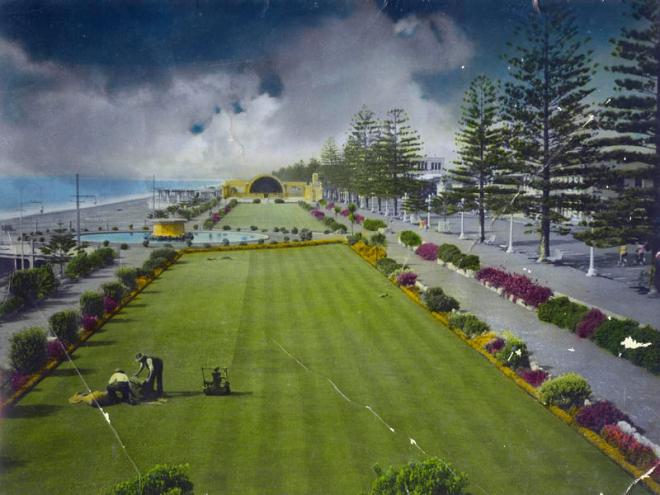
Already by the late 19th Century, the tree had moved out of its native habitat. It seems to have been a popular tree to plant near shore lines because of its high tolerance to salt and humidity, as well as its ability to grow in sandy soil. It also always grows straight regardless of prevailing winds. Here’s a nice example from the city of Napier in New Zealand, where a row of Norfolk Island pines was planted along the sea front in 1890, to create the Marine Parade.
This particular photo was taken in the 1930s and later coloured by hand. The trees are still there, although recent articles say the trees are getting to the end of their lives and need replacing.
And then, in ways that probably no-one has studied, and probably never will (who cares about the history of a plant?), it reached the piece of Ligurian coast where my wife and I spend time, a trip of 18,300 km as the crow, or perhaps better the albatross, flies (nearly half the Earth’s circumference).
I don’t know how long the trees have been here. They are quite tall but Norfolk Island pines grow slowly. From information I’ve managed to glean from the internet, I’m guessing that these particular specimens are fifty or so years old, which means they would have been planted around the time I first started coming to this Ligurian village. With a bit of luck, they’ll see me to my grave.
As in the case of my previous post, the little trip my wife and I recently undertook in central Italy was kicked off by an article in the Guardian which I read some four-five months ago now (although quite how I got to it I can no longer remember; the article is more than three years’ old). The article was about a fresco by the Renaissance artist Piero della Francesca depicting Mary pregnant with Jesus.
It was such a different depiction of Mary when pregnant. The only paintings I know of where we see her pregnant are depictions of the Visitation, the story in the New Testament where Mary goes to meet Elizabeth and both women are pregnant. Here is a nice example of the genre, by Rogier Van der Weyden, where it is clear that both women are pregnant; in many versions of the Visitation, you would be hard put to see that the two are “with child”, as they used to say.
But Piero della Francesca has Mary alone, not doing anything in particular, just resting her hand on her belly. Such a natural pose! I remember vividly my wife doing exactly the same when she was pregnant with our two children.
Charmed by this fresco, I immediately proposed to my wife that we go to see it. She said she was all for it as long as we got some hiking in too. The fresco is held in a village called Monterchi, on the borders of Tuscany. Once I discovered that we would need to get to Monterchi via Arezzo, I proposed that we also visit Arezzo – I had visited the town fifty years ago, my wife never. And then I saw that one of the earlier stages of the Via di Francesco, the Way of Francis, several stages of which we hiked back in October 2023, passed through Citerna, a village across from Monterchi. So then we decided to walk from Citerna to Sansepolcro. Then late in the planning, we discovered that there was going to be a “once in a lifetime” exhibition of Caravaggio, my favourite painter, in Rome. My wife eventually persuaded me that we should tack on a quick visit to Rome, which allowed for an extra day’s hike to Città di Castello, followed by a two-day stay in Perugia (again, visited by me fifty years ago and by my wife never), with a final quick visit to Rome just for the exhibition.
What follows are notes on our little expedition.
Arezzo (population: 99,000)
After taking a Flixbus down to Florence, we rolled in to Arezzo train station in the early afternoon.
I have to confess that I have no idea why I decided to go to Arezzo fifty years ago. I have but one memory of the place: going to a cafe for lunch and being served by a man with a fascinating face, the type of face I see in Caravaggio’s paintings; the lunch was good, too, as I recall. But I remember nothing of what I visited. A bit embarrassing, really.
What we found was a very pleasant old town, built up a slope towards the cathedral.
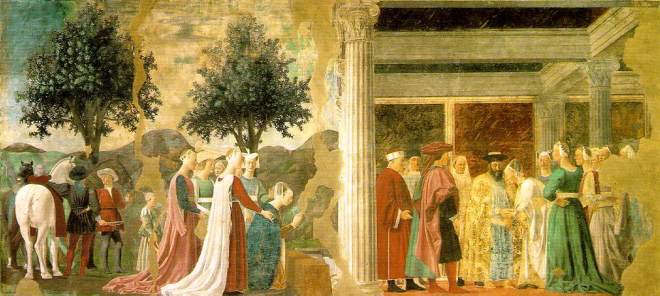
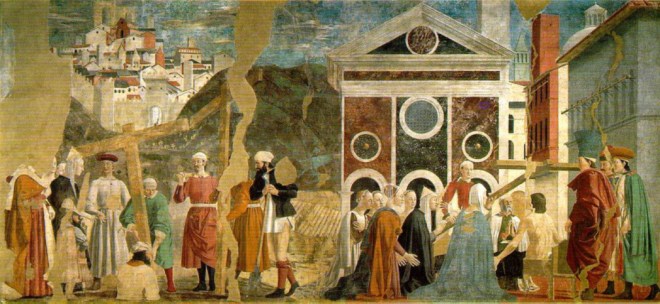
I very nearly missed the town’s artistic highlight, the frescoes in the cappella maggiore in the Church of Saint Francis, by Piero della Francesca (him again; not surprising, really, he was from this part of Tuscany). On the day we set aside to visit Arezzo, the chapel was closed. No problem, we said, we’ll see it tomorrow morning before our bus leaves for Monterchi. Next morning, we were at the church when it opened, but disaster! we were informed that you had to book your visit online, and there were no spaces left. My wife, excellent negotiator that she is, managed to persuade the ladies at the ticket desk to at least allow me in. So I went in and relayed photos to my wife outside via WhatsApp. These photos, scraped from the web, are frankly much better than the ones I took.
We climbed up and over to the other side of the hill, to the old village school, which had been turned into a little museum just for Piero della Francesca’s fresco of the pregnant Madonna. I won’t repeat the photo I inserted earlier. I throw in instead a photo of a reconstruction of what the fresco originally looked like, with Mary in a tent of some sort.
My photo
It is indeed a lovely representation of pregnancy. I can understand why pregnant women in past centuries would flock to the chapel which contained it, to pray for a safe and easy birth.
Citerna (pop: 3,400)
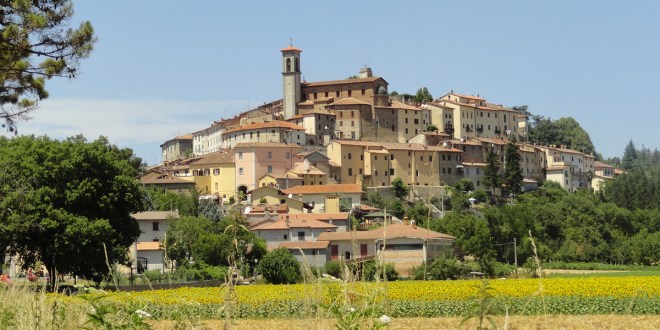
After the visit to the museum, my wife and I walked to Citerna, sitting on the top of a high hill on the other side of the valley from Monterchi.
My wife’s photo
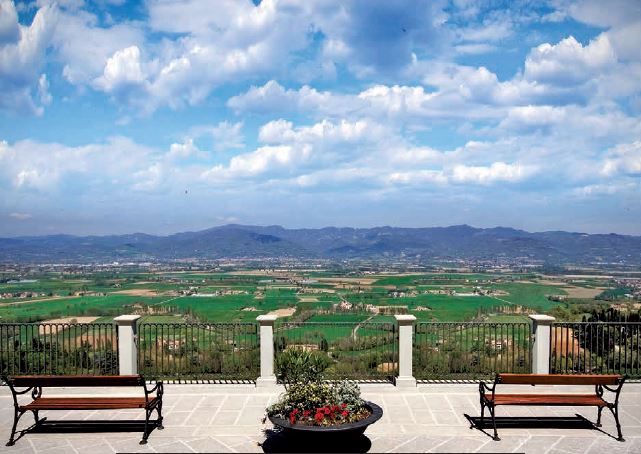
It was a short hike, some 2 km, but steep: the route suggested by Google Maps took us pretty much straight up the hill. What we found at the top was a sleepy little village most of whose residents were old – the fate of so many of Italy’s villages. Internet had informed me that the local church contained a statue by Donatello, although I was warned it was difficult to visit. And so it proved. The church was locked, but there was a note on the door with a phone number to call to arrange a visit. My wife called, but the man who responded told her he was in Ravenna; tomorrow morning, he said, he would be there at 9.45 – or maybe later, he wasn’t sure. Since we were planning to be on the road by 9.00, that was that. The only other thing of note in the village was splendid views of the valley which we would be hiking across the next day.
There was also a stone tablet set in a wall which got me all excited.
My photo
It commemorates the fact that Garibaldi and his beloved wife Anita stayed here in July 1849. Theirs was an impossibly romantic story. They met in 1839 in Brazil; Garibaldi was fighting in a number of wars of independence in Latin America. The way my history teacher told the story in my O-level history class (the only thing I really remember of the part of the curriculum on Italian unification), Anita was washing clothes in the river. Garibaldi spotted her through his telescope from the bridge of his ship. He immediately got his sailors to row him over to her. When he reached her he declared to her – in Italian – “you must be mine!” She was already married but somehow or other the husband was dispensed with and they got married. When Garibaldi came back to Italy in 1848 to fight in the various popular uprisings taking place there, she followed him. She was with him in Rome in 1849, when he was defending the short-lived Roman Republic. Together, they escaped as the Republic collapsed in June. Their aim was to get to Venice, but they were being pursued by at least three armies and navies: the French, Austrian, and papal forces. It was during this flight towards Venice that the pair spent a – presumably hurried – night in Citerna. Tragically, Anita died, probably of malaria, in Garibaldi’s arms, near Ravenna in early August. I throw in a photo of the pair.
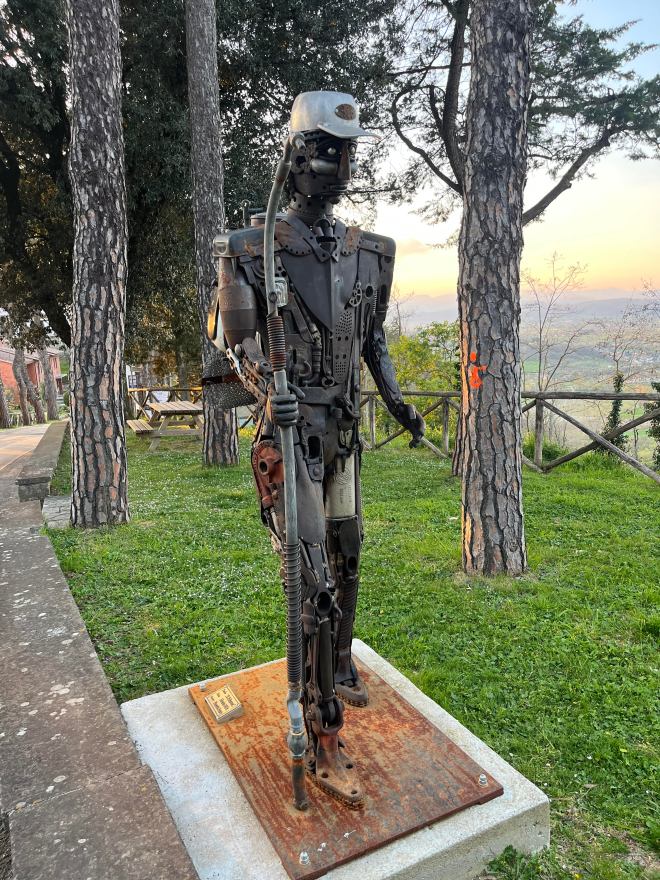
Made of scrap metal, it commemorates the pilgrims who pass through Citerna, walking the Via di Francesco on their way to Assisi. It was the route we would be taking the next day, although we would be walking it in the opposite direction, to Sansepolcro.
Sansepolcro (pop: 15,000)
We made our way down the hill from Citerna and then started making our way across the valley which lay between us and Sansepolcro. We were taking small roads across the valley which wound their way across flat fields.
From time to time, we passed groups of pilgrims walking the other way, otherwise we had the road to ourselves. 15 km later we arrived at Sansepolcro.
Having dropped off our rucksacks, we went off to explore. In truth, there wasn’t much to explore, but we did go and see the town’s crown jewel, its municipal museum, which contains this lovely polyptich painted by Piero della Francesca.
I’ve always loved these depictions of Mary as the Madonna of Mercy, where she is gathering up a group of faithful into the folds of her cloak. If I had lived in the Renaissance – and if I had been very rich – I would have commissioned a Madonna of Mercy, with my wife and I, along with our two children, their partners, and their children, all gathered under her cloak.
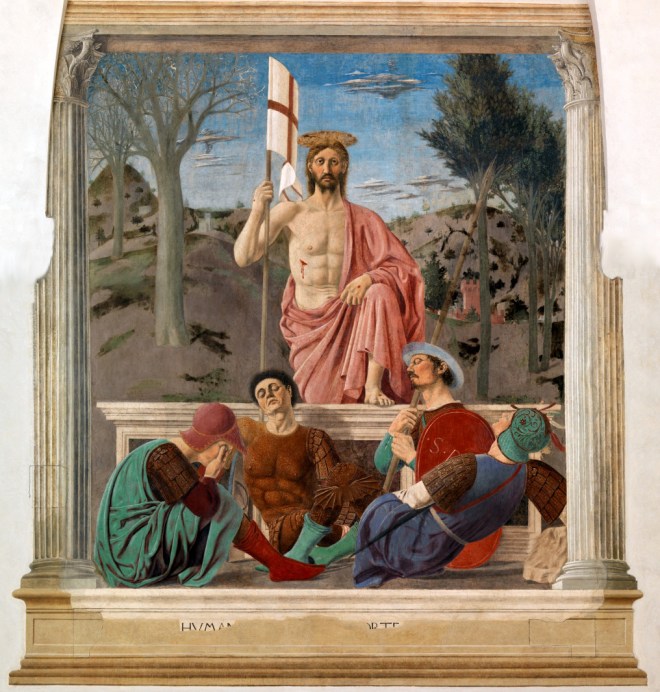
The museum also contained this magnificent Resurrection by Piero della Francesca.
Source
There is a heart-warming story about this fresco. Aldous Huxley had visited Sansepolcro to see this fresco, and in an essay he wrote in the 1920s he described it as “the greatest picture in the world”. In the summer of 1944, as Allied troops were advancing up Italy, the Royal Horse Artillery took up positions to shell Sansepolcro according to orders received. Suddenly, a Lieutenant, by the name of Anthony Clarke, remembered reading that essay as a teenager. Fearing that the shelling could destroy the fresco, he ordered the men to cease fire. Luckily for him, the Germans had already evacuated the town, so the Allied troops could capture it without losses.
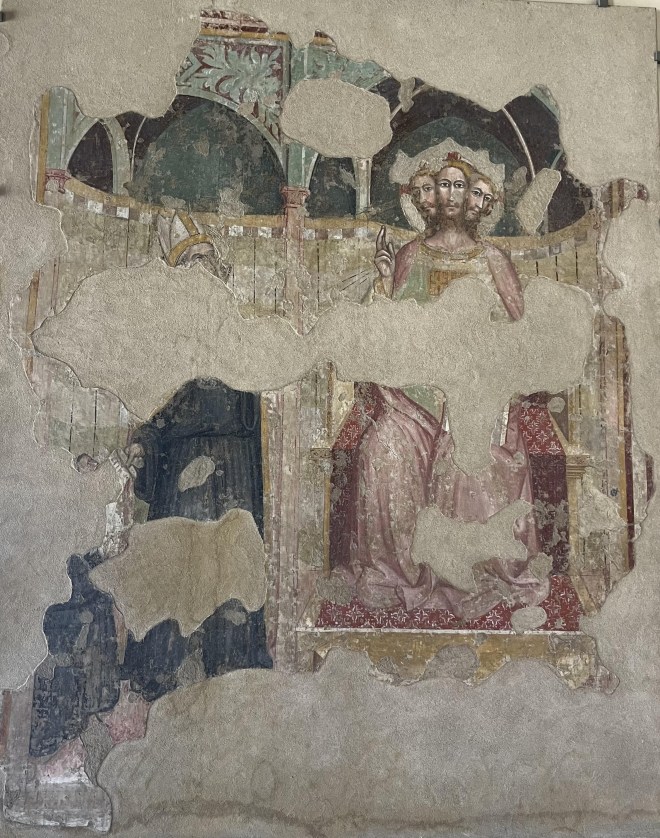
The rest of the museum was so-so, although I was much struck by a very strange fresco tucked away in a back room.
My photo
It is meant to represent the Holy Trinity, although this three-headed person looks more monstrous than holy.
Città di Castello (pop: 38,000)
The next day, we made a 10 km hike southwards to Città di Castello. We weren’t following a pilgrim trail, just a route suggested by one of the hiking apps we use. The first half was very pleasant, taking us along back roads and tracks through fields. The second half was less so, having us walk along a busy road and then through what seemed like the interminable suburbs of the town itself.
Once we had found our lodgings and dropped off our rucksacks, we sallied out to see what we could find. As in the case of Sansepolcro, there really wasn’t much to find. But we did discover – to our surprise, I have to admit – that Città di Castello was the birthplace of a fairly well known modern Italian artist by the name of Alberto Burri, and that, with the blessings of the municipality, he had set up a museum containing an extensive collection of his works. The Green Michelin Guide, my go-to source for all things cultural to visit, gave the museum two stars. Well, what the hell, we said, why not.
Well, I can’t say I was super excited by his work. He used materials like tar, iron, plastic, wood, earth, and glue to create his pieces, which I suppose would be defined as abstract art. A site I read had this to say about him: “Alberto Burri was an Italian painter, among the most important of the 20th Century. His techniques anticipated movements like arte povera and nuovo realismo.” The only work in the museum which I could have lived with is this one.
My photo
After our visit to the museum, we wended our way to the town’s main drag to have an Aperol Spritz, but not before coming across this wonderful stone tablet set in the wall of the old municipal building.
Source
It was an excellent example of a style of lapidary declamation that I often come across in Italy: wordy, pompous, and often – to me, anyway – incomprehensible, mostly because no punctuation is ever used. Below is my best guess at a translation of what the Socialists of Città di Castello were trying to say back in 1911:
“From the red dawn of the International to the victorious outbreak of proletarian forces, neither persecution nor honours bent the proud soul of Andrea Costa away from the socialist ideals of workers’ rights. Supporter, apostle, in the square, in prison, in parliament.
In the name of he who was the symbol of the noblest faith, the Internationalist group of Città di Castello, dispersed in the lands of exile by violent blasts, remember, honor.
The Socialists”
Perugia (pop: 162,000)
We took a creaky old train, much painted over by graffiti, to Ponte San Giovanni at the foot of Perugia and then a bus up to Perugia itself, high up on the hilltops. The weather had turned and we reached our hotel in the midst of a downpour.
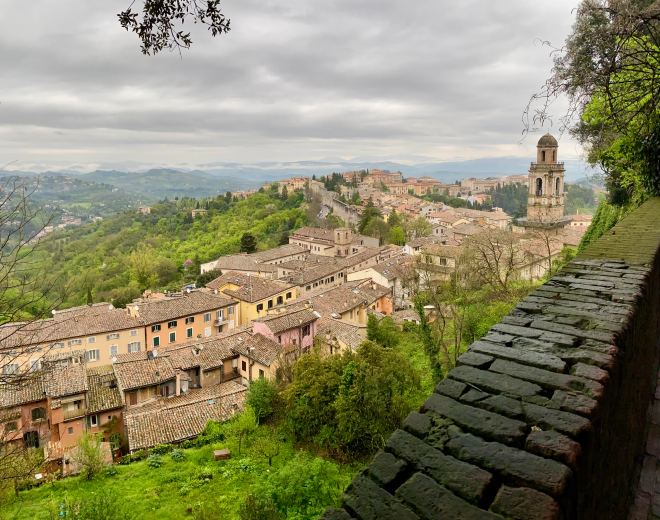
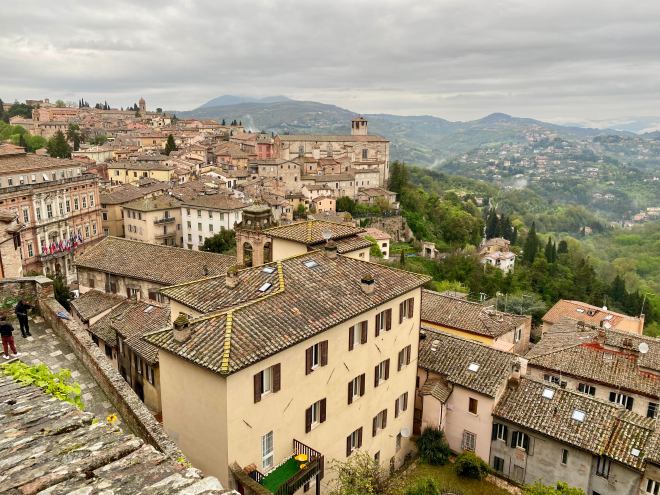
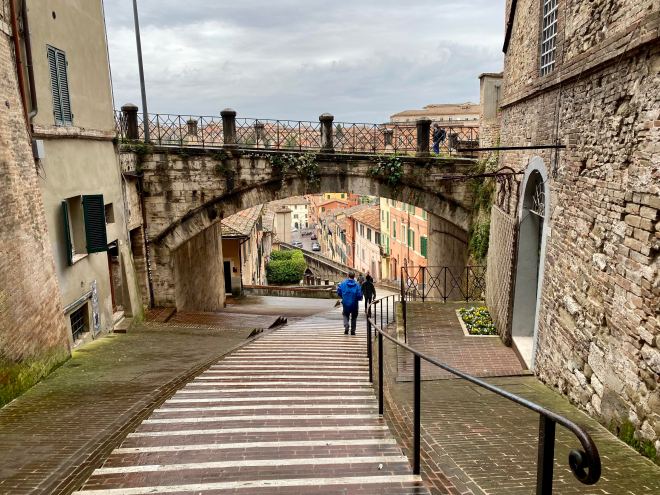
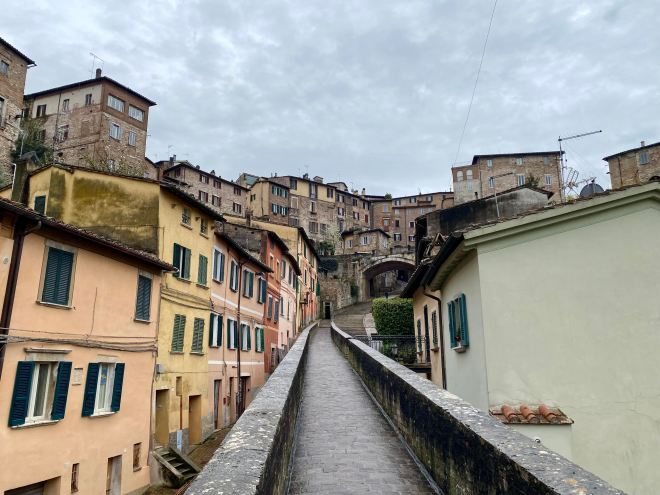
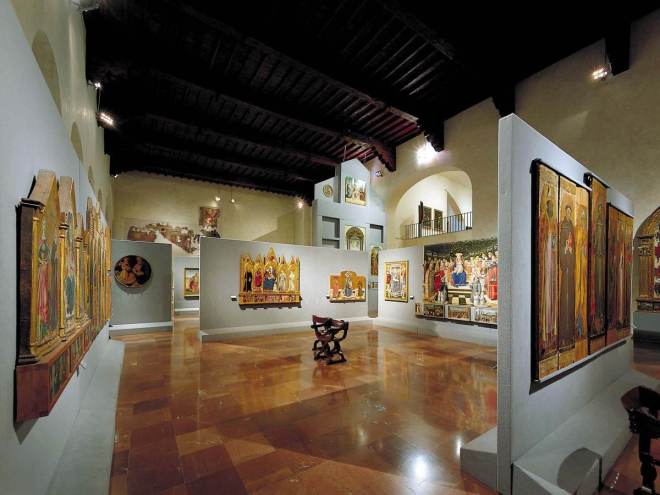
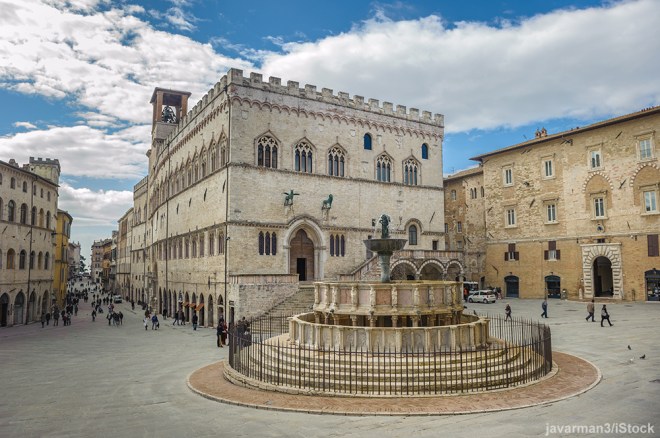
My only memory of Perugia from my previous visit of 50 years ago is a very vague one. It has to do with a museum, the national gallery of Umbria, but has nothing to do with any of the pieces in that museum. My memory synapses just stored away my pleasure at the halls’ minimalist style: undecorated white walls, relatively few well spaced paintings on these walls, uncluttered floors with only the occasional bench to sit on. It is a style that my wife and I have adopted all our lives – although I have sometimes weakened, seeing lovely, and relatively cheap, things to hang on the wall; but my wife has kept me on the straight and narrow. I must admit, it is a strange memory of Perugia to have carried with me all these decades. For instance, I have no memory of the town’s topography. Over the millennia, Perugia has spread over a series of hilltops and their connecting crests, so there are a lot of fairly steep ascents and descents involved in visiting the town. My wife, on her first visit to Perugia, was charmed by this form of urban development and took several photos to record it.
My wife’s photoMy wife’s photoMy wife’s photo
To help the locals (and maybe tourists) to tackle the town’s steep slopes, the municipality has installed escalators at various points. This one passes through the bowels of a fortress built by a pope to keep the Perugians in line.
My wife’s photo
They rather reminded us of the Central-Mid Levels escalator in Hong Kong – although that one was considerably longer.
The municipality has also rather cleverly readapted an old viaduct and made it into a walkway.
My wife’s photo
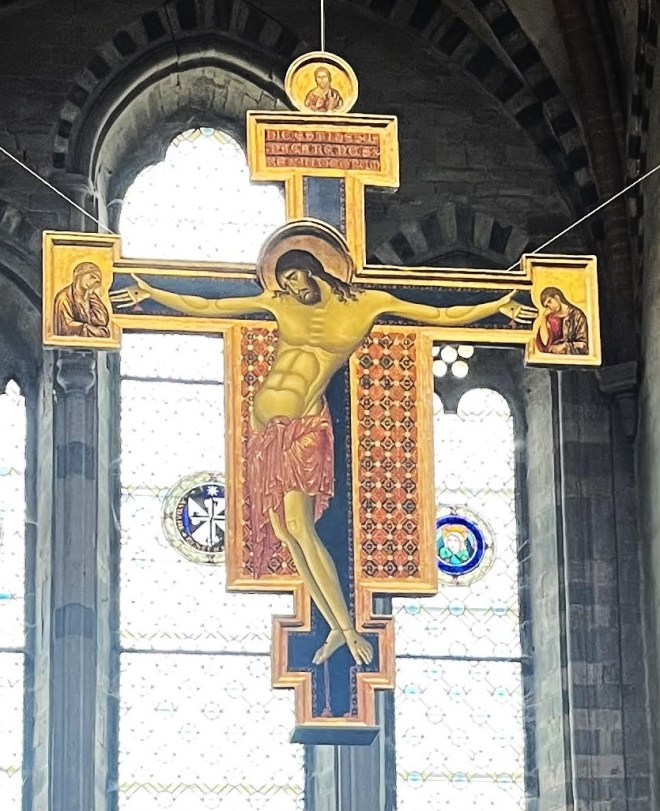
Talking of the national gallery of Umbria, it was a pleasure to (re)visit it. It houses a wonderful, huge crucifix by “the Master of Saint Francis”.
The panels were carved by Nicola and Giovanni Pisano (we weren’t actually looking at the originals, which are now housed in the Galleria Nazionale dell’Umbria). The panels depict the months of the year, various allegorical figures, and some other subjects. I show the two panels which cover the months of our two birthdays.
We took the Flixbus down to Rome, which left us off at Tiburtina station. From there, without even bothering to put down our bags at the hotel, we took the subway to Palazzo Barberini where the Caravaggio exhibition was being held.
It was a wonderful exhibition. Some of the pieces I had already seen “in the flesh”, like this painting, Judith Beheading Holofernes, held in Palazzo Barberini’s own collection.
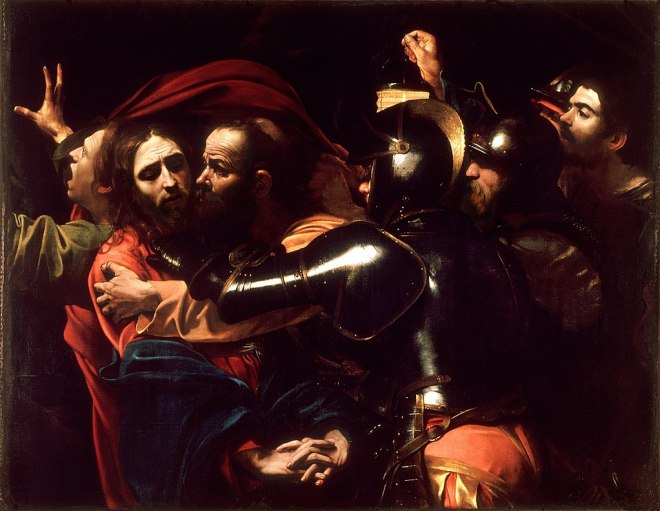
Others I had only seen in my book of Caravaggio’s paintings. For instance, this one, The Taking of Christ, which currently resides in the National Gallery of Ireland (it was rediscovered a mere thirty years ago!).
In both, one can see self-portraits of Caravaggio, at the back of the crowds, peering over people’s shoulders.
With that, all our visits on this little trip were now over. But not, alas, our adventures, or rather misadventures in this case. On the subway trip back to the hotel, my wallet was picked from my pocket. The money was the least of things. Gone were the credit and debit cards, my residence permit for Austria, my driver’s license, and few other odds and ends.
We took the bus back to our seaside place. All the way, I was seething inside over my wallet. I decided I should put a curse on the thief. I should do like the ancients, who wrote their curses on thin sheets of lead, rolled them up, and consigned them to a sacred place. The example I give here is one of 130 curse tablets that were discovered at the bottom of what was during Roman times a sacred spring in Bath, in the UK.
I don’t know what particular curse this tablet has scratched on it, but one of the 130 has this to say about the theft of a ring:
“So long as someone, whether slave or free, keeps silent or knows anything about it, may he be accursed in his blood and eyes and every limb, and even have all his intestines quite eaten away if he has stolen the ring or been privy to the theft.”
Hmm, that sounds like a good curse. But actually, I know an even better one, a really hideous one. I won’t say what it is because then it wouldn’t work anymore. I don’t need a sheet of lead, a sheet of paper will do, and I will consign it to one of those offerings boxes they have in churches. Let the thief suffer the torments of hell, for ever and ever and ever!






















 the heart thrills
