Vienna, 18 June 2025
It’s summer time! And summer time, for my wife and me in Vienna at least, means it’s time to go hiking around the city and beyond. And that means studying guides, electronic and hard-copy, to find new hikes for us to do. So it was that a month ago now I bought a guide to the Jakobsweg, the pilgrim routes (or at least modern versions of these; so many of the original routes have been overlain by the asphalt of large roads) that wend across Austria and eventually lead the walker (after crossing Italy or Germany and then France and Spain) to the cathedral of St. James in Compostela.
Here we have a Medieval miniature of St. James as a pilgrim on his way to Compostela – note the scallop shell on his satchel, the symbol of this pilgrimage.

Although in my mind’s eye I see the road snaking out before me over hill and dale all the way to Compostela (Google Maps tells me that the town is 2,760 km away from my living room), I’ve been looking more modestly at the stages which are not too, too far from Vienna. Specifically, I’ve been looking at the stages beyond the great monastery of Melk.

(The reason for that is simply that we’ve already walked the stages between Vienna and Melk.)
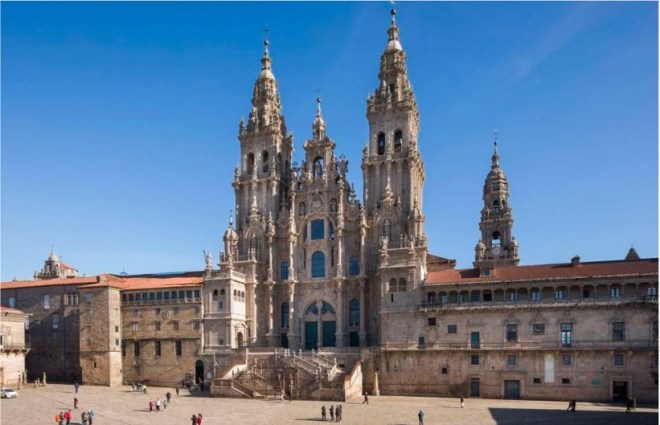
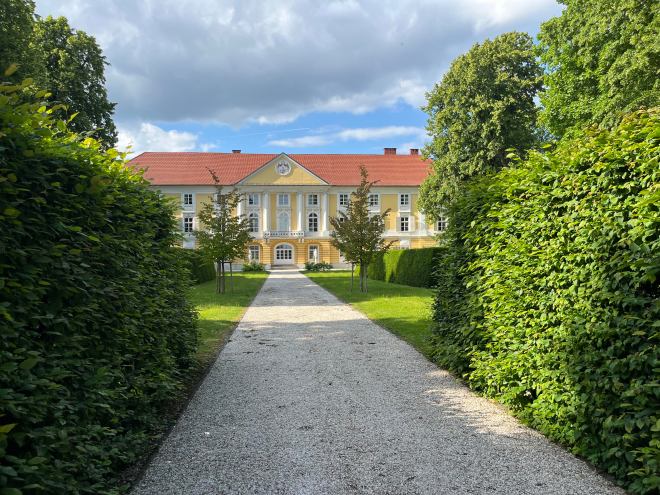
As I followed the stages in my new guide and figured out where we might stay for the night along the way, my eye was caught by the name of a village we would walk through: Sankt Pantaleon. I throw in a photo of the village which I found online. It looks like a nice, typical Austrian village.

Readers of these posts will know that I have a fondness for obscure saints whose names still pepper our landscape – although I have to say that the name Pantaleon is thin on the ground. Google Maps – once again – informs me that there are only a couple of villages in Austria which go by that name, as well as a handful of churches and streets. The same is true for France, Italy, and Spain. He has a somewhat greater presence in Greece and other Orthodox lands under the name Pantaléémon. In Switzerland, Germany, Belgium, and Portugal he has hardly any presence, and in the Netherlands and the UK none at all. My wife and I will not be coming across him very often on our hikes, it seems.
What do we know of this saint? Well, not much at all, as is usually the case with these saints from the earliest centuries of Christianity. If he existed at all, he hailed from Asia Minor as most of these early saints seem to have done. His various hagiographies tell us that he was born in the late 200s AD and brought up a Christian by his mother (his father was a pagan). But he fell away from the faith when he studied medicine. He was brought back to the straight-and-narrow by an even shadowier saint, who – if I’ve understood the sub-text correctly – basically said “Jesus did better than you, by healing through faith alone”. And in fact, Pantaleon converted his pagan father after healing a blind man by invoking the name of Jesus over him.
In any event, he continued being a doctor; and he must have been a very good one, because he became the personal physician to successive Emperors. But he must also have continued dispensing care – for free – to those who needed it, which has earned him in Orthodox Christianity the delightful title of Holy Unmercenary Healer. This is an epithet that has been given to various saints who offered their medical services for free, contrary to the (still) prevailing practice by doctors of charging (often a lot) for their services. The National Health Service in the UK, which still manages (just) to offer its services free at the point of delivery, should take Pantaleon as its patron saint.
Things came to a head when Diocletian started his persecution of Christians in 305 AD. Doctors, envious of Pantaleon’s success as a court physician – and of course pissed off that he was offering his services gratis – denounced him to the Emperor. Since the latter rather appreciated Pantaleon’s skills he tried to get our hero to abjure his faith, which of course Pantaleon did not do. So the Emperor handed him over to the torturers. They subjected him to the usual menu of hideous tortures which hagiographers delighted to write up in minute detail. I won’t bother readers with even a summary of them. I’ll just throw in a photo of a relatively recent painting depicting one of his tortures, being put in a bath of molten lead (which, according to the hagiographers, immediately went cold when he stepped into it, so I’m not sure how he was meant to get out of the now-solidified lead; but I guess I’m just being picky).
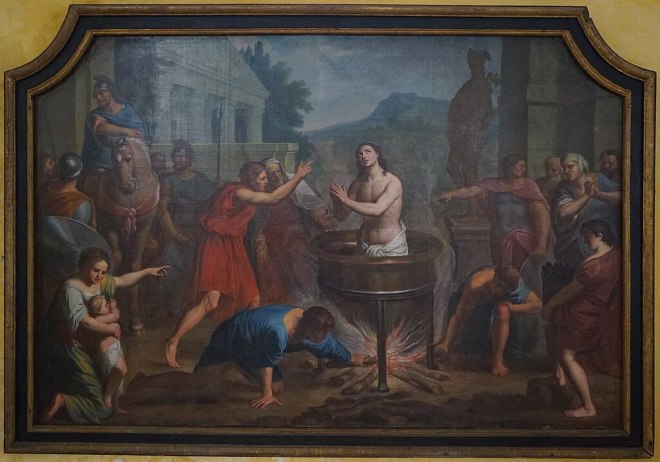
I’ll also mention one other torture to which he was subjected – because it is important for later in our story – namely the nailing of his hands to his head. Ouch! In the end, it’s only when he gave his tormentors permission to cut off his head that they managed to do so.
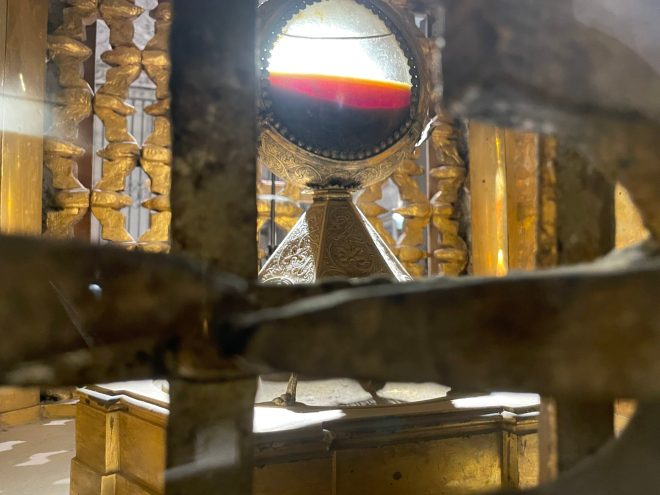
As usual, when the veneration of relics became popular in Christianity, various relics of Saint Pantaleon popped up: a head here, an arm there, a finger bone somewhere else. More unusually, a vial of his blood ended up in the town of Ravello, near Amalfi. Like the more famous case of Saint Gennaro’s blood in Naples, which is just around the corner from Ravello, the blood in the vial liquifies once a year. Here we have a photo of that vial when it is apparently liquifying in 2022.
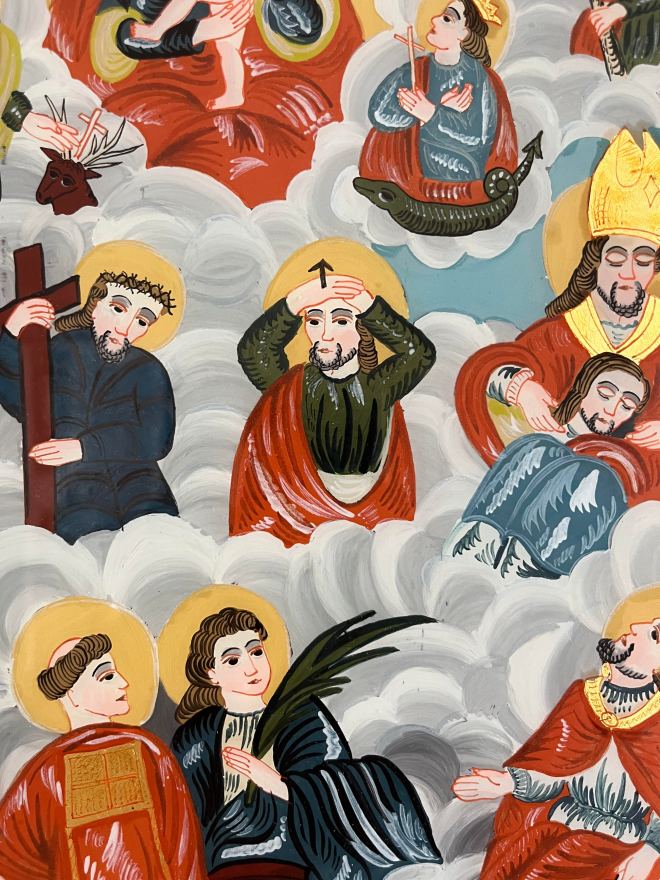
So popular was Saint Pantaleon that he was made one of the Fourteen Holy Helpers, who, from the late Middle Ages on, were invoked to help with people’s everyday problems, especially health problems. I’ve written about a number of the Holy Helpers in earlier posts, so it’s nice to be able to add to the list with this post. I guess it made a lot of sense to include Pantaleon in the group; he was a doctor after all. And in fact, he was the patron saint of doctors and midwives. He was invoked specifically in cases of cancer and tuberculosis; why those two diseases rather than any other is not clear to me. What makes perfect sense to me, however, is that he was also invoked in cases of headaches and any other pains in the head, or even mental illnesses. This photo of a panel which I stumbled across in the church of Eferding during our recent hike along the Danube – I kept the photo back for this post – shows very clearly why. The saint to the right is Pantaleon, and we can see the nail which has been hammered through his hands into his head. To a mere mortal like me it looks incredibly painful, although the sculptor has Pantaleon looking very stoic.

This story of the nail in the head has also meant that I’ve identified one more of the fourteen Holy Helpers in my painting on glass of them, which pleases me no end!
As I wrote earlier, a fair number of churches have been named after Saint Pantaleon. I will only mention one, the church of San Pantalon in Venice.
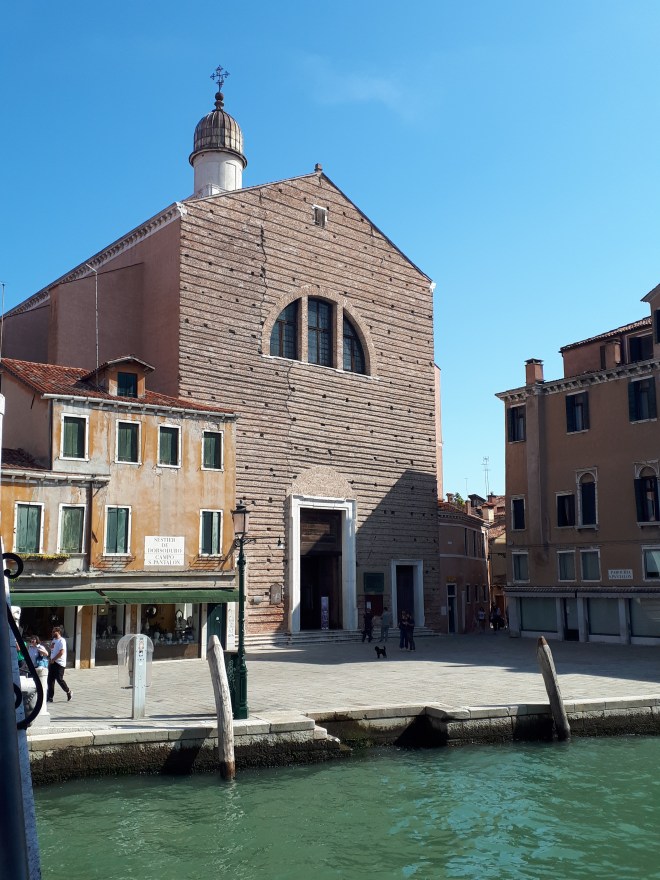
If I mention it, it’s because my wife and I checked it out during a brief trip we made recently to Venice, to visit the Biennale (architecture is the theme this year). The church’s exterior is not much to write home about. The church’s main claim to fame is its ceiling, which depicts the martyrdom and glory of Saint Pantaleon. It is indeed quite breathtaking.
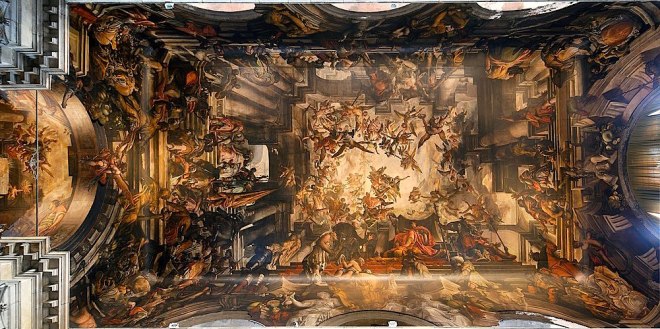
It is not, as might seem at first sight, a fresco; it is a vast painting on canvas, which has then been stuck to the ceiling. Apparently, these were quite popular in Venice; quite why, I don’t know.
This mention of Venice allows me to segue smoothly from the sublime to the ridiculous. San Pantaleone (or Pantalon in Venetian dialect) was once a very popular saint in Venice. No-one has given me an explanation for this. Nevertheless I have one, born of my fervid imagination. To explain my theory, I have to jump to the countries in the southern cone of Latin America. It is a tradition there to eat gnocchi on the 29th of each month (and so the tradition is called los ñoquis del 29). It is a festive occasion, as this photo – one of many on the internet – attests.
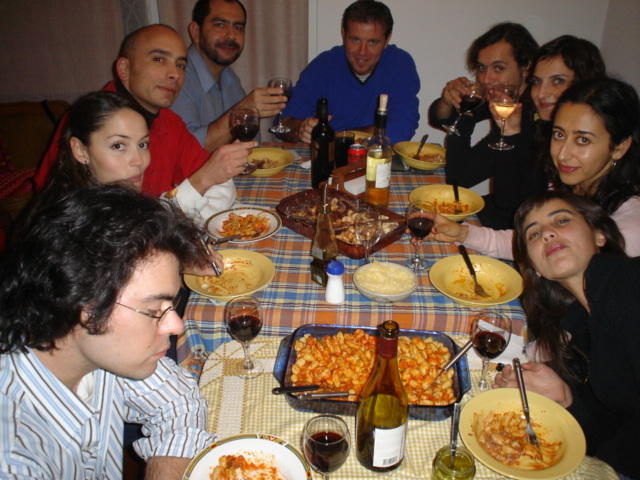
It was also the custom – perhaps not so much now – to place some money under your plate to bring you luck and prosperity. It was the Italian immigrants to this part of the world, many of them from the Veneto region, who brought this charming tradition with them. It was based on a legend about San Pantalon (to give him his Venetian name) which made the rounds in the Veneto. Even though he lived in Asia Minor, it was said that he had once come to northern Italy on a pilgrimage. One day, the twenty-ninth day of the month, he asked some poor peasants near Venice for bread; they generously invited him to share their meagre meal. In gratitude, San Pantalon announced that they would enjoy a whole year of abundant fish catches and harvests, which was indeed the case. The custom of placing some money under one’s plate of gnocchi – a simple dish, one for poor people – on the 29th of each month is therefore intended to obtain the renewal of this prosperity once granted by the saint.
Lovely story. But what I see in this legend is that for the Venetians – whose whole livelihood, indeed whose whole State, depended completely and totally on trade – San Pantalon would have been the go-to saint: “dear San Pantalon, here’s a lovely candle for you and some money in the offerings box. I’ve also put my life’s savings in this ship going to Constantinople [=the money under the plate]. Please, please, please make it come back with mounds of fantastic stuff that I can make a fortune off.”
Whatever the reason for his popularity in Venice, in the minds of other Italians Venetians became inextricably linked with San Pantalon. And so, when Commedia dell’Arte was born in the 16th Century, one of the stock characters in the plays was Pantalone. Pantalone is basically a caricature of Venetian merchants and just to underline this fact the character is meant to speak in Venetian dialect, at least in the Italian versions of the plays. He is retired, so he’s played as a wizened old man. He’s miserly and loves his money. Despite his age, he’s a lech and a smooth talker, and makes numerous passes at women, although he is always rejected. Given the high social standing of merchants he also represents those at the top of the social order, and he feels that this allows him to meddle in the affairs of others. In sum, the character of Pantalone is entirely based on money and ego, but at every step he becomes the butt for every conceivable kind of trick. Rereading this, which is based on a composite of many descriptions I found of the character, I get the distinct impression that the rest of Italy didn’t much like the Venetians. Quite a comedown from our heroic martyr Pantaleone.
But it gets worse! To understand why, I show here a couple of depictions of what the Pantalone character typically looked like on stage. By one of those wonderful acts of serendipity, my wife and I saw the first of these depictions just yesterday at the Kunsthistorisches Museum in an exhibition they are currently holding entitled “Arcimboldo-Bassano-Breughel” (for any readers in Vienna, hurry up to see it, it finishes on 29 June!). This particular painting is by Leandro Bassano. It was one of a series that depicted the months of the year, in this case the month of February, which of course is carnival time in Italy, which was a popular time for putting on plays.
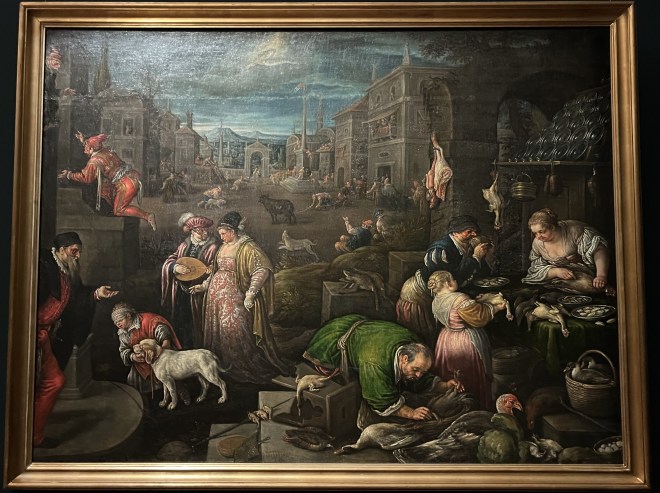
The set of characters on the far left of the painting (minus the boy and the dog) are all characters from commedia dell’arte plays. Pantalone is on the very far left. I throw in a blow-up of that part of the painting.

It’s a pity that Bassano put Pantalone half out of the painting, but you can make out his sartorial particularities – red doublet and hose, slippers, a black cloak, a black hat, and a sword. And of course a mask. You can see these much better in this painting by an unknown artist in the Carnavalet Museum in Paris.
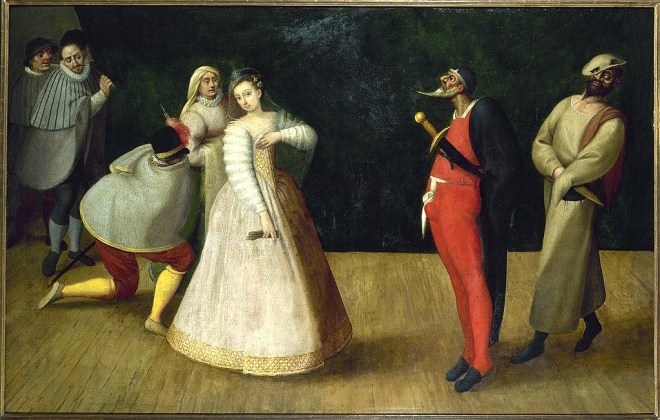
This painting, on the other hand, by the French painter François Bunel the younger, from the late 16th Century, shows what a figure of mockery Pantalone was.
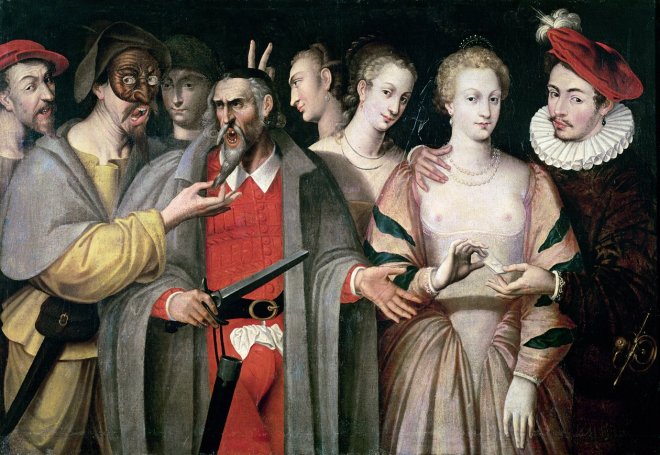
It’s actually quite pertinent that I chose depictions by French artists of old Pantalone, because commedia dell’arte took the rest of Europe by storm. Every country had their shows, with the names of the characters modified to fit local ears: in German our foolish old man stayed as Pantalone, but in French he became Pantalon and in English Pantaloon. So well-known was he that even Shakespeare, in his famous monologue in As You Like It about the seven ages of man, mentions him as the sixth age:
The sixth age shifts
Into the lean and slippered Pantaloon,
With spectacles on nose and pouch on side;
His youthful hose, well saved, a world too wide
For his shrunk shank …
In both Britain and France, that “youthful hose” was eventually given the character’s name: “pantaloon” on one side of the Channel, “pantalon” on the other. Even though this type of clothing (“covers the lower part of the body from the waist to the feet, consisting of two cylinder-shaped parts, one for each leg, that are joined at the top”, as one dictionary definition has it) has gone through considerable redesign over the centuries, the French have kept their name for it, and the North Americans have kept the English form of the name, although under the shortened form of “pants” (the British quite quickly opted for “trousers” instead as their name for this type of fashion statement). So in many parts of the world our heroic martyr has been debased to a vulgar piece of clothing. But it gets even worse! Because another piece of clothing, which covers our private parts, has become called “underpants”. Poor Pantaleon, from this:

to this:

































 the heart thrills