Vienna, 7 September 2025
My wife and I went to Schladming in Styria recently, for a few days of hiking. We did some lovely hikes on the mountains behind Schladming as well as along some of the valleys wedged in between those mountains. It was on one of the latter hikes that I began to notice some eye-catching structures standing on the roofs of the farmhouses we were passing. Here are two that I managed to photograph.

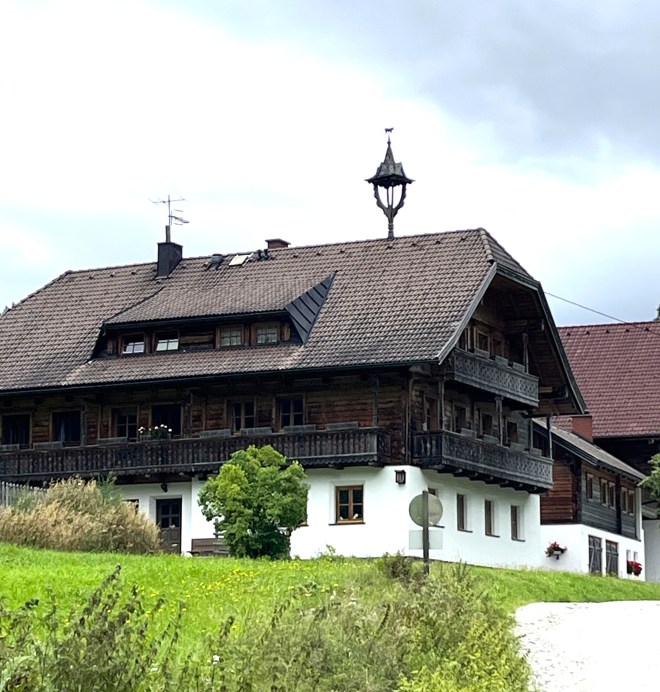
They really are handsome, I told my wife, but what are they? Once we were back in Vienna, I did some research and discovered that they are called Glockenstuhl, literally bell stool although it is normally translated as bell frame or bell tower. This next photo shows more clearly the bell that should sit beneath the little roof and which gives the frame its name.
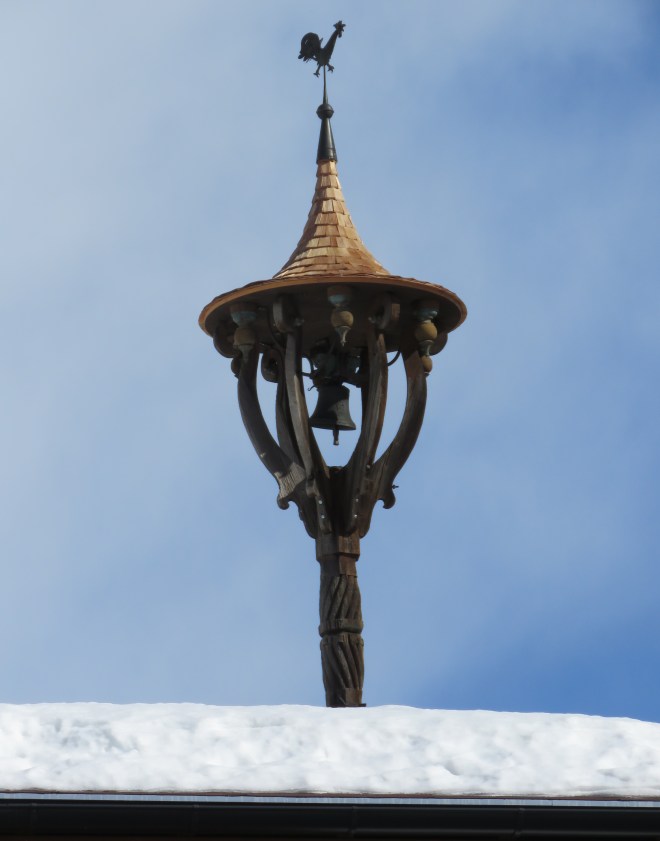
I don’t think either of the Glockenstuhl I photographed have this bell, although the second photo shows a ring of little bells around the rim of the roof – a fanciful modern addition, I believe. One can also see the weather vane on the very top, in this case a cock (in my two photos, the Glockenstuhl sports a cow in the first case and a cock in the second).
Of course, these Glockenstuhl primarily had a functional purpose. The bell was used by the farmer’s wife to call the farmer and his hands back to the farmhouse when lunch or dinner were ready. And the bell was also rung in case of an alarm. A nice touch: the bell of each farmhouse had a different tone so that the farmer and his workers would be sure that it was their farm and not another that was ringing its bell.
But of course, this primarily utilitarian object gave local people an excuse to make something that was, yes, useful but also beautiful.
The Glockenstuhl’s original use has made me think of paintings by the Austrian painter Albin Egger-Lienz. I first got to know him through his paintings of the First World War. These are remarkable paintings, and I would strongly recommend my readers to see them if they ever come to Austria (I doubt if museums in any other country has any). But he also depicted many scenes of rural life in his native Tyrol. In this case, I’m thinking in particular of his paintings of farm workers out in the fields, who would have heard the bell from their farmhouse’s Glockenstuhl and known it was time to come back to the farmhouse to eat. Here are two of his paintings. In the first, the farm hands are scything the hay, in the second a farm hand is sowing seed.


And in this painting, farm workers are gathered around the table to eat.
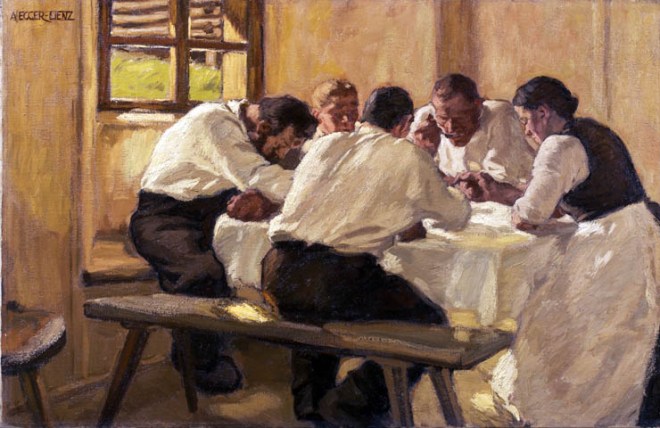
Here, too, I would strongly recommend that readers see Egger-Lienz’s paintings and drawings of peasant life.
Still today, there are a few artisans making Glockenstuhl, but they are now just beautiful pieces of handicraft. There’s no need for the bell, the farmer’s wife no doubt calls the farmer on his mobile phone when lunch is ready, if she’s not herself out in the fields (and the farm hands disappeared long ago into the factories in the cities). You can have one made for you for a mere € 2,000 or so. But please, don’t use it, as some people apparently do, as a bird stand in your garden! Put it on your roof where passers-by like me and my wife can admire them as we walk by.

 the heart thrills