Florence, 21 November 2025
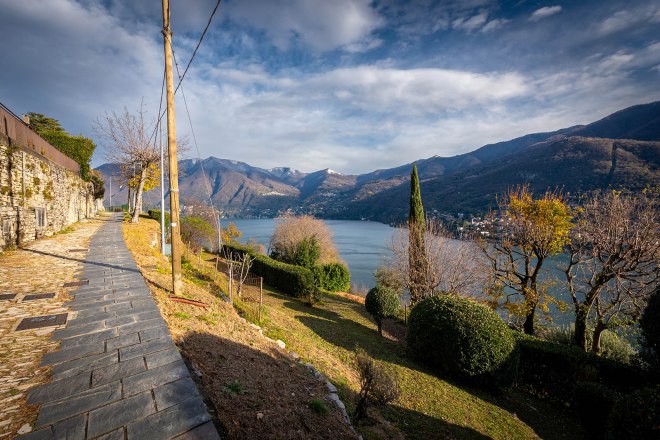
A week or so ago, my wife and I were doing a gentle hike on Lake Como. We’ve both been a bit under the weather, so a hike with none of the brutal climbs required of many of the hikes around Lake Como were just what we needed. We had also done a few other, rougher hikes along the lake in the previous days and had discovered to our dismay that heavy rains back in late September had made a number of them impassable. So as I say, a nice gentle hike along a well-kept path was just what we needed. For any of my readers who might want to know which hike we did, it was the “Via Verde”, which runs between the villages of Moltrasio and Laglio (and is not to be confused with the rival “Green Way”, which runs further north along the same shoreline of the lake). Here is a photo of the typical view one enjoys along this path at this time of the year.
Towards the end, we were walking into the village of Carate Urio when we came across a table set up along the path and on which were placed two crates holding a dozen or so of these strange-looking vegetables – or were they fruits?
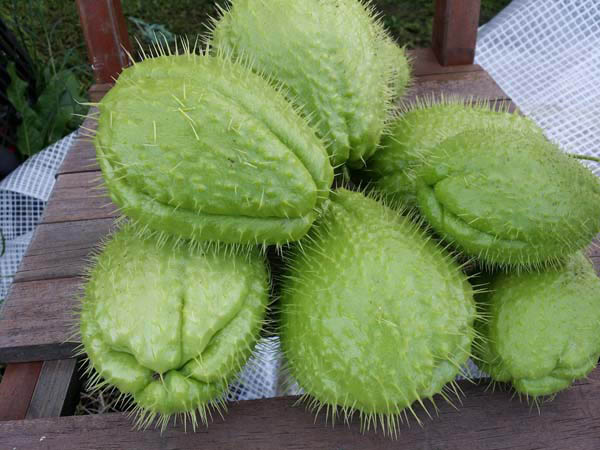
My wife trained her iPhone camera on one of these vegetables (or fruits?) and promptly identified it. In Italian, it is called “zucca spinosa”, or spiny pumpkin. They were certainly spiny, but the relationship to pumpkins wasn’t immediately obvious. And being a pumpkin, it’s sort of both a fruit and vegetable: botanically a fruit but culinarily a vegetable given the way it is eaten (as we shall see in a minute). For the purposes of this post, I will henceforth refer to it as a vegetable.
Different parts of the world have different names for this vegetable. It’s called chayote in the US. Here we have a lady from Louisiana showing off two of them (although, reflecting that State’s French heritage, they are often called mirlitons there, as they are in nearby Haiti).

The Americans have actually just borrowed the Spanish name for the vegetable; we’ll come back to the Spanish name in a minute.
It’s called chocho or chuchu or some variant thereof in places as varied as Mauritius, India, Sri Lanka, Brazil, and Jamaica. This is thought to be the Pidgin English version of chayote. Here we have a farmer in Assam with his crop of chocho.

The vegetable is called choko in Cantonese (am I wrong in thinking that this ultimately derives from chocho?), which later became the name used in Australia and New Zealand thanks to the Cantonese who emigrated there in the 19th Century. Here we have an Australian proudly showing off the chokos growing in his garden (note that his variety is without spines).

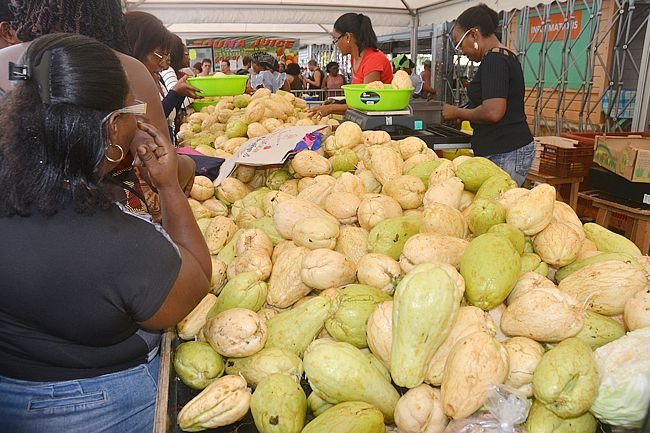
Meanwhile, in the islands of the eastern Caribbean, the vegetable is called christophine or christophene. Here we have early risers in a market in the island of Martinique searching for their choice christophenes.
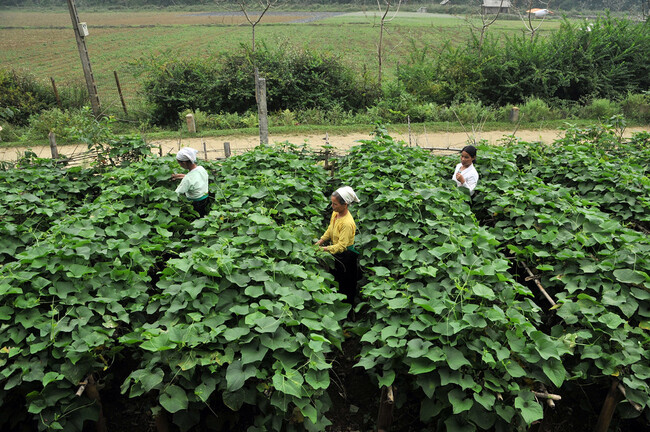
There are more names used for this spiny pumpkin, but the ones I’ve cited give us an indication of where it originally came from. It is one of those foodstuffs which make up the great Columbian exchange: that massive movement of foodstuffs, people and diseases which occurred after Christopher Columbus stumbled across the Americas. I’ve mentioned this exchange several times already in these posts, when writing about the prickly pear, the Jerusalem artichoke, vanilla, and turkeys. And now I can add to the list the spiny pumpkin, or christophene (which reflects the connection to Christopher Columbus), or chayote, which is a Spanish transliteration of the Nahuatl name chayohtli. In fact, modern studies indicate that the chayote was first cultivated in Mesoamerica, between southern Mexico (in the states of Oaxaca, Puebla, and Veracruz) and Honduras, with the most genetic diversity being present in both Mexico and Guatemala. Here, we have a field of chayote in Mexico.
Just to finish my elongated riff on names, another name for the vegetable which is used in Guatemala and El Salvador is güisquil or huisquil, which is derived from another Nahuatl name for it, huitzli. Here we have a Guatemalan singing the praises of the güisquil.
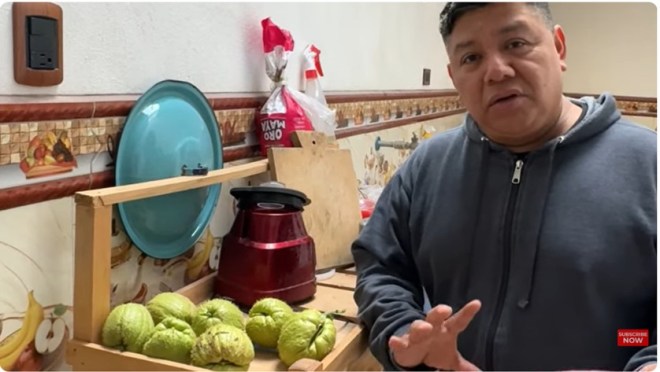
But to come back to my wife and me, standing in front of that table on the Via Verde. The vegetables’ anonymous grower was offering them for free to passers-by. I was hesitant, but my wife was bolder. She reminded me that we were having some old friends over for dinner the next day, why not try the spiny pumpkins out on them? But we don’t know how to prepare them, I objected. My wife waved off that objection, immediately doing a search on the internet. Hey presto, she found what sounded like a pretty easy recipe, explained in a video by a lady from Calabria in southern Italy, who mentioned in passing that the spiny pumpkin was particularly popular in her region – readers should note this link of the spiny pumpkin to Calabria, as we shall come back to it in a minute. My doubts brushed aside, we picked up five of these little spiny pumpkins and loaded them up in our rucksacks.
The next day, preparations started early. As recommended by the Calabrian lady, I peeled the pumpkins with a potato peeler – the spines were a little annoying but no more than that. Then I opened them up to take out the stone, after which I cut the halves into thin slices. Then I could start on the other two ingredients, tomatoes and onions. I divided up six large tomatoes, and sliced up one small onion (the recipe called for more but I’m not a fan of onions). At which point, I handed over to my wife, who threw all the ingredients into a big bowl, added the herbs, salt, and oil, and mixed everything up thoroughly. At the right moment, she ladled the mix out into a pan and put it into the oven for 40 minutes at 180 degrees Centigrade. I throw in a photo of what the result looked like – this is actually from the Calabrian lady’s video; we forgot to take a photo since we were so busy with preparations of the dinner.
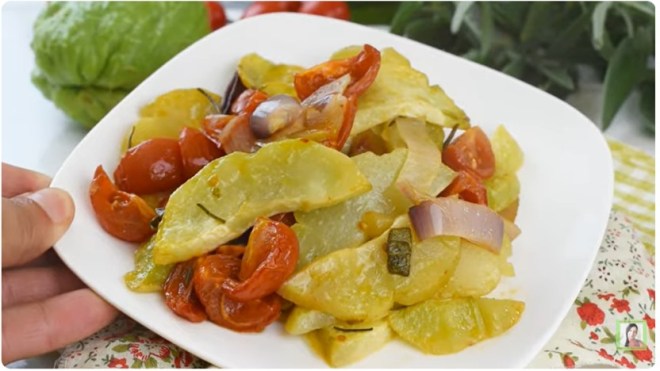
Because what we had prepared was a side dish. The main course, the pièce de resistance, was cotechino with lentils and mashed potatoes. Like that, if the side dish turned out to be a disaster, we still had the main dish to fall back on. Luckily, it all turned out well. When I carried in the side dish, I explained the whole back-story. None of our guests – three Italians and one American – had ever heard of zucche spinose (in the case of the Italians) or chayote (in the case of the American). We all tried the dish with a little trepidation, but luckily it tasted really good. To me, the spiny pumpkins tasted like a cross between zucchini and cucumber. They went well with the tomatoes.
We didn’t finish the dish, so my wife froze the remains. When we get back from Florence where we are at the moment (to see an exhibition on Fra’ Angelico), we’ll try it out on our son too.
I fear we’ll never make the dish again, unless our anonymous grower on Lake Como is kind enough to make next year’s crop available to passers-by, because you cannot grow spiny pumpkins in the north of Italy (except, as we have seen, in Lake Como’s microclimate). As a result, northern Italians have no culinary experience with it – which is why our three Italian guests, all from Milan, had never heard of it. Of course, we could travel down to Calabria. Because, I discovered, Calabria is a “hot spot” for the growth and consumption in Italy of the spiny pumpkin. This is a consequence of one of the many individual rivulets that made up the giant global flow of plants out of the Americas after the continent’s accidental discovery by Columbus. When, in 1502, the Spaniards took over the Kingdom of Naples, of which Calabria was part, they carried the spiny pumpkin from their new dominions in Mesoamerica to their new dominions in southern Italy. And the plant took particular root in Calabria.
But we can’t go to Calabria just to eat spiny pumpkin! I’ll have to come up with an exciting trip full of new things that we’ve never done before if I’m ever going to persuade my wife. I have one or two things in mind. There’s the Riace Bronzes in Reggio Calabria, which we’ve never seen. There’s some old Christian mosaics in a monastery up in the Calabrian mountains, mentioned by John Julius Norwich in one of his books, which we’ve never seen. I’ve got the whole winter to come up with some more things to see and do …






 the heart thrills
