A CLUSTER OF MORNING GLORIES

San Francisco, 23 September 2012

We left this morning for San Francisco, to visit our son. We were up early, and since it was a beautiful morning – the sky was a cloudless clear blue – we decided to walk to the station to catch the train to the airport. The walk took us past our local supermarket, the modest housing estates that cluster around it, past the smart office buildings along the Third Ring Road, and finally along a rough semi-constructed path that follows the highway out to the airport until the stairs to the station are reached. The last stretch of our walk reminded us that Beijing is still constructing itself. It is one of those pieces of land that get left behind in urban renewal projects, stuck between new constructions – in this case, the highway on one side, modern office buildings on the other – and are fast going feral. Weeds were growing in abundance along the side of the path and covering the construction rubble underfoot, rogue trees were beginning to push up through the cracks, the fencing along the path was rusting and bent. We picked our way along, weaving to avoid the commuters streaming in to work, with the suitcase stumbling behind us over the rough paving.

Suddenly, there, in the shade of the early morning sun, was a cluster of morning glories flowering on the fence. The plant itself is nothing much to write home about; it has the weak tendril-like stalk of a climbing plant and the leaves are a drear matte green. But the flowers were magnificent – a cool, dark violet colour, almost phosphorescent in its intensity. I’m guessing they were Ipomoea purpurea, the purple or common morning glory. We stopped for a minute to admire them, but we were in a hurry now and had to move on.

As I write this, my mind’s eye suddenly whirls off half a world away and I find myself walking down the main coast road south of Genova, just as it enters the village where we used to spend our summers when the children were young. I am next to the cemetery; the village dead have the best view, out over the coast to the distant promontory. It’s a beautiful summer morning. Down in the cleft where a creek runs off the hills behind me, the morning glories have run amok, covering and smothering everything. But the flowers are open, beautiful in the morning light, cool, dark, violet.

And my mind’s eye whirls off again, this time alighting in the town in Africa where I was born. More than fifty years have passed and the memory is fading. But I see a wall – is it in a park, in a garden? – covered in morning glories, glowing in the morning light, cool – dark – violet.

OLYMPUS DIGITAL CAMERA

_____________

picture: http://georgeswebpage.com/almanac

THREE TAKES ON BROKEN CHINAWARE

Beijing, 31 August 2012

Take 1:

When I was a boy, I spent a fair amount of time with my English grandmother, on my way to and from boarding school. One of my memories of her is a set of china plates which she used for meals. The plates carried polychromatic designs of butterflies, flowers and trees on a white background, and I liked studying the designs as I ate my meat and two veg (making sure to keep my elbows well in; my grandmother was quite particular about table manners). The strange thing about these plates was that they had all been broken, often quite badly. But rather than throwing them away, my grandmother had had them carefully stapled together! By that, I mean that small pieces of metal had been fixed across the breaks. Here is the picture of such a plate.

stapled plate

I suppose my grandmother was very attached to the plates and preferred to keep them in this strange, cobbled-together form rather than not have them at all. But I won’t ever know because I never asked her the reason.

Take 2:

On our living room table, in a wide wooden bowl, my wife and I have carefully laid out some broken pieces of porcelain. I think they are from a bottle. They all have a blue pattern on a white background.

broken bits 001

They are part of our larger collection of odds and ends we’ve picked up in the streets during our three years in Beijing: broken bricks from construction sites, chunks of coal, a set of Chinese chequers. But our collection of broken porcelain has a special significance; we collected the pieces on the verge of the road outside Ai Weiwei’s house. We feel that somehow they have been bathed in his aura.

Take 3:

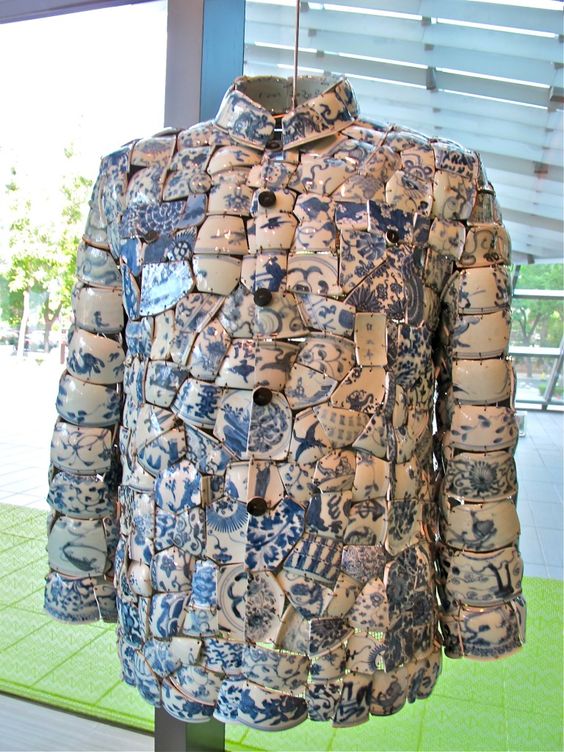
At the window near the entrance to the Opposite House, a chic hotel on Sanlitun, stand two wonderful sculptures. They represent an old Chinese dress and an old Chinese jacket. They have been created out of bits of broken Ming pottery, and all have blue patterns on a white background. This photo shows one of them.

China’s old Ming pottery works are littered with broken crockery from all the runs that failed. The artist collected some and has turned these failures into pieces of real beauty. A wonderful example of arte povera.

_______________________
the stapled plate: http://jwcsybaritic.blogspot.com/2011/11/stapled-porcelain.html
the porcelain jacket: https://www.pinterest.es/pin/419397784062874431/
other photo: mine

TINTIN À PÉKIN

Beijing, 14 August 2012

To get to our favourite cafés, my wife and I cross the bridge which spans my piece of canal and then walk all the way down Sanlitun road to the South Village. It’s one of the places in Beijing where many Embassies are located. It’s very green and leafy, quiet, a really pleasant place to walk.

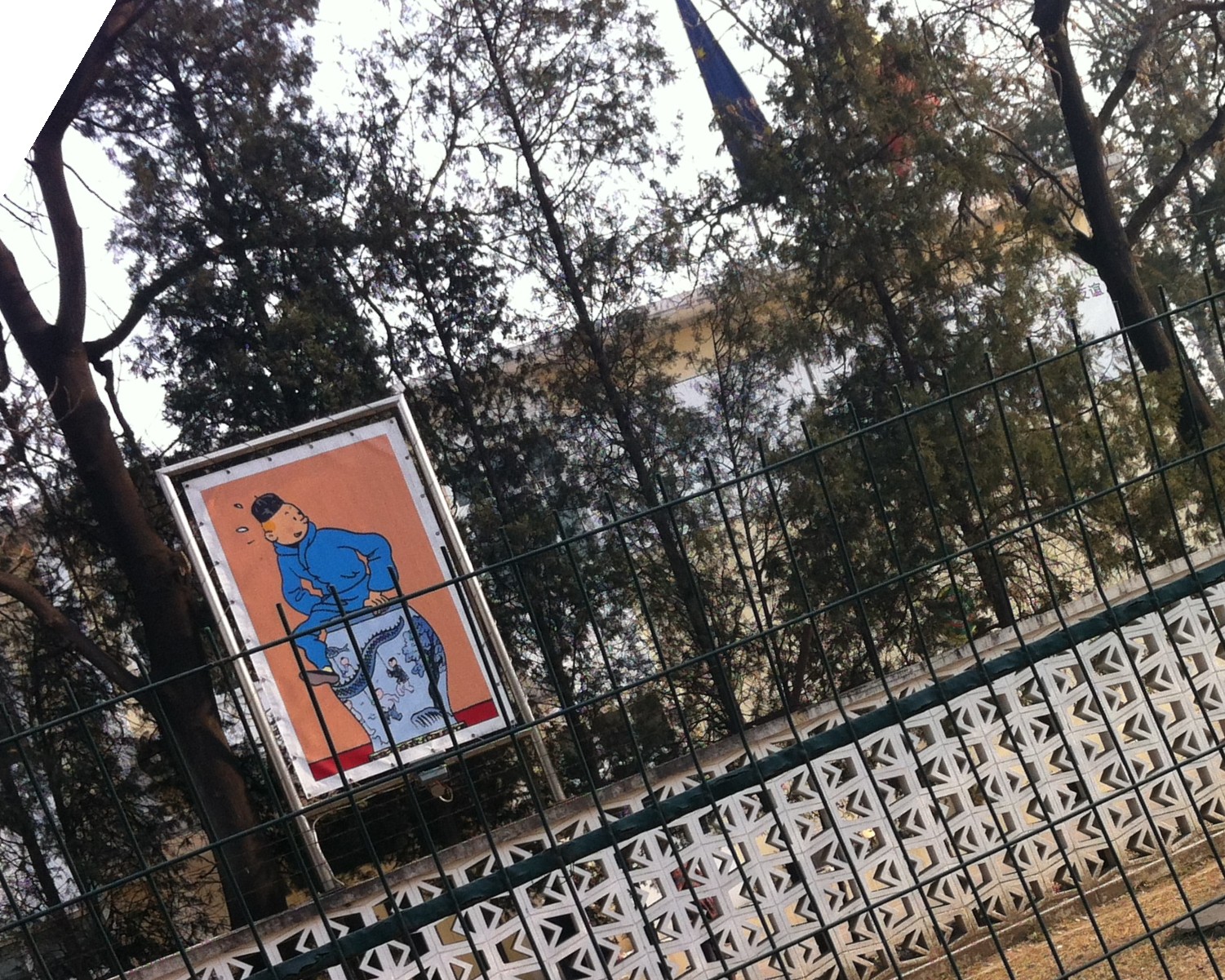
Our usual route takes us past the Belgian Embassy. It has nothing notable about it except for one rather odd thing. Set up outside the Embassy’s perimeter wall, about two metres above the ground and facing the road, lit up at night, is a large picture of Tintin. I tried to take a photo of it for this posting,  but was warned off by the Chinese guard at the gate. So I took a photo in secret, stopping in front of the picture and pretending to take a call but actually clicking a photo! I’m rather pleased with myself even though the photo is skew.

tintin embassy poster 001

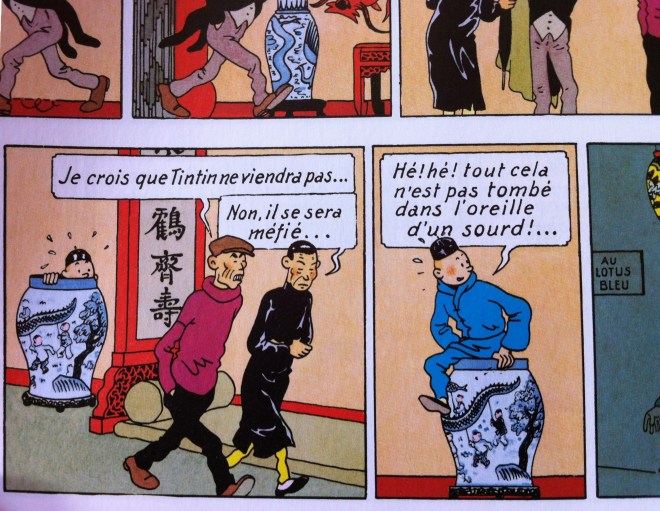
Tintin aficionados will immediately recognise this as a scene from Le Lotus Bleu, the fifth album of the series and first published in 1936. It comes from a moment in the story when Tintin, who has been hiding in an opium den in Shanghai to pick up information on the Japanese villain Mitsuhirato, is making his getaway. It’s quite a cheerful picture; Tintin has a slight smile as he jumps out, and the vase has a design of children carrying a paper dragon through the streets. I show here the original picture in the album.

bande dessine 003

So famous is this picture that it is one of a number of scenes from Tintin which have been turned into collectible statuettes.

tintin from vase 008

As I say, I find it slightly odd that the Belgian Embassy, an institution I would have thought anxious to project a sense of its own importance and probity, should decide to put up a picture from a comics album in so public a fashion.  But if it is going to do it, a picture of Tintin, who was drawn by Hergé, no doubt the best known Belgian in the world, taken from a story that takes place in China, sounds like a good choice.

Apart from smiling at this picture seen in such incongruous surroundings, I was also intrigued by it. Before coming to China, I had checked what books were banned here. I had read that Le Lotus Bleu was one of them because it gave too sympathetic a reading of the Kuomintang. But the Belgian Embassy’s bold move suggested that the ban was no longer in place, if it had ever been. Or perhaps the Chinese Government simply didn’t believe that any Chinese walking by would know the story and so recognise the picture. Which is probably true and to my mind quite sad. The Chinese are missing something.

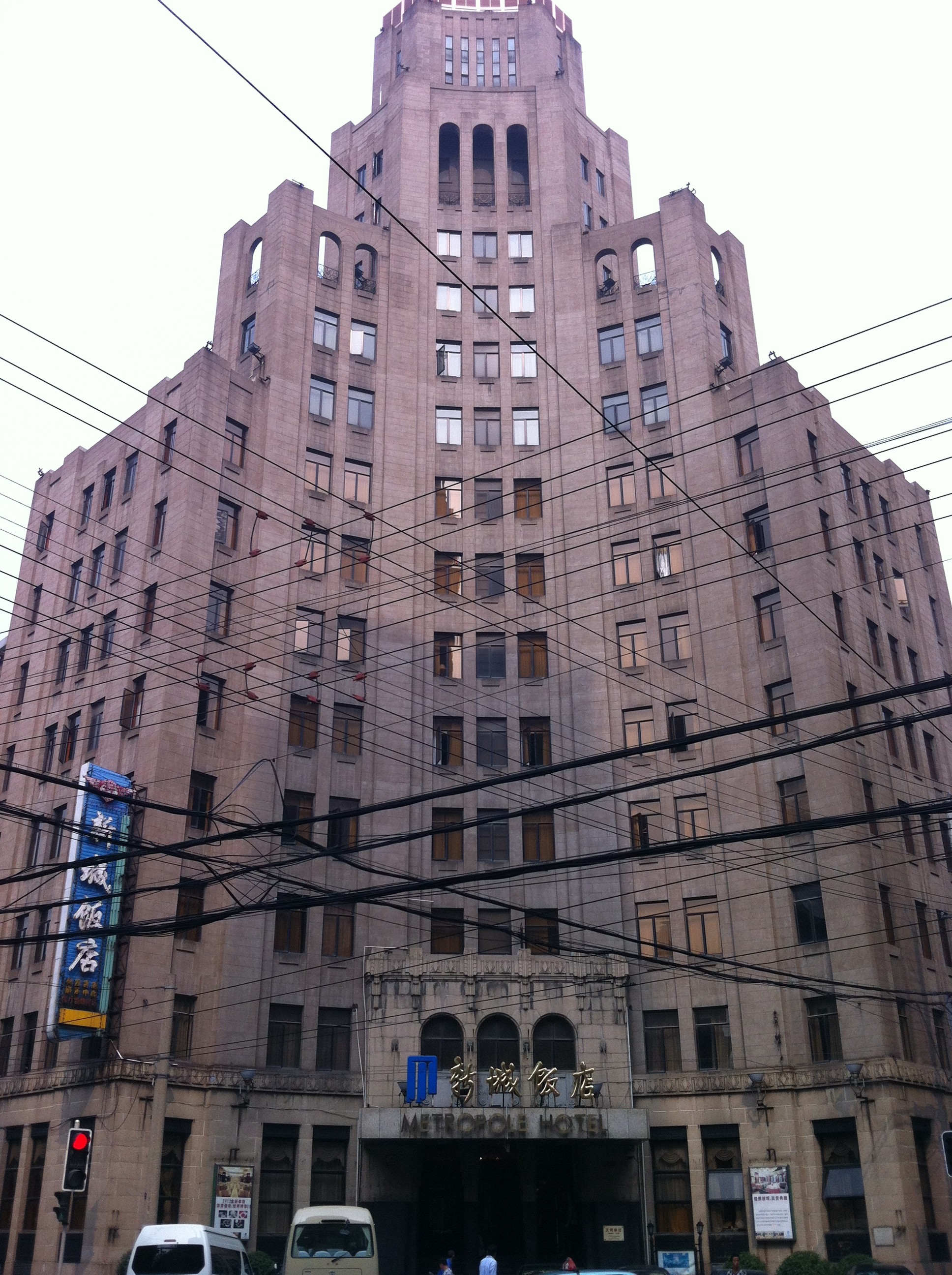
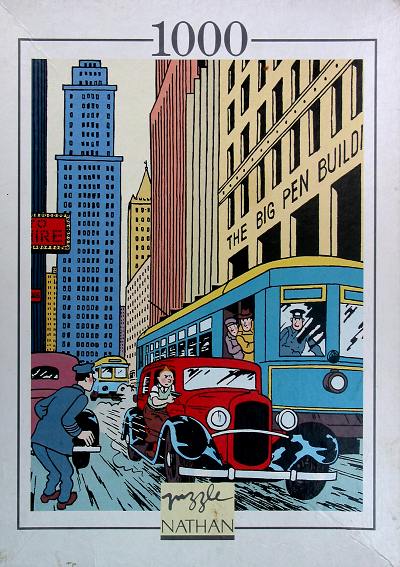
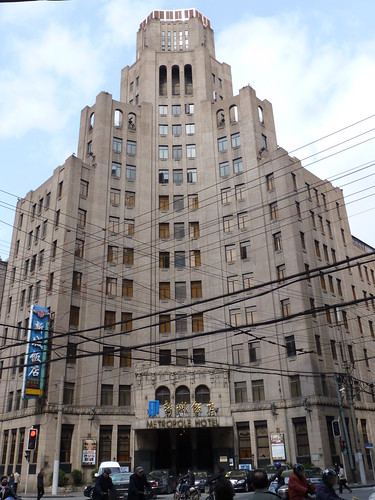
Le Lotus Bleu is of course the most Chinese of Tintin’s adventures, but Tintin en Amérique, first published in 1932, also has strong Chinese echoes for me. The first time my wife and I went to Shanghai, as we walked from the Bund to Renmin Square we found ourselves among buildings from the thirties. And all of a sudden we found ourselves at the crossing of Fuzhou and Sichuan Roads where there are four identical buildings on each corner. This picture is of one of them, the Metropole Hotel:

shanghai-2012 082

… and suddenly I was in Chicago in 1932, watching Tintin roar by in a Deusenberg, chasing Al Capone’s men!

tintin in chicago 010

Oh no! Just around the corner other members of the gang were waiting to gun him down! …

… I miss my Tintin albums. They are sitting in a packing box in the dark of a warehouse in Vienna, waiting for us to come back to Europe to retrieve them. I’m nearly 60 but I’m not ashamed to say that I always got a lift when I pulled one out of the bookshelf and settled down on the couch for a good read.

And I miss the times on that same couch when I read the albums to my young children, translating as I went along. How they laughed at the Fat Man Full of Soup! A minor character in the earlier parts of L’Oreille Cassée, I should clarify, who was called such by a parrot and who thought it was the carrier of the parrot who had dared so insult him. I miss the simple joys which suffused those years, as we watched our children grow. Perhaps one day I will have grandchildren sitting with me on the couch laughing again at the Fat Man Full of Soup.

__________________
photo credits
Tintin picture outside Embassy: my picture
Scenes from the album: my picture
Tintin coming out of the vase: www.1000-sabords.fr
Hotel Metropole: my photo
Tintin in Chicago: bd-blogeur.blogspot.com

MY MOTHER HAS JUST DIED

Beijing, 11 August 2012

My mother died a few days ago. My brother’s email telling me so didn’t give any details, and a later email from my sister simply said that she had passed away very peacefully; the usual words.

My mother has actually been dead for a while. The person I visited last month was not my mother. She didn’t talk, she didn’t react to my talking, she simply sat there gazing blankly. It was the hollowed-out shell of my mother, a moulted exoskeleton. So the news elicited no grief from me, just a melancholy relief that she had finally been spared the indignity of living on.

Did she die well? I would like to think that she did. I would like to hope that she – a fervent Catholic all her life – managed one last prayer to the Lord her God before her heart finally gave out. But I doubt it; she probably died the way an old, badly tuned car engine sputters out, just a last wheeze and jolt and that was it, in the little room that she occupied in the old person’s home.

I have always had this picture of the generations walking in cohorts towards the final end, one behind the other; rather like regiments marching across No Man’s Land. The generation ahead of mine – my parents and my aunts and uncles – is sadly depleted; only three very elderly aunts remain. Soon even they will be gone, and then there will be no-one between me and the end. Even my cohort is beginning to thin; death has picked off the husband of my sister, a cousin … the pace will pick up in the coming years.

This vision wouldn’t bother me so much if I – like my parents – could believe that death is merely an uncomfortable rite of passage to be endured, because it leads to a greater – and eternal – life. But I cannot. Decades ago, I played Claudius in Shakespeare’s Measure for Measure. As he awaits execution in prison, Claudius meditates on what will come after he dies:

…to die, and go we know not where;
To lie in cold obstruction and to rot;
This sensible warm motion to become
A kneaded clod; and the delighted spirit
To bathe in fiery floods, or to reside
In thrilling region of thick-ribbed ice;
To be imprison’d in the viewless winds,
And blown with restless violence round about
The pendant world; or to be worse than worst
Of those that lawless and incertain thoughts
Imagine howling: ’tis too horrible!
The weariest and most loathed worldly life
That age, ache, penury and imprisonment
Can lay on nature is a paradise
To what we fear of death.

At much the same time that I played Claudius I had come to the unalterable conclusion that there was no world beyond ours and I turned away forever from the religion of my forebears. So like Claudius, I am afraid “to lie in cold obstruction and to rot; this sensible warm motion to become a kneaded clod”. And I too feel that “the weariest and most loathed worldly life that age, ache, penury and imprisonment can lay on nature is a paradise to what we fear of death.” But I cannot follow Claudius in his belief of an afterworld, even if his vision is one of terror. I am merely afraid of disappearing forever.