TOM STOPPARD

Milan, 1 December 2025

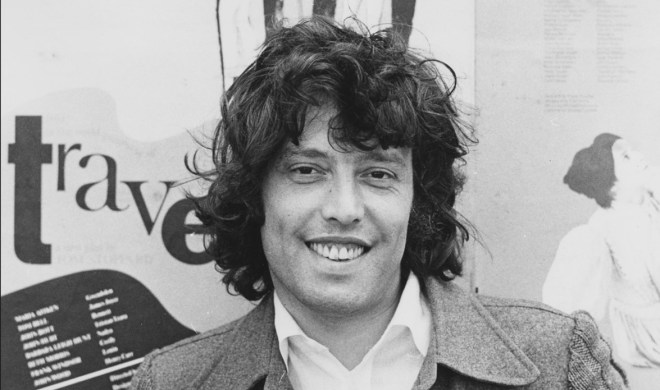
As I appeared bleary-eyed for breakfast a day ago, my wife – who normally gets out of bed before me – announced, “Tom Stoppard is dead”. How old, I asked? 88 she replied. A good age. In my advancing years, I read obituaries more and more frequently (such interesting lives people have lived!), and I have noted that many of those who are graced with an obituary in the newspaper I read shuffle off this mortal coil in their 80s. So, as I say, a good age.

Source

For any of my readers who are not familiar with him, Tom Stoppard was a playwright, primarily for the stage, but also for radio, for TV, and for film (as a screenwriter in this case). Perhaps they will have seen the film Shakespeare in Love, whose screenplay Tom Stoppard co-wrote (and for which he shared a screenwriting Oscar).

Source

Famous playwrights have been popping off, and I’ve never written about them. So if I write a post about Tom Stoppard’s death, it’s because he holds a special place in my heart. Many, many years ago, when I was 17 to be precise, I played a lead role in the play that made Stoppard’s name, “Rosencrantz and Guildenstern are Dead”. I have preciously kept the edition of the play we used as a script. It is now battered and worn from following us around on our countless moves over the intervening decades.

Source

The play is a riff on Shakespeare’s “Hamlet”. Stoppard has taken two very secondary characters from that play, who are friends of Hamlet’s from way back, and has turned them into the protagonists, but of what exactly is never really clear, to them or to the audience. They have been summoned to the court of Denmark by the king, but they don’t know why. Essentially, the whole play is happening in the wings of the play “Hamlet”, with R & G passing the time discussing various topics and waiting for someone to explain to them what is going on; this aspect of the play has strong echoes of Samuel Beckett’s “Waiting for Godot”.

Source

From time to time, apparently to give them the explanations they crave for, scenes from “Hamlet” roll onto the stage and our two hapless friends find themselves taking part in those scenes.

Source

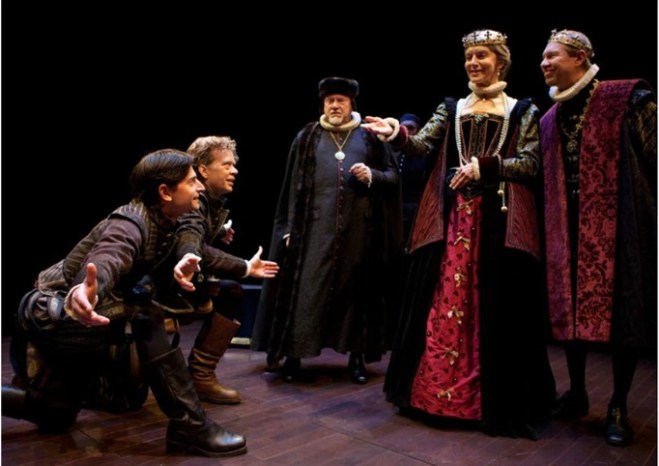
They are such minor characters that the king and queen, as we see in this photo are constantly getting them mixed up. Then the “Hamlet” scenes roll off the stage and R & G find themselves alone again and even more befuddled than before. Eventually, after a hilariously farcical scene on a ship with pirates, and without really understanding why, they die. The dialogue is absolutely scintillating, a hallmark of Stoppard’s. In fact, a common criticism of his plays is that there is too much head and too little heart. Perhaps, but his dialogue is among the best I have ever heard or read.

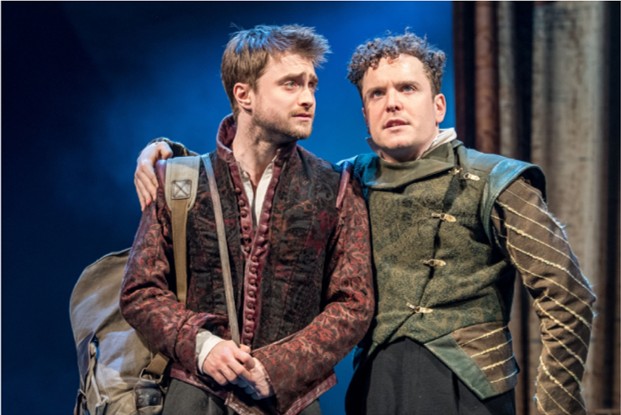
I played Rosencrantz, although I have to say that over the decades my memory faded and, like the king and queen of Denmark, I got confused about who I had played; I had to re-read the script again to be sure. I have no photos of myself, alas, in this performance. I’m sure photos were taken, but they will have remained in one of the albums which littered, and no doubt still litter, the school theatre’s green room. Instead, I’ll throw in some photos of some of the well-known actors who have played R & G, to show what good company I’m in. Here we have Daniel Radcliffe and Joshua McGuire playing the two roles.

Source

I’m chuffed to see that Racliffe played Rosencrantz.

Here we have Gary Oldman and Tim Roth.

Source

I’m equally chuffed to see that Oldman (whom my wife and I have been watching religiously in “Slow Horses”) played Rosencrantz.

And here we have Adrian Scarborough and Simon Russell Beale.

Source

Scarborough plays Rosencrantz, I’m pleased to see – my wife and I watched him recently playing a police inspector solving hideous murders.

Looking back, I realise that playing Rosencrantz was the apex of my acting career. I performed it in my last year at school, and my subsequent acting career at university was a relatively swift decline into secondary Rosencrantz-and-Guildenstern-like roles. The fact is, there were much better actors than me at university. I had briefly entertained the idea of becoming a professional actor, but I quickly realised that unless I wanted to spend much of my life out of work I had better find something else to do.

Funnily enough, I have never seen another of Stoppard’s plays in the intervening decades, although I have read a good number – that scintillating dialogue. I have to say, I turned off play-going after I stopped acting; I was spending too much time thinking about how I would have directed the plays I was watching. But maybe I could at least watch on YouTube the one film Stoppard himself directed – which happens to be of “Rosencrantz and Guildenstern are Dead”. That would surely be a fitting way for me to remember this great playwright.

Source

PANTALEON

Vienna, 18 June 2025

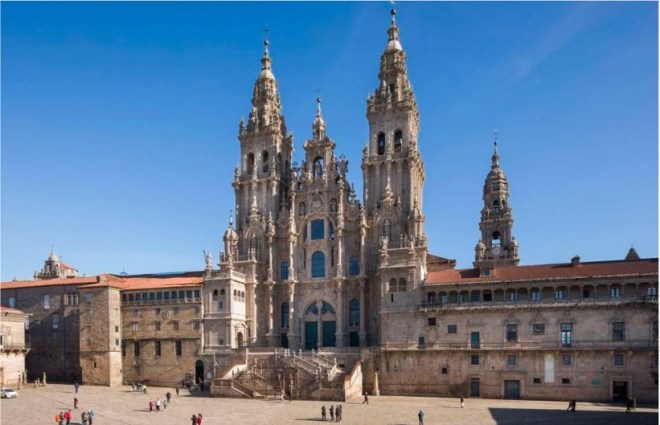
It’s summer time! And summer time, for my wife and me in Vienna at least, means it’s time to go hiking around the city and beyond. And that means studying guides, electronic and hard-copy, to find new hikes for us to do. So it was that a month ago now I bought a guide to the Jakobsweg, the pilgrim routes (or at least modern versions of these; so many of the original routes have been overlain by the asphalt of large roads) that wend across Austria and eventually lead the walker (after crossing Italy or Germany and then France and Spain) to the cathedral of St. James in Compostela.

Source

Here we have a Medieval miniature of St. James as a pilgrim on his way to Compostela – note the scallop shell on his satchel, the symbol of this pilgrimage.

Source

Although in my mind’s eye I see the road snaking out before me over hill and dale all the way to Compostela (Google Maps tells me that the town is 2,760 km away from my living room), I’ve been looking more modestly at the stages which are not too, too far from Vienna. Specifically, I’ve been looking at the stages beyond the great monastery of Melk.

Source

(The reason for that is simply that we’ve already walked the stages between Vienna and Melk.)

As I followed the stages in my new guide and figured out where we might stay for the night along the way, my eye was caught by the name of a village we would walk through: Sankt Pantaleon. I throw in a photo of the village which I found online. It looks like a nice, typical Austrian village.

Source

Readers of these posts will know that I have a fondness for obscure saints whose names still pepper our landscape – although I have to say that the name Pantaleon is thin on the ground. Google Maps – once again – informs me that there are only a couple of villages in Austria which go by that name, as well as a handful of churches and streets. The same is true for France, Italy, and Spain. He has a somewhat greater presence in Greece and other Orthodox lands under the name Pantaléémon. In Switzerland, Germany, Belgium, and Portugal he has hardly any presence, and in the Netherlands and the UK none at all. My wife and I will not be coming across him very often on our hikes, it seems.

What do we know of this saint? Well, not much at all, as is usually the case with these saints from the earliest centuries of Christianity. If he existed at all, he hailed from Asia Minor as most of these early saints seem to have done. His various hagiographies tell us that he was born in the late 200s AD and brought up a Christian by his mother (his father was a pagan). But he  fell away from the faith when he studied medicine. He was brought back to the straight-and-narrow by an even shadowier saint, who – if I’ve understood the sub-text correctly – basically said “Jesus did better than you, by healing through faith alone”. And in fact, Pantaleon converted his pagan father after healing a blind man by invoking the name of Jesus over him.

In any event, he continued being a doctor; and he must have been a very good one, because he became the personal physician to successive Emperors. But he must also have continued dispensing care – for free – to those who needed it, which has earned him in Orthodox Christianity the delightful title of Holy Unmercenary Healer. This is an epithet that has been given to various saints who offered their medical services for free, contrary to the (still) prevailing practice by doctors of charging (often a lot) for their services. The National Health Service in the UK, which still manages (just) to offer its services free at the point of delivery, should take Pantaleon as its patron saint.

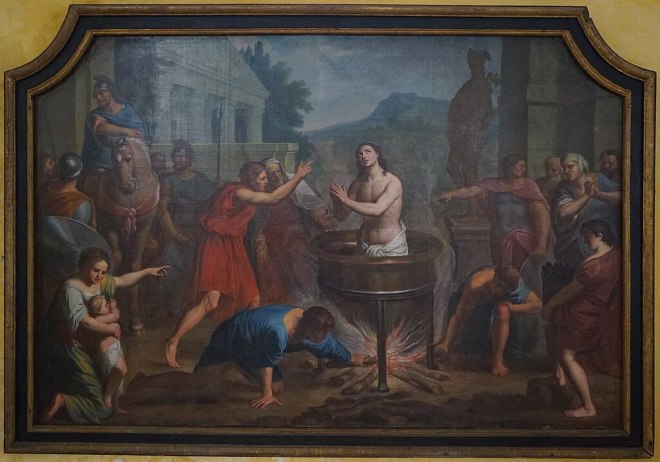
Things came to a head when Diocletian started his persecution of Christians in 305 AD. Doctors, envious of Pantaleon’s success as a court physician – and of course pissed off that he was offering his services gratis – denounced him to the Emperor. Since the latter rather appreciated Pantaleon’s skills he tried to get our hero to abjure his faith, which of course Pantaleon did not do. So the Emperor handed him over to the torturers. They subjected him to the usual menu of hideous tortures which hagiographers delighted to write up in minute detail. I won’t bother readers with even a summary of them. I’ll just throw in a photo of a relatively recent painting depicting one of his tortures, being put in a bath of molten lead (which, according to the hagiographers, immediately went cold when he stepped into it, so I’m not sure how he was meant to get out of the now-solidified lead; but I guess I’m just being picky).

Source

I’ll also mention one other torture to which he was subjected – because it is important for later in our story – namely the nailing of his hands to his head. Ouch! In the end, it’s only when he gave his tormentors permission to cut off his head that they managed to do so.

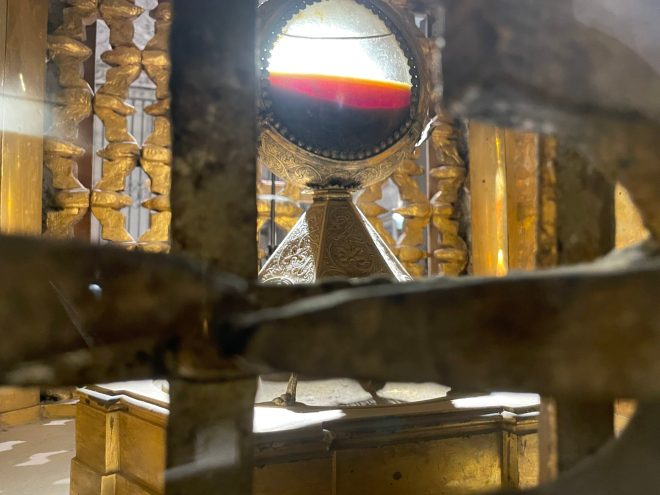
As usual, when the veneration of relics became popular in Christianity, various relics of Saint Pantaleon popped up: a head here, an arm there, a finger bone somewhere else. More unusually, a vial of his blood ended up in the town of Ravello, near Amalfi. Like the more famous case of Saint Gennaro’s blood in Naples, which is just around the corner from Ravello, the blood in the vial liquifies once a year. Here we have a photo of that vial when it is apparently liquifying in 2022.

Source

So popular was Saint Pantaleon that he was made one of the Fourteen Holy Helpers, who, from the late Middle Ages on, were invoked to help with people’s everyday problems, especially health problems. I’ve written about a number of the Holy Helpers in earlier posts, so it’s nice to be able to add to the list with this post. I guess it made a lot of sense to include Pantaleon in the group; he was a doctor after all. And in fact, he was the patron saint of doctors and midwives. He was invoked specifically in cases of cancer and tuberculosis; why those two diseases rather than any other is not clear to me. What makes perfect sense to me, however, is that he was also invoked in cases of headaches and any other pains in the head, or even mental illnesses. This photo of a panel which I stumbled across in the church of Eferding during our recent hike along the Danube – I kept the photo back for this post – shows very clearly why. The saint to the right is Pantaleon, and we can see the nail which has been hammered through his hands into his head. To a mere mortal like me it looks incredibly painful, although the sculptor has Pantaleon looking very stoic.

My photo

This story of the nail in the head has also meant that I’ve identified one more of the fourteen Holy Helpers in my painting on glass of them, which pleases me no end!

My photo

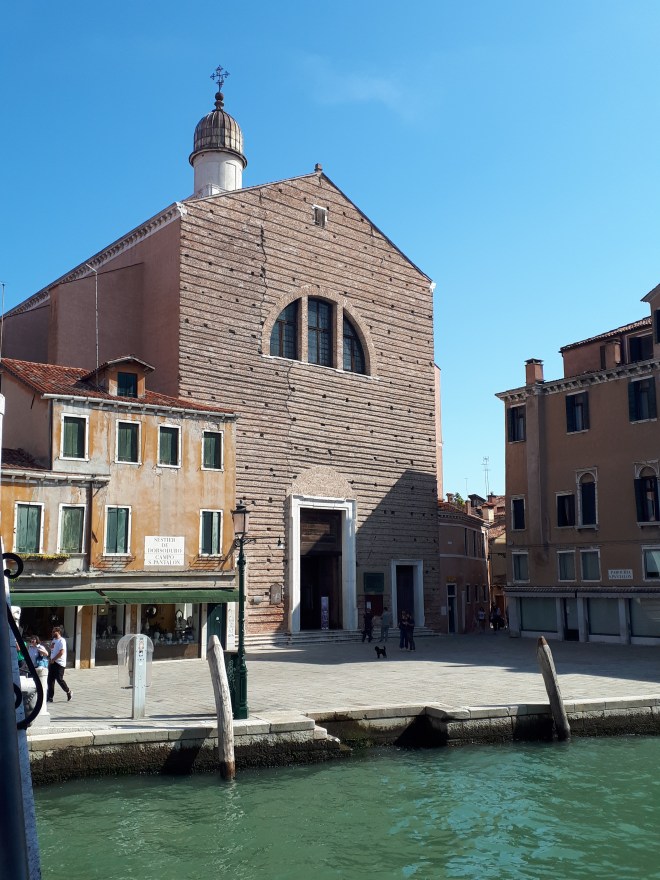
As I wrote earlier, a fair number of churches have been named after Saint Pantaleon. I will only mention one, the church of San Pantalon in Venice.

Source

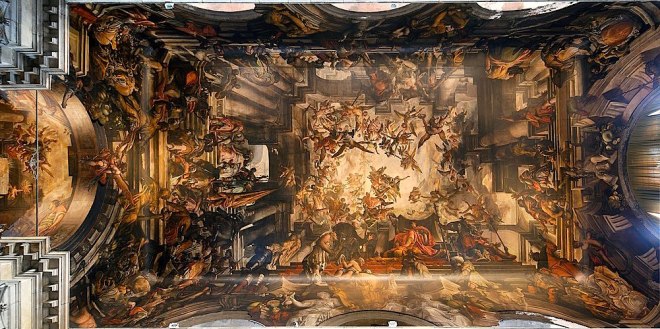
If I mention it, it’s because my wife and I checked it out during a brief trip we made recently to Venice, to visit the Biennale (architecture is the theme this year). The church’s exterior is not much to write home about. The church’s main claim to fame is its ceiling, which depicts the martyrdom and glory of Saint Pantaleon. It is indeed quite breathtaking.

Source

It is not, as might seem at first sight, a fresco; it is a vast painting on canvas, which has then been stuck to the ceiling. Apparently, these were quite popular in Venice; quite why, I don’t know.

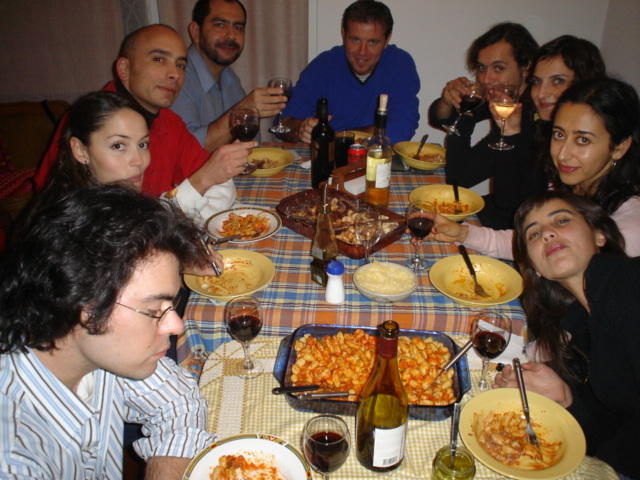
This mention of Venice allows me to segue smoothly from the sublime to the ridiculous. San Pantaleone (or Pantalon in Venetian dialect) was once a very popular saint in Venice. No-one has given me an explanation for this. Nevertheless I have one, born of my fervid imagination. To explain my theory, I have to jump to the countries in the southern cone of Latin America. It is a tradition there to eat gnocchi on the 29th of each month (and so the tradition is called los ñoquis del 29). It is a festive occasion, as this photo – one of many on the internet – attests.

Source

It was also the custom – perhaps not so much now – to place some money under your plate to bring you luck and prosperity. It was the Italian immigrants to this part of the world, many of them from the Veneto region, who brought this charming tradition with them. It was based on a legend about San Pantalon (to give him his Venetian name) which made the rounds in the Veneto. Even though he lived in Asia Minor, it was said that he had once come to northern Italy on a pilgrimage. One day, the twenty-ninth day of the month, he asked some poor peasants near Venice for bread; they generously invited him to share their meagre meal. In gratitude, San Pantalon announced that they would enjoy a whole year of abundant fish catches and harvests, which was indeed the case. The custom of placing some money under one’s plate of gnocchi – a simple dish, one for poor people – on the 29th of each month is therefore intended to obtain the renewal of this prosperity once granted by the saint.

Lovely story. But what I see in this legend is that for the Venetians – whose whole livelihood, indeed whose whole State, depended completely and totally on trade – San Pantalon would have been the go-to saint: “dear San Pantalon, here’s a lovely candle for you and some money in the offerings box. I’ve also put my life’s savings in this ship going to Constantinople [=the money under the plate]. Please, please, please make it come back with mounds of fantastic stuff that I can make a fortune off.”

Whatever the reason for his popularity in Venice, in the minds of other Italians Venetians became inextricably linked with San Pantalon. And so, when Commedia dell’Arte was born in the 16th Century, one of the stock characters in the plays was Pantalone. Pantalone is basically a caricature of Venetian merchants and just to underline this fact the character is meant to speak in Venetian dialect, at least in the Italian versions of the plays. He is retired, so he’s played as a wizened old man. He’s miserly and loves his money. Despite his age, he’s a lech and a smooth talker, and makes numerous passes at women, although he is always rejected. Given the high social standing of merchants he also represents those at the top of the social order, and he feels that this allows him to meddle in the affairs of others. In sum, the character of Pantalone is entirely based on money and ego, but at every step he becomes the butt for every conceivable kind of trick. Rereading this, which is based on a composite of many descriptions I found of the character, I get the distinct impression that the rest of Italy didn’t much like the Venetians. Quite a comedown from our heroic martyr Pantaleone.

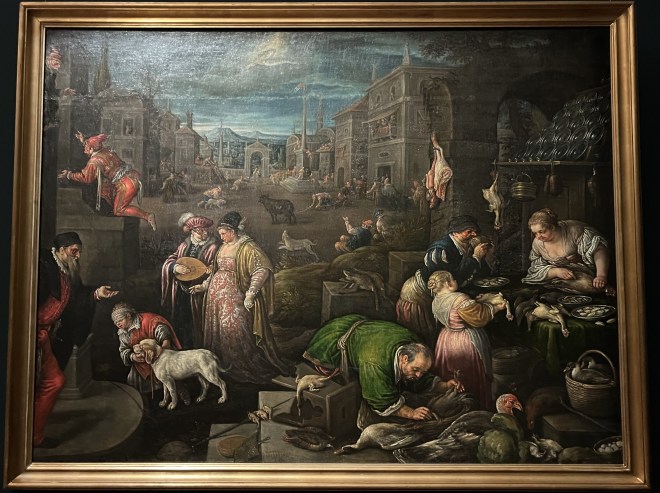
But it gets worse! To understand why, I show here a couple of depictions of what the Pantalone character typically looked like on stage. By one of those wonderful acts of serendipity, my wife and I saw the first of these depictions just yesterday at the Kunsthistorisches Museum in an exhibition they are currently holding entitled “Arcimboldo-Bassano-Breughel” (for any readers in Vienna, hurry up to see it, it finishes on 29 June!). This particular painting is by Leandro Bassano. It was one of a series that depicted the months of the year, in this case the month of February, which of course is carnival time in Italy, which was a popular time for putting on plays.

My photo

The set of characters on the far left of the painting (minus the boy and the dog) are all characters from commedia dell’arte plays. Pantalone is on the very far left. I throw in a blow-up of that part of the painting.

My photo

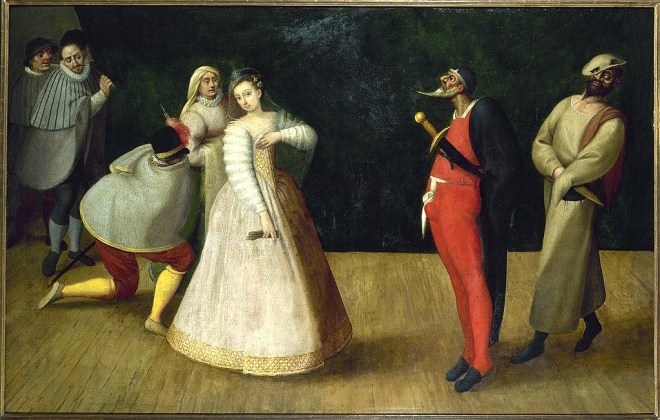
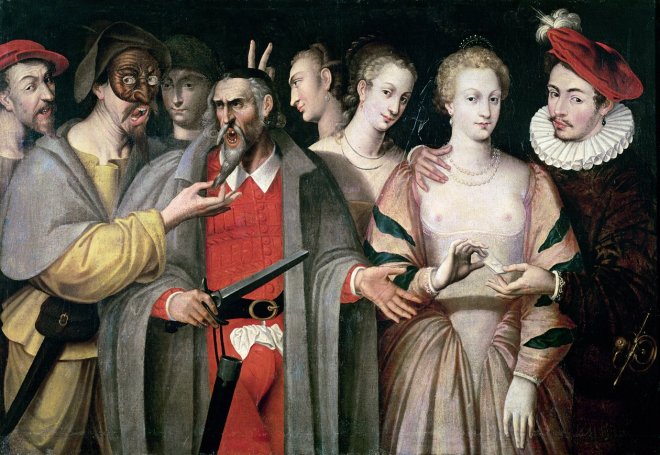
It’s a pity that Bassano put Pantalone half out of the painting, but you can make out his sartorial particularities – red doublet and hose, slippers, a black cloak, a black hat, and a sword. And of course a mask. You can see these much better in this painting by an unknown artist in the Carnavalet Museum in Paris.

Source

This painting, on the other hand, by the French painter François Bunel the younger, from the late 16th Century, shows what a figure of mockery Pantalone was.

Source

It’s actually quite pertinent that I chose depictions by French artists of old Pantalone, because commedia dell’arte took the rest of Europe by storm. Every country had their shows, with the names of the characters modified to fit local ears: in German our foolish old man stayed as Pantalone, but in French he became Pantalon and in English Pantaloon. So well-known was he that even Shakespeare, in his famous monologue in As You Like It about the seven ages of man, mentions him as the sixth age:

                                       The sixth age shifts
Into the lean and slippered Pantaloon,
With spectacles on nose and pouch on side;
His youthful hose, well saved, a world too wide
For his shrunk shank …

In both Britain and France, that “youthful hose” was eventually given the character’s name: “pantaloon” on one side of the Channel, “pantalon” on the other. Even though this type of clothing (“covers the lower part of the body from the waist to the feet, consisting of two cylinder-shaped parts, one for each leg, that are joined at the top”, as one dictionary definition has it) has gone through considerable redesign over the centuries, the French have kept their name for it, and the North Americans have kept the English form of the name, although under the shortened form of “pants” (the British quite quickly opted for “trousers” instead as their name for this type of fashion statement). So in many parts of the world our heroic martyr has been debased to a vulgar piece of clothing. But it gets even worse! Because another piece of clothing, which covers our private parts, has become called “underpants”. Poor Pantaleon, from this:

Source

to this:

Source

WILL AND I

Bangkok, 30 April 2016

One of the problems of living abroad is that issues of great moment back home have little if any echo here in Bangkok. So it was with the 400th anniversary of Will Shakespeare’s death, which fell on 23rd April last week. It was only when I was catching up with news from home (to Brexit or not to Brexit?) that I saw the huge amount of chatter on line and realized this.

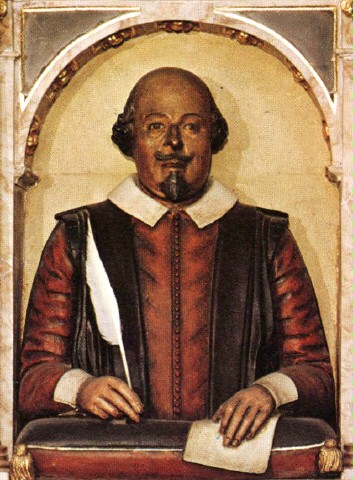
Well! I cannot let this anniversary go by, even though I am already a week late in celebrating it. I mean, Will and I go back a long way! Before I start my breathless recollections, though, let me throw in a picture of one of the few portraits of Shakespeare which are thought to probably be a good likeness, from his funerary monument in his home town, Stratford-upon-Avon.
image
(my alert readers will have noticed much circumspection in that last phrase; so little is known about the real-life Will)

I saw my first piece of Shakespeare – a mere snippet – when I was a seven-year old. My parents had taken me along to visit my elder brother at his school’s Sports Day. As the name suggests, the day was primarily about sports, but to show some high-browsedness among all this low-browsedness the Headmaster also put on a few scenes from Shakespeare, played by the boys. One of these boys was my brother, who played a scene from Henry VIII. Although I don’t know which scene it was exactly, I do remember sitting next to him afterwards and – pesky child that I was – pulling off strands of his stuck-on beard.

A year later, I was packed off to the same school, and at one of the next Sports Days I got my first role, a walk-on part as a page of Macbeth’s. My moment in the spotlight was short. I preceded Macbeth onto the stage, who then ordered me off to do something. I bowed with dignity and exited left. After which Macbeth launched into that great soliloquy:

“Is this a dagger which I see before me,
The handle toward my hand? Come, let me clutch thee.
I have thee not, and yet I see thee still.
Art thou not, fatal vision, sensible
To feeling as to sight? or art thou but
A dagger of the mind, a false creation,
Proceeding from the heat-oppressed brain?”

It goes on for several more fevered lines, but we’ll leave it at that.

In later years, I was a regular at these theatrical events on Sports Days, but I never got to do any more Shakespeare. The best I managed was the lead role, as a waiter, in some farce to do with a coconut being mistaken for a bomb. No matter! I was hooked on the acting life.

My school might have been buried in the wilds of Somerset, but that did not stop the Headmaster from trying to expose us to Culture. One way he did this was by taking us to theatrical events. Thus it was that one beautiful summer’s day (“Shall I compare thee to a summer’s day?”) we were bussed off to a local Stately Home and watched the Winter’s Tale on its manicured gardens. I can’t say I was terribly impressed by the play, certainly none of the text has remained with me. I appreciated more the strawberries and cream served at the interval. I was probably too young to appreciate the play (I must have been all of eleven at the time). But I did very much appreciate the al fresco setting, and so a number of years later, when I was at high school, I was an enthusiastic member of a small audience watching Waiting for Godot, sitting on the grass watching as Vladimir and Estragon acted out their empty lives on a lonely dirt road.

At that same high school, I acted in my first full-length Shakespeare play, Richard II, as the Duke of York. I’ve mentioned this in an earlier post, so will not elaborate. What has stayed with me all these years, though, apart from dying John of Gaunt’s paeon to England (“This other Eden, demi-paradise … this precious stone set in the silver sea … this blessed plot, this earth, this realm, this England”) is Henry Bolingbroke’s icy remark to the captive Richard II, who is wallowing in self-pity: “The shadow of your sorrows hath destroyed the shadow of your face”.

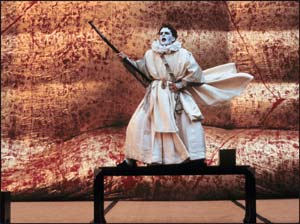
If I’m to be honest, our Richard II was no great shakes. It was a good attempt by amateurs, no more. To prep us, our Director had hired a van and taken us down to Stratford, to see the Royal Shakespeare Company put on Richard II. It was certainly better than what we did, but it was no more than workmanlike, I would say. I had to wait some ten years to see a truly splendid production of Richard II, directed by Ariane Mnouchkine in a large space in the Bois de Vincennes in Paris. Ah, what a wonderful production that was! Mnouchkine used a style that mixed Japanese theatrical traditions with mime, on a large set uncluttered by any of the traditional theatrical props. It was truly magic, one of those theatrical experiences that stays with you forever.
image
Back to my own theatrical career at high school! It reached its zenith when I acted in Tom Stoppard’s brilliant comedy Rosencrantz and Guildenstern are Dead. I played Rosencrantz (or maybe Guildenstern, I forget; the characters themselves were always getting confused about who they were). This hilarious play is a riff on Shakespeare’s Hamlet, in which R&G play minor and totally inglorious roles. To my great regret, I never acted in Hamlet itself. The closest I got was playing a few scenes on the portico of the Scottish National Gallery in Edinburgh, during the University’s charity week. I played Polonius as a completely senile old twerp, unashamedly hamming it up for the audience: a disgraceful exhibition – but fun!

In truth, my days treading the theatre boards were even then numbered. I quickly realized at University that I was a mediocre actor and it was time for me to get serious. But before my final curtain call, I did manage get a modest part in Measure for Measure, playing Claudio, a young man sentenced to death for getting his girlfriend pregnant. It’s a strange play, aptly titled a “problem play”, categorized as a comedy but being no such thing. None of the characters are that nice either, so it’s difficult to feel much sympathy for anyone. My character Claudio gets some wonderful lines as he sits in gaol, bathed in a total funk at the idea of dying:

“Ay, but to die, and go we know not where;
To lie in cold obstruction, and to rot;
This sensible warm motion to become
A kneaded clod; and the delighted spirit
To bathe in fiery floods, or to reside
In thrilling region of thick-ribbed ice;
To be imprisoned in the viewless winds
And blown with restless violence round about
The pendant world; or to be worse than worst
Of those that lawless and incertain thought
Imagine howling – ’tis too horrible!
The weariest and most loathed worldly life
That age, ache, penury, and imprisonment
Can lay on nature is a paradise
To what we fear of death.”

And as I grow older, the lines of Duke Vincentio, spoken in his disguise as a monk to Claudio in prison, resonate ever more strongly with me: “when thou art old and rich, thou hast neither heat, affection, limb, nor beauty to make thy riches pleasant”. So true, alas!

And that was the end of my days on the proscenium. From then on, my engagement with Shakespeare was through films and other people’s theatrical productions. The most vivid of my recollections centre around Laurence Olivier. There was a poky little cinema on the Left Bank of Paris which one year when we lived there held a festival of Olivier’s Shakespeare films. My wife and I first watched Olivier’s film version of Hamlet, the first proper Hamlet I had ever seen. Olivier started with his voiced-over summary of Hamlet: “This is the tragedy of a man who could not make up his mind”.
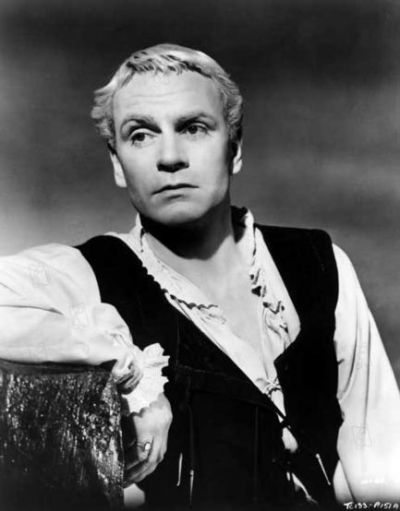
Hamlet 1948 rŽal : Laurence Olivier Laurence Olivier Collection Christophel

It was masterly, no doubt about it. Of course, there were all the hoary Hamlet quotes: “Alas, poor Yorrick, I knew him”, “get thee to a nunnery”, “neither a borrower nor a lender be”, and of course probably the hoariest of all hoary Shakespeare quotes, “To be or not to be, that is the question”. Actually, behind all that hoariness lies one of Shakespeare’s most profound, and profoundly beautiful, soliloquies, of which I cite here only some lines, those which have always resonated with me the most:

“………..To die: to sleep;
No more; and, by a sleep to say we end
The heart-ache and the thousand natural shocks
That flesh is heir to, ’tis a consummation
Devoutly to be wish’d. To die, to sleep;
To sleep: perchance to dream: ay, there’s the rub.
For in this sleep of death what dreams may come
When we have shuffled off this mortal coil,
Must give us pause …”

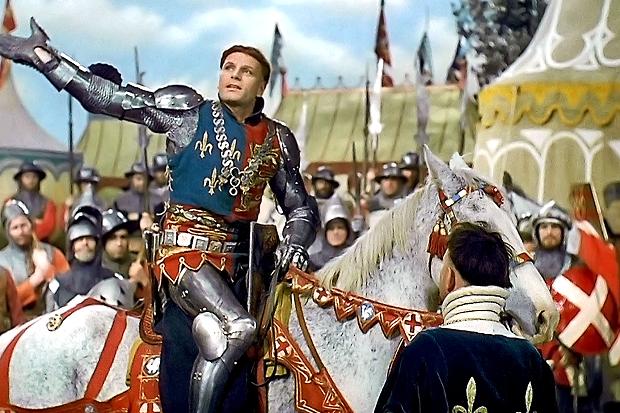
In that same poky little cinema on the Left Bank, we got to see Olivier’s wonderful Richard III, which I have commented on in an earlier post, but also his sublime Henry V, a wonderful propaganda piece made in 1944 as a morale booster and dedicated to the “Commandos and Airborne Troops of Great Britain, the spirit of whose ancestors it has been humbly attempted to recapture”. So it is that we have great, reverberating lines like these:

“Once more unto the breach, dear friends, once more;
Or close the wall up with our English dead!

I see you stand like greyhounds in the slips,
Straining upon the start. The game’s afoot:
Follow your spirit; and, upon this charge
Cry ‘God for Harry! England and Saint George!'”

“We few, we happy few, we band of brothers;
For he to-day that sheds his blood with me
Shall be my brother; be he ne’er so vile
This day shall gentle his condition:
And gentlemen in England, now a-bed
Shall think themselves accursed they were not here,
And hold their manhoods cheap whiles any speaks
That fought with us upon Saint Crispin’s day.”
image
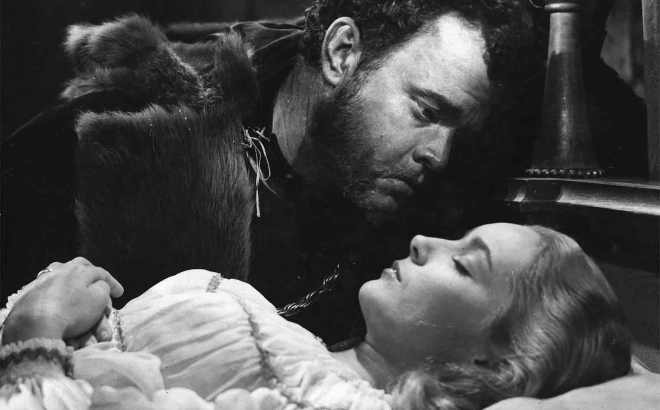
To my great regret, we missed the showing of Olivier’s film of Othello. But we did later see, in an equally poky cinema somewhere else, Orson Welle’s Othello, filmed in some exotic castle in Morocco. Ah, the terrible torments of jealousy! “beware, my lord, of jealousy; It is the green-ey’d monster which doth mock the meat it feeds on”.
image
“I kissed thee ere I killed thee, no way but this, killing myself, to die upon a kiss.”

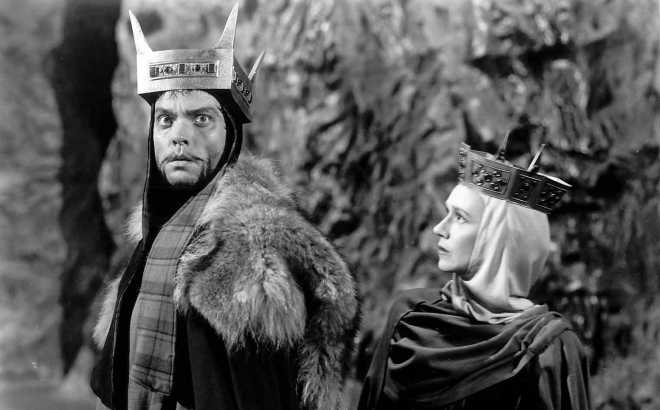
And then there was Orson Welles as Macbeth! Rather over the top – a cross, as Welles himself put it, between Wuthering Heights and Bride of Frankenstein
image
but home of some of the most sublime of Shakespeare’s lines, uttered by Macbeth as the power he has sold his soul for crumbles away around him.

“To-morrow, and to-morrow, and to-morrow,
Creeps in this petty pace from day to day,
To the last syllable of recorded time;
And all our yesterdays have lighted fools
The way to dusty death. Out, out, brief candle!
Life’s but a walking shadow, a poor player
That struts and frets his hour upon the stage
And then is heard no more: it is a tale
Told by an idiot, full of sound and fury,
Signifying nothing.”

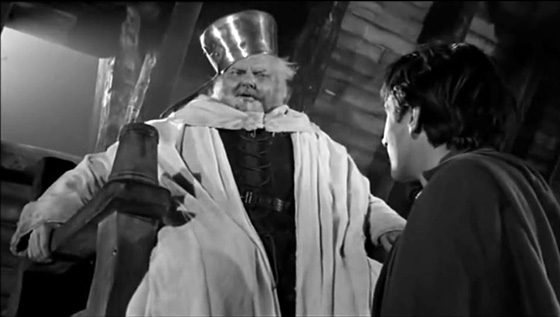
Orson Welles did another great Shakespeare film, The Chimes at Midnight, a medley from Henry IV Parts I and II, Henry V, Richard II, and even The Merry Wives of Windsor, and focusing on Sir John Falstaff, to my mind the only Shakespearean character who is really comic in the modern sense.
image
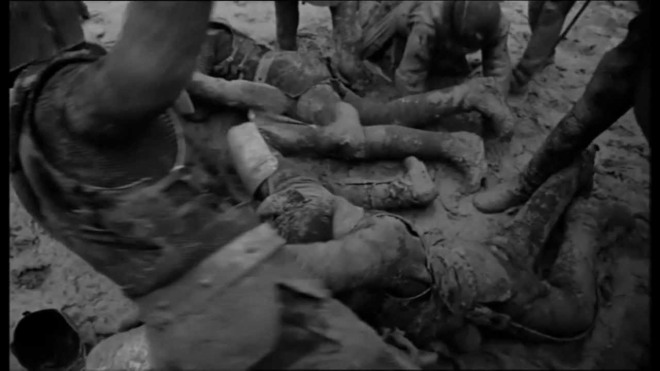
It’s a truly funny film. It’s also the film which brought home to me how Medieval battles were just brutal slugfests, with men bludgeoning each other to death with heavy, and sharp, pieces of metal.
image
But it’s ultimately a film about betrayal. Prince Hal, a Crown Prince who cannot bear to take his responsibilities seriously, strings Falstaff along, making him believe that they are fast friends. But when Prince Hal becomes Henry V and Falstaff thinks he is now in the clover (“My King! My Jove! I speak to thee my heart”), the newly crowned King rejects him, literally turning his back on him (“I know thee not, old man; fall to thy prayers! How ill white hairs become a fool and jester!”).

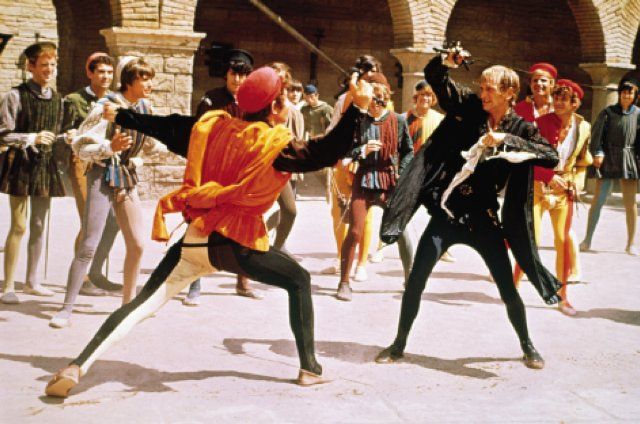
Over the years, my wife and I have seen a number of other Shakespeare plays in film or theatre. Most, alas, have left little or no mark. Two, though, have stayed with me. One is a stage production of The Tempest directed by Giorgio Strehler, which was visually absolutely stunning. The other is Franco Zefirelli’s lush Romeo and Juliet. I don’t remember it so much for the love story – to my modern, cynical, ear, it all sounds very twee – as for the way Zeffirelli beautifully captured the edgy, ultimately tragic, banter between Mercutio and the Capulets.
image
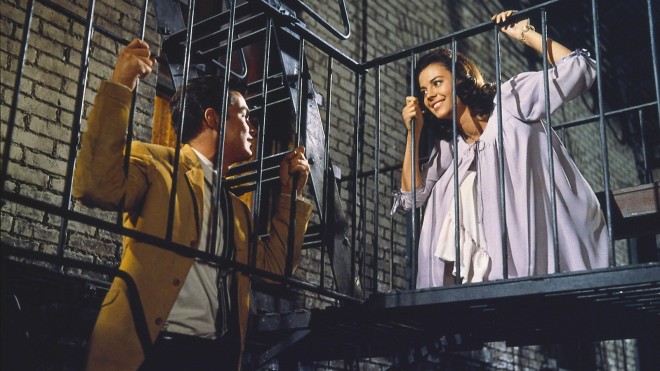
I may be a cynical old fart, but it’s undeniable that the drama of love across forbidden barriers resonates. There’s Leonard Bernstein’s West Side Story, an adaptation of Romeo and Juliet to New York’s gangs
image
image
and just recently I was watching an Al Jazeera show following the production of a Romeo and Juliet adaptation in Mali, a country where it is still the norm for parents to decide whom you marry; the, mostly female, audience were captivated. 400 years on, Shakespeare is still relevant.

I’ve focused on Shakespeare the dramatist. There is also Shakespeare the writer of the sonnets. One sonnet in particular is close to my heart at this time of my life:

“That time of year thou may’st in me behold
When yellow leaves, or none, or few, do hang
Upon those boughs which shake against the cold,
Bare ruin’d choirs, where late the sweet birds sang.
In me thou see’st the twilight of such day,
As after sunset fadeth in the west,
Which by-and-by black night doth take away,
Death’s second self, that seals up all in rest.
In me thou see’st the glowing of such fire
That on the ashes of his youth doth lie,
As the death-bed whereon it must expire
Consum’d with that which it was nourish’d by.
This thou perceivest, which makes thy love more strong,
To love that well which thou must leave ere long.”

Like I said, Shakespeare still speaks to us 400 years on. I just hope to have a few more goose-bump moments with Will before the sixth and seventh ages of man which he clinically describes kick in:

“The sixth age shifts
Into the lean and slippered pantaloon,
With spectacles on nose and pouch on side;
His youthful hose, well saved, a world too wide
For his shrunk shank, and his big manly voice,
Turning again toward childish treble, pipes
And whistles in his sound. Last scene of all,
That ends this strange eventful history,
Is second childishness and mere oblivion,
Sans teeth, sans eyes, sans taste, sans everything.”

___________________________
Shakespeare’s funerary monument: http://www.hollowaypages.com/Shakespearemonument.htm
Théatre du Soleil, Richard II: https://jeffberryman.com/2009/07/20/finishing-the-story-le-theatre-du-soleil/
Olivier Hamlet: http://www.fanpop.com/clubs/laurence-olivier/images/5111432/title/hamlet-photo
Olivier Henry V: http://hayhistorygroup.co.uk/new-events/2015/9/11/hay-history-weekend-henry-v-at-booths-cinema-olivier-version
Welles Othello: http://filmforum.org/film/othello-welles-film
Welles Macbeth: http://filmforum.org/film/macbeth-scottish-version-welles-film
Welles Chimes at Midnight: http://www.midnightonly.com/2015/04/12/chimes-at-midnight-1965/
Battle Chimes at Midnight: https://www.youtube.com/watch?v=3bWraOy6Kw4
Romeo and Juliet: https://www.pinterest.com/pin/186125397070342206/
West Side Story love: https://www.filmlinc.org/events/west-side-story/
West Side Story fight: http://cityartsonline.com/blog/2010/06/siff-review-seeing-west-side-story-first-time

A HORSE! A HORSE! MY KINDGOM FOR A HORSE!

Beijing, 5 February 2013

I was all atwitter this morning when I saw the news. The skeleton found under the car park in Leicester, England, is indeed that of Richard III, last of England’s Plantagenet kings! OK, there are some sour-puss academics raising doubts, but that’s probably because the skeleton wasn’t found under their car park.

I spent the early morning skittering around the house with one shoulder up and shouting “A horse! A horse! My kingdom for a horse!” instead of getting ready for work. My wife looked on and rolled her eyes. But what Englishman has not at least heard of Shakespeare’s play Richard III? What person, who – like me – has thespian pretensions, has not dreamed of prancing about a stage as a mediaeval version of Quasimodo, murdering all and sundry with devilish glee and getting the beautiful women into the bargain? If it wasn’t for Shakespeare, who would remember King Richard III?

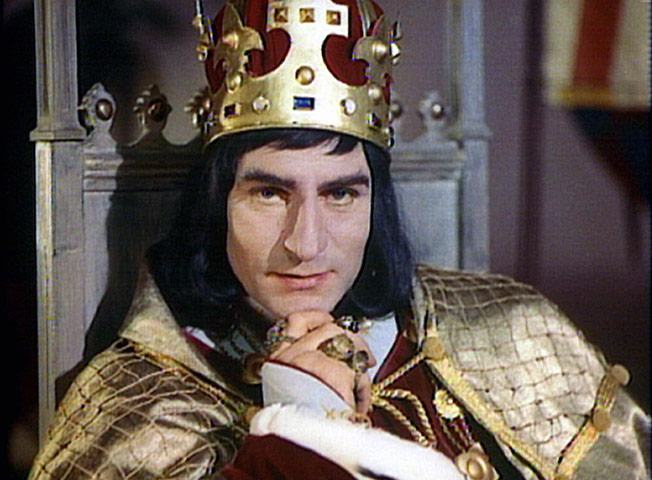
I did most of my acting at school. To my great regret, we never put on Richard III. But I’ve seen it a number of times, both in film as well as on the stage. I first saw it years ago with my wife, in some poky cinema on Paris’s rive gauche. That was the 1955 film version, with Laurence Olivier doing a marvelously over-the-top evil characterization of Richard.

laurence olivier

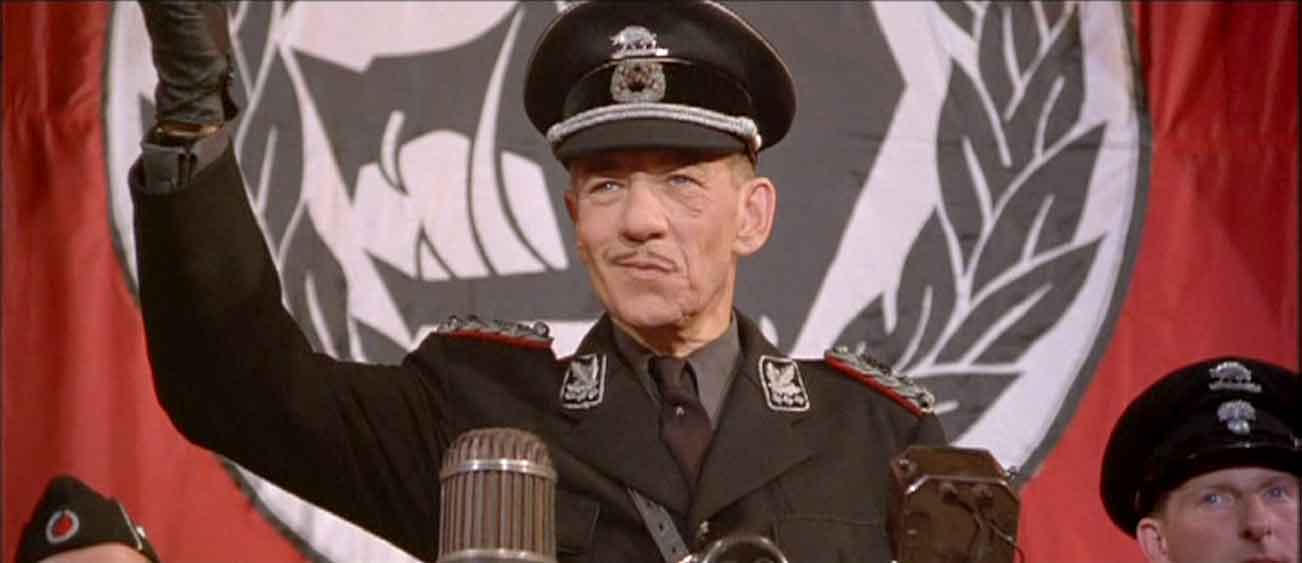
This film stayed in some sort of medieval setting. The next version I saw, with Ian McKellen playing Richard III, was made 40 years after Olivier’s movie. It tried to be clever and set the story in some sort of 1930s fascist version of Britain where the king’s deformity was moral rather than physical.

ian mckellen

We saw this film in Milan. As you can imagine, given Italy’s history

mussolini

the fascist overtones of the film had a certain resonance there.

And then, about a year ago, through sheer serendipity – we just happened to be visiting Hong Kong when the play was running – we saw Kevin Spacey play Richard III with a manic savageness.

kevin spacey

One of the amazing things about Shakespeare is the sheer number of quotes he has generated. Half the quotes people use, or so it seems, come from one Shakespeare play or another. Richard III has its fair share. There’s the quote which I’ve used as my title, which must be one of the most famous quotes in the English language. Then there is this quote:

“Now is the winter of our discontent
Made glorious summer by this sun of York”

which seems to be one of those quotes that everyone knows. Then there is this quote:

“Off with his head!”

which my father was very fond of using  whenever I was naughty.

Apart from these, the play has some deliciously cynical lines:

“Conscience is but a word that cowards use
Devis’d at first to keep the strong in awe”

“And thus I clothe my naked villainy
With odd old ends stolen out of holy writ;
And seem a saint, when most I play the devil.”

“Why, I can smile and murder while I smile,
And cry ‘content’ to that which grieves my heart,
And wet my cheeks with artificial tears,
And frame my face for all occasions”

Yes, we never did put on Richard III at school. But we put on Shakespeare’s Richard II; the events it recounts were the original cause of the War of the Roses, whose final act was the unhorsing of Richard III on Bosworth Field outside of Leicester and his killing with several savage blows to the head as shown by that skull beneath the car park.  I played the Duke of York (I should have played King Richard II, of course, but we’ll pass over that). As usual, the play has many memorable lines, but one set in particular remains with me, uttered by my elder brother John of Gaunt, Duke of Lancaster, as he lies dying in Act I:

This other Eden, demi-paradise;
This fortress, built by nature for herself,
Against infection, and the hand of war;
This happy breed of men, this little world;
This precious stone set in the silver sea,
Which serves it in the office of a wall,
Or as a moat defensive to a house,
Against the envy of less happier lands;
This blessed plot, this earth, this realm, this England

I don’t go back to the UK very often, but those lines echo with me when I stand in the countryside and see how so very lovely it can be.

english-countryside

_______________________________-

Laurence Olivier: http://3.bp.blogspot.com/-Z1o-IQnC1nE/UK8xybvIJ7I/AAAAAAAABCU/OJcjGS2QOzE/s1600/tumblr_m3xc1hNXLZ1rrfb56o1_1280.jpg

Ian McKellen: http://www.mckellen.com/images/r3/ban-15.jpg

Mussolini: http://757f8ed9aaa522dde29d-4c07cfa4f788be17c79661948c0f2477.r99.cf1.rackcdn.com/5728_1323465695_july-25th-benito-mussolini-deposed.jpg

Kevin Spacey: http://i.telegraph.co.uk/multimedia/archive/01934/Richard_a_1934160b.jpg

English countryside: http://www.style-passport.com/style/wp-content/uploads/2012/10/english-countryside.jpg