WILL AND I

Bangkok, 30 April 2016

One of the problems of living abroad is that issues of great moment back home have little if any echo here in Bangkok. So it was with the 400th anniversary of Will Shakespeare’s death, which fell on 23rd April last week. It was only when I was catching up with news from home (to Brexit or not to Brexit?) that I saw the huge amount of chatter on line and realized this.

Well! I cannot let this anniversary go by, even though I am already a week late in celebrating it. I mean, Will and I go back a long way! Before I start my breathless recollections, though, let me throw in a picture of one of the few portraits of Shakespeare which are thought to probably be a good likeness, from his funerary monument in his home town, Stratford-upon-Avon.
image
(my alert readers will have noticed much circumspection in that last phrase; so little is known about the real-life Will)

I saw my first piece of Shakespeare – a mere snippet – when I was a seven-year old. My parents had taken me along to visit my elder brother at his school’s Sports Day. As the name suggests, the day was primarily about sports, but to show some high-browsedness among all this low-browsedness the Headmaster also put on a few scenes from Shakespeare, played by the boys. One of these boys was my brother, who played a scene from Henry VIII. Although I don’t know which scene it was exactly, I do remember sitting next to him afterwards and – pesky child that I was – pulling off strands of his stuck-on beard.

A year later, I was packed off to the same school, and at one of the next Sports Days I got my first role, a walk-on part as a page of Macbeth’s. My moment in the spotlight was short. I preceded Macbeth onto the stage, who then ordered me off to do something. I bowed with dignity and exited left. After which Macbeth launched into that great soliloquy:

“Is this a dagger which I see before me,
The handle toward my hand? Come, let me clutch thee.
I have thee not, and yet I see thee still.
Art thou not, fatal vision, sensible
To feeling as to sight? or art thou but
A dagger of the mind, a false creation,
Proceeding from the heat-oppressed brain?”

It goes on for several more fevered lines, but we’ll leave it at that.

In later years, I was a regular at these theatrical events on Sports Days, but I never got to do any more Shakespeare. The best I managed was the lead role, as a waiter, in some farce to do with a coconut being mistaken for a bomb. No matter! I was hooked on the acting life.

My school might have been buried in the wilds of Somerset, but that did not stop the Headmaster from trying to expose us to Culture. One way he did this was by taking us to theatrical events. Thus it was that one beautiful summer’s day (“Shall I compare thee to a summer’s day?”) we were bussed off to a local Stately Home and watched the Winter’s Tale on its manicured gardens. I can’t say I was terribly impressed by the play, certainly none of the text has remained with me. I appreciated more the strawberries and cream served at the interval. I was probably too young to appreciate the play (I must have been all of eleven at the time). But I did very much appreciate the al fresco setting, and so a number of years later, when I was at high school, I was an enthusiastic member of a small audience watching Waiting for Godot, sitting on the grass watching as Vladimir and Estragon acted out their empty lives on a lonely dirt road.

At that same high school, I acted in my first full-length Shakespeare play, Richard II, as the Duke of York. I’ve mentioned this in an earlier post, so will not elaborate. What has stayed with me all these years, though, apart from dying John of Gaunt’s paeon to England (“This other Eden, demi-paradise … this precious stone set in the silver sea … this blessed plot, this earth, this realm, this England”) is Henry Bolingbroke’s icy remark to the captive Richard II, who is wallowing in self-pity: “The shadow of your sorrows hath destroyed the shadow of your face”.

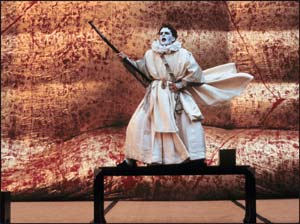
If I’m to be honest, our Richard II was no great shakes. It was a good attempt by amateurs, no more. To prep us, our Director had hired a van and taken us down to Stratford, to see the Royal Shakespeare Company put on Richard II. It was certainly better than what we did, but it was no more than workmanlike, I would say. I had to wait some ten years to see a truly splendid production of Richard II, directed by Ariane Mnouchkine in a large space in the Bois de Vincennes in Paris. Ah, what a wonderful production that was! Mnouchkine used a style that mixed Japanese theatrical traditions with mime, on a large set uncluttered by any of the traditional theatrical props. It was truly magic, one of those theatrical experiences that stays with you forever.
image
Back to my own theatrical career at high school! It reached its zenith when I acted in Tom Stoppard’s brilliant comedy Rosencrantz and Guildenstern are Dead. I played Rosencrantz (or maybe Guildenstern, I forget; the characters themselves were always getting confused about who they were). This hilarious play is a riff on Shakespeare’s Hamlet, in which R&G play minor and totally inglorious roles. To my great regret, I never acted in Hamlet itself. The closest I got was playing a few scenes on the portico of the Scottish National Gallery in Edinburgh, during the University’s charity week. I played Polonius as a completely senile old twerp, unashamedly hamming it up for the audience: a disgraceful exhibition – but fun!

In truth, my days treading the theatre boards were even then numbered. I quickly realized at University that I was a mediocre actor and it was time for me to get serious. But before my final curtain call, I did manage get a modest part in Measure for Measure, playing Claudio, a young man sentenced to death for getting his girlfriend pregnant. It’s a strange play, aptly titled a “problem play”, categorized as a comedy but being no such thing. None of the characters are that nice either, so it’s difficult to feel much sympathy for anyone. My character Claudio gets some wonderful lines as he sits in gaol, bathed in a total funk at the idea of dying:

“Ay, but to die, and go we know not where;
To lie in cold obstruction, and to rot;
This sensible warm motion to become
A kneaded clod; and the delighted spirit
To bathe in fiery floods, or to reside
In thrilling region of thick-ribbed ice;
To be imprisoned in the viewless winds
And blown with restless violence round about
The pendant world; or to be worse than worst
Of those that lawless and incertain thought
Imagine howling – ’tis too horrible!
The weariest and most loathed worldly life
That age, ache, penury, and imprisonment
Can lay on nature is a paradise
To what we fear of death.”

And as I grow older, the lines of Duke Vincentio, spoken in his disguise as a monk to Claudio in prison, resonate ever more strongly with me: “when thou art old and rich, thou hast neither heat, affection, limb, nor beauty to make thy riches pleasant”. So true, alas!

And that was the end of my days on the proscenium. From then on, my engagement with Shakespeare was through films and other people’s theatrical productions. The most vivid of my recollections centre around Laurence Olivier. There was a poky little cinema on the Left Bank of Paris which one year when we lived there held a festival of Olivier’s Shakespeare films. My wife and I first watched Olivier’s film version of Hamlet, the first proper Hamlet I had ever seen. Olivier started with his voiced-over summary of Hamlet: “This is the tragedy of a man who could not make up his mind”.

Hamlet 1948 rŽal : Laurence Olivier Laurence Olivier Collection Christophel

It was masterly, no doubt about it. Of course, there were all the hoary Hamlet quotes: “Alas, poor Yorrick, I knew him”, “get thee to a nunnery”, “neither a borrower nor a lender be”, and of course probably the hoariest of all hoary Shakespeare quotes, “To be or not to be, that is the question”. Actually, behind all that hoariness lies one of Shakespeare’s most profound, and profoundly beautiful, soliloquies, of which I cite here only some lines, those which have always resonated with me the most:

“………..To die: to sleep;
No more; and, by a sleep to say we end
The heart-ache and the thousand natural shocks
That flesh is heir to, ’tis a consummation
Devoutly to be wish’d. To die, to sleep;
To sleep: perchance to dream: ay, there’s the rub.
For in this sleep of death what dreams may come
When we have shuffled off this mortal coil,
Must give us pause …”

In that same poky little cinema on the Left Bank, we got to see Olivier’s wonderful Richard III, which I have commented on in an earlier post, but also his sublime Henry V, a wonderful propaganda piece made in 1944 as a morale booster and dedicated to the “Commandos and Airborne Troops of Great Britain, the spirit of whose ancestors it has been humbly attempted to recapture”. So it is that we have great, reverberating lines like these:

“Once more unto the breach, dear friends, once more;
Or close the wall up with our English dead!

I see you stand like greyhounds in the slips,
Straining upon the start. The game’s afoot:
Follow your spirit; and, upon this charge
Cry ‘God for Harry! England and Saint George!'”

“We few, we happy few, we band of brothers;
For he to-day that sheds his blood with me
Shall be my brother; be he ne’er so vile
This day shall gentle his condition:
And gentlemen in England, now a-bed
Shall think themselves accursed they were not here,
And hold their manhoods cheap whiles any speaks
That fought with us upon Saint Crispin’s day.”

image
To my great regret, we missed the showing of Olivier’s film of Othello. But we did later see, in an equally poky cinema somewhere else, Orson Welle’s Othello, filmed in some exotic castle in Morocco. Ah, the terrible torments of jealousy! “beware, my lord, of jealousy; It is the green-ey’d monster which doth mock the meat it feeds on”.
image
“I kissed thee ere I killed thee, no way but this, killing myself, to die upon a kiss.”

And then there was Orson Welles as Macbeth! Rather over the top – a cross, as Welles himself put it, between Wuthering Heights and Bride of Frankenstein
image
but home of some of the most sublime of Shakespeare’s lines, uttered by Macbeth as the power he has sold his soul for crumbles away around him.

“To-morrow, and to-morrow, and to-morrow,
Creeps in this petty pace from day to day,
To the last syllable of recorded time;
And all our yesterdays have lighted fools
The way to dusty death. Out, out, brief candle!
Life’s but a walking shadow, a poor player
That struts and frets his hour upon the stage
And then is heard no more: it is a tale
Told by an idiot, full of sound and fury,
Signifying nothing.”

Orson Welles did another great Shakespeare film, The Chimes at Midnight, a medley from Henry IV Parts I and II, Henry V, Richard II, and even The Merry Wives of Windsor, and focusing on Sir John Falstaff, to my mind the only Shakespearean character who is really comic in the modern sense.

image
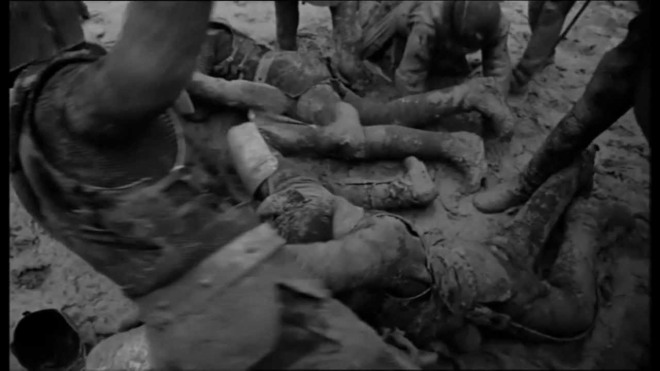
It’s a truly funny film. It’s also the film which brought home to me how Medieval battles were just brutal slugfests, with men bludgeoning each other to death with heavy, and sharp, pieces of metal.
image
But it’s ultimately a film about betrayal. Prince Hal, a Crown Prince who cannot bear to take his responsibilities seriously, strings Falstaff along, making him believe that they are fast friends. But when Prince Hal becomes Henry V and Falstaff thinks he is now in the clover (“My King! My Jove! I speak to thee my heart”), the newly crowned King rejects him, literally turning his back on him (“I know thee not, old man; fall to thy prayers! How ill white hairs become a fool and jester!”).

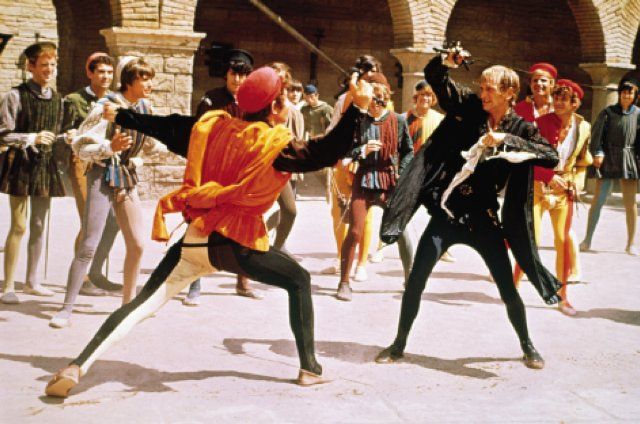
Over the years, my wife and I have seen a number of other Shakespeare plays in film or theatre. Most, alas, have left little or no mark. Two, though, have stayed with me. One is a stage production of The Tempest directed by Giorgio Strehler, which was visually absolutely stunning. The other is Franco Zefirelli’s lush Romeo and Juliet. I don’t remember it so much for the love story – to my modern, cynical, ear, it all sounds very twee – as for the way Zeffirelli beautifully captured the edgy, ultimately tragic, banter between Mercutio and the Capulets.

image
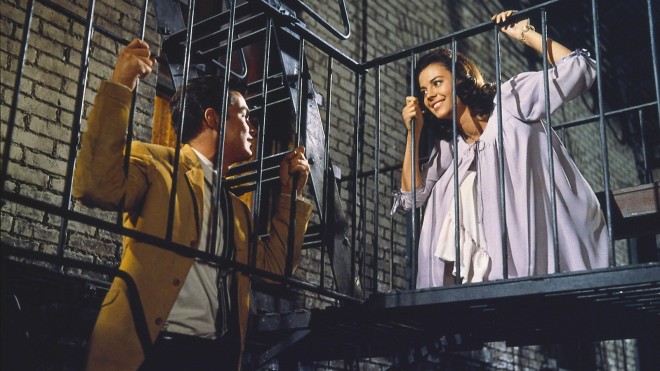
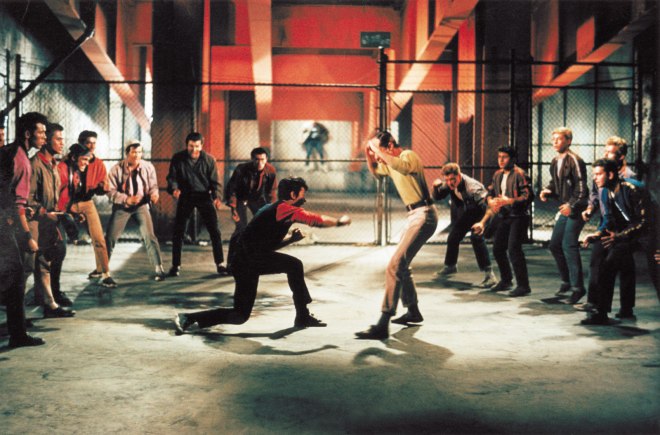
I may be a cynical old fart, but it’s undeniable that the drama of love across forbidden barriers resonates. There’s Leonard Bernstein’s West Side Story, an adaptation of Romeo and Juliet to New York’s gangs
image
image
and just recently I was watching an Al Jazeera show following the production of a Romeo and Juliet adaptation in Mali, a country where it is still the norm for parents to decide whom you marry; the, mostly female, audience were captivated. 400 years on, Shakespeare is still relevant.

I’ve focused on Shakespeare the dramatist. There is also Shakespeare the writer of the sonnets. One sonnet in particular is close to my heart at this time of my life:

“That time of year thou may’st in me behold
When yellow leaves, or none, or few, do hang
Upon those boughs which shake against the cold,
Bare ruin’d choirs, where late the sweet birds sang.
In me thou see’st the twilight of such day,
As after sunset fadeth in the west,
Which by-and-by black night doth take away,
Death’s second self, that seals up all in rest.
In me thou see’st the glowing of such fire
That on the ashes of his youth doth lie,
As the death-bed whereon it must expire
Consum’d with that which it was nourish’d by.
This thou perceivest, which makes thy love more strong,
To love that well which thou must leave ere long.”

Like I said, Shakespeare still speaks to us 400 years on. I just hope to have a few more goose-bump moments with Will before the sixth and seventh ages of man which he clinically describes kick in:

“The sixth age shifts
Into the lean and slippered pantaloon,
With spectacles on nose and pouch on side;
His youthful hose, well saved, a world too wide
For his shrunk shank, and his big manly voice,
Turning again toward childish treble, pipes
And whistles in his sound. Last scene of all,
That ends this strange eventful history,
Is second childishness and mere oblivion,
Sans teeth, sans eyes, sans taste, sans everything.”

___________________________
Shakespeare’s funerary monument: http://www.hollowaypages.com/Shakespearemonument.htm
Théatre du Soleil, Richard II: https://jeffberryman.com/2009/07/20/finishing-the-story-le-theatre-du-soleil/
Olivier Hamlet: http://www.fanpop.com/clubs/laurence-olivier/images/5111432/title/hamlet-photo
Olivier Henry V: http://hayhistorygroup.co.uk/new-events/2015/9/11/hay-history-weekend-henry-v-at-booths-cinema-olivier-version
Welles Othello: http://filmforum.org/film/othello-welles-film
Welles Macbeth: http://filmforum.org/film/macbeth-scottish-version-welles-film
Welles Chimes at Midnight: http://www.midnightonly.com/2015/04/12/chimes-at-midnight-1965/
Battle Chimes at Midnight: https://www.youtube.com/watch?v=3bWraOy6Kw4
Romeo and Juliet: https://www.pinterest.com/pin/186125397070342206/
West Side Story love: https://www.filmlinc.org/events/west-side-story/
West Side Story fight: http://cityartsonline.com/blog/2010/06/siff-review-seeing-west-side-story-first-time

INDIGO

Bangkok, 3 February 2016

After reading my last post, my wife asked me a very simple but very penetrating question: “But why are jeans blue?”

One can of course be nit-picking and respond that actually not all jeans are blue. This is undoubtedly true but let’s face it, the huge majority of jeans are dyed some shade of blue. Jeans are not called blue jeans for nothing.

One can also give the trivial answer “because blue dye is used”, which rightfully elicits the riposte “Ha-ha, very funny”. But actually, an interesting tale does hang on the dye used, which I learned while preparing the previous post and which I can’t resist recounting here.

We have to go to Europe for an answer to my wife’s question, because it was from there that the denim material used for blue jeans came to America. So what is the history of blue dye in Europe?

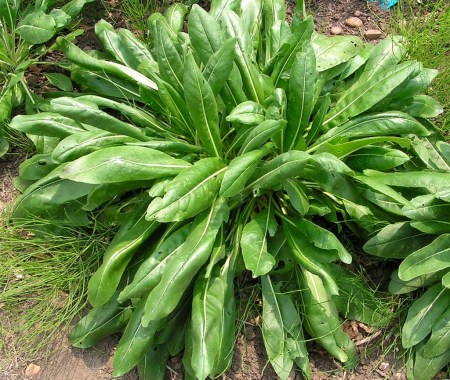
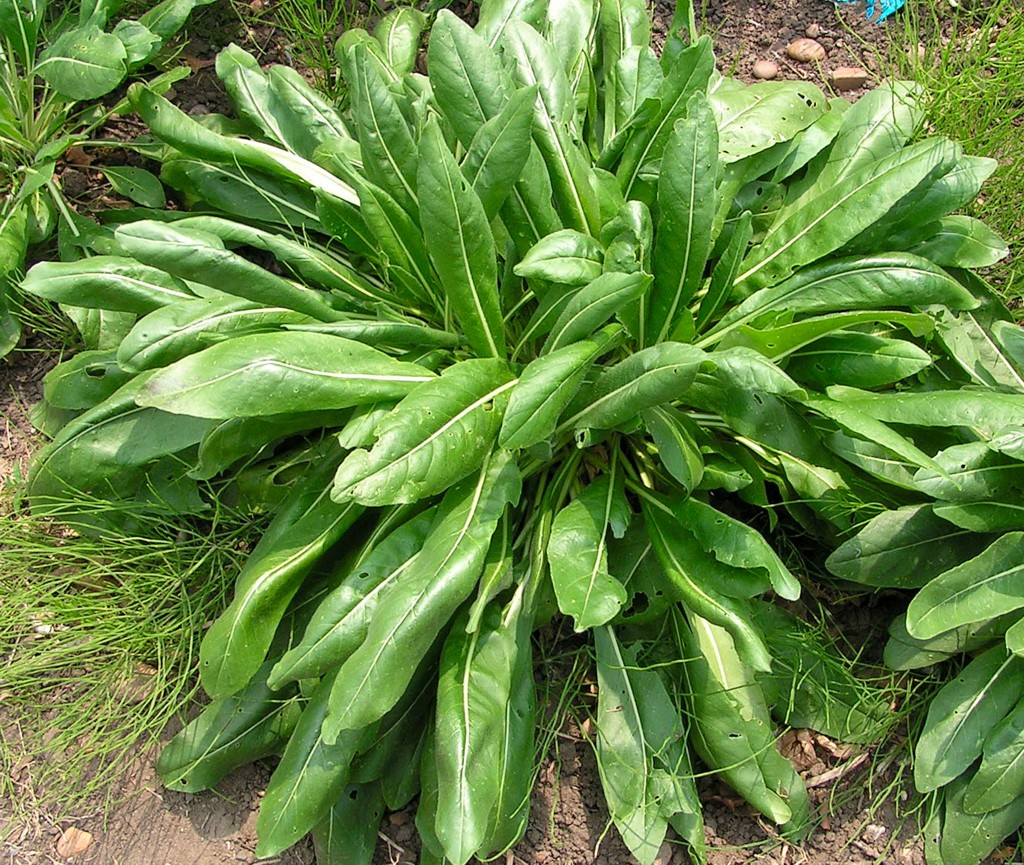
I was delighted to learn that the original blue dye of choice in Europe was extracted from woad. For those – I’m sure many – readers who have no idea what woad is, it is a plant native to many parts of Europe from whose leaves indigo dye can be extracted. I throw in a picture here in case any of my readers might wish to go searching for it.

woad plant

Personally, I must admit that I only knew woad as the stuff which Julius Caesar, in his De Bello Gallico, tells us the Britons smeared themselves with: “Omnes vero se Britanni vitro inficiunt, quod caeruleum efficit colorem, atque hoc horridiores sunt in pugna aspectu”, “In truth, all the Britons stain themselves with woad that occasions a bluish colour, and thereby they have a more terrible appearance in battle”. But I prefer the way it is put in that sublime history of Great Britain, 1066 And All That: “Julius Caesar advanced energetically, throwing his cavalry several thousand paces over the River Flumen; but the Ancient Britons, although all well over military age, painted themselves true blue, or woad, and fought heroically under their dashing queen, Woadicea, as they did later in thin red lines under their good queen, Victoria.” Mel Gibson in Braveheart shows us how it should be done.

mel gibson

Trivia aside, woad was actually economically a very important crop in many parts of Medieval Europe and made some communities very wealthy. In France, for instance, the trade in the dye from woad built many of the more beautiful buildings in Toulouse

Hôtel_d'Assézat,_toulouse_(panorama)

while in Germany woad paid for the University of Erfurt, established back in 1389.

erfurt university

The indigo from woad coloured the best of medieval tapestries.

medieval tapestry

In sum, all seemed to be going swimmingly for the woad sector!

But there was a worm in the rose: the same indigo dye, but extracted from the leaves of another plant, in much larger quantities per leaf, in India.

Indigofera_tinctoria

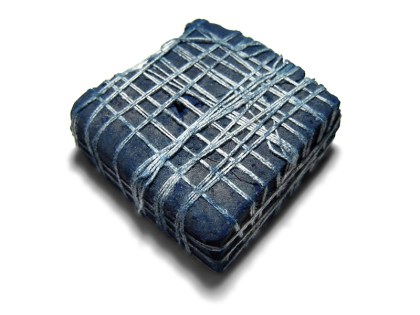
This stuff was already arriving in small and very costly amounts onto Greek, and later Roman, markets, along those same trade routes which I’ve had cause to mention in earlier posts. Because it was so expensive it was used primarily as a pigment in paint and not as a dye of fabrics. The Greeks called it indikon, the Indian dye. The Romans latinized this to indicum, which eventually gave us our indigo. Once the Europeans rounded the Cape of Good Hope and made it safely across the Indian Ocean, they could buy the stuff directly from the producers and cut out all the middle men. Nice packets like this began to arrive in Europe in the hold of European ships.

Indian_indigo_dye_lumpThe price in the European market places duly dropped, woad producers saw their livelihoods threatened, and they resorted to the classic weapons of getting pliant governments to forbid its use (it’s called anti-dumping these days) and putting around rumours that using indigo from India severely affected the quality of the fabric. All to no avail. The higher transportation costs from India were more than offset by the much higher productivity of the Indian plant. Transportation and production costs were then further slashed when the Spaniards started growing the Indian plant in their Latin American colonies and the British in their southern American colonies (Carolina and Georgia), both with slave labour.

Indigo Processing Carolinas

The British then went on to use their early stranglehold on Bengal to create vast indigo estates, turning the local farmers into de facto slaves in the process, which further reduced costs.

indigo processing bengal

Woad was doomed and disappeared from the scene.

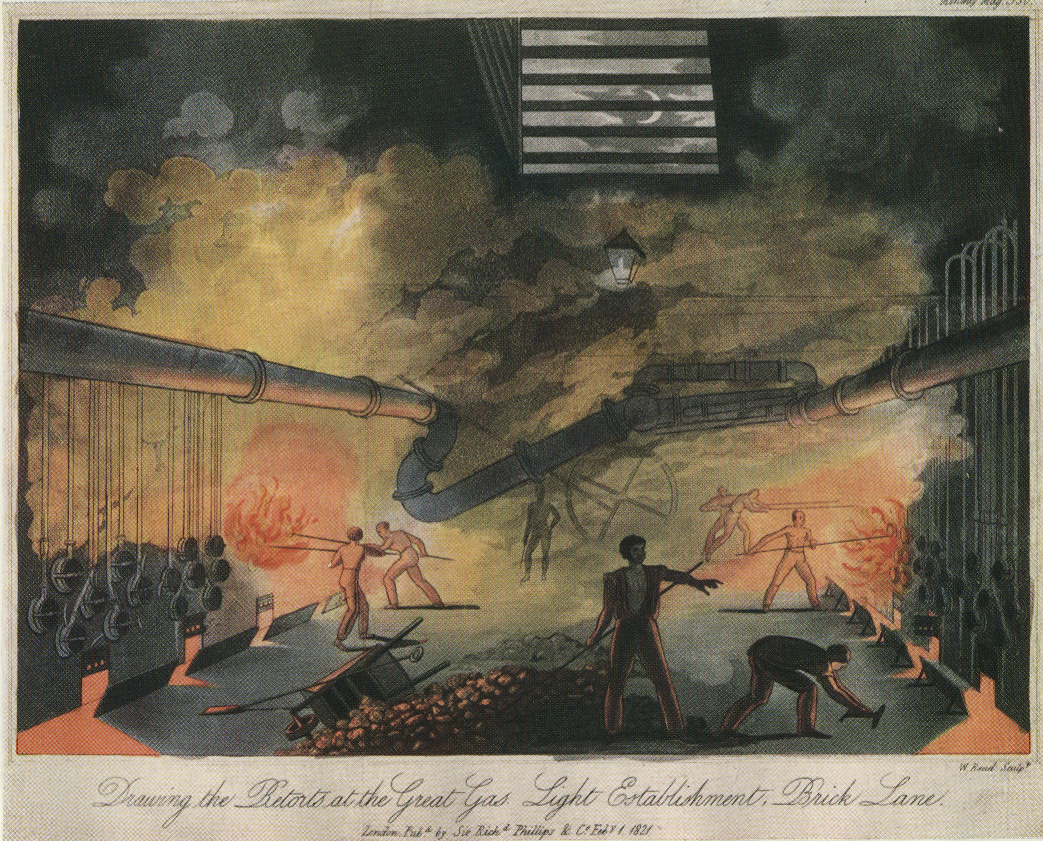
But at this moment of triumph for Asian indigo, there was another worm in the rose, this time in the form of the nascent organic chemical industry. In the early 1800s, when woad was fighting its final rearguard actions against Asian indigo, Europe and North America were starting to adopt town gas to light and later heat homes and businesses. Town gas was produced from coal.

town gas manufacture

Its production also created various very nasty wastes, some of which I have stumbled across in my professional career buried in old gasworks sites. One of these wastes was coal tar, a nasty, gooey, stinking waste which looks like this.

coal tar

Chemists started dabbling with coal tar to see what they could extract from it. The breakthrough occurred in 1856 when a young British chemist by the name of Henry Perkin, while trying to make quinine from coal tar, serendipitously produced a purple dye that he later commercialized under the name mauveine.

mauveineIt must have been so thrilling, almost magic, for Mr. Perkin to extract this beautiful colour from that horrible, nasty black gunk. For sure, in the chemistry lab as a boy I found those moments when the liquid in my test tube turned a beautiful colour to be the most memorable. But perhaps Mr. Perkins only saw the commercial possibilities in this lovely mauve.

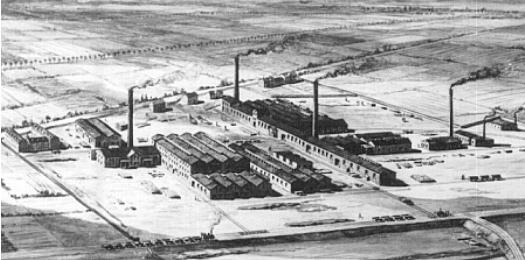
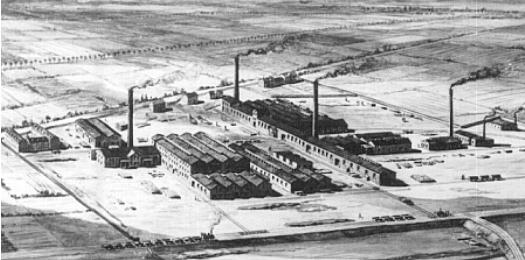
In any event, the race was on! Chemists piled in to see what other dyes (and later other organic products) they could make by fiddling around with coal tar. The Germans soon dominated the field, accounting for almost 90% of synthetic dye production at the outbreak of World War I. It took a while for synthetic indigo to be produced, because coal tar didn’t contain a suitable “carbon skeleton”. Finally, in the late 1870s, early 1880s, the German chemist Adolf Baeyer managed to find several routes to synthetic indigo. His Nobel Prize for chemistry in 1905 was partially based on this work. Chemists at the Badische Anilin und Soda-Fabrick (better known to us as BASF) came up with yet another, commercially more viable, route, and BASF marketed its first synthetic indigo in 1897. By the way, just to close the circle, BASF was created in 1865 by one Friedrich Engelhorn, who had established the gasworks for the town of Mannheim in 1861 and saw in Perkin’s discovery of mauveine a way of turning this damned coal tar waste into something useful. As BASF’s name suggests, the company initially focused on aniline-based dyes. This is the original BASF plant at Ludwigshafen in 1866.

BASF_Werk_Ludwigshafen_1866

Natural indigo was doomed. Synthetic indigo’s better quality, the greater reliability of its supplies, and its lower cost all drove natural indigo off the market, despite the usual attempts, which we’ve seen already with woad, by sympathetic governments to try and block the use of synthetic indigo by fair means or foul. In 1897, the year that synthetic indigo first came onto the market, 19,000 tons of natural indigo were produced. By 1914, this had plummeted to 1,000 tons and the free fall was not over. Asian indigo followed woad-based indigo into oblivion.

At this moment of triumph for synthetic indigo, there lurked yet another worm ready to devour the rose’s heart: other blue synthetic dyes. Indanthrene Blue RS was patented in 1901, Hydron Blue was developed in 1908, and maybe there were others – the world of textile dyes is bewilderingly complex. I’m not quite sure how these various dyes fought it out for the denim market, but in the 1950s BASF and other indigo producers seriously considered promoting other blue dyes for denim because of indigo’s poor fastness properties. This is jargon for meaning that textiles dyed with indigo tend to fade rather easily. What stopped them was the fact that this very property of fading was what was so earnestly desired by the young owners of blue jeans, the product in which indigo was most used. So indigo was saved and the worm crawled off to devour other roses. Because of the popularity of jeans, indigo is in fact king of the heap. It is the textile dye with the highest production volumes in the world, some 30,000 tons a year (when you think that most of it is used to dye jeans and that it only takes 10 grams of indigo to dye one pair of jeans, readers with good mathematical skills will quickly figure out that literally billions of jeans must be made every year).

But after that tour through the world of dyes and its cut-throat competition, I am afraid to say that I still haven’t properly answered my wife’s question: “why are jeans blue?” Why are they not red or green or black or yellow? Well I think we have established why they are blue today: because of indigo’s quirk of fading in interesting patterns. But why did the Amoskeag Mills in New Hampshire, which initially supplied Levi Strauss with his denim, use indigo dye? Despite my best efforts, I have not been able to find a satisfactory answer. I suspect it was because by the 1860s, when the mill started supplying Mr. Strauss with his denim, this particular fabric had “always” been dyed with indigo or woad or some other blue dye. “Always” seems to mean at least since the 16th Century. One article I came across says that it was at this time that blue in the UK became the poor’s colour of choice for their clothing. Judging by the paintings of the Master of the Blue Jeans, it was the colour of choice for the poor in Europe more generally.

master of the blue jeans

Why? I don’t know. I have to assume that cost was a factor, but it could also have been simply a fashion trend.

So I’m afraid that I have failed to answer my wife’s question at the deepest level. But I shall keep an eye out, and maybe one day I will come across the answer and be able to update this post. Any leads will be welcome. In the meantime, I invite my readers to enjoy some blue.

Blue Spectrum

_______________________

Woad plant: http://woad.weebly.com/uploads/1/5/7/6/1576/1436768_orig.jpg (in http://woad.weebly.com/grow.html)
Mel Gibson: http://media-cdn.timesfreepress.com/img/news/tease/2012/11/02/braveheart-3_t1070_h10b97cb70851af7b29a07a4e9321ac5de746798e.jpg (in http://www.timesfreepress.com/news/sports/columns/story/2012/nov/02/5-10-friday-mailbag-dooley-dynasties-defenses-and-/91886/)
Medieval tapestry: http://www.needlenthread.com/wp-content/uploads/2011/09/wool-tapestry-01.jpg (in http://www.needlenthread.com/2011/09/pins-and-woad-dyeing-of-textiles.html)
Hôtel particulier, Toulouse: https://upload.wikimedia.org/wikipedia/commons/4/43/H%C3%B4tel_d’Ass%C3%A9zat,_toulouse_%28panorama%29.jpg
Erfurt University: http://www.suehnekreuz.de/PHP/ewiki/sk_wiki.php?binary=internal%3A%2F%2F84cd21ee849566f965b0eeaaf15626e8.jpeg (in http://www.suehnekreuz.de/PHP/ewiki/sk_wiki.php?id=Erfurt)
Indigofera tinctoria: http://s3.amazonaws.com/sagebudphotos/INTI/Indigofera_tinctoria2_600.jpg (in http://sagebud.com/true-indigo-indigofera-tinctoria/)
Packet of natural indigo dye: https://en.m.wikipedia.org/wiki/Indigo_dye
Indigo processing Carolinas: https://www.unf.edu/floridahistoryonline/Plantations/images/IndigoProcessingSCMap-lg.jpg (in https://www.unf.edu/floridahistoryonline/Plantations/plantations/Indigo_Cultivation_and_Processing.htm)
Indigo processing Bengal: http://www.columbia.edu/itc/mealac/pritchett/00glossarydata/terms/indigo/iln1869.jpg (in http://eastindiacompany1600-1857.blogspot.com/2015_01_01_archive.html)
Town gas manufacturing: https://upload.wikimedia.org/wikipedia/commons/a/a0/Drawing_the_retorts_at_the_Great_Gas_Establishment_Brick_Lane.png (in https://en.wikipedia.org/wiki/History_of_manufactured_gas)
Coal tar: http://www.permastripe.com/wp-content/uploads/2015/05/coal-tar-16.jpg (in http://www.permastripe.com/coal-tar-parking-lot-sealer-is-it-toxic/)
Mauveine: https://lilyabsinthe.files.wordpress.com/2015/05/6233293ca7d59e6c175f596742cba93b.jpg (in http://lilyabsinthe.com/2015/05/14/mauveine/)
Old BASF plant: https://upload.wikimedia.org/wikipedia/commons/7/7c/BASF_Werk_Ludwigshafen_1866.JPG (in https://en.wikipedia.org/wiki/BASF)
Master of the Blue Jeans painting: http://images.artnet.com/images_us/magazine/reviews/karlins/karlins1-26-11-2.jpg (in http://www.artnet.com/magazineus/reviews/karlins/master-of-blue-jeans1-25-11.asp)
Blue spectrum: http://pl.wallpapersma.com/wp-content/uploads/2013/05/Blue-Spectrum-728×455.jpg (in http://pl.wallpapersma.com/wallpaper/blue-spectrum.html)

KEEP IT SIMPLE

Bangkok, 19 December 2015

I don’t know what it was, it seems to be happening to me more and more often as I near retirement, but a few days ago my mind wandered off the Worthy but Very Boring Thing I was working on and, light as feather, drifted away on the winds of memory to finally alight in St. George’s Chapel in Windsor Castle, which is the spiritual home of the Order of the Garter.

Yes, I know, very strange. What can I say, that’s where my mind went that day.

My wife and I had visited the chapel some nine-ten years ago. For those of my readers who have never been there, I throw in a photo that gives a generalized view of the chapel’s interior.
image
I could chirrup on about the age of the chapel, its architecture, its history. But I won’t. I invite readers who are interested in these details to go to the relevant websites. Instead, I will focus on the one thing that immediately strikes any sentient being who crosses the chapel’s threshold: the flags hanging from its walls.
image
I need to explain these flags, which in turn requires me to give a brief background to the Order of the Garter. As any English child of my generation will know, if they didn’t spend all their history classes snoozing, the Order of the Garter was created by King Edward III one evening back in the early 1300s, during a dance, when the Countess of Salisbury lost her garter. As the King picked it up, someone sniggered, and the King pronounced (in French; the English kings didn’t speak English yet) “Honi soit qui mal y pense”, which can be loosely translated as “Only dirty buggers would see anything wrong in my simply picking up a garter”. Now, why this story should have led to the creation of an Order of Chivalry (basically, a club of aristocrats), with the reigning monarchs at its head and the original kingly utterance as its motto, was not clear to me when I was a ten year old boy and is still not clear to me as a sixty-one year old adult. But there you go, it did.

The important point as far as the flags are concerned is that the members of the Order were originally all aristocrats, and as we all know one of the many things which distinguished aristocrats from the vulgar hoi polloi like us was the fact that they had the right to a coat of arms. So what we have hanging from the walls are the heraldic banners of the members of the order (which of course means that when the Order began to let in representatives of the vulgar hoi polloi these vulgar persons had to get themselves double quick a title and a coat of arms).

For the purpose of my story, there is another important point to make about the Order’s membership. From the start, there could only be 24 members in addition to the sovereign and the Prince of Wales, and of course the members were only English (and later British). But George III started adding “supernumerary” members, to deal with the pressing problem of him having a whole bunch of sons who all wanted to be members. Then he had the bright idea of adding the Emperor of Russia as a supernumerary member, after which various other members of European royal families got added, then more exotic royalty like the Sultan of the Ottoman Empire and the King of Persia, to finish – importantly for this story – this march to the East with the Emperor of Japan in 1903. The Emperors of Japan have been members ever since (barring, understandably, the World War II years and several decades thereafter when spirits were still bruised by Japanese atrocities).

OK, so what, I hear my readers say. Well, all this allows me to vault onto one of my favourite hobby horses, my insistence that design should be simple. In this case, I am referring to the design of the members’ heraldic banners. To see what I mean, please see below the coat of arms of one of the British members, that of Gerald Grosvenor, 6th Duke of Westminster (I choose him for no other reason than he is stinking rich due to his property holdings around Grosvenor Square in London and elsewhere).
image
So complicated! So fussy! So busy! The formal heraldic description of the shield, which is what is on the banner, says it all:
“Quarterly, 1st and 4th, Azure a Portcullis with chains pendant Or on a Chief of the last between two united Roses of York and Lancaster a Pale charged with the Arms of King Edward the Confessor; 2nd and 3rd, Azure a Garb Or”.

Aïe! Contorted! Confusing! And this is not the most complicated of the Order’s members’ banners. I mean, look at the one of the good Prince of Wales
image
with its heraldic description of the shield “Quarterly 1st and 4th Gules three lions passant guardant in pale Or armed and langed Azure 2nd Or a lion rampant Gules armed and langued Azure within a double tressure flory counterflory 3rd Azure a harp Or stringed Argent overall an inescutcheon of the Royal Badge of Wales”. It hurts my eyes just to read this.

Consider, now, the banner of the Emperor of Japan, which responds to the same original need – signaling who you are on the battlefield – but adopts a completely different design principle:
image

So simple! And simply so beautiful!

The beautiful, essential simplicity of the Japanese banner immediately leapt out at me that summer morning years ago when we visited the chapel. The second photo I’ve inserted shows this, where the Emperor’s banner shines out among all the surrounding fussiness. And I have kept that memory with me ever since, as a vivid reminder of the KISS design principle: Keep It Simple, Stupid (a principle originally enunciated, interestingly enough, by the US Navy in 1960).

It must have been some fussy design which set my mind wandering those few days ago …

__________________________
St. George’s Chapel interior: https://boothancestry.wordpress.com/booth-profiles/knights-of-the-garter/
The flags:
https://en.m.wikipedia.org/wiki/St_George%27s_Chapel,_Windsor_Castle
Duke of Westminster’s coat of arms: https://en.m.wikipedia.org/wiki/Order_of_the_Garter#List_of_Founder_Knights
Prince of Wales’s coat of arms: https://en.m.wikipedia.org/wiki/Order_of_the_Garter#List_of_Founder_Knights
Emperor of Japan’s standard: https://en.m.wikipedia.org/wiki/Akihito

WORLD TOUR WITH MINT

Bangkok, 11th October 2015

A little while back, my wife, bored with the usual round of cooking in the tiny, stuffy, hot kitchen of our apartment and longing to spice things up a bit with some change, espied a fresh herb in the vegetable section of our local supermarket which turned out to be mint. She brought it back and for several weeks now, we have been trying chicken à la mint, pork à la mint, fresh mint in green salad, and – the subject of this post – mint in tomato-based sauce for pasta.

Let me interject here that a basic difference between me and my wife is that she is adventurous, ready to try new things, and I am timorous, fearful of the new and comfortable with the true and the tried. This is as true for food as it is for any other sphere of life. I therefore approached these experiments in our usual cuisine with some diffidence if not suspicion. Actually, apart from the fresh mint in green salad, which I forcefully suggested we not try again, it worked rather well. In the case of mint in tomato-based sauce for pasta, it worked really well. The mint added a sweet overtone to the acidity of the tomato which did wonders to the palate. I have graciously allowed this variation on a theme to be added to our culinary repertoire. It’s very easy to prepare, by the way: replace basil leaves with mint, et voilà! (or you can just add the mint to the basil leaves)

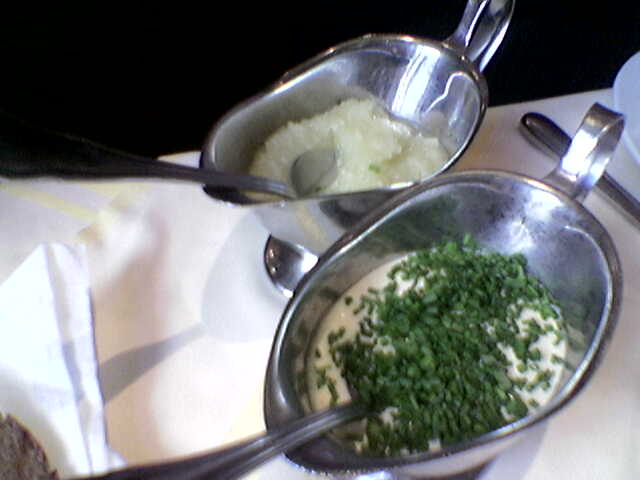
A quick whip around the internet shows me that my wife is not the only one to have stumbled onto this use of mint. Martha Stewart, no less, offers a recipe where the tomato sauce contains mint. I throw in a picture from another recipe – readers are going to have to take it on faith that the little green bits in the sauce are finely chopped mint leaves.
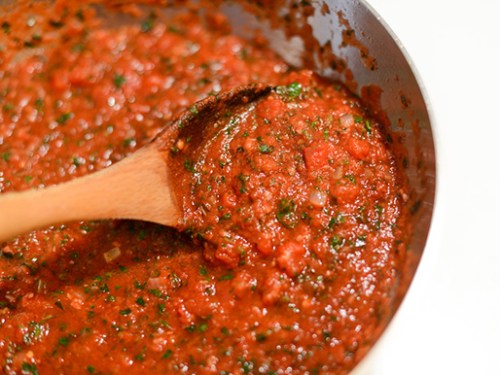
tomato-mint sauce

One thread in these posts of mine has been to salute the humbler ingredients in our food, those which never get much publicity but are actually the ones that make each of our dishes so special. I’ve written on lemongrass recently, and capers and anise a while back (and, at the other end of the spectrum, I’ve written very disapprovingly about the use of hot spices). So I will use this occasion to also sing the praises of mint, reviewing some of its better uses in food.

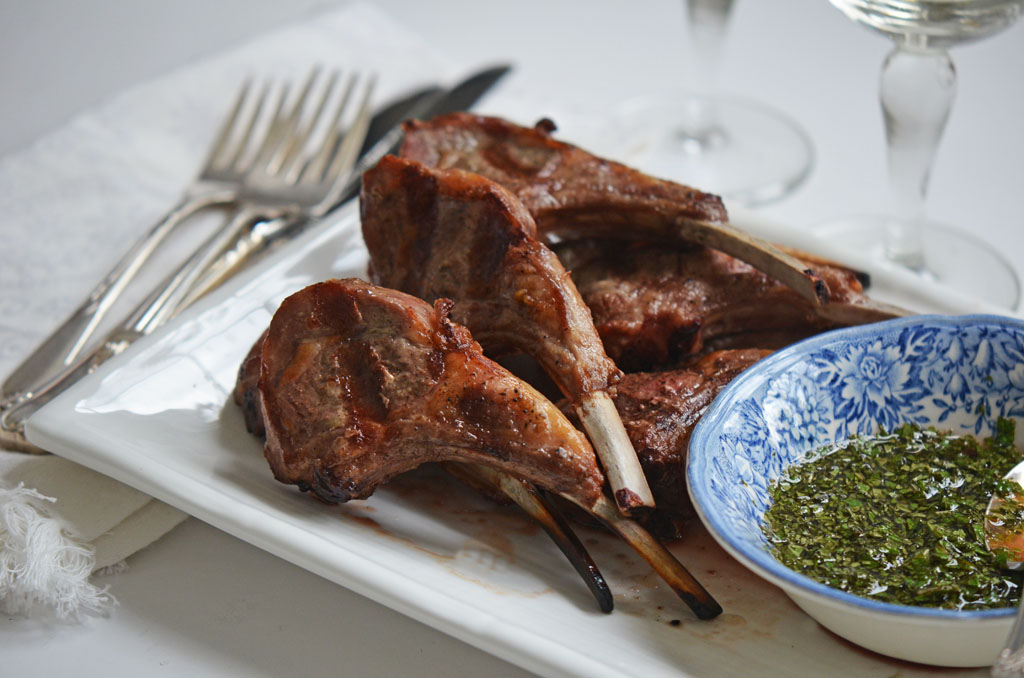
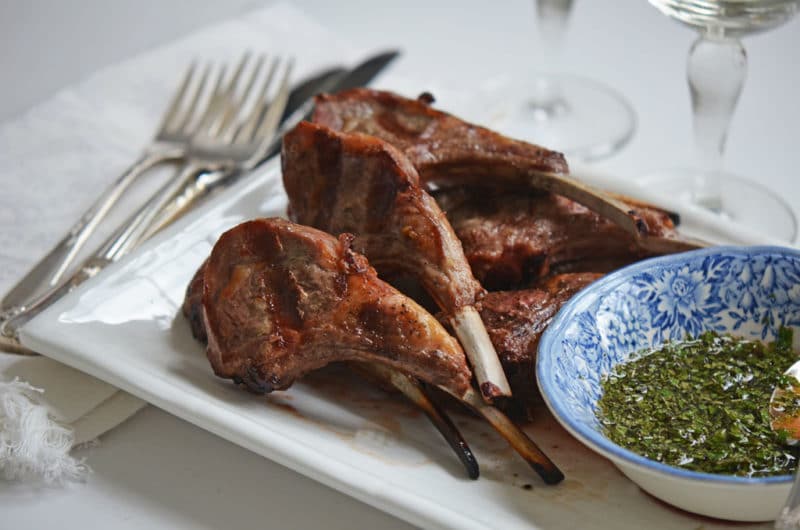
As I usually do, I began surfing around the internet to see what I could find. I was surprised to not come across a huge use of mint, at least in my part of Europe (Western Europe, to use the Cold War parlance). Of course, there is that most English of dishes, mint sauce, a wonderful, wonderful sauce to put on lamb chops. But this dish has already been the subject (or one of the subjects) of a previous post, in which I sing the praises of the sweet-and-salt combination, so I don’t feel I can go on about it again. I will leave readers to refer to that post and move on – but not before throwing in a picture of mint sauce with lamb chops.
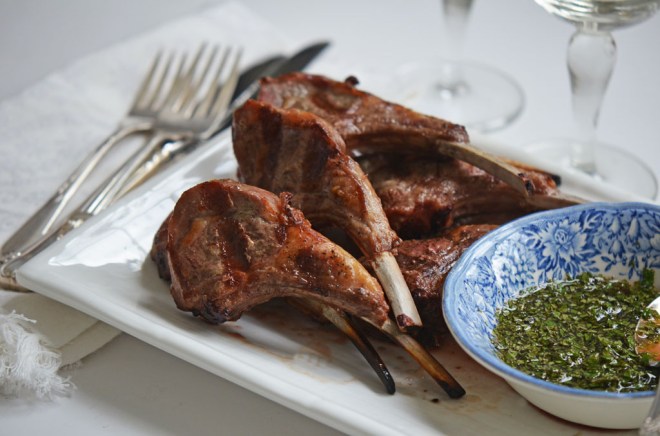
lamb sauce and lamb

In my electronic wanderings, I stumbled across the following dish, which also seems incredibly English – at least, it involves peas, and since peas are in my mind as English as Big Ben or HM the Queen (one of the veggies in every meat and two veggies which I had in my youth seemed to be peas), I include it. We are talking of pea soup with mint (I give thumbnail recipes for this and other dishes that I mention at the end of the post).
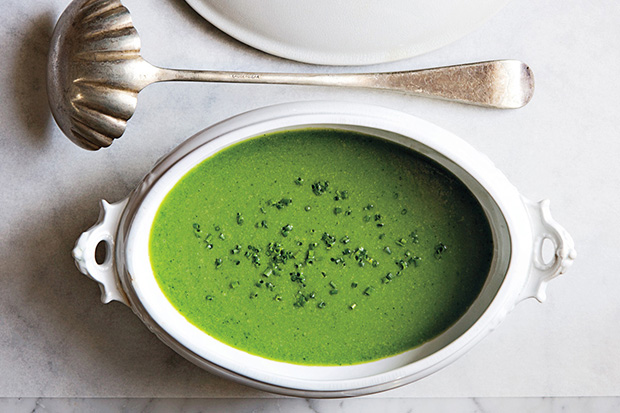
pea and mint soup

I have a feeling that this soup would be good chilled, like gazpacho.

I also want to add here another dish that I came across as I went around raising electronic rocks to see what was hidden below them. It’s actually an eggplant dish from 16th Century Italy. I add it because I think it’s kind of cool to look at what our ancestors were eating. But it’s also an intriguing dish because it looks to be an ancestor of the modern dish we know as eggplant parmigiana. The big difference between the two is the absence of a tomato-based sauce in the old recipe. I suppose this difference reflects the fact that tomatoes were not yet current in Italian cuisine in the 16th Century. Instead, a mix of herbs (mint, sweet marjoram, salad Burnet, parsley, fresh fennel tips), crushed garlic, a couple of spices (cinnamon and cloves), pepper, and salt, are spread over the eggplant, and the whole is splashed with verjuice (I will let readers look that one up, as I had to) and sprinkled with sugar. Then, like eggplant parmigiana, cheese is spread over the whole. Here’s what it looks like, and the thumbnail recipe is at the end.

pomi sdegnosi

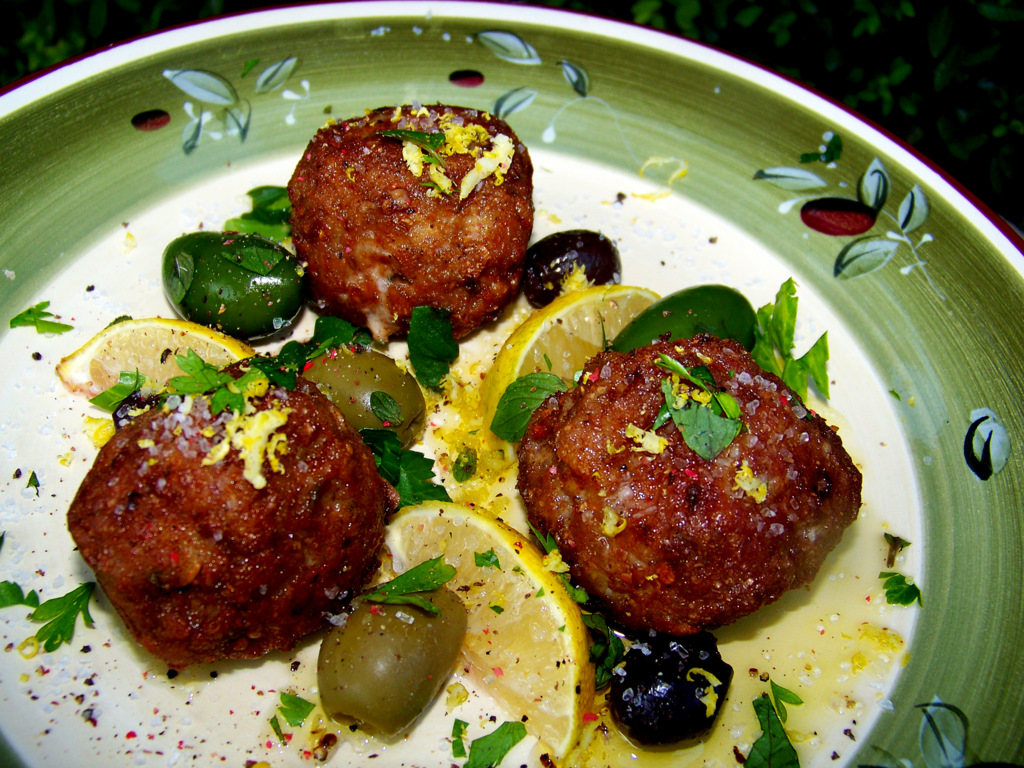
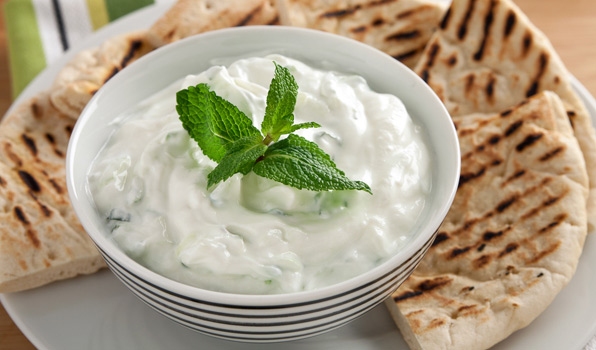
It was at this point that luck came to the rescue. As I was surfing disconsolately around the internet, I came across an interesting article entitled “Mints in Ethnic Cuisines”, written by two ladies from Texas, Madalene Hill and Gwen Barclay. I am indebted to them for much of what follows. It was they, for instance, who taught me that Greek cuisine bucks the (modern?) European trend of using little mint. It seems that Greeks use mint with wild abandon in their cuisine. The two authors mention several dishes in particular: keftedes meatballs, the yoghurt-based tzatziki sauce, the bean stew gigantes plaki, dolmas (stuffed grape vine leaves), hortopita, which is a vegetable and rice pie; even that best known of Greek dishes, moussaka, has mint in it! I give thumbnail recipes of all these dishes at the end, but here I will only post pictures of keftedes meatballs

keftedes

which can be served with the yoghurt-based tzatziki sauce as a dip

Tzatziki

I chose to put pictures of these two dishes with the hope that my wife (and I) can try to make them …

I now leave Europe behind, skimming over the waves of the Aegean Sea to the land of Lebanon, because I want to raise a cheer for that most Lebanese of dishes, tabouleh.
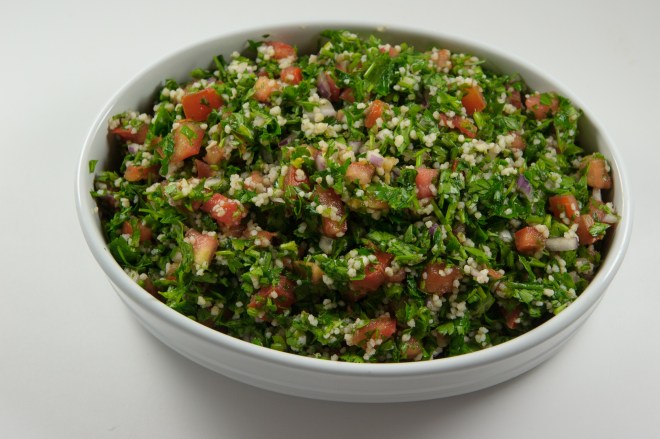
tabouleh

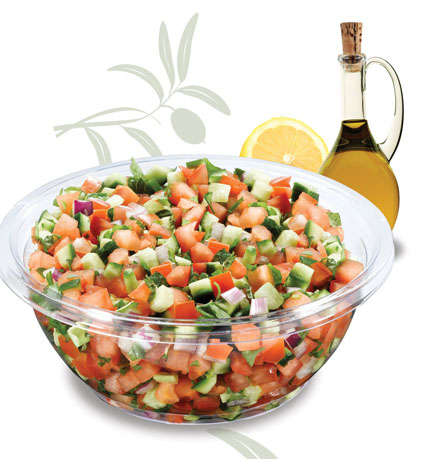
I have very fond memories of eating tabouleh in Beijing – yes, Beijing. There was a little Lebanese restaurant down the road from where we lived, run by a small, tubby Lebanese man with a twinkle in his eye. When Spring came rolling round, it was incredibly pleasant for my wife and I to sit outside the restaurant, under the barely budding trees, in the tepid heat of the midday sun, slowly working our way through a plate of tabouleh. I must say, though, I’m a little surprised that not only chopped parsley but also chopped mint is added. I’m not sure that our tubby Lebanese restaurateur was putting mint in his tabouleh. I will need to hunt down a restaurant which serves tabouleh with both mint and parsley. While I’m at it, I will also see if it serves Arab or Middle-East salad.

arabic-saladLemon segments, diced cucumber and tomatoes, the whole mixed with chopped onions, mint, and parsley. Sounds sooooo good …

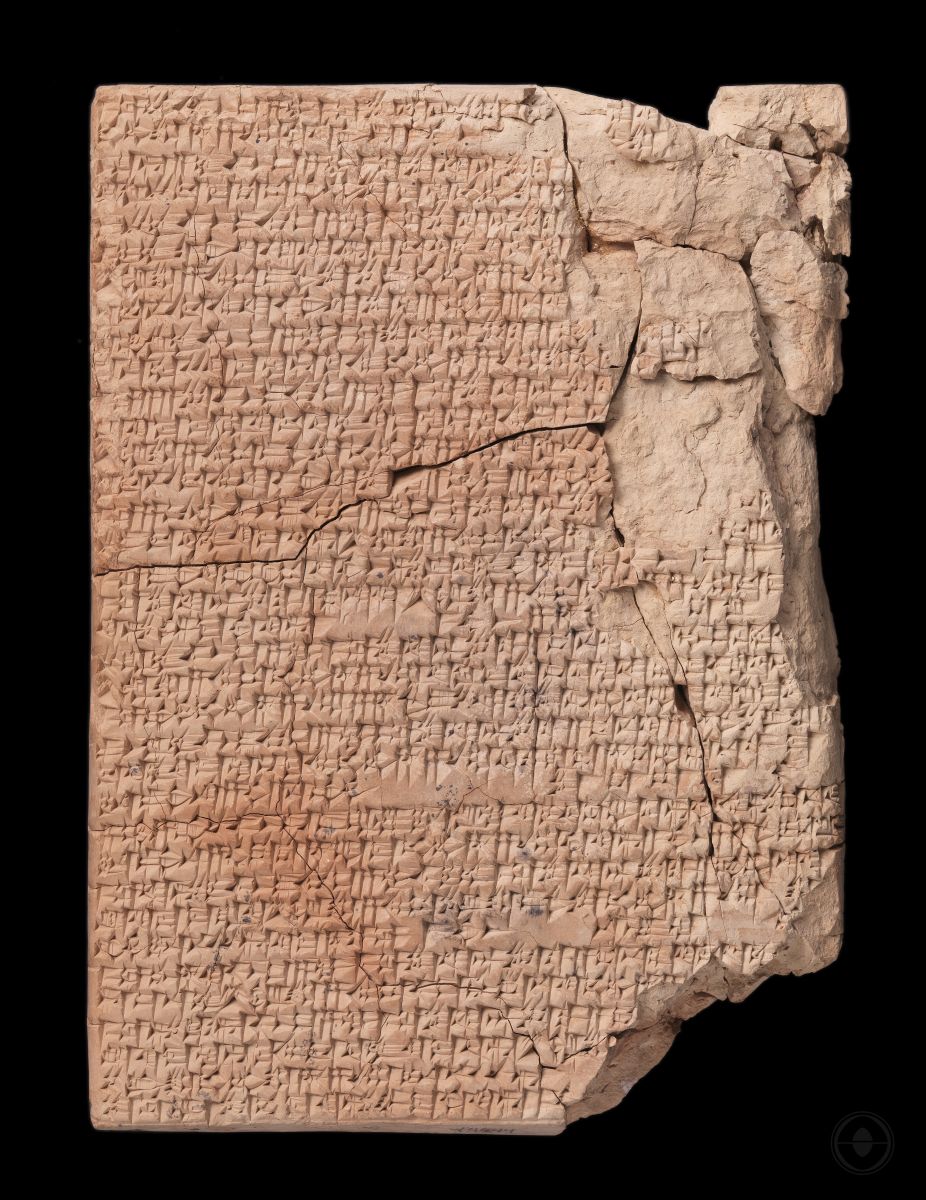
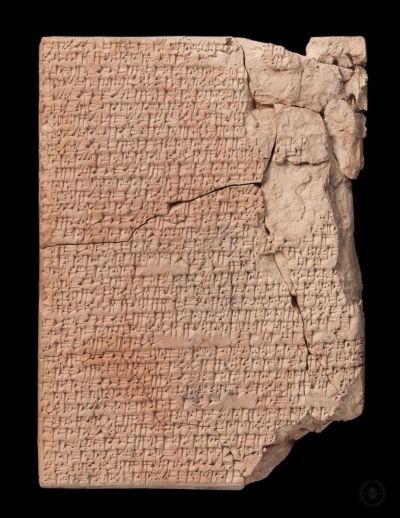
I now want to arc over to the Indian subcontinent, but not before pausing for a minute in modern-day Iraq. I’m actually stopping here for Iraq’s Babylonian past. Like any self-respecting university, Yale University has a collection of cuneiform tablets, some of which, like this one, list recipes.
YBC4644

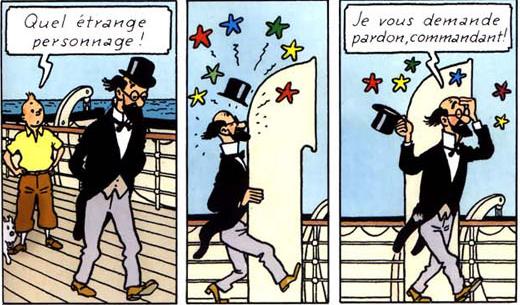
These have been translated by a Frenchman, Jean Botéro (this immediately makes me think of the Egyptologist, Professor Philémon Siclone, in the Tintin album “Les Cigares du Pharaön”
egyptologue-siclone-jpg

but I digress).

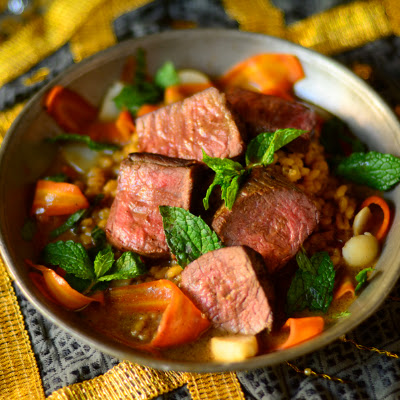
One of these, Recipe XXIII, contains mint, to whit: “Leg (of mutton) (?) meat is used. Prepare water; [add] fat […] samidu, coriander (?), cumin (?), and kanašû. Assemble (all the ingredients in the cooking vessel) and sprinkle with crushed garlic. (After cooking,) blend into the pot šuhutinnû and mint […]” As you can see, words are missing, the translation of some of the ingredients is unknown, and to make matters worse the recipe is exceedingly brief compared to our modern ones, leaving much to the skill – and imagination – of the cook. Nevertheless, Laura Kelley and a band of hardy cooks have been piecing together these telegraphic recipes from 4,000 years ago and trying them out. Many of the results are described on the web site “The Silk Road Gourmet”  I post here the picture of a modern take on Recipe XXIII, after someone concluded that šuhutinnû is probably carrot or possibly parsnip, and samidu is barley:

babylonian lamb and mint

I have added the modern version of the recipe to the thumbnail recipes below, for those who might want to try connecting gastronomically with our remote Babylonian ancestors.

After that pit stop in the fertile crescent, we go on to the Indian subcontinent, the land of chutneys – not so much the fruit-based chutneys which the colonial Brits brought back to the UK, but more vegetable-based chutneys. Here is a chutney, mint-coriander chutney, where mint takes pride of place.

mint-coriander chutney

One of the recipes I perused helpfully informs the reader that this chutney can be served with pakoras, samosas, chaat, chole, or even potato chips.

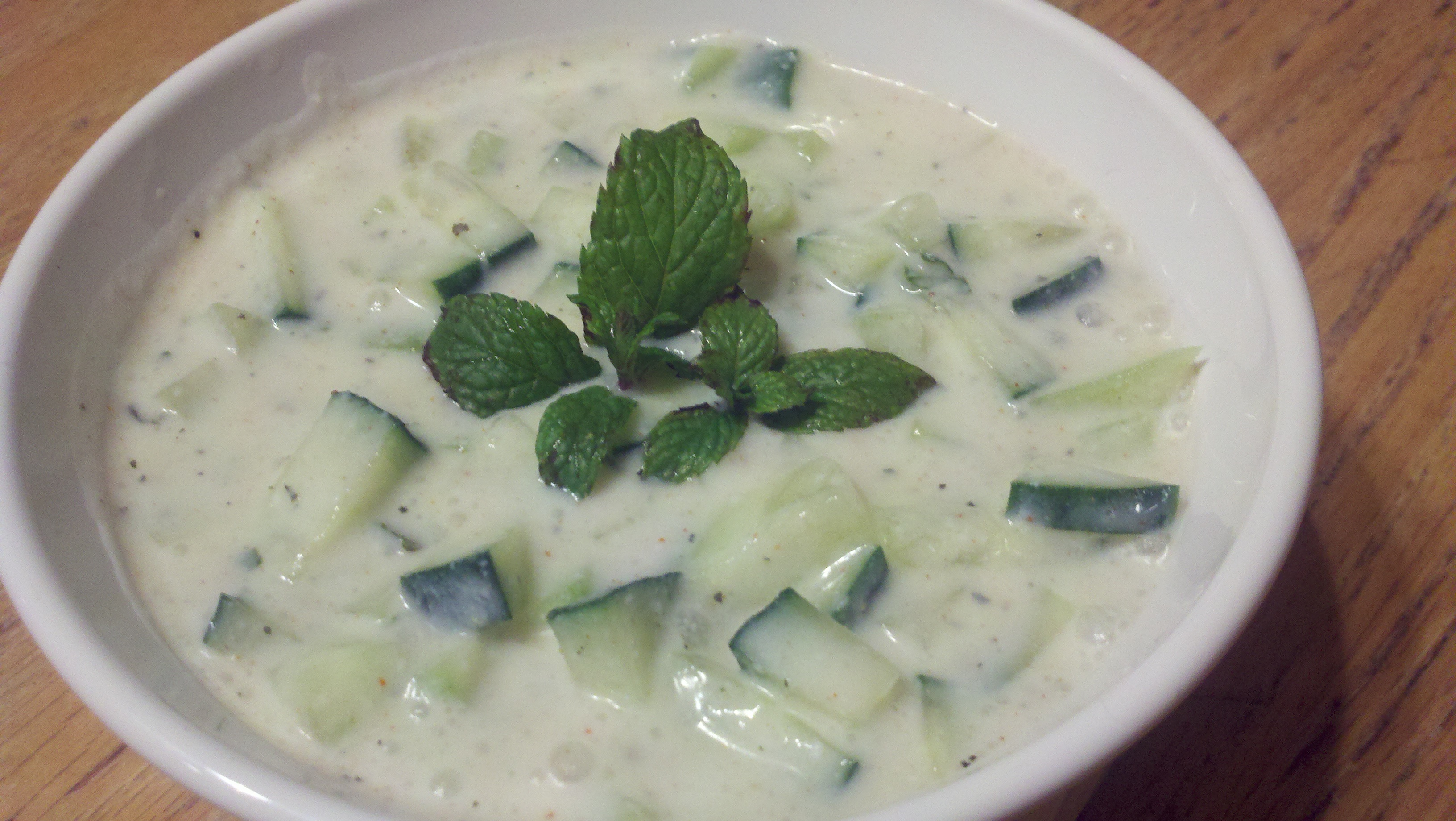
This chutney allows me to segue smoothly into another popular dish from that part of the world, raita, a cold yogurt condiment served to cut the heat of spicy dishes. And here I will throw in a picture of a cucumber-mint raita (with thumbnail recipe at the end).

cucumber-mint raita

Being based on yoghurt (or strictly speaking curds) and looking at how raitas are made, I have to think that they are (perhaps not so) distant cousins of the Greek tzatziki (which itself is part of a broader family of yoghurt-based dishes to be found from the Balkans to the Caucasus). Maybe one day I should write a post on yoghurt …

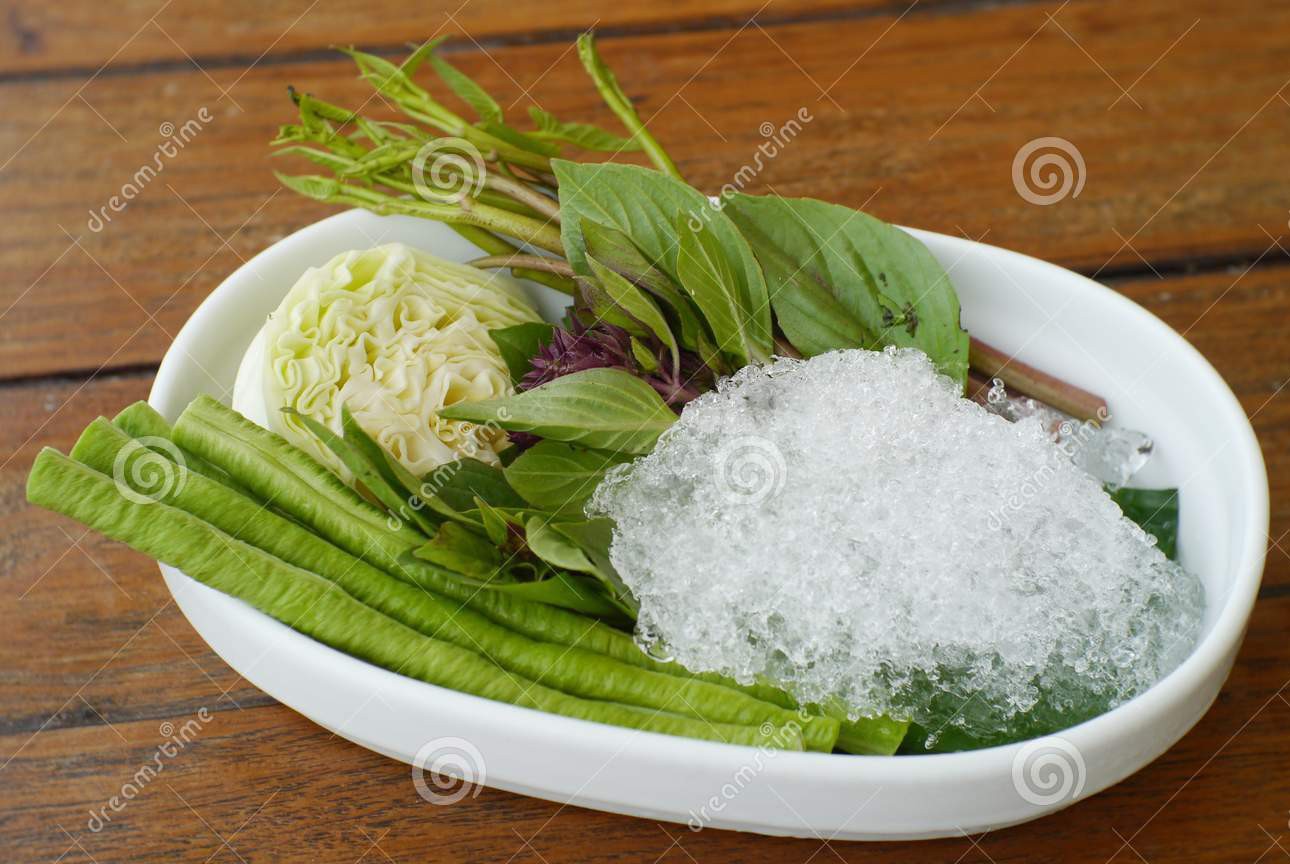
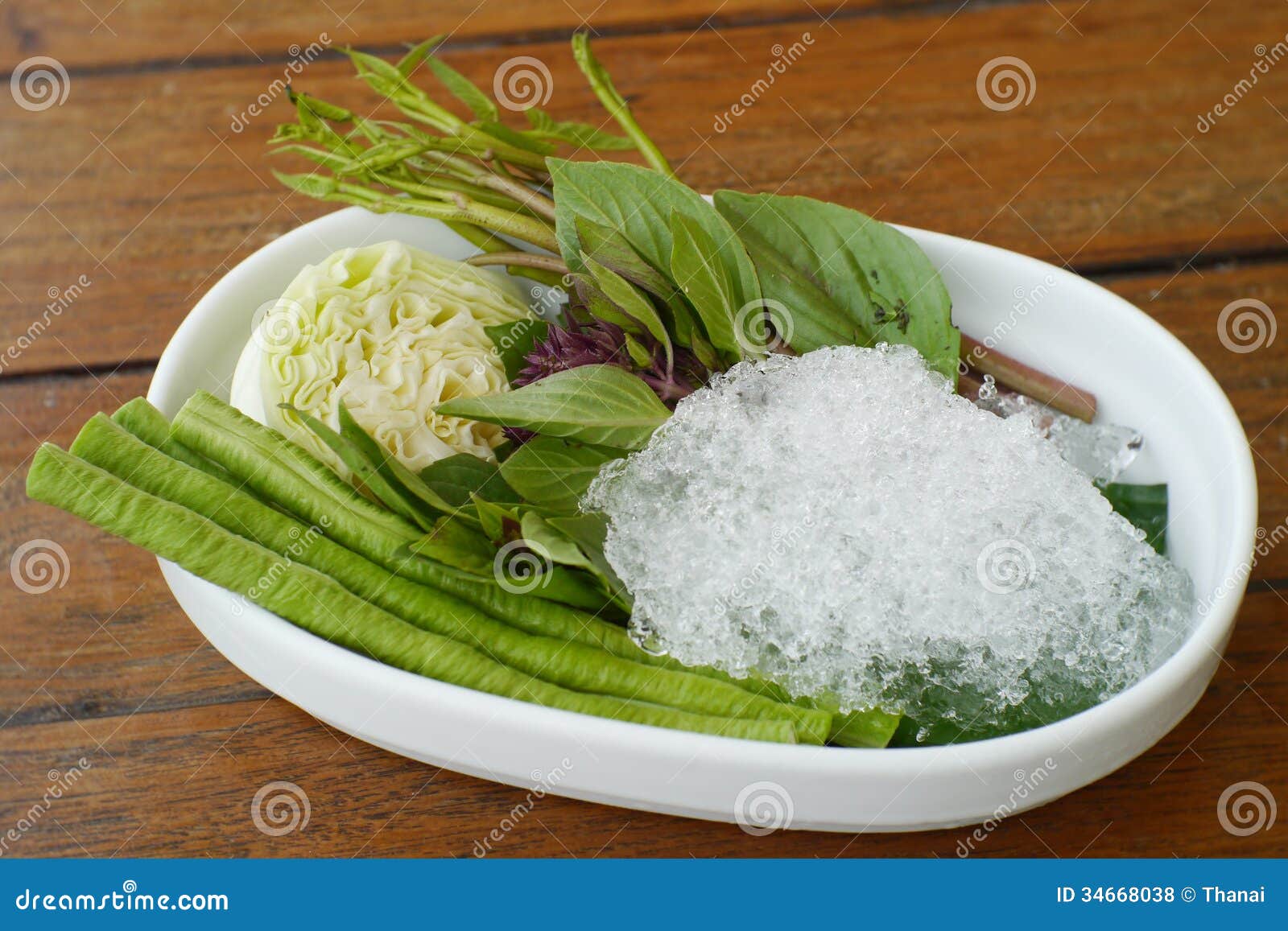
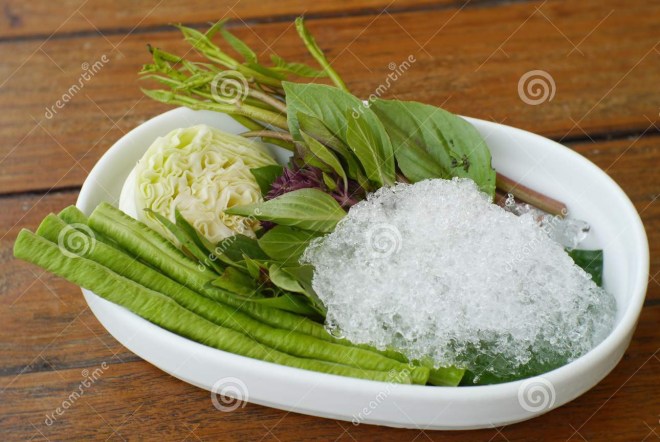
After this, I soar over the Bay of Bengal back to Thailand. Madalene Hill and Gwen Barclay say that mint is a very popular ingredient in Thai cuisine and in South-East Asian cuisine more generally. Certainly, I recently had a taste of a common use of mint here, where it joins a number of fresh vegetables being served as a side dish to be added to noodle dishes or just eaten along with other main dishes.
side dish fresh vegetables

We were saying bye-bye to a colleague and had lunch together in the office. The food was ordered from outside. My Thai colleagues informed me that most of the dishes I was trying were from the north of the country. I found it interesting to eat fresh mint leaves with some of the spicier dishes. This side dish of fresh vegetables is also common in Vietnam, and I suspect throughout South-East Asia.

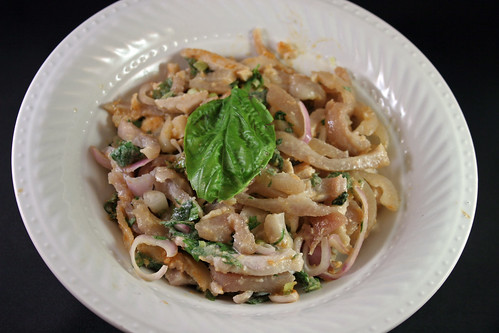
I’ll finish with a dish from Thailand, yam nang mu (pork skin salad). This is actually one of many Thai “salads” in which various cuts of meat or offal are sliced small, seasoned with spicy/sour/sweet sauces, and then mixed with herbs of one variety or another. In this particular case, you season boiled, defatted pork skin (there is a cousin to this dish using pig’s ears) with fish and shrimp sauce, lime juice, sugar, and mix it all with a large amount of mint leaves, some lemongrass, some roasted rice, and a number of other ingredients (thumbnail recipe at the end).

pork skin salad

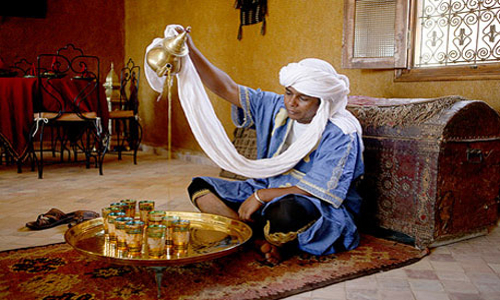
Well, that brings me to the end of my world tour following the trace of mint. There are a lot of dishes which use mint that I’ve not mentioned. I’ve also not touched on the use mint in drinks, for instance Moroccan mint tea with its spectacular pouring technique

moroccan mint tea

or the somewhat more alcoholic mint julep, a favourite of the Kentucky Derby.

mint julep

But I’ll leave these for another day. Right now, my wife is looking at her watch and at the door. Time to go.

THUMBNAIL RECIPES

Pea and mint soup: Soften some onions in a heavy pot over medium heat. Add broth and bring to a boil. Add peas, reduce heat, and simmer gently until tender. Add chopped mint leaves (and parsley if you want). Add more broth. Purée in a blender until smooth. Season with salt and pepper.

Pomi sdegnosi, or braised eggplant: Slice the eggplant lengthwise and let them steep in in lukewarm water for 30 minutes. Rinse. Submerge the eggplant slices in boiling water for about 8 minutes. Remove and drain. Dredge the eggplant slices in flour and layer the bottom of an oiled dish. Chop all of the herbs – fresh mint, marjoram, parsley, salad Burnet, fennel tips – and mix them with minced garlic, spices – cinnamon, cloves, pepper – salt, sugar, and verjuice (for which lemon juice can be substituted). Cover the eggplant with breadcrumbs, drizzle with olive oil, cover with herb/spice mixture and then with provatura cheese (mozzarella, another pulled cheese, can be substituted). Repeat for each layer of eggplant. Bake in the oven for 30 minutes. (Adapted from http://atasteofhistorywithjoycewhite.blogspot.com/2014/08/to-braise-eggplant-historic-food.html)

Keftedes: Combine ground beef, bread dunked in milk, minced onion, minced garlic, finely chopped mint and oregano, some vinegar, some beaten eggs, a small amount of grated nutmeg, salt, and pepper, and mix well. Roll the mixture into balls. Dust the balls with flour. Put them in hot oil in a pan. Brown on all sides.

Tzatziki: Peel cucumbers and dice. To draw out their water, sprinkle them with salt and let them sit for 30 minutes. Drain well. Put them in a blender, along with minced garlic, some lemon juice, some chopped mint (and some chopped dill if you wish), and a little ground black pepper. Process until well blended. Stir the result into Greek yogurt. Salt to taste. Let it stand for at least two hours before serving so flavours can blend.

Gigantes Plaki: Soak gigantes beans (giant butter beans) overnight. Cover with fresh water and bring to the boil. Simmer for a couple of hours until the beans are just tender. In parallel, gently soften chopped onions and garlic for a few minutes. Then stir in some sweet paprika, tinned tomatoes, 100ml water. Salt and pepper. Bring to the boil, then simmer for half an hour. Stir in sea kale or dandelion leaves (or chard as an alternative). Mix the cooked beans with the sauce, adding some more olive oil and chopped mint and parsley. Transfer to a casserole pan, and bake for half an hour or so until the beans are tender and the sauce thickened and bubbling. Can be served hot, warm or at room temperature.

Dolmas: In a little broth, mix ground beef and lamb with uncooked rice, minced onion and garlic, some pine nuts, chopped mint and parsley. Place rinsed grape leaves on a work surface. Place a dollop of the mixture at the center of each leaf. Tuck in the ends and roll tightly toward the leaf point. Layer the wrapped leaves in a large saucepan Cover them with broth mixed with lemon juice. Cook over low heat for three-quarters of an hour.

Moussaka: Place minced lamb, minced onions, crushed garlic, chopped mint and oregano, a couple of bay leaves and a cinnamon stick in a large frying pan and cook over a medium heat for a quarter of an hour. Stir in some flour. Add a glass of wine, canned tomatoes, some tomato purée, and bring to a simmer. Cook for half an hour, until the lamb is tender and the sauce has thickened. Season with salt and freshly ground black pepper to taste. Set aside this meat sauce. Fry eggplant slices for a couple of minutes. Set them aside. Cook potatoes in boiling water for five minutes, then cool under running water. Prepare a white sauce as follows. Melt butter in a saucepan, stir in some flour. Cook for a few seconds, then gradually stir in milk. Add some grated parmesan and grated nutmeg. Simmer the sauce gently for 5 minutes. Season to taste with salt and pepper. Remove from the heat and stir in a beaten egg. Spoon some of the meat sauce into a shallow dish. Cover with a layer of potatoes and a layer of eggplant. Repeat the layers twice more, finishing with the eggplant. Pour over the white sauce to cover the whole in a thick, even layer. Sprinkle with a bit more parmesan. Bake in the oven until deep golden-brown and bubbling.

Hortopita: Peel, seed, and shred some pumpkin. Weight it to drain its liquid. Cook it in a skillet until it wilts and most or all of its liquid has evaporated. Transfer to a bowl. Cook in the same skillet a chopped leek and onion until also wilted. Transfer to the bowl with the pumpkin. Cook chopped chard and spinach until wilted; add to the bowl. Add the herbs – mint, sorrel, hartwort, chervil, dill, fennel leaves, parsley, and oregano – to the bowl. Season to taste with salt and pepper. Roll out a first phyllo dough ball and place it inside an oiled roasting pan. Brush with olive oil. Repeat with the second piece of dough. Spread the filling evenly over the dough. Repeat with a third sheet of dough, placing it over the filling. Brush with olive oil. Roll out the last piece of dough to a slightly smaller piece, and place it over the surface of the pie. Join the bottom and top layers of dough. Brush the top of the pie generously with olive oil. Bake until the pastry is golden and crisp. Remove and serve warm or at room temperature.

Tabouleh: Stir together some bulgur and olive oil. Pour boiling water over, and let stand for a quarter of an hour. Drain well. Toss with finely chopped mint and parsley, a couple of chopped tomatoes, half a cucumber, several tablespoons of lemon and of olive oil. Season with salt and pepper.

Arab salad: Cut segments from half of lemon free from membranes and transfer segments to a cutting board, then squeeze juice from the remaining half a lemon into bowl. Put a couple of tablespoons of lemon juice in a bowl. Add finely chopped segments of lemon. Add salt, pepper, and several tablespoons of olive oil. Whisk to combine. Stir in the remaining ingredients: diced cucumber and tomatoes, finely chopped onion, finely chopped mint and parsley.

Babylonian lamb with barley and mint: Marinate lamb steaks in soy sauce for half an hour. Sauté in oil, along with the trimmings. Remove, leaving the trimmings in the pan. Stir barley into the oil and toast for a few moments. Add cumin, coriander, and chopped garlic. Simmer until the barley is cooked. Place the lamb steaks in the pan and cook the desired degree. Add finely sliced carrots and chopped mint for a few minutes. Remove the lamb and slice. Place the carrots in a serving dish, spoon the barley over carrots, add the sliced lamb, and spoon over with the sauce. (adapted from http://lostpastremembered.blogspot.com/2011/07/onions-onions-everywhere.html)

Mint-coriander chutney: In a blender, grind together chopped mint leaves, chopped coriander, a chopped green chili (personally, I would cut out the chili, but can it be Indian without it?), a piece of ginger, a small amount of cumin, and some lemon juice, until smooth, using a little water if necessary. Salt to taste.

Cucumber-mint raita: Coarsely grate a cucumber. Squeeze dry. Whisk curds (yogurt can substitute), chopped mint, a little cumin, even less cayenne pepper in medium bowl to blend. Add cucumbers and mix well. Season to taste with salt and pepper.

Yam nang mu (Pork skin salad): Boil pork skin until soft. Cool. Remove any fat from the skin. Slice the skin into thin, short slices. Mix well with a large handful of chopped mint leaves, finely minced lemongrass, lime juice, fish sauce, palm sugar, and ground roasted rice.

_______________________________

Tomato-mint sauce: http://www.seriouseats.com/images/2013/03/20130302-242913-tomato-mint-sauce.jpg (in http://www.seriouseats.com/2013/03/sauced-tomato-mint-sauce.html)
Mint sauce and lamb: http://www.maureenabood.com/wp-content/uploads/2012/03/Grilled-chops-platter-POST.jpg (in http://www.maureenabood.com/2012/03/29/grilled-lamb-lollipops-with-fresh-mint-sauce-chine-on/)
Pea and mint soup: http://www.epicurious.com/images/recipesmenus/2013/2013_april/51154900.jpg (in http://www.epicurious.com/recipes/food/views/minty-pea-soup-51154900)
Pomi sdegnosi: http://i.ytimg.com/vi/MgcFEo-S8WI/hqdefault.jpg (in https://www.youtube.com/watch?v=MgcFEo-S8WI)
Keftedes: https://rencooks.files.wordpress.com/2009/11/100_4063.jpg (in http://ediblearia.com/2009/11/05/lamb-keftedes/)
Tzatziki: http://www.cbc.ca/inthekitchen/assets_c/2012/02/Tzatziki4563-thumb-596×350-174210.jpg (in http://www.cbc.ca/inthekitchen/2012/02/tzatziki-sauce.html)
Tabouleh: http://almarahgrill.com/wp-content/uploads/2015/06/tabouleh.jpg (in http://almarahgrill.com/product/tabouleh/)
Arabic salad: http://suzyeats.com/wp-content/uploads/2011/05/arabic-salad.jpg (in http://www.snipview.com/q/Arab_salad)
Cuneiform tablet YBC 4644: http://babylonian-collection.yale.edu/sites/default/files/images/New%20Images/YBC4644_OBV_0004.jpg (in http://babylonian-collection.yale.edu/highlights)
Egyptologist in Tintin: http://s1.e-monsite.com/2009/04/06/06/46230270a-siclone-jpg.jpg (in http://univers-tintin.e-monsite.com/pages/les-personnages/philemon-siclone.html)
Babylonian lamb and mint: http://1.bp.blogspot.com/-h-K2nSXnfys/TiNFcYNVuzI/AAAAAAAACSI/5JHqnYlNzv4/s400/DSC_2266.JPG (in http://lostpastremembered.blogspot.com/2011/07/onions-onions-everywhere.html)
Mint-coriander chutney http://crumbsandtales.com/wp-content/uploads/2013/07/Hari-Green-Chutney-made-with-cilantro-and-mint-21.jpg (in http://crumbsandtales.com/mint-and-coriander-chutney/)
Cucumber-mint raita: https://familynaturally.files.wordpress.com/2012/02/2012-02-26_19-55-59_782.jpg (in https://familynaturally.wordpress.com/2012/02/26/raita-yogurt-with-cucumber-and-mint/)
Side dish fresh vegetables: http://thumbs.dreamstime.com/z/side-dish-vegetable-thai-restaurants-you-see-serves-hot-spicy-food-e-g-som-tam-green-papaya-salad-34668038.jpg (in http://www.dreamstime.com/royalty-free-stock-photos-side-dish-vegetable-thai-restaurants-you-see-serves-hot-spicy-food-e-g-som-tam-green-papaya-salad-image34668038)
Pork skin salad: https://c2.staticflickr.com/4/3038/3047383176_dbdea9103c.jpg (in https://www.flickr.com/photos/jakeslagle/3047383176)
Moroccan mint tea: http://lcmt.topdesert.com/content/photos/travel-guide/authentic-culinary-experiences/pouring-your-mint-tea-without-spilling-a-drop//lowcost-morocco-travel-pouring-your-mint-tea-without-spilling-a-drop1.jpg (in http://lcmt.topdesert.com/index.php?ref=ait-ben-haddou-and-ouarzazate-one-day)
Mint julep: http://ccattache.com/wp-content/uploads/2014/04/k17_18865809.jpg (in http://chuckcowdery.blogspot.com/2015/04/brown-forman-has-kentucky-derby-locked.html)
TOUCHING MY TOES

Bangkok, 2 August 2015

In a previous post I have mentioned the physical exercise programme which we are currently in the thick of. When I wrote it, I was discouraged by the apparent lack of progress. But now things are better. We haven’t left that vale of tears so dear to the writers of the Psalms, and probably we never will leave it – no pain, no gain, as Jane Fonda used to trill in her workout videos of the 1980s. But we are definitely out of the darkest section of the vale, and our wails and lamentations are not so shrill as they used to be.

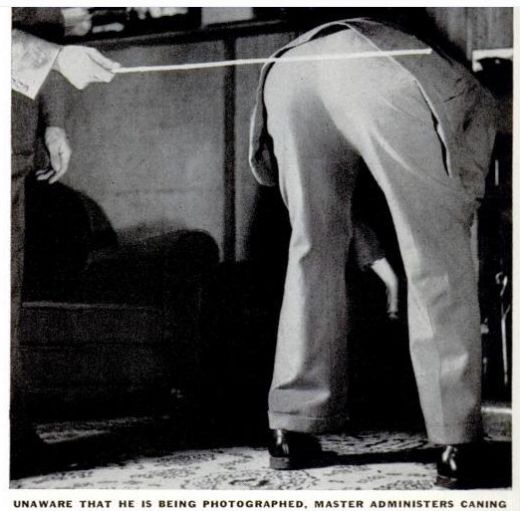
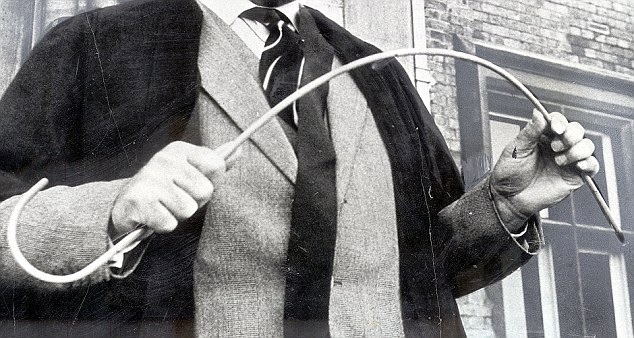
However, there is one stretching exercise which defeats me still: touching my toes. It has always defeated me. I can never remember a moment in my life when I could touch those damned toes of mine. And as I strain and heave to touch them, with our trainer urging me on but my hamstrings and every other string and tendon and muscle in my legs screeching to me not to continue, I hear in my memory another voice urging me on, that of Mr Mortimer, the Headmaster at my boarding primary school (prep school in English parlance). This was on those occasions when he was caning me, and I had to bend down in his study to receive “six of the best” (six strokes) or, more rarely, three of the best – I was a rather naughty boy. I was ten-eleven, as I recall.

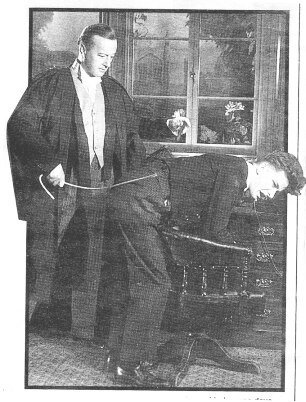
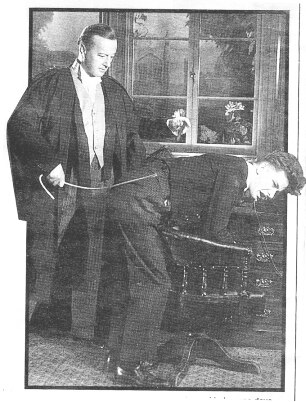
The administration of the caning was done rather ceremoniously. The boys who were to be caned would get in a nervous, muttering line at the study door at the required time (after lunch, I think), and we would be called in one after the other. The Headmaster would remind you of the crime committed, state once more the number of strokes you would receive for said crime, and then invite you to stand in one particular place, and bend down and touch your toes (“Come on, boy, you can bend down further than that!” was always what I would then hear at this juncture).
image
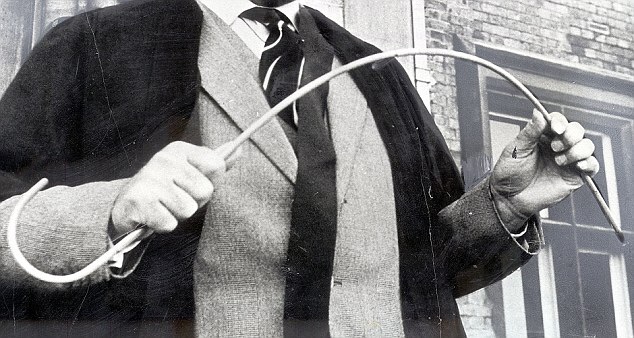
Mr Mortimer used this kind of cane, thin and flexible
image
One of my pals, Glover was his name (after all these years I still remember it … but not his first name; we called each other by our surnames), stole this cane as a memento at the end of our final term. Mr Mortimer hauled me in (I was Head Boy) and threatened to cane me with his spare if I didn’t have the original restituted. I leaned on Glover …

In any event, once you had received the caning, you politely thanked the Headmaster for it (we were English, after all), left the study, and then ran like hell. Running sort of let off the pent-up energy caused by the pain of the caning. I remember that in winter sitting on a radiator after running was also quite soothing. After the pain had dissipated you were normally left with stripes on your bottom, war wounds which you proudly displayed in the communal showers.

All this was happening at a time of great social change and ferment in the UK. We were in the mid-sixties, the Beatles were raging, the Rolling Stones were on the up-and-up, the straightened laces were being loosened: hair was growing, clothes were getting louder, skirts were getting shorter, sex was OK, drugs were coming in from the wild side. Little of this percolated through to us in primary school, buried as we were in the depths of Somerset, but when I moved to my boarding secondary school (public school in English parlance) in 1967, I found the winds of change blustering their way down the school’s corridors. Just as a small example, in my first year the Head of School would march around with a phalanx of school monitors, looking grim and army-like. By my third year, the Head of School was a nice, approachable guy who would actually smile. And beating (not caning; since we were now bigger, a bigger, thicker stick was used), which was already rare when I arrived, vanished within a few years.

But not before I was beaten! I believe I and my pal Mike Wallace (another sign of the changing times; we now called ourselves by our first names) were the last boys in the school to be beaten. It was 1969, maybe 1970. In brief, we were caught sneaking back into school with a bottle of wine which we had bought at an off-license even though we were underage. But that wasn’t why we were beaten. Our real crime was that we had skipped a meeting called by the Headmaster for all exam sitters; it had been especially emphasized that there were to be no excuses for not attending. Our Housemaster was instructed to administer the punishment. He beat Mike and me with a swagger stick, one of those things which British officers would tuck under their arm and … well, swagger about with.
image
This is what the stick looks like closer up.
image
I didn’t have to touch my toes this time. An armchair was thoughtfully placed against the bookshelf whose arms we grasped as we leaned over.
imageWe got four strokes as I recall. And of course we politely thanked our Headmaster at the end.

That was my last brush with corporal punishment.

Was I psychologically scarred by my canings and beatings at school? Honestly, I don’t think so. They were not administered in a sadistic, or even in a cruel or vindictive, way. They were not administered in public. They were for crimes truly committed, so they were not unfair. The pain was neither intense nor long-lasting. They were on a par with punishments I received at home – my father used to beat me with a wooden metre ruler when I was extra-naughty as a small child, which seems to have been quite often. But, when I’m there, straining and heaving to touch my damned toes, urged on by our trainer, those memories of the little me bending over to receive my canings do come flooding back, along with the butterflies which fluttered in my stomach during the final moments before the cane came swishing down.

_________________

Caning: http://usercontent2.hubimg.com/2456657_f520.jpg (in http://wordperfect.hubpages.com/hub/Why-I-Am-For-Caning-Children-Forever)
Cane: http://1.bp.blogspot.com/-aS6kKXlL6VA/U1htg4LgSII/AAAAAAAAAFI/WPW3oZATxEM/s1600/article-2455291-0019D14100000258-114_634x338.jpg (in http://zainal-1932.blogspot.com)
Officer with swagger stick: http://www.alldressedup.net/wp-content/uploads/2012/10/img336-Copy1.jpg (in http://www.alldressedup.net/costume-list/halloween/429-2/character-costumes/costume-images/uniforms/british-army-officer/)
Swagger stick: http://usarmy.vo.llnwd.net/e2/c/images/2013/04/25/292553/size0.jpg (in http://www.army.mil/article/101913)
Beating over an armchair: http://www.corpun.com/16283as.jpg (in http://www.corpun.com/uks00508.htm)

TROMPE L’OEIL AND STINGINESS

Bangkok, 27 July 2015

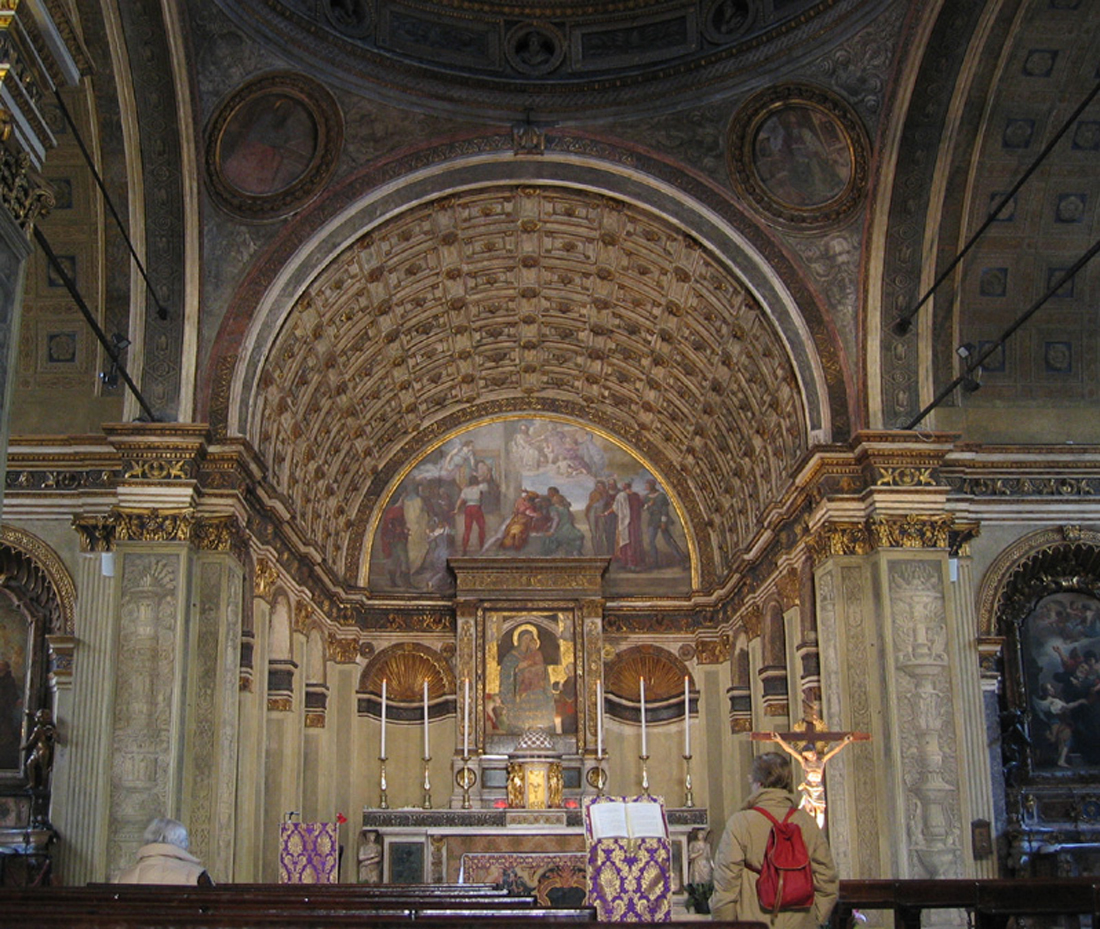
Trompe l’oeil is a very respectable art form, with a long and distinguished presence in the world of art, at least in Western art. I am told that the Greeks and Romans practiced it, although I do not recall ever having seen an example. In any event, artists took it up again with a vengeance during the Renaissance, and art thereafter is littered with pieces which “fool the eye”, tricking the viewer to see three-dimensional depth where there is none. We have a beautiful example just up the road from our apartment in Milan, in the church of Santa Maria presso San Satiro. My not-yet wife took me there on my first trip to Milan in 1975 and my eyes were indeed fooled.
image
What I had taken to be a deep apse behind the altar is actually an almost flat wall. The clever artist in question was Bramante, who painted it in the 1480s. In this case, he didn’t do it just to show how good he was, it was to give a feeling of greater depth to a church which was squeezed in between the adjoining buildings.

I could go on giving other examples from High Art, but actually I want to focus on a lower form of the art found in the province of Liguria. We’ve just come back from spending a week by the sea, near Genova, the province’s capital (and from where I managed to launch several of the previous posts).

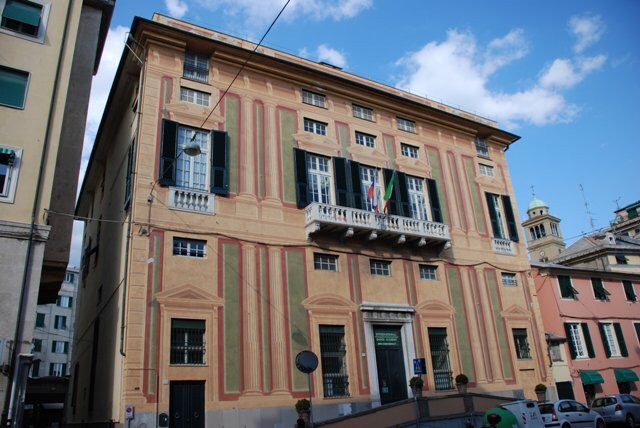
One of my recurring pleasures as I walk the streets of any conurbation in Liguria, from Genova down to the smallest village, is to come across houses like these.
image
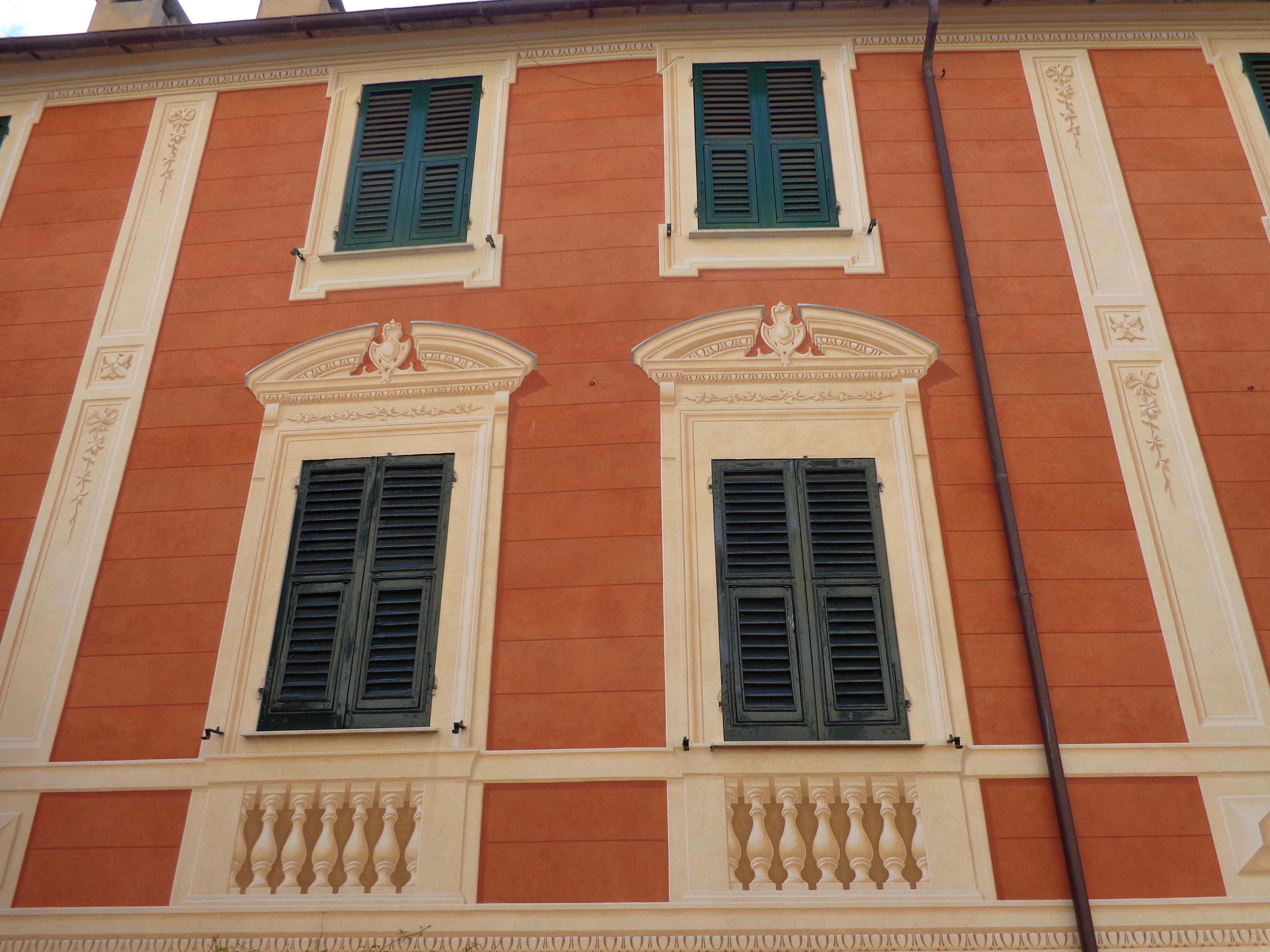
This form of trompe l’oeil is only found in Liguria, to the extent that the practice is almost a D.O.C.. In these cases, the painter (I hesitate to call him artist) embellishes what is otherwise the drab and flat facade of a house (you see an example to the right in the photo) with architectural elements which are painted so cleverly as to fool the eye into thinking that they are three-dimensional and “real”. The result is to make an ordinary house look more imposing, which in the old days no doubt (and perhaps even today) raised the residing family’s social standing a notch or two. It is even a way of making up for unfortunate blemishes in a facade, like the absence of a window which mars the symmetry of a house.
image
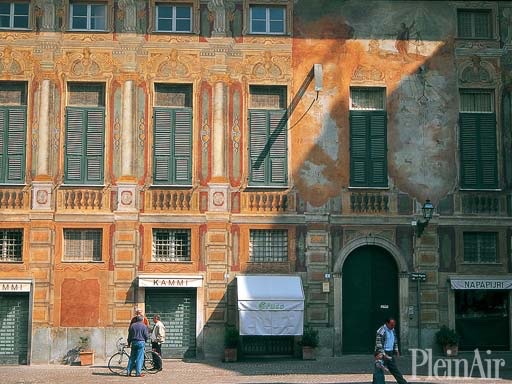
What is nice is to see is examples which run from the fresh and new to various states of weathering and finally decrepitude brought about by sun, rain, and more recently pollution.
image
image
image

image

Of course, one has to ask oneself why this art form is so popular in Liguria and nowhere else. My theory, for what it’s worth, is that it is a reflection of the well-known stinginess of the Genoese (and more generally Ligurians). In Italy, the Genoese have the same reputation as the Scots in England for being tight fisted, and there are loads of jokes about it, as indeed there are in the case of the Scots (“There was an Englishman, an Irishman, and a Scotsman in a pub. The Englishman stood a round, the Irishman stood a round, but the Scotsman just stood around”; sorry, I thought I would just quickly throw that one in). According to this theory, then, the Genoese (and by reflection the Ligurians) preferred to paint architectural elements onto their facades à la trompe l’oeil rather than go with the real things, because it cost them less.

I’m sure the Genoese must feel that this typing of them as scrooges by the rest of Italy is grossly unfair and they probably find it very irritating to be the butt of incessant jokes about it. But as they say, “there is no smoke without fire”. There must surely be some reason why they got this reputation. Curious to see what I could find out, I did an internet search on the topic (in truth, my wife did it since she’s very good at internet searches). Several suggestions popped up. One is that Liguria is in general a very poor land, made up of steep hills and little good agricultural land. People who live in such lands tend to be more careful with their hard-earned wealth scratched out of an unforgiving earth than those of us from richer lands (I’m sure this is the basis for the Scots’ reputation for stinginess). Another suggestion is that the Genoese in particular made much of their wealth in banking (they were the bankers of the Spaniards in the 16th century), and like all bankers got into the habit of not throwing their money around like we foolish non-bankers do. A third, which I like so much that I have adopted it, is a variant on the second (I have to thank Grimaldina, a citizen of Genova, for bringing it to my attention).

In 1586 or thereabouts Philip II, King of Spain, decided that he was going to invade England, to uphold the Catholic cause of course, but also to teach the damned English a lesson for attacking Spanish treasure fleets and shipping more generally. The worst offender was this gentleman, Sir Francis Drake

image

A great Englishman for the English, but nothing more than a damned pirate for the Spaniards.

To invade England, Phillip was going to need a navy, and a big one. As I said, the Genoese were the bankers of the Spaniards, so he came to them for the funds to build the necessary ships. I suspect the King made the Genoese an offer they couldn’t refuse. In any event, after much hesitation because it was a huge amount of money, and no doubt after extracting juicy concessions about trading monopolies for Genova in England once conquered, the Genoese accepted to fund the venture. Thus was built the Spanish Armada, or the Grande y Felicísima Armada, the “Great and Most Fortunate Armada”, as the Spaniards called it. And here, just for the hell of it, I throw in pictures of Philip II and Elizabeth I (it’s clear already from the pictures who’s going to win; I mean, look at Phillip II, have you ever seen such a nasty scowl?)
image

image

Alas, the Spanish Armada was perhaps great but it was not fortunate. After several engagements in the English Channel, where overall the Spaniards got the worst of it
image
the Armada was driven by the winds up into the North Sea, all the way up to Scotland. At that point, the Spanish commander decided to give up and go home. His idea was to round the top of Scotland, head out into the Atlantic, and then turn south. He turned too soon. His remaining ships found themselves too close to the west coast of Ireland, where, hit by terrible Atlantic gales, many were driven ashore. Of the 130 ships which left Spain only 67 limped home. The English cheered, but the Genoese cried; their fortunes had sunk to the bottom of the sea along with the ships. Genova went into a steep economic decline thereafter, from which it never really recovered. Thus was born the Genoese’s parsimony (and not stinginess, as stressed by Grimaldina). Like all great families which fall on hard times, it had to keep up appearances with less money in its pocket: ideal conditions for heavy adoption of trompe l’oeil.

________________

Santa Maria presso San Satiro: https://upload.wikimedia.org/wikipedia/commons/2/27/Sansatiro5.jpg (in https://it.m.wikipedia.org/wiki/Bramante#Santa_Maria_presso_San_Satiro_.281482-1486.29)
Genoese facade-1: http://www.sampierdarena.ge.it/joomla/images/phocagallery/villesamp/litoraneo/pallavicinocreditoitaliano/thumbs/phoca_thumb_l_dsc_0617.jpg (in http://www.sampierdarena.ge.it/joomla/index.php?option=com_content&view=article&id=94:villa-pallavicino-sec-xvi-via-sampierdarena-71&catid=48:litoraneo&Itemid=59)
Fake windows: https://dearmissfletcher.files.wordpress.com/2015/03/finestre-6.jpg (in https://dearmissfletcher.wordpress.com/2015/03/page/5/)
Genoese facade-2: https://timelessitaly.files.wordpress.com/2013/11/20131103-175731.jpg (in http://timelessitaly.me/tag/nervi/)
Genoese facade-3: http://rotellando.vanityfair.it/files/2015/06/IMG_6719.jpg (in http://rotellando.vanityfair.it/2015/06/16/piemonte-10/)
Genoese facade-4: http://cdn.pleinair.it/wp-content/uploads/106011.jpg (in http://www.pleinair.it/meta/viaggi-camper-l-impero-dipinto/)
Genoese facade-5: http://www.liguria.beniculturali.it/getImage.php?id=779&w=100&h=100&c=0&co=1&f=0 (in http://www.liguria.beniculturali.it/index.php?it/136/percorsi-tematici/3/5/3)
Sir Francis Drake: https://en.m.wikipedia.org/wiki/Spanish_Armada#/media/File:Gheeraerts_Francis_Drake_1591.jpg (in https://en.m.wikipedia.org/wiki/Spanish_Armada)
Phillip II: https://en.m.wikipedia.org/wiki/Spanish_Armada#/media/File:Philip_II,_King_of_Spain_from_NPG.jpg (in https://en.m.wikipedia.org/wiki/Spanish_Armada)
Elizabeth I: https://en.m.wikipedia.org/wiki/Spanish_Armada#/media/File:Elizabeth_I_(Armada_Portrait).jpg ( in https://en.m.wikipedia.org/wiki/Spanish_Armada#/media/File:Elizabeth_I_(Armada_Portrait).jpg)
Spanish Armada fighting English ships: https://en.m.wikipedia.org/wiki/Spanish_Armada#/media/File:Invincible_Armada.jpg (in https://en.m.wikipedia.org/wiki/Spanish_Armada)

SOUNDSCAPES OF BRITAIN

Bangkok, 12 April 2015

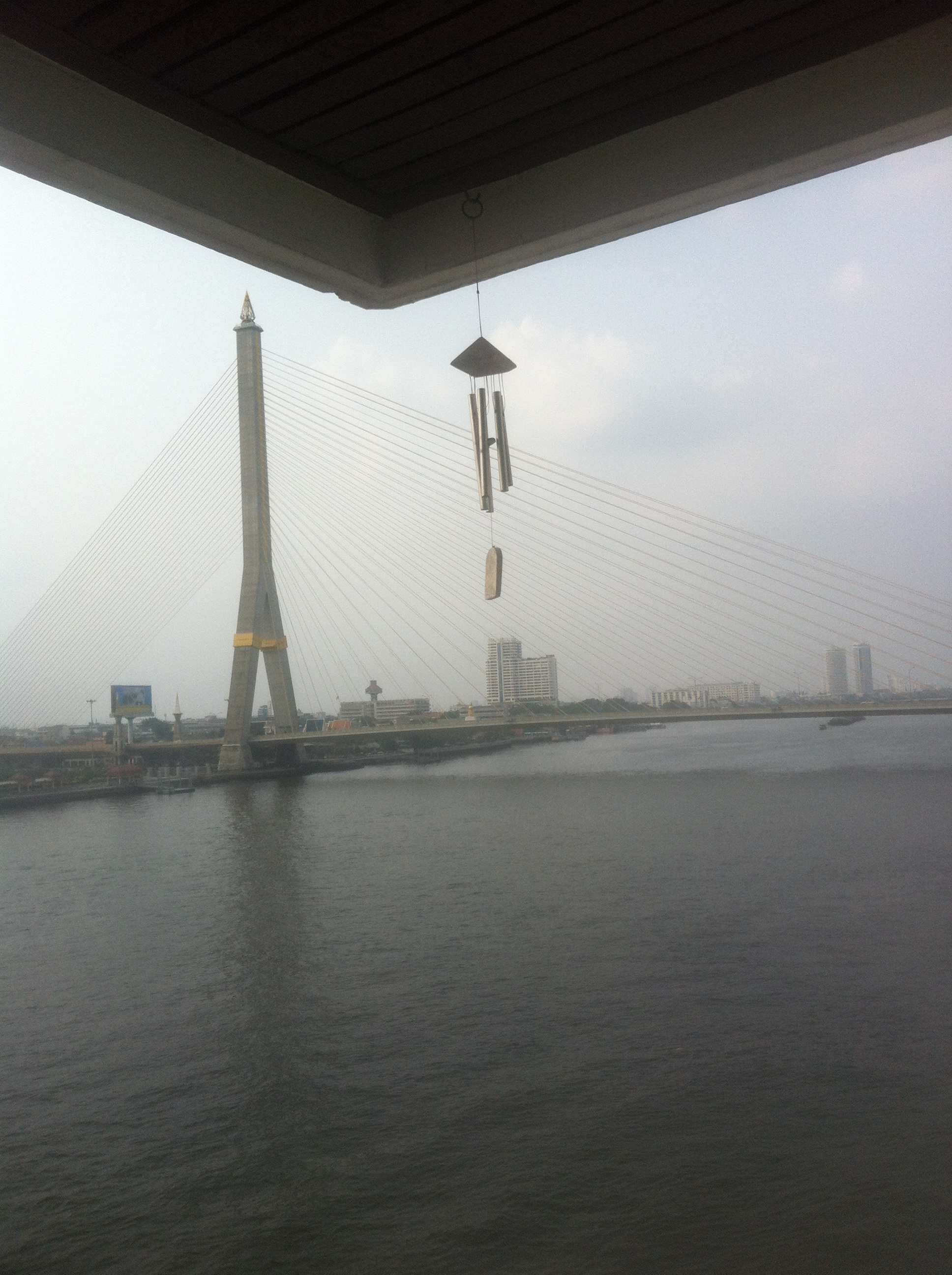
When we moved into our apartment here in Bangkok, we found that a previous tenant had left a wind chime hanging on the balcony, in front of the living room, ready to tinkle with every passing breeze – and since many breezes pass up and down the river which flows by our building, it tinkled quite a lot.

I was charmed, my wife less so. It is true that its more-or-less constant tinkling became rather intrusive to our life in the living room. My wife was for removing it completely. As a compromise, I moved it to the end of the balcony, keeping company to the King Rama VII Bridge (about which I’ve written earlier). From there, its chimes would be less sonically importunate, and it might, I hoped, keep the pesky pigeons from resting on the balcony railing.
wind chime bangkok 001
The former worked, the latter didn’t; true to form, the pigeons simply ignore the chimes and continue to land – and poop – on the railing.

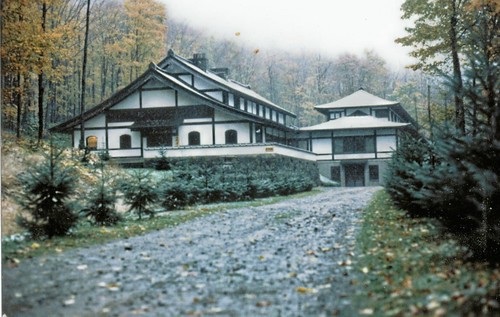
My wife and I had first come across wind chimes some 35 years ago, during a visit we made to a Buddhist temple situated in the Catskill mountains to the north of New York City. We were spending a few days in the Catskills, getting our small children out of the city and into some fresh air. By chance, during a drive around the countryside, we came across a sign indicating the way to the temple. Intrigued, we followed the sign and found ourselves with this before us.
buddhist temple catskills
A very nice (American) Buddhist nun took us on a tour, and afterwards, while wandering around the temple’s outhouses, we came across the wind chime, tinkling quietly in the wind.

We recently came across a more religious version of wind chimes in Myanmar, where almost universally stupas are topped with a complicated crown that includes, among other things, a circle of little bells at its base which nod with every passing breeze.
07-kakku 007
In consequence, our visits to the stupa forests around Inle lake were accompanied by an almost constant quiet background tinkle whose level rose and fell as breezes snaked their way languidly between the stupas. Their purpose, I read, is to ward off evil spirits. This seems to be the primary raison-d’être of wind chimes in this part of the world, another example of something beautiful inspired by fear. Sad, really.

As I read around for this post, I discovered that a certain set of wind chimes – at Mizusawa railway station in Ōshū, Japan, to be precise – were one of the 100 soundscapes of Japan officially designated as such by the Ministry of Environment. Soundscapes! Now, that is something I had never heard of. And my research – and consequently this post – went off on a tangent. I’ve been like a dog who while following the scent of a fox, suddenly comes across the scent of a boar and races off in a different direction.

Soundscapes, I read, are sounds that “describe a place, a sonic identity, a sonic memory, but always a sound that is pertinent to a place”.  I’ve scanned the list of official 100 soundscapes of Japan (chosen, by the way, very democratically from a pool of candidates created after the Ministry of Environment called on the citizenry to submit their favourite soundscapes). Apart from the wind chimes in Mizusawa station, I see drift ice in the Sea of Okhotsk, the Japanese crane sanctuary in Tsurui, singing frogs and wild birds of the Hirose River, ship whistles for the New Year at Yokohama Port, reed fields at the mouth of the Kitakami River, pinewoods sighing in the wind in Noshiro, the approach to Kawasaki Daishi Temple, a cicada chorus in Honda-no-Mori Forest, sand eel fishing at Tarumi port, and on and on. Any reader who is interested in the whole list can go to the Wikipedia entry.

Wow … 100 soundscapes that somehow define a country … Well, I guess Mynamarians might choose the tinkle of bells in their stupa forests as one of their soundscapes. But I can’t decide their soundscapes for them. As an Englishman, though (OK, half an Englishman but let’s not quibble), I could have a go at choosing some soundscapes for the UK.

So what sounds define the UK? Well, the national psyche is very much defined by its being an island, so soundscapes of the sea are an obvious choice. There’s the sound of the water itself: the quiet hiss of seawater running over a shingle beach like the one my grandmother used to take us grandchildren to in Norfolk, or the splintering of waves against sea-cliffs which my wife and I heard in the Orkneys, or even the howl of the wind racing inland on the back of a big winter storm. But there’s also the cries of the innumerable seabirds and other wildlife which inhabit the UK’s coasts. And then there are the human-related noises linked to the sea: the sharp orders of the skipper followed by the thunderous clap of sails resetting on a sail boat as it turns about, the blast of a siren and the churning of water as a ship moves out of port, the lugubrious sound of a fog horn, but also the chatter on a crowded beach on a summer’s day.

Staying with water, rain is also definitely part of the British psyche, so a soundscape of falling rain seems called for: not the hard, dense tropical rain we have here in Bangkok, but a softer rain that goes on and on (and on …). And then there is the sound of all those brooks and streams which criss-cross the country as they hurry down over rock and fallen log: I have a particularly vivid sonic memory from my childhood of the brook which bordered our school’s playing fields.

Talking of playing fields, these evoke for me countless sonic memories: the crack of cricket bat against ball (such an English sound! although Americans may have a cousin in baseball’s bat against ball), the thud of foot against ball, the encouraging cheers of onlookers, which in football and other commercially organized sporting events has now swelled into the chanting of the stadium (this must be one of the few truly international soundscapes), and, strangely enough because I’m not really into horses, the thunder of hooves on soft turf as race horses come round the bend into the final straight. Horse racing also evokes in me a very specific sonic memory of the TV commentator: “and it’s Blue Blazes in the lead!, and Desperate Straights is coming hard up on the inside!!, but Blue Blazes is holding the lead!!!, …” and so the voice would continue to rise to a crescendo until the finishing line was crossed, when it would fall away to normal levels. Probably not specifically an English soundscape but to me always a memory of my English youth: Saturday afternoon in front of the telly.

Going back to nature, wind is a constant in the British Isles, so we must have wind soundscapes in the collection: trees soughing in the wind; wind rustling grass, sedges, heather; the dry clacking of leafless branch on leafless branch in a strong wind. Trees lead me to birds, which hold a special place in the British heart. A dawn chorus in summer would be a definite entry, but so could the songs of any number of birds. I would definitely want to have a lake soundscape with a loon calling out – I have such a strong childhood memory of that.

The Japanese Ministry held its competition for the 100 soundscapes of Japan as a way of reminding the Japanese of their country’s natural sounds. I have sympathy for that: we are so surrounded in our daily, highly urbanized, lives with a cacophony of artificial sounds that we no longer hear Nature. But still, there are soundscapes made up of man-made sounds which so “describe a place, a sonic identity, a sonic memory”, to requote the definition, that they cannot be left out from this compendium of national sounds which I am sketching out. My personal entries would be two. One is the sound which London Underground trains make when they are halted, waiting to go. The electric engine goes into some sort of standby mode, emitting a very particular sound which I have never heard anywhere else. When I hear that noise, I know I’m back in London. The second such sound is from the diesel engine of the old double decker buses. These emitted a particular throaty rasp which I would immediately recognize anywhere. Alas, I think this soundscape now belongs to history. Today’s double deckers must have a newer engine, for I hear that throaty rasp no longer.

I cannot finish my list without mentioning the UK’s regional accents. I’ve always loved the wide variety of accents you find in the UK. It just fascinates me that the same language can be pronounced in so many different ways. I don’t know if regional accents count as soundscapes, but you certainly can’t find a more British sound than a Yorkshire accent, or a Somerset accent, or a Welsh accent, or one of the Scottish accents, just to cite the ones I am most familiar with. Whenever I hear a British regional accent on the streets or in the shopping malls of Bangkok, I turn around and smile. That’s home …

My wife has been telling me that we should think of spending six months in the UK after I retire. I’m inclined to agree. It would allow me to reconnect not only with the sights but also the sounds of my once-native land.

___________________________

Buddhist temple Catskills: https://c1.staticflickr.com/3/2162/2092854607_e6f4aa3d32.jpg (in https://www.flickr.com/photos/shoshin-seishu/2092854607/)

Other photos: mine

SALT AND SWEET

Bangkok, 5 February, 2015

A few weeks ago, I visited a couple of electric arc furnaces which were recycling scrap steel. It was a very interesting visit, the first time I had seen this type of furnace in action.

EAF

They are a nice example of a vital step in what the Chinese call a “circular economy”, an economy in which the materials we use do not simply get thrown away after we’ve finished with them, but are collected, recovered, and reused.

But actually, what I want to focus on in this post is the dinner we were served during the visit, or rather on one course of that dinner. I should explain that since these furnaces work on electricity and since electricity is expensive in Thailand during the day, the furnaces are run at night. So the visit of the furnaces started at 8 o’clock in the evening, and the first company we visited kindly offered us dinner to fortify us for the hot and dusty visit which awaited us. Since this was a Chinese-owned company, we were served a Chinese-style dinner which, after my five years spent in China, brought a nostalgic mist to my eye. As is usual in China, the dinner ended with fresh fruit. But this fruit course had an interesting twist. We were served fresh pineapple with a soy sauce dip. Soy sauce! That is not something I had ever thought of combining with pineapple. But actually it was delicious.

Pineapple and Soy Sauce

This is the only photo I could find on the (English-language) web which in any way resembled what we found before us at dessert time, but even this is for a recipe where the pineapple is fried, which explains the presence in the photo of the coriander (to be used as a final garnish). I take this lack of photos to be an indicator that I may be one of the few in the English-speaking world who has tried this particular combination of sweet and salt. But readers are free to disabuse me of my belief.

In any event, as I let my taste buds deal with this interesting sweet-salt combination, I remembered a conversation we had had around the Christmas lunch table about precisely this issue: the mixing of salt and sweet. Our son had maintained that it was not natural to mix sweet and salt, and more generally that different flavours should be kept separate. Our daughter maintained that there were many dishes where salt and sweet were combined, which suggested that actually it was quite natural to mix sweet and salt. I was torn. As my long-suffering wife knows only too well, I object to mixing things on my plate: the vegetables are to be kept neatly separated from the meat and from each other, the dressing from the salad should not be allowed to leak over to the meat, etc. So on these grounds, I also feel that sweet and salt should not mix. Yet I have to acknowledge that there are dishes where the sweet and salt combination is exceedingly pleasing. After the pineapple and soy sauce dip experience, I resolved to do some research (a.k.a. web browsing) on the topic.

I’ve now done the research and am ready to report back, although I must confess to not having much to report. All agree that “common sense” suggests that salt and sweet do not mix, yet all agree that actually many of us do like to mix the two. Why is this? As far as I can make out, no-one has really figured it out. One possible answer is biochemical. The sodium ions of salt somehow enhance all taste buds: “there’s evidence that applying a sodium-channel blocker (TTX) can dramatically inhibit the activity of all taste receptors, suggesting that sodium plays a key role in the cellular detection of every taste (and not just the taste of salty things) … This would explain why food without any salt is so hopelessly boring: it might be literally harder for our various taste receptors to get excited.” So mixing salt with sweet enhances sweet because of a biochemical pathway we are born with. Just to make the whole discussion sound even more scientific, I throw in here a close-up of a taste bud on a tongue, which is what sodium ions seem to be enhancing.

tongue-taste-bud

But why would we have evolved to have that biochemical pathway? One possible answer is that because we humans are omnivores, we’re wired to desire many different foods and tastes. It’s bad for us to eat just one thing, so our sense of taste has evolved to give us greater gratification if we mix tastes. My wife will be very pleased to hear that there is a scientific underpinning to her insistence on mixing foods and tastes.

Let me celebrate this new understanding on my part of my biological processes by sharing with readers some of the wonderful sweet-salt dishes which I have stumbled across in my life. Where to start? Well, at the beginning, I guess, with the first such dish I ever remember trying, lamb with mint sauce. My English grandmother had taken me to visit an uncle and aunt and assorted cousins, and my aunt served us lamb with mint sauce for lunch.

lamb and mint

She served it with two veg, as is de rigeur for any English meat dish. In this case, I remember distinctly that the veg in question were that most English of combinations, peas and potatoes (she also made a magnificent apple crumble, by the way; no apple crumble I have ever eaten since has tasted so good).

Mint sauce is really easy to make, by the way, about as easy as lamb chops. I give an executive-summary recipe at the end of the post for those readers who are interested. What I think is important to point out here is that the recipe calls for a mix of sugar and vinegar. In my humble opinion the best combination is actually sweet, salt, and acid or tartness. To my mind, that’s what made the pineapple and soy sauce so good, the fact that the pineapple is also tart. Dragon fruit, a much milder fruit, was being served along with the pineapple. When I asked if that too should be dipped in the soy sauce, our hosts pursed their lips and gave it as their considered opinion that it wouldn’t work.

Lamb with mint sauce is incredibly English (and I mean English. I don’t think the Scots or the Welsh eat it). It is so English that the French made fun of Les Anglais because of it – the French consider the use of mint sauce to be beyond the cooking pale. Our friends Goscinny and Uderzo, who wrote the Asterix and Obelix stories, had mint sauce play a major role in our heroes’ adventures in Britain, with the governor of province at one point shouting that if his men did not find the pair (who had just disappeared from prison) he would have his commanders boiled and served with mint sauce to the lions. To which the commanders commented how horrible that would be – for the lions.

asterix sauce a la menthe

The French loved it, lapping up the fun being poked at English cuisine. But I will ignore the smirking French and concentrate on another great example of English cuisine which is also a sweet-salt dish, roast pork and apple sauce. I first had this delicious dish as a boy scout. It was summer, the end of the school year, that time in the calendar when England can often be bathed in golden light rather than be grey and sodden.  For our last outing of the year, the scout master had the brilliant idea of buying a whole pig and roasting it on a spit in the woods. I have this crystal clear memory of sitting around the spit, listening to the fat crackle, breathing in the smell of cooking meat, watching the scout master sharpen the large carving knife, while the sunlight dappled the ground all around us. It’s the closest I have ever felt to being a Cro-Magnon man.

roasted pig

And then there was the discovery of the exquisite taste of roast pork and apple sauce, a large dollop of which was dumped onto our metal field plates along with a big slab of pork meat and crackling.

roast pork and apple sauce

Those readers interested in knowing how to make this sauce should scroll down to the end of the post. I just want to note that cooking apples should be used. They are tarter than eating apples. It’s the tartness thing again. One can also add lemon zest, presumably to add yet more tartness.

Of course, the English do not have a monopoly in Europe on sweet-salt dishes. Allow me to introduce here a dish I discovered and came to love when we moved to Vienna: Tafelspitz. There is a venerable ritual to cooking Tafelspitz, but when you reduce it to its essentials it is beef meat (topside or top round) boiled slowly over many hours with a medley of root vegetables – carrot, celeriac, parsnip and the like – and a piece of marrow bone. It is normally served like this:

tafelspitz

You can start with a cup of the broth which is engendered by the boiling of the meat, just to whet your appetite. You can then turn your attention to the meat proper, which you will eat with the vegetables, possibly some fried grated potatoes, and – to spice up what is otherwise a rather bland dish – two types of sauce, a cream-based chive sauce and apple-horseradish sauce.

tafelspitz sauces

My earnest suggestion is that you ignore the chive sauce in the front of the photo and go with the apple-horseradish sauce behind it. It is just a variant of the apple sauce I described earlier; you simply add grated horseradish. If you make this sauce at home, my further suggestion is to be generous with the amount of horseradish you add. The best Tafelspitz I ever had was served with an apple-horseradish sauce that made my eyes water slightly. I don’t want to sound like a broken record, endlessly repeating myself, but tartness really helps appreciation of the sweet-salt taste.

Both the French and the Italians have a similar dish of boiled meat, pot-au-feu in the first case and bollito misto in the second. My French grandmother made an excellent pot-au-feu and I am very fond of it, but since it is normally eaten with mustard I will drop it from this discussion. We shall focus instead on bollito misto, a dish which is very popular in northern Italy and (as the name suggests) consists of a variety of boiled meats: cuts of beef and veal, cotechino (a pork-based sausage), and sections of hen or capon.

bollito misto

My wife reminisces from time to time that her father was very fond of bollito misto, eating it like most northern Italians do with a sauce called mostardaactually, mostarda di Cremona. In a country known for the fierce independence of its cities, it will come as no surprise to the readers that probably every city in northern Italy has its own variety of mostarda. Despite its name, the sauce has only a little to do with mustard. It is really a mix of candied fruit which is given a kick by the addition of mustard powder (that tartness thing again…). Those slices of fruit in the photo above are the mostarda, but I give here a more direct picture.

mostarda di cremona

My wife confesses to never having liked mostarda; she can’t even stand the smell. Personally, I have never tried it, but a number of sites do support my wife’s assertion, mentioning that the taste of mostarda is an “acquired taste”. This is normally code for saying that something tastes revolting the first several/many times you try it. In any event, if my wife says it’s not nice, then that’s good enough for me! No spoonful of it shall ever pass my lips. For those readers who will ignore these warnings and wish to try it, though, I give a brief recipe at the end of the post.

I feel that I cannot move away from mostarda without mentioning the somewhat similar chutney sauce one finds in the UK, or at least one found when I was a boy. Although “chutney” as a word has Indian roots, what I ate as a boy was several removes from things Indian. The most popular brand back then was a mango chutney which went by the name of Major Grey’s Chutney and was sold by Crosse & Blackwell. The story went that a certain Major Grey, a British officer in India, had surveyed the local Indian chutneys and then invented his own, more British, chutney, which he proceeded to bring back to the motherland when he retired, to remind him of the Good Old Days. When I was a boy I rather imagined this Major Grey to look like this

British soldier India-1

fighting heroically against savage natives on the Northwest frontier and getting a VC for his –quite literal – pains. But alas! this appears to be pure legend. It seems that something similar to mostarda, some sort of fruit conserve, existed already in the UK and the Brits in India took the idea with them and adapted it to local ingredients. So what this chutney will usually have as ingredients is mangoes, raisins, vinegar, onions, sugar, and spices. Crosse & Blackwell also include lime juice and tamarind juice. As you can imagine from the ingredients, this chutney is both sweet and tart. Again, for heroic readers who want to make this sauce from scratch, scroll to the end of the post.

I haven’t eaten this kind of chutney in many decades, but when I was young my favourite way of eating it was with slices of cold meat (the chutney is in the round bowl to the left of the photo below).

cold meat and chutney

This was an especially popular dish in pubs, where this photo was taken. Sitting here in Thailand, I feel a sudden nostalgia for the English country pubs whose bars I propped up in my youth, so I am moved to throw in a photo of a nice country pub.

Bridge Inn

Like Superman, I now vault over to the US and alight somewhere in the open ranges of the Midwest, for no better reason than having this feeling that my next salt-sweet sauce – barbecue sauce – was invented around there somewhere. That being said, my wife and I didn’t try it there. We were just discussing this point and we reckon that it was somewhere between Boston and Washington in the early 1980s. Wherever it was, we stared open-mouthed at these large racks of ribs smothered in this dark reddish brown sauce.

ribs and barbecue sauce

But very soon we were closing our mouths over those ribs. Ah, that sauce! … But I should say: those sauces. In this little research I’ve done I have discovered that there are dozens of different barbecue sauces. I thought the Italian quarrels about where the best mostarda is made were fierce, but boy! the arguments about what place in the US makes the best barbecue sauce are right up there. I’m going to keep my head low without backing any particular sauce. I’m merely going to say that wherever the sauces are made they all seem to have sugar (preferably brown), tomato ketchup, vinegar, and some salt, to which various spices are added in varying levels and in different combinations (Worcestershire sauce, pepper, paprika, mustard, chili, cayenne, and on and on). That combination of sweet and tart again, to challenge the salt of the meat. Readers can look at the end of a post for condensed recipe of an excellent sauce from Kansas City (but don’t tell anyone I said it).

Deary me, I seem to have gone on for quite a while here, and I’m sure I haven’t covered one-hundredth of the sweet-salt dishes enjoyed around the world. On top of it, I’ve only mentioned meat dishes; it makes me sound a total carnivore, red in tooth and claw. But there was that fish dish in Shanghai … and there are all those sweet salad sauces to pour on vegetables … But I have to stop. I’ll just add two final combinations of salt and sweet which show that meat (or fish) is not the only food the delight of which is heightened by the salt-sweet experience: one which probably every person on the planet has enjoyed by now, what with the prevalence of fast food joints, french fries and ketchup

french fries and ketchup

and one which I’ve mentioned in an earlier post, chocolate and French baguette

chocolate and baguette

Mmm, so good!

So give your taste buds a whirl and douse them with sugar and salt – and a dash of vinegar, or horseradish, or something tart. Enjoy!

-o0o-

Mint sauce: Strip the leaves off a bunch of mint, sprinkle them with a pinch of salt, and chop finely. Place the result in a bowl, add 1 level tablespoon of caster sugar and pour over the mix 4 tablespoons of boiling water. Stir and leave to cool. Stir in 4 tablespoons of vinegar. Add more water or vinegar to suit your taste.

Apple sauce: Take a number of cooking apples, peel them, core them, and chop them up. Put the apples in a saucepan and add water. Once can also add lemon zest. Cover and cook over a low heat until the apples have gone soft and mushy. At which point take off the heat and beat in a knob of butter and a teaspoon of sugar. Cool.

Mostarda di Cremona: Begin by washing the various fruit: pears, quinces, cherries, apricots, figs, and peaches (although I’m sure you can vary the fruit as you wish). Cut the apricots and peaches into halves or quarters (depending on their size) and remove their stones, peel. Core and quarter the pears and quinces. Dry all the fruit after preparation. Add the sugar – a lot of sugar! half a kilo for every kilo of fruit, more if you want your mostarda sweet (but for reasons suggested above, I would go easy on the sweetness and maybe go heavier on the mustard powder). Pour some squeezed orange juice over it. Let the whole rest for 24 hours, gently turning the pieces a couple of times. By the end of this time the sugar will have dissolved. Drain the fruit well – without losing the syrup! Bring the syrup slowly to a boil, and let it boil gently until its volume is reduced by half. Pour the remaining syrup back over the fruit. The sugar in the now-concentrated syrup will extract more moisture from the fruit, which will begin to shrink and firm up. Concentrate the syrup again and steep the fruit in it overnight again. Dissolve several tablespoons of mustard powder in some white wine vinegar. Bring the mixture gently to a boil and let it bubble for a few minutes. In the meantime, drain the fruit again, and concentrate the syrup again. Put the candied fruit into jars, add the mustard powder infusion, and then add the hot syrup. The amount of infusion you add will determine of course how much of a kick your mostarda will have. Cover the jars and put them on a cool dark shelf. The mostarda will be ready to eat in two weeks’ time.

Major Grey’s chutney: (this is one of many recipes for this kind of chutney) Combine 4 cups of 5-6 medium-sized chopped mangoes, 1 cup of brown sugar, half a cup of molasses, 1 cup of vinegar, 1 cup of coarsely chopped onions, three-quarters of a cup of golden raisins, half a cup of seeded and chopped limes, half a cup of peeled, seeded and chopped orange, a quarter of a cup of peeled, seeded and chopped lemon, and finally a bunch of spices: half a cup of grated ginger root , 3 cloves of minced garlic, 1 tablespoon of mustard seed, 1 tablespoon of dried red pepper flakes. Cook for about 30 minutes, stirring often. Add 2 tablespoons finely chopped fresh cilantro, 1 teaspoon of ground cinnamon, a quarter of a teaspoon of ground cloves, a quarter of a teaspoon of ground allspice. Cook for another 10 minutes or so, until chutney starts to thicken. Ladle chutney into a jar and close it air-tight.

Barbecue sauce: (from Kansas City) In a saucepan over medium heat, stir together ½ cup of ketchup, 2 tablespoons of brown sugar, 1 tablespoon of cider vinegar, 2 tablespoons of Worcestershire sauce, ¼ teaspoon of salt, ¼ teaspoon of mustard powder, 1 teaspoon of garlic powder, and a dash of hot pepper sauce. Bring to a simmer, then remove from heat and allow to cool.

_________________

Electric arc furnace: http://ih.constantcontact.com/fs163/1101151826392/img/505.jpg (in http://ricorant.blogspot.com/2014/11/fwd-dominance-of-steel-111114.html)
Pineapple and soy sauce: http://static.squarespace.com/static/51107688e4b0e3b888c1183b/t/519f0a2ee4b0bb6d74d9bdcf/1369377327493/Grilled+Soy-Sauce+Pineapple (in http://larkspurcompany.com/blog/2013/5/20/grilled-soy-sauce-pineapple)
Taste bud closeup: http://cdn1-www.webecoist.momtastic.com/assets/uploads/2010/01/tongue-taste-bud1.jpg (in http://webecoist.momtastic.com/2010/01/11/biological-photography-magnificent-microscopic-ultraminiature-photos/)
Lamb and mint sauce: http://www.thetimes.co.uk/tto/multimedia/archive/00050/table_townsend_74217_50069c.jpg (in http://www.thetimes.co.uk/tto/life/food/recipes/article2701689.ece)
Asterix sauce a la menthe: http://www.prise2tete.fr/upload/NickoGecko-Saucementhe.jpg (in
Roasted pig: http://previews.123rf.com/images/azlightning/azlightning0908/azlightning090800003/5315340-whole-golden-roasted-pig-on-a-spit-spit-roasting-is-a-traditional-hawaiian-luau-method-of-cooking-a-.jpg (in http://www.123rf.com/photo_5315340_whole-golden-roasted-pig-on-a-spit-spit-roasting-is-a-traditional-hawaiian-luau-method-of-cooking-a-.html)
Roast pork and apple sauce: http://www.growingagreenerworld.com/wp-content/uploads/2010/10/123-dishAppleSauce_Pork.jpg (in http://www.growingagreenerworld.com/pork-tenderloin-spiced-applesauce-recipe/)
Tafelspitz: http://www.plachutta.at/typo3temp/pics/1115b4ecd0.jpg (in http://www.plachutta.at/en/about/)
Tafelspitz sauces: http://thepassionatecook.typepad.com/sauces.jpg (in http://thepassionatecook.typepad.com/thepassionatecook/traditional_austrian_food/page/2/)
Bollito misto: http://www.buonissimo.org/archive/borg/XRqDUZ2JX8O3MtcV7PuMgNvG9IvTytvNm6Rhlcw8yOzcxGV4vWA1kg%253D%253D (in http://www.buonissimo.org/lericette/5685_Bollito_misto)
Mostarda di Cremona: http://www.cremonacitta.it/intranet/immagini/_resized/1/scheda/58/w/490x/Prodotti_De_Co_di_Cremona_la_Mostarda_cremonese-img58-01-1.jpg (in http://www.cremonacitta.it/it/gusto_e_sapori_a_cremona/prodotti_de_co_a_cremona_mostarda_tradizionale_sc_58.htm)
Cold meat and chutney: http://media-cdn.tripadvisor.com/media/photo-s/07/0d/d8/5a/blairs-inn.jpg (in http://www.tripadvisor.ie/LocationPhotoDirectLink-g186599-d2014376-i118347866-Blairs_Inn-Blarney_County_Cork.html)
Bridge Inn: http://www.hallflatfarm.co.uk/IMAGES/The%20local%20-%20the%20Bridge%20Inn.jpg (in http://www.hallflatfarm.co.uk/location.html)
British officer in India: http://i80.photobucket.com/albums/j199/matteaston/Afghan1.jpg (in http://www.fioredeiliberi.org/victorian/)
Ribs and sauce: http://www.cooldeals.es/Images/deal-images/eef5c31f-f992-46a5-8993-db0198715a35/20140818133044604.jpg (in http://www.cooldeals.es/Deals/Marbella-Estepona/9fd8ffad-612a-42de-8755-55153751c9e6)
French fries and ketchup: http://scms.machteamsoft.ro/uploads/photos/652×450/652x450_7b63084e7d5012a126811947191414.jpeg (in http://stiri.acasa.ro/social-125/afla-ce-alimente-ascund-sute-de-kilocalorii-110745.html)
Baguette with chocolate: http://a142.idata.over-blog.com/600×449/2/90/63/97/Autrefois-./Chocolat/Le-Bon-Chocolat–13-.JPG

SCULPTURE AND NATURE

Beijing, 15 June 2014

My wife and I were watching TV with one eye the other day when the BBC passed a programme which caught our attention. It was about the Yorkshire Sculpture Park in the north of England. I think a few words of explanation are required for those readers who have never heard of this Park (our situation before watching the BBC programme). It was established back in 1977 in the grounds of a stately home the last of whose aristocratic owners (Viscount Allendale) had sold it to the local council after World War II, no doubt to save his financial skin (I mentioned the financial woes of the UK’s stately homes in an earlier posting of mine). The idea is a simple one: rather than displaying modern sculpture in open spaces in cities like plazas
sculpture in cities-1

sculpture in cities-2

or squares

sculpture in cities-3

sculpture in cities-4

or using the atriums of posh buildings

sculpture in cities-6

use the sweeping, open vistas of the countryside to display them. Here are some of the pieces at the Yorkshire Sculpture Park:
YSP-4
DSCN2327.JPG
YSP-6

YSP-9

YSP-10

YSP-14

YSP-1
My wife and I agree on many things, and one of them is that modern sculptures are enhanced by being seen in a natural, organic setting rather than in the built urban environment. Personally, I think it has to do with the contrast between the dead surfaces of the sculptures and the much softer, living surfaces of the surrounding landscapes. It sounds a bit fancy, but the dead sculpture comes alive when in contact with organic life.

This was brought home to us very strongly when, 25 years ago, and on the advice of a friend who worked at the Metropolitan Museum of Art, we visited the Storm King Art Centre, which is an hour’s drive north of New York City, near the Hudson River. Here again, a few words of introduction. It’s really the classic American story (as much as the history of the Yorkshire Sculpture Park is the classic British story of modern times – decay of the old order and birth of a new one). A certain Mr. Ogden, after a successful career in the family business, purchased the land and property of Storm King and started collecting. He initially bought small sculptures which he exhibited around the house. At some point, he expanded out into the surrounding landscape, installing much bigger pieces. That’s it, in a nutshell. But the result – for us at least – was epiphanic.

In wonder we wandered along the rides mown through the grass, walking from one towering sculpture to another

SK-1

SK-4

from hilltops, we discovered long views across the surrounding landscape, where sculpture and land merged into one

SK-2

we walked through glades in the woods, each with their own sculpture

SK-8

SK-9

we entered the woods to find smaller, more intimate sculptures scattered under the trees

SK-7

SK-10

we also found a sculpture-wall meandering through them

SK-5

(better seen in this photo taken during the winter)

SK-14

we turned our steps back to the house, discovering other smaller sculptures set down in more formal gardens around the house.

SONY DSC

SK-11

And finally, we entered the house and fell upon a sculpture which in all these years I have never forgotten: a group of robotic-looking statues with small motors making their jaws work up and down and with a closed-loop recording of voices quietly droning “chatter, chatter, chatter, chatter, chatter, chatter …” on and on, endlessly. Wonderful.  Every time I find myself in one of those meetings where people blather on and on and on I recall this statue group with intense clarity.

So taken were we with Storm King that the very first time we went back to New York after an absence of fifteen years we made sure to find time to go up there. It cast the same spell over us – although sadly the chattering statues had vanished (smashed to smithereens, no doubt, by an employee crazed by their endless droning).

As I contemplate these photos, it occurs to me that many of the megalithic structures scattered across the face of Europe could pass as modern sculptures set down in the surrounding landscape. Stonehenge, the most iconic of all megalithic structures, is probably too much like a ruin to make this comparison
Stonhenge-2
but Avebury, like Stonehenge located in Wiltshire, has something of the abstraction of sculpture parks

Avebury-2

Avebury-1

and how about Carnac, in Brittany?
carnac-1

carnac-2
or Badelunda in Sweden?

Badelunda Västmanland

or the Ring of Brodgar, in the Orkney islands?

Ring of Brodgar

And even further afield, although not from the Mesolithic period, we have this intimate collection of upright stones in Toraja, Indonesia

OLYMPUS DIGITAL CAMERA

Of course, the people who built these structures were not building sculpture parks, but I have to think that they too were stirred by the same feeling of connectedness between their standing stones and nature as we have between sculpture and nature. They attributed this feeling to a divine grace in the place, we simply enjoy the feeling.

____________________________

Sculpture in cities-1: http://percivalhenry.files.wordpress.com/2014/03/52af841ee4b0b09acc808041-lost3f3f3f-1387234862071-flamingo.jpg [in http://percivalhenry.wordpress.com/2014/03/20/art-history-martch-madness-first-round-new-york-regional/comment-page-1/%5D
Sculptures in cities-2: http://upload.wikimedia.org/wikipedia/commons/2/26/Juilliard_School-Manhattan-New_york.jpg [in http://commons.wikimedia.org/wiki/File:Juilliard_School-Manhattan-New_york.jpg%5D
Sculpture in cities-3: http://i3.mirror.co.uk/incoming/article740970.ece/alternates/s615/A%20new%20sculpture%20on%20the%20fourth%20plinth%20in%20Trafalgar%20Square,%20central%20London%20The%20work%20by%20sculptor%20Bill%20Woodrow,%20entitled%20%27Regardless%20of%20History%27,%20%20shows%20a%20tree%20resting%20on%20a%20head%20and%20a%20book [in http://www.mirror.co.uk/news/uk-news/love-it-or-hate-it-bronze-rocking-741129%5D
Sculpture in cities-4: http://womenworld.org/image/082012/Paris%20-%20Beaubourg%20and%20Les%20Halles_1.jpg [in http://womenworld.org/travel/paris—around-town—beaubourg-and-les-halles-%28part-1%29.aspx%5D
Sculpture in cities-5: http://www-news.uchicago.edu/releases/06/images/cis/sculpture.jpg [in http://www-news.uchicago.edu/releases/06/060426.cis-photos.shtml%5D
YSP-1: http://www.yorkshireattractions.org/images/cms/attractions_21_3_large.jpg [in http://www.yorkshireattractions.org/visitor-attractions/21/yorkshire-sculpture-park%5D
YSP-2: http://upload.wikimedia.org/wikipedia/commons/0/0a/Yorkshire_Sculpture_Park_Caro_Promenade.jpg [in http://commons.wikimedia.org/wiki/File:Yorkshire_Sculpture_Park_Caro_Promenade.jpg%5D
YSP-3: http://antonyjwaller.files.wordpress.com/2012/06/nik_5931-copy.jpg [in http://antonyjwaller.wordpress.com/travel-articles/yorkshire-and-northern-england/the-yorkshire-sculpture-park/%5D
YSP-4: http://www.sculpture-info.com/upload/1008/image/Yorkshiresculpturepark.jpg [in http://www.sculpture-info.com/news-626/yorkshire-sculpture-park.html%5D
YSP-5: http://2.bp.blogspot.com/-6GgifPCMTc8/UgZKx2yojhI/AAAAAAAACDg/WYBKhXaNWp8/s1600/2+Buddha+and+Rob.JPG [in http://expertslife.blogspot.com/2013/08/picture-of-week-10-august-2013.html%5D
YSP-6: http://www.thomasharveydesign.co.uk/wp-content/uploads/2011/05/YSP6.jpg [in http://www.thomasharveydesign.co.uk/2011/05/09/yorkshire-sculpture-park-wakefield/%5D
YSP-7: http://news.bbcimg.co.uk/media/images/52104000/jpg/_52104252_7cbb7745-313f-43e9-8974-d144adf6c05f.jpg [in http://www.bbc.co.uk/news/entertainment-arts-13034363%5D
SK-1: http://brooklynimbecile.files.wordpress.com/2011/10/img_4256.jpg [in http://brooklynimbecile.com/2011/11/05/weekend-spread-storm-king-art-center/%5D
SK-2: http://3.bp.blogspot.com/-OWDq8YQCBog/UA6M17c9N6I/AAAAAAAAYI4/OqODfTIunKU/s1600/Mountainville_NY_A_Calder_Storm_King_AC_photo_S_Gruber_June_2012_+%2888%29.JPG [in http://publicartandmemory.blogspot.com/2012_07_01_archive.html%5D
SK-3: http://www.greenstrides.com/images-wp/Storm-King.jpg [in http://www.greenstrides.com/2013/07/10/sculpture-parks-can-inspire-your-own-garden-design/%5D
SK-4: http://4.bp.blogspot.com/-4sgNF1ufdU4/U4T1ul7DPRI/AAAAAAAAP8w/JzGsmMOY6No/s1600/Newman.jpg [in http://nycgarden.blogspot.com/2014/06/storm-king.html%5D
SK-5: http://i.vimeocdn.com/video/332835418_1280.jpg [in http://vimeo.com/48015694%5D
SK-6: http://inhabitat.com/nyc/wp-content/blogs.dir/2/files/2011/07/storm-king-boulders.jpg [in http://inhabitat.com/nyc/storm-king-art-center-a-summer-retreat-for-the-artsy-nature-loving-new-yorker/storm-king-boulders/%5D
SK-7: http://faeriemooncreations.blogspot.com/2010_11_01_archive.html [in http://faeriemooncreations.blogspot.com/2010_11_01_archive.html%5D
SK-8: http://4.bp.blogspot.com/_sVe9wO8fJls/S4zMOOgpUZI/AAAAAAAAEDo/IaUESi6KOGQ/s800/goldsw3.jpg [in http://lettuce-eating.blogspot.com/2010_03_01_archive.html%5D
SK-9: http://stormking.weebly.com/uploads/2/3/8/8/23889452/6893557.jpg [in http://stormking.weebly.com/permanent-collection.html%5D
SK-10: http://www.stormking.org/wp-content/uploads/2013/07/smith-lawn1.jpg [in http://www.stormking.org/collection-conversation/%5D
SK-11: http://eof737.files.wordpress.com/2011/09/img_2564.jpg?w=800 [in http://mirthandmotivation.com/2011/09/04/happiness-installation-art-at-storm-king/img_2564/%5D
Stonehenge: http://st-listas.20minutos.es/images/2013-06/362538/4049632_640px.jpg?1370571567 [in http://listas.20minutos.es/lista/maravillas-del-mundo-362538/%5D
Avebury-1: http://en.wikipedia.org/wiki/Avebury#mediaviewer/File:Avebury_Panorama,_Wiltshire,_UK_-_Diliff.jpg [in http://en.wikipedia.org/wiki/Avebury%5D
Avebury-2: http://en.wikipedia.org/wiki/Avebury#mediaviewer/File:Avebury,_West_Kennet_Avenue,_Wiltshire,_UK_-_Diliff.jpg [in http://en.wikipedia.org/wiki/Avebury%5D
Carnac-1: http://weadorefrance.com/es/images/w.800/h.600/c.1/d.guide_photos/sd./i.carnac-brittany-standing-stones-20130325.jpg [in http://weadorefrance.com/es/brittany-bretagne/g.31%5D
Carnac-2: http://media.tinmoi.vn//2012/02/27/4_28_1330310626_92_20120224114942_l6.jpg [in http://www.tktyt1haiduong.edu.vn/?p=888%5D
Badelunda, Sweden: http://upload.wikimedia.org/wikipedia/commons/d/d3/Badelunda_V%C3%A4stmanland_Sweden.jpg [in http://some-landscapes.blogspot.com/2011_10_01_archive.html%5D
Ring of Brodgar, Orkney: http://en.wikipedia.org/wiki/Ring_of_Brodgar#mediaviewer/File:RingofBrodgar.jpg [in http://en.wikipedia.org/wiki/Ring_of_Brodgar%5D
Toraja, Indonesia: http://tribudragon.files.wordpress.com/2013/03/2-tt-6.jpg [in http://tribudragon.wordpress.com/category/indonesia/%5D

CAPABILITY BROWN

London, 12 May 2014

When I studied history in primary school, it was still taught the old way, by rote. So one learned royal genealogies by heart (“William the Conqueror, William Rufus, Henry I, Stephen, Henry II, Richard I, John Lackland”, etc.) as well as names of battles and the year they were fought (“Battle of Hastings 1066, Battle of Bannockburn 1314, Battle of Crecy 1346, Battle of Agincourt 1415, Battle of Naseby 1645, Battle of Culloden 1746” etc.). It was all very 1066 And All That, which is why I so dote on that book. One especially tricky set of battles to remember were those won by the Glorious Duke of Marlborough, who really stuck it in the eye of the French King, rah-rah (it was especially trying to be half French in these moments of our history classes when the Brits were triumphing over the French). For those of my readers who might have forgotten these battles (or much more probably have never heard of them), we are talking about the Battles of Blenheim, Ramillies, Oudenaarde, and Malplaquet, fought in the years 1704, 1706, 1708, and 1709. To help us remember the names of these battles and their dates, our history teacher taught us an ingenious mnemonic in the form of a telephone number: BROM-4689 (only British readers as old as me will remember that there was a time when UK telephone numbers were a mix of letters and numbers). So now, for the rest of my life I will remember the dates of these four battles, glorious victories for the British, rah-rah. A quick whip through the internet shows me that my history teacher wasn’t the only one who used this mnemonic, which has somewhat deflated the admiration I have had for him all these years.

If I am recounting this old story, it is to explain the emotion which I felt when my wife and I visited Blenheim Palace a few days ago. After all those years of having BROM-4689 uselessly rattling around my brain, I could finally see a concrete output of at least one of these battles, the Battle of Blenheim.  For the Duke of Marlborough was given a modest manor and its grounds by a grateful Queen and a promise of funds from “the nation” (i.e., the taxpayer) to knock down the manor and build a grand new home and garden, worthy of the victor of the glorious Battle of Blenheim, rah-rah. In the event, the Duke and Duchess (because she was heavily involved) got little if any funds from the “grateful nation” and the Duke paid for most of the works from his own pocket. The story of the building’s construction is worthy of an opera, but I will skip over that to focus on the end result, here seen in all its glory from the air

image

image

image

To be honest, I think it’s really only from the air that one can appreciate this ducal pile. My wife and I found that from ground level it’s all rather overpowering. Here’s a shot of the front taken by another visitor. Note the size of the persons compared to the building.

image
We visited the inside, looking respectfully at all the nice things displayed – the portraits of worthy grandees, the tapestries, the long library with its organ, the expensive baubles scattered over various surfaces – but all the time my wife and I kept saying to each other “how did the Dukes keep this place warm and lit?” The bills for the upkeep must have been staggering. And in fact the current Duke has had to do all sorts of things (add a little train, build a butterfly house and a maze) to attract the tourists and get their entry fee. And you can get married there – for a fee. Etc., etc.

What really caught me was the garden. It would, of course. It was designed by Lancelot “Capability” Brown. I love his style, which is so very naturalistic. He creates these undulating fields of grass which sweep up to the house. He scatters clumps or belts of trees, or even individual trees, over these fields. He will often create lakes by invisibly damming small rivers or streams running through the property. His garden at Blenheim Palace has all of these. This is a modern photo

image

But I prefer this old painting

image

For me, Capability Brown’s gardens are the quintessence of the English garden, preferable by far to the strict and sterile geometry of a French garden, of which Blenheim Palace also has an example.

image

By one of those strange twists of Fate which one’s life is filled with, I had first come across Capability Brown at the same time that I was learning BROM-4689. My grandmother had come down for the weekend to visit me in my primary school and she took me to visit Longleat House, another of those stately homes which dot the English countryside, this time belonging to the Marquesses of Bath.

image

As required by the fashion of the times, Longleat had boasted of a very large, formal French garden

image

but luckily good sense had prevailed and the 1st Marquess of Bath (they had been mere Viscounts before that …) had hired Capability Brown to replace the formal gardens with one of his creations.

image

See how Brown’s work fits seamlessly into Britain’s natural landscape.

image

Of course, the Marquesses of Bath have been under the same financial pressure as the Dukes of Marlborough. At Longleat, the Marquesses have adopted the same kind of tourist attractions as the Dukes at Blenheim: little trains, mazes, weddings, and so on. But the Marquesses went one step further and created one of the first Safari Parks in the UK in the grounds of Longleat. So in Capability Brown’s landscape we now find lions, giraffes, zebras, and more.

image

How fallen are the mighty. But what to do, even Dukes and Marquesses (finally) have to make a living like everyone else.

___________________

Blenheim Palace aerial view-1: http://4.bp.blogspot.com/-khCnNCcHPyE/T9bWqchSzrI/AAAAAAABYSY/dPjnMkUU-ME/s1600/011_blenheim-palace_theredlist.jpg (in http://loveisspeed.blogspot.com/2012/06/blenheim-palace-england.html)

Blenheim Palace aerial view-2: http://s1.acorneplc.info/content/img/product/main/visit-to-blenheim-palace-31143824.jpg (in http://www.virginexperiencedays.co.uk/visit-to-blenheim-palace-with-a-deluxe-picnic-for-two)
Blenheim Palace aerial view-3: http://bestvaluetours.co.uk/images/products/gt-bpct-n/xl-p-233-blenheim-palace.jpg (in http://bestvaluetours.co.uk/search-the-cotswolds-and-bleheim-palace-day-tour-129)
Blenheim Palace front door: http://satnavandcider.files.wordpress.com/2012/05/blenheim-palace-front-8973-640×480.jpg (in http://satnavandcider.wordpress.com/2012/05/03/at-blenheim-palace-keep-off-the-gravel/)
Blenheim Palace-gardens-modern photo: https://www.english-heritage.org.uk/content/news/2011/images/blenheim-palace (in https://www.english-heritage.org.uk/about/news/exclusive-members-event-woodstock-literary-festival/)
Blenheim Palace-gardens-old painting: http://upload.wikimedia.org/wikipedia/commons/6/6a/Blenheim_PalaceDE.jpg (in http://en.wikipedia.org/wiki/Blenheim_Palace)
Blenheim Palace-formal gardens: http://3.bp.blogspot.com/-DNgdli09UZA/UQwuWAE-IaI/AAAAAAAAK-s/DfxInZN3z7s/s1600/photo+email.jpg (in http://www.weddingblogdesigner.com/2013/02/bleneim-palace_4.html)
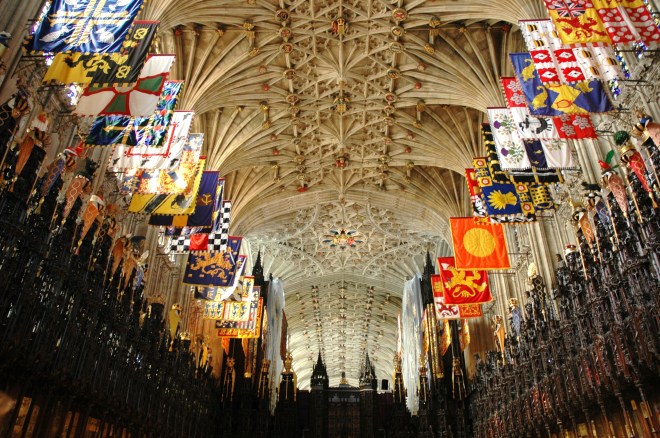
Longleat House: http://www.chch.ox.ac.uk/sites/default/files/images/development/dev2011/longleat-house.jpg (in http://www.chch.ox.ac.uk/development/events/future/2005/7-july-longleat-house-visit)
Longleat old French gardens: http://upload.wikimedia.org/wikipedia/commons/e/e2/Longleat_by_Knyff_edited.JPG (in http://en.wikipedia.org/wiki/Longleat)
Longleat gardens: http://www.writework.com/uploads/3/39734/english-longleat-house-wiltshire-longleat-house-home-lord-ba.jpg (in http://www.writework.com/essay/ao1-investigating-business-actais-and-longleat-aims-and-ob)
Longleat aerial view: http://4.bp.blogspot.com/-MO9gG__FJ7U/T03YIfdx_kI/AAAAAAAAAQc/9U-JgcFxX6Y/s1600/Brown+-+Longleat.001.jpg (in http://www.gardenhistorymatters.com/2012/12/lancelot-brown-is-blogging.html)

Rhinos at Longleat: http://www.millfarmglamping.co.uk/wp-content/uploads/2012/09/longleat-700×401.jpg (in http://www.millfarmglamping.co.uk/in-this-area/longleat/)