MY PSYCHEDELIC TIES

New York, 1 January 2013

My last post has brought back a memory from when I was a teenager. I went to a boarding school that was located some twenty miles from the nearest major train station, so at the beginning and end of each term buses would bring us to and from the station. The bus ride back to school at the beginning of the term was a staid affair, everyone quietly talking or just meditating. The bus ride back home at the end of term was an altogether more riotous event. Bawdy rugby songs were sung at high volume, starting from the back of the bus where the bad boys sat, and what in a different era were called “off-colour” jokes were retold loudly and with relish. This album cover conveys the general idea, although we did keep our clothes on.

rugby songs

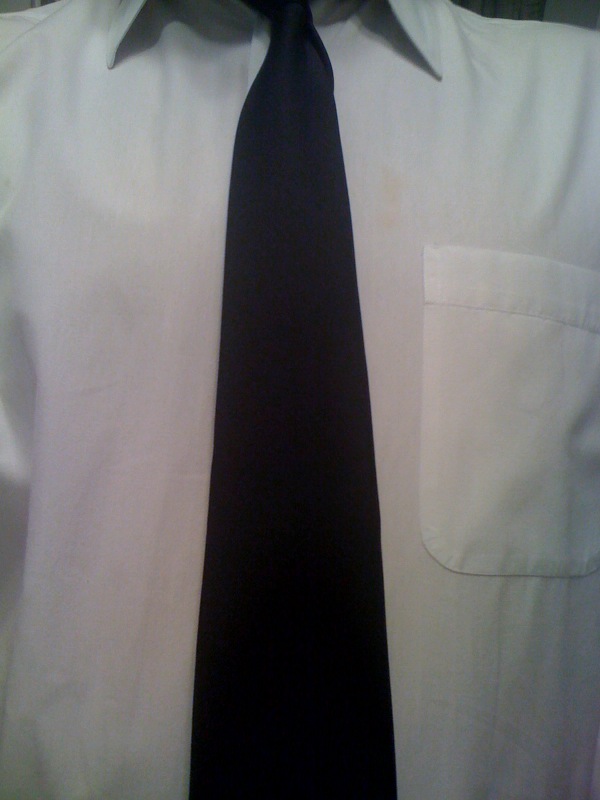
One element of the journey home was that we would all wear the loudest possible ties. I should explain that while we did not wear uniforms as such at our school, sports jackets were de rigeur along with a tie. Not just any old tie; a black tie. All of us, all term, wore a black tie.

black-tie-2

The only exceptions were school and house monitors as well as the sporty types who won their cricket, rugby or other colours for exceptional gamesmanship.  We had many theories about why we all had to wear ties of such a lugubrious colour; the one I remember has to do with commemorating the deaths of several boys in a fire decades ago in one of the school houses (no girls; this was a boys’ school).

Whatever the reason, on the last day of term we threw off that horrible black tie and marched onto the bus each with a tie louder and – given the times – more psychedelic than the last. These photos give an idea of the sudden blast of colour we offered each other:

sixties-ties-3

sixties-ties-2

Getting onto the bus was to take part in a fashion cat walk, with comments about each tie and loud cheers for the brightest. We all came back to school with a secret hoard of bright ties, from which we selected one to parade that last morning in front of our peers. And then off we went, singing our bawdy rugby songs.

What happened to my psychedelic ties? Gone, I think, with other mementos of my youth when my sister, tired of seeing me not collect that suitcase which I had asked her to store in her attic, threw it and its contents out.

suitcase in trash

So goes life.

____________________
Rugby songs album: http://farm4.static.flickr.com/3126/3086393712_13bffb7baa.jpg
Black-tie: http://100days100ties.files.wordpress.com/2011/01/black-tie.jpg
Sixties-ties-1: http://img.ehowcdn.com/article-new/ehow/images/a06/q3/of/men_s-fashion-60s-1.1-800×800.jpg
Sixties-ties-2: http://t1.gstatic.com/images?q=tbn:ANd9GcSLL3ymfg76pRMQkN79f7YMTuTYx8Ftz4I_Srr46O7eIhIHs48IAxr5HDgs
Suitcase in a trash can: http://hilariousnyc.com/wp-content/uploads/2010/12/Suitcase-Trash-Can.jpg

THE SCENT OF WATER

Beijing, 12 October 2012

How would you describe the scent of water? This evening, as I reached the bridge which crosses my piece of canal a gentle breeze lifted the scent off the water’s surface and wafted it over to me. And I asked myself that question.

Let me take a leaf out of wine reviews and try a little of their purple prose: “I sense a hint of moss, with an undercurrent of peat, perhaps a whiff of algal respiration”. But actually what I was smelling was my childhood. Don’t you find that scents are a powerful trigger of memories? I do: a drift of scent will suddenly have me awash in memories. And so it was that as I crossed the bridge I was suddenly ten years old again, on my grandmother’s sail boat on the Norfolk Broads, moored at her buoy on Barton Broad. The sun has set, a light breeze is blowing off the water bringing me the scent of the Broad’s peaty water, and small waves are slapping quietly at the boat’s hull. A grebe calls out in the night.

I loved the Broads. My grandmother spent most of her summer on the boat, taking her numerous grandchildren in shifts of two weeks. I must have gone five years in a row. The sailing didn’t really excite me; it was kayaking among the rushes and in the little creeks on the edges of the Broads that I loved, watching the wildlife and discovering small marsh flowers at every turn.

But I grew up, and my grandmother grew old, and life moved on.  I stopped going and haven’t been back since. Yet I am sure that the Broads made me what I am today: an environmental engineer who for more than thirty years has tried to push back the tide of waste threatening to wash away the natural beauties that are around us.
__________________
pix from:
http://maalie.blogspot.com/2010/08/kayaking-on-norfolk-broads.html
http://news.bbc.co.uk/local/norfolk/hi/people_and_places/nature/newsid_8090000/8090224.stm

PASSION FOR PORCELAIN

Beijing, 6 September 2012

Last weekend, my wife and I visited the exhibition “Passion for Porcelain” at the National Museum of China on Tiananmen Square. Through pieces from the collections of the Victoria & Albert Museum and the British Museum, the exhibition celebrates the discovery by Europe of Chinese porcelain, that wonderful moment in the seventeenth century when chinaware began pouring into Europe as ballast in the holds of the East India companies’ ships. Europeans were dazzled by what they saw, for compared to Chinese porcelain the European ceramics of the time were rough, crude articles.

Chinese potters first exported ware with purely Chinese designs

Passion-for-Porcelain 008-dragon plate

Then they started exporting wares with European designs. Some of them are hilariously bad, like this example.

Passion-for-Porcelain 006-jesus baptism plate

It takes a moment to understand that the two blobs in the plate’s centre are John baptizing Jesus. Obviously, the Chinese designer had no feel for what he was copying. Or take these two figurines, which the label insists are figurines in French court costumes.

Passion-for-Porcelain 012-french figurines

Some are simply odd when seen in a Chinese context. Plates with the armorial bearings of some English aristocrat, for instance, sound a strange note on Tiananmen Square.

Passion-for-Porcelain 013-armorial plate

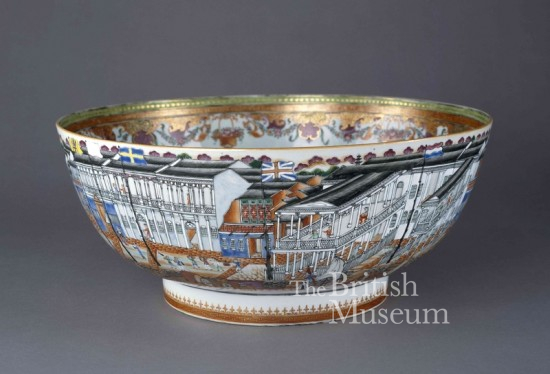
But I suppose it is no stranger than Christmas decorations pouring out of a modern Chinese factory ready for shipment to the US or Europe. In all fairness, some designs have merged Chinese sensibilities exceedingly well with European-driven designs, like this plate picturing the trading hongs in Canton.

Passion-for-Porcelain 009-hongs plate

Then the Europeans started to make copies. And some of these are hilariously awful in their depiction of Chinese scenes.

Passion-for-Porcelain 015-english chinese mug

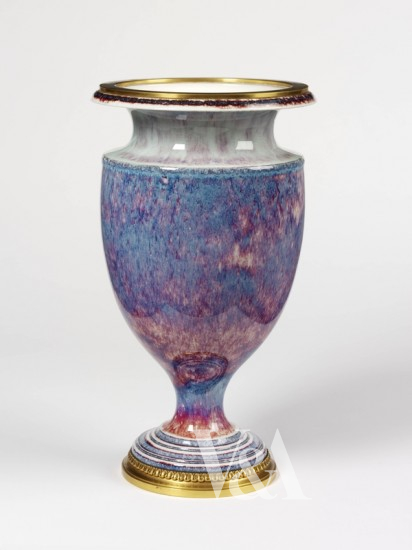
Others are technically poor copies of Chinese techniques, like these two articles which are both using the flambée technique; the European version suffers distinctly from the comparison.


Once the Europeans had mastered the technique of porcelain-making, they could cut the cord with China and make wares of purely European design.

An interesting journey indeed through Europe’s love affair with porcelain. But the exhibition’s postscript made all the previous showings “full of sound and fury signifying nothing”.  But I will deal with this in my next post.

THREE TAKES ON BROKEN CHINAWARE

Beijing, 31 August 2012

Take 1:

When I was a boy, I spent a fair amount of time with my English grandmother, on my way to and from boarding school. One of my memories of her is a set of china plates which she used for meals. The plates carried polychromatic designs of butterflies, flowers and trees on a white background, and I liked studying the designs as I ate my meat and two veg (making sure to keep my elbows well in; my grandmother was quite particular about table manners). The strange thing about these plates was that they had all been broken, often quite badly. But rather than throwing them away, my grandmother had had them carefully stapled together! By that, I mean that small pieces of metal had been fixed across the breaks. Here is the picture of such a plate.

stapled plate

I suppose my grandmother was very attached to the plates and preferred to keep them in this strange, cobbled-together form rather than not have them at all. But I won’t ever know because I never asked her the reason.

Take 2:

On our living room table, in a wide wooden bowl, my wife and I have carefully laid out some broken pieces of porcelain. I think they are from a bottle. They all have a blue pattern on a white background.

broken bits 001

They are part of our larger collection of odds and ends we’ve picked up in the streets during our three years in Beijing: broken bricks from construction sites, chunks of coal, a set of Chinese chequers. But our collection of broken porcelain has a special significance; we collected the pieces on the verge of the road outside Ai Weiwei’s house. We feel that somehow they have been bathed in his aura.

Take 3:

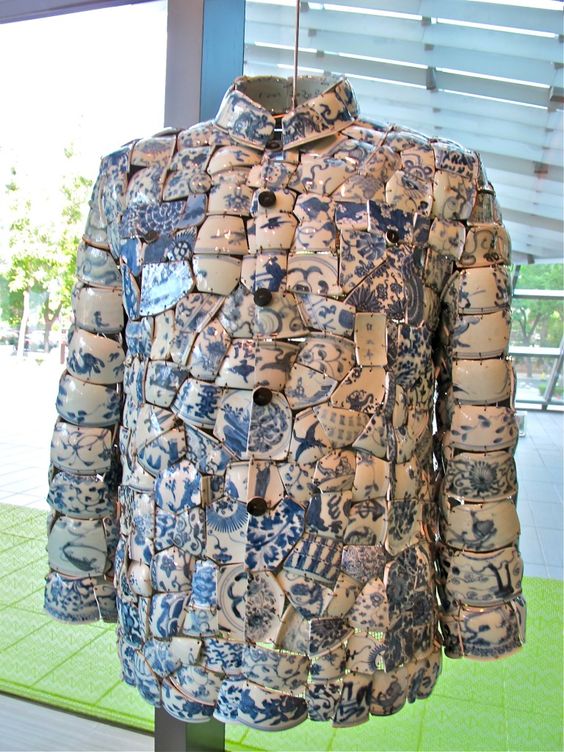
At the window near the entrance to the Opposite House, a chic hotel on Sanlitun, stand two wonderful sculptures. They represent an old Chinese dress and an old Chinese jacket. They have been created out of bits of broken Ming pottery, and all have blue patterns on a white background. This photo shows one of them.

China’s old Ming pottery works are littered with broken crockery from all the runs that failed. The artist collected some and has turned these failures into pieces of real beauty. A wonderful example of arte povera.

_______________________
the stapled plate: http://jwcsybaritic.blogspot.com/2011/11/stapled-porcelain.html
the porcelain jacket: https://www.pinterest.es/pin/419397784062874431/
other photo: mine

THE OLYMPIC FLAME

Beijing, 29 July 2012

My wife and I managed to crawl out of bed at around 4 am to watch the opening ceremony of the Olympic Games. It had already started, and by the time we joined the billion or so people watching, the show was celebrating the NHS. We missed the Green and Pleasant Land, the Dark Satanic Mills, the Forging of the Olympic Rings, and – worst of all! – the Queen and James Bond parachuting. No matter, we watched the rest, letting ourselves ride along with the slightly manic fun of it all (I don’t know what non-Brits made of it; I’m British but I’ve been out of the country for nigh on 40 years and found a good number of the references quite baffling). We patiently watched as all the country teams filed into the stadium, commenting on costumes and trying to guess which would be the next country, listened politely to the various speeches and Olympic oaths, until we finally got to the lighting of the Olympic flame, or should I say Olympic cauldron.

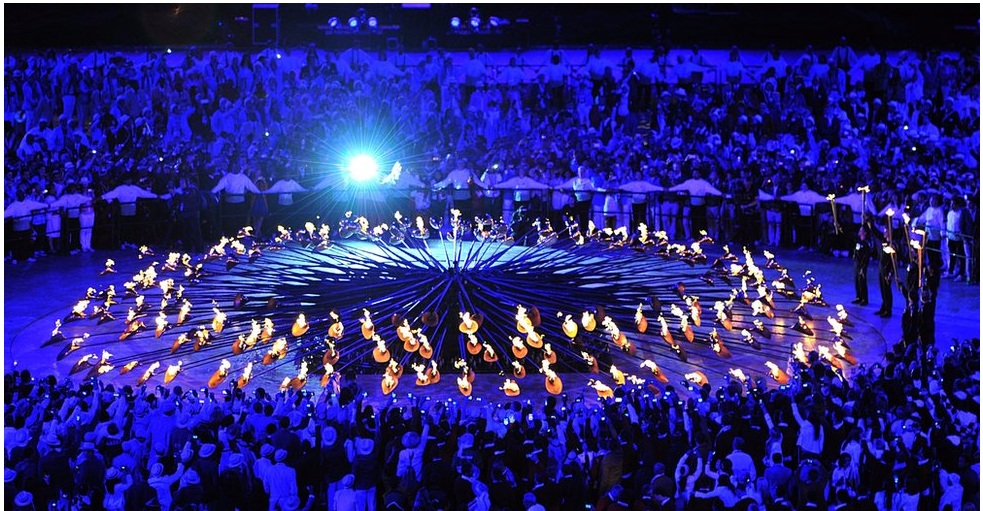
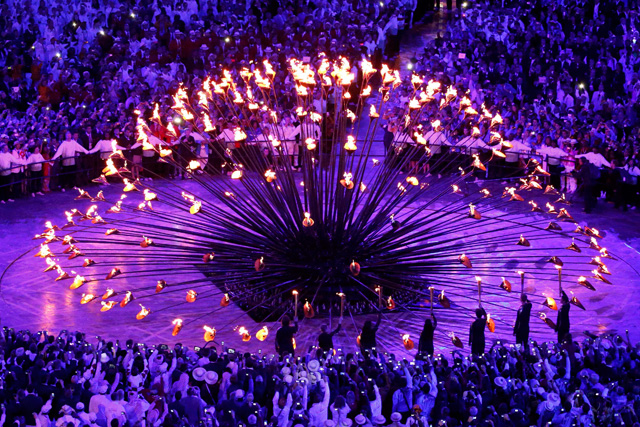
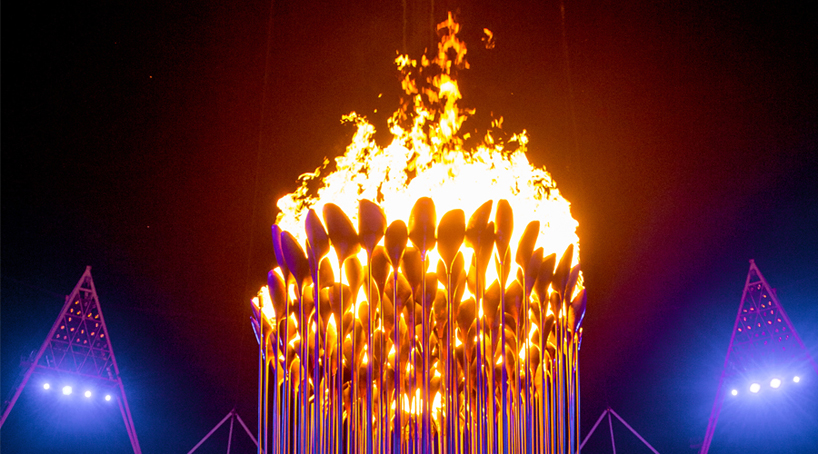
We had vaguely followed the discussions on who might be the person honoured to light the flame, but I must say I was deeply touched by the – very Olympic – decision  to go for inclusion, to have the honour shared between seven athletes. And not just shared, but shared by young, promising athletes each chosen by a respected past Olympian.  It gave real meaning to the Games’s slightly cheesy motto Inspire a Generation. And that cauldron! That is truly a beautiful piece of design. It was breathtaking to watch those seven initial flames spread and spread in ever smaller circles until all 204 flames were lit. But I’m always stirred by design with a deeper meaning, and I loved this idea of 204 separate flames, each representing a nation competing in the Games, once lit slowly coming together as one flame: we compete individually, but we are one world.

Olympic-Cauldron-1

Olympic-Cauldron-2

Olympic-Cauldron-3

Olympic-Cauldron-4

Olympic-Cauldron-5

P.S. For those of you interested in design, Thomas Heatherwick, the designer of the Olympic cauldron, also designed the UK Pavilion at the 2010 Shanghai Expo, the so-called Seed Cathedral. I had to visit the Expo as part of my work. Much of it I found dreary and superficial. The UK pavilion was one of the few that made the experience worthwhile.

uk-pavillon-expo-shanghai

_____________
pix come from:
Olympic cauldron:
http://www.doubleglazingblogger.com/2012/07/the-olympic-opening-ceremony-proud-to-be-british/
http://www.interaksyon.com/interaktv/seven-teenagers-light-olympic-cauldron
http://www.designboom.com/weblog/cat/8/view/22698/heatherwick-studio-2012-london-olympics-cauldron.html
UK pavilion:
http://architecture.mapolismagazin.com/heatherwick-studio-uk-pavillon-expo-shanghai-2010-shanghai