Vienna, 12 January 2024
This past Christmas, my wife and I were debating what we should cook for Christmas lunch. We finally decided to adopt a programme in honour of our children, whereby over the coming years we will use Christmas lunches to celebrate our children’s rich and varied heritage. This will mean that over the course of the next six Christmases we will prepare typical Christmas lunches starting with Puglia in the south of Italy, going on to Lombardy, Beaujolais, England, Scotland, and finally Norway. After Norway, we will extend the programme at least several more years, by celebrating the extra heritage of our currently only grandchild, which will take us to Ireland and to Lithuania and Bielorussia. If there are further grandchildren with other heritages to bring – literally – to the table, we will tack on more years to the programme (assuming we haven’t popped our clogs before that).
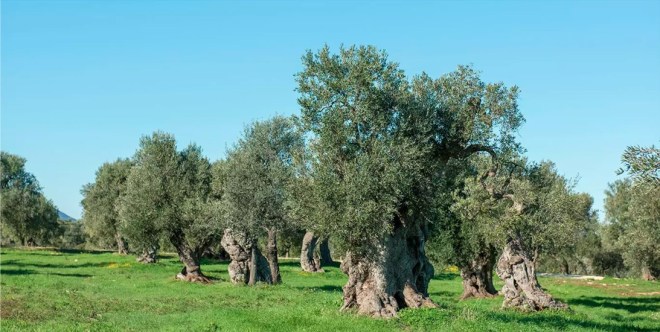
With this multi-year framework programme agreed upon, we got to work and started our research: what would be a typical Christmas lunch in Puglia? Just to get us into an Apulian mood, I throw in here a photo of an Apulian olive grove with millenarian olive trees.
Unfortunately, my wife had never been brought up in Apulian traditions: it was her maternal grandfather who had been the Apulian of the family; he had immigrated to Milan as a young man before World War I, and like many immigrants before and after him he had wanted to blend in to the local, northern Italian, culture. So we had to fall back on the internet. Our initial surfing showed us that there are actually several traditional Apulian Christmas lunches to choose from, broadly divided between fish and meat. After some to-ing and fro-ing, we plumped for roast lamb and potatoes, with something called lampascioni on the side, and we left hanging the question of what to do about dessert.
Well, lamb and potatoes aren’t particularly Apulian, nor did any of the articles we read say that a particular cut of lamb was required for the Apulian Christmas lunch, so we took whatever cuts of lamb were available at our local supermarket. What was truly Apulian about the lunch were the lampascioni. No doubt like us, many of my readers will have no idea what these lampascioni are. I certainly had no idea whatsoever, and my wife had only heard of them but had never tried them. They are the bulb of a flower which goes by the English name of tassel hyacinth. Its natural range is the Mediterranean basin, although it is also found as far east as Iran and as far west as the Canary Islands. It naturalizes quite easily, though, and over the centuries it has moved northward to Poland. Now, of course, with globalisation, it’s also found in many other parts of the world. As this photo shows, the flower is really quite handsome.

This has led to its being planted in many a garden, although I think I prefer them in the wild, like these tassel hyacinths in an olive grove.

They may be handsome flowers, but the inhabitants of the heel, instep, and toe of Italy’s boot, namely the regions of Puglia, Basilicata and Calabria, have other ideas. They have taken to eating the bulb of the plant (a habit, I should say in passing, that they share with the inhabitants of the island of Crete).
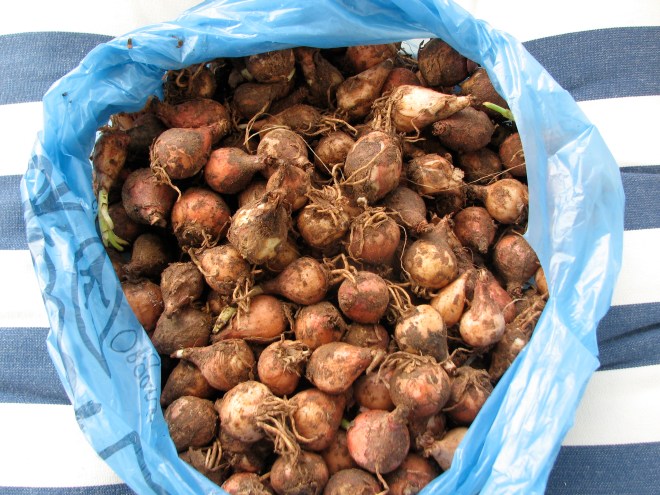
The bulbs are not an obvious candidate for the dining table since in their natural state they have an unpleasantly bitter taste. But at some point in the distant past (there is evidence that the bulbs were already being eaten in Neolithic times), this problem was solved. To be edible, the bulbs have to be left to steep in water for a significant period of time (one day should do it, with a change of water in between) and then cooked. At which point, they look like this.
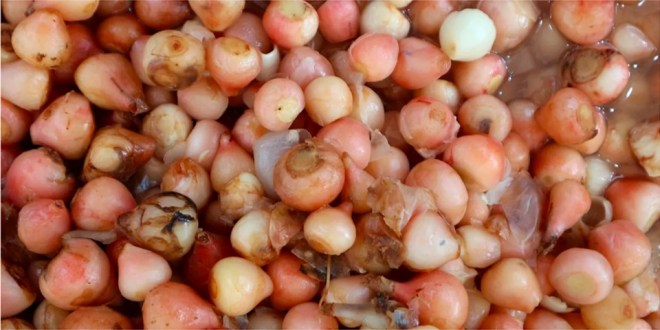
It was all very well to want to have lampascioni for lunch, but where were we going to buy them? A very regional foodstuff like this was only going to be sold in a specialist shop. As luck would have it, I discovered that a long urban walk we had planned (to a modern church on the outskirts of Milan – perhaps the subject of a later post) happened to take us by a small shop selling Apulian foodstuffs. So I persuaded my wife to make a small detour to check the shop out. When we reached it, we entered with our hearts in our mouths – and there on the shelf were jars of lampascioni! They were immersed in a lovely Apulian olive oil.
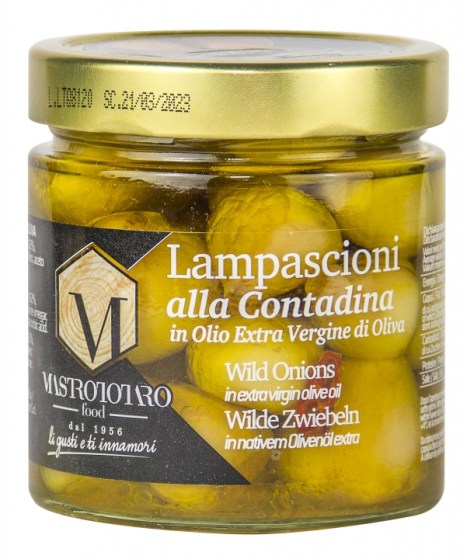
This is the normal way of selling lampascioni; the bulbs are only harvested in the early months of the year. So, to be able to eat them all year round, they are kept in olive oil (the Cretans instead, I can once again mention in passing, keep them in vinegar on which is floated a thin layer of olive oil).
So we had our lampascioni to accompany the lamb and potatoes! We were moving along nicely. Most satisfactorily, the same shop also solved our dessert problem. They were selling trays of something called cartellate con vincotto di fichi. I had certainly never heard of these cartellate, and neither had my wife. Nevertheless, they were obviously Apulian and obviously a dessert. So a decision was rapidly taken and a tray of cartellate joined the jar of lampascioni.

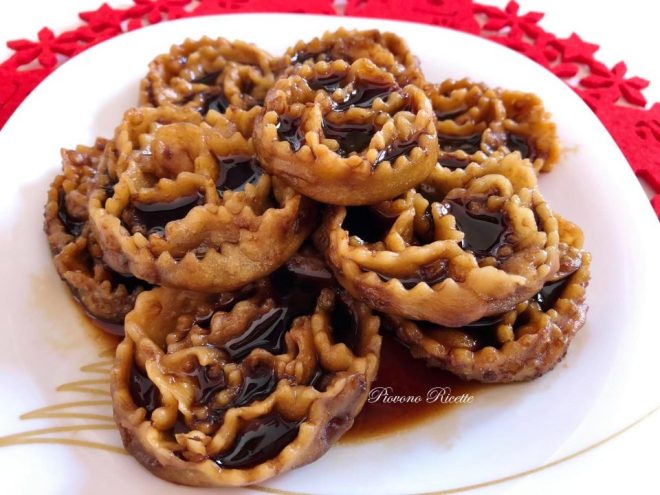
I think I need to explain what these cartellate are. I had to look it up on the internet because just looking at them didn’t help. They are made with thin, long and narrow slices of dough (with, interestingly enough, a local white wine taking the place of water). These are rolled up into the shape of rosettes, and the rosettes are then deep-fried in oil. Into the little cups of the rosettes is poured a thick syrup made by boiling figs over a long, long time and sieving out the solids. I think I should add in a photo of the these cartellate out of the packaging, so that readers can get a better idea of what they look like (in passing, I find it strange that they call this syrup vincotto di fichi, which translates as “cooked wine of figs”, because no wine is involved).
So now we had all the ingredients we needed! 25 December dawned, and it was time to start cooking the lamb and potatoes. Our son, who was going to eat lunch with us, joined us for the preparations.
Since our internet sources hadn’t mentioned a typically Apulian way of roasting the lamb, we chose a recipe from the Italian cookery site Giallo Zafferano. The only thing which, to us at least, was untoward about this recipe was its insistence on adding a lot of water to the pan in which the lamb and potatoes were being roasted.
After an hour or so, the lamb and potatoes were ready.

It was time for us to sit ourselves down at the table. The lamb and potatoes were ceremoniously brought to the table, my wife served us, we fished the lampascioni out of their jar, and we tucked in.
The lamb was delicious. The addition of water worked really well. The lamb was juicy and tender, with just a bit of crispiness on the top where the meat was above the water, and the potatoes were done to perfection.
And how about the lampascioni? What did they taste like? Well, they tasted slightly bitter, as one might imagine, but also slightly sweet. So there was an interesting sweet-and-sour thing going on with the taste buds. They also had a most interesting texture, almost melting in the mouth. I have to say, they were an excellent accompaniment to the lamb and spuds. And the oil that was left after we had polished off the lampascioni was exquisite. Apulian olive oil is anyway very good, but now it had a slight umami taste to it, which made it an excellent oil to put on my post-Christmas salads, adding an evanescent flavour to otherwise rather staid vegetables. I would buy another jar of lampascioni just for its oil.
I’m afraid the cartellate were a different story. I don’t want to badmouth them, but we won’t be buying them again, at least not if they are made with fig syrup. All that boiling meant that the syrup actually had a somewhat bitter taste to it, which rather ruined the experience of eating the cartellate. Internet sites suggest that alternatives can be used: grape syrup (but I suspect there would be the same problem of bitterness), honey, or icing sugar. If ever we come across cartellate made with any of these alternatives, we might give the dish a second chance.
So there we have it. Apulian Christmas lunch: done! Next year: Lombard Christmas lunch.





 the heart thrills