OUR DOLOMITES HIKE, 2024

Vienna, 27 June 2024

My wife and I recently completed our annual hike in the Dolomites. We returned to old stamping grounds this year, to the Val di Fassa, in the autonomous province of Trento. This was where we started our annual pilgrimages to the Dolomites five years ago. That year, however, our carefully constructed six-day hike was thrown into chaos and confusion by two mega-meteorological events. The first was a hugely powerful windstorm, Vaia, which swept through the Italian Alps in late October of 2018 and brought millions of trees crashing to the ground – the official tally talks of 8 million cubic metres of trees being downed.

Source

The second was a monster snowfall in May of 2019, a mere month before we were meant to start our hike.

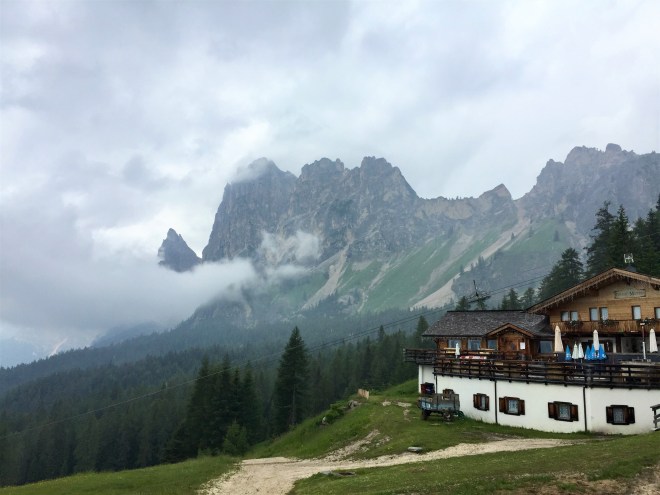
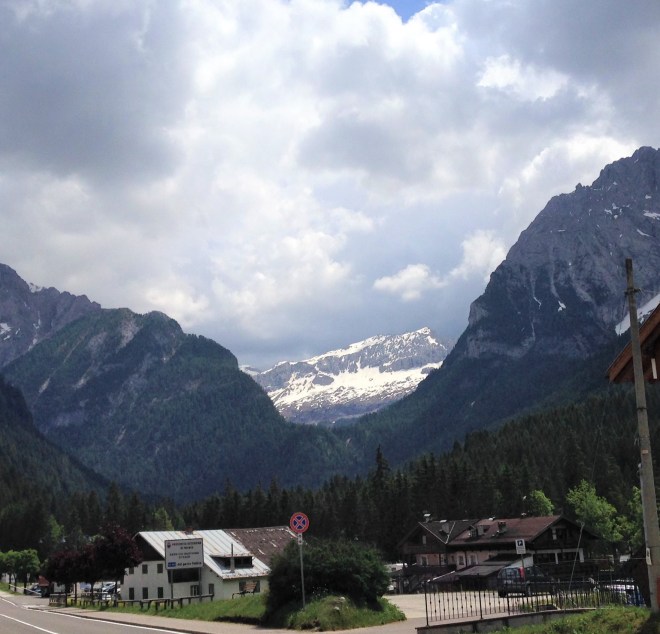
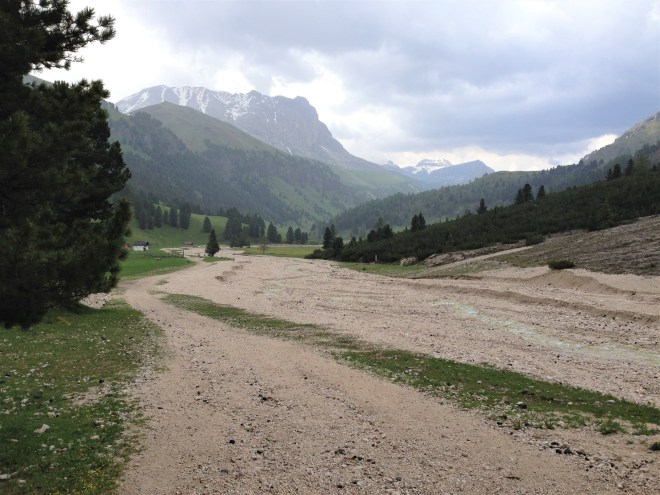
As we saw over and over again during our severely modified hike, the Val di Fassa was badly hit by Vaia.

My photo

A good number of the trails we were meant to take were blocked off over long sections by downed trees. The local tourism authorities had planned to use the month of May to clear the trails, but the monster snowfall of that month put paid to their plan. On top of it, that unexpectedly heavy snowfall meant that a good number of the huts we were meant to spend nights at, and the trails leading into them and out from them, were still blocked with snow when we arrived in the Val di Fassa.

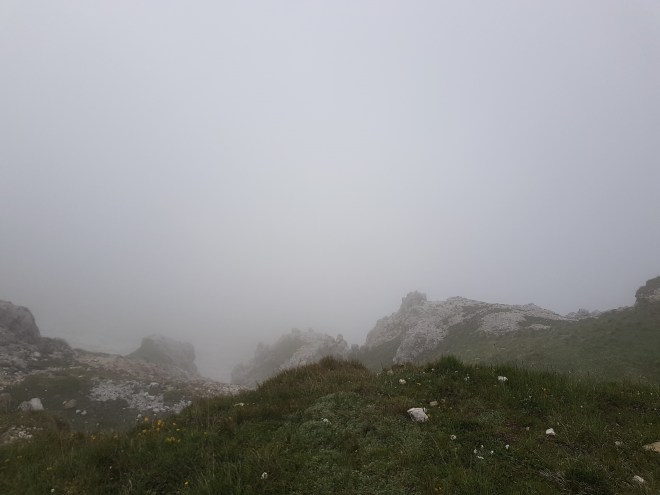
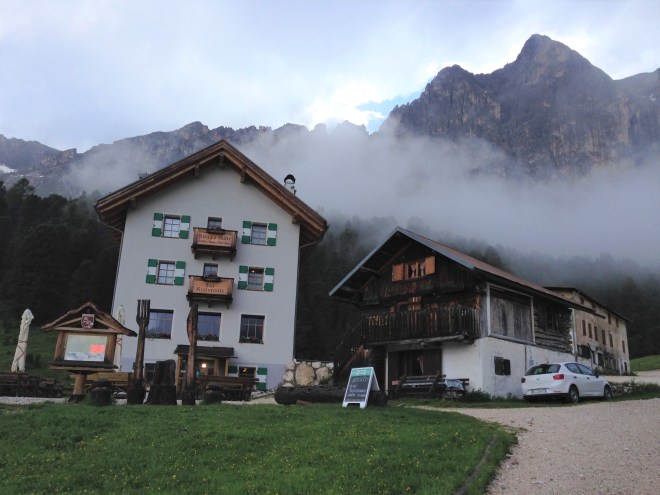
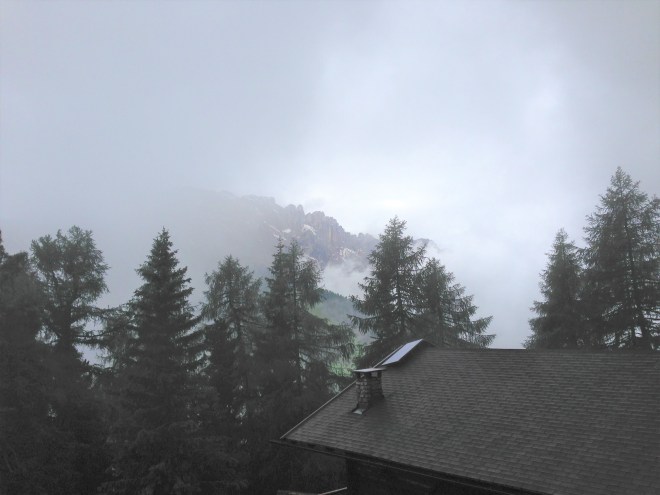
Five years on, the weather behaved better in the preceding months, and we were able to do a good number of the trails blocked to us back in 2019. We got off to an iffy start, hiking in fog so thick that we could have been in a park in Milan during the month of November.

My photo

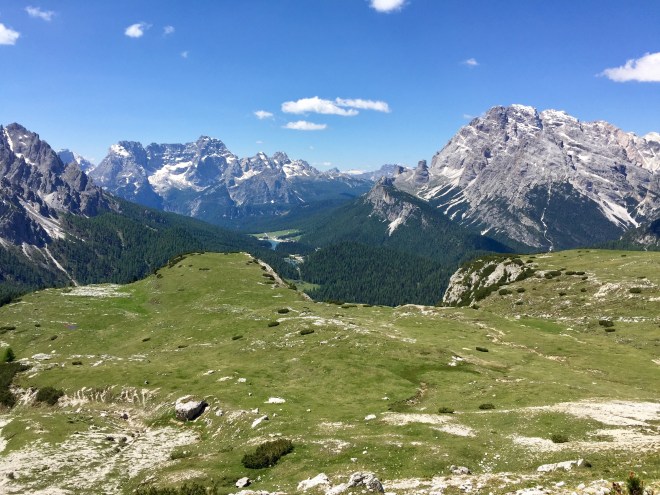
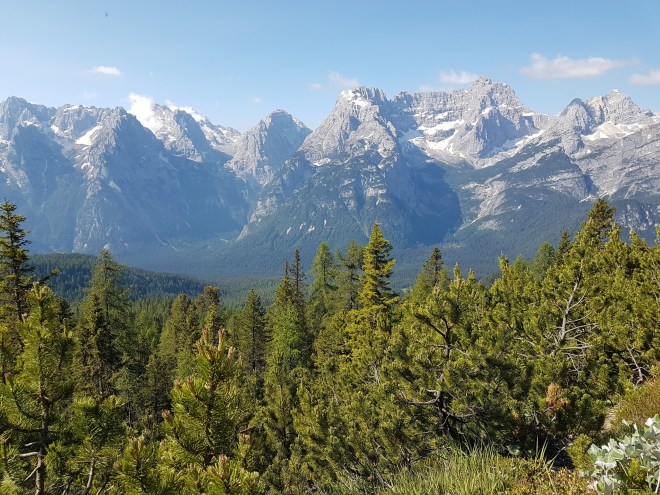
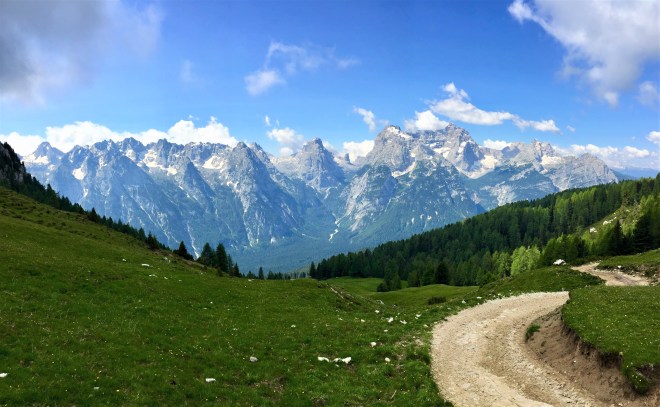
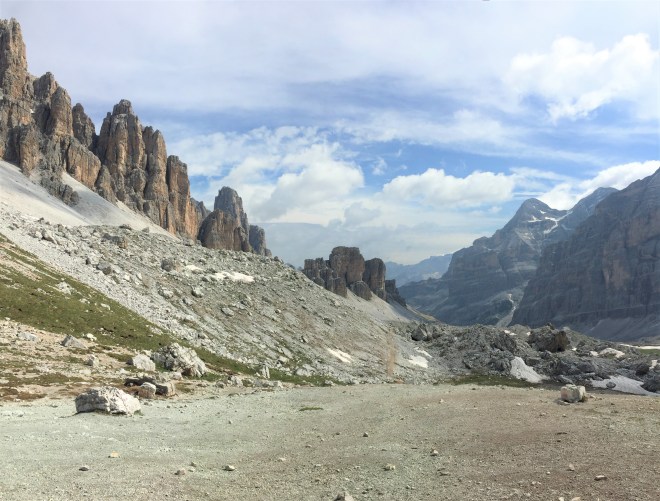
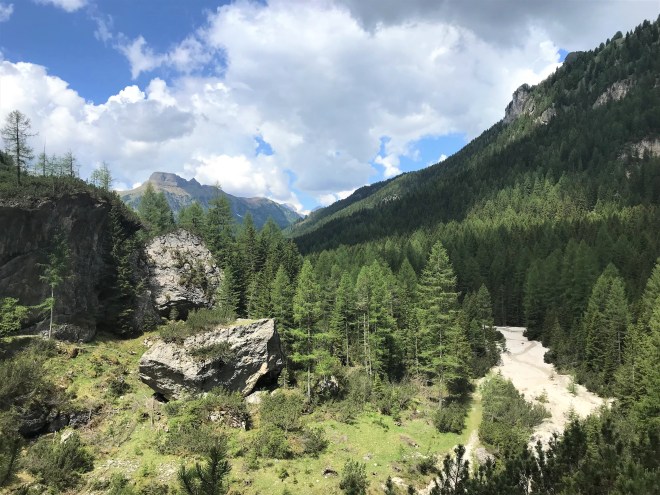
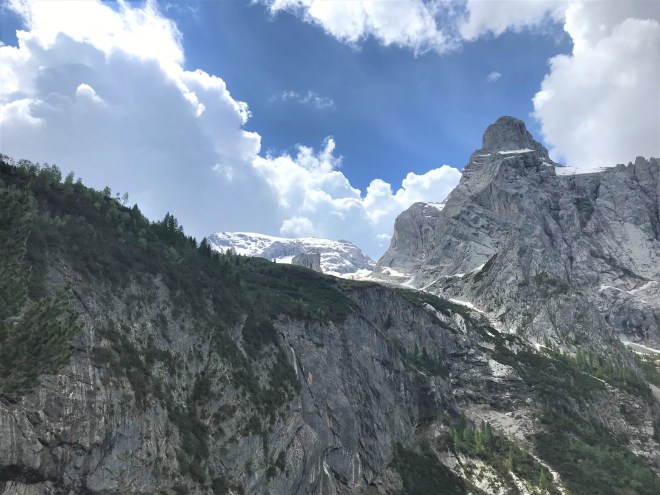
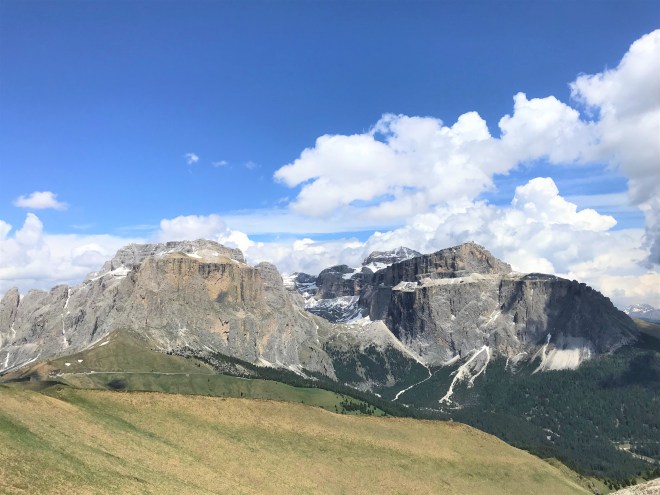
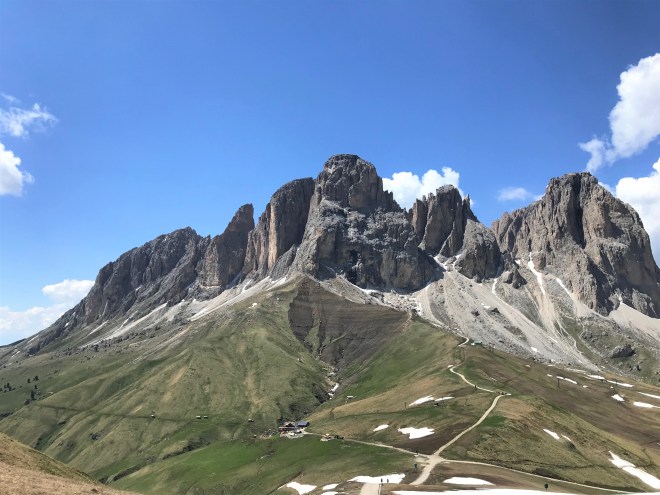
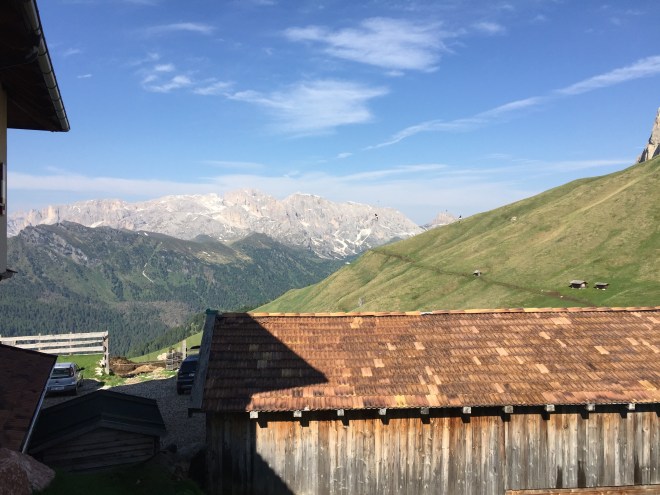
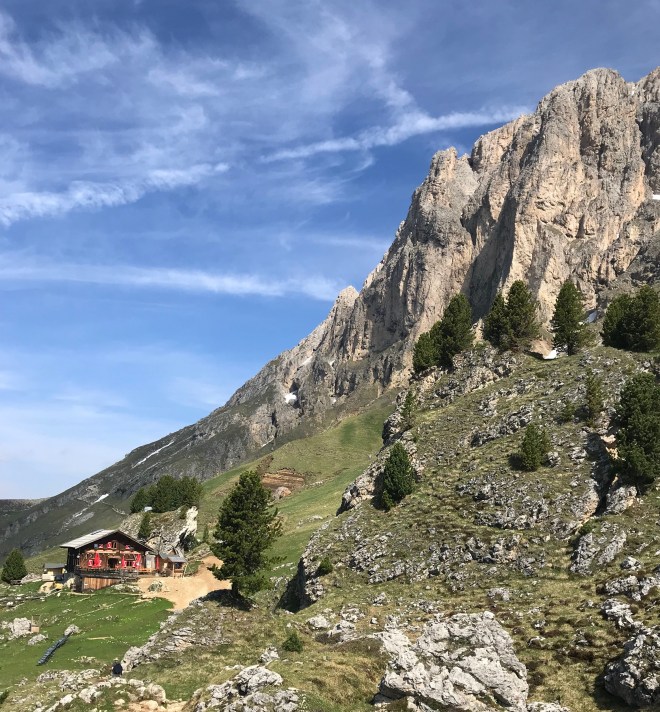
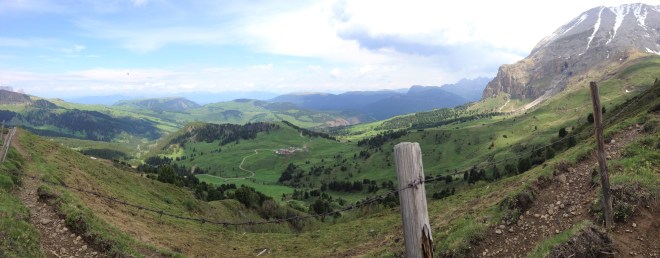
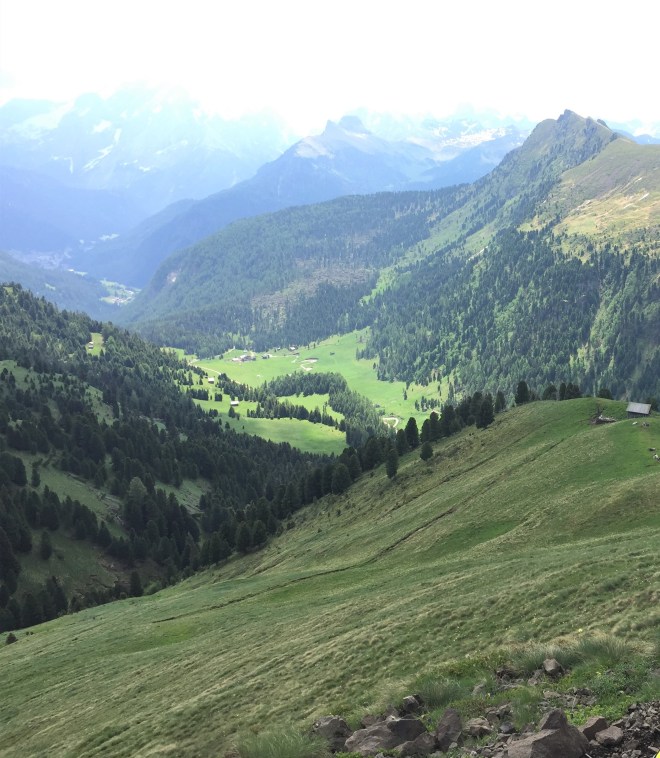
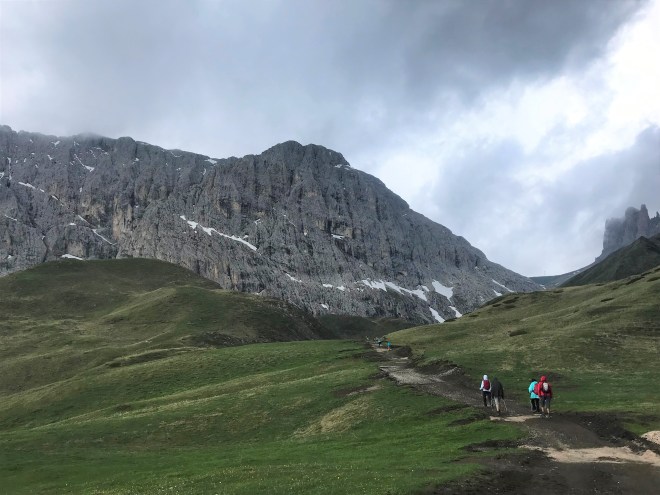
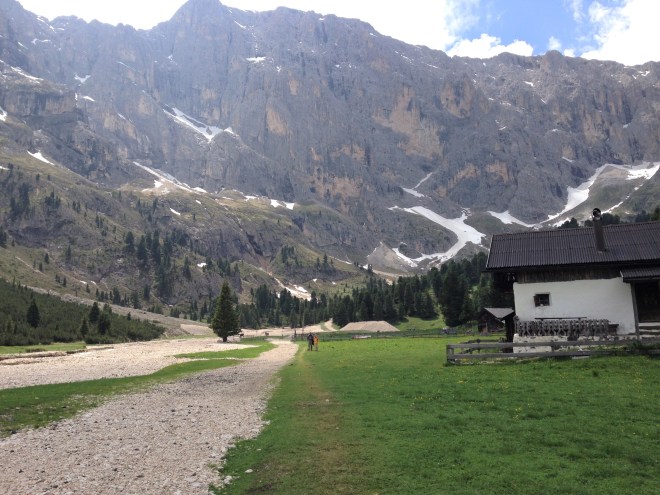
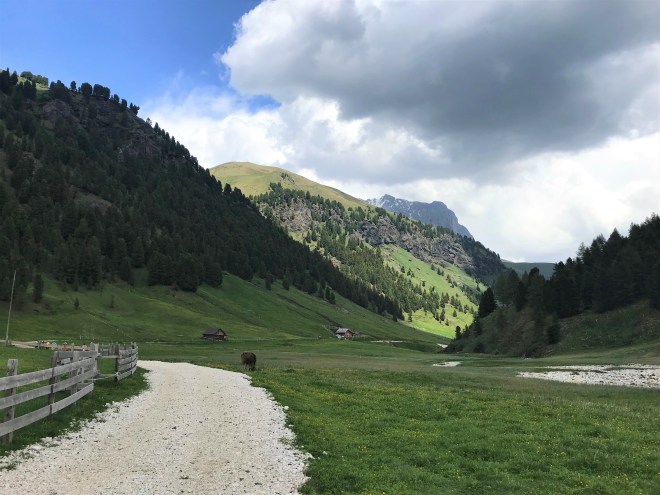
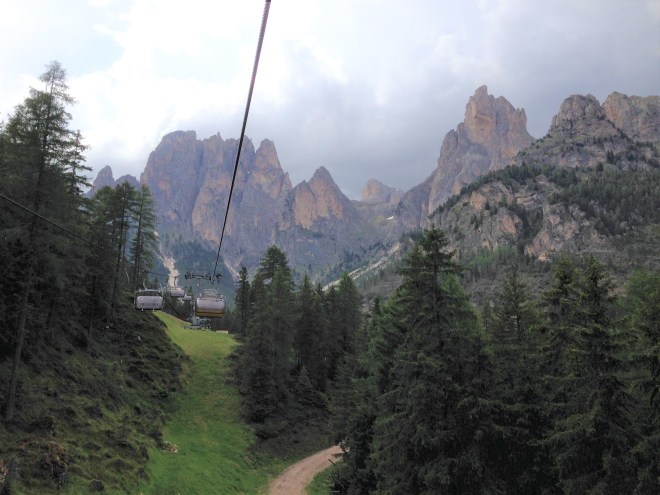
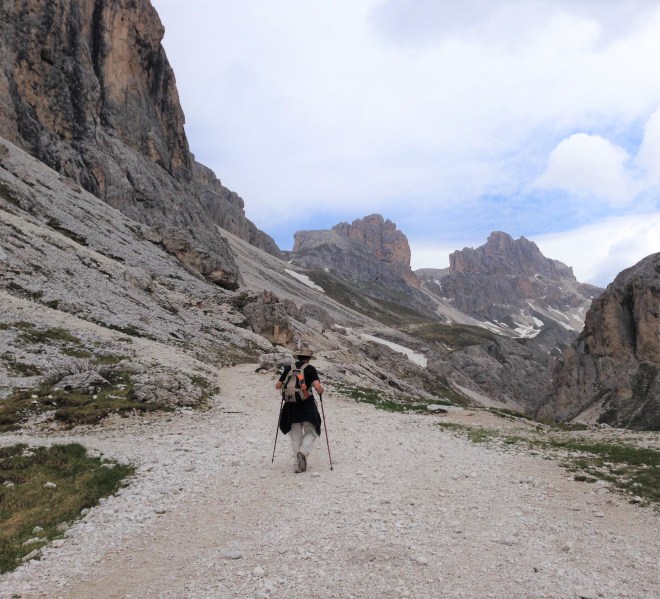
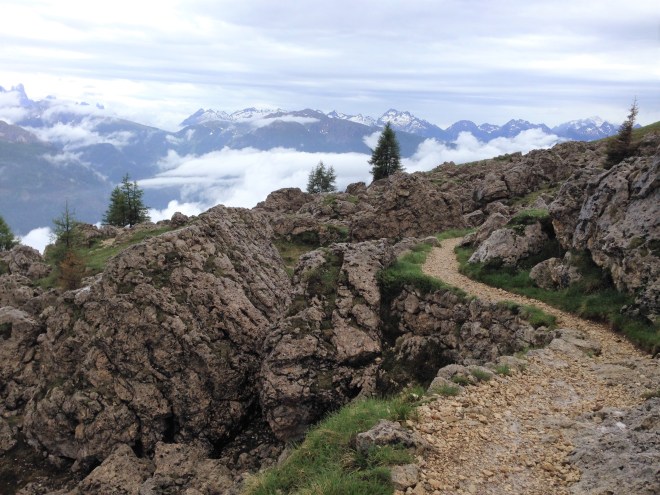
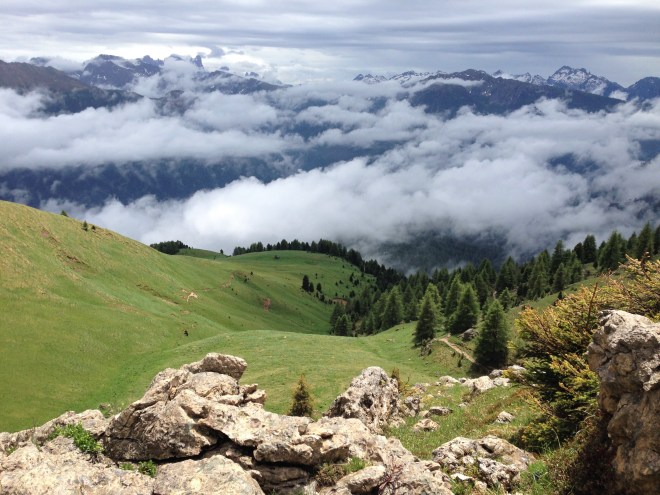
But after that, the weather cleared and glorious sights awaited us!

My wife’s photo
My wife’s photo
My wife’s photo
My wife’s photo
My wife’s photo
My photo
My wife’s photo
My photo
my wife’s photo
My wife’s photo

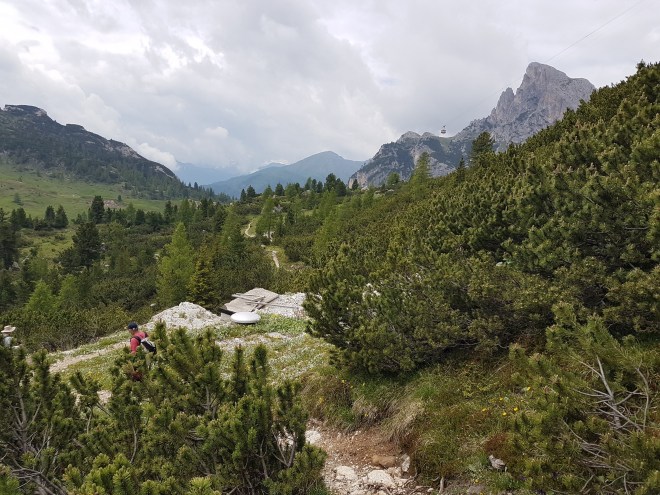
It wasn’t just towering mountains and emerald valleys far below us that left us breathless (although some of the breathlessness was also due to our climbing hundreds of metres of steep slopes). It was also the streams and small lakes we passed by.

my photo
My photo

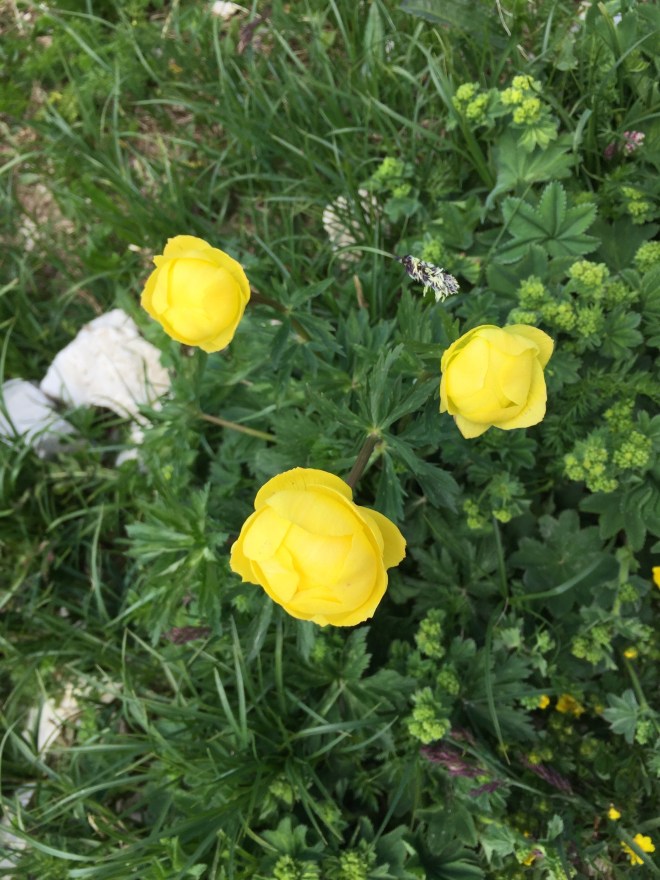
Or the wild flowers that greeted us along the paths we passed along.

My photo
My photo
My photo
my photo
My photo

Even the smallest beings we came across had the power to enchant us.

My photo
My wife’s photo

There were shadows among all this wonderfulnness, though, notably the clusters of dead European spruce trees we saw dotting the woods that clothed the steep flanks of the valleys.

Source

All was not right. There hadn’t been so many standing dead trees in 2019. What was going on? A massive infestation by another beetle was what was going on. A beetle not nearly as cute-looking as the other beetles we had seen and photographed.

Source

A beetle which goes by the name of European spruce bark beetle in English and bostrico tipografo in Italian. The English name is rather prosaic, merely confirming the beetle’s preferred victim to be the European spruce. The Italian name is much more interesting. The second part of the name rather colourfully indicates the type of intriguing “calligraphy” which the beetle and its offspring create in the tree as they burrow into it – and kill it.

Source

The first part of the Italian name also harks back to the elegant whorl-shaped channels which other members of this family of wood-burrowing beetle creates. It is an italianization of the name that Aristotle gave to the family, βόστρυχος, which is the Greek word for “curl”.

I hope my readers will excuse this little riff on the etymology of the beetle’s name, but I feel that often the origin of words tells us a lot about how our ancestors perceived the world around them. In any event, for all its intriguingly shaped burrows, this beetle kills the European spruces (and other trees) which it infects, and it kills them quite quickly, within a few months. The trees first look peeky, their crown wilting and turning rust-coloured, then they start massively losing their needles, then they dry out, at which point, to borrow – with the necessary adaptations – John Cleese’s speech about the dead Norwegian parrot, the trees are no more, they have ceased to be, they’re expired and gone to meet their maker, they are late trees, bereft of life they rest in peace, they’ve rung down the curtain and joined the choir invisible: they are ex-trees.

Source

Under normal circumstances, healthy European spruce can beat off the nefarious beetle’s attacks, which usually only burrows into dead trees or trees that are already dying. The infestations are endemic but under control. But after huge destructions of trees which massive storms like Vaia bring about, there is suddenly vast amounts of dead and dying trees available for the beetle to feast on. Worse, the trees which have remained standing are – unsurprisingly – stressed and unable to defend themselves effectively, so the beetle also merrily attacks apparently healthy standing trees. The result: an uncontrolled epidemic of the beetle, with huge increases in its population, and the large patches of dead trees we were seeing everywhere.

Locals grimly told us that it could be five years or more before the situation rights itself and beetle populations drop back down to endemic levels again. By then, perhaps as many trees will have been killed off as were brought down by Vaia. I fear that if we come back to Val di Fassa in the coming years, we’ll find valleys which look like they have a bad case of the mange, with big, bald patches speckling the hillsides.

I don’t want to sound smugly virtuous, but the people who manage these forests haven’t done a very good job. Anxious to maximise profits, they have planted monocultures of European spruce and trees all of the same age, to make it easy to clear cut any particular patch of forest. If instead they had planted a mix of different species and ensured a mix of trees with different ages, they might have made less profits short-term but they would have been better able to weather big disruptions like those caused by Vaia. This is especially urgent since with climate change massive, intense storms like Vaia (wind velocities of over 200 km/hr were recorded) are going to happen more frequently.

But who is listening to old farts like me? I fear that on our future hikes, my wife and I will be mournful witnesses to ever more examples of short-term thinking: downed trees, dead trees, bad erosion, flooding, desertification, and on and on. I despair sometimes at the world we are leaving our little grandson and any other grandchildren who may soon come along.
BACK IN THE DOLOMITES

Vienna, 11 July 2020

Last year, at about this time, my wife and I undertook our first hike in the Dolomites. Readers can see the commented photos of that hike in an earlier post. At the time, we promised ourselves to come back this year, to explore another part of the Dolomites. We were true to our promise, even though Covid-19 threatened to upset our plans, particularly since we were joined by one of my French cousins and his wife: would the borders be open on time? would they  have to quarantine in Italy? or in France on their way back? But all was well; restrictions on travel were lifted in time. And it was great that they could come, because I have shamelessly used a good number of the photos they took.

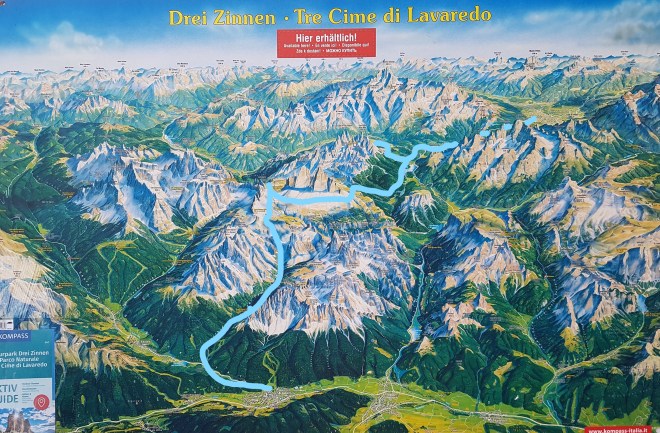
This year, we explored the Dolomites around the Val Pusteria as well as the Ampezzine Dolomites close to Cortina d’Ampezzo. I have a fondness of bird’s-eye view maps like the one below, but they do allow me to mark the route we took.

Cousins’ photo

We started in San Candido at the bottom of the map (which is Innichen to the local, mostly German-speaking population; we are in the South Tyrol here). We hiked over the group of mountains south of the town, where the Tre Cime di Lavaredo, the Three Peaks, were the star of the show, and down into Cortina d’Ampezzo at the top right of the map. Then we hiked around another group of mountains to the west of Cortina; I’ll show a map of that in a minute. But let’s have the photos tell the rest of the tale!

21 June

On the evening we arrive, the setting sun brightens the tops of the mountains behind San Candido / Innichen

our photo

22 June

First stage, hiking up the Val Campo di Dentro up to the Drei Schuster Hütte / Rifugio Tre Scarperi: gradual climb of about 450 m. Here we are, arriving at the hut in time for lunch.

Cousins’ photo

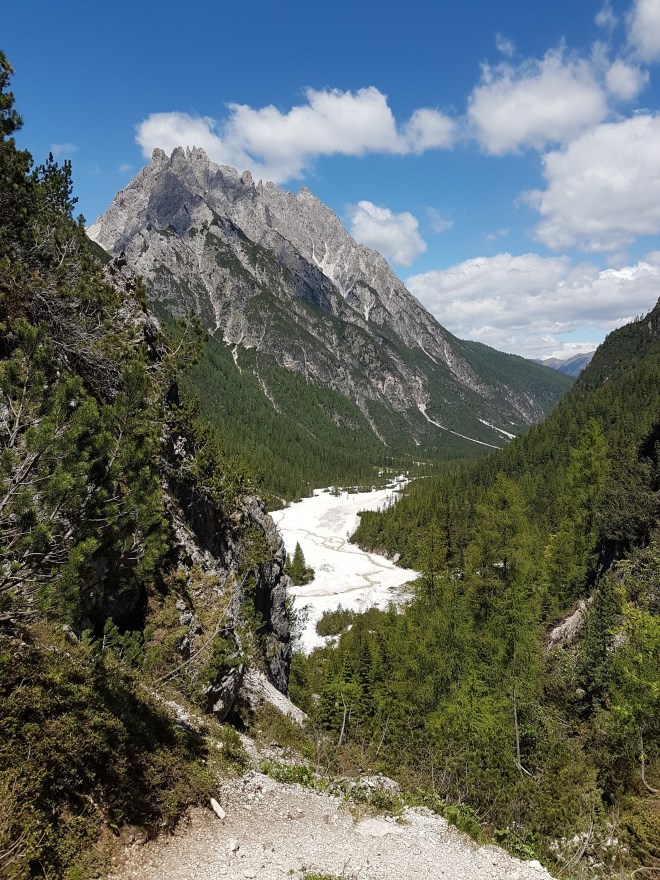
The mountain blocking the end of the valley. After lunch we climbed up to the top of the saddle to the left of that mountain: a brutally steep climb of 840 m!

Our photo

We have started climbing. The valley floor is dropping away below us
Cousins’ photo

Clambering over an impossibly lovely stream, hoping not to fall in …

Cousins’ photo

And we climb …

Our photo

The valley is far below now …

Our photo

… but still we climb … we begin to hit snow patches …

Cousins’ photo

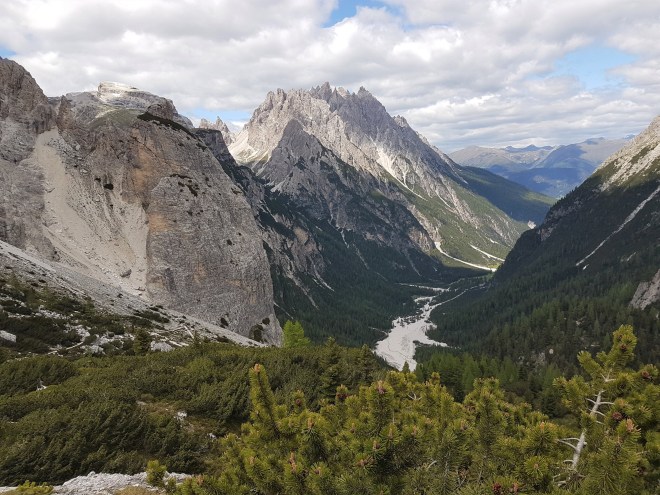
Last sighting of the valley far, far below

Cousins’ photo

… and still we climb …

Our photo

Finally, the top!

Cousins’ photo

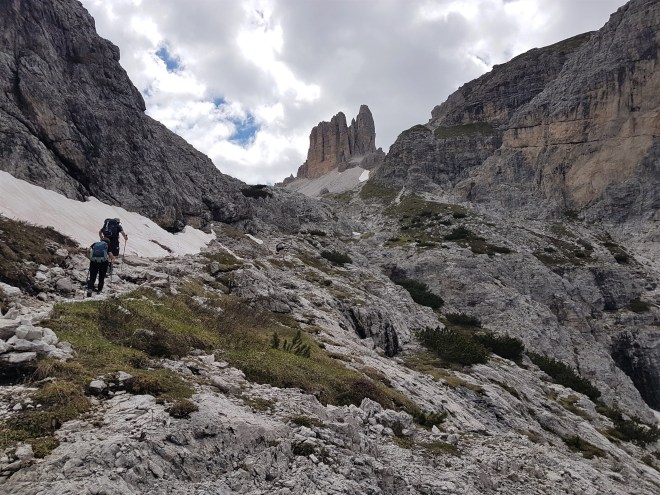
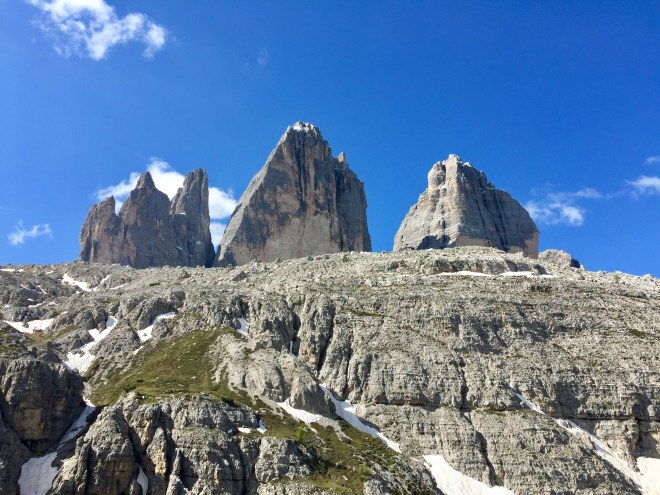
Our first sighting of the Three Peaks of Lavaredo. We will be walking to the saddle to the left of them, to reach the mountain hut we will be sleeping in.

our photo

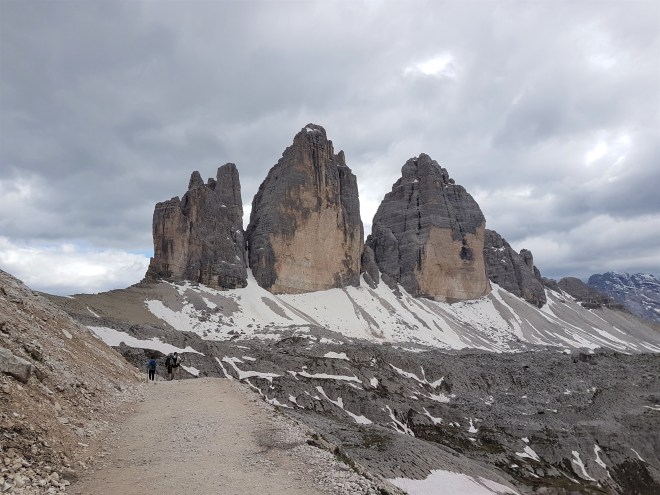
Our first clear view of of these three majestic peaks

Cousins’ photo

Getting closer to them, while the weather is turning …

Cousins’ photo

… also looking back at the route we’ve taken.

Cousins’ photo

Nearly at the top of the saddle …

Our photo

Looking over the other side of the saddle, down onto the Rifugio Lavaredo where we will be staying the night. Nearly the end of a long day.

Our photo

23 June

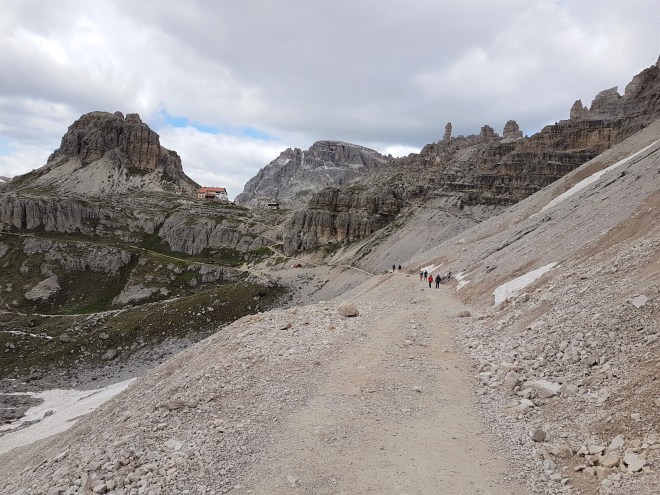
Beautiful day. We go back to the top of the saddle.

That’s the path we’ll be taking today, snaking away to the far left.

Our photo

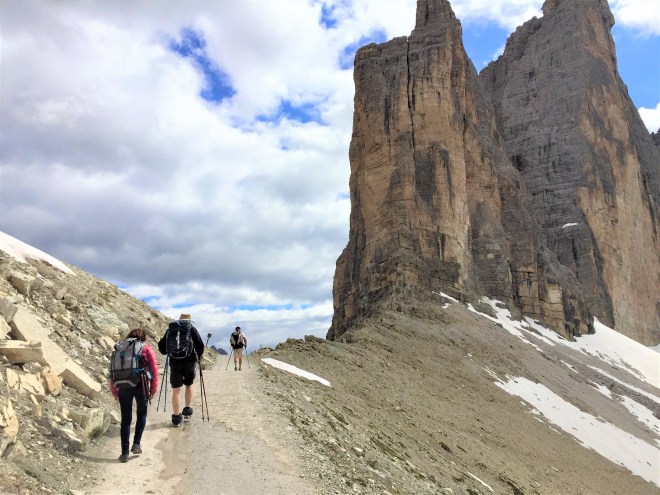
The Three Peaks keep us company on our left as we walk

Our photo

We pass a lovely spray of pink flowers

Cousins’ photo

A last look at the Three Peaks …

Our photo

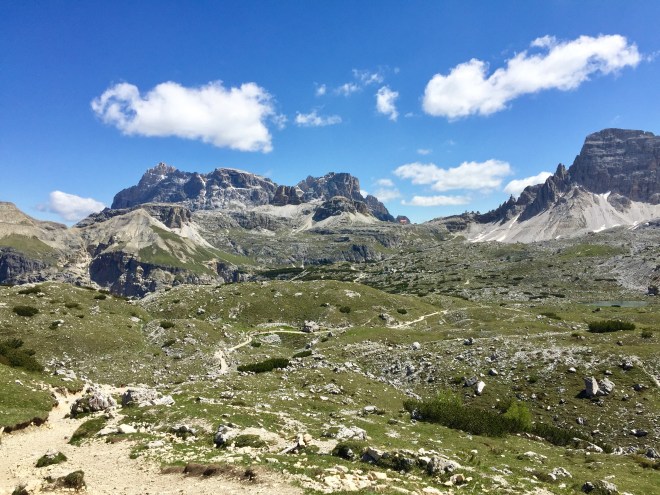
… and at the panorama behind us, with the path we’ve just taken winding across it

Our photo

Lake Misurina, glinting in the sunlight, beckons to us from far below in the valley. It is time to start climbing down.

Our photo

We drop about 600 m before finally arriving at the lake.

Source

We take the chairlift to the Rifugio Col de Varda, the mountain hut where we will be staying the night.

24 June

Today is taken up with a walk to the Rifugio di Città di Carpi and back via Lake Misurina. It’s a walk primarily through forest but with some fine views across the valley …

Cousins’ photo

… as well as sightings of some beautiful flowers – this is a particularly lovely example of the globe flower

our photo

We arrive at the Rifugio di Città di Carpi in time for coffee – to be purchased with masks on the face; Covid-19 haunts us even here.

Source

After coffee, a final look at the view …

our photo

… before we plunge once more into the forest, walking down to Misurina.

Source

25 June

Today the weather forecast is for rain, so we kit ourselves up. We are walking mostly through forest, up to the Passo Tre Croci and then down to Cortina d’Ampezzo.

A tank trap near the pass, built by Mussolini to keep out the Germans – the most obvious sign we came across of this area being a border region, with all the tensions that come with that. During our walks around the Tre Cime we were crossing now vanished World War I trenches and spied dugouts carved into the rocks.

Cousins’ photo

Some lovely forest land around the Agritur El Brite de Larieto (closed, alas, when we passed by; I had rather been hoping to have lunch there), which mixed woods and pastures – a delightful combination, especially when we saw the cows wandering between the trees; and what a heavenly smell they gave off! Of fresh milk.

Source

By the time we reached the Rifugio Mietres (also closed), the weather was turning decidedly to the stormy, with thunder rumbling away in the mountains above us.

Our photo

Our first view of Cortina d’Ampezzo in the valley below, our objective for today

Our photo

Going down a ski track. In the middle distance a flock of sheep

Cousins’ photo

A closer look at the sheep. They must be on their way to the high alpine meadows for the summer

Cousins’ photo

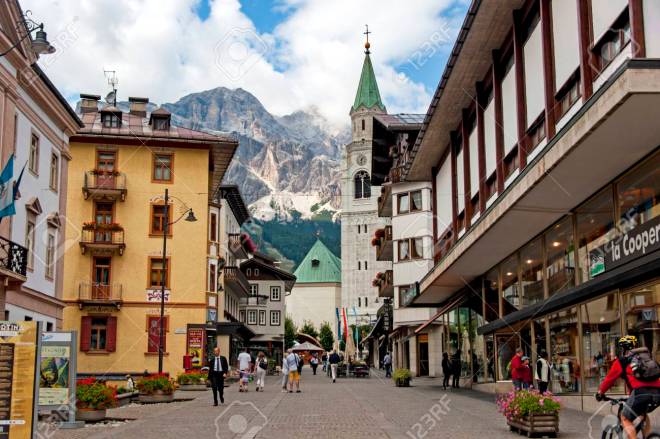
The main street in Cortina d’Ampezzo, where we had a late lunch before driving up to the hotel at the Passo Falzarego

Source

26 June

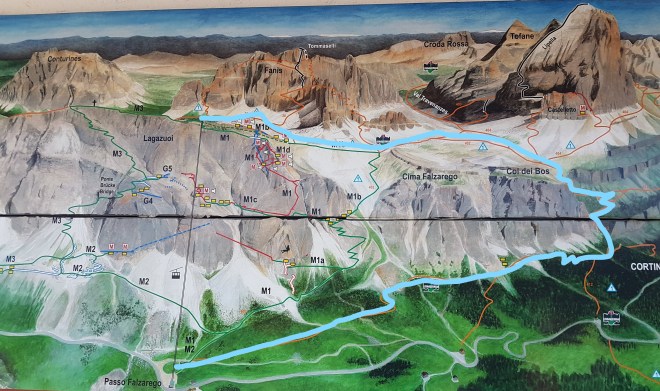
I said I would show another map of the trail we did on this last day of our hike, so here it is.

Cousins’ photo

We start at Lagazuói, taking the cable car from the Pass up to it.

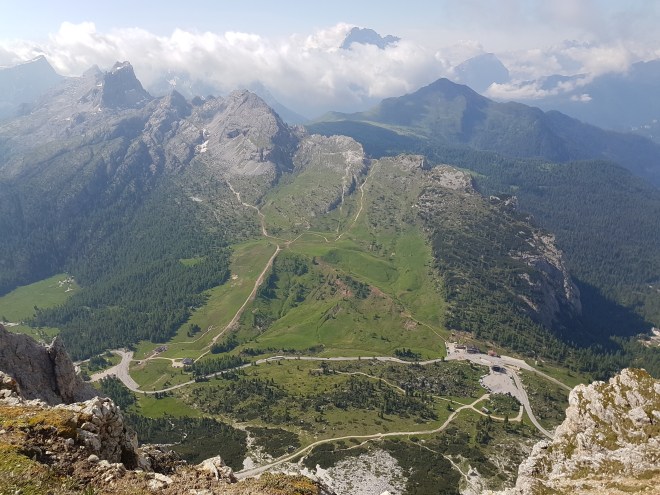
View of the Pass far below from the top of the cable car

Cousins’ photo

View of the other side, where we would be walking down and then going off to the right

Cousins’ photo

We’ve walked down, over extensive beds of snow, to this first pass

Our photo

Further on, a plunging view down to our left

Cousins’ photo

Striding across a soggy meadow

Cousins’ photo

The clouds are billowing up from the valley below …

our photo

… which means that we are soon climbing down into mist

Cousins’ photo

Soon, the world around us turns milky

Cousins’ photo

But we eventually break out from the mist and can look up at the heights we came down from

Our photo

The path wends its way through dwarf pines

Cousins’ photo

We go on until we reach the cable car you can see in the distance.

Cousins’ photo

So ended this year’s hike to the Dolomites. I’m sure we will be back next year – Covid-19 permitting.
HIKING IN THE DOLOMITES

Vienna, 16 July 2019

Well, it’s taken me quite a while to get around to this post. We completed our hike in the Dolomites three weeks ago, but it’s only now that I’ve managed to put all our photos in order – there were three sets of photos to arrange, my wife’s, my daughter’s, and my own. But the work of electronic filing and folderizing is over and I can finally write this post.
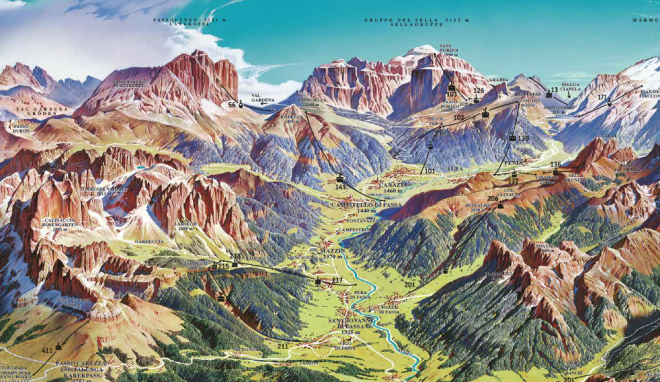
My last post had us in Bolzano, visiting Ötzi the Iceman. From there, we took the bus over to the next valley, the Val di Fassa. Just to give readers an idea of this valley, here is one of those bird’s-eye-view maps that clever cartographers come up with.
And here is the same map with a rather wonky red line put in by me showing our itinerary.
We hiked for six days, staying for the most part in mountain huts. We had the pleasure of being joined by our daughter and her partner for three of those days.

The itinerary didn’t quite turn out as planned. The area had got hit by a terrible storm in October of last year, which brought down thousands of trees and blocked a good number of the paths. The authorities’ plan had been to start clean-up in May, but the valley suffered from unusually heavy late-season snowfalls that month, which meant that when we arrived not only many of the paths blocked by trees hadn’t been cleared but other paths were now blocked because of snow. The result was that we didn’t walk quite as long at high altitude as had originally been planned. But it was wonderful nevertheless.

I’ve done writing. I shall let our photos speak for themselves.
June 16th:

Our first sight of the mountains bathed in the evening rays of the sun

June 17th:

Walking by meadows in flower as we followed the river upstream
The mountains beckoning, at the end of the day’s hike. Our daughter and her partner are waiting for us at the hotel

June 18th:

In the early morning sunshine, crossing the river which we will follow for an hour or so
We’ve begun our climb off the valley floor
We’re now far above the valley floor
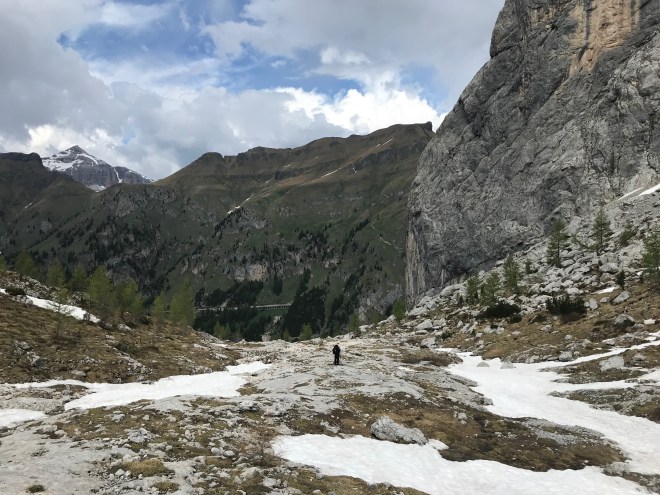
We’re getting above the treeline, into the rock and snow
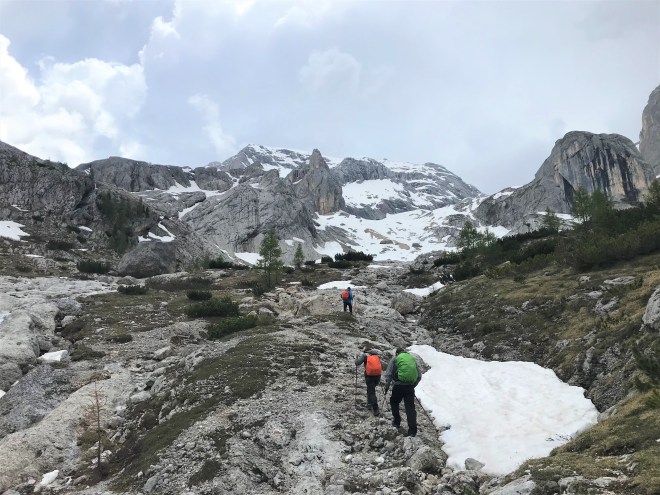
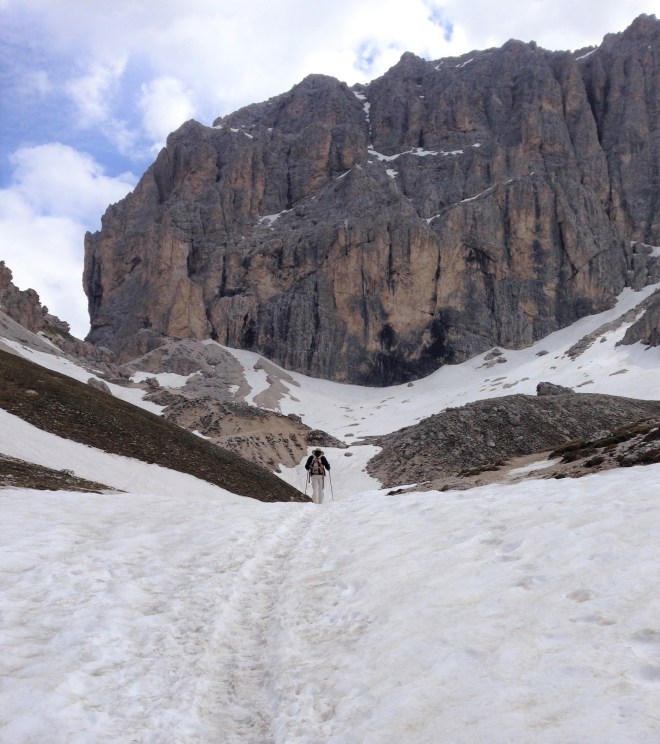
Among the rock and snow, and the weather is closing in
Those heavy May snowfalls! Where is the path?
Path found! On our way down to the mountain hut where we’ll be spending the night
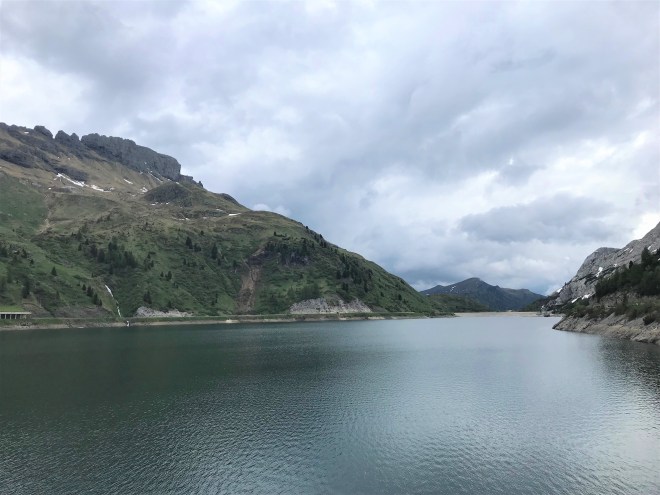
The dam we have to cross
We’ve reached the dam
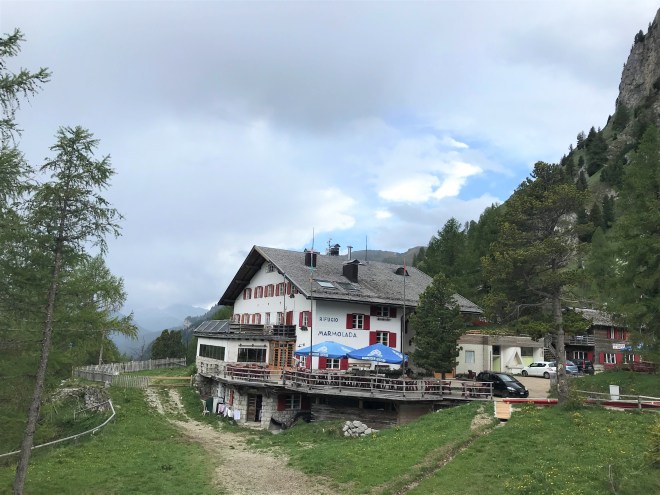
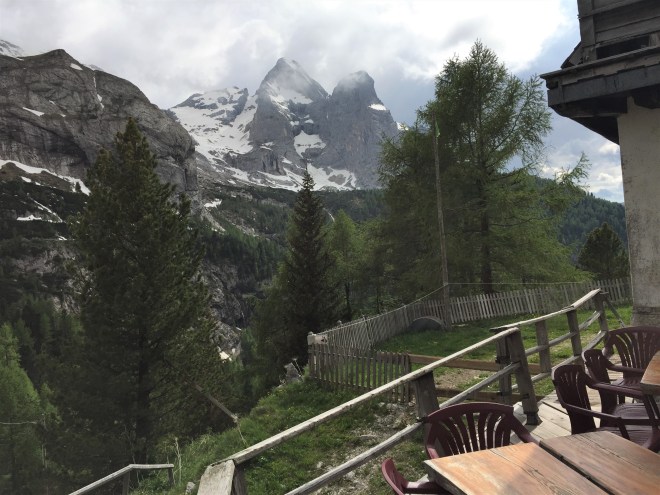
The mountain hut “Marmolada”, where we will spend the night
From the terrace of the hut, looking back at the snowfields we crossed

June 19th:

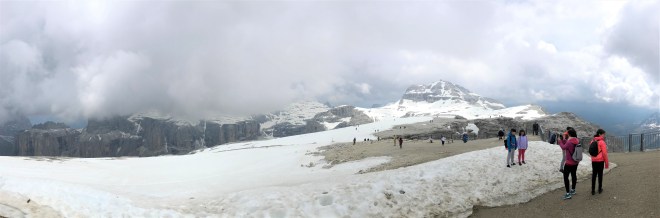
We’ll be going (by cablecar) to that black dot on the edge of the mountain range straight ahead – the Sass Pordoi
The mountains on the other side of the Val di Fassa
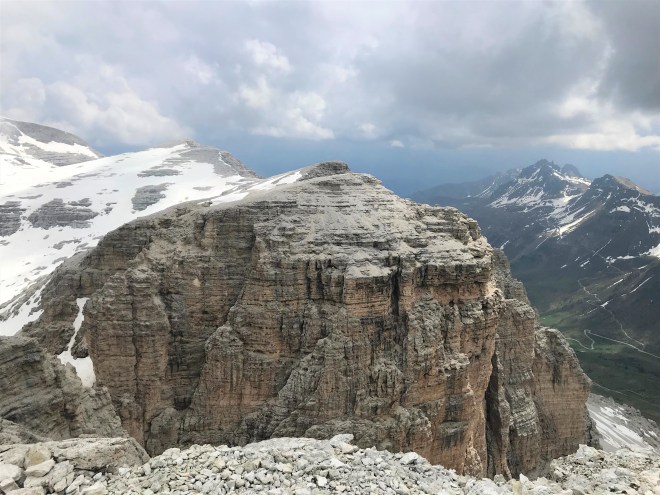
View from the top of Sass Pordoi
The walls of Sass Pordoi …
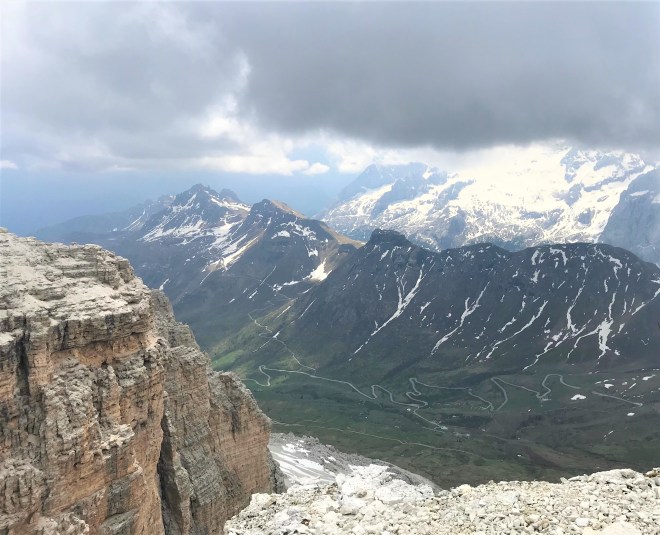
… and the valley floor far below
Walking down from Sass Pordoi. Our next objective is that dot on top of the small pyramid to the far left. The Sasso Lungo group towers over it.
We’ve reached the top of that pyramid (by cable car). Looking back at Sass Pordoi and the Gruppo del Sella behind it.
Looking down at our final destination for the day, the mountain hut “Friedrich August”, cowering under the Sasso Lungo
The hut’s dog, standing guard on the roof
Evening has drawn in

June 20th:

The path we’ll be taking today, snaking away across the mountainside
The Mountain hut “Sandro Pertini”, first break of the day.
Looking back along the path we’ve just walked
Looking down into the Val di Fassa. We have to reach that town at the very bottom.
The mountain hut “Sasso Piatto”, our next resting point. Afterwards, we’ll go on to the base of those mountains in the far distance.
Looking down into the valleys to the north.
Dark clouds have suddenly swept in. It’s hailing! Down below is the valley, the Val Duron, we will eventually be walking down.
The Val Duron, now bathed in sunshine
The weather is closing in again. Time to put the rain gear back on.
Walking down off the ridge into the head of the Val Duron
The Val Duron beckons
A local inhabitant of the valley nuzzling up to us
The backdrop to the valley …
… and the road ahead of us
Local wood carvers have been at work along the way
Taking the chairlift to tonight’s mountain hut. The Larsech group towers up in the distance
Evidence of the catastrophic storm of last October
The mountain hut “Stella Alpina”, where my wife and I will stay for two nights but my daughter and her partner only one

June 21st:

After fond farewells to our daughter and her partner, who are leaving us today, we start walking up through stony detritus towards the Torri del Vajolet, in the shadow of the Catinaccio group
The mountain hut “Paul Preuss”, our first stop for a breather, sitting precariously on its cliff
Onwards through the stone fields
Now it’s through snow
We stopped for lunch in the Mountain hut ” Passo Principe” (not our photo – source). Braver souls were climbing higher but there was too much snow for us.
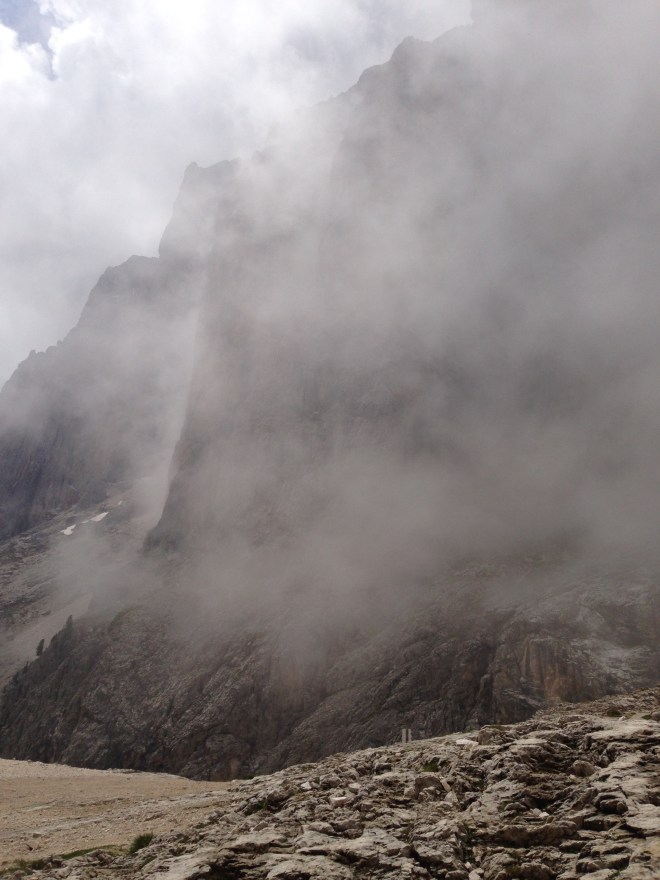
On our way back down to the “Stella Alpina”, the weather started closing in, wreathing the cliffs around us in clouds
One last walk before dinner
As we walk back to the mountain hut, a glimpse of the path we’ll be taking tomorrow morning

June 22nd:

About to plunge into the woods
The path wends its way through the woods …
… to come out into this lovely natural amphitheatre
The mountain hut “Roda de Vael” sits perched on the ridge of the amphitheatre – it’s where we plan to have lunch
But we first have to climb this long, long flight of steps
The view back from top of the stairs – and evidence of having reached nearly 2,300 metres
We make it into the hut just before it starts raining hard
After lunch, and after the rain has slackened, we set off again, making for the Passo di Carezza, the end of our hike
Plunging views into the Val di Fassa, wreathed in clouds
As we re-enter civilization, the weather closes in again

At the Passo di Carezza, we took refuge from the rain in a hotel’s restaurant, and drank a cup of tea while waiting for the bus to take us down to the Val di Fassa. The next day, we took the bus back to Bolzano, and from there made our way back to Milan.

We’ll be back in the Dolomites. It’s just too beautiful to pass up. We are still discussing where in the Dolomites to go next. Readers will have to wait with bated breath until next year’s post on the topic to know what we decided.