THOUGHTS ON VISITING ASSISI

Kyoto, 29 November 2023

At the end of October, my wife and I did a two-day hike from Gubbio to Assisi, along the Via di San Francesco. As the trail’s name suggests, it centres around the life and times of St. Francis of Assisi. As befits any saint from the Middle Ages, he was the protagonist of a great number of stories, many of which became the subject of the late 13th Century frescoes painted in Assisi and elsewhere after his death in 1226. I will choose some of these to illustrate stories which took place in the localities linked by the trail.

To the north of Assisi, the trail starts at La Verna, where Francis received the stigmata.

Source

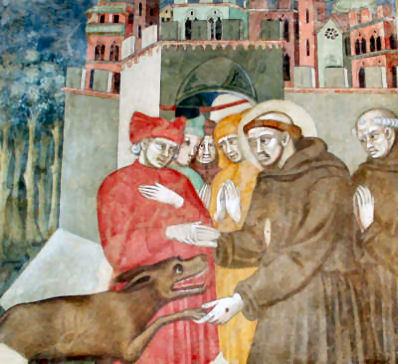
It passes through Gubbio, where he tamed the Big Bad Wolf which was terrorising the good people of the town.
Source

It then goes on to Assisi.

As for the southern portion of the trail, it starts in Rome, where Francis went a number of times to keep his movement on the right side of the Church authorities – this fresco depicts his critical first meeting with Pope Innocent III, to receive the pope’s blessing for his nascent movement.

Source

It goes on to Rieti, where Francis came many times. His last visit was shortly before his death, to have an operation on his eyes – he had become nearly blind (the operation failed, alas).

Source

Nearby, while resting and preparing for his operation, he worked on his Canticle of the Sun:
“Be praised, my Lord, through all your creatures,
especially through my lord Brother Sun,
who brings the day; and you give light through him.”
He goes on to praise “Sister Moon”, “Brother Wind”, “Sister Water”, “Brother Fire”, “Sister Mother Earth”. He completed the last verse on “Sister Bodily Death” as he lay dying in Assisi soon after.

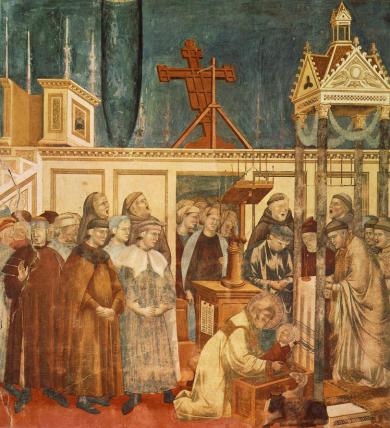
In nearby Greccio, he created the first living crèche, using locals as the actors in the drama. It was his way of telling the Christmas story to rural folk, who couldn’t understand the Latin in which the story was normally told.
Source

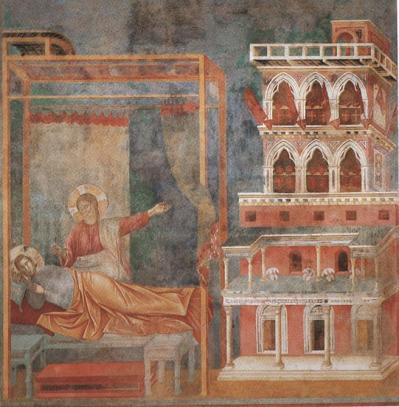
The trail goes on to Spoleto, where Francis had the dream which convinced him to give up his plan of becoming a knight to fight in the Crusades.
Source

And it, too, of course ends in Assisi, where Francis’s spiritual journey began and ended. Of the many stories about him that happen in the town, I choose two:
His renunciation of his father and family, stripping himself naked in the town’s piazza and giving his clothes back to his father;
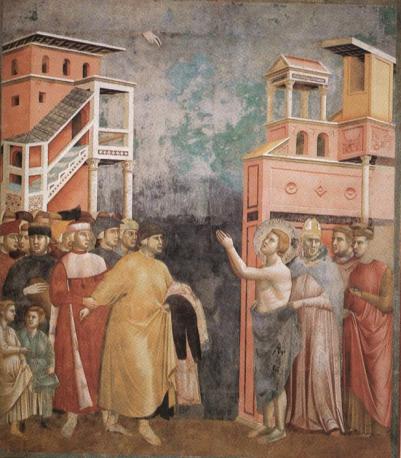
Source

And the moment when Christ on the cross spoke to him in the little church of San Damiano on the edges of Assisi.

Source

And then there is the tiny church of Porziuncola down in the valley below the town, which Francis had rebuilt and where he loved to spend time. Here is an artist’s rendering of what it looked like in his day. Those two rows of little huts are where the friars stayed.

Source

It was in that church – chapel, really – that Francis heard the priest read out from the Gospel of Matthew the passage where Christ sends his disciples far and wide to proclaim the Good News, with the following instructions: “You received without charge, give without charge. Provide yourselves with no gold or silver, not even with coppers for your purses, with no haversack for the journey or spare tunic or footwear or a staff, for the labourer deserves his keep.” Then and there, he decided that he and his followers would do the same. Thus was born the order of mendicant friars which was to take his name, the Franciscan Order.

Funnily enough, this momentous decision doesn’t feature in any of the frescoes about him – at least, none that I have found. But other stories involving Porziuncola have been the subject of frescoes. I choose three:
His welcoming of Clare when she ran away from her family to join Francis’s movement and eventually established the Order of Poor Clares;

Source

His moment of doubt, when he rolled himself in a rose bush whose thorns, though, miraculously turned into flowers;

Source

His death at the little infirmary next to Porziuncola.

Source

After our two days of hiking, my wife and I spent a day in Assisi. Alas, I can’t say that I liked the town in its modern guise. It’s just a tourist trap, crowded, full of shops selling tourist tat and restaurants selling overpriced food.

Source

Francis would have been horrified at all these shops pushing tourists to consume – and in his name at that. I rather think – I hope – that like Jesus in the Temple in Jerusalem he would have gone after all these sellers of tat. Turning once again to Matthew: “Jesus then went into the Temple and drove out all those who were selling and buying there; he upset the tables of the money-changers and the seats of the dove-sellers. He said to them, ‘According to scripture, my house will be called a house of prayer; but you are turning it into a bandits’ den.'” I throw in a painting by El Greco of Jesus  wielding the whip in the Temple, one that always comes to my mind when I see these shops in places that are supposed to be havens of religion.

Source

But even the basilica of St. Francis, which one reaches after braving the tourist shops and overpriced restaurants, disappointed me. Yes, it is full of art whose creation supposedly kick-started the Italian Renaissance, and I’ve used many of its frescoes above as illustrations. But I was struck by something I read. In his testament, Francis had specified where he wanted to be buried in Assisi. It was at the far end of the town, its lower end. It was here that convicts were executed and the town’s lepers and other outcasts congregated. Its noisome reputation led to the area being called the “collis Inferni”, the hill of Hell. Francis had often spent time on that hill, ministering to the wretched who eked out a living there. It was of a piece with his beliefs to want to be put to rest in a humble grave among the lowest of the low. Yet, the Church authorities, actively supported by the Franciscan Order’s hierarchy, were having none of that. It was decreed that a splendid basilica would rise on the collis Inferni, turning it into the “collis Paradisi”, the hill of Paradise.

Source

Poor Francis must have been spinning in his coffin when he was finally interred in that basilica, four years after he died. It was a betrayal of everything he stood for.

As for Porziuncola, that humble chapel so beloved by Francis, Pope Pius V in the 16th Century ordered a huge church to be built, Santa Maria degli Angeli.

Source

It literally englobes the little chapel

Source

as well the infirmary where Francis died
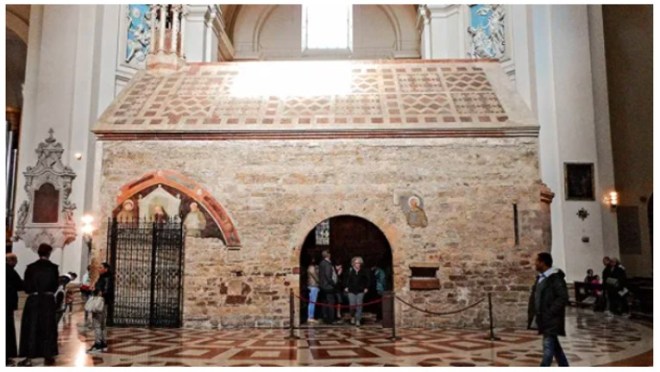
Source

and the rose bush he rolled himself in.
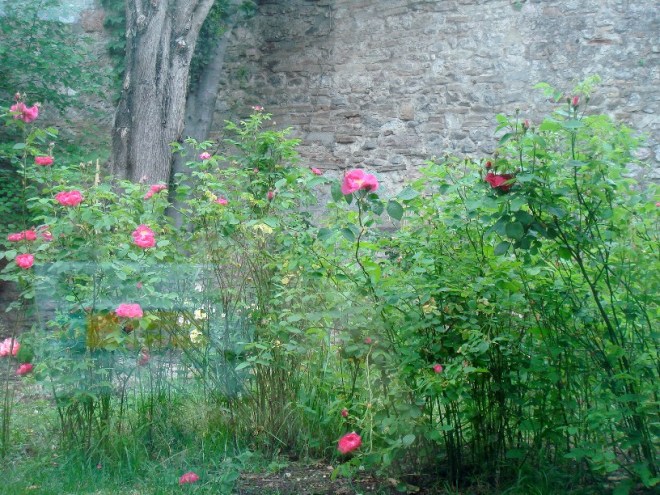
Source

The ostensible reason for building the church was to better control the flow of pilgrims. The guide books are at pains to point out the bareness of the interior of this mastodontic church, as proof of its respect for Francis’s vows to Lady Poverty. But, standing on the square in front of the church, it is difficult not to see this as one more example of the Church authorities glorifying themselves. I’m certain that Francis would have been horrified.

As I’ve said in an earlier post, I am a great admirer of Francis – not the religious side of him; as I’ve said in another post, I am an atheist and have been since I fell off the straight-and-narrow as a student at University. But his turning away from the material side of life – a core part of the Rule he wrote for his friars being that they should own nothing – makes him truly a man for our times.

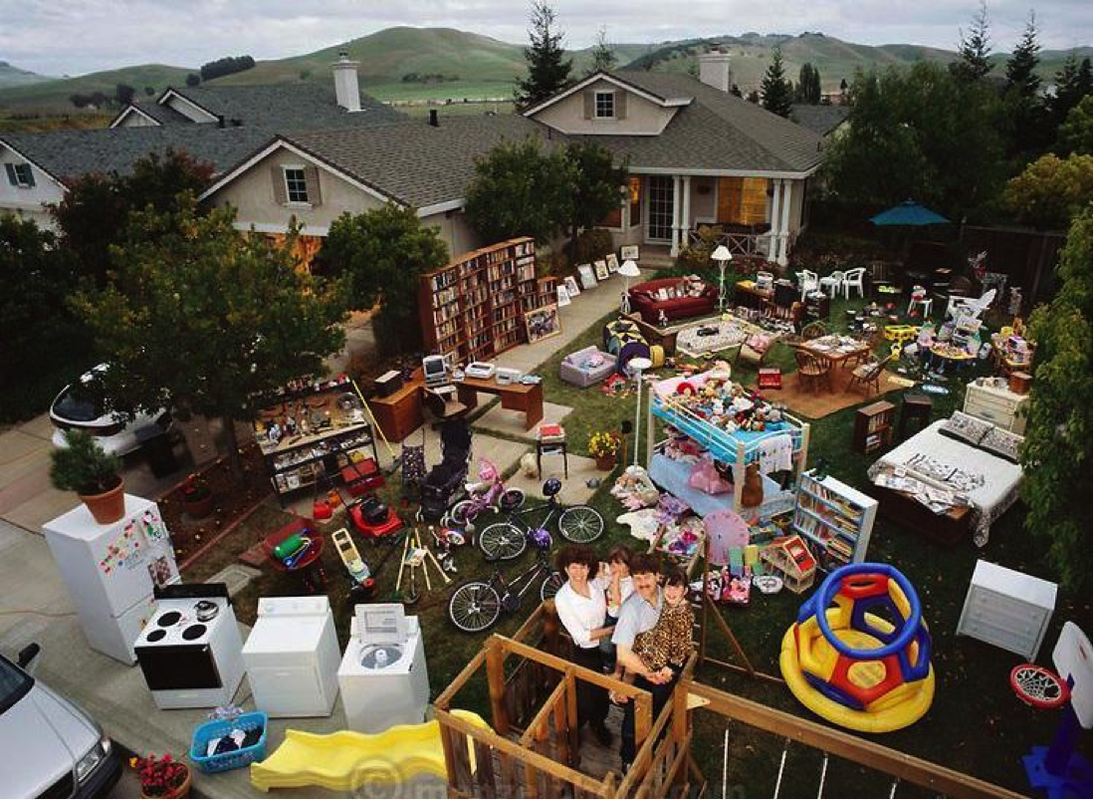
I hardly ever allow my professional work to leak into my posts, but today will be different; I suppose it’s because I’m writing this post in Kyoto where I am giving my annual course to university students on precisely this: how we can build a society that has a much smaller footprint. What I tell my students is that after working for 45 years in the environmental field, I have become convinced that our excessive consumption is literally destroying our planet. Look at these photos taken by Peter Menzel. He travelled to different countries and invited households whom he met to put everything they owned out on the street in front of where they lived. This photo is of a family somewhere in North America, a place with one of the highest levels of per capita consumption in the world.
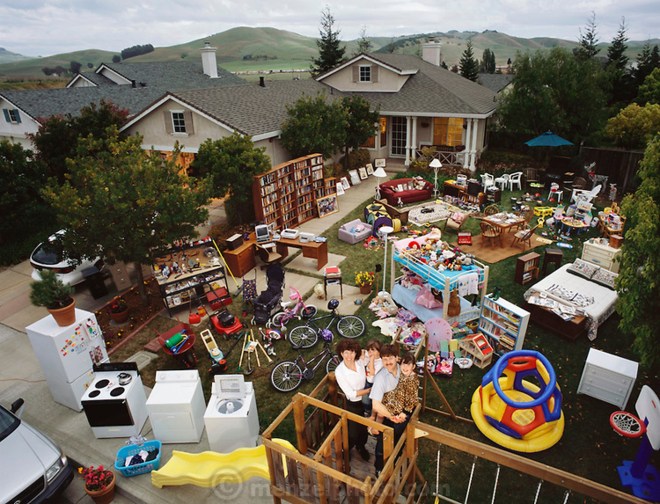
Source

This one is from Japan.

Source
This one is from Kuwait.
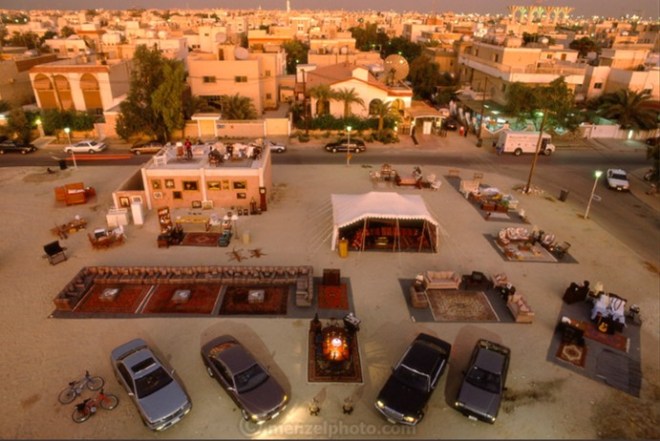
Source

This is all worrying enough. But what’s even more worrying is that people who live in less developed countries, whose levels of ownership and consumption of stuff are still modest, like South Africa
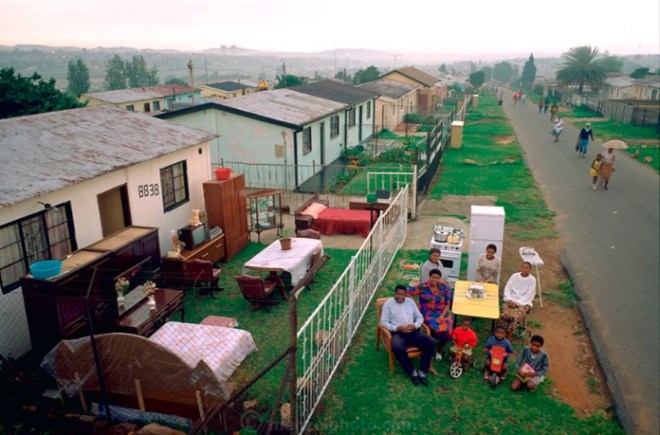
Source

or Bhutan

Source

they want to have the same levels of consumption as the richer countries.

That impulse is perfectly understandable. But it cannot be. We cannot all consume at the levels of that North American family, or even of that  Japanese family. We must heed Francis’s call to adopt a life shorn of stuff. We must – we must – reduce our levels of consumption, or else we will face an ecological catastrophe. Here, too, Francis is a man for our times because of his views on Nature. Unlike most of his contemporaries, and indeed unlike most of humanity even today, he saw the rest of Nature as equal to us humans. His Canticle to the Sun is an ode to Nature, as relevant today as it was when he wrote it 800 years ago. Of course, his reverence of Nature sprang from his reverence of God – if God created Nature, his argument went, we should revere Nature as God’s work. My position is rather different. Whether we like it or not, we are an intimate part of the world’s biosphere, and if it dies we die. Yet, because of our huge levels of consumption, growing ever huger with every passing year, we are ripping our biosphere apart, one result being that the Earth is losing species at rates which have not been seen in the last 10 million years. Francis, I’m sure, would have been appalled. If we go on like this, we are going towards a general collapse of the world’s ecosystems, which will sweep away our civilisations – for all our cleverness, we will not survive breakdowns in our biological life-support systems.

And finally Francis is a man for our times because he felt closest to the poor, the outcasts, the lowest of the low. Today, we live in a world riven by inequalities. In the photos above, I showed one type of inequality, the inequality between countries. Seemingly, this type of inequality is narrowing, but only to be replaced by a much more insidious inequality, the inequality between the citizens of these countries. Already rich individuals are getting ever richer at the expense of everyone else and don’t care anymore about their fellow citizens. We have to change that. We must – we must – pay more attention to the greater societal good rather than to our own individual desires. Frankly, this is not – as was the case for Francis – a disinterested decision, an “act of love for our fellow men”; it is very self-interested. If we don’t look after those who have been left behind, they will eventually come for us with their pitchforks.
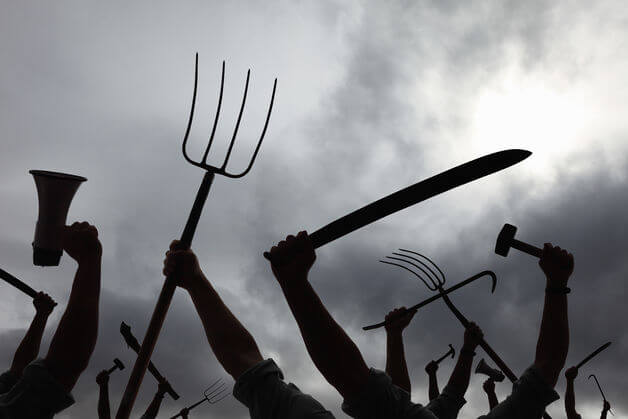
Source

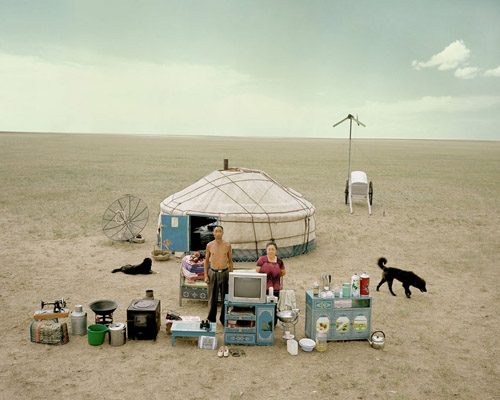
This family from Cuba shows us more or less what our levels of consumption needs to be for them to be sustainable.

Source

And this should not be an average. Every one of us should have this level of consumption, from the Bezoses and Musks of this world to the homeless that haunt our streets.
A PAPAL ENCYCLICAL

Bangkok, 2 July 2015

There’s been quite a bit of brouhaha in the press about the new Encyclical which Pope Francis brought out on 18 June, with the title “Laudato Si’: On Care for Our Common Home”. Normally, I would just read what the press has to say and move on. Although I come out of the Catholic tradition, I fell off the Straight- and-Narrow decades ago and it never occurred to me to read any of the Encyclicals brought out by Paul VI or John-Paul II, and certainly none by Benedict XVI, who always struck me as a complete dinosaur. I remember my father reading the Encyclicals, in the original Latin no less (his was probably the last generation of Europeans who were given a serious education in classics; he read Latin and Greek at University). But me, no way, I wasn’t going to read these letters by old, white, celibate men, most of whose views were diametrically opposite mine.

But this Encyclical was different. It was about avoiding a planetary ecological disaster, brought about by climate change and other environmental catastrophes, something which I’ve been wrestling with all my professional life. And it was different from the kind of work I do, which is technical and scientific. It was bringing ethics to bear on the problem, which have been sadly lacking. So I decided that it was time for me to try this rather special form of literature.

Here’s how the Encyclical starts:

  1. “Laudato si’, mi’ Signore” – “Praise be to you, my Lord”. In the words of this beautiful canticle, Saint Francis of Assisi reminds us that our common home is like a sister with whom we share our life and a beautiful mother who opens her arms to embrace us. “Praise be to you, my Lord, through our Sister, Mother Earth, who sustains and governs us, and who produces various fruit with coloured flowers and herbs”.
  2. This sister now cries out to us because of the harm we have inflicted on her by our irresponsible use and abuse of the goods with which God has endowed her. We have come to see ourselves as her lords and masters, entitled to plunder her at will. The violence present in our hearts, wounded by sin, is also reflected in the symptoms of sickness evident in the soil, in the water, in the air and in all forms of life. This is why the earth herself, burdened and laid waste, is among the most abandoned and maltreated of our poor; she “groans in travail” (Rom 8:22). We have forgotten that we ourselves are dust of the earth (cf. Gen 2:7); our very bodies are made up of her elements, we breathe her air and we receive life and refreshment from her waters.

Whoa! Stirring words, pretty different from the stuff I normally read. Thoroughly intrigued, I settled down to read the whole document, all 246 paragraphs of it. Allow me to rapidly summarize its contents for any of my readers who might be too busy or distracted by other things to read it (by the way, the Encyclical has a message for them: “true wisdom, as the fruit of self-examination, dialogue and generous encounter between persons, is not acquired by a mere accumulation of data which eventually leads to overload and confusion, a sort of mental pollution”).

After a review of the state of the planetary environment, whose conclusion can be summed up in this other punchy quote, “the earth, our home, is beginning to look more and more like an immense pile of filth”, the Pope reminds us that our inability to look after our Earth is reflected in our inability to look after our poor: “we should be particularly indignant at the enormous inequalities in our midst, whereby we continue to tolerate some considering themselves more worthy than others. We fail to see that some are mired in desperate and degrading poverty, with no way out, while others have not the faintest idea of what to do with their possessions, vainly showing off their supposed superiority and leaving behind them so much waste which, if it were the case everywhere, would destroy the planet”, to conclude that “a true ecological approach always becomes a social approach; it must integrate questions of justice in debates on the environment, so as to hear both the cry of the earth and the cry of the poor.”

His main conclusion is that both the environmental ills of the planet as well as the ills which bedevil our societies have their roots in excessive consumption by the better-off amongst us.

  • “We all know that it is not possible to sustain the present level of consumption in developed countries and wealthier sectors of society, where the habit of wasting and discarding has reached unprecedented levels.”
  • “To blame population growth instead of extreme and selective consumerism on the part of some, is one way of refusing to face the issues. It is an attempt to legitimize the present model of distribution, where a minority believes that it has the right to consume in a way which can never be universalized, since the planet could not even contain the waste products of such consumption.”
  • “… poor countries … need to acknowledge the scandalous level of consumption in some privileged sectors of their population and to combat corruption more effectively.”
  • “We may well be leaving to coming generations debris, desolation and filth. The pace of consumption, waste and environmental change has so stretched the planet’s capacity that our contemporary lifestyle, unsustainable as it is, can only precipitate catastrophes, such as those which even now periodically occur in different areas of the world.”
  • “.. given the insatiable and irresponsible growth produced over many decades, we need also to think of containing growth by setting some reasonable limits and even retracing our steps before it is too late.”
  • “… a world of exacerbated consumption is at the same time a world which mistreats life in all its forms.”

All music to my ears! For ten years now, I’ve seen that excessive consumption is the key to all our most intractable environmental problems and have been wrestling with what to do about it. We have to do something to reduce the levels of consumption in the richest countries, or more specifically among the world’s richest people (because as the Pope pointed out even the poor countries have hideously rich people).

But to have this happen is a huge, huge political problem. To explain why, let me borrow a photo or two from the photographer Peter Menzel and others who have copied him. Mr. Menzel went around the world photographing families outside their homes with all their stuff piled up around them (anyone wanting to see the whole series should dip into his book “Material World: A Global Family Portrait”). His idea proved so popular that others copied him. This photo, which is of a family in Inner Mongolia

inner mongolian family

shows a level of stuff-ownership which is typical of millions, if not billions, of families around the world. These families want a materially better life. And why not? There is no reason they should not have it. But if the goal of every family in the world is to end up like this one

developed family

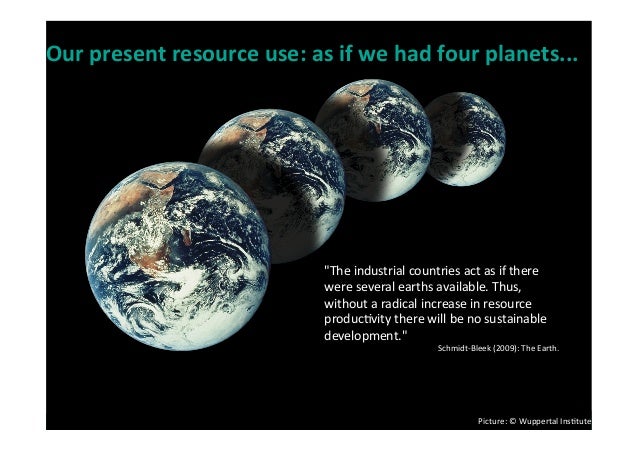
– well, it’s simply not possible, because a lifestyle like this for everyone requires a level of consumption of the world’s resources that would need 4 or more Earths to sustain

four planets

and, except for those of us who live in a parallel universe, we all know that there is but one planet.

But it’s also not possible to have a world where a few families can live like kings while everyone else has to live like the huddled masses or else the planet goes into meltdown. Somehow, those who currently are over-consuming have to accept to reduce their consumption.

What kind of material sacrifice would be required of these over-consumers? To answer this question, let me use myself as an example. A little while back, curious to see how large my personal environmental footprint might be, I used a footprint calculator offered by the Environmental Protection Agency of the State of Victoria in Australia (there are a number of such calculators on-line; I chose this one because it’s easy to use and I reckon that Southern Australia’s climate is quite similar to Italy’s where I intend to retire – I couldn’t find a good Italian footprint calculator). With an eye to my upcoming retirement, I entered data for myself and my wife on our eating habits, on the home we will live in, and the modes of transport we will be using. To put it in a nutshell, the two of us will live in a 120 sq. metre apartment in an apartment block, whose electricity will partially come from renewable energy. We’ll be having several servings a day of dairy, eggs, fish, or meat products, and a quarter of the food that we’ll eat will be either processed, packaged, or imported. Since we’ll be recycling a lot we’ll throw away less than one 30 litre bin-bag of waste a week. We’ll be using a lot of public transportation, but we’ll still have a small car to potter around town a bit, while twice a year we’ll fly to see the kids in the States. I pushed the last button, and the answer came back … “If everyone lived like you, we would need 3.9 planets” Aarrgh!!!! I was one of those guys greedily overusing the Earth’s resources! I could NOT believe it! I had worked in the environmental field all my professional life, and yet here I was devouring the planet! O-M-G!!

Once the shock wore off, I started doing what scientists call sensitivity analysis: I changed my answers one at a time, to see which changes would give me the biggest reductions. That would give me a menu of changes to our lifestyles which we could adopt, with the goal of bringing that horrible figure of 3.9 down to 1.0 – I think it’s OK to have a lifestyle which, were everyone to have it, would use only 1 planet’s worth of resources.

I won’t weary my readers with a full summary of the results, let me just give the highlights. The biggest reduction in my levels of planetary destruction comes from changes in diet. Having only a few servings a week of dairy, eggs, fish, or meat products, instead of several a day, cuts 1 full planet out of my footprint. That’s great, I knew that meat-eating especially is terribly harmful to the environment. I think we can switch to a strongly vegetarian diet without too much difficulty.

So that’s already 1.0 planet’s worth of reduction.

The other big reduction, though, 1.1 planets’ worth, comes from basically cutting out air travel. No, no, this is not possible, we cannot stop visiting our children! And we can’t just tell the kids to come instead, that would be foisting onto them part of our footprint! What to do? I suppose we could cut our trips to once a year … Alright, let’s say that, so that’s half a planet’s worth of reduction.

That gives us a running total of 1.5 planets’ worth of reduction.

The next biggest reduction, 0.7 planet’s worth, would come if we switched from living in a multi-storey apartment building to a free-standing house without running water. OK, we’re not going to cut off our water, but my take-away here is that saving water has a significant impact on the size of my footprint. We can’t stop drinking, but we’ll ruthlessly chop at our three other big water uses, hot showers, clothes washing, and toilet flushing. We’ll simply shower less, wash our clothes less often, and (ugh!) flush less often. Let’s clock that in at 0.35 planet’s worth.

So, the running total is now 1.85 planets’ worth of reduction.

Next on my list is to switch to a green design residence, which would give me half a planet’s worth of reduction. Well, we can’t change apartments at this point. But we can do things to make the apartment more energy efficient: compact fluorescent bulbs (although they will look totally hideous in the chandelier we have in the living room), double-glazed windows everywhere (more costs …), if possible more insulation on that wall in our bedroom, … I don’t know, there must be other things we can do. Let’s just assume that there are and clock this in at 0.25 planet’s worth.

That gives me a running total of 2.1 planets’ worth of reduction.

What else?

Well, next on the list is simply to cut off the electricity to the apartment, which would give me another half a planet’s worth of reduction. Well, that ain’t gonna happen … But we could reduce our consumption of electricity. The CFLs I’ve already decided to install will help here, as will the reductions in the use of the washing machine. We can mostly wash our dishes by hand, which will reduce the use of the dishwasher (which will also help reduce water use). We could unplug all those gadgets with pilot lights so they aren’t on all the time. I promise not to leave the lights on after leaving a room (a bad habit I have). We could climb the stairs rather than use the elevator (which will be good exercise anyway). I don’t know if they offer this in Italy, but if they do I could ask to have all my electricity booked as coming from renewable energy…. OK, let’s assume 0.25 planet’s worth for all this.

Running total: 2.35 planets’ worth of reduction.

I’m running out of options here, and I still need to chop 0.55 planet’s worth out of our lifestyle!

OK, we can switch to riding bicycles around town and walking even more, so as to reduce our use of public transportation (I have us hardly using a car). Maybe we could squeeze another 0.2 planet’s worth out of our lifestyle in this way.

Running total: 2.55 planets’ worth of reduction.

Let me see, what else? … I’m really scraping the bottom of the barrel here … Well, we could have a third person come and live with us. I choose this option with extreme reluctance. One of the kids would be ideal, but they probably have no desire to come and live with their parents. And anyway, they would need a job in Italy, which in this economic climate is not at all a given. Maybe we could take in a student, preferably one who is studying environmental sciences and who would enthusiastically join in the hunt for things to do to reduce our footprint. One more person in the apartment would give us 0.3 planet’s worth of reduction.

That gives us a grand total of 2.85 planets’ worth of reduction, close enough to the goal of 2.9.

That was hard, really hard! I’m making big sacrifices here. I don’t think eating much more greens will be that bad, but not being able to see the children more than once a year, that will be tough. And having to share the apartment with a stranger does not fill me with joy at all.

And therein lies the huge political problem. This all sounds like an intense diet, and as we all know diets are not greeted with joy but with mournful suffering. Who wants to do them? We need to flip this, we need to make people like me feel happy as they merrily throw out of their lives the mountain of stuff that surrounds them.

This is where the rest of Pope Francis’s Encyclical comes in. In the case of Catholics, it’s easy. He’s telling them that it is their moral duty to change their lifestyles, and he strongly suggests this to other Christians too. But to the others amongst us who are not Christians? I can do no better than quote another chunk of text:

We need to take up an ancient lesson, found in different religious traditions and also in the Bible. It is the conviction that “less is more”. A constant flood of new consumer goods can baffle the heart and prevent us from cherishing each thing and each moment. To be serenely present to each reality, however small it may be, opens us to much greater horizons of understanding and personal fulfilment. Christian spirituality proposes a growth marked by moderation and the capacity to be happy with little. It is a return to that simplicity which allows us to stop and appreciate the small things, to be grateful for the opportunities which life affords us, to be spiritually detached from what we possess, and not to succumb to sadness for what we lack. This implies avoiding the dynamic of dominion and the mere accumulation of pleasures.

Such sobriety, when lived freely and consciously, is liberating. It is not a lesser life or one lived with less intensity. On the contrary, it is a way of living life to the full. In reality, those who enjoy more and live better each moment are those who have given up dipping here and there, always on the look-out for what they do not have. They experience what it means to appreciate each person and each thing, learning familiarity with the simplest things and how to enjoy them. So they are able to shed unsatisfied needs, reducing their obsessiveness and weariness. Even living on little, they can live a lot, above all when they cultivate other pleasures and find satisfaction in fraternal encounters, in service, in developing their gifts, in music and art, in contact with nature, in prayer. Happiness means knowing how to limit some needs which only diminish us, and being open to the many different possibilities which life can offer.

We need to start a huge campaign to persuade people of the rightness of the message “less is more”, and to have them actively wanting to drastically reduce their material needs, of feeling bad, almost sick, if they start accumulating too much. If we don’t change this basic mindset we are doomed. As the Encyclical so rightly says, there is no technical solution to climate change and other severe global environmental problems, there is only an ethical choice.

I hope this piece can be one small part of this campaign.

___________

Inner Mongolian family: http://fast.mediamatic.nl/f/sjnh/image/146/188097-500-400.jpg
Developed country family’s stuff: http://akkermanlc.weebly.com/uploads/1/2/7/5/12751216/4773841_orig.png (in http://akkermanlc.weebly.com/quality-of-life-project.html)
Four planets: http://image.slidesharecdn.com/foodinasustainablematerialfootprint-131011032957-phpapp01/95/food-in-sustainable-consumption-2-638.jpg?cb=1381463878 (in http://www.slideshare.net/lettenmeier/food-in-sustainable-consumption)