PAWPAWS, NOT PAPAYAS

Vienna, 20 July 2024

My wife and I recently had our annual check-up with our GP in Vienna. He’s been our doctor here for nigh on 20 years. The first thing he told us was that he was retiring at the end of the week. Tutto cambia, tutto su transforma, everything changes, everything is transformed, as I mournfully intoned in an earlier post. After he had given us our prescriptions for the routine blood and other tests we do every year (the results of which, though, will be reviewed this year by his partner in the medical practice), we chatted a bit about his retirement plans. He told us that he and his partner would be selling their apartment in Vienna (which is how we met him; they lived on the floor below ours), and they would be moving to a house which they have spent the last couple of years restoring, out in the countryside in southern Styria.

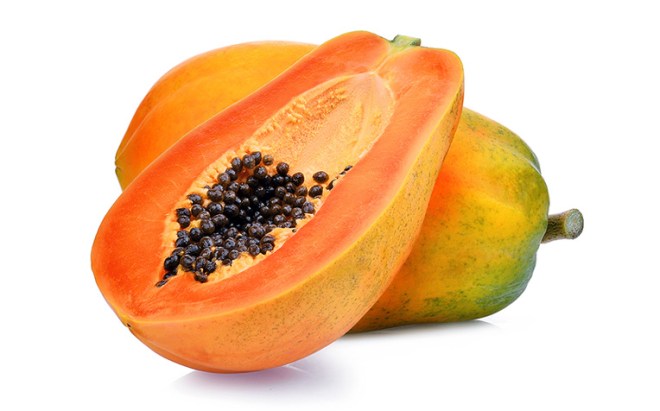
He was especially enthusiastic about its garden. He told us that he has filled it with all sorts of exotic plants, which have been flourishing. It doesn’t surprise me, he has exceedingly green fingers; we would gaze down with wonderment (and not a little envy) at the terrace of their apartment, a riot of flowers and plants, which he would lovingly curate in the evenings during the spring and summer. He told us with a note of pride in his voice that he had even successfully planted a pau-pau tree. A what tree, my wife and I both asked? After some toing and froing, we finally understood he was talking about a tree that produces a fruit called pawpaw. But the confusion wasn’t over yet. Since neither of us had ever heard of pawpaw fruits, my wife fished out her iPad and undertook a rapid Google search to see what they looked like. The search term “pawpaw” resulted in this image.
Source

You mean papaya, we asked? This is what we call this fruit. No, no, our doctor said, not papayas; pawpaws. More Google searching and my wife came up with this.

Source

Yes, the good doctor said, that’s the one.

Well, well, they say you learn something new every day (who coined that phrase, I wonder? Must Google it). My wife and I certainly did that day, along with the distressing news about our doctor’s retirement. After promising to visit the two of them in Styria one of these days, we said our emotional goodbyes.

Of course, I couldn’t leave it there. I was just like my little grandson picking at a scab (did I mention that he’s been staying with us?). I just had to find out more about this pawpaw. Which was fine, because it turned out to be a really interesting fruit.

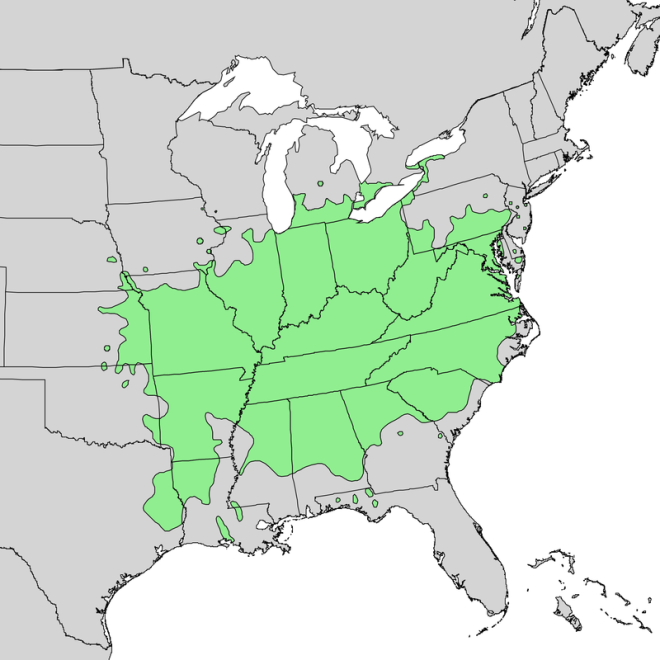
First of all, as this map shows, pawpaws are native to the US, and more specifically to the eastern, southern, and midwestern states – the push into southern Ontario is probably man-induced, as we shall see in a minute.
Source

It’s intriguing that the pawpaw tree is found this far north, in temperate climes, because it actually belongs to a family nearly all of whose members are tropical. It’s a nice example of environmental adaptation. It would seem that the ancestor of the pawpaw developed on what is now the North American continent when the climate was tropical. As the climate cooled, the plant reacted by adapting to the chillier temperatures. Nevertheless, it never quite lost its earlier tropical “look”. Its leaves, for instance, have drip tips, a typical feature of tropical plants which are subjected to heavy rains.

Source

And the fruit itself looks quite tropical; looking at the photo above one could easily mistake it for a mango, for instance.

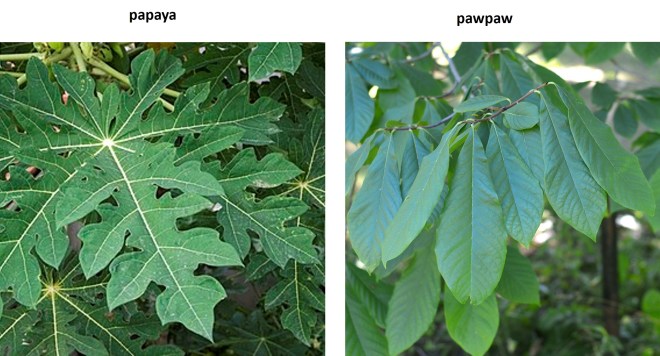
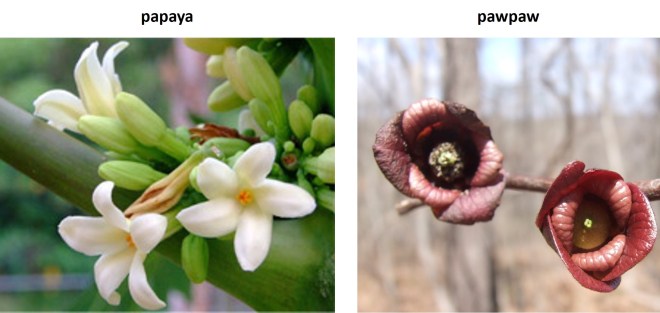
The name “pawpaw” is a bit of a puzzle. It seems that there was a confusion between the pawpaw and the papaya. Down in the British Caribbean colonies, the papaya was known as the pawpaw – and still today, in the UK and in many ex-British colonies, the papaya is called pawpaw. There was a brisk trade between the Caribbean and American colonies, and the thinking goes that when Brits coming from the Caribbean landed in the more southerly American colonies and first set eyes on this tree and its fruit they said “Ooh, look, those look like pawpaws” and the name stuck. Those Brits must have had very poor eyesight, though. In these next few photos, I invite my readers to compare various aspects of the two plants. Here’s what the tree looks like.

Source                                                                            Source

Here’s what the leaves look like

Source                                                                              Source

Here’s what the flower looks like.

Source                                                                                 Source

Here’s what the fruits look like on the outside.

Source                                                                             Source

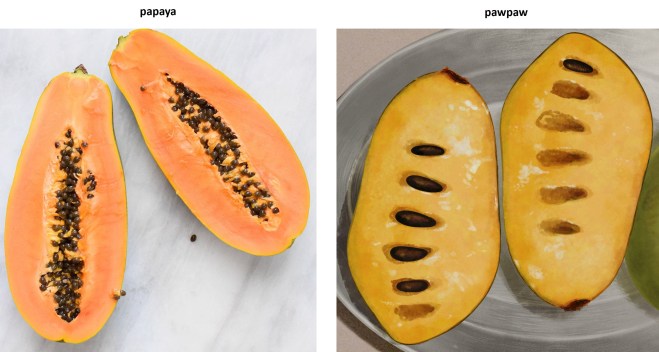
And here is what they look like on the inside.
Source                                                                           Source

I think my readers will agree that, with the possible exception of the whole fruits, the two really don’t look like each other at all. Maybe those Brits from the Caribbean were actually comparing the taste of the two fruits? For reasons that will become clear in a minute, neither I nor my wife have ever eaten pawpaw, so I am relying here on other people’s impressions of the fruit’s taste. This description, from its entry in Wikipedia, seems to summarise quite well various attempts I have found around the internet to describe the taste : “a flavour somewhat similar to banana, mango, and pineapple”. I haven’t eaten piles of papaya, but that description doesn’t fit with my sense of the papaya’s taste. I rather agree with one person’s assessment that the papaya tastes like a cross between a cantaloupe and a mango.

So the mystery remains: what the hell were those initial namers thinking?! They just created a big confusion. Why didn’t the colonists in the American colonies adopt the name given to the fruit by the local First Nations tribes? The Virginians did it with persimmons, after  all (a transliteration of the Algonquian name for the fruit: “pessamin”).

Source

The coureurs des bois (roamers of the woods), French Canadians who traded for furs with the First Nations and who were a key figure in the North American fur trade, were often the first Europeans to explore the part of the US which is the fruit’s natural range. They sensibly adopted the Algonquian name for the fruit, “assimin”, giving it a French twist, though, coming up with “asiminier”. Here we have an etching of a heroic-looking coureur des bois which appeared in a French Canadian magazine from 1871.

Source

Taking a leaf from the Virginian colonists’ book, I shall start a campaign to have the fruit’s name changed to assimmon. Readers are welcome to join me in this futile tilting at windmills; just for the hell of it, I insert Picasso’s take on the original tilter at windmills, Don Quixote, with his faithful sidekick, Sancho Panchez.

Source

I have to say, I do have a sort-of official approval for this effort: the plant’s proper botanical name is Asimina triloba, where the first part of the name picked up the coureurs des bois’s name. In fact, I shall start right now. I shall call the fruit assimon in the rest of this post.

As readers can imagine, the pawpaw – sorry, the assimon – was very popular with the First Nation tribes who occupied the fruit’s range. Here you have what turns out to be the largest edible fruit that is indigenous to the US, and it’s delicious to boot! The tribes loved it so much that they extended the fruit’s original range by carrying it with them when they moved into new territories (as they did with the Jerusalem artichoke – and of course maize). This most probably explains the fruit’s presence in Southern Ontario, brought there, it is theorised, by the Erie and Onondaga tribes. To bring us back to those far-off times, I throw in a photo of a figure that appeared in Samuel de Champlain’s books on his voyages in what is now Canada and the US. It relates to an attack Champlain carried out together with the Hurons on an Onondaga village, situated on what is now called Onondaga lake, close to the modern city of Syracuse in the northern New York State.

Source

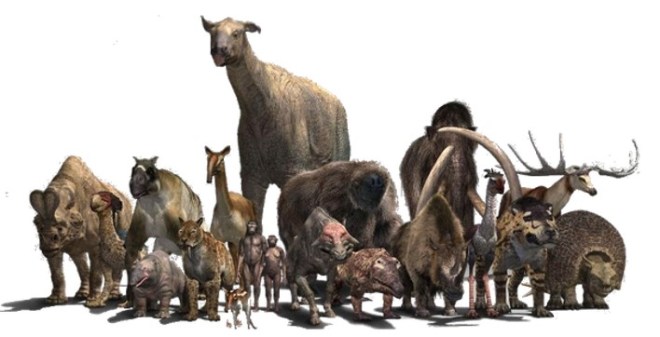
It’s lucky that the First Nations did move the assimon tree around, because it had evolved into a cul-de-sac. If readers go back to the photo of the open assimon fruit, they will notice its large stones. Fruit stones have evolved to be swallowed by the animals which consume the fruit, to be then expelled in a nice, fertilising pile of poo somewhere else as the animal in question wanders around. The bigger the fruit stone, the larger must be the animals eat the fruit – otherwise, they can’t swallow it. It’s been theorised that the assimon’s very large stone means that it evolved to be eaten by the American continent’s megafauna. Here is a photo of these large beasts, also showing humans, to give an idea of their enormous size.
Source

Only the omnivores amongst them ate fruit, of course, but those which did spread the assimon around.

About 10,000 years ago, though, America’s megafauna died out. Quite why this happened is hotly debated, but the arrival of human beings, the ancestors of the First Nations, from across the Bering Straits was in all probability a big factor in this wave of extinctions. The modern bear is now the only animal big enough to swallow the stones of the assimon without choking. So it was just as well for the plant that humans stepped in and moved the plant around – and it was only fair that they did so, given the role they had played in the extinction of the megafauna.

As I said earlier, even though my wife and I lived something like eight years all told in the assimon’s range, we never tried it. We never even saw it being sold in supermarkets. How can it be that the US’s largest indigenous fruit is not readily available in every supermarket in the country? How can it be that enterprising Americans didn’t bring the plant to Europe, China, Japan, and anywhere else with the same temperate climate and establish assimon orchards?

The sad fact is that the assimon, in contrast to more popular – and non-American – commercial fruits like apples, pears, or peaches, stores poorly, primarily because the fruit ripens to the point of fermentation very quickly after it is picked. An assimon only keeps for 2–3 days at room temperature, about double that if it is refrigerated. This short shelf-life and therefore difficulty in shipping the fruit any distance means that the food industry is simply not interested in it. I have commented unfavourably in an earlier post about the fact that many of the foodstuffs eaten in the US are not native there, suggesting that native foodstuffs should be eaten. But in this case it really seems that the assimon is simply unsuited to our modern way of life. The best one can hope for is to find it in farmers’ markets held in the fruit’s range. And they will only offer it during the month of September, which is when the fruit ripens (there is a niche market for the shipping of the fruit over longer distances, but it must be a risky business).

Or you plant a tree in your garden if you live in the right climate. Which brings me back to my good doctor! We said we would go and see them. Maybe we could go and see them in September, when his assimons are ripe. But we need to know very precisely when they are ripe and then immediately go down to visit them and try this delectable fruit. But how to do this without sounding crass? “Hello, are your assimons ripe? If not, we’re not interested in coming.” I shall have to discuss this with my wife and try and find a more subtle way of doing this.

JERKY AND PEMMICAN

Los Angeles, 29 November 2022

Our daughter is currently in the sleep-eat-repeat mode with her newborn. Since she is breast-feeding and the little one is somewhat dilatory at the breast, she spends a lot of her time sitting on the sofa either feeding him or having skin-time with him. Which in turn means that my wife and I have taken over a lot of the routine household tasks. One of these is doing the shopping at the local supermarket.

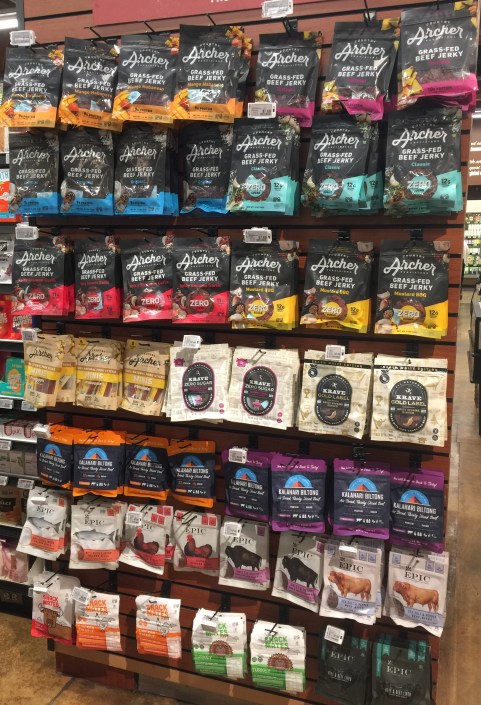
It was while we were on one of these shopping trips, traipsing up and down aisles trying to find things, that I came across these displays.

my photo
my photo

As sharp-eyed readers will see (especially if they blow up the photos), what we have here is a wide array of different brands of beef jerky (along with a couple of bags of turkey jerky and other dried meat products thrown in).

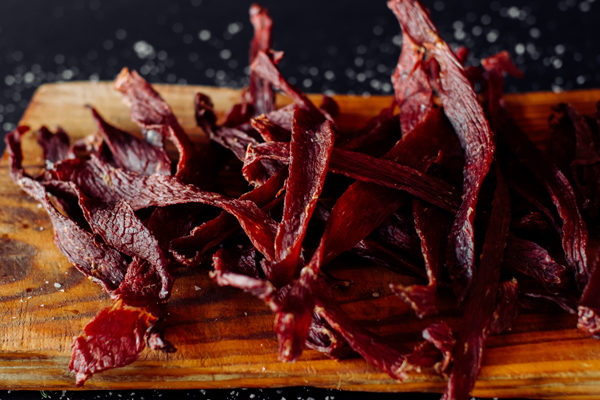
For those of my readers who are not familiar with jerky, it’s basically thin strips of lean meat which have been dried out to stop spoilage by bacteria. In the past, this drying was done by laying the meat out in the sun.

Source

Alternatively, it could be smoked.

Source

Nowadays, it is more often than not salted. It can be marinated beforehand in spices and – in my opinion, most unfortunately – sugar. The net result looks like this.

Source

Contrary to what one might think, the meat is not that hard or tough; crumbly might be a better description. Depending on what marinades are used, it can be salty or – yech! – sweetish. If prepared and stored properly, jerky can remain edible for months.

My discovery of this display of jerkies got me all excited. Nowadays, it is marketed as a protein-rich snack. But in the old days, when the Europeans were moving west across North America it was a great way of carrying food around with you on your travels: light but rich in protein, long shelf-life, no need for refrigeration. I’m sure it was used by the pioneers as their carriages creaked slowly across the prairies.

Source

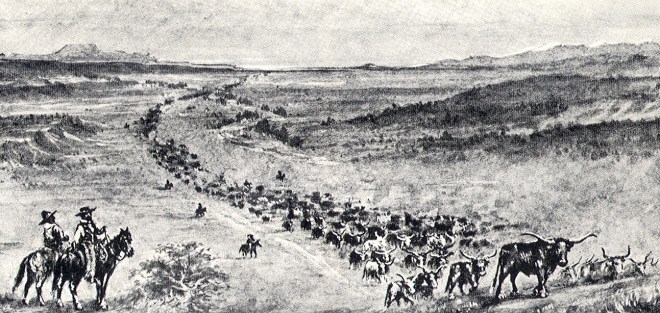
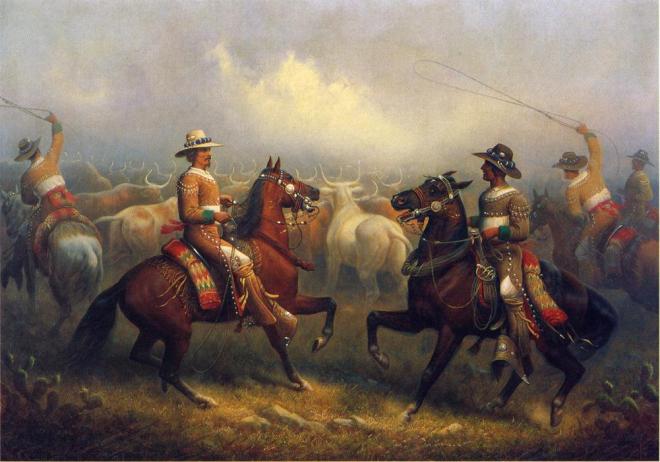
But for me, it evokes more romantic visions of old-time cowboys out on the range driving cattle to the rail heads.

Source

Or perhaps out in a posse hunting down Billy the Kid or some other outlaw.

Source

I’m sure my boyhood cowboy hero Lucky Luke would have eaten jerky, although I don’t recall any of his stories showing this.

Source

The drying of meat (and fish) as a way of preserving it has of course been used in many cultures all over the world, but jerky specifically has its roots in the Americas. The word itself hails from the Andes, coming from the language of the Quechua people.

Source

When the Spaniards conquered the Incan Empire, they found the Quechua making a dried-meat product from the llamas and alpacas which they had domesticated. The Quechua called it (as transliterated into the Roman alphabet) ch’arki, which simply means “dried meat”.

Source

The Spaniards must have been very impressed with this product because they adopted both the product as well as its name, hispanicised to charqui, and spread its use throughout their American dominions. Not surprisingly, though, the source of meat changed along the way, with beef coming to predominate. So did the methods of preparation and drying. The Quechua dried pieces of meat with the bone still in place and they relied on the particular climate of the high Andes for the drying, with the meat slow-cooking in the hot sun during the day and freezing during the night. The Spaniards instead ended up cutting the meat into small thin strips and smoke-drying them.

I have to assume that when, in their migrations through the Americas, other Europeans collided with the Spaniards, they adopted this practice of preparing and eating dried beef; they also adopted the name, although the English-speaking among them eventually anglicized it to jerky. The Romantic-In-Me would like to think that American cowboys picked up the jerky habit from Mexican vaqueros somewhere out in the Far West.

Source

But there is probably a more mundane explanation. Take, for instance, John Smith, who established the first successful colony in Virginia, at Jamestown, in 1612 (and who Disney studios had looking like this in the animated film Pocahontas

Source

but who in reality looked more like this).

Source

Smith had obviously heard of jerky. He had this to say about the culinary habits of the local Native American tribes he met living around the new colony: “Their fish and flesh … after the Spanish fashion, putting it on a spit, they turne first the one side, then the other, til it be as drie as their ierkin beefe in the west Indies, that they may keepe it a month or more without putrifying.” Which suggests that the name “jerky” may have come to North America via the Caribbean island colonies and a good deal earlier than the cowboys.

John Smith’s comment also tells us that the habit of drying fish and meat to preserve it was prevalent throughout the Americas – which is not really surprising; as I said, many cultures the world over have discovered this method for preserving fish and meat. Having no domesticated animals (apart from dogs), the First Nations of North America sourced their meat from the wild animals that roamed free around them: bison, deer, elk, moose, but also sometimes duck. Which brings me in a rather roundabout way to another foodstuff that makes me dream, pemmican.

For those of my readers who may not be familiar with this foodstuff, it is made by grinding jerky to a crumble and then mixing it with tallow (rendered animal fat) and sometimes with locally available dried berries. Like jerky, it can last a long time. This is what pemmican looks like.

Source

The word itself is derived from the Cree word pimîhkân – other First Nation tribes had different names for it, but I suppose the Europeans only started using it when they entered into contact with the Cree people.

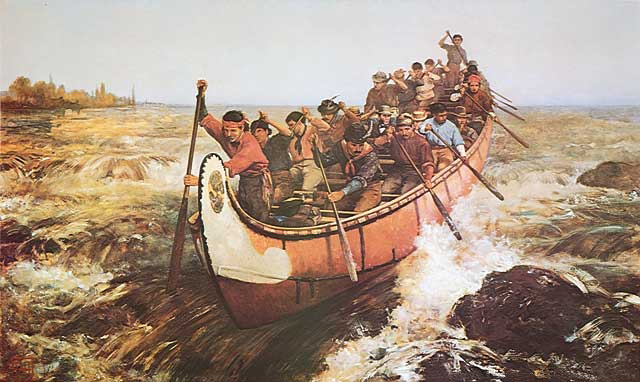
Why, readers may ask, does pemmican make me dream? Here, I have to explain that there was a time in my life, in my early teens, when my parents lived in Winnipeg, capital of the Canadian province of Manitoba. Winnipeg became an important link in the beaver fur trade routes which linked the north-west of Canada with both Montreal and Hudson Bay. A book I read when I was a sober adult, titled “A Green History of the World”, informed me that the trade itself was a catastrophe, leading to collapse after collapse of local beaver populations as they were hunted out of existence in one river system after another. But when I was a young teen, it wasn’t the poor little furry animals that interested me, it was the voyageurs. These were the men (and only men) who held the fur trade together. It was they who paddled the big canoes which in the Spring carried goods out west to trade for the beaver furs and in the Fall carried the furs back east.

Source

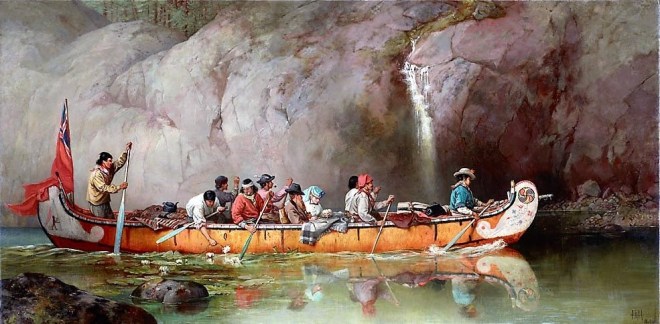
To the Young Me, the lives of these voyageurs seemed impossibly romantic: paddling through the vast wilderness that was then Canada

Source

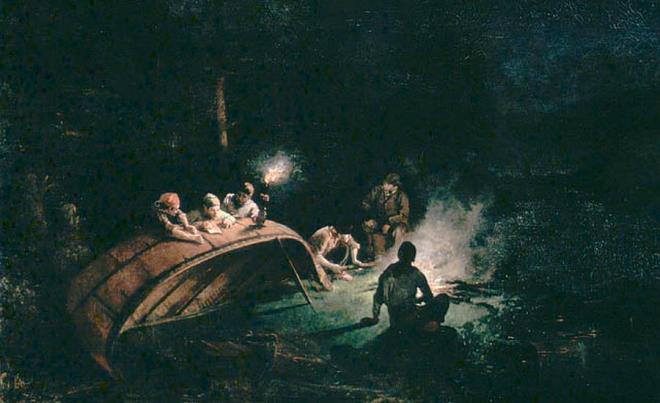
sleeping by the fire under the stars

Source
Source

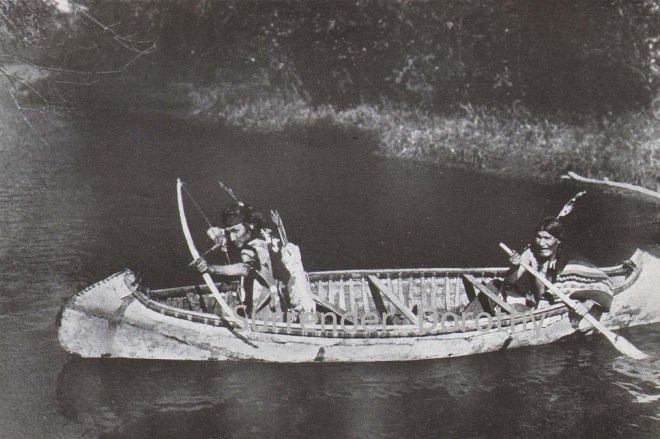
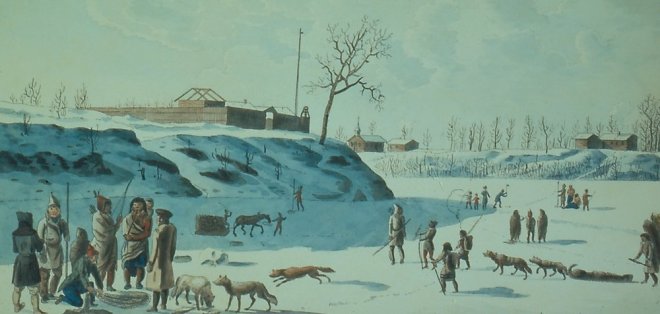
meeting people of the First Nations when they were still – more or less – living their original lives …

Source

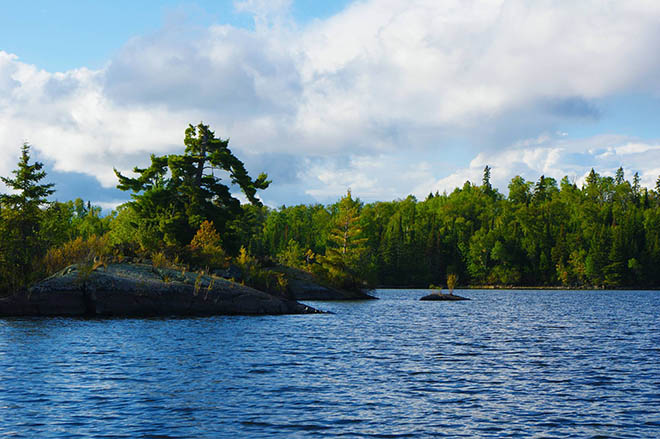
I had one, tiny taste of this life when I was 14 going 15, paddling a canoe for a couple of weeks along the Rainy River and across Lake of the Woods, camping at night on the shore of the river and on islands in the middle of the lake

Source

and one day meeting a very old man on one island who thrillingly remembered as a child hiding from the local First Nations tribes who had gone on the warpath.

Source

Of course, the voyageurs’ life was considerably harder than I ever imagined it as a boy. For instance, coming back to pemmican, they didn’t have space in their canoes to carry their own food, nor did they have time to forage for it. They were expected to work 14 hours a day, paddling at 50 strokes a minute or carrying the canoes and their load over sometimes miles-long portages, from May to October. So they had to be supplied with food along the way. In the region around Winnipeg that meant being supplied with pemmican.

A whole industry sprang up to supply the large quantities of pemmican needed by the voyageurs. It was run by the Métis, another fascinating group of people. As the Frenchmen (mostly, if not all, men) pushed out into the Canadian West, many married, more or less formally, First Nations women from the local tribes. The primary purpose of these marriages was to cement trading relations with local tribes; it was also a way of creating the necessary interpreters. The children of these marriages were the Métis (which is French for people of mixed heritage). They in turn intermarried, or married First Nations people, and over time, created what were essentially new tribes. Although the Métis retained some European customs, the most important of which being the speaking of French, for the most part they adopted the customs of the First Nations.

Source

There were especially large groupings of Métis around what was to become Winnipeg. One of the bigger groupings lived in St. Boniface on the Red River.

Source
Source

This has now become one of the quarters of Winnipeg, and is where my parents used to live. At that time (we are talking the late 1960s), most of the population of St. Boniface was still Francophone and I suspect that many were descendants of the Métis, although they would not have publicized the fact. Being Métis was rather looked down on at the time.

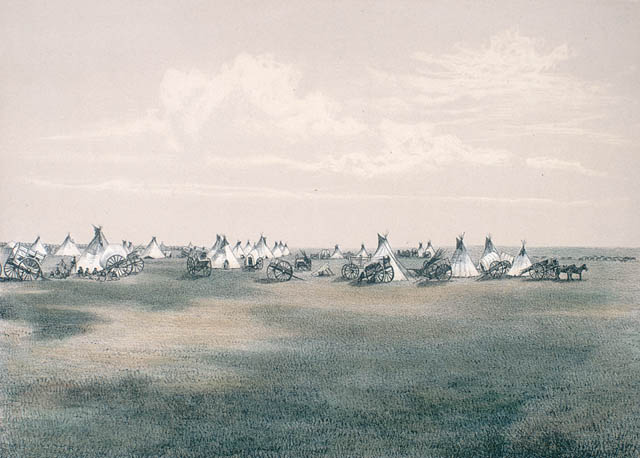
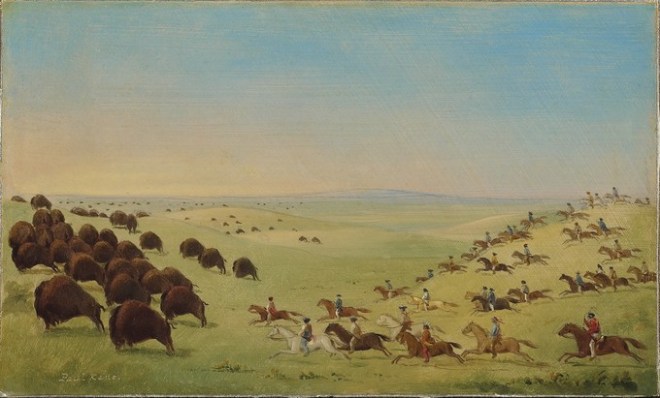
One of the customs which the Métis adopted from the First Nations was the making and eating of pemmican, hunting the numerous bison which then still roamed the central plains of North America for both the meat and the tallow they required. But the demand from the fur trade business upped the ante, and the Métis started producing pemmican on a quasi-industrial scale. Twice yearly, large hunting groups left the Winnipeg area and moved south and west looking for the bison herds. Here we have a series of paintings, watercolours, and lithographs showing the various phases of these bison hunts.

The Métis encamped out on the plains.

Source
Source

The hunts.

Source
Source
Source

Drying the bison meat and creating the tallow, preparatory to mixing them to make pemmican.

Source
Source

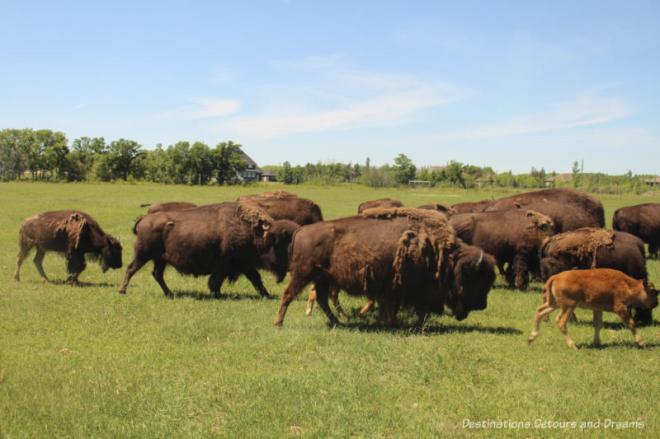
It all seemed glorious to me when I was a boy – a sort of souped-up, months-long Scout camp – but as a sober adult I learned of the very dark side of these twice-yearly hunting expeditions. Huge numbers of bison were killed during these hunts, especially females, which were the preferred target; this was a significant factor in the near-extinction of the bison in North America. Luckily, they have survived, although in much diminished numbers. One summer in Winnipeg, my father took us to a park where bison ranged free; we were able to get quite close – magnificent animals.

Source
Source

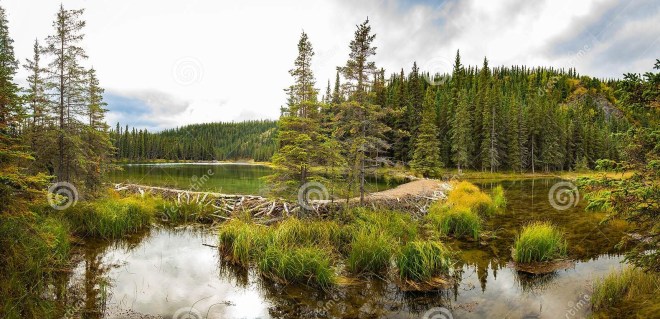
On that same trip, we spied a beaver dam somewhat like this one in the photo below through the trees and decided to go and have a peek.

Source

But we were driven back by the swarms of voracious mosquitoes which, literally smelling blood, rose up from the ground as one and closed in on us. The voyageurs were also much troubled by mosquitoes and black flies during the few hours of sleep allowed to them; they used smudge fires to keep them away. As a result, many suffered from respiratory problems – another side to their not-so romantic lives.

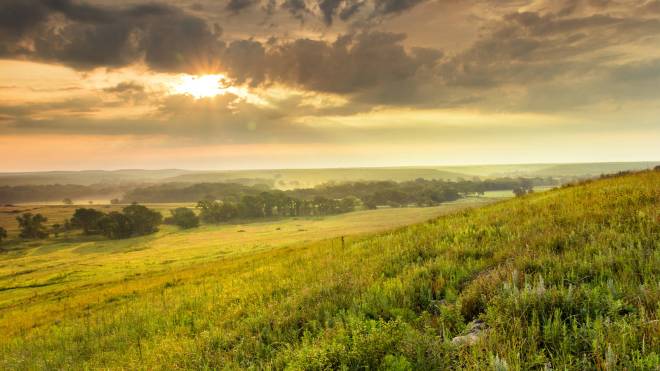
My father also used to take us for rides down towards the American border, where the Métis had once travelled for their bison hunts, trekking across prairies which – as the paintings above intimate – had stretched to the horizon. But they’ve nearly all disappeared too; a few shreds remain in some national parks.

Source

What we saw was wheat stretching to the horizon.

Source

Ah, memories, memories … I’ve told my wife that one day I’ll take her to Winnipeg. We can visit St. Boniface and talk French. And drive through the endless waves of wheat towards Saskatchewan. Perhaps go north to Lake Winnipeg, so big you can’t see the other side of it from the shore. And camp out in a provincial park, under the stars.