Vienna, 28 September 2025
A week ago, my wife and I were passing by a florist during our afternoon walk down into the city centre when my eye was caught by one of the products the shop was selling.

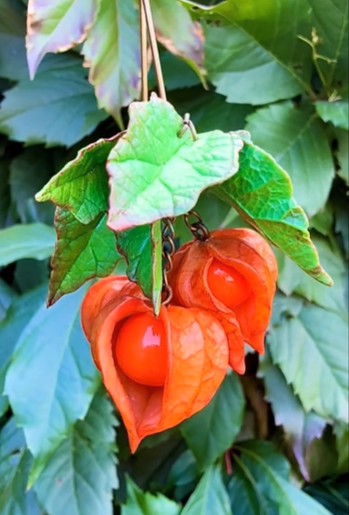
It wasn’t just the pretty display that caught my attention. It just so happened that I had taken a photo of the very same plant growing along the side of the path during one of our earlier walks during the summer, in Vienna’s Tiergarten (a very nice area of woods and meadows on the edge of the city which used to be an imperial hunting ground).

Already when I had taken this photo, I had said to myself that I should look into this plant. The clever feature on my phone’s camera told me that I was looking at a groundcherry, so at least I knew what the plant was. But, as Samuel Johnson is reported to have said, the road to hell is paved with good intentions – I hadn’t gotten around to doing anything. But that second sighting in front of the florist got me going again. And now, finally, after a few days of rain, I have cobbled together my story.
I suppose I should start with the plant’s most conspicuous feature, its bright orange to red papery calyx.

It is this beautiful calyx that caught my eye and catches the eye those who decide to plant it in their gardens.

It’s also what makes people put the plant in arrangements of dried flowers.
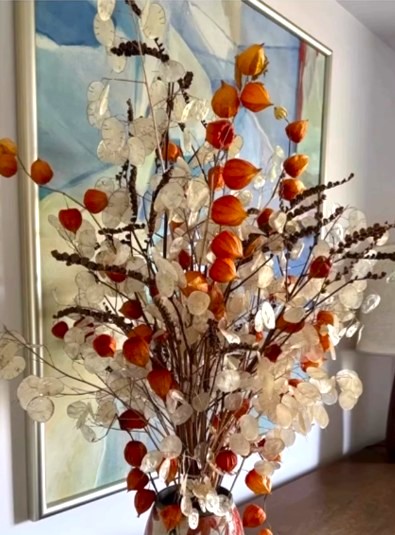
These sometimes can veer towards the Japanese ikebana style.
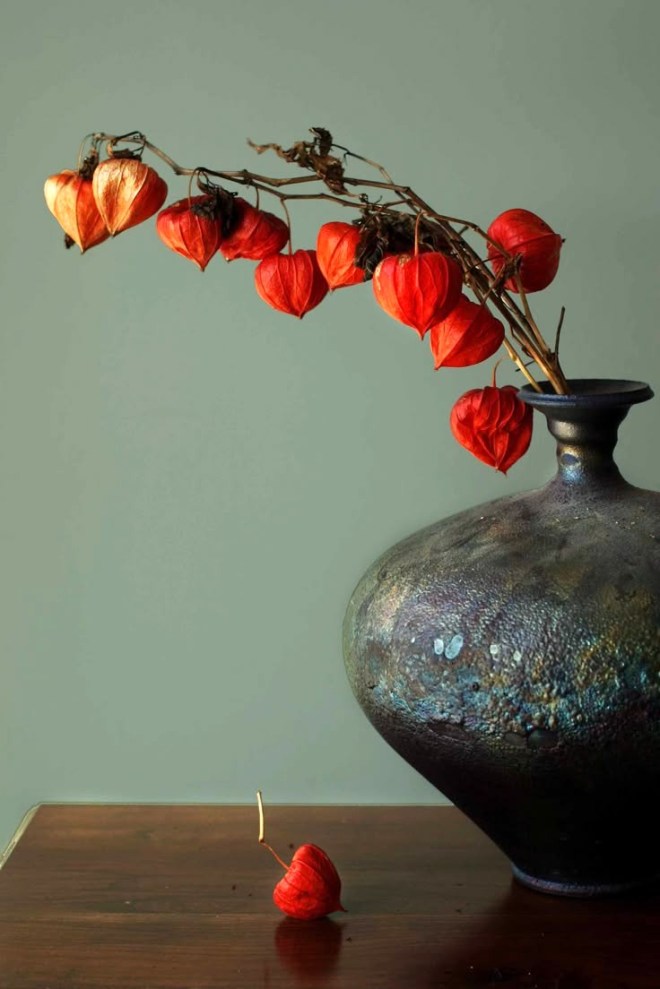
Not surprisingly, it is also this calyx which gives the plant one of its more common names in English, Chinese lantern, in German, Lampionblume or lantern flower, and in French, lanterne or lantern.
If left on the plant, much of the calyx will decompose, leaving behind only the veins of the calyx in the form of a delicately beautiful, skeletal net and revealing an orange-red berry within.

The berry’s resemblance to a small cherry has given rise to the plant’s other common name in English, the groundcherry. Having a berry trapped, as it were, inside the calyx has also given rise to other common names, like the French amour en cage, love in a cage, but the one I like best is one of its Persian names: the puppet behind the curtain.
As I have noted several times in these posts, while our ancestors no doubt saw the beauty in the world around them, they were nothing if not profoundly utilitarian: how can this thing (plant, fruit, rock, wood, animal, whatever it is) be useful to me? So of course they explored whether or not the berry of the Chinese lantern was edible; there is evidence that our Neolithic ancestors were eating the berries. The internet is not very clear on how tasty these berries are. As far as I can make out, though, they are not very tasty, having low levels of sugar and being somewhat sour. But with the addition of a lot of sugar they can be made into scrumptious jams and marmalades. Apparently, the Italians also pickle the berries, although I’ve never, ever seen this in Italy.
Our Medieval ancestors, and very probably even earlier ancestors, were just as interested, if not more interested, in the plant’s use as a medicine, particularly the berry. And this interest explains the plant’s rather strange scientific name, Alkekengi officinarum. It’s the plant’s generic name, Alkekengi, that’s so odd. It’s not Latin, what is it? The answer to that lies in Persia. In Persian traditional medicine, the Unani system of medicine, the dried berry was used as a diuretic, antiseptic, liver corrective, and sedative. The Persian name for the plant is kākunaj (which, by the way, I think means “balloon” or “bladder”, another common description of the plant). I throw in here a photo of a 15th Century miniature of a Persian garden.

When the Arabs overran the Persian empire, they picked up the Persians’ traditional medicine and carried it westward. This included the kākunaj berry, whose name they arabised to al-kākanj. In turn, Arabic traditional medicine was carried into Europe, where the name of the berry, and the plant, was europeanised to “alkekengi”. Another small example of the way ideas were transmitted along trade routes, something which I have written about many, many times in these posts.
The plant’s medicinal role has now died away, although there are still a lot of articles written on its pharmacological properties. So we are left with its beautiful calyx, that orange-red lantern, to enjoy. Which leads me to one lovely traditional use of the plant, in Japan. During the summer Obon Festival, the Japanese remember their deceased ancestors, believing that their spirits return to visit them. They use lanterns to guide the spirits from their graves on the first day of the festival, and back to their graves on the last day of the festival. Normally, they use paper lanterns, but in many places they also drape strings of groundcherry calyxes – called ghost lanterns in Japanese – on the shrines in temple grounds that house memorial tablets for the deceased. This photo shows a market selling strings of grouncherry calyxes.

Maybe we should institute this practice at Halloween, when the spirits of the dead traditionally come back into the world of the living.
 the heart thrills