SAINT ERASMUS AND HIS GUTS

Milan, 18 March 2025

My wife and I recently went to an exhibition at the Gallerie d’Italia, a relatively new museum in Milan which is situated right next to the Scala. The exhibition’s title, “The Genius of Milan. Crossroads of the Arts from the Cathedral Workshop to the Twentieth Century”, didn’t really reveal what the exhibition was about, and I’m not sure I had any better idea after our visit. I think it was trying to show how many non-Milanese artists had come to Milan over the centuries and flourished there, but I wouldn’t swear to it.

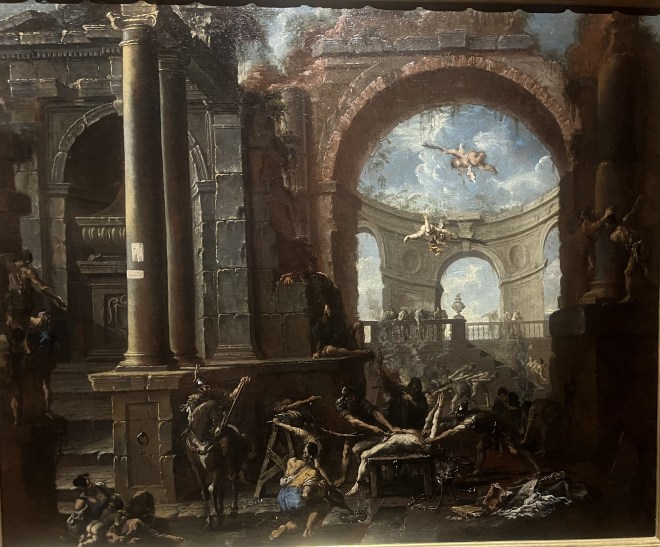
In any event, at some point I was suddenly transfixed by this painting, which shows in horrible, gory detail some poor guy having his entrails pulled out of him and wound around some contraption or other.

My photo

The painting’s label helpfully informed me that the poor guy in question was Saint Erasmus and he was being martyred. It was clearly a popular subject, because there was another painting just across the way about the same thing.
My photo

I’ve mentioned in past posts that early and Medieval Christians loved dreaming up horrible deaths for martyrs, but this one really took the biscuit! What sadistic mind came up with this one? And how did this particular form of torture even cross their mind?! I had, of course, to do some research.

As usual, as written up in the various pious hagiographies which appeared from at least the 5th Century onwards, St. Erasmus’s life seems to be one long muddle. So I’m going to more or less ignore these and sketch out what I think happened, not so much to Erasmus himself as to the legends which clustered around him and to the way he was portrayed in paintings.

It would seem that Erasmus started out as a local saint in the city of Formiae, a Roman port city some 90 km up the coast from Naples. Perhaps he was a bishop there. Bishop or no, there is a good chance that he was martyred in the city during Emperor Diocletian’s campaign of persecution, which ran with differing degrees of intensity from 303 AD to 313 AD. In later centuries, when relics of martyrs and saints became so important, his remains must have been reverently kept by the citizens of Formiae. Probably, too, to bolster the importance of his relics, legends about wondrous deeds performed by Erasmus began to circulate. One of these, which is important for our story, has him continuing to preach even after a thunderbolt struck the ground beside him. By the 5th Century, manuscripts also relating his nasty, vicious martyrdom at the hands of various Emperors were already circulating.

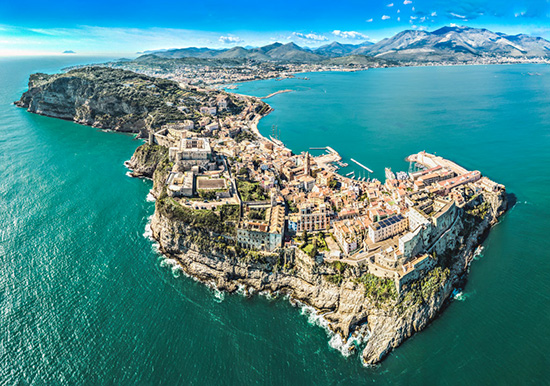
In the meantime, back in the real world, things were not going too well for Formiae. After suffering badly at the hands of the barbarians who flowed into Italy during the death throes of the western Roman Empire, it was razed to the ground in 842 AD by “Saracen” pirates who came from the sea. Its citizens ran – literally – for the hills, and that was the end of Formiae. Luckily, before the city was finally trashed, Erasmus’s precious relics were transported over the bay to nearby Gaeta, which was located on a much more defensible position, as this photo shows, and managed to hold off the pirates.
Source

The relics are held to this day in Gaeta’s cathedral, along with the relics of four or five other saints, in a large crypt built in the early 17th Century.

Source

In the 9th Century, when the relics were transferred from Formiae, and for a few centuries thereafter, Gaeta was a marine republic, like the ones on the Sorrentine peninsula further south, and very much in competition with them. Shipping was the backbone of the city’s prosperity, and the city’s sailors adopted Erasmus – one of Gaeta’s patron saints now that they owned his relics – as their personal patron saint. It seems that they chose him on the basis of that story I mentioned earlier, of him being unperturbed by a lightning bolt hitting the ground next to him. One of the perils which sailors ran (and still run) were violent storms. It’s not surprising that so many of the ex-votos found in churches in port cities have as their subject a sailor who was saved during a storm.

Source

During such storms their boats could get hit by lightning. And so Erasmus became one of the patron saints of sailors. In this guise, he was often associated with the crank of a windlass. This may seem odd to readers, but windlasses were used on boats to pull up or let out an anchor or other heavy weights. The heavy weight is tied to a rope, the rope – maybe threaded through a winch – is wound around a barrel, which sailors turn using a crank (K in the diagram below).

Source

It looks like people simplified everything by just associating the crank with Erasmus.

St. Erasmus’s connection in the minds of sailors to lightning got them to also connect him to another electrical phenomenon which sailing ships were (and still are) subject to. In brief, during thunderstorms, when high-voltage differentials are present between the clouds and the ground, oxygen and nitrogen molecules in the air can get ionized around the point of any rod-like object and glow faintly blue or violet. Well, of course, sailing ships in the old days had lots of rod-like objects, like masts or spars or booms, and when conditions were right there would be a faint glow at the end of all these. Here is a print of an old sailing ship with these ghostly “flames” on the ends of its masts and spars.

Source

And here is a modern photo of the phenomenon around a clipper ship, the Cutty Sark, moored on the Thames in London.

Source

Well, of course, sailors knew nothing of the physics behind the phenomenon. They interpreted those little flames as meaning that St. Erasmus was protecting their ship, especially since the phenomenon often occurred before the thunder and lightning started. And so the phenomenon become known as St. Elmo’s Fire (Elmo being an Italian corruption of Erasmus).

In a parallel universe, various martyrologies continued to be published over the ages, full of the usual hideous tortures meted out to martyrs. But nothing yet about poor Erasmus’s entrails being pulled out of him. Then, in about 1260, a certain Jacobus de Voragine published his martyrology under the title The Golden Legend. His story about Erasmus recycled many of the tortures covered in previous martyrologies to which the saint had been subjected. But then, Jacobus slipped in a brand new torture. In his words (translated into English by Wynken de Worde in 1527):

“[…] the emperor […] waxed out of his wit for anger, and called with a loud voice like as he had been mad, and said: This is the devil, shall we not bring this caitiff to death? Then found he a counsel for to make a windlass, […] and they laid this holy martyr under the windlass all naked upon a table, and cut him upon his belly, and wound out his guts or bowels out of his blessed body.”

Here is how the scene was depicted in one of the early editions of the Golden Legend (in case any readers are interested, the two fellows on the left having their heads chopped off are Saints Processus and Martinian).

Source

Now, I said at the beginning, how did this particular form of torture ever cross Jacobus’s or someone else’s mind? Well, it has been suggested – and it doesn’t sound improbable – that whoever dreamed it up found inspiration (if that’s the word) from the association of Erasmus with the crank of a windlass. Presumably they assumed that the windlass had to have something to do with his martyrdom. After all, the depictions of many martyrs have them holding the instruments of their torture. Saint Lawrence, for instance, leaning on the grill he was roasted on:

Source

Or Saint Bartholomew carrying the knife with which he was flayed alive.

Source

Or Saint Stephen, balancing on his head and shoulders the stones with which he was stoned to death.

Source

But what could the torture be in Erasmus’s case? Well, what do we humans have that looks like ropes? Entrails! And so this novel form of torture was dreamed up.

Now, Jacobus’s list of tortures inflicted on poor Erasmus is really long: I count 19 in all. Many of them would have made very appropriate subjects for the gory paintings of martyrs so beloved by painters until quite recent times. And yet, the entrails being pulled out on the windlass really caught on; I have to assume it’s because that was the one torture that Jacobus had a picture of in his book. Here’s just a few examples I found on the internet.

This first version is a more sophisticated variant of the picture in The Golden Legend and had added the emperor, “waxed out of his wit for anger”, looking on.

Source

This next version is quite similar, except that St. Erasmus’s bishop’s mitre has now been thoughtfully placed to one side.

Source

In this next one, we’re beginning to get a bit more dramatic.

Source

While this one, by Nicolas Poussin, has pushed the drama levels to stratospheric heights.

Source

Other paintings, perhaps trying to avoid all the gruesomeness of these kinds of paintings, just had a thoughtful-looking Erasmus, dressed as a bishop, holding his crank around which his entrails have been tastefully wound. This next painting is an excellent example of the genre.

Source

This focus on Erasmus’s guts and the acute pain he no doubt suffered having them drawn out had an interesting side-effect. I’ve mentioned in a previous post the Fourteen Holy Helpers who helped Medieval people deal with their physical trials and tribulations – the headaches, or the sore throats, or the epileptic fits, or … they suffered from. Well, Erasmus fit very well into this scheme of things! He was obviously the go-to Holy Helper for cases of stomach and intestinal illnesses.

I related in the postscript to a previous post that in a moment of weakness I had bought a painting on glass of the Fourteen Holy Helpers. All this research has allowed me to identify which of the Helpers in my painting is St. Erasmus. Here he is, with his crank and some of his intestines rolled around it. All this research I do does sometimes have benefits …

My photo

OLIVES

Dedicated to my daughter, who loves olives as much as I do

Sori, 27 January 2020

A week or so ago, I accompanied my wife to a supermarket that we go to from time to time – it’s bigger than the ones just down the road from us but somewhat further away, so we only go there for certain items which the closer supermarkets don’t stock. But I don’t want to discuss shopping strategies in this post, fascinating as these are to retirees like ourselves. I want to discuss table olives.

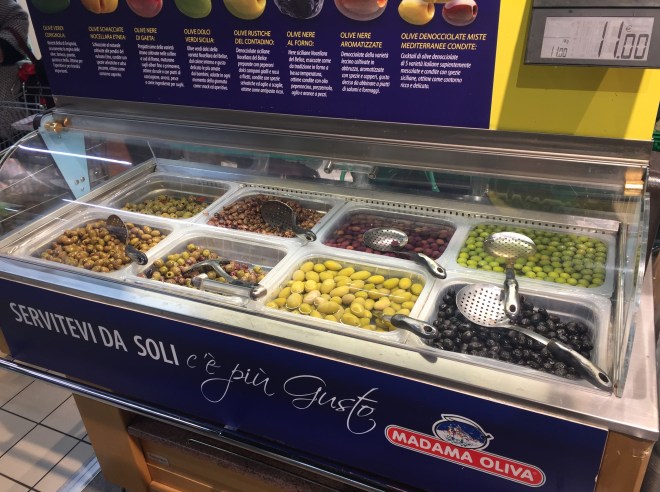
This particular supermarket has an olive bar, where you can buy olives loose by the gram (or kilogram if you’re an olive fanatic).

my photo

It’s a delightful spot in this otherwise bog-standard supermarket. I like to linger there, looking over these glistening globules of yumminess. From time to time – when I’m in a mood to splash out – I will take the plunge, grab the beckoning spoons, and fill a few plastic tubs to take home and munch my way through. I hasten to add that I remember what we taught the children: I will share, with my wife if her diet allows it and with my children if they happen to be around.

This supermarket is proudly patriotic and offers only Italian olives. For the uninitiated, it is offering, among others:

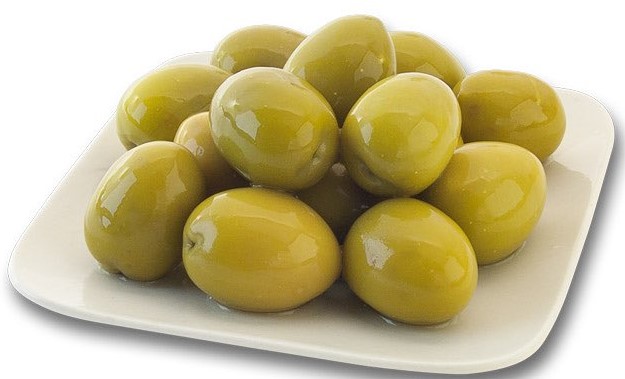
Green olives from Cerignola in Puglia

Source

These gigantic green olives are probably my favourite. They are crisp, not too strongly flavoured, almost buttery.

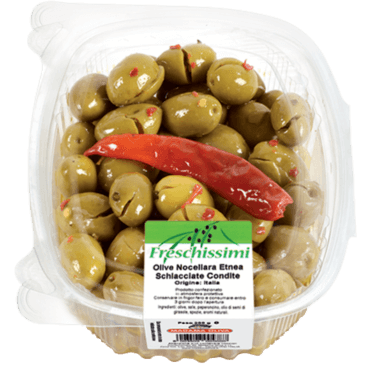
Green Nocellara olives, from the flanks of Mount Etna in Sicily

Source

These olives are cut, crushed, seasoned with oil, spices and hot sauce and garnished with whole chillies. The use of chillies (which I profoundly dislike) and their slightly bitter taste mean that I skip these when I get some tubfuls of olives at the supermarket.

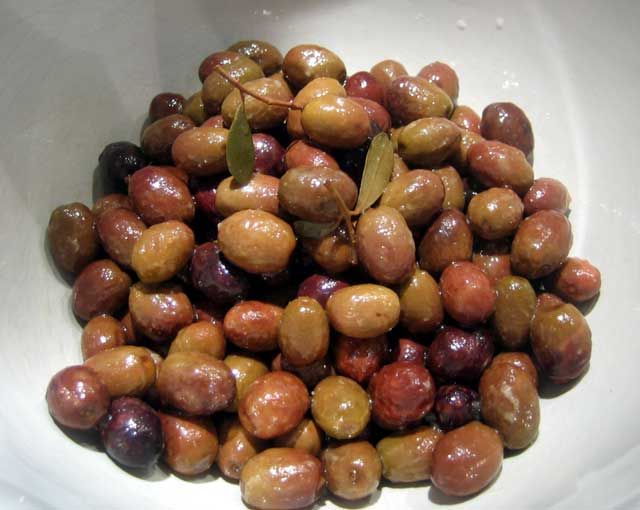
Black olives from Gaeta in Puglia.

Source

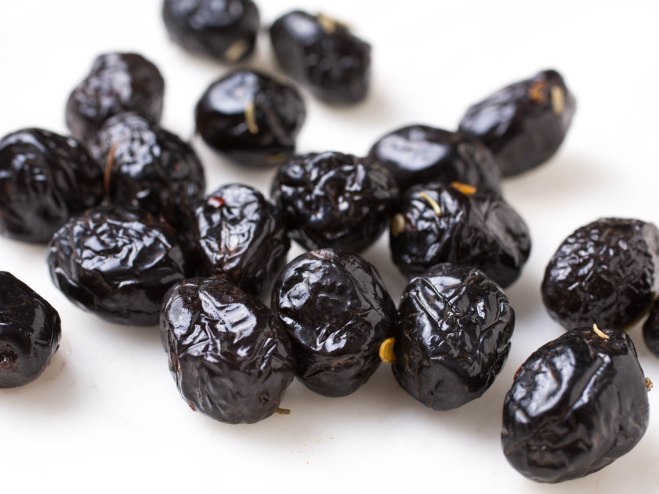
These small, purplish-brown olives have a soft, tender flesh and a tart, citrusy taste. The Gaetas in the supermarket are brine-cured, but they can also be dry-cured, in which case they are more shrivelled and chewy, somewhat like the next ones.

Black Nocellara olives from the Belice valley in western Sicily.

Source

These olives are harvested when completely ripe (in November). After an initial brining to desiccate them somewhat, they are placed in an oven at low temperature to further desiccate them.

There are more varieties of olive in the supermarket’s olive bar but I will stop there, for fear of boring readers with my purplish prose. And anyway, while I respect the supermarket’s patriotic choice of only offering Italian olives, I feel I must point out that other parts of the Mediterranean basin offer equally delicious olives.

There are the Greek Agrinion and Amfissa olives, for instance, both coming from the same variety of olive tree, but the former grown at lowish altitudes near the Ionian Sea / Gulf of Corinth and the latter grown at higher altitudes around Delphi in central Greece. They come in the green and black forms as well as every hue in between, depending on when they are picked, and both have a wide range of tastes. After some debate with myself I have chosen to insert a photo of the Amfissa olive as the emblem of these two olives, but only because I liked the farmer’s hands cradling the olives.

Source

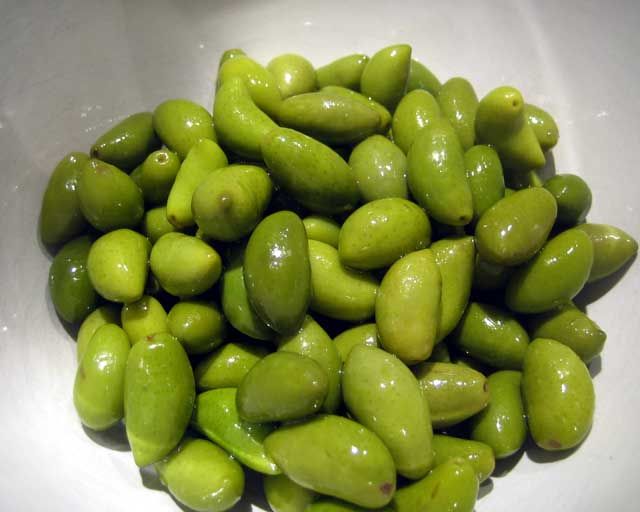
Or there are Gordal olives from Andalusia in Spain.

Source

True to their name (gordal means “fatty” in Spanish), these olives are big and plump, with plenty of firm, meaty richness.

Or we have Lucques olives from the Languedoc region of France.

Source

These olives marry an interesting external appearance – bright green and crescent shaped – with a mild nutty taste and buttery texture inside.

From further east in France, around the Côte d’Azur, come Niçoise olives.

Source

We know these olives because of the Salade Niçoise, of which they are an integral part. In truth, the Niçoise is none other than the Taggiasca olive, which is grown across the border in Liguria and which is the olive my wife and I buy when we go down to the sea. They both come from the same variety of olive tree and grow in the same climate. On both sides of the – artificial – border growers pick the olives while they are in the process of changing from green to black, giving them a striking medium to dark brown color.

I’ve only mentioned olives from the Mediterranean’s northern seaboard. The southern and eastern seaboards have equal variety, but they are just not as well known. Canny marketing hasn’t created brands there yet, so they are rarely consumed beyond their local area of production. Beldi olives from central Morocco are an exception.

Source

These olives, picked when they are fully ripe, are then salt-cured. This gives them a shriveled appearance and a chewy texture. They are wildly, intensely flavorful.

From the eastern end of the Mediterranean, I’ve picked Gemlik olives from the Zeytinbaği region on the Sea of Marmara in the north of Turkey, close to Istanbul.

Source

These too are picked when they are fully ripe. Because of their high oil content, they can be cured in a number of different ways, giving rise to olives with different tastes:

    • oil-cured (rotated in drums with a little salt; the agitation causes the olive to exude oil), then dry stored; this gives a rich, low-salt-tasting olive;
    • purely brine-cured olive, which gives a firm, salty olive;
    • dried in a basket of rock salt, which draws all the water out of the olive, leaving a firm, crinkly olive with hardly any salty taste.

There are good olives produced in other parts of the world where Europeans have transported the olive tree, the Americas especially, but I will be proudly patriotic and focus only on olives from the Mediterranean basin, which is the tree’s original home.

Olives joins that long list of plants which were basically inedible but out of which our ancestors were able to extract extremely yummy foodstuffs. In these posts, I have written about five such plants – the caper bush, cole, sea beet, common chicory, and cardoon – and there must be hundreds of others. I’m always amazed by the cleverness which was shown by armies of anonymous farmers over the millennia in patiently coaxing the DNA of plants which grew around them to evolve in a direction which expanded the range of foods available to them and to us, their descendants.

The edibility problem with wild olives is that they contain a number of incredibly bitter chemicals which go by such names as oleuropein, ligstroside, and dimethyl oleuropein. The levels of these chemicals are high in a just ripening olive, enough to impart such a bitter taste as to make you desist eating it immediately. As the fruit ripens further, the levels of these nasty chemicals drop. In most cases, though, their levels never drop low enough to make eating an olive straight off the tree a pleasant experience (there are a couple of domesticated varieties where the bitterness levels are low enough in the fully ripe olive to make them edible, but they are the exception). It’s a defence mechanism: the plant doesn’t want predators other than birds to eat its fruit because they could crack and therefore ruin the seeds (this is not a problem in the case of birds, which swallow the olives whole).

But actually, edibility is a secondary issue for the olive. The first use of olives was not as food but as a source of oil. Olives are rich in oil and by at least 5,000 years ago some bright spark (or sparks) had figured out ways of squeezing the oil out of ripe olives. It’s not even clear that the oil was used initially as a foodstuff. The same problem of bitterness rears its head with olive oil: if the olives are picked too early this will impart a bitter taste to the oil. It could well be that olive oils were first used as a source of fuel in lamps or as a raw material in soap making, or were used as a skin-care product or in medicines or in perfumes. It was olive oil that really drove the domestication of the olive tree. The economies of at least two Mediterranean civilizations – the late Minoan and the Mycenaean – were probably based in good part on the production of olive oil and its trade around the Mediterranean. Olives to eat became a by-product of the oil industry. That is still the case today: the great majority of olives which are grown around the world are turned into oil, with only a small percentage being eaten.

Luckily for us olive lovers, though, at some point some other bright spark (or sparks) stumbled on the discovery that steeping olives in brine for a good few months cut the bitterness levels to acceptable levels, because the nasty chemicals were leached out. Even better, the fermentation processes which brining kicked off gave the olives a better taste. On top of that, brining dealt with the familiar problem which our ancestors were confronted with everywhere: the fruit (or grain, or vegetables) ripen all at the same time; how can we conserve them so that in the weeks and months ahead we can eat the excess that we don’t eat straight away? By acidifying them a bit, brining meant the olives would last quite some time without going bad. A win-win-win situation, as we would say today!

After this fundamental breakthrough, olive eating could take off. Human beings being the way they are, our ancestors continued to tinker away. Various things were added (herbs, spices, wine, vinegar, …) to make the final product even more yummy. It was discovered that cutting or cracking the olive – basically, splitting open the flesh – allowed the leaching to happen faster. Different methods for leaching were developed (water – very slow; salt – gives rise to chewy olives like the Beldi). And, more importantly, they tried brining not quite ripe olives, picked when they were going from green to black and when the dreaded levels of bitterness were still high. Well, by gum, it worked! Sufficient leaching took place so that you could pick the olives somewhat earlier – maybe a month earlier – and still have a yummy product to eat. That allowed the development of olives like the Taggiasca or the Niçoise.

The next big breakthrough was the discovery by yet another bright spark or sparks that if you used a weak solution of lye (or caustic soda, to use a more modern appellation), you could turn green olives with very high levels of bitterness in them into an edible product. In this case, rather than encouraging the nasty chemicals to leach out as brine does, the lye penetrates the olive and chemically destroys them. As readers might suspect, olives subjected just to processing with lye don’t taste very good, so there is still a brining step involved. This treatment was developed in Spain, apparently; it’s called the Spanish or Sevillian approach. I’m not sure if I should congratulate the Spaniards who came up with lye processing. On the one hand, it has allowed us olive lovers to eat green olives like the Cerignola and the Lucques. On the other hand, it does begin to feel more like chemical processing than food preparation, the first step on a slippery slope.

I feel confirmed in my fears by the next big advance in olive processing – the so-called California style of processing (presumably because that was where it was invented) – which smacks even more of chemical processing. It is used with green and semi-ripe olives. It adds a step between the lye treatment and the brining, and consists of washing the olives in water injected with compressed air. This intense exposure to air oxidises the skin and flesh of the olives, turning them black. In other words, it’s a way of taking green olives and artificially “ripening” them. Olives treated in this way are the ones most favoured by fast-food pizza makers, those olives which are chewy and have no taste but look good sitting on the pizza.

And it’s not finished! An article I read which summarizes the state of play in olive processing reports that people are looking into the use of ultrasound during lye treatment to accelerate debittering; adding absorptive resins to the brine; running treatment processes under a vacuum; blanketing green olives in carbon dioxide; blanketing them in pure oxygen; using potassium and calcium chloride solutions instead of normal brine (sodium chloride solutions); exposing olives while still on the tree to aminoethoxyvinylglycine to delay ripening and so allowing levels of the bitterness-causing chemicals to reduce more than they normally would. And I’ve skipped a few.

Reading this list makes me look at my olives in a different light now. Rather than food, I see lumps of chemicals. Why can’t we just prepare food the good old way?

Source