TRISKELES

Milan, 6 November 2025

My wife and I were down in Sicily recently. Our daughter and her partner came over with the grandson and they decided to spend a week down in the very far south of the island, near one of Sicily’s three promontories, Capo Passero (if I mention this detail, it’s because it plays a role later). The house they rented gave directly onto the beach and our grandson spent many happy hours digging holes, making sandcastles, and braving the – relatively small – waves that broke onto the beach.

In between these sessions on the beach, we managed to get in brief visits to Noto and Syracuse, both UNESCO World Heritage Sites. Here’s a photo of the cathedral in Noto.

Source

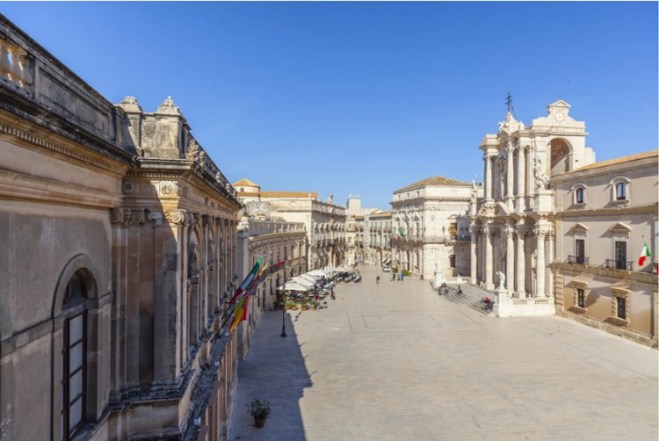
And here is one of the square in front of the cathedral in Syracuse.
Source

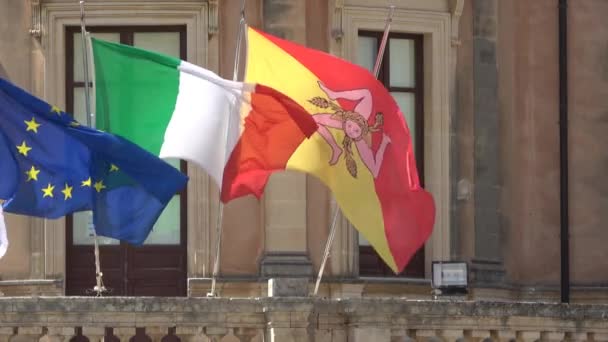
It was while I was wandering the streets of Syracuse that I noticed this flag – every public building had one.

Source

I discovered that it is the official flag of the region of Sicily (which is why I normally saw it flying along with the Italian national flag and the EU flag).
Source

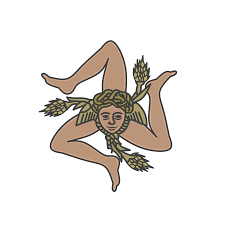
I’m a bit of a flag man – many years ago, quite soon after I started this blog, I wrote a post about what I considered to be the most elegant national flags. So of course I focused in on this flag. What really intrigued me about it was that symbol in the middle: a face from which emanate three legs bent at the knee.
Source

I quickly established that this symbol is called a triskeles, Greek for three-legged. It was a popular symbol on coins. The earliest numismatic representation of it (from around 465 BCE) is on coins from the Greek statelet of Pamphylia, in what is now southern Turkey.
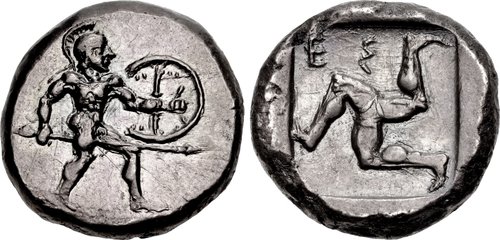
Source

The triskeles was used in varying formats on Greek coins for several centuries thereafter, but it was most closely associated with the coins of Agathocles, Tyrant of Syracuse from 317 BCE, and self-proclaimed king of Sicily from 304 BCE, until his death in 289 BCE. On this coin, it is the main decoration on the reverse side of the coin, because Agathocles adopted it as a personal symbol of his reign.
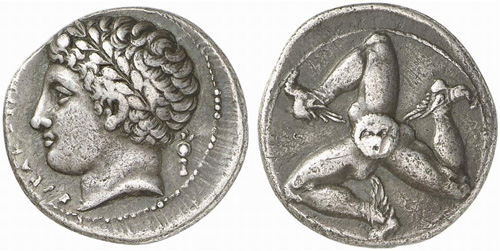
Source

Agathocles brought an important modification to the design, placing a Gorgon’s head as the central hub from which the legs emanate. He also added wings to the feet.

On this Syracusan coin, instead, it is used as the mint mark.

Source


It seems that Agathocles chose the triskeles as his symbol because it mirrored the (roughly) triangular shape of Sicily.

Source

The Greek name for the island was Trinacria, which means three headlands. The three headlands in question were those at the “corners” of the island: Capo Peloro, to the north of Messina, Capo Passero, all the way down south of Syracuse (and close to where we spent our little Sicilian holiday), and Capo Lilibeo, close to Marsala. The choice by Agathocles of the triskeles as his personal symbol was no doubt meant to underline his ambition – realised in the last years of his life – to be ruler of the whole of Sicily.

None of Agathocles’s heirs who were still alive when he died managed to succeed him as king of Sicily. In fact, he was formally reviled after his death, with all statues of him throughout Sicily being destroyed. Nevertheless, his triskeles continued to be used as a symbol for the island. After the Romans had turned the island into a province of its Empire, they added three ears of wheat to the Sicilian triskeles, apparently to underline the province’s role as a granary for Rome (and took the wings off the feet).

Source

With the collapse of the Western Roman Empire, the use of the triskeles seems to have disappeared in Sicily. But it came roaring back in 1282, when, in what has become known as the War of Sicilian Vespers, the Sicilians rebelled against their French Angevin overlords and invited the King of Aragon to take their place. The Sicilians created a flag to carry into battle.

Source

It was made up of the red and yellow colours of Aragon (but also the colours of the communes of Palermo and Corleone, where the revolt started) with a triskeles at its centre (where the Roman ears of wheat had disappeared and the wings brought back, but this time attached to the head).

After twenty years, peace was concluded and the House of Aragon ruled Sicily for the next 400 years or so.

In 1848, some 600 years after that first burst of rebelliousness, and when the whole of Europe was being shaken by revolutionary outbursts, the Sicilians had another bout of rebellion and ousted their Bourbon overlords. The movement of course needed a flag, so the triskeles was rolled out again, but this time it was affixed to the red, white and green tricolour, itself created in 1789 by Italian revolutionaries copying their counterparts in France.
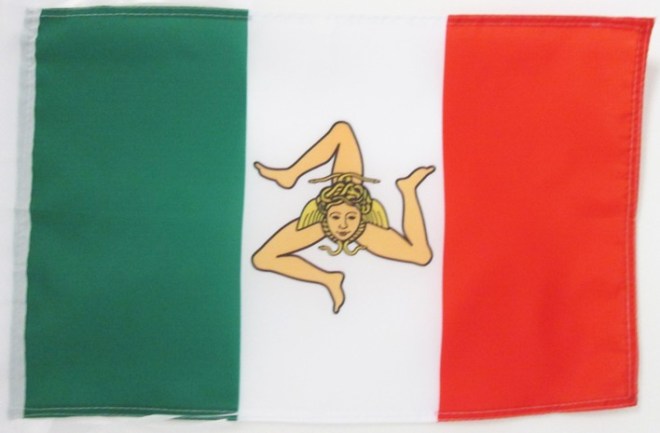
Source

Alas, the revolt, and the flag, lasted only a year, until the Bourbons took back control of the island. But then, a mere ten years or so later, in 1860, when Garibaldi and his thousand volunteers disembarked in Sicily on his way to conquering the island and the boot of Italy, the Sicilian rebels dusted off this flag to fight behind. That rebellion was successful this time. Or maybe it wasn’t, because Sicily shucked off its Bourbon overlords but only to become part of the new Italian State, where national unity was strongly promoted and regional diversity quashed. So of course the triskeles disappeared from the tricolour flag.

Then, at the tail end of the Second World War and after 80 years as part of the new Italian State, separatism reared its head in Sicily. In the chaos created by the Allies’ invasion of Sicily and the collapse of the national government, the Movement for the Independence of Sicily was formed. Of course, it created its own flag which naturally enough sported a triskeles, a bright red one in this case. I’ve no idea why the separatists chose this colour for its triskeles, or the colour of the flag’s background – perhaps simply the red and yellow now traditionally seen as Sicily’s colours?

Source

It was a strange movement, which pulled in people from the left and the right of the political spectrum but also had links with the mafia and the island’s traditional bandits. Indeed, the darker, criminal elements of the movement spawned an armed force, the Volunteer Army for the Independence of Sicily. It, too, created its own, triskeles-bearing, flag.
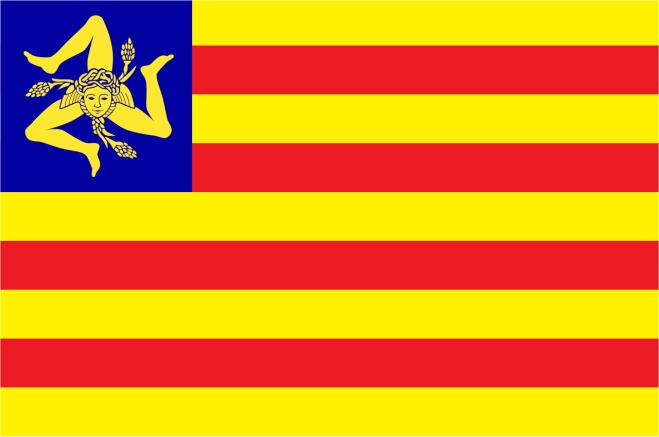
Source

This “army” attacked Carabinieri barracks and made general mayhem but was eventually crushed. In the meantime, the national government bought off the separatists by promising Sicily a special autonomous status (as it did to other regions on the rim of the country: Sardinia, Val d’Aosta, and Trentino-Alto Adige).

In the decades after the War, Italy’s regions, which had been politically moribund since the country’s unification, slowly clawed back their political importance. Finally, in 1970, the country’s first regional elections took place, while in 2001 a constitutional amendment gave the regions greater say in policy-making.

With the regions’ increasing political importance came the desire to create their own flags, banners, armorial bearings, and so on. Sicily was no different. Its regional parliament approved a first flag in 1995.

Source

Its design explicitly harked back to the flag created by the rebels in 1282 (although the colours of the background were switched around), but instead of the triskeles the region’s coat of arms was placed in the flag’s centre. This did include the triskeles but quartered it with the arms of the Normans, the Swabians, and the Aragonese, who had all been overlords of Sicily at some point.

Finally, in 2000 good sense prevailed and the regional parliament approved today’s flag with only the triskeles in the centre.

So there we are. An ancient symbol created back in the mists of time has managed to survive down through the centuries as a symbol of Sicily’s desire to shake off its overlords and now has been given a new lease of life as a symbol of – hopefully – a vibrant region in a more federalist national state.

COLOURING POLITICS

Bangkok, 9 December 2014

We have just finished celebrating H.M. the King’s birthday here in Bangkok. Truth to tell, “celebrating” may be a little of an overstatement. My wife and I found it quite a muted affair. For instance, the fireworks in the evening were really quite brief and modest, while a drive-by of high officials, which we just happened to find ourselves witnesses to, was greeted with silence by the folk lining the road side. What was out in full force, though, were the yellow shirts. They had already been popping up with greater and greater insistence in the days running up to the great day. But on the birthday itself the pavements were a sea of yellow.
image
Many were wearing yellow T-shirts made specifically for the purpose, but many others (who didn’t get included in the official photos) gave the impression of having grabbed the first yellow, or near-yellow, shirt or blouse they could find in their wardrobe. So the palette of yellows went all the way from pastel yellow through to citrine. Given the recent history of Thailand, one began to wonder if the choice of hue was a political statement of some sort. That man with the orange shirt, for instance, was it just the closest thing he had to yellow in his drawer, or was it actually the closest he dared get to the dreaded colour red? Or that woman over there with the pastel yellow blouse, had she simply been caught short without anything really yellow in her closet, or was she actually signalling her lack of enthusiasm for the whole exercise? Or what about the few people without yellow shirts? What, if anything, was their message? That student, for example, with the green shirt, what was he trying to tell us?

Thus are the seeds of paranoia sown ….

(By the way, for those of you who may be interested, the King’s colour is yellow because he was born on a Monday. Based on Hindu mythology, Thai (and Khmer) tradition assigns different colours to each day. For those of you who may be fascinated by this arcane point, I recommend you visit the following site on Wikipedia)

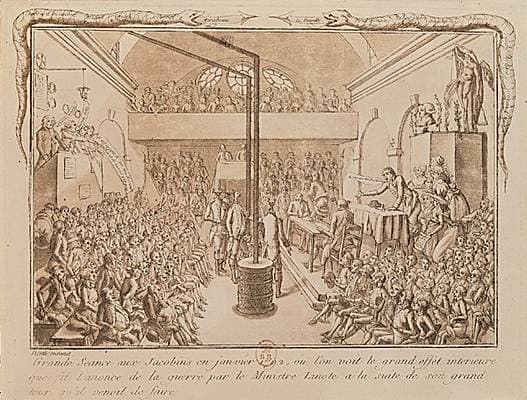
Colours have been recruited to support political quarrels since time immemorial. When I was young, red was the colour of Marxism in all its forms (Social-Democratic, Socialist, Marxist-Leninist, Maoist, Vietminh, Khmer Rouge, …). We have the French Jacobins
image
to thank for this association of red with the left of the political spectrum. For reasons which are too complicated to explain here, the Jacobins adopted the red flag as their own during the French Revolution, and the tradition continued in the European Left thereafter. I suppose we are all aware of the red symbols of the Left: the flags, the official art, the scarves, the buttons. But my preferred symbol of redness are the Garibaldini, those 1,000 or so red-shirted volunteers who, led by Giuseppe Garibaldi, sailed away in 1860 from Genoa to Sicily and in a few short months of fighting completed the unification of Italy.
image
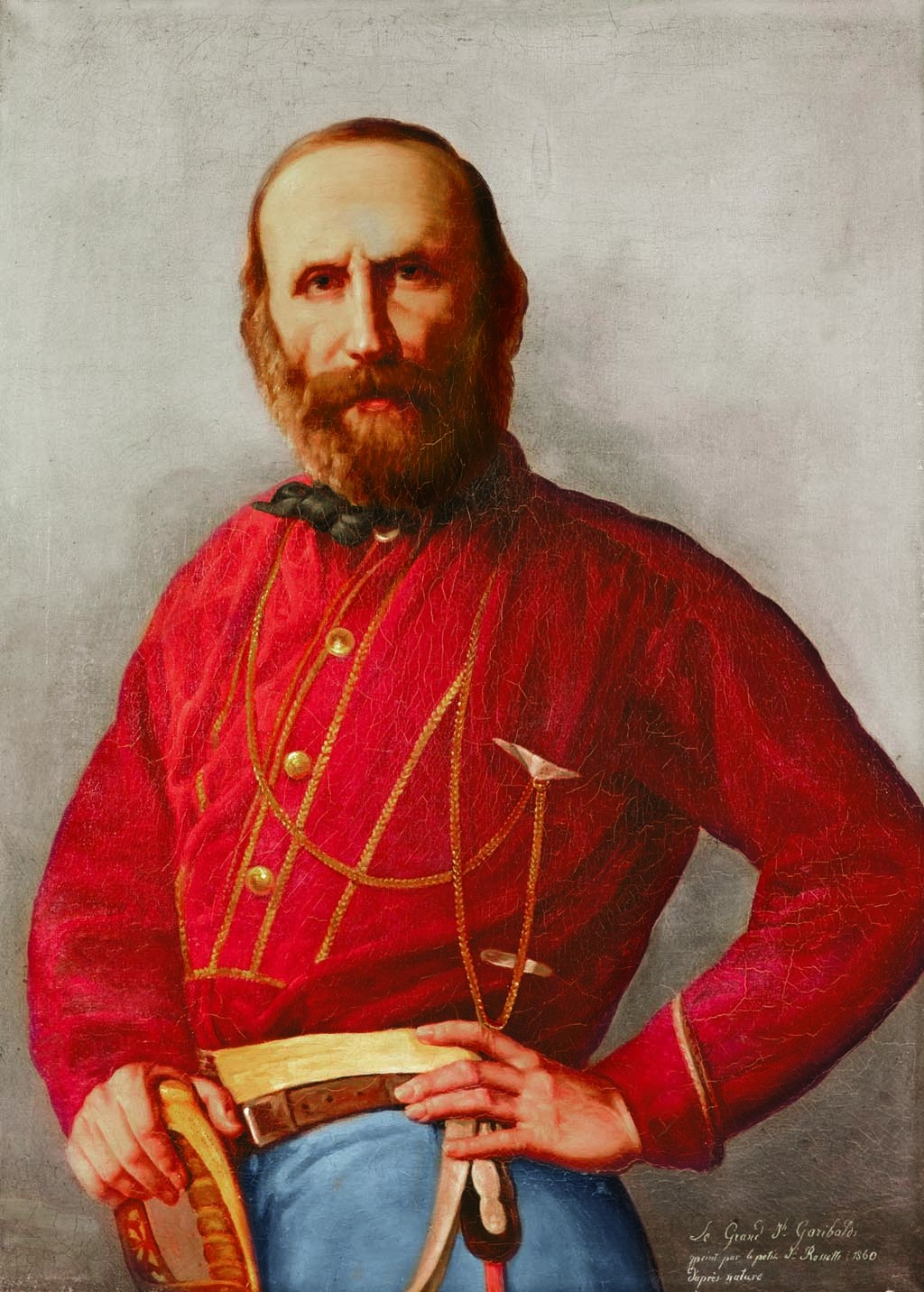
I have to add here a painting of the Great Man himself, whose statue graces at least one square, and whose name graces at least one street, in every village, town, and city of Italy.

image

I like Garibaldi, I’ve liked him ever since as a teenager I studied the unification of Italy for my O level History. By way of introduction to Garibaldi, our teacher told us about his earlier exploits in South America. The only thing that sticks in my mind about these worthy endeavors is our teacher’s description of how Garibaldi met his wife. He was on a boat on the Río de la Plata, where he was inspecting something or other through a telescope. He noticed his future wife on the bank, washing clothes or some such. After one look at her, he said (and here the teacher put on a thick Italian accent and struck an operatic pose), “Brring me to herr!”

But back to colours and politics. In the interwar years the red of the Socialists and Communists was violently opposed by various other colours. It was the black-shirted Fascists in Italy, seen here in the March on Rome in 1922
image
and the black-shirted Fascists in Spain, seen here jubilating at the fall of Irun during the Spanish Civil War.
image
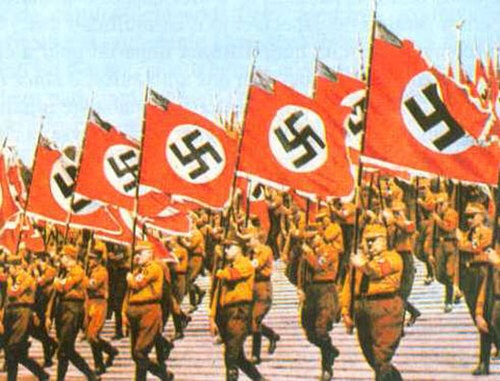
In Germany, it was the brown-shirted Nazis.
image
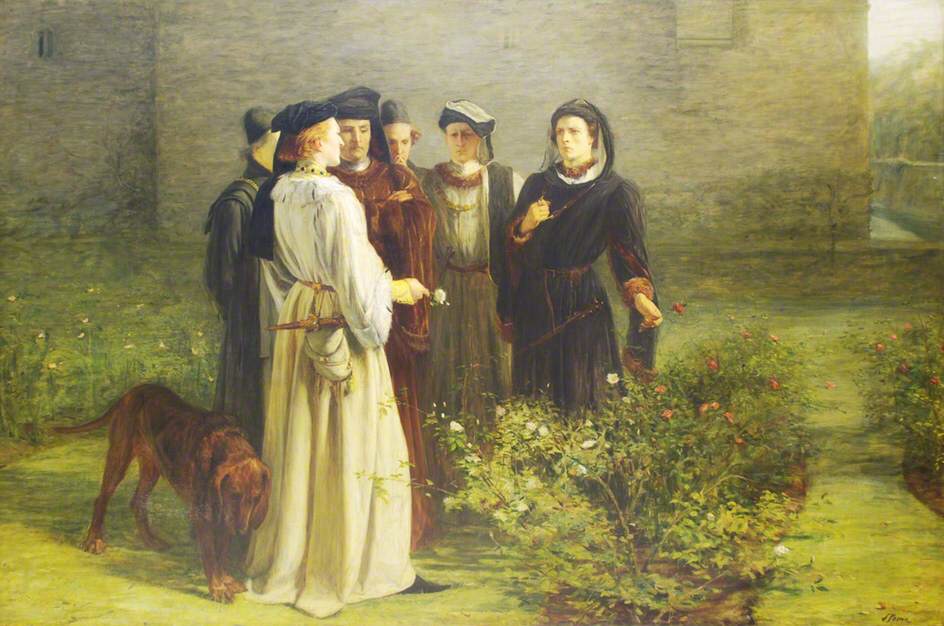
From here my memory leaves coloured shirts and vaults back some 500 years or so to the gardens at the Inner Temple in London, where – at least, according to Shakespeare in Henry VI, Part I – the Lords of Court chose which side to be on in the upcoming War of the Roses, by plucking either a white rose (the Yorkists) or a red rose (the Lancastrians) from rose bushes growing in the garden. Colours again, defining which side you would be taking in the looming political struggle. The scene is caught in this much romanticized painting from the 1870s.

image
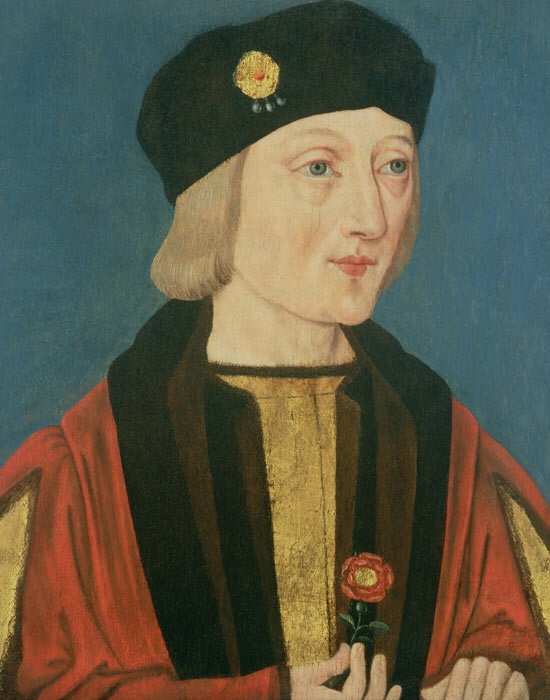
The Lancastrian Red Roses and the Yorkist White Roses fought it out for 30 years until Richard III was unhorsed and killed at the Battle of Bosworth Field, and Henry VII was crowned in his place. As a symbol of a once-more unified country, Henry devised a new badge for his dynasty, a mixed red-and-white rose now called the Tudor Rose.
image
A very clever piece of political manipulation through colour …

Talking of using colours for political purposes, we can fast-forward 300 years to the French Revolution and watch the storming of the Bastille.
image
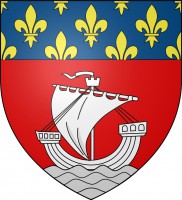
The Paris militia played a prominent role in the attack. To distinguish themselves from other groups taking part, they wore a blue and red cockade in their hats, Paris’s traditional colours.

image

The people of Paris were elated by this victory. But the more moderate – more aristocratic – elements of the revolutionary camp were alarmed by what they saw as rampaging – and armed – mobs. It was decided to create a National Guard out of the Paris militia under the command of the Marquis de Lafayette, a moderate revolutionary with military experience (gained during the American Revolution) and with the trust of King Louis XVI. Lafayette proposed to add white to the militia’s blue and red cockade. His argument was that this would turn what was mainly a Parisian militia into a national force: white was then the national colour.
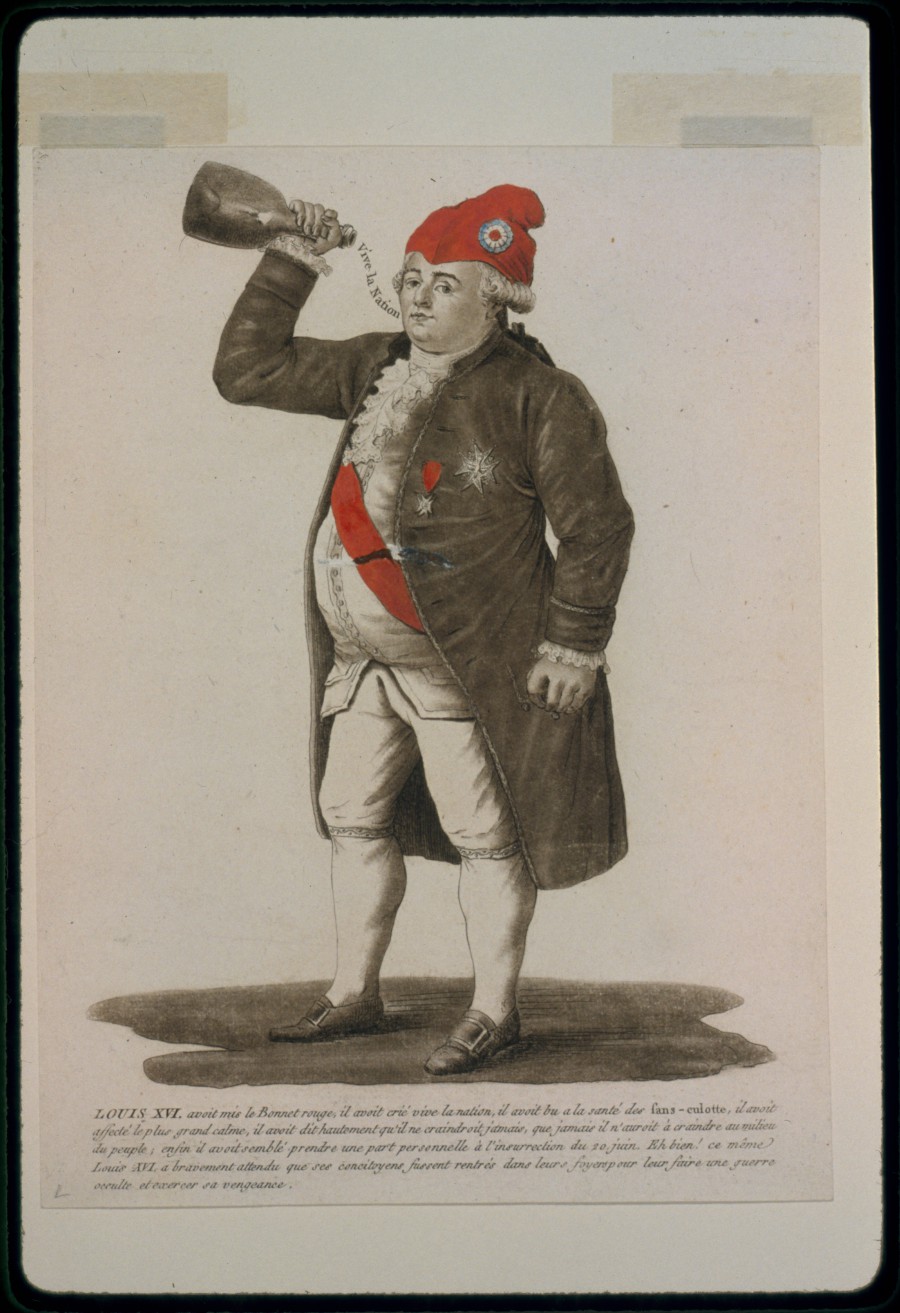
imageBut in a political system where all things national were the King’s, this was also a way of saying “revolutionaries yes, but still loyal to the King”. Well, things didn’t quite work out that way, but thus was born the red, white, and blue cockade, which even King Louis gracefully accepted to wear – at least for a little while.

image

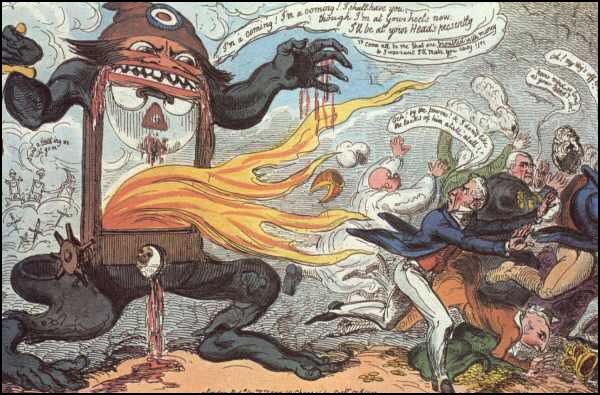
The cockade morphed into the flag, which became a symbol of hope for some

image
and the dread of many more as French troops unfurled like a tsunami over much of Europe.

image

Rampaging mobs makes my mind spin back more than a thousand years to Constantinople and to its hippodrome, home of the city’s chariot races. Chariot racing was to the Romans and the Byzantines what soccer is today to many people the world over, a mania, a fixation. All over the Roman world, there were four factions, the Greens, the Blues, the Whites, and the Reds, and all chariots in a race belonged to one of these four factions. The charioteers, as well as the fans, wore the colours of their faction, like in this mosaic in Lyon.

image

Like soccer players today, charioteers could and did change faction, but like soccer fans today the fans never did. If you chose to follow the Greens, you were a Green for life. Like soccer today, the enthusiasm of the fans inside the hippodrome often turned into hooliganism and gang warfare outside it. Like soccer today in some parts of the world where there is no recognized outlet for political and social frustrations, factional fighting became a way to vent political anger and score political points.

So it was in Constantinople in 532 AD, when Justinian I was Emperor. By now, there were only really two chariot factions that counted, the Blues and the Greens. Justinian supported the Blues so his enemies at court naturally supported the Greens. Justinian was in the midst of negotiating a badly-needed peace settlement with the Persians, and he had to have peace on the home front. But the people of Constantinople were angry: taxes were crushingly high. There had been politically motivated rioting after some earlier chariot races and a number of rioters had been hanged. But this did not calm excited spirits. For some strange reason, Justinian thought another day of chariot races would pour oil over troubled waters. The races started alright, with Blues and Greens vociferously supporting their teams, even though they also hurled insults at the Emperor, sitting – no doubt a bit nervously – in the imperial box. By the end, though, the two factions united in a common roar of “Nika! Conquer!” With that, the spectators burst out of the hippodrome and assaulted the palace, which conveniently abutted the hippodrome. For the next five days, they laid siege to it, demanding reductions in taxes and the dismissal of the prefect responsible for collecting the taxes and the quaestor responsible for rewriting the tax code. For good measure, they declared Justinian deposed and raised a new Emperor in his place. In the resulting mayhem, fires broke out which eventually burned down half the city.

Initially, Justinian panicked and was looking to scarper. But his wife Theodora was made of sterner stuff and stiffened his spine. Once his funk had passed, Justinian reverted to a true-and-tried method: gold. He got his eunuch Narses to go into the hippodrome, where the Greens and Blues were about to crown the new Emperor, with a large bag of gold. Narses quietly joined the heads of the Blue faction. He reminded them that Justinian was a Blue and that he had always supported them, he pointed out that the new Emperor was a Green and they could surely imagine what would happen to them under him, and then he distributed the gold. The faction leaders held a quiet conference, then spread the word among their followers. In the middle of the coronation, the Blues suddenly all stormed out of the hippodrome, leaving the Greens sitting stunned in their seats. At which point, imperial troops under trusted generals burst into the hippodrome and massacred all and sundry. It is reported that thirty thousand people died that day.

All in the name of colours …

Colours have been hitched to the wagon of many other political causes. Green has morphed from the colour of Byzantine charioteering factions to the colour of modern environmental factions, and we now hear of Deep Green and Light Green factions, each trading barbed – and not so barbed – insults about the depth of their commitment to the cause. We have Hindu fanatics cladding themselves in the colour saffron, a colour with deep religious connotations in Hinduism, and going on rampages against non-Hindus. And on and on … Readers who are interested in the topic can do no worse than go to this Wikipedia site.

But, misquoting Elton John, all I want to say is “Don’t shoot me, I’m only a colour”.

_______________
Yellow-shirts celebrating the King’s birthday: http://www.bangkokpost.com/multimedia/photo/447447/king-birthday
Meeting of a Jacobin club: http://www.larousse.fr/encyclopedie/data/images/1004994-Club_des_Jacobins.jpg (in http://www.larousse.fr/encyclopedie/divers/club_des_Jacobins/125450)
Garibaldini fighting: http://www.ondadelsud.it/wp-content/uploads/2011/04/Marsala-1860-Sbarco-dei-Mille.jpg (in http://www.ondadelsud.it/?p=4664)
Garibaldi: http://www.museotorino.it/images/86/94/ce/b0/8694ceb03de848108691d55482fd1c40-1.jpg?VSCL=100 (in http://www.museotorino.it/view/s/238dcc0376d444d2b6decf0378c13e6c)
The March on Rome: http://www.history.com/news/wp-content/uploads/2012/10/mussolini-march-on-rome.jpg (in http://www.history.com/news/9-things-you-may-not-know-about-mussolini)
Spanish fascists in Irun: http://pix.avaxnews.com/avaxnews/6a/1d/00001d6a_medium.jpeg (in http://avaxnews.net/educative/Spanish_Civil_War_2.html)
Brown shirts marching: http://img2.blog.zdn.vn/37516513.jpg (in http://me.zing.vn/zb/dt/toyotasolara/17039283?from=my)
Scene in the Temple Garden: http://ichef.bbci.co.uk/arts/yourpaintings/images/paintings/warg/large/nml_warg_wag_2712_large.jpg (in http://www.bbc.co.uk/arts/yourpaintings/paintings/scene-in-the-temple-garden-98909)
Henry VII and Tudor rose: http://static.guim.co.uk/sys-images/Admin/BkFill/Default_image_group/2012/3/1/1330616510280/Henry-VII-001.jpg (in http://www.theguardian.com/books/2012/mar/02/tudors-henry-vii-wars-roses)
Storming of the Bastille: http://media-1.web.britannica.com/eb-media/98/90498-004-CEB880DC.jpg (in http://global.britannica.com/EBchecked/topic/55622/Bastille)
Arms of Paris: http://upload.wikimedia.org/wikipedia/commons/thumb/c/ca/Blason_paris_75.svg/931px-Blason_paris_75.svg.png ( in http://en.m.wikipedia.org/wiki/File:Blason_paris_75.svg)
Royal standard of France: http://en.m.wikipedia.org/wiki/Royal_Standard_of_France#/image/File:Pavillon_royal_de_France.svg (in http://en.m.wikipedia.org/wiki/Royal_Standard_of_France#Middle_Ages)
Louis XVI: http://upload.wikimedia.org/wikipedia/commons/7/74/Louis_le_dernier.jpg (in http://commons.m.wikimedia.org/wiki/File:Louis_le_dernier.jpg)
Liberty guiding the People: http://upload.wikimedia.org/wikipedia/commons/thumb/c/cc/Eugène_Delacroix_-_La_liberté_guidant_le_peuple-2.jpg/967px-Eugène_Delacroix_-_La_liberté_guidant_le_peuple-2.jpg (in http://commons.m.wikimedia.org/wiki/File:Eugène_Delacroix_-_La_liberté_guidant_le_peuple-2.jpg)
Revolution as ogre: http://goodcomics.comicbookresources.com/wp-content/uploads/2008/10/cruikshank14.jpg (in http://pixgood.com/french-revolution-political-cartoon.html)
Mosaic of chariot race: http://travellingman.jalbum.net/Lyon%202011/slides/P1120092.JPG (in http://travellingman.jalbum.net/Lyon%202011/slides/P1120092.html)