Milan, 1 December 2025
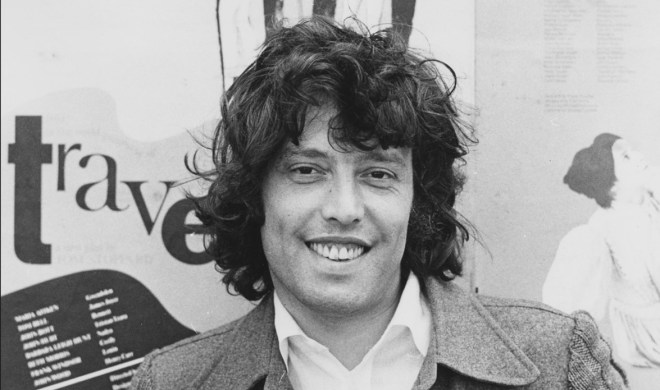
As I appeared bleary-eyed for breakfast a day ago, my wife – who normally gets out of bed before me – announced, “Tom Stoppard is dead”. How old, I asked? 88 she replied. A good age. In my advancing years, I read obituaries more and more frequently (such interesting lives people have lived!), and I have noted that many of those who are graced with an obituary in the newspaper I read shuffle off this mortal coil in their 80s. So, as I say, a good age.

For any of my readers who are not familiar with him, Tom Stoppard was a playwright, primarily for the stage, but also for radio, for TV, and for film (as a screenwriter in this case). Perhaps they will have seen the film Shakespeare in Love, whose screenplay Tom Stoppard co-wrote (and for which he shared a screenwriting Oscar).

Famous playwrights have been popping off, and I’ve never written about them. So if I write a post about Tom Stoppard’s death, it’s because he holds a special place in my heart. Many, many years ago, when I was 17 to be precise, I played a lead role in the play that made Stoppard’s name, “Rosencrantz and Guildenstern are Dead”. I have preciously kept the edition of the play we used as a script. It is now battered and worn from following us around on our countless moves over the intervening decades.

The play is a riff on Shakespeare’s “Hamlet”. Stoppard has taken two very secondary characters from that play, who are friends of Hamlet’s from way back, and has turned them into the protagonists, but of what exactly is never really clear, to them or to the audience. They have been summoned to the court of Denmark by the king, but they don’t know why. Essentially, the whole play is happening in the wings of the play “Hamlet”, with R & G passing the time discussing various topics and waiting for someone to explain to them what is going on; this aspect of the play has strong echoes of Samuel Beckett’s “Waiting for Godot”.

From time to time, apparently to give them the explanations they crave for, scenes from “Hamlet” roll onto the stage and our two hapless friends find themselves taking part in those scenes.
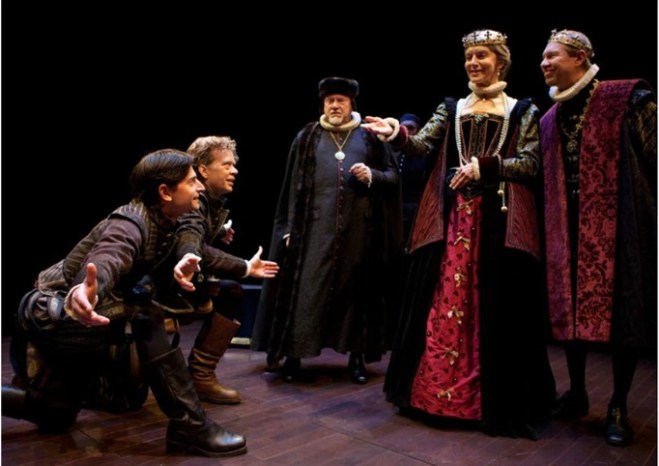
They are such minor characters that the king and queen, as we see in this photo are constantly getting them mixed up. Then the “Hamlet” scenes roll off the stage and R & G find themselves alone again and even more befuddled than before. Eventually, after a hilariously farcical scene on a ship with pirates, and without really understanding why, they die. The dialogue is absolutely scintillating, a hallmark of Stoppard’s. In fact, a common criticism of his plays is that there is too much head and too little heart. Perhaps, but his dialogue is among the best I have ever heard or read.
I played Rosencrantz, although I have to say that over the decades my memory faded and, like the king and queen of Denmark, I got confused about who I had played; I had to re-read the script again to be sure. I have no photos of myself, alas, in this performance. I’m sure photos were taken, but they will have remained in one of the albums which littered, and no doubt still litter, the school theatre’s green room. Instead, I’ll throw in some photos of some of the well-known actors who have played R & G, to show what good company I’m in. Here we have Daniel Radcliffe and Joshua McGuire playing the two roles.
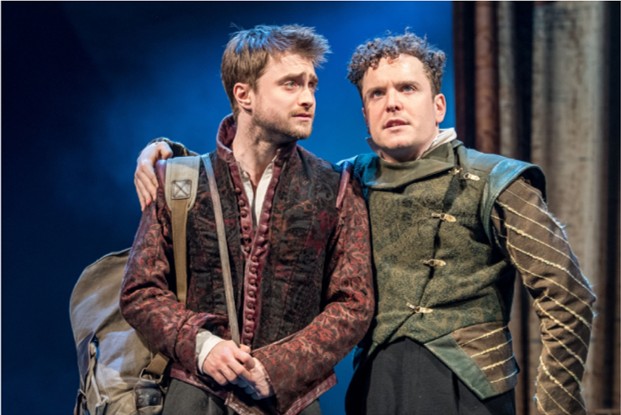
I’m chuffed to see that Racliffe played Rosencrantz.
Here we have Gary Oldman and Tim Roth.

I’m equally chuffed to see that Oldman (whom my wife and I have been watching religiously in “Slow Horses”) played Rosencrantz.
And here we have Adrian Scarborough and Simon Russell Beale.

Scarborough plays Rosencrantz, I’m pleased to see – my wife and I watched him recently playing a police inspector solving hideous murders.
Looking back, I realise that playing Rosencrantz was the apex of my acting career. I performed it in my last year at school, and my subsequent acting career at university was a relatively swift decline into secondary Rosencrantz-and-Guildenstern-like roles. The fact is, there were much better actors than me at university. I had briefly entertained the idea of becoming a professional actor, but I quickly realised that unless I wanted to spend much of my life out of work I had better find something else to do.
Funnily enough, I have never seen another of Stoppard’s plays in the intervening decades, although I have read a good number – that scintillating dialogue. I have to say, I turned off play-going after I stopped acting; I was spending too much time thinking about how I would have directed the plays I was watching. But maybe I could at least watch on YouTube the one film Stoppard himself directed – which happens to be of “Rosencrantz and Guildenstern are Dead”. That would surely be a fitting way for me to remember this great playwright.
 the heart thrills