ST. CHRISTOPHER

Milan, 30 October 2025

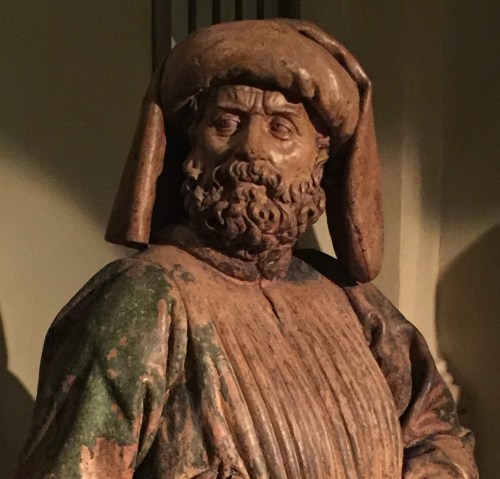
The genesis of this post was a hike my wife and I did back in May, around the Danube not too far from Linz. As I relate in the post I wrote about that hike, one stop we made was at the small church in the village of Pupping. And there I found, among other things, this wooden statue of Saint Christopher.

My photo

The statue caught my attention because of Saint Christopher’s expression; as I wrote in the post, the Saint looks less than pleased with the Child Jesus sitting on his shoulder. In fact, I would go so far as to say that he looks downright grumpy. A nice take, I thought, on the traditional story about St. Christopher, and normally the only story that most people have ever heard about the Saint. So I made a mental note to come back one day to this Saint’s story. On a drizzly afternoon in Milan, that day has come.

So what is the story that most people have heard about St. Christopher? I think a quick recap might be useful. I should start by noting a little-known fact, that at the beginning of the story our Saint was actually called Reprobus. He was a big, brawny man – a giant in many tellings of his life – and he was in this period of his life spending his time carrying people across a deep ford at a river somewhere in Asia Minor. In case any readers might think this surely was not a job people did in the old days – they would use a boat or a raft, right? – I throw in here a print of people doing precisely this in Japan in the 1860s.
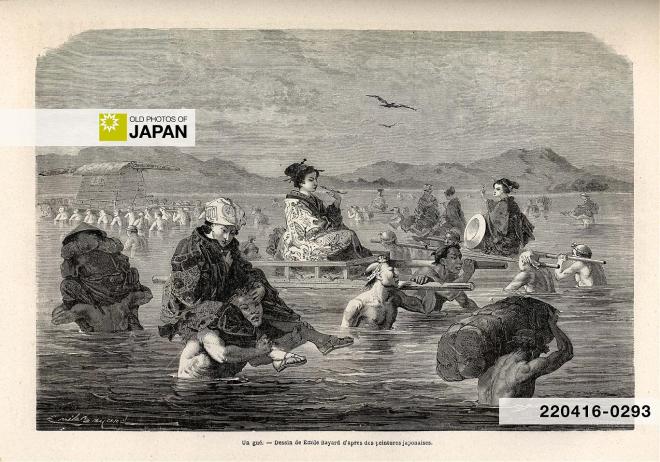
Source

In any event, one night Reprobus heard a young voice calling out. It turned out to be a child asking to be carried to the other side. So even though it was late Reprobus put the child on his shoulder, seized his trusty staff, and started crossing. To his consternation, as he waded across, the child got heavier and heavier. So heavy did the child get that this huge, strong man found himself struggling mightily to make it across. When he finally made it to the other side, he said to the child: “You put me in the greatest danger. I don’t think the whole world could have been as heavy on my shoulders as you were.” To which the child replied: “Don’t be surprised, Christopher [which in Greek means Carrier of Christ], you had on your shoulders not only the whole world but Him who made it. I am Christ your king, whom you are serving by this work.” Thus did Reprobus become Christopher. And no wonder Reprobus-about-to-become Christopher is looking so grumpy in that statue in the church in Pupping!

It is a charming story which got painted many times by numerous artists in Western Europe. I throw in here an assortment:
By the Master of the Pearl of Brabant
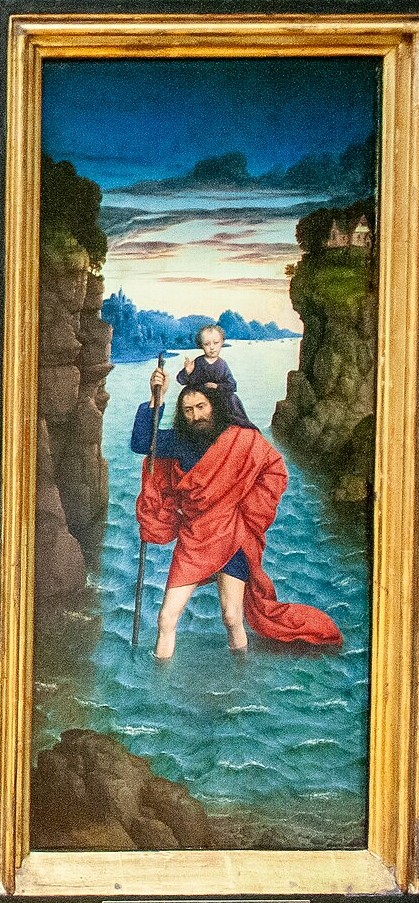
Source

By the Flemish painter Joachim Patinir
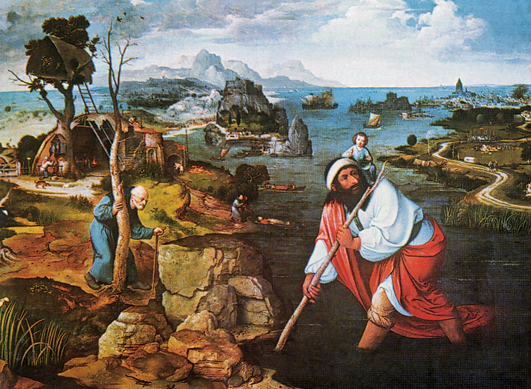
Source

By Rubens

Source

In fact, it’s just about the only story of Christopher’s life that ever got painted in Western Europe, crowding out all the other stories associated with him.

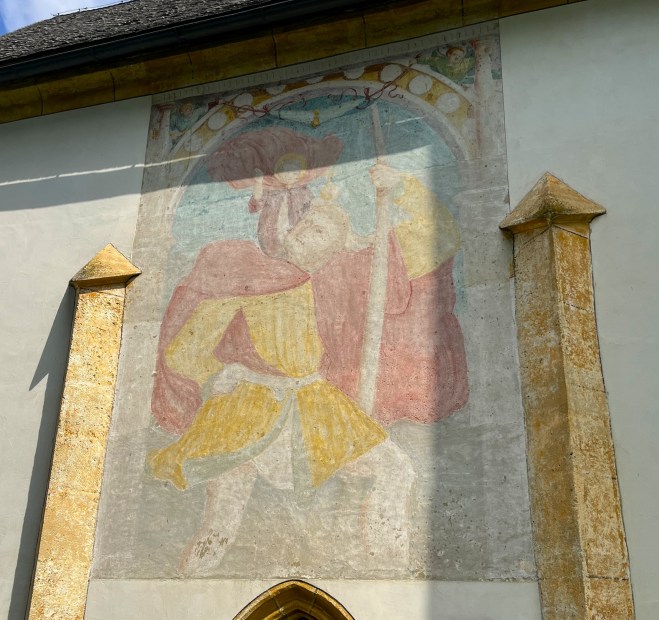
I must confess, the precise theological messages of the story elude me, even though I have perused several posts trying to help me out. In fact, I read elsewhere that the story was actually made up by various churchmen to “normalise” what was a widespread practice by the “little people” of painting enormous portraits of St. Christopher with Christ, first inside their churches and then later on their outer walls. When I read that, I had a jolt of recognition. A couple of weeks before that hike around the Danube, my wife and I had hiked for a couple of days in the south of Austria in the hills around Villach. In some of the small villages we walked through I had noticed these giant St. Christophers painted on the outside of three of the village churches which we passed. I was so struck by them that I took several photos.
This is a general view of the church where I saw the first one
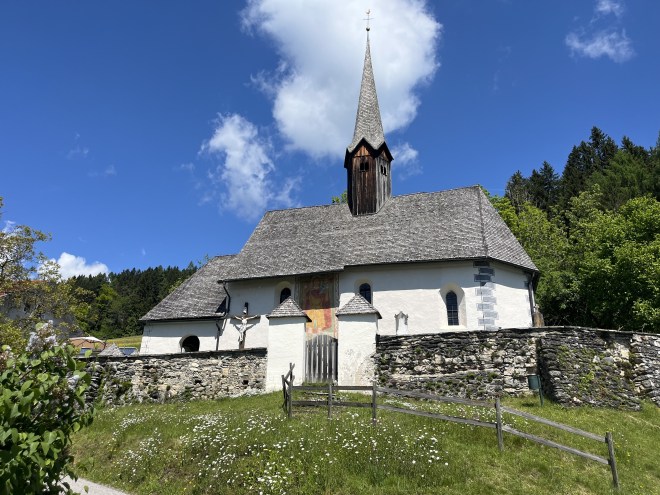
My photo

Here is a close-up of the fresco

My photo

This was in the next village we passed through
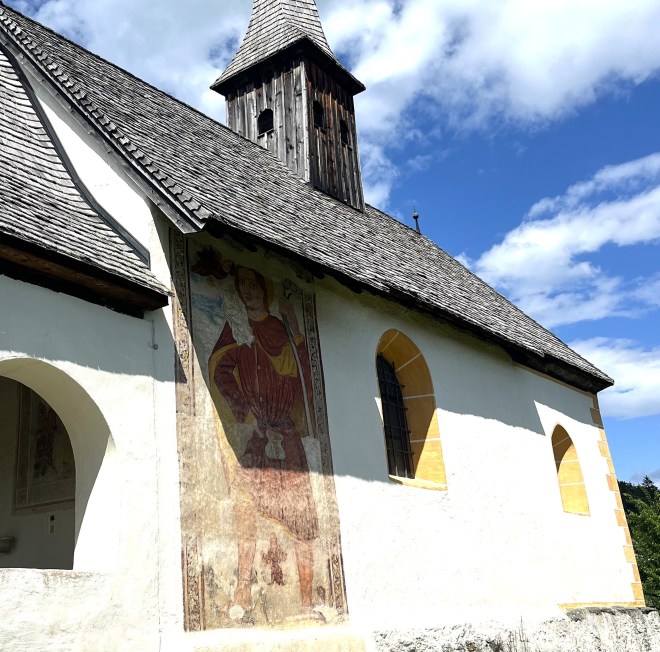
My photo

This was at the church where we sat down to have our sandwiches for lunch.

My photo
My photo

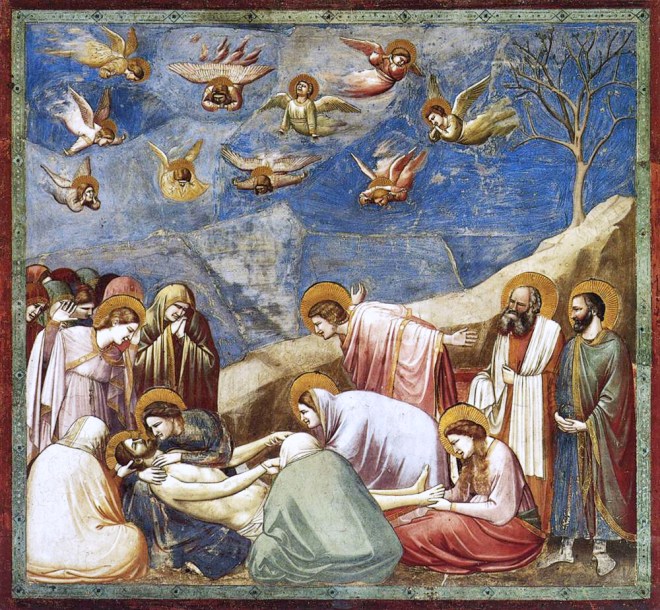
At the time, I had found these frescoes charming. I was now reading that they actually had a precise meaning. They were showing St. Christopher in his role as the “guardian from a bad death”, and especially a sudden and unexpected death. We have to plunge into the Christian mindset of the Middle Ages to understand why this was so vital. Any person who died “unshriven”, that is to say without having confessed and been absolved of their sins, was condemned to spend eternity in Hell without any possibility of salvation. And the torments of Hell were always well represented in church frescoes in case people forgot. Here is one such example, painted by Giotto in the Scrovegni chapel in Padova.
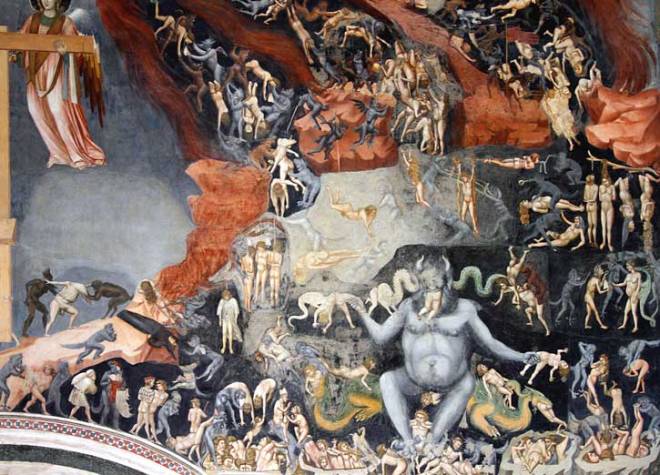
Source

Under the circumstances, it made perfect sense for everyone to do whatever they could to avoid an unshriven death. Somehow, the belief sprang up that if you saw the image of St. Christopher you wouldn’t die that day. Thus the huge size of the St. Christophers as well as their location on the outside walls of village churches; like that, all villagers, even those living far from the church, avoided the risk of not seeing the image during the day. As one can imagine, the popularity of these images soared during the Black Death, when the risk of dying unshriven increased enormously. Continuing bouts of the plague over the centuries maintained their popularity.

I rather like this role of St. Christopher as a Gentle Giant keeping an eye on your lifespan. However, by the 15th Century, when huge St. Christophers had proliferated everywhere, theological and ecclesiastical authorities had become less enthusiastic, considering this trust of the “little people” in St. Christopher to be mere superstition. They were far more comfortable with the Saint’s role as the protector of travelers and all things travel-related (it was of course his role of carrying travelers across the river that led to travelers invoking his protection). And the coming of the automobile, where the dangers it posed to life and limb became immediately obvious, saw a huge increase in the Saint’s popularity. Even now, miniature statues of the Saint are frequently displayed in cars; sign of the times, you can buy one on Amazon. Yours for a mere $8.99!

Source

Meanwhile, in Orthodox Christianity, things took a different path for Christopher. The whole story of him carrying the Boy Christ across a river was ignored (at least until relatively recently). Instead, the focus was on his good, Christian life after his baptism and his martyrdom. So the icons of him have a young man, normally dressed as a soldier. Here is an example from Saint Paraskevi Church in Adam.

Source

So far, so bog-standard. But then, there is a startling alternative in his iconography, one where he is depicted as having a dog’s head (at least, I find this startling; showing saints with dog-heads seems rather disrespectful to me).

Source

I find these icons so strange that I am moved to throw in the photo of another one, where St. Christopher is cheek by jowl with a perfectly normal St. Stephen.

Source

This strand of iconography came about from a rather too literal reading of the legends about Christopher’s origins. It was said that he had been captured by Roman troops in combat against tribes dwelling to the west of Egypt in Cyrenaica. Already back in the 5th Century BCE the Greek historian Herodotus had written that in these parts, on the edges of the civilised world, lived dog-headed men as well as headless men whose eyes were in their chests. This belief in Europe that the edges of Europeans’ known world were populated by strange hybrid human species continued well into the early modern times, as this woodcut from the 1544 book Cosmographia shows.

Source

As a consequence, some icon painters believed that Christopher (or Reprobus as we have seen he was then known) was dog-headed, and they painted him as such.

Not surprisingly, there was pushback on this depiction of Christopher from the Higher-Ups. In a 10th Century hagiography about the Saint, its author, Saint Nikodemos the Hagiorite, wrote: “Dog-headed means here that the Saint was ugly and disfigured in his face, and not that he completely had the form of a dog, as many uneducated painters depict him. His face was human, like all other humans, but it was ugly and monstrous and wild.” For its part, in the 18th century the Russian Orthodox Church forbade the depiction of the Saint with a dog head because of the association of such a representation with stories of werewolves or monstrous races.

Poor Christopher! Giant, dog-headed, and now cancelled. Because, back in 1969 the Catholic Church struck him from the General Roman Calendar, deeming that there wasn’t enough evidence to show that he had ever existed. I still remember the general consternation this caused at the time. What about all those miniature statues in cars (and medallions around necks)? How could they protect you if Christopher had never existed? I guess the fact that people continue to buy them shows that the “little people” will still believe in these images’ magical ability to protect, whatever the Higher-Ups say or do.

LAMENTATIONS OVER A LOVED ONE

Milan, 8 June 2019

During the month of March, my wife and I went to Bologna for a short visit (I should have written up this post quite a while back; but hey, as they say, better late than never). It’s a nice little town, somewhat off the tourists’ beaten track, which makes it all the nicer. It had been decades since either of us had been back – my wife studied there for a year in the late 1970s, and I had visited her one Christmas before we went off for a little jaunt to Puglia. So it was nice to visit a few old haunts, although in truth her memories of the town were somewhat hazy and mine were almost non-existent.

But actually, what I had really been looking forward to visit was a Lamentation over the Dead Christ, by Niccolò dell’Arca from 1463, which is located in the Church of Santa Maria della Vita (tucked away behind Piazza del Nettuno). I had come across it a decade or so ago when I was methodically leafing through the 1,000 pages of the book 30,000 Years of Art: the story of human creativity across time and space.

Source

This very – very – thick book purports to summarize the best art that we humans have created ever since we started making things: the first entry in the book is from c. 28000 BC, the last is from the mid-1990s. Its entry for the year 1463 is Niccolò dell’Arca’s Lamentation (on page 685, if anyone is interested). When I saw it, I said to myself, “One day, I must go to Bologna to see this!”

The Lamentation in question is not a painting. Rather, it is a collection of terracotta statues making up a sort of “tableau vivant” of the scene of sorrow around Jesus’s dead body, after he has been taken down from the cross and before he has been deposed in his tomb. It seems that Lamentations of this kind were quite common, at least in Italy (and not just in terracotta; I recently saw the remains of two other Lamentations made of wood, in the Pinacoteca of Milan’s castle). The statues represent a set of stock characters: Jesus, of course, lying on the ground after being taken down from the cross; Mary, the mother of Jesus (whom I shall henceforth refer to as the Madonna, to avoid confusion with the three other Marys); St. John the Evangelist; the three other Marys – Mary Magdalene, Mary of Cleophas, Mary Salome; Joseph of Arimathea; and Nicodemus. Here is a typical example of the form, which we also saw in Bologna, in the cathedral, made by the artist Alfonso Lombardi between 1522 and 1526.

our photo

Very nice, very dignified, very composed.

But now consider the Lamentation which I wanted to see.

Source

Talk about lamentation! Look at the faces of the women!
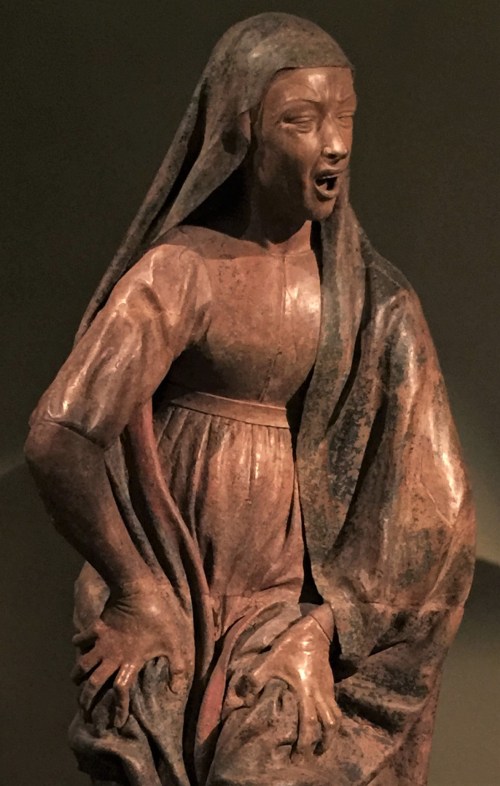
Mary, mother of Jesus, first of all

our photo

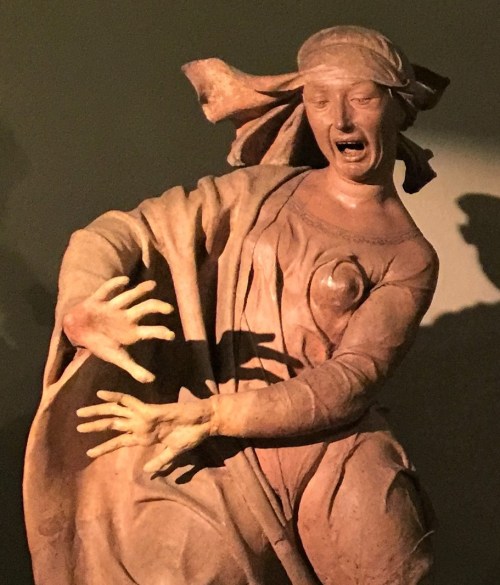
Next to her, Mary Salome, gripping her thighs frenetically in her anguish

our photo

At the feet of Jesus, Mary of Cleophas, trying to shield herself from the awful truth

our photo

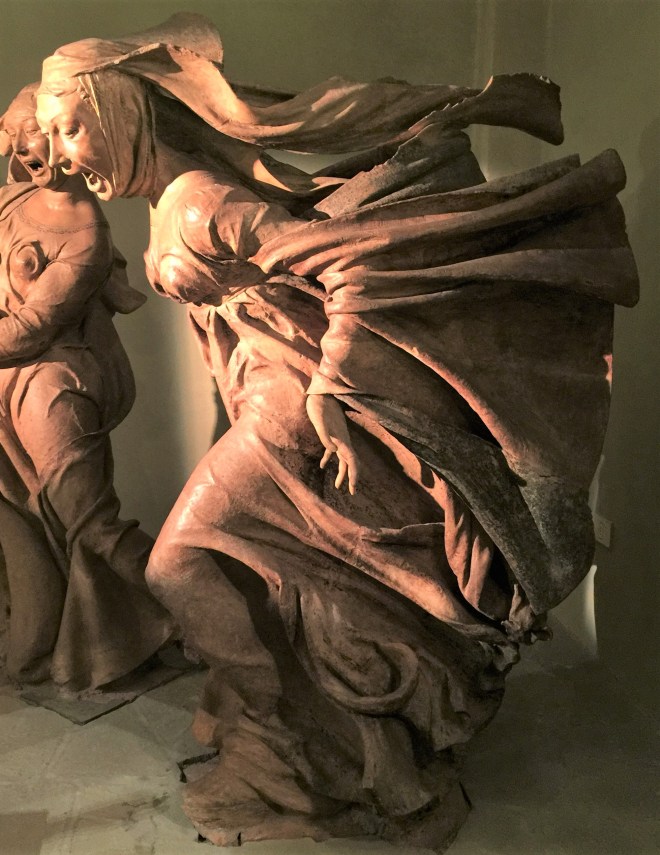
Finally, next to her, Mary Magdalene, shrieking out her horror at what she sees.

our photo

The weeping, the wailing – the shrieking – going on in that circle of people is all heightened by Mary Magdalene’s clothes streaming behind her in a most dramatic fashion.

our photo

The explanation given in the church is that she was running to the scene and the artist caught her – as if in a cinematic still – at the moment when she burst into the circle around the body and saw with horror that Jesus was dead.

In contrast, the two men in the group are quite subdued. St. John’s expression can only be described as that of someone who is feeling somewhat miserable

our photo

while Joseph of Arimathea simply looks phlegmatic.

our photo

(for those of my readers who might be asking themselves this, Nicodemus was either not part of this particular group or he disappeared in the intervening 400 years)

This male-female contrast in emotions brings to mind an exchange we as a family had on WhatsApp about Theresa May’s resignation speech in late May. Our son commented that it was somewhat embarrassing to see her cry, at which our daughter leaped to her defence. I quote: “I thought her speech was pretty good. She got emotional when talking about the honour of the job and the fact that she was the second ever female UK prime minister (and not the last) – I think it’s fair to get emotional at that stage! We need to stop vilifying emotional releases such as tears. Women are physiologically more prone to crying – our tear ducts open more easily. If we see tears as a sign of weakness we are inherently disadvantaging women. Anyway, the premise that being “strong” means being unemotional I also think should be changed. We don’t need to go to the opposite extreme but her release was very appropriate.”

Well, Nicolò dell’Arca certainly seemed to think that grown men don’t cry, but that women do, and copiously!

It struck me that I could use the various Lamentations paintings created over the centuries to explore how painters felt about this gender difference in the showing of emotions, or simply about the showing of emotions at all. I should add a warning here that my personal take on this is that in real life the scene at the centre of the Lamentations would have been highly emotional: your son, or your leader, who has had you believing that he is heralding the arrival of the end of time and the start of the reign of Yahweh, has instead been shamefully put to death by the colonial authorities and now lies before you, dead. All your hopes, all your beliefs, smashed to smithereens. If I had been there I would have been a total puddle, even if I am a man. But let’s see what painters thought.

We can start this exploration some two centuries before dell’Arca’s composition, with Giotto’s Lamentation of 1303, which is to be found in the Scrovegni chapel in Padova (and on page 615 of the Very, Very Thick Book).

Source

Here, everyone who is gathered around the dead Jesus is crying – not wailing as the women are in dell’Arco’s composition, but definitely crying. Even St. John – the person standing over the women huddled around Jesus – is crying. In fact, I would say that St. John is in transports of sorrow, more so than the women. Even the angels are in anguish. It is true that the two fellows to the right – believed to be Joseph of Arimathea and Nicodemus – are quite composed, but one could argue that they were not close companions of Jesus and so not as committed to the cause that he represented. It could also show that Giotto thought it was OK for young men like St. John to show their emotions, but that older men should keep their upper lip well stiffened.

Jumping forward to 1440-42, we have a Lamentation by the Dominican monk Fra’ Angelico, in the Monastery of San Marco in Florence.

Source

Here, no crying, just a gentle preparation of the body for the tomb behind, by the women and St. John (who has his back to us) (the fellow in the background is St. Dominic, seeing all this in a trance). A typical work of Fra’ Angelico, I would say, as gentle as the man himself. Maybe strong emotions frightened him. Maybe he preferred to choose a moment slightly after the tears and the wailing, when practical considerations kicked in: the dead body needed to be prepared for the grave.

We can go forward another fifty years, to Mantegna’s Lamentation of 1489, hanging on the walls of Milan’s Pinacoteca di Brera just up the road from where I write this (and which can be viewed on page 707 of the VVThB, by the way).

Source

Looking at the painting, readers can see that next to Jesus there are three people – the Madonna, St. John next to her, and a third person you can just make out over the Madonna’s shoulder. They are all crying copiously. It seems that Mantegna, rather like Giotto, believed in everyone showing their emotions.

On the other hand, in Botticelli’s Lamentation of almost the same period (1490-92), now in Munich’s Alte Pinakothek, the artist only has the women lamenting (although in a very stylized way, it seems to me; shades of things to come). St. John simply looks grim. So Boticcelli appears to be with dell’Arco on this one: women show emotions, men don’t.

Source

The painting also has that stock situation, common in later times, and which I must confess to find most irritating, of the Madonna fainting from the emotion of it all. This really is the male assumption about the weakness and frailty of women: when the going gets tough, women faint. The other men, saints of various kinds, are simply there to witness the scene, like St. Dominic in Fra’ Angelico’s version, so do not show much emotion (I do think, though, that Botticelli had some cheek in including St. Peter – the fellow to the right, clutching a big key – since according to the Gospels while Jesus was being taken down from the cross and being buried he and the other – male – disciples were all cowering in a room somewhere, in fear of imminent arrest).

This next Lamentation is by Bellini, executed at the same time as Botticelli’s (1485-95). It is one of many Lamentations which he painted. This particular one is in the Uffizi in Florence. Here, everyone is even more composed: the Madonna, Mary Magdalene, and St. John seem to be sniffling a little while everyone else is looking calmly noble. Bellini does not believe in showing emotions, it would seem (although in fairness to him, some of his other Lamentations seem somewhat more emotionally charged).

Source

On the other hand, in this Lamentation by the Venetian painter Carlo Crivelli, from exactly the same period (1485) (and now in Boston’s Museum of Fine Arts), both the Madonna and St. John are in absolute agony, with the latter literally howling (it is true to say, though, that Mary Magdalene is more contained).

Source

It would seem that Crivelli was a believer in showing strong emotions, like dell’Arca, and was quite happy with men showing such emotions.

But now look at this Lamentation by Perugino, again from the same period, 1495 (and now in the Palazzo Pitti in Florence).

Source

I mean, everyone, man and woman, looks ridiculously calm and noble! (there is one half-hearted attempt at gesticulation, by the lady in red at the back, but it’s very unconvincing). Perugino must have thought that emotions weren’t necessary to the scene.

From 50 years later, 1547, we have this Lamentation by Paolo Veronese (it seems that every artist worth his salt had a go at this theme), now in the Castelvecchio Museum in Verona.

Source

Again, everyone looks calm and dignified. The Madonna looks a trifle pale, but that’s about it. No emotions please!

A decade on, 1560 or thereabouts, Tintoretto painted this Removal from the Cross bleeding into a Lamentation, now in the Galleria dell’Accademia in Venice.

Source

This is best described as baroque, although it’s a bit early for that. We have a fainting Madonna, dramatic gesticulation, contorted clothing – but not a single tear. Drama is required, but not emotions.

The same message comes through 45 years later in Caravaggio’s Deposition of 1603-1604 (which also contains some Lamentation in it), now in the Pinacoteca Vaticana.

Source

The drama here comes from the play of light and dark and the angle from which it was painted. But the women seem quite composed in their sorrow; the gesticulation of the girl at the back feels contrived.

If real emotions seem to have drained away from the Lamentations painted in Italy, to be replaced first by Olympian calm and then by drama, there never seems to have been any real emotions at all in the Lamentations painted north of the Alps. The genre crossed the Alps at about the time that Giotto painted his Lamentation in Padova and became very popular. I have not been able to find any tears, or even much emotion, in these Northern European versions of the genre. For instance, this Lamentation from 1455-60, by the Early Netherlandish painter Petrus Christus (and now in Brussel’s Royal Museum of Fine Art) has the Madonna in a tasteful swoon, a lady to the right possibly wiping away a tear, and a woman to the left meekly wringing her hands. But everyone else is quietly going about their business.

Source

This Lamentation by the Burgundian Early Netherlandish painter Simon Marmion is from a little later, about 1476 (and now in New York’s Metropolitan Museum).

Source

Not a shred of emotion here. No drama, either. “Oh dear, he’s dead” is all I get from it.

Dürer, a few decades later (c. 1500), managed to include one person in his Lamentation who is gesticulating, although in a quite contained manner (you almost feel that Dürer included her because it was the done thing to do). The other women just look a little sad, while all the men are simply standing around. (This is another painting in Munich’s Alte Pinakothek)

Source

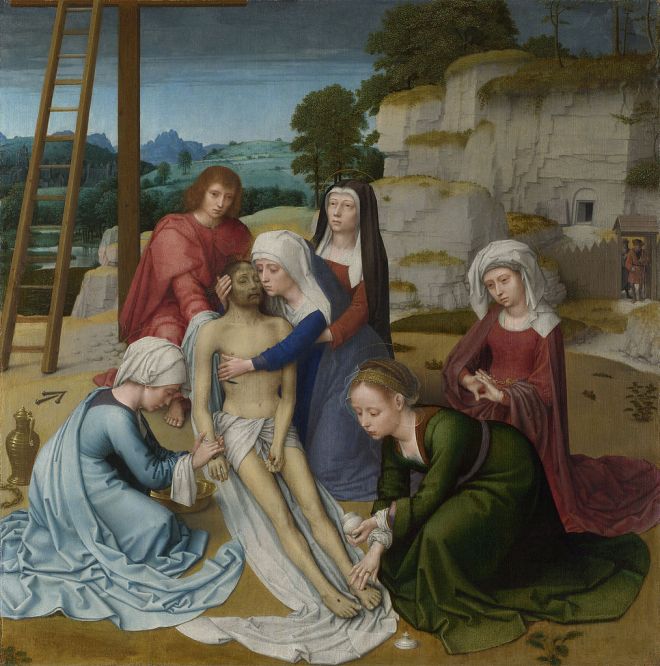
This next Lamentation, in London’s National Gallery, is by Gerard David, another Early Netherlandish painter, and is from a few decades later still, 1515-1523.

Source

It looks a polished work, but I still see very little emotion. A certain quiet sadness is all I get from the painting, from everyone involved.

I could add more paintings – like I say, every painter worth his salt seems to have had a crack at this one – but I think we get the gist. If there is any trend in later paintings, it’s towards the dramatic – exaggerated gestures, contorted clothing – but with only the women showing – theatrical – emotion; the men simply look stolid.

So what conclusions can we draw? – because we have to draw some conclusion. I have to say that I agree with my daughter on this one. Perhaps it is physiologically easier for women to cry than men, but I also think that European culture (and possibly all cultures) have evolved and now strongly suggest that men should have stiff upper lips while it’s OK for women’s (and children’s, male and female) upper lips to tremble.  I also think that it is expected for our leaders not to cry – stern anger, for instance against the enemy is OK, but no tears. Tears imply weakness, and our leaders must not be weak. Which is why the Renaissance painters stopped showing these ordinary people around Jesus, which Christianity had turned into leaders, crying – and why our son felt a certain embarrassment at seeing May crack up at her podium in front of No. 10. But I think we men should stop trying to look strong and weep and wail when we feel the need to, especially when we have lost someone very near and dear to us.

Oh, and do go to Bologna to see dell’Arco’s Lamentation. it’s really worth the visit – and Bologna is a nice place, with very good food.