My wife and I recently went to an exhibition at the Gallerie d’Italia, a relatively new museum in Milan which is situated right next to the Scala. The exhibition’s title, “The Genius of Milan. Crossroads of the Arts from the Cathedral Workshop to the Twentieth Century”, didn’t really reveal what the exhibition was about, and I’m not sure I had any better idea after our visit. I think it was trying to show how many non-Milanese artists had come to Milan over the centuries and flourished there, but I wouldn’t swear to it.
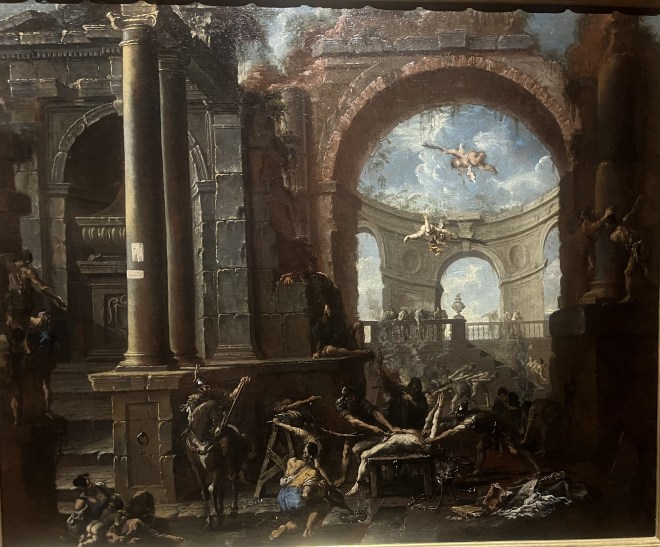
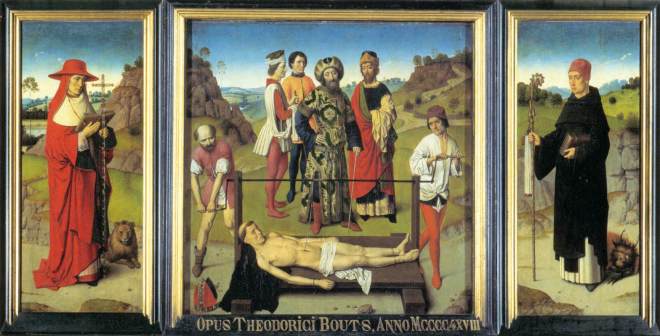
In any event, at some point I was suddenly transfixed by this painting, which shows in horrible, gory detail some poor guy having his entrails pulled out of him and wound around some contraption or other.
My photo
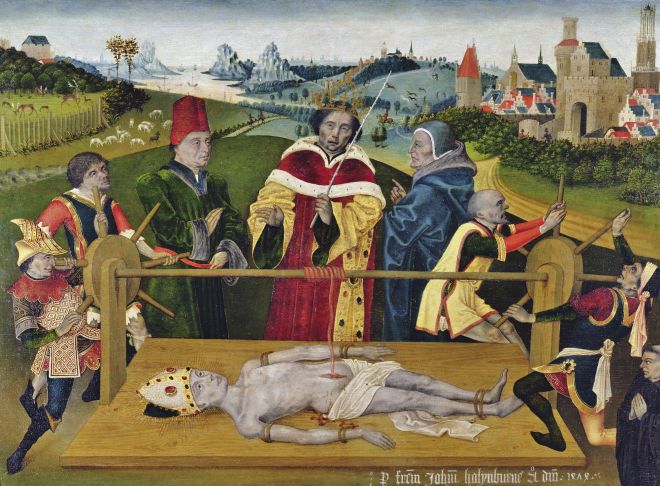
The painting’s label helpfully informed me that the poor guy in question was Saint Erasmus and he was being martyred. It was clearly a popular subject, because there was another painting just across the way about the same thing.
My photo
I’ve mentioned in past posts that early and Medieval Christians loved dreaming up horrible deaths for martyrs, but this one really took the biscuit! What sadistic mind came up with this one? And how did this particular form of torture even cross their mind?! I had, of course, to do some research.
As usual, as written up in the various pious hagiographies which appeared from at least the 5th Century onwards, St. Erasmus’s life seems to be one long muddle. So I’m going to more or less ignore these and sketch out what I think happened, not so much to Erasmus himself as to the legends which clustered around him and to the way he was portrayed in paintings.
It would seem that Erasmus started out as a local saint in the city of Formiae, a Roman port city some 90 km up the coast from Naples. Perhaps he was a bishop there. Bishop or no, there is a good chance that he was martyred in the city during Emperor Diocletian’s campaign of persecution, which ran with differing degrees of intensity from 303 AD to 313 AD. In later centuries, when relics of martyrs and saints became so important, his remains must have been reverently kept by the citizens of Formiae. Probably, too, to bolster the importance of his relics, legends about wondrous deeds performed by Erasmus began to circulate. One of these, which is important for our story, has him continuing to preach even after a thunderbolt struck the ground beside him. By the 5th Century, manuscripts also relating his nasty, vicious martyrdom at the hands of various Emperors were already circulating.
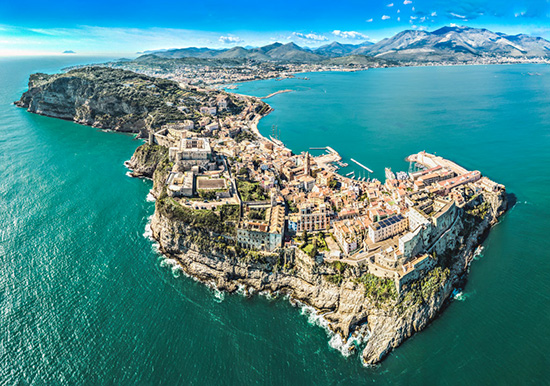
In the meantime, back in the real world, things were not going too well for Formiae. After suffering badly at the hands of the barbarians who flowed into Italy during the death throes of the western Roman Empire, it was razed to the ground in 842 AD by “Saracen” pirates who came from the sea. Its citizens ran – literally – for the hills, and that was the end of Formiae. Luckily, before the city was finally trashed, Erasmus’s precious relics were transported over the bay to nearby Gaeta, which was located on a much more defensible position, as this photo shows, and managed to hold off the pirates.
The relics are held to this day in Gaeta’s cathedral, along with the relics of four or five other saints, in a large crypt built in the early 17th Century.
In the 9th Century, when the relics were transferred from Formiae, and for a few centuries thereafter, Gaeta was a marine republic, like the ones on the Sorrentine peninsula further south, and very much in competition with them. Shipping was the backbone of the city’s prosperity, and the city’s sailors adopted Erasmus – one of Gaeta’s patron saints now that they owned his relics – as their personal patron saint. It seems that they chose him on the basis of that story I mentioned earlier, of him being unperturbed by a lightning bolt hitting the ground next to him. One of the perils which sailors ran (and still run) were violent storms. It’s not surprising that so many of the ex-votos found in churches in port cities have as their subject a sailor who was saved during a storm.
During such storms their boats could get hit by lightning. And so Erasmus became one of the patron saints of sailors. In this guise, he was often associated with the crank of a windlass. This may seem odd to readers, but windlasses were used on boats to pull up or let out an anchor or other heavy weights. The heavy weight is tied to a rope, the rope – maybe threaded through a winch – is wound around a barrel, which sailors turn using a crank (K in the diagram below).
It looks like people simplified everything by just associating the crank with Erasmus.
St. Erasmus’s connection in the minds of sailors to lightning got them to also connect him to another electrical phenomenon which sailing ships were (and still are) subject to. In brief, during thunderstorms, when high-voltage differentials are present between the clouds and the ground, oxygen and nitrogen molecules in the air can get ionized around the point of any rod-like object and glow faintly blue or violet. Well, of course, sailing ships in the old days had lots of rod-like objects, like masts or spars or booms, and when conditions were right there would be a faint glow at the end of all these. Here is a print of an old sailing ship with these ghostly “flames” on the ends of its masts and spars.
Well, of course, sailors knew nothing of the physics behind the phenomenon. They interpreted those little flames as meaning that St. Erasmus was protecting their ship, especially since the phenomenon often occurred before the thunder and lightning started. And so the phenomenon become known as St. Elmo’s Fire (Elmo being an Italian corruption of Erasmus).
In a parallel universe, various martyrologies continued to be published over the ages, full of the usual hideous tortures meted out to martyrs. But nothing yet about poor Erasmus’s entrails being pulled out of him. Then, in about 1260, a certain Jacobus de Voragine published his martyrology under the title The Golden Legend. His story about Erasmus recycled many of the tortures covered in previous martyrologies to which the saint had been subjected. But then, Jacobus slipped in a brand new torture. In his words (translated into English by Wynken de Worde in 1527):
“[…] the emperor […] waxed out of his wit for anger, and called with a loud voice like as he had been mad, and said: This is the devil, shall we not bring this caitiff to death? Then found he a counsel for to make a windlass, […] and they laid this holy martyr under the windlass all naked upon a table, and cut him upon his belly, and wound out his guts or bowels out of his blessed body.”
Here is how the scene was depicted in one of the early editions of the Golden Legend (in case any readers are interested, the two fellows on the left having their heads chopped off are Saints Processus and Martinian).
Now, I said at the beginning, how did this particular form of torture ever cross Jacobus’s or someone else’s mind? Well, it has been suggested – and it doesn’t sound improbable – that whoever dreamed it up found inspiration (if that’s the word) from the association of Erasmus with the crank of a windlass. Presumably they assumed that the windlass had to have something to do with his martyrdom. After all, the depictions of many martyrs have them holding the instruments of their torture. Saint Lawrence, for instance, leaning on the grill he was roasted on:
But what could the torture be in Erasmus’s case? Well, what do we humans have that looks like ropes? Entrails! And so this novel form of torture was dreamed up.
Now, Jacobus’s list of tortures inflicted on poor Erasmus is really long: I count 19 in all. Many of them would have made very appropriate subjects for the gory paintings of martyrs so beloved by painters until quite recent times. And yet, the entrails being pulled out on the windlass really caught on; I have to assume it’s because that was the one torture that Jacobus had a picture of in his book. Here’s just a few examples I found on the internet.
This first version is a more sophisticated variant of the picture in The Golden Legend and had added the emperor, “waxed out of his wit for anger”, looking on.
Other paintings, perhaps trying to avoid all the gruesomeness of these kinds of paintings, just had a thoughtful-looking Erasmus, dressed as a bishop, holding his crank around which his entrails have been tastefully wound. This next painting is an excellent example of the genre.
Source
This focus on Erasmus’s guts and the acute pain he no doubt suffered having them drawn out had an interesting side-effect. I’ve mentioned in a previous post the Fourteen Holy Helpers who helped Medieval people deal with their physical trials and tribulations – the headaches, or the sore throats, or the epileptic fits, or … they suffered from. Well, Erasmus fit very well into this scheme of things! He was obviously the go-to Holy Helper for cases of stomach and intestinal illnesses.
I related in the postscript to a previous post that in a moment of weakness I had bought a painting on glass of the Fourteen Holy Helpers. All this research has allowed me to identify which of the Helpers in my painting is St. Erasmus. Here he is, with his crank and some of his intestines rolled around it. All this research I do does sometimes have benefits …
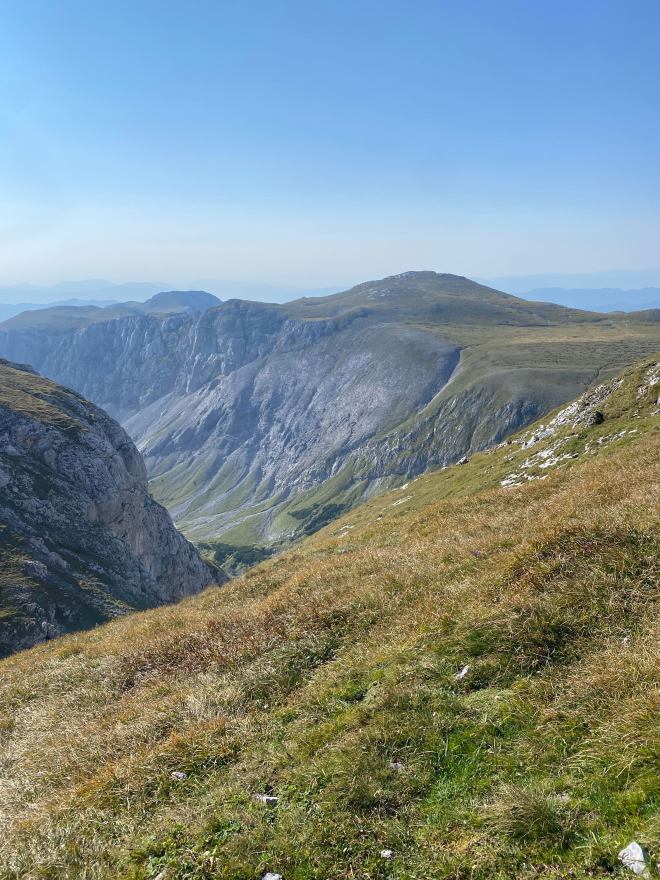
It had to happen. On our latest wandering across the Austrian landscape, this time in Styria, my wife and I came across yet another obscure saint, Saint Ilgen. This good saint had given his – or was it her? – name to a village located in the similarly named Ilgental, the valley of Ilgen, along which we were walking to get to the jump-off point for our three-day hike around the Hochshwab. I throw in a photo of the jump-off point, the Bodenbauer inn. As readers can see, it’s a popular place.
And here are a couple of photos of the mountains we climbed over.
My wife’s photoMy wife’s photoMy photomy wife’s photoMy photo
But now, settled in the train back to Vienna, I have had the time to investigate this mysterious Saint Ilgen. My first inkling of who we might be talking about came about this morning, as we walked back through the village of Saint Ilgen. I noticed a small shrine on the side of the road that I had missed the first time we came passed through the village.
My photo
For readers whose sight, like mine, is not quite what it used to be, the writing above the statue says, in German, “Saint Aegidius pray for us”. Ah! So Ilgen was probably the same as Aegidius! A little bit of train-based internetting has confirmed this.
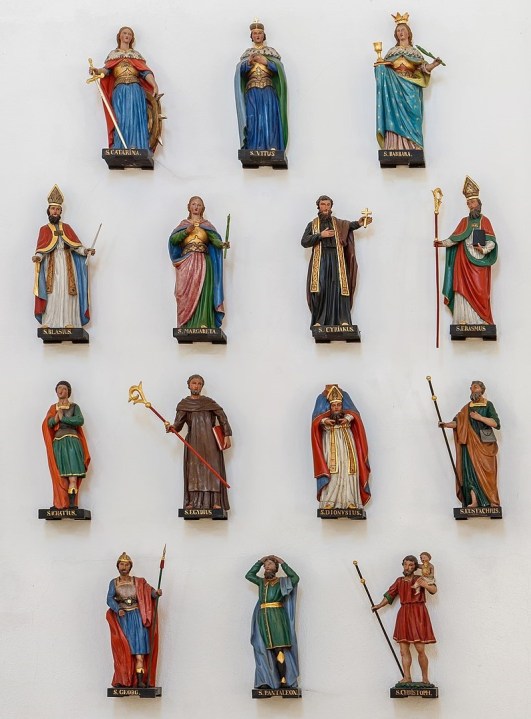
Aegidius was a name that rang a bell. And indeed, a little bit of e-riffling through my past posts has confirmed this. Last year, I had come across Saint Aegidius when researching another obscure saint, Saint Veit, whose name my wife and I would quite often come across on our wanderings across the Austrian landscape. Saint Aegidius, like Saint Veit, was one of the fourteen Holy Helpers who Medieval Europeans turned to, to deal with life’s many miseries. Here is a photo of those Holy Helpers from a chapel in Baden-Württemberg. Saint Aegidius is in the third row from the top, the second from the right, wearing a monk’s brown tunic but holding a bishop’s crozier. I only know this because I blew up the photo enough to be able to read the names helpfully added to the base of each statue. Readers will notice that the statue is decked out in very much the same way as the statue in the photo above. This was no doubt the standard way of depicting the saint.
I don’t know why the saint was called Aegidius, because most Medieval Europeans didn’t call him that. The British knew him as Giles, and many other Europeans knew him by variants of that name. For instance, the French knew him as Gilles – as we shall see in a minute, he was a French saint. And since our story starts in Austria, I feel I ought to mention some of the German variants: Jillies, but also Gilg or Gilgen which in some places – like that valley which my wife and I had been walking up and down – morphed into Ilg or Ilgen. So I shall drop Aegidius and continue with Giles.
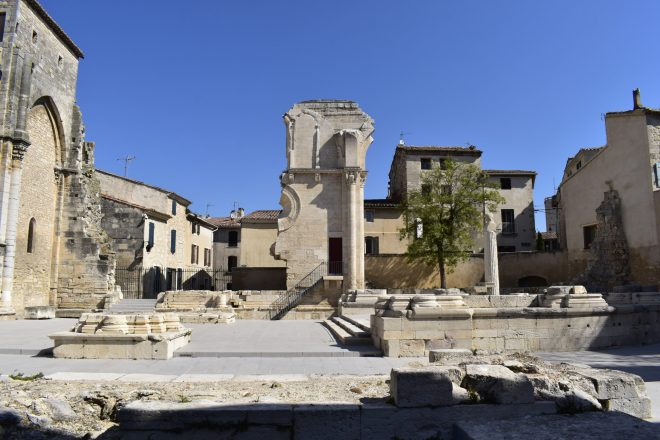
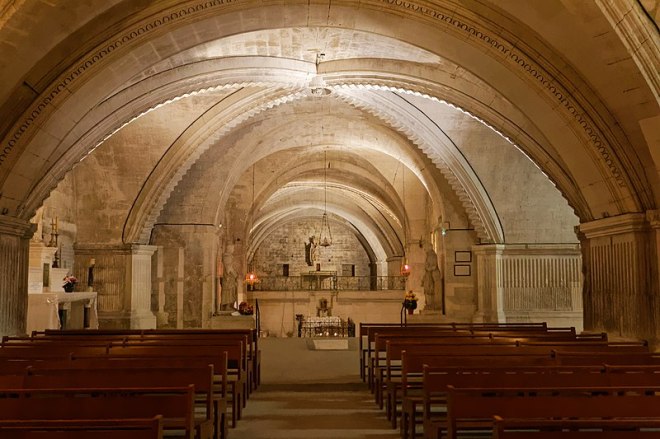
Who exactly was this saint Giles? Quite honestly, I’m not sure he ever existed. But the story put out by the monastery of Saint-Gilles, which lay between Nîmes and Arles in the south of France and whose tomb the monks claimed to have in their church crypt, was that he was a hermit who in the 7th Century AD was living a saintly life in the thick forests around Nîmes. His only companion was a female deer, to whom he was very attached. One day, hunters of the local king – or maybe the king himself – were pursuing the deer, which ran to Giles for protection. Giles put himself between the hunters and the deer and got wounded in the hand by an arrow. Full of remorse for having wounded such a holy man, the king gave him land and money to build a monastery, which Giles proceeded to do. He then became its first abbot, leading the monastery until his death, carrying out miracles etc. along the way. There are other, more fanciful details in his hagiography, but I’ll leave it at that. Here, we have a painting by an unknown, possibly French, possibly Dutch, painter from about 1500 depicting our good saint.
We see him protecting the deer, with the arrow in his hand and presumably the chastened king kneeling at his feet.
Saint Giles was one of the Medieval Europe’s most popular saints. As far as I can make out, this can be traced back to the fact that the monastery of Saint-Gilles was strategically placed at the crossroads of a number of pilgrim routes. One of the branches of the Camino de Santiago de Compostela, used by pilgrims from Provence and northern Italy, passed by the monastery. I throw in a map of the three main routes in France for the Camino de Santiago. The one which passed by Saint-Gilles is the bottom, maroon-coloured, one.
The same route could of course be used in the opposite direction, and indeed was so used by Spanish pilgrims going to Rome. At Saint-Gilles they could either go overland through northern Italy or they could sail to central Italy, embarking at a port located close the monastery. French pilgrims, and Northern European pilgrims more generally, on their way to Rome also often used this marine route. The same with pilgrims on their way to the Holy Land, who would frequently pass through Rome first. I mention all of this because I want to use this occasion to see if I can’t persuade my wife to do some hiking in this part of the world. To whet her appetite, I insert a photo here of a pensive hiker near the Col du Mont Genèvre, which pilgrims from northern Italy would have crossed. I’m sure we could find a hiking trail which would take us down the French side maybe as far as Sisteron.
But back to Saint Giles. I don’t think I’m being too cynical if I suspect that the good monks of Saint-Gilles, watching all this pilgrim traffic going by, felt the need to more effectively tap into the riches it represented. They therefore created the backstory of Giles the saintly hermit, with the requisite tomb and relics, et voila! Pilgrims began to stop at the monastery’s church to pray and leave a few pence in the offerings box. Of course, the pilgrims also needed places to stay and eat, so a small town sprang up around the monastery to service these (and no doubt other) needs, giving the monastery another source of income via tithes, taxes, and whatnot.
Over the next few centuries, the fame of the monastery of St-Gilles grew to such a degree that it became an important pilgrimage destination in its own right, up there with with Jerusalem, Rome, and Santiago de Compostela. It’s not surprising, then, that Giles was such a popular saint – and that so many boys came to be called after him.
Of course, with all this pilgrim traffic the monastery grew rich and powerful, and large building programmes were undertaken. But, as Giles the Hermit could have told them if he had ever really existed, all power, all riches are transitory. The fashion of pilgrimages passed and the port silted up, so the monastery’s main source of income dried up. The number of monks dropped off, so those large monastic buildings were half empty. And then vicious religious wars were fought, with Huguenot forces burning the monastery buildings to the ground. Whatever was left of them were razed during the French Revolution. Only a few mouldering remains are left.
Maybe I could persuade my wife to make a quick visit to the church after we’ve hiked down from the Col du Mont Genèvre …
And the name of the goodly hermit, once so popular? Well, I’m afraid it has dropped way down in the rankings. In the UK, only 8 baby boys were given the name Giles in 2023. In France, it was slightly better, with 50 little Gilles being registered. As for the German-speaking lands, Ilgen seems to be only a surname these days. Like the hermit, the name seems to have retreated far, far away from human societies.
I guess that means my wife and I will have to leave future sightings of the name to our wanderings across the face of Europe.
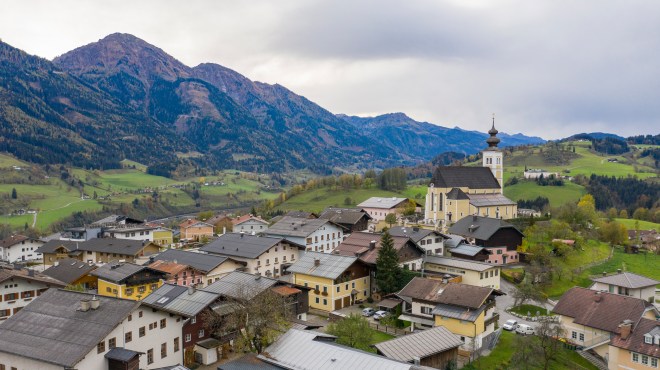
In our wanderings across the Austrian landscape, my wife and I have from time to time come across villages (or, in the case of Vienna, districts) called Sankt Veit. Here’s one such village in the region of Salzburg.
In the past, there has been no more than a flicker in my subconscious as some neurones somewhere registered the name. But the last time it happened, a neurone or two formulated the question, “who was this Sankt Veit?”, a question which led me to my usual desultory surfing of the web. The conclusion has been this post, which can be added to my various past posts on obscure saints whose names pepper the Austrian landscape and end up being our companions on our hikes across it.
Sankt Veit was originally Saint Vitus, a martyr from the late 3rd Century-early 4th Century. His story – or rather his hagiography – is quickly told. He was born in the far west of Sicily, in the town of Mazara del Vallo (and so, of course, in his italianised form San Vito, he is the town’s patron saint). I’ve never been there, but judging from photos on the web it has a nice central piazza.
In any event, Vitus’s mother died when he was a child. The times being what they were, his father wasn’t going to bring him up. Instead, he delegated this task to a nanny, Crescenzia, and a teacher, Modestus. Unbeknownst to him, the pair were Christians and converted Vitus when he was 12. Even though just a young lad, Vitus was of course very holy and began performing miracles. One such miracle took place in a locality near Catania on the eastern side of the island. Quite what he was doing there when he lived in the far west of the island isn’t explained. In any event, he met some shepherds who were in a frenzy because some dogs had torn a child to pieces. Vitus called the dogs over, had them hand over the remains of the child, and then brought the child back to life. This story explains why it’s common for him to be depicted with dogs. We see him here, for instance, on a capital in the church which was built on the site where Vitus met the shepherds, bringing those wild dogs to heel.
I presume being a Christian was a big no-no at the time, because when Vitus’s father found out, he had the three of them arrested and brought before the local judge, who ordered Vitus to recant. When Vitus refused, the judge invited his father to punish him severely, which he was glad to do, beating him to within an inch of his life. Still Vitus refused to recant. So his father imprisoned all three of them. At this point, an angel intervened and got them out of jail. Whereupon they fled, taking a ship to the ancient Roman province of Lucania, which more or less corresponds to today’s Italian region of Basilicata. There, all three continued their work of proselytism, with Vitus continuing to cure people.
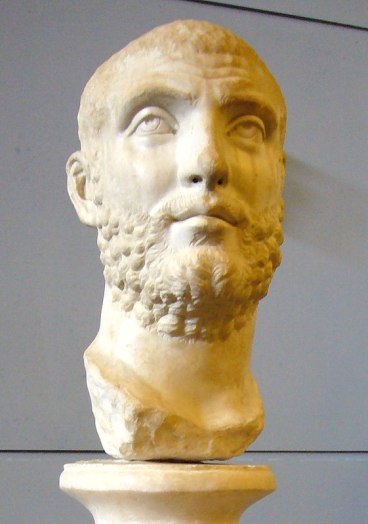
Vitus’s fame as a healer grew to the point where the Emperor Diocletian up in Rome heard about him. We have here a bust of Diocletian. I must say, he looks rather grim, which fits nicely with the rest of the story.
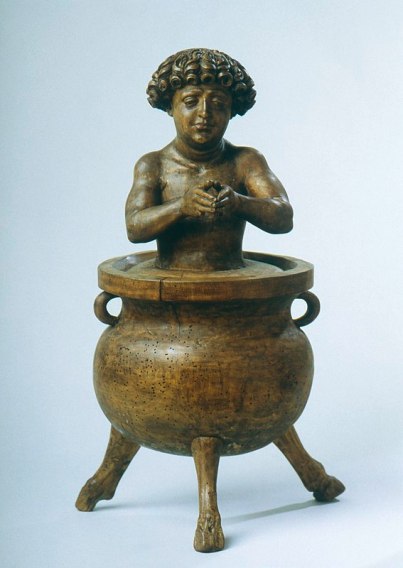
It so happened that Diocletian’s son was possessed by a demon. Diocletian had Vitus and his two companions brought to Rome, where he implored Vitus to cure his son. This Vitus did, but the only reward he got was a demand from Diocletian that the three of them give up their faith (the ingratitude of it! but what could you expect from a pagan?). Vitus of course refused, so then started all those grisly tortures which hagiographers love to pile onto martyrs: see the tortures inflicted on Saint Blaise, Saint Florian, and Saint Pancras. First, Diocletian had Vitus and his two companions thrown into cauldrons of boiling pitch, which gave painters and sculptors of later centuries a very satisfying subject to work on.
But they remained unharmed! So then Diocletian had them thrown to the lions. But these ferocious beasts suddenly became meek and mild, licking Vitus’s feet!
But even though their bodies were close to breaking they survived! And so angels carried them off back to Lucania, where they died.
The End.
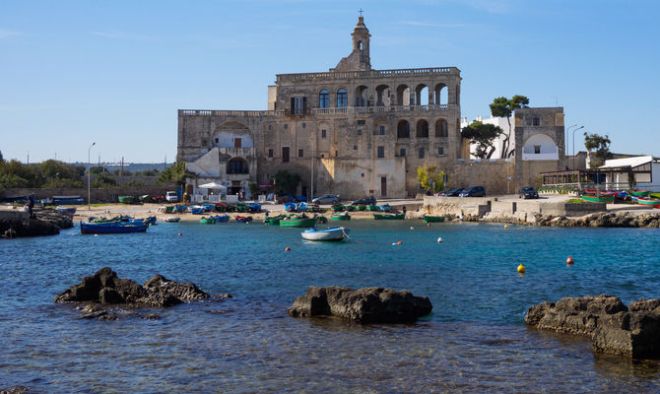
I won’t bother readers with a secondary complicated story of a princess who some four centuries after Vitus’s death was involved in carrying his remains from Lucania to San Polignano a Mare, some 30 km south of Bari, on the other side of Italy. I rather suspect that the story was a complete fabrication which nevertheless allowed the monks of a monastery in San Polignano to claim that they had the saint’s relics. This encouraged a vigorous relics-based tourism from which the monastery no doubt profited. The monastery has gone through many rebuilds in the intervening centuries, but it is still a rather arresting building, at least from a distance.
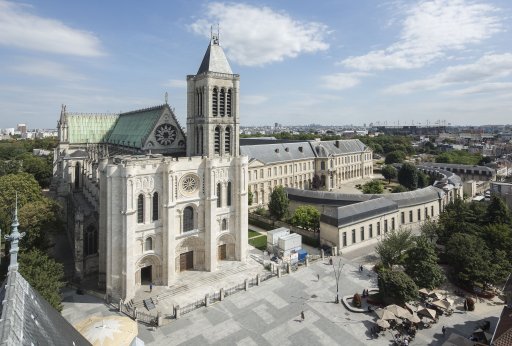
Whatever the truth is about the historical Vitus, assuming he even existed, the fact is that his veneration spread rapidly in Sicily and southern Italy. And then, once the great craze for relics started in the 3rd Century or so, his relics started circulating in Europe. In the 490s, Pope Gelasius I mentions a reliquary of Saint Vitus in the chapel of a deaconry dedicated to him in Rome. In 756, Fulrad, one of the great Abbots of the Abbey of Saint-Denis in what is now the outskirts of Paris, brought relics of St. Vitus to the Basilica there. This is what the abbey church looks like now, after its gothic makeover in the 12th Century.
About a century later, in 836, these relics were presented to Abbot Warin of Corvey on the river Weser. Founded in 822, this was the first Benedictine monastery in Saxony. It later became a princely Imperial Abbey in the political crazy quilt that was the Holy Roman Empire. The abbey has survived the vicissitudes of time, and is an imposing set of buildings. And Saint Vitus is still the patron saint of the abbey today.
The abbey of Corvey played a very important role in the Christianisation of eastern and northern Germany. Monks fanned out from the mother house, and to help along in their missionary work they took with them parts of the relics of Saint Vitus, thus also spreading the veneration of the saint throughout the German lands.
The same proselytising impetus brought Saint Vitus to the Slav lands, where he became extremely popular. It’s been theorised that this is because the German Sankt Veit was translated as Sveti Vid, which sounded very similar to Svetovid, the name of the Slav god of abundance and war.
Sveti Vid certainly became very popular in Prague after king Henry I of Germany gifted to Wenceslaus, Duke of Bohemia, the bones of one of Saint Vitus’s hands in 925. As a result, he became patron saint of Prague’s cathedral. To this hand was added Vitus’s head in 1355, when Charles, King of Bohemia (the Dukes had traded up to Kings in 1212) became the Holy Roman Emperor Charles IV. He filched it from a church in Pavia – the town “belonged” to the Holy Roman Emperors at that time (in turn, the head had been brought to Pavia in 755 by the Longobard King Astulfus, God knows where from; I’m sure many PhDs have been written about the European trade in relics). This same Charles IV, by the way, was the man behind Prague cathedral’s Gothic makeover, which is more or less the version of the cathedral that we see today.
Relics don’t carry the same weight these days – at least, they don’t with me – but some of the reliquaries that were made to house relics are wonderful works of gold and silversmithing. Here’s one such reliquary holding a relic of Saint Vitus from the Treasury of the Cathedral. The artist even gave the young man a dimple in his chin!
Quite why Saint Vitus was plucked out from among all the martyrs of the early church and became so popular is not clear to me. Nevertheless, something in the stories and legends that accreted to his person got him connected to diseases where convulsive, uncoordinated movements were part of the symptoms. Thus, he became the go-to saint when you had epilepsy, chorea, and ergotism, all illnesses giving rise to uncoordinated movements. Chorea especially gives rise to rapid, jerky movements in the face, hands and feet, and so it was often called Saint Vitus’s dance. He was also your saint when you had been bitten by rabid or venomous animals, a fate which can also lead to convulsions. Somewhat more randomly, it seems to me, his intercession was also invoked in cases of bedwetting.
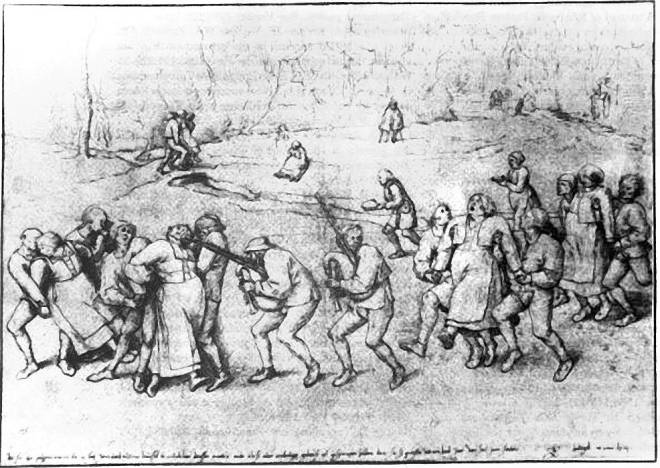
His connection to cases of uncoordinated, jerky movements also led him to be invoked in the strange European phenomenon of dancing mania. Although the first episodes were recorded in the 8th century and occurred intermittently in the succeeding centuries, there was an enormous increase in incidences between the 14th and 17th centuries, after which it disappeared abruptly. I’m not sure dancing mania is really such a good term. Dancing requires music, while here people were just hopping and writhing around. The phenomenon involved groups of people, sometimes numbering in the thousands, who went on “dancing” sometimes for days on end, until they collapsed from exhaustion or injuries. The condition was often considered a curse sent by Saint Vitus, and was therefore also, somewhat confusingly, called St. Vitus’s Dance. Victims of dancing mania often made their way to places dedicated to the saint, who was prayed to in an effort to end the “dancing”. Here, we have a drawing by Pieter Bruegel the Elder of women overtaken by dancing mania being taken to a church.
Not surprisingly, outbreaks often started around the time of the feast of Saint Vitus, on 15th June.
Even today, there is no consensus about what was going on here. It is speculated to have been a mass psychogenic illness, also known as epidemic hysteria, in which physical symptoms with no known physical cause affect a group of people, as a form of social influence. But what started off these bouts of epidemic hysteria? To my mind, the most reasonable suggestion that has been made is that people started “dancing” when their stress levels, induced by chronic poverty and political instability, got too high – although why, then, did the phenomenon abruptly disappear in the 17th Century? People were just as stressed in the succeeding centuries. Mystery …
Of course, people at the time had no idea how to stop an outbreak of dancing mania once it caught hold – other than praying to Saint Vitus. One possible remedy that was tried was music – in the drawing above, one can see a couple of men playing bagpipes. It was theorised that music would get people to channel their chaotic flailing around into a regular rhythm and so bring them down from their hysterical high. The type of music was important; as one writer put it, “lively, shrill tunes, played on trumpets and fifes, excited the dancers; soft, calm harmonies, graduated from fast to slow, high to low, prove efficacious for the cure” (one unintended side-effect of playing music, though, was that sometimes onlookers would now join in, swelling the numbers dancing). It’s not really relevant, but I thought this would be a good place to throw in a wonderful painting (by Pieter Bruegel the Elder again) of peasants dancing.
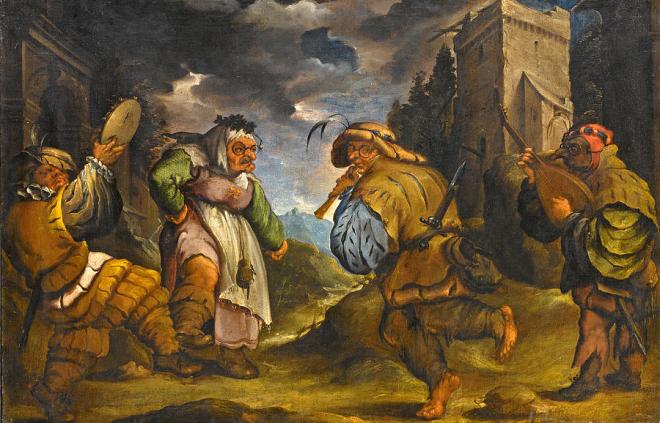
In the south of Italy, dancing mania was known as tarantism (because it was believed to be caused by the bite of a poisonous spider, the tarantula – confusingly, not a member of the well-known family of tarantulas). The music used there to tame the dancers was thus called the tarantella, which in the intervening centuries has become a well-known musical export from Italy. Many twee paintings of people dancing the tarantella have been produced, normally in a Neapolitan context, like this one.
But back to Saint Vitus after this interesting digression into phenomena of mass hysteria!
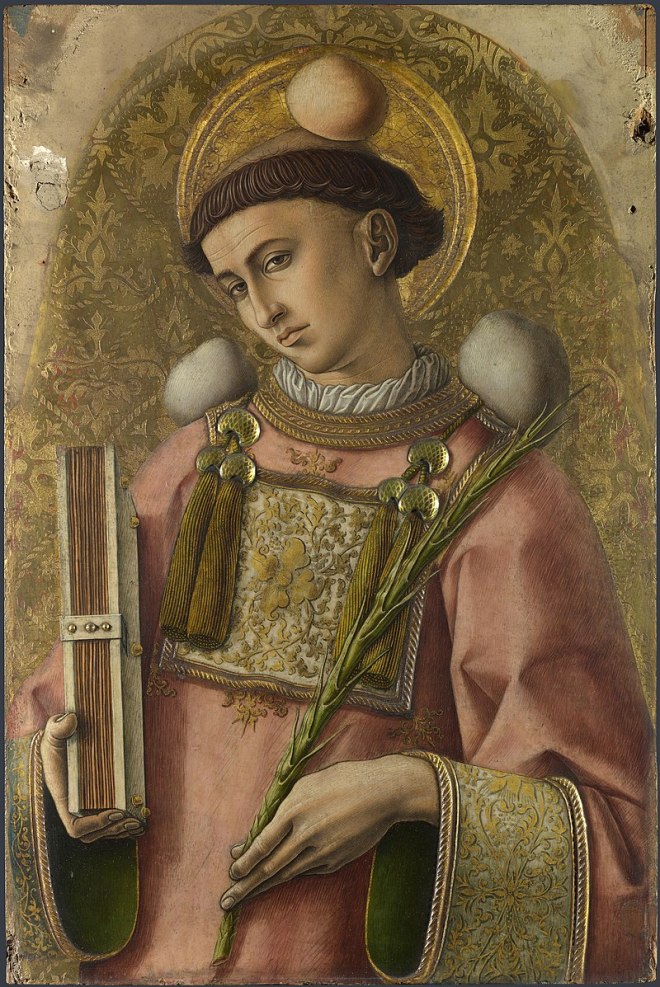
In the 14th Century, largely because of the shocks caused by the Black Death, Germans in the Rhineland created a collection of fourteen saints called the Nothelfer, or Helpers in times of need; their formal name in English is the Holy Helpers. Basically, these fourteen saints were tasked with helping people with all the ills they suffered from. We’ve already seen what Saint Vitus was meant to help you with. Another of the Holy Helpers which I’ve dealt with in a previous post, Saint Blaise, was to help with any illnesses of the throat. Staying with the head, Saint Catherine of Alexandria was charged with illnesses of the tongue, Saint Ciriac of Rome with illnesses of the eye, Saint Acacius with migraines, Saint Denis with normal headaches, Saint Barbara with fevers, and Saint Giles with mental illnesses (and with nightmares, I suppose by extension of his powers over mental illnesses). Moving to other parts of the body, Saint Erasmus (or Saint Elmo) was invoked in cases of stomach and intestinal illnesses and Saint George when it came to diseases of the skin. Saint Margaret of Antioch was prayed to when backaches were the problem and when childbirth was looming (this was by extension, I suppose, since many pregnant women suffer from backaches). Meanwhile, Saint Pantaleon was the go-to saint when cancers and consumptive diseases were the problem.
But requests for help from our fourteen Holy Helpers didn’t stop there. They were also invoked to prevent risks to life and limb caused by events in the outside world. You prayed to Saint Barbara to avoid a sudden and violent death at work. When travel was necessary, you prayed to Saint Christopher to avoid the many dangers of travelling. I suppose by extension you also prayed to him to avoid the plague – a sensible thing; we all saw during Covid how plagues spread through travel. For good measure, terror of the plague being great, you also prayed to Saint Giles to avoid the plague. Storms and lightning must have been a common problem because you also prayed to Saint Christopher to avoid the consequences of storms (a good extension of his powers since storms are a common enough danger when travelling), to Saint Vitus to avoid both storms and lightning (a sensible combination) and to Saint Barbara to avoid lightning. Fire, too, must have been an ever-present threat when houses were made primarily of wood, because two of the saints looked after the risk of fire for you: Saint Barbara (by extension, no doubt, of her protective powers against lightning) and Saint Eustace. Interestingly enough, Saint Eustace was also the saint to go to for protection from family discord – this must have been quite a common problem if it warranted a Holy Helper. And of course, since this was a time when the great majority of people were peasants, and since much of their wealth was tied up in livestock and domestic animals, no less than five of the Holy Helpers could be invoked to protect these animals: Saint Blaise, Saint Elmo, Saint George, Saint Pantaleon, as well as our friend Saint Vitus. In fact, in the small Italian town of San Gregorio Magno in the province of Salerno, there is still an annual festival when people come with their animals and go round the local church of St. Vitus three times, followed – given the saint’s connection to dogs – by dog owners with their dogs. We have here goats doing the rounds.
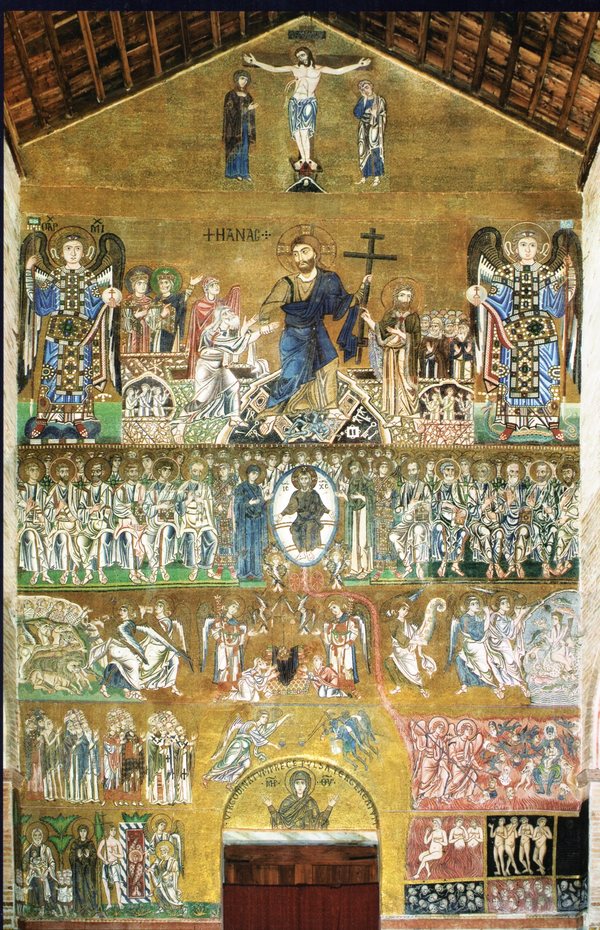
But the help requested from the Holy Helpers didn’t end there. People were profoundly Christian and specifically believed in the afterlife, where depending on how good or bad you had been in this life you would either go to heaven or to hell. Here is a mosaic from the church on the island of Torcello in the Venice Lagoon of the Last Judgement, where parishioners could see just what would happen to them if they were judged to be bad.
And it was for all eternity! So it was incredibly important to end up on the right side of Divine Judgement. The Holy Helpers were duly invoked to help here. You prayed to Saints Barbara and Catherine of Alexandria to avoid a sudden death (i.e, one where you had not confessed your sins and received extreme unction). You prayed to Saint Giles to make a good confession: generally a desirable thing, but especially desirable just before you died. You prayed to Saint Ciriac of Rome to avoid temptation on your death-bed, which would indeed be a very ill-judged moment to give in to temptation since you might not have time to confess (but who on their death-bed would have the energy to be tempted, I ask myself?). You also prayed to Saint Ciriac as well as to Saint Denis to avoid demonic possession. I suspect in Saint Ciriac’s case this was as an extension of his powers to protect you from diseases of the eye (the eye could be an entry point for the devil, the Evil Eye) while in Saint Denis’s case, I see it as an extension of his powers to prevent headaches (I mean, when I’ve had bad headaches it’s often felt as if some small monster was pounding on the insides of my head). Saint Barbara of Antioch, meanwhile, was invoked for escape from the clutches of devils in general. Finally, you prayed to Saint Eustace to prevent you ending up in the eternal fires of Hell, a very natural extension, it seems to me, of his powers to protect people from fires in the terrestrial realm.
So there you have, in a nutshell, the fears that wracked the great majority of Europeans in the 14th and later centuries. The idea of a bevvy of saints who could help you with all the trials and tribulations of life proved to be so popular that it spread rapidly from its point of origin in the Rhineland to the rest of Europe, with local additions and subtractions from the basic list. Here is a collection of statuettes of the fourteen Holy Helpers from a chapel in Baden-Württemberg, where centuries ago you could have gone and asked the relevant saint, or saints, for help with your problems.
However, all I can say is, thank God for modern medicine, and thank God for governments which enact (and hopefully enforce) laws to protect us, and thank God for insurance companies which can cushion us from the risks of everyday life – as long as we read the fine print. As for fears of Hell, all I can say is, thank God Europe is dechristianising – although the fear of death is still there, in a different form, but still there.
Let me end this post with some examples of well-known people who have been named after Saint Vitus.
For Vitus, I tried to find a well-known Roman who was called that but failed to find one. So I choose Vitus Bering.
Bering was a Dane but spent most of his working life in the Russian Imperial Navy. His explorations in the northern Pacific Ocean gave us the Bering Strait, the Bering Sea, and Bering Island (on which he died and was buried).
For Vito, I choose the very famous fictional character Vito Corleone, as played by Marlon Brando in the film The Godfather.
I’m sure it’s no coincidence that Mario Puzo, who wrote the book on which the film is based, chose the name Vito for his character. As readers can imagine, it is a popular name in Sicily since Saint Vitus hailed from there (assuming, of course, that he ever really existed).
For Veit, I had difficulties finding someone who was really, really famous. So I choose Veit Bach, for the simple reason that he founded the Bach family, one of the most important musical families in history. There is no portrait of him, so I choose instead a portrait of Johann Sebastian Bach, who was his great-great grandson.
I also choose Veit Bach because he was a victim of Europe’s religious wars. He was a Protestant who lived in the Kingdom of Hungary, then ruled by the staunchly Catholic Hapsburgs. Religious persecution drove him to relocate his family to the Protestant state of Thuringia. He will contrast neatly with another personage I will mention in a second.
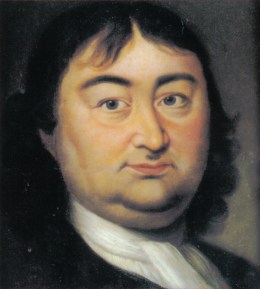
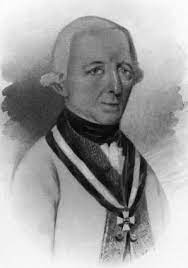
For Vid, I had even more difficulties finding someone who is even modestly famous. For lack of anything better, I choose Petar Vid Gvozdanović, a Croatian who was born at a time when Croatia was part of the Hapsburg Empire.
He joined the army, where his name was Germanified to Peter Vitus Quosdanovich, and he fought in the Seven Years’ War, then the War of the Bavarian Succession, then the Austro-Turkish war, rising steadily through the ranks. By the time the wars with the French revolutionaries started, he was a major-general and had been made a baron. After successfully fighting the French on their northern frontiers, he was made Field Marshall Lieutenant and sent to Italy to fight Napoleon. Alas! Napoleon was his nemesis, beating him repeatedly and leaving his reputation in tatters. After his final defeat at the battle of Rivoli, he was “retired”; he does look a little mournful in his photo.
The name game doesn’t end there! At some point during the invasions of Italy by the Germanic Longobards, the Latin name Vitus got inextricably mixed up with the Longobard name Wito or Wido and was transmuted into the name Guido. The French turned that into Guy, today pronounced very much like the Indian clarified butter ghee. The Normans brought the name with them when they invaded England, but its pronunciation over the centuries changed to the same as “buy” or “hi!” or “lie”. So now we have three more variants!
For Guido, I choose Guido Reni, a baroque painter from Italy. Here is a self portrait.
He is a Famous Author, and as a result I have never read any of his stuff. If any of my readers are curious to read him, Wikipedia informs me that his first published story, “Boule de Suif”, or “The Dumpling”, is often considered his most famous work. I welcome anyone who has read it to tell me what it’s like. Who knows, one day, at the next pandemic-induced lockdown, I might get around to read it.
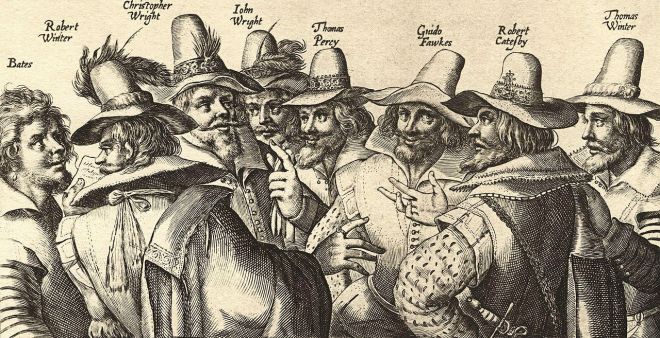
For the English Guy, I choose Guy Fawkes. He, like Veit Bach, was a victim of Europe’s religious wars, although his situation was the mirror image of Veit Bach’s: he was a Catholic in a Protestant kingdom. He was also definitely more militant than Bach was in his response. He was one of the main conspirators in the Gunpowder Plot, where the plan was to blow up King James I and the House of Lords. His role was to light the fuse which would set off the barrels of gunpowder which the conspirators had stashed away under the House of Lords. He was caught red-handed at the last minute, tortured, and hanged, drawn, and quartered. He is the third to the right in this contemporary engraving of eight of the thirteen conspirators (he was also known as Guido, because he had fought many years on the continent in Spanish armies).
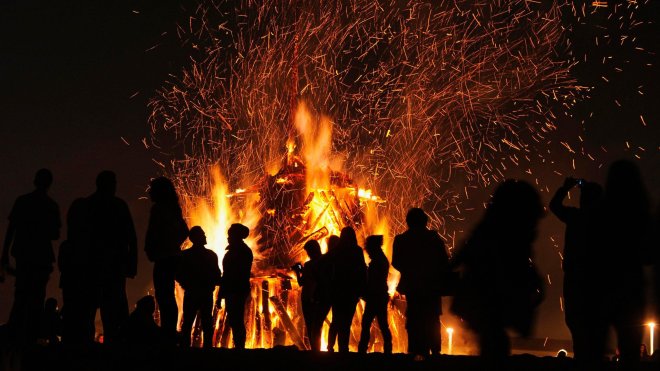
Ever since, on 5th November, the day Guy Fawkes was caught, big bonfires are burned all over the UK on which are perched effigies, originally of the Pope but later of Guy Fawkes, and nowadays of just about any public figure whom the bonfire-makers dislike (in case readers don’t recognise her, it’s Margaret Thatcher in the photo).
So there we have it. I’ve taken my readers through quite a wander of things related to Vitus – sometimes rather remotely. And now my wife and I can wander over the Austrian landscape in our hikes, knowing that the next time we come across a village called Sankt Veit or a church dedicated to Sankt Veit we’ll be able to say “Ah yes! Remember that post?”
POSTSCRIPT
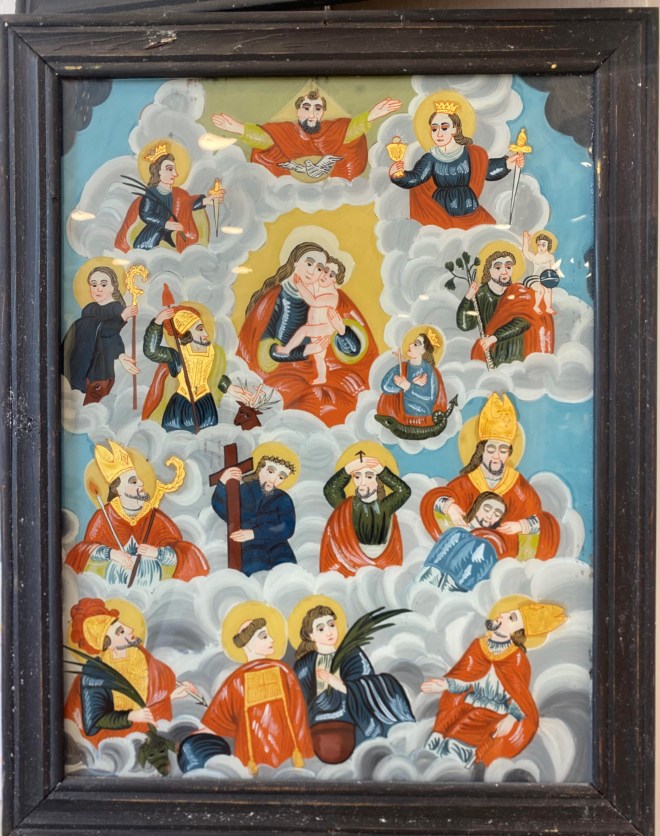
A week or so after writing this post, my wife and I went down to the Dorotheum auction house for tea and a nose around to see what was new. In a small section they have devoted to religious art, I came across this painting on glass.
My photo
It was a painting of the fourteen Holy Helpers plus God the Father with the Holy Ghost, Mary with the Baby Jesus, and Jesus with his cross. I can’t figure out who is who except in a few cases. The young man at the very bottom holding a palm must be St. Vitus; he’s always depicted as a boy. The bishop holding a candle must be St. Blaise (see my post about him to understand the meaning of the candle). The fellow with a baby on his shoulder must be St. Christopher. After that, I’m a bit lost. I leave it to my readers to figure out the rest.
The painting was being sold with a companion piece depicting the Last Judgement.
My photo
Somewhat more succinct than the mosaic in Torcello, it nevertheless passes on the vital message: “if you’re bad, you burn”.
I had to have them! So I forked out the €166 being requested, and they now hang proudly on our wall, on either side of another painting on glass I bought several years ago of God the Father blessing all and sundry.
































 the heart thrills


