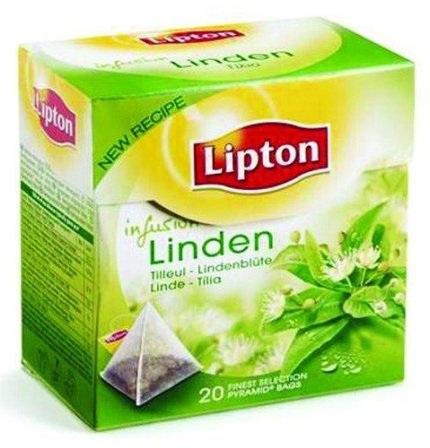
LIME TREES TO SHOE POLISH

Milan, 11 June 2024

What is the matter with me?!

Over the last few days, we’ve been passing down alleys of lime trees.

My photo

The trees are all in flower – this one was covered with them.

My photo

The flowers fill the air with their scent, I breathe it in … and I am reminded of shoe polish.

Source

No-one under the age of 40 will remember a world where most of the shoes we wore were made of leather. As I look around the subway carriage where I’m writing this, I can only see one pair of leather shoes among perhaps 70 pairs of feet. I, on the other hand, being well over the age of 40, still remember a time when we mostly wore leather shoes – and remember the concomitant joys and anguish of shoe polishing. At my boarding primary school (prep school in British parlance), a specific period of every week was set aside for shoe polishing. We all had to go to a room dedicated to this task, where we picked up a cloth – to spread the polish – and a brush – to put a high gloss on our shoes – before getting to work. As I picked up the tin, there was that ineffable smell of the polish. That was the joy – or at least the pleasant sensation. No doubt it was caused by the solvent which the manufacturers used to keep their polish pasty. After the spreading of the polish on my shoes came the vigorous polishing. That was the agony, as my arm very soon began to ache. But I couldn’t slow down, there was always a master on hand to bark at me to put my back into it. And then came again the joy, as I admired my well-polished shoes glowing on my feet. Of course, I have no photo of this weekly exercise. I did find this photo, though, which will give readers a sense of what it was like – although the boy in question looks to be enjoying it far too much.

Source

After the passage of so many decades, I can’t remember the brand of polish we used. I’m guessing it was Kiwi; that was certainly the brand that my English grandmother used, and it seems to have been the most popular brand in the UK.

Source

In passing, I should say that I learned to my surprise that Kiwi was originally an Australian brand (and was given its name by the owner to honour his wife who hailed from New Zealand). Merely another example of my unconscious Euro-centric biases …

Old brands of consumer products always have me searching for the posters they used in their advertising campaigns. I find these old posters a fascinating sub-genre of popular art. In another life I would have been an avid collector of old posters. In this case, though, I didn’t find any really scintillating Kiwi posters online. The best I found was this one.

Source

Not so in the case of a now extinct brand of Italian shoe polish called Taos, manufactured by the now also extinct company Edoardo Pessi. Look at this lovely poster! It’s a riff on the fact that the biggest purchaser of Pessi’s shoe polish was the Italian army.
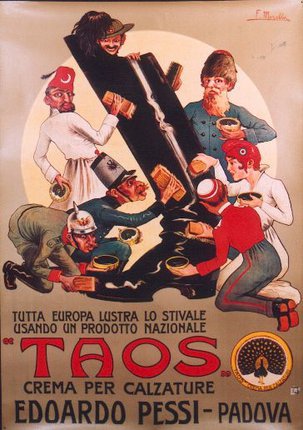
Source

In a rush of enthusiasm, I throw in photos of a few more posters for Taos and other Italian shoe polishes.
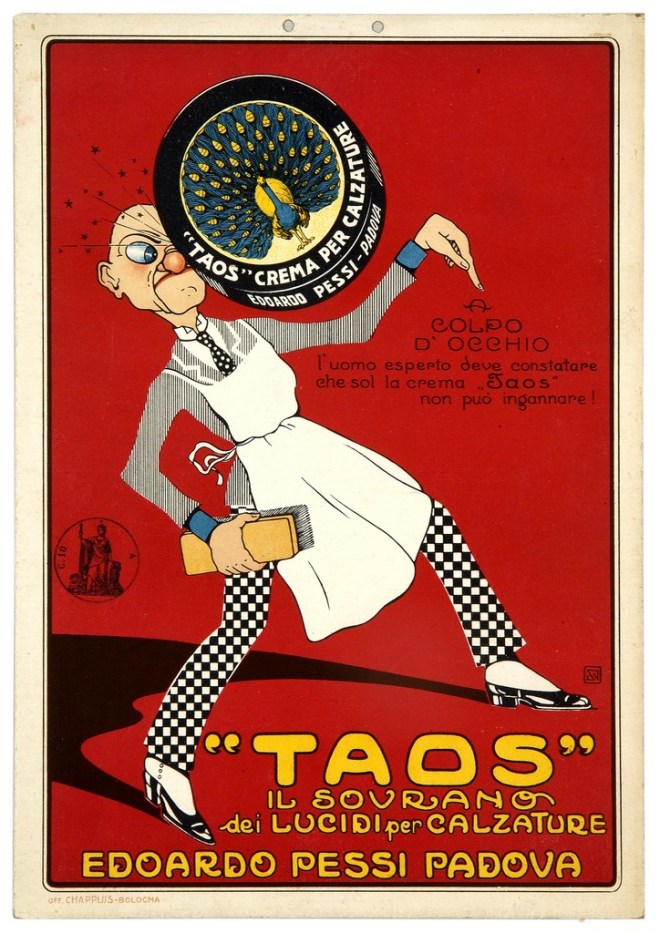
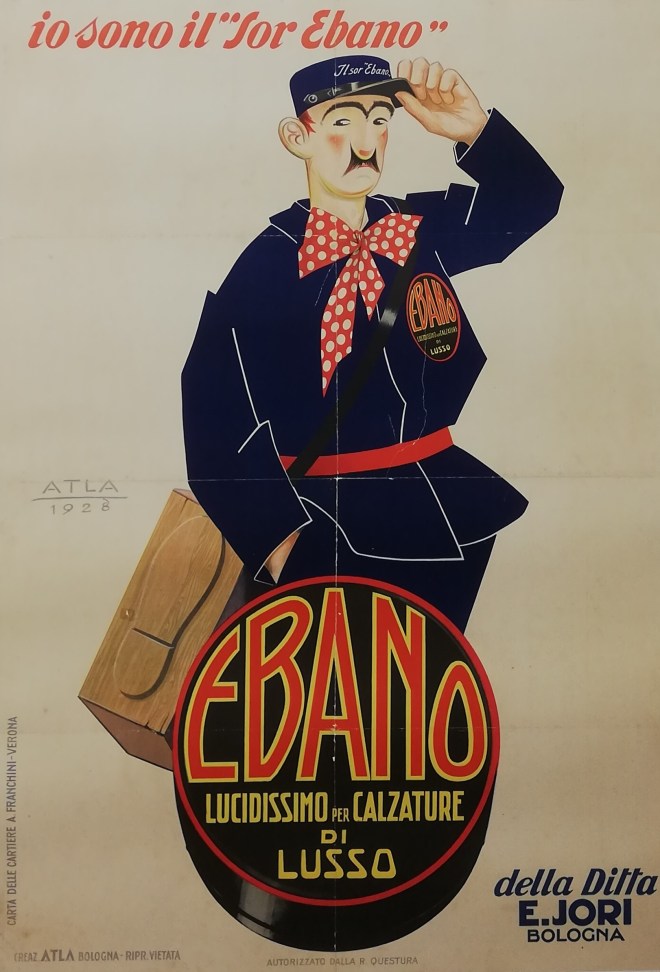
Source
Source
Source

At this point, I have to admit to having played a very small part in Edoardo Pessi’s demise. It was early on in my career as an environmental consultant. My company was hired by the multinational corporation Sara Lee (now also extinct) to carry out an environmental assessment of the Pessi factory. Sara Lee was in negotiations to purchase Edoardo Pessi, and the idea was to figure out what environmental liabilities Sara Lee might also be buying and bring down the purchase price by a corresponding amount. This is the factory where I carried out my assessment.
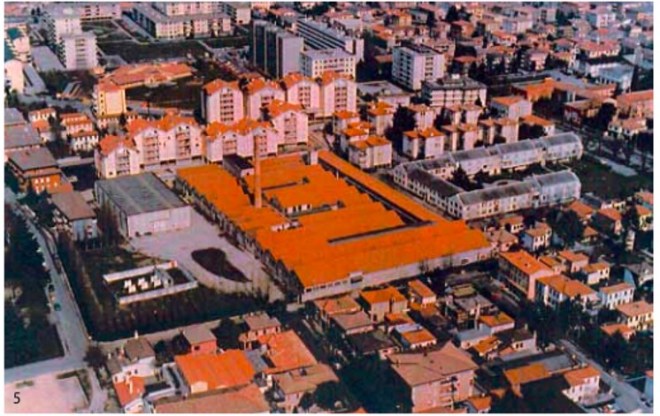
Source

I don’t think I’m giving away any trade secrets when I say that there were some problems with underground tanks leaking solvents (out in the back yard there, next to that sliver of lawn; I remember it well). I guess a couple of 100,000 dollars were knocked off the purchase price because of that.

In any event, the purchase by Sara Lee went through. But it was really just an exercise in asset stripping. Quite quickly after the purchase, Sara Lee concluded that this factory had no future – which made a lot of sense; I mean, look at it, hemmed in as it is on all sides by houses. So they closed the factory down. But they didn’t shift operations to an industrial site on the outskirts of town as they could have done. Instead, the packed all the equipment off to their other factories, they laid off the workers, and sold the land to a developer, who proceeded to raze the factory to the ground and put up some swanky apartment buildings in its place. Sara Lee even stopped making the Taos shoe polish – who polishes their shoes anymore? (and they already owned Kiwi; one shoe polish brand was more than enough).

Well, all of this, although  an enjoyable little trip down Memory Lane, still doesn’t explain why, when I breathe in the scent of lime tree flowers, I think shoe polish. The  mysteries of olfactory chemistry …

UNDER A LINDEN TREE

Vienna, 1 June 2017

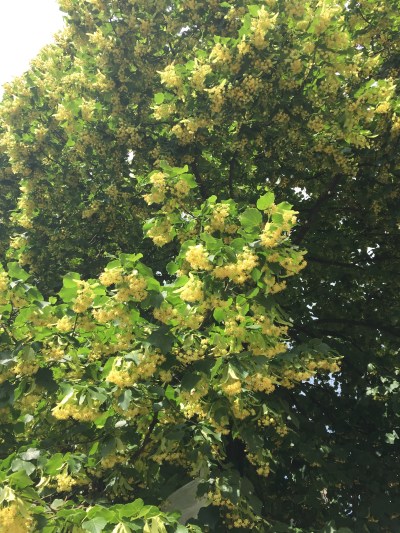
One of the reasons we were attracted to the apartment we bought in Vienna is that there is a linden tree, or lime tree, just outside the living room, at eye level.

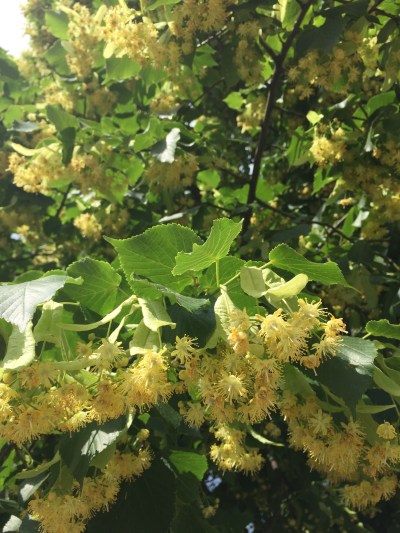
Right now, the flowers are still forming, but it was July when we bought the apartment and the tree was in full bloom, covered in pale yellow flowers around which buzzed a thousand insects.


The scent that wafted through the open window was divine. For those readers who have not had the good fortune to be near a linden tree in full bloom, let me try to describe the scent: delicate – your brain barely registers it; sweet – at the height of the bloom, insects are crazy to get to the nectar; ephemeral – the scent wafts your way for a second, then disappears just as quickly. I’m sure the memory of that scent still lingered in our minds when we signed the purchase contract.

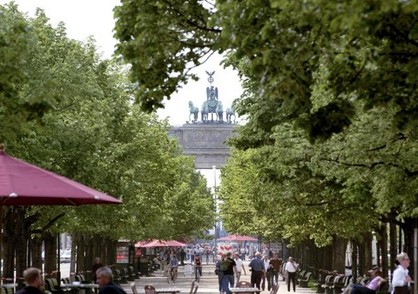
Strangely enough, even though the linden tree grows in the U.K., I have no memory of that scent from my youth; perhaps because I hardly ever spent any of my summers there. Nor do I have any memory of the scent from France, where I spent many a youthful summer, or from Italy, where I spent many of my adult years. It was only when I moved to Austria twenty years ago that I became aware of it. Was it perhaps because linden trees are common shade trees throughout the Germanic and Slavic lands? Certainly, the street we live on in Vienna has a portion, closer to the city centre, which is entirely shaded in linden trees – and what a treat it is for the nose to walk unter den linden, under the linden trees, when they are in bloom! I will make sure we walk along the much more famous Unter den Linden Avenue in Berlin


when we go there in early August although by then I fear that the peak of the trees’ blooming will have passed.

I have to think that the frequent presence of linden trees in urban settings throughout Central Europe can be traced back to the sacred place the tree had in Germanic and Slavic mythology. When Christianity arrived, it sensibly adapted, planting linden trees around churches, accepting that villagers congregate under the village linden tree for important meetings or for seasonal festivities

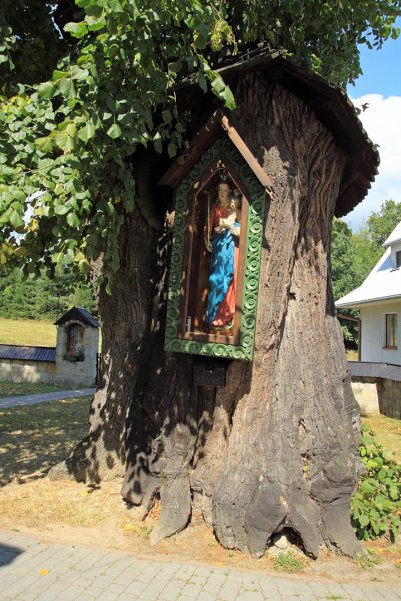
as well as encouraging a tradition linking the Virgin Mary to the linden tree (probably because this displaced a pagan goddess linked to the tree).

Thus was the tree’s place in Central Europe’s modern cities assured. But why the linden tree was sacred to Slavic and Germanic tribes in the first place is not clear to me – at least, I have found no good answer in the literature available to me on the web. I have read that the tree was seen to represent the female side of nature (with the oak tree representing the male side), its natural capacity to regrow quickly being seen to symbolize rebirth and fertility. Perhaps. But – simply because it appeals to my romantic fancies – let me add here another theory, which I extracted from the wilder and woolier side of the internet, from a site dedicated to Druidism to be exact. There, the writer noted that the tree is in full bloom around the time of the summer solstice. Well! What better reason to sacralize a tree which gives off a heavenly scent when the great Sun God reaches its apogee! (we have here modern devotees celebrating the summer solstice at Stonehenge)

Whatever the reasons, the linden tree’s connection to the feminine side has meant that it has naturally been connected to love. Betrothals took place under the village linden tree, but so – people whispered – did love in its wilder form. A famous German minstrel song from the 12th Century, Unter der Linden (translated here by Raymond Oliver, with one tiny change by me), says it all (or nearly so).

Under the linden tree
On the heather,
Where we had shared a place of rest,
Still you may find there,
Lovely together,
Flowers crushed and grass down-pressed.
Beside the forest in the vale,
Tándaradéi,
Sweetly sang the nightingale.

I came to meet him
At the green:
There was my true love come before.
Such was I greeted —
Heaven’s Queen! —
That I am glad for evermore.
Had he kisses? A thousand some:
Tándaradéi,
See how red my mouth’s become.

There he had fashioned
For luxury
A bed from every kind of flower.
It sets to laughing
Delightedly
Whoever comes upon that bower;
By the roses well one may,
Tándaradéi,
Mark the spot my head once lay.

If any knew
He lay with me
(May God forbid!), for shame I’d die.
What did he do?
May none but he
Ever be sure of that — and I,
And one extremely tiny bird,
Tándaradéi,
Who will, I think, not say a word.

Of course, the tree’s sacred properties meant that it had a special place in the apothecary of our ancestors, with various parts of it being ingested to remedy numerous ills. A pale descendant of this is the infusions of linden flowers which are available in our supermarkets.

My mother-in-law liked this infusion and always had a packet of it in her kitchen cupboard (my wife and I prefer camomile; it has more taste, we think).

But tasteless infusions are not the only food which is extracted today from linden trees. Bees adore linden flowers, and honey aficionados adore linden flower honey, praising it to the rafters for its sublime taste. Not being a honey enthusiast, I can only offer this judgment without comment. They also mention its much lighter colour compared to other honeys, which this photo certainly attests to.

As can be imagined, the linden tree’s wood was also considered to have talismanic properties. I want to believe that many religious statues in this part of Europe were carved out of limewood for this reason, although more prosaic reasons such as the wood’s ease of carving and its ability to hold intricate detailing are also given. Be that as it may, some lovely carvings have resulted. Here is a Saint Stephen looking pensive and holding in his lap the rocks with which he was lapidated

while this is the Supper at Emmaus, a solemn occasion indeed for the artist, from the look on everyone’s faces.

Well, time now to go to bed. Tomorrow, at breakfast, we’ll open the window again on our linden tree.

___________

Linden tree from window: our picture
Linden tree blooms: our picture
Unter den Linden Avenue, Berlin: http://www.berlin.de/tourismus/fotos/sehenswuerdigkeiten-fotos/1355832-1355138.gallery.html?page=2
Villagers dancing under a linden tree: https://fineartamerica.com/featured/under-the-village-linden-tree-ken-welsh.html
Shrine under linden tree: https://www.lamusdworski.wordpress.com/2017/03/19/linden-tree/amp/
Summer solstice, Stonehenge: http://notihoy.com/en-fotos-mas-de-20-000-personas-presenciaron-el-solsticio-de-verano-en-stonehenge/
Linden flower infusion: https://www.amazon.co.uk/Lipton-LINDEN-Tea-Bags-pyramid/dp/B00TVCXZ7S
Lime flower honey: http://www.dealtechnic.com/shop/honey/raw-wild-flower-lime-honey-800g-with-jar-honey-flow-2014-natural-organic-farm/
Saint Stephen: https://www.pinterest.com/elkie2/small-sculpture/
Supper at Emmaus: http://www.alamy.com/stock-photo-christ-in-the-house-of-mary-and-martha-the-last-supper-the-supper-68542669.html