Sori, 15 May 2025
updated 21 November 2025
For some time now, I’ve been intrigued by this tree, which I see fairly regularly in gardens at our seaside place in Liguria. I see this particular example when we walk along the main road that runs through the village.

While another one, along the road to Recco, has long caught my eye.

I find the tree’s rigorous symmetry very pleasant to the eye, while the upward tilt of its fronds is most arresting – it looks like a pine tree growing upside down.
Up till now, my half-hearted attempts to identify it have been a failure. However, my wife recently discovered a plant identification service on our iPhone cameras. You take a photo of a plant and you will be told what the plant’s name is – not every time, I’ve discovered, but often enough to make such searches rewarding. I promptly trained my camera on the mystery tree and after a few goes it gave me a name: Norfolk Island pine. A couple of independent searches on “Norfolk Island Pine” confirmed the identification (one always has to beware false positives!).
Unsurprisingly, given its name, these independent searches also informed me that this tree hails from Norfolk Island, a dot of an island in the South Pacific Ocean. Although the tree has close-ish relatives in New Caledonia, the only place in the world where it is endemic is on this tiny island in the middle of nowhere. Norfolk Island is really very remote. It is pretty much equidistant between New Zealand to the south and New Caledonia to the north, with about 760 km of open water in either direction. And there’s double that distance between the island and the closest point in Australia, the country which oversees it.

The first Europeans to set eyes on the island were on James Cook’s ship during his second voyage to the South Pacific. I’ll quote what Cook had to say about the island in the published journal of this voyage.
“We continued to stretch to W. S. W. till the 10th [October 1774], when, at day-break, we discovered land bearing S. W., which on a nearer approach we found to be an island of good height, and five leagues in circuit. I named it Norfolk Isle, in honour of the noble family of Howard. … After dinner, a party of us embarked in two boats, and landed on the island, without any difficulty, … We found it uninhabited, and were undoubtedly the first that ever set foot on it.”
Cook was wrong about this. Archaeological surveys on the island have shown that Polynesians had already reached the island and lived there, but for some unknown reason they had all upped sticks and left several centuries before Cook hove to on the horizon.
Cook continues:
“We observed many trees and plants common at New Zealand; and, in particular, the flax plant, which is rather more luxuriant here than in any part of that country; but the chief produce is a sort of spruce pine, which grows in great abundance, and to a large size, many of the trees being as thick, breast high, as two men could fathom, and exceedingly straight and tall. … “
Cook wrote a bit more about the tree in a variation of his Journal (quite what variation this is I have not managed to ascertain – perhaps his handwritten journal?)
“[The tree] is of a different sort to those in New Caledonia and also to those in New Zealand, and for Masts, Yards &ca [it is] superior to both. We cut down one of the Smallest trees we could find and Cut a length of the uper end to make a Topgt Mast or Yard. My Carpenter tells me that the wood is exactly of the same nature as the Quebeck Pines”.
Luckily for the Norfolk Island pine, Cook was also wrong about the tree’s utility in the manufacture of masts, yards and spars. Quite quickly, it was found not to be resilient enough for the purpose, so initial plans to harvest the trees were abandoned. I say luckily, because if the wood had indeed been good for the task, I’m sure all the island’s pines would have been cut down by now.
As it is, the “great abundance” of Norfolk Island pines which Cook saw has been greatly reduced over the last 250 years. The UK government turned the island into a penal settlement for some 55 years, and the convicts cut down trees for their own use as well as to clear land for agriculture. Then, in 1856, the UK government relocated part of the population of Pitcairn Island to Norfolk Island because Pitcairn was getting too small for its growing population. After the grimness of the island’s use as a prison, this puts it in a rather romantic light: Pitcairn islanders were descendants of the mutineers on the Bounty and their Tahitian partners. I remember vividly the film “Mutiny on the Bounty”, where Marlon Brando plays the role of Lieutenant Fletcher Christian.
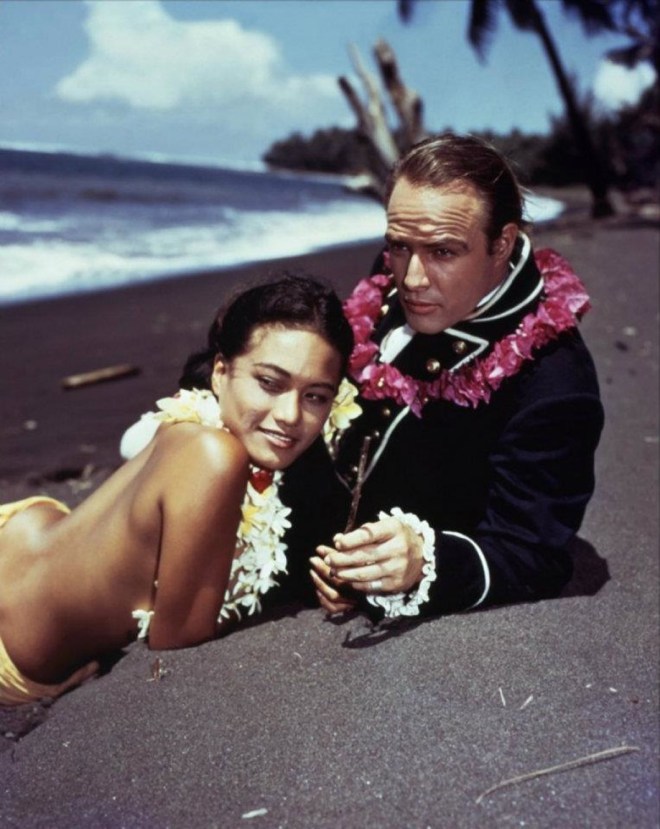
(the earlier version with Clark Gable in the role was not so good, in my humble opinion)
To these romantic new residents were added a few more people, people who jumped ship from visiting whalers or other ships which passed. All these new residents unromantically continued cutting down trees to clear land for agriculture. The trees also had to start competing with other, foreign species brought to the island. As late as the 1950s, some bright spark had the idea of turning Norfolk Island pines into plywood. A batch was exported to Sydney, and excellent results were reported of the trial plywood produced. Luckily, someone with some sense realised that this was not a sustainable business and the idea was dropped.
As a result of all this mismanagement of the island’s pines over the centuries, the stands have gradually shrunk, with the last remaining stands of any size now protected in a national park, on land which is too steep or rocky to farm.

The International Union for the Conservation of Nature has classified the species as “vulnerable”.
Someone – maybe several people – along the way also realised that this handsome tree had potential in the horticultural trade. Quite quickly, it entered that global trade in plants which I’ve written about earlier. From a purely selfish point of view, that was lucky for me, because otherwise I would never have seen this handsome tree on the Ligurian coast. I see no reason why I would ever visit Norfolk Island – I’m not the type to take part in a mutiny and I’ll never, thank God, work on a whaler (not a complete impossibility; some of my ancestors did).
Already by the late 19th Century, the tree had moved out of its native habitat. It seems to have been a popular tree to plant near shore lines because of its high tolerance to salt and humidity, as well as its ability to grow in sandy soil. It also always grows straight regardless of prevailing winds. Here’s a nice example from the city of Napier in New Zealand, where a row of Norfolk Island pines was planted along the sea front in 1890, to create the Marine Parade.
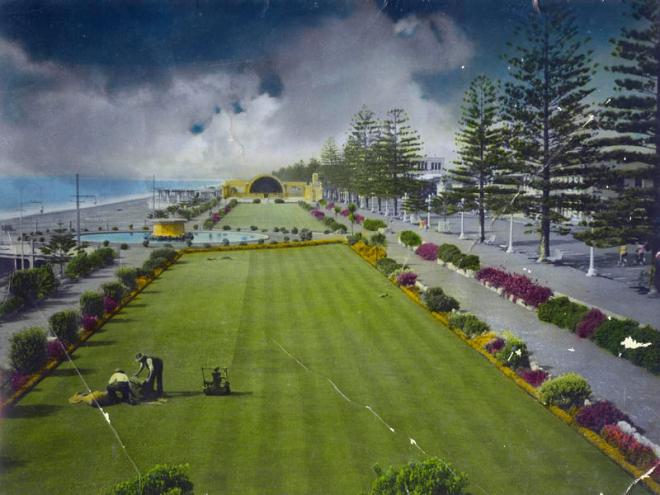
This particular photo was taken in the 1930s and later coloured by hand. The trees are still there, although recent articles say the trees are getting to the end of their lives and need replacing.
And then, in ways that probably no-one has studied, and probably never will (who cares about the history of a plant?), it reached the piece of Ligurian coast where my wife and I spend time, a trip of 18,300 km as the crow, or perhaps better the albatross, flies (nearly half the Earth’s circumference).
I don’t know how long the trees have been here. They are quite tall but Norfolk Island pines grow slowly. From information I’ve managed to glean from the internet, I’m guessing that these particular specimens are fifty or so years old, which means they would have been planted around the time I first started coming to this Ligurian village. With a bit of luck, they’ll see me to my grave.
 the heart thrills