Milan, 8 October 2023
We took our grandson to Milan’s Museo dei Bambini a few weeks ago (our daughter and her partner came over from Los Angeles to attend the wedding of a very dear friend of hers and left us their boy – one year old already! – to babysit; a key bullet point in the job descriptions of all grandparents). It’s not actually a museum, it’s a place where – at a price – toddlers and little children can have fun for 75 minutes playing around with industrial scrap: lots of plastic pieces left over from various industrial operations. It sounds terrible, like the urban poor in developing countries sifting through landfills.

But actually it works beautifully. The kids can have great fun with these various bits and bobs – who needs toys, for Lord’s sake?! A nice example of the repurposing of waste; I think I shall use it in my next lecture on circular economies.
But that’s not what I want to talk about in this post. I want to recount something that occurred as we wheeled our grandson home. Just to change things, I took the second of the routes suggested to me by Google Maps, having taken the first to get there. It so happened that this made us pass close to the Università degli Studi, Milan’s most venerable university established hundreds of years ago.

Suddenly, I remembered the street we were walking along from long, long ago, 1975 to be exact, the year when I first came to Italy and was staying with one of my university flatmates who, a few years later, was to become my wife. One day, she took me to this street, into a little shop which made and sold panzerotti. She got two and passed me one. I took a bite …. ah, my friends, what a revelation!

As I bit through the crisp pastry, my taste buds encountered tomatoes and mozzarella. Nothing else. But it was soooo good! I was in a trance until I had finished it. Here are two, much younger, Italians, also savouring their panzerotti.

I knew then and there that for the rest of my life I had to be part of the culture which created such delights. Two weeks later, my future wife and I were an item (it wasn’t just because of the panzerotto, I should clarify).

Two years later, I went down on one knee in a dark Milan street and proposed.

A year after that, we were married in the lovely chapel at MIT.

(And eleven years after we had made our vows we had a daughter, who one year ago gave birth to that son who I was now wheeling home).
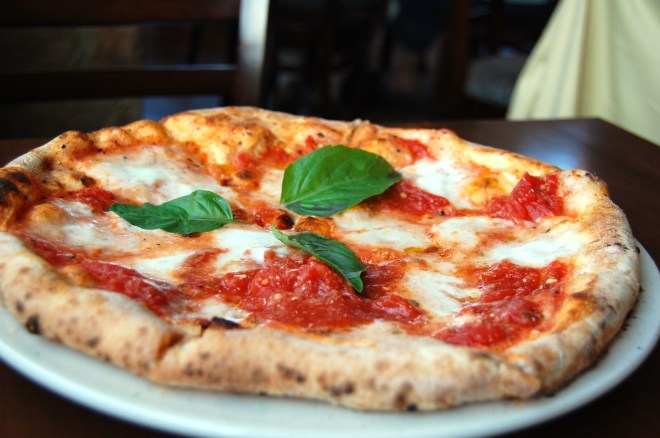
To those of my readers who aren’t familiar with the panzerotto, I suppose the easiest way to describe it is that it looks like a small calzone. Now, I am here assuming that all my readers are familiar with pizza. I mean, is there any angle of the world where pizza isn’t known? maybe in the depths of the Amazon jungle; I show here the most traditional of pizzas, the pizza Margherita (tomato, mozzarella, a couple of basil leaves).
I am further assuming – and this may be a bit more of a stretch than my last assumption – that my readers are familiar with that rather particular form of pizza, the calzone, which is basically a pizza which has been folded over and closed along the edges.
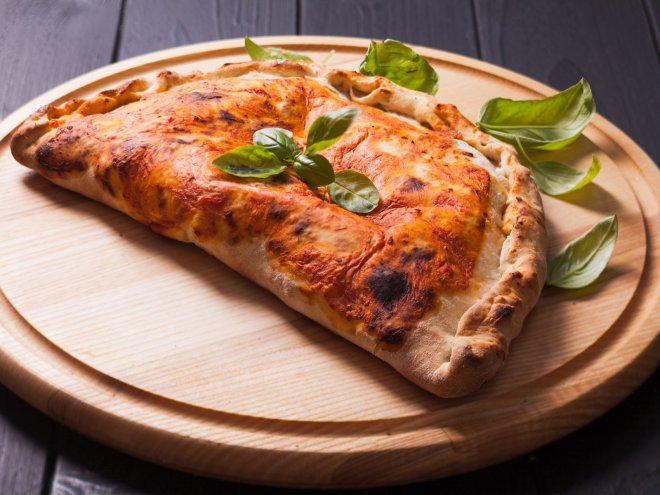
I think this photo shows the superficial similarity between the panzerotto and the calzone. But apart from the size difference, there is actually one big – one enormous – difference between the two. The calzone, like all pizzas, is cooked in an oven (preferably fired with wood).

The panzerotto, on the other hand, is deep-fried in oil.

The panzerotto’s origins lie somewhere in the south of Italy, probably Puglia. Food historians think it was invented by a baker or a housewife who had a small amount of dough left over from their bread making. Rather than throwing the dough away, they made a casing of it, stuffed it with tomato sauce and mozzarella, and deep-fried it. Ecco! A simple, cheap food was born, and its design – easy to hold in one hand while walking – made the panzerotto an obvious candidate for street food. Which is what it became, and which was why I ate that panzerotto where I did nearly fifty years ago; that venerable university just around the corner was the home to hordes of poor, hungry students, who were the shop’s primary clients.

Alas! In the intervening decades, the panzerotto has become chic. That little shop has disappeared and I suppose the students go to the local supermarket to buy ready-made sandwiches. On the other hand, a smart shop has sprung up not too far away, near Milan’s Duomo, where the tourist hordes swirl through the little streets. Every time I go by, it has a long line of tourists in front of it, patiently waiting for their panzerotti.

I have vowed never to buy a panzerotto there. But where, then, will we introduce our grandson to the panzerotto when he is old enough? I still have a few years left in which to do the necessary research.
 the heart thrills