SAINT ERASMUS AND HIS GUTS

Milan, 18 March 2025

My wife and I recently went to an exhibition at the Gallerie d’Italia, a relatively new museum in Milan which is situated right next to the Scala. The exhibition’s title, “The Genius of Milan. Crossroads of the Arts from the Cathedral Workshop to the Twentieth Century”, didn’t really reveal what the exhibition was about, and I’m not sure I had any better idea after our visit. I think it was trying to show how many non-Milanese artists had come to Milan over the centuries and flourished there, but I wouldn’t swear to it.

In any event, at some point I was suddenly transfixed by this painting, which shows in horrible, gory detail some poor guy having his entrails pulled out of him and wound around some contraption or other.

My photo

The painting’s label helpfully informed me that the poor guy in question was Saint Erasmus and he was being martyred. It was clearly a popular subject, because there was another painting just across the way about the same thing.
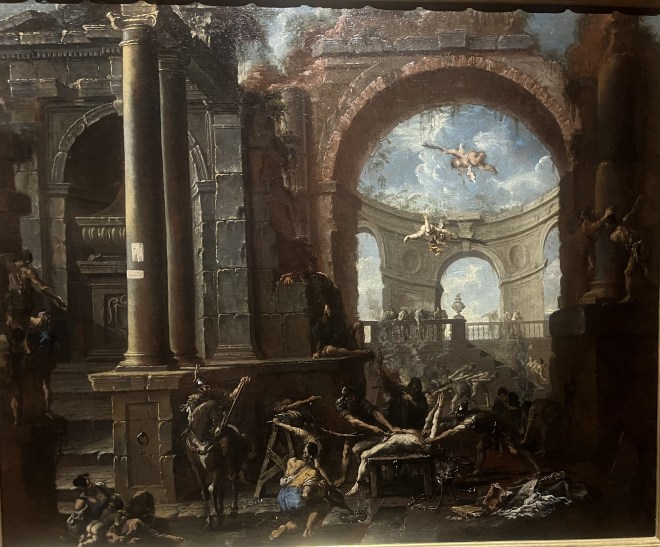
My photo

I’ve mentioned in past posts that early and Medieval Christians loved dreaming up horrible deaths for martyrs, but this one really took the biscuit! What sadistic mind came up with this one? And how did this particular form of torture even cross their mind?! I had, of course, to do some research.

As usual, as written up in the various pious hagiographies which appeared from at least the 5th Century onwards, St. Erasmus’s life seems to be one long muddle. So I’m going to more or less ignore these and sketch out what I think happened, not so much to Erasmus himself as to the legends which clustered around him and to the way he was portrayed in paintings.

It would seem that Erasmus started out as a local saint in the city of Formiae, a Roman port city some 90 km up the coast from Naples. Perhaps he was a bishop there. Bishop or no, there is a good chance that he was martyred in the city during Emperor Diocletian’s campaign of persecution, which ran with differing degrees of intensity from 303 AD to 313 AD. In later centuries, when relics of martyrs and saints became so important, his remains must have been reverently kept by the citizens of Formiae. Probably, too, to bolster the importance of his relics, legends about wondrous deeds performed by Erasmus began to circulate. One of these, which is important for our story, has him continuing to preach even after a thunderbolt struck the ground beside him. By the 5th Century, manuscripts also relating his nasty, vicious martyrdom at the hands of various Emperors were already circulating.

In the meantime, back in the real world, things were not going too well for Formiae. After suffering badly at the hands of the barbarians who flowed into Italy during the death throes of the western Roman Empire, it was razed to the ground in 842 AD by “Saracen” pirates who came from the sea. Its citizens ran – literally – for the hills, and that was the end of Formiae. Luckily, before the city was finally trashed, Erasmus’s precious relics were transported over the bay to nearby Gaeta, which was located on a much more defensible position, as this photo shows, and managed to hold off the pirates.
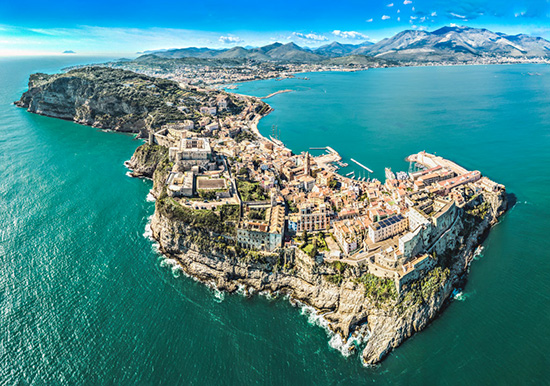
Source

The relics are held to this day in Gaeta’s cathedral, along with the relics of four or five other saints, in a large crypt built in the early 17th Century.

Source

In the 9th Century, when the relics were transferred from Formiae, and for a few centuries thereafter, Gaeta was a marine republic, like the ones on the Sorrentine peninsula further south, and very much in competition with them. Shipping was the backbone of the city’s prosperity, and the city’s sailors adopted Erasmus – one of Gaeta’s patron saints now that they owned his relics – as their personal patron saint. It seems that they chose him on the basis of that story I mentioned earlier, of him being unperturbed by a lightning bolt hitting the ground next to him. One of the perils which sailors ran (and still run) were violent storms. It’s not surprising that so many of the ex-votos found in churches in port cities have as their subject a sailor who was saved during a storm.

Source

During such storms their boats could get hit by lightning. And so Erasmus became one of the patron saints of sailors. In this guise, he was often associated with the crank of a windlass. This may seem odd to readers, but windlasses were used on boats to pull up or let out an anchor or other heavy weights. The heavy weight is tied to a rope, the rope – maybe threaded through a winch – is wound around a barrel, which sailors turn using a crank (K in the diagram below).

Source

It looks like people simplified everything by just associating the crank with Erasmus.

St. Erasmus’s connection in the minds of sailors to lightning got them to also connect him to another electrical phenomenon which sailing ships were (and still are) subject to. In brief, during thunderstorms, when high-voltage differentials are present between the clouds and the ground, oxygen and nitrogen molecules in the air can get ionized around the point of any rod-like object and glow faintly blue or violet. Well, of course, sailing ships in the old days had lots of rod-like objects, like masts or spars or booms, and when conditions were right there would be a faint glow at the end of all these. Here is a print of an old sailing ship with these ghostly “flames” on the ends of its masts and spars.

Source

And here is a modern photo of the phenomenon around a clipper ship, the Cutty Sark, moored on the Thames in London.
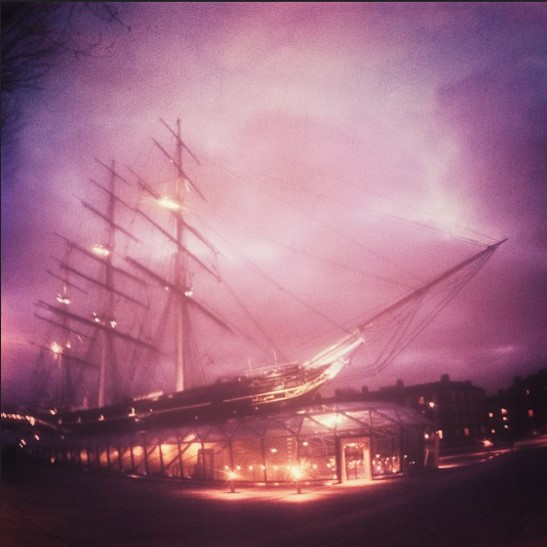
Source

Well, of course, sailors knew nothing of the physics behind the phenomenon. They interpreted those little flames as meaning that St. Erasmus was protecting their ship, especially since the phenomenon often occurred before the thunder and lightning started. And so the phenomenon become known as St. Elmo’s Fire (Elmo being an Italian corruption of Erasmus).

In a parallel universe, various martyrologies continued to be published over the ages, full of the usual hideous tortures meted out to martyrs. But nothing yet about poor Erasmus’s entrails being pulled out of him. Then, in about 1260, a certain Jacobus de Voragine published his martyrology under the title The Golden Legend. His story about Erasmus recycled many of the tortures covered in previous martyrologies to which the saint had been subjected. But then, Jacobus slipped in a brand new torture. In his words (translated into English by Wynken de Worde in 1527):

“[…] the emperor […] waxed out of his wit for anger, and called with a loud voice like as he had been mad, and said: This is the devil, shall we not bring this caitiff to death? Then found he a counsel for to make a windlass, […] and they laid this holy martyr under the windlass all naked upon a table, and cut him upon his belly, and wound out his guts or bowels out of his blessed body.”

Here is how the scene was depicted in one of the early editions of the Golden Legend (in case any readers are interested, the two fellows on the left having their heads chopped off are Saints Processus and Martinian).

Source

Now, I said at the beginning, how did this particular form of torture ever cross Jacobus’s or someone else’s mind? Well, it has been suggested – and it doesn’t sound improbable – that whoever dreamed it up found inspiration (if that’s the word) from the association of Erasmus with the crank of a windlass. Presumably they assumed that the windlass had to have something to do with his martyrdom. After all, the depictions of many martyrs have them holding the instruments of their torture. Saint Lawrence, for instance, leaning on the grill he was roasted on:

Source

Or Saint Bartholomew carrying the knife with which he was flayed alive.

Source

Or Saint Stephen, balancing on his head and shoulders the stones with which he was stoned to death.
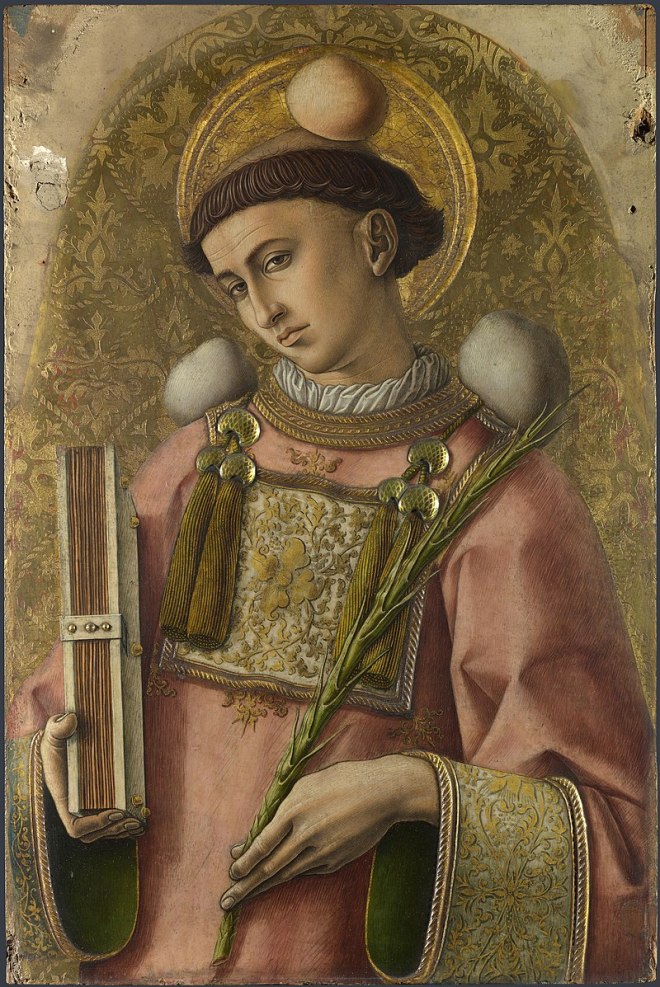
Source

But what could the torture be in Erasmus’s case? Well, what do we humans have that looks like ropes? Entrails! And so this novel form of torture was dreamed up.

Now, Jacobus’s list of tortures inflicted on poor Erasmus is really long: I count 19 in all. Many of them would have made very appropriate subjects for the gory paintings of martyrs so beloved by painters until quite recent times. And yet, the entrails being pulled out on the windlass really caught on; I have to assume it’s because that was the one torture that Jacobus had a picture of in his book. Here’s just a few examples I found on the internet.

This first version is a more sophisticated variant of the picture in The Golden Legend and had added the emperor, “waxed out of his wit for anger”, looking on.
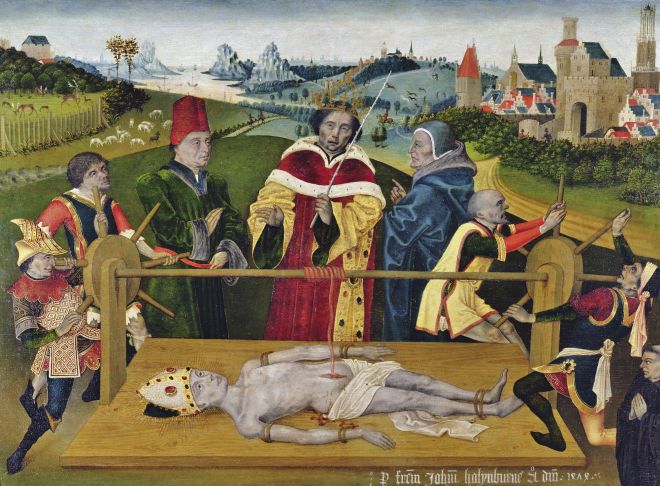
Source

This next version is quite similar, except that St. Erasmus’s bishop’s mitre has now been thoughtfully placed to one side.
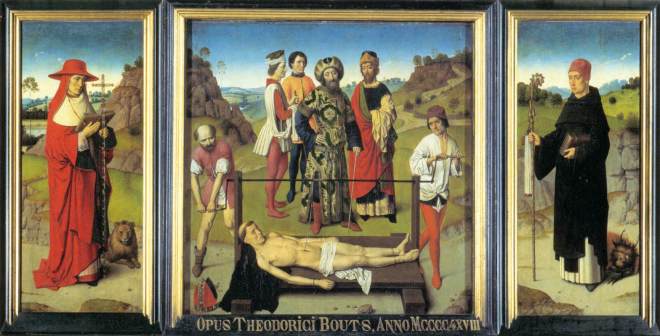
Source

In this next one, we’re beginning to get a bit more dramatic.

Source

While this one, by Nicolas Poussin, has pushed the drama levels to stratospheric heights.

Source

Other paintings, perhaps trying to avoid all the gruesomeness of these kinds of paintings, just had a thoughtful-looking Erasmus, dressed as a bishop, holding his crank around which his entrails have been tastefully wound. This next painting is an excellent example of the genre.

Source

This focus on Erasmus’s guts and the acute pain he no doubt suffered having them drawn out had an interesting side-effect. I’ve mentioned in a previous post the Fourteen Holy Helpers who helped Medieval people deal with their physical trials and tribulations – the headaches, or the sore throats, or the epileptic fits, or … they suffered from. Well, Erasmus fit very well into this scheme of things! He was obviously the go-to Holy Helper for cases of stomach and intestinal illnesses.

I related in the postscript to a previous post that in a moment of weakness I had bought a painting on glass of the Fourteen Holy Helpers. All this research has allowed me to identify which of the Helpers in my painting is St. Erasmus. Here he is, with his crank and some of his intestines rolled around it. All this research I do does sometimes have benefits …

My photo

THE OBSCURE NAMES DEPARTMENT

Vienna, 14 October 2020

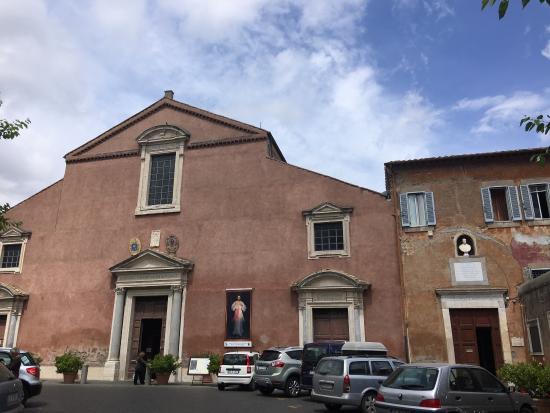
Question: What connects this tumbledown church, which my wife and I stumbled across during a multi-day hike we did this summer in the Wachau region of Austria

my photo

and this train station in London, well known to all those who take Eurail to go to London?

Source

Answer: Their names: they are both called Saint Pancras.

I must say, when we came across that half-ruined church and discovered its name my curiosity was piqued. I mean, Pancras is a funny name, no? I’ve never met anyone face-to-face called Pancras, I’ve never even heard of someone called Pancras. And those websites which will breathlessly list you famous persons having a certain name all came up blank for Pancras. I had only ever heard the name due to the station, and that only because it’s right next to King’s Cross Station, which I used a lot at a certain moment of my life. And I only remember the name because of its close similarity to the name of that organ we all have and whose precise purpose I have never really understood. Yet here were two places some 1,500 km apart with the same name. Yes, my curiosity was piqued, I had to investigate – “Google it!”, as my son always says. And I am now ready to report.

First of all, who was this Saint Pancras? Well, he was an obscure fellow about whom relatively little is known. Like Saint Blaise, another obscure fellow whom I have written about in an earlier post, he was born in what is now central Turkey some time in the 3rd Century. When still a boy and after his parents died, he moved to Rome to be with his guardian. There, again like Saint Blaise, he was caught up in one of the periodic persecutions against Christians, in this case by the Emperor Diocletian. It seems that he and his guardian were giving shelter to Christians and as a result he (and presumably his guardian, but he disappears from the story) were arrested. Pancras was 14. Here, the story gets fanciful. His hagiographer claims that Pancras was hauled in front of the Emperor himself, that the two had a long discussion during which Pancras impressed the Emperor with his youth and determination. Finally, annoyed (enraged, says the hagiographer) by the teenager’s refusal to refute his Christianity, he ordered Pancras’s execution. Pancras was promptly dragged off and beheaded. I find it hard to believe that the Emperor ever bothered to speak to this unknown youth; in fact, as one of the commentators diplomatically put it, it would have been very difficult for him to do so since he was not actually in Rome in the year that Pancras was beheaded. Whatever actually happened, it seems that Pancras was buried along the Via Aureliana.

For reasons that are just as obscure to me as the details of his life, his grave became a hub of pilgrimage and supposed miracles. Pope Symmachus built a basilica over the grave in 500 AD, a basilica that was expanded and much remodeled over the centuries. A church still stands on the spot (a church which, I must admit, I have never visited; perhaps the next time I’m in the Eternal City …).

Source

If things had remained there, Pancras might have ended up as simply a minor regional saint. But for reasons which are yet again obscure to me Saint Gregory of Tours in France wrote in a famous book on Christian martyrs which was published in about 590 AD, that anyone making a false oath at the saint’s tomb would be seized by a demon and would collapse and die. Well! In an age where oaths were taken incredibly seriously and where everyone believed in the existence of demons and Hell, this was equivalent to saying that Saint Pancras was a divine lie detector: who in their right minds would dare to lie if asked to take an oath on the saint’s tomb? An oath on Saint Pancras’s tomb was considered so potent that it could be held up in court as proof of a witness’s testimony.

There was one slight problem: Saint Pancras’s tomb was in Rome and Rome was far away. No matter! In an age in which trade in the relics of saints flourished, relics of Saint Pancras were considered just as potent. There was therefore a huge and urgent demand from all over Western Christendom for relics of Saint Pancras to be sent to them. The Romans were not slow to oblige, and soon relics purported to be of Saint Pancras were on their way to every corner of Western Europe. As one source I read commented: “The whole body of the Saint was apparently in at least twenty churches; the head, in at least ten cities. As for the individual bones, they were without number. Of course, only a small part of these relics could be authentic .”

Of course, such potent relics needed to be housed appropriately! As a result, many a church was built and dedicated to Saint Pancras, with his relics enclosed in the main altar. In great pomp and ceremony, swearers of oaths could be solemnly brought before the altar and required to take their oaths. In our more cynical age, we can smile at the credulity of our ancestors but I have to say if I had been around in the Middle Ages and had been required to take an oath before the relics of Saint Pancras I’m pretty sure I wouldn’t have lied. Who wants to spend eternity in Hell, even if you are being asked to swear that you didn’t kill someone?

It wasn’t just churches who owned relics. Rich aristocrats also had their collections of relics, housed in richly made reliquaries like this one.

Source

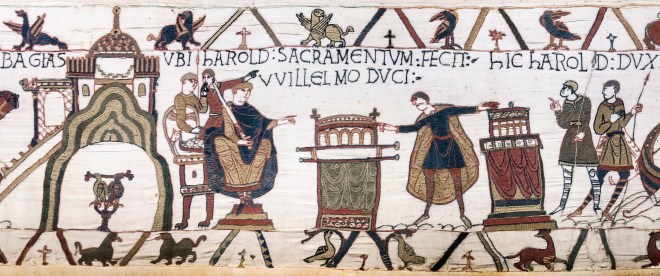
I have absolutely no basis for making the following claim, but I would like to believe that one of the most famous of all oaths taken during the Middle Ages, that taken by Harold Godwinson in Normandy in 1064 before Duke William, was taken on relics of Saint Pancras. For readers who are not familiar with this story, let me quickly summarize the salient points. In 1064, the-then king of England, Edward the Confessor, was clearly nearing the end of his life and didn’t have a son to succeed him. Various regional powers were jockeying to get into position to take the crown on Edward’s death. One of these was Duke William of Normandy, who was related to Edward, although in a rather indirect way. Another was Harold Godwinson, head of the most powerful family in England. For reasons which are not entirely clear, Harold went to Normandy (some say he was actually on his way to France but got shipwrecked on the Normandy coast). Duke William promptly laid hands on him and held him prisoner, although he went through the motions of treating him as a valued guest. Harold’s “stay” ended with him swearing an oath on a series of relics. The Bayeux tapestry captures this moment.

Source

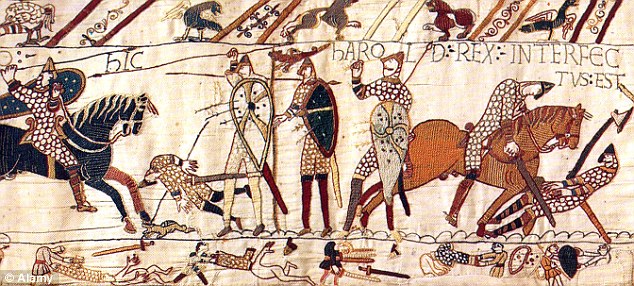
Quite what he swore is not clear. William claimed that Harold swore fealty to him and agreed that he would support him to be king. Consequently, he cried foul when Edward died and Harold took the throne. Harold retorted that he had been made to take the oath under duress and therefore (whatever it was that he was made to promise) it was not valid. William took this “betrayal” as an excuse to legitimize his invasion of England. We all know how that finished. The two armies met at Hastings, Harold took an arrow in the eye and died, and his army collapsed. Again, this key moment in English history was caught in the Bayeux tapestry.

Source

We’ll never know what oath Harold really took. As they say, history is written by the victors. But coming back to the relics that Harold took his oath on, it certainly seemed to have been important enough to have warranted the use of Saint Pancras’s relics. The poet Lord Alfred Tennyson believed that they were of Saint Pancras. In his verse-drama “Harold,” when it comes to the moment of the oath he has William exclaim:
“Lay thou thy hand upon this golden pall!
Behold the jewel of St. Pancratius
Woven into the gold. Swear thou on this!”

Continuing in the obscurity department, when the Church hierarchy got around to assigning saints to all the days in the year, something which they seemed to have done quite early on, they assigned St. Pancras to 12th May. Why St. Pancras got 12th May is completely mysterious to me. In any event, 12th May was already St. Pancras day in 896 AD, when the Holy Roman Emperor Arnulf of Carinthia conquered Rome. Arnulf belonged to that delightful period of European history when everyone had fantastic names, something I have noted in an earlier post about Saint Radegund (itself a wonderful name). His father was called Carloman, his mother Liutswind, his son Zwentibold. He deposed Charles the Fat as Holy Roman Emperor and took his place, he was saving Pope Formosus from the clutches of Lambert and his mother Ageltrude when he conquered Rome. And on and on: there are literally dozens more such colourful names attached to Arnulf’s life and times.

But I digress. Arnulf attributed his success in conquering Rome to the intercession of that day’s saint, that is to say Saint Pancras. This made Saint Pancras even more popular than he already was in the German lands, and could well explain in a roundabout way why my wife and I came across this dilapidated church in the Wachau dedicated to him.

The fact that May 12th is Saint Pancras’s day meant that for centuries he also played an important role in the agricultural calendar of large swathes of Europe, from Lombardy and Liguria as well as Slovenia and Croatia in the south to Sweden and Poland in the north, from Belgium and France to the west to Hungary in the east. He, St. Mamertus (May 11th), St. Servatius (May 13th), and St. Boniface of Tarsus (May 14th) became collectively known as the Ice Saints, and Saint Sophia (May 15th) as Cold Sophy. They were so called because the middle days of May were believed to often bring a brief spell of colder weather, and there were warnings against sowing too early in case young crops were caught in a frost. These were translated into a series of colourful sayings, no doubt repeated around the hearth by the wise men (and perhaps wise women) of the village:

Pankraz, Servaz, Bonifaz
only make way for summer.

No summer before Boniface
No frost after Sophie.

You’re never safe from night frost
Until Sophie is over.

Servaz must be over
If you want to be safe from night frost.

Pankrazi, Servazi and Bonifazi are three frosty Bazi.
And finally, Cold Sophie is never missing.

Pankraz and Servaz are two bad brothers
What spring brought they destroy again.

Never plant before Cold Sophie.

Readers get the picture. Alas, science seems to disprove peasants’ belief that there was a tendency to a cold spell in that period. In fact, science has generally stopped us from giving any credence to saints. Which is generally a good thing. But it does mean that names like Pancras, Mamertus, Servatius, and Boniface have sunk into obscurity, so much so that when I came across a church dedicated to Pancras I scratched my head and muttered to myself “Who on earth was he?” Luckily there was Google to help me find the answer.

Oh, in case any readers are asking themselves why the railway station in London is called after St. Pancras, it seems that it was so called because the surrounding district was so called, and the district was so called because there was once in the vicinity a very ancient church dedicated to Saint Pancras. So there you are.