ARRESTING FACES

Milan, 28 February 2025

It was freezing cold in Vienna this last month we were there, far too cold for my wife and I to go hiking. So we spent our spare time visiting Vienna’s nice, warm museums. One museum we visited was the Paintings Gallery of the Academy of Fine Arts; I don’t think we’ve been back to it since a visit we made shortly after we arrived here, back in 1998. As the name indicates, we are actually dealing with an arts school, but it has quite a worthy collection of paintings donated to it by various aristocrats over the centuries. It has a particularly good collection of paintings by Lucas Cranach the Elder, and it was one of these that caught my attention, St. Valentine and a Kneeling Donor, painted in 1502-1503.

Source

What a magnificent face St. Valentine has! Not a handsome face at all, but it still had me gazing at it in fascination. A face full of character! If I were to meet this person in real life, my staring at him would probably provoke him into demanding what the hell I was looking at and to scarper before he took a swing at me. His face reminds me of the actor Walter Matthau at his most scowling.

Source

From today’s perspective, what with the saint’s feast day of 14 February being irremediably lodged in our collective memories as the day of lovers, I think many people would be surprised by Cranach’s choice of model. They might have someone more sucrose in mind, like this painting in the church of Santa Maria degli Angeli in Rome.
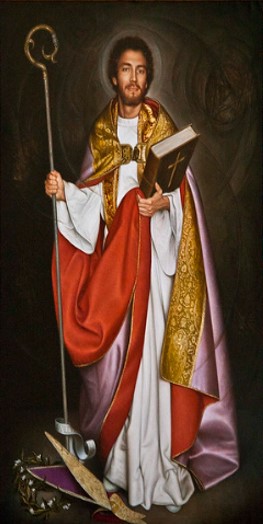
Source

But that is to forget that in Cranach’s time, St. Valentine was also the saint to whom epileptics would pray, and in fact down at St. Valentine’s feet in Cranach’s painting one can see a man having an epileptic fit. Perhaps this rugged face fits better a saint who was meant to be dealing with epilepsy.

By coincidence, a few days later, at the Museum of the Lower Belvedere, I came across another painting with equally interesting faces. It is of three saints, Jerome, Leonard, and Nicholas. It is from the late 15th Century, painted by an unknown artist.
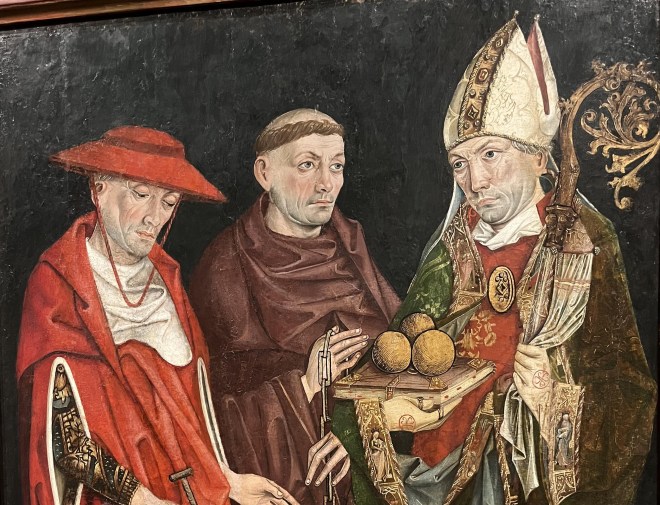
my photo

As I’ve noted in previous posts, I have a fascination for faces in art. When I visit most collections of Old Masters, after enduring a long series of paintings of classical figures prancing around in sylvan scenes or of various members of the nobility hamming it up in their best clothes, it comes as a relief for me to gaze upon portraits from times past. These are faces I can relate to, faces of people whom I could be seeing on any street corner on any day of the week, just dressed in different clothes. It reminds me that history is not some colourful story in a book but was the lived experience of people just like me.

Most of the faces I gaze on are pleasant; I look, I note, I move on. But sometimes – like St. Valentine’s – they are arresting. There is something about the face that holds my gaze, that makes me stop and look more closely, that makes me wonder what the person was like. Let me use the rest of this post to celebrate some of these arresting faces in art.

A good example is Maximilian I, Holy Roman Emperor. I am particularly fond of this portrait of him, by Albrecht Dürer, painted a few years after Cranach’s St. Valentine.
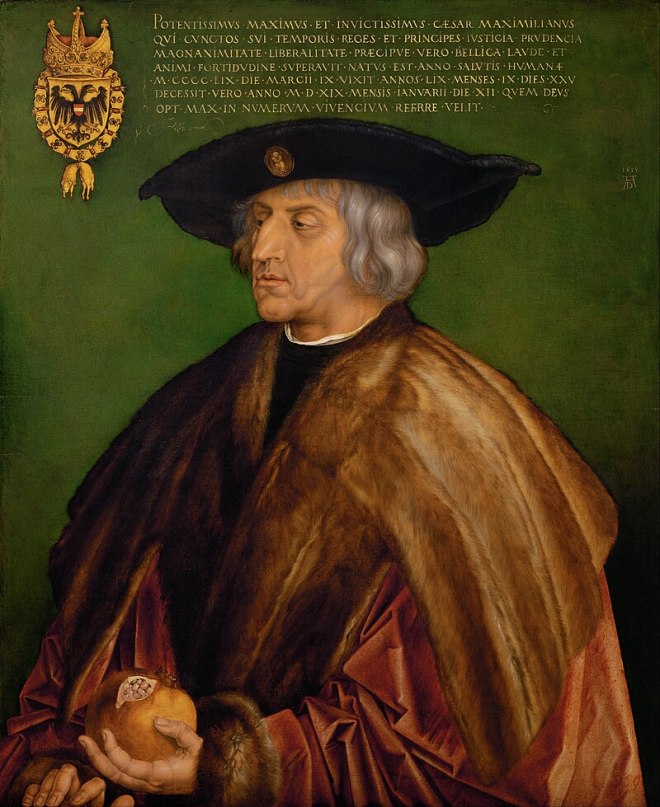
Source

It’s another painting my wife and I saw as we took refuge from the cold in Vienna’s museums, this time in the Kunsthistorisches Museum.

There are many other portraits of Maximilian, and in some of them he is frankly ugly, like this one of him and his family. With this side pose, his very prominent nose stands out.
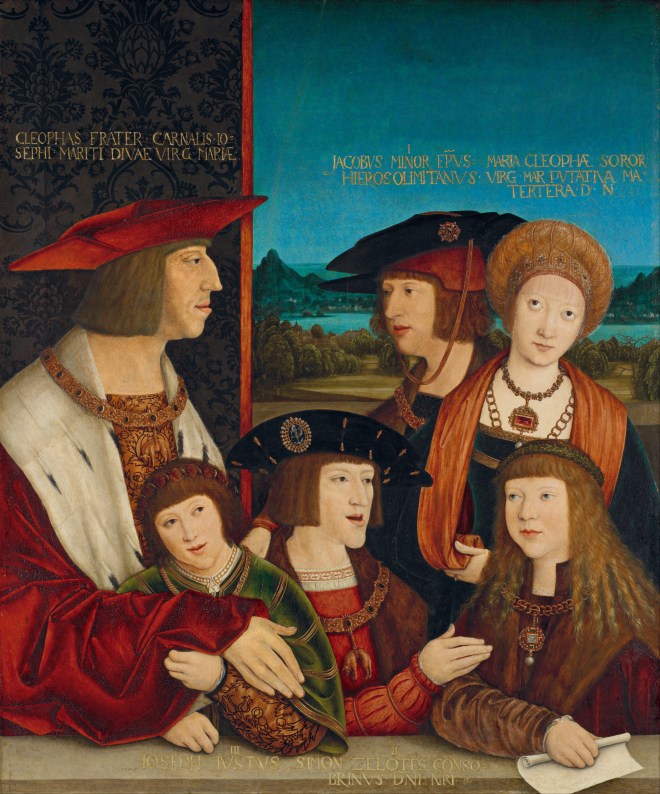
Source

Maximilian certainly looks better than many of his successors, who sported the monstrous Hapsburg jaw. It seems to have started with his grandson Charles V, who is in that last painting, bottom centre. It continued down the generations. Here is a portrait of Charles V when young.
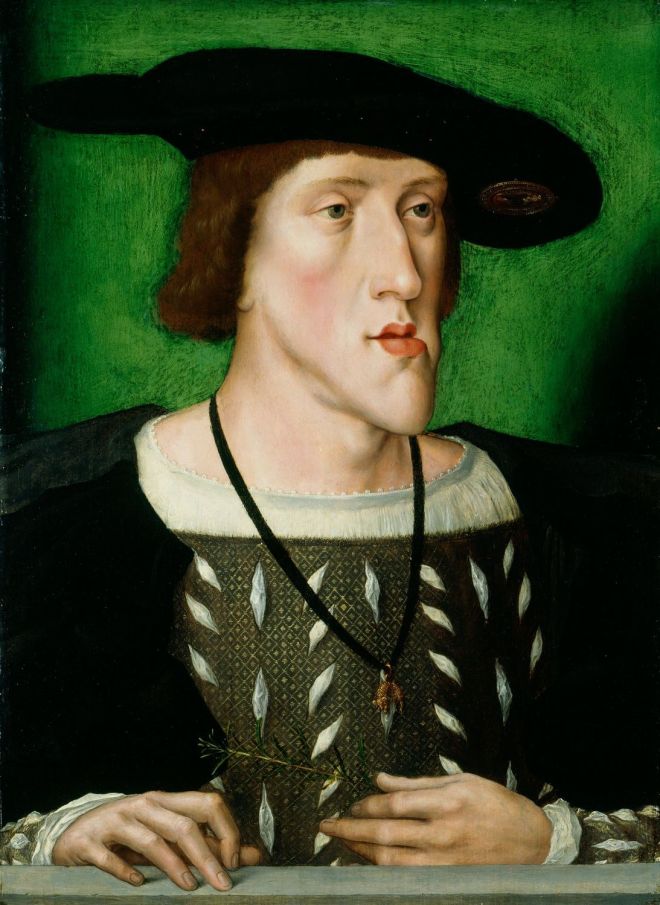
Source

In later life, he grew a beard, presumably to camouflage the chin.

But I don’t want to focus on ugly people, even though they are the subject of many, many paintings. So my next candidate for arresting faces is Federico da Montefeltro, Duke of Urbino. Probably the most well-known portrait of him is this one in the Uffizi, in a double portrait with his wife Battista Sforza.
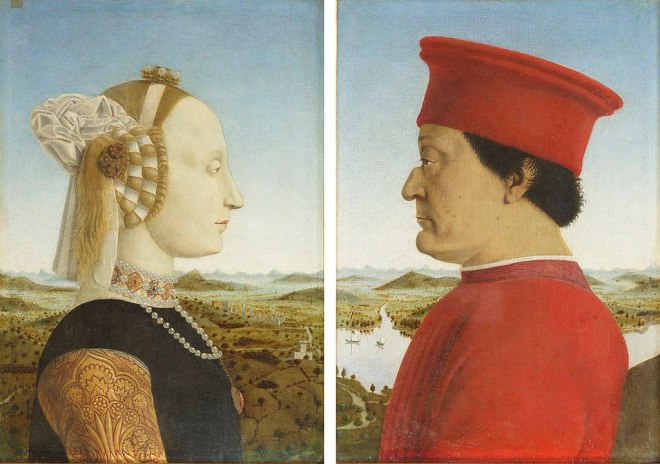
Source

I prefer this portrait of him, though, where we see him together with his son Guidobaldo.

Source

That is a really interestingly craggy face! It certainly mirrors his life, a man who was a brilliant condottiero but also a very cultured man: in the last painting, he is dressed in armour but he is reading a book, an allusion to his humanist interests. Of course, the thing most people almost immediately notice about his face is that notch at the top of his prominent nose. He lost his right eye in a joust (and probably smashed up the right side of his face in the process; he always had himself painted from the left). To be able to see better with his one remaining eye, especially when fighting, he had the top of his nose cut away. A tough, tough guy …

Staying in Italy, the next arresting face I pull up is that of Lorenzo de Medici, il Magnifico. Of the many representations that were made of him, I choose this terracotta statue, whose brooding look captures me. What dark secrets are hidden there!

Source

Other arresting faces come from Caravaggio. It’s the faces of the secondary characters in his paintings who most draw my eye. A prime example is the Incredulity of Saint Thomas. Look at the weatherbeaten faces of those three apostles! They could truly be fishermen walking the shores of the Sea of Galilee, or indeed any shores anywhere.

Source

Or his Salome with the Head of Saint John the Baptist. Look at the face of the executioner!
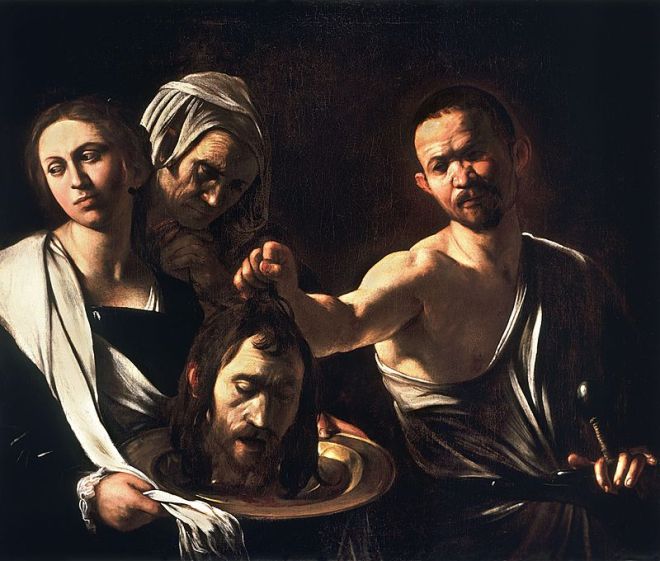
Source

It’s a face which reminds me of Michelangelo’s, another arresting face.

Source

Personally, I’ve always loved this self-portrait, where Michelangelo included himself as Nicodemus in the Deposition, a sculpture I first saw in Florence decades and decades ago on my first trip to Italy.

Source

Michelangelo’s badly broken nose adds to the allure of his face. I read a while back that it got broken after he mocked the drawings of the artist Pietro Torrigiano, who in a rage took a swing at him.

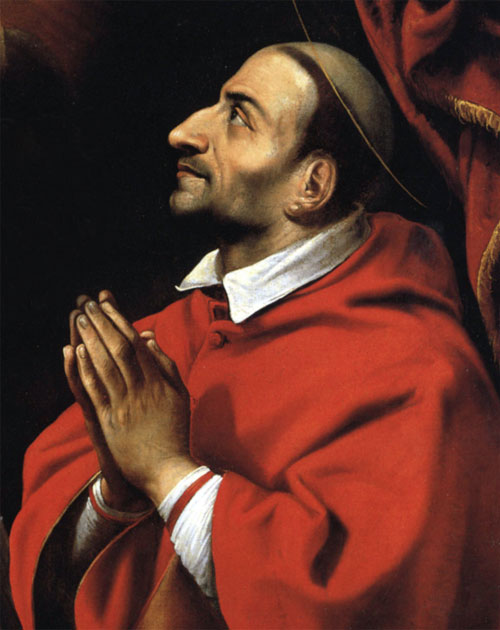
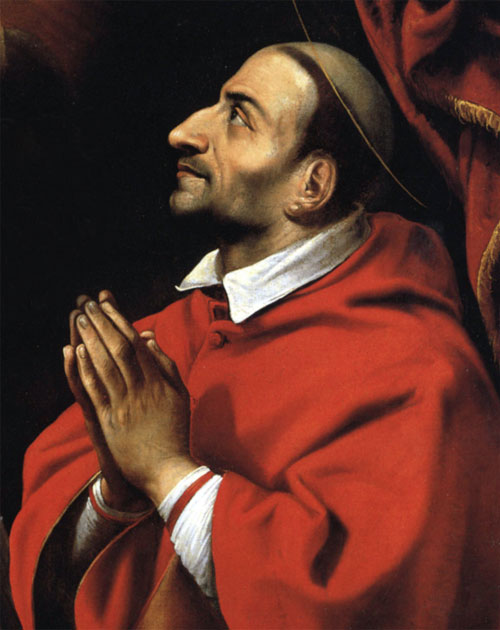
I can’t leave Italy without including a portrait of San Carlo Borromeo, cardinal archbishop of Milan.

Source

His large nose led the Milanese to nickname him Il Nason, Big Nose.

Readers will see that it’s all been men up to now. Indeed, it’s been very hard to find paintings of women’s faces which are arresting: beautiful yes, haughty yes, homely yes, motherly yes, careworn yes, but arresting …

After a considerable amount of searching, I came up with a few examples. This is Mary, Queen of England.
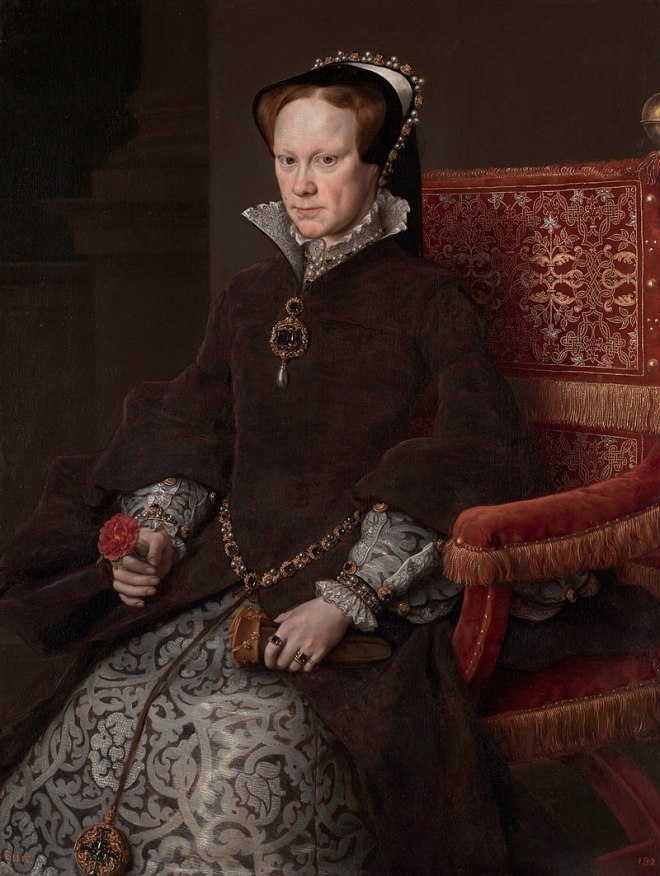
Source

Now that is the face of a very determined woman! And determined she was. She suffered through all the travails of her father Henry VIII declaring her illegitimate, banishing her from court, and refusing to let her be with her mother when she died, and, once on the throne, she tried with all her might to bring England back into the Catholic fold.

And this is her half-sister Elizabeth I.

Source

She, too, suffered under Henry VIII, nearly losing her head at one point, and when she was queen had to navigate tempestuous religious factional fighting. She was not a woman to be pushed around.

Perhaps I could add this self-portrait of Artemisia Gentileschi. It’s not a face that necessarily arrests me, but knowing her background – raped when she was young by another painter, tortured during his trial for rape to see if she kept to her story, having to see her rapist’s meagre two-year sentence reversed after a short prison term – I sense a steeliness in her.
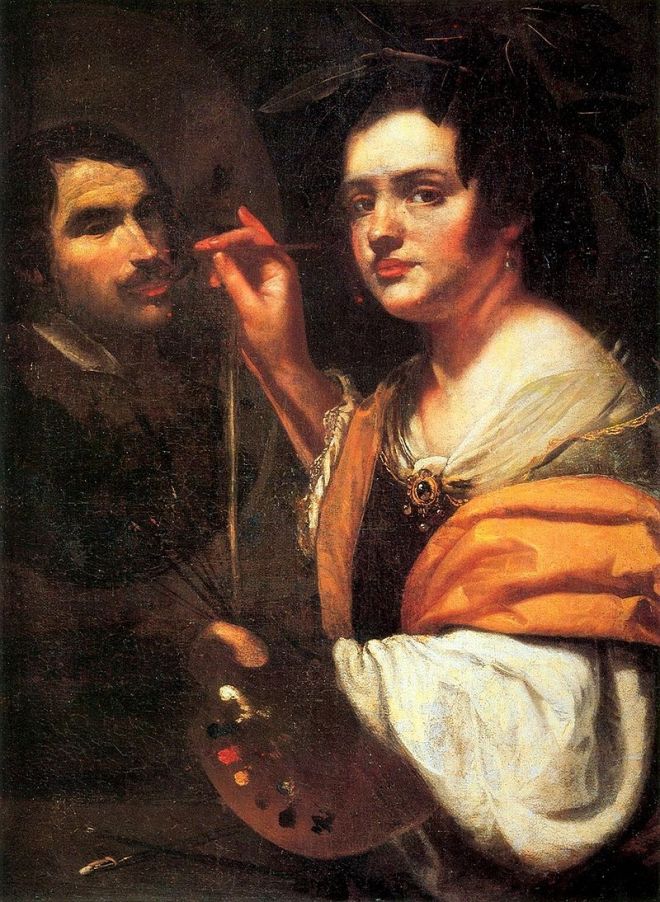
Source

I finish with the face of a peasant woman in an early painting by Van Gogh, before he went to Paris. It’s from the Potato Eaters, a really dark painting (literally).
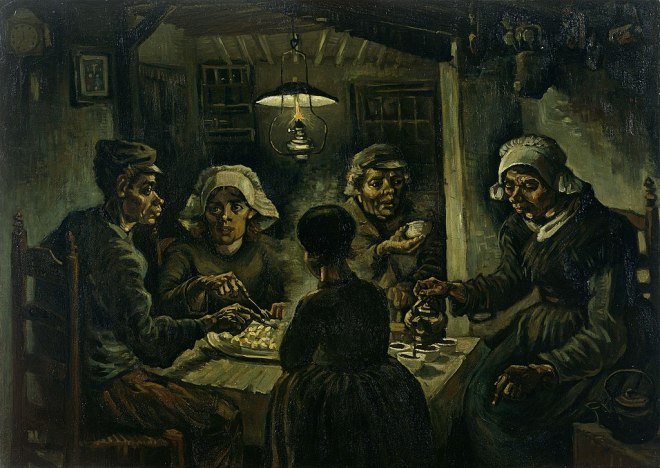
Source

It’s the woman on the far right that intrigues me. I show a blow-up (I’ve also lightened it a bit).

Source

Now that’s an arresting face!

SERENDIPITY

Milan, 20 January 2023

I love serendipity, those moments in life when, quite by chance, something wonderful happens to you. Such a moment occurred a month or so ago now, when my wife and I, free for the day from our babysitting duties, headed off to LA’s Chinatown, to have our hair cut and to nose around a little. Pleasant as this all was, it was not where the serendipitous moment occurred. It was later, when we decided to walk from Chinatown to Bunker Hill, hoping to catch an exhibition at the Broad Museum or the Museum of Contemporary Art, which both sit on that hill. There was indeed a wonderful exhibition at MOCA, but fascinating as it was, it was also not there that the serendipitous moment occurred. It happened on the way; by sheer chance, I chose a route which took us past LA’s Catholic Cathedral of Our Lady of the Angels.

I cannot stress strongly enough, one should never go past a church without visiting it. For two thousand years, churches have been the repositories of some of the best art our cultures have produced (as indeed have temples and other sites of worship the world over), so there are very good chances that there will be something interesting to see in every church. The Cathedral of our Lady of the Angels was a brilliant example of the truth of my injunction, “Enter that church! Do not walk past it!”

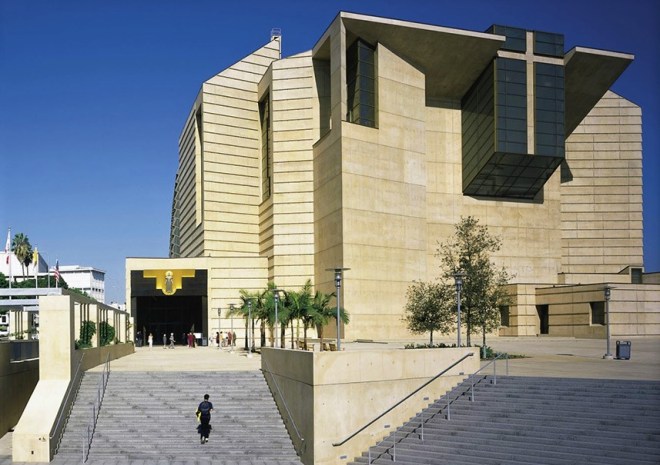
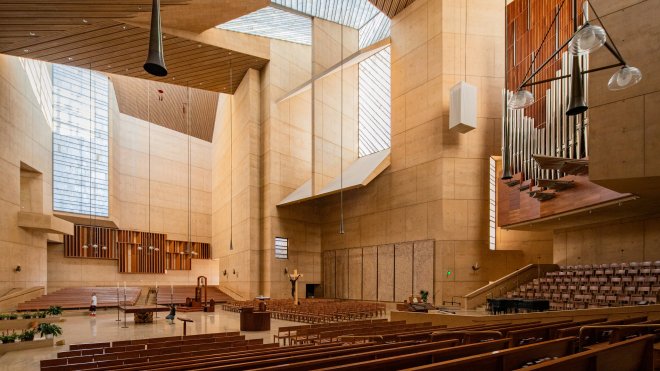
The cathedral itself, opened in 2002, is certainly an interesting example of postmodern design by the Spanish architect Rafael Moneo (who also designed the fantastic museum of Roman Art in Merida, Spain, which my wife and I visited some 15 years ago; but that is another story). These two photos give an idea of what the cathedral looks like inside and out.

Source
Source

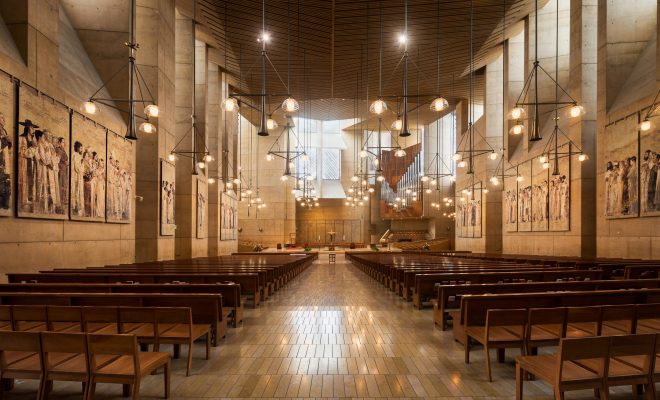
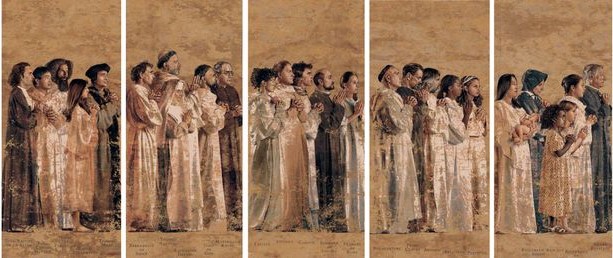
As I said, interesting. But the real jewel – that serendipitous moment – were the tapestries that lined the two walls of the nave. They were magnificent. They were designed by the Californian artist John Nava and woven in Belgium, a country with a centuries-old tradition in the making of tapestries.

This photo shows their general layout.

Source

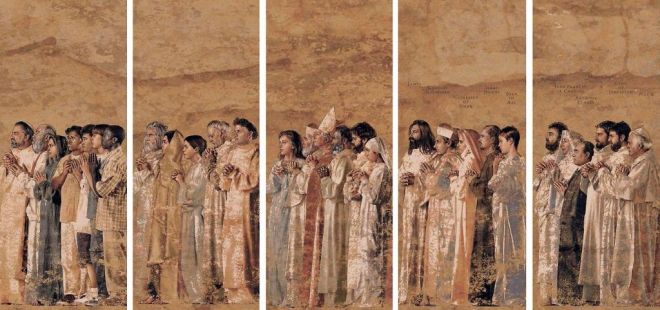
Readers with good eyes will be able to see that the tapestries depict a procession of people – women, men, children – moving towards the cross above the high altar. Closer inspection shows that most of these people are saints (or in certain cases blesseds). These photos show some of the panels (there are 26 of them in all).
Some of the tapestries on the southern wall:

Source

Sone of the tapestries on the northern wall:

Source

With the more modern saints, Nava used photos or contemporary paintings to create their likeness, otherwise he used family members, acquaintances, and models. He wanted his saints to look like real people, where we the viewers could say “hey, that looks awfully like so-and-so”.

The tapestries show quite a mix of saints and blesseds, from all over the world (although Europe does predominate) and across all ages. A good number I’m familiar with. My mother, may she rest in peace, used to ply me with comic books (graphic novels might be a more respectable term, given the subject matter) of the lives of various saints, to give me good examples to live up to. So, for instance, I’m familiar with Jean Vianney, the Curé d’Ars (the saint on the far right in this photo).

Source
Then there’s Saint Francis, a saint I am particularly fond of as I’ve written about in an earlier post (again, the saint on the far right of this photo).

Source

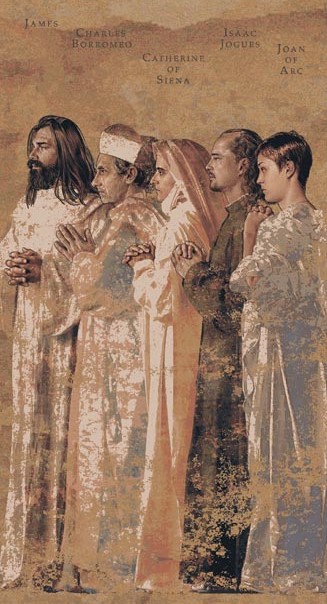
Then there’s San Carlo Borromeo; you cannot live in Milan for any length of time without coming across him multiple times (he’s the second from the left in the photo below).

Source

I’ve mentioned San Carlo a few times in my posts, and I think Nava has made his nose too small – all the paintings of the saint I’ve ever seen show that he had a monstrous conk.

Some are saints who were alive during my lifetime and with whom I have a certain familiarity – Mother Theresa and Pope John XXIII, for instance.

Source

I like the fact that Nava has mixed in a number of anonymous people with his saints and blesseds – mostly children, as we see in the first of these close-up photos – to remind us that we can all be saints (although, as history has sadly taught us, we can all be devils too; but we’ll draw a veil over that today).

Readers will see that while the faces which Nava created are intact, the clothes of many show gaps and scars, reminiscent of old frescoes which have been partly destroyed; a nice touch, I found.

Stumbling across these tapestries was wonderful enough. But what was even more delightful was that this modern procession of saints immediately brought to my mind another such procession, in a church nearly 10,000 km away and erected some 1,500 years before the cathedral of our Lady of the Angels: Sant’Apollinare Nuovo in Ravenna, a church which has been the subject of several of my earlier posts.

Source

Ravenna is one of my most favorite places in the world, filled as it is with early Christian churches whose interiors house mosaics. Any long-term readers of my blog will know that early Christian mosaics hold a special place in my heart. I still remember that morning in early July of 1975 when I walked into Sant’Apollinare Nuovo for the first time: another serendipitous moment. Callow youth that I was, I had put Ravenna on my itinerary because the Michelin Green Guide, which I was religiously following, assigned the town its maximum of three stars. I had no idea what to expect, and I was overcome by what I found before me. The walls of Sant’Apollinare glitter with wonderful mosaics showing a line of virgins and martyrs processing solemnly towards the high altar. In a sign of how things have changed in the intervening 1,500 years, whereas in the tapestries all the saints are mixed companionably together, in Ravenna they are rigorously segregated by gender, with the virgins processing down one wall and the martyrs (all male) processing down the other (they are also all white, showing the much more local reach of the Christian church then than now).

Here we have the procession of the virgins.

Source

And here, a little less clearly, we have the procession of the martyrs.

Source

I throw in a couple of close-ups to give readers a better sense of what the mosaics are like. Here, are some of the virgins, with names that we would recognize today – Christina, Caterina, Paulina.

Source

And here are some of the martyrs, with names like Clement and Laurence but also others which are far less familiar to us today – Sistus, Hypolitus, Cornelius.

Source

The other mosaics I discovered that day – in the churches of Sant’Apollinare in Classe and of San Vitale, in the Mausoleum of Galla Placidia, in the Baptistery of Neon and the Arian Baptistery – were just as magnificent and are forever etched in my mind.

Ah, the thrill of serendipity! Remember, readers: never pass a church (or a mosque, or a synagogue, or a temple, or a gurdwara) without going in! (if they allow you, that is) Chances are you’ll see something interesting, and sometimes you’ll find something wonderful.

A SCHNOZZLE, A CONK, A HOOTER!

Beijing, 21 May 2015

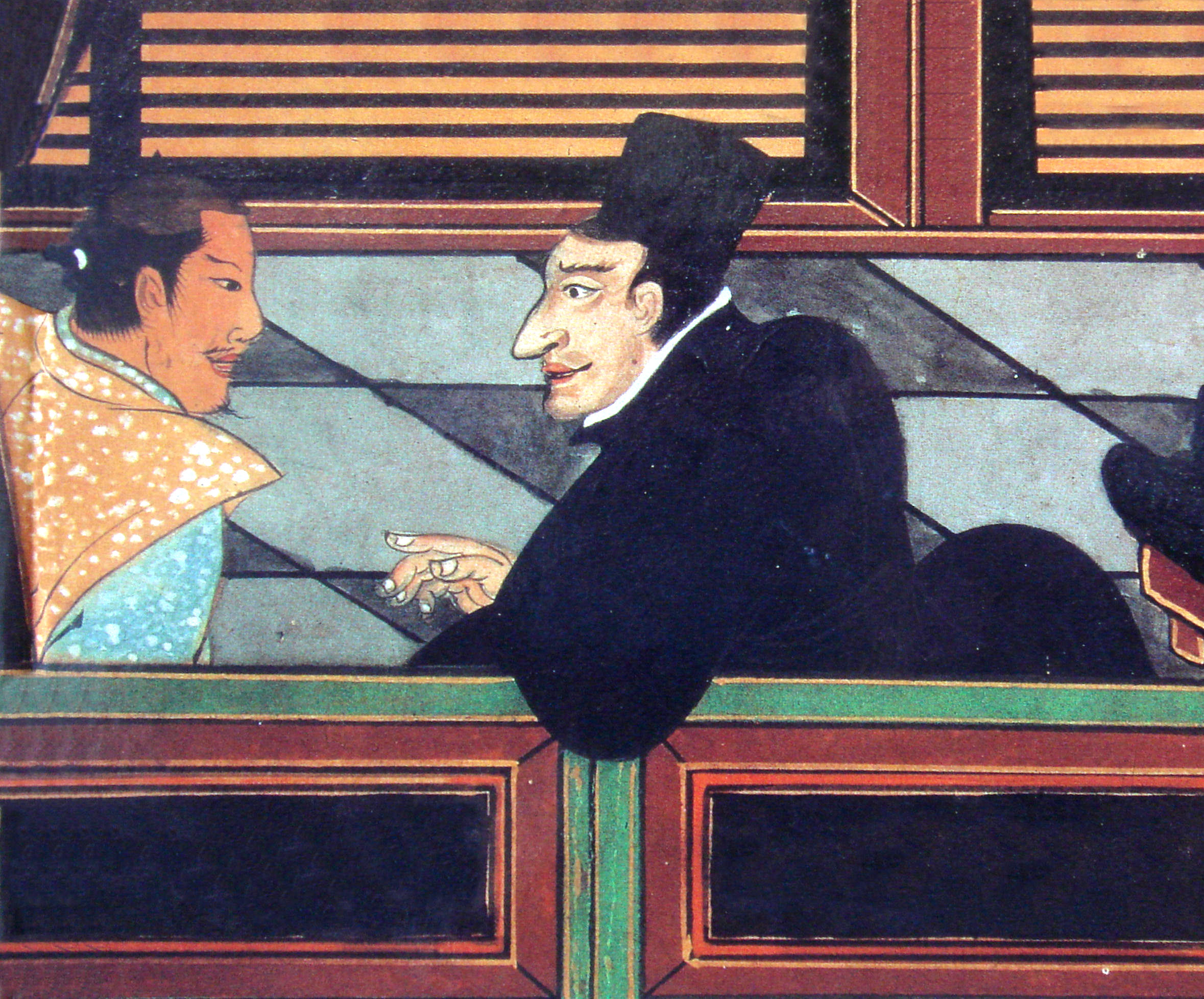
I’ve just come back to Beijing from Europe. I’ve been living long enough in China now that whenever I’m back in Europe I acutely notice differences, especially physical differences. For instance … noses. We white folk have really big schnozzles, you know! This was one of the first things which the Japanese noticed when the Portuguese showed up on their shores in the late 1500’s. The Japanese paintings of the time stress differences in nose sizes.

Jesuit in Japan

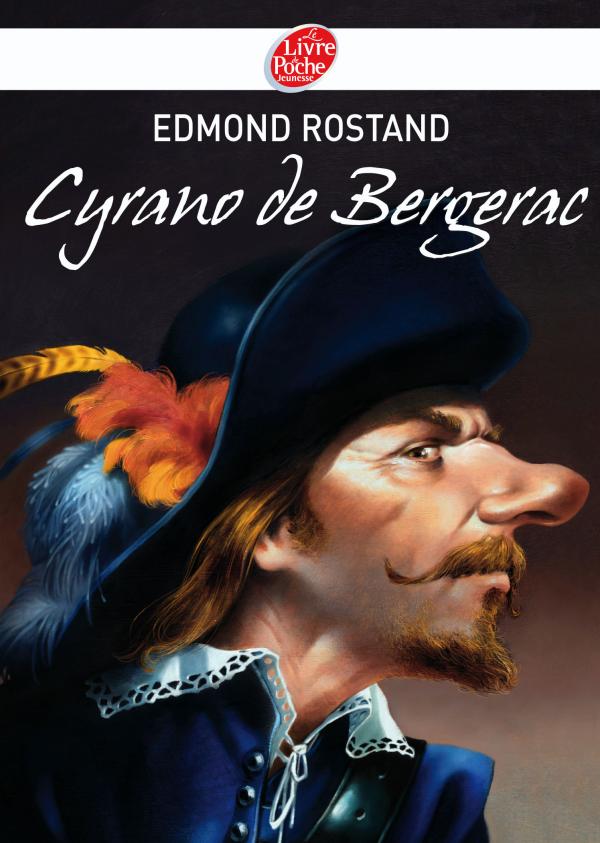
And now, after just four years in Asia, I feel that everyone in Europe is Cyrano de Bergerac

cyrano de bergerac

or San Carlo Borromeo, the cardinal saint from Milan whose conk sticks out mightily from every painting of him in every church of Milan

San_Carlo_Borromeo

As I see these large noses all around me back home, the lines from Cyrano come to mind, where he mocks his own gigantic hooter in front of an appreciative audience, on stage and off:

Ah ! Non ! C’est un peu court, jeune homme !
On pouvait dire… oh ! Dieu ! … bien des choses en somme…
En variant le ton, —par exemple, tenez :
Agressif : « moi, monsieur, si j’avais un tel nez,
Il faudrait sur le champ que je me l’amputasse ! »
Amical : « mais il doit tremper dans votre tasse :
Pour boire, faites-vous fabriquer un hanap ! »
Descriptif : « c’est un roc ! … c’est un pic… c’est un cap !
Que dis-je, c’est un cap ? … c’est une péninsule ! »
Etc.

 Or, in English:

Ah no! young blade! That was a trifle short!
You might have said at least a hundred things
By varying the tone. . .like this, suppose,. . .
Aggressive: “Sir, if I had such a nose
I’d amputate it!’ Friendly: ‘When you sup
It must annoy you, dipping in your cup;
You need a drinking-bowl of special shape!’
Descriptive: ”Tis a rock!. . .a peak!. . .a cape!
–A cape, forsooth! ‘Tis a peninsular!’
Curious: ‘How serves that oblong capsular?
For scissor-sheath? Or pot to hold your ink?’
Gracious: ‘You love the little birds, I think?
I see you’ve managed with a fond research
To find their tiny claws a roomy perch!’
Truculent: ‘When you smoke your pipe. . .suppose
That the tobacco-smoke spouts from your nose–
Do not the neighbors, as the fumes rise higher,
Cry terror-struck: “The chimney is afire”?’
Considerate: ‘Take care,. . .your head bowed low
By such a weight. . .lest head o’er heels you go!’
Tender: ‘Pray get a small umbrella made,
Lest its bright color in the sun should fade!’
Pedantic: ‘That beast Aristophanes
Names Hippocamelelephantoles
Must have possessed just such a solid lump
Of flesh and bone, beneath his forehead’s bump!’
Cavalier: ‘The last fashion, friend, that hook?
To hang your hat on? ‘Tis a useful crook!’
Emphatic: ‘No wind, O majestic nose,
Can give THEE cold!–save when the mistral blows!’
Dramatic: ‘When it bleeds, what a Red Sea!’
Admiring: ‘Sign for a perfumery!’
Lyric: ‘Is this a conch?. . .a Triton you?’
Simple: ‘When is the monument on view?’
Rustic: ‘That thing a nose? Marry-come-up!
‘Tis a dwarf pumpkin, or a prize turnip!’
Military: ‘Point against cavalry!’
Practical: ‘Put it in a lottery!
Assuredly ‘twould be the biggest prize!’
Or. . .parodying Pyramus’ sighs. . .
‘Behold the nose that mars the harmony
Of its master’s phiz! blushing its treachery!’

_________________________

Jesuit priest in Japan: http://upload.wikimedia.org/wikipedia/commons/3/3a/Jesuit_with_Japanese_nobleman_circa_1600.jpg [in http://en.wikipedia.org/wiki/Hidden_Christians_of_Japan%5D
Cyrano de Bergerac: http://www.lecture-academy.com/wp-content/uploads/2014/05/logo_13453.jpg [in http://www.lecture-academy.com/livre/poche-cyrano-de-bergerac-texte-integral/%5D
San Carlo Borromeo: http://biografieonline.it/img/bio/s/San_Carlo_Borromeo.jpg [in http://biografieonline.it/biografia.htm?BioID=3135&biografia=San+Carlo+Borromeo%5D