Vienna, 8 August 2024
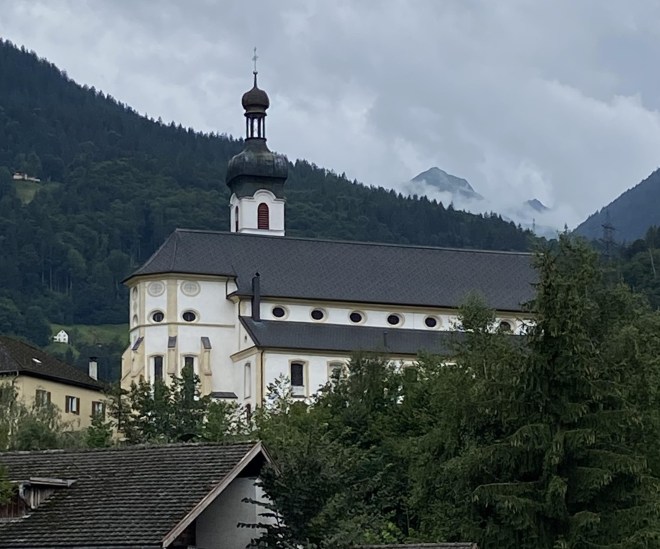
In my last post, I mentioned the brief trip my wife and I made to Schruns in the Montafon valley. We liked the Montafon valley so much that we decided to go back for some more hiking. This time, we explored new side valleys and some of the (artificial) lakes at the top of the valley. But I don’t want to talk about that, delightful though it has been. I want to talk about the view from the terrace when we were eating our dinner.
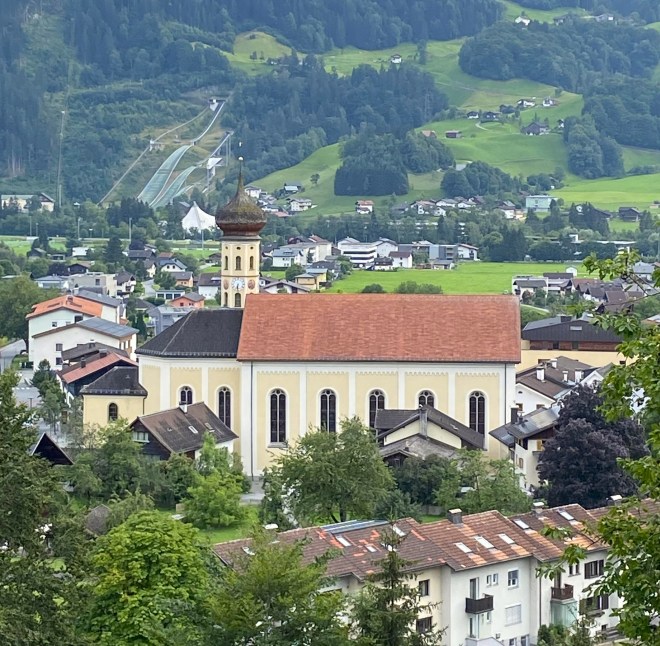
As readers can see, the town’s church tower is capped by a delightful example of an onion dome. The towers of many churches in Austria and Bavaria, as well as in other parts of the German lands, are crowned with onion domes. In the valley of Montafon alone, my wife and I saw five onion domes during our hikes or from the bus on our way to our hikes’ starting points.
Sankt Gallenkirch:
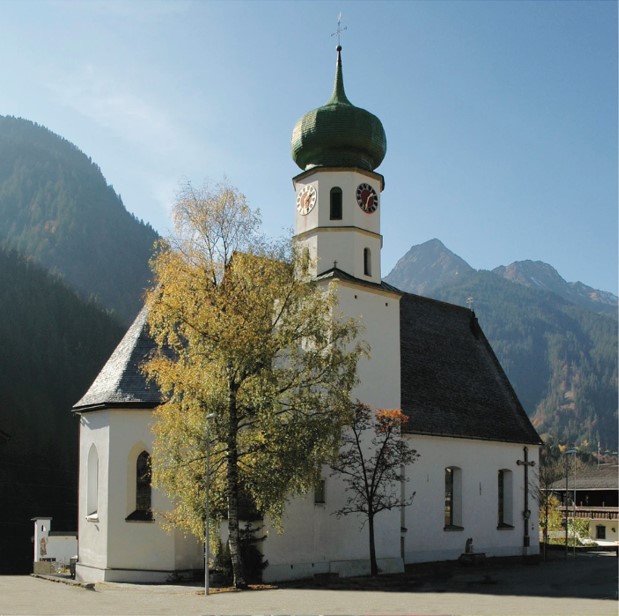
Gortipohl:
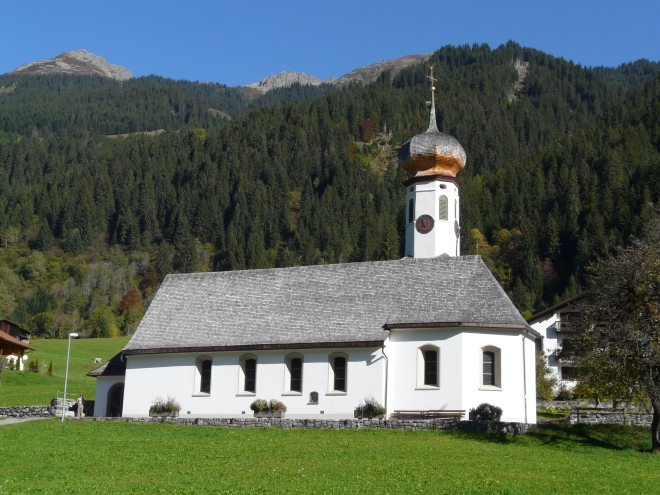
Gaschurn:
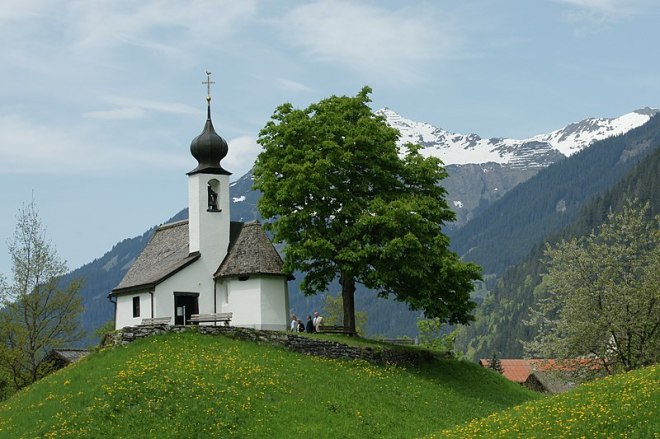
Partenen:

And finally Tschagguns, where a lantern has been inserted into the onion:
I first remember seeing these onion domes decades ago, when one of my flatmates at University invited me to spend the Easter vacation at her mother’s place in the Alps in Austria (her mother was Austrian). We drove all the way there from the UK. At some point, we crossed into Bavaria and I began seeing these onion domes atop church towers through the car window. I was rather astonished; for me, onion domes was something you only found in Christian Orthodox lands. The example that comes to mind for most people is St. Basil’s Cathedral on Moscow’s Red Square, but I refuse to give space to the invaders of Ukraine. I shall instead insert a photo St. Michael’s monastery in Kyiv.

What on earth were these onion domes doing in Germany and Austria?! I didn’t get an answer to my question at the time – even though my flatmate was studying architecture, she had never posed herself the question – and life rolled by. It wasn’t until I was sitting on that terrace staring at the tower of Schruns’s church that I posed myself the question anew. Luckily, in the intervening decades the internet has come along and Wikipedia – that splendid instrument for giving answers to the most off-the-wall questions – has been created.
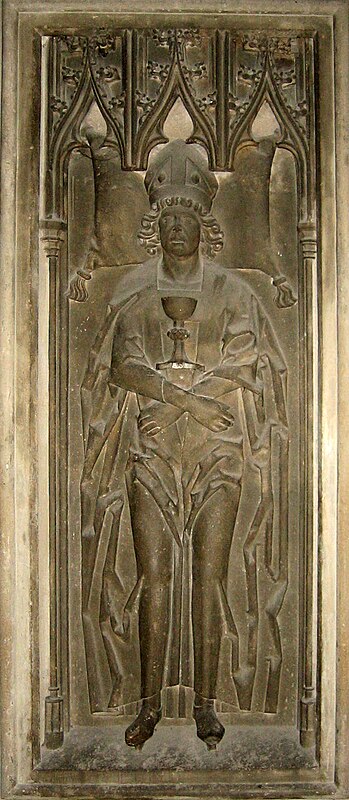
The story which Wikipedia tells is a fascinating one. First of all, this was not a question of German-speaking church builders importing a new style from further east in Europe. It seems, rather, that the answer lies with a certain Bernhard von Braidenbach, an important official in the Archdiocese of Mainz, who lived from about 1440 to 1497. He was important enough to deserve a tombstone in Mainz cathedral, of the type that brass rubbers love. I throw in a photo of his tombstone.
Braidenbach is chiefly remembered today for a book he wrote in 1486, Peregrinatio in terram sanctam, in which he recounted his pilgrimage to the Holy Land undertaken in 1483-84. He was actually accompanying (i.e., keeping an eye on) the young Count Johann von Solms-Lich, so he also had a knight with him to protect the Count and the party. And, very important for us, he took along a certain Erhard Reuwich, an artist from Mainz. Why he decided to take an artist with him is unknown – at least to me. But it’s good that he did, as we shall see. Once back in Mainz (minus the count, alas, who had died on the return trip), Braidenbach wrote what was essentially a travel guide for future pilgrims to the Holy Land. What was groundbreaking about the book is that he inserted into the text some 25 woodcuts prepared by Reuwich, of views of the cities they passed through and other topics.
The book was an instant hit with European elites. It went through several editions and was translated into numerous languages. And – what is important for our story – church builders picked up on a detail in one of the woodcuts, Reuwich’s view of Jerusalem as seen from the Mount of Olives.
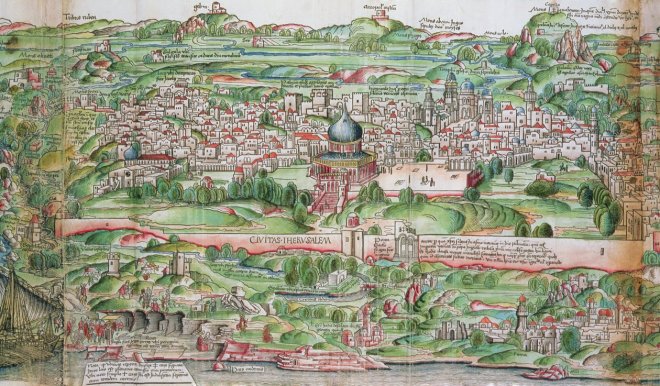
Sharp-eyed readers will immediately see the unmistakably onion-shaped dome on the building in the foreground of the woodcut. I blow up the photo for those of my readers whose sight, like mine, is less than perfect.

So there we have it. That little feature in one of the book’s woodcuts – admittedly of one of the holiest places in the world for Christians – seems to have inspired builders in the southern German lands to crown their church towers with onion domes.
The building whose onion dome they copied is the Dome of the Rock, an Islamic shrine at the centre of the Al-Aqsa mosque compound on the Temple Mount in the Old City of Jerusalem. This aerial photo is taken more or less from above the Mount of Olives and gives a very similar view as the woodcut.

The photo shows the unmistakable octagonal arcade surrounding the dome. It also shows – shock! horror! – that the dome is not onion-shaped! From my extensive reading (in Wikipedia), it seems that it never was. As far as I can make out, the dome has kept the same shape it had when it was built back in 692 AD.
I have to assume that our friend Erhard Reuwich was taken by a fit of poetic license when he prepared the woodcut. Quite honestly, I’m glad that he was feeling poetic the day he laboured over the woodcut, because otherwise I wouldn’t have found myself staring with such pleasure at the church tower in Schruns and other places in Montafon valley.
In this day and age of hostility between the Islamic and Christian worlds, I’m also rather pleased to see that Christian church builders don’t seem to have had any scruples about copying the dome of an Islamic building for their Christian churches.
Well, I finished this post on the train back to Vienna, and as I paused and stared out of the window somewhere in Bavaria, a church tower with an onion dome flashed by.
 the heart thrills
