PHOTO ALBUM OF A HIKE

Vienna, 8 June 2025

My wife and I recently completed a four-day hike around the Danube, in the reaches of the river some 20 km upstream from Linz. We started in the village of Ottensheim, made our way to Eferding and then to Aschach, ending the hike in the village of Sankt Martin. I can’t resist inserting here a composite photo I’ve created of the hike.

My composite

As readers can see, we wandered rather drunkenly along the Danube.

The wonderful thing about hiking is that you move slowly across the landscape, which allows you to notice things which you probably wouldn’t notice on a bike, let alone a car. I give my readers here a taste of what my wife and I came across – quite serendipitously – as we slowly crossed this Danubian landscape.

Thursday

We arrive in Ottensheim, which sits on the Danube river, in the early afternoon. We take advantage of our early arrival to go for a walk on the high lands behind the town. Here is the view of the Danube which greets us at the top. You can see the hydroelectric dam spanning the river. We’ll be passing that dam tomorrow.

My photo

We have pizza at the place we’re staying the night, down by the river’s bank. We chat with the staff, all Neapolitans, who all left Naples because of a lack of opportunities there. A story we’ve heard so many times. Such a tragedy for Naples, this steady draining away of their youth.

Friday

We’re greeted at the exit of the hotel by this strange painting on the wall of a house.
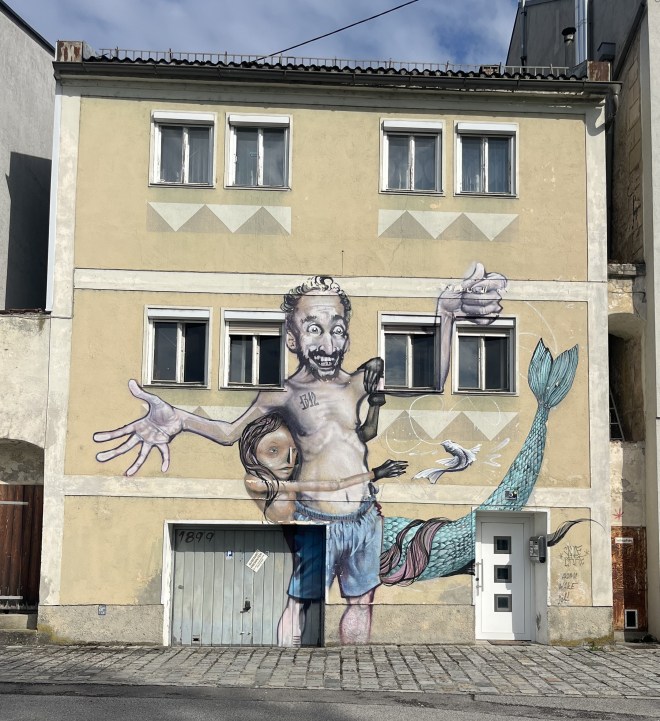
My photo

Not sure what happened to the mermaid’s nose …

We’re waiting to board the ferry, which will carry us over to the other bank.

My photo

While waiting, we spy a statue of St. Johann Nepomuk, protector of those who cross streams and rivers, so common in this part of the world. This statue is coloured, though, which is rare.

My photo

The view from the ferry’s deck, looking upstream. The hydroelectric dam is in the far distance.

My photo

We can also see a peek of Ottensheim’s local castle in that last photo. We get a better view as we start walking along the river’s bank.

My photo

Its recent history has been quite eventful. Owned by a British family in the 1930s, it was confiscated by the Nazis at the beginning of the war. They used it as a forestry office for the Wermacht. After the war, the Soviets, who occupied that side of the Danube, used it as a barracks. After they left in 1955, when Austria got back its independence, the castle reverted to its pre-war owners. By then it was in a pretty sad state, but its owners didn’t have the money to restore it. It was only in 1988, when the castle was sold to a group of families with deeper pockets, that the castle could be restored. It is still in private hands.

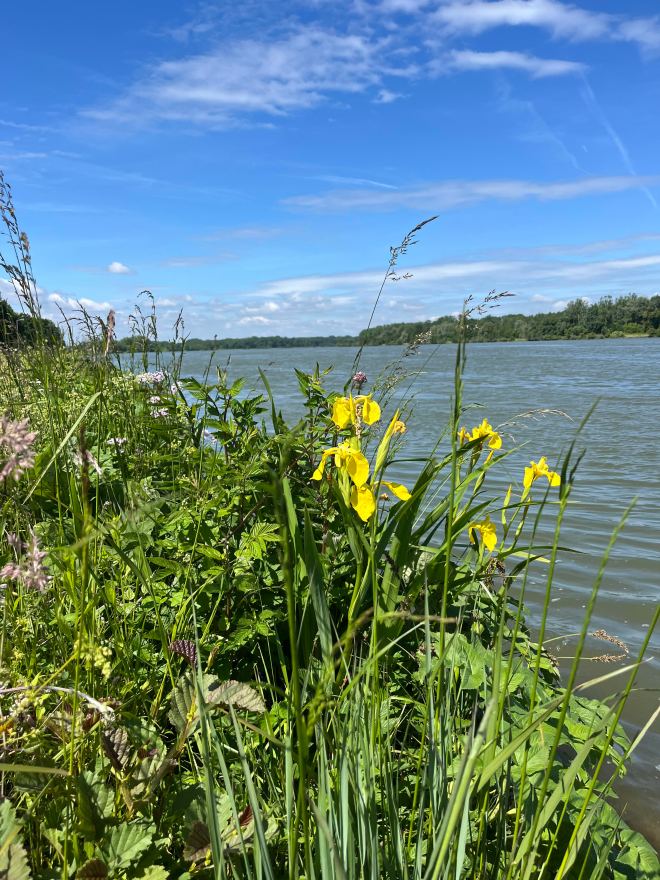
Yellow irises blooming along the water’s edge, the first of many wildflowers we will be seeing on this hike.
My photo

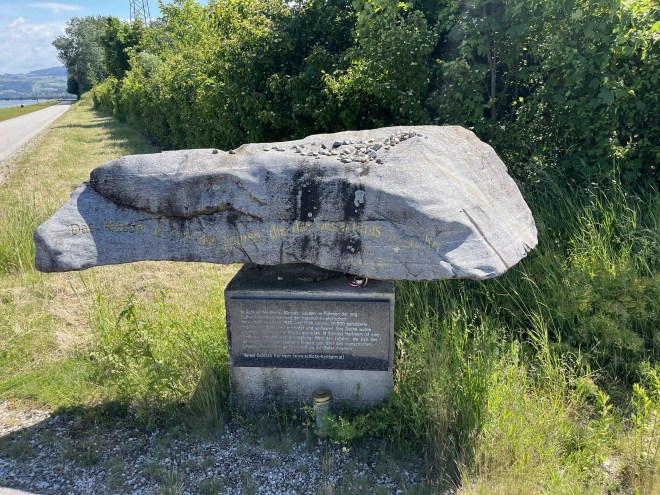
Close by, a memorial on the side of the path.
My photo

It commemorates the nearly 30,000 people murdered through poisoning with carbon monoxide by the Nazi regime in nearby Hartheim castle, between May 1940 and December 1944. Once their bodies had been cremated the ashes were brought to this spot and dumped into the Danube. Until September 1941, it was a “euthanasia” centre, where 8,000 physically and mentally handicapped people, almost all from Bavaria and Austria, were murdered. After Hitler closed down the Nazis’ euthanasia programme (because of protests from the Roman Catholic Church in Germany), the centre quickly “pivoted” to become a centre for the killing of inmates from nearby concentrations camps, primarily Mauthausen or its satellite camps, who were too sick or injured to work any longer. By December 1944, they had murdered a further 12,000 people, most of them Soviet Prisoners of War.

Wildflowers by the side of the path

My photo

Outside a fire station, an intriguing monument to firemen and women, as well as to officers of the Austrian river authority.

My photo

An old farmhouse on the edge of the road.

My photo

Eferding, the end point of today’s hike, with the parish church’s bell tower dominating the town.

My photo

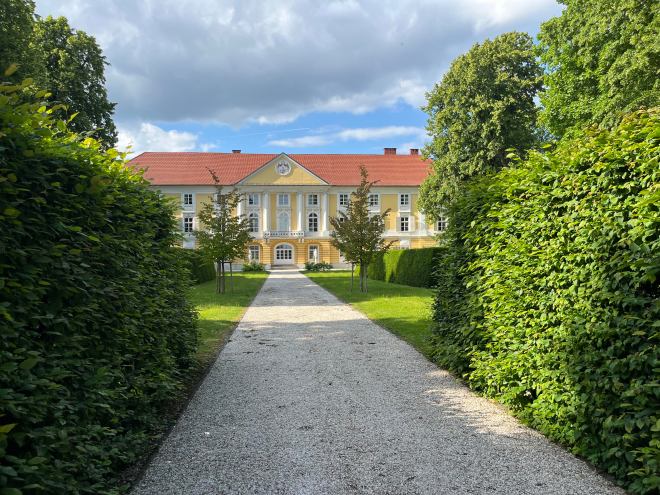
A photo of Eferding’s castle, taken by slipping my iPhone through the big gates that barred entry.
My photo

The castle is still owned by the Starhemberg family, who inherited it and the lands that came with it in 1559. Interesting family. They’ve been involved in Austrian politics for the last 1,000 years or so. The latest (in)famous member of the family was Ernst Rüdiger Prince von Stahremberg, who was born in 1899 in the castle and died in 1956 in Voralberg. He was a right-wing politician with great admiration for Mussolini’s fascism. He served in Austria’s right-wing governments from 1930 until 1936. Although fascistic, he really disliked the Nazis and made his dislike very public, so after the Anschluss of 1938 he fled to Switzerland to avoid vengeful retaliation by the Nazis (and perhaps also to protect his wife, who was Jewish). At the beginning of World War II, he served in some capacity in the British and Free French Air Forces, but he resigned in disgust after the UK and the US allied themselves with the Soviet Union in 1941 – he viewed communism and Nazism as equally evil. Thereafter, he and his wife left for Argentina; not unnaturally, he felt a great affinity with the politics of Juan Peron. In 1956, after Peron had been ousted by the army, he travelled to Austria for an extended visit, no doubt to explore the possibility of coming back. He was staying at a spa in Schruns (the bell tower of whose parish church I had so admired last year). During a walk, he was photographed by a journalist who worked at a communist newspaper. In a rage, he attacked the journalist with his walking stick, but this triggered a cardiac arrest and he died there on the pavement.

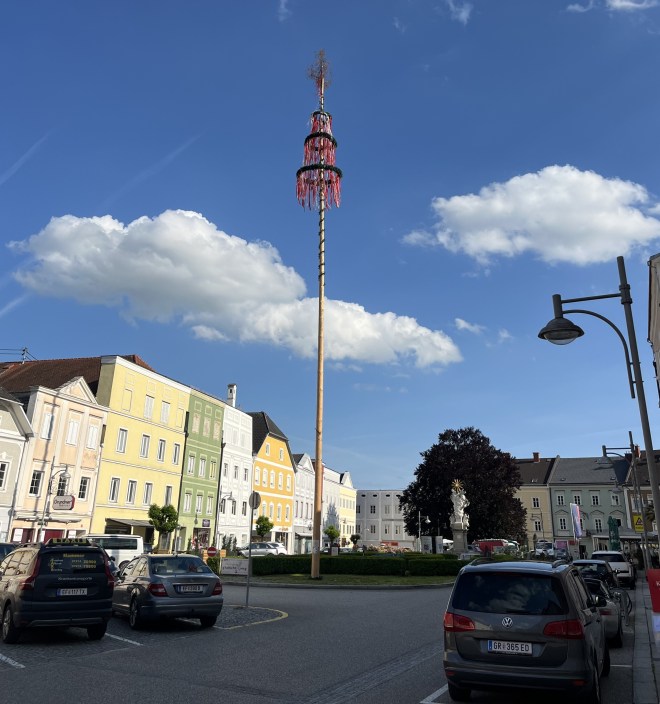
Turning my back on the Stahremberg castle, a view of Eferding’s main square

My photo

with its maypole still standing

My photo

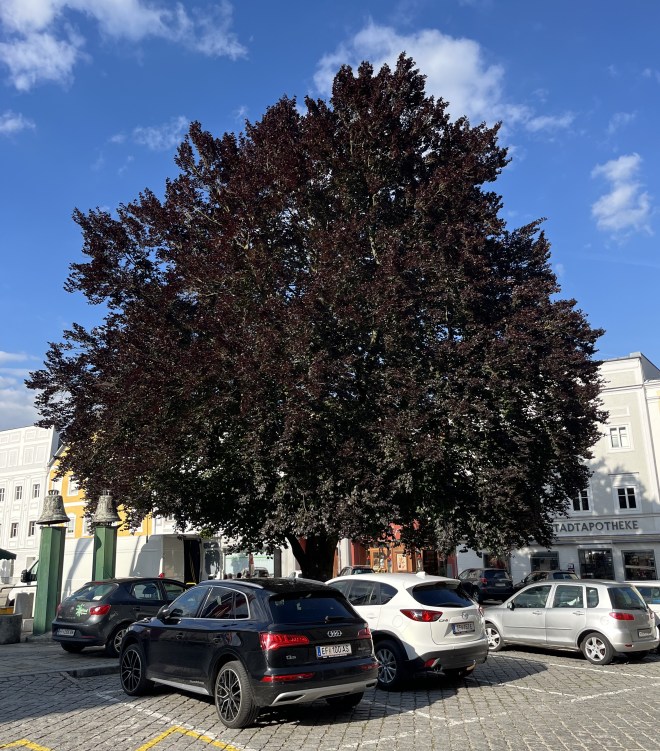
and a magnificent copper beach at the far end.
My photo

Eferding’s parish church

Source

with its beautifully carved pulpit (although not as beautiful as the one my wife and I saw in Traunkirchen several years ago)

Source

and the tombstone of some long dead knight.

My photo

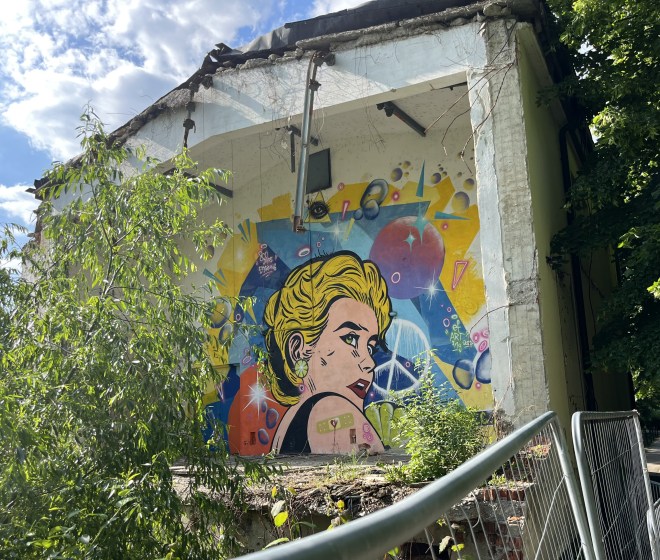
A Lichtenstein-like mural on the wall of a ruined house
My photo

An amusing ad for a shop offering orthopaedic services.

My photo

And so to dinner and bed.

Saturday

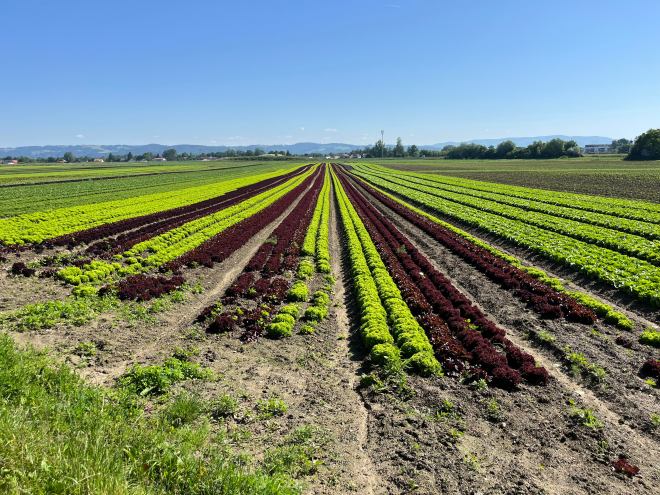
We start the day by walking over the rich farmland around Eferding. We pass these multicoloured rows of lettuces.
My photo

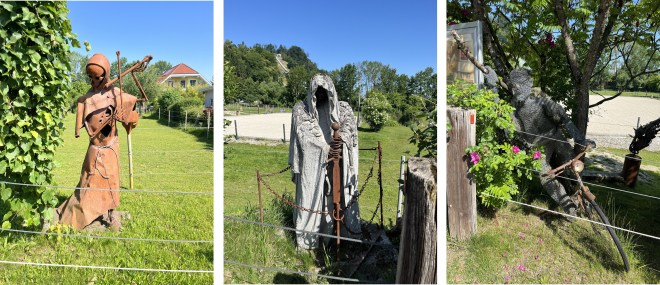
We go past a garden whose owner must be an amateur sculptor with a fondness for using scrap metal.
My photos

Nearby, beauty among the garbage.

My photo

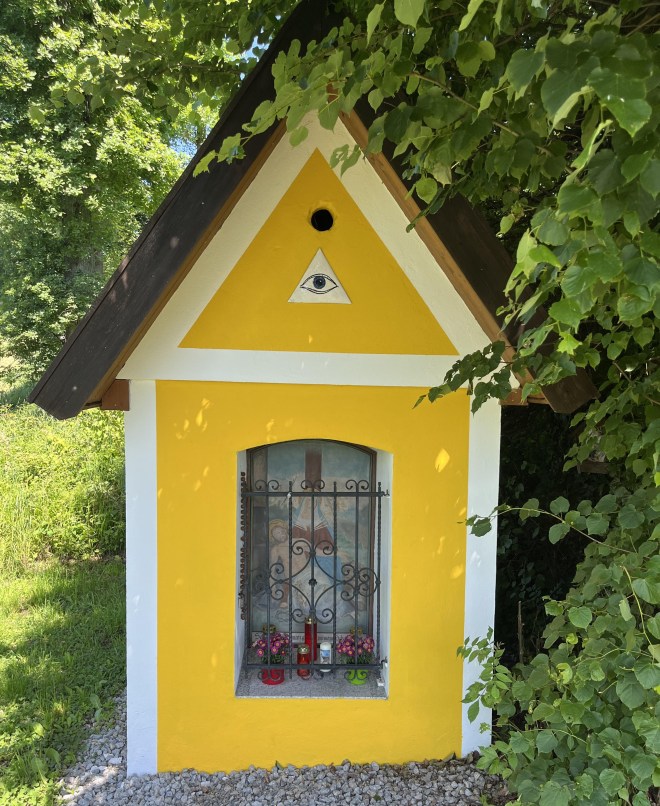
We begin to climb a steep ridge. We pass a shrine on the side of the road.
My photo

Shrines are common throughout Austria, but I notice that in this region shrines – like this one – have an eye painted on them. I suppose it represents God, the “All-Seeing Eye”. But I find it rather unnerving: “You can’t hide from me, I can see everything that you do” – just like Big Brother in George Orwell’s “Nineteen Eighty-Four”.

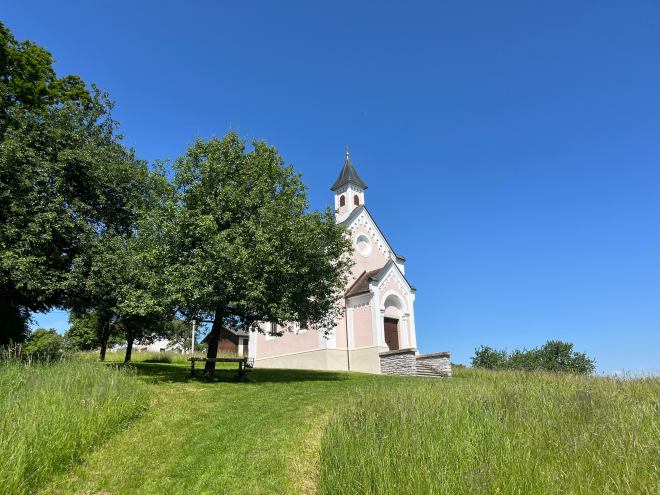
A chapel at the top of the ridge.
My photo

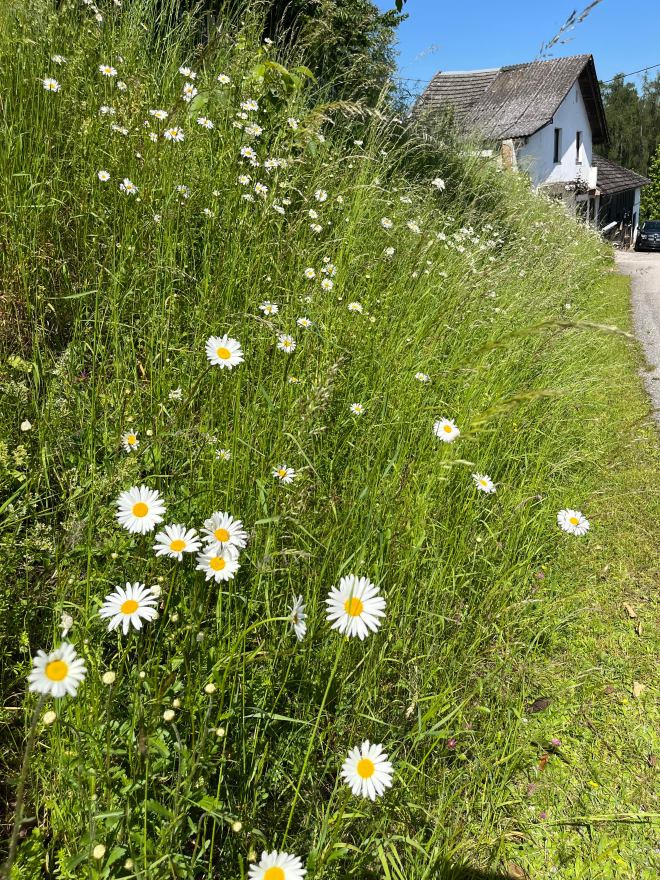
A spray of daisies on the side of the road.
My photo

We plunge into the woods.

My photo
My photo

A view over the plain around Eferding.

My photo

We come down the ridge and pass the small airfield – literally, in this case – of a gliding club.

My photo

We have been watching the gliders soaring over us all morning; my iPhone, alas, cannot capture their ethereal beauty.

We look back at the ridge we walked along, with a castle ruin sitting on it.

My photo

We stop for lunch in the village of Pupping, finding a bench in the parish church’s garden to sit on. I, of course, cannot pass up the opportunity of visiting the church after lunch. I find a mix of old and new.

A statue of St. Wolfgang, who, it is said, died at the altar of the (original) church in 994 CE.

My photo

A statue of St. Christopher, looking less than pleased with having to carry the Child Jesus.

My photo

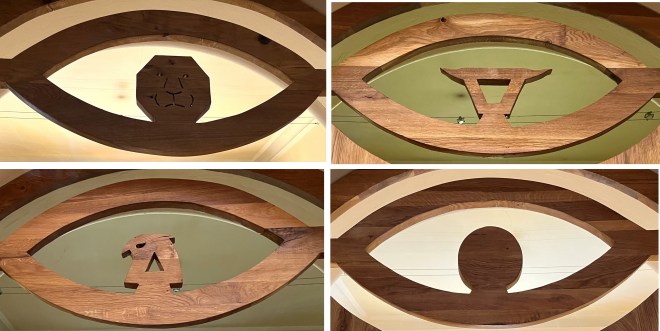
Four carved door lintels, displaying the symbols of the four Evangelists: clockwise from the top left, the lion of St. Mark (you have to look hard to see the lion’s face), the ox of St. Luke, the angel of St. Matthew, and the eagle of St. John.
My photos

It takes me a while to understand that Luke’s angel is represented by an eye – the eye again …

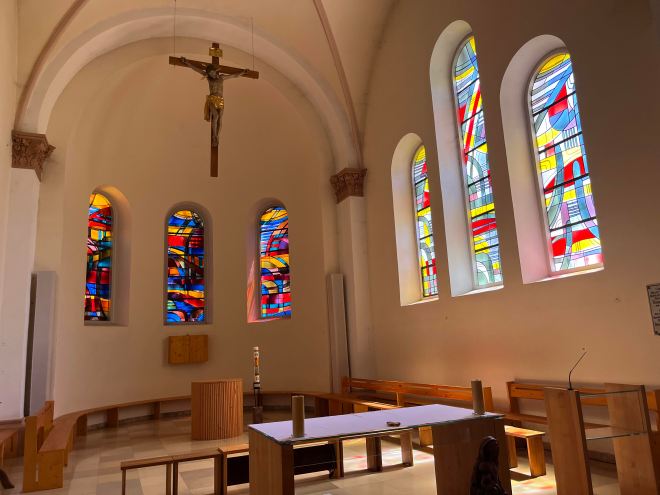
Rather pleasant stained-glass windows.
My photo

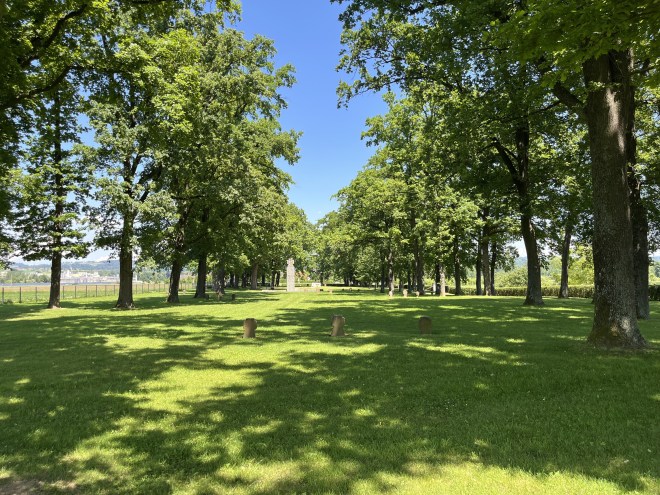
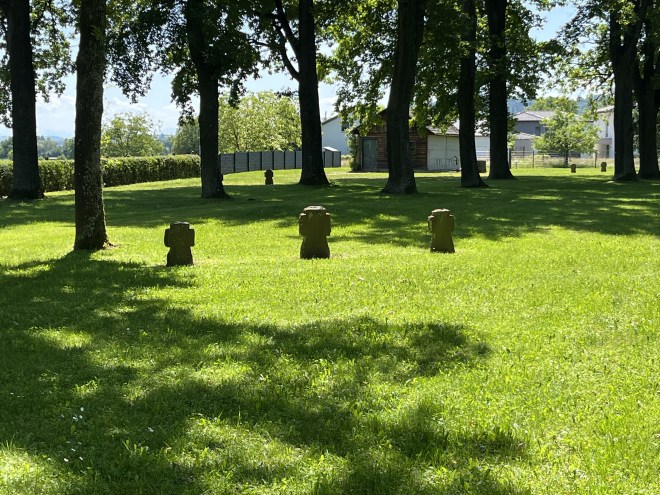
We continue the hike towards our end point today, Aschach, on the Danube. Quite by chance, our route takes us past a war cemetery.

It has the look and feel of the German war cemeteries which my wife and I had visited on the Western Front: tall oak trees, shading a lawn, in which are planted stone crosses.
My photo
My photo
My photo

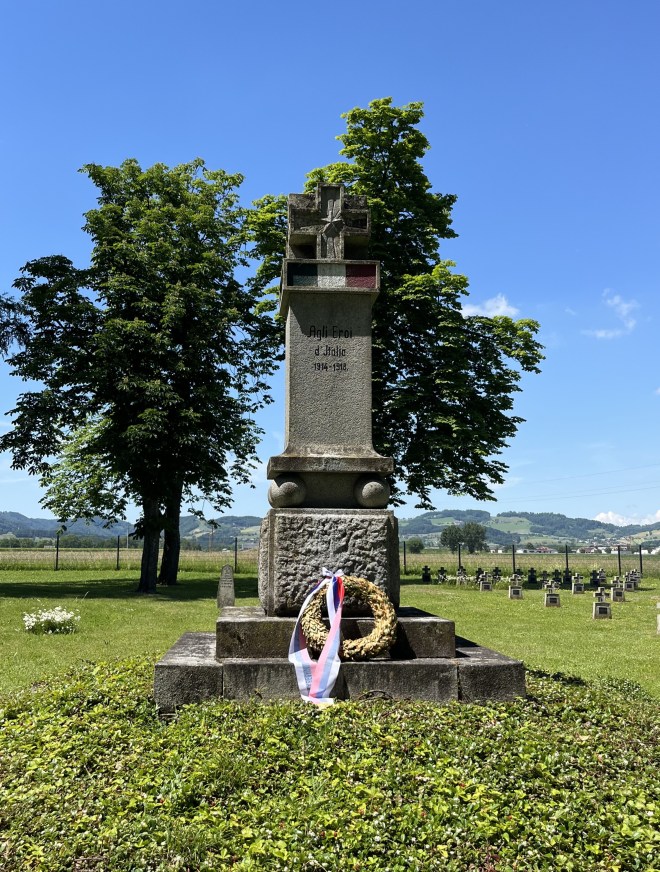
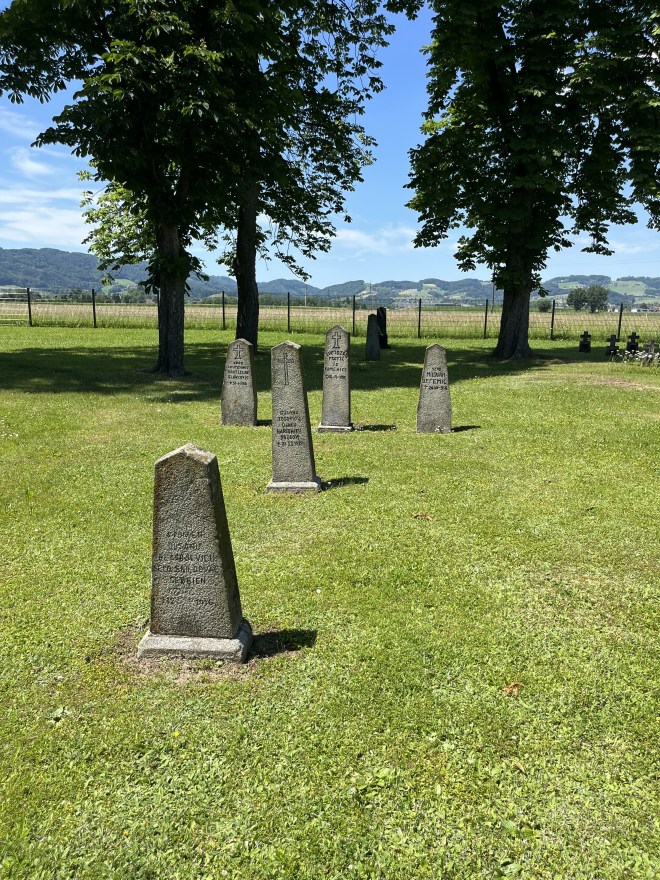
But actually, although the cemetery is looked after by the German association for war graves (hence the look), none of the soldiers buried there are Austrian or German. And none of the dead who are commemorated fell on the frontline; they were all prisoners of war who died in a POW camp which the Austro-Hungarians built close by for use during the First World War. They were mainly Italians

My photo

with their memorial

My photo

and Serbians

My photo

with theirs.

My photo

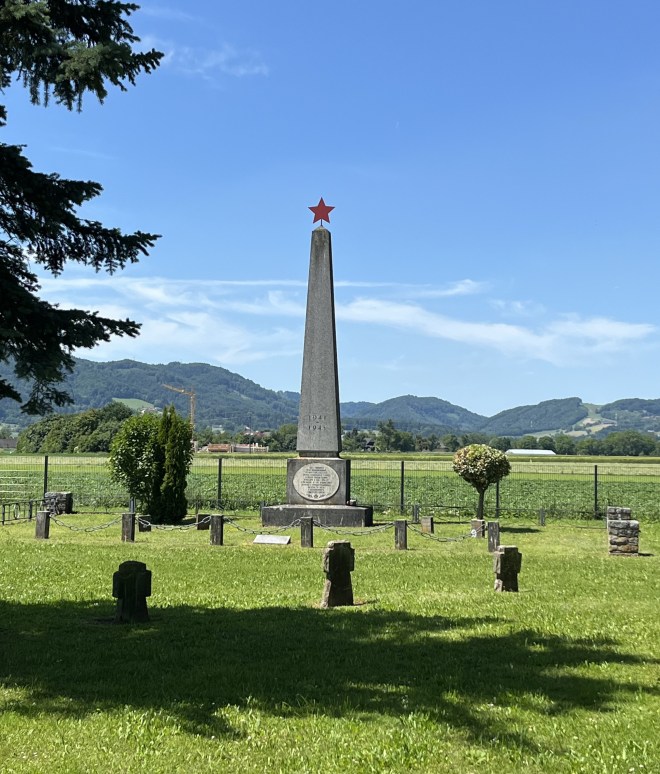
After the Second World War, the Soviets put up a memorial to their POWs who had been murdered in Mauthausen and other nearby concentration camps.
My photo

Of course, the thousands of murdered Soviet POWs didn’t get an individual grave, their names were not even inscribed on a monument. But some Russian family had come and attached a photo of one Soviet prisoner to a stone cross, with the epitaph “We remember, we love, we grieve. The grandchildren”.

My photo

We walk on to Aschach.

Sunday

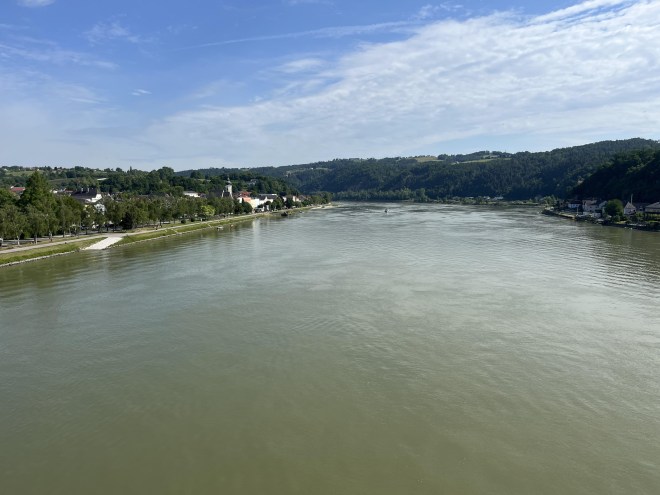
We start the day by once again crossing the Danube, but this time using a bridge rather than on a ferry.
My photo

Some purple irises catch my eye as we walked along the river bank.

My photo

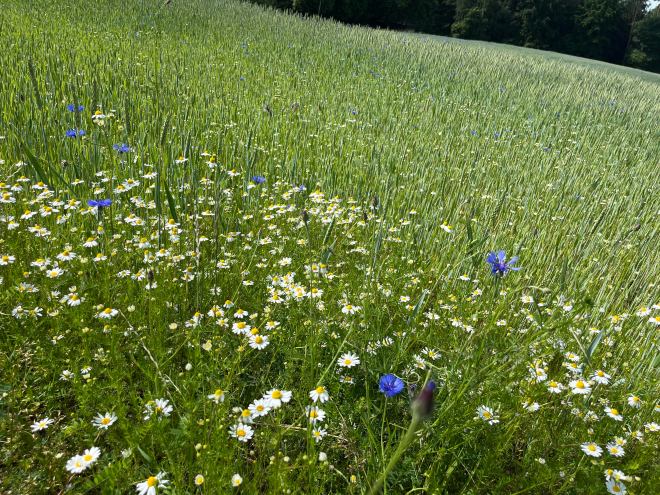
We climb up to the high lands overlooking the river, past fields of wheat studded with corn flowers and daisies.
My photo

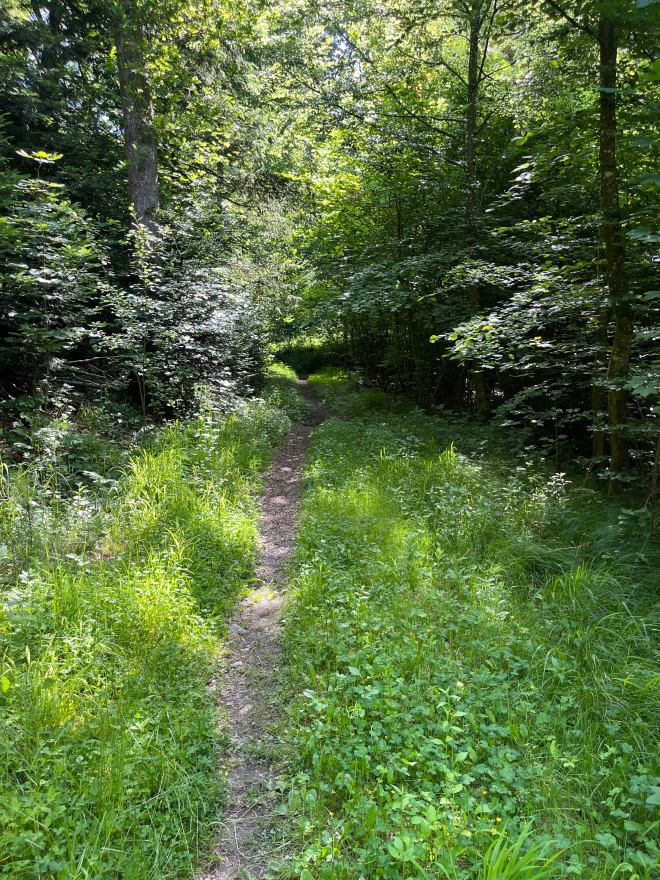
We enter the woods.

My photo

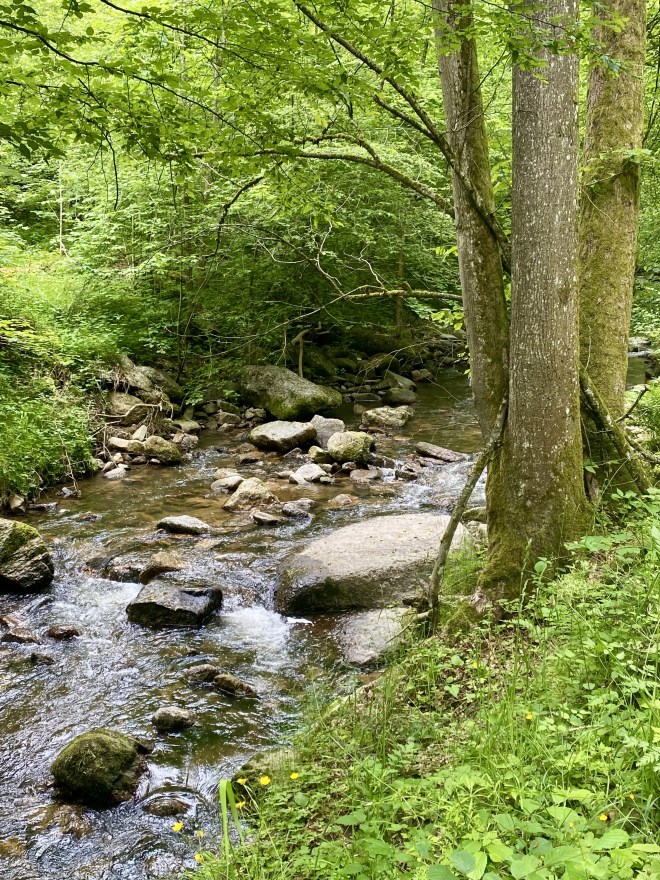
The path eventually leads us off the high lands and down to a stream at the bottom of a valley. We start following the stream towards its source. At first, the stream cheerfully burbles along.
My wife’s photo

But soon the stream bed becomes rough as stones from above have tumbled down, and the water jumps around.

My photo
My photo

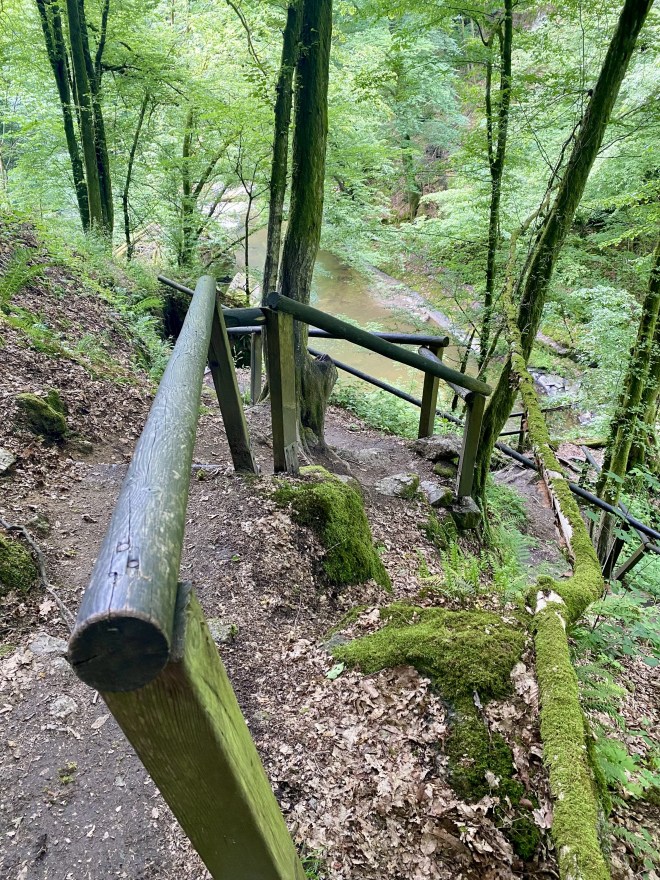
The path mimics the roughness of the stream.
My wife’s photo

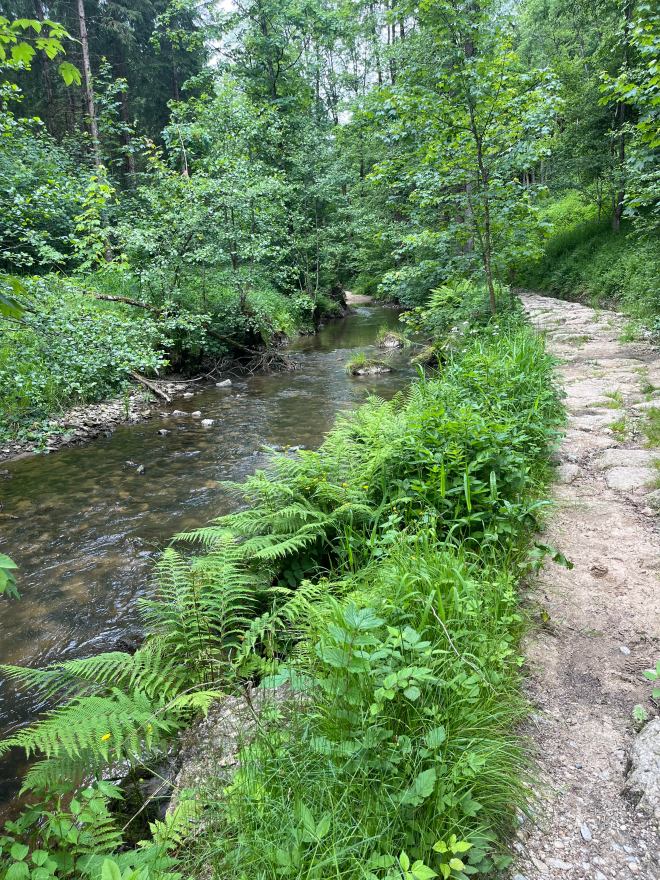
Once we reach the high lands, the stream quietens down, the path likewise.
My photo

We pass meadows along the stream’s banks. Some have been turned into lawns.

My photo

Here, another anonymous sculptor has turned a tree trunk into a whimsical totem pole.

My photo

One of the meadows is carpeted in pink flowers.

My photo

Finally, we leave the stream and climb up onto a ridge. An alpine pasture falls away to our right. It is impossibly green.

My photo

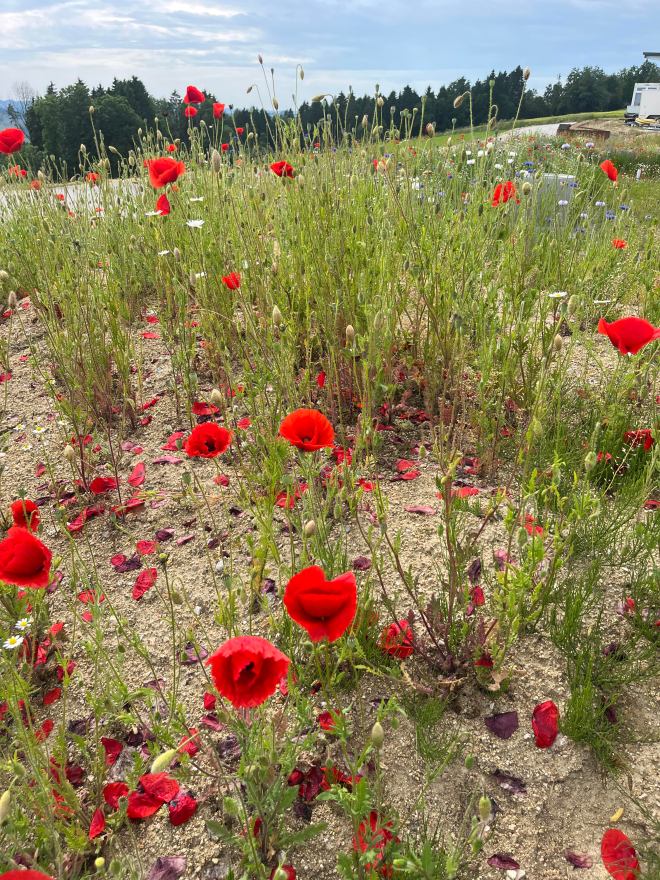
We pass through Sankt Martin and start walking along a main road. This is the only way to our hotel. We pass a building site, where a riot of poppies grow: beauty clothing the ugliness.
My photo

We reach the hotel. Our hike is finished.

WILDFLOWER EXPLOSION

Los Angeles, 10 April 2017

The dark clouds which dumped huge amounts of rain on southern California a few months ago have had a multicolored lining: the intense blooms of wildflowers which have burst out all over this desertic and semi-desertic landscape – water is life. A few posts ago, I wrote about the wildflower blooms in Joshua Tree National Park, considerably more intense this year than in previous years.

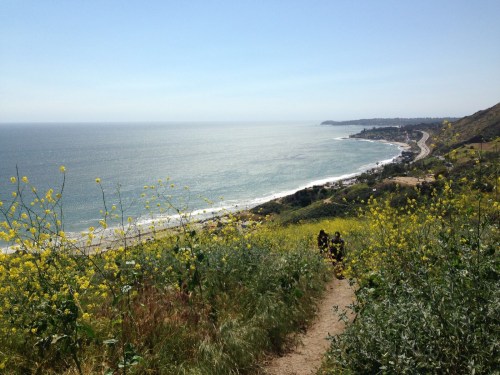
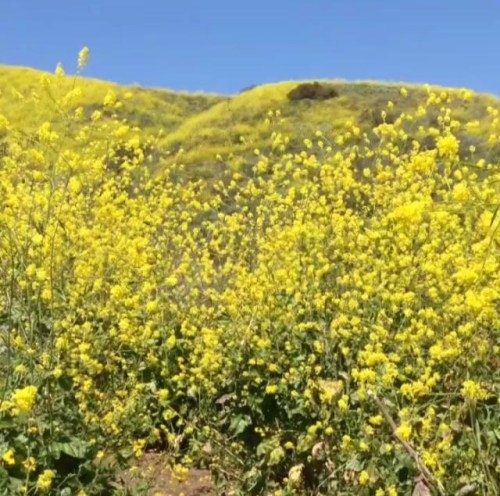
Last weekend, my wife and I joined our daughter and her boyfriend on a trek in the Malibu hills where they plunge into the Pacific Ocean.

The hillsides were a riot of yellow, with the flowers growing head high, crowding in over the track, brushing your face, leaving pollen streaks on your cheeks.

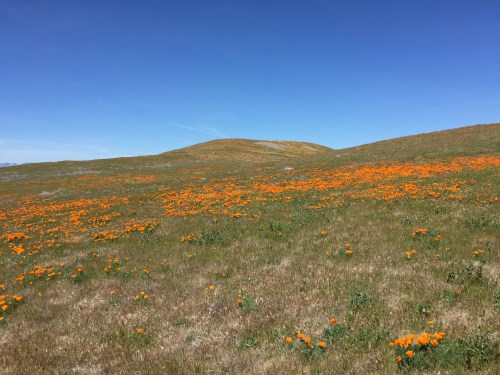
And there has been the Antelope Valley California Poppy Reserve …

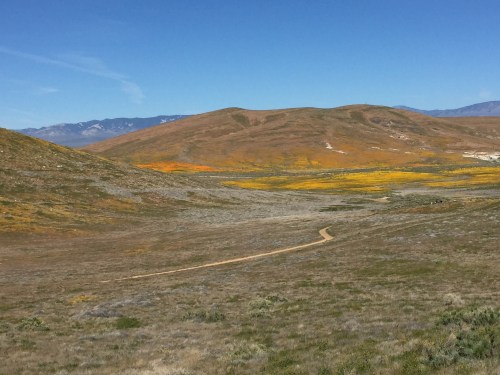
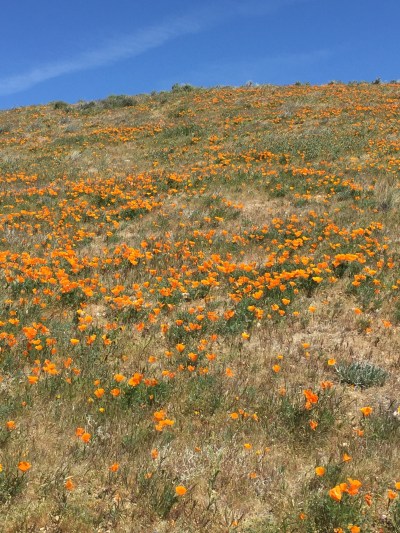
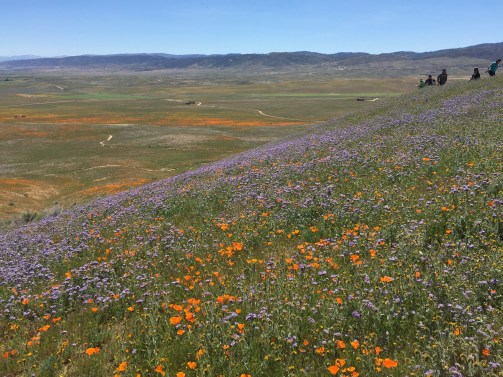
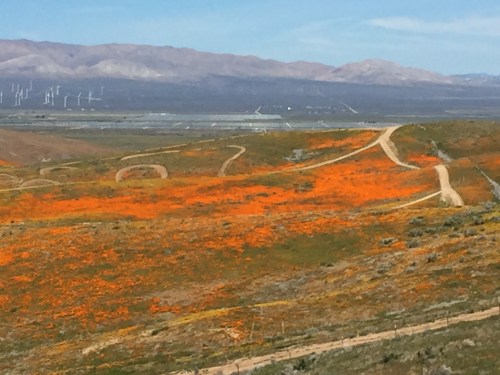
My wife and I went up there some ten days ago. As we exited San Francisquito Canyon high up on the southern slope of Antelope Valley, we saw spread before us on the valley’s opposite slope several faint patches of orange shimmering in the heat: our goal.

On we drove, down to the valley’s floor and along the its northern slope. We turned a corner and the banks of the road suddenly flamed orange. We were starting to see the California Poppy close up.


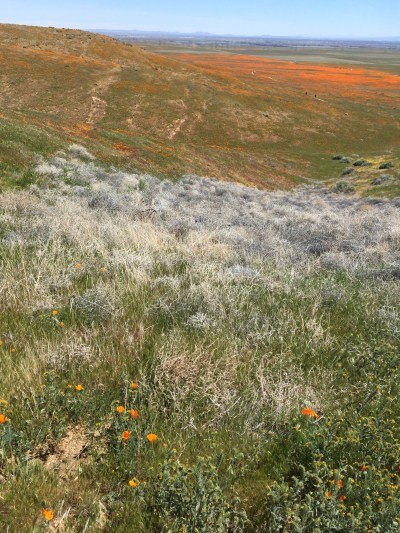
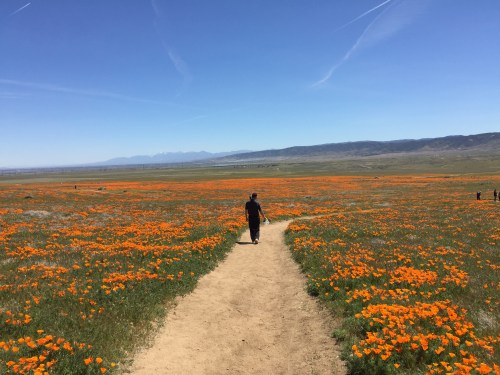
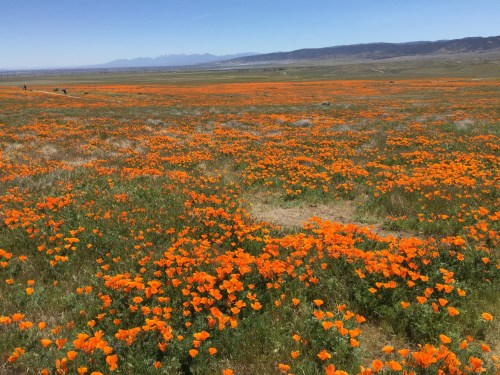
After paying our park entry fee and parking the car, we started walking the trails. Our aim was to climb to the top of Kitanemuk hill, walk along the crest a while and then come down and loop around back to the car park. These photos document our walk. I don’t think they need commenting.


I love wildflowers. I love their brilliance, their panoply of shapes and colors. I enjoy their anarchy; not for me the regimented flower beds of suburban gardens. I mourn their evanescence. I see them for a short time in Spring, and spend the rest of the year impatiently waiting their return. I’m really glad that our daughter’s birthday – our excuse for coming to Los Angeles – serendipitously coincides with the annual wildflower explosion in this corner of the world. And I’m secretly thankful for all that rain earlier in the year. It brought much misery to many but a great joy to me and my wife.

____________

Pictures: all ours

NOTES ON AUSTRALIA – UPPER MURRAY RIVER

Beijing, 8 October 2013

After a quick visit to Canberra and its museums, which I covered in my last post, we were on our way to the Snowy Mountains and beyond. Since I want to focus on the beyond, I’ll quickly slip through the mountains part. It wasn’t quite that easy in practice. Our plan was to drive along the Alpine Way, but when we got to Jindabyne, we discovered that the Way was closed after Thredbo because of a massive landslide.  What to do? After poring over the map, we decided to loop through the mountains to the north and rejoin the Alpine Way just before Corryong.

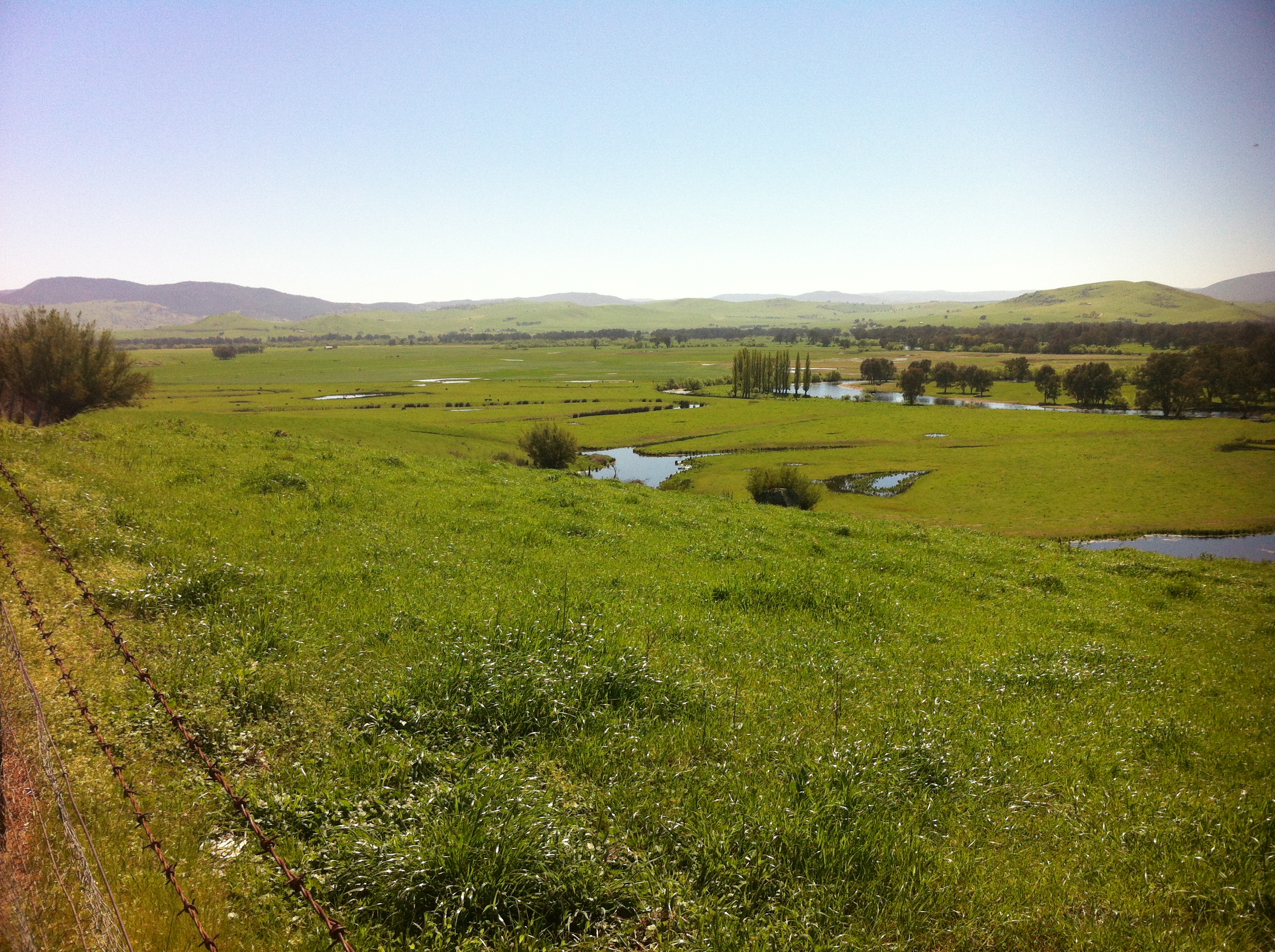
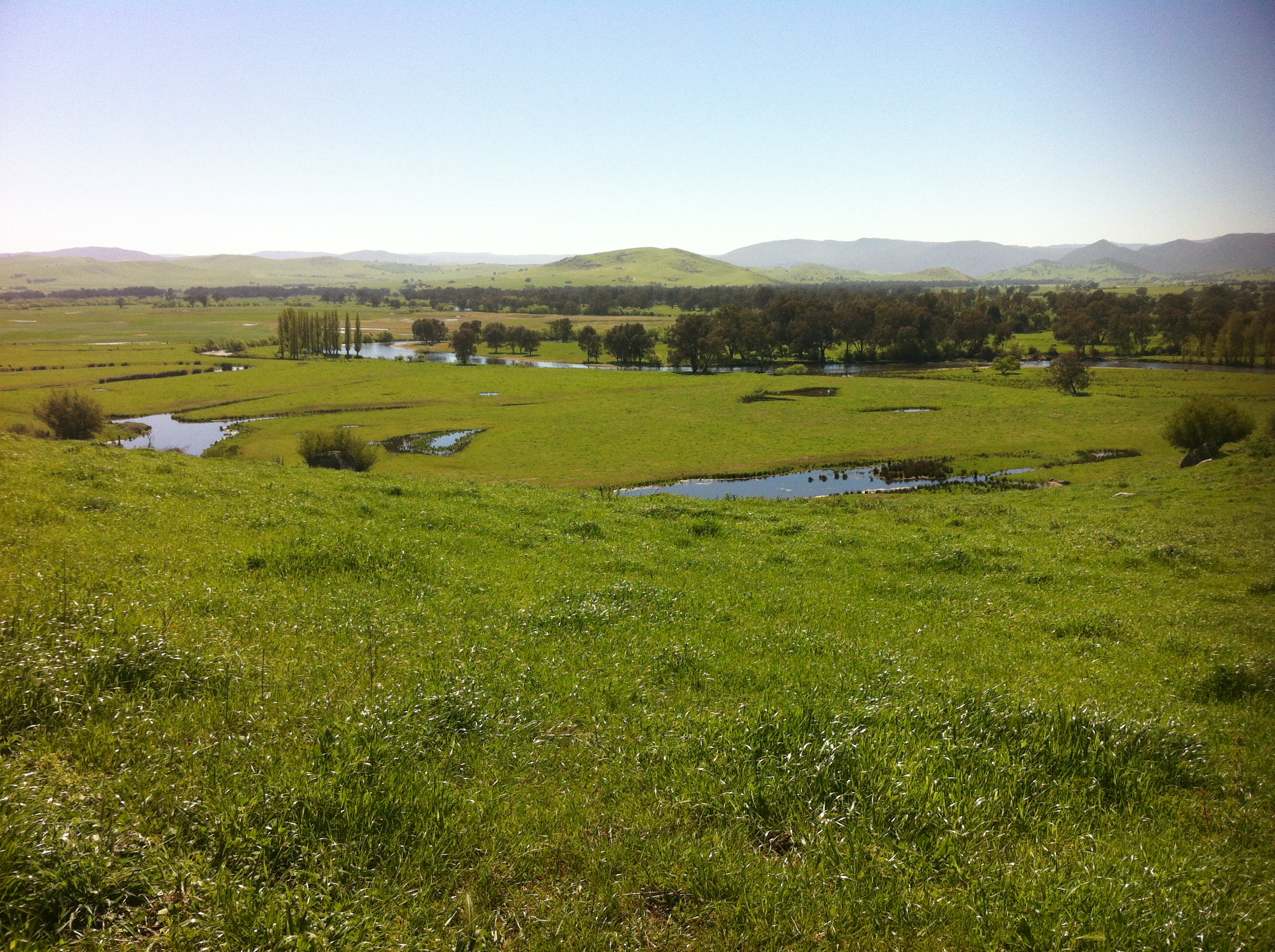
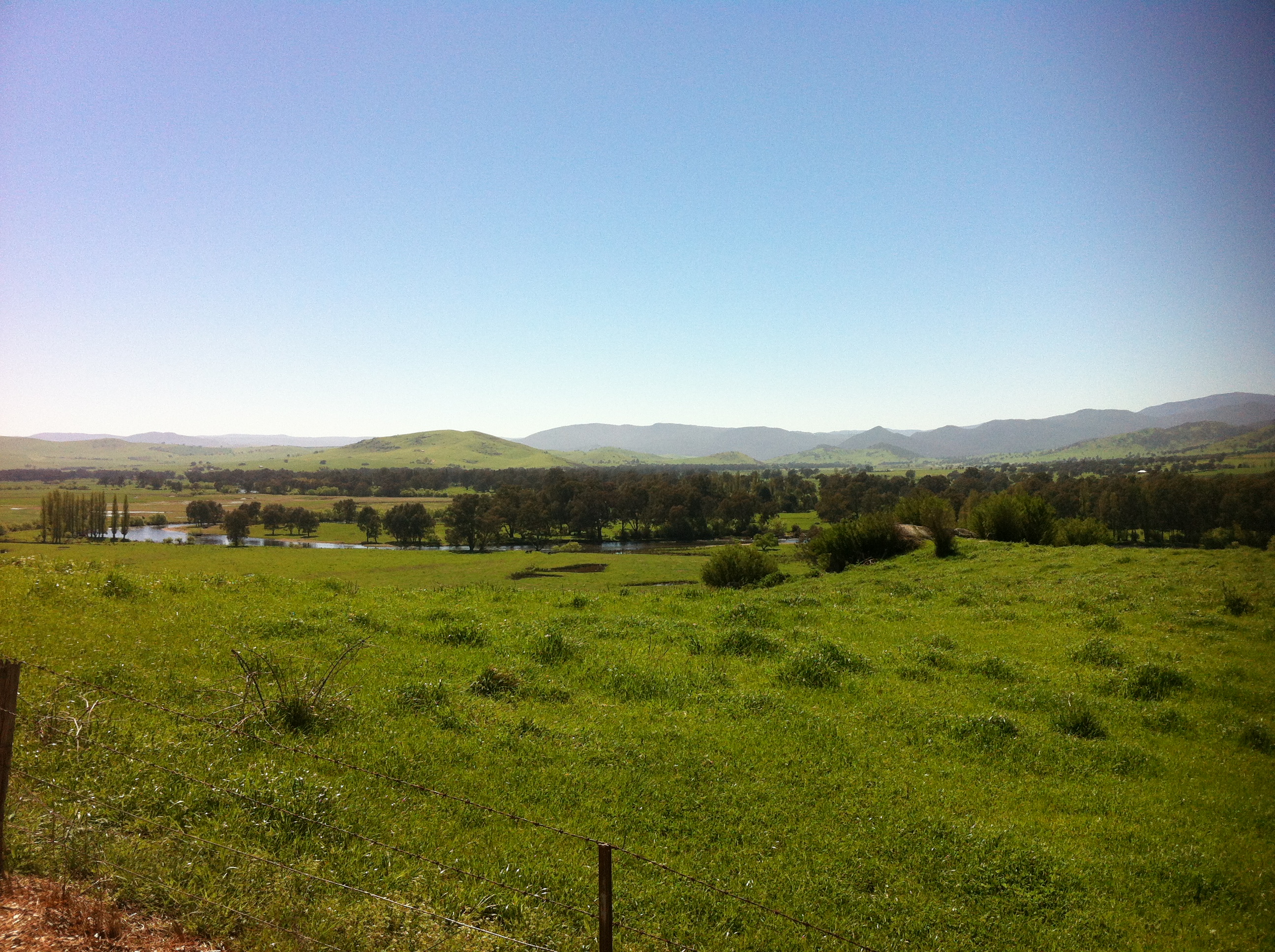
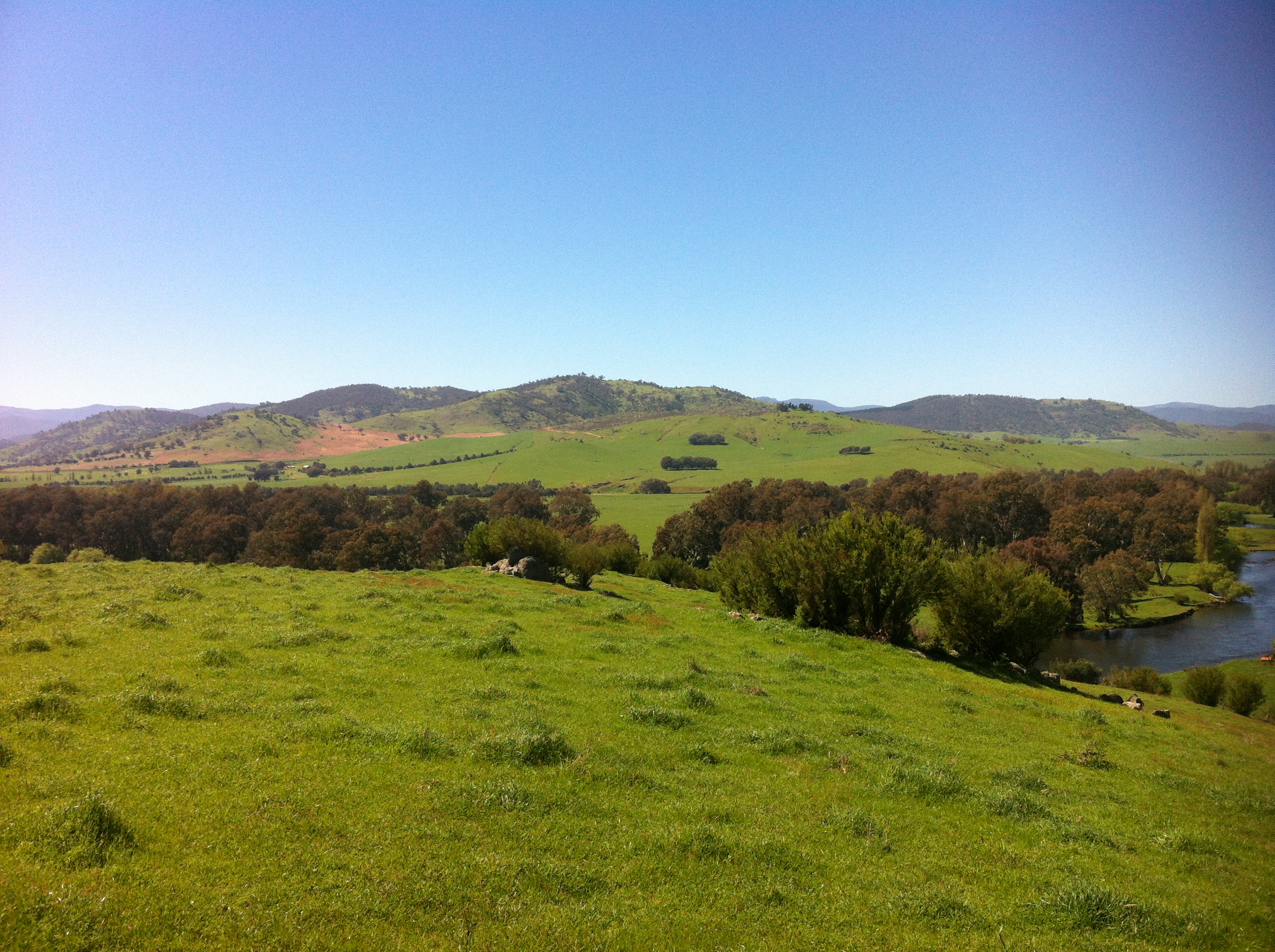
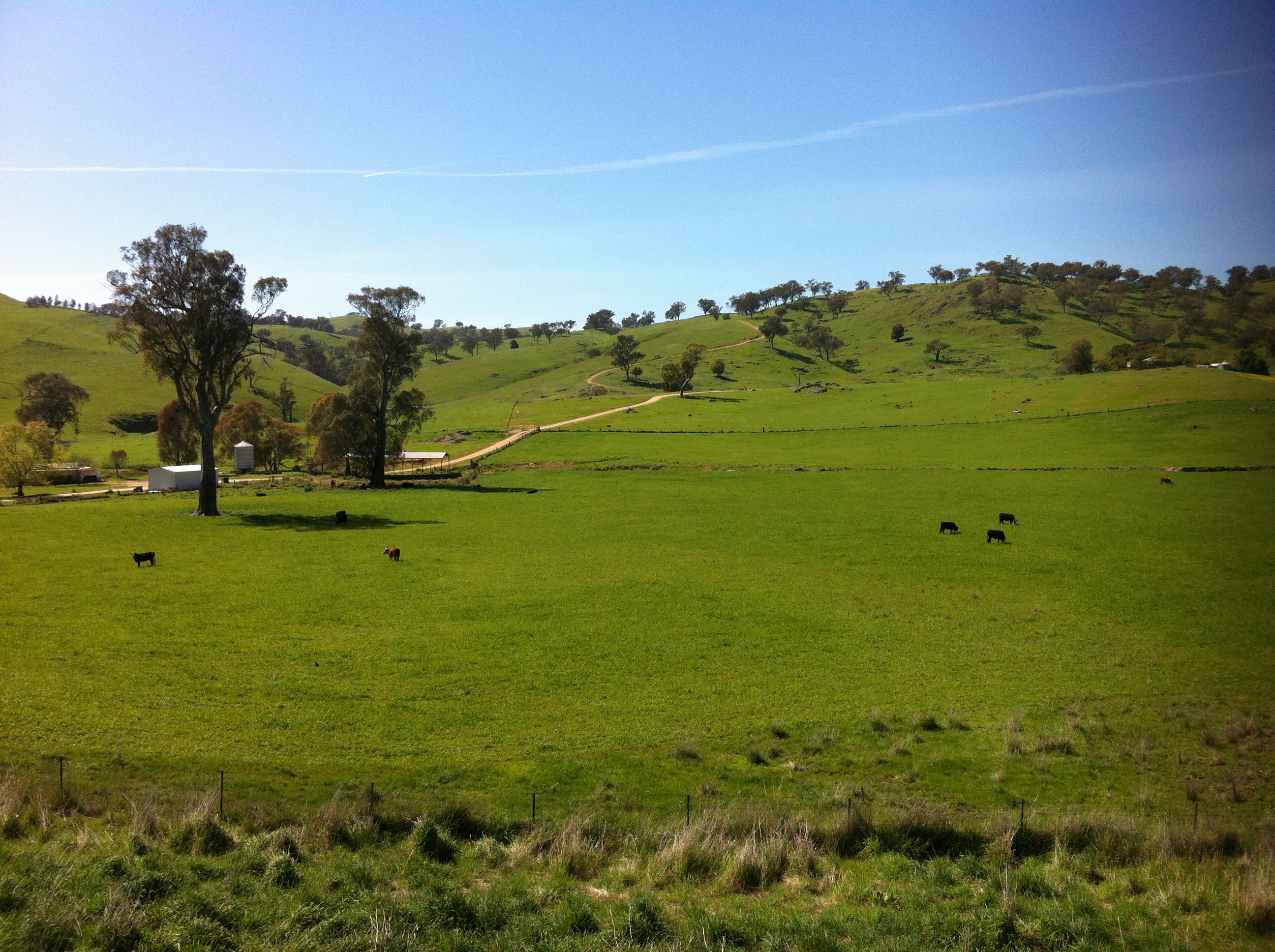
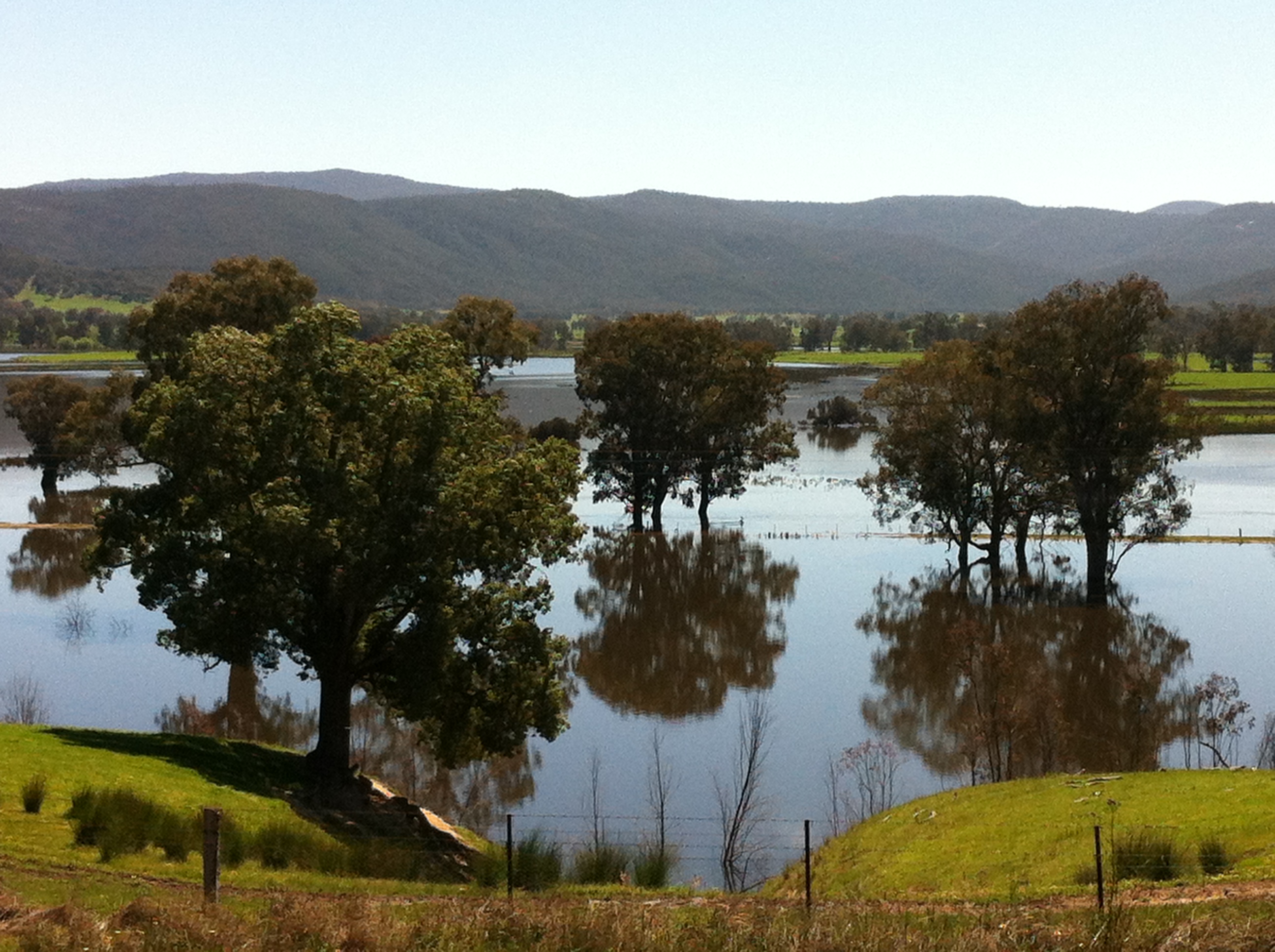
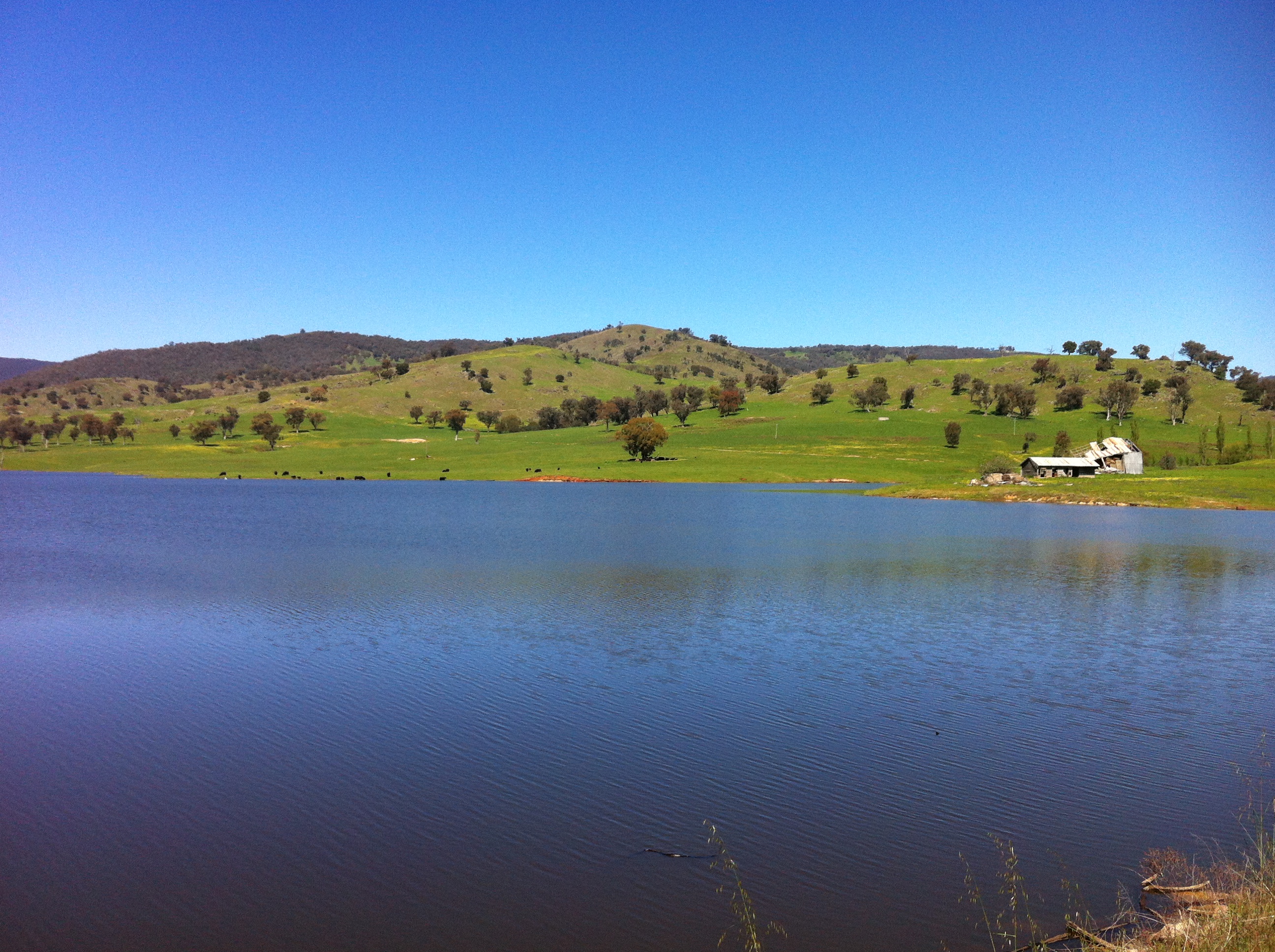
And so we found ourselves, without really planning it, in the upper reaches of the Murray River. I have to tell you, it was absolutely, absolutely lovely.  Maybe we were lucky with the season, with spring being in full swing. It certainly helped that we had clear, sunny days. Here’s a series of photos I took with my iPhone. Hopefully, they can give readers a sense of the sheer beauty of the landscape that we had wandered into.

upper murray river valley-corryong 020

upper murray river valley-corryong 019

upper murray river valley-corryong 017

upper murray river valley-corryong 016

upper murray river valley-corryong 015

You can see the Snowy Mountains in the distance, while the river in the foreground is the Murray River and the ponds are the famous billabongs which I mentioned in my first Australian post.

When I saw this landscape after our drive through the relatively dry eastern side of the Snowy Mountains and the forests of Kosciuszko National Park, I could not stop myself from thinking biblically. Up popped the Old Testament story of the Israelites who come back to Moses after exploring Canaan and exclaim, “We went into the land to which you sent us, and it does flow with milk and honey!” Milk and honey … that certainly describes the land we saw before us. William Blake’s Jerusalem also came to mind:
And did those feet in ancient time,
Walk upon England’s mountains green:
And was the holy Lamb of God,
On England’s pleasant pastures seen!

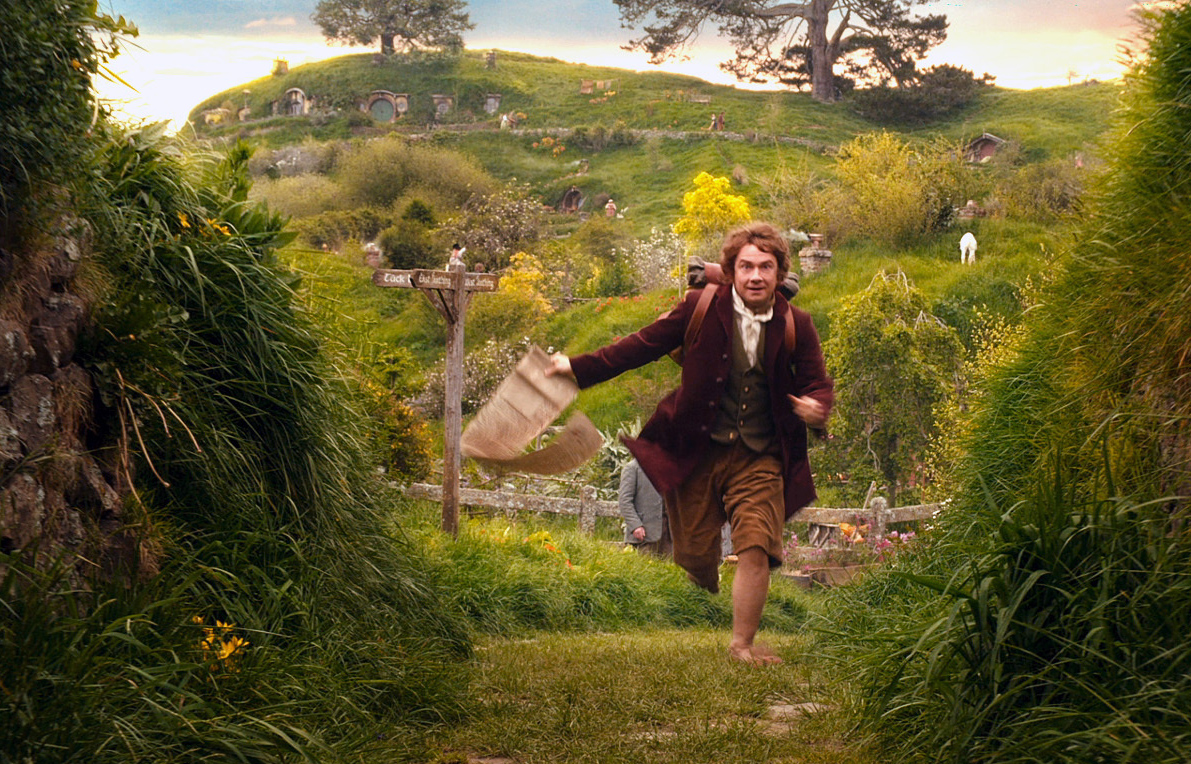
My wife’s first thought had instead a whiff of the pagan. It reminded her, she said, of Lord of the Rings or the Hobbit.

the-hobbit-movie

Whatever the reference, it was certainly very beautiful.

After spending a night in Corryong, and getting some good advice on which road to take from a very nice lady at the local information centre (I have to say, these information centres gave us excellent service everywhere we went), we set off along a small road which hugged the Murray River. It was all very peaceful.

upper murray river valley-corryong 050

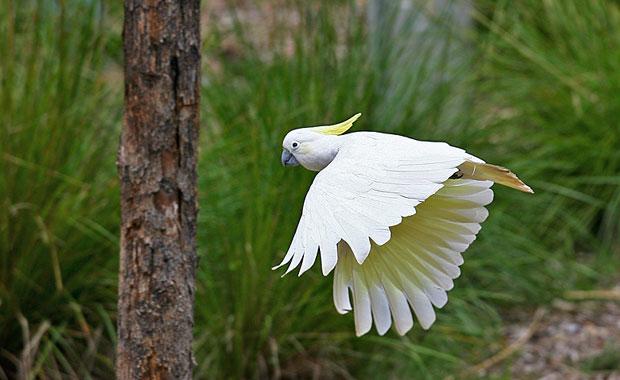
We watched a local farmer and his family herd in cows and their calves for marking, as they bellowed mightily against this corralling, and had a long chat with them about the future of farming. We watched Australian white ibises, which we had last seen in Sydney as scavengers, fly regally over our heads, while sulphur-crested cockatoos crossed our path with a slow and sensuous flap of their wings.

sulphur-crest-cockatoo

We finally reached Lake Hume. At first, it was the drowned trees which struck us

upper murray river valley-corryong 021

then it was the pelicans, which were swimming among the trees

upper murray river valley-corryong 024

The last time I had seen pelicans was as a child in St. James’s park

Then the lake broadened out.

upper murray river valley-corryong 036

We followed the lakeshore until Albury. Thereafter, the landscape got drier, flatter and less interesting so I’ll skip the final day.

Finally, it was time to drive back to Sydney. We decided to pass through Corryong again; we had liked it so much. We had one last vision of wondrous drifts of wildflowers in the fields

upper murray river valley-corryong 038

upper murray river valley-corryong 051

before we headed up through Tumbarumba and Tumut to the Hume Highway. Next stop, Sydney Airport and then Beijing. Sigh!

_____________________________

Hobbit: http://www.digitaltrends.com/wp-content/uploads/2013/02/the-hobbit-movie-48-fps.jpg
Sulphur-crested cockatoo: http://www.zoo.org.au/sites/default/files/styles/zv_carousel_large/public/sulphur-crest-cockatoo-animal-profile-web620.jpg?itok=dXPfOmk5
all other photos: mine

MY CRUISE OF FIRSTS

Beijing, 5 April 2013

My previous post about chocolate Easter eggs led me to take a page from Charles Dickens and I allowed myself to be visited by the ghost of Easters past. He took me back through memories of previous Easters, some very pleasant and others not so much. One in particular has stayed with me, the Easter I passed on a cruise in the Mediterranean when I was 14.

My English grandmother had decided that she would like to go on a cruise but wanted company. So she took me and my older brother along with her. It was a wonderful trip, one of those golden-hued memories that each one of us has. Easter itself was celebrated without much fuss and bother in Brindisi, in southern Italy – we were just a few Catholics among a sea of Anglicans and so were packed off to a small room on the ship and a local priest was brought in for the occasion.  A surf through the web tells me that Easter occurred on April 14, two weeks later than this year. We were already towards the end of the cruise. There were a couple more stops in what was then Yugoslavia and is now Croatia, at Split and Dubrovnik, and then it was back to Venice where we had boarded ship. Before Brindisi, we had visited Olympia, Crete, Athens, Istanbul, Ephesus, and then finally Rhodes before starting back (there was also a visit to one of the smaller Ionian islands but I no longer remember which one).

For me, this was a trip of many firsts (well, the whole trip was a first but there were certain things which were more first than others, if you get my drift).

It was my first trip to Venice, one which my wife and I have repeated many, many times, sometimes with the children, first from Milan when we lived there and then later from Vienna. What I fell in love with that first time and keep going back to is not the grand theatricality of St. Mark’s Square

venice-st marks square

or of the laguna, which the cruise ship sailed down as we left Venicevenice-the lagoon

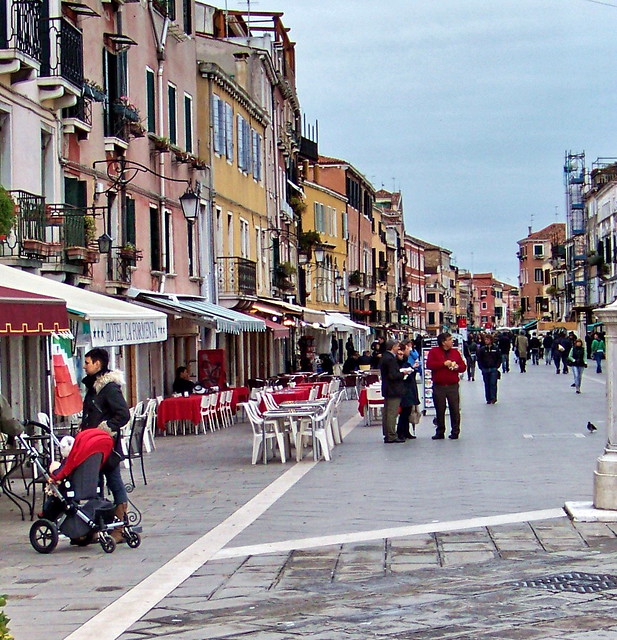
No, what always bring us back is the humbler Venice, the alleys and lanes (it’s hard to talk of streets when there are no cars) far away from the tourist haunts, which widen and narrow with no apparent rhyme or reason, which loop and re-loop over narrow canals, which suddenly bring you, blinking in the light, into small piazzas teeming with life.

venice-calle-1

venice-calle-2

venice-calle-3

venice-calle-4

We spent the afternoon before setting sail wandering around, map in hand – a map is always necessary in Venice, although my wife is not really of that opinion: ask people the way, that’s her motto.

The cruise also took me on my first visit to classical ruins. England and the parts of France I was then familiar with don’t have any Roman ruins to speak of; an odd crumbling wall here and there is about the sum of it. Here, we had a feast!

Olympia

olympia-column-2

Knossos

Knossos-palace-1

Mycenae

mycenae-lion-gate-4

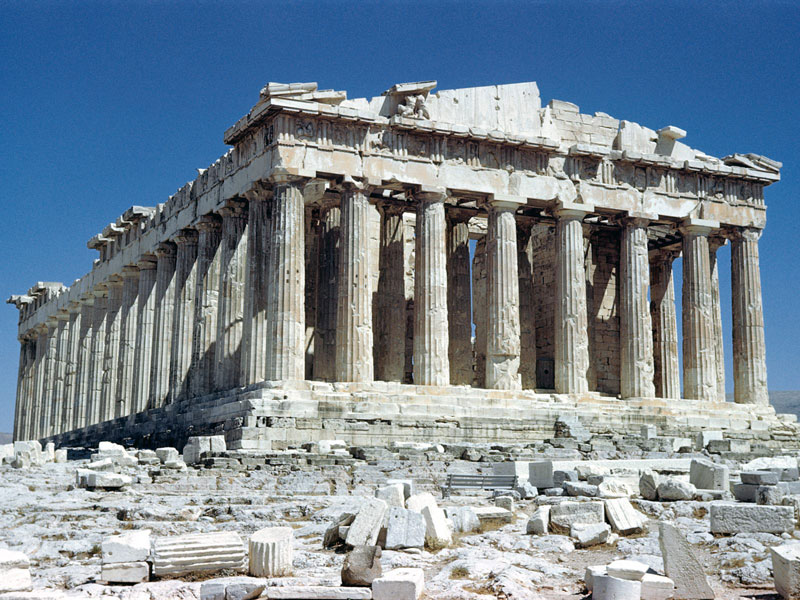
The Acropolis in Athens

athens-acropolis-1

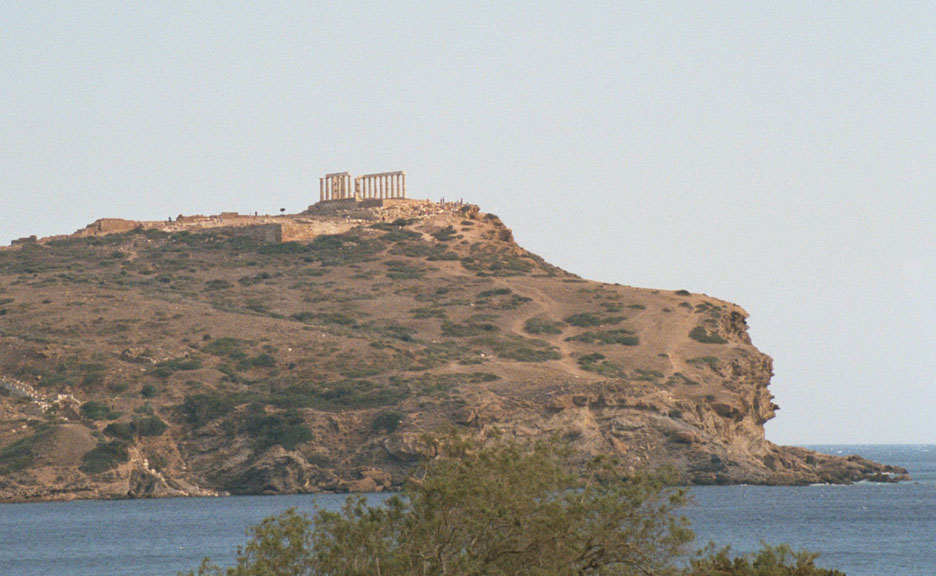
Cape Sounion

cape-sounion

Ephesus

ephesus

Actually, it was more a surfeit than a feast. To be very honest, after I’ve seen three broken columns and five fallen walls the experience begins to pall. Many decades later, when I got to know Shelley’s poem Ozymandias I could relate to all these ruins and many others I have seen since all over the world in a different way:

I met a traveller from an antique land
Who said: Two vast and trunkless legs of stone
Stand in the desert. Near them, on the sand,
Half sunk, a shattered visage lies, whose frown,
And wrinkled lip, and sneer of cold command,
Tell that its sculptor well those passions read
Which yet survive, stamped on these lifeless things,
The hand that mocked them and the heart that fed:
And on the pedestal these words appear:
“My name is Ozymandias, king of kings:
Look on my works, ye Mighty, and despair!”
Nothing beside remains. Round the decay
Of that colossal wreck, boundless and bare
The lone and level sands stretch far away

But, in all this blur of broken stone one memory stands out, etched for ever more in my mind: wildflowers growing in profusion among the ruins of Olympia. A search of the web shows that I am not the only traveler to Olympia who has been struck by the flowers there:

olympia-wildflowers-6

olympia-wildflowers-5

SANYO DIGITAL CAMERA

The trip was also my first real exposure to Greek sculpture. My grandmother had taken me a few times to the British Museum but somehow we always seemed to end up in the section of the Egyptian mummies – at least, that’s all I remember of those early visits. But the visit to the National Archaeological Museum in Athens was a real eye-opener for me. Two pieces I remember particularly well. One was the statue of Zeus (or is it Poseidon?):

Athense-bronze_statue_of_Zeus_or_Poseidon-1

Look at that face!

Athense-bronze_statue_of_Zeus_or_Poseidon-3

Speaking of faces, the other piece that impressed itself on me was the gold mask which Schliemann dug up in Mycenae (our Greek and Latin teacher had often quoted the phrase “I have gazed upon the face of Agamemnon”, said to have been uttered by Schliemann when he first set eyes on the mask)

agamemnon-1

Another notable first on this trip was my exposure to Byzantine mosaics, in the cavernous interior of Hagia Sophia in Istanbul.

istanbul-hagia sophia-interior-1

istanbul-hagia sophia-mosaics-1

istanbul-hagia sophia-mosaics-4

istanbul-hagia sophia-mosaics-5

This started an interest – an obsessive interest, my wife might observe – in early Christian mosaics, which I have tracked down in various parts of the Mediterranean basin since then.

Istanbul was the site of yet another first, my first exposure to Muslim architecture, in the form of the incomparably beautiful Sultan Ahmed Mosque.

istanbul-sultan ahmed mosque-exterior-2

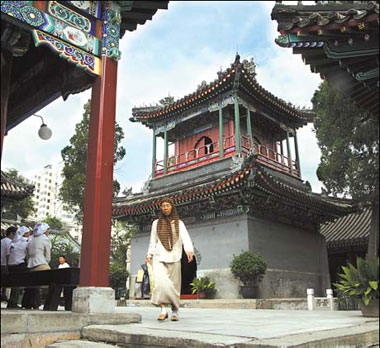
Since then, I have been lucky enough to admire Muslim architecture in all its wonderfully different variations in many parts of the world – even here in Beijing, where it has taken on decidedly Chinese characteristics.

beijing mosque

Iran and Central Asia await me still …

On a lighter note, the cruise was the first – and probably last – time I saw the foxtrot being danced. Every evening a three-man band played in the dance room. It started with oldies, and a retired English Major and his wife were assiduous dancers. As the band started up, they would step out, glide through a number of foxtrot numbers, and then retire to the bar.

foxtrot-1

They looked surprisingly like this picture, just somewhat longer in the tooth.

After they had left, the tempo changed and us young things would take over the dance floor and dance the night away. Well, I didn’t. I was far too shy. I would look on enviously at the elder young things. At last, one took pity on me and led me to the floor to dance my first modern dance. Another first …

Last, but definitely not least, it was on that cruise that I first set eyes on the Mediterranean. It was love at first sight.

mediterranean sea-3

______________________

Venice-St Mark’s square: http://www.instablogsimages.com/1/2012/04/25/sunset_on_st_marks_square_image_title_upyro.jpg
Venice-Lagoon: http://cdn2.vtourist.com/4/3990973-looking_back_from_the_water_bus_Venice.jpg
Venice-calle-1: http://renaissancerules.files.wordpress.com/2011/01/venice-2009-294.jpg
Venice-calle-2: http://picasaweb.google.com/lh/photo/Vx_htYT8ClwJ1DwCpMcy1A
Venice-calle-3: http://www.cepolina.com/photo/Europe/Italy/Venice/Venice-mix/3/Venice-street-narrow-calle-rill.jpg
Venice-calle-4: http://farm2.staticflickr.com/1265/5186001188_065ec8a290_z.jpg
Olympia: http://images.fanpop.com/images/image_uploads/Olympia-greece-585497_1024_768.jpg
Knossos-palace: http://ant3145crete.wikispaces.com/file/view/Knossos_1.jpg/68392549/Knossos_1.jpg
Mycenae-lion-gate: http://www.civilization.org.uk/wp-content/uploads/2012/02/Mycenae-Lion-gate-028.jpg
Athens-acropolis: http://www.limotaxi.gr/wp-content/uploads/2010/10/athens1.jpg
Cape Sounion: http://www.grisel.net/images/greece/sounion11.JPG
Ephesus: http://historyoftheancientworld.files.wordpress.com/2012/09/theatre2.jpg
Olympia-wildflowers-1: http://farm3.staticflickr.com/2245/2331955314_1629efb4ab_z.jpg
Olympia-wildflowers-2: http://farm3.staticflickr.com/2380/2331125289_93eb068ca2_z.jpg
Olympia-wildflowers-3: http://www.touringtykes.com/wp-content/uploads/2010/02/olymipia-flowers.jpg
Athens-statue of Zeus/Poseidon-1: http://upload.wikimedia.org/wikipedia/commons/6/67/Bronze_statue_of_Zeus_or_Poseidon.jpg
Athens-statue of Zeus/Poseidon-2: http://cdn.arstechnica.net/wp-content/uploads/2011/11/zeus_or_poseidon_national_archaeological_museum_athens-4ecd0b1-intro.jpg
Athens- Gold Mask “Agamemnon”: http://hernandopages.com/agamemnon.jpg
Istanbul Hagia Sophia-interior: http://hansmast.com/images/istanbul/hagia_sophia/IMG_1846_Enhancer-IMG_1857_Enhancer-2.jpg
Istanbul-Hagia Sophia-mosaics-1: http://www.mosaicartsource.com/Assets/html/artists/lilian/mosaic_hagia_sophia.jpg
Istanbul-Hagia Sophia-mosaics-2: http://www.sacred-destinations.com/turkey/istanbul-hagia-sophia-photos/slides/imperial-entrance-mosaic-c-hbetts.jpg
Istanbul-Hagia Sophia-mosaics-3: http://www.turkey4travel.com/wp-content/uploads/2009/05/hagia-sofia-mosaic.jpg
Istanbul-sultan ahmed mosque: http://www.viitoaremireasa.ro/images/articole/large/2084/Istanbul-Orasul-care-se-intinde-pe-doua-continente-5.jpg
Beijing mosque: http://www.chinadaily.com.cn/cndy/attachement/jpg/site1/20080815/000802ab80450a0f185656.jpg
Foxtrot: http://ssqq.com/archive/images/foxtrot.jpg
Mediterranean Sea-3: http://1.bp.blogspot.com/-4O6DVn4JTeQ/UG6WCS6K7yI/AAAAAAAAFaQ/NHquXzafTsA/s1600/43923144.jpg