DRAGONS: MAD AND BAD OR NICE AND NOBLE?

Vienna, 24 February 2026

A few weeks ago, when we were down at the seaside, my wife and I went to the Palazzo Reale in Genova to see an exhibition on St. George. The excuse for the exhibition was that he is one of the patron saints of Genova (as he is of England and many other cities, regions, and countries). I’m sure many of my readers are familiar with the most famous story about St. George, his killing of a dragon to save a young woman. But just in case, I cite here the story as told in the Legenda Aurea, a compendium of hagiographies of saints and martyrs, written by one Jacobus de Voragine (who, it so happens, was a bishop of Genova). The original was written in Latin, so I give the 1483 English translation by William Caxton (I’ve cut it a little to focus on the essentials):

By [the city of Silene, in the province of Libya] was a pond like a lake, wherein was a dragon which poisoned all the country. … And when it came nigh the city it poisoned the people with its breath, and therefore the people of the city gave to it every day two sheep for to feed it, because it should do no harm to the people. And when the sheep failed … then was an ordinance made in the town that there should be taken the children and young people of them of the town by lot, and every each one as it fell, were he gentle or poor, should be delivered when the lot fell on him or her.

So it happed that [after] many of them of the town were delivered, … the lot fell upon the king’s daughter, whereof the king … began to weep, and said to his daughter: “Now shall I never see thine espousals.” … Then did the king array his daughter like as she should be wedded, and embraced her, kissed her and gave her his benediction, and after led her to the place where the dragon was.

When she was there St. George passed by, and when he saw the lady he asked her what she made there and … she said to him how she was delivered to the dragon. … Thus as they spake together the dragon appeared and came running to them, and St. George was upon his horse, and drew out his sword and garnished himself with the sign of the cross, and rode hardily against the dragon which came towards him, and smote it with his spear and hurt it sore and threw it to the ground.

And after he said to the maid “Deliver to me your girdle, and bind it about the neck of the dragon and be not afeard.” When she had done so the dragon followed her as it had been a meek beast and debonair. Then she led it into the city, and the people fled by mountains and valleys, and said: “Alas! alas! we shall be all dead.” Then St. George said to them: “Doubt ye no thing, without more, believe ye in God, Jesu Christ, and do ye to be baptized and I shall slay the dragon.”

Then the king was baptized and all his people, and St. George slew the dragon and smote off its head, and commanded that it should be thrown in the fields, and they took four carts with oxen that drew it out of the city.

The story gave great opportunities to numerous painters to strut their stuff. Here is a selection of paintings.
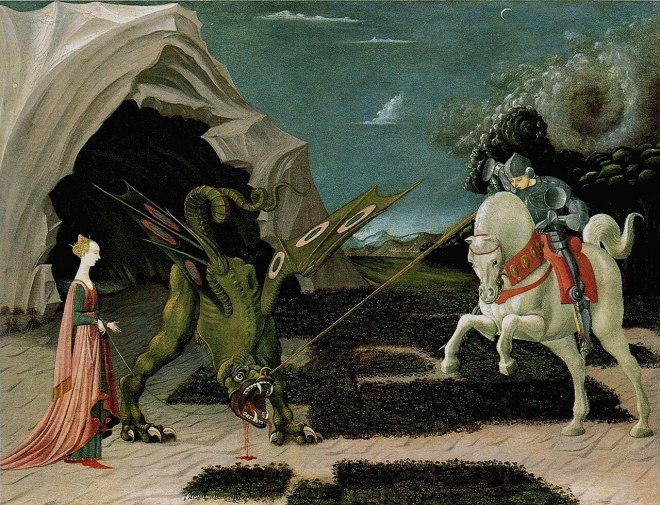
This is probably one of the more famous paintings of the subject, by Paolo Uccello. It has St. George spearing the dragon, but unlike other paintings of the genre is has also included the scene of the young princess’s girdle being tied around the dragon’s neck.
Source

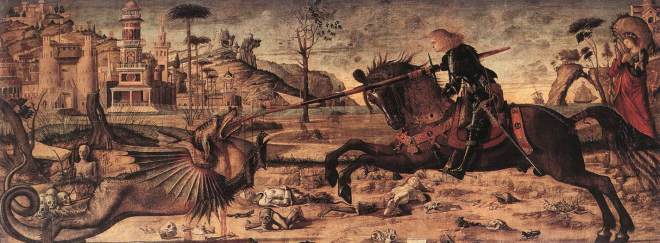
This next painting is by Carpaccio. Notice the remains of previous victims littering the ground. This detail was quite popular.
Source

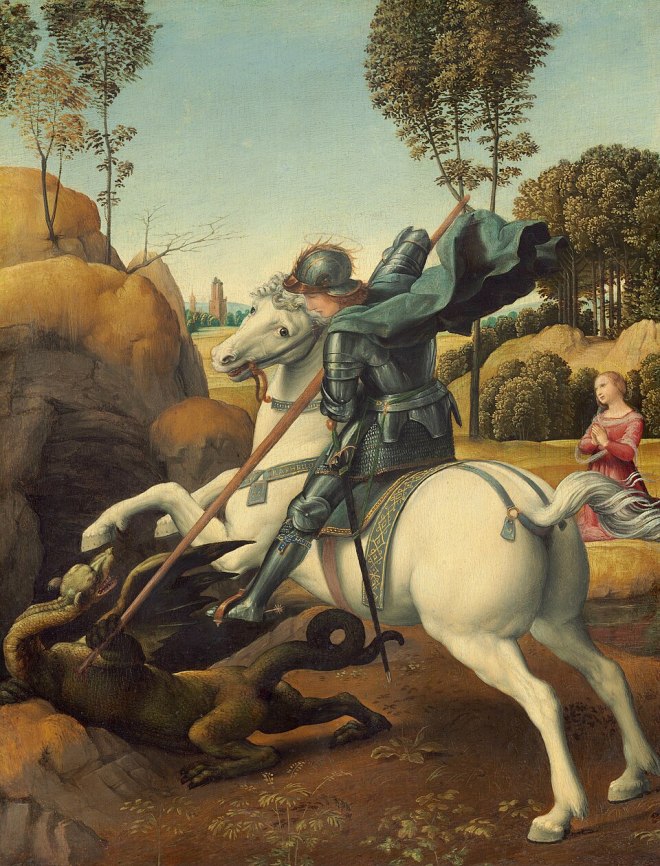
From the same period but more refined, a painting by Raphael.
Source

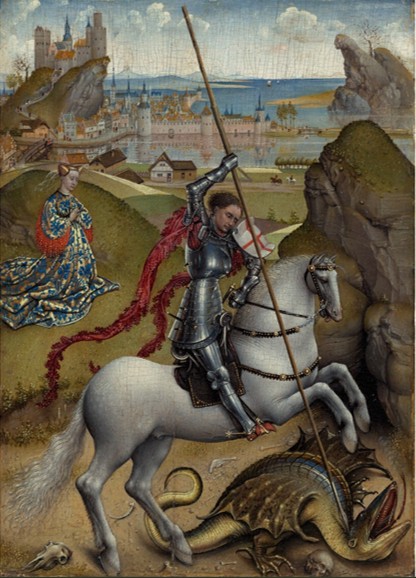
To show that it wasn’t just Italian artists who painted the subject, here’s one from the other side of the Alps, by the Flemish artist Rogier van der Weyden
Source

And here is a woodcut by Albrecht Dürer.
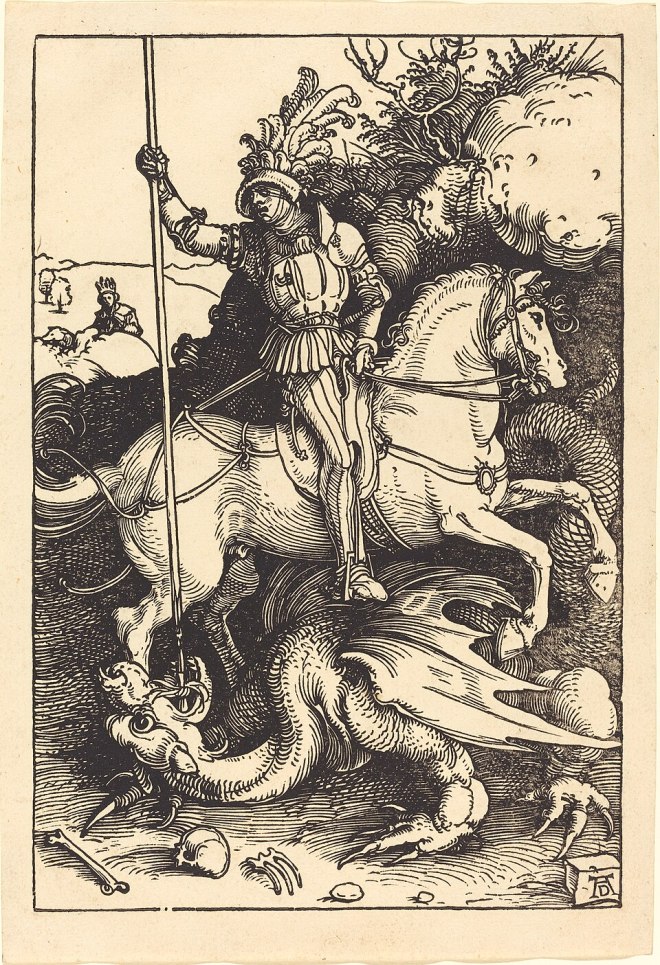
Source

And just to show that St. George was equally popular in Orthodox Christianity, here is a Russian icon of St. George killing the dragon. Here, the damsel in distress has been eliminated; instead, we have the hand of God blessing St. George.
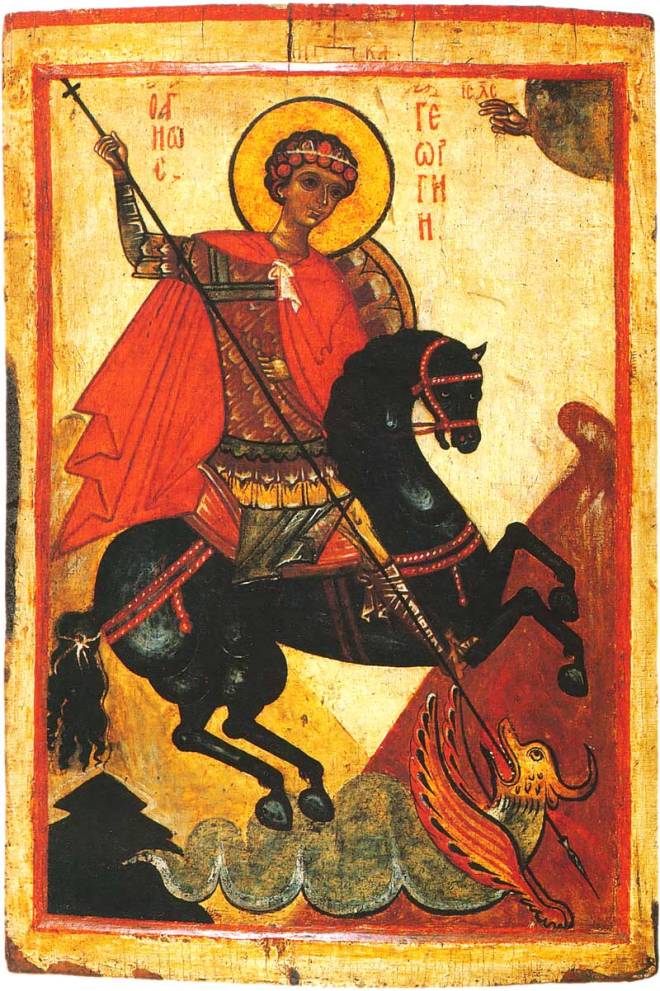
Source

Quite honestly, the dragon is the most interesting part of the story; St. George and the princess are very virtuous and therefore boring. So let’s focus on the dragon. It’s quite obvious from the story that the inhabitants of Medieval Europe considered dragons to be Bad Creatures. And this particular dragon is especially bad. I was much struck by the detail that its breath was so poisonous that it killed people. It strongly reminded me of a boss I once had who had dreadful halitosis; it was dangerous to get too close. He was also quite reptilian in many other ways; I was very relieved when I got another job and left.

This typing by Europeans of dragons as bad has remained unchanged up to the present. The one big addition to their badness is that the pestilential breath became a fiery breath. In that iconic set of books about Harry Potter, for instance, dragons appear several times, and of course they are dangerous, fire-breathing creatures. Dragons grace the cover of at least one of the books.

Source

So, irredeemably bad. Mad and bad.

By one of those acts of serendipity that make the world so interesting, while we were watching St. George skewer his dragon in Genova’s Palazzo Reale, up the hill from there – a mere 15 minutes’ walk away – the Museo delle Culture del Mondo was holding an exhibition on Chinese dragons. Here’s a couple of dragons on show there.
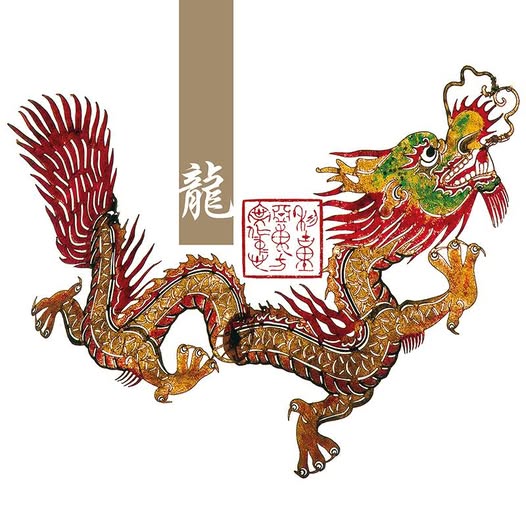
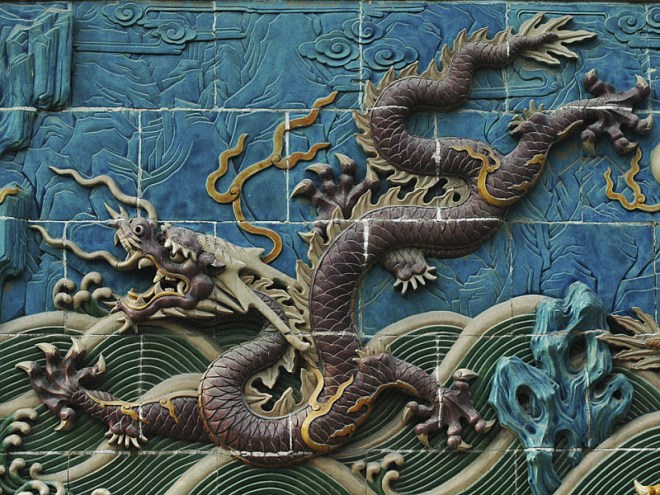
Source
Source

And here are a couple of dragons amongst our possessions.
A vase my wife picked up in Suzhou during our years in China,
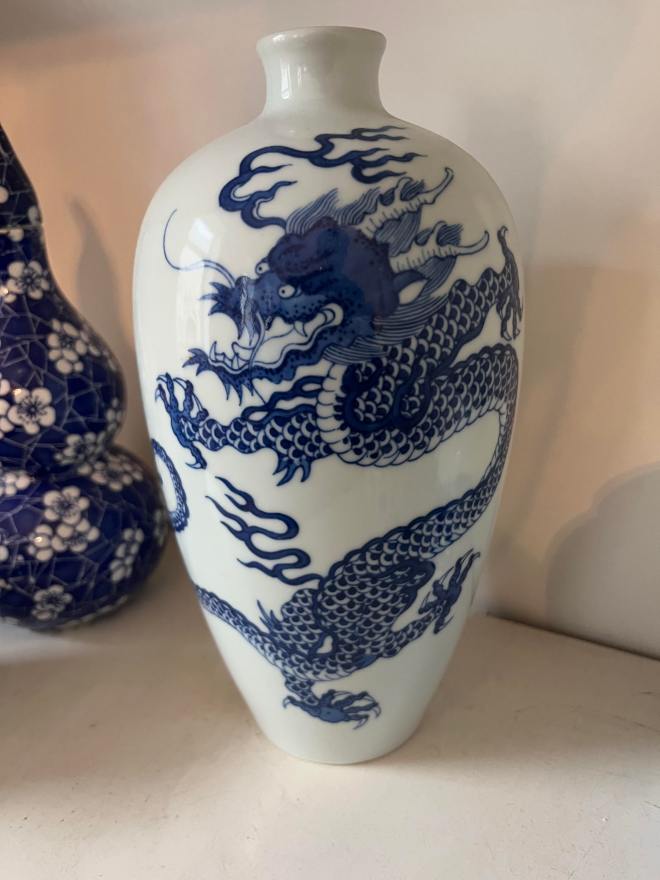
My photo

And a cushion cover made with a piece of fabric she picked up on last year’s trip to Kyoto.
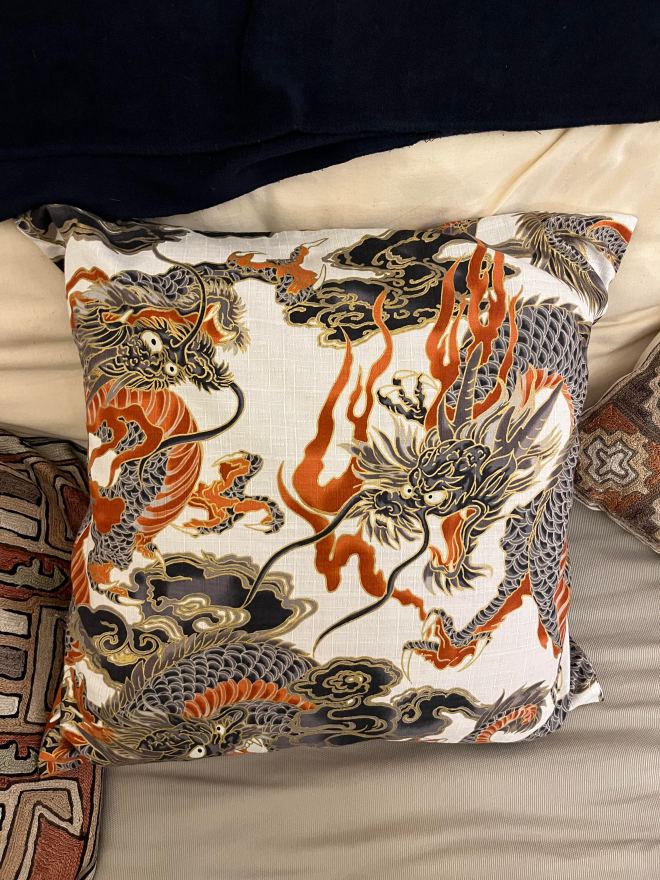
My photo

Although Chinese dragons are fearsome-looking, the Chinese consider them to be Nice Creatures. They believe they bring prosperity and good luck. In earlier times, they were also believed to bring rain and were prayed to during droughts. Here are a couple of dragons from a Song dynasty scroll flying through mist and clouds, an early form of cloud seeding as it were.
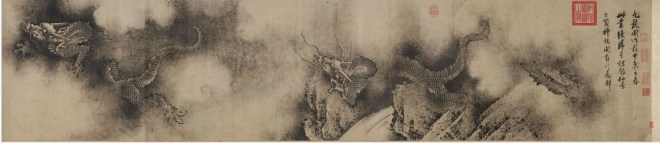
Source

Dragons were considered such Nice Creatures in China that the emperors adopted them as their own. Already 2,000 years ago, during the Han dynasty, the emperors claimed to be sons of dragons. By the time the Ming dynasty rolled around in 1368, the dragon, specifically the five-clawed variety, was strictly reserved for the clothes and accoutrements of the emperor and his family. Anyone who transgressed this rule risked death (along with their whole family). We have here the Emperor Ming Yingzhong wearing his dragon robe.
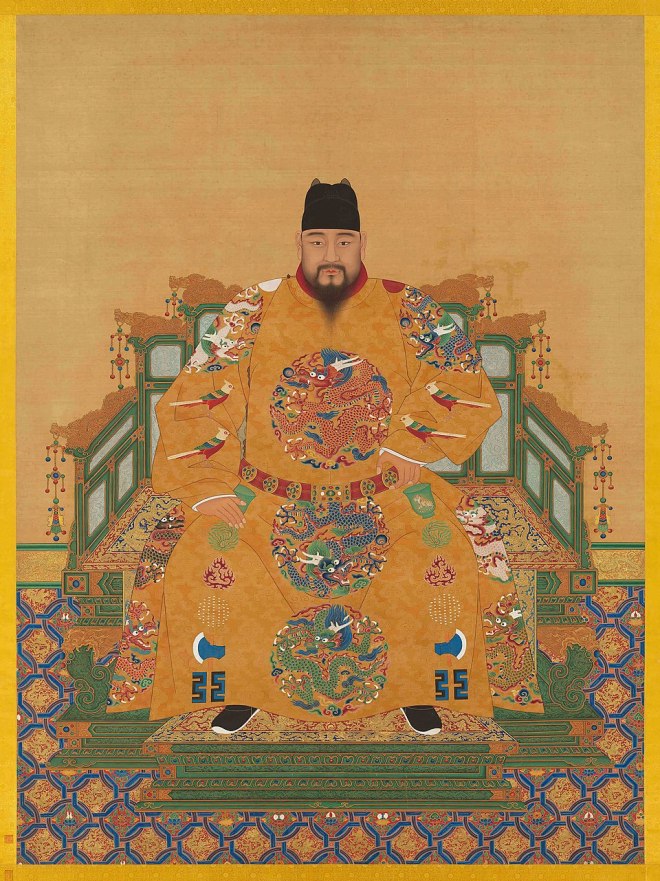
Source

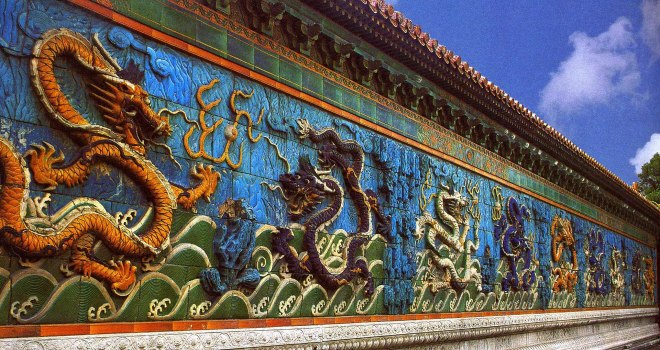
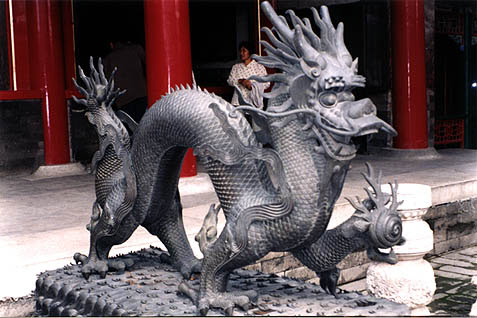
And of course the Forbidden City in Beijing, the centre of later emperors’ power, is littered with dragons. I show here two examples, the first in the Nine Dragon Wall, the second a dragon statue standing guard before one of the temples.
Source
Source

The Emperors graciously allowed their nobles to avail themselves of the lesser four-clawed dragon for their clothes and furnishings, while commoners were allowed to use the vulgar three-clawed dragon (I only notice now that we are guilty of terrible lèse-majesté with our vase, where the dragon in question has five claws, while our cushion cover is within the norm for commoners like us since the dragons have three claws).

So, nice and simpatico, but also very noble, these Chinese dragons.

Well, this is a conundrum! Mad and bad, or nice and noble? Who is right, East or West? Let’s put aside the obvious response, which is that since dragons don’t actually exist the question is irrelevant. That’s just party-pooping. Let’s also ignore the response that it’s all in the wings: European dragons have wings, which makes them bad, while Chinese dragons do not, which make them nice. That’s just silly; wings can’t make such a difference. How about being Solomonic and saying that dragons can actually be both, just like us, depending on which side of the bed they get out of in the morning.

Source

THREE DAYS IN VERONA

Milan, 12 February 2026

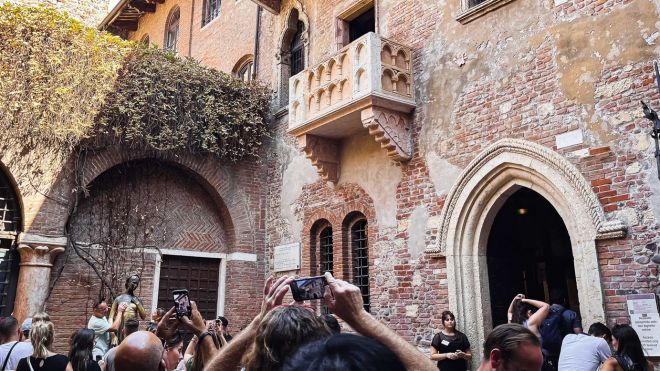
A couple of weeks ago, my wife and I went on a quick three-day trip to Verona. We’d made a lightning visit there a few years ago, when we had a couple of hours to wait at the station for our train connection. I have no memory of that visit other than standing in front of a balcony purported to be the one where Juliet stood while talking to Romeo (“O Romeo, Romeo, wherefore art thou Romeo?” etc.) and wondering what on earth the fuss was about – as far as we could tell, 90% of the tourists flocking to Verona had come to see this.

Source

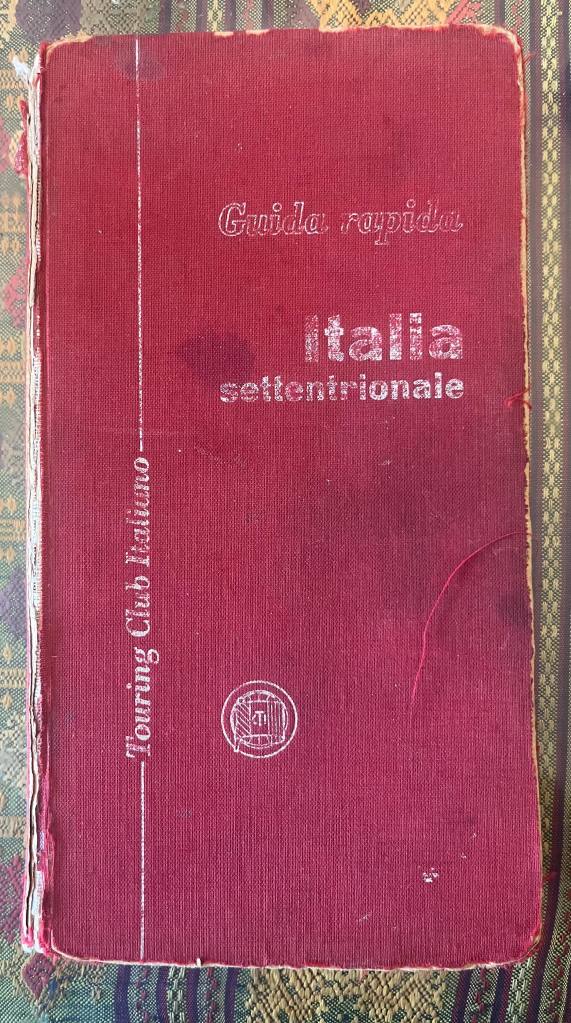
This time, we were determined to keep completely away from anything related to the two “star-cross’d lovers”, and we succeeded admirably. I have to say, we were greatly aided in this by relying on an old and well-thumbed guidebook of the Touring Club Italiano, which my parents-in-law had bought way back when.

my photo

It had been published in 1958, long, long before the current instagram- and TikTok-fuelled hysteria about Romeo and Juliet, and so had not a word to say about them. For the first two days, we faithfully followed the two itineraries suggested in the guide, while we spent the third day visiting a couple of art museums.

So, “let us go and make our visit”, as T.S. Eliot intoned.

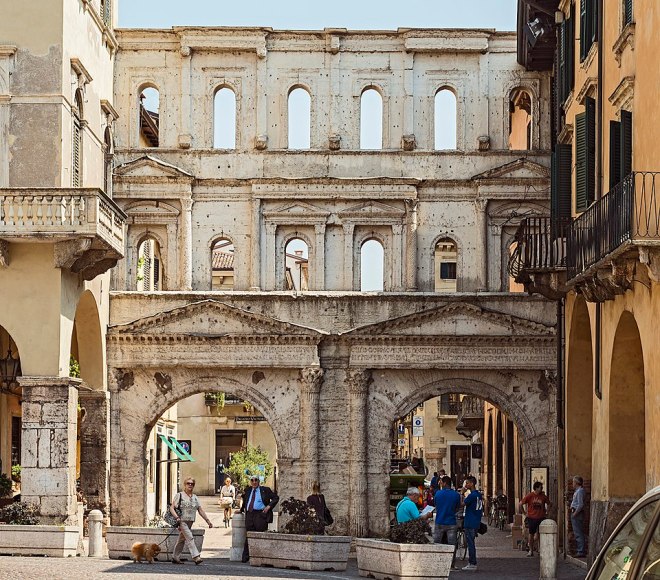
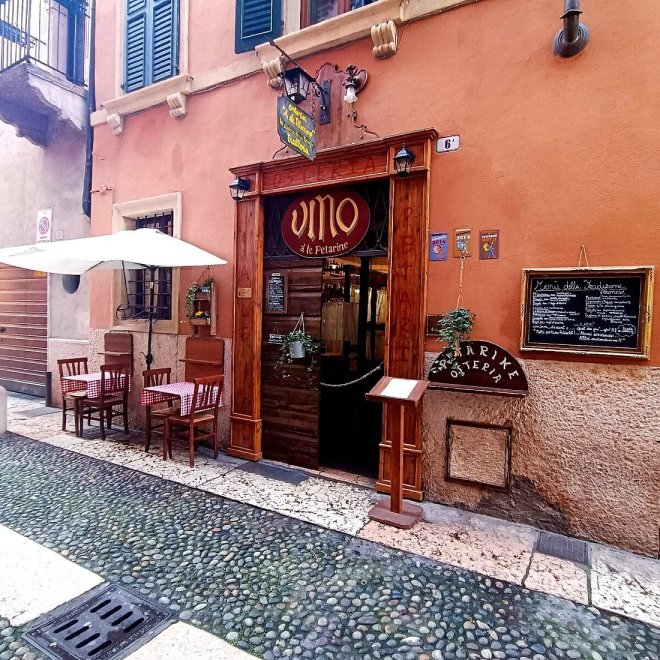
Since our Flixbus from Milan arrived at around lunchtime, we actually started proceedings by going to lunch – always good to start a visit on a full stomach! My wife had identified a trattoria that looked interesting, the Osteria A Le Petarine, at the far end of the old city. To work up an appetite, we walked up there. That took us through Porta Borsari, an ancient city gate that started life as the main gate in the city’s ancient Roman walls.

Source

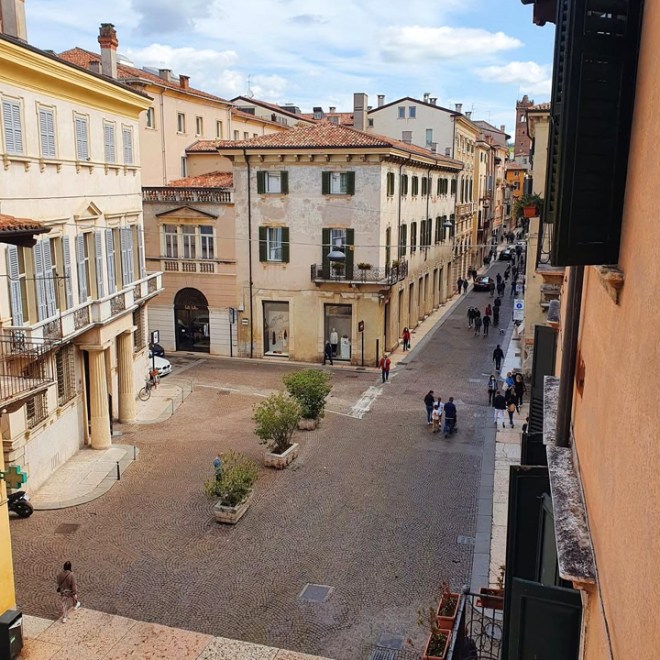
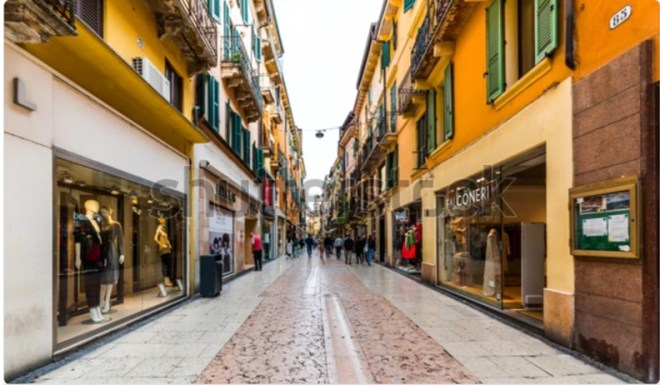
We continued up corso Porta Borsari, the old decumanus maximus of Roman Verona, and now a pleasant pedestrianised street.

Source

After a few dog legs through the narrow streets of the old town, we finally arrived at the trattoria.

Source

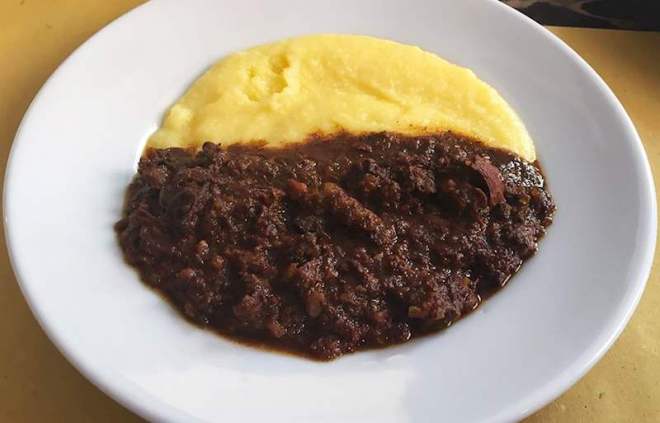
My wife was not persuaded by her choice, but I had an excellent Pastisada de caval, a dish of horse meat stew laid on a bed of polenta.

Source

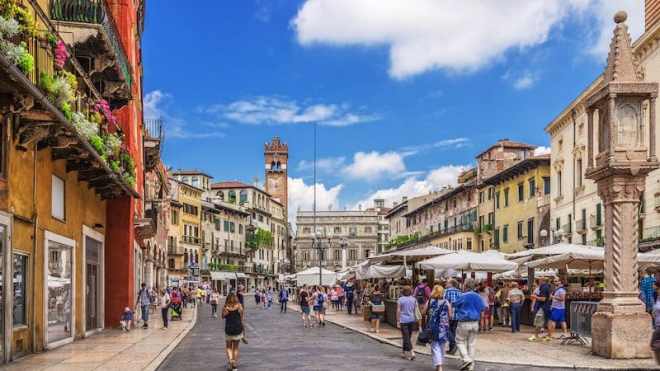
After lunch, we headed over to our hotel, dropped off our bags, and sallied forth on our first itinerary. This took us first to piazza delle Erbe, which has been the centre of Verona’s civic life since Roman times, when this was the forum.

Source

It’s unfortunate that the square has been invaded by stalls selling tourist tat. It’s difficult to get a clear view of the square now.

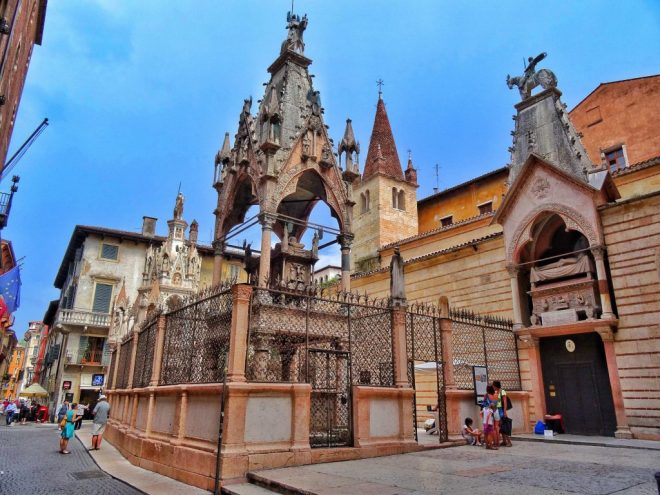
The itinerary instructed us to next take a small street leading off the square, which took us to the Arche Scaligere, the tombs of the Della Scala family, which was Verona’s most famous family, ruling the city in the Middle Ages.

Source

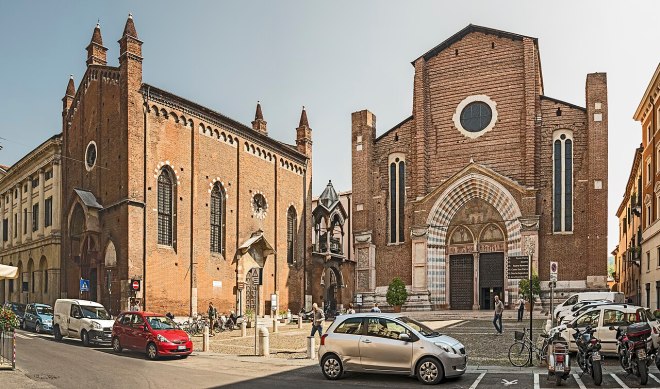
The itinerary then led us to Santa Anastasia, the first of four churches we were to visit. We would have visited a few more churches, but they were closed the day we tried to visit them (I think my wife was quite relieved by that; it is possible to have too much of a good thing).

Santa Anastasia’s facade, the first part of the church we saw, was nothing to write home about, and in fact I later read that it was never completed (a problem in Italy which I’ve complained about in an earlier post).

Source

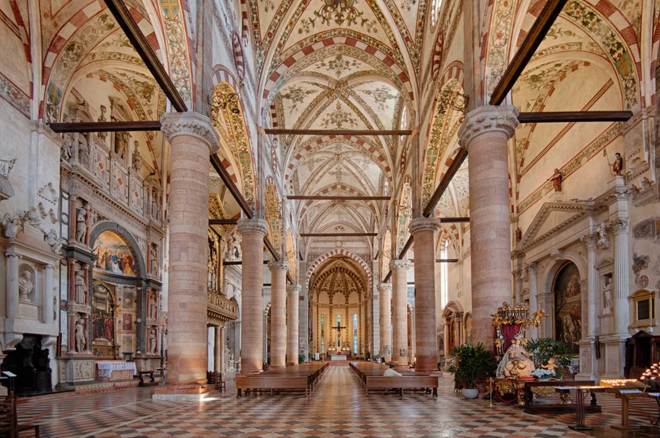
The inside was a different story: tall, airy, and with a ceiling painted with a vegetation motif. It quite put a bounce in my step to see all that exuberance on the ceiling.
Source

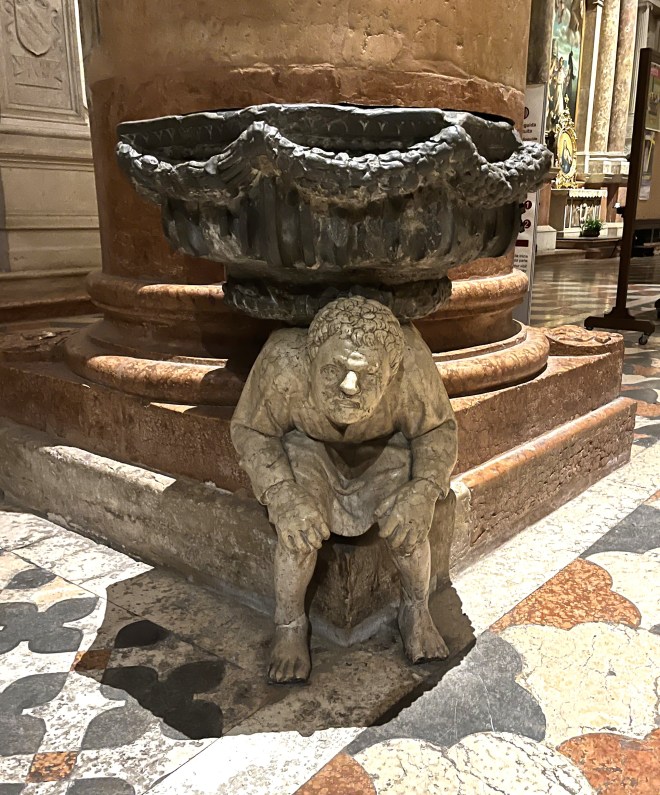
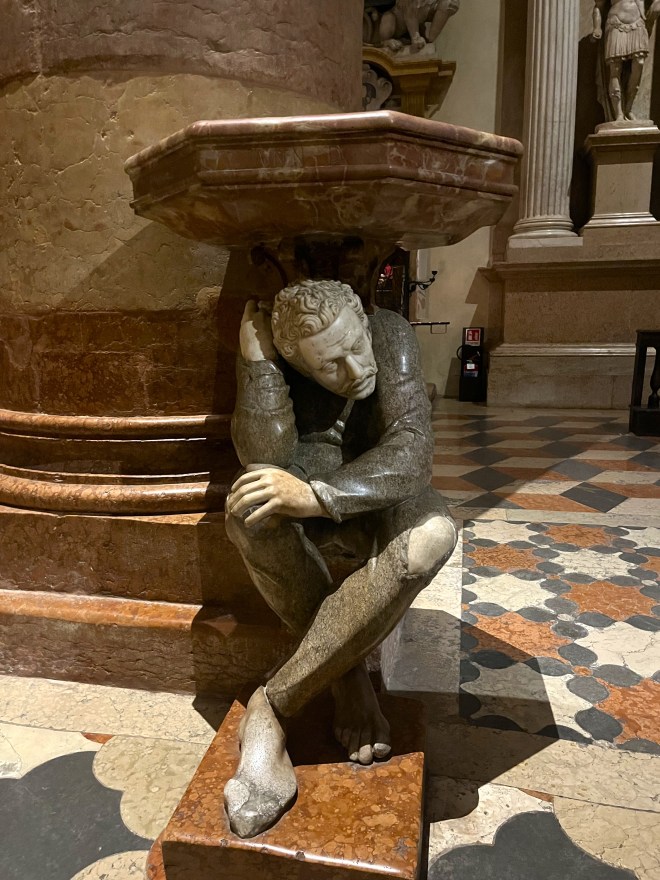
Of the internal details, there were a couple of frescoes and paintings by Worthy Artists, but the one that caught my eye was these two holy water fonts. I’ve never seen any fonts quite like these.

My photo
My photo

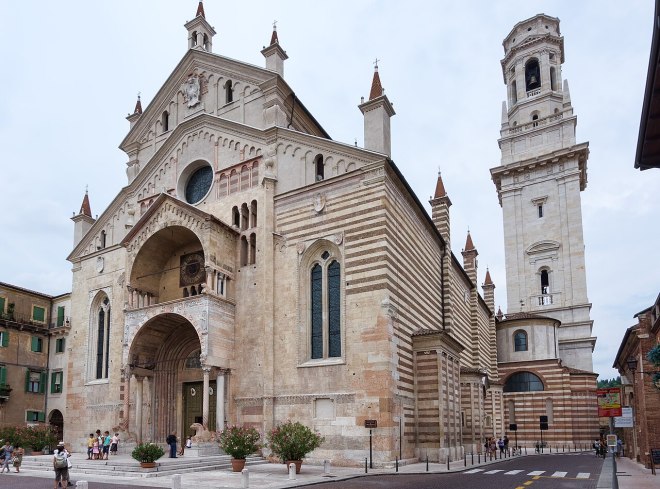
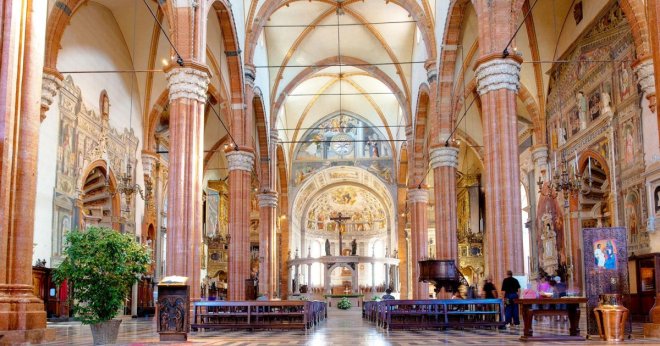
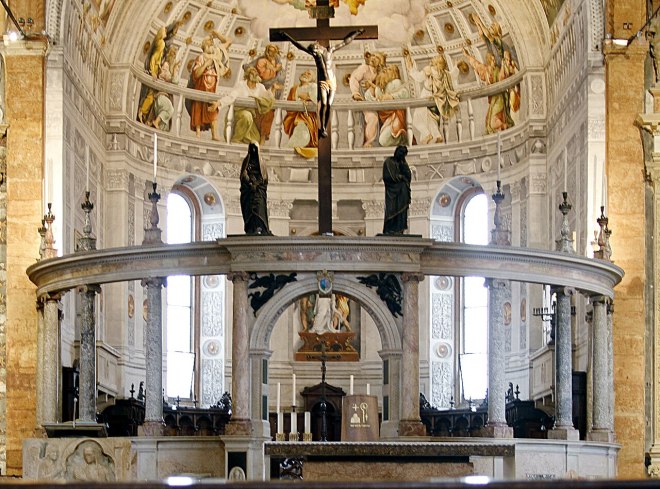
The itinerary next took us to the Duomo. It was early evening by now, so our visit was hampered by a lack of light. Whether it was that or simply that there wasn’t much to see in the Duomo, I have only vague memories of it. Nevertheless, I’ll throw in a few photos from the internet.
The exterior:

Source

A view of the inside:

Source

The one detail that caught my attention, this semicircular choir screen that encloses the presbytery:

Source

After which, we decided to call it a day (or rather night since by now it was pitch black) for our sightseeing.
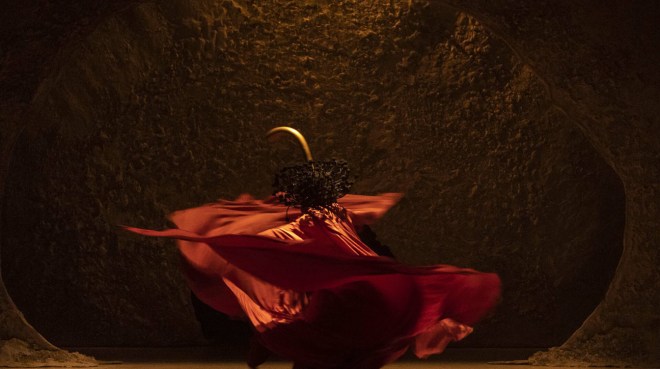
But we weren’t ready for bed yet! My wife had got us tickets to a show where a dance troupe danced to Stravinsky’s Sacre du Printemps.

Source

The music was lovely, the dancing rather less so. Nevertheless, it was a very pleasant end to the day.

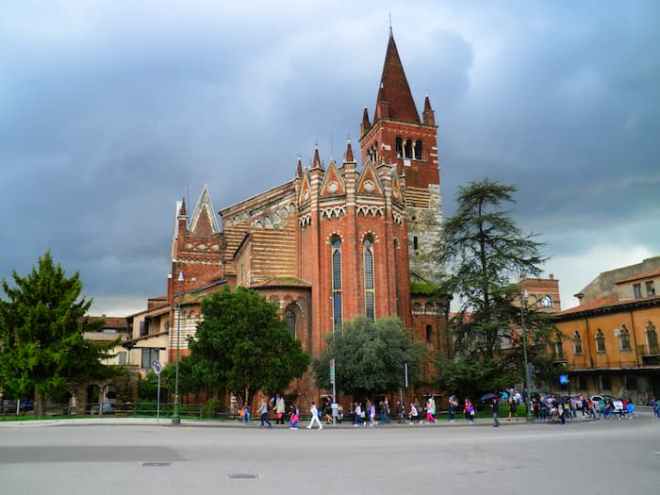
The next day saw us pick up the second itinerary a few streets away from our hotel. The first stop was the church of San Fermo Maggiore.

Source

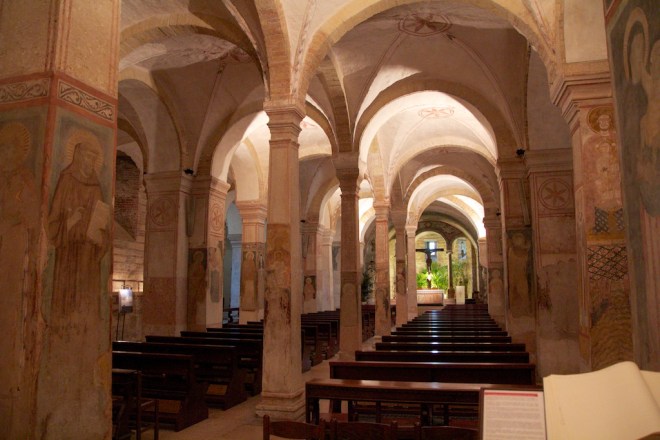
It’s actually two churches in one. The lower church is the oldest. Its low ceiling gave the space an intimate feeling.
Source

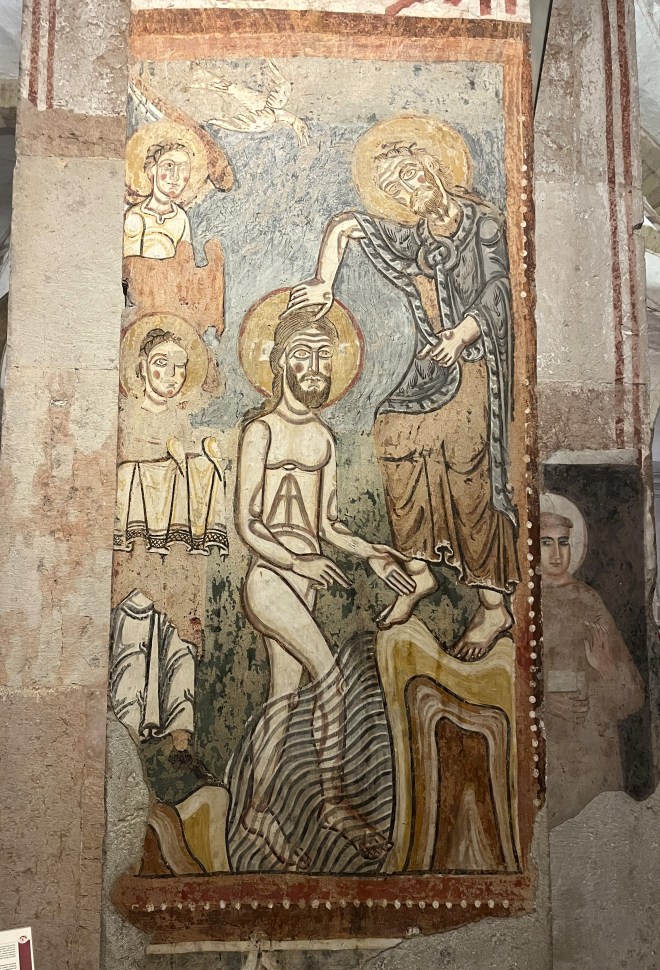
The most interesting detail was the frescoes which decorated many of the pillars. My wife and I agreed that this 11th Century fresco, of the Baptism of Christ, was the most remarkable.
My photo

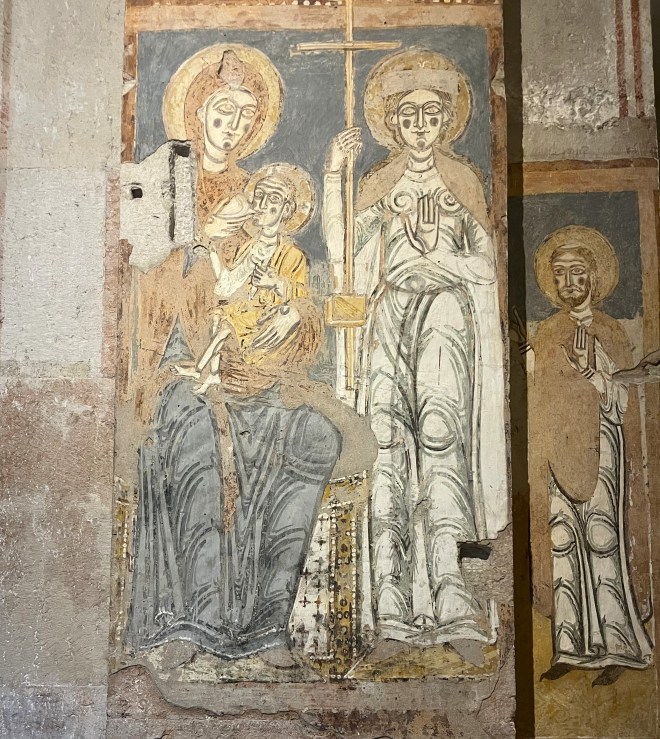
But I also liked this fresco from the same period, of the Virgin Mary breastfeeding the baby Jesus.

My photo

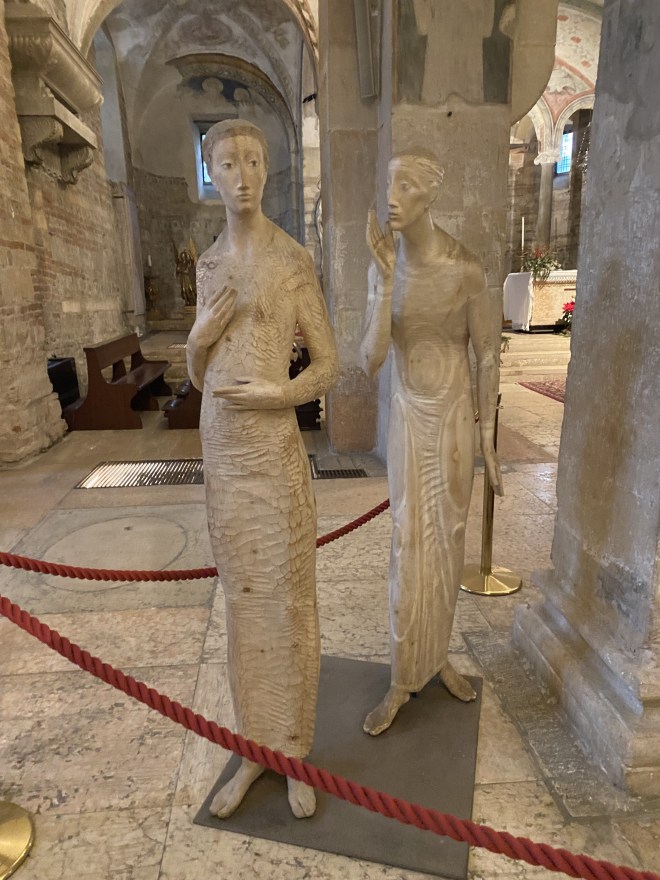
We also agreed that this modern sculpture, of the Annunciation, was wonderful.

My wife’s photo

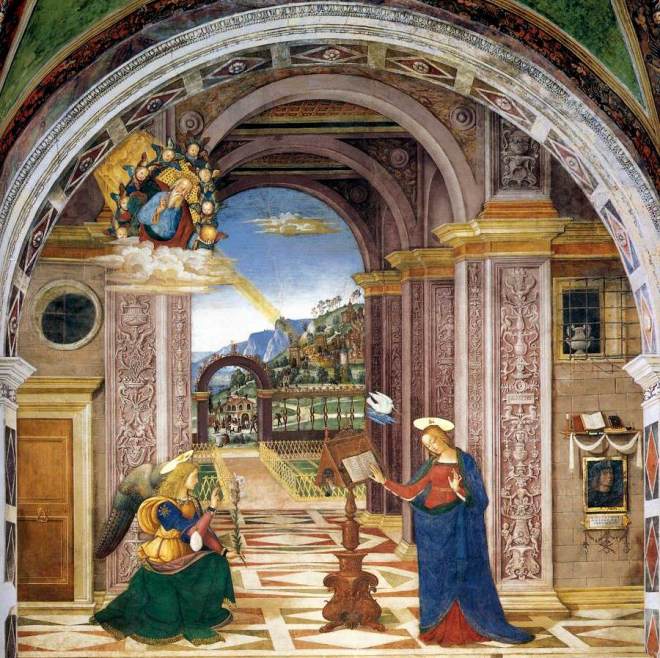
The normal iconography is something along these lines: an angel – obvious because of its wings – on one side, announcing the message, and the Virgin Mary, modestly attired and sitting or standing, reading a book, on the other (I’ve chosen the Annunciation by Pinturicchio as my example).

Source

But here you have what looks like two young women, adolescent girls almost, one, the angel, whispering the message to the other, the Virgin Mary. In case any readers are interested, it is by the South Tyrolian sculptor Hermann Josef Runggaldier.

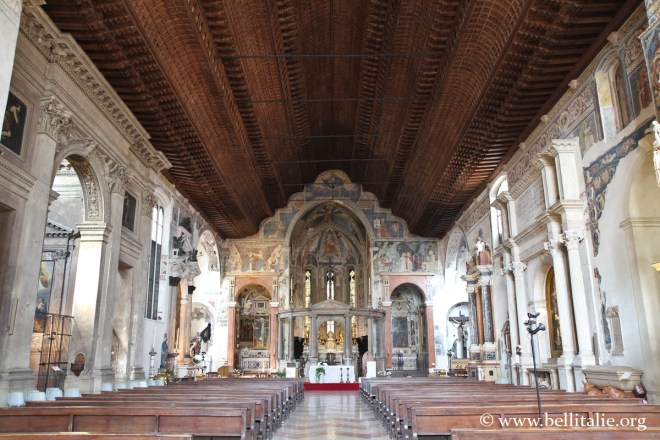
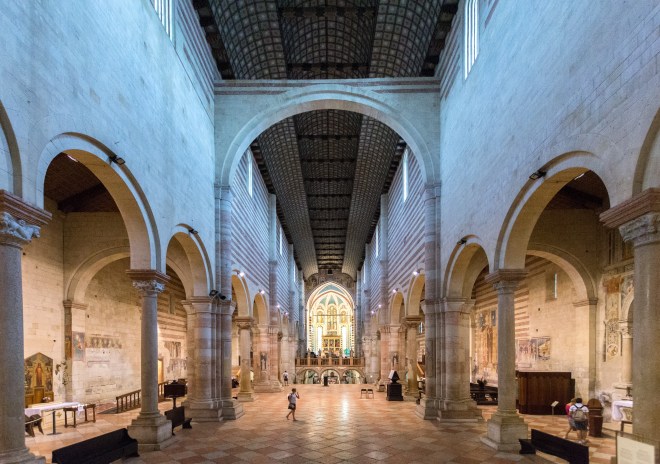
We then climbed the stairs to the upper church. After the intimacy of the lower church, the space felt majestic.

Source

The most remarkable aspect of this church was its wooden ceiling.

Source

It was built in the first half of the 1300s and by some miracle it has survived until now (I think with melancholy of Notre-Dame Cathedral in Paris, whose centuries-old forest of oak logs in its ceiling caught fire back in 2019 and nearly burned the whole cathedral down).

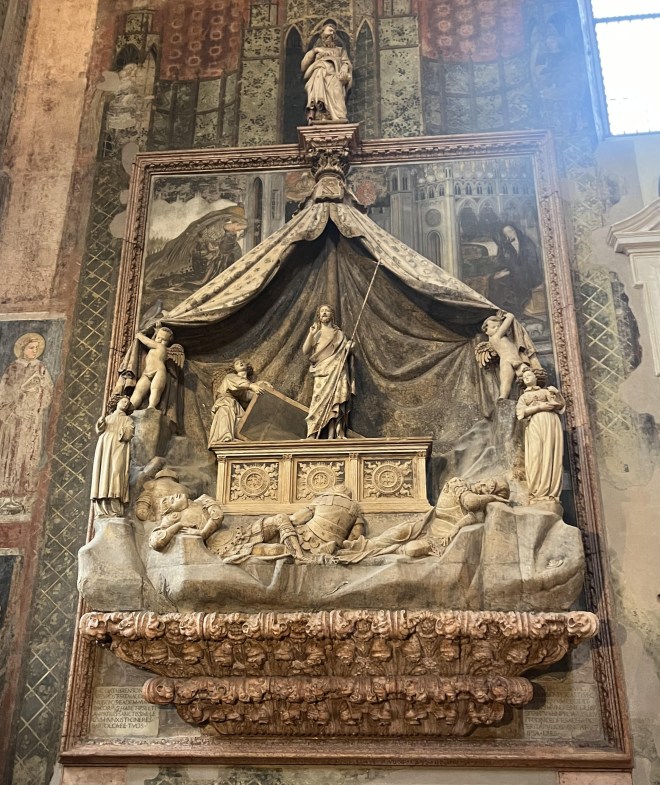
This funerary monument for Niccolò Brenzoni, from the early 1400s, was also arresting.

My photo

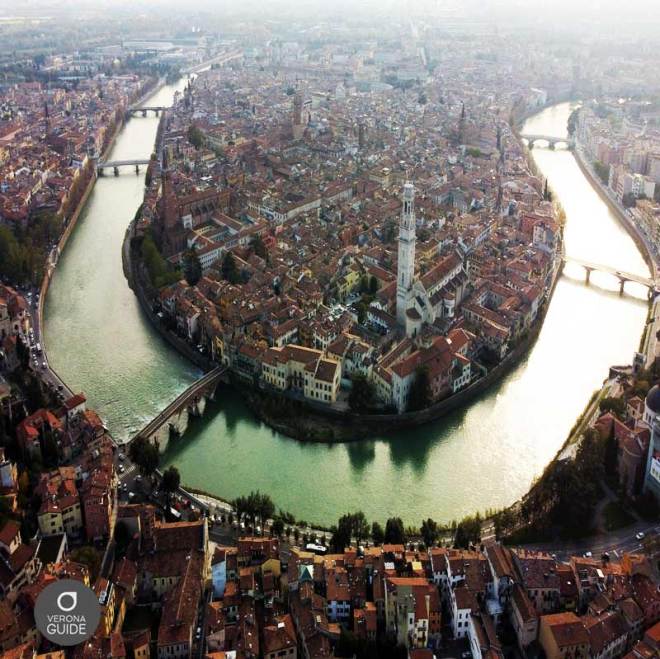
The itinerary now took us to the River Adige, which encloses the old town in a large hairpin bend.

Source

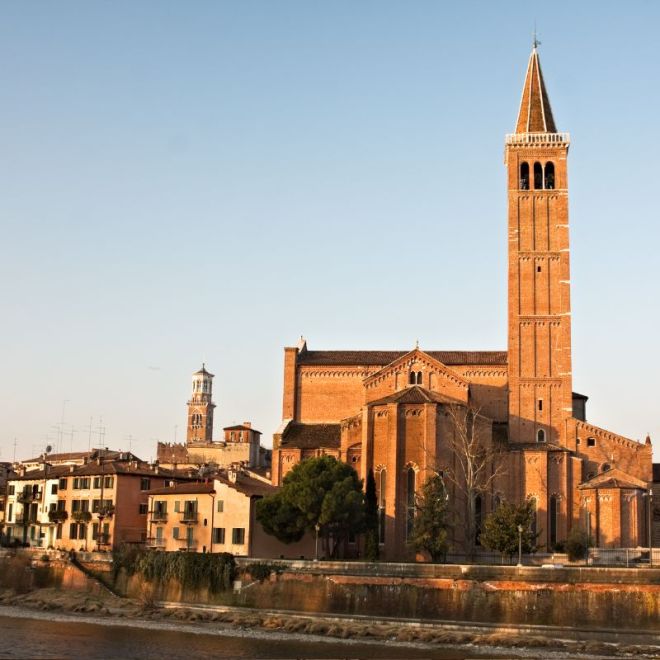
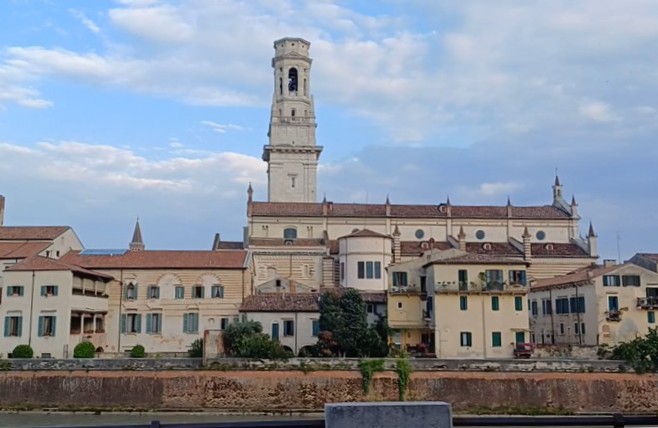
It had us cross the river and walk along its bank. We got to admire the church of Santa Anastasia and its campanile from the back, much nicer than from the front.

Source

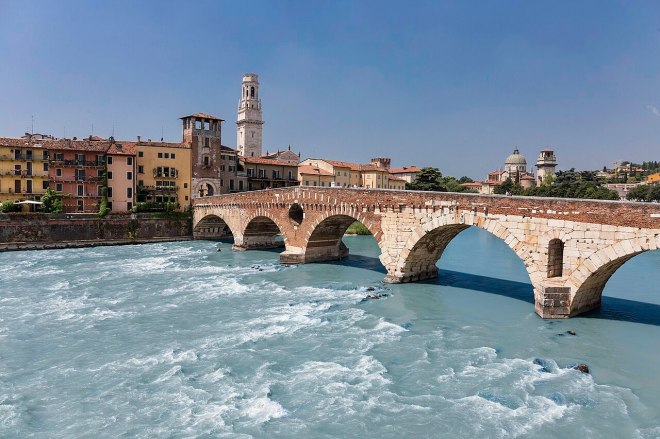
We passed the old Roman bridge, much remodeled over the centuries (and partially destroyed by the Germans, who blew it up when they retreated out of Verona in 1945).

Source

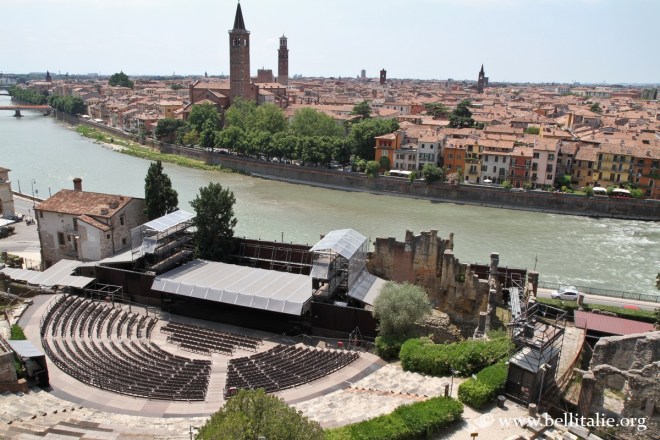
We passed the old Roman theatre which had been carved into the side of the hills running alongside the river. It has been turned into a modern outdoor theater.

Source

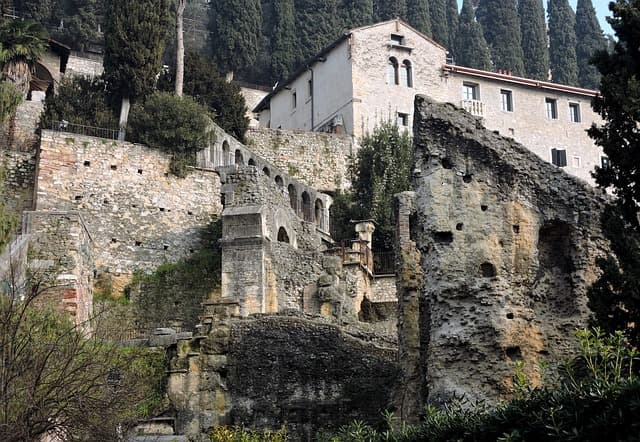
But this is what it looked like to us as we walked past it, some mouldering walls with houses built on top of it.

Source

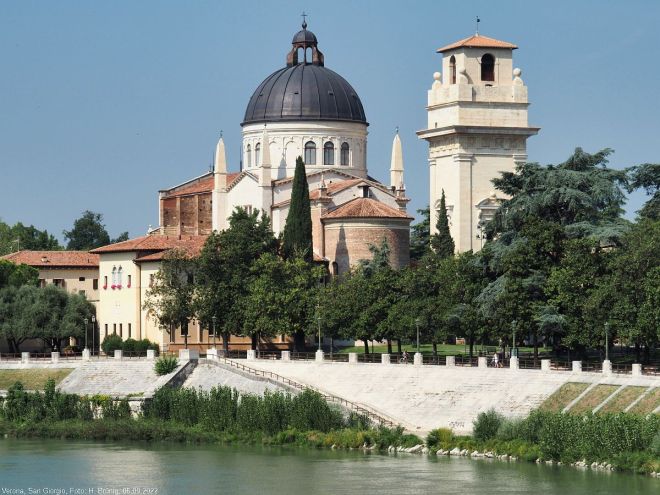
The skyline was now dominated by the church San Giorgio in Braida, which sits next to the river.

Source

Alas! A visit was not possible because the church was closed. No matter! We admired the view of the Duomo across the river.

Source

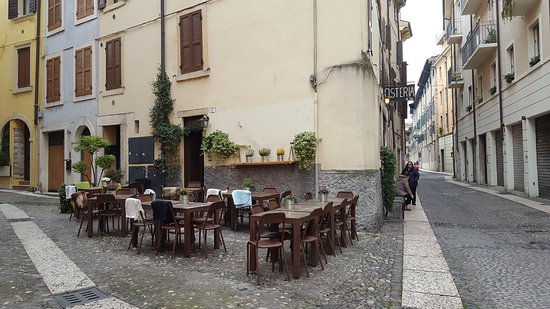
And since we were beginning to feel a bit peckish, my wife used this pause to find another trattoria in the vicinity where we could have lunch. She discovered the Osteria A La Carega, located down a small road which we took just after we had recrossed the Adige.

Source

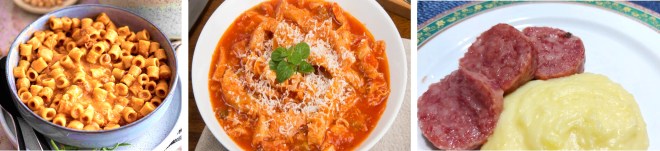
We shared a pasta e fagioli as a first, after which I had a trippa alla Parmigiana while my wife chose a cotechino con puré. Delicious!

Source                                        Source                                                   Source

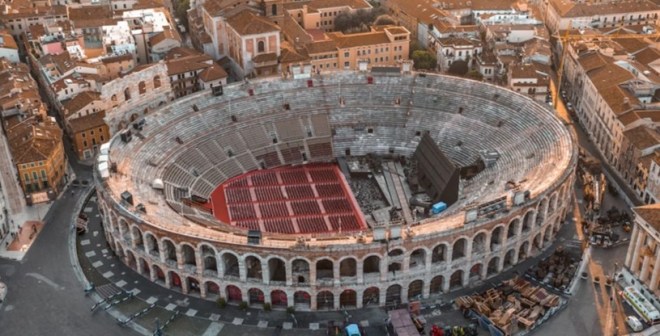
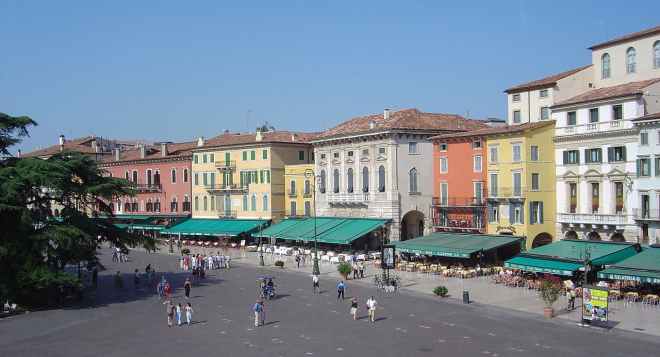
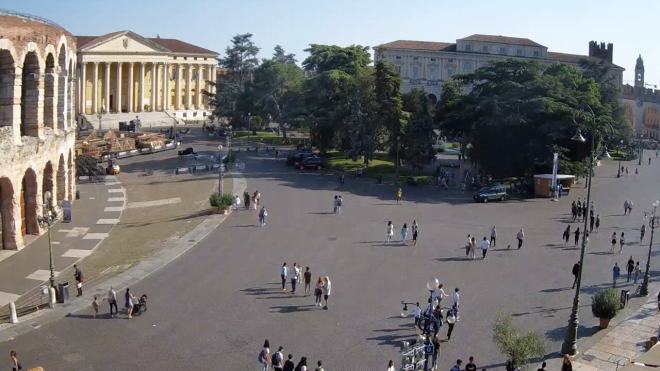
Nourished and refreshed, we picked up the itinerary again. It now took us to piazza Bra, a large square along one side of which stands what is probably Verona’s most well-known monument, the ancient Roman amphitheatre.

Source

We couldn’t actually see much of the amphitheatre since workers were busily getting it ready for the closing ceremony of the Olympic Winter Games. The square itself is very pleasant, with a row of cafes along one side (mostly tourist traps, unfortunately)

Source

And with a little garden in the middle (we see the wall of the amphitheatre on the left).

Source

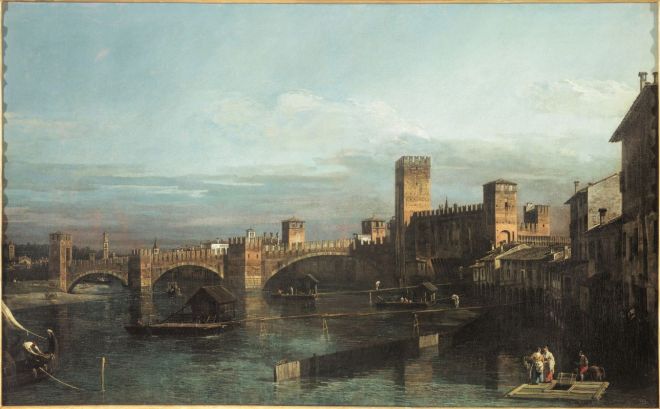
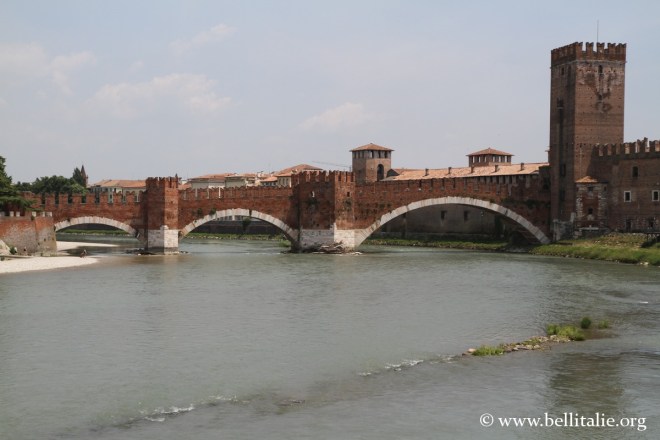
The itinerary now took us back to the river. We skirted the Castelvecchio (we would be visiting its art museum tomorrow) and admired the view of the ponte Scaligero over the River Adige, behind the castle.

Source

As we discovered the next day at the art museum, it was a view that had been painted by Bernardo Bellotto in about 1745.

Source

Little seems to have changed in the intervening centuries.

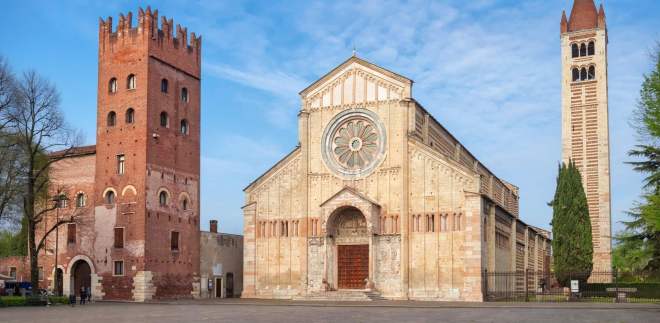
The itinerary drew us along the river and then through a maze of little streets to the church of San Zeno. As we entered into the piazza, this was the view that greeted us.

Source

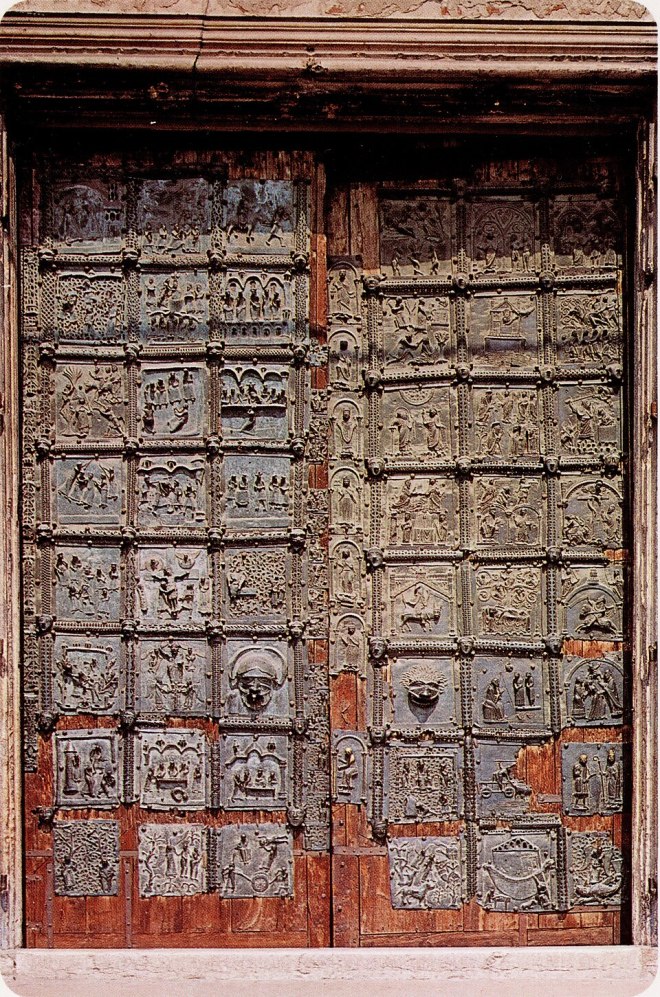
In particular, the main door was fantastic (although you only see it from inside the church). It is made up of 48 bronze tiles, produced in the 11th and 12th Centuries.

Source

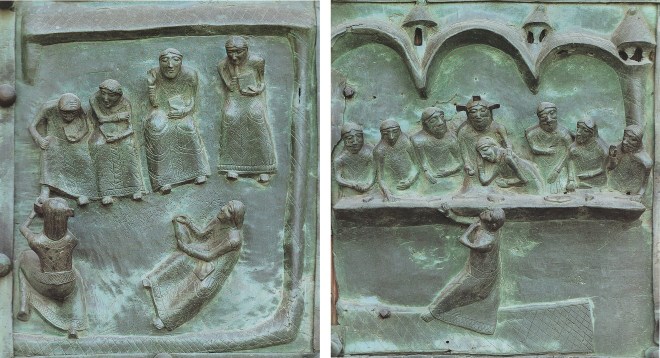
Each tile represents a story about Jesus or, more rarely, Saint Zeno. Here are close-ups of a couple of the tiles, just to whet readers’ appetite. From left to right, they represent the washing of the disciples’ feet by Jesus, and the Last Supper.

Source

The interior was light and airy.

Source

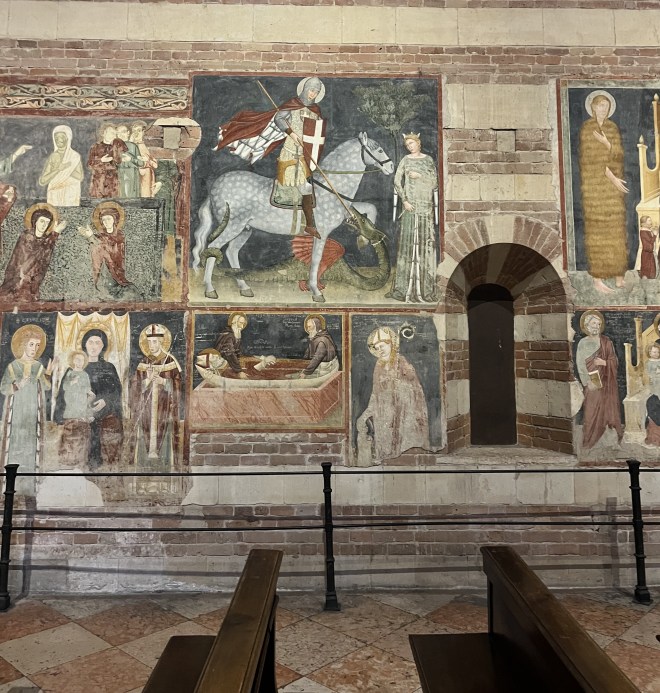
There was a hodgepodge of frescoes on the walls, all very pleasant.

My photo

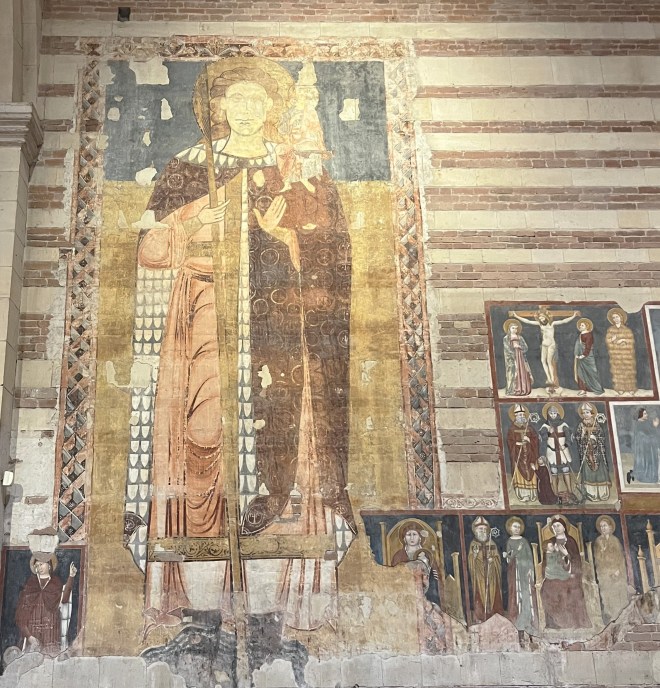
But the fresco that really caught my eye was a giant St. Christopher.

My photo

It was nice to see this gentle giant again after my sightings of him in one of our hikes in Austria last summer. No doubt he was there to greet pilgrims from Central Europe who had come over the Brenner Pass and walked down the valley of the Adige River, on their way to Rome or Jerusalem.

Our visit to San Zeno brought us to the end of the second itinerary. We celebrated with a nice cup of tea in a bar across from the church, and then slowly made our way back to our hotel.

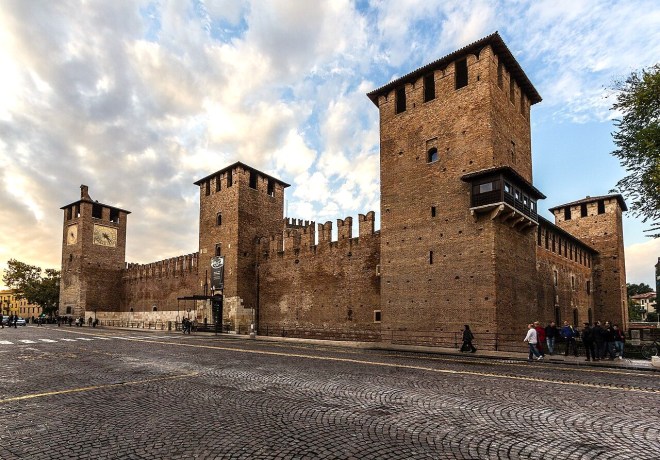
On our final day in Verona, we visited two museums, both dedicated to Veronese artists. We started with the museum in Castelvecchio, which was once the castle of the Della Vecchia family.

Source

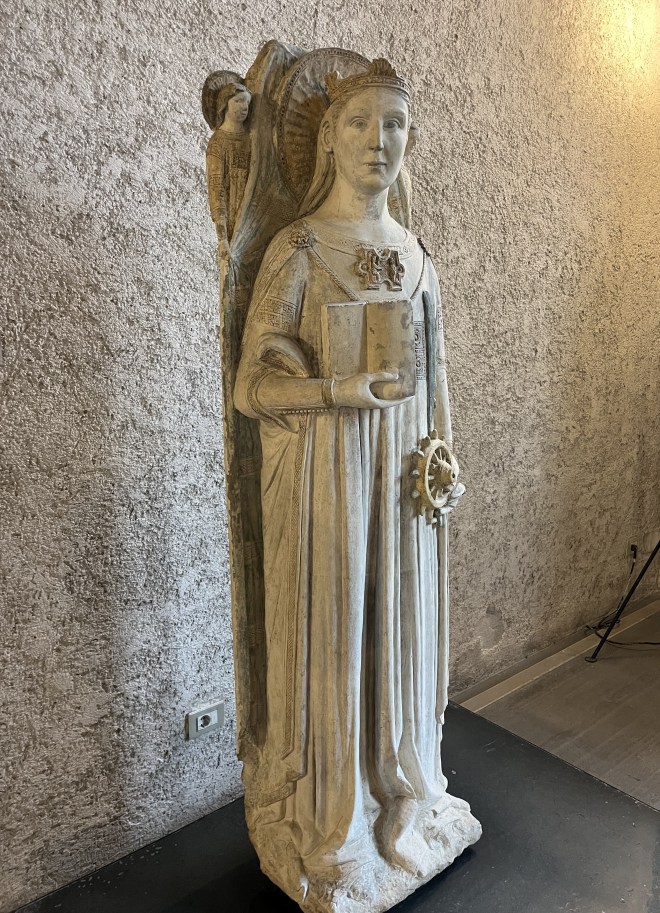
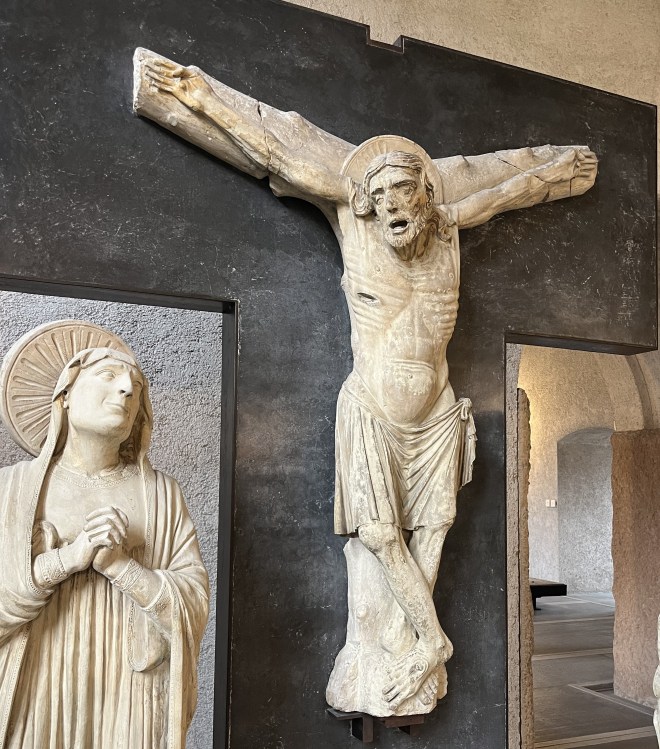
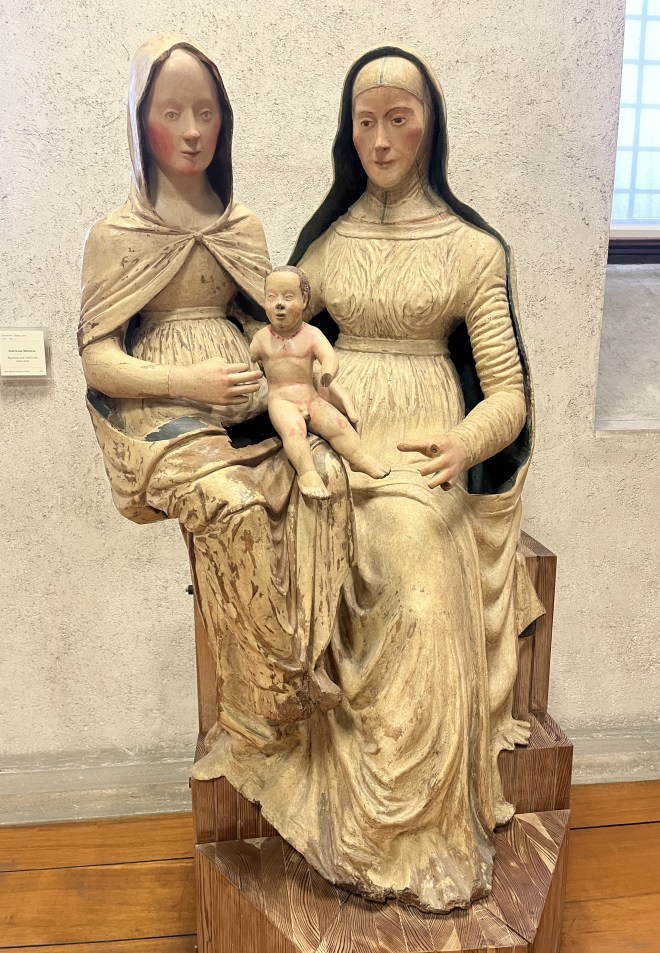
The collection goes from the Middle Ages to the 18th Century. My wife and I both agreed that the statuary from the Middle Ages was the most interesting. Here is a sample:

A most expressive St. Catherine

My photo

I’ve never seen a Medieval statue look at you in that way!

Christ on the cross

My photo

I’ve never seen such a suffering Christ!

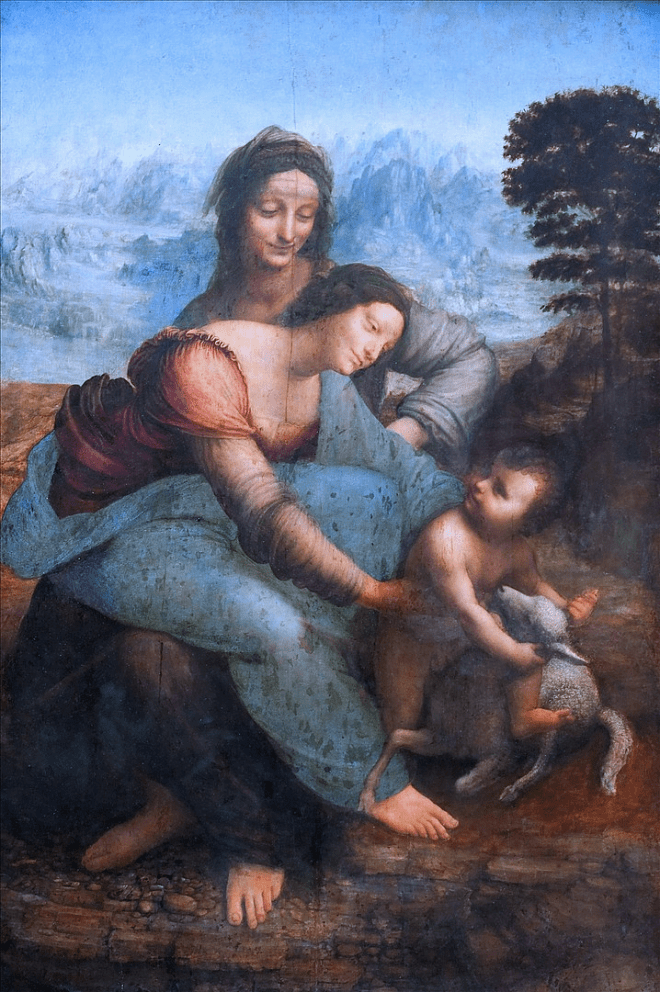
A Sant’Anna Metterza, a formalised composition where the Virgin Mary, holding baby Jesus, sits on the lap of her mother, St. Anne.

My photo

I’ve always found this such an improbable situation: what grown woman would ever sit on the lap of her mother!? But it was a popular subject. Famously, Leonardo da Vinci painted a version.

Source

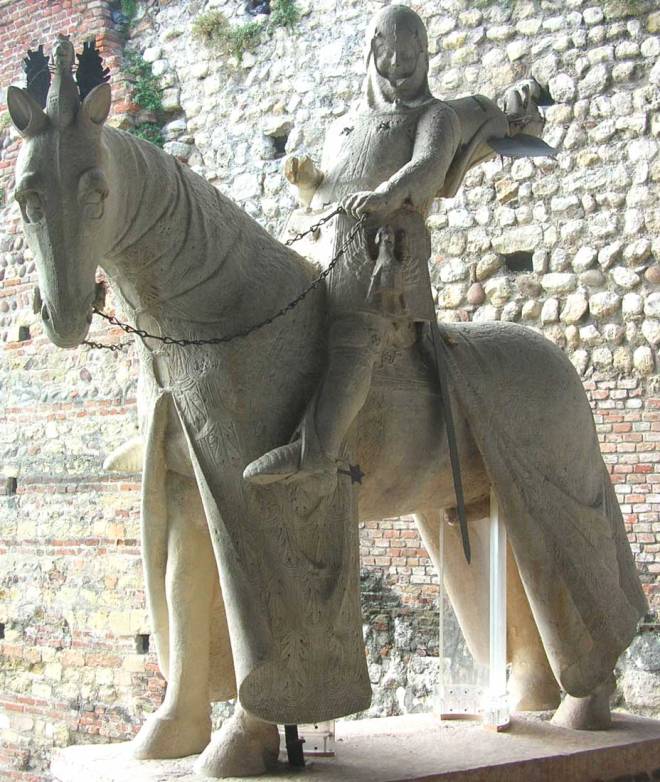
The equestrian statue of Cangrande Della Scala, the greatest of the Della Scala family.

Source

From the broad smile on his face, Cangrande must have been a very merry fellow.

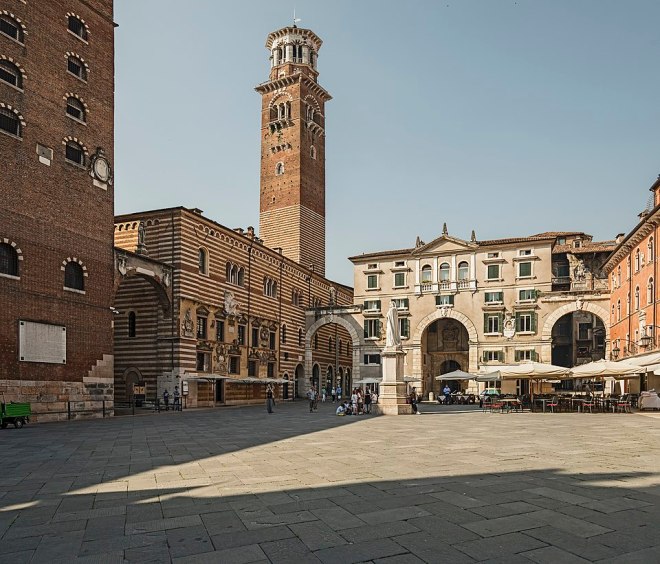
After the visit, it was time for lunch. We chose a restaurant near Castelvecchio, but unfortunately it turned out to be a tourist trap, so I won’t bother to report on what we ate. We then walked back up to the Piazza delle Erbe; the second museum we visited, the Galleria d’Arte Moderna Achille Forti, was installed in the old Palazzo della Ragione, which gives on the square.

Source

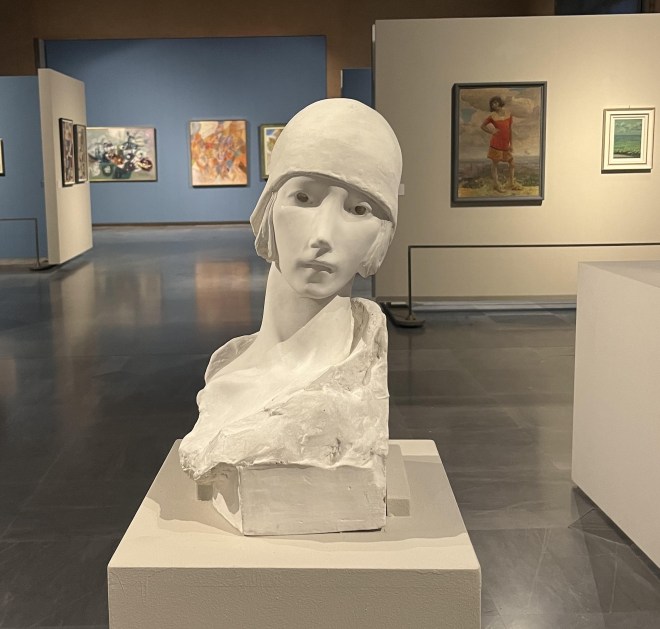
It covered the 19th and the first part of the 20th Centuries. To be frank, there wasn’t much in the collection that struck me. This statue, of a young woman wearing a hat typical of the 1920s, was one of the few pieces that caught my attention.

My photo

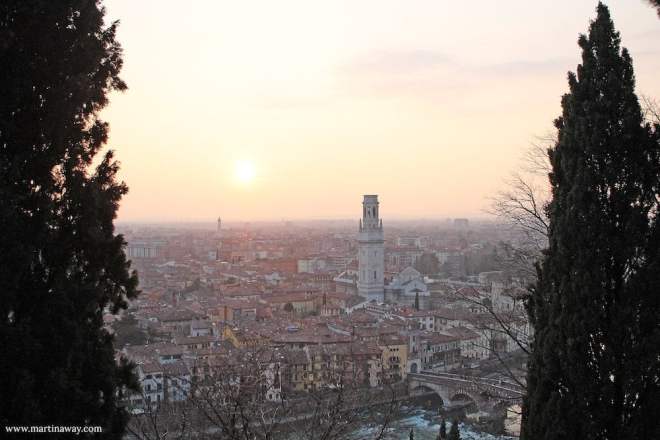
Otherwise, a couple of paintings which showed views of the city from the top of the hills above the old Roman theatre made me regret that our old guidebook hadn’t included an itinerary taking us up into those hills. Here is a view of the city from the top of those hills.

Source

With that, our visit to Verona was over. We walked down another of the city’s very pleasant pedestrianised streets, via Mazzini, which runs from piazza delle Erbe to piazza Bra.

Source

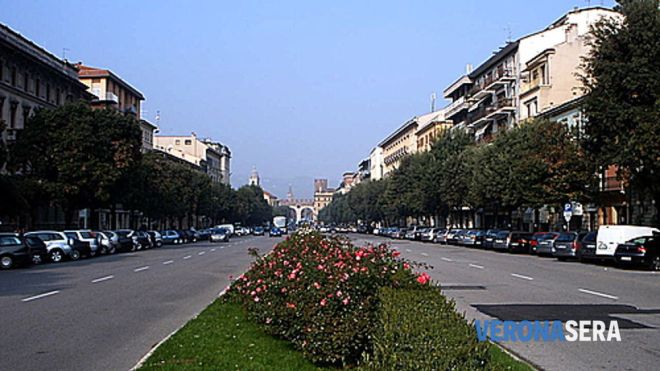
And then on down Corso Porta Nuova, a broad avenue running through the newer part of the city.

Source

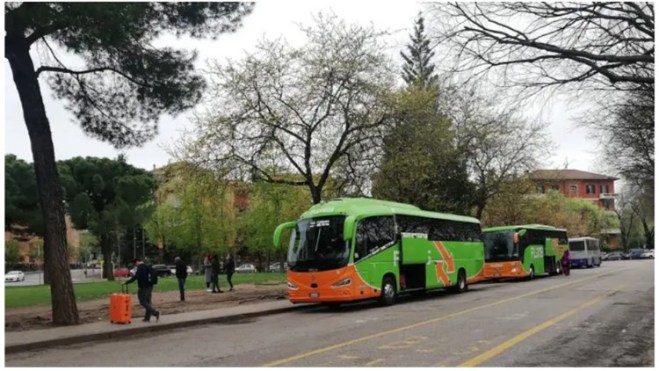
And so back to the bus stop to take our Flixbus back to Milan.

Source

SEAPLANES OVER LAKE COMO

Sori, 31 January 2026

One of the gentler walks my wife and I take from Como is one which takes us along the lakeside all the way to Cernobbio. We choose it when one (or both) of us are feeling tired or have a pain somewhere in our ageing bodies or when it’s really too cold to venture higher up on the hills around the lake.

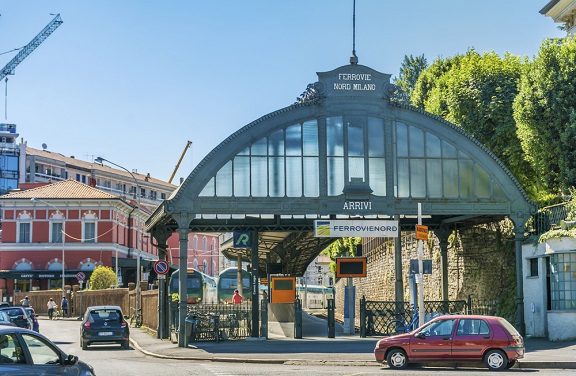
We start at the train station of Como Lago (which is a charming rinky-dink little station with an entrance in Liberty style, much nicer than the rather grim main station at Como).

Source

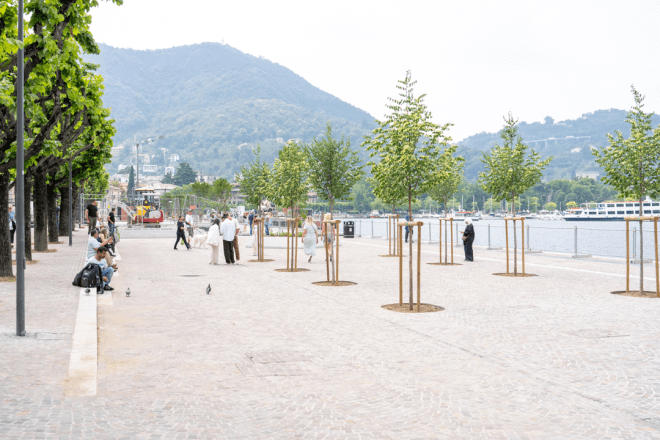
We walk along Como’s newly developed lake front (which will look very nice when the newly-planted trees have grown).

Source

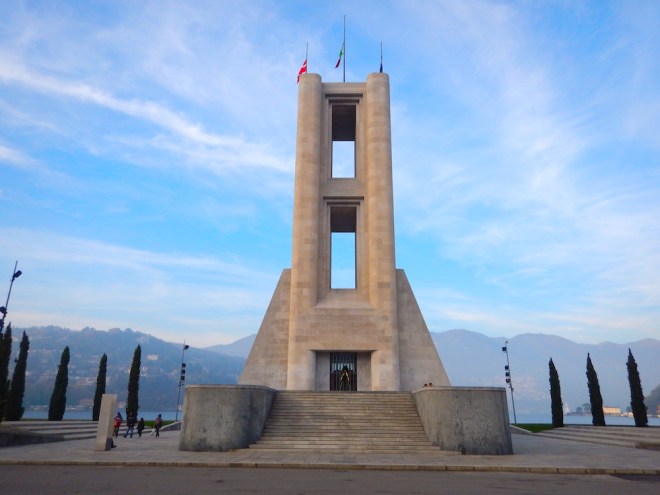
We pass the town’s war memorial (which I must confess I find rather brutalist).

Source

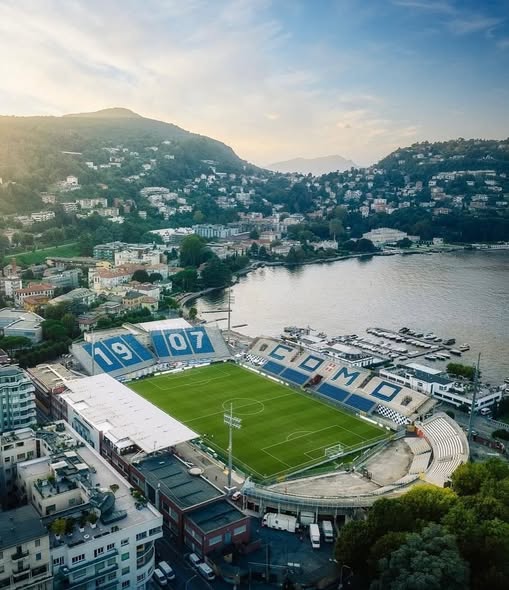
We pass the soccer stadium which is home to the town’s home team, Como 1907 (which looks quite nice in this aerial view, although all we see are the forbidding outer walls).

Source

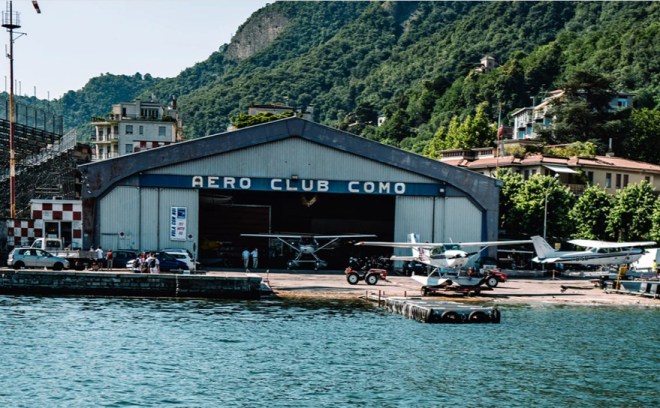
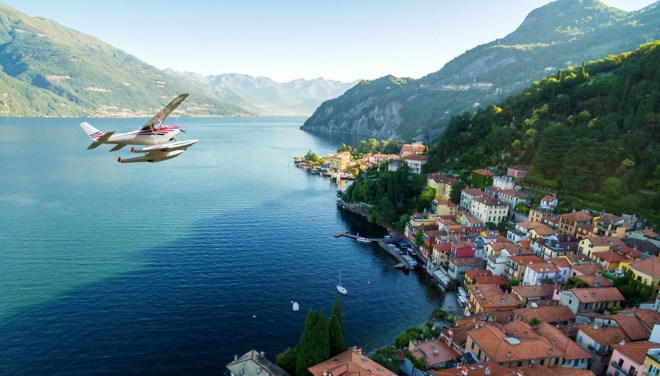
We pass the site of the Aero Club Como, which offers scenic flights around the lake in seaplanes.

Source

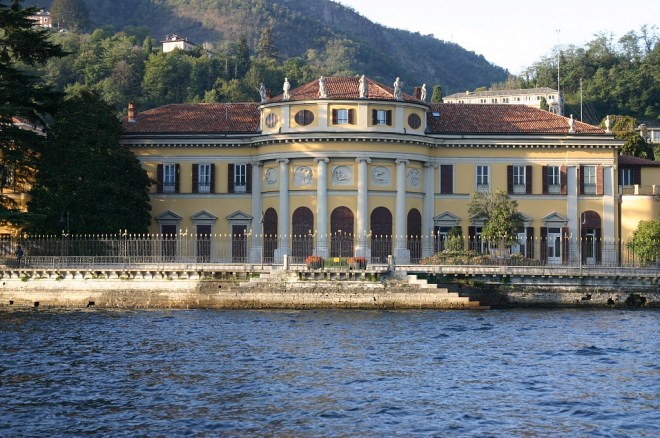
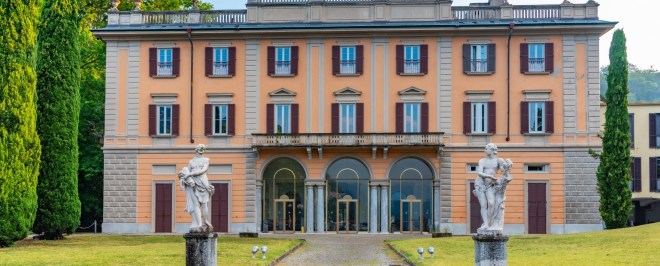
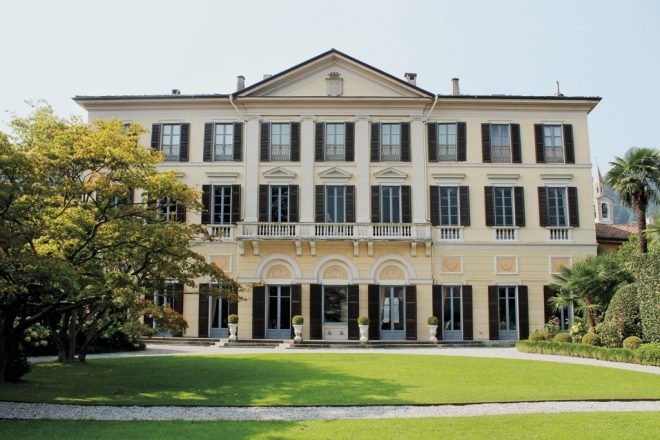
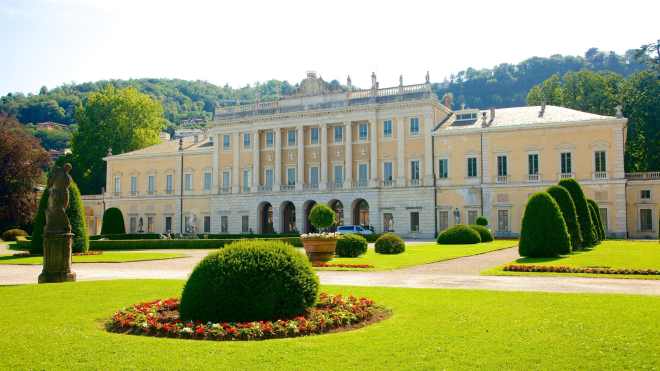
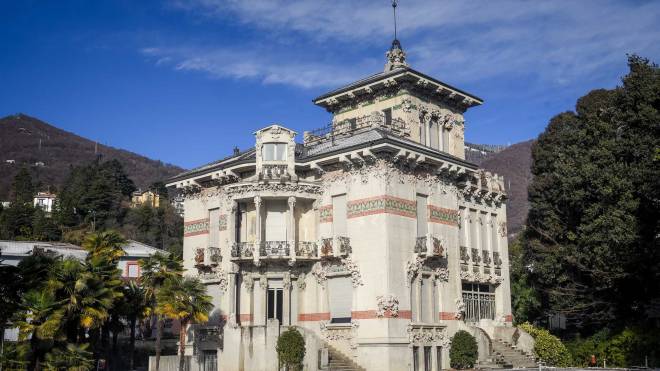
We then walk along a walkway that hugs the lakeside and takes us past a series of neoclassical villas giving onto the lake.

Source
Source
Source
Source

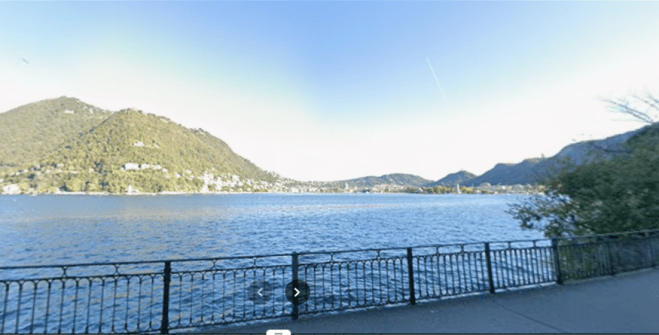
The walkway ends at a busy main road. We walk along the road, with lovely views across the lake to our right.

Source

The road brings us to the old village of Tavernola (now a drab suburb of Como), where we branch off along a long straight road that passes the Liberty-style villa Bernasconi, once the property of a rich manufacturer of silk and now a museum.

Source

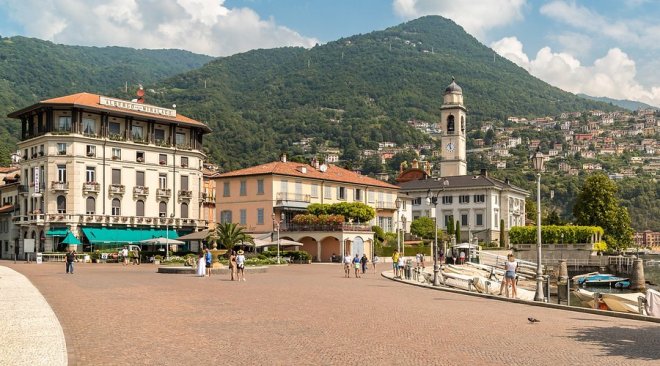
After which we finally arrive in Cernobbio.

Source

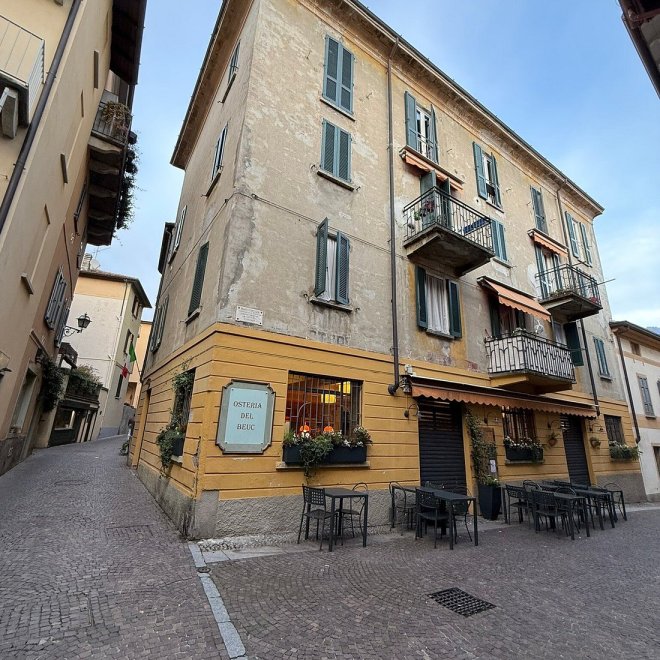
At this time of the year, when it’s too cold to eat a picnic outside, we’ll often treat ourselves to lunch at the Osteria del Beuc.

Source

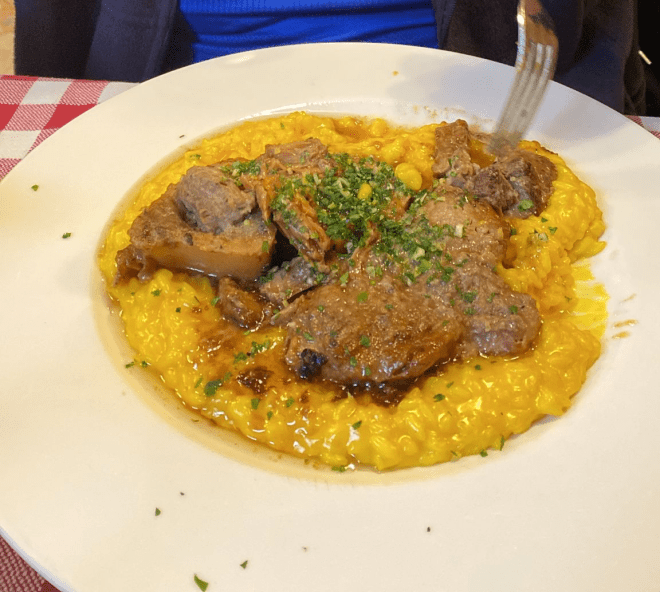
The last time I was there, I had a magnificent osso buco with risotto.

My wife’s photo

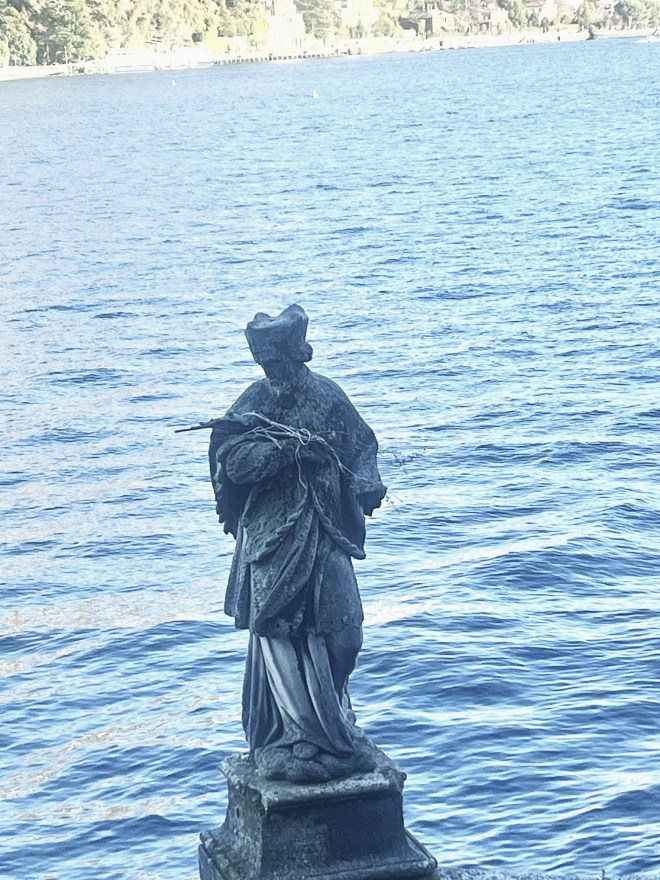
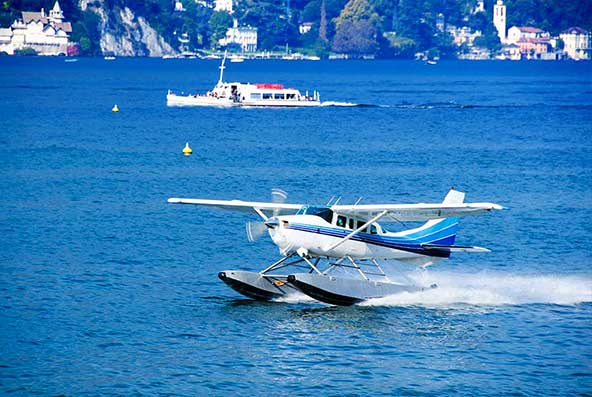
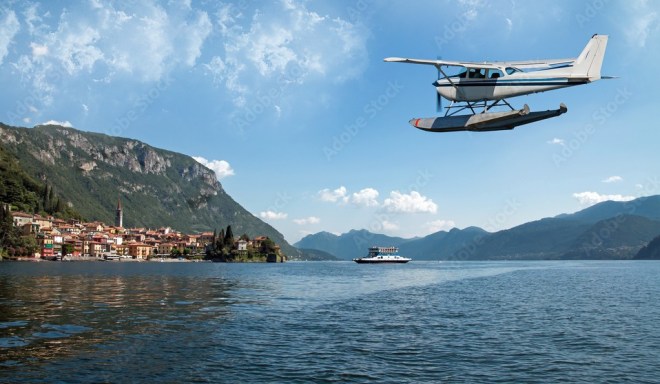
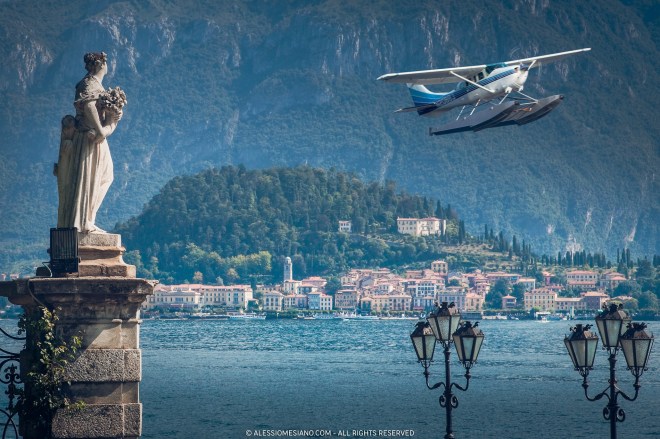
One of the pleasures of the section of the walk along the busy main road (apart from getting to nod hello to a mouldering statue of St. John Nepomuk down by the water’s edge) is watching the seaplanes from Aero Club Como taking off and landing.

Source
Source

I’m very fond of these seaplanes. There’s something quite beautiful about these little planes skimming across the water, their engines at full throttle, finally rising off the water surface and soaring up, up, up

Source

and then banking to fly along the lake, the drone of their engines bouncing off the hills (I love the noise of prop engines, so much nicer than the ear-splitting whine of jet engines).

Source

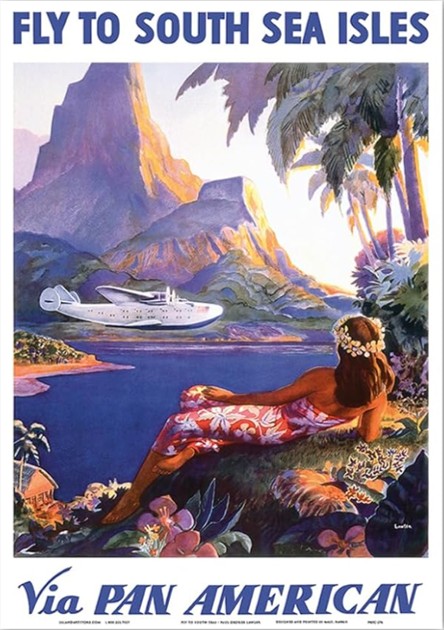
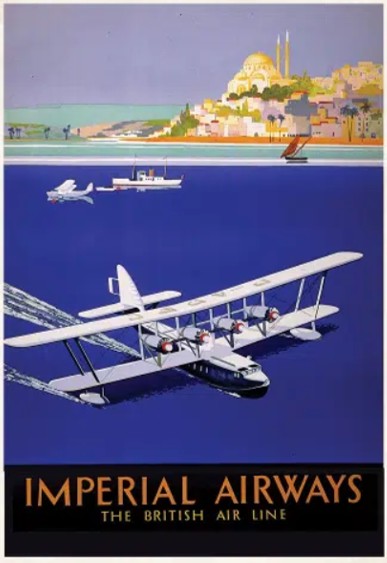
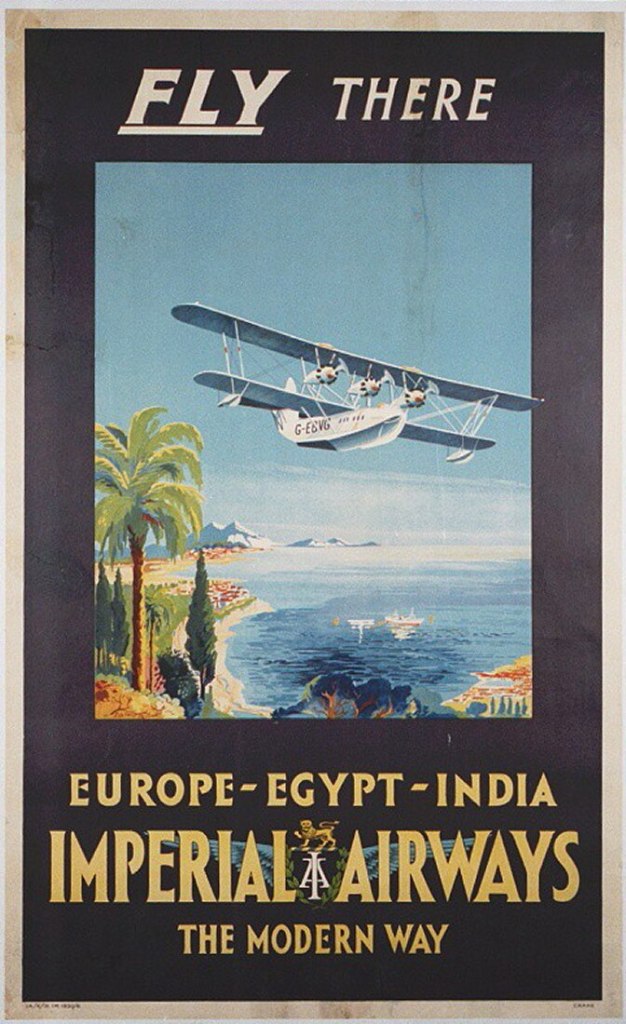
During the years between World Wars I and II, the use of seaplanes flourished: the “airfields” were free, compared to the high cost of building airfields on land. Various commercial lines were established, giving rise to some wonderful poster art.

Source
Source
Source

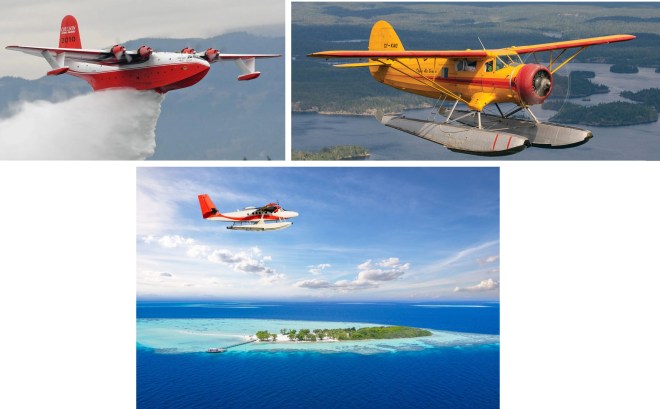
Things changed dramatically after the Second World War. Many of the military airfields which had been built during the war were no longer needed and could be turned over to civilian use. Suddenly, land-based airfields were available cheap, and so the main competitive advantage of seaplanes disappeared. On top of that, land-based planes were much less affected by weather (even small waves could halt seaplane flights) and they flew faster (the aerodynamics of seaplanes are poorer). The result was a swift decline in the use of seaplanes, which are now squeezed into a few niche uses, like aerial firefighting, access to undeveloped or roadless areas which have numerous lakes, air transport around archipelagos …

Source                             Source                                 Source

… as well, of course, as the offering of scenic flights over dramatic lakes.

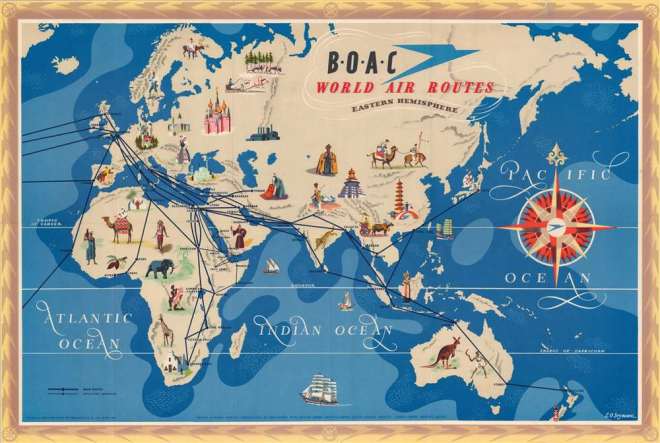
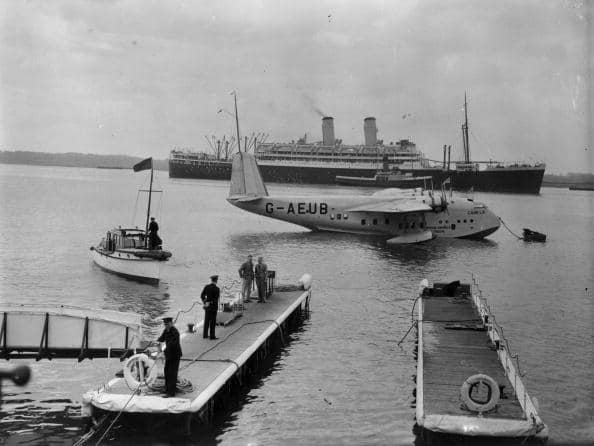
In the late 1940s, 1947 I’m guessing, My parents took what was probably one of the last long-distance seaplane flights offered by BOAC, which ran between Sydney and Southampton. They boarded at Karachi and stopped off at Bahrain, Cairo, Augusta in Sicily, and Marseilles, before arriving in Southampton.

Source

The scene of their arrival in Southampton would have looked something like this.

Source

Once, in a moment of madness, as we watched a seaplane gracefully lift off Lake Como, I excitedly suggested to my wife that we take one of the scenic flights offered by the Aereo Club. A check of the prices soon put paid to that idea. Ah well, another experience of my parents which I will never share.