Los Angeles, 6 April 2026
The day of the birth is coming soon! Keeping our daughter company as we wait for The Happy Event, we have been spending considerable time in the house’s backyard. It is, I’m sure, like many other backyards in this part of Los Angeles: a rectangle of lawn surrounded by various plants, some introduced by my daughter, some brought in by wind, birds, or squirrels, but the great majority, I’m sure, planted by previous occupants of the house.
In a moment of idle curiosity, I started looking more closely at all these plants. In most cases, I had no idea what they were. Luckily, though, my trusty iPhone helped me out with its plant identification app. And the picture that emerged is that the whole wide world has been brought into this little rectangle of Los Angeles earth.
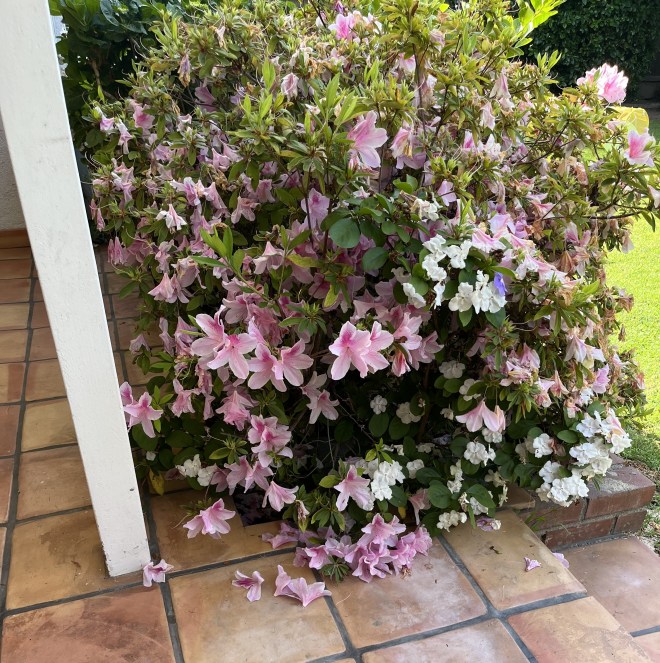
The biggest contributor has been Asia, especially East Asia. The most showy of these Asian immigrants has been an Indian azalea – which, despite its name, is actually native to southern China as well as Viet Nam and Thailand. When my wife and I arrived, we were dazzled by the cloud of flowers on it.
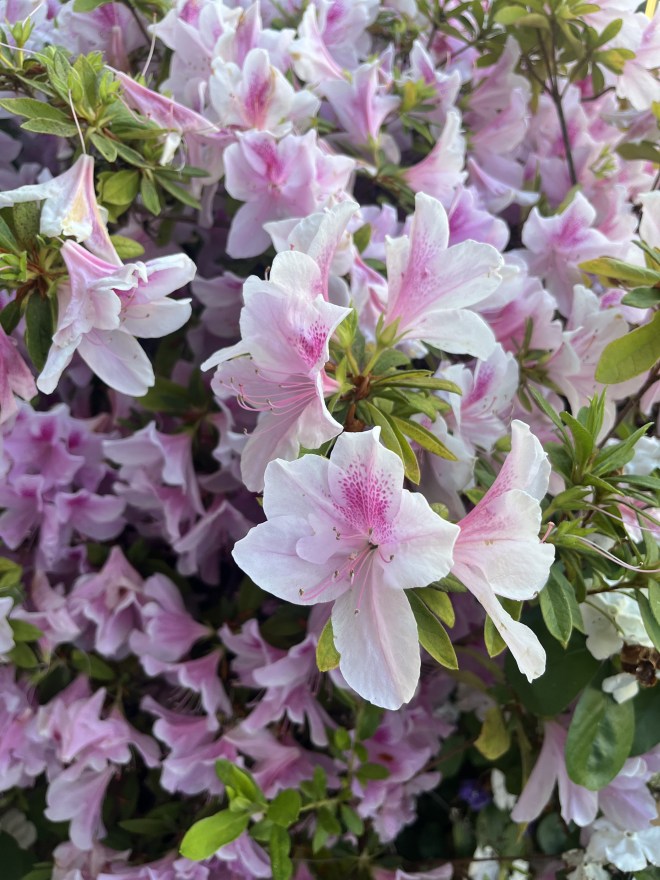
Since that first day, flowering has peaked and the bush is looking less dramatic.
Across the lawn are a couple of camellia bushes, a plant which is native to China and Japan. They form a veritable wall.
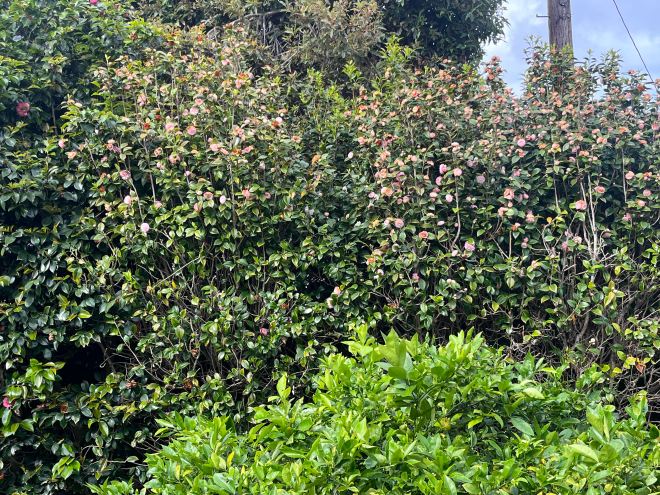
The flowers, on one bush a deep pink and on the other bush a whitish pink, are a charming vista.
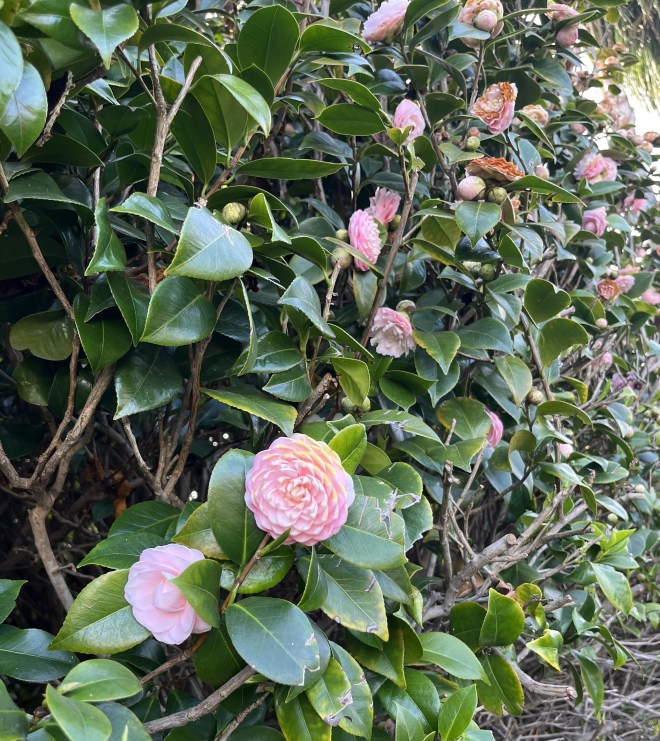
Another camellia down the house’s side alley gently rains white flowers day after day, lifting my spirits as I throw the trash out.
Hidden away behind some other bushes is an Indian hawthorn, which, again, despite its name, is native to southern China, as well as Japan and a number of countries in South-East Asia.
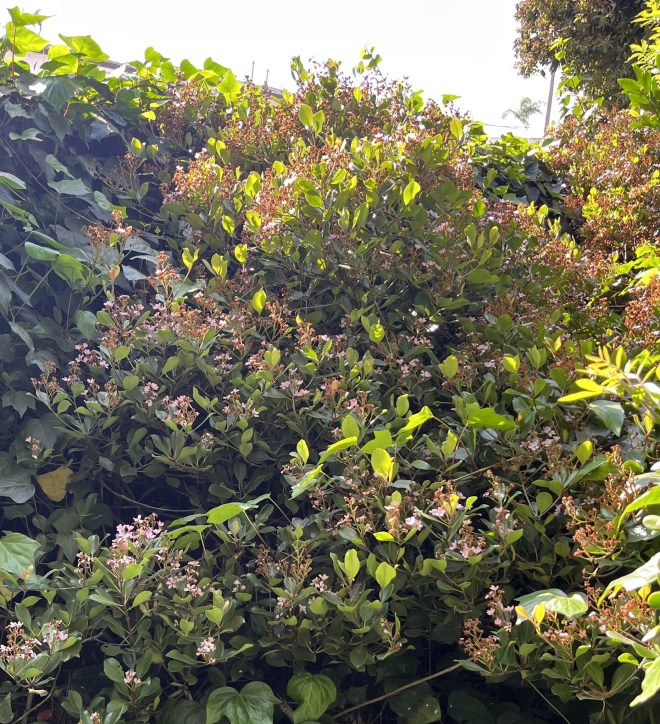
When in full flower, as is the case for this bush close to where we are staying, it’s quite a magnificent site.
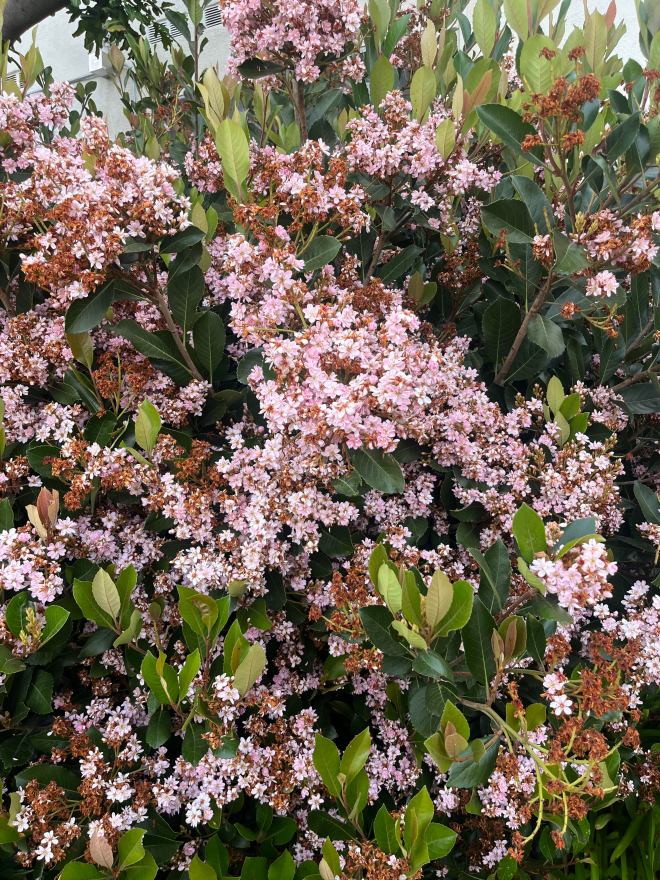
From the bush’s position in a corner where no-one goes (except nosy parkers like myself), I suspect that it was a “gift” from another garden brought by wind, birds, or squirrels; it is a popular plant in the neighbourhood.
There is also a rose bush against the fence. Truth to tell, as this photo shows, it is a rather miserable specimen, with only one flower on it at the moment.
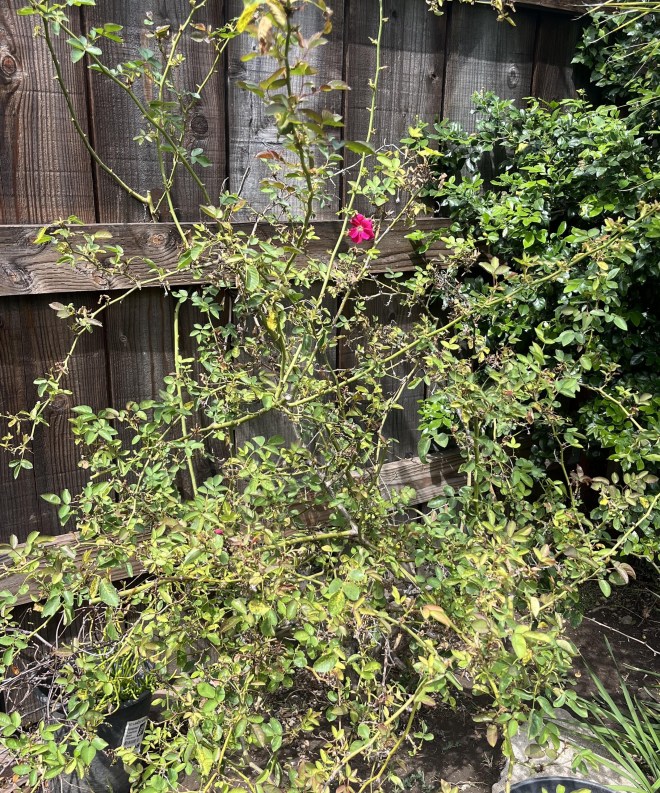
But its presence allows me to recount the interesting story behind garden roses. There are more than 300 species of wild roses; most of them are native to Asia, with smaller numbers hailing from Europe, North America, and Northwest Africa. Despite this global presence, it is the China rose, native to Southwest China, which has most contributed to today’s cultivated roses. For about 1,000 years, the Chinese had been breeding it into garden varieties, extensively interbreeding it as well with the giant rose, which is native to Yunnan as well as to northeast India and northern Myanmar. Then, from the 17th Century onwards, Europeans brought back a number of varieties from China and started the modern breeding programmes, which has led to the enormous range of domesticated roses that we know today.
East Asia keeps on giving, with a Chinese photinia in a corner.
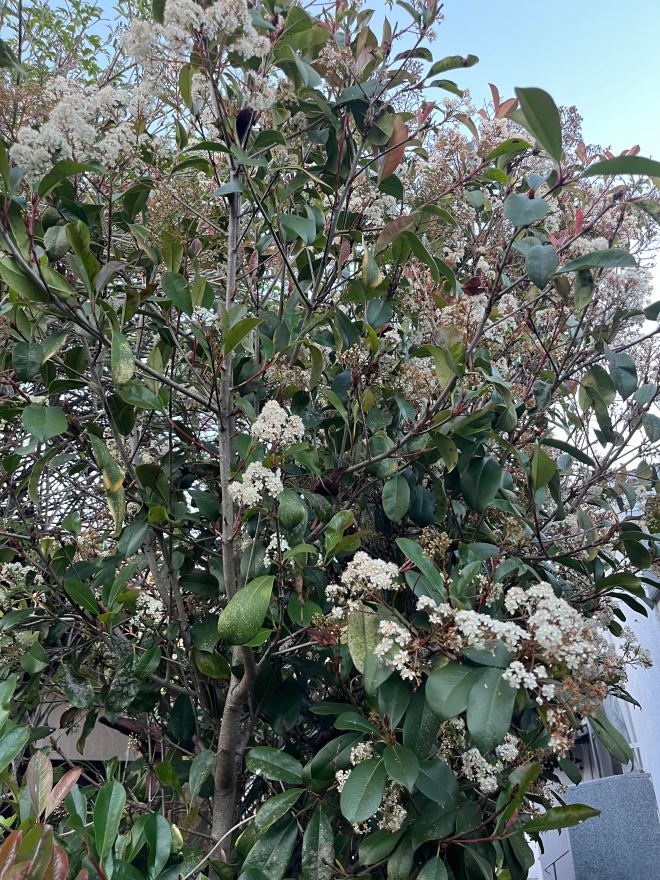
As the name suggests, this plant is native to China, but also to Taiwan, Japan, the Philippines, Indonesia, and India.
Next to the Chinese photinia is the aptly-named red tip photinia.
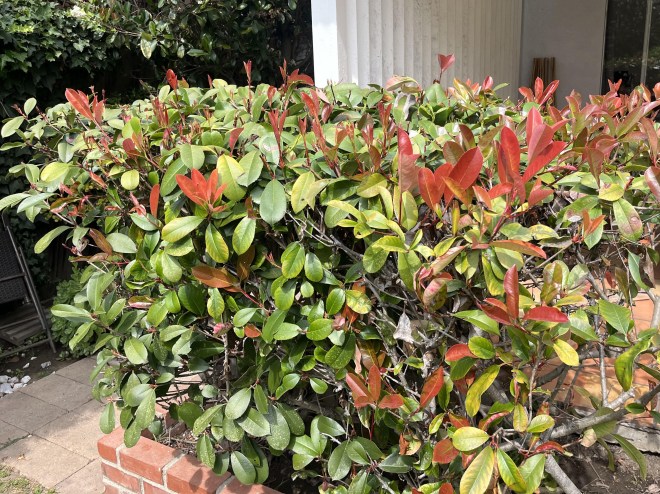
As the photo shows, the top leaves turn bright red. When all the top leaves go red, it is a very handsome sight. This photinia is actually a hybrid, between the Chinese photinia and another photinia, the Japanese photinia, which is not only native to Japan but also to south and central China, as well as to parts of Thailand and Myanmar.
We’re not finished with East Asia yet! Tucked away close to the “Indian” azalea is a small bush of heavenly bamboo (which, confusingly, is not actually a bamboo). It is native to broad swathes of East Asia.
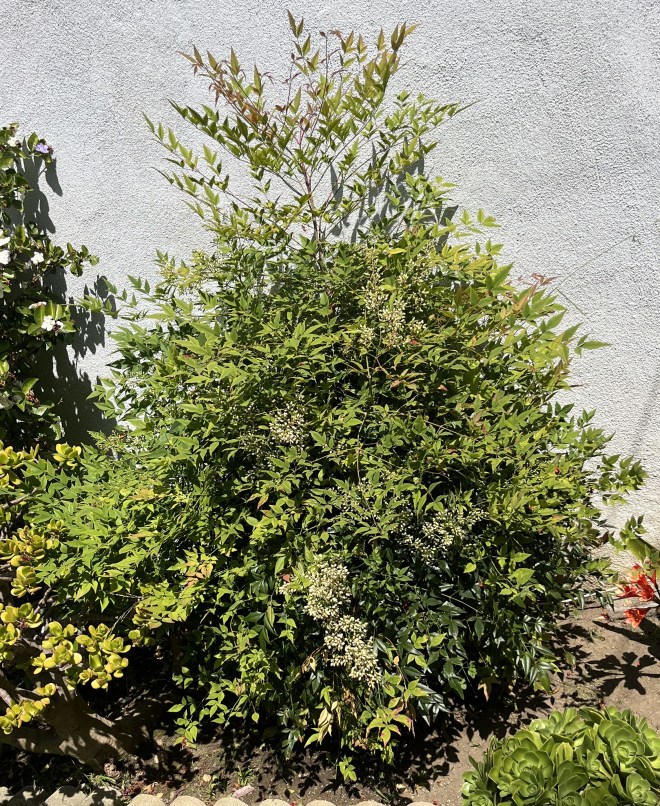
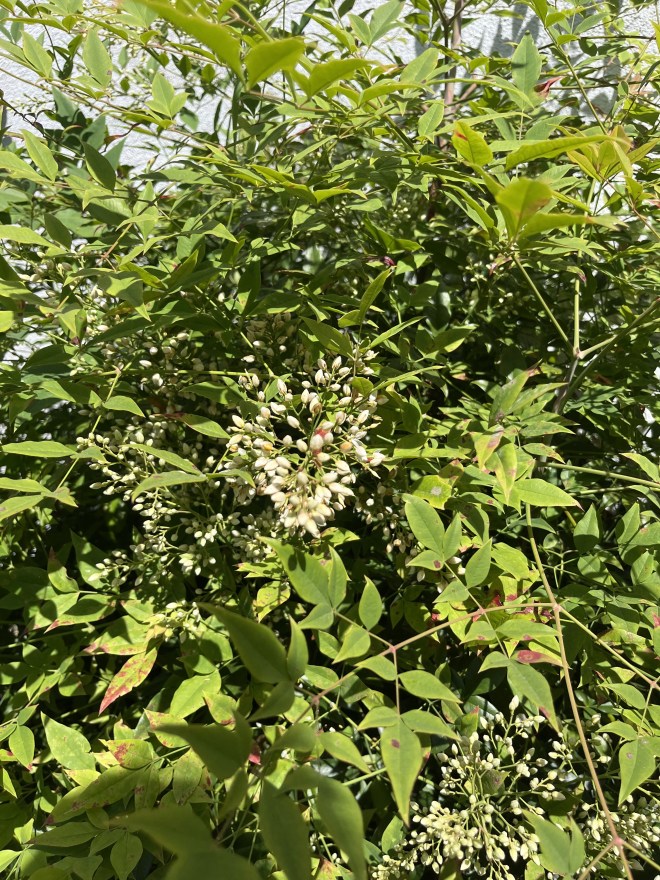
This particular bush is in flower at the moment.
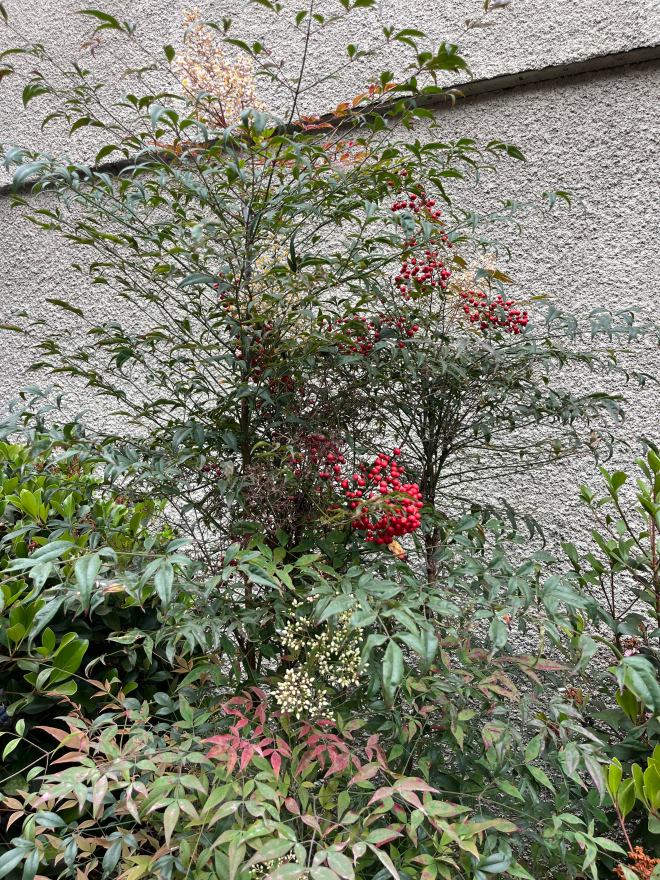
But heavenly bamboo also grows bright red berries, as this specimen I came across in the neighbourhood shows.
Next to the heavenly bamboo is a bush of hydrangea (or hortensia, as I’ve always called it).
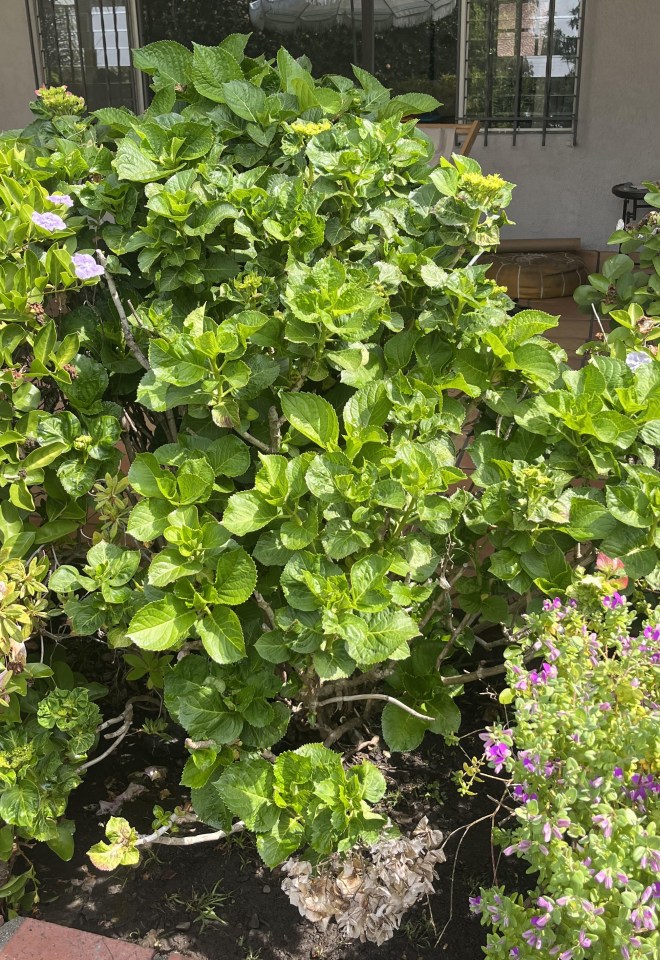
It’s only just beginning to bloom, but my daughter tells me that its mophead flowers are pinkish in colour. This tells me that it is almost certainly a variety of Bigleaf hydrangea, which is a native of coastal areas of Japan.
In front of the Indian hawthorn – one of several plants screening the poor hawthorn from view – stands a Japanese cheesewood. It is native to the southern half of Japan but also to China, Taiwan, and Korea.
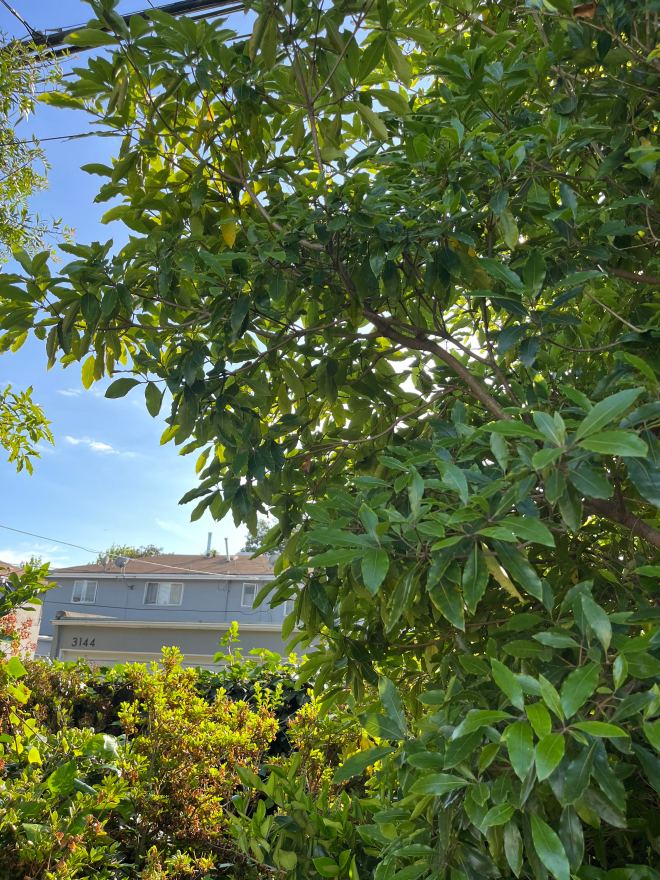
It’s not terribly interesting at the moment, but my daughter tells me that when it flowers the scent is heavenly.
The final immigrant from East Asia is a dwarf umbrella tree. As the name suggests, it is small, pressed down by the other trees and bushes around it.
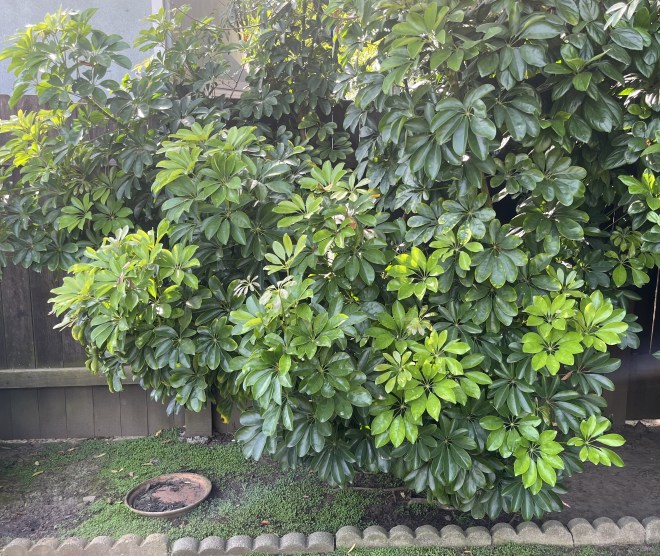
It is native to Hainan province in China and Taiwan.
Asia has still not finished giving! Two final plants from this region come from South Asia.
Planted in front of the camellia “wall” is a lemon tree, which has been the subject of a past post. It is producing a satisfactory number of lemons at the moment.
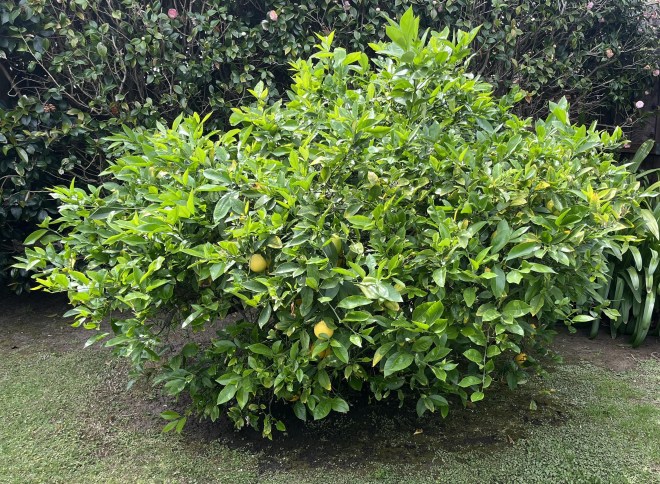
As I mentioned in another post, on citron, the citrus family hybridises like crazy. The lemon is one such hybrid, of the citron and the bitter orange. The hybridisation event probably occurred in Northeastern India during the 1st millennium BC.
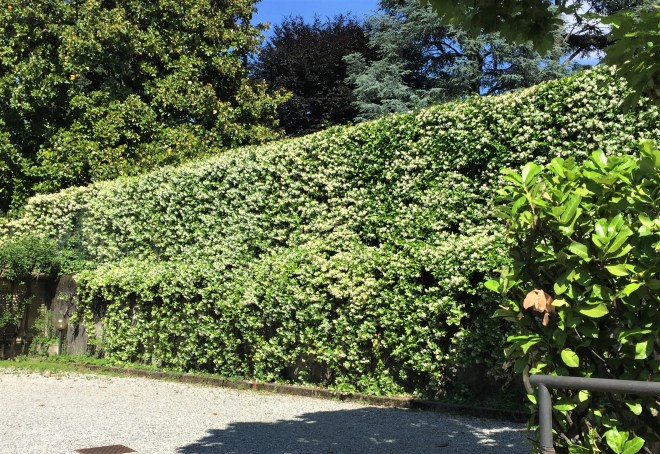
The second plant in the garden to have come originally from South Asia is orange jasmine.
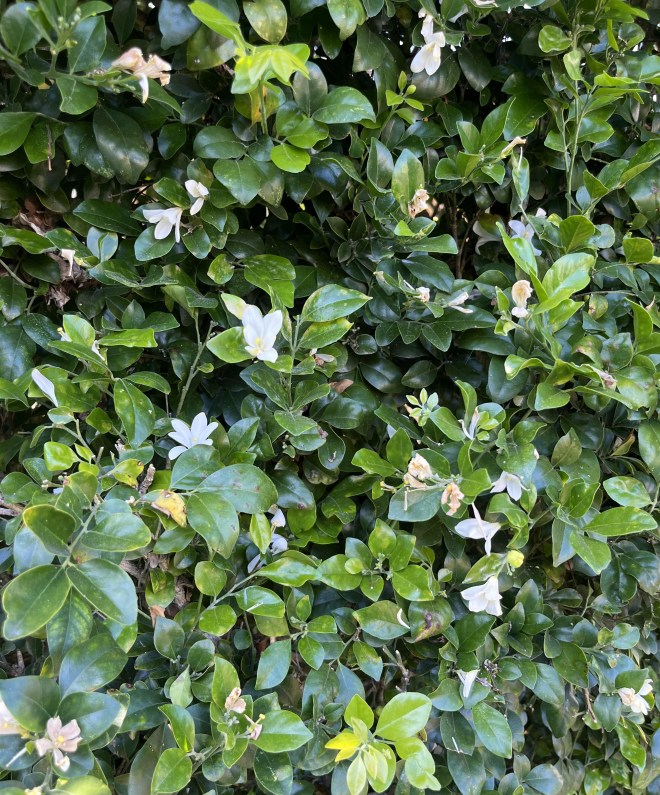
This species of jasmine is native to South Asia, Southeast Asia and northern Australia. The flowers smell lovely, although their density on this particular bush is quite low compared to other species of jasmine my wife and I have seen.
I don’t know if readers have been counting, but that is 12 species to have come from Asia. Africa, however, is fighting its corner as a source. It has birthed nine of the plants which have put down roots in that little rectangle of Los Angeles earth – most of them, interestingly enough, from South Africa.
Currently, the most showy of these African immigrants is the Natal lily.
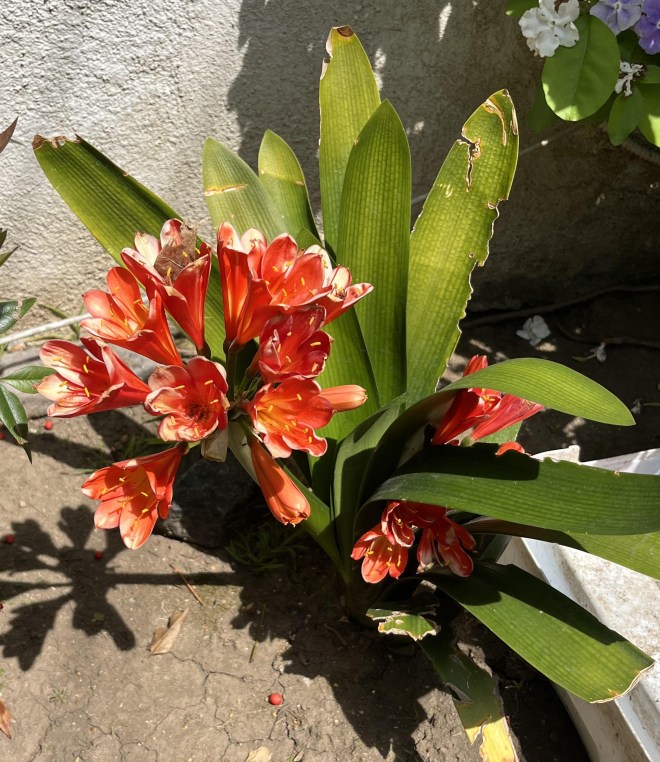
It is native to the Eastern Cape, Mpumalanga and KwaZulu-Natal provinces of South Africa, as well as to Eswatini.
From more or less the same part of the world comes the myrtle-leaf milkwort. It’s not as showy as the Natal lily, but it’s still very pleasant on the eye.
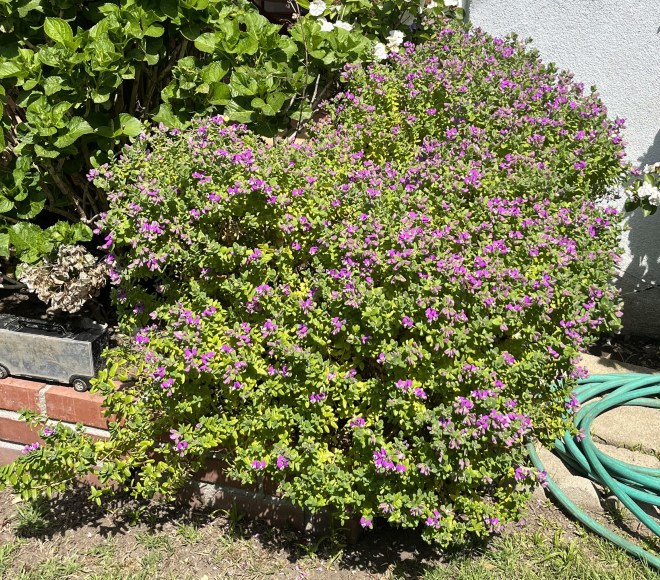
It is native to the Western Cape and KwaZulu-Natal provinces of South Africa.
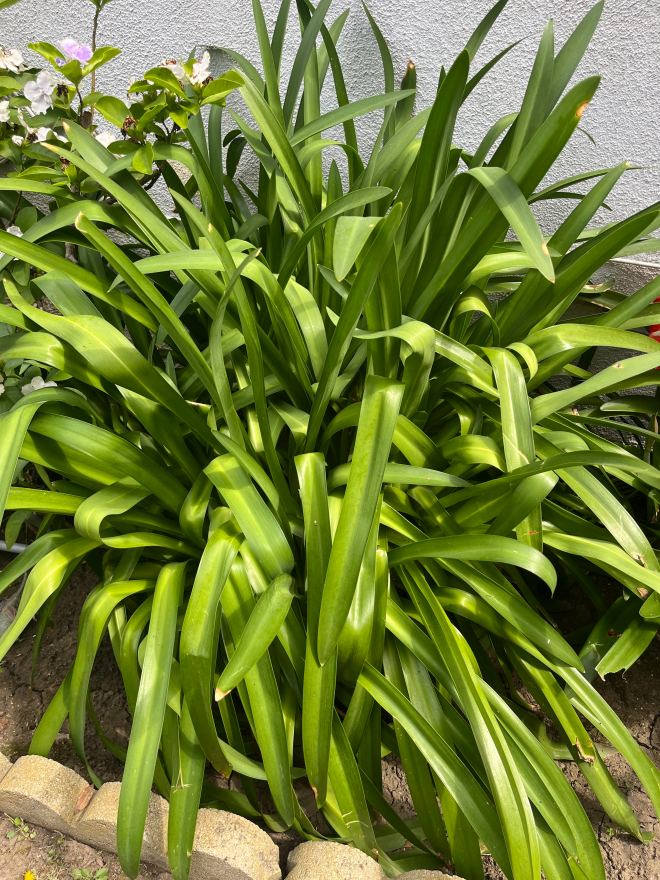
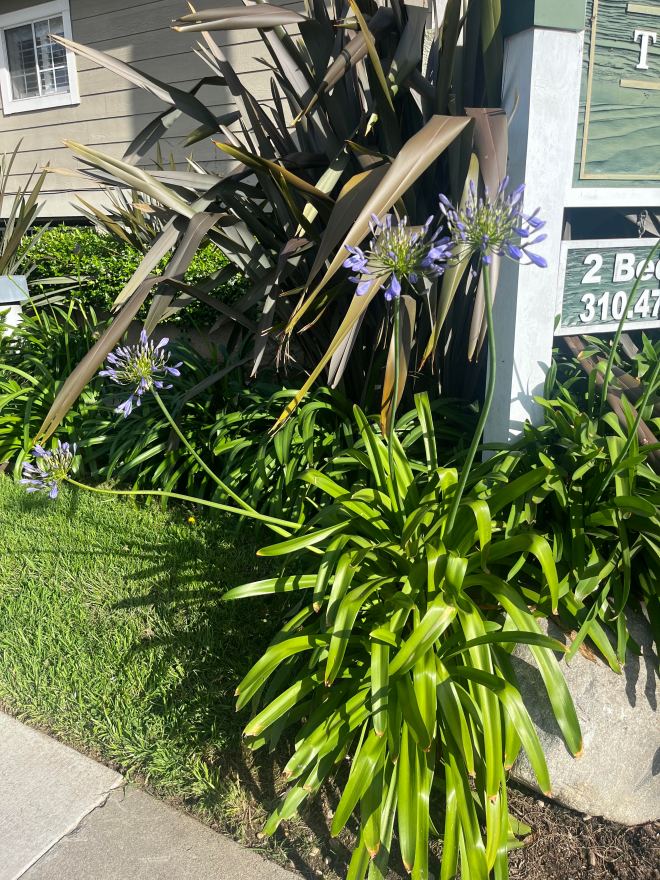
The garden also contains an African lily, which is another native of the Kwa-Zulu-Natal and Eastern Cape provinces of South Africa. The specimen in the garden is currently just a jumble of rather uninteresting leaves.
But it will soon have lovely blue flowers, mopheads like the hydrangea. Here’s an example from around the corner, where the flowers are just beginning to come out.
Poking out from a crush of bushes in one corner is the carnival ochna, which also is indigenous to the KwaZulu-Natal, the Eastern Cape, and parts of the Western Cape provinces, as well as Eswatini and Lesotho. It has this small but rather lovely flower.
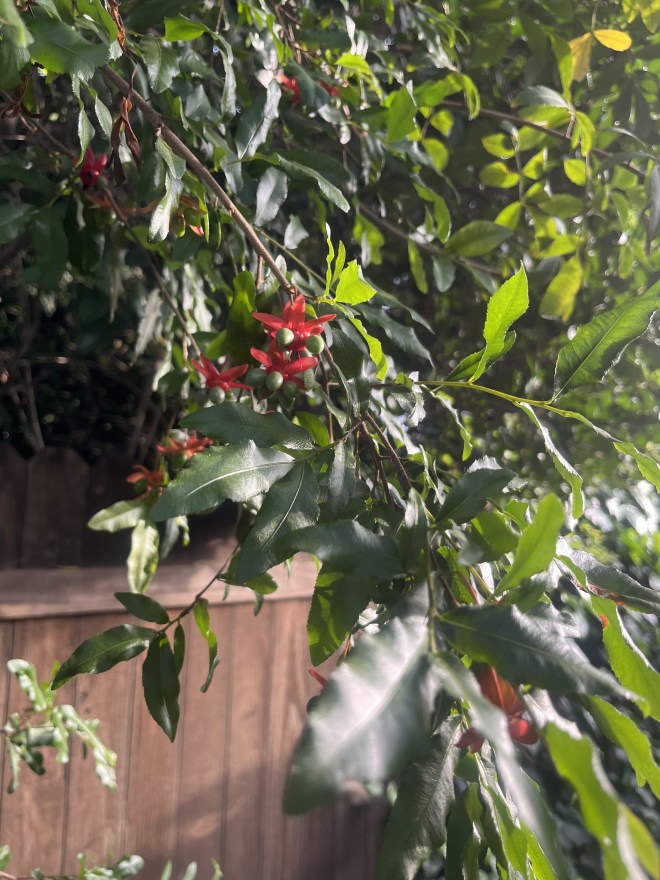
This flower gives rise to another, rather odd, name for the bush: Mickey Mouse bush. I report without comment the explanation I’ve read for this name: if you take the flower when the fruit is ripe (which is when those green spheres become black) and hold it upside down, those spheres resemble Micky Mouse’s head and ears, while the bright red sepals resemble his shorts.
Another plant from the KwaZulu-Natal and Eastern Cape provinces of South Africa (but also from Mozambique), a succulent this time, is the jade plant. It is growing in several different places in the garden This is the most handsome specimen.
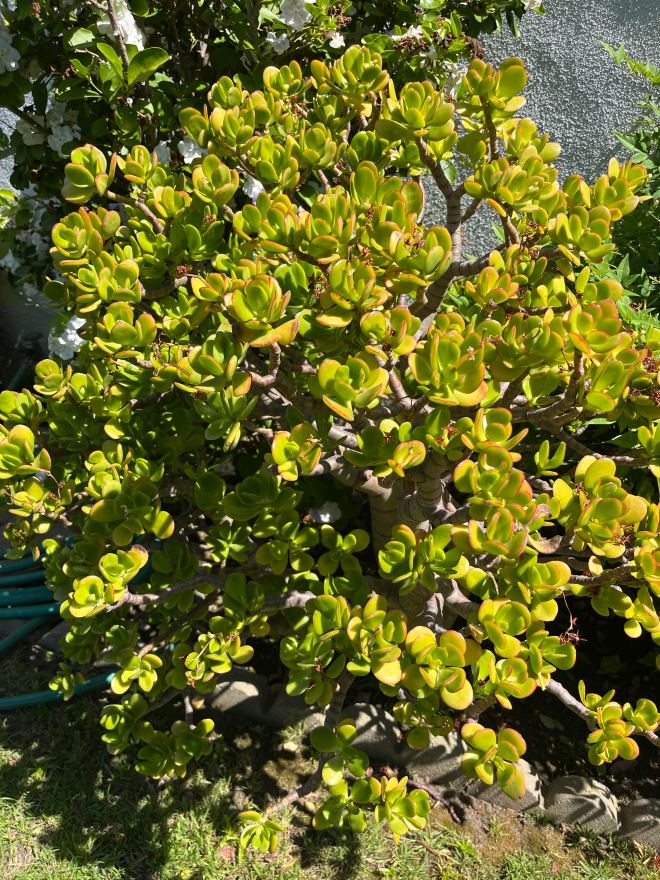
I’m generally not a great fan of succulents, but I have to say, these jade plants are really quite eye-catching. This particular specimen has no flowers at the moment, but another specimen in another corner of the garden has come out with small pink and white flowers.
A final plant native to southern Africa, but also the more tropical latitudes of the continent, is the spider plant.
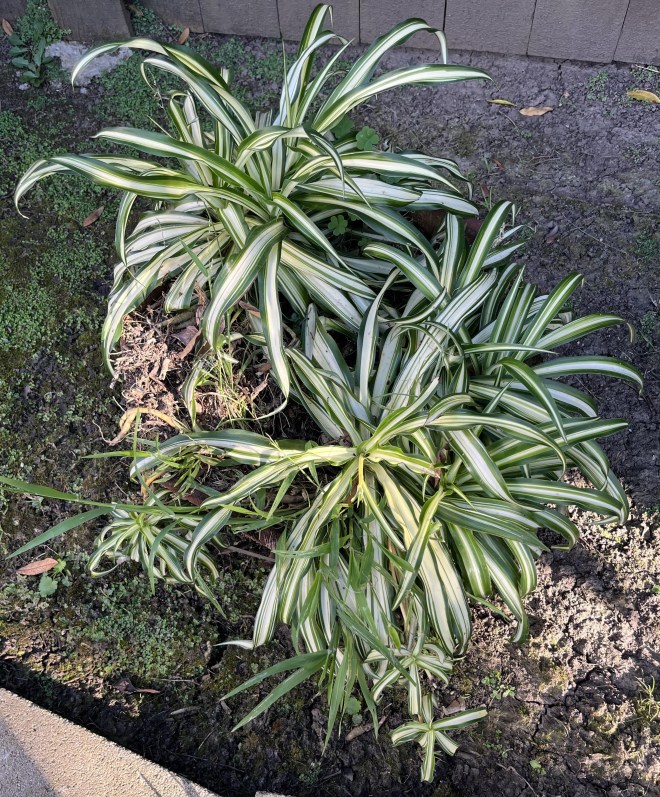
It does indeed have a spider-like look, of the daddy-long-legs variety. It comes out with a lovely white flower, but at the moment the specimen in the garden is flowerless.
So, many plants from southern Africa, and in particular from the Kwa-Zulu-Natal and Eastern Cape provinces of South Africa – there must be a biodiversity hotspot in those two provinces. But the garden also has two succulents from the Canary Islands (which I include in Africa even if they are formally part of Spain; a glance at a map will show why). These two succulents actually belong to the same family. There is a giant velvet rose (although this particular specimen is not so gigantic).
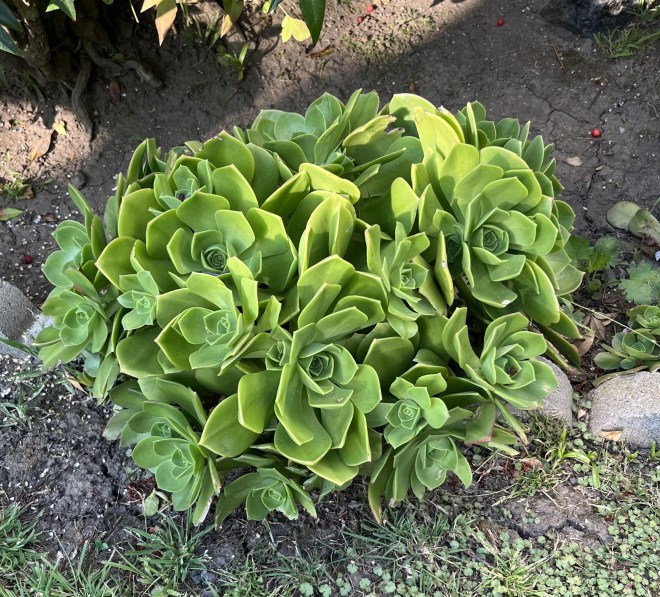
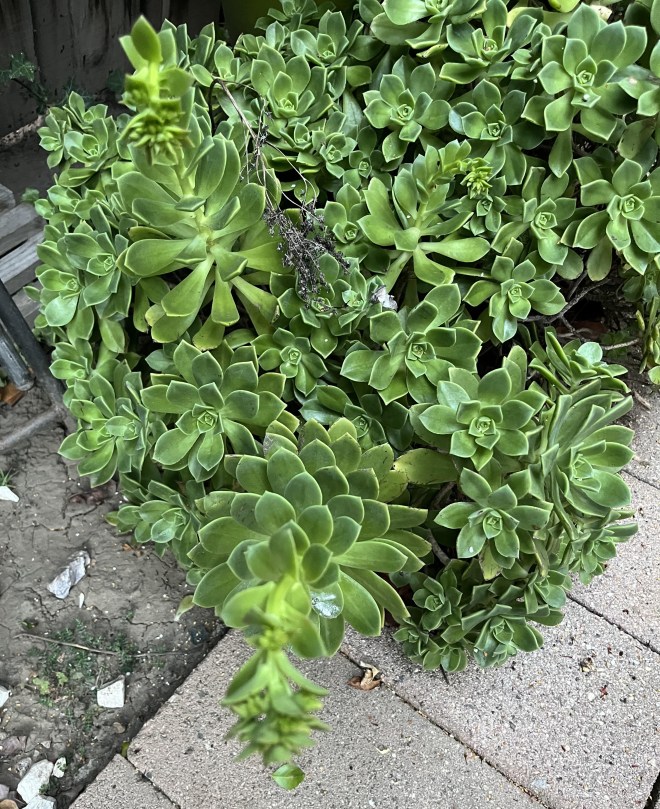
And there is a tree houseleek or Irish rose.
The final plant from Africa is the fire stick, which has a wide distribution throughout Africa as well as being present in the Arabian Peninsula.
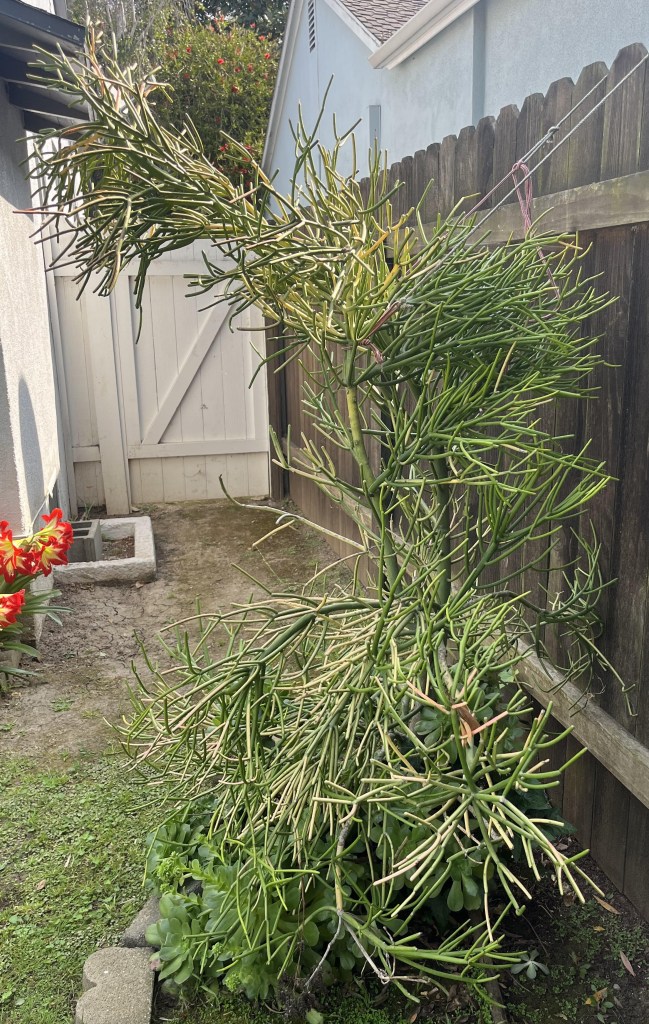
The topmost branches of some of the specimens we have seen here really are a fiery orange, living up to their name of fire stick.
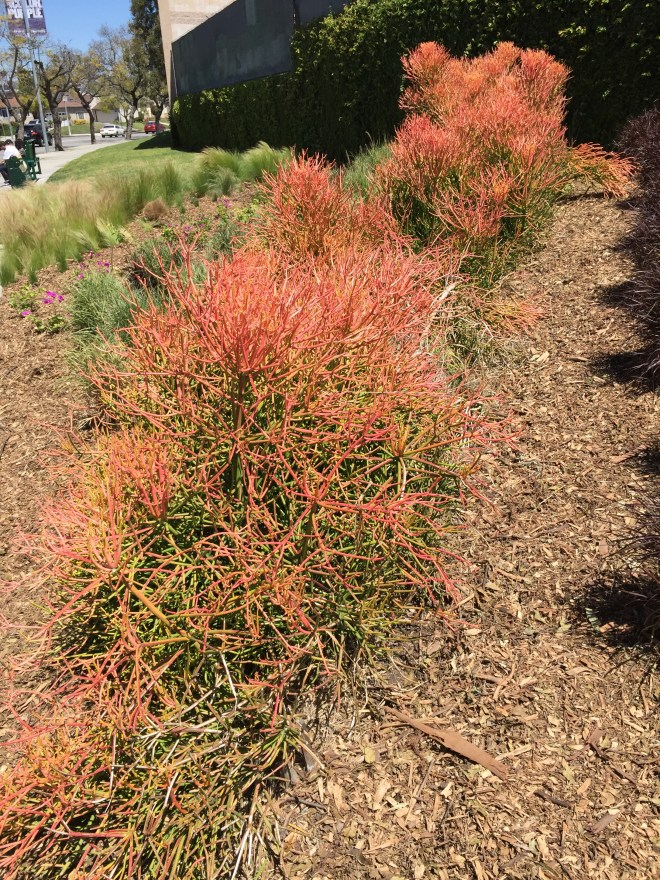
But this specimen’s colouring is rather dull.
Latin America and the Caribbean also has a strong presence in the garden, clocking in at seven plants. The most showy of these is an amaryllis.
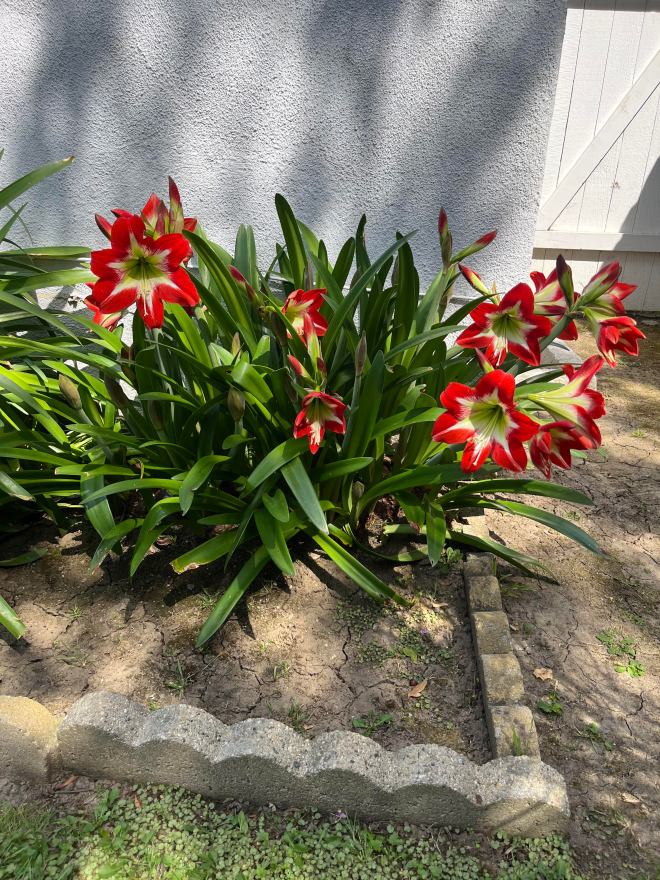
Most of the species are concentrated in eastern Brazil and in the central southern Andes of Peru, Bolivia and Argentina, with some species being found as far north as Mexico and the West Indies.
I prefer this plant, though, with its white, mauve, and purple flowers.
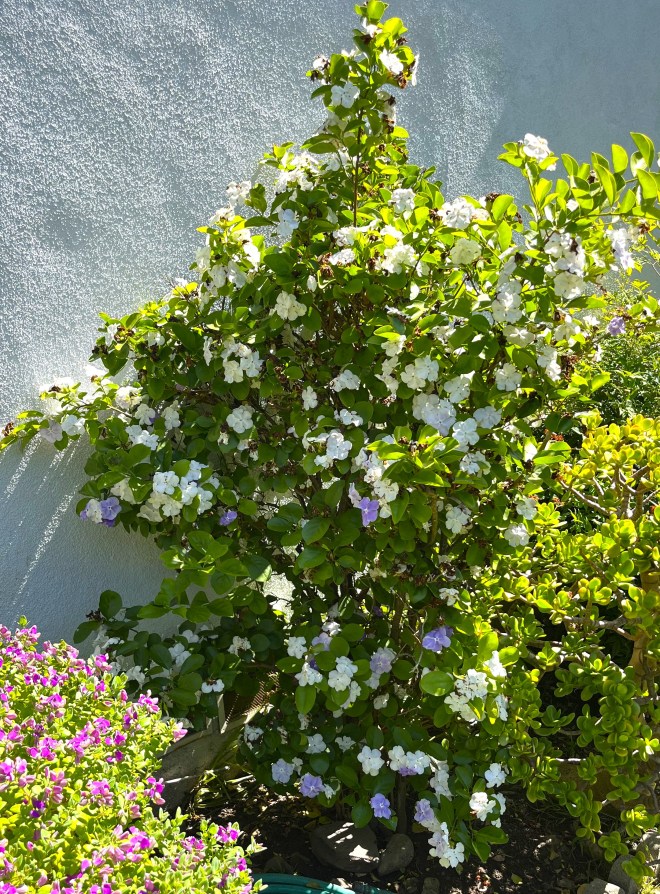
The flowers start as white and then shade off to mauve and finally to purple as they age. I suppose that explains its rather strange name: yesterday, today and tomorrow, as well as a number of variations on that theme of three. It is endemic to Brazil.
Against the fence is a young queen palm.
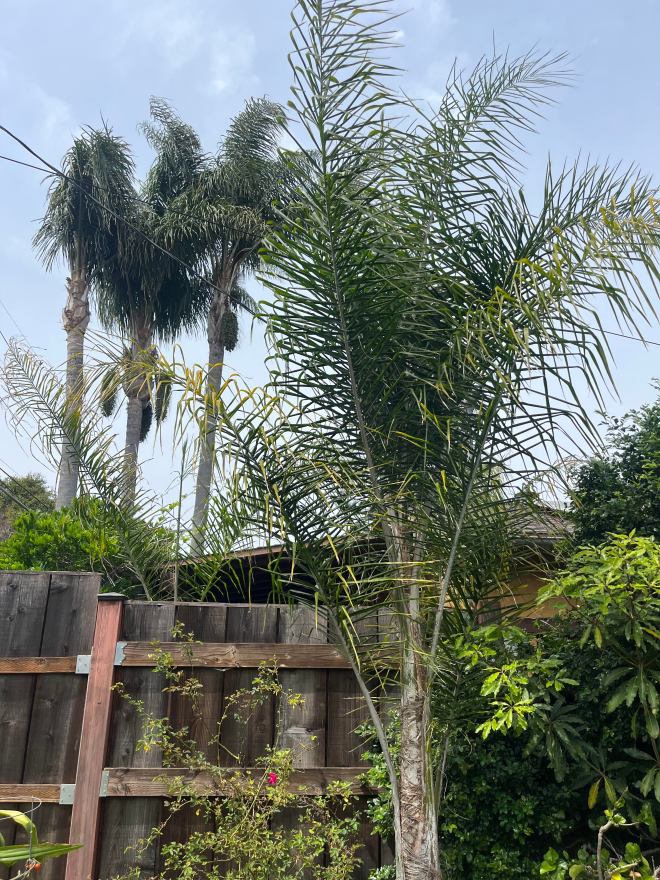
Its original home is the area which is comprised of northern Uruguay, northern Argentina, eastern and central Paraguay, and eastern and southern Brazil. My daughter tells me that this tree just appeared one day. She suspects – correctly, I think – that its parents are the mature queen palms one can see in the background, which grace the neighbour’s backyard. No doubt one of the squirrels which scamper along the garden’s fences brought over a nut which fell from those large, hanging clusters we see on the mature trees.
Close to the queen palm my daughter planted a couple of cherry tomatoes last year. I doubted they would take, but one of them has!
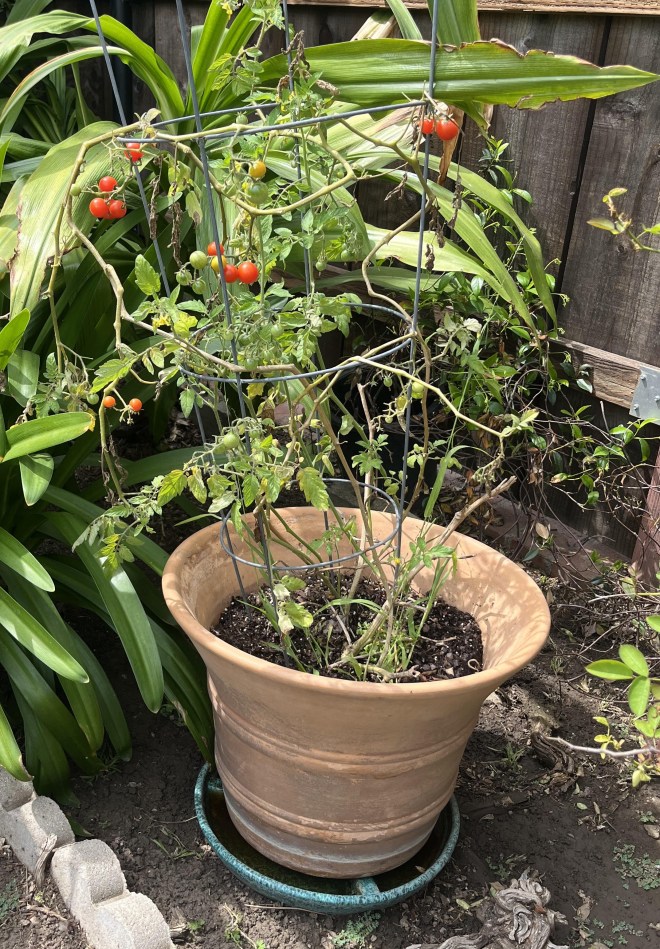
While we admire my daughter’s handiwork, it is good to remind ourselves that the wild ancestor of the tomato, the currant tomato or pimp, is native to Ecuador and Peru. It was domesticated somewhere between there and Mexico, where the Spanish conquistadors saw it in the markets of Tenochtitlan and started its global travels.
Talking of plantings by my daughter, she got the gardener to plant a monstera which had outgrown its pot. After a few days, it was looking miserable and in this case, too, I thought it wouldn’t last. But it has!
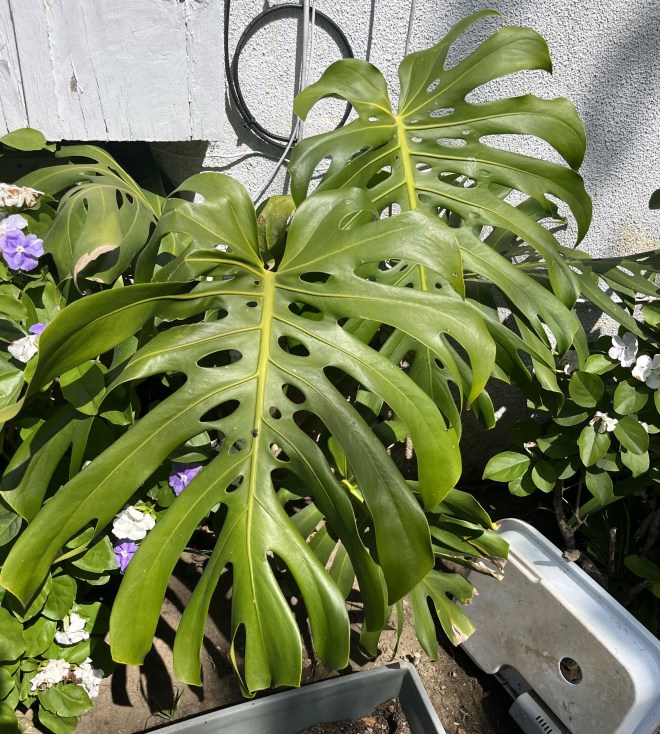
I had always thought that monsteras hailed from Africa. But no. They are native to tropical regions of Central and South America. For any of my readers who, like me, are interested in the etymology of words, they might be intrigued to know that the plant’s name comes from the Latin word for “monstrous” or “abnormal”, and refers to its unusual leaves with their slits and holes.
Cheek by jowl with China’s dwarf umbrella tree is a boldo.
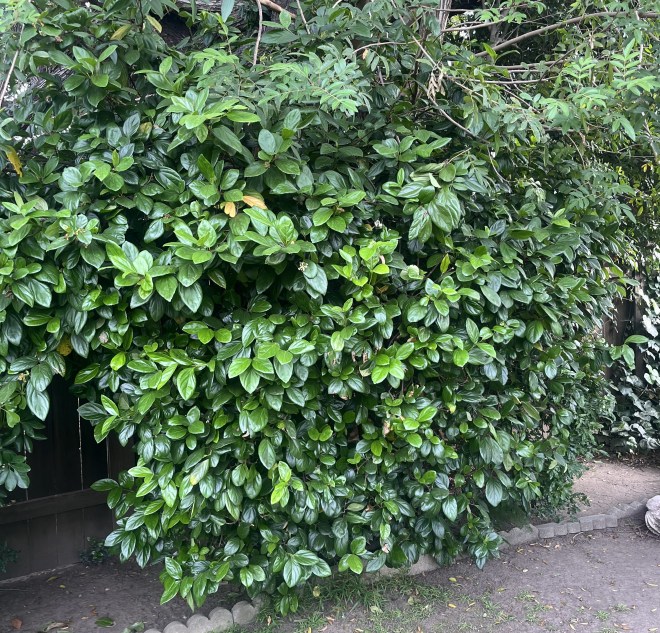
This small tree is endemic to the central region of Chile.
The Caribbean islands have given the garden one plant, the variegated spider-lily. Right now, it is just a mass of unruly leaves. My daughter says the plant has been growing like crazy and she plans to cut it back.
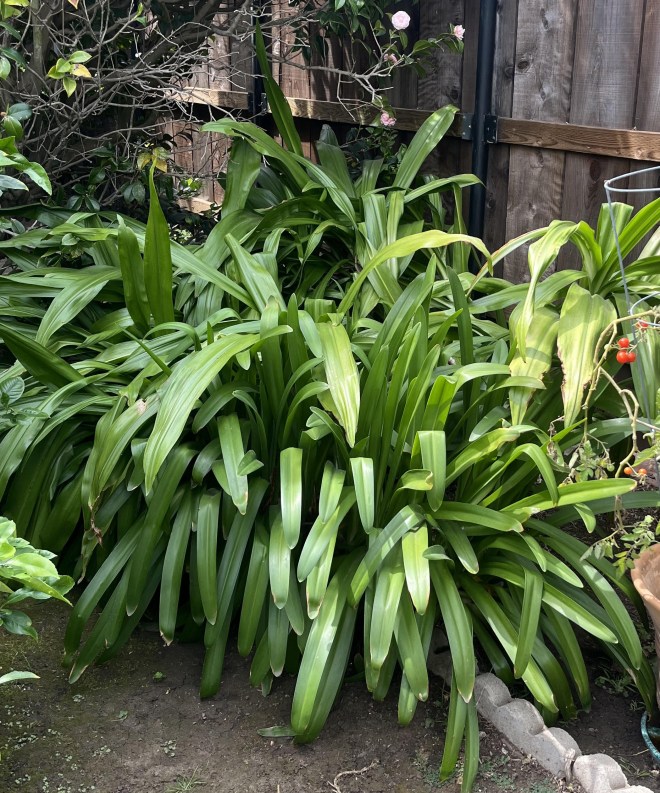
With a bit of luck, we’ll see its rather lovely white flower before we leave.
The world still keeps giving! From Europe, we have the wild privet, which is currently flowering.
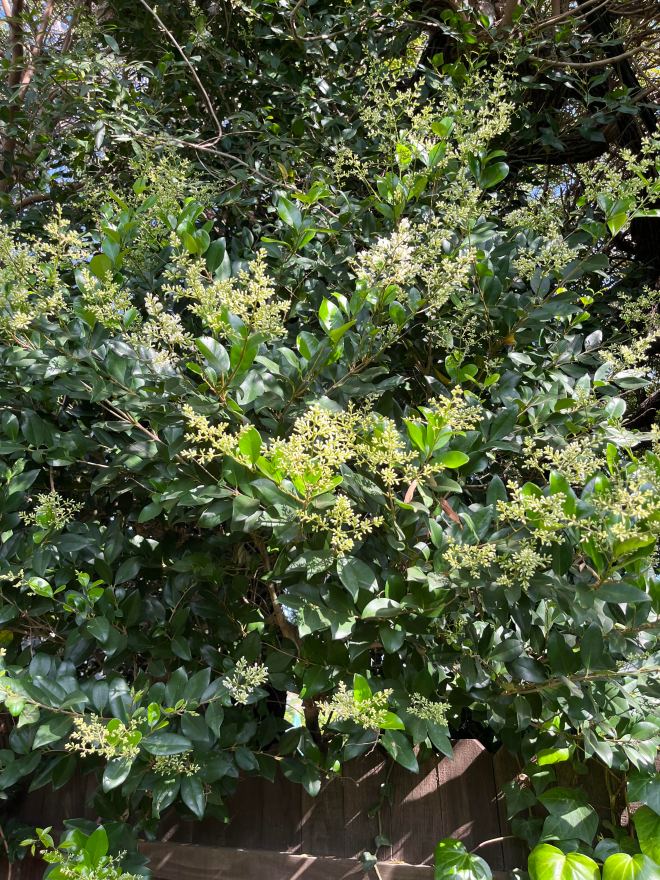
Unfortunately, Europe has also given the garden ivy, which I am currently hard at work trying to eradicate. It’s been taking over a whole section of the garden and threatens to throttle all the plants in its way.
The Pacific Islands are the original home of one plant in the garden, the Hawaiian hibiscus. The cultivar planted here is a beautiful yellow.
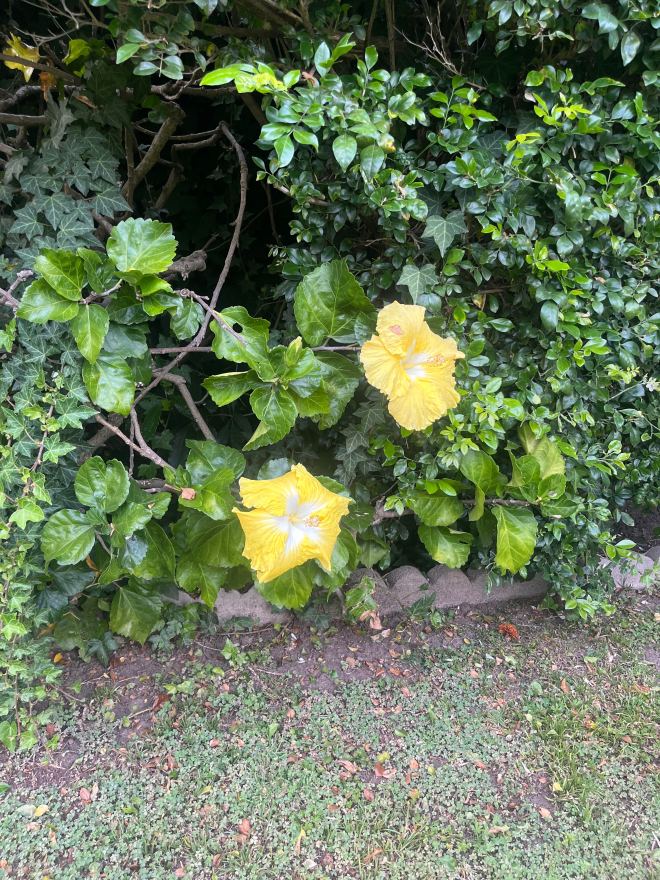
The Hawaiian hibiscus is actually the result an ancient hybridisation event, which took place before the Europeans discovered the Pacific Islands. Fascinatingly, the hybridisation involved a hibiscus found in the islands of Vanuatu and another hibiscus which hails from the islands of French Polynesia. These two sets of islands are more than 4,000 km apart! So how did these two species of hibiscus manage to hybridise? Since the hibiscus from French Polynesia was important in Polynesian culture and medicine, it is theorised that it must have been taken across the south Pacific as one of the so-called canoe plants which Polynesians carried with them when they undertook their long-range seafaring, a topic I’ve discussed in the context of the sweet potato.
Is California the source of any of the plants in the garden? As far as I can tell, no. The only American plant in the garden, a great rhododendron, actually comes from the Appalachians, some 4,500 km away.
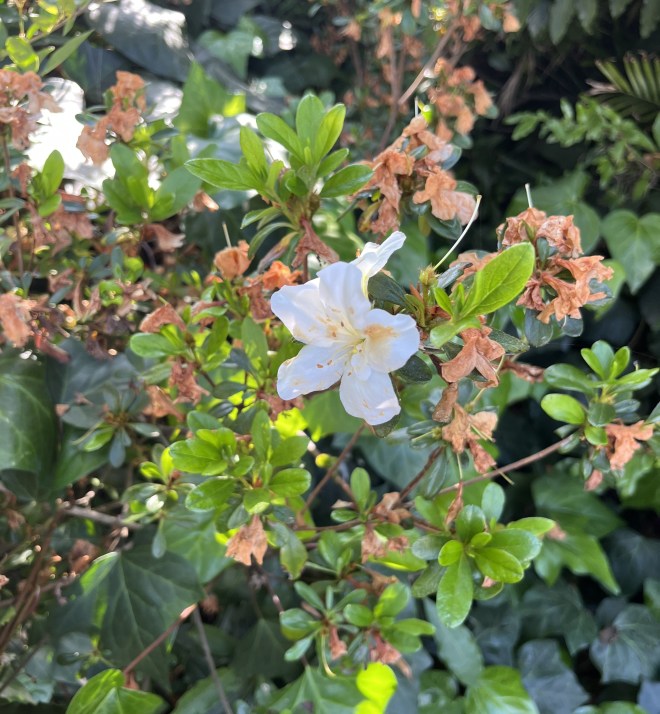
Right now, the bush has exactly one flower on it, although there are signs (in the form of dead flowers which have not been removed) that it will be covered in flowers at some point – if the damned ivy doesn’t throttle it beforehand.
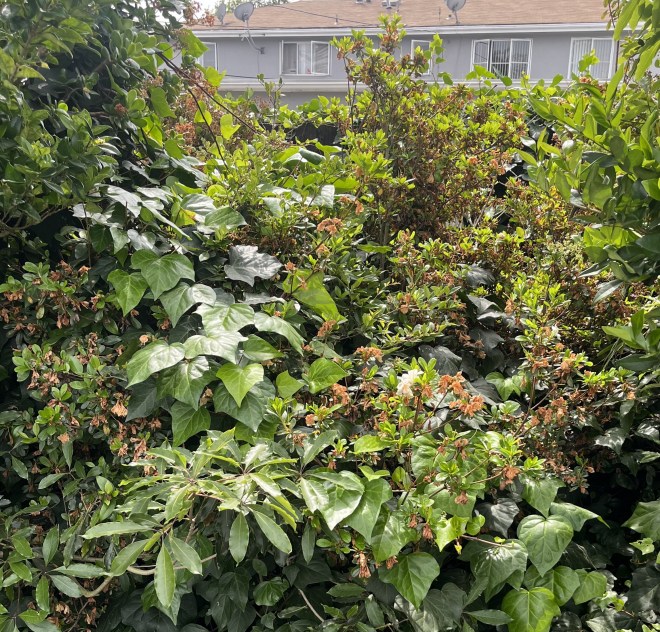
Well, since I started this post The Happy Event has occurred! My wife and I now have a second grandson. Over the next few months, we can take him out to the garden and show him the plants and tell him that he can already begin to explore the world he entered right here in his Mum and Dad’s backyard.

 the heart thrills