I like writing, but I’ve spent most of my life writing about things that don’t particularly interest me. Finally, as I neared the age of 60, I decided to change that. I wanted to write about things that interested me.
What really interests me is beauty. So I’ve focused this blog on beautiful things. I could be writing about a formally beautiful object in a museum. But it could also be something sitting quietly on a shelf. Or it could be just a fleeting view that's caught my eye, or a momentary splash of colour-on-colour at the turn of the road. Or it could be a piece of music I've just heard. Or a piece of poetry. Or food. And I’m sure I’ve missed things.
But I’ll also write about interesting things that I hear or read about. Isn't there a beauty about things pleasing to the mind?
I started just writing, but my wife quickly persuaded me to include photos. I tried it and I liked it. So my posts are now a mix of words and pictures, most of which I find on the internet.
What else about me?
When I first started this blog, my wife and I lived in Beijing where I was head of the regional office of the UN Agency I worked for. So at the beginning I wrote a lot about things Chinese. Then we moved to Bangkok, where again I headed up my Agency's regional office. So for a period I wrote about Thailand and South-East Asia more generally. But we had lived in Austria for many years before moving to China, and anyway we both come from Europe my wife is Italian while I'm half English, half French - so I often write about things European. Now I'm retired and we've moved back to Europe, so I suppose I will be writing a lot more about the Old Continent, interspersed with posts we have gone to visit.
What else? We have two grown children, who had already left the nest when we moved to China, but they still figure from time to time in my posts. I’ll let my readers figure out more about me from reading what I've written.
As these readers will discover, I really like trees. So I chose a tree - an apple tree, painted by the Austrian painter Gustav Klimt - as my gravatar. And I chose Abellio as my name because he is the Celtic God of the apple tree.
I hope you enjoy my posts.
http://ipaintingsforsale.com/UploadPic/Gustav Klimt/big/Apple Tree I.jpg
Meanwhile, my wife waits patiently at the next turn in the path, no doubt hoping that this new-found enthusiasm of mine for visiting death and destruction on passing vegetation will soon fade away.
My wife and I have finally made it down to the sea. It took a while; we’ve been back in Italy for three weeks. We got here just in time to witness the – very low key – official celebrations on 4th November of the end of the First World War for Italy: the Austro-Hungarian Empire collapsed a week before the German Empire did.
Among other things, a fresh wreath has been fixed to the plaque posed on the wall of the house near the village church where Francesco Solimano was born back in 1918.
my photo
The plaque states:
HERE WAS BORN
SOLIMANO FRANCESCO
SERGEANT MAJOR IN THE ALPINE REGIMENTS
GOLD MEDAL FOR MILITARY VALOUR
SORI 1918 – RUSSIAN FRONT 1943
Italy’s “Medaglia d’Oro” is the highest award an Italian soldier can get for bravery on the field of battle. I would say that it’s equivalent to the UK’s Victoria Cross or the US’s Medal of Honor. Readers can imagine, then, that Francesco is the pride of his native village. Along with the plaque on his house, he has received that great accolade of having a village street named after him – the same street, it so happens, which our apartment is located on. A couple of years ago, while we were in the municipal building trying to understand something related to one of the local taxes we were paying, we also stumbled across a photo of Francesco hanging in the corridor.
My photo
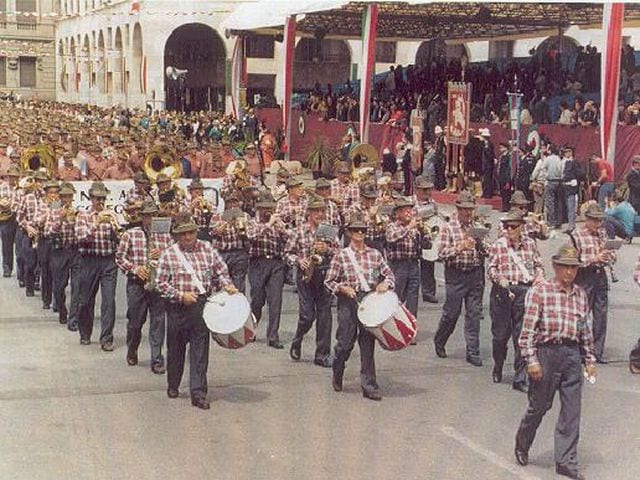
Readers will note his hat with the feather, the typical hat that all “Alpini” – soldiers in Italy’s Alpine regiments – wear at the various get-togethers which they regularly have. This, for instance, is a get-together in Genova for the Ligurian sections of the Alpini, which Francesco would surely have attended had he lived.
If his photo is anything to go by, Francesco seems to have been a sympathetic fellow. But it wasn’t a smile or a joke that got him his Gold Medal. The official website has his official citation for the medal.
“At the command of a 45-mm mortar squad, during the retreat from the Don he showed exceptional steadfastness by keeping his team steady and efficient, and at its head he participated with legendary valor in repeated hard fighting that took place during ten days of retreat. In the course of the violent offensives, he kept his team at full efficiency by recovering abandoned weapons and ammunition, and so was able to oppose the enemy with renewed ardour and tenacious resistance and react with daring counterattacks. Wounded during a cavalry charge that overwhelmed our lines, he refused aid from the survivors, urged them to fight to the bitter end, and rather than save himself preferred to share the fate of his wounded comrades left on the frozen steppes. An admirable example of absolute dedication to duty and stoic firmness. January 17-26, 1943”
This lyrical description of personal courage skates over the overarching military disaster that the “retreat from the Don” constituted for the Italians. Let me try and describe the titanic battle which took place in late December 1942-early January 1943 between the Soviets and the Axis powers, a battle in which Francesco Solimano and his squad were but a tiny cog.
Francesco Solimano’s squad was part of the 1st Alpine Regiment, which was one of three regiments making up the 4th, or Cuneense, Alpine Division, which, together with the 2nd, Tridentina, Alpine Division and the 3rd, Julia, Alpine Division, made up the Alpine Army Corps. This in turn was one of three Army Corps making up the 8th Italian Army. In early December 1942, the 8th Army was holding a 230-km front along the River Don, north of Stalingrad. Already, attacks by the Soviets in September 1942 had shown that the line was too extended given the Army’s strength and the rather poor weaponry at its disposal. It had consequently been reinforced with German units, but most of these had been shifted southwards as the battle of Stalingrad sucked in more and more German troops. On its left (north-western) flank was the 2nd Hungarian Army, on its right (south-eastern) flank was the 3rd Romanian Army, both even weaker than the 8th Italian Army. The Alpine Corps held the 8th Army’s northernmost sector, next to the Hungarians. Here we have Italian troops moving into new positions in the winter of 1942.
On 11th December, the Soviets attacked the 8th Army, with the strategic intention of annihilating it. Naturally, it chose to attack the Army’s weakest sector, which was on the right, southern flank. Despite being outnumbered 9 to 1 by the Soviets, and facing a huge disadvantage in weaponry, the Italians managed to hold out, though at huge cost. A week later, the Soviets attacked the Romanians, who, already weakened by the battle around Stalingrad, crumbled. The 8th Army was in danger of having its flank turned. Orders were given to retreat but the Soviets now attacked the divisions at the center of the Italian line. After eleven days of desperate fighting, what remained of these divisions was surrounded and surrendered.
It was now the turn of the Alpine Army Corps, which had been relatively unaffected by the fighting in December and were still in their positions on the Don River. By early January 1943, the position of the Alpini had become critical. The Italian Divisions to their right had collapsed, but so had the Hungarian Army to their left, which the Soviets had attacked shortly after starting their attacks on the Romanians. They were ripe for encirclement. The Soviets started the attack on 14th January. They very rapidly smashed through what was left of the Hungarians on the left and a Panzerkorps, which had been thrown in to fill a gap, on the right. The Alpini started a chaotic retreat. Only the Tridentina Division was still capable of conducting combat operations; the Julia and Cuneense Divisions had been decimated in the initial Soviet attack. The Tridentina Division led the retreat, with the remains of the other two Divisions, mixed in with survivors from the German and Hungarian units, following behind. The soldiers fought their way back towards the west, with the Russians continually trying to cut off their retreat. They managed to break though a first Soviet encirclement on 20th January, then a second on 22nd January, then a third on 25th January. Finally, what was left of the Tridentina Division managed a breakthrough on 26 January at a place called Nikolayevka, and after a few more days of retreating westward made it to the safety of the German lines. Those who didn’t make it in the final breakthrough were surrounded at Valujki, some 40 km to the south of Nikolayevka, and surrendered on 27 January.
And where does that tiny cog Francesco Solimano fit into all of this? From the dates given in his citation, it looks like he led his squad back in the retreat, managing to keep them together as a fighting force, fought through several of the Soviet attempted encirclements, and fell a day before what was left of his Division finally surrendered.
Maybe Francesco was right to exhort his comrades to fight to the bitter end. Imprisonment turned out to be a fate worse than death. Some 65,000 Italian soldiers were captured in the fighting, one-quarter of all the soldiers in the 8th Army. 10,000 died on the forced marches eastward to the internment camps.
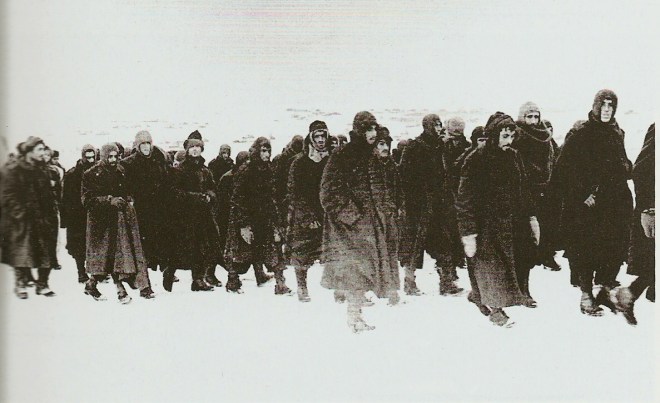
Another 44,000 died in the camps, mostly during the winter of 1943, of starvation and disease. Only 11,000 made it back to Italy after the War. As for the 150,000 who escaped encirclement, the aftermath was also pretty grim. 34,000 were wounded or frostbitten. They had lost all their weaponry. The Soviets had accomplished their objective: the 8th Army was no more. The Fascist government dissolved the Army and repatriated the survivors to Italy in March and April 1943. Appalled by their appearance and fearing a backlash from the population if the real news of what had transpired on the Russian steppes ever came out, they kept them hidden out of sight. The news filtered out anyway and helped topple the Fascist regime later that year.
Francesco and his comrades who died on those frozen steppes are not buried in nice, neat cemeteries. The Soviets probably just dug mass graves or burnt the bodies. Why should they have given an honourable burial to soldiers who had invaded their lands? And anyway, they had their own dead to bury. But the Italian government never put up a monument honouring its dead in Russia either; the whole saga quickly became enveloped in Italy’s post-War ideological conflicts between the (American-backed) Christian Democrats and the (Soviet-backed) Communists, with accusations and counter-accusations flying back and forth. And anyway, there was the embarrassing fact that the Italians had fought for the “wrong” side in the War. It was left to the survivors themselves to honour their dead, and a few monuments were put up here and there to remember those who died in Russia. Perhaps the most arresting is a monument that was erected in the 1950s in Bologna.
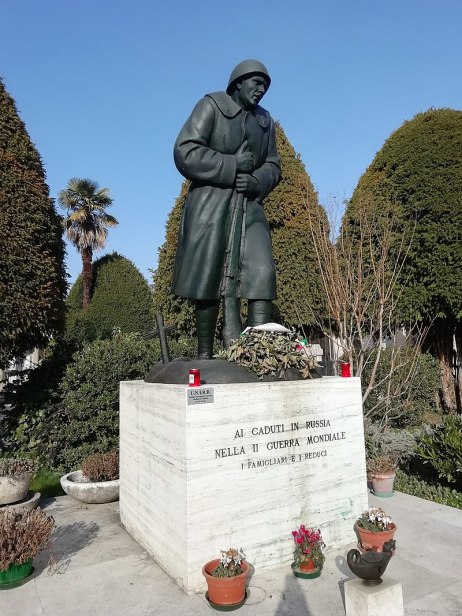
Francesco and his comrades have another type of monument, in the written memories of a number of survivors. Mario Rigoni Stern wrote “The Sergeant in the Snow”. He was a sergeant-major in the Tridentina Alpine Division, and was one of the lucky ones who broke out alive of the Soviet encirclement. In the book he describes the disastrous retreat from the Don.
Giulio Bedeschi wrote “A Thousand Mess Tins of Ice” and “Nikolayevka: I Was There Too”, both about that terrible retreat from the Don. He was in the “Julia” Division, one of the very few from that Division to break out alive of the Soviet encirclement.
Source
Nuto Revelli wrote “The Road of Davai” about the Italian POWs (“Davai” was what the Soviet guards shouted all the time at the prisoners on their forced marches into internment; it is Russian for “Keep moving”). Revelli was a Lieutenant in the Tridentina Division and managed to get out alive from the retreat from the Don.
All these books, and others, are perhaps the best monument to Francesco and the thousands of other Italians who suffered and died for really no good reason out there on those frozen Russian steppes. They pull back the curtain of forgetfulness and force us to remember what happened to all those young men, badly equipped, badly dressed, badly fed, sent to their fate by a bunch of sinister jokers sitting in Rome, spouting ideological nonsense and strutting on the political stage.
My son commented to me yesterday morning that I hadn’t posted in a while, and he’s right. It’s been over a month! The fact is, I’ve been busy these days (or B-U-S-Y as my son used to write in reply when we fond parents sent him a WhatsApp message suggesting a chat; luckily, he wasn’t B-U-S-Y yesterday morning). I’ve been helping students at a school in Wales figure out how the school could reduce its carbon footprint and I’ve had to prepare and deliver quite a number lectures for webinars on the topic of Circular Economies. All fascinating stuff, but it has eaten into my blogging time.
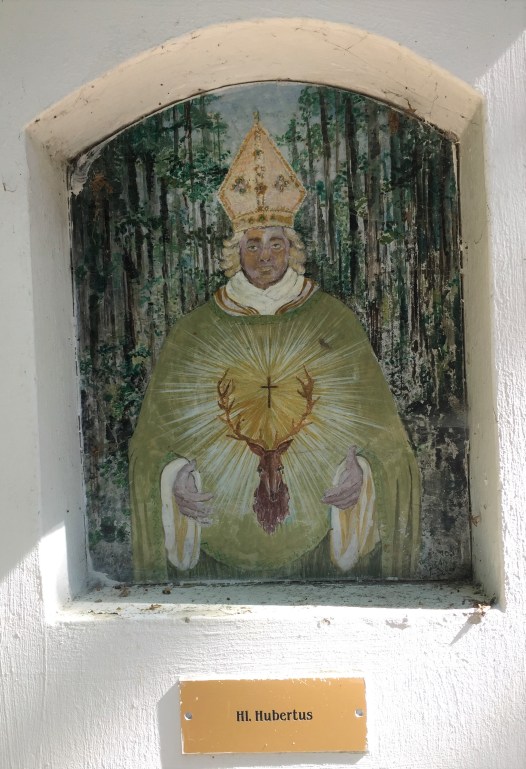
Anyway, it seems to me that as the days shorten, the temperatures fall, and my wife and I have our last hikes in the woods around Vienna before we migrate south to Italy for the winter, it would be good to celebrate Saint Hubert, the patron saint of all things linked to forests:
– Of hunters and their hounds, here painted by Paolo Uccello.
– Of trappers (another type of hunter who lurked in forests trapping beavers and other animals for their furs), here seen in a painting at the Metropolitan Museum of Art.
Here is a photo of Hubert on one side of a small forest shrine that we came across during one of our recent hikes.
my photo
And this is the shrine.
My photo
Hubert’s story, which explains why he was made patron saint of all things to do with forests, is quickly told. He was born in the 650s AD in Toulouse, into a family that was part of the high Frankish aristocracy. Initially, he joined the Neustrian court centered on Paris, but because of quarrels with the Mayor of the Neustrian palace he transferred to the Austrasian court centered on Metz, where he was warmly welcomed by the Mayor of the Austrasian palace, on the grounds of “the enemy of my enemy is my friend” – the two Mayors were constantly fighting each other. He seems to have quickly inserted himself into the local elites, marrying the daughter of the Duke of Leuven (if you’re a Flemish speaker, Louvain if you’re a French speaker).
Like all good aristocrats of the time (indeed, like all good aristocrats of all ages), Hubert loved to hunt, and he seems to have spent most of his time roaming the forests of the Ardennes looking for some red meat to shoot. His predilection for hunting only increased after his wife died in child birth, to the point that one Good Friday, when he really should have been in a church on his knees praying for his soul, he instead vaulted onto his horse and rode off into the forest in pursuit of game.
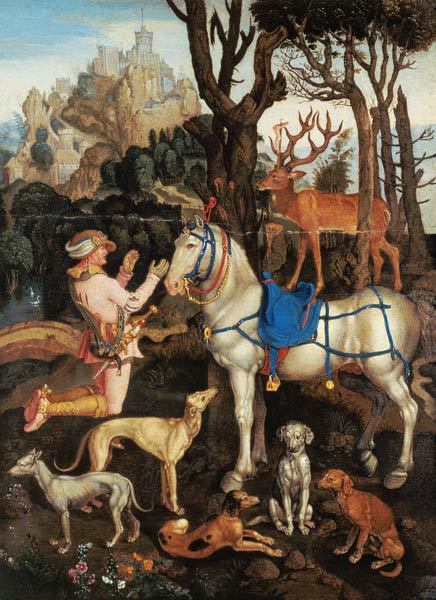
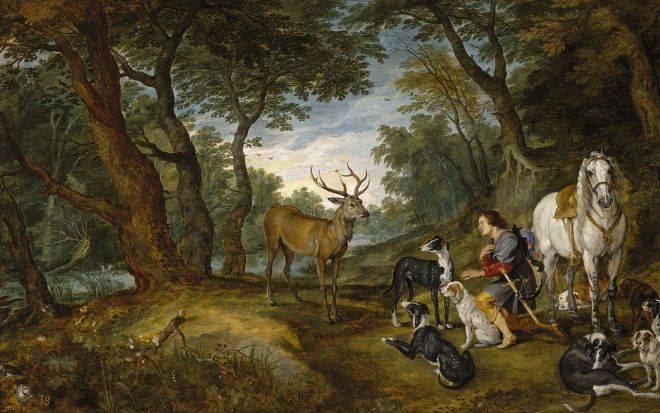
The story goes that he spied a magnificent stag and was riding full tilt after it, when the animal suddenly turned. Hubert was astounded to see a crucifix hovering between its antlers. This scene has captivated various artists over the centuries – or more probably, it captivated their clients and the artists merely executed their clients’ wishes. Here’s a version by Albrecht Dürer.
In any event, the story goes on that Hubert heard a Voice, telling him to clean up his act or else he would be going straight to Hell. When he humbly asked the Voice what he should do, It told him to go find Lambert, Bishop of Maastricht, who would straighten him out.
And straighten him out he did! Under Lambert’s direction, Hubert gave away all his worldly possessions, entered a monastery, led an ascetic life, evangelized among the heathen folk who lived in the depths of the forest of Ardennes where he had once joyously hunted, etc., etc.
In about 705 AD, Lambert was assassinated, the victim of some quarrel between different Frankish factions. The event is depicted in all its gory detail in this painting by Jan van Brussel.
Hubert became bishop in Lambert’s place. At some point, he moved Lambert’s remains from Maastricht to Liège, where Lambert had been killed, as we see here in this manuscript miniature.
He built a magnificent basilica, which was soon turned into a cathedral, of which he naturally became the bishop (in the process, he kick-started the rise to greatness of Liège, which was then just a pissy little village). Alas, this cathedral was demolished by revolutionaries in 1794.
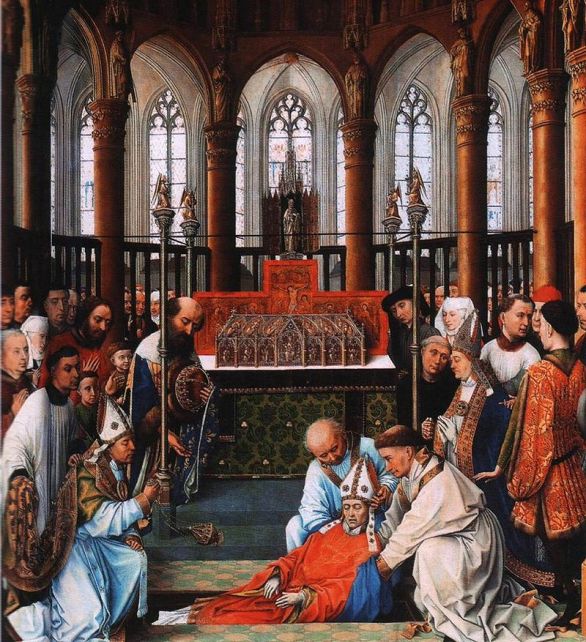
Much to his disappointment, Hubert wasn’t martyred but died peacefully in his bed in the late 720s AD. He was, as might be expected, initially buried in Liège, but about 100 years later his bones were dug up and transferred to the Benedictine Abbey of Amdain. This event was depicted in this wonderful painting by Rogier van der Weyden.
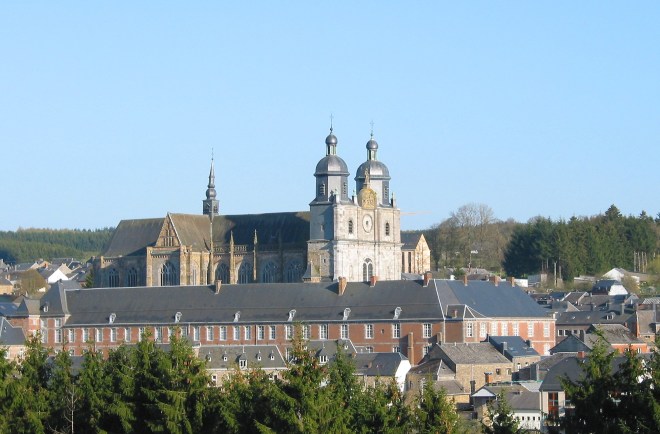
Not surprisingly, the town around the abbey renamed itself Saint-Hubert in his honour and became a focus for pilgrimages over the succeeding centuries (no doubt making the Abbey rich in the process).
I think readers will now understand why Hubert is patron saint of all things forest. He was a very popular saint among the little people in the Middle Ages, probably because forests played an important role in people’s livelihoods until deforestation shrank those forests, first to woods and then to woodlots on the margins of rural lives. Not surprisingly, given his passion for hunting, Hubert was also very popular among the aristocracy, and several Noble Orders dedicated to hunting were named after him. Take, for instance, the Venerable Order of Saint Hubertus, which was founded in 1695 by Count Franz Anton von Sporck.
The Order brought together the Holy Roman Emperor Charles VI and hunting enthusiasts from various other noble families throughout the Holy Roman Empire. It still exists, its current Grand Master being Istvan von Habsburg-Lothringen.
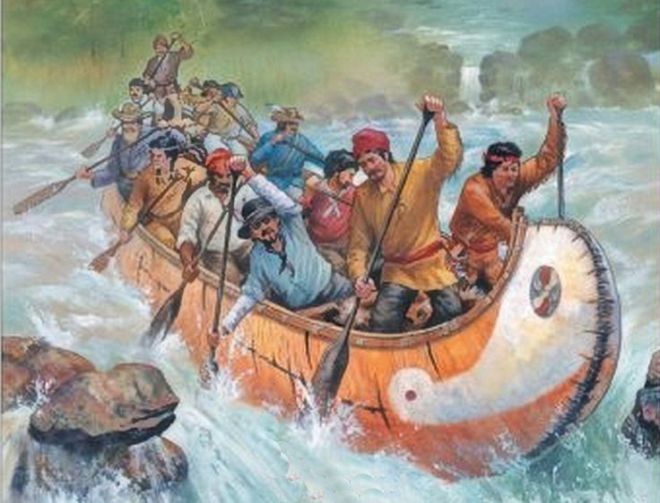
Given that in the early days of the European presence in Canada so many French Canadians were involved in the fur trade as trappers, I also now understand why Saint Hubert was a popular saint in French Canada; in the teen years I spent there, I was intrigued by the number of places called Saint-Hubert (there is even a chain of chicken restaurants in Quebec called Saint Hubert). No doubt the saint’s protection was invoked by the Catholic trappers as their canoes set off on their way to the beaver grounds out west.
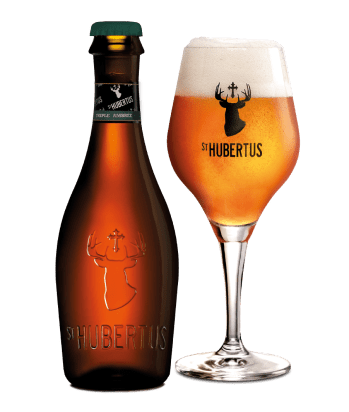
Of course, since the regions we now call Belgium and southern Netherlands were the saint’s favoured hunting grounds, both literally and figuratively, many places there are also called Saint-Hubert (French) or Sint Hubertus (Flemish/ Netherlandish). One beer has taken its name from the town of Saint-Hubert around the abbey where Hubert was eventually buried. Here is a bottle of one of the company’s brews (triple amber for any beer enthusiasts among my readers).
Source
There is also a brew that is popular here in Vienna, the Hubertus Bräu.
I’m not sure why it’s called Hubert’s Brew. It’s certainly not named after the place it’s brewed in, which is Laa an der Thaya (nice area; we’ve been on a couple of hikes around there). But it has a very distinguished pedigree. The town obtained the right to brew it back in 1454, from Ladislaus Postumus, Duke of Austria (and for this privilege they had to deliver the good Duke a keg of beer on each holiday, which doesn’t sound much – but maybe there were lots of holidays back then).
As readers will note, both these beers have as a symbol the famous stag’s head with the crucifix hovering between its antlers. So does the digestive Jägermeister, that concoction of herbs macerated in alcohol, which for some strange reason became popular with the student crowd.
In this case, the connection to Hubert is via its name, which means Master of the Hunt.
Of course, I understand why any alcoholic drink which has some sort of connection to Hubert would use the symbol of the stag with the hovering crucifix. But I wonder if the makers of these drinks have thought this idea through. For me, the implication is that drinking the beer or digestive will make you see things which aren’t there (rather like that hoary chestnut that alcoholics see pink elephants).
Not perhaps the best image one wants to give to an alcoholic drink. On the other hand, putting a picture of Hubert as a bishop, like the one in the photo which I started this post with, could well put a damper on one’s enthusiastic desire to drink. A tricky marketing conundrum …
With that, I lift a good glass of wine to my readers and go and join my wife to do the packing. Auf wiedersehen, arrivederci, we will see each other again once we’ve moved down to Italy!
Some months ago, I was asked by the Student Sustainability Committee of a school in Wales which I’m involved with to help them estimate the carbon footprint of the food eaten in the school. In the case of prepared food, which made up a substantial portion of the food consumed at the school, this exercise required me to plough through a lot of recipes to understand what were the raw ingredients of these prepared foodstuffs (so as to calculate the carbon footprint of each ingredient). Apart from this being a hell of a lot of work, as my wife will testify (“have you still not finished that stuff?!”), I discovered with surprise that many, many prepared foodstuffs of the sweet variety (biscuits, cakes, chocolate, and various sundry others) have vanilla extract as one of their ingredients (and as a side note, I was very surprised to see that these sweet foodstuffs made up a large portion of all the food consumed in the school; it didn’t seem to be a very healthy diet).
These constant references to vanilla extract intrigued me, and I decided that one day I would investigate vanilla a bit more. This decision crystallized into action over the last few weeks, because it so happens that my wife is very fond of vanilla. In the Bad Old Days, before we started our rigorous dieting, she consumed a fair amount of vanilla-based ice creams, normally those covered with a chocolate casing (I will not give free publicity to her favourite brand by naming it; I will leave my readers to guess). Now, in these more virtuous times, diet-wise, her vanilla consumption mainly takes the form of vanilla-flavored yogurt, and this only for lunch on our hikes (which these summer days has meant quite frequently). For the sake of complete transparency, I should state that she still consumes a chocolate-covered vanilla ice cream from time to time, whenever a hike is judged to have been particularly strenuous.
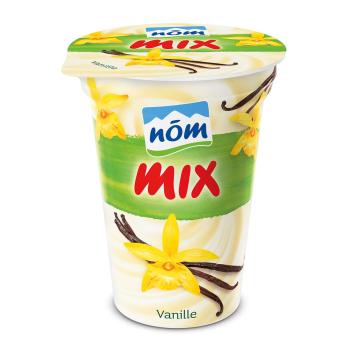
The brand of vanilla-flavored yoghurt which my wife generally favours is this one – I should add that she favours it simply because our local supermarket offers it, at a very reasonable price.
And here is the plant more or less in its natural state (readers will note that this orchid is a type of vine; in Nature it will grow up trees, like the pepper vine).
It’s really a very pretty flower, but it is only of passing interest to the vanilla aficionado. She or he is after the “fruit”, a seed pod really, that the flower creates once it has been pollinated. The three dark-coloured stringy things pictured behind the flower on the yoghurt tub are these seed pods. Again, here is a photo of the Real Thing.
But even the seed pod, if in its natural state, just picked from the vine, does not interest the vanilla aficionado, because it contains very low levels of vanilla flavour and aroma (these, by the way, come mostly from the chemical vanillin, although there are a number of other chemicals present which it is claimed enhance both flavour and aroma). It is only once the seed pod has been cured that the vanilla aficionado becomes interested, because now the levels of vanillin are considerably higher, high enough to add that distinct vanilla flavour and aroma to foods and drinks.
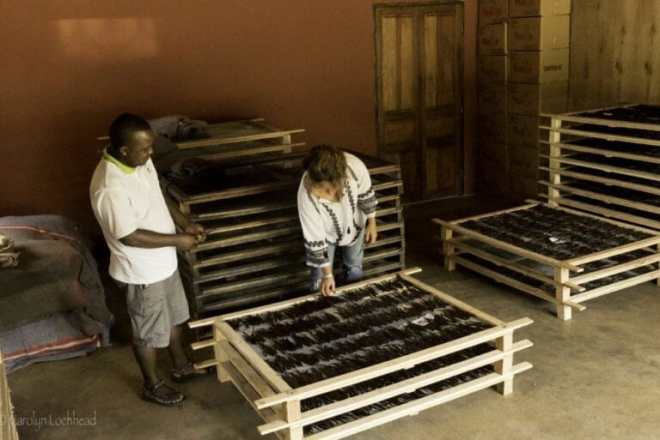
The curing of vanilla seed pods is a rather complicated, months-long process, whose purpose is to bring about an enzymatic reaction in the pods which turns the glucovanillin they contain into vanillin proper (in case any readers were asking themselves, glucovanillin has no flavour or aroma). Curing consists of four basic steps: killing, sweating, slow-drying, and conditioning. In the killing step, the seed pods are generally heated (in hot water or in an oven or by exposing the pods to the sun).
This stops any further vegetative growth in the pods and initiates the necessary enzymatic reactions.
In the sweating step, the pods are kept at temperatures of 45–65°C and at high humidity levels by stacking them densely and insulating them in wool or other cloth. The pods are subjected to this Turkish bath regime for 7 to 10 days, possibly with a daily exposure to the sun or a dip in hot water.
The desired enzymatic reactions love these conditions, so by the end of the sweating step the seed pods have attained much of the desired vanilla flavour and aroma. However, they still have a high moisture content. Which brings us to drying.
To prevent the pods from rotting and to lock in the vanilla aroma, drying is required. And so, over a period of three to four weeks, the pods are exposed to air and to periods of shade and sunlight.
This is what vanilla aficionados lust after, what they dream of incorporating into their dishes, from soup to sweet dishes. And they are willing to pay top money. Vanilla is the second most expensive spice, after saffron. Those wrinkled-up beans can set you back anywhere from $50 to $500 per kilogram.
When I look at these kinds of convoluted processes, I always ask myself, “How on earth did anyone discover this process?” I mean, really, how did the first vanilla producers stand in front of those aroma-less and flavour-less seed pods and figure out that this long and complicated process would eventually lead them to seed pods with a wonderful aroma and flavour of vanilla? I would have to ask this question to the ancestors of the Totonacs, an Amerindian people who live on the east coast of Mexico. It was they who first “made” vanilla-flavoured seed pods from the vanilla orchid – the orchid’s natural habitat is in this part of the world. Here, we have Diego Rivera’s take on the Totonacs, as part of one of his murals in the National Palace in Mexico City.
Unfortunately, I’m sure today’s Totonacs have no idea; I just have to accept that the answer is lost in the mists of time.
Readers might think that since the vanilla orchid is natural to Mexico’s eastern seaboard, that country would be a major producer of vanilla. Alas, not so! The reason for that is the great Columbian exchange, that massive movement of plants, animals, humans – and diseases – which took place between the New and Old Worlds after the discovery of the Americas by Christopher Columbus. The vanilla orchid was part of that exchange. The Conquistadors, like the Totonacs (and like the Aztecs) loved the flavour and aroma of vanilla and figured that people back home would love it too. They exported the pods back to Europe, where they caused a sensation, at least among the elites, who had the money to burn on this rare and expensive novelty. They put it in everything, from chocolate (also a product of Mexico) to soup. They adopted the Spanish name for it (vanilla is a corruption of the Spanish vainilla, meaning “little pod”). Other Europeans looked on enviously. Eventually, the French laid their hands on some exemplars of the plant and took them to their colonies which had similar climates to Mexico’s eastern seaboard, namely those in the Caribbean and the Indian Ocean, especially the islands of Madagascar, Réunion, and Mauritius.
For a while, Mexico continued to be the main global producer of vanilla, because this transplant of the vanilla orchid to other places was a failure. The plant flowered alright, but it never produced pods. The reason for this is an exquisite example of specialized evolution: vanilla flowers can only be pollinated by this little critter, Eulaema meriana, one of some 25 species of orchid bees.
No other insect is attracted by the sex pheromones emitted by the flower, nor can any other insect successfully navigate the orchid’s complicated geometry and pollinate the flower along the way.
Once non-Mexican wannabe vanilla producers realized the problem, they tried the obvious thing, which was to transplant the vanilla-pollinating orchid bee along with the orchid. But it didn’t work; the bee couldn’t survive outside of its native habitat. The wannabe vanilla producers were stumped. Until 1841.
In that year, a 12-year old slave called Edmond (no surname, he was a slave), who had been born into slavery on the Island of Réunion, came up with a quick and easy way of pollinating the vanilla orchid flower by hand. He had been lent out by his master to a botanist by the name of Ferreol Bellier-Beaumont, to help him out. Beaumont had shown him how to hand pollinate a watermelon plant and the boy went off and successfully applied his new skills to the vanilla orchid. (For anyone considering hand-pollinating a vanilla orchid flower, here’s what you do: with a small sliver of bamboo or wood (or even a stem of grass), lift the membrane separating the flower’s anther and stigma; then, using your thumb, transfer the pollinia from anther to stigma.)
Edmond never got anything out of his discovery. Who did were all the the slave-owning planters on Réunion who now got into vanilla growing: for a while, Réunion became the world’s largest producer of vanilla. But the French authorities made sure the method was transferred to its other island colonies in the Indian Ocean and in the Caribbean. Since then, Madagascar has dominated world production (Indonesia, which muscled into the market in the 1980s, is now second in the producers’ league table). Mexico, on the other hand, has pretty much vanished from the scene, which is a crying shame.
As for Edmond, seven years after his discovery, at the age of 19, he got his freedom; the French government finally outlawed slavery in its colonies in 1848. He left the world of plantations to work as a kitchen hand in the island’s main city, and adopted the surname Albius, from the Latin alba or white, in reference to the vanilla orchid’s colour. Beaumont tried to get the governor of Réunion to give Edmond a stipend or at least a reward for his great discovery but the governor ignored the petition. No doubt, he didn’t think it was worth spending public monies on a black ex-slave.
Unfortunately, Edmond fell in with a bad crowd in his new life and got involved in a theft of jewelry. He was caught and sentenced to 10 years in jail, which, after an appeal by Beaumont to the governor, was reduced to five. After doing his time, Edmond moved back to a village close to the plantation and got married.
Edmond’s travails were not over. It seems to have been an irritation in certain quarters that where white professional botanists had failed, a black slave, and a child to boot, had succeeded. Some time in 1860s a well-known French botanist and plant collector by the name of Jean Richard claimed that actually, he had come up with this revolutionary pollination method in the late 1830s, that he had taught it to some planters in Réunion, and that Edmond must have sneaked into the meeting and heard his explanation. Luckily, Beaumont and a few others vigorously defended Edmond’s primacy to the discovery, although Richard’s false claim did get some traction for a while. May Richard’s name be damned forever …
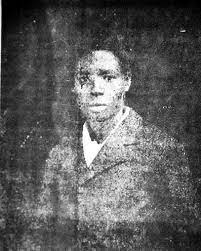
Edmond died in poverty in 1880, at the age of 51. Luckily, he left a physical trace of himself in history, rare for ex-slaves. Here we have a rather grainy photograph of him when young.
I’m afraid to tell her, and any other readers who might be vanilla lovers, that the vast majority of the vanillin used commercially in the world is fake – well, artificial might be a less inflammatory word. Most of the world’s vanillin is produced from crude oil derivatives in chemical plants: benzene is alkylated with propylene to form cumene, which is then oxidized to phenol. Phenol is hydroxylated into catechol, which is further methylated into guaiacol. Finally, guaiacol is reacted with glyoxilic acid by electrophilic aromatic substitution to produce vanillylmandelic acid, which is converted to vanillin by oxidative decarboxylation. The remainder of the world’s artificial vanillin is made from a waste stream generated in the sulphite process to make paper pulp.
Yes, I know, very disappointing. And the worst of it is that when Cooks Illustrated ran some taste tests which pitted natural vanilla against artificial vanillin used in baked goods and other applications, tasters could not tell the difference! Don’t know what the world is coming to … Luckily, the tasters could tell the difference where ice cream was concerned, with natural vanilla winning out; l’onore è salvo, honour has been saved, as my wife might say.
The tree has been a constant companion on our hikes this summer as we explore the western reaches of the Wienerwald, the woods encircling Vienna to its north and west. Apart from the odd oak, wild cherry, and conifer, the European beech reigns supreme in the Wienerwald.
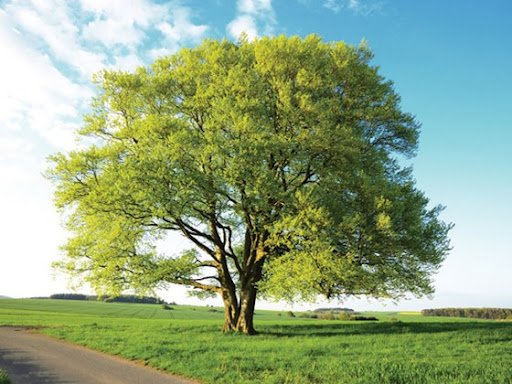
My memories of the beech start at the age of 10 or so, at my Prep school (Brit-speak for a private, boarding, primary school). Just outside the school gates, at the bottom of a field, was a magnificent copper beech; we would pass it every time we made our way to the school’s playing fields which were down the road. I have no photo of this tree, it may even no longer stand, so this photo will have to stand in for it and for all these magnificent variants of the beech.
I used to think the copper beech was a different species, but no, all the world’s copper beeches are fruit of a single spontaneous mutation that occurred in a beech tree in a forest in Thuringia, in Germany. It was noticed back in 1690 and was carried from there around the world. One single mutation … like blue eyes.
My next memory of beech is a long beech hedge at my Public school (Brit-speak for a private, boarding, secondary school), which bordered the campus’s entrance road. It was lovely during the summer, with that long solid block of tender green running along the road. Again, I don’t have a photo of this hedge, so this photo of a wonderful hedge somewhere in the UK will have to stand in for it.
It was really only when we moved to Vienna and got to know the Wienerwald that my wife and I discovered beech woods. And what magnificent woods they are! I insert here one photo we took, where the sun dappled the trunks that stretched off into the distance.
my photo
But our iPhones can’t do these woods justice, so I’ve also picked out a few photos from the Internet taken by people who’ve got the right equipment and know what they are doing.
That last photo could be of us, following the marked paths through the woods, rather like Hansel and Gretel following Hansel’s white pebbles.
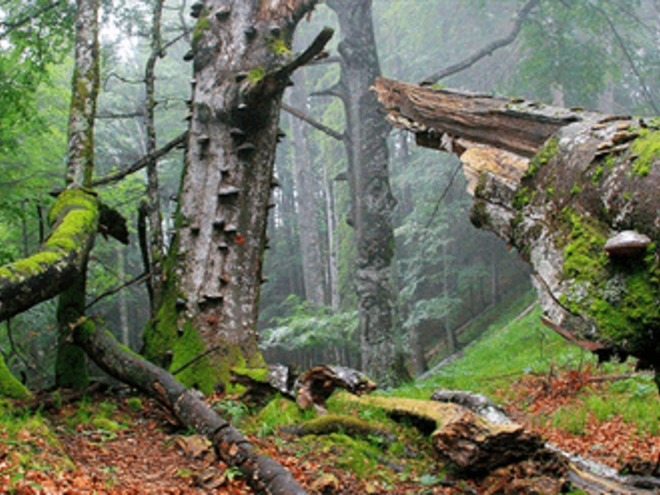
Having been enchanted by these beech woods, my wife and I have decided that some day we will visit some of Europe’s primeval beech forests. These are beech forests which have never, ever been cut or otherwise exploited by human beings, the kind of beech forests through which our hunter-gatherer ancestors would have wandered ten thousand and more years ago. There are 94 such forests in Europe, and as a group they have become a UNESCO World Heritage Site. Austria has five of the 94, Italy 13. In one way or another, we’ll figure out a way of getting to a couple of them. In the meantime, I throw in a photo of one of the Austrian forests, Hintergebirg.
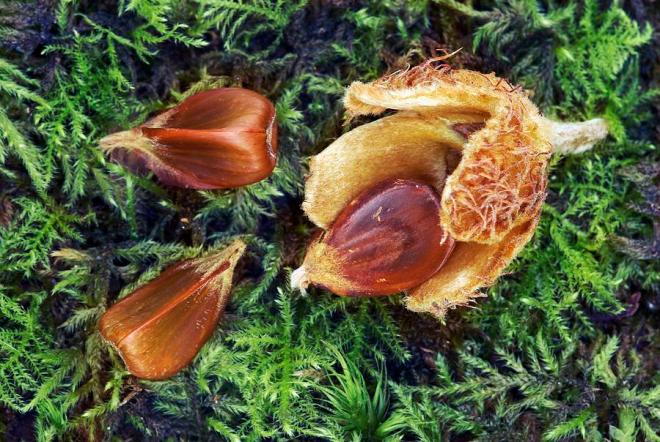
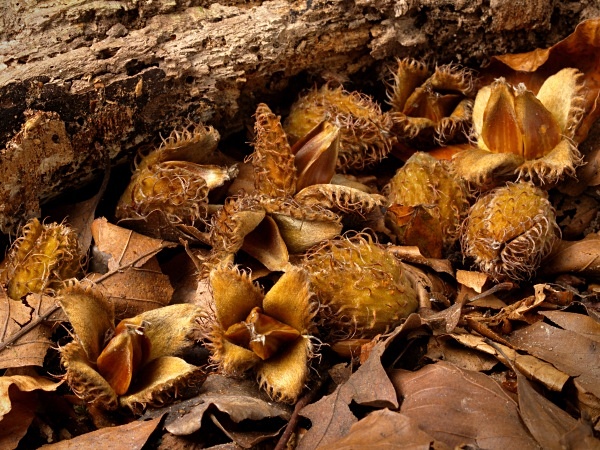
Interestingly enough, the UK has no primeval beech forests (nor does Ireland, for that matter). It could be that over the centuries the British have simply not been able to leave any of their beech forests alone, cutting them, clearing them, or otherwise fiddling around with them. Or it could be that there never were any primeval beech forests in the first place. The beech is considered natural in the southern part of the island. However, some voices have been raised wondering if this is actually correct. These voices suggest that perhaps the beech was brought to the UK by our Iron Age ancestors, who wanted to have it with them as a source of food – the food in question in this case being the beech tree’s nuts, or mast as it is called. Here we have a (very) close-up – the nuts are quite small.
I must confess to having been surprised to read that our ancestors ate mast. But that only goes to show how alienated I have become from natural sources of food – “if it ain’t on supermarket shelves it ain’t food”. By my reckoning, it’s five generations since any of my ancestors might have foraged for beech mast. But foraging is becoming popular, with many websites dedicated to this lost art form. A good number of them mention beech mast, claiming that the nuts are good to eat (although small and time-consuming to gather). Other, probably more objective sites warn that the nuts can taste bitter because of their high levels of tannins, but that they can be ground to a flour and the tannins leached out – that’s probably how my more recent ancestors would have eaten mast, if and when they ate it. I now know that I should start looking out for fresh nuts on our hikes in a few weeks’ time; they fall in late August, early September. I’ll try a couple – and see if I can’t persuade my wife to try them too – and will report back.
Coming back to beech woods, one of their characteristics is that they are – relatively speaking – quite dark; the crown of leaves at the top of the trees are dense enough to keep out a lot of the incoming sunlight. As a result, little if anything grows in the shade of the towering beech trunks. The most common sight is a carpet of bronze-coloured beech leaves lying on the forest floor, the product of the trees losing their leaves year after year. My wife and I see this most spectacularly on the hikes we do during the winter months through a beech wood high above Lake Como, when the dead beech leaves on the ground are the only colour present.
But from time to time we walk through sections of beech woods where a beautiful field of grass lies at the feet of the trees.
My photo
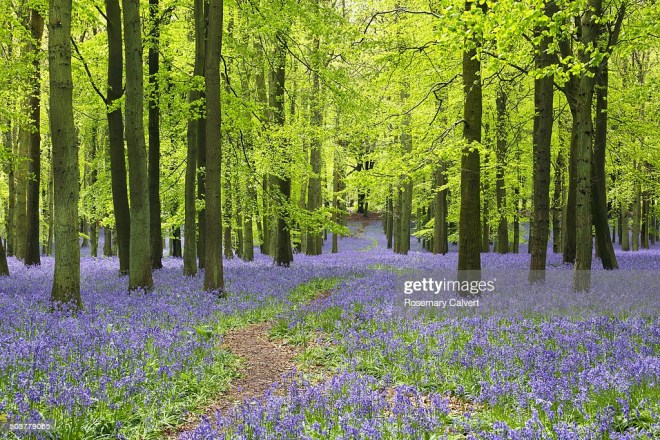
I don’t know what grass this is, or why it only grows in certain places, but the sight of these lawns stretching off into the distance between the trees is a joy to behold. But perhaps not as breathtaking as the fields of bluebells in some of the UK’s beech woods.
The bluebells escape the deadly shade of the beeches by flowering before the trees are fully in leaf. I’m ashamed to say that I have never visited any of these bluebell groves – another item on our bucket list.
The other characteristic of beech woods is the trees’ smooth bark. It’s quite a striking sight to see all these pale grey, smooth trunks towering up into the sky above our heads. And one can immediately spot the lone oak or cherry or conifer skulking among the beeches; their rough barks stand out. This smoothness actually signals a fragility in the beech’s bark; it is easily scarred and the marks remain forever as the bark cannot heal. Many of the beech trees we cross are marked by scars in their bark, no doubt caused by branches of other trees or bushes scraping against them when they were young. But on our walks we also see examples of silly boys, and perhaps some silly girls, using the inability of the beech’s bark to heal to carve their initials into it, quite often combined with the initials of a loved one and the whole enclosed within a heart; they will stay, more and more distorted as the tree grows, until it is cut or blown down.
Initials carved in a beech’s bark is another of my beech memories. This particular beech was in my French grandmother’s garden and the initials carved into its bark my uncle’s. He must have done it 30-40 years before I saw it. Family lore has it that my grandmother was furious with him when she discovered this disfigurement of her tree – “so vulgar!” – and gave him a good thrashing. The tree has gone, alas. It died some 15 years after my grandmother died, shaded out, I suspect, by the mighty sequoia nearby, but also probably suffering from a drop in the area’s aquifer: too much water is being pumped out.
Scratching initials on beech bark allows me to make a connection between this wonderful tree and another wonderful item of which I have many exemplars: the book. Beech and book actually come from the same root, the Old English bōc. This has the primary sense of “beech” but also a secondary sense of “book”. The connection is perhaps more obvious in other modern Germanic languages. In modern German, the word for “book” is Buch, with Buche meaning “beech tree”. In modern Dutch, the word for “book” is boek, with beuk meaning “beech tree”. In Swedish, the word bok means both “beech tree” and “book”. This connection allows me to hold forth on another favourite topic of mine, trade – or rather, the exchange of ideas that comes with trade.
When the Germanic tribes migrated into Europe, pushing out the Celts, they were illiterate, with no culture of writing and no alphabet of their own. When they met the Romans, they fought them of course, but they also traded with them and in so doing came into contact both with writing and with the waxed wooden tablets on which traders (and many others in the Roman Empire) made notes or wrote short missives. As far as the alphabet was concerned, the Germanic tribes adopted a precursor to the Roman alphabet, the old Italic alphabet, to create their runes. As for the tablets, the Germanic tribes used the tree that surrounded them, the beech, to make them, and called these tablets after the tree from which they came. Later, when the Germanic tribes shifted to using parchment, they continued to call what they wrote in books.
Being made of wood, these tablets have normally decayed away, but some examples of Roman tablets have been unearthed along Hadrian’s Wall, somehow miraculously avoiding the normal decay processes.
I’ve mentioned in previous posts the migratory habits which regulate our lives since we retired: when it begins to get cold in the late autumn we migrate south to Italy, when it begins to get hot in the early summer we migrate north to Austria.
It’s me, really, that’s imposed this pattern on our lives. I have a great dislike of intense cold, so I prefer to abandon Austria to its fate in the winter. But equally, I have a great dislike of intense heat, so I hasten to vacate Italy when the mercury begins to climb vertiginously. I suppose it’s my Anglo-Saxon genes that dictate this behaviour: the breeding of generations have led them to feel most at home in places with mild, not too sunny weather.
I was thinking of this as my wife and I hiked this last week in the Hohe Tauern region of Austria, high up along the edges of the Salzach valley. The weather was cool, cloudy, with patches of sun, but also a little rain now and then, ideal weather for hiking. I throw in a couple of photos which we took.
my photomy photomy photo
Yes, I was glad to be out of the furnace that is Italy at this time of the year. Even the lure of the Mediterranean Sea in Liguria, our favourite site for hiking, cannot overcome my dislike of Italy’s summer heat.
my photo
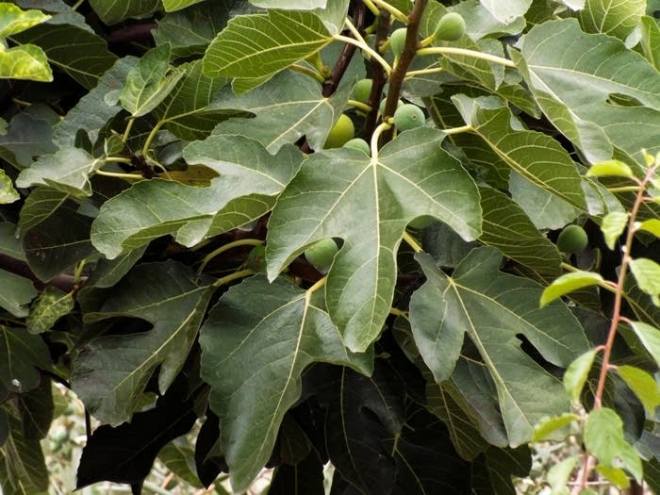
That being said, there is one thing I do miss from our hikes in Liguria: the scent of fig trees. It’s actually one tree in particular which I miss. It borders the path leading from behind our apartment up to the village of Pieve Alta.
I cannot even begin to describe the cloud of scent that will suddenly envelop us as we pass that fig tree in late May, early June. It is a scent which for me evokes a dollop of fig jam dissolved in coconut milk, with a pinch of vanilla added, along – perhaps – with a sprinkling of cinnamon. It is like someone passing under my nose a plateful of very ripe figs, all cut open.
I used to think that it was the fruit giving off this scent, but after reading up on fig trees I now think it is more likely to be the tree’s beautiful, deeply lobed leaves that are emitting the scent.
Wherever the scent is coming from, and for whatever reason the tree is giving it off (surely not to attract me), I thank the Good Lord that I can get such pleasure from passing a fig tree. Sometimes, as I stride across high Alpine pastures or thread my way through dark stands of tall fir trees, I feel a point of nostalgia for that humble fig tree growing along the path between our apartment and Pieve Alta.
I coincidentally started this blog when the London Olympics were opening – my first post was about the opening ceremony – so with the start today of the Games of the XXXII Olympiad in Tokyo, it seems appropriate to celebrate the II Olympiad of my scribbling with a piece on the act of writing itself. Or more specifically, on the symbols which I use to commit my scribbles to (electronic) paper, the letters of the Latin alphabet. Their creation is a fascinating example of the untiring efforts of people the world over to give permanence to the sounds emanating from their mouths: verba volant, scripta manent, the old Latin proverb intones, “spoken words fly away, written words remain”.
The creation of the Latin alphabet, my alphabet if I may call it that, is also a fascinating story of trade as we shall see. Assiduous readers of my posts will know that I have often written about the material things as well as ideas that have been transmitted by trade.
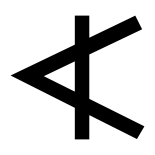
The overall arc of development of my alphabet can be summarized by the letter Turn that letter upside down, and you have:
I think readers will agree that this could be considered a very schematic drawing of a cow’s or ox’s head. And that is exactly where my A originally comes from, the Egyptian hieroglyph for ox’s head.
By what twists and turns did that hieroglyph morph over the millennia into my letter A?
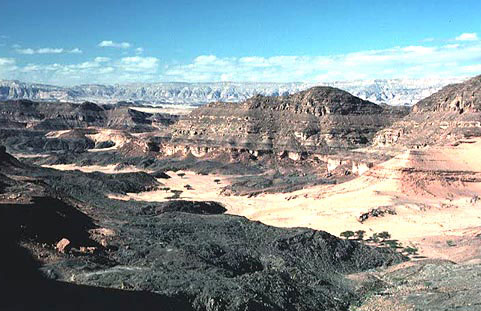
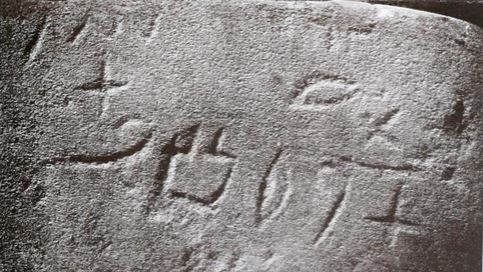
The story starts somewhere in the Sinai peninsula in about 2000-1800 BC. A Semitic people there were in contact with the Egyptian civilization and were familiar with their hieroglyphic method of writing. They adopted those hieroglyphs to write down their own language. The earliest example we have is from a place now called Serabit el-Khadim in the Sinai, which in antiquity was the location of a very rich turquoise mine.
Initially, this Semitic people followed the basic Egyptian principle of hieroglyphs being pictograms: a picture of an ox stood for the word ox. In this, they were no different from the peoples of East Asia, for instance, who adopted the Chinese writing system – also at its base a pictogramic system – to write down their, very different, languages.
But then, relatively quickly, this Semitic people made one very crucial change: they made the picture of an ox stand for the first sound in their word for “ox”. In other words, their signs began to stand for sounds rather than whole words. This was revolutionary, because it meant that with a relatively small number of signs – some 20 in all – this people could cover all the sounds they used, and then they could string those signs together to write the thousands of words they used. This approach made it much, much easier to learn how to write because it was much easier to memorize such a small number of signs. Compare that to an Egyptian scribe, who had to memorize 1,000 or so hieroglyphs. It democratized writing: only a tiny proportion of Ancient Egyptians could ever hope to be able to write, while – in theory, at least – every one of our Semitic people could become a writer (theory only really became practice in our age, and tragically even today in many parts of the world people have not been able to learn to write).
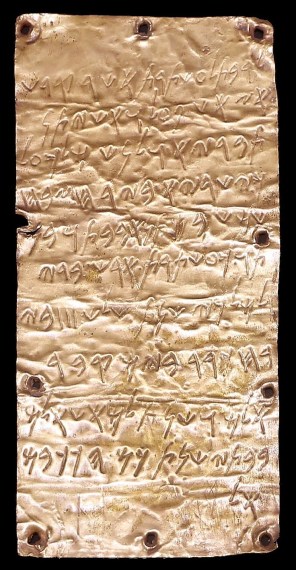
The Phoenicians, who lived along the eastern coast of the Mediterranean in present-day Lebanon and northern Israel, and who were descendants of those Semitic people in the Sinai, perfected this method of writing. They came up with a group – an alphabet as we would come to know it – of 22 signs, with which they could write any word in their language. Here, for instance, is their “ox” sign; they actually flipped the sign onto its side, like so, probably because it was easier to write with a stylus. The Phoenician word for “ox” was ‘alep. So this sign represented the “a”-like guttural which was the first sound in the word (Phoenician, like the modern Semitic languages, used a lot of gutturals). With time, ‘alep also became the name of this sign.
For their “b” sound, the Phoenicians used this sign, which stood for beth, or “house” in Phoenician. And again, beth too eventually became the name of the sign. This sign was ultimately derived from the Egyptian hieroglyph for “house”, although the sign seems to have got bent out of shape over the centuries.
For their hard “g”-sound (like in “go”), the Phoenicians used this sign, which stood for giml, or “throwing stick” in Phoenician. And giml became the sign’s name. Again, the Egyptian hieroglyph for “throwing stick” was at the origin of this sign. I could go on, but I think readers will have got the point by now. I do think, though, that the Phoenicians deserve to have their whole alphabet shown here.
This tablet comes from a temple that was built in about 500 BC on the Tyrrhenian coast of what is now central Italy. It is there because the Phoenicians were present in the whole of the Mediterranean basin. Which brings us to trade.
The Phoenicians were inveterate traders, trading with their neighbours to the east as well as across the whole of the Mediterranean basin; they also established a string of colonies along the shores of the Mediterranean, the most famous of which was Carthage. Not surprisingly, they took their writing system with them wherever they went, and their trading counterparts got to know about it. Many of them quickly twigged to its power and adopted it for their language. The ones who interest me are the Greeks. Around the 8th Century BC, they adopted the Phoenician alphabet wholesale, even transliterating the Phoenician names of the letters into something more Greek sounding. So ‘aleph became alpha, beth became beta, giml became gamma, and so on (and we thus got our name for a group of such signs, or letters as we can now call them: the alphabet, a merging of the names of the first two letters alpha and beta).
The Greeks did have to bring in some modifications to the Phoenician alphabet, because the sounds they used were not quite the same as the sounds the Phoenicians used. The biggest difference was in the vowels. Greek had more obvious vowel sounds than did Phoenician, which relied on gutturals. There was also the hard-“th”, the “ks” and the “ps” sounds. In most cases, the Greeks repurposed Phoenician letters for sounds which did not exist in Greek, in a few others they created new letters.
Actually, because of different dialects spoken among the Greeks, which meant that there were some variations in the sounds used, there were three somewhat different alphabets created by the Greek polities, as shown on this map.
It’s the western Greek alphabet (used in the parts of Greece coloured orange in the map) which interests us most, for reasons which will become clear in a minute. I show this alphabet here, along with the original Phoenician “template”. One can see the outlines of the classical Greek alphabet peeping out – the one I used as an unhappy student of ancient Greek at school. With time, the Greeks dropped some of these letters and added others, like omega. In some cases, where I show two letters in the Western Greek column, there were variants. And in those variants, one can see the outlines of letters which were to be found in the Latin alphabet and not in the classical Greek alphabet: the C, the D with the rounded “tummy”, the beginnings of the P (the loop still needed to be fully closed), the beginning of the R (the downward slanting stroke was miniscule), the S. The importance of these variants will become apparent in a minute.
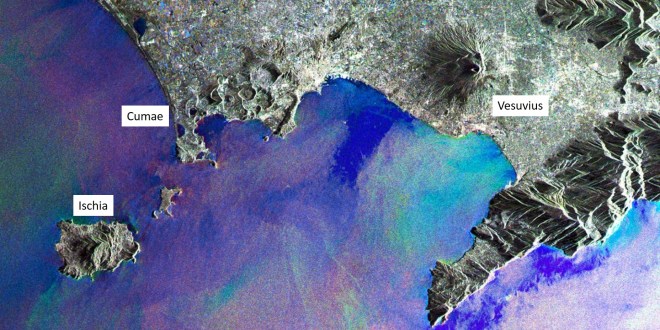
The Euboean Greeks, who used this western Greek alphabet, were also, like the Phoenicians, traders and colonists. In particular, they had set up what are probably the oldest Greek colonies in Italy, around the bay of Naples: one on the island of Ischia (Pithekoussai) and one on the mainland (Cumae).
They set them up in the 8th Century BC, pretty much when the Greeks adopted the Phoenician alphabet. No doubt the Western Greek alphabet arrived very quickly in these two colonies. There, the Euboeans came into contact with the Etruscans, who were at the time the major power in the Italian peninsula and, as this map shows, were poised to expand their power and influence even further up and down the peninsula.
The contacts which the Euboeans had with the Etruscans were primarily through trade but, given that the Etruscans eventually enveloped both colonies, these could also have led to political alliances.
When the Etruscans got to know the Euboean alphabet they, like the Euboeans before them, must have realized the power of this writing system and adopted it, although they too had to bring in a good number of modifications to deal with the different sounds which they had in their language. I won’t list their alphabet, for the very cruel reason that their language was extinguished – so thoroughly that its vocabulary and grammar are still only partly known, in spite of more than a century of intense research.
Which brings us to the Romans, who did the extinguishing. Early on in their history, this upstart, but aggressive, tribe from the middle of the Italian peninsula were ruled over by the Etruscans, but they took them on and eventually beat them comprehensively. Along the way, though, in a pattern which must be familiar to readers by now, the Romans also recognized the power of alphabets and adopted the Etruscan one – with the usual modifications to account for different sounds in their language, including the readoption of some of the letters in the Greek alphabet which the Etruscans has dropped as not useful to them.
And so, coming back to the letter A with which I started, let me use it to show the arc of development that took place, from the Egyptian hieroglyph to the Latin letter.
Of course, the story doesn’t end with the Romans. The Latin alphabet could have disappeared at the fall of the Western Roman Empire, along with so much else that did disappear. That it didn’t is a testimony to writing’s utility to the Western Christian Church, the only organization left standing from the Roman era. Apart from the ability to more easily transmit religious ideas, the alphabet allowed the Church to – once again – give written form to languages without writing, in this case all the languages which the Germanic and Slavic tribes brought with them, often mixed in with the remains of Latin and its offshoots. As usual, there was the usual problem of dealing with sounds which didn’t exist in Latin, but interestingly enough no new letters were created. There was just fiddling around with the existing ones. So, for instance, we have Å, Ê, Ï, Ø, Ù to deal with various long vowels, and Č, Š, Ñ, to deal with the “ch”, “sh”, and “ny” consonants, in various European languages (there are lots of other fiddles, but for the sake of brevity I will leave them out). The process of using the Latin alphabet to create writing systems for various languages has gone on in modern times as the European powers colonized other parts of the world which didn’t have writing – the North American tribes, for instance, or the tribes in Sub-Saharan Africa – or even which did, for instance in Vietnam.
All of this has given me the puerile desire to create my own alphabet. I’ll use the same process of development: assign to each letter in my alphabet an object which starts with that letter, create pictograms for each of those objects, and then simplify those pictograms into letters. To identify the necessary objects, I’ll use one of those songs with which parents teach their children the alphabet, songs which go something like this:
A is for apple, a a apple
B is for ball, b b ball
C is for cat, c c cat
etc.
As an added plus, I can use the exercise to ruthlessly cull my alphabet of unnecessary letters: C, because S can be used for soft-C, K can be used for hard-C; X, because you can simply write X as KS. And I’ll come up with standardized ways of dealing with diphthongs. In the process, I’ll make English writing sound the way it’s spoken: as any non-English native will tell you, English has one of the craziest spellings in the world, there is no way in hell that you can tell what a word sounds like by the way it’s spelled.
Mind you, I’m not sure what I’ll do with my new alphabet once I have it. I’m not 10 years old anymore, with a BFF with whom I could pass notes back and forth during classes in our own secret code. And I’m past the age of being a spy, sending my minders coded messages about where the weapons of mass destruction have been stashed away.
No worries, I’ll think of something! Watch this space …
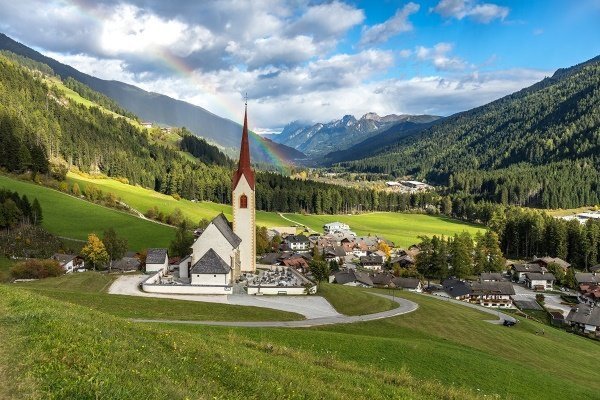
During this year’s week-long hike in the Dolomites (which I also mentioned in passing in my previous post), I managed to squeeze in a visit to the parish church of Sesto (or Sexten, to give its German name; we are in Sud Tirol, after all). Let me repeat here a message I have tried to pass in previous posts: always visit every church you come across in Europe, no matter how small it is, because there is a good chance that you will discover an artistic gem (or two). The church in Sesto / Sexten was no exception.
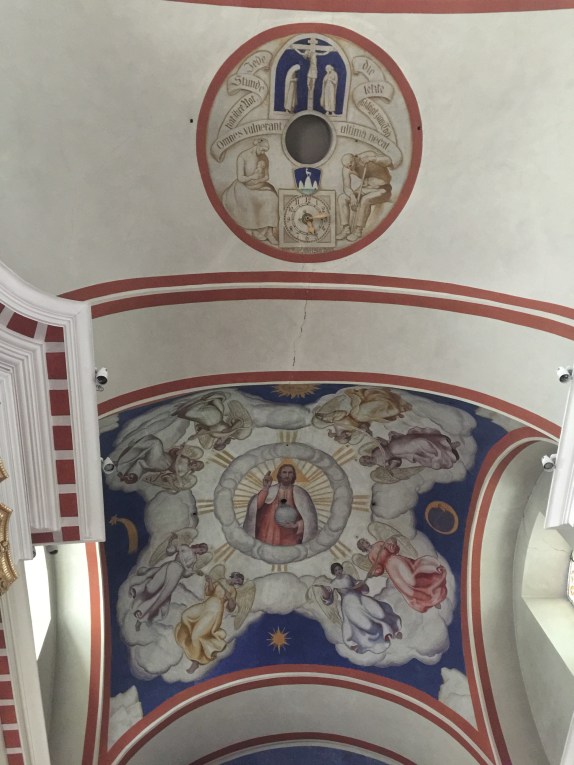
The church itself was OK – it had some interesting frescoes on the ceiling.
My photo
But what really made the visit worth while was the cemetery. My wife will tell you that I have a morbid streak, and indeed I don’t deny having a certain preoccupation with death – a preoccupation which, naturally enough I think, is growing with age. But cemeteries do also often contain wonderful art, as people try to lessen the pain caused by the departure of loved ones and reduce the fear of death itself through art. Things started with a bang at the entrance to the cemetery, which took the form of a small circular pavilion reached by a covered staircase from the road.
My photo
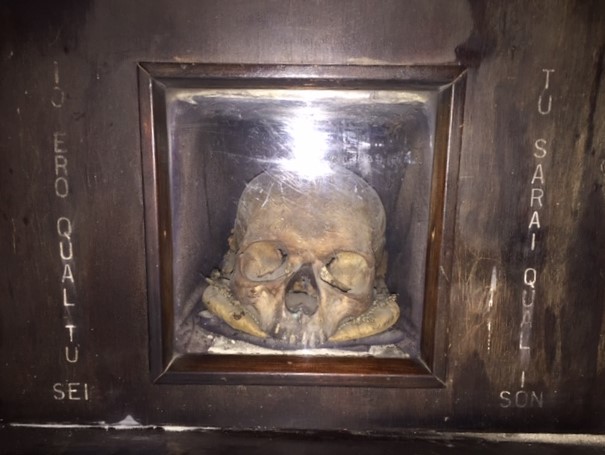
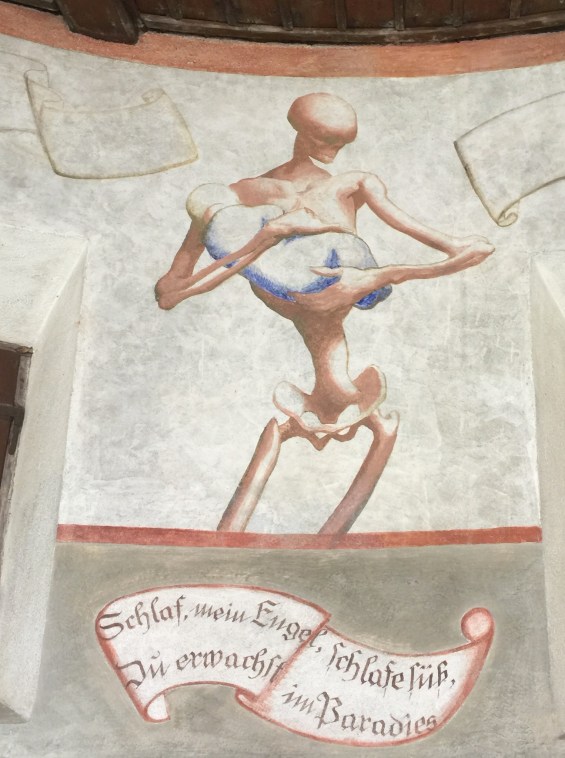
The ceiling of the pavilion was adorned with a Totentanz, or Dance of Death (danza macabra in Italian). This type of artistic depiction flourished in Europe during the 15th and 16th Centuries, probably in response to the Black Death and the lesser outbreaks of the plague which continued to periodically sweep through the continent. They were a form of memento mori, a reminder to us that we must all die sooner or later: “Remember, man, that thou art dust and to dust thou shalt return”. I came across a typical example of the form several years ago, in a church in Milan.
My photo
The phrase on the left says “I was what you are”, while the one on the right says “You will be what I am” (I emailed the photo to a dear friend of mine as an attachment to a lighthearted note; he died a year later – death catches us all, some of us sooner than later).
Dances of Death were different because they stressed that Death was the Great Leveller: whatever your social position, however powerful you were, you could not hide from Death. I suppose this idea was thrown into sharp relief by the Plague: here was a disease which made no distinctions, remorselessly scything down rich and poor, powerful and powerless, old and young, sick and healthy. And so Dances of Death would depict men and women – and children – from all ranks of society and all walks of life dancing with, being embraced by, skeletons. Here are typical examples of the genre.
In the earlier versions, each person would be accompanied by a short poem, often written in an ironic tone, commenting on him or her and their incipient death. And the skeletons would be quite jolly, not only dancing but frolicking about.
Even though the example on the ceiling of that pavilion in the cemetery of Sesto / Sexten was quite modern – it was painted soon after the First World War – its author, Rudolf Stolz, followed the traditional iconography quite faithfully. Thus, we have a ruler.
My photo
He is accompanied by a rhyming couplet in German, which states (in my rather free translation)
“The sands have run out,
Lay aside your scepter.”
The skeleton is holding an hourglass, so we can interpret these couplets as something the skeletons are saying to their charges.
Then we have a mature woman, a “matron” as they used to be called.
My photo
Her skeleton is saying to her
“Woman, your devotions are over
Idly burns your candle”
To make the point, it pinches the candle’s wick. Like many a matron in a village like Sesto, she must have been a regular churchgoer.
Next we have a mature man, no doubt a local farmer, dressed the way locals would have dressed until quite recently.
My photo
With a scythe slung over its shoulder, his skeleton is intoning
“Your virility, your creativity
Cut like grass by a stroke of my scythe”
He is followed by the most poignant of the depictions, that of a baby.
My photo
The skeleton is crooning to the baby
“Sleep, my angel, sleep sweetly
You’ll awake in paradise”
At a time when the death of babies and children was still quite common, I can only hope that this painting was of some comfort to grieving mothers on their way to tend the graves of their children.
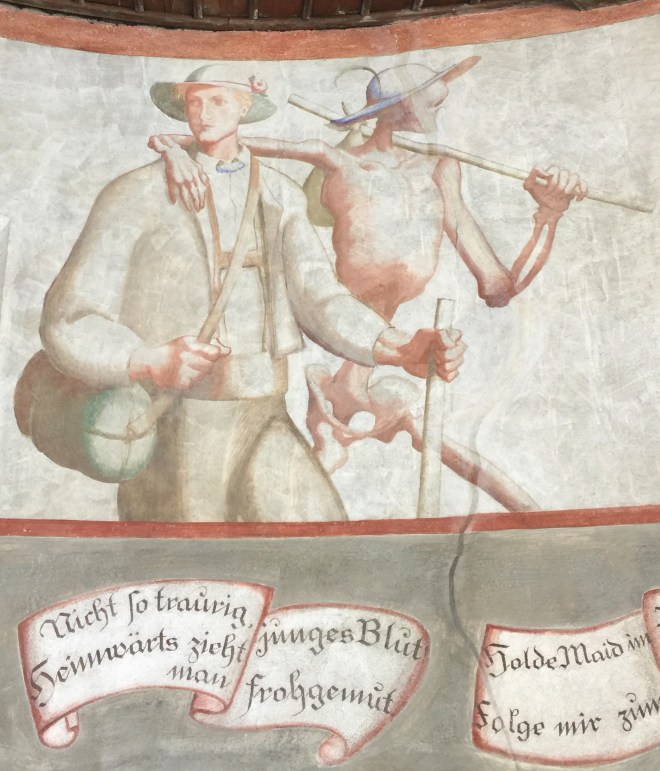
On goes the dance! We move on to a young man.
My photo
His friendly skeleton, bony arm wrapped around his shoulder, is telling him
“Not so sad, young blood
Go homewards with cheerful heart”
Presumably “homewards” in this context means home to the kingdom of God.
Which brings us to a young woman.
My photo
Her skeleton is telling her
“Fair maiden with the myrtle wreath
Follow me to the wedding dance”
And indeed the skeleton seems to be about to start the kind of square dance that was common in these parts. But no doubt it is referring to a wedding with Death.
And so we come to the final character, a bishop.
My photo
His skeleton is telling him
“Bishop with the shepherd’s crook
Set aside your heavy burden”
and is helpfully taking away his crosier (his crook), no doubt as a first step in divesting him of his other accoutrements.
When I saw this Dance of Death, I was immediately reminded of another Dance of Death which recently went under the hammer at the Dorotheum auction house in Vienna, a version of Albin Egger-Lienz’s “Totentanz 1809”.
The affinity between these paintings is no surprise. As his name indicates, Egger-Lienz was born just down the road from Sesto / Sexten, in Lienz, now in Austria. Most of the themes of his paintings were Tyrolese. Rudolf Stolz was a great fan of his.
Suitably reminded of my own approaching demise, I passed into the cemetery itself. Tyrolese cemeteries are a joy to visit. Each grave is a little garden, carefully tended by relatives. This one was particularly well kept, and the view on the Dolomites of Sesto was magnificent.
My photo
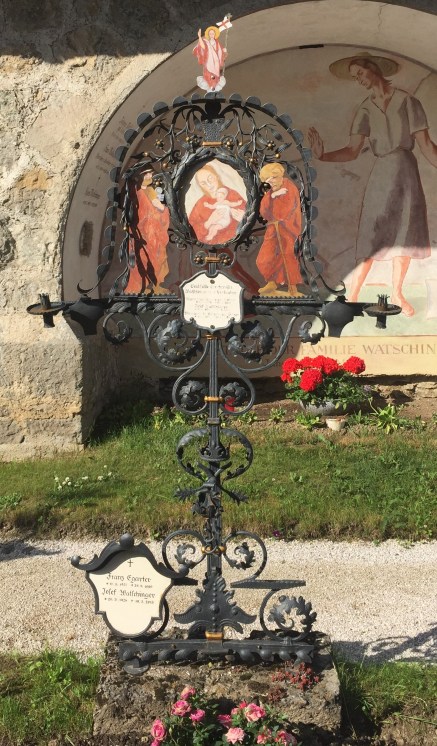
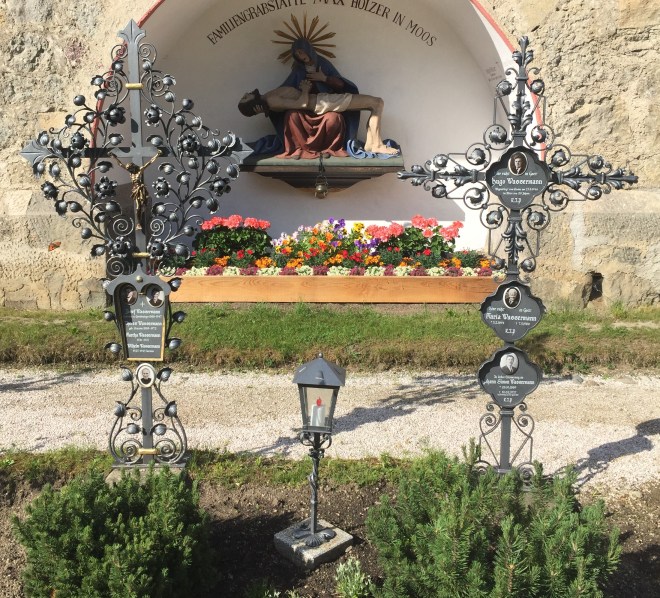
In addition, the crosses over the graves are often masterpieces of ironwork. I throw in a few examples I came across.
My photoMy photoMy photo
I have to assume that all those flowery curlicues are to remind the Christian viewer that the wooden cross is the bearer of (eternal) life, rather like a stick which – when stuck in the ground – sprouts leaves.
Behind the first cross you can see an example of the frescoes that are painted on some of the cemetery’s family tombs. Rudolf and his two brothers Albert and Ignaz painted a good number of these (Albert also painted the frescoes on the ceiling of the church). I rather like this fresco by Ignaz Stolz, a nice take on the story of the Sermon on the Mount.
My photo
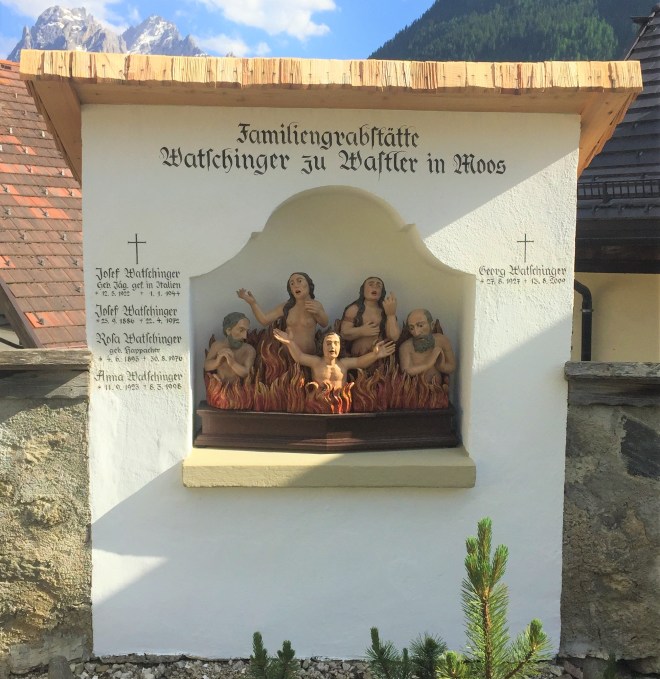
In the end, though, I rather preferred the sculptures in wood – another great art form in the Tirol; not surprising, given the wealth of wood here – that adorned some of the family tombs.
My photo
I’m not sure I would want a sculpture on my family tomb strongly suggesting that I would be burning in Hell …
My photo
The story of the women coming to the grave of Jesus to prepare him, only to find an angel sitting at the mouth of the tomb.
My photo
A pietà.
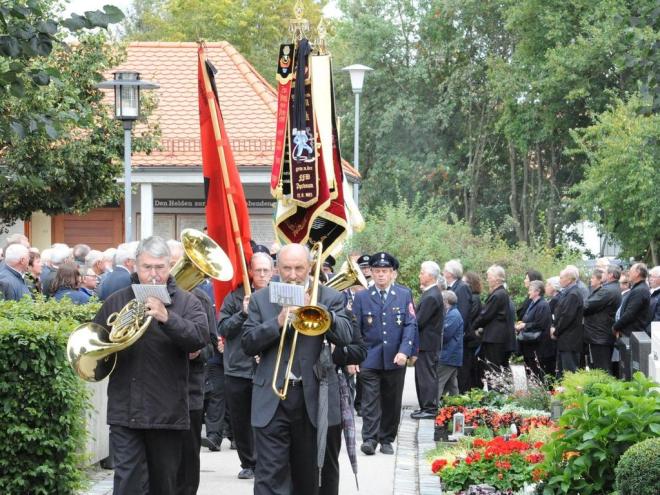
Yes, if I am finally laid to rest in a cemetery – which is not a given; cremation is a strong possibility – I think a Tyrolese grave, surrounded by mountain flowers, will do me very well. And I want a brass band to see me off! Once, many years ago, when I was convalescing at home after a knee operation, my wife took me for a spin through the countryside around Vienna. Quite by chance, we came across a funeral procession that had just reached the village cemetery. We stopped to watch. Suddenly, the sombre silence was broken by a duet between trumpet and trombone. What a way to go, to the sound of brass!
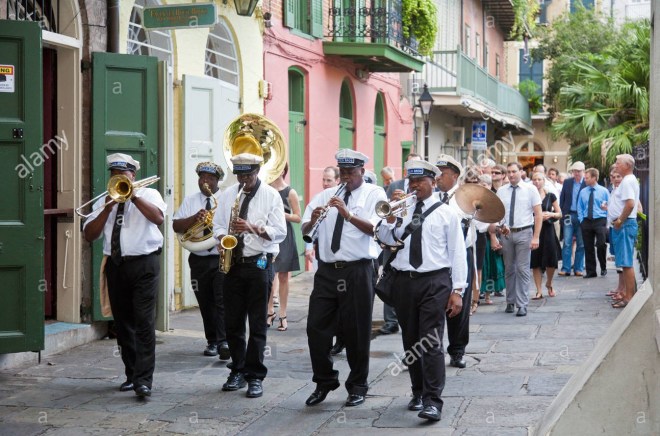
I have often told my wife of this desire, but I suspect she has been dismissing it as an emanation of the Monty-Pythonesque side of me, not to be taken seriously. But really, what better way to say that that final goodbye than through the booming notes of a brass band? Since she and I like jazz so much, maybe she could fly in one of those New Orleans funeral bands. Now that would be something!
My wife and I, together with our daughter this year, have just finished our annual week-long hike in the Dolomites. We went back to the valley where we had started our hike last year, the Val Fiscalina in Alto Adige (or Sud Tirol).
I will hopefully post my usual photo-essay of the hikes we did, once our daughter sends us the photos – as she repeatedly reminded us, the camera in her iPhone is way better than ours, so she took most of the photos. But here I want to talk about something that happened during an easy hike we took on one of our five days of hiking, to give our muscles a rest. It was along the side of the valley between Sesto and Dobbiaco. Along the way, we crossed this panel.
It was announcing that we were crossing the sources of the Drava River. The Drava River! … I knew this river as a tributary of the Danube, somewhere in the Balkans. Yet here was its source, some 500 km away as the crow flies. To memorialize the moment, I took this picture, just when a young boy happened to be messing around with the stream of water.
my photo
I immediately recognized that pastime from my own childhood, damming and undamming streams; I still enjoy undamming the rivulets that trickle down the side of tracks we hike along, poking away at the amassed debris with my walking sticks. I would also float sticks on streams and watch them disappear around the nearest bend. Where would those sticks end up, I wondered.
Once, when I was a bit older, I spent hours poring over maps of England, trying to figure out how I might be able to kayak down the stream which ran along the bottom of the valley in front of my school, all the way to London. Ah, the foolishness of youth! I’m not sure a kayak would have even fitted in that stream.
A few years later again – I was in my mid teens by then – I was consumed with envy when I discovered that my two cousins had spent a couple of weeks tubing down some river in France. Just the thing I had wanted to do with my kayak!
That evening, I was once again studying maps, to see where the Drava river went. And suddenly, I found myself dreaming up an imaginary tubing journey down the Drava with my wife, all the way to its mouth on the Danube. This picture gives my readers an idea of what I’m talking about, although this particular tubing expedition is taking place in Tuscany.
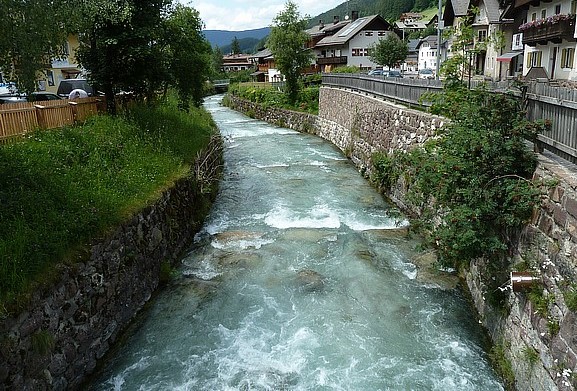
I decide that we will start our imaginary tubing journey in San Candido. At its very beginning, the Drava is really a miserable little stream, there’s no way we could float two tubes in it – plus a third one carrying our stuff. But at San Candido, it receives the waters of the much bigger Sextner Bach.
After Lienz, the Drava, a river now, although still a small river, will carry us into the upper Drava valley. We’ll first pass through the Kärntner Tor, or Carinthian Gate, which is a narrowing in the Drava Valley and the entry point into the province of Carinthia.
The river runs between the Kreuzeck range of the High Tauern in the north and the Gailtal Alps in the south. After carrying us past various picturesque villages like the village of Greifenburg
We’ll be traveling faster on the more rapid currents and we’ll burst out of the narrows, spinning perhaps in our tubes, to find ourselves floating past Sachsenburg itself.
Maybe a few flecks of gold will cling to our tubes at this point! The Möll, but also the Isel earlier and other streams coming out of the High Tauern Mountains, carry alluvial gold out of these mountains. For several thousand years, pan handlers have earned a modest but honest living along the Drava River downstream of the High Tauern Mountains, panning the river’s detritus for gold, all the way down into Croatia. Even today, some hardy souls try their luck.
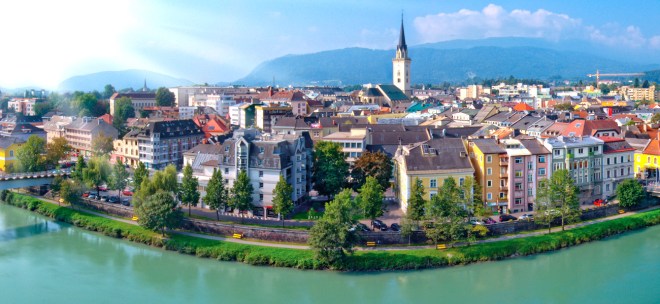
After Villach, the Drava River becomes more of a lowland river, running slower and beginning to twist and turn across the landscape. Our tubes will follow it in these twists and turns, eventually entering the Rosental valley and running along the northern side of the Karawanken mountain ranges. Here, the river, and my wife and I, will end our travels in Austria. We will float gently by Völkermarkt
before following the river south as it slips through a gap in the mountains and enters Slovenia. In total, we will have travelled 255 kilometres in Austria.
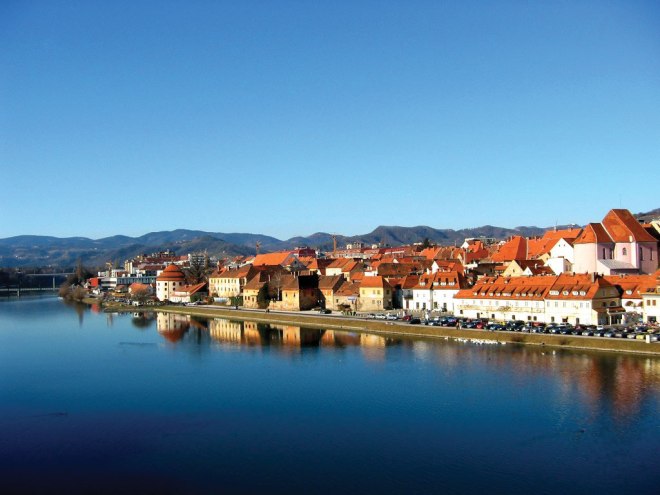
Onwards into Slovenia! We will soon reach our first Slovenian town, Dravograd.
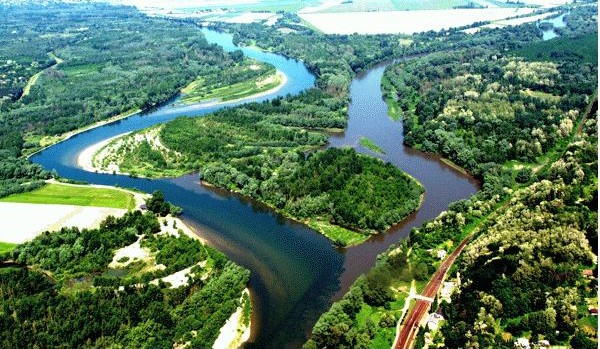
For 130 kilometers or so, the river now becomes the border between Croatia and Hungary. It has become a very slow-moving river, meandering its way across the landscape, which has become a pleasant forest- and marsh-filled environment.
From now on, we’ll have to be careful not to be run over by the ships which begin to ply the Drava for trade. Further on, we will glide past the small Croatian town of Donji Miholjac.
Source
The river now stops being the border with Hungary. On it goes, looping and relooping as it crosses the region of Slavonia.
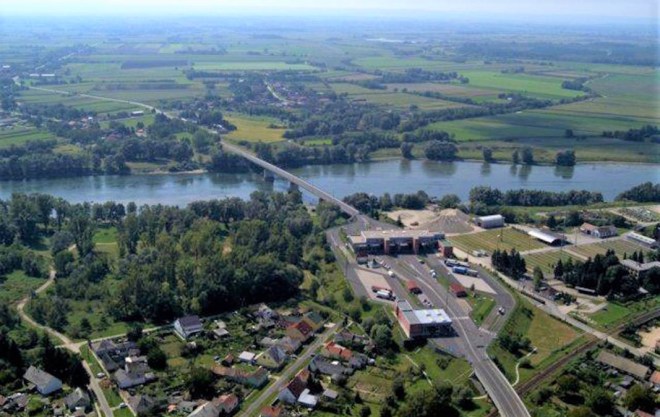
I think I’ll stop our imaginary journey here. We’ve already travelled some 160 kilometres through Croatia, and some 7 kilometres beyond Osijek the Drava finally flows into, and loses itself in, the Danube.
I don’t think there would be anywhere for us to get off the river there, and I don’t feel like continuing all the way down the Danube to the Black Sea.
Well, that was a nice dream! Alas, I suspect that doing a trip like this in real life wouldn’t be possible. For one thing, the river has been dammed to within an inch of its life, for hydropower. There are no less than 22 hydroelectric stations along the river. Assuming one is even allowed onto the lakes behind the dams, at some point we would somehow have to schlepp our tubes around the dams and down onto the river again – assuming that there would be enough water downstream of the dams to plonk our tubes into. For another, I rather suspect that having one’s bum in the water all day, for something like two weeks (my guess as to how long this little trip would take), might not be too good for the skin of the bum. For a third, the waters of the Drava up to at least the Möll River are all from glacial or snow melt and so would be pretty damned cold. But hey! What would life be like without dreams?
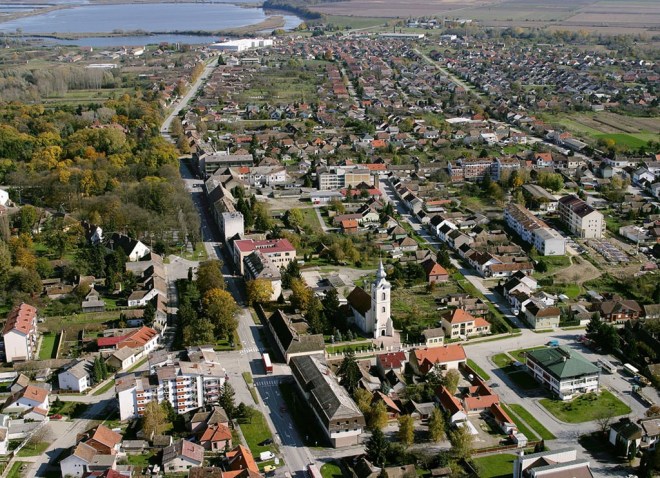
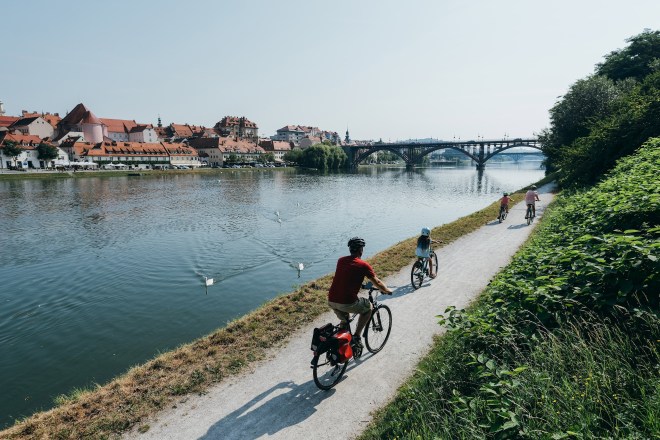
I read, however, that they are constructing a bike path all the way down the river. Maybe it would be more sensible for my wife and me to simply bike down the Drava …
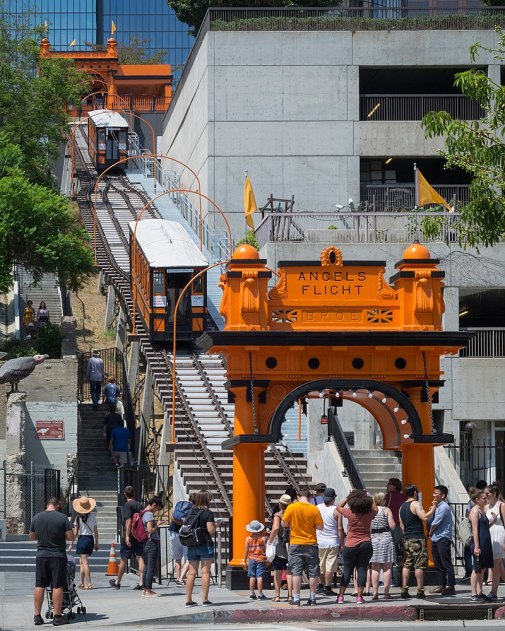
It’s not often that I write about technologies, they are mostly workhorses of some sort without much else to commend them. But from time to time I come across a technology that catches my eye. Sometimes it’s because the technology in question is genuinely lovely to look at – solar power towers come to mind – but sometimes it’s simply because it’s quirky and fun and brings a smile to my world-weary, seen-it-all-before, been-there-done-that face. Funiculars fall into the latter category.
My wife and I have been taking funiculars quite often this last month or so. Actually, we’ve been taking one specific funicular quite often, the one between Como and Brunate, the village perched high above Como, on the steep hills – cliffs, almost – that plunge into the lake. It is the jump-off point for a number of our hikes.
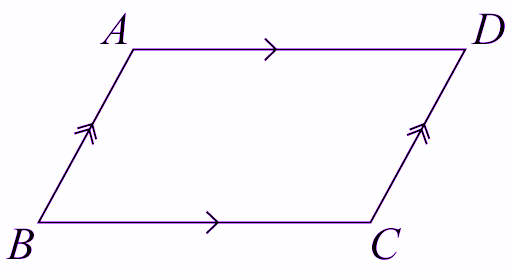
They are the only thing I’ve ever come across in the real world which look just like those parallelograms we used to draw in geometry classes at primary school.
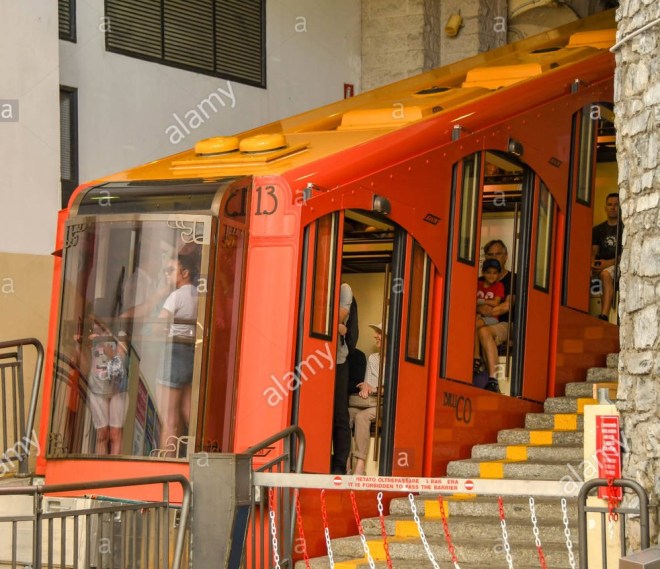
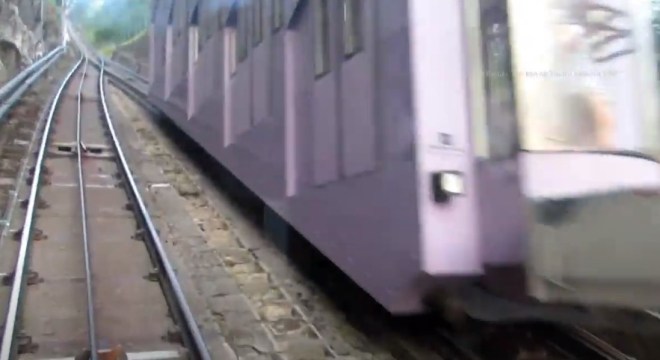
Entering a funicular carriage is like entering a world where everything leans to one side. Luckily for us, as readers can see from the picture of the carriage its’ designers have rigged up the inside into a series of flat platforms connected by steps, so we can sit in a normal position and not like those astronauts who are about to take off from Cape Canaveral.
and continue on their way. Soon after, we ease slowly into the upper station at Brunate, the doors open, and we stride off to yet another hike, after briefly stopping to admire the view.
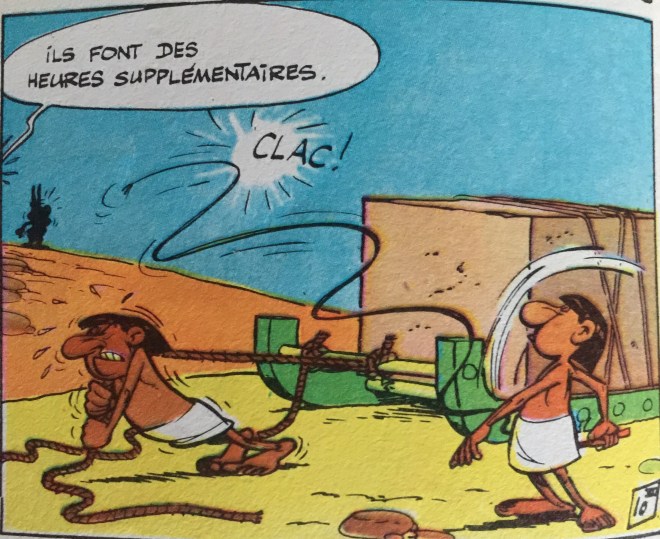
It’s not just their quirkiness that makes me like funiculars. They are also clever pieces of design. The key design principle behind them is to have two carriages attached to the same cable. I personally haven’t dragged anything up a very steep hill, but I would imagine that it’s pretty hard work, requiring the outlay of a lot of energy – and an overseer to whip the bejeezus out of me to make me pull harder. A picture from Asterix and Cleopatra shows what I mean.
my photo from the album
Attaching another carriage to the cable means that at least the weight of the carriage being dragged up the hill is now counterbalanced by the weight of the carriage sliding down it, so the only energy you need to add to the system is the energy required to drag the people sitting in the carriage up the hill. And if you can get people into the carriage going down the hill, they can pretty much balance the people coming up, reducing even more the energy required to get the upcoming carriage to the top of the hill.
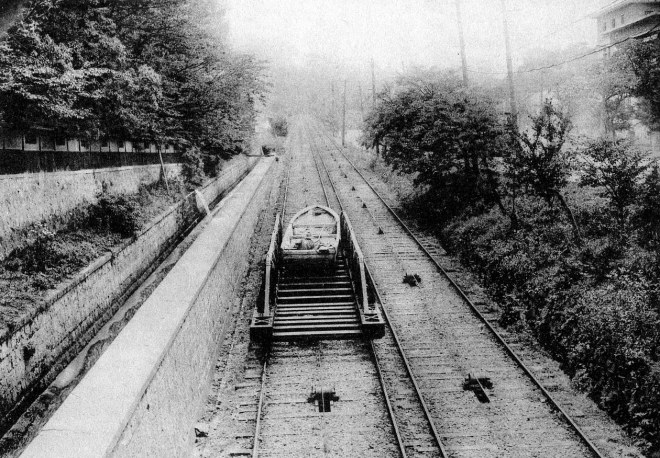
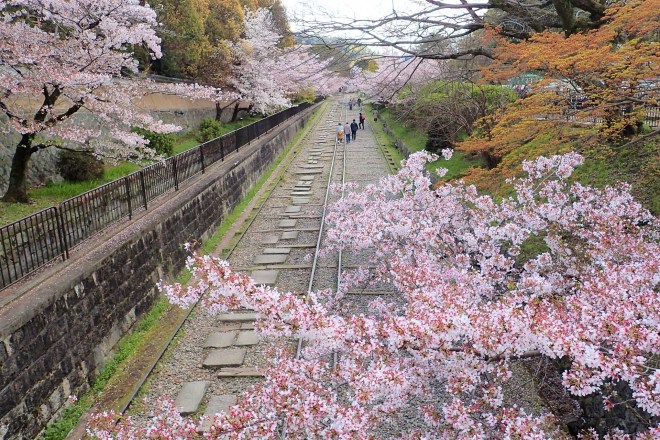
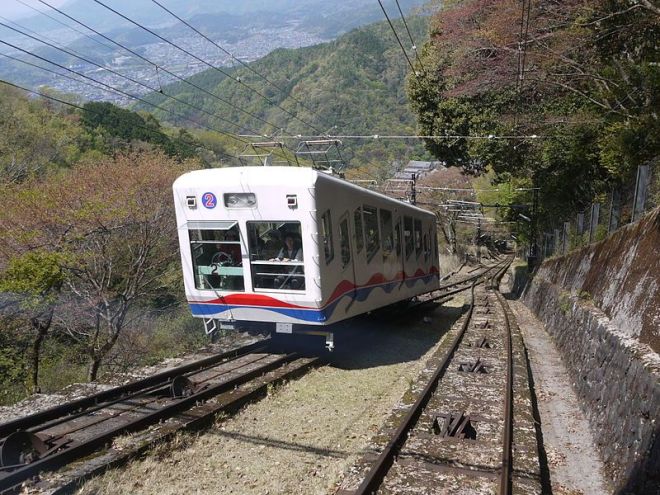
I can’t find any claim on the internet to an inventor for this key idea. I suspect it’s an old idea, with the inventor lost in the mists of time. The most immediate precursor comes from the golden age of canals, where similar systems were used to drag boats up from a lower canal to a higher one, counterbalanced by boats being let down from the higher canal to the lower one. My wife and I have walked down the slope of one such system, the Keage Incline, in Kyoto. It used to connect the canal from Lake Biwa to the canal 36 meters lower which ran through Kyoto.
It was taken out of use in 1948. Now only tourists like us use it, especially during the Spring when the cherry trees, which have been planted along it, are in bloom.
This clever idea of the counterbalancing act was taken one step further in a few funiculars, where a water tank was attached to the carriages. An operator at the top of the funicular would fill the tank of the downward-going carriage with enough water to make it just a bit heavier than the upward-coming carriage, so that the downward-moving carriage could pull the upward-coming carriage up the hill without the need for any extra energy input. At the bottom, the tank was emptied out, and the whole cycle started over. Unfortunately, this alternative to the funiculars’ basic balancing act was never very common, because it needs a good (cheap) source of water at the top of the hill, whereas most sources of water are at the bottom of hills. I also suspect these types of funiculars were more complicated to manage. Over the years, a good number have been switched to more conventional hauling engines, but a few still exist, for instance the Bom Jesus funicular in Braga, Portugal (the water tank is below the carriage)
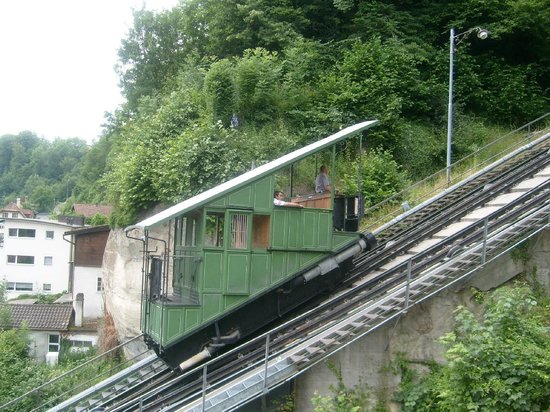
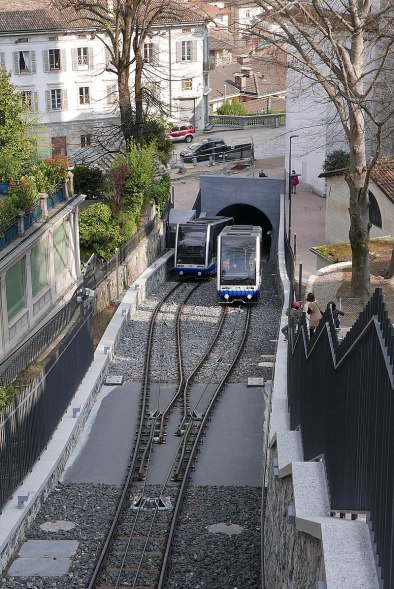
The Fribourg funicular has reached a maximum of cleverness. It uses the treated wastewater from a treatment plant located on the top of the hill to fill the tanks. At a minimum, that makes it a win-win-win solution, and I think there must be another “win” in there somewhere.
The next important invention in the funicular story does have a name and a face attached to it. Originally, cables were made of hemp or other natural fibres. As readers can imagine, they were not that strong. If the weight being pulled was too great they would snap. In practice, this meant that the hills up which things were dragged could not be too steep or the loads too heavy. This limitation was overcome when the German Wilhelm Albert figured out how to make stranded steel cables, with the first steel cable being put into use in 1834.
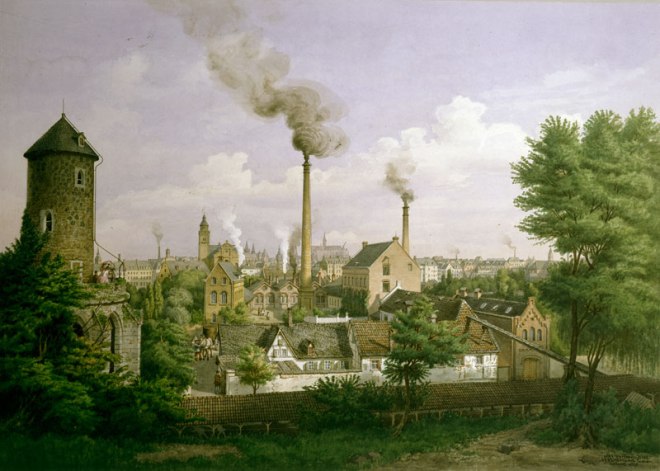
Initially, the steel cables were stranded by hand, which obviously limited output, but in 1837 an Austrian by the name of Wurm developed a machine to strand cables. The German rope-makers Felten & Guillaume then got into the game and by the 1840s were churning out more, and cheaper, steel cables. We see here their factory in Cologne in the 1860s.
This greatly expanded the scope of where funiculars – and anything else being dragged up inclines – could be used.
The final important invention had to do with track layout. In the first funiculars, each carriage had its own set of tracks. This funicular in Hastings in the UK, which was actually built quite late in the day – 1902 – shows the principle.
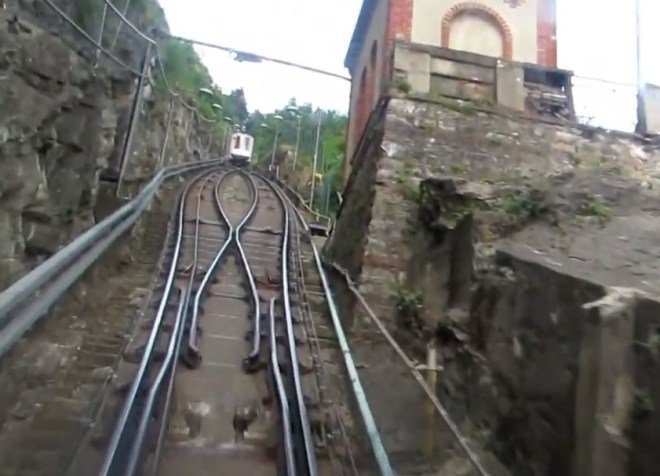
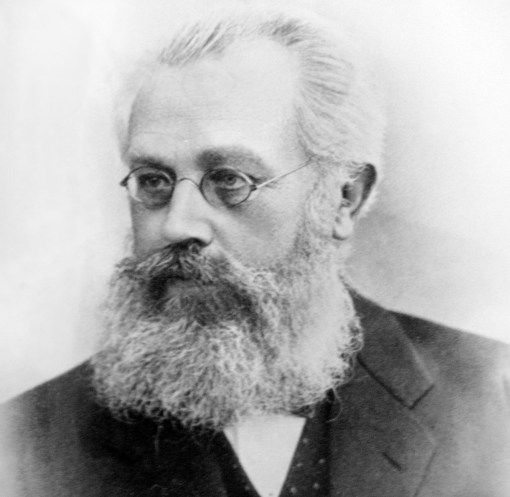
Two tracks laid side by side, plus four platforms – each track had to have its own top and bottom platforms – took up a lot of space, space which was often carved out of the living rock. If only one track could be used (and only two platforms), the construction costs could be lowered considerably. But how to get the two carriages past each other when they met at the midpoint? This knotty problem was solved by a Swiss engineer by the name of Carl Roman Abt.
As the diagram shows, to make it work the wheels on the left of one carriage are flanged on both sides, while it’s the other way around on the other carriage. Like that, when the carriages come to the passing point, the carriage flanged on the left always veers left, the carriage flanged on the right always veers right. The inner wheels aren’t flanged at all. Quite simple, really – although I’m sure the execution in real life is more complex than that two-sentence description.
Abt first used this system in 1886 on the funicular in Lugano which connects the old town to the railway station. Which is great, because it allows me to throw in a picture of one of the funiculars which my wife and I have used in our lives. Readers can see that the cars are thoroughly modern, fruit of a makeover in 2016.
While I’m at it, I can throw in pictures of the two other funiculars we have travelled on:
The Angel’s Flight in Los Angeles (which uses a 3-rail track layout)
I’m racking my brains to think of other funiculars we’ve travelled on but I think that’s it: four in total, counting the one in Como. Not a huge number given that there are some 300 funiculars around the world. We really have to do better. I shall review with my wife Wikipedia’s list of funiculars around the world, to see which ones we should try to ride (this could be an excuse to visit places we haven’t been to yet, like Rio de Janeiro or Santiago in Chile). And then, when (if) COVID-19 is brought under control, we can be on our way!