We’re off to Los Angeles, to stay with the little family of our daughter and her partner – about to grow by one more child!
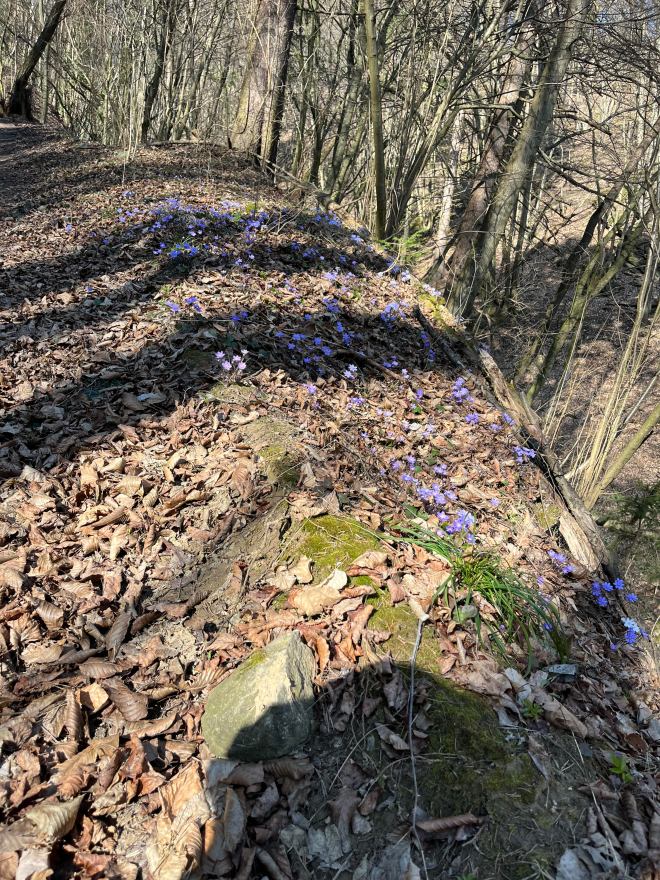
We leave Austria with Spring timidly showing its face. On our last hike in the Wachau, we spied small drifts of pennywort pushing through the forest litter.
My photo
Their light purple petals were almost glowing.
My photo
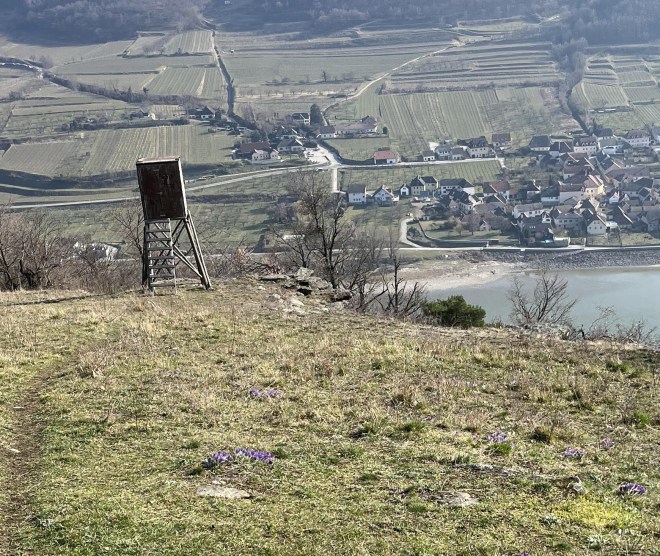
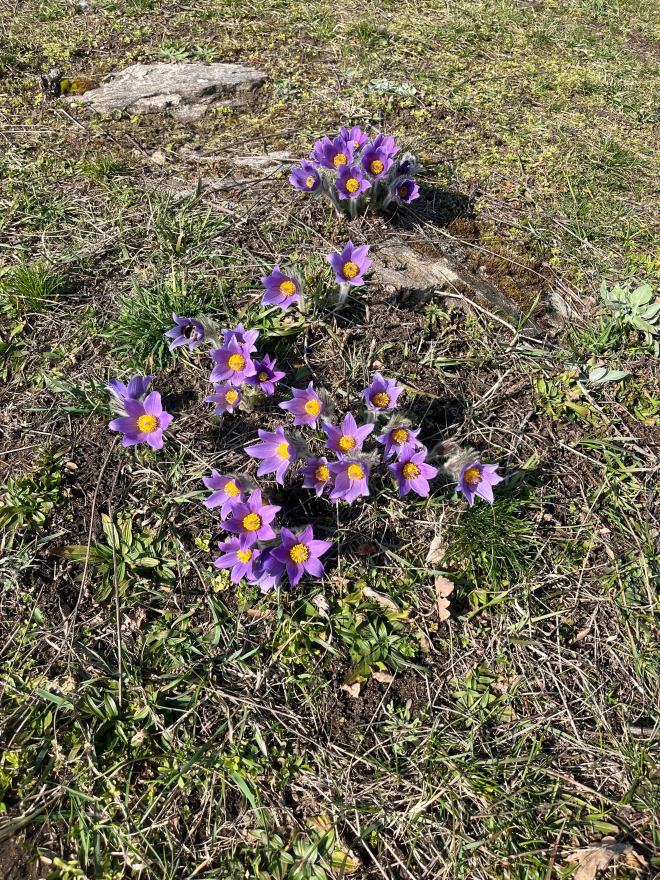
Further on, on a dry, rocky outcrop overlooking the Danube river, we spied a little group of greater pasque flowers – well named, Easter is around the corner.
My photo
Their yellow hearts stood out against the dark purple of the petals.
My photo
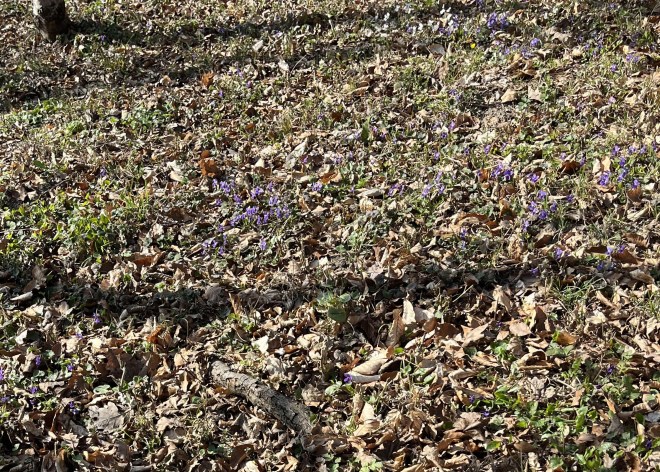
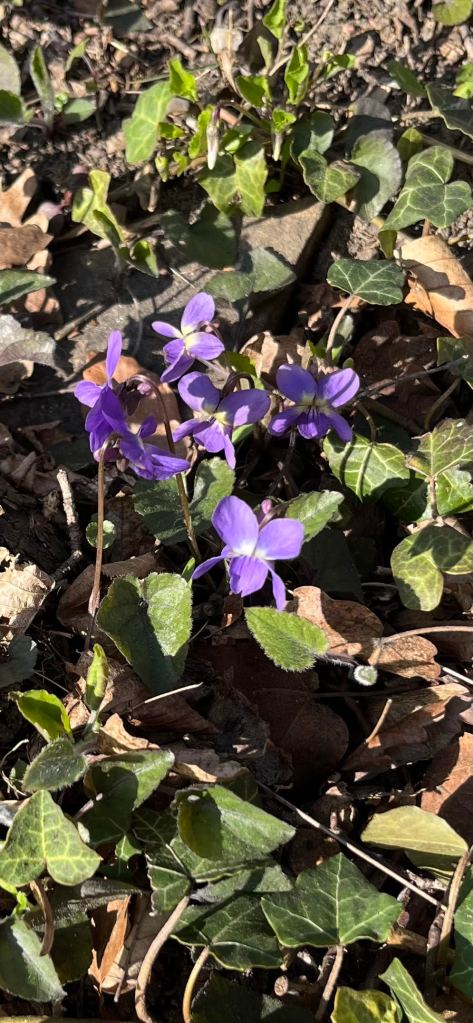
The next day, in the woods covering the hills overlooking Vienna, we bumped into sprays of violets peeping up through the dead leaves.
My photo
So small, so delicate …
My photo
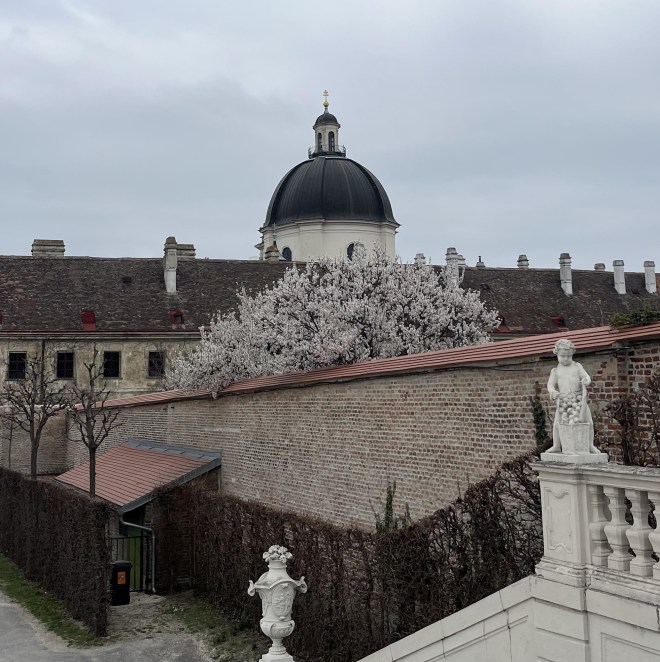
And yesterday, during our last walk around Vienna, which took us through the gardens of the Belvedere Palace, we passed a blooming cherry tree.
My photo
The next time we’re back in Vienna, it will be late summer. Who knows what flowers will greet us then?
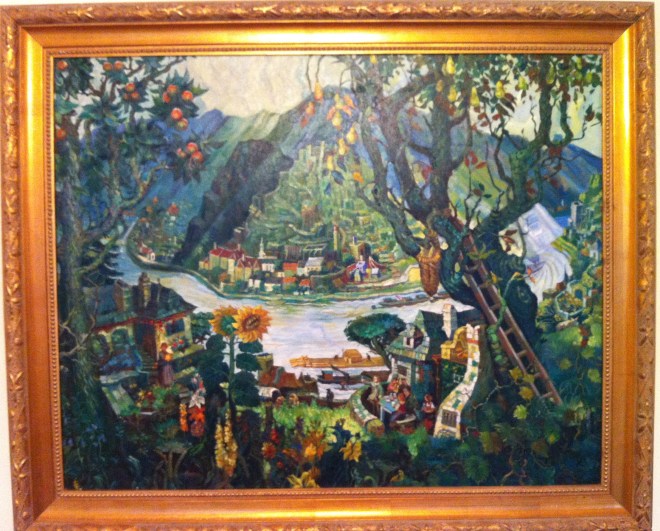
Of my very modest collection of paintings, this is the one I am most fond of.
My photo
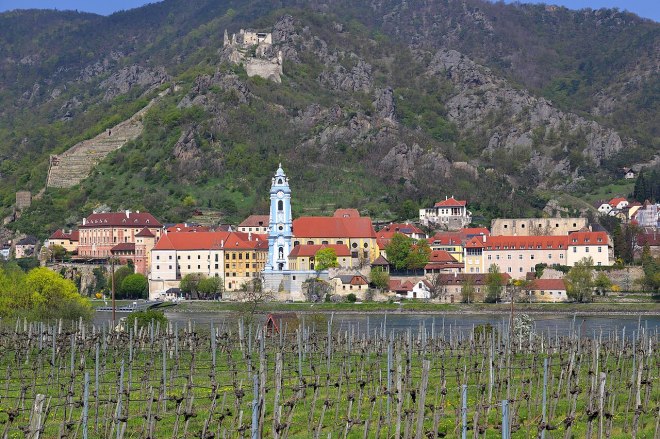
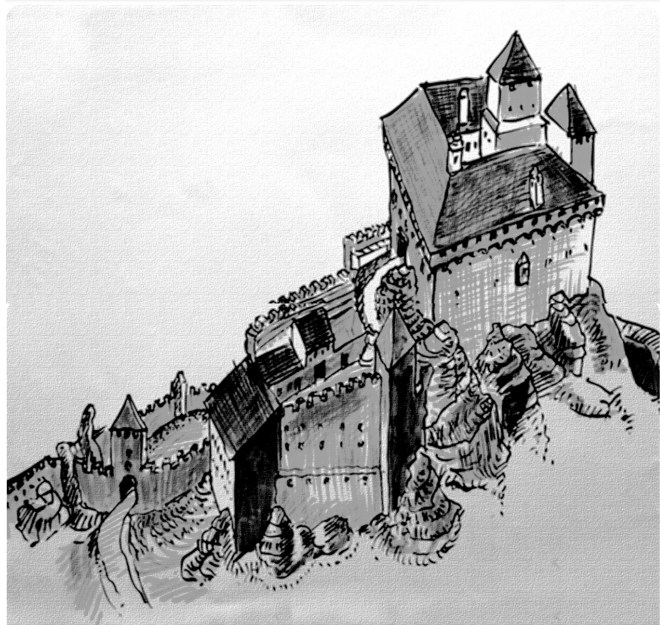
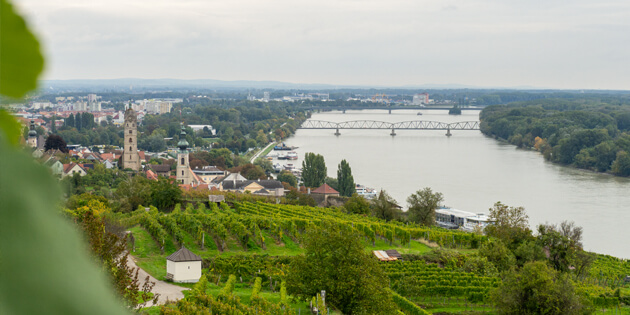
It is a view of the little town and castle of Dürnstein, which sit in a bend of the Danube river some 8 km upstream of the city of Krems. The town lies a little above the waterline, the castle sits atop the dry, rocky hill which rises behind the town. This photo, taken from the other side of the river, shows both the town and the castle very clearly.
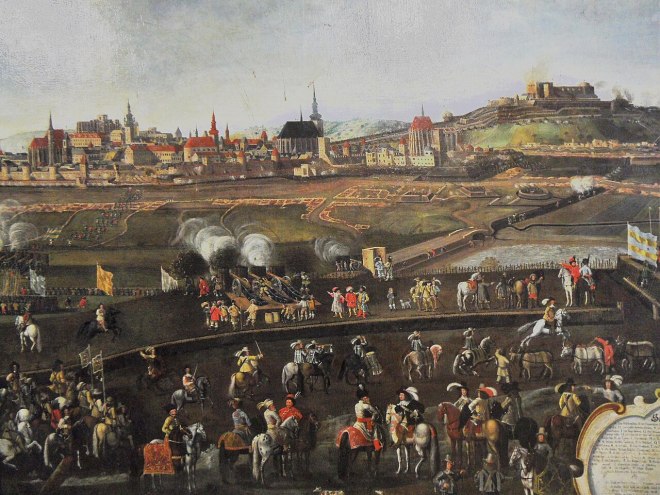
But as the modern photo shows, it is a ruin now. Its downward spiral started in the final years of the Thirty Years’ War, when Swedish troops had captured the castle on their way to trying to take Vienna. That attempt failed and they moved on to Brno, now the capital of Slovakia. The Swedes laid siege to the city.
But that failed, too, and the Swedes retreated back into Bohemia. As they left Dürnstein castle, they partially blew it up to render it unusable. Later owners didn’t bother to patch it up and live there anymore, so it slowly fell to pieces.
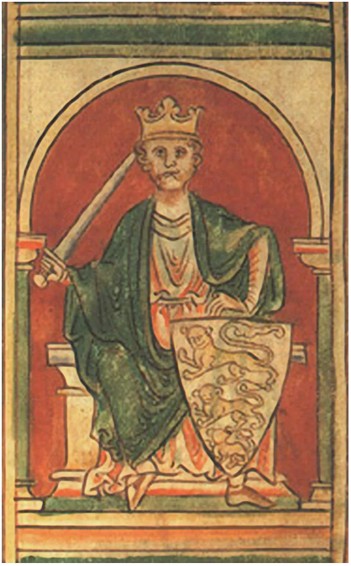
In its early days, though, back in 1192-93, Dürnstein castle became famous throughout Europe as the place where Richard the Lionheart, King of England, was imprisoned.
Source
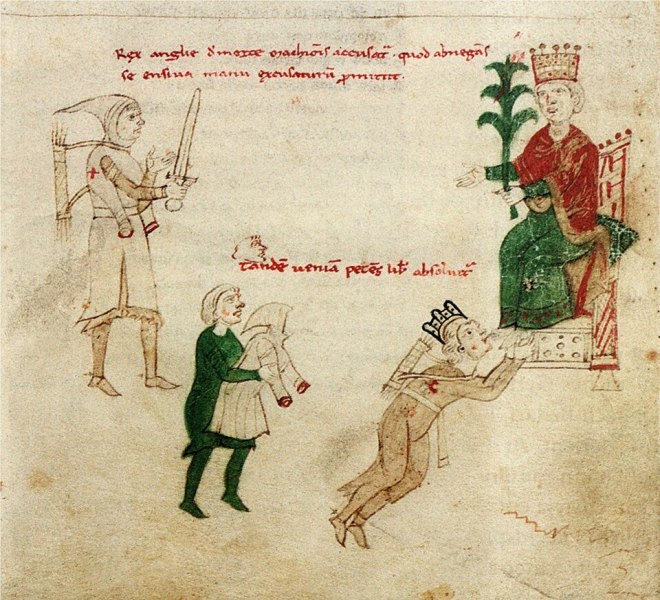
Richard was trying to get back to England from the Crusades. He had made a lot of enemies over the years, who were all intent on capturing him as he crossed their lands to get home. He chose to take a circuitous route, which saw him land on the northern shores of the Adriatic Sea, and then pass through the lands of the count of Gorizia, the Duke of Carinthia, and Leopold V, Duke of Austria – all enemies of his – before making it into Bohemia, whose king was an ally. From there, he planned to go on into Saxony, whose Duke was his brother-in-law, and take a ship over to England. By late December 1192, he had got as far as a village on the outskirts of Vienna, where he decided to hole up to rest for a few days. Unfortunately for him, Duke Leopold’s men got wind of his presence and he was duly arrested. Leopold held him for a few months in Dürnstein castle before passing him on to Henry VI, Holy Roman Emperor, who also had a few axes to grind with Richard. Henry imprisoned him in another castle and demanded a huge ransom for his release. By imposing a ferocious set of taxes on one and all, England’s regents, aided by Richard’s mother, Eleanor of Aquitaine, managed to raise the ransom, and he was duly released. We have here a photo of one of the illustrations in the “Book in honour of the Augustus”, a propaganda piece for Henry VI, showing Richard humbly kissing Henry’s feet.
I’m sure Richard loudly denied that any such humiliating submission had taken place – although he did have himself re-crowned when he got back to England, to wipe away the shame of imprisonment and to counteract any whispers there might have been that his being imprisoned meant he was no longer king.
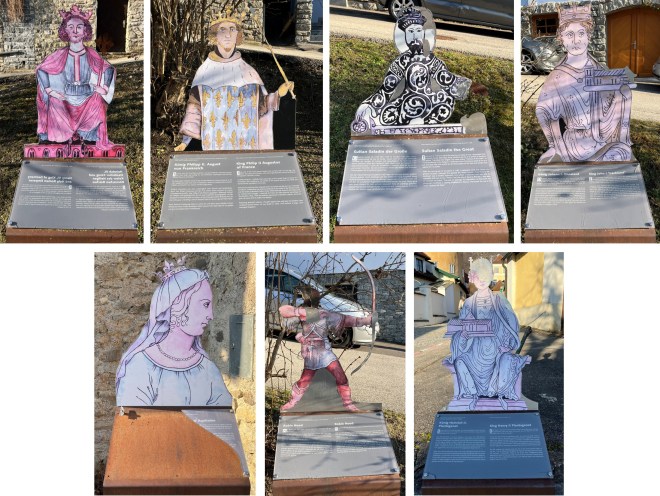
The good citizens of Dürnstein have milked this story for all it’s worth, littering the town with interpretive markers giving information on the main actors in the drama as well as a few more.
My photos
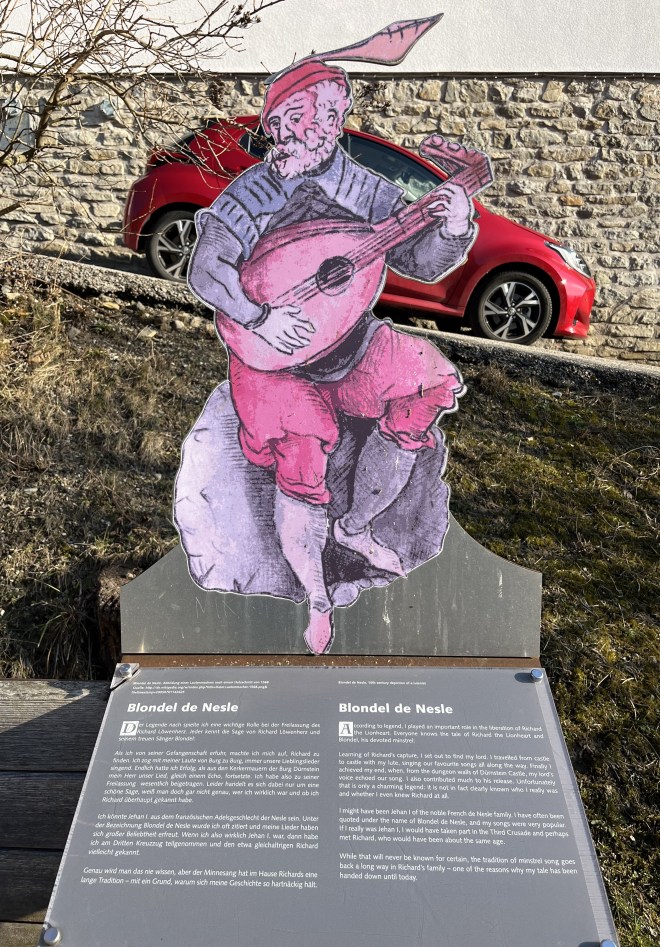
To spice up the tourist experience, they give space to legends as well as to facts. In particular, they have a marker reporting on the minstrel Blondel de Nesle.
My photo
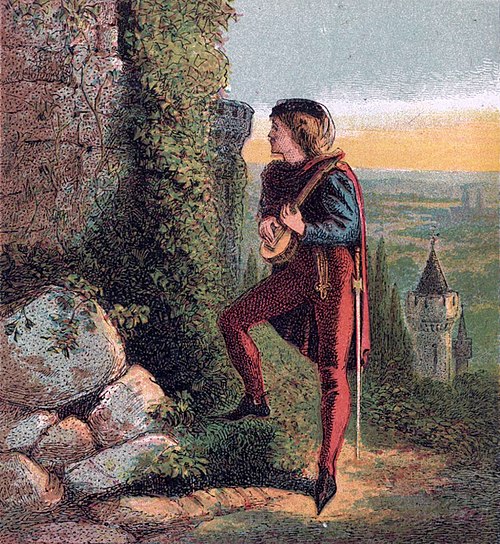
A story was invented in the 18th Century, which went like this: no-one knew in which castle Richard was being kept prisoner, so Blondel, who knew Richard, went from castle to castle singing a song only he and Richard knew. Finally, at Dürnstein Richard sang along with him. At last, Richard had been found! Here’s a coloured lithograph by a certain Joseph Martin Kronheim from the mid-1850s, which has Blondel singing at the foot of the castle’s walls.
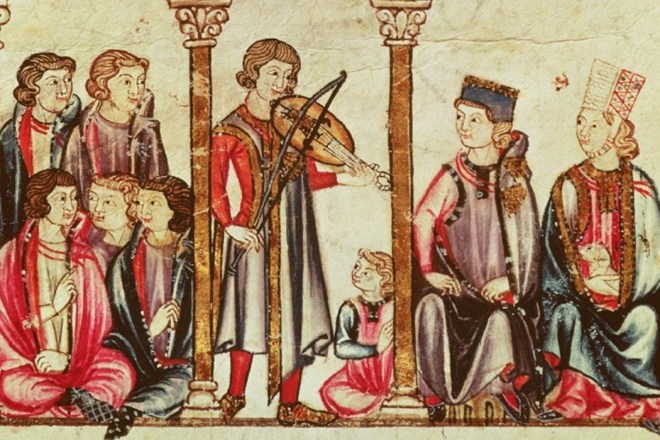
As I say, all invented. But, like all good legends, the story contains a kernel of truth. Richard was brought up in Aquitaine, the beating heart of troubadour culture.
As Duke of Aquitaine, he encouraged and supported the troubadours. He also wrote and sang his own songs, one of which – composed during his imprisonment in Dürnstein – has come down to us. He wrote it in Langue d’Oc, the old language of the south of France. I cite here the first two verses (it’s a bit too long to quote in full).
Ja nuls hom pres non dira sa razon
Adrechament, si com hom dolens non;
Mas per conort deu hom faire canson.
Pro n’ay d’amis, mas paure son li don;
Ancta lur es si, per ma rezenson,
Soi sai dos ivers pres.
Or sapchon ben miei hom e miei baron,
Angles, norman, peitavin e gascon,
Qu’ieu non ay ja si paure companhon
Qu’ieu laissasse, per aver, en preison.
Non ho dic mia per nulla retraison,
Mas anquar soi ieu pres.
Since I presume that, like me, most if not all of my readers do not speak Langue d’Oc, I give here a translation in English of these two verses.
No prisoner can tell his honest thought
Unless he speaks as one who suffers wrong;
But for his comfort as he may make a song.
My friends are many, but their gifts are naught.
Shame will be theirs, if, for my ransom, here
— I lie another year.
They know this well, my barons and my men,
Normandy, England, Gascony, Poitou,
That I had never follower so low
Whom I would leave in prison to my gain.
I say it not for a reproach to them,
— But prisoner I am!
He was clearly trying to guilt trip his vassals into paying the ransom. If any of my readers want to hear the song they can do no worse than go to this link.
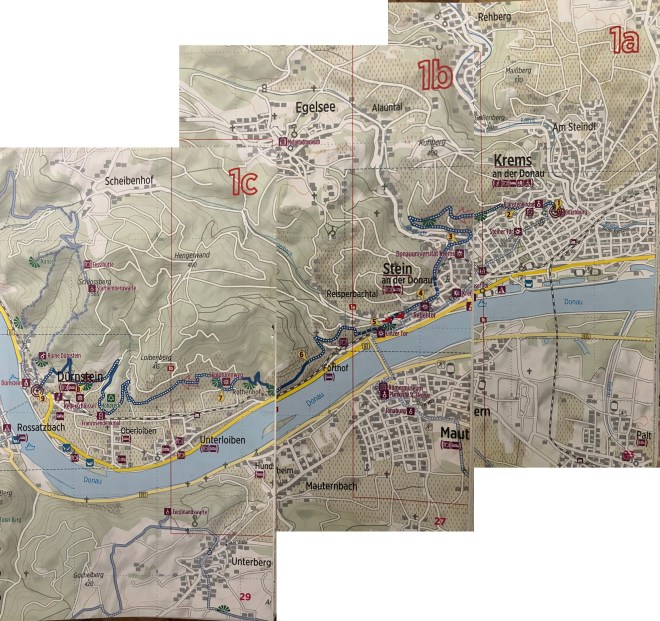
My wife and I pass through Dürnstein at least once a year. There is a hike that goes all the way up the left side of Wachau river valley from Krems to Melk and then back down the other side of the river to Krems. The first stage runs from Krems to Dürnstein. The path hugs the hills between the two places.
My photos
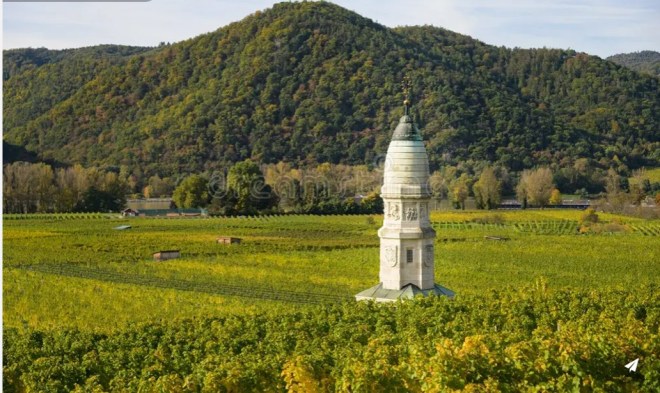
As you amble along, you get beautiful views onto the Danube River flowing below.
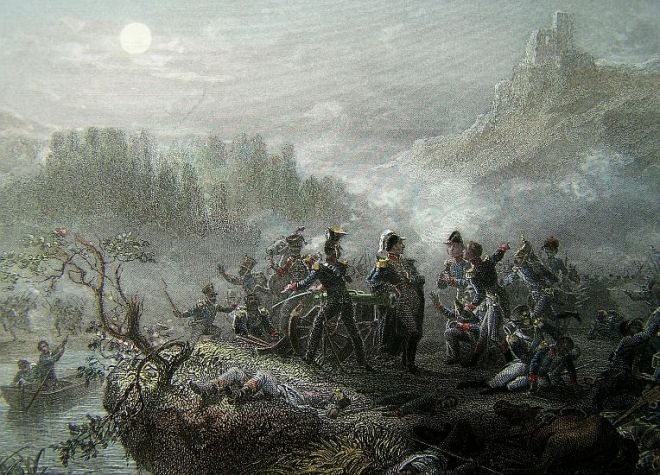
It was built in 1905, to commemorate the 100th anniversary of the battle of Dürnstein-Loiben, one of the many battles of the Napoleonic wars. The fighting took place where those vines now peacefully grow their grapes. It pitched about 7,000 French troops against some 11,000 Russian and Austrian troops. Fighting went on well into the night before it ground to a halt with no obvious winner, although both sides claimed victory. The losses were heavy: about 3,000 men on both sides. This is the only illustration I can find of the battle. I suppose that is meant to be Dürnstein castle in the background.
The battle was completely overshadowed by Napoleon’s brilliant victory in the battle at Austerlitz three weeks later. Years ago, a friend of ours took my wife and me to one the annual reenactments of that battle, the one and only time we’ve ever been to a battle reenactment.
But no-one reenacts the battle of Dürnstein-Loiben. It resolved nothing and no-one remembers it anymore. The 6,000 soldiers who lost their lives did so for no good reason.
Ah, this land, steeped in history – and drenched in blood.
The genesis of this post was a hike my wife and I did back in May, around the Danube not too far from Linz. As I relate in the post I wrote about that hike, one stop we made was at the small church in the village of Pupping. And there I found, among other things, this wooden statue of Saint Christopher.
My photo
The statue caught my attention because of Saint Christopher’s expression; as I wrote in the post, the Saint looks less than pleased with the Child Jesus sitting on his shoulder. In fact, I would go so far as to say that he looks downright grumpy. A nice take, I thought, on the traditional story about St. Christopher, and normally the only story that most people have ever heard about the Saint. So I made a mental note to come back one day to this Saint’s story. On a drizzly afternoon in Milan, that day has come.
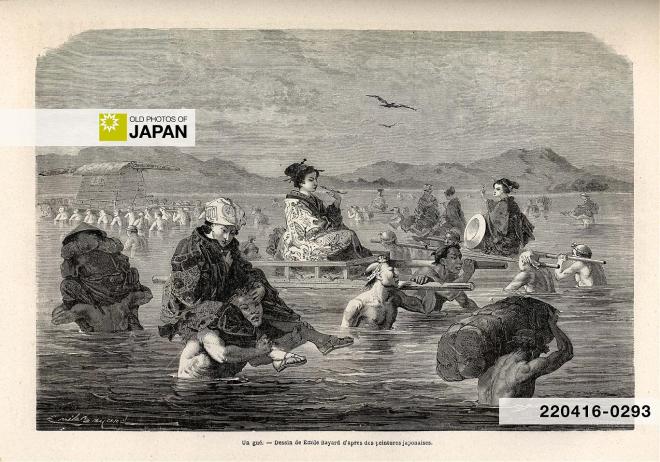
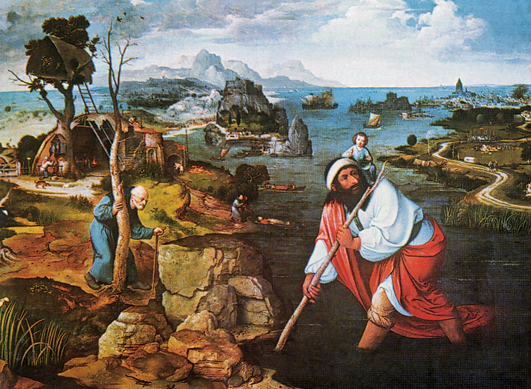
So what is the story that most people have heard about St. Christopher? I think a quick recap might be useful. I should start by noting a little-known fact, that at the beginning of the story our Saint was actually called Reprobus. He was a big, brawny man – a giant in many tellings of his life – and he was in this period of his life spending his time carrying people across a deep ford at a river somewhere in Asia Minor. In case any readers might think this surely was not a job people did in the old days – they would use a boat or a raft, right? – I throw in here a print of people doing precisely this in Japan in the 1860s.
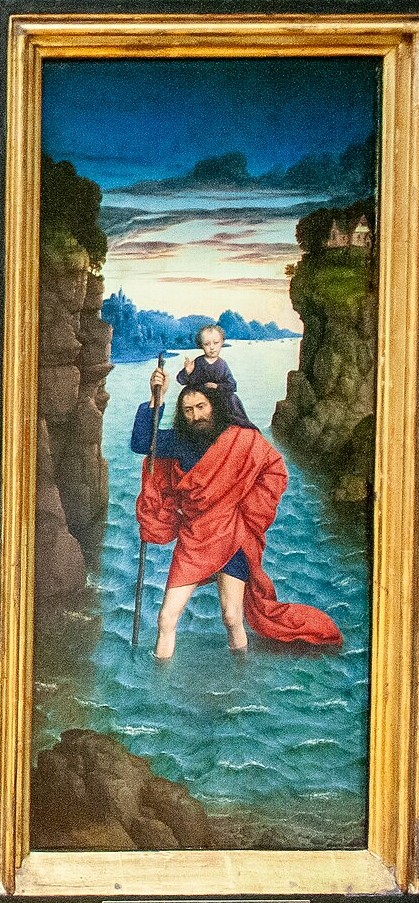
In any event, one night Reprobus heard a young voice calling out. It turned out to be a child asking to be carried to the other side. So even though it was late Reprobus put the child on his shoulder, seized his trusty staff, and started crossing. To his consternation, as he waded across, the child got heavier and heavier. So heavy did the child get that this huge, strong man found himself struggling mightily to make it across. When he finally made it to the other side, he said to the child: “You put me in the greatest danger. I don’t think the whole world could have been as heavy on my shoulders as you were.” To which the child replied: “Don’t be surprised, Christopher [which in Greek means Carrier of Christ], you had on your shoulders not only the whole world but Him who made it. I am Christ your king, whom you are serving by this work.” Thus did Reprobus become Christopher. And no wonder Reprobus-about-to-become Christopher is looking so grumpy in that statue in the church in Pupping!
It is a charming story which got painted many times by numerous artists in Western Europe. I throw in here an assortment:
By the Master of the Pearl of Brabant
In fact, it’s just about the only story of Christopher’s life that ever got painted in Western Europe, crowding out all the other stories associated with him.
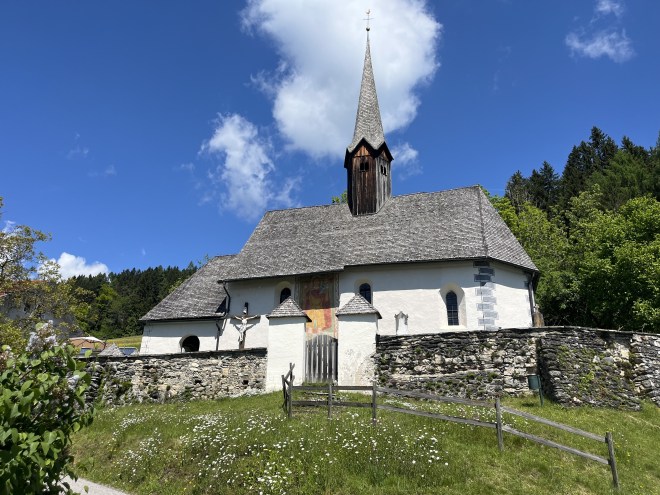
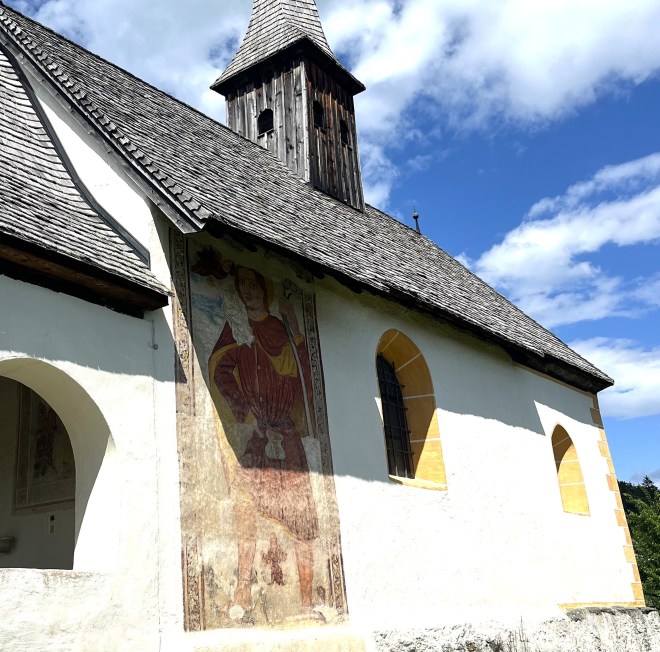
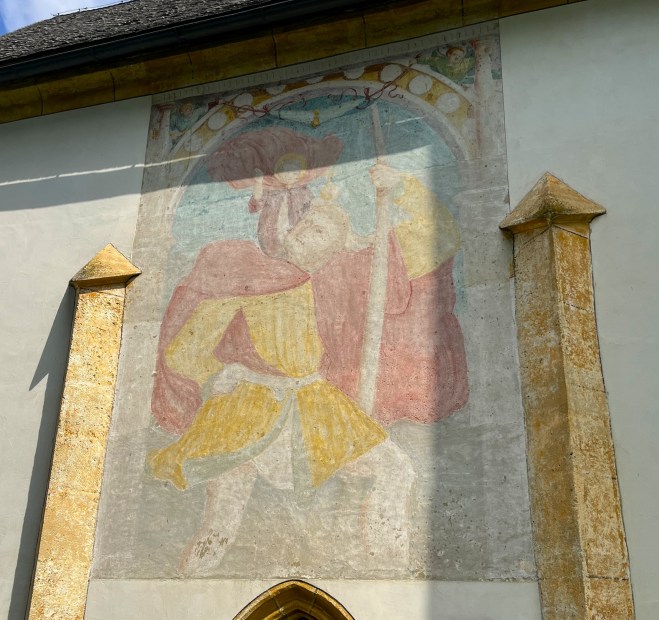
I must confess, the precise theological messages of the story elude me, even though I have perused several posts trying to help me out. In fact, I read elsewhere that the story was actually made up by various churchmen to “normalise” what was a widespread practice by the “little people” of painting enormous portraits of St. Christopher with Christ, first inside their churches and then later on their outer walls. When I read that, I had a jolt of recognition. A couple of weeks before that hike around the Danube, my wife and I had hiked for a couple of days in the south of Austria in the hills around Villach. In some of the small villages we walked through I had noticed these giant St. Christophers painted on the outside of three of the village churches which we passed. I was so struck by them that I took several photos.
This is a general view of the church where I saw the first one
My photo
Here is a close-up of the fresco
My photo
This was in the next village we passed through
My photo
This was at the church where we sat down to have our sandwiches for lunch.
My photoMy photo
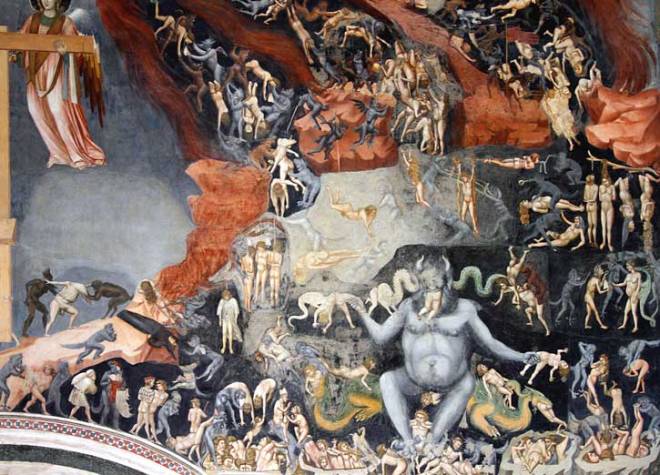
At the time, I had found these frescoes charming. I was now reading that they actually had a precise meaning. They were showing St. Christopher in his role as the “guardian from a bad death”, and especially a sudden and unexpected death. We have to plunge into the Christian mindset of the Middle Ages to understand why this was so vital. Any person who died “unshriven”, that is to say without having confessed and been absolved of their sins, was condemned to spend eternity in Hell without any possibility of salvation. And the torments of Hell were always well represented in church frescoes in case people forgot. Here is one such example, painted by Giotto in the Scrovegni chapel in Padova.
Source
Under the circumstances, it made perfect sense for everyone to do whatever they could to avoid an unshriven death. Somehow, the belief sprang up that if you saw the image of St. Christopher you wouldn’t die that day. Thus the huge size of the St. Christophers as well as their location on the outside walls of village churches; like that, all villagers, even those living far from the church, avoided the risk of not seeing the image during the day. As one can imagine, the popularity of these images soared during the Black Death, when the risk of dying unshriven increased enormously. Continuing bouts of the plague over the centuries maintained their popularity.
I rather like this role of St. Christopher as a Gentle Giant keeping an eye on your lifespan. However, by the 15th Century, when huge St. Christophers had proliferated everywhere, theological and ecclesiastical authorities had become less enthusiastic, considering this trust of the “little people” in St. Christopher to be mere superstition. They were far more comfortable with the Saint’s role as the protector of travelers and all things travel-related (it was of course his role of carrying travelers across the river that led to travelers invoking his protection). And the coming of the automobile, where the dangers it posed to life and limb became immediately obvious, saw a huge increase in the Saint’s popularity. Even now, miniature statues of the Saint are frequently displayed in cars; sign of the times, you can buy one on Amazon. Yours for a mere $8.99!
Meanwhile, in Orthodox Christianity, things took a different path for Christopher. The whole story of him carrying the Boy Christ across a river was ignored (at least until relatively recently). Instead, the focus was on his good, Christian life after his baptism and his martyrdom. So the icons of him have a young man, normally dressed as a soldier. Here is an example from Saint Paraskevi Church in Adam.
So far, so bog-standard. But then, there is a startling alternative in his iconography, one where he is depicted as having a dog’s head (at least, I find this startling; showing saints with dog-heads seems rather disrespectful to me).
I find these icons so strange that I am moved to throw in the photo of another one, where St. Christopher is cheek by jowl with a perfectly normal St. Stephen.
This strand of iconography came about from a rather too literal reading of the legends about Christopher’s origins. It was said that he had been captured by Roman troops in combat against tribes dwelling to the west of Egypt in Cyrenaica. Already back in the 5th Century BCE the Greek historian Herodotus had written that in these parts, on the edges of the civilised world, lived dog-headed men as well as headless men whose eyes were in their chests. This belief in Europe that the edges of Europeans’ known world were populated by strange hybrid human species continued well into the early modern times, as this woodcut from the 1544 book Cosmographia shows.
As a consequence, some icon painters believed that Christopher (or Reprobus as we have seen he was then known) was dog-headed, and they painted him as such.
Not surprisingly, there was pushback on this depiction of Christopher from the Higher-Ups. In a 10th Century hagiography about the Saint, its author, Saint Nikodemos the Hagiorite, wrote: “Dog-headed means here that the Saint was ugly and disfigured in his face, and not that he completely had the form of a dog, as many uneducated painters depict him. His face was human, like all other humans, but it was ugly and monstrous and wild.” For its part, in the 18th century the Russian Orthodox Church forbade the depiction of the Saint with a dog head because of the association of such a representation with stories of werewolves or monstrous races.
Poor Christopher! Giant, dog-headed, and now cancelled. Because, back in 1969 the Catholic Church struck him from the General Roman Calendar, deeming that there wasn’t enough evidence to show that he had ever existed. I still remember the general consternation this caused at the time. What about all those miniature statues in cars (and medallions around necks)? How could they protect you if Christopher had never existed? I guess the fact that people continue to buy them shows that the “little people” will still believe in these images’ magical ability to protect, whatever the Higher-Ups say or do.
It was our last hike in Austria this year. We hiked across the hills between Sankt Veit an der Gölsen (another Sankt Veit) and Wiesenfeld, in the pre-Alps behind St. Pölten. During the final walk into Wiesendorf, I spotted this flowering bush on the roadside.
My photo
I’d seen the plant before, but this time I decided to identify it. I did my usual trick of using my iPhone’s plant identifier programme, but it was a complete failure. It first suggested “hawthorne”, which even I knew was wrong, and then, on two other try’s, it simply suggested “plant”, which was really not very helpful. So I turned to the internet. And there I got my answer: I was looking at a Euonymus europaeus, the European or common spindle tree (or bush to some people – it seems to fall between being a small tree and a big bush).
The plant has a rather lovely fruit, which is why I’d spotted the plant in the first place. I throw in a close-up of the fruit.
It is a lovely pink, and then, as the photo shows, when it ripens it splits open to reveal a bright orange seed (actually, what you see is an orange aril, a “fleshy” material in which the seed is buried; the edible aril attracts birds and other animals, which helps in seed dispersal).
To my eye, this combination of pink and orange is a bit jarring, but hey! that’s the colour combination the plant “chose” (is there some scientific reason behind the colours you find on plants? A question for another day).
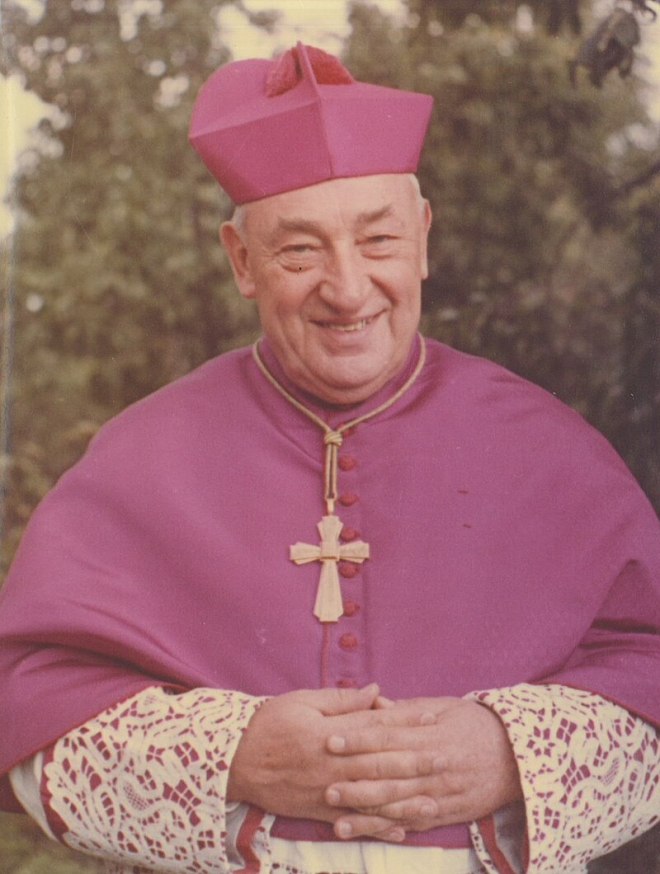
The fruit’s pink colour, and the fact that it is four-lobed, has led to one of the plant’s French names: bonnet d’évêque, bishop’s cap. I don’t know if bishops wear them anymore, but the hat they wore in the past was four-sided and pink.
All very nice, but as I said in my previous post, while our ancestors might have admired the colours of nature, they were highly utilitarian in their approach to plants: how can I use them? Well, the fruits of the spindle tree are toxic – indeed, every part of the plant is toxic – so there was no nutrition to be had from this particular plant. But our ancestors did manage to eke various uses out of it. Two stand out for me.
As the plant’s English name indicates, the plant’s wood was used to make spindles. Women (for the most part) used spindles to spin wool or flax fibres into yarn or thread. In this picture, the spindle is in the woman’s right hand (and the distaff in her left).
Spindles are a very ancient technology. The oldest evidence of their use goes back 12,000 years. But at least in the developed countries, they were eliminated by the Industrial Revolution, when automation destroyed the cottage industry of spinning. Their use lingered on here and there; this photo, for instance, from 1901, shows a peasant woman in Greece still spinning by hand.
And I still remember watching a housewife in Eritrea, where I was born, sitting at the door of her house spinning with a distaff and spindle. This would have been in the late 1950s.
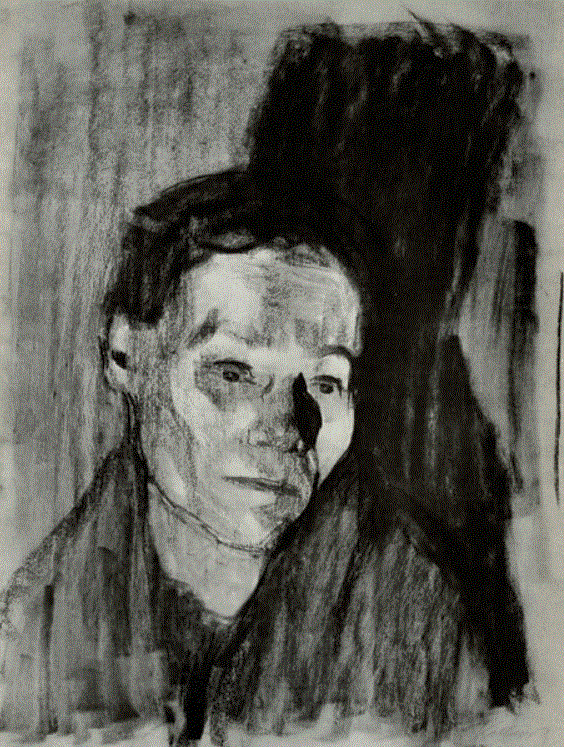
One of the plant’s French names – fusain – indicates the second of the plant’s intriguing uses. Fusain is a charcoal made from the wood of the spindle tree, which is used in drawing. It’s much appreciated by artists for its exceptional strength and density. This is a good excuse for me to throw in a few charcoal drawings by famous artists, although I will start with an artist I personally have never heard of, François Bovin, simply because the subject of his drawing connects us back to what I was just writing about, spinning.
My wife and I have just finished a long weekend in the little town of Waidhofen an der Ybbs. We were actually using it as a base from which to carry out a number of very pleasant hikes over the surrounding hills. These are impossibly beautiful: broad swathes of light and dark green draped over the hills, dotted here and there with farmsteads.
My photo
The weather was glorious, which certainly helped.
As I looked through the various brochures which we picked up to figure out what hikes to do, I came across the following brief write-up about the church in a village some 10 km away, the village of St. Leonhard am Walde:
“Fiakerkirche St. Leonhard/Wald: The traditional place of pilgrimage for Viennese hackney carriage drivers since 1826. St. Leonhard is the patron saint of cattle, sheep – and horses. In 1908, the Viennese hackney carriage drivers donated the Marian altar. A few decades ago, the Viennese cab drivers also joined the pilgrimage.”
Now that really intrigued me! Hackney carriages, fiaker in German, are a picturesque sight down in the centre of Vienna, although nowadays, of course, they are only for tourists.
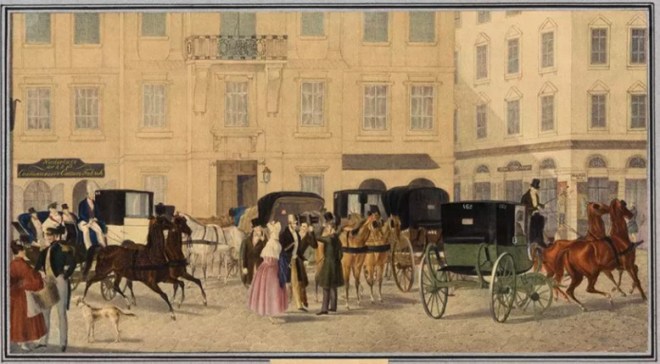
But, being an early form of taxi, there was a time when hackney carriages were ubiquitous throughout the city, as indeed they were in all European cities. Here is a colourised copperplate engraving from the 1830s of a smart set of Viennese and their carriages.
I suspect, though, the carriages and their drivers didn’t look quite so smart when they were merely acting as taxis, ferrying people around town. This looks more like the typical hackney carriage driver; the photo is taken from an engraving in a book of 1844.
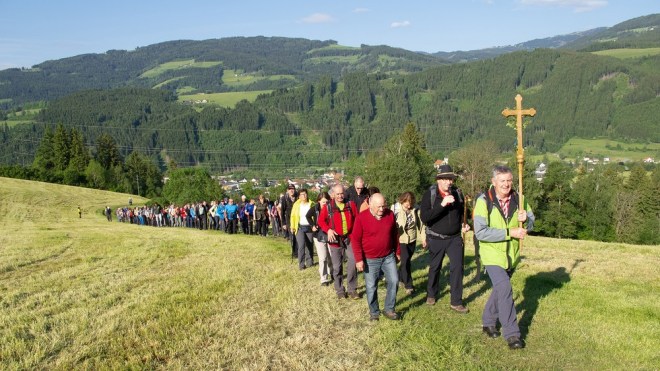
Hackney carriage drivers have always struck me as a hard-boiled lot, not taken to making pilgrimages. I have a hard time seeing them doing this (this is a modern pilgrimage, but I don’t suppose pilgrimages have changed much, apart from the clothes the pilgrims wear).
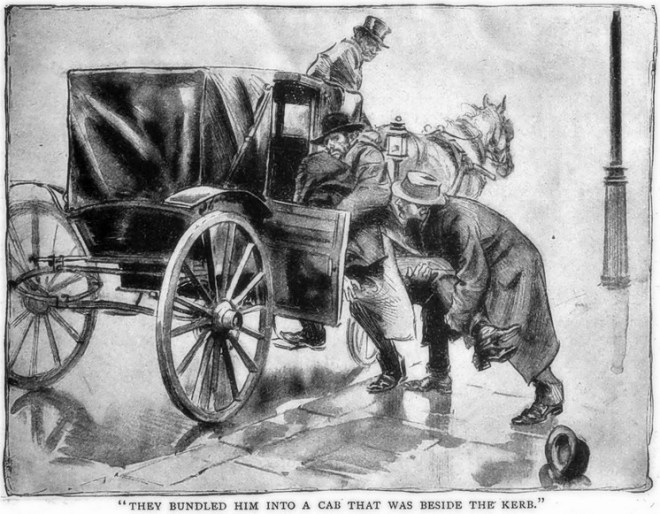
But it could be that I am being influenced by various books I’ve read and films I’ve seen where hackney carriage drivers seemed to be a sinister and semi-criminal lot. This is an example from one of the Sherlock Holmes stories.
Maybe the majority were God-fearing, devout, family men.
Source
Of course, given the way my mind works, I started wondering why hackney carriage drivers would have chosen a church dedicated to St. Leonard as the church to which they would make their annual pilgrimage. The little blurb I quoted above suggests an answer: he was the patron saint of horses, and of course horses were key to hackney carriages, being their motor as it were. But how, my mind was asking, did Saint Leonard become the patron saint of horses?
Since I knew nothing about Saint Leonard, I had to do some reading. I should note in passing that there have been various Saint Leonards over the centuries; the one we are interested in is St. Leonard of Noblac. Assuming he ever actually existed, his story is quickly told.
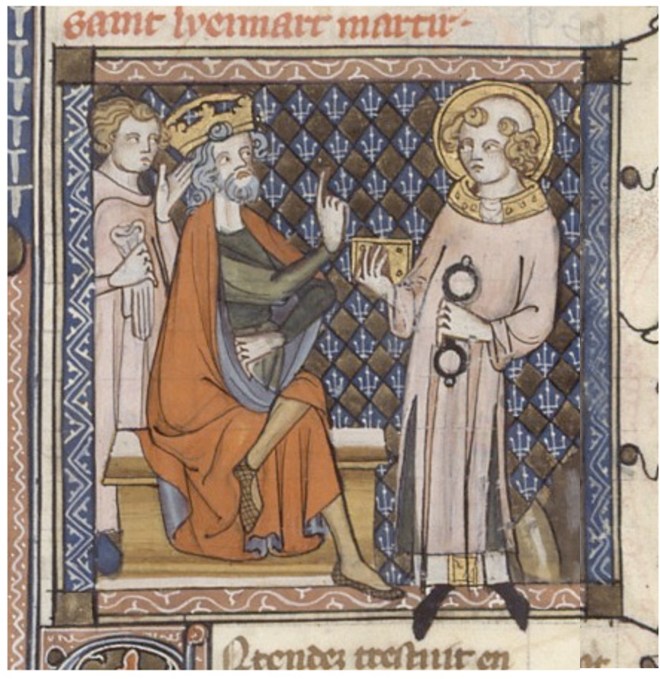
Leonard was a Frankish nobleman, coming from a family that was closely allied to Clovis, the first Frankish king of what was later to become France. Clovis was young Leonard’s godfather when he was baptised, along with Clovis himself and all his court, by St. Remi, bishop of Reims, on Christmas Eve of 496. As Leonard grew up, he became much exercised by prisoners, to the point where he asked Clovis to have the right to visit prisoners and free those he considered worthy of it. Clovis granted the request. We have the scene played out here in a French work from the 14th Century.
Many prisoners were thereafter liberated by Leonard.
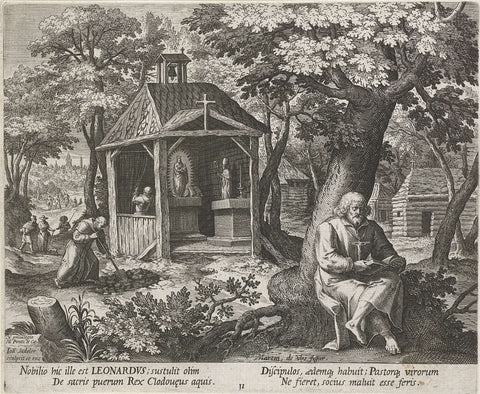
Much impressed, I presume, by his holiness, Clovis offered him a bishopric, but Leonard turned the honour down, preferring to join a monastery near Orléans, whose abbot was another saint, St. Mesmin. After the latter went the way of all flesh, Leonard decided to strike out on his own. He moved to a forest in a place called Noblac (Noblat today) near Limoges, where he set up a hermitage. His preaching, good works, etc. led to a multitude of people flocking to his hermitage, including many prisoners whose chains miraculously flew off their hands and legs after they had prayed to St. Leonard for his intercession. Here, we have a print from 1600 giving us a rather fanciful vision of this scene.
I do believe that the monk working the land behind Leonard in the print is one of these prisoners now living an honest life.
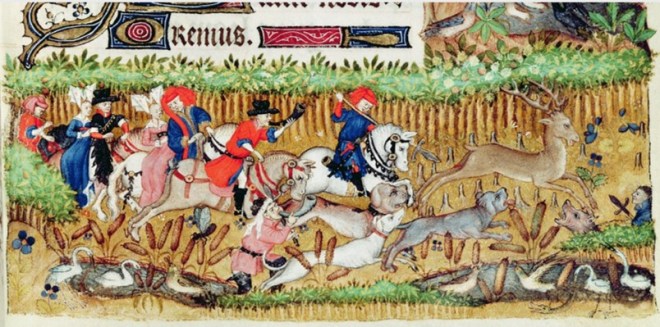
At some point in all of this, the-then Frankish king Clotaire I (Clovis having died in the meantime) and his heavily pregnant wife came to visit Leonard in his forest hermitage – we have to remember that Clovis’s family and Leonard’s family were close. The royal couple decided – like the good aristos that they were – to use the occasion to go for a hunt in the forest. To get us into the spirit of things, I throw in here a miniature from the 15th-Century Book of Hours of Marguerite d’Orleans showing Lords and Ladies off to the hunt.
During the hunt, however, the queen suddenly went into labour. It was turning into a difficult and dangerous birth. Leonard rushed to her side and his prayers saved queen and baby. In gratitude – especially since it was a baby boy – the king wanted to shower Leonard with loads of money. But Leonard only asked for as much forest area around his hermitage as he could ride around on his donkey in one night. The king granted this wish. On the land that Leonard was subsequently given he built a church and monastery. He became its first abbot and died there peacefully, mourned by all. The Romanesque version of that church still stands, in a place called Saint-Léonard-de-Noblat.
Given his involvement with prisoners, it is not surprising to learn that St. Leonard is the patron saint of prisoners. Given that story with the pregnant queen, it’s also not surprising that he is considered a helper of women in childbirth. But patron saint of cattle, sheep and horses? How did that come about?
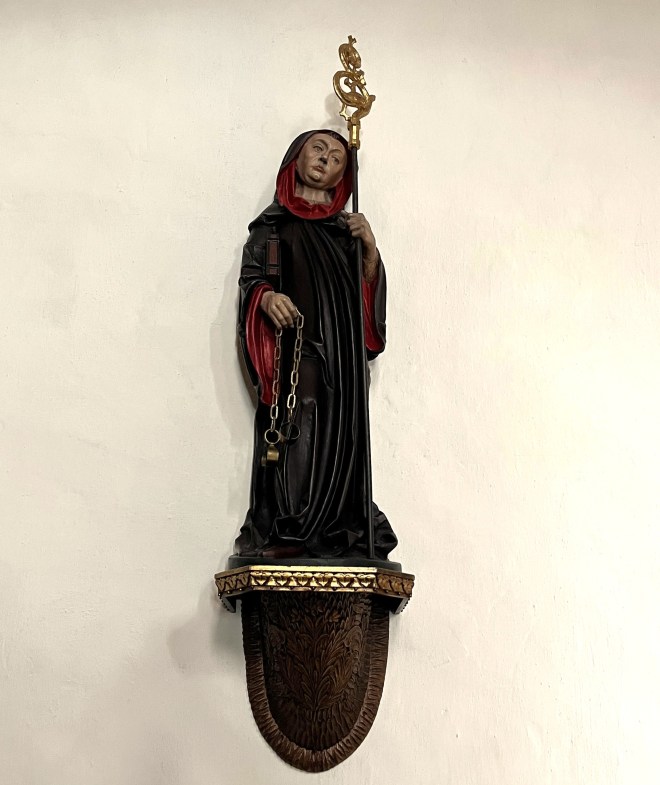
For that, we have to know that from the earliest times St. Leonard was often depicted as an abbot with a crosier and holding a chain or fetters or manacles, symbolising the liberation of prisoners achieved by him. In fact, in one of those serendipitous moments I love so much, I came across just such a representation of him in a church in Waidhofen, down the road from where my wife and I were staying.
My photo
Over time, rural folk mistakenly thought that the chains which St. Leonard was holding were cattle chains – these are commonly used to tether cattle or to control them during walks, or even to help birthing calves.
By extension he became the patron saint of all farm animals, which of course also included horses.
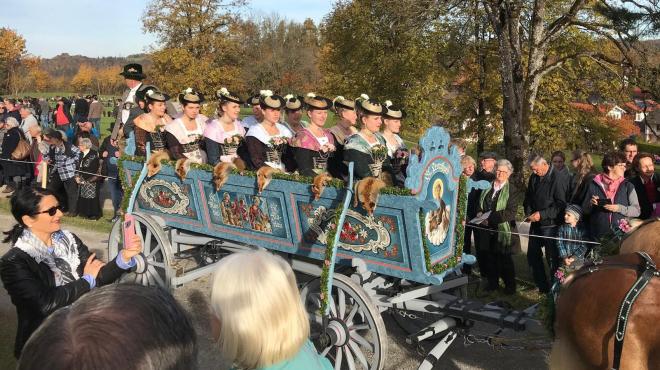
Given this swerve of patronage towards livestock, I suppose it’s not surprising that Saint Leonard became a popular saint throughout the Alpine regions of Europe. After all, as I’ve mentioned in a previous post, cattle was pretty central to the rural economies of all Alpine communities. This devotion to the saint means that his feast day – November 6th – is celebrated with enthusiasm in many places in the Alpine regions, especially the German-speaking ones. Here, for example, are photos of the celebrations in Bad Tölz in Bavaria (which got a mention in an earlier post because of its rather naughty statue of St. Florian).
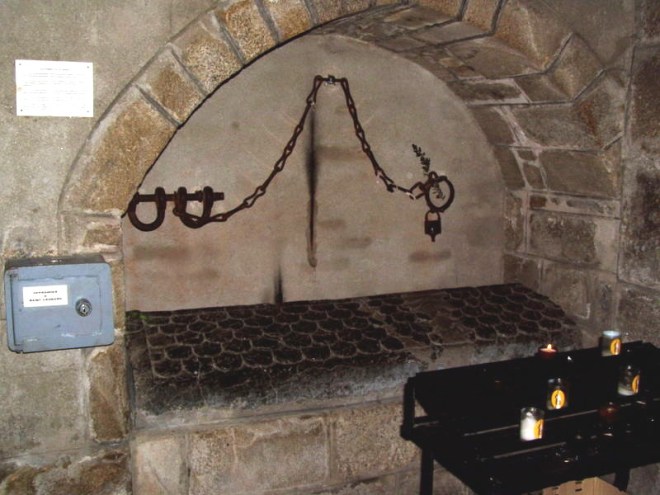
It also gave rise to the intriguing phenomenon of chain churches in the Alpine regions. These are churches dedicated to St. Leonard which have chains running around them, either put up temporarily on his feast day or mounted permanently. The Fiakerkirche is not a chain church, alas. Here is a nice example from Tholbath in Bavaria (the church also has a quite respectable onion dome, the subject of an earlier post).
But if we’re going to visit a church dedicated to St. Leonard, it won’t be one of the chain churches. It will be the one I’ve already mentioned in Saint-Léonard-de-Noblat. What a fine-looking Romanesque church! I have to say, I am partial to Romanesque churches. I’ve already inserted a photo of the church’s exterior. Here is a photo of its interior.
What a wonderfully bare church! No annoying accretions to cover the spare, simple lines of the architecture.
But the photo shows an additional reason why I will try to persuade my wife to travel all the way to France to see this church: the rucksacks and the walking sticks. This church is situated on one of the four Ways of St. James of Compostela through France. I’ve mentioned one of these, the Via Tolosana, in an earlier post. The church of Saint-Léonard-de-Noblat is on another, the Via Lemovicensis, the Way of Limoges. There must surely be some good hiking to be done in the area.
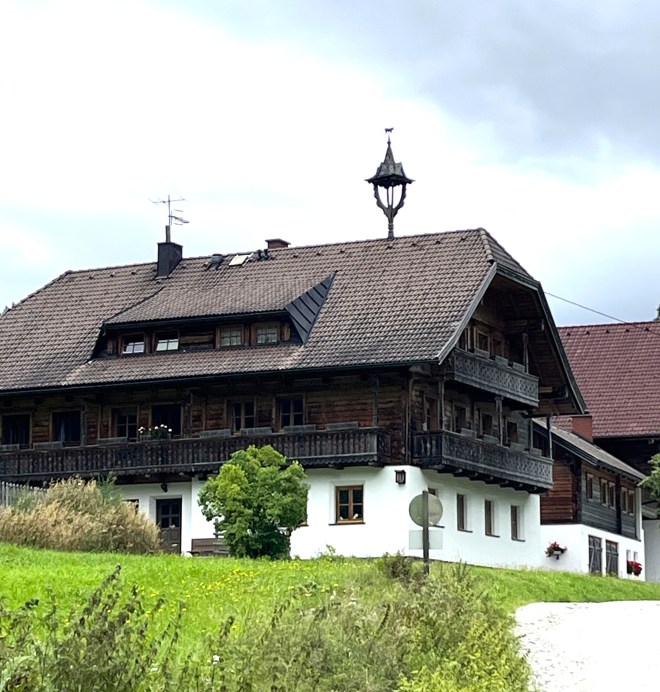
My wife and I went to Schladming in Styria recently, for a few days of hiking. We did some lovely hikes on the mountains behind Schladming as well as along some of the valleys wedged in between those mountains. It was on one of the latter hikes that I began to notice some eye-catching structures standing on the roofs of the farmhouses we were passing. Here are two that I managed to photograph.
My photoMy photo
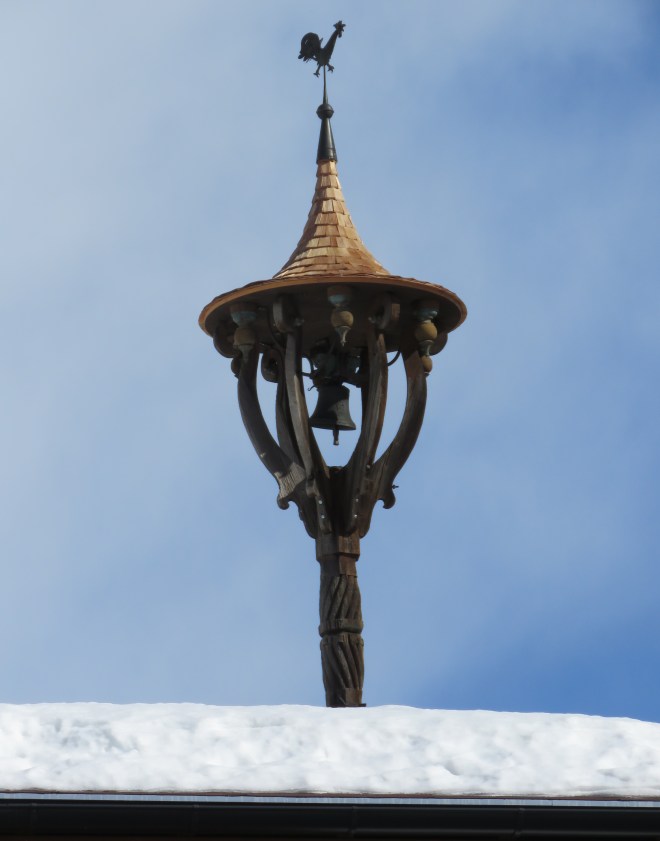
They really are handsome, I told my wife, but what are they? Once we were back in Vienna, I did some research and discovered that they are called Glockenstuhl, literally bell stool although it is normally translated as bell frame or bell tower. This next photo shows more clearly the bell that should sit beneath the little roof and which gives the frame its name.
I don’t think either of the Glockenstuhl I photographed have this bell, although the second photo shows a ring of little bells around the rim of the roof – a fanciful modern addition, I believe. One can also see the weather vane on the very top, in this case a cock (in my two photos, the Glockenstuhl sports a cow in the first case and a cock in the second).
Of course, these Glockenstuhl primarily had a functional purpose. The bell was used by the farmer’s wife to call the farmer and his hands back to the farmhouse when lunch or dinner were ready. And the bell was also rung in case of an alarm. A nice touch: the bell of each farmhouse had a different tone so that the farmer and his workers would be sure that it was their farm and not another that was ringing its bell.
But of course, this primarily utilitarian object gave local people an excuse to make something that was, yes, useful but also beautiful.
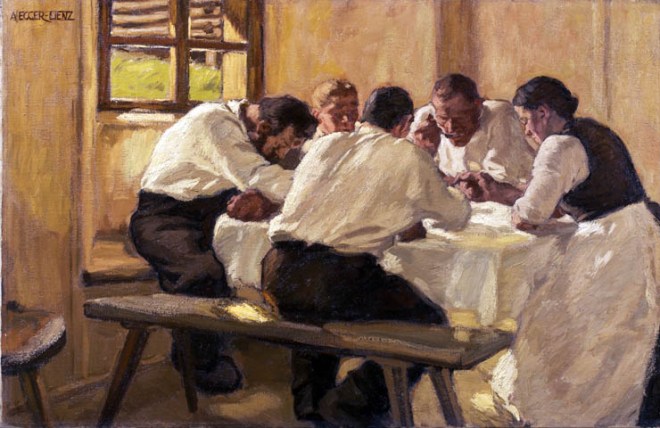
The Glockenstuhl’s original use has made me think of paintings by the Austrian painter Albin Egger-Lienz. I first got to know him through his paintings of the First World War. These are remarkable paintings, and I would strongly recommend my readers to see them if they ever come to Austria (I doubt if museums in any other country has any). But he also depicted many scenes of rural life in his native Tyrol. In this case, I’m thinking in particular of his paintings of farm workers out in the fields, who would have heard the bell from their farmhouse’s Glockenstuhl and known it was time to come back to the farmhouse to eat. Here are two of his paintings. In the first, the farm hands are scything the hay, in the second a farm hand is sowing seed.
Here, too, I would strongly recommend that readers see Egger-Lienz’s paintings and drawings of peasant life.
Still today, there are a few artisans making Glockenstuhl, but they are now just beautiful pieces of handicraft. There’s no need for the bell, the farmer’s wife no doubt calls the farmer on his mobile phone when lunch is ready, if she’s not herself out in the fields (and the farm hands disappeared long ago into the factories in the cities). You can have one made for you for a mere € 2,000 or so. But please, don’t use it, as some people apparently do, as a bird stand in your garden! Put it on your roof where passers-by like me and my wife can admire them as we walk by.
My wife and I recently completed a four-day hike around the Danube, in the reaches of the river some 20 km upstream from Linz. We started in the village of Ottensheim, made our way to Eferding and then to Aschach, ending the hike in the village of Sankt Martin. I can’t resist inserting here a composite photo I’ve created of the hike.
My composite
As readers can see, we wandered rather drunkenly along the Danube.
The wonderful thing about hiking is that you move slowly across the landscape, which allows you to notice things which you probably wouldn’t notice on a bike, let alone a car. I give my readers here a taste of what my wife and I came across – quite serendipitously – as we slowly crossed this Danubian landscape.
Thursday
We arrive in Ottensheim, which sits on the Danube river, in the early afternoon. We take advantage of our early arrival to go for a walk on the high lands behind the town. Here is the view of the Danube which greets us at the top. You can see the hydroelectric dam spanning the river. We’ll be passing that dam tomorrow.
My photo
We have pizza at the place we’re staying the night, down by the river’s bank. We chat with the staff, all Neapolitans, who all left Naples because of a lack of opportunities there. A story we’ve heard so many times. Such a tragedy for Naples, this steady draining away of their youth.
Friday
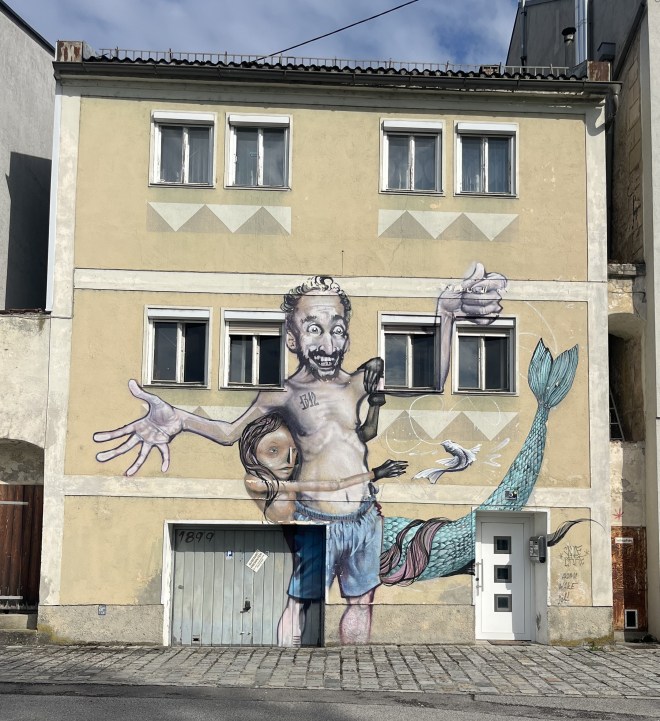
We’re greeted at the exit of the hotel by this strange painting on the wall of a house.
My photo
Not sure what happened to the mermaid’s nose …
We’re waiting to board the ferry, which will carry us over to the other bank.
My photo
While waiting, we spy a statue of St. Johann Nepomuk, protector of those who cross streams and rivers, so common in this part of the world. This statue is coloured, though, which is rare.
My photo
The view from the ferry’s deck, looking upstream. The hydroelectric dam is in the far distance.
My photo
We can also see a peek of Ottensheim’s local castle in that last photo. We get a better view as we start walking along the river’s bank.
My photo
Its recent history has been quite eventful. Owned by a British family in the 1930s, it was confiscated by the Nazis at the beginning of the war. They used it as a forestry office for the Wermacht. After the war, the Soviets, who occupied that side of the Danube, used it as a barracks. After they left in 1955, when Austria got back its independence, the castle reverted to its pre-war owners. By then it was in a pretty sad state, but its owners didn’t have the money to restore it. It was only in 1988, when the castle was sold to a group of families with deeper pockets, that the castle could be restored. It is still in private hands.
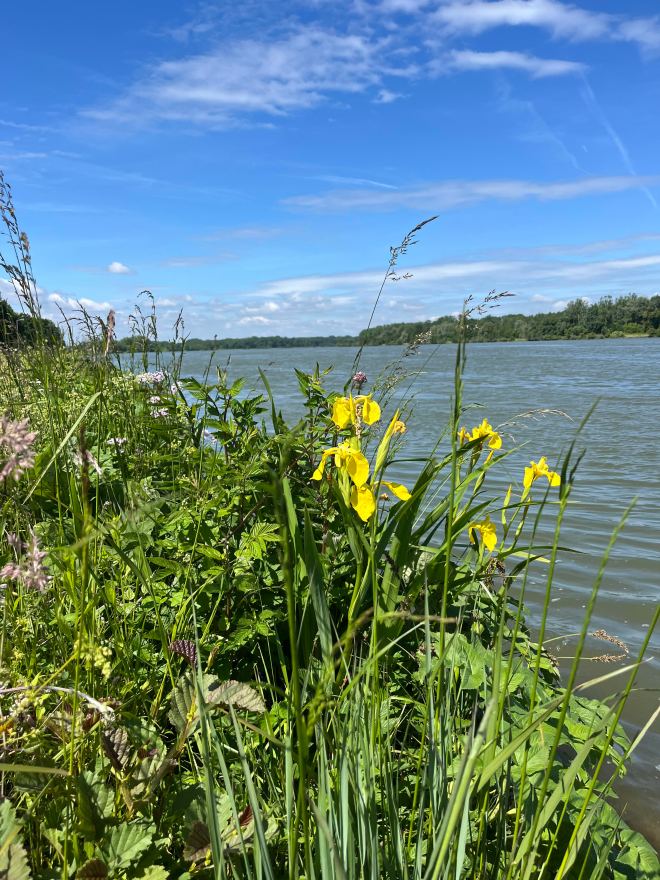
Yellow irises blooming along the water’s edge, the first of many wildflowers we will be seeing on this hike.
My photo
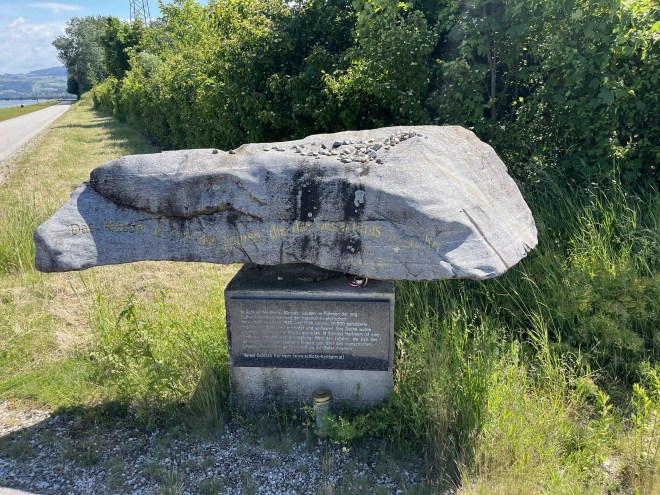
Close by, a memorial on the side of the path.
My photo
It commemorates the nearly 30,000 people murdered through poisoning with carbon monoxide by the Nazi regime in nearby Hartheim castle, between May 1940 and December 1944. Once their bodies had been cremated the ashes were brought to this spot and dumped into the Danube. Until September 1941, it was a “euthanasia” centre, where 8,000 physically and mentally handicapped people, almost all from Bavaria and Austria, were murdered. After Hitler closed down the Nazis’ euthanasia programme (because of protests from the Roman Catholic Church in Germany), the centre quickly “pivoted” to become a centre for the killing of inmates from nearby concentrations camps, primarily Mauthausen or its satellite camps, who were too sick or injured to work any longer. By December 1944, they had murdered a further 12,000 people, most of them Soviet Prisoners of War.
Wildflowers by the side of the path
My photo
Outside a fire station, an intriguing monument to firemen and women, as well as to officers of the Austrian river authority.
My photo
An old farmhouse on the edge of the road.
My photo
Eferding, the end point of today’s hike, with the parish church’s bell tower dominating the town.
My photo
A photo of Eferding’s castle, taken by slipping my iPhone through the big gates that barred entry.
My photo
The castle is still owned by the Starhemberg family, who inherited it and the lands that came with it in 1559. Interesting family. They’ve been involved in Austrian politics for the last 1,000 years or so. The latest (in)famous member of the family was Ernst Rüdiger Prince von Stahremberg, who was born in 1899 in the castle and died in 1956 in Voralberg. He was a right-wing politician with great admiration for Mussolini’s fascism. He served in Austria’s right-wing governments from 1930 until 1936. Although fascistic, he really disliked the Nazis and made his dislike very public, so after the Anschluss of 1938 he fled to Switzerland to avoid vengeful retaliation by the Nazis (and perhaps also to protect his wife, who was Jewish). At the beginning of World War II, he served in some capacity in the British and Free French Air Forces, but he resigned in disgust after the UK and the US allied themselves with the Soviet Union in 1941 – he viewed communism and Nazism as equally evil. Thereafter, he and his wife left for Argentina; not unnaturally, he felt a great affinity with the politics of Juan Peron. In 1956, after Peron had been ousted by the army, he travelled to Austria for an extended visit, no doubt to explore the possibility of coming back. He was staying at a spa in Schruns (the bell tower of whose parish church I had so admired last year). During a walk, he was photographed by a journalist who worked at a communist newspaper. In a rage, he attacked the journalist with his walking stick, but this triggered a cardiac arrest and he died there on the pavement.
Turning my back on the Stahremberg castle, a view of Eferding’s main square
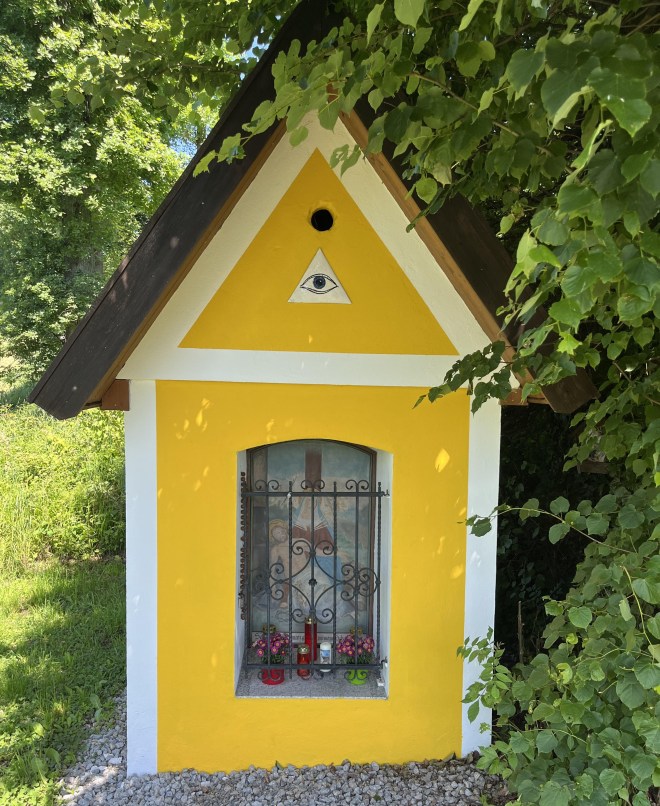
We begin to climb a steep ridge. We pass a shrine on the side of the road.
My photo
Shrines are common throughout Austria, but I notice that in this region shrines – like this one – have an eye painted on them. I suppose it represents God, the “All-Seeing Eye”. But I find it rather unnerving: “You can’t hide from me, I can see everything that you do” – just like Big Brother in George Orwell’s “Nineteen Eighty-Four”.
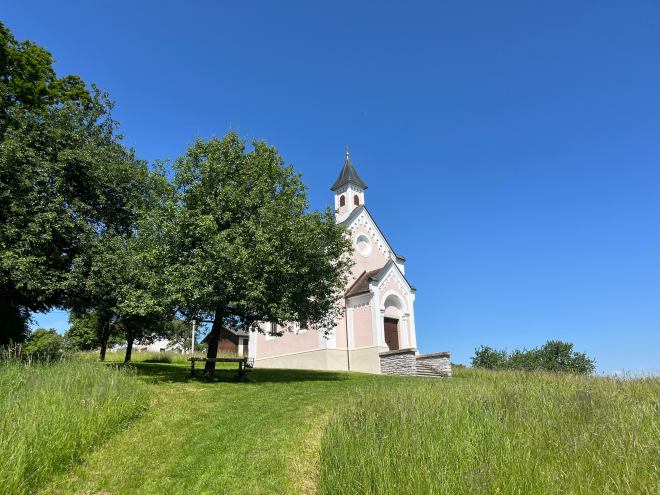
A chapel at the top of the ridge.
My photo
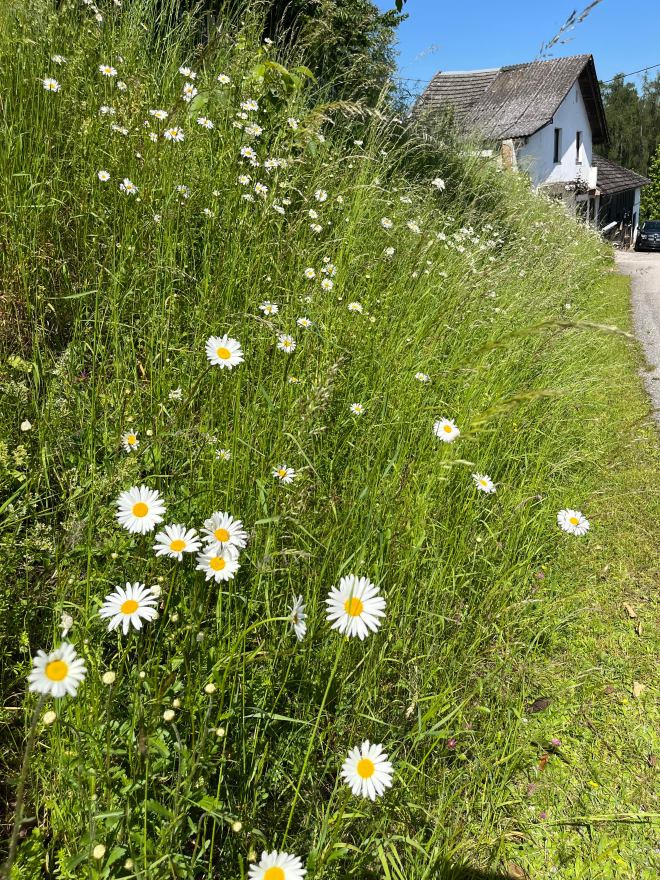
A spray of daisies on the side of the road.
My photo
We plunge into the woods.
My photoMy photo
A view over the plain around Eferding.
My photo
We come down the ridge and pass the small airfield – literally, in this case – of a gliding club.
My photo
We have been watching the gliders soaring over us all morning; my iPhone, alas, cannot capture their ethereal beauty.
We look back at the ridge we walked along, with a castle ruin sitting on it.
My photo
We stop for lunch in the village of Pupping, finding a bench in the parish church’s garden to sit on. I, of course, cannot pass up the opportunity of visiting the church after lunch. I find a mix of old and new.
A statue of St. Wolfgang, who, it is said, died at the altar of the (original) church in 994 CE.
My photo
A statue of St. Christopher, looking less than pleased with having to carry the Child Jesus.
My photo
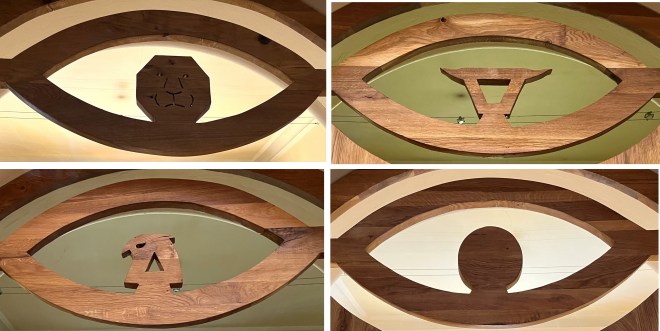
Four carved door lintels, displaying the symbols of the four Evangelists: clockwise from the top left, the lion of St. Mark (you have to look hard to see the lion’s face), the ox of St. Luke, the angel of St. Matthew, and the eagle of St. John.
My photos
It takes me a while to understand that Luke’s angel is represented by an eye – the eye again …
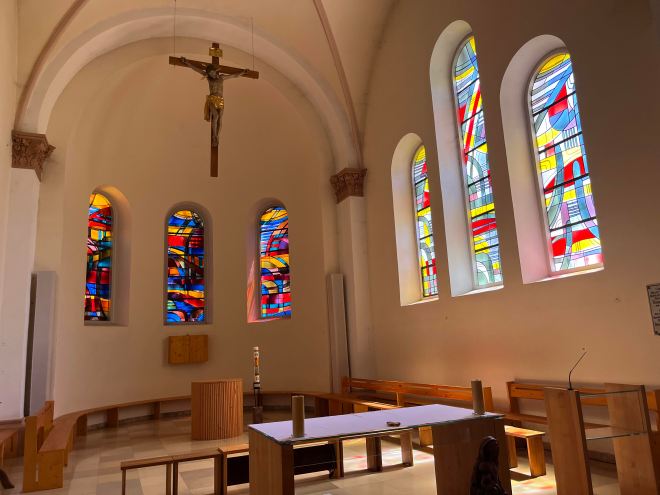
Rather pleasant stained-glass windows.
My photo
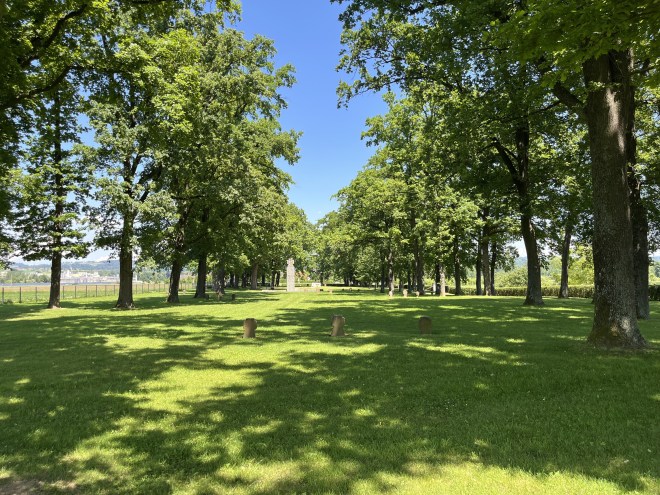
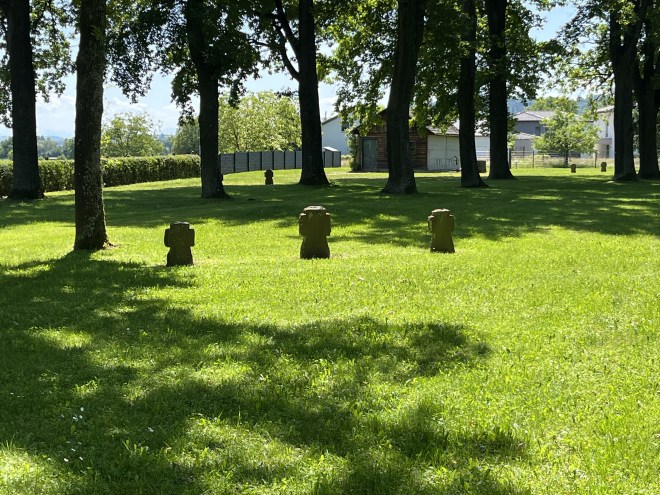
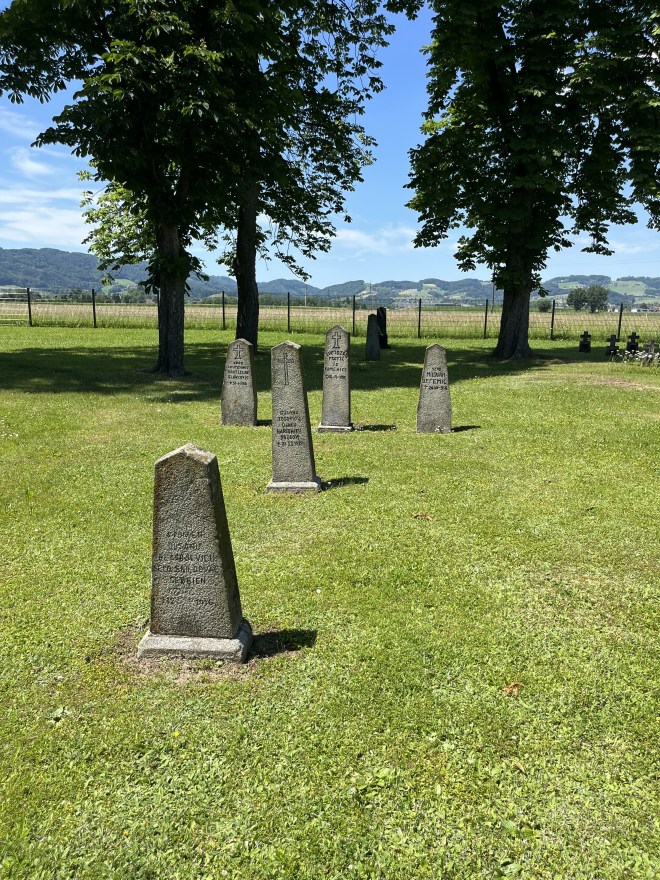
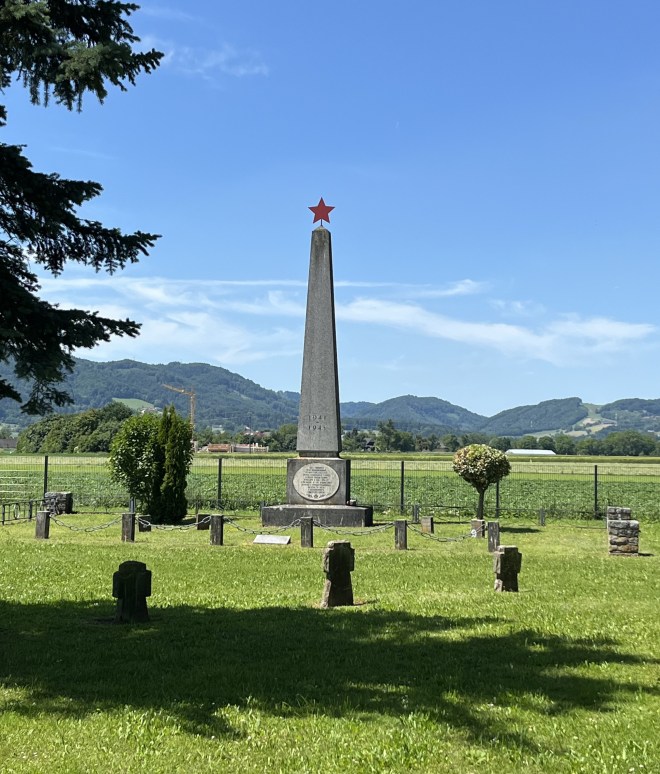
We continue the hike towards our end point today, Aschach, on the Danube. Quite by chance, our route takes us past a war cemetery.
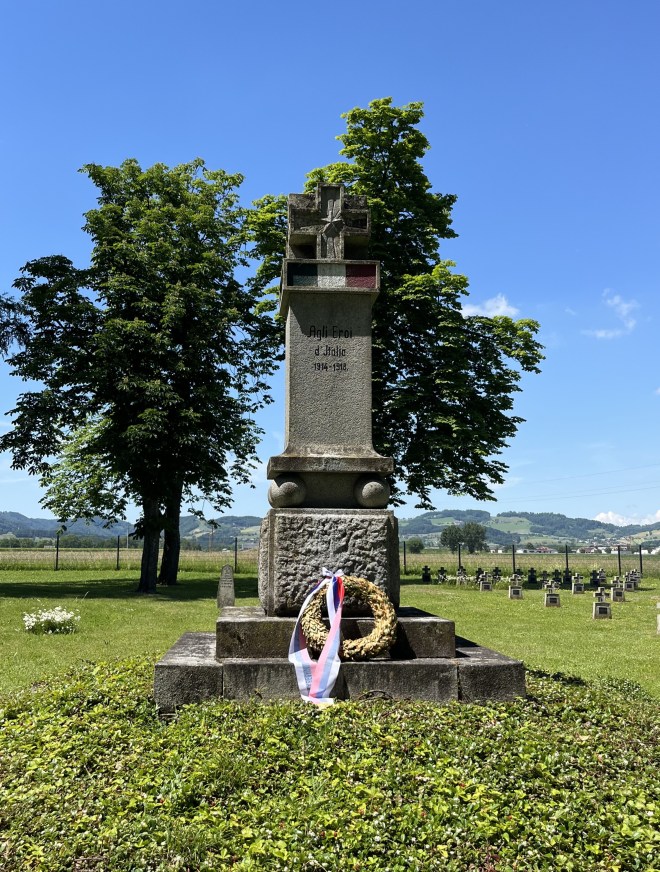
But actually, although the cemetery is looked after by the German association for war graves (hence the look), none of the soldiers buried there are Austrian or German. And none of the dead who are commemorated fell on the frontline; they were all prisoners of war who died in a POW camp which the Austro-Hungarians built close by for use during the First World War. They were mainly Italians
My photo
with their memorial
My photo
and Serbians
My photo
with theirs.
My photo
After the Second World War, the Soviets put up a memorial to their POWs who had been murdered in Mauthausen and other nearby concentration camps.
My photo
Of course, the thousands of murdered Soviet POWs didn’t get an individual grave, their names were not even inscribed on a monument. But some Russian family had come and attached a photo of one Soviet prisoner to a stone cross, with the epitaph “We remember, we love, we grieve. The grandchildren”.
My photo
We walk on to Aschach.
Sunday
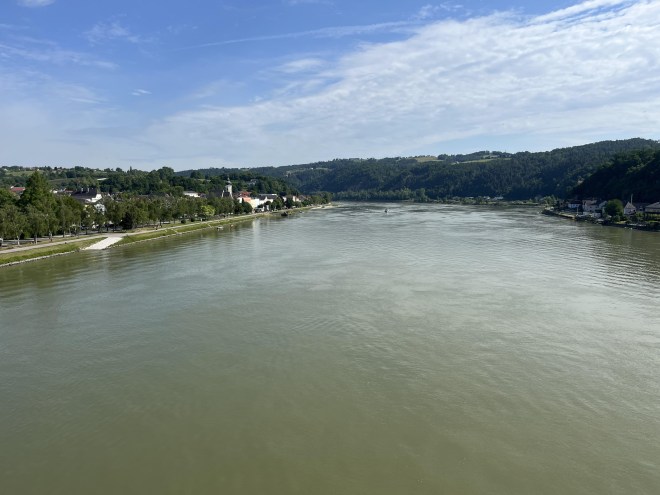
We start the day by once again crossing the Danube, but this time using a bridge rather than on a ferry.
My photo
Some purple irises catch my eye as we walked along the river bank.
My photo
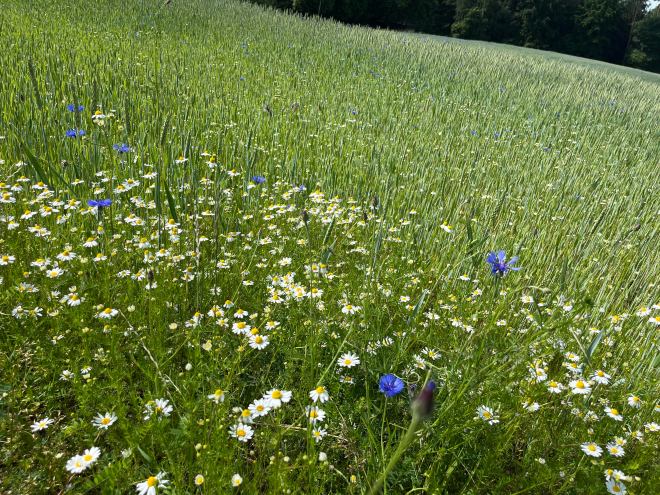
We climb up to the high lands overlooking the river, past fields of wheat studded with corn flowers and daisies.
My photo
We enter the woods.
My photo
The path eventually leads us off the high lands and down to a stream at the bottom of a valley. We start following the stream towards its source. At first, the stream cheerfully burbles along.
My wife’s photo
But soon the stream bed becomes rough as stones from above have tumbled down, and the water jumps around.
My photoMy photo
The path mimics the roughness of the stream.
My wife’s photo
Once we reach the high lands, the stream quietens down, the path likewise.
My photo
We pass meadows along the stream’s banks. Some have been turned into lawns.
My photo
Here, another anonymous sculptor has turned a tree trunk into a whimsical totem pole.
My photo
One of the meadows is carpeted in pink flowers.
My photo
Finally, we leave the stream and climb up onto a ridge. An alpine pasture falls away to our right. It is impossibly green.
My photo
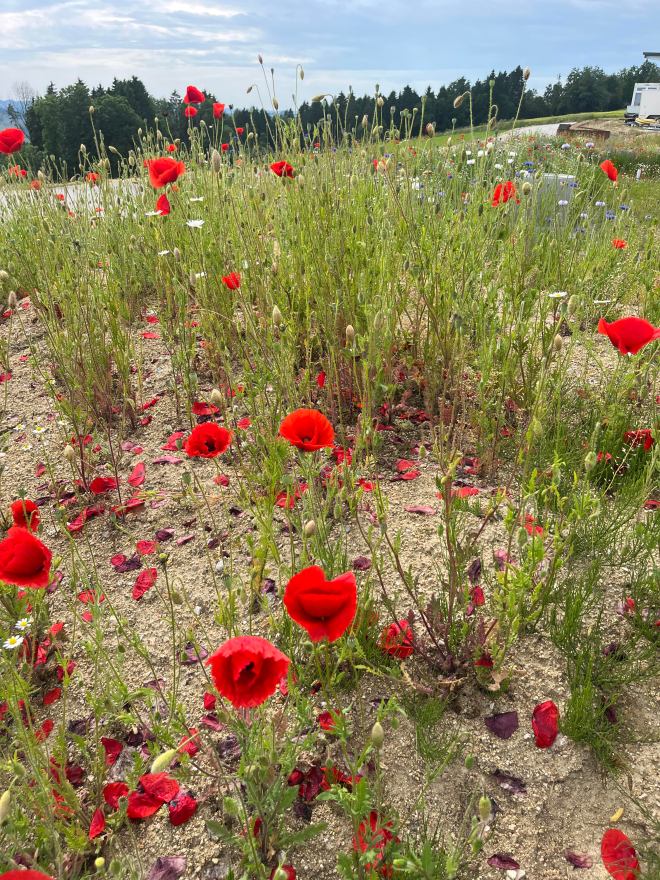
We pass through Sankt Martin and start walking along a main road. This is the only way to our hotel. We pass a building site, where a riot of poppies grow: beauty clothing the ugliness.
It was freezing cold in Vienna this last month we were there, far too cold for my wife and I to go hiking. So we spent our spare time visiting Vienna’s nice, warm museums. One museum we visited was the Paintings Gallery of the Academy of Fine Arts; I don’t think we’ve been back to it since a visit we made shortly after we arrived here, back in 1998. As the name indicates, we are actually dealing with an arts school, but it has quite a worthy collection of paintings donated to it by various aristocrats over the centuries. It has a particularly good collection of paintings by Lucas Cranach the Elder, and it was one of these that caught my attention, St. Valentine and a Kneeling Donor, painted in 1502-1503.
What a magnificent face St. Valentine has! Not a handsome face at all, but it still had me gazing at it in fascination. A face full of character! If I were to meet this person in real life, my staring at him would probably provoke him into demanding what the hell I was looking at and to scarper before he took a swing at me. His face reminds me of the actor Walter Matthau at his most scowling.
From today’s perspective, what with the saint’s feast day of 14 February being irremediably lodged in our collective memories as the day of lovers, I think many people would be surprised by Cranach’s choice of model. They might have someone more sucrose in mind, like this painting in the church of Santa Maria degli Angeli in Rome.
Source
But that is to forget that in Cranach’s time, St. Valentine was also the saint to whom epileptics would pray, and in fact down at St. Valentine’s feet in Cranach’s painting one can see a man having an epileptic fit. Perhaps this rugged face fits better a saint who was meant to be dealing with epilepsy.
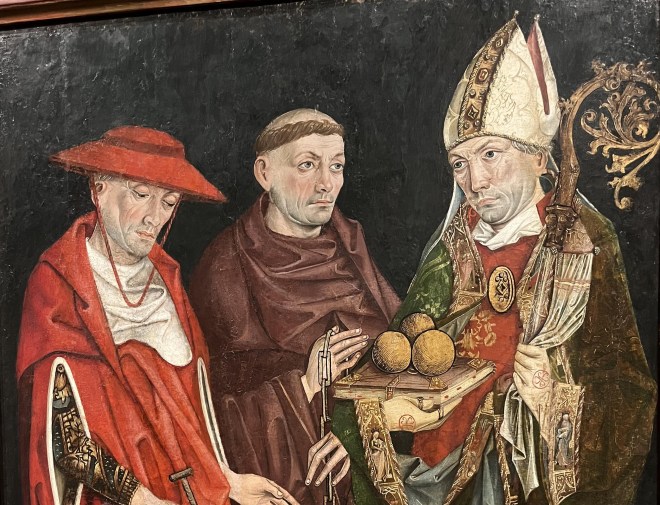
By coincidence, a few days later, at the Museum of the Lower Belvedere, I came across another painting with equally interesting faces. It is of three saints, Jerome, Leonard, and Nicholas. It is from the late 15th Century, painted by an unknown artist.
my photo
As I’ve noted in previous posts, I have a fascination for faces in art. When I visit most collections of Old Masters, after enduring a long series of paintings of classical figures prancing around in sylvan scenes or of various members of the nobility hamming it up in their best clothes, it comes as a relief for me to gaze upon portraits from times past. These are faces I can relate to, faces of people whom I could be seeing on any street corner on any day of the week, just dressed in different clothes. It reminds me that history is not some colourful story in a book but was the lived experience of people just like me.
Most of the faces I gaze on are pleasant; I look, I note, I move on. But sometimes – like St. Valentine’s – they are arresting. There is something about the face that holds my gaze, that makes me stop and look more closely, that makes me wonder what the person was like. Let me use the rest of this post to celebrate some of these arresting faces in art.
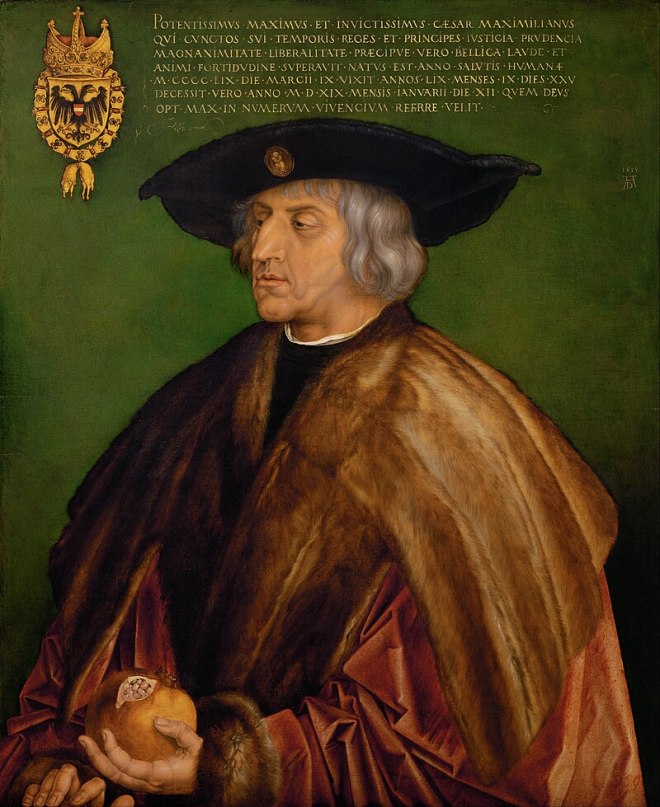
A good example is Maximilian I, Holy Roman Emperor. I am particularly fond of this portrait of him, by Albrecht Dürer, painted a few years after Cranach’s St. Valentine.
It’s another painting my wife and I saw as we took refuge from the cold in Vienna’s museums, this time in the Kunsthistorisches Museum.
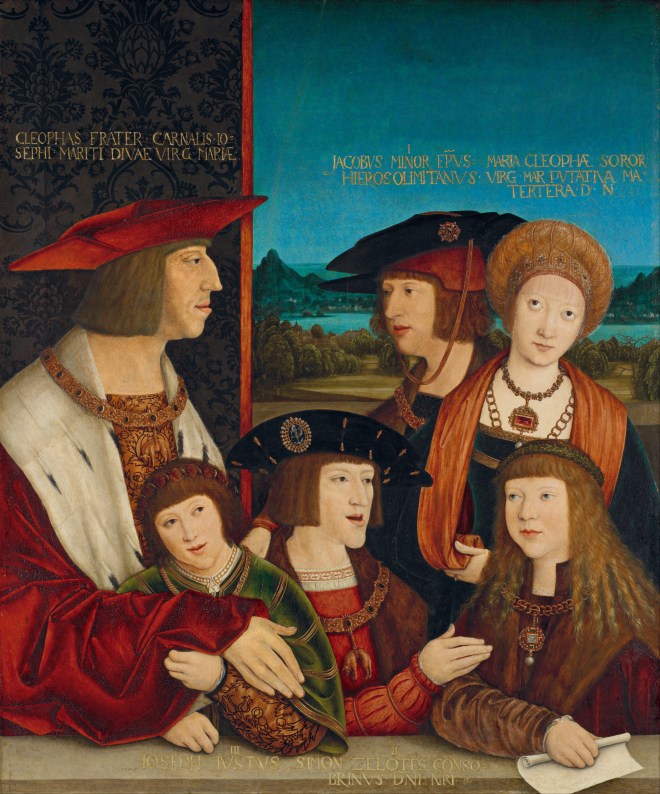
There are many other portraits of Maximilian, and in some of them he is frankly ugly, like this one of him and his family. With this side pose, his very prominent nose stands out.
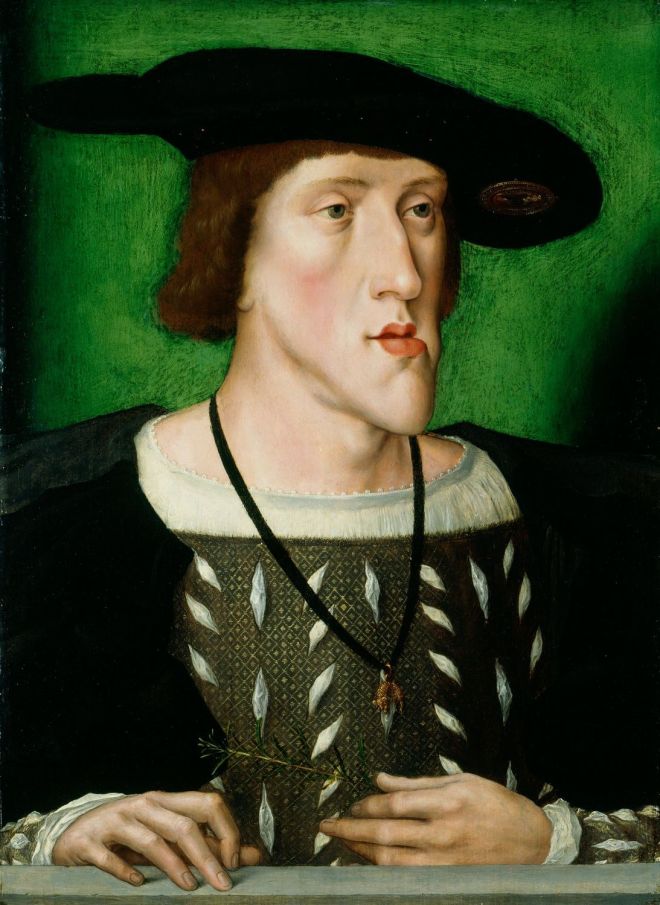
Maximilian certainly looks better than many of his successors, who sported the monstrous Hapsburg jaw. It seems to have started with his grandson Charles V, who is in that last painting, bottom centre. It continued down the generations. Here is a portrait of Charles V when young.
Source
In later life, he grew a beard, presumably to camouflage the chin.
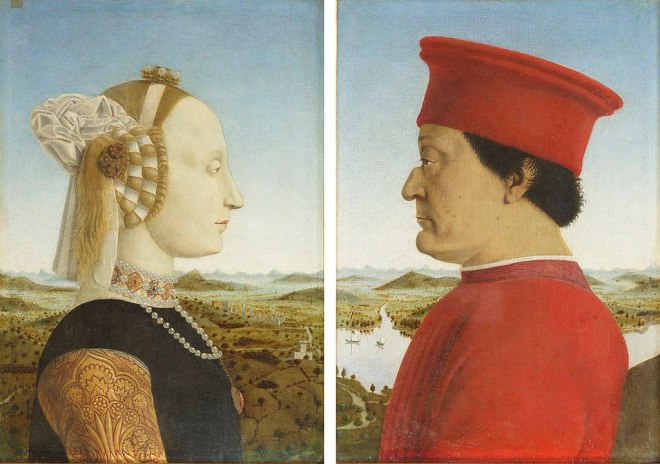
But I don’t want to focus on ugly people, even though they are the subject of many, many paintings. So my next candidate for arresting faces is Federico da Montefeltro, Duke of Urbino. Probably the most well-known portrait of him is this one in the Uffizi, in a double portrait with his wife Battista Sforza.
That is a really interestingly craggy face! It certainly mirrors his life, a man who was a brilliant condottiero but also a very cultured man: in the last painting, he is dressed in armour but he is reading a book, an allusion to his humanist interests. Of course, the thing most people almost immediately notice about his face is that notch at the top of his prominent nose. He lost his right eye in a joust (and probably smashed up the right side of his face in the process; he always had himself painted from the left). To be able to see better with his one remaining eye, especially when fighting, he had the top of his nose cut away. A tough, tough guy …
Staying in Italy, the next arresting face I pull up is that of Lorenzo de Medici, il Magnifico. Of the many representations that were made of him, I choose this terracotta statue, whose brooding look captures me. What dark secrets are hidden there!
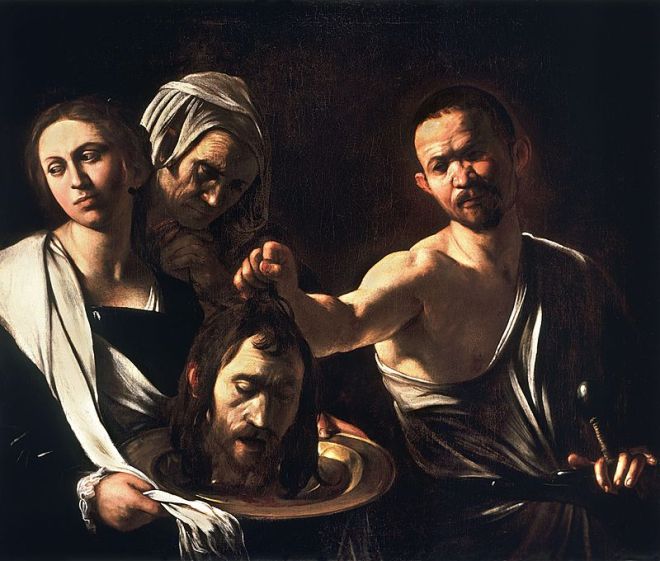
Other arresting faces come from Caravaggio. It’s the faces of the secondary characters in his paintings who most draw my eye. A prime example is the Incredulity of Saint Thomas. Look at the weatherbeaten faces of those three apostles! They could truly be fishermen walking the shores of the Sea of Galilee, or indeed any shores anywhere.
Michelangelo’s badly broken nose adds to the allure of his face. I read a while back that it got broken after he mocked the drawings of the artist Pietro Torrigiano, who in a rage took a swing at him.
I can’t leave Italy without including a portrait of San Carlo Borromeo, cardinal archbishop of Milan.
Source
His large nose led the Milanese to nickname him Il Nason, Big Nose.
Readers will see that it’s all been men up to now. Indeed, it’s been very hard to find paintings of women’s faces which are arresting: beautiful yes, haughty yes, homely yes, motherly yes, careworn yes, but arresting …
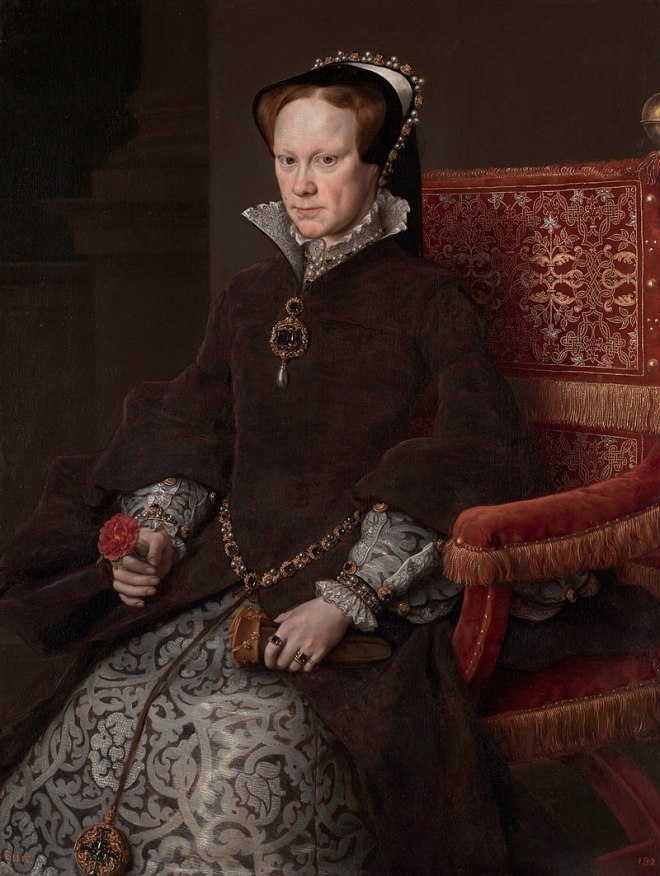
After a considerable amount of searching, I came up with a few examples. This is Mary, Queen of England.
Now that is the face of a very determined woman! And determined she was. She suffered through all the travails of her father Henry VIII declaring her illegitimate, banishing her from court, and refusing to let her be with her mother when she died, and, once on the throne, she tried with all her might to bring England back into the Catholic fold.
She, too, suffered under Henry VIII, nearly losing her head at one point, and when she was queen had to navigate tempestuous religious factional fighting. She was not a woman to be pushed around.
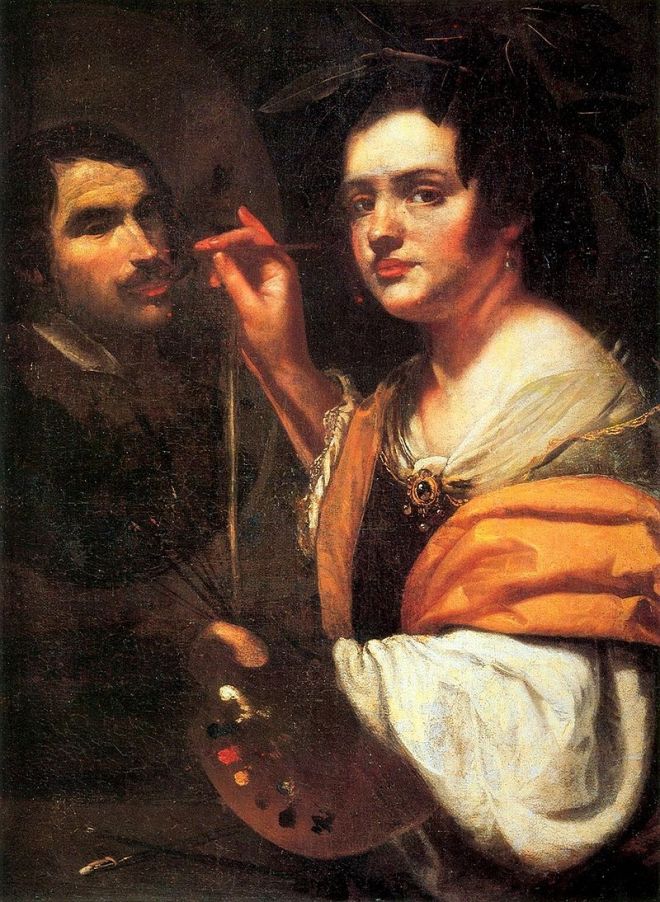
Perhaps I could add this self-portrait of Artemisia Gentileschi. It’s not a face that necessarily arrests me, but knowing her background – raped when she was young by another painter, tortured during his trial for rape to see if she kept to her story, having to see her rapist’s meagre two-year sentence reversed after a short prison term – I sense a steeliness in her.
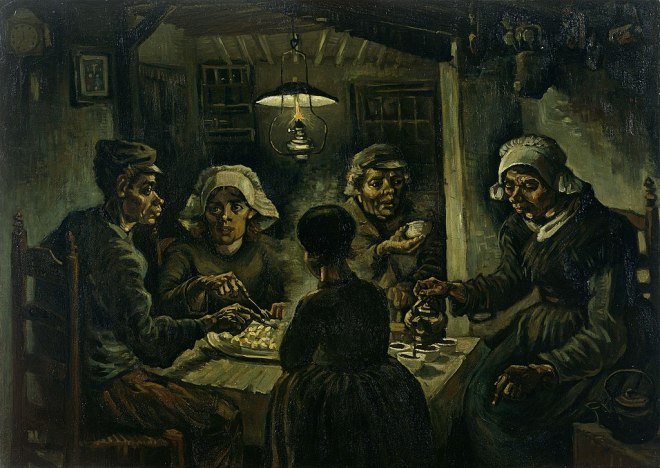
I finish with the face of a peasant woman in an early painting by Van Gogh, before he went to Paris. It’s from the Potato Eaters, a really dark painting (literally).
It’s that time of the year again. The time of plums here in Central Europe (or strictly speaking, European plums; there are so many different types of plums). On our hikes now we often see small plum trees covered in the dark purple fruit.
I can never understand if these trees have seeded wild after the passage of some plum-munching, stone-spitting person, or if they were part of now abandoned communal orchards which were once a common feature in this part of the world (the so-called Streuobstwiesen, the scattered-fruit-meadows, meadows through which villages have sprinkled plum and other fruit trees for their communal use – a nice idea, I think).
However the plum trees got there, they are welcome indeed. When we come across them, we will fill our rucksacks with a few days’ worth of dessert and walk on.
Normally, when the plums arrive the weather is turning towards Autumn here. The days are drawing in, the temperatures are beginning to bite, it’s time to wear trousers when I hike and take a sweatshirt with me in case a cold wind picks up; time, too, to carry a waterproof jacket to counter the occasional shower.
As I eat my plums, I will often feel a pang of regret that the Summer is drawing to a close. But this Summer has been ferociously hot in Central Europe. So it is with a certain sense of relief that I bite into my plums these days, even as I grieve the massive damage caused by the recent floods to man, beast, and vegetation (including plum trees, no doubt).
They seemed to be wild, or at least feral, being used as fencing around gardens or just mixed up with other trees and bushes on the side of the paths. There were never any plums within reach, evidence that other gatherers had hiked these paths before us. All we were left with were plums that had been knocked off by wind or the heavy rains that we have been having this summer (a result of the intense heat). Many of these little plums were damaged and, judging by the taste, not necessarily all that ripe. We picked them up anyway; it breaks our heart to see this free bounty from Nature just being trampled underfoot. Our gatherer ancestors would never have countenanced such waste.
Talking of our ancestors, it seems that we human beings have been chomping on plums and spitting out the stones for a long, long time. Archaeologists digging in Neolithic sites in Bulgaria, for instance, have found plum stones from 8,000 years ago. Some of the stones seem to belong to a wild plum called cherry plum.
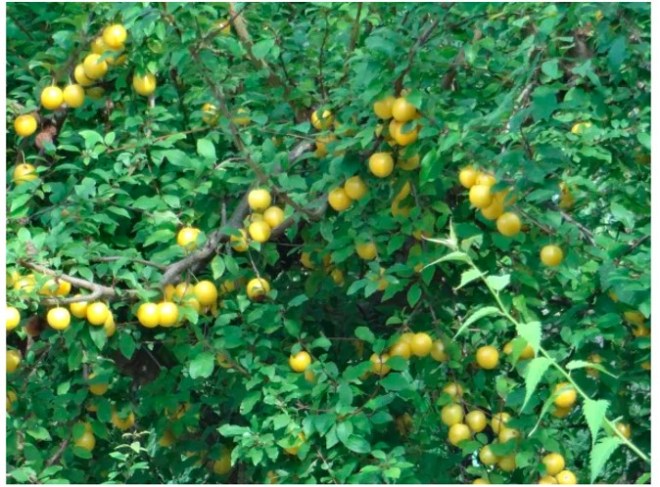
They do indeed look cherry-like, small and red. I don’t think I’ve ever seen this plum tree on our hikes. But that’s not too surprising since its natural range is South-West Europe (which includes Bulgaria, of course) and West Asia. So the Neolithic farmers who were drifting into Europe from Anatolia must have been very familiar with this tree. From articles I’ve read, I sense that most cherry plums tend to be on the sour side. But I also get the sense that our ancestors, until not too, too long ago, before the massive production of sugar, preferred sourer food, or at least were more tolerant of sourer food. That sourness still resonates with the descendants of our Neolithic ancestors in Romania and Georgia. They use cherry plums in their recipes as a souring note. The Georgians, for instance, use cherry plums to make Tkemalu sauce, a sour sauce, which is then a main ingredient in kharcho soup (mmm, looks good, I wonder if there’s a Georgian restaurant here in Vienna where I could try it?).
Source
Some other stones in those Bulgarian Neolithic sites, no doubt in the more recent archaeological layers, seem to show that domestication of the plum had begun to occur. It’s not very clear what species exactly got domesticated to give us the various types of plums we have in Europe: European plums, damsons, bullaces, egg plums, greengages, spillings, mirabelle plums, just to give the names we use in English. It could have been the cherry plum alone whose DNA was manipulated. Or it could have been that cherry plums were crossed with sloe plums.
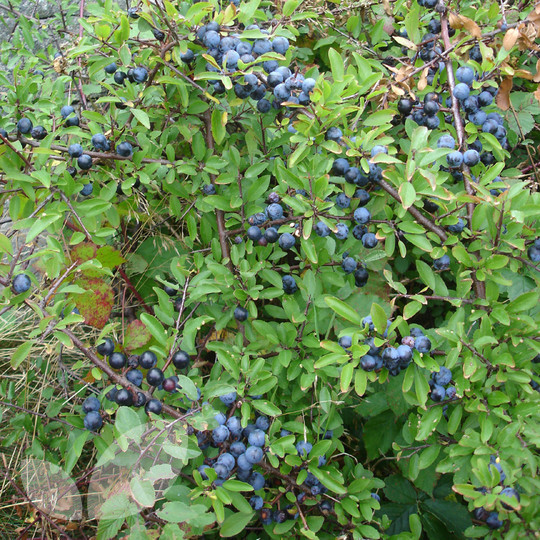
I came across a couple of bushes of sloe plums this summer as we crossed a meadow or two – not scattered-fruit-meadows, I should add, just ordinary meadows. The bushes were on the edges of these meadows, in that indeterminate zone between meadow and woods. I looked at them, thinking “they look like miniature plums” and wondering if they were edible. I went back and forth on trying them, but in the end I felt that discretion was the better part of valour. I didn’t want to keel over in a meadow, poisoned by some unknown plant. But now that I’ve done a bit of reading on plums, next time I come across them – next year at this point, God willing – I’ll give them a little nibble. I don’t expect the experience to be all that pleasant, I have read that sloe plums are quite tart. Maybe I’ll just drink sloe gin, a gin in which sloe plums have been marinated. That sounds a much more pleasant experience.
It had to happen. On our latest wandering across the Austrian landscape, this time in Styria, my wife and I came across yet another obscure saint, Saint Ilgen. This good saint had given his – or was it her? – name to a village located in the similarly named Ilgental, the valley of Ilgen, along which we were walking to get to the jump-off point for our three-day hike around the Hochshwab. I throw in a photo of the jump-off point, the Bodenbauer inn. As readers can see, it’s a popular place.
And here are a couple of photos of the mountains we climbed over.
My wife’s photoMy wife’s photoMy photomy wife’s photoMy photo
But now, settled in the train back to Vienna, I have had the time to investigate this mysterious Saint Ilgen. My first inkling of who we might be talking about came about this morning, as we walked back through the village of Saint Ilgen. I noticed a small shrine on the side of the road that I had missed the first time we came passed through the village.
My photo
For readers whose sight, like mine, is not quite what it used to be, the writing above the statue says, in German, “Saint Aegidius pray for us”. Ah! So Ilgen was probably the same as Aegidius! A little bit of train-based internetting has confirmed this.
Aegidius was a name that rang a bell. And indeed, a little bit of e-riffling through my past posts has confirmed this. Last year, I had come across Saint Aegidius when researching another obscure saint, Saint Veit, whose name my wife and I would quite often come across on our wanderings across the Austrian landscape. Saint Aegidius, like Saint Veit, was one of the fourteen Holy Helpers who Medieval Europeans turned to, to deal with life’s many miseries. Here is a photo of those Holy Helpers from a chapel in Baden-Württemberg. Saint Aegidius is in the third row from the top, the second from the right, wearing a monk’s brown tunic but holding a bishop’s crozier. I only know this because I blew up the photo enough to be able to read the names helpfully added to the base of each statue. Readers will notice that the statue is decked out in very much the same way as the statue in the photo above. This was no doubt the standard way of depicting the saint.
I don’t know why the saint was called Aegidius, because most Medieval Europeans didn’t call him that. The British knew him as Giles, and many other Europeans knew him by variants of that name. For instance, the French knew him as Gilles – as we shall see in a minute, he was a French saint. And since our story starts in Austria, I feel I ought to mention some of the German variants: Jillies, but also Gilg or Gilgen which in some places – like that valley which my wife and I had been walking up and down – morphed into Ilg or Ilgen. So I shall drop Aegidius and continue with Giles.
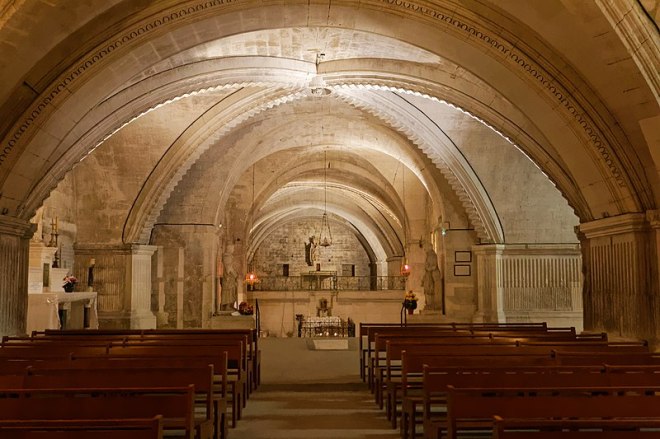
Who exactly was this saint Giles? Quite honestly, I’m not sure he ever existed. But the story put out by the monastery of Saint-Gilles, which lay between Nîmes and Arles in the south of France and whose tomb the monks claimed to have in their church crypt, was that he was a hermit who in the 7th Century AD was living a saintly life in the thick forests around Nîmes. His only companion was a female deer, to whom he was very attached. One day, hunters of the local king – or maybe the king himself – were pursuing the deer, which ran to Giles for protection. Giles put himself between the hunters and the deer and got wounded in the hand by an arrow. Full of remorse for having wounded such a holy man, the king gave him land and money to build a monastery, which Giles proceeded to do. He then became its first abbot, leading the monastery until his death, carrying out miracles etc. along the way. There are other, more fanciful details in his hagiography, but I’ll leave it at that. Here, we have a painting by an unknown, possibly French, possibly Dutch, painter from about 1500 depicting our good saint.
We see him protecting the deer, with the arrow in his hand and presumably the chastened king kneeling at his feet.
Saint Giles was one of the Medieval Europe’s most popular saints. As far as I can make out, this can be traced back to the fact that the monastery of Saint-Gilles was strategically placed at the crossroads of a number of pilgrim routes. One of the branches of the Camino de Santiago de Compostela, used by pilgrims from Provence and northern Italy, passed by the monastery. I throw in a map of the three main routes in France for the Camino de Santiago. The one which passed by Saint-Gilles is the bottom, maroon-coloured, one.
The same route could of course be used in the opposite direction, and indeed was so used by Spanish pilgrims going to Rome. At Saint-Gilles they could either go overland through northern Italy or they could sail to central Italy, embarking at a port located close the monastery. French pilgrims, and Northern European pilgrims more generally, on their way to Rome also often used this marine route. The same with pilgrims on their way to the Holy Land, who would frequently pass through Rome first. I mention all of this because I want to use this occasion to see if I can’t persuade my wife to do some hiking in this part of the world. To whet her appetite, I insert a photo here of a pensive hiker near the Col du Mont Genèvre, which pilgrims from northern Italy would have crossed. I’m sure we could find a hiking trail which would take us down the French side maybe as far as Sisteron.
But back to Saint Giles. I don’t think I’m being too cynical if I suspect that the good monks of Saint-Gilles, watching all this pilgrim traffic going by, felt the need to more effectively tap into the riches it represented. They therefore created the backstory of Giles the saintly hermit, with the requisite tomb and relics, et voila! Pilgrims began to stop at the monastery’s church to pray and leave a few pence in the offerings box. Of course, the pilgrims also needed places to stay and eat, so a small town sprang up around the monastery to service these (and no doubt other) needs, giving the monastery another source of income via tithes, taxes, and whatnot.
Over the next few centuries, the fame of the monastery of St-Gilles grew to such a degree that it became an important pilgrimage destination in its own right, up there with with Jerusalem, Rome, and Santiago de Compostela. It’s not surprising, then, that Giles was such a popular saint – and that so many boys came to be called after him.
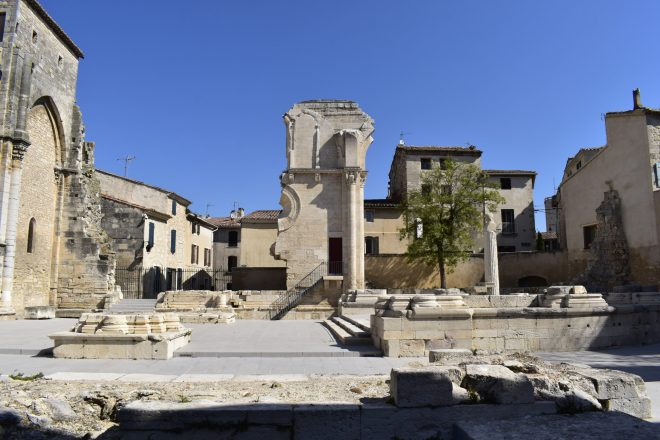
Of course, with all this pilgrim traffic the monastery grew rich and powerful, and large building programmes were undertaken. But, as Giles the Hermit could have told them if he had ever really existed, all power, all riches are transitory. The fashion of pilgrimages passed and the port silted up, so the monastery’s main source of income dried up. The number of monks dropped off, so those large monastic buildings were half empty. And then vicious religious wars were fought, with Huguenot forces burning the monastery buildings to the ground. Whatever was left of them were razed during the French Revolution. Only a few mouldering remains are left.
Maybe I could persuade my wife to make a quick visit to the church after we’ve hiked down from the Col du Mont Genèvre …
And the name of the goodly hermit, once so popular? Well, I’m afraid it has dropped way down in the rankings. In the UK, only 8 baby boys were given the name Giles in 2023. In France, it was slightly better, with 50 little Gilles being registered. As for the German-speaking lands, Ilgen seems to be only a surname these days. Like the hermit, the name seems to have retreated far, far away from human societies.
I guess that means my wife and I will have to leave future sightings of the name to our wanderings across the face of Europe.






























































 the heart thrills


