TRISKELES

Milan, 6 November 2025

My wife and I were down in Sicily recently. Our daughter and her partner came over with the grandson and they decided to spend a week down in the very far south of the island, near one of Sicily’s three promontories, Capo Passero (if I mention this detail, it’s because it plays a role later). The house they rented gave directly onto the beach and our grandson spent many happy hours digging holes, making sandcastles, and braving the – relatively small – waves that broke onto the beach.

In between these sessions on the beach, we managed to get in brief visits to Noto and Syracuse, both UNESCO World Heritage Sites. Here’s a photo of the cathedral in Noto.

Source

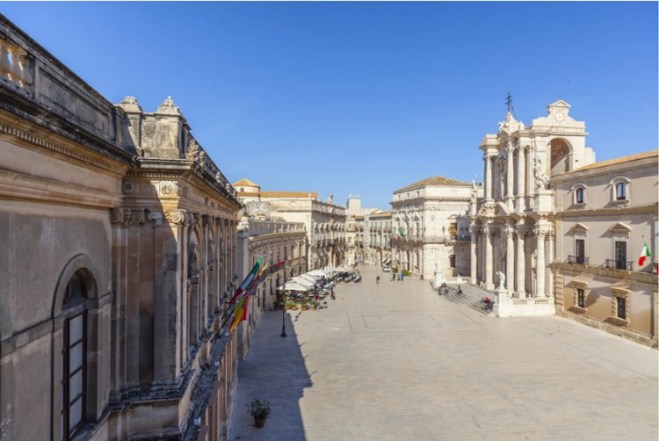
And here is one of the square in front of the cathedral in Syracuse.

Source

It was while I was wandering the streets of Syracuse that I noticed this flag – every public building had one.

Source

I discovered that it is the official flag of the region of Sicily (which is why I normally saw it flying along with the Italian national flag and the EU flag).

Source

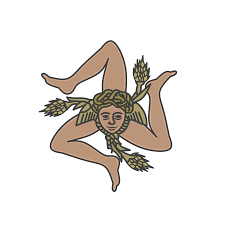
I’m a bit of a flag man – many years ago, quite soon after I started this blog, I wrote a post about what I considered to be the most elegant national flags. So of course I focused in on this flag. What really intrigued me about it was that symbol in the middle: a face from which emanate three legs bent at the knee.

Source

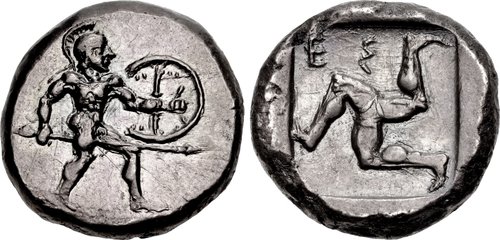
I quickly established that this symbol is called a triskeles, Greek for three-legged. It was a popular symbol on coins. The earliest numismatic representation of it (from around 465 BCE) is on coins from the Greek statelet of Pamphylia, in what is now southern Turkey.

Source

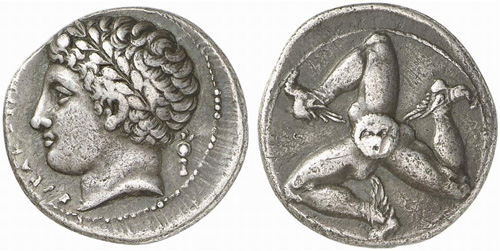
The triskeles was used in varying formats on Greek coins for several centuries thereafter, but it was most closely associated with the coins of Agathocles, Tyrant of Syracuse from 317 BCE, and self-proclaimed king of Sicily from 304 BCE, until his death in 289 BCE. On this coin, it is the main decoration on the reverse side of the coin, because Agathocles adopted it as a personal symbol of his reign.

Source

Agathocles brought an important modification to the design, placing a Gorgon’s head as the central hub from which the legs emanate. He also added wings to the feet.

On this Syracusan coin, instead, it is used as the mint mark.

Source


It seems that Agathocles chose the triskeles as his symbol because it mirrored the (roughly) triangular shape of Sicily.

Source

The Greek name for the island was Trinacria, which means three headlands. The three headlands in question were those at the “corners” of the island: Capo Peloro, to the north of Messina, Capo Passero, all the way down south of Syracuse (and close to where we spent our little Sicilian holiday), and Capo Lilibeo, close to Marsala. The choice by Agathocles of the triskeles as his personal symbol was no doubt meant to underline his ambition – realised in the last years of his life – to be ruler of the whole of Sicily.

None of Agathocles’s heirs who were still alive when he died managed to succeed him as king of Sicily. In fact, he was formally reviled after his death, with all statues of him throughout Sicily being destroyed. Nevertheless, his triskeles continued to be used as a symbol for the island. After the Romans had turned the island into a province of its Empire, they added three ears of wheat to the Sicilian triskeles, apparently to underline the province’s role as a granary for Rome (and took the wings off the feet).

Source

With the collapse of the Western Roman Empire, the use of the triskeles seems to have disappeared in Sicily. But it came roaring back in 1282, when, in what has become known as the War of Sicilian Vespers, the Sicilians rebelled against their French Angevin overlords and invited the King of Aragon to take their place. The Sicilians created a flag to carry into battle.

Source

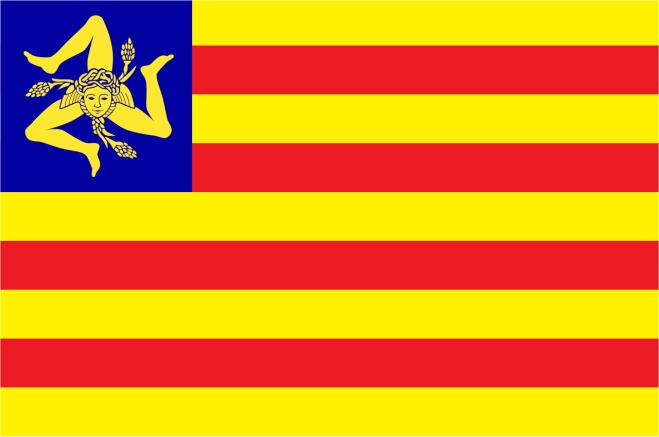
It was made up of the red and yellow colours of Aragon (but also the colours of the communes of Palermo and Corleone, where the revolt started) with a triskeles at its centre (where the Roman ears of wheat had disappeared and the wings brought back, but this time attached to the head).

After twenty years, peace was concluded and the House of Aragon ruled Sicily for the next 400 years or so.

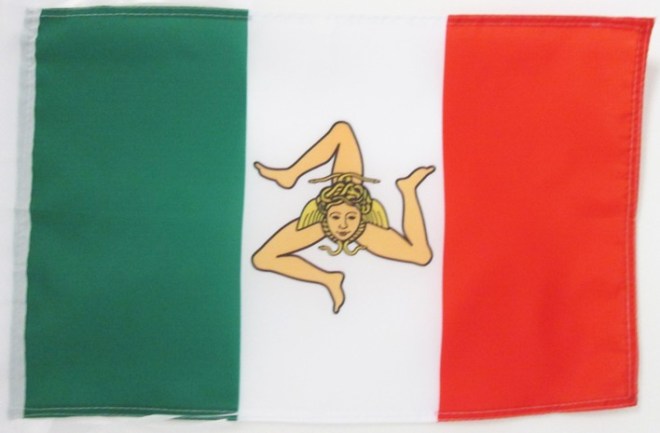
In 1848, some 600 years after that first burst of rebelliousness, and when the whole of Europe was being shaken by revolutionary outbursts, the Sicilians had another bout of rebellion and ousted their Bourbon overlords. The movement of course needed a flag, so the triskeles was rolled out again, but this time it was affixed to the red, white and green tricolour, itself created in 1789 by Italian revolutionaries copying their counterparts in France.

Source

Alas, the revolt, and the flag, lasted only a year, until the Bourbons took back control of the island. But then, a mere ten years or so later, in 1860, when Garibaldi and his thousand volunteers disembarked in Sicily on his way to conquering the island and the boot of Italy, the Sicilian rebels dusted off this flag to fight behind. That rebellion was successful this time. Or maybe it wasn’t, because Sicily shucked off its Bourbon overlords but only to become part of the new Italian State, where national unity was strongly promoted and regional diversity quashed. So of course the triskeles disappeared from the tricolour flag.

Then, at the tail end of the Second World War and after 80 years as part of the new Italian State, separatism reared its head in Sicily. In the chaos created by the Allies’ invasion of Sicily and the collapse of the national government, the Movement for the Independence of Sicily was formed. Of course, it created its own flag which naturally enough sported a triskeles, a bright red one in this case. I’ve no idea why the separatists chose this colour for its triskeles, or the colour of the flag’s background – perhaps simply the red and yellow now traditionally seen as Sicily’s colours?

Source

It was a strange movement, which pulled in people from the left and the right of the political spectrum but also had links with the mafia and the island’s traditional bandits. Indeed, the darker, criminal elements of the movement spawned an armed force, the Volunteer Army for the Independence of Sicily. It, too, created its own, triskeles-bearing, flag.

Source

This “army” attacked Carabinieri barracks and made general mayhem but was eventually crushed. In the meantime, the national government bought off the separatists by promising Sicily a special autonomous status (as it did to other regions on the rim of the country: Sardinia, Val d’Aosta, and Trentino-Alto Adige).

In the decades after the War, Italy’s regions, which had been politically moribund since the country’s unification, slowly clawed back their political importance. Finally, in 1970, the country’s first regional elections took place, while in 2001 a constitutional amendment gave the regions greater say in policy-making.

With the regions’ increasing political importance came the desire to create their own flags, banners, armorial bearings, and so on. Sicily was no different. Its regional parliament approved a first flag in 1995.

Source

Its design explicitly harked back to the flag created by the rebels in 1282 (although the colours of the background were switched around), but instead of the triskeles the region’s coat of arms was placed in the flag’s centre. This did include the triskeles but quartered it with the arms of the Normans, the Swabians, and the Aragonese, who had all been overlords of Sicily at some point.

Finally, in 2000 good sense prevailed and the regional parliament approved today’s flag with only the triskeles in the centre.

So there we are. An ancient symbol created back in the mists of time has managed to survive down through the centuries as a symbol of Sicily’s desire to shake off its overlords and now has been given a new lease of life as a symbol of – hopefully – a vibrant region in a more federalist national state.

ST. CHRISTOPHER

Milan, 30 October 2025

The genesis of this post was a hike my wife and I did back in May, around the Danube not too far from Linz. As I relate in the post I wrote about that hike, one stop we made was at the small church in the village of Pupping. And there I found, among other things, this wooden statue of Saint Christopher.

My photo

The statue caught my attention because of Saint Christopher’s expression; as I wrote in the post, the Saint looks less than pleased with the Child Jesus sitting on his shoulder. In fact, I would go so far as to say that he looks downright grumpy. A nice take, I thought, on the traditional story about St. Christopher, and normally the only story that most people have ever heard about the Saint. So I made a mental note to come back one day to this Saint’s story. On a drizzly afternoon in Milan, that day has come.

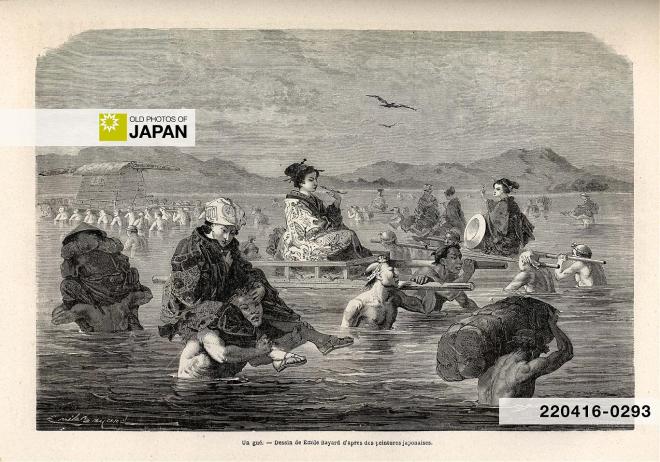
So what is the story that most people have heard about St. Christopher? I think a quick recap might be useful. I should start by noting a little-known fact, that at the beginning of the story our Saint was actually called Reprobus. He was a big, brawny man – a giant in many tellings of his life – and he was in this period of his life spending his time carrying people across a deep ford at a river somewhere in Asia Minor. In case any readers might think this surely was not a job people did in the old days – they would use a boat or a raft, right? – I throw in here a print of people doing precisely this in Japan in the 1860s.

Source

In any event, one night Reprobus heard a young voice calling out. It turned out to be a child asking to be carried to the other side. So even though it was late Reprobus put the child on his shoulder, seized his trusty staff, and started crossing. To his consternation, as he waded across, the child got heavier and heavier. So heavy did the child get that this huge, strong man found himself struggling mightily to make it across. When he finally made it to the other side, he said to the child: “You put me in the greatest danger. I don’t think the whole world could have been as heavy on my shoulders as you were.” To which the child replied: “Don’t be surprised, Christopher [which in Greek means Carrier of Christ], you had on your shoulders not only the whole world but Him who made it. I am Christ your king, whom you are serving by this work.” Thus did Reprobus become Christopher. And no wonder Reprobus-about-to-become Christopher is looking so grumpy in that statue in the church in Pupping!

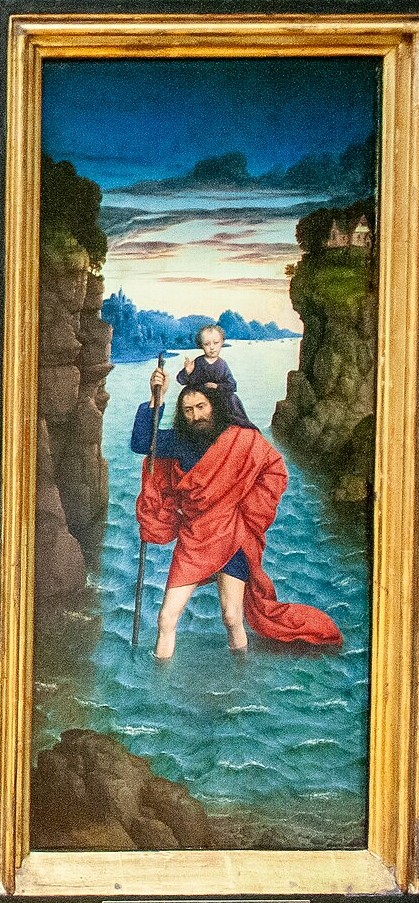
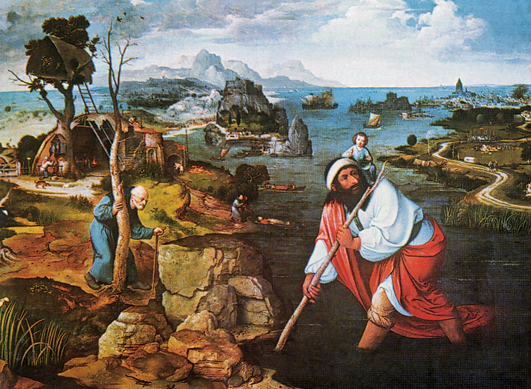
It is a charming story which got painted many times by numerous artists in Western Europe. I throw in here an assortment:
By the Master of the Pearl of Brabant

Source

By the Flemish painter Joachim Patinir

Source

By Rubens

Source

In fact, it’s just about the only story of Christopher’s life that ever got painted in Western Europe, crowding out all the other stories associated with him.

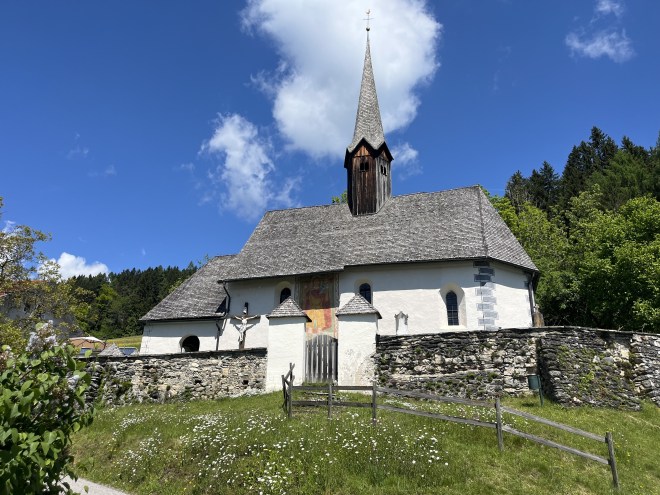
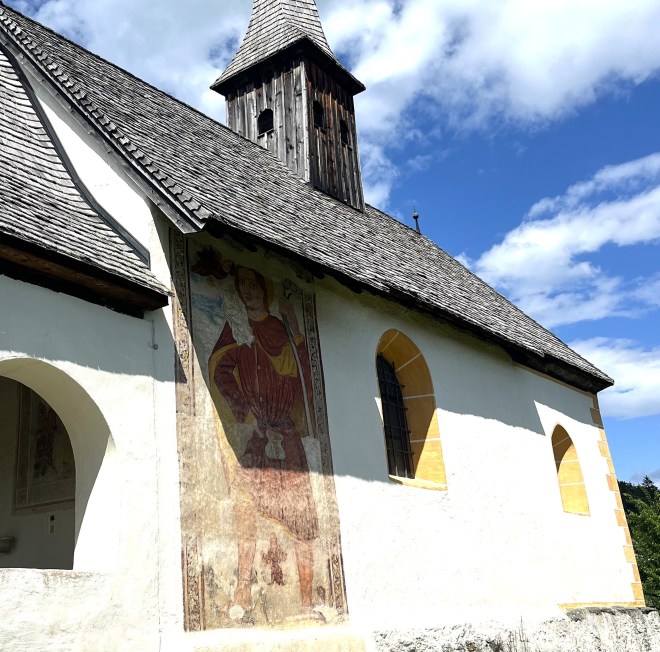
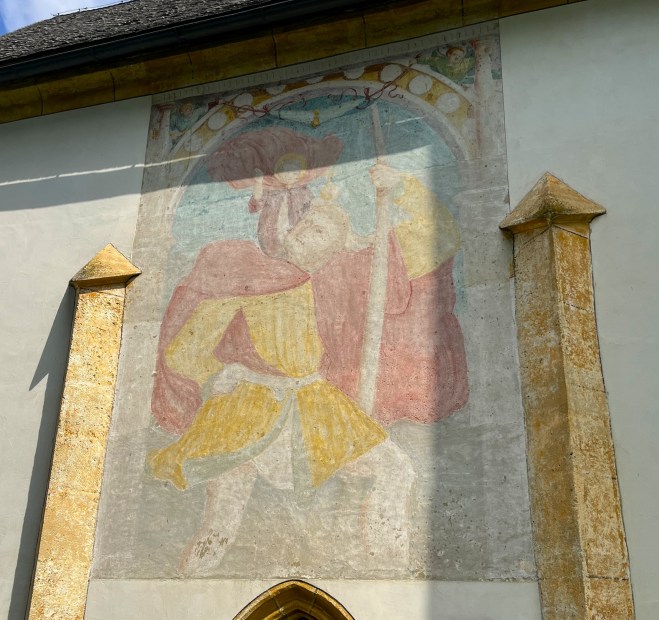
I must confess, the precise theological messages of the story elude me, even though I have perused several posts trying to help me out. In fact, I read elsewhere that the story was actually made up by various churchmen to “normalise” what was a widespread practice by the “little people” of painting enormous portraits of St. Christopher with Christ, first inside their churches and then later on their outer walls. When I read that, I had a jolt of recognition. A couple of weeks before that hike around the Danube, my wife and I had hiked for a couple of days in the south of Austria in the hills around Villach. In some of the small villages we walked through I had noticed these giant St. Christophers painted on the outside of three of the village churches which we passed. I was so struck by them that I took several photos.
This is a general view of the church where I saw the first one

My photo

Here is a close-up of the fresco

My photo

This was in the next village we passed through

My photo

This was at the church where we sat down to have our sandwiches for lunch.

My photo
My photo

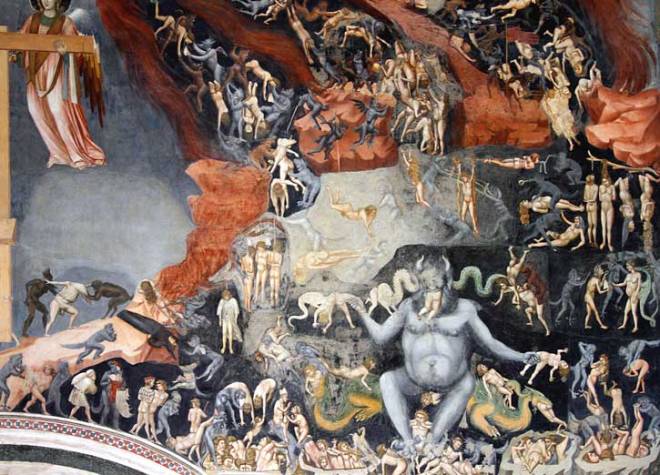
At the time, I had found these frescoes charming. I was now reading that they actually had a precise meaning. They were showing St. Christopher in his role as the “guardian from a bad death”, and especially a sudden and unexpected death. We have to plunge into the Christian mindset of the Middle Ages to understand why this was so vital. Any person who died “unshriven”, that is to say without having confessed and been absolved of their sins, was condemned to spend eternity in Hell without any possibility of salvation. And the torments of Hell were always well represented in church frescoes in case people forgot. Here is one such example, painted by Giotto in the Scrovegni chapel in Padova.
Source

Under the circumstances, it made perfect sense for everyone to do whatever they could to avoid an unshriven death. Somehow, the belief sprang up that if you saw the image of St. Christopher you wouldn’t die that day. Thus the huge size of the St. Christophers as well as their location on the outside walls of village churches; like that, all villagers, even those living far from the church, avoided the risk of not seeing the image during the day. As one can imagine, the popularity of these images soared during the Black Death, when the risk of dying unshriven increased enormously. Continuing bouts of the plague over the centuries maintained their popularity.

I rather like this role of St. Christopher as a Gentle Giant keeping an eye on your lifespan. However, by the 15th Century, when huge St. Christophers had proliferated everywhere, theological and ecclesiastical authorities had become less enthusiastic, considering this trust of the “little people” in St. Christopher to be mere superstition. They were far more comfortable with the Saint’s role as the protector of travelers and all things travel-related (it was of course his role of carrying travelers across the river that led to travelers invoking his protection). And the coming of the automobile, where the dangers it posed to life and limb became immediately obvious, saw a huge increase in the Saint’s popularity. Even now, miniature statues of the Saint are frequently displayed in cars; sign of the times, you can buy one on Amazon. Yours for a mere $8.99!

Source

Meanwhile, in Orthodox Christianity, things took a different path for Christopher. The whole story of him carrying the Boy Christ across a river was ignored (at least until relatively recently). Instead, the focus was on his good, Christian life after his baptism and his martyrdom. So the icons of him have a young man, normally dressed as a soldier. Here is an example from Saint Paraskevi Church in Adam.

Source

So far, so bog-standard. But then, there is a startling alternative in his iconography, one where he is depicted as having a dog’s head (at least, I find this startling; showing saints with dog-heads seems rather disrespectful to me).

Source

I find these icons so strange that I am moved to throw in the photo of another one, where St. Christopher is cheek by jowl with a perfectly normal St. Stephen.

Source

This strand of iconography came about from a rather too literal reading of the legends about Christopher’s origins. It was said that he had been captured by Roman troops in combat against tribes dwelling to the west of Egypt in Cyrenaica. Already back in the 5th Century BCE the Greek historian Herodotus had written that in these parts, on the edges of the civilised world, lived dog-headed men as well as headless men whose eyes were in their chests. This belief in Europe that the edges of Europeans’ known world were populated by strange hybrid human species continued well into the early modern times, as this woodcut from the 1544 book Cosmographia shows.

Source

As a consequence, some icon painters believed that Christopher (or Reprobus as we have seen he was then known) was dog-headed, and they painted him as such.

Not surprisingly, there was pushback on this depiction of Christopher from the Higher-Ups. In a 10th Century hagiography about the Saint, its author, Saint Nikodemos the Hagiorite, wrote: “Dog-headed means here that the Saint was ugly and disfigured in his face, and not that he completely had the form of a dog, as many uneducated painters depict him. His face was human, like all other humans, but it was ugly and monstrous and wild.” For its part, in the 18th century the Russian Orthodox Church forbade the depiction of the Saint with a dog head because of the association of such a representation with stories of werewolves or monstrous races.

Poor Christopher! Giant, dog-headed, and now cancelled. Because, back in 1969 the Catholic Church struck him from the General Roman Calendar, deeming that there wasn’t enough evidence to show that he had ever existed. I still remember the general consternation this caused at the time. What about all those miniature statues in cars (and medallions around necks)? How could they protect you if Christopher had never existed? I guess the fact that people continue to buy them shows that the “little people” will still believe in these images’ magical ability to protect, whatever the Higher-Ups say or do.

SPINDLE TREE

Milan, 15 October 2025

It was our last hike in Austria this year. We hiked across the hills between Sankt Veit an der Gölsen (another Sankt Veit) and Wiesenfeld, in the pre-Alps behind St. Pölten. During the final walk into Wiesendorf, I spotted this flowering bush on the roadside.

My photo

I’d seen the plant before, but this time I decided to identify it. I did my usual trick of using my iPhone’s plant identifier programme, but it was a complete failure. It first suggested “hawthorne”, which even I knew was wrong, and then, on two other try’s, it simply suggested “plant”, which was really not very helpful. So I turned to the internet. And there I got my answer: I was looking at a Euonymus europaeus, the European or common spindle tree (or bush to some people – it seems to fall between being a small tree and a big bush).

The plant has a rather lovely fruit, which is why I’d spotted the plant in the first place. I throw in a close-up of the fruit.

Source

It is a lovely pink, and then, as the photo shows, when it ripens it splits open to reveal a bright orange seed (actually, what you see is an orange aril, a “fleshy” material in which the seed is buried; the edible aril attracts birds and other animals, which helps in seed dispersal).

To my eye, this combination of pink and orange is a bit jarring, but hey! that’s the colour combination the plant “chose” (is there some scientific reason behind the colours you find on plants? A question for another day).

The fruit’s pink colour, and the fact that it is four-lobed, has led to one of the plant’s French names: bonnet d’évêque, bishop’s cap. I don’t know if bishops wear them anymore, but the hat they wore in the past was four-sided and pink.

Source

All very nice, but as I said in my previous post, while our ancestors might have admired the colours of nature, they were highly utilitarian in their approach to plants: how can I use them? Well, the fruits of the spindle tree are toxic – indeed, every part of the plant is toxic – so there was no nutrition to be had from this particular plant. But our ancestors did manage to eke various uses out of it. Two stand out for me.

As the plant’s English name indicates, the plant’s wood was used to make spindles. Women (for the most part) used spindles to spin wool or flax fibres into yarn or thread. In this picture, the spindle is in the woman’s right hand (and the distaff in her left).

Source

And here we have a group of women all spinning together. I guess this was seen very much as a communal activity, the way women used to knit together.

Source

Spindles are a very ancient technology. The oldest evidence of their use goes back 12,000 years. But at least in the developed countries, they were eliminated by the Industrial Revolution, when automation destroyed the cottage industry of spinning. Their use lingered on here and there; this photo, for instance, from 1901, shows a peasant woman in Greece still spinning by hand.

Source

And I still remember watching a housewife in Eritrea, where I was born, sitting at the door of her house spinning with a distaff and spindle. This would have been in the late 1950s.

One of the plant’s French names – fusain – indicates the second of the plant’s intriguing uses. Fusain is a charcoal made from the wood of the spindle tree, which is used in drawing. It’s much appreciated by artists for its exceptional strength and density. This is a good excuse for me to throw in a few charcoal drawings by famous artists, although I will start with an artist I personally have never heard of, François Bovin, simply because the subject of his drawing connects us back to what I was just writing about, spinning.

Source

Turning to other artists, these are preparatory drawings of Tahitian faces, by Paul Gauguin.

Source

This is a drawing by a favourite artist of mine, Käthe Kollwitz, of a home worker.

Source

And this is a drawing by another of my favourite artists, Egon Schiele, of a reclining model in chemise and stockings.

Source

And finally, a cubist charcoal drawing by Pablo Picasso of a standing female nude.

Source

A week after this hike, we were gone. We’ll be back next year, maybe early enough to see a spindle tree in flower.

Source

GROUNDCHERRIES, OR CHINESE LANTERNS

Vienna, 28 September 2025

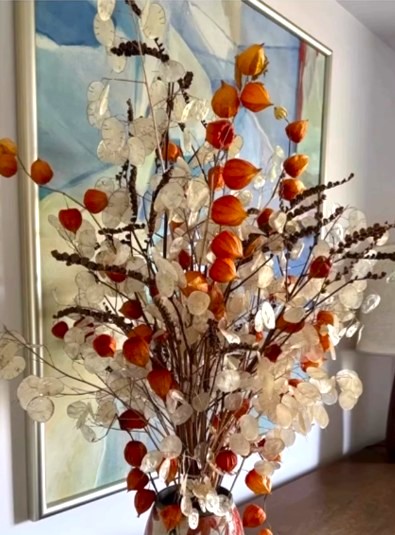
A week ago, my wife and I were passing by a florist during our afternoon walk down into the city centre when my eye was caught by one of the products the shop was selling.

My photo

It wasn’t just the pretty display that caught my attention. It just so happened that I had taken a photo of the very same plant growing along the side of the path during one of our earlier walks during the summer, in Vienna’s Tiergarten (a very nice area of woods and meadows on the edge of the city which used to be an imperial hunting ground).

My photo

Already when I had taken this photo, I had said to myself that I should look into this plant. The clever feature on my phone’s camera told me that I was looking at a groundcherry, so at least I knew what the plant was. But, as Samuel Johnson is reported to have said, the road to hell is paved with good intentions – I hadn’t gotten around to doing anything. But that second sighting in front of the florist got me going again. And now, finally, after a few days of rain, I have cobbled together my story.

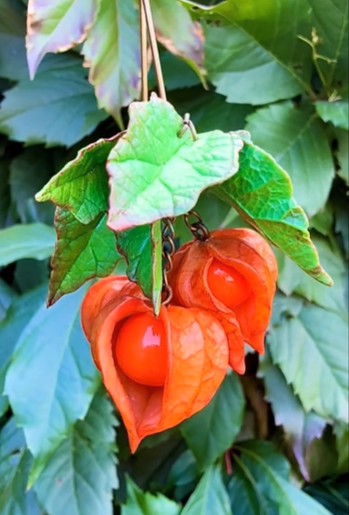
I suppose I should start with the plant’s most conspicuous feature, its bright orange to red papery calyx.

Source

It is this beautiful calyx that caught my eye and catches the eye those who decide to plant it in their gardens.

My photo

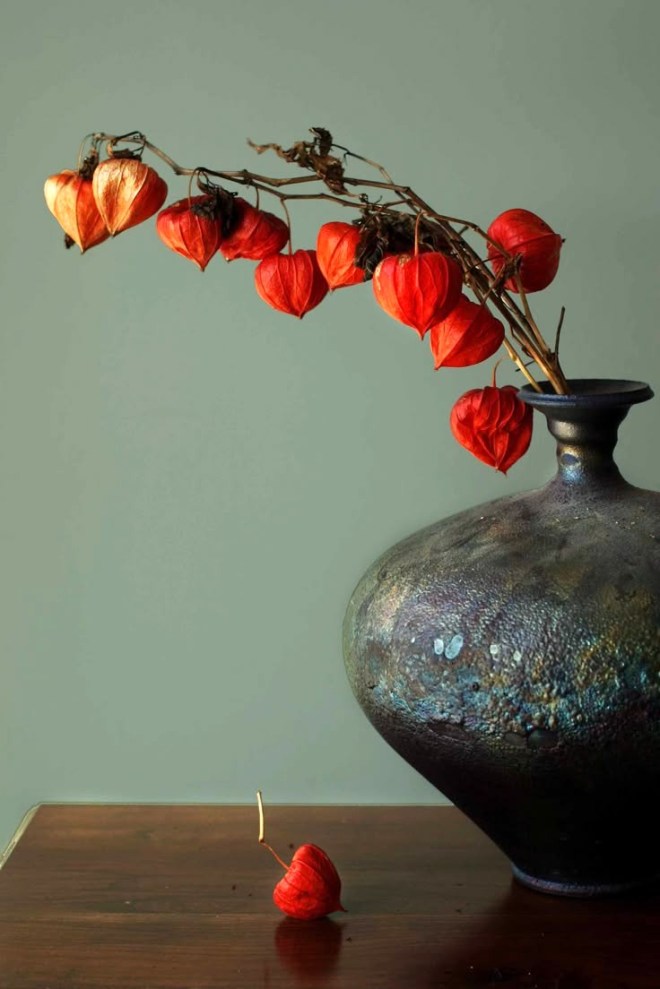
It’s also what makes people put the plant in arrangements of dried flowers.

Source

These sometimes can veer towards the Japanese ikebana style.

Source

Not surprisingly, it is also this calyx which gives the plant one of its more common names in English, Chinese lantern, in German, Lampionblume or lantern flower, and in French, lanterne or lantern.

If left on the plant, much of the calyx will decompose, leaving behind only the veins of the calyx in the form of a delicately beautiful, skeletal net and revealing an orange-red berry within.

Source

The berry’s resemblance to a small cherry has given rise to the plant’s other common name in English, the groundcherry. Having a berry trapped, as it were, inside the calyx has also given rise to other common names, like the French amour en cage, love in a cage, but the one I like best is one of its Persian names: the puppet behind the curtain.

Source

As I have noted several times in these posts, while our ancestors no doubt saw the beauty in the world around them, they were nothing if not profoundly utilitarian: how can this thing (plant, fruit, rock, wood, animal, whatever it is) be useful to me? So of course they explored whether or not the berry of the Chinese lantern was edible; there is evidence that our Neolithic ancestors were eating the berries. The internet is not very clear on how tasty these berries are. As far as I can make out, though, they are not very tasty, having low levels of sugar and being somewhat sour. But with the addition of a lot of sugar they can be made into scrumptious jams and marmalades. Apparently, the Italians also pickle the berries, although I’ve never, ever seen this in Italy.

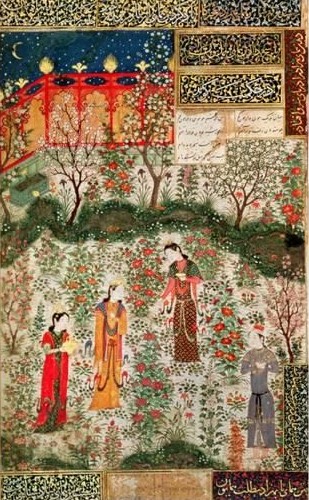
Our Medieval ancestors, and very probably even earlier ancestors, were just as interested, if not more interested, in the plant’s use as a medicine, particularly the berry. And this interest explains the plant’s rather strange scientific name, Alkekengi officinarum. It’s the plant’s generic name, Alkekengi, that’s so odd. It’s not Latin, what is it? The answer to that lies in Persia. In Persian traditional medicine, the Unani system of medicine, the dried berry was used as a diuretic, antiseptic, liver corrective, and sedative. The Persian name for the plant is kākunaj (which, by the way, I think means “balloon” or “bladder”, another common description of the plant). I throw in here a photo of a 15th Century miniature of a Persian garden.

Source

When the Arabs overran the Persian empire, they picked up the Persians’ traditional medicine and carried it westward. This included the kākunaj berry, whose name they arabised to al-kākanj. In turn, Arabic traditional medicine was carried into Europe, where the name of the berry, and the plant, was europeanised to “alkekengi”. Another small example of the way ideas were transmitted along trade routes, something which I have written about many, many times in these posts.

The plant’s medicinal role has now died away, although there are still a lot of articles written on its pharmacological properties. So we are left with its beautiful calyx, that orange-red lantern, to enjoy. Which leads me to one lovely traditional use of the plant, in Japan. During the summer Obon Festival, the Japanese remember their deceased ancestors, believing that their spirits return to visit them. They use lanterns to guide the spirits from their graves on the first day of the festival, and back to their graves on the last day of the festival. Normally, they use paper lanterns, but in many places they also drape strings of groundcherry calyxes – called ghost lanterns in Japanese – on the shrines in temple grounds that house memorial tablets for the deceased. This photo shows a market selling strings of grouncherry calyxes.

Source

Maybe we should institute this practice at Halloween, when the spirits of the dead traditionally come back into the world of the living.

SAINT LEONARD OF NOBLAC

Vienna, 24 September 2025

My wife and I have just finished a long weekend in the little town of Waidhofen an der Ybbs. We were actually using it as a base from which to carry out a number of very pleasant hikes over the surrounding hills. These are impossibly beautiful: broad swathes of light and dark green draped over the hills, dotted here and there with farmsteads.

My photo

The weather was glorious, which certainly helped.

As I looked through the various brochures which we picked up to figure out what hikes to do, I came across the following brief write-up about the church in a village some 10 km away, the village of St. Leonhard am Walde:

“Fiakerkirche St. Leonhard/Wald: The traditional place of pilgrimage for Viennese hackney carriage drivers since 1826. St. Leonhard is the patron saint of cattle, sheep – and horses. In 1908, the Viennese hackney carriage drivers donated the Marian altar. A few decades ago, the Viennese cab drivers also joined the pilgrimage.”

Now that really intrigued me! Hackney carriages, fiaker in German, are a picturesque sight down in the centre of Vienna, although nowadays, of course, they are only for tourists.

Source

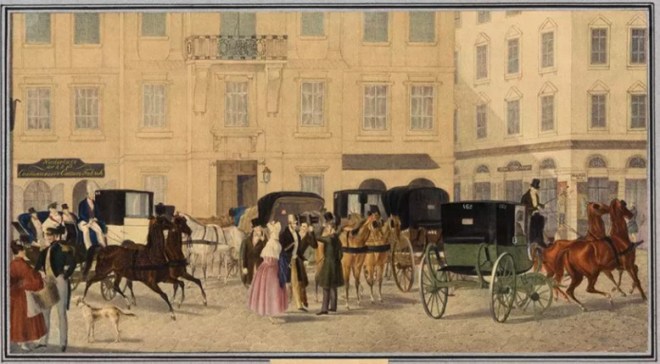
But, being an early form of taxi, there was a time when hackney carriages were ubiquitous throughout the city, as indeed they were in all European cities. Here is a colourised copperplate engraving from the 1830s of a smart set of Viennese and their carriages.

Source

I suspect, though, the carriages and their drivers didn’t look quite so smart when they were merely acting as taxis, ferrying people around town. This looks more like the typical hackney carriage driver; the photo is taken from an engraving in a book of 1844.

Source

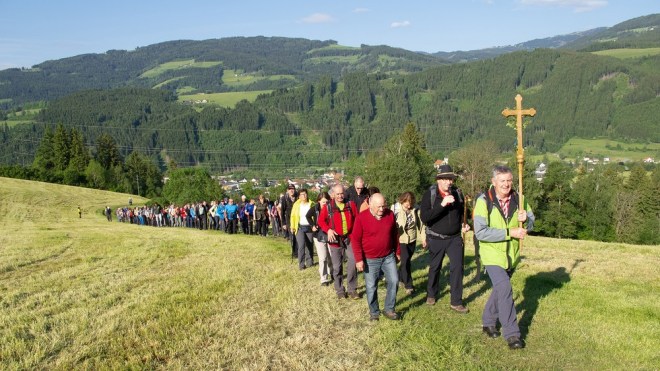
Hackney carriage drivers have always struck me as a hard-boiled lot, not taken to making pilgrimages. I have a hard time seeing them doing this (this is a modern pilgrimage, but I don’t suppose pilgrimages have changed much, apart from the clothes the pilgrims wear).

Source

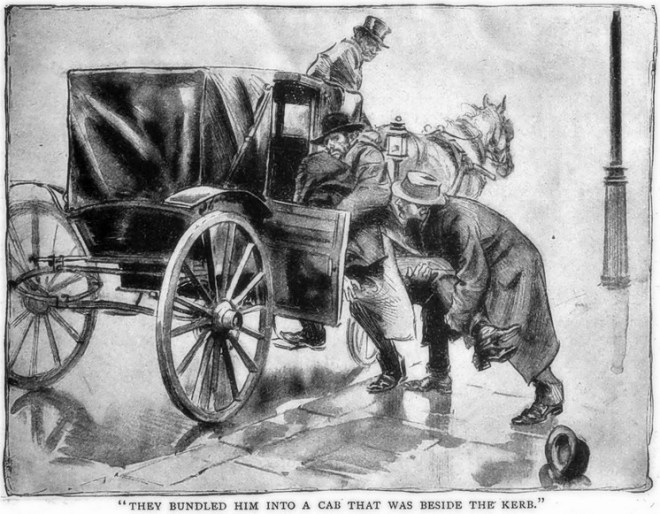
But it could be that I am being influenced by various books I’ve read and films I’ve seen where hackney carriage drivers seemed to be a sinister and semi-criminal lot. This is an example from one of the Sherlock Holmes stories.

Source

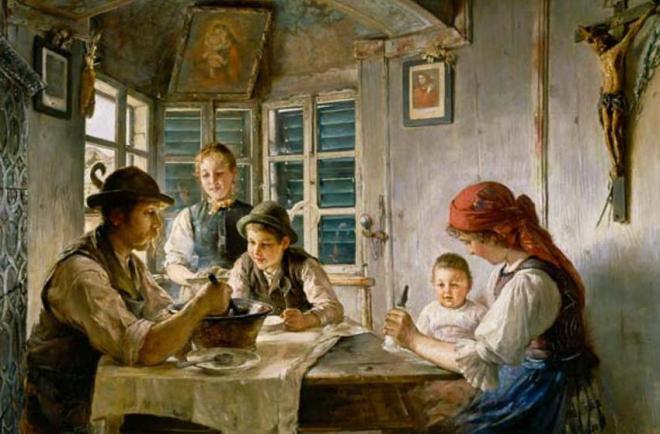
Maybe the majority were God-fearing, devout, family men.

Source

Of course, given the way my mind works, I started wondering why hackney carriage drivers would have chosen a church dedicated to St. Leonard as the church to which they would make their annual pilgrimage. The little blurb I quoted above suggests an answer: he was the patron saint of horses, and of course horses were key to hackney carriages, being their motor as it were. But how, my mind was asking, did Saint Leonard become the patron saint of horses?

Since I knew nothing about Saint Leonard, I had to do some reading. I should note in passing that there have been various Saint Leonards over the centuries; the one we are interested in is St. Leonard of Noblac. Assuming he ever actually existed, his story is quickly told.

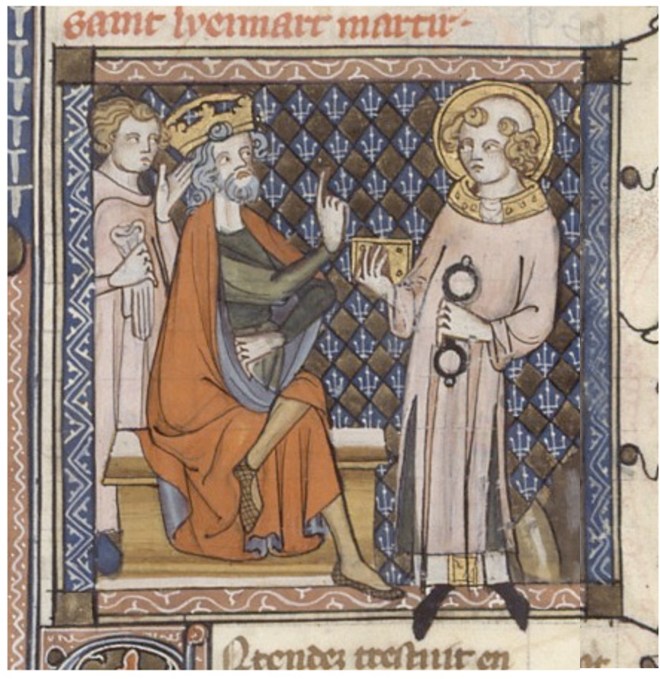
Leonard was a Frankish nobleman, coming from a family that was closely allied to Clovis, the first Frankish king of what was later to become France. Clovis was young Leonard’s godfather when he was baptised, along with Clovis himself and all his court, by St. Remi, bishop of Reims, on Christmas Eve of 496. As Leonard grew up, he became much exercised by prisoners, to the point where he asked Clovis to have the right to visit prisoners and free those he considered worthy of it. Clovis granted the request. We have the scene played out here in a French work from the 14th Century.

Source

Many prisoners were thereafter liberated by Leonard.

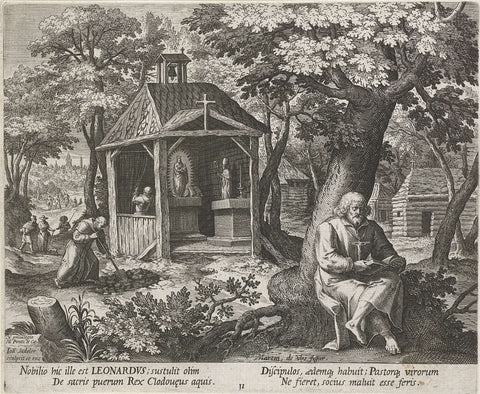
Much impressed, I presume, by his holiness, Clovis offered him a bishopric, but Leonard turned the honour down, preferring to join a monastery near Orléans, whose abbot was another saint, St. Mesmin. After the latter went the way of all flesh, Leonard decided to strike out on his own. He moved to a forest in a place called Noblac (Noblat today) near Limoges, where he set up a hermitage. His preaching, good works, etc. led to a multitude of people flocking to his hermitage, including many prisoners whose chains miraculously flew off their hands and legs after they had prayed to St. Leonard for his intercession. Here, we have a print from 1600 giving us a rather fanciful vision of this scene.

Source

I do believe that the monk working the land behind Leonard in the print is one of these prisoners now living an honest life.

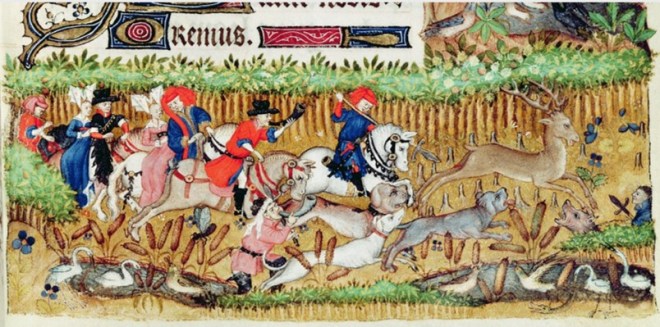
At some point in all of this, the-then Frankish king Clotaire I (Clovis having died in the meantime) and his heavily pregnant wife came to visit Leonard in his forest hermitage – we have to remember that Clovis’s family and Leonard’s family were close. The royal couple decided – like the good aristos that they were – to use the occasion to go for a hunt in the forest.  To get us into the spirit of things, I throw in here a miniature from the 15th-Century Book of Hours of Marguerite d’Orleans showing Lords and Ladies off to the hunt.

Source

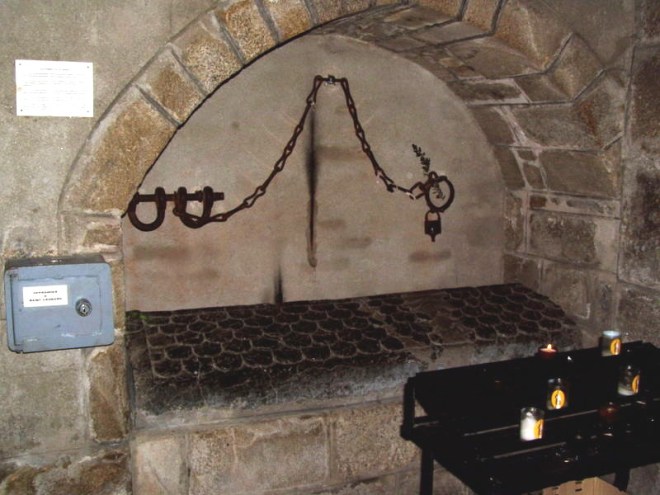
During the hunt, however, the queen suddenly went into labour. It was turning into a difficult and dangerous birth. Leonard rushed to her side and his prayers saved queen and baby. In gratitude – especially since it was a baby boy – the king wanted to shower Leonard with loads of money. But Leonard only asked for as much forest area around his hermitage as he could ride around on his donkey in one night. The king granted this wish. On the land that Leonard was subsequently given he built a church and monastery. He became its first abbot and died there peacefully, mourned by all. The Romanesque version of that church still stands, in a place called Saint-Léonard-de-Noblat.

Source

And that church contains what is purported to be Saint Leonard’s tomb.

Source

Given his involvement with prisoners, it is not surprising to learn that St. Leonard is the patron saint of prisoners. Given that story with the pregnant queen, it’s also not surprising that he is considered a helper of women in childbirth. But patron saint of cattle, sheep and horses? How did that come about?

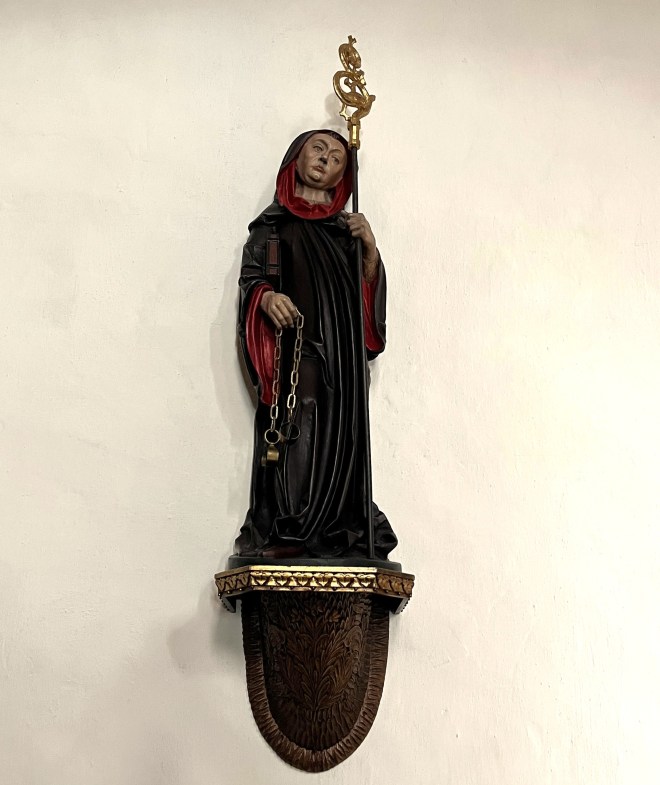
For that, we have to know that from the earliest times St. Leonard was often depicted as an abbot with a crosier and holding a chain or fetters or manacles, symbolising the liberation of prisoners achieved by him. In fact, in one of those serendipitous moments I love so much, I came across just such a representation of him in a church in Waidhofen, down the road from where my wife and I were staying.

My photo

Over time, rural folk mistakenly thought that the chains which St. Leonard was holding were cattle chains – these are commonly used to tether cattle or to control them during walks, or even to help birthing calves.

Source

By extension he became the patron saint of all farm animals, which of course also included horses.

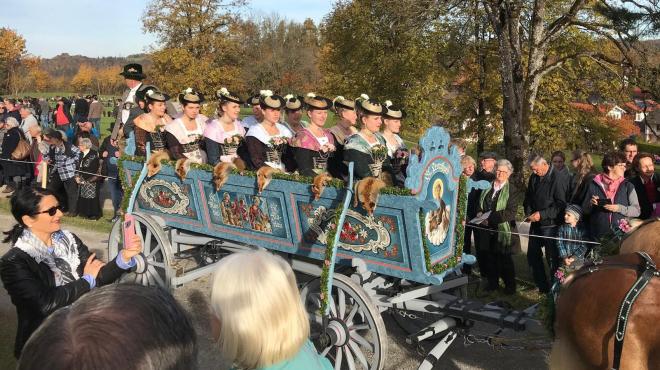
Given this swerve of patronage towards livestock, I suppose it’s not surprising that Saint Leonard became a popular saint throughout the Alpine regions of Europe. After all, as I’ve mentioned in a previous post, cattle was pretty central to the rural economies of all Alpine communities. This devotion to the saint means that his feast day – November 6th – is celebrated with enthusiasm in many places in the Alpine regions, especially the German-speaking ones. Here, for example, are photos of the celebrations in Bad Tölz in Bavaria (which got a mention in an earlier post  because of its rather naughty statue of St. Florian).

Source
Source

It also gave rise to the intriguing phenomenon of chain churches in the Alpine regions. These are churches dedicated to St. Leonard which have chains running around them, either put up temporarily on his feast day or mounted permanently. The Fiakerkirche is not a chain church, alas. Here is a nice example from Tholbath in Bavaria (the church also has a quite respectable onion dome, the subject of an earlier post).

Source

But if we’re going to visit a church dedicated to St. Leonard, it won’t be one of the chain churches. It will be the one I’ve already mentioned in Saint-Léonard-de-Noblat. What a fine-looking Romanesque church! I have to say, I am partial to Romanesque churches. I’ve already inserted a photo of the church’s exterior. Here is a photo of its interior.

Source

What a wonderfully bare church! No annoying accretions to cover the spare, simple lines of the architecture.

But the photo shows an additional reason why I will try to persuade my wife to travel all the way to France to see this church: the rucksacks and the walking sticks. This church is situated on one of the four Ways of St. James of Compostela through France. I’ve mentioned one of these, the Via Tolosana, in an earlier post.  The church of Saint-Léonard-de-Noblat is on another, the Via Lemovicensis, the Way of Limoges. There must surely be some good hiking to be done in the area.

PANTALEON

Vienna, 18 June 2025

It’s summer time! And summer time, for my wife and me in Vienna at least, means it’s time to go hiking around the city and beyond. And that means studying guides, electronic and hard-copy, to find new hikes for us to do. So it was that a month ago now I bought a guide to the Jakobsweg, the pilgrim routes (or at least modern versions of these; so many of the original routes have been overlain by the asphalt of large roads) that wend across Austria and eventually lead the walker (after crossing Italy or Germany and then France and Spain) to the cathedral of St. James in Compostela.

Source

Here we have a Medieval miniature of St. James as a pilgrim on his way to Compostela – note the scallop shell on his satchel, the symbol of this pilgrimage.

Source

Although in my mind’s eye I see the road snaking out before me over hill and dale all the way to Compostela (Google Maps tells me that the town is 2,760 km away from my living room), I’ve been looking more modestly at the stages which are not too, too far from Vienna. Specifically, I’ve been looking at the stages beyond the great monastery of Melk.

Source

(The reason for that is simply that we’ve already walked the stages between Vienna and Melk.)

As I followed the stages in my new guide and figured out where we might stay for the night along the way, my eye was caught by the name of a village we would walk through: Sankt Pantaleon. I throw in a photo of the village which I found online. It looks like a nice, typical Austrian village.

Source

Readers of these posts will know that I have a fondness for obscure saints whose names still pepper our landscape – although I have to say that the name Pantaleon is thin on the ground. Google Maps – once again – informs me that there are only a couple of villages in Austria which go by that name, as well as a handful of churches and streets. The same is true for France, Italy, and Spain. He has a somewhat greater presence in Greece and other Orthodox lands under the name Pantaléémon. In Switzerland, Germany, Belgium, and Portugal he has hardly any presence, and in the Netherlands and the UK none at all. My wife and I will not be coming across him very often on our hikes, it seems.

What do we know of this saint? Well, not much at all, as is usually the case with these saints from the earliest centuries of Christianity. If he existed at all, he hailed from Asia Minor as most of these early saints seem to have done. His various hagiographies tell us that he was born in the late 200s AD and brought up a Christian by his mother (his father was a pagan). But he  fell away from the faith when he studied medicine. He was brought back to the straight-and-narrow by an even shadowier saint, who – if I’ve understood the sub-text correctly – basically said “Jesus did better than you, by healing through faith alone”. And in fact, Pantaleon converted his pagan father after healing a blind man by invoking the name of Jesus over him.

In any event, he continued being a doctor; and he must have been a very good one, because he became the personal physician to successive Emperors. But he must also have continued dispensing care – for free – to those who needed it, which has earned him in Orthodox Christianity the delightful title of Holy Unmercenary Healer. This is an epithet that has been given to various saints who offered their medical services for free, contrary to the (still) prevailing practice by doctors of charging (often a lot) for their services. The National Health Service in the UK, which still manages (just) to offer its services free at the point of delivery, should take Pantaleon as its patron saint.

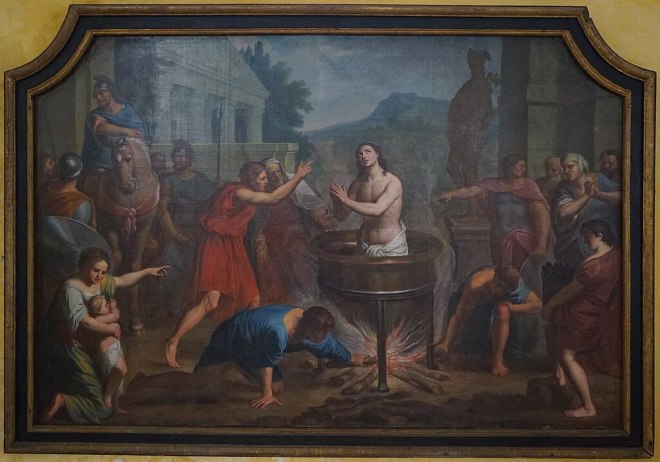
Things came to a head when Diocletian started his persecution of Christians in 305 AD. Doctors, envious of Pantaleon’s success as a court physician – and of course pissed off that he was offering his services gratis – denounced him to the Emperor. Since the latter rather appreciated Pantaleon’s skills he tried to get our hero to abjure his faith, which of course Pantaleon did not do. So the Emperor handed him over to the torturers. They subjected him to the usual menu of hideous tortures which hagiographers delighted to write up in minute detail. I won’t bother readers with even a summary of them. I’ll just throw in a photo of a relatively recent painting depicting one of his tortures, being put in a bath of molten lead (which, according to the hagiographers, immediately went cold when he stepped into it, so I’m not sure how he was meant to get out of the now-solidified lead; but I guess I’m just being picky).

Source

I’ll also mention one other torture to which he was subjected – because it is important for later in our story – namely the nailing of his hands to his head. Ouch! In the end, it’s only when he gave his tormentors permission to cut off his head that they managed to do so.

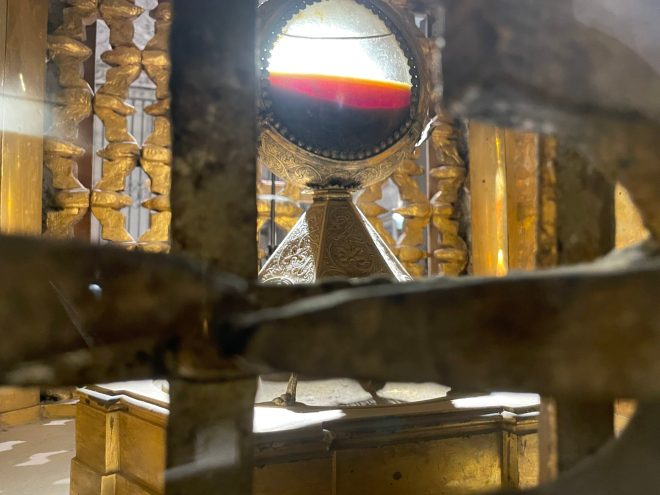
As usual, when the veneration of relics became popular in Christianity, various relics of Saint Pantaleon popped up: a head here, an arm there, a finger bone somewhere else. More unusually, a vial of his blood ended up in the town of Ravello, near Amalfi. Like the more famous case of Saint Gennaro’s blood in Naples, which is just around the corner from Ravello, the blood in the vial liquifies once a year. Here we have a photo of that vial when it is apparently liquifying in 2022.

Source

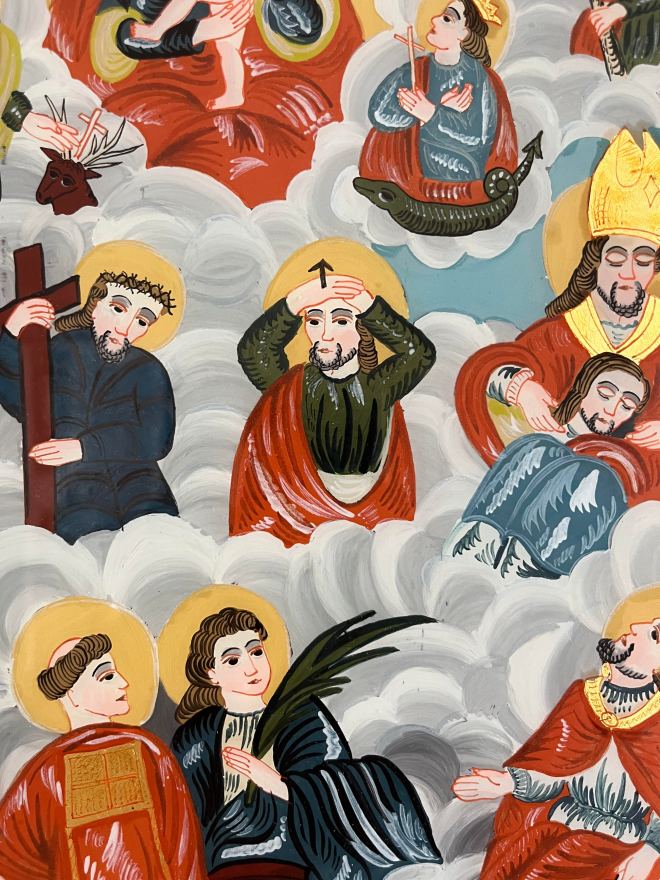
So popular was Saint Pantaleon that he was made one of the Fourteen Holy Helpers, who, from the late Middle Ages on, were invoked to help with people’s everyday problems, especially health problems. I’ve written about a number of the Holy Helpers in earlier posts, so it’s nice to be able to add to the list with this post. I guess it made a lot of sense to include Pantaleon in the group; he was a doctor after all. And in fact, he was the patron saint of doctors and midwives. He was invoked specifically in cases of cancer and tuberculosis; why those two diseases rather than any other is not clear to me. What makes perfect sense to me, however, is that he was also invoked in cases of headaches and any other pains in the head, or even mental illnesses. This photo of a panel which I stumbled across in the church of Eferding during our recent hike along the Danube – I kept the photo back for this post – shows very clearly why. The saint to the right is Pantaleon, and we can see the nail which has been hammered through his hands into his head. To a mere mortal like me it looks incredibly painful, although the sculptor has Pantaleon looking very stoic.

My photo

This story of the nail in the head has also meant that I’ve identified one more of the fourteen Holy Helpers in my painting on glass of them, which pleases me no end!

My photo

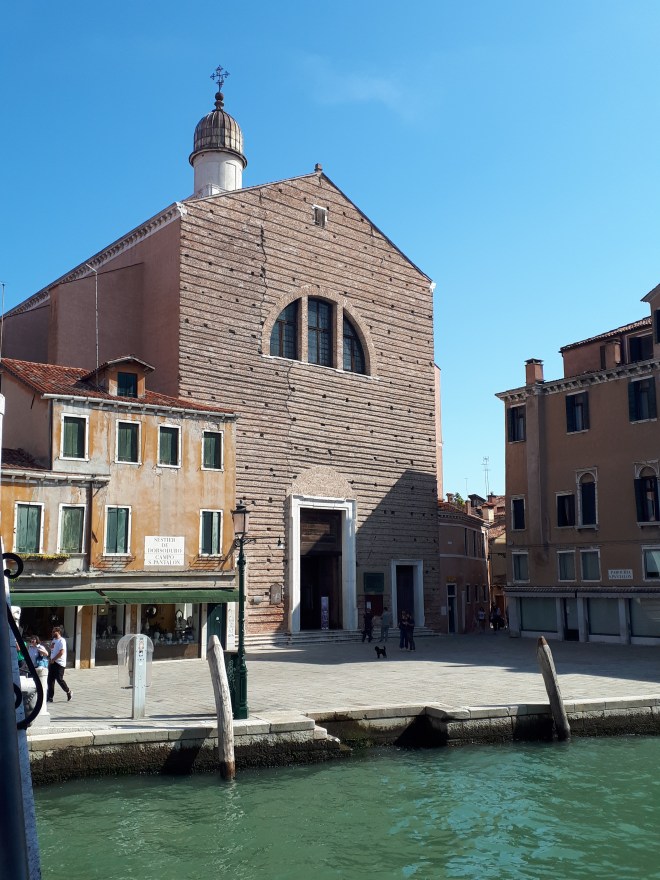
As I wrote earlier, a fair number of churches have been named after Saint Pantaleon. I will only mention one, the church of San Pantalon in Venice.

Source

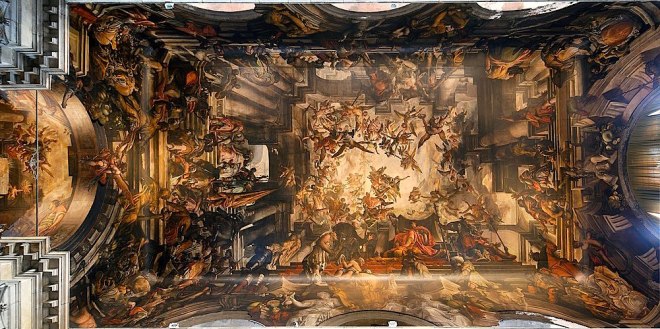
If I mention it, it’s because my wife and I checked it out during a brief trip we made recently to Venice, to visit the Biennale (architecture is the theme this year). The church’s exterior is not much to write home about. The church’s main claim to fame is its ceiling, which depicts the martyrdom and glory of Saint Pantaleon. It is indeed quite breathtaking.

Source

It is not, as might seem at first sight, a fresco; it is a vast painting on canvas, which has then been stuck to the ceiling. Apparently, these were quite popular in Venice; quite why, I don’t know.

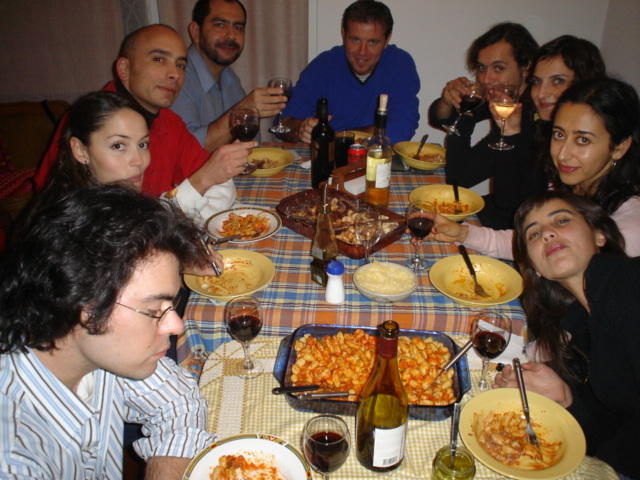
This mention of Venice allows me to segue smoothly from the sublime to the ridiculous. San Pantaleone (or Pantalon in Venetian dialect) was once a very popular saint in Venice. No-one has given me an explanation for this. Nevertheless I have one, born of my fervid imagination. To explain my theory, I have to jump to the countries in the southern cone of Latin America. It is a tradition there to eat gnocchi on the 29th of each month (and so the tradition is called los ñoquis del 29). It is a festive occasion, as this photo – one of many on the internet – attests.

Source

It was also the custom – perhaps not so much now – to place some money under your plate to bring you luck and prosperity. It was the Italian immigrants to this part of the world, many of them from the Veneto region, who brought this charming tradition with them. It was based on a legend about San Pantalon (to give him his Venetian name) which made the rounds in the Veneto. Even though he lived in Asia Minor, it was said that he had once come to northern Italy on a pilgrimage. One day, the twenty-ninth day of the month, he asked some poor peasants near Venice for bread; they generously invited him to share their meagre meal. In gratitude, San Pantalon announced that they would enjoy a whole year of abundant fish catches and harvests, which was indeed the case. The custom of placing some money under one’s plate of gnocchi – a simple dish, one for poor people – on the 29th of each month is therefore intended to obtain the renewal of this prosperity once granted by the saint.

Lovely story. But what I see in this legend is that for the Venetians – whose whole livelihood, indeed whose whole State, depended completely and totally on trade – San Pantalon would have been the go-to saint: “dear San Pantalon, here’s a lovely candle for you and some money in the offerings box. I’ve also put my life’s savings in this ship going to Constantinople [=the money under the plate]. Please, please, please make it come back with mounds of fantastic stuff that I can make a fortune off.”

Whatever the reason for his popularity in Venice, in the minds of other Italians Venetians became inextricably linked with San Pantalon. And so, when Commedia dell’Arte was born in the 16th Century, one of the stock characters in the plays was Pantalone. Pantalone is basically a caricature of Venetian merchants and just to underline this fact the character is meant to speak in Venetian dialect, at least in the Italian versions of the plays. He is retired, so he’s played as a wizened old man. He’s miserly and loves his money. Despite his age, he’s a lech and a smooth talker, and makes numerous passes at women, although he is always rejected. Given the high social standing of merchants he also represents those at the top of the social order, and he feels that this allows him to meddle in the affairs of others. In sum, the character of Pantalone is entirely based on money and ego, but at every step he becomes the butt for every conceivable kind of trick. Rereading this, which is based on a composite of many descriptions I found of the character, I get the distinct impression that the rest of Italy didn’t much like the Venetians. Quite a comedown from our heroic martyr Pantaleone.

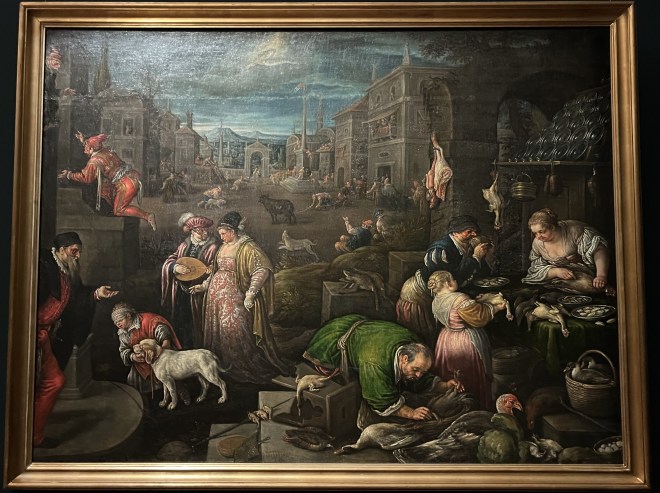
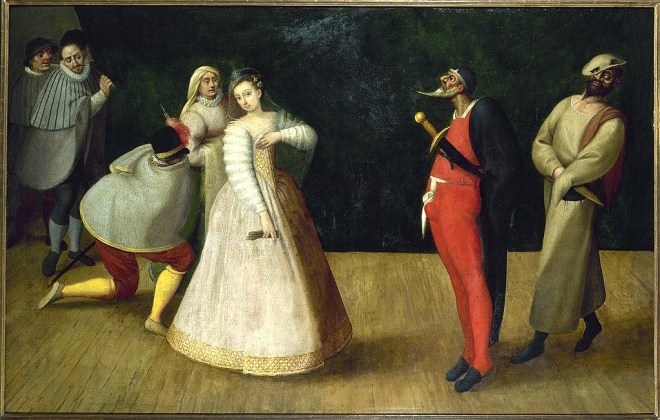
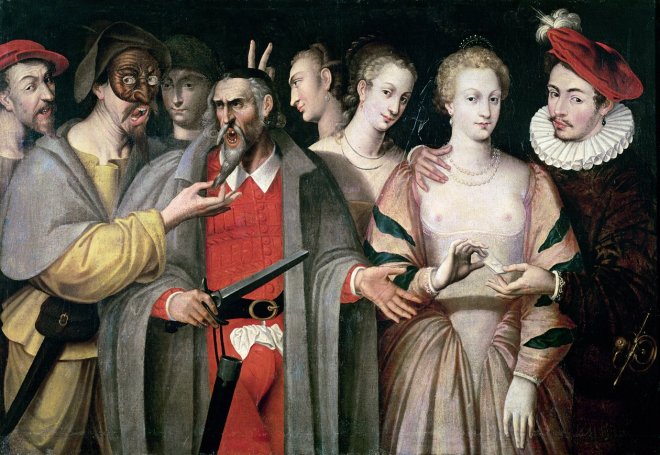
But it gets worse! To understand why, I show here a couple of depictions of what the Pantalone character typically looked like on stage. By one of those wonderful acts of serendipity, my wife and I saw the first of these depictions just yesterday at the Kunsthistorisches Museum in an exhibition they are currently holding entitled “Arcimboldo-Bassano-Breughel” (for any readers in Vienna, hurry up to see it, it finishes on 29 June!). This particular painting is by Leandro Bassano. It was one of a series that depicted the months of the year, in this case the month of February, which of course is carnival time in Italy, which was a popular time for putting on plays.

My photo

The set of characters on the far left of the painting (minus the boy and the dog) are all characters from commedia dell’arte plays. Pantalone is on the very far left. I throw in a blow-up of that part of the painting.

My photo

It’s a pity that Bassano put Pantalone half out of the painting, but you can make out his sartorial particularities – red doublet and hose, slippers, a black cloak, a black hat, and a sword. And of course a mask. You can see these much better in this painting by an unknown artist in the Carnavalet Museum in Paris.

Source

This painting, on the other hand, by the French painter François Bunel the younger, from the late 16th Century, shows what a figure of mockery Pantalone was.

Source

It’s actually quite pertinent that I chose depictions by French artists of old Pantalone, because commedia dell’arte took the rest of Europe by storm. Every country had their shows, with the names of the characters modified to fit local ears: in German our foolish old man stayed as Pantalone, but in French he became Pantalon and in English Pantaloon. So well-known was he that even Shakespeare, in his famous monologue in As You Like It about the seven ages of man, mentions him as the sixth age:

                                       The sixth age shifts
Into the lean and slippered Pantaloon,
With spectacles on nose and pouch on side;
His youthful hose, well saved, a world too wide
For his shrunk shank …

In both Britain and France, that “youthful hose” was eventually given the character’s name: “pantaloon” on one side of the Channel, “pantalon” on the other. Even though this type of clothing (“covers the lower part of the body from the waist to the feet, consisting of two cylinder-shaped parts, one for each leg, that are joined at the top”, as one dictionary definition has it) has gone through considerable redesign over the centuries, the French have kept their name for it, and the North Americans have kept the English form of the name, although under the shortened form of “pants” (the British quite quickly opted for “trousers” instead as their name for this type of fashion statement). So in many parts of the world our heroic martyr has been debased to a vulgar piece of clothing. But it gets even worse! Because another piece of clothing, which covers our private parts, has become called “underpants”. Poor Pantaleon, from this:

Source

to this:

Source

BREAD

Sori, Easter Sunday 2025

I suppose every person on this planet will rave about a foodstuff made from the grain which got domesticated in their corner of the planet. I’ve seen Chinese and Japanese go misty-eyed about various rice-based foodstuffs.

Source

I’m sure Central Americans do the same for foodstuffs made with maize.

Source

Or Africans for foodstuffs made with sorghum.

Source

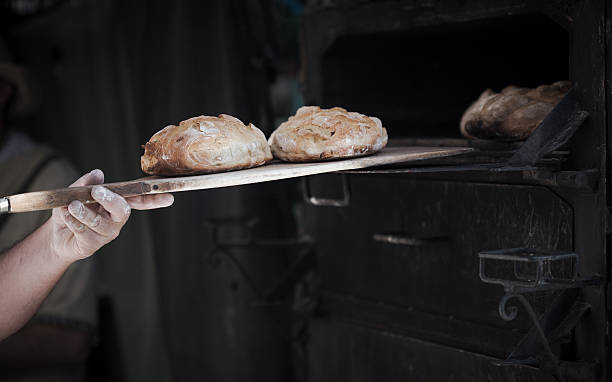
Because my roots are in Europe, where wheat reigns supreme, I go dreamy about foodstuffs made with wheat, a grass that was domesticated in the Middle East. And I go very dreamy about one particular foodstuff made with wheat: bread.

Source

Aaah, that wonderful smell that emanates from local bakeries!

Source

I remember still the delicious scents that wafted out of a bakery in Edinburgh, where I was a student in the early 1970s. It was halfway between my halls of residence and the hall where I was rehearsing plays with the university’s drama society. I would whizz by that bakery on my moped, passing through this cloud of deliciousness.

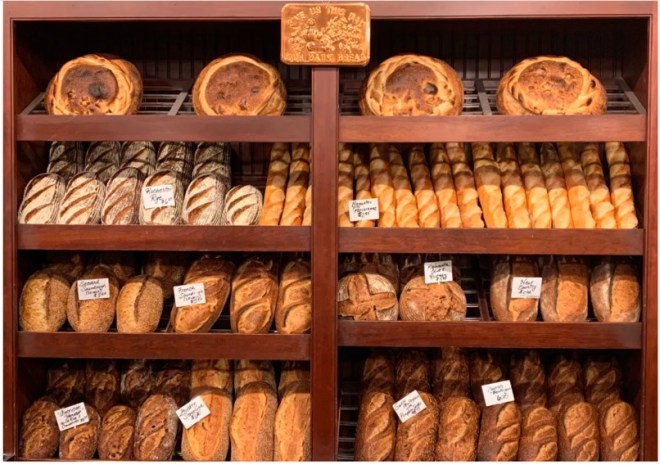
And the wonderful smell that will greet you as you step into a local bakery’s shop and are confronted by rows of freshly baked loaves!

Source

And the delicious taste as you sink your teeth into a loaf still warm from the oven!

Source

And even when the bread is cold the wonderful taste it will have after you’ve used it to mop up the sauce on your plate.

Source

Or the way it will heighten the taste of a hunk of cheese.

Source

Or of the butter and marmalade you’ve spread onto it.

Source

Mm, yes, bread … (I should note in passing that my heightened appreciation of bread comes from the fact that I eat little of it now – the diet, you know …)

It seems that we have the Ancient Egyptians to thank for these sensory wonders. It is the leavening of bread with yeast that gives bread that very special smell and taste.

Source

And leavening is a discovery the Ancient Egyptians stumbled across. Quite how they did so is a matter of lively debate, at least in certain circles. The theory I most approve of (although no-one is asking for my approval) suggests a serendipitous cross-over from beer making. The making of beer was (and of course still is) another yeast-aided process working on a mash of grains from another grass domesticated in the Middle East, in this case barley. The theory goes that some Ancient Egyptian involved in the making of both unleavened flatbread and beer accidentally splashed some of the beer’s yeast-laden froth (which goes by the delightful name of barm) onto some dough they had prepared. Then for some reason they left the dough to rest for a while (maybe it was evening). When they came back, they saw that the dough had risen. Instead of throwing it away as spoilt, they baked it anyway (maybe supplies of food were limited and they were hungry), and they saw what a marvel resulted.

It can’t have been that simple, there must have been a lot of tinkering after that first leavening of bread, but this story satisfies my fervid imagination. Here, we have small models showing the making of bread, which Ancient Egyptians placed in a tomb, presumably to ensure that the dead person would get to eat bread in the afterlife.

Source

Here we have a similar set of small models from another tomb, showing the brewing of beer.

Source

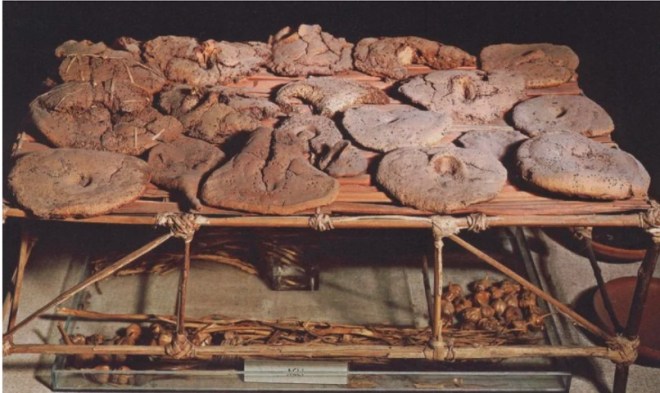
And here we have some real Ancient Egyptian bread loaves found as grave goods.

Source

I grant you they don’t look terribly edible, but they have been sitting in a grave for several thousands of years after all.

At some point, someone – yet again an Ancient Egyptian, I’m thinking – came up with the idea of keeping back a piece of the leavened dough to inoculate the next batch of unleavened dough. And at some other point, I’m guessing also in Ancient Egypt, leavened dough got contaminated with lactic acid bacteria. Maybe the bacteria were on the hands of the people kneading the dough; they had picked them up touching milk products. Or maybe another pathway came into play. However the contamination occurred, it led to the creation of sourdough; it is these bacteria that give sourdough bread its characteristic sour taste. And so nearly all the pieces were in place for the making of sourdough bread for the next five millennia or so – because until the middle of the 19th Century sourdough bread dominated bread making with wheat.

The last piece of the puzzle was the baking oven. It seems that we have the Ancient Greeks to thank for that. What they came up with must have looked quite similar to the wood-fed ovens which any self-respecting pizzeria will install today.

Source

The cupola shape of these ovens concentrates the heat radiating from the bricks onto the oven’s centre, making it more efficient (and thereby lessening the chore for our ancestors of having to go out to collect wood). And progress in oven-building meant that large ovens could be built, in which multiple loaves could be baked at the same time. Thus was born the profession of the baker (which, among many other things, eventually led centuries later to that delightfully ridiculous nursery rhyme “Rub-a-dub-dub, three maids in a tub, And who do you think were there? The butcher, the baker, the candlestick-maker, And all of them gone to the fair”).

The Ancient Greeks seem also to have taught the uncouth Romans to eat leavened wheat bread. In fairness to the Romans, they weren’t really that different from anyone else in this uncouthness. Originally, they baked flatbread with their grains, or simply ate them in gruel like our Neolithic ancestors had done – but also like many, mostly poor, people have done ever since. I don’t claim to be poor, but the only way I eat oats – another of the grasses domesticated in the Middle East – is as a viscous gruel known to all and sundry as porridge.

Source

And the Italians have what is now a chi-chi dish, zuppa di farro, which originally was just a gruel made with grains of spelt, an early form of wheat which has now all but disappeared.

Source

However, once introduced to the joys of leavened wheat bread, the Romans got into it with a vengeance. And of course evidence of this new enthusiasm of theirs came to light in the ruins of Pompeii, in the form of now burnt loaves of bread abandoned in the town’s bakeries as Mount Vesuvius erupted and the workers ran for their lives.

Source

Perhaps it had already happened elsewhere, but certainly in Rome class reared its ugly head in the matter of bread eating: bread made with the most refined, and so costly, wheat flour, was eaten by the rich, while the poor made do with bread made with poorly sifted whole wheat flour or even a mix of wheat flour and the flour of other grains like barley or oats. That translated into a colour bar: the crumb of the most expensive bread was white while that of the least expensive bread was various shades of brown.

Source

It’s ironic, really, that the rich were eating the nutritionally poorest bread … But at least they were eating other things which could make up for the loss of nutrition in their expensive bread. The poor, on the other hand, had little but bread to eat. Which is why already from the times of the late Republic the Roman governing class was handing out free or subsidised wheat to the poor in Rome, to keep them happy – and politically passive. The Roman poet Juvenal decried this in one of his Satires: “Already long ago, from when we sold our vote to no man, the People abdicated their duties; for the People who once handed out military command, high civil office, legions – everything, now restrains itself and anxiously hopes for just two things: bread and circuses” (it’s a comment that George Orwell updated in his novel 1984 when he described “the Proles”: “Heavy physical work, the care of home and children, petty quarrels with neighbours, films, football, beer and, above all, gambling filled up the horizon of their minds. To keep them in control was not difficult.”)

Fast forward another thousand years or so and we are in Europe’s Middle Ages. The rich were still eating white bread and the poor brown-to-black bread, and bread was still the most important part of the poor’s diet. So nothing much had changed. But if I pause here, it’s because of a very interesting habit we find in rich households regarding tableware. Basically, bread was not just a food, it was also used as a plate. A round piece of, often stale, bread was cut from a large loaf – hence the English name of this tableware, trencher, from the French “trancher”, to cut. The food was ladled onto the trencher, which would absorb any juice or gravy. The illustration below shows trenchers being prepared. It comes from “Les Tres Riches Heures du Duc de Berry”, a prayer book put together during the first half of the 1400s for the said Duke, who we see sitting at the table.

Source

Once the food had been eaten, the trencher, now softened, was cut up and also eaten.

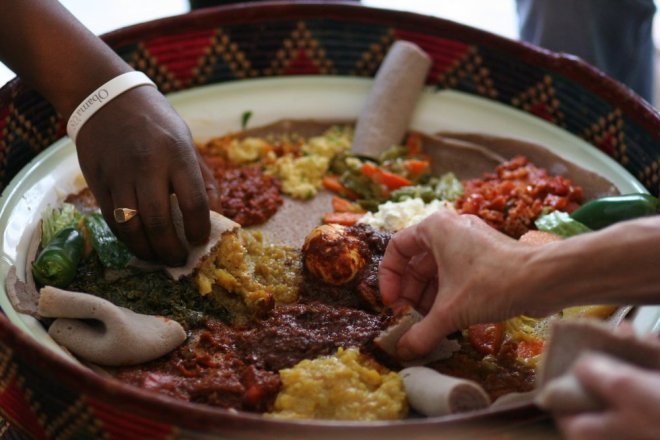
I find this a wonderful way of eating bread. It’s sad that trenchers began to be made of metal or wood, later to be replaced by the plates we are all familiar with today. The only culture that I know of which uses bread in this way is that of the Ethiopian Highlands, where the food is placed on injera, made with flour from the local grain, teff (although, as this photo shows, nowadays the injera is in turn placed on a plate).

Source

Injera is also used as the utensils to pick up the food.

Source

But back to the bread trencher, where there was a similar relation between rich and poor as there had been in Rome over free supplies of bread. If the harvests had been good, if food in the household was plentiful, if the lady of the house was feeling generous or pious, rather than being eaten the used trencher could instead be given to the poor for them to eat. Or it could be fed to the dogs (which is what the Duc de Berry’s servants seem to be doing in the bottom right-hand corner of the illustration). I suppose when supplies were tight and household ate their own trenchers, the poor were just left to starve.

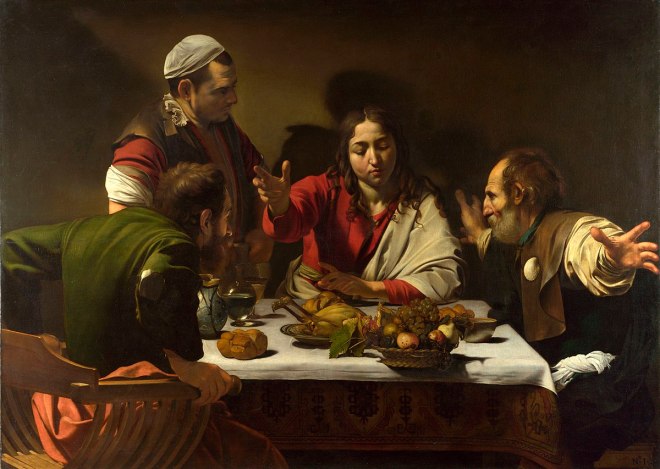
Bread had now also taken on strong religious overtones in Christian lands, because of the role which bread played in the Last Supper. Many are the paintings of the Last Supper, probably the most famous being the fresco by Leonardo da Vinci. But I won’t show a photo of that fresco. It’s too well known, and anyway you can hardly see anything, it’s in such a bad state of conservation. I’ll throw in a painting by Caravaggio instead, and not of the Last Supper but of the Supper at Emmaus. As recounted in St. Luke’s Gospel (in the King James Version):

And, behold, two of them went that same day [the day of the resurrection] to a village called Emmaus, which was from Jerusalem about threescore furlongs. And they talked together of all these things which had happened. And it came to pass, that, while they communed together and reasoned, Jesus himself drew near, and went with them. But their eyes were holden that they should not know him. … And they drew nigh unto the village, whither they went: and he made as though he would have gone further. But they constrained him, saying, Abide with us: for it is toward evening, and the day is far spent. And he went in to tarry with them. And it came to pass, as he sat at meat with them, he took bread, and blessed it, and brake, and gave to them. And their eyes were opened, and they knew him; and he vanished out of their sight.

Source

You can see the bread loaves Jesus is blessing on the table in front of each of them (I should note in passing that my timing here is excellent, today being Easter Sunday, the day this meeting in Emmaus would have taken place).

The formal theme of Caravaggio’s painting might be religious, but what I see in it is companionship: the Latin roots of the word “companion” are cum and panis, “together with bread”. I find it deeply satisfying that bread was considered not just a food but also a strong binder of friends.

And so we whizz on through the centuries, to stop again at the International Exposition of 1867, which was held in Paris.

Source

It was here that Austria presented the first breads made not with sourdough but with much purer strains of yeast uncontaminated with lactic acid bacteria (later known as baker’s yeast). I will show just one of these breads, the Kaisersemmel, for the simple reason that I eat this from time to time during our sojourns in Vienna.

Source

Many people tried the Austrians’ bread at the Exposition and liked it. Why? Because it tasted “sweet”; it didn’t have that characteristic sour taste of bread made with sourdough. This new, exciting way of making bread, the so-called Vienna Process, caught on. And so, perhaps without anyone really noticing, a fundamental shift started taking place for the peoples in Europe, North Africa, and the Middle East who ate leavened wheat bread: they slowly abandoned the sourdough bread which their ancestors had eaten for thousands of years for “sweet” bread. Today, sourdough bread is a niche product.

Was the switch away from sourdough bread a tragedy? I don’t think so. But then, I like sweet bread. I’m quite partial to a Kaisersemmel, for instance, and I will kill for a warm, crusty baguette.

Source

What was definitely a tragedy was the tinkering that went on from the mid-180Os onwards to find ways to make bread faster. “Time is money!” we are told, and never was this aphorism truer than in breadmaking. Making a loaf of sourdough bread takes 24 hours or more from start to finish. Anything to speed this up meant more loaves could be made, and sold, every 24 hours; already the Vienna Process was faster than the traditional method. This tinkering eventually led the British to invent the Chorleywood bread process in 1961. Without going into the technical details, this process can make a loaf of bread from start to finish (sliced and packaged) in about three and a half hours. It results in this hideous kind of product.

Source

A soft, limp crumb, a miserably thin crust, a thing that you don’t need teeth to eat. Dreadful. The only thing it’s good for is to make toast, which probably explains why toast is so popular in the UK.

Source

And so we have followed the rise – literal as well as metaphorical – of leavened wheat bread and its fall into limpness, softness, and general yuckiness. Luckily, it seems that there is a revival of Real Bread, sourdough bread. Rise (again) Sour-dough!

Source

SAINT TECLA

Milan, 18 November 2024

Ever since 2016, when I wrote a post about Saint Radegund I’ve been meaning on and off – more off than on, I should say – to write a post about Saint Tecla, as part of my sub-category of posts on obscure saints whose names still dot the European landscape; in this particular case, a small road behind Milan’s Duomo is called after her. The last post in the series, from this summer, was about Sankt Ilgen. Two days ago, at the end of a hike which my wife and I did on Lake Como, I came across a church dedicated to Saint Tecla, in the village of Torno. It’s not a particularly interesting church. This is what the exterior looks like.

Source

And this is a view of its interior.

Source

Quite honestly, the view from the church’s door across Lake Como is more interesting.

Source

Nevertheless, I took my bumping into this church as A Sign that I should finally get my finger out and write this post.

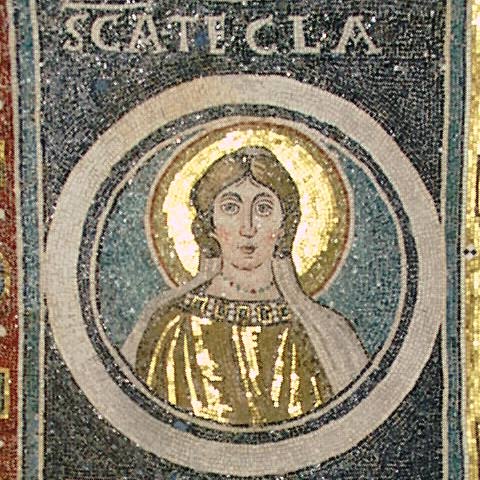
So who was this Saint Tecla? (and by the way, I prefer to use the Italian – and Spanish and Portuguese – spelling of her name rather than the English Thecla) Let me start by inserting a photo of a 6th Century mosaic portrait of her which graces the Basilica Eufrasiana in the town of Poreč in Istria, in Croatia.

Source

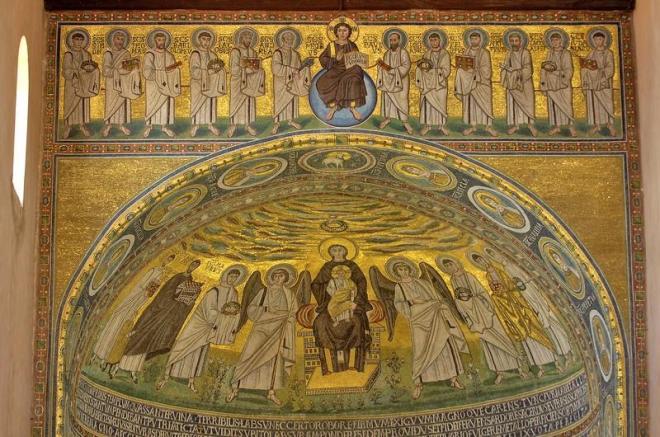
For any of my readers who are interested in early Christian mosaics and have never visited the Basilica Eufrasiana, I suggest that you do so. I throw in a couple of photos of the mosaics there to whet their appetite.

Source
Source
Source

Readers with good eyesight will see that the portrait of Saint Tecla is one of the portraits on the inside of the arch, to the right.

Given her great popularity in Christian Orthodox religions (probably much greater now than it is in Western Christian religions), I also throw in a photo of a depiction of her in a manuscript produced for the Eastern Roman Emperor Basil II in the 11th Century.

Source

Of course, neither of these portraits is from life. And in fact, there is a good chance that Tecla never had a life – the Roman Catholic church quietly dropped her from its official Martyrology back in 1969, which normally occurred because there was a lack of historical evidence that the saint or martyr in question ever existed. But let us put this cavil aside, and see what her various hagiographers had to say about her.

Tecla was believed to have come from Iconium in the Roman province of Galatia (now Konya in the modern country of Türkiye). The story goes that when St. Paul passed through Iconium on his second missionary journey, Tecla was transfixed by his sermons. Here is the scene depicted in an altar carved in the 15th Century for a chapel in the cathedral of Saragossa in Spain, but which now resides in New York’s Metropolitan Museum of Art’s Cloisters. That’s Saint Tecla at the the window of her house. Note the man (I think) stroking his chin pensively down at the right; a nice touch.

Source

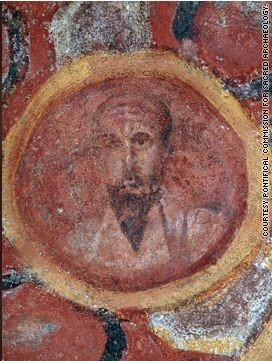
Unfortunately, Saint Paul seems to have lost his head. No worries, let me throw in a photo here of a fresco of St. Paul’s head, recently uncovered through the clever use of a laser-based technology, in a 4th Century catacomb named after St. Tecla, in Rome. This, I read, is the oldest extant solo portrait of the Apostle. I’m intrigued by the very pointy beard; I have never imagined Paul with that kind of beard.

Source

Continuing on with Tecla’s story, she declared to her mother Theocleia and her fiancé Thamyris that she was abandoning her marriage plans and would join Paul. Both Theocleia and Thamyris were alarmed at this attempt at independence and decided to drag both Paul and Tecla before the city governor. Paul was merely sentenced to scourging and expulsion, but Tecla was to be burned at the stake. Turning again to that altar which once resided in Saragossa’s cathedral, we have the scene sculpted in alabaster. The sources say she was stripped naked, but that clearly didn’t play well with the sculptor and/or the donor.

Source

Miraculously, a storm blew up, which doused the pyre. Personally, I would have put her back in gaol, built another pyre, and had a second go. But no, she was freed, whereupon she joined Paul, cut off her hair (I always find it interesting that hair is considered – by male authors? – such a sign of femininity, the cutting of which signifies renunciation of physical attraction), and followed him. And off they went to Antioch in Pisidia (nowadays called Yalvaç). There – even without her hair – she drew the lascivious attention of one Alexander, a nobleman of the city. He attempted to take her by force, but she fought him off, tearing off his cloak and knocking the coronet off his head in the process, much to the amusement of the townspeople. Seemingly, then, Alexander attempted this rape of Tecla, for that is what it seems to have been, in public, which is a little odd. Or maybe the writer of the story wanted to show the arrogance of power.

In any event, Alexander felt greatly injured in his aristocratic pride and had her dragged – yet again – in front of the city’s governor for assaulting a nobleman. This time, the governor condemned her to be thrown to the wild beasts (as an aside, I have to say that hagiographers of the early Christian martyrs all seem to have been working off the same playbook; martyrs were either burned at the stake, tortured in hideous ways, thrown into rivers with heavy weights around them, or thrown to wild beasts, or some combination of these). Interestingly, the women of Antioch rose up as one against the sentence, although it changed nothing (I think the hagiographers’ intention was to intimate that Tecla was a natural leader of women).

And so she was paraded through the streets of Antioch, stripped of her clothes (again), and thrust into the arena. The men in the crowds were baying for blood, the women were weeping for poor Tecla (taken by the spirit of the story, I have added this bit; as far as I know, none of the hagiographers said it, although they do make clear that the women in the crowd were rooting for Tecla). Miracle! Some of the wild animals (female) protected her from other (male) animals. A lioness was especially active in defending Tecla. We see the scene here in a 15th Century altar from the chapel of the Cathedral of Tarragona in Spain (in passing, I should note that Saint Tecla is the patron saint of Tarragona). In this case, the sculptor had no problems making Tecla at least half naked. Note all the animals lying meekly at her feet. I like, too, the crowd pressing in to see what’s happening.
Source

At this point, the story gets somewhat muddled for me. Reading between the lines, and giving my fervid imagination free rein, I’m guessing that the organizers of this spectacle had thought up the idea of having a large vat in the arena full of ravenous seals. They must have thought they could throw the remains of Tecla, once she had been ripped to pieces by the wild beasts, into the vat (although I wonder if seals would eat human remains; but hey, what do I know?). But Tecla had other ideas. She had asked Paul to baptize her, although for some reason he had temporized. Standing in that arena, surrounded by wild – but currently meek – animals, she decided that before she died in that arena, she would baptize herself. Note once again her streak of independence: baptizing yourself?! impossible; only men can baptize people! Nevertheless, she threw herself into the vat. The altar in Tarragona’s cathedral gives us once again a vision of this scene.

Source

I’m not sure what has happened to the arena and its crowds, we seem to have a more sylvan scene. I also get the impression that the sculptor had no idea what seals looked like, he seems to have come up with a bunch of eels. But le’s not niggle, because another miracle occurred! The vat was struck by lightning, which killed all the seals – but of course not Tecla.

All these miracles were too much for the governor. He ordered her clothed and released her to the rejoicing women of the city. She returned to Paul, “wearing a mantle that she had altered so as to make a man’s cloak” (an important phrase for future generations of some women, who looked to Tecla as an example of breaking the eternal glass ceiling for women). She went on to convert many people, including her mother, to Christianity, and then retired to a cave near Seleucia (today’s Silifke) where she lived for many decades. This is the exterior of the cave.

Source

And this is a shot of its interior, which has been turned into a church.

Source

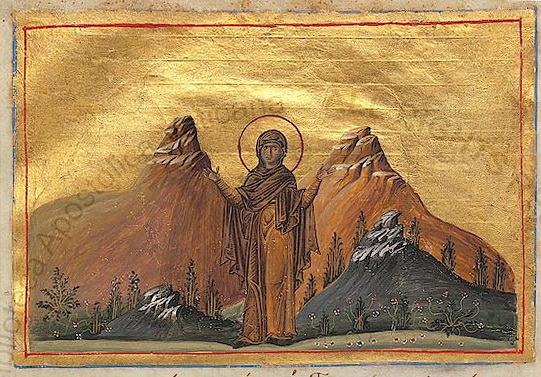
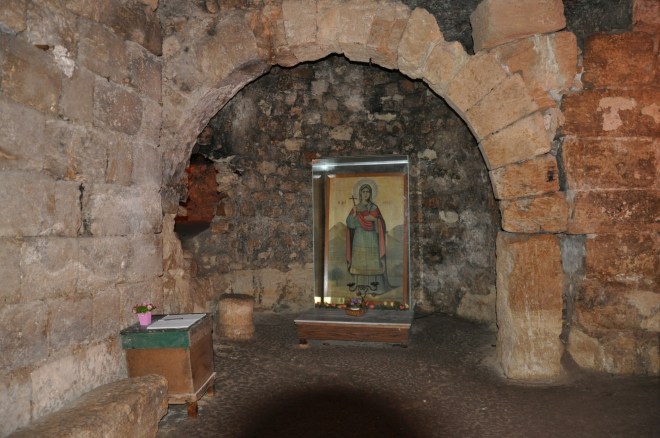
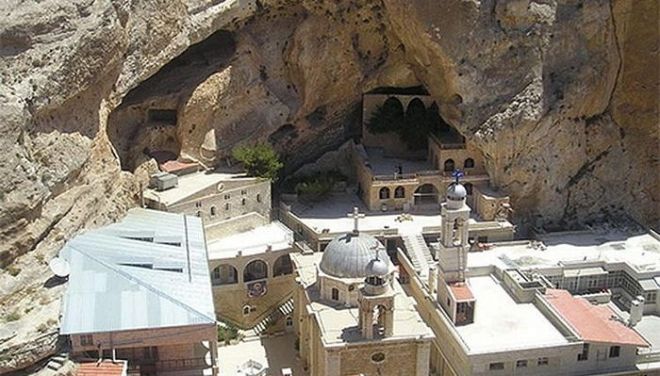
I would be remiss if I didn’t point out that there is a rival story that Tecla did indeed spend her last years in a cave, but in the small town of Maaloula in what was then the kingdom of the Nabateans, close allies of the Romans, and in what is now Syria. It seems a far more dramatic site, and has a Christian Orthodox church and nunnery built next to it.

Source

The site, alas, has fallen prey to modern religious wars. ISIS fighters invaded Maaloula in 2013, going on a rampage against Christian people and buildings, destroying all religious sites in the town. 3,000 fled the city, leaving only Muslims and the nunnery’s forty nuns. Twelve of them were kidnapped, and after negotiations were release in 2014. The nuns were dispersed and were only able to come back to the town in 2018. Horrors continue to be committed in the name of religion …

There’s further bits and pieces to Tecla’s hagiography, but I’ll skip them. Given the story, it’s a bit of a mystery why Tecla was such a popular saint. As far as I can make out, her popularity rested on the fact that she offered early Christian women a strong example, equal to, not subordinate to, men. She offered a female equivalent to the – male – Apostles; she went around converting people just as much as Paul did. She threw off the bonds of what was a strongly patriarchal society – she broke off an engagement arranged by her family, in fact she turned her back altogether on marriage; she didn’t wait to be baptized by a man but just did it herself; she took to the road without a protecting male presence (although she seems to have had to pretend she was a man in order to do this). The Church Fathers, notably Ambrose of Milan, lauded her for her virginity – but I always suspect this approval of virginity by the Church, since it always seems to be tied to retiring from the world into a nunnery and being Wedded to Christ; the idea of being in this world on equal terms with men was anathema to the Church (and to society more generally). I suspect she could easily be the patron saint of this new B4 Movement coming out of South Korea.

Well, I’ll leave readers with a somewhat more modern take on Saint Tecla by El Greco, in his late 16th Century painting “The Virgin and Child with St. Martina and St. Tecla”. It was painted for the Oratory of St. Joseph in the city of Toledo, but is now in the National Gallery of Art in Washington, D.C.

Source

We will, of course, immediately recognize Tecla because of the lioness which is protecting her. She also, rather oddly, is holding a martyr’s palm – oddly, because she actually was never martyred. One of the many strange things about Tecla.

PLUMS – IT’S AUTUMN

Vienna, 23 September 2024

It’s that time of the year again. The time of plums here in Central Europe (or strictly speaking, European plums; there are so many different types of plums). On our hikes now we often see small plum trees covered in the dark purple fruit.

Source

I can never understand if these trees have seeded wild after the passage of some plum-munching, stone-spitting person, or if they were part of now abandoned communal orchards which were once a common feature in this part of the world (the so-called Streuobstwiesen, the scattered-fruit-meadows, meadows through which villages have sprinkled plum and other fruit trees for their communal use – a nice idea, I think).

Source
Source

However the plum trees got there, they are welcome indeed. When we come across them, we will fill our rucksacks with a few days’ worth of dessert and walk on.

Normally, when the plums arrive the weather is turning towards Autumn here. The days are drawing in, the temperatures are beginning to bite, it’s time to wear trousers when I hike and take a sweatshirt with me in case a cold wind picks up; time, too, to carry a waterproof jacket to counter the occasional shower.

As I eat my plums, I will often feel a pang of regret that the Summer is drawing to a close. But this Summer has been ferociously hot in Central Europe. So it is with a certain sense of relief that I bite into my plums these days, even as I grieve the massive damage caused by the recent floods to man, beast, and vegetation (including plum trees, no doubt).

Source

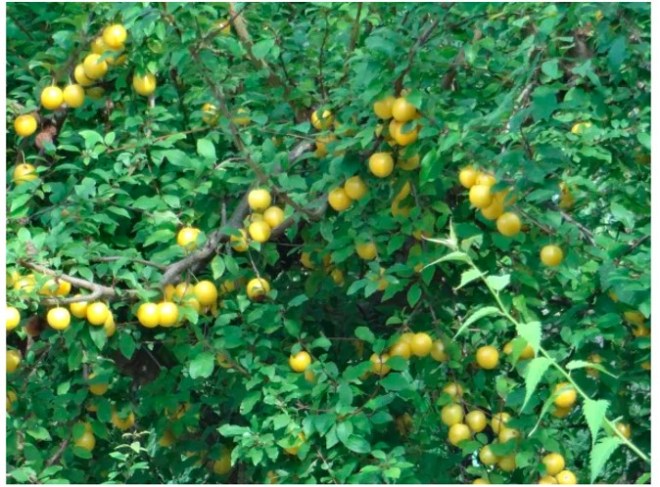
About a month ago, during our hikes we were coming across what looked like mirabelle plums: small, round, yellowish.

Source

They seemed to be wild, or at least feral, being used as fencing around gardens or just mixed up with other trees and bushes on the side of the paths. There were never any plums within reach, evidence that other gatherers had hiked these paths before us. All we were left with were plums that had been knocked off by wind or the heavy rains that we have been having this summer (a result of the intense heat). Many of these little plums were damaged and, judging by the taste, not necessarily all that ripe. We picked them up anyway; it breaks our heart to see this free bounty from Nature just being trampled underfoot. Our gatherer ancestors would never have countenanced such waste.

Talking of our ancestors, it seems that we human beings have been chomping on plums and spitting out the stones for a long, long time.  Archaeologists digging in Neolithic sites in Bulgaria, for instance, have found plum stones from 8,000 years ago. Some of the stones seem to belong to a wild plum called cherry plum.

Source

They do indeed look cherry-like, small and red. I don’t think I’ve ever seen this plum tree on our hikes. But that’s not too surprising since its natural range is South-West Europe (which includes Bulgaria, of course) and West Asia. So the Neolithic farmers who were drifting into Europe from Anatolia must have been very familiar with this tree. From articles I’ve read, I sense that most cherry plums tend to be on the sour side. But I also get the sense that our ancestors, until not too, too long ago, before the massive production of sugar, preferred sourer food, or at least were more tolerant of sourer food. That sourness still resonates with the descendants of our Neolithic ancestors in Romania and Georgia. They use cherry plums in their recipes as a souring note. The Georgians, for instance, use cherry plums to make Tkemalu sauce, a sour sauce, which is then a main ingredient in kharcho soup (mmm, looks good, I wonder if there’s a Georgian restaurant here in Vienna where I could try it?).

Source

Some other stones in those Bulgarian Neolithic sites, no doubt in the more recent archaeological layers, seem to show that domestication of the plum had begun to occur. It’s not very clear what species exactly got domesticated to give us the various types of plums we have in Europe: European plums, damsons, bullaces, egg plums, greengages, spillings, mirabelle plums, just to give the names we use in English. It could have been the cherry plum alone whose DNA was manipulated. Or it could have been that cherry plums were crossed with sloe plums.

Source

I came across a couple of bushes of sloe plums this summer as we crossed a meadow or two – not scattered-fruit-meadows, I should add, just ordinary meadows. The bushes were on the edges of these meadows, in that indeterminate zone between meadow and woods. I looked at them, thinking “they look like miniature plums” and wondering if they were edible. I went back and forth on trying them, but in the end I felt that discretion was the better part of valour. I didn’t want to keel over in a meadow, poisoned by some unknown plant. But now that I’ve done a bit of reading on plums, next time I come across them – next year at this point, God willing – I’ll give them a little nibble. I don’t expect the experience to be all that pleasant, I have read that sloe plums are quite tart. Maybe I’ll just drink sloe gin, a gin in which sloe plums have been marinated. That sounds a much more pleasant experience.

Source

THE COMMON RHODODENDRON – PRETTY FLOWER, INVASIVE SPECIES

Vienna, 30 July 2024

I mentioned briefly in my last post that our grandson had spent some time with us. Wonderful! But tiring. After we had waved him and his parents goodbye, my wife and I headed into the Austrian Alps for a few days of well-deserved R&R. Specifically, we went to a place called Schruns, which – for those readers who are interested – lies in the Austrian province of Vorarlberg. But provincial boundaries – or any boundaries, really – are just lines in our heads, abstractions we impose on the landscape which surrounds us. It would be better to say that Schruns sits in the lower part of the valley of the river Ill, a river that starts its course at the head of the high Alpine valley of Ochsental, up on the slopes of the Piz Buin (Ox Peak in the local Rhaeto-Romance language), the highest peak in Voralberg, and then runs through the 40-km long Montafon valley.

Sorry, let me immediately be clear that this post is not going to be a rant about the foolishness of borders. I just got carried away a bit as I wrote that last paragraph. No, it is actually the result of a hike that my wife and I did high up above Schruns, at 2300 m, on a beautiful, sunny day. Here we are at the top, looking down at Schruns in the Montafon valley below.

My photo

In case any readers are wondering, we did not hike up the 1600 metres up to the top of the mountain from Schruns. Dedicated hikers we may be, but not fanatics. We took a gondola lift up 1200 metres and then hiked up the rest of the way. In that climb, we passed through a huge field of dwarf rhododendron.

My photo
My photo
My photo
My photo

I have to say that, although the sight was very pretty, my heart sank when I saw those rhododendrons. You see, I was under the impression that all rhododendrons originally came from the Himalayas, that I was in front of an introduced species, and – based on something I had read somewhere – that rhododendrons in Europe were now an invasive species, a topic I have written about in several posts. I was biased towards this thinking by my sighting, the previous day, on a hike along the river Ill of thick stands of Himalayan Balsam, which as I’ve reported in an earlier post is indeed an invasive species here in Europe. So it was with a certain grimness that I photographed another patch of rhododendrons on a hillside in front of where we had lunch on the edges of a small Alpine pond.

My photo

Well, I’m glad to report that I was completely wrong. Yes, the Himalayas do host a large number of rhododendron species, as – surprisingly to my mind – do Papua New Guinea and Borneo. But there are a number of rhododendron species native to North America, and – key to this post – a few rhododendron species native to Europe. I am extremely glad to tell readers that two of these, closely related to each other, are native to the Alps, so no invasive species on our hike! They are the alpenrose, Rhododendron ferrugineum

Source

and the hairy alpenrose, R. hirsutum.

Source

I think readers will agree that there doesn’t seem to be much difference between the two. The biggest difference seems to be in the leaves. The undersides of the alpenrose’s leaves are covered in rust-brown spots, while the hairy alpenrose’s leaves have hairy edges. The pH of the soil is a prime decider of what Alp they will grow on, with the alpenrose favouring acidic soils and the hairy alpenrose alkaline soils. I suspect that once upon a time the two were one and the same species, and then they began to diverge as they adapted to different soils. They are still close enough so that they will hybridise where their ranges overlap. Since I have absolutely no idea what the pH of the soil is in the mountains above Schruns, I have correspondingly no idea which of the two alpenroses my wife and I were looking at on our hike. And I certainly didn’t get down on my knees to have a closer look at their leaves.

But where did I get this idea that rhododendrons are an invasive species? I can’t have dreamed it. Well, it turns out that there is another European species, the common or pontic rhododendron, R. ponticum, which is indeed invasive. Actually, as in the case of the alpenroses, there are two closely related species. One, the subspecies ponticum, is found around the southern Black Sea basin (hence its name) and all the way to Georgia and the northern Caucasus, with a presence also in Lebanon.

Source

The other, subspecies baeticum, is found in a few damp valleys in a couple of mountain ranges in central and southern Portugal and southern Spain.

Source

It is this latter subspecies that has become an invasive species in the UK and more generally in Western Europe. Its story is typical of the period when Europeans went around the world hunting for “pretty plants”, plants which simply gave pleasure because of their flowers, foliage, shape, or other characteristics. This started in the early 18th century; of course, the global trade in plants had started several centuries earlier, immediately after Europe’s discovery of the Americas, but in those earlier centuries people were interested only in plants that were commercially interesting. The common rhododendron ssp. baeticum was an early example of this massive movement of pretty plants around the world. It seems that it was brought to England in 1763 through that British foothold on the Iberian peninsula, Gibraltar, which is located quite close to its natural range. A new plant nursery in Hackney, run by a German émigré by the name of Joachim Conrad Loddiges, was the first to make the common rhododendron’s seeds available. One of the early buyers from Loddiges was the 2nd Marquess of Rockingham, who had the distinction of being British Prime Minister twice.
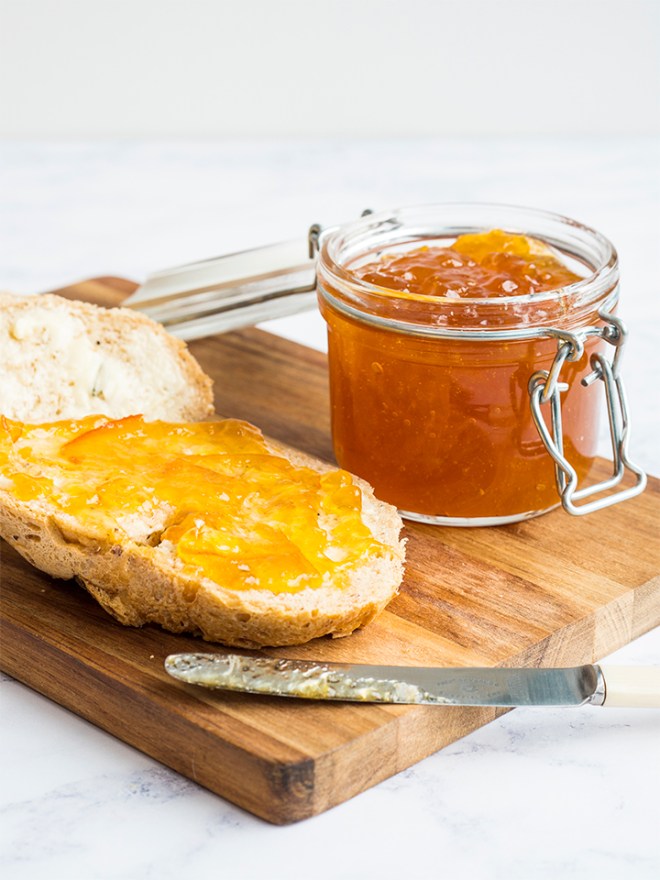
Source

As readers can imagine, in those days, when Respect for one’s Betters was much more engrained, where such a Distinguished Personage went others were sure to follow.  The result was that the planting of common rhododendrons in posh and then not so posh gardens quickly spread. Of course, it helped that it had a really pretty flower. But then most rhododendrons do. The craze for rhododendrons expanded as new species of rhododendrons, from North America and then from Asia, poured into the UK and Europe more generally. Rhododendrons hybridise quite easily, which added to the excitement as gardeners hybridised rhododendrons with abandon to create plants with ever more glamorous  flowers. Often, to speed things up, new species were grafted onto the rootstock of common rhododendrons; the latter were tough and often there already, so it made for a quick way to turn your garden into a splendid glade of multi-hued rhododendrons. I throw in here photos of some modern examples of such dazzling displays of rhododendrons. The first, fittingly, is from Wentworth House in Yorkshire, one of two country houses that our friend the 2nd Marquess of Rockingham once owned.

Source
Source
Source

Just to remind ourselves that it’s not just grand gardens that have rhododendrons, here’s one – maybe a common rhododendron, but you can’t tell, what with all the hybrids around – in someone’s back garden.

Source

Alas! As far as the common rhododendron was concerned, it all turned out to be too good to be true. By the 1970s if not before, people had realised that it was a horribly invasive species. Primarily because of its huge production of seeds, it quite easily “hops over” garden fences and – if the soil and climate on the other side is welcoming – it goes feral. Then, once the plant has rooted, the roots send up suckers, which in no time at all grow into new bushes. The branches of all these bushes layer tightly together, blocking out sunlight and stopping anything else from growing. And to cap it all, many of the rhododendrons which were grafted onto the rootstock of common rhododendrons reverted to common rhododendrons if they weren’t looked after, creating yet more common rhododendron plants ready to hop over garden fences. The net result was thick stands of common rhododendrons taking over large swathes of land.

Source

Here, a stand of common rhododendron is slowly engulfing a bus stop.

Source

Well, who cares about a bus stop? But the common rhododendrons are choking stream beds and the understory of woods. They also carry a family of pathogens that can kill certain species of trees. This map shows the distribution of the common rhododendron, both inside gardens and out, throughout the UK and Ireland in the early 1970s.

Source: J.R. Cross, “Rhododendron Ponticum L.”, Jnl. Ecology, Vol. 63, No. 1, pp.345-364, Mar. 1975

Readers will notice dense patches of dots in many places in the UK, as well as in Ireland. Western Scotland and Snowdonia in Wales have been especially badly affected. Eradication programmes are underway. But it’s hard (and therefore expensive) work.

Source
Source

And you have to come back for at least five years after you’ve cleared a patch, to ensure that no roots were left which have thrown up suckers and no seeds were left which have sprouted. And now scientists have discovered that after you’ve cleared  a patch it’s not a given that the cleared land will revert back to its original composition of plants; the balance has been disturbed and some plants may move back in faster than others and stop the slower movers from recolonising the land. So more work will be required to ensure that the original plant composition returns.

There is something really quite ironic about the common rhododendron letting rip and taking over large swathes of British, and other European, countryside. Back in the Iberian peninsula, where the plant came from originally, it is hanging on by its fingernails. It is a relict population from the the original laurissilva forests which covered the Iberian peninsula 66 million years ago, It is no longer suited to the dry climate in Iberia and has retreated into a few damp valleys. Reproduction is largely confined to the roots sending out suckers as the climate is now too dry for seedlings to survive. With climate change turning the southern part of the Iberian peninsula into a semi-desert, I suspect it will expire there. But, luckily for it, and unluckily for other plants, a bunch of ignorant plant traders brought it into an ecological niche where it just thrives, thank you very much! Of course, we can’t really blame the people who back in 1763 carried the plant to the UK, no-one then had the knowledge of what impacts there can be from moving plants around the planet. But now we do know, and yet we still do it. Are we stupid or what?!

Sorry, I can sense another rant coming on, time to stop. But if any of my readers have common rhododendrons in their gardens I beg them to rip them out without delay. If they really want rhododendrons, there are many, many equally pretty rhododendrons which do not “go forth and multiply”, as the Bible has it.