SAINT ERASMUS AND HIS GUTS

Milan, 18 March 2025

My wife and I recently went to an exhibition at the Gallerie d’Italia, a relatively new museum in Milan which is situated right next to the Scala. The exhibition’s title, “The Genius of Milan. Crossroads of the Arts from the Cathedral Workshop to the Twentieth Century”, didn’t really reveal what the exhibition was about, and I’m not sure I had any better idea after our visit. I think it was trying to show how many non-Milanese artists had come to Milan over the centuries and flourished there, but I wouldn’t swear to it.

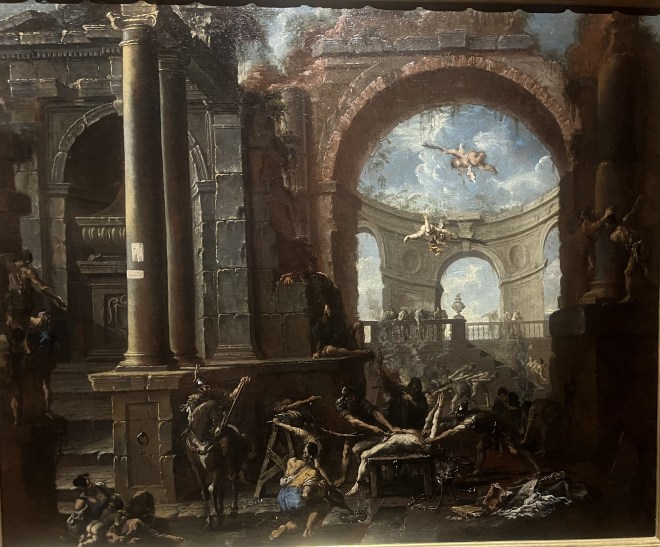
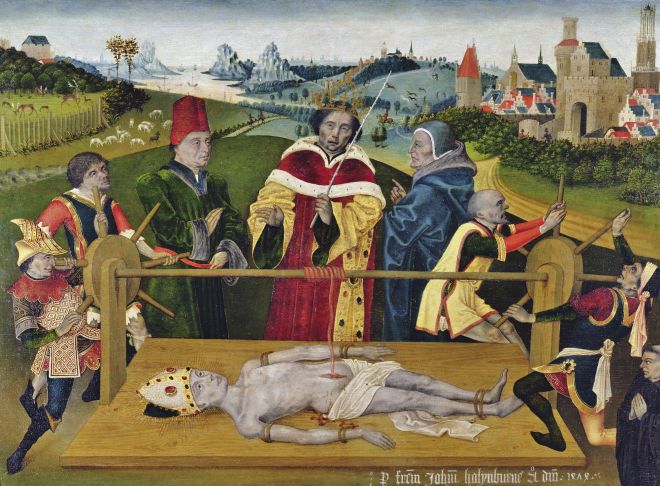
In any event, at some point I was suddenly transfixed by this painting, which shows in horrible, gory detail some poor guy having his entrails pulled out of him and wound around some contraption or other.

My photo

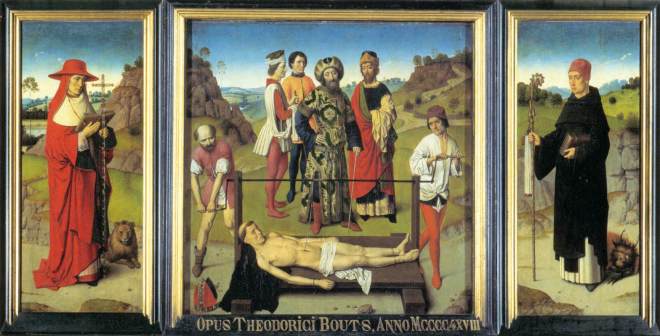
The painting’s label helpfully informed me that the poor guy in question was Saint Erasmus and he was being martyred. It was clearly a popular subject, because there was another painting just across the way about the same thing.

My photo

I’ve mentioned in past posts that early and Medieval Christians loved dreaming up horrible deaths for martyrs, but this one really took the biscuit! What sadistic mind came up with this one? And how did this particular form of torture even cross their mind?! I had, of course, to do some research.

As usual, as written up in the various pious hagiographies which appeared from at least the 5th Century onwards, St. Erasmus’s life seems to be one long muddle. So I’m going to more or less ignore these and sketch out what I think happened, not so much to Erasmus himself as to the legends which clustered around him and to the way he was portrayed in paintings.

It would seem that Erasmus started out as a local saint in the city of Formiae, a Roman port city some 90 km up the coast from Naples. Perhaps he was a bishop there. Bishop or no, there is a good chance that he was martyred in the city during Emperor Diocletian’s campaign of persecution, which ran with differing degrees of intensity from 303 AD to 313 AD. In later centuries, when relics of martyrs and saints became so important, his remains must have been reverently kept by the citizens of Formiae. Probably, too, to bolster the importance of his relics, legends about wondrous deeds performed by Erasmus began to circulate. One of these, which is important for our story, has him continuing to preach even after a thunderbolt struck the ground beside him. By the 5th Century, manuscripts also relating his nasty, vicious martyrdom at the hands of various Emperors were already circulating.

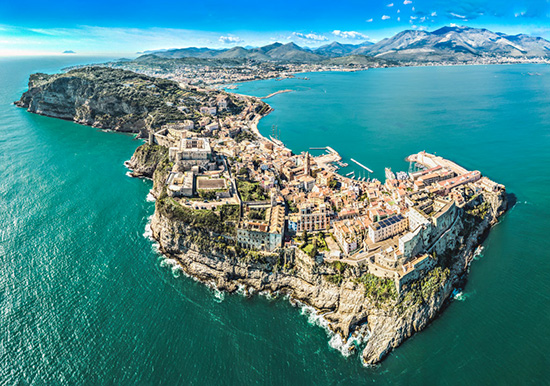
In the meantime, back in the real world, things were not going too well for Formiae. After suffering badly at the hands of the barbarians who flowed into Italy during the death throes of the western Roman Empire, it was razed to the ground in 842 AD by “Saracen” pirates who came from the sea. Its citizens ran – literally – for the hills, and that was the end of Formiae. Luckily, before the city was finally trashed, Erasmus’s precious relics were transported over the bay to nearby Gaeta, which was located on a much more defensible position, as this photo shows, and managed to hold off the pirates.

Source

The relics are held to this day in Gaeta’s cathedral, along with the relics of four or five other saints, in a large crypt built in the early 17th Century.

Source

In the 9th Century, when the relics were transferred from Formiae, and for a few centuries thereafter, Gaeta was a marine republic, like the ones on the Sorrentine peninsula further south, and very much in competition with them. Shipping was the backbone of the city’s prosperity, and the city’s sailors adopted Erasmus – one of Gaeta’s patron saints now that they owned his relics – as their personal patron saint. It seems that they chose him on the basis of that story I mentioned earlier, of him being unperturbed by a lightning bolt hitting the ground next to him. One of the perils which sailors ran (and still run) were violent storms. It’s not surprising that so many of the ex-votos found in churches in port cities have as their subject a sailor who was saved during a storm.

Source

During such storms their boats could get hit by lightning. And so Erasmus became one of the patron saints of sailors. In this guise, he was often associated with the crank of a windlass. This may seem odd to readers, but windlasses were used on boats to pull up or let out an anchor or other heavy weights. The heavy weight is tied to a rope, the rope – maybe threaded through a winch – is wound around a barrel, which sailors turn using a crank (K in the diagram below).

Source

It looks like people simplified everything by just associating the crank with Erasmus.

St. Erasmus’s connection in the minds of sailors to lightning got them to also connect him to another electrical phenomenon which sailing ships were (and still are) subject to. In brief, during thunderstorms, when high-voltage differentials are present between the clouds and the ground, oxygen and nitrogen molecules in the air can get ionized around the point of any rod-like object and glow faintly blue or violet. Well, of course, sailing ships in the old days had lots of rod-like objects, like masts or spars or booms, and when conditions were right there would be a faint glow at the end of all these. Here is a print of an old sailing ship with these ghostly “flames” on the ends of its masts and spars.

Source

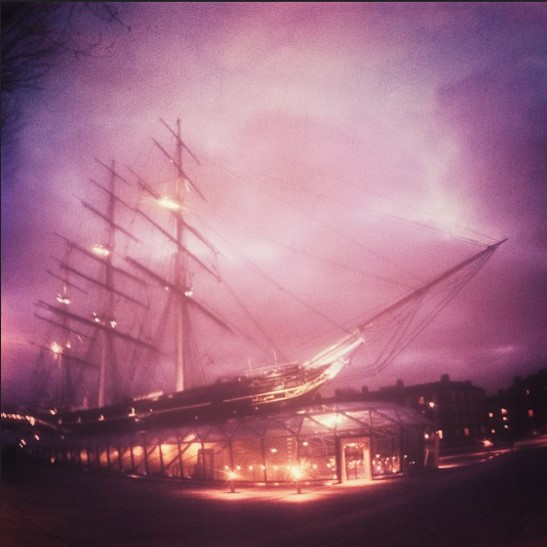
And here is a modern photo of the phenomenon around a clipper ship, the Cutty Sark, moored on the Thames in London.

Source

Well, of course, sailors knew nothing of the physics behind the phenomenon. They interpreted those little flames as meaning that St. Erasmus was protecting their ship, especially since the phenomenon often occurred before the thunder and lightning started. And so the phenomenon become known as St. Elmo’s Fire (Elmo being an Italian corruption of Erasmus).

In a parallel universe, various martyrologies continued to be published over the ages, full of the usual hideous tortures meted out to martyrs. But nothing yet about poor Erasmus’s entrails being pulled out of him. Then, in about 1260, a certain Jacobus de Voragine published his martyrology under the title The Golden Legend. His story about Erasmus recycled many of the tortures covered in previous martyrologies to which the saint had been subjected. But then, Jacobus slipped in a brand new torture. In his words (translated into English by Wynken de Worde in 1527):

“[…] the emperor […] waxed out of his wit for anger, and called with a loud voice like as he had been mad, and said: This is the devil, shall we not bring this caitiff to death? Then found he a counsel for to make a windlass, […] and they laid this holy martyr under the windlass all naked upon a table, and cut him upon his belly, and wound out his guts or bowels out of his blessed body.”

Here is how the scene was depicted in one of the early editions of the Golden Legend (in case any readers are interested, the two fellows on the left having their heads chopped off are Saints Processus and Martinian).

Source

Now, I said at the beginning, how did this particular form of torture ever cross Jacobus’s or someone else’s mind? Well, it has been suggested – and it doesn’t sound improbable – that whoever dreamed it up found inspiration (if that’s the word) from the association of Erasmus with the crank of a windlass. Presumably they assumed that the windlass had to have something to do with his martyrdom. After all, the depictions of many martyrs have them holding the instruments of their torture. Saint Lawrence, for instance, leaning on the grill he was roasted on:

Source

Or Saint Bartholomew carrying the knife with which he was flayed alive.

Source

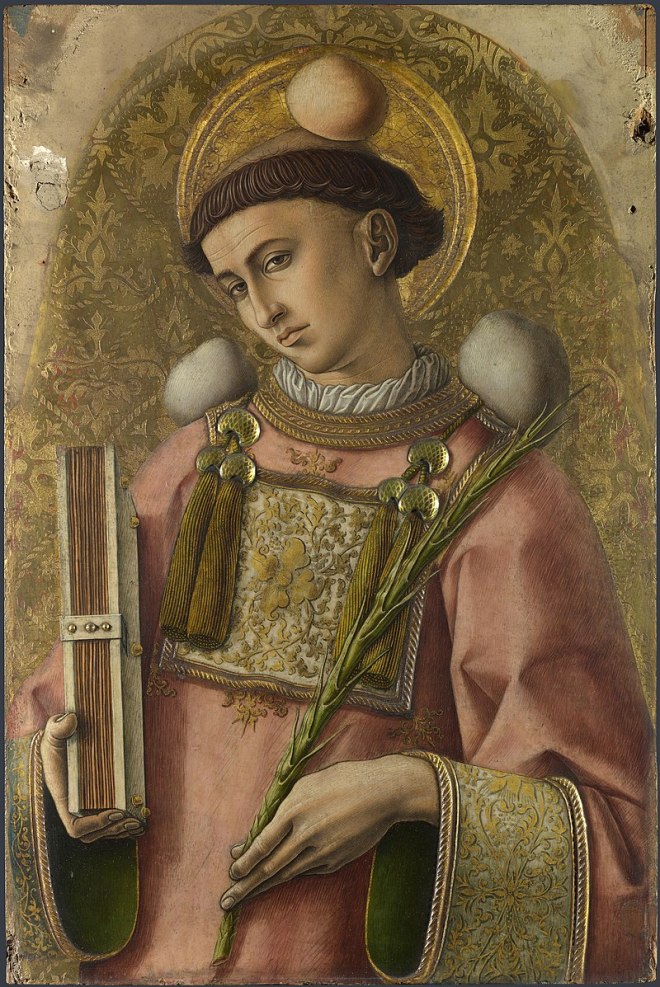
Or Saint Stephen, balancing on his head and shoulders the stones with which he was stoned to death.

Source

But what could the torture be in Erasmus’s case? Well, what do we humans have that looks like ropes? Entrails! And so this novel form of torture was dreamed up.

Now, Jacobus’s list of tortures inflicted on poor Erasmus is really long: I count 19 in all. Many of them would have made very appropriate subjects for the gory paintings of martyrs so beloved by painters until quite recent times. And yet, the entrails being pulled out on the windlass really caught on; I have to assume it’s because that was the one torture that Jacobus had a picture of in his book. Here’s just a few examples I found on the internet.

This first version is a more sophisticated variant of the picture in The Golden Legend and had added the emperor, “waxed out of his wit for anger”, looking on.

Source

This next version is quite similar, except that St. Erasmus’s bishop’s mitre has now been thoughtfully placed to one side.

Source

In this next one, we’re beginning to get a bit more dramatic.

Source

While this one, by Nicolas Poussin, has pushed the drama levels to stratospheric heights.

Source

Other paintings, perhaps trying to avoid all the gruesomeness of these kinds of paintings, just had a thoughtful-looking Erasmus, dressed as a bishop, holding his crank around which his entrails have been tastefully wound. This next painting is an excellent example of the genre.

Source

This focus on Erasmus’s guts and the acute pain he no doubt suffered having them drawn out had an interesting side-effect. I’ve mentioned in a previous post the Fourteen Holy Helpers who helped Medieval people deal with their physical trials and tribulations – the headaches, or the sore throats, or the epileptic fits, or … they suffered from. Well, Erasmus fit very well into this scheme of things! He was obviously the go-to Holy Helper for cases of stomach and intestinal illnesses.

I related in the postscript to a previous post that in a moment of weakness I had bought a painting on glass of the Fourteen Holy Helpers. All this research has allowed me to identify which of the Helpers in my painting is St. Erasmus. Here he is, with his crank and some of his intestines rolled around it. All this research I do does sometimes have benefits …

My photo

THREE WISE MEN

Milan, 6 January 2025

Today is 6 January, the day of the Epiphany! The day when the Three Wise Men arrive in Bethlehem to find the Child Jesus. Momentous event! In the words of St. Matthew’s Gospel (I cite the King James version)

And when they were come into the house, they saw the young child with Mary his mother, and fell down, and worshipped him: and when they had opened their treasures, they presented unto him gifts; gold, and frankincense and myrrh.

Or, as the Christmas carol puts it

Three Wise Men
We Three Kings of Orient are,
Bearing gifts we traverse afar,
Field and fountain,
Moor and mountain,
Following yonder Star.
Refrain
O Star of Wonder, Star of Night,
Star with Royal Beauty bright,
Westward leading,
Still proceeding,
Guide us to Thy perfect Light.

Gaspard
Born a King on Bethlehem plain,
Gold I bring to crown Him again,
King for ever,
Ceasing never
Over us all to reign.
Refrain

Melchior
Frankincense to offer have I,
Incense owns a Deity nigh:
Prayer and praising
All men raising,
Worship Him God on High.
Refrain

Balthazar
Myrrh is mine; its bitter perfume
Breathes a life of gathering gloom;—
Sorrowing, sighing,
Bleeding, dying,
Sealed in the stone-cold tomb.
Refrain

Three Wise Men
Glorious now behold Him arise,
King, and God, and Sacrifice;
Heav’n sings Hallelujah:
Hallelujah the earth replies.
Refrain

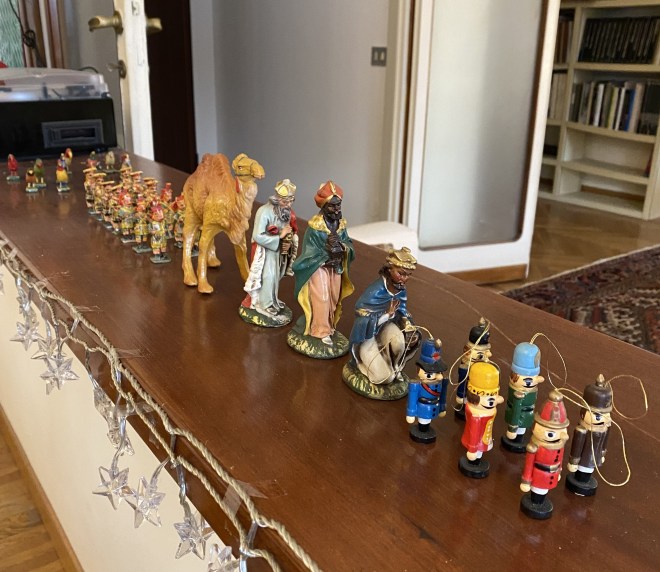
The Three Wise Men are, of course, important characters in our annual crèche. Ever since Christmas Day, they have been travelling across the furniture of our living room, on their way to Bethlehem. This year, I have had them accompanied by a retinue worthy of their rank.

My photo

I found the figurines of the retinue in a box where they had been carefully stored away by my mother-in-law many years ago. It seemed a pity not to bring them out into the light of day. I think it all looks pretty impressive! (But we have to do something about the camels; I’ve been telling my wife for years that we need to find some more camels, one camel simply isn’t enough. And we have to get a statue to replace the kneeling Wise Man; kneeling before the Baby Jesus is OK, but he can’t be on his knees the whole trip to Bethlehem …).

Here, we can see the tail-end of the cortege.

My photo

I added the birds because they were also in the box. A bit odd, but why not? Maybe the Wise Men were like St. Francis, they were listened to by the birds (boy, are we going to have fun when we set up the crèche with our grandson, possibly grandchildren, in a few years’ time! Who knows what interesting additions we could come up with!).

And now the Three Wise Men have arrived at the manger and are adoring the Baby Jesus!

My photo

This scene of the Adoration of the Magi has been painted over and over again by European artists. I pick here just one of the many offerings. It is by the Flemish painter Hugo van der Goes, who painted it in about 1470.

Source

In truth, though, I prefer the rendering of the Three Wise Men in the mosaics of Sant’Apollinare Nuovo in Ravenna.

Source

Dressed as they are as Persians, wearing the Phrygian cap which Romans seemed to think all Persians wore, they fit better with what the Gospel of St. Matthew had to say: “behold, there came wise men from the east”. Now Matthew didn’t actually say how many Wise Men there were, but pretty quickly most Christian sects settled for three, one for each gift. Matthew also didn’t say how old they were, but clearly by the time these mosaics were laid down it was generally agreed that they represented the three ages of Man, so we have one old one, one middle-aged one, and one young one. It was only later that it was decided that they also represented the three races known to Europeans: the Europeans themselves, the peoples of the Middle-East, and the peoples of Africa. Paintings of the Magi are some of the earliest representations of Black people in European art. Here is a lovely example from an Adoration of the Magi by Hieronymus Bosch.

Source

Painters don’t seem to have been much interested in what was happening to the Three Wise Men on their way to Bethlehem. But T.S. Eliot, in his poem Journey of the Magi, did try to imagine what the trip was like. I cite here the first twenty lines of the poem.

A cold coming we had of it,
Just the worst time of the year
For a journey, and such a long journey:
The ways deep and the weather sharp,
The very dead of winter.’
And the camels galled, sore-footed, refractory,
Lying down in the melting snow.
There were times we regretted
The summer palaces on slopes, the terraces,
And the silken girls bringing sherbet.
Then the camel men cursing and grumbling
And running away, and wanting their liquor and women,
And the night-fires going out, and the lack of shelters,
And the cities hostile and the towns unfriendly
And the villages dirty and charging high prices:
A hard time we had of it.
At the end we preferred to travel all night,
Sleeping in snatches,
With the voices singing in our ears, saying
That this was all folly.

Compared to this description, our Three Wise Men have had it pretty easy: nice, warm living room, easy travel across the furniture, respectful entourage …

As told in St. Matthew’s Gospel, the arrival of the Three Wise Men was like a poke in a hornet’s nest. In Jerusalem, they asked, “Where is he that is born King of the Jews? for we have seen his star in the east, and are come to worship him.” Matthew goes on, “When Herod the king had heard these things, he was troubled, and all Jerusalem with him. And … he demanded of them where Christ should be born. And they said unto him, In Bethlehem … Then Herod … said, Go and search diligently for the young child; and when ye have found him, bring me word again, that I may come and worship him also.” But, Matthew tells us, after giving Jesus his gifts, “being warned of God in a dream that they should not return to Herod, they departed into their own country another way.” He goes on, “behold, the angel of the Lord appeareth to Joseph in a dream, saying, Arise, and take the young child and his mother, and flee into Egypt, and be thou there until I bring thee word: for Herod will seek the young child to destroy him. When he arose, he took the young child and his mother by night, and departed into Egypt.” The Flight to Egypt was also a popular theme for European painters. I show one example, by my favourite painter, Caravaggio, Rest on the Flight to Egypt, where one of the painter’s luminous angels is playing music on a viol to soothe Mary and Jesus in their slumber (the music held by Joseph is readable; it is a motet by the Flemish composer Noel Bauldeweyn dedicated to the Madonna, with a text from the Song of Songs, Quam pulchra es, “How beautiful you are”; nice touch).

Source

Alas, Herod was not a man to be crossed. Matthew tells us, “Then Herod, when he saw that he was mocked of the wise men, was exceeding wroth, and sent forth, and slew all the children that were in Bethlehem, and in all the coasts thereof, from two years old and under.” This Massacre of the Innocents was, too, a popular theme for European artists. I show here an example of the genre by Peter Breughel the Elder.

Source

I’m actually being a little economical with the truth. This is really a copy of Breughel’s painting, by his son Peter Breughel the Younger. The original was once owned by the Holy Roman Emperor, Rudolf II. For some reason – queasiness? – he had the dead children painted over. This copy retains the dead children.

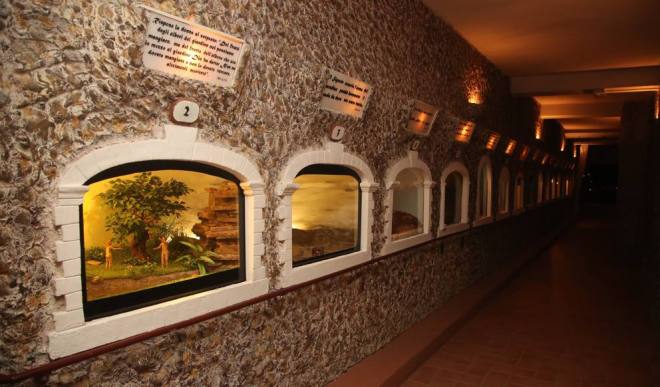
Quite by chance, just before Christmas, we stumbled across a very sophisticated crèche, in a place called Baggio, which once was a village but then got swallowed up by Milan some 150 years ago. There, in the crypt of a church, over the last forty years or so, dedicated local volunteers have created 58 scenes from the Bible, with the Nativity being the central scene. Some of the scenes have running water, others have moving figurines, … it’s very impressive. Here is a shot of the first scene, Adam and Eve in the Garden of Eden (with a delightfully slithery snake in the tree).

Source

Here is one of Moses and the parting of the waters of the Red Sea.

Source

And here is a shot of the central scene of the Nativity.

Source

As I say, very impressive … although I will admit to having been just a teeny-weeny bit jealous. We’ll soon be packing away the crèche and its figurines for another year, but I’m already thinking how we could expand the offerings next year. Running water and moving figurines is a bit beyond me. But maybe Herod in a palace in Jerusalem? The Massacre of the Innocents? Some “snow” for the Wise Men to trudge wearily through? At least let’s fix the camel problem!

SAINT TECLA

Milan, 18 November 2024

Ever since 2016, when I wrote a post about Saint Radegund I’ve been meaning on and off – more off than on, I should say – to write a post about Saint Tecla, as part of my sub-category of posts on obscure saints whose names still dot the European landscape; in this particular case, a small road behind Milan’s Duomo is called after her. The last post in the series, from this summer, was about Sankt Ilgen. Two days ago, at the end of a hike which my wife and I did on Lake Como, I came across a church dedicated to Saint Tecla, in the village of Torno. It’s not a particularly interesting church. This is what the exterior looks like.

Source

And this is a view of its interior.

Source

Quite honestly, the view from the church’s door across Lake Como is more interesting.

Source

Nevertheless, I took my bumping into this church as A Sign that I should finally get my finger out and write this post.

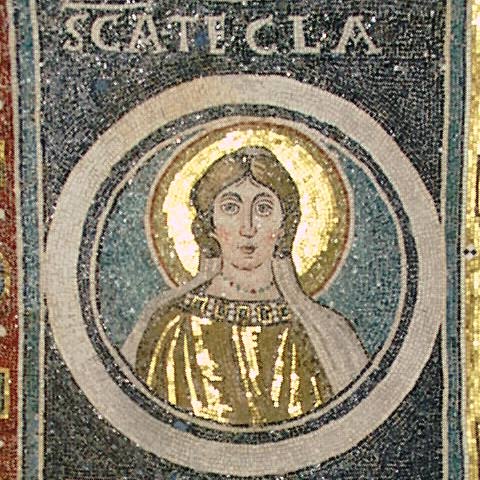
So who was this Saint Tecla? (and by the way, I prefer to use the Italian – and Spanish and Portuguese – spelling of her name rather than the English Thecla) Let me start by inserting a photo of a 6th Century mosaic portrait of her which graces the Basilica Eufrasiana in the town of Poreč in Istria, in Croatia.

Source

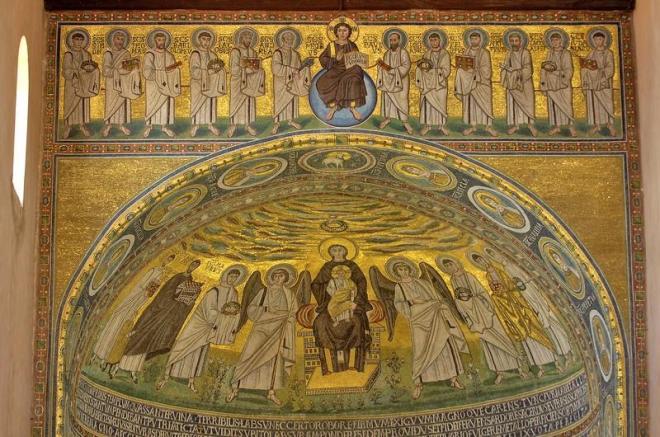
For any of my readers who are interested in early Christian mosaics and have never visited the Basilica Eufrasiana, I suggest that you do so. I throw in a couple of photos of the mosaics there to whet their appetite.

Source
Source
Source

Readers with good eyesight will see that the portrait of Saint Tecla is one of the portraits on the inside of the arch, to the right.

Given her great popularity in Christian Orthodox religions (probably much greater now than it is in Western Christian religions), I also throw in a photo of a depiction of her in a manuscript produced for the Eastern Roman Emperor Basil II in the 11th Century.

Source

Of course, neither of these portraits is from life. And in fact, there is a good chance that Tecla never had a life – the Roman Catholic church quietly dropped her from its official Martyrology back in 1969, which normally occurred because there was a lack of historical evidence that the saint or martyr in question ever existed. But let us put this cavil aside, and see what her various hagiographers had to say about her.

Tecla was believed to have come from Iconium in the Roman province of Galatia (now Konya in the modern country of Türkiye). The story goes that when St. Paul passed through Iconium on his second missionary journey, Tecla was transfixed by his sermons. Here is the scene depicted in an altar carved in the 15th Century for a chapel in the cathedral of Saragossa in Spain, but which now resides in New York’s Metropolitan Museum of Art’s Cloisters. That’s Saint Tecla at the the window of her house. Note the man (I think) stroking his chin pensively down at the right; a nice touch.

Source

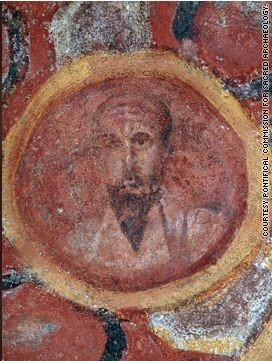
Unfortunately, Saint Paul seems to have lost his head. No worries, let me throw in a photo here of a fresco of St. Paul’s head, recently uncovered through the clever use of a laser-based technology, in a 4th Century catacomb named after St. Tecla, in Rome. This, I read, is the oldest extant solo portrait of the Apostle. I’m intrigued by the very pointy beard; I have never imagined Paul with that kind of beard.

Source

Continuing on with Tecla’s story, she declared to her mother Theocleia and her fiancé Thamyris that she was abandoning her marriage plans and would join Paul. Both Theocleia and Thamyris were alarmed at this attempt at independence and decided to drag both Paul and Tecla before the city governor. Paul was merely sentenced to scourging and expulsion, but Tecla was to be burned at the stake. Turning again to that altar which once resided in Saragossa’s cathedral, we have the scene sculpted in alabaster. The sources say she was stripped naked, but that clearly didn’t play well with the sculptor and/or the donor.

Source

Miraculously, a storm blew up, which doused the pyre. Personally, I would have put her back in gaol, built another pyre, and had a second go. But no, she was freed, whereupon she joined Paul, cut off her hair (I always find it interesting that hair is considered – by male authors? – such a sign of femininity, the cutting of which signifies renunciation of physical attraction), and followed him. And off they went to Antioch in Pisidia (nowadays called Yalvaç). There – even without her hair – she drew the lascivious attention of one Alexander, a nobleman of the city. He attempted to take her by force, but she fought him off, tearing off his cloak and knocking the coronet off his head in the process, much to the amusement of the townspeople. Seemingly, then, Alexander attempted this rape of Tecla, for that is what it seems to have been, in public, which is a little odd. Or maybe the writer of the story wanted to show the arrogance of power.

In any event, Alexander felt greatly injured in his aristocratic pride and had her dragged – yet again – in front of the city’s governor for assaulting a nobleman. This time, the governor condemned her to be thrown to the wild beasts (as an aside, I have to say that hagiographers of the early Christian martyrs all seem to have been working off the same playbook; martyrs were either burned at the stake, tortured in hideous ways, thrown into rivers with heavy weights around them, or thrown to wild beasts, or some combination of these). Interestingly, the women of Antioch rose up as one against the sentence, although it changed nothing (I think the hagiographers’ intention was to intimate that Tecla was a natural leader of women).

And so she was paraded through the streets of Antioch, stripped of her clothes (again), and thrust into the arena. The men in the crowds were baying for blood, the women were weeping for poor Tecla (taken by the spirit of the story, I have added this bit; as far as I know, none of the hagiographers said it, although they do make clear that the women in the crowd were rooting for Tecla). Miracle! Some of the wild animals (female) protected her from other (male) animals. A lioness was especially active in defending Tecla. We see the scene here in a 15th Century altar from the chapel of the Cathedral of Tarragona in Spain (in passing, I should note that Saint Tecla is the patron saint of Tarragona). In this case, the sculptor had no problems making Tecla at least half naked. Note all the animals lying meekly at her feet. I like, too, the crowd pressing in to see what’s happening.

Source

At this point, the story gets somewhat muddled for me. Reading between the lines, and giving my fervid imagination free rein, I’m guessing that the organizers of this spectacle had thought up the idea of having a large vat in the arena full of ravenous seals. They must have thought they could throw the remains of Tecla, once she had been ripped to pieces by the wild beasts, into the vat (although I wonder if seals would eat human remains; but hey, what do I know?). But Tecla had other ideas. She had asked Paul to baptize her, although for some reason he had temporized. Standing in that arena, surrounded by wild – but currently meek – animals, she decided that before she died in that arena, she would baptize herself. Note once again her streak of independence: baptizing yourself?! impossible; only men can baptize people! Nevertheless, she threw herself into the vat. The altar in Tarragona’s cathedral gives us once again a vision of this scene.

Source

I’m not sure what has happened to the arena and its crowds, we seem to have a more sylvan scene. I also get the impression that the sculptor had no idea what seals looked like, he seems to have come up with a bunch of eels. But le’s not niggle, because another miracle occurred! The vat was struck by lightning, which killed all the seals – but of course not Tecla.

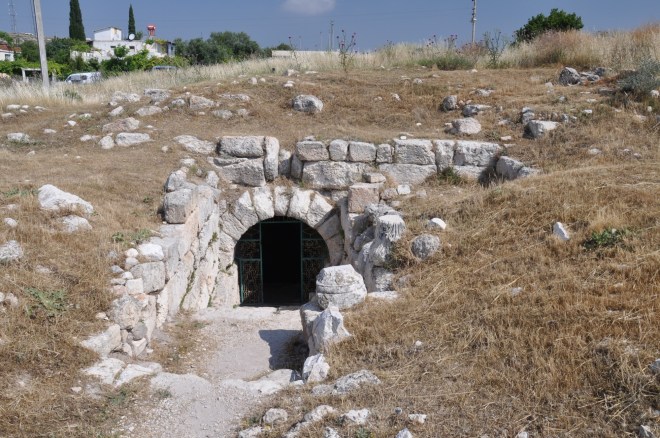
All these miracles were too much for the governor. He ordered her clothed and released her to the rejoicing women of the city. She returned to Paul, “wearing a mantle that she had altered so as to make a man’s cloak” (an important phrase for future generations of some women, who looked to Tecla as an example of breaking the eternal glass ceiling for women). She went on to convert many people, including her mother, to Christianity, and then retired to a cave near Seleucia (today’s Silifke) where she lived for many decades. This is the exterior of the cave.

Source

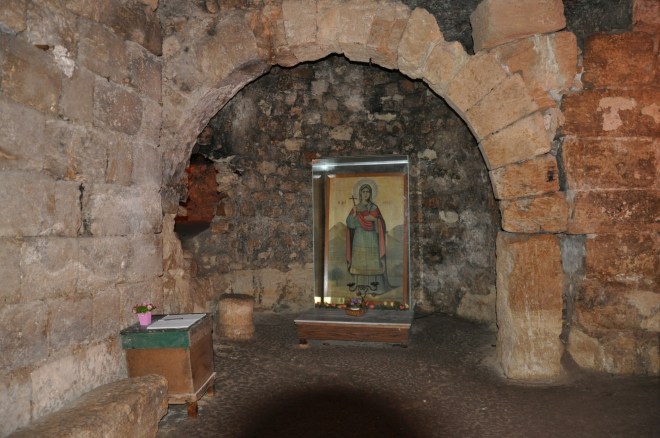
And this is a shot of its interior, which has been turned into a church.

Source

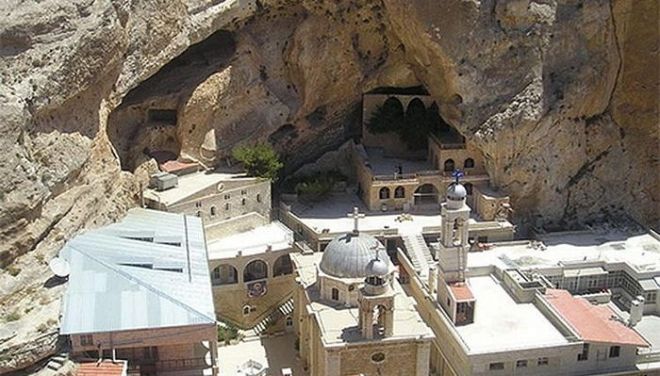
I would be remiss if I didn’t point out that there is a rival story that Tecla did indeed spend her last years in a cave, but in the small town of Maaloula in what was then the kingdom of the Nabateans, close allies of the Romans, and in what is now Syria. It seems a far more dramatic site, and has a Christian Orthodox church and nunnery built next to it.

Source

The site, alas, has fallen prey to modern religious wars. ISIS fighters invaded Maaloula in 2013, going on a rampage against Christian people and buildings, destroying all religious sites in the town. 3,000 fled the city, leaving only Muslims and the nunnery’s forty nuns. Twelve of them were kidnapped, and after negotiations were release in 2014. The nuns were dispersed and were only able to come back to the town in 2018. Horrors continue to be committed in the name of religion …

There’s further bits and pieces to Tecla’s hagiography, but I’ll skip them. Given the story, it’s a bit of a mystery why Tecla was such a popular saint. As far as I can make out, her popularity rested on the fact that she offered early Christian women a strong example, equal to, not subordinate to, men. She offered a female equivalent to the – male – Apostles; she went around converting people just as much as Paul did. She threw off the bonds of what was a strongly patriarchal society – she broke off an engagement arranged by her family, in fact she turned her back altogether on marriage; she didn’t wait to be baptized by a man but just did it herself; she took to the road without a protecting male presence (although she seems to have had to pretend she was a man in order to do this). The Church Fathers, notably Ambrose of Milan, lauded her for her virginity – but I always suspect this approval of virginity by the Church, since it always seems to be tied to retiring from the world into a nunnery and being Wedded to Christ; the idea of being in this world on equal terms with men was anathema to the Church (and to society more generally). I suspect she could easily be the patron saint of this new B4 Movement coming out of South Korea.

Well, I’ll leave readers with a somewhat more modern take on Saint Tecla by El Greco, in his late 16th Century painting “The Virgin and Child with St. Martina and St. Tecla”. It was painted for the Oratory of St. Joseph in the city of Toledo, but is now in the National Gallery of Art in Washington, D.C.

Source

We will, of course, immediately recognize Tecla because of the lioness which is protecting her. She also, rather oddly, is holding a martyr’s palm – oddly, because she actually was never martyred. One of the many strange things about Tecla.

PLUMS – IT’S AUTUMN

Vienna, 23 September 2024

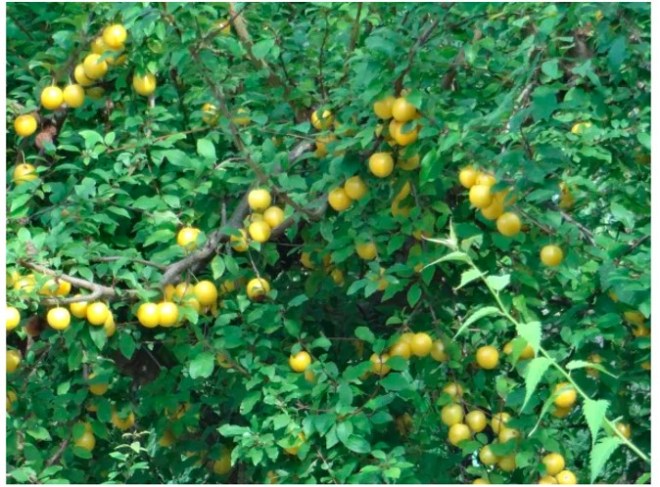
It’s that time of the year again. The time of plums here in Central Europe (or strictly speaking, European plums; there are so many different types of plums). On our hikes now we often see small plum trees covered in the dark purple fruit.

Source

I can never understand if these trees have seeded wild after the passage of some plum-munching, stone-spitting person, or if they were part of now abandoned communal orchards which were once a common feature in this part of the world (the so-called Streuobstwiesen, the scattered-fruit-meadows, meadows through which villages have sprinkled plum and other fruit trees for their communal use – a nice idea, I think).

Source
Source

However the plum trees got there, they are welcome indeed. When we come across them, we will fill our rucksacks with a few days’ worth of dessert and walk on.

Normally, when the plums arrive the weather is turning towards Autumn here. The days are drawing in, the temperatures are beginning to bite, it’s time to wear trousers when I hike and take a sweatshirt with me in case a cold wind picks up; time, too, to carry a waterproof jacket to counter the occasional shower.

As I eat my plums, I will often feel a pang of regret that the Summer is drawing to a close. But this Summer has been ferociously hot in Central Europe. So it is with a certain sense of relief that I bite into my plums these days, even as I grieve the massive damage caused by the recent floods to man, beast, and vegetation (including plum trees, no doubt).

Source

About a month ago, during our hikes we were coming across what looked like mirabelle plums: small, round, yellowish.

Source

They seemed to be wild, or at least feral, being used as fencing around gardens or just mixed up with other trees and bushes on the side of the paths. There were never any plums within reach, evidence that other gatherers had hiked these paths before us. All we were left with were plums that had been knocked off by wind or the heavy rains that we have been having this summer (a result of the intense heat). Many of these little plums were damaged and, judging by the taste, not necessarily all that ripe. We picked them up anyway; it breaks our heart to see this free bounty from Nature just being trampled underfoot. Our gatherer ancestors would never have countenanced such waste.

Talking of our ancestors, it seems that we human beings have been chomping on plums and spitting out the stones for a long, long time.  Archaeologists digging in Neolithic sites in Bulgaria, for instance, have found plum stones from 8,000 years ago. Some of the stones seem to belong to a wild plum called cherry plum.

Source

They do indeed look cherry-like, small and red. I don’t think I’ve ever seen this plum tree on our hikes. But that’s not too surprising since its natural range is South-West Europe (which includes Bulgaria, of course) and West Asia. So the Neolithic farmers who were drifting into Europe from Anatolia must have been very familiar with this tree. From articles I’ve read, I sense that most cherry plums tend to be on the sour side. But I also get the sense that our ancestors, until not too, too long ago, before the massive production of sugar, preferred sourer food, or at least were more tolerant of sourer food. That sourness still resonates with the descendants of our Neolithic ancestors in Romania and Georgia. They use cherry plums in their recipes as a souring note. The Georgians, for instance, use cherry plums to make Tkemalu sauce, a sour sauce, which is then a main ingredient in kharcho soup (mmm, looks good, I wonder if there’s a Georgian restaurant here in Vienna where I could try it?).

Source

Some other stones in those Bulgarian Neolithic sites, no doubt in the more recent archaeological layers, seem to show that domestication of the plum had begun to occur. It’s not very clear what species exactly got domesticated to give us the various types of plums we have in Europe: European plums, damsons, bullaces, egg plums, greengages, spillings, mirabelle plums, just to give the names we use in English. It could have been the cherry plum alone whose DNA was manipulated. Or it could have been that cherry plums were crossed with sloe plums.

Source

I came across a couple of bushes of sloe plums this summer as we crossed a meadow or two – not scattered-fruit-meadows, I should add, just ordinary meadows. The bushes were on the edges of these meadows, in that indeterminate zone between meadow and woods. I looked at them, thinking “they look like miniature plums” and wondering if they were edible. I went back and forth on trying them, but in the end I felt that discretion was the better part of valour. I didn’t want to keel over in a meadow, poisoned by some unknown plant. But now that I’ve done a bit of reading on plums, next time I come across them – next year at this point, God willing – I’ll give them a little nibble. I don’t expect the experience to be all that pleasant, I have read that sloe plums are quite tart. Maybe I’ll just drink sloe gin, a gin in which sloe plums have been marinated. That sounds a much more pleasant experience.

Source

SANKT ILGEN

Vienna, 10 September 2024

It had to happen. On our latest wandering across the Austrian landscape, this time in Styria, my wife and I came across yet another obscure saint, Saint Ilgen. This good saint had given his – or was it her? – name to a village located in the similarly named Ilgental, the valley of Ilgen, along which we were walking to get to the jump-off point for our three-day hike around the Hochshwab. I throw in a photo of the jump-off point, the Bodenbauer inn. As readers can see, it’s a popular place.

Source

And here are a couple of photos of the mountains we climbed over.

My wife’s photo
My wife’s photo
My photo
my wife’s photo
My photo

But now, settled in the train back to Vienna, I have had the time to investigate this mysterious Saint Ilgen. My first inkling of who we might be talking about came about this morning, as we walked back through the village of Saint Ilgen. I noticed a small shrine on the side of the road that I had missed the first time we came passed through the village.

My photo

For readers whose sight, like mine, is not quite what it used to be, the writing above the statue says, in German, “Saint Aegidius pray for us”. Ah! So Ilgen was probably the same as Aegidius! A little bit of train-based internetting has confirmed this.
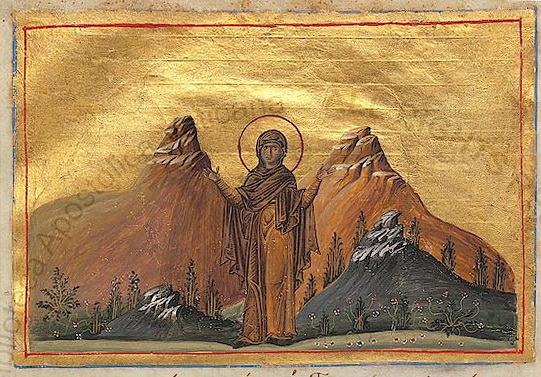
Aegidius was a name that rang a bell. And indeed, a little bit of e-riffling through my past posts has confirmed this. Last year, I had come across Saint Aegidius when researching another obscure saint, Saint Veit, whose name my wife and I would quite often come across on our wanderings across the Austrian landscape. Saint Aegidius, like Saint Veit, was one of the fourteen Holy Helpers who Medieval Europeans turned to, to deal with life’s many miseries. Here is a photo of those Holy Helpers from a chapel in Baden-Württemberg. Saint Aegidius is in the third row from the top, the second from the right, wearing a monk’s brown tunic but holding a bishop’s crozier. I only know this because I blew up the photo enough to be able to read the names helpfully added to the base of each statue. Readers will notice that the statue is decked out in very much the same way as the statue in the photo above. This was no doubt the standard way of depicting the saint.

Source

I don’t know why the saint was called Aegidius, because most Medieval Europeans didn’t call him that. The British knew him as Giles, and many other Europeans knew him by variants of that name. For instance, the French knew him as Gilles – as we shall see in a minute, he was a French saint. And since our story starts in Austria, I feel I ought to mention some of the German variants: Jillies, but also Gilg or Gilgen which in some places – like that valley which my wife and I had been walking up and down – morphed into Ilg or Ilgen. So I shall drop Aegidius and continue with Giles.

Who exactly was this saint Giles? Quite honestly, I’m not sure he ever existed. But the story put out by the monastery of Saint-Gilles, which lay between Nîmes and Arles in the south of France and whose tomb the monks claimed to have in their church crypt, was that he was a hermit who in the 7th Century AD was living a saintly life in the thick forests around Nîmes. His only companion was a female deer, to whom he was very attached. One day, hunters of the local king – or maybe the king himself – were pursuing the deer, which ran to Giles for protection. Giles put himself between the hunters and the deer and got wounded in the hand by an arrow. Full of remorse for having wounded such a holy man, the king gave him land and money to build a monastery, which Giles proceeded to do. He then became its first abbot, leading the monastery until his death, carrying out miracles etc. along the way. There are other, more fanciful details in his hagiography, but I’ll leave it at that. Here, we have a painting by an unknown, possibly French, possibly Dutch, painter from about 1500 depicting our good saint.

Source

We see him protecting the deer, with the arrow in his hand and presumably the chastened king kneeling at his feet.

Saint Giles was one of the Medieval Europe’s most popular saints. As far as I can make out, this can be traced back to the fact that the monastery of Saint-Gilles was strategically placed at the crossroads of a number of pilgrim routes. One of the branches of the Camino de Santiago de Compostela, used by pilgrims from Provence and northern Italy, passed by the monastery. I throw in a map of the three main routes in France for the Camino de Santiago. The one which passed by Saint-Gilles is the bottom, maroon-coloured, one.

Source

The same route could of course be used in the opposite direction, and indeed was so used by Spanish pilgrims going to Rome. At Saint-Gilles they could either go overland through northern Italy or they could sail to central Italy, embarking at a port located close the monastery. French pilgrims, and Northern European pilgrims more generally, on their way to Rome also often used this marine route. The same with pilgrims on their way to the Holy Land, who would frequently pass through Rome first. I mention all of this because I want to use this occasion to see if I can’t persuade my wife to do some hiking in this part of the world. To whet her appetite, I insert a photo here of a pensive hiker near the Col du Mont Genèvre, which pilgrims from northern Italy would have crossed. I’m sure we could find a hiking trail which would take us down the French side maybe as far as Sisteron.

Source

But back to Saint Giles. I don’t think I’m being too cynical if I suspect that the good monks of Saint-Gilles, watching all this pilgrim traffic going by, felt the need to more effectively tap into the riches it represented. They therefore created the backstory of Giles the saintly hermit, with the requisite tomb and relics, et voila! Pilgrims began to stop at the monastery’s church to pray and leave a few pence in the offerings box. Of course, the pilgrims also needed places to stay and eat, so a small town sprang up around the monastery to service these (and no doubt other) needs, giving the monastery another source of income via tithes, taxes, and whatnot.

Over the next few centuries, the fame of the monastery of St-Gilles grew to such a degree that it became an important pilgrimage destination in its own right, up there with with Jerusalem, Rome, and Santiago de Compostela. It’s not surprising, then, that Giles was such a popular saint – and that so many boys came to be called after him.

Of course, with all this pilgrim traffic the monastery grew rich and powerful, and large building programmes were undertaken. But, as Giles the Hermit could have told them if he had ever really existed, all power, all riches are transitory. The fashion of pilgrimages passed and the port silted up, so the monastery’s main source of income dried up. The number of monks dropped off, so those large monastic buildings were half empty. And then vicious religious wars were fought, with Huguenot forces burning the monastery buildings to the ground. Whatever was left of them were razed during the French Revolution. Only a few mouldering remains are left.

Source

The Abbey church, although also badly damaged a few times, has remained. Here we see the beautiful Romanesque portico.

Source

While here we have the interior, where the gothic style has begun to intrude.

Source

And here we have the crypt, where the Saint’s tomb – rediscovered in 1865 – is located.

Source

Maybe I could persuade my wife to make a quick visit to the church after we’ve hiked down from the Col du Mont Genèvre …

And the name of the goodly hermit, once so popular? Well, I’m afraid it has dropped way down in the rankings. In the UK, only 8 baby boys were given the name Giles in 2023. In France, it was slightly better, with 50 little Gilles being registered. As for the German-speaking lands, Ilgen seems to be only a surname these days. Like the hermit, the name seems to have retreated far, far away from human societies.

I guess that means my wife and I will have to leave future sightings of the name to our wanderings across the face of Europe.

Source

ONION DOMES

Vienna, 8 August 2024

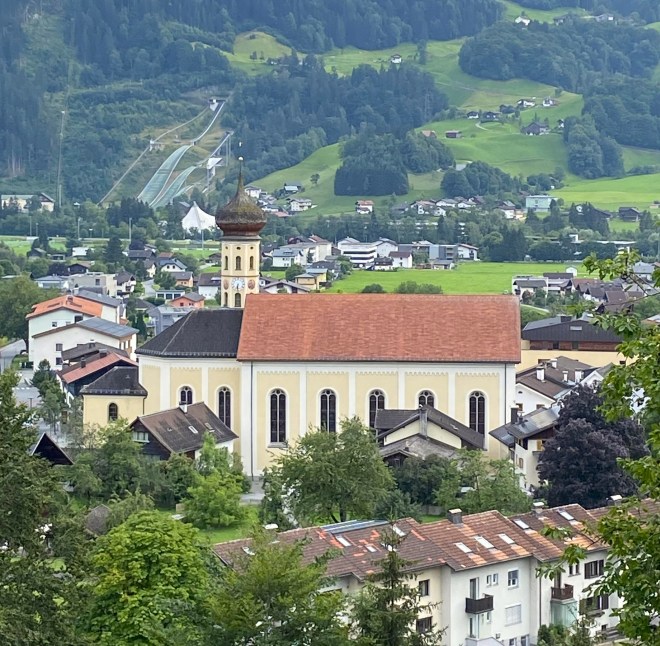
In my last post, I mentioned the brief trip my wife and I made to Schruns in the Montafon valley. We liked the Montafon valley so much that we decided to go back for some more hiking. This time, we explored new side valleys and some of the (artificial) lakes at the top of the valley. But I don’t want to talk about that, delightful though it has been. I want to talk about the view from the terrace when we were eating our dinner.

My photo

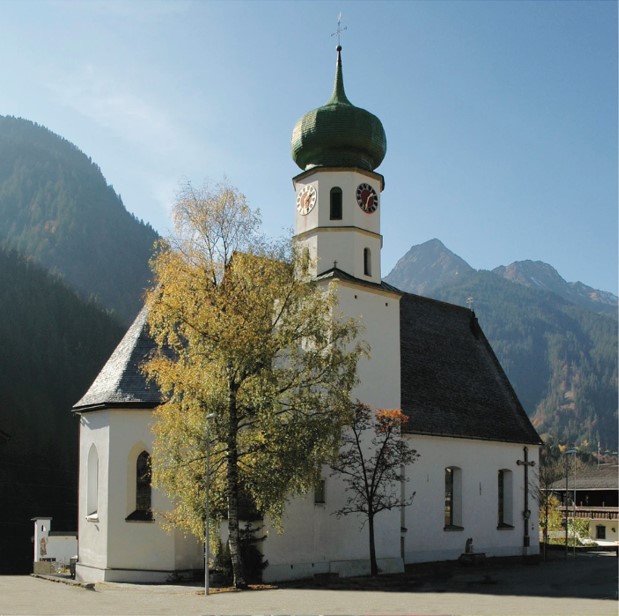
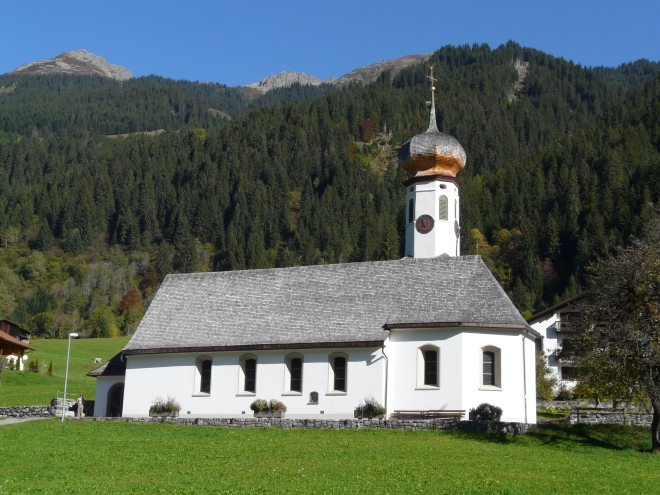
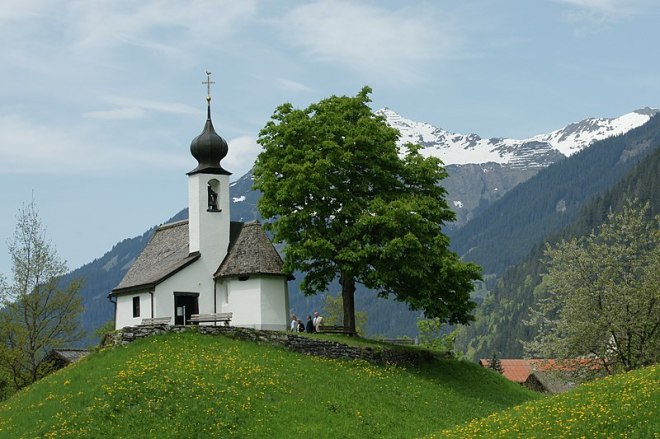
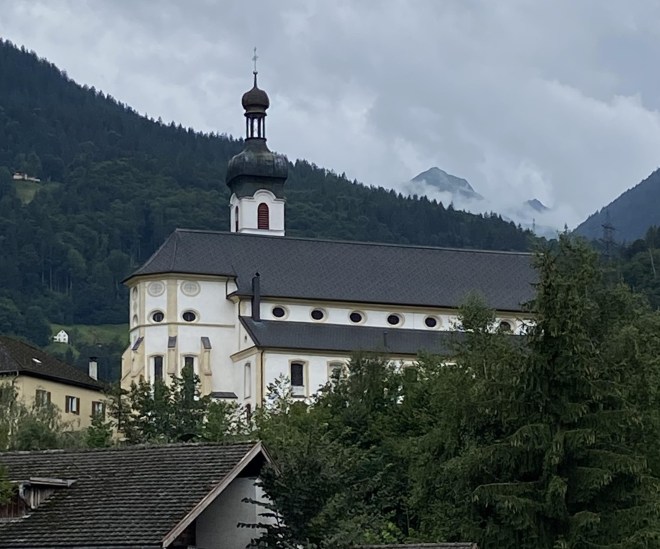
As readers can see, the town’s church tower is capped by a delightful example of an onion dome. The towers of many churches in Austria and Bavaria, as well as in other parts of the German lands, are crowned with onion domes. In the valley of Montafon alone, my wife and I saw five onion domes during our hikes or from the bus on our way to our hikes’ starting points.
Sankt Gallenkirch:

Source

Gortipohl:

Source

Gaschurn:

Source

Partenen:

My photo

And finally Tschagguns, where a lantern has been inserted into the onion:

My photo

I first remember seeing these onion domes decades ago, when one of my flatmates at University invited me to spend the Easter vacation at her mother’s place in the Alps in Austria (her mother was Austrian). We drove all the way there from the UK. At some point, we crossed into Bavaria and I began seeing these onion domes atop church towers through the car window. I was rather astonished; for me, onion domes was something you only found in Christian Orthodox lands. The example that comes to mind for most people is St. Basil’s Cathedral on Moscow’s Red Square, but I refuse to give space to the invaders of Ukraine. I shall instead insert a photo St. Michael’s monastery in Kyiv.

Source

What on earth were these onion domes doing in Germany and Austria?! I didn’t get an answer to my question at the time – even though my flatmate was studying architecture, she had never posed herself the question – and life rolled by. It wasn’t until I was sitting on that terrace staring at the tower of Schruns’s church that I posed myself the question anew. Luckily, in the intervening decades the internet has come along and Wikipedia – that splendid instrument for giving answers to the most off-the-wall questions – has been created.

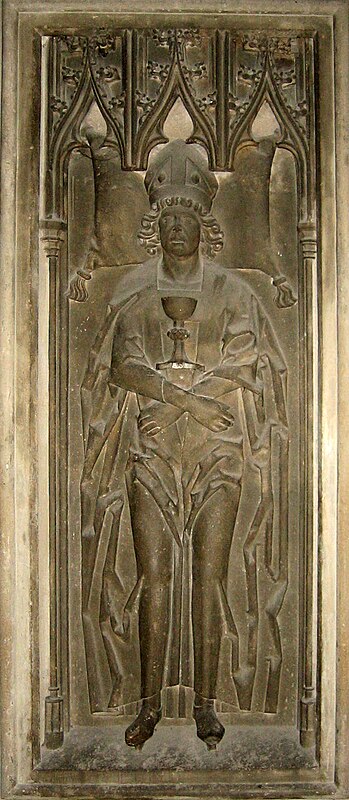
The story which Wikipedia tells is a fascinating one. First of all, this was not a question of German-speaking church builders importing a new style from further east in Europe. It seems, rather, that the answer lies with a certain Bernhard von Braidenbach, an important official in the Archdiocese of Mainz, who lived from about 1440 to 1497. He was important enough to deserve a tombstone in Mainz cathedral, of the type that brass rubbers love. I throw in a photo of his tombstone.

Source

Braidenbach is chiefly remembered today for a book he wrote in 1486, Peregrinatio in terram sanctam, in which he recounted his pilgrimage to the Holy Land undertaken in 1483-84. He was actually accompanying (i.e., keeping an eye on) the young Count Johann von Solms-Lich, so he also had a knight with him to protect the Count and the party. And, very important for us, he took along a certain Erhard Reuwich, an artist from Mainz. Why he decided to take an artist with him is unknown – at least to me. But it’s good that he did, as we shall see. Once back in Mainz (minus the count, alas, who had died on the return trip), Braidenbach wrote what was essentially a travel guide for future pilgrims to the Holy Land. What was groundbreaking about the book is that he inserted into the text some 25 woodcuts prepared by Reuwich, of views of the cities they passed through and other topics.

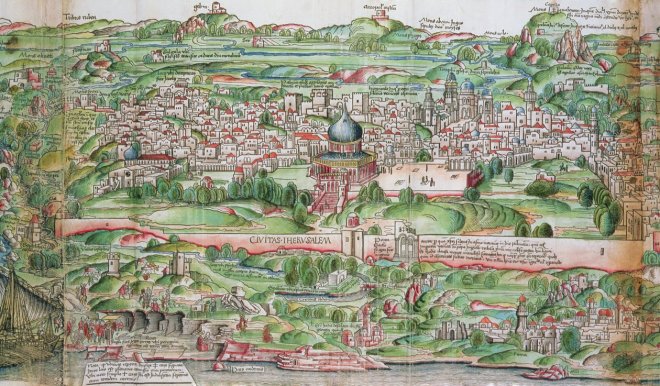
The book was an instant hit with European elites. It went through several editions and was translated into numerous languages. And – what is important for our story – church builders picked up on a detail in one of the woodcuts, Reuwich’s view of Jerusalem as seen from the Mount of Olives.

Source

Sharp-eyed readers will immediately see the unmistakably onion-shaped dome on the building in the foreground of the woodcut. I blow up the photo for those of my readers whose sight, like mine, is less than perfect.

Source

So there we have it. That little feature in one of the book’s woodcuts – admittedly of one of the holiest places in the world for Christians – seems to have inspired builders in the southern German lands to crown their church towers with onion domes.

The building whose onion dome they copied is the Dome of the Rock, an Islamic shrine at the centre of the Al-Aqsa mosque compound on the Temple Mount in the Old City of Jerusalem. This aerial photo is taken more or less from above the Mount of Olives and gives a very similar view as the woodcut.

Source

The photo shows the unmistakable octagonal arcade surrounding the dome. It also shows – shock! horror! – that the dome is not onion-shaped! From my extensive reading (in Wikipedia), it seems that it never was. As far as I can make out, the dome has kept the same shape it had when it was built back in 692 AD.

I have to assume that our friend Erhard Reuwich was taken by a fit of poetic license when he prepared the woodcut. Quite honestly, I’m glad that he was feeling poetic the day he laboured over the woodcut, because otherwise I wouldn’t have found myself staring with such pleasure at the church tower in Schruns and other places in Montafon valley.

In this day and age of hostility between the Islamic and Christian worlds, I’m also rather pleased to see that Christian church builders don’t seem to have had any scruples about copying the dome of an Islamic building for their Christian churches.

Well, I finished this post on the train back to Vienna, and as I paused and stared out of the window somewhere in Bavaria, a church tower with an onion dome flashed by.

THE COMMON RHODODENDRON – PRETTY FLOWER, INVASIVE SPECIES

Vienna, 30 July 2024

I mentioned briefly in my last post that our grandson had spent some time with us. Wonderful! But tiring. After we had waved him and his parents goodbye, my wife and I headed into the Austrian Alps for a few days of well-deserved R&R. Specifically, we went to a place called Schruns, which – for those readers who are interested – lies in the Austrian province of Vorarlberg. But provincial boundaries – or any boundaries, really – are just lines in our heads, abstractions we impose on the landscape which surrounds us. It would be better to say that Schruns sits in the lower part of the valley of the river Ill, a river that starts its course at the head of the high Alpine valley of Ochsental, up on the slopes of the Piz Buin (Ox Peak in the local Rhaeto-Romance language), the highest peak in Voralberg, and then runs through the 40-km long Montafon valley.

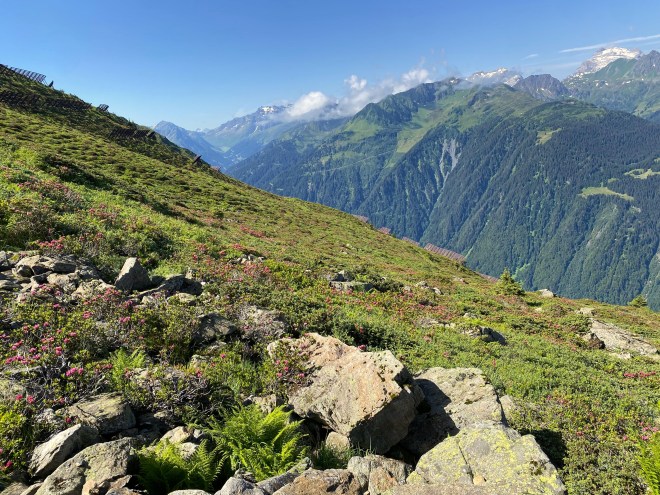
Sorry, let me immediately be clear that this post is not going to be a rant about the foolishness of borders. I just got carried away a bit as I wrote that last paragraph. No, it is actually the result of a hike that my wife and I did high up above Schruns, at 2300 m, on a beautiful, sunny day. Here we are at the top, looking down at Schruns in the Montafon valley below.

My photo

In case any readers are wondering, we did not hike up the 1600 metres up to the top of the mountain from Schruns. Dedicated hikers we may be, but not fanatics. We took a gondola lift up 1200 metres and then hiked up the rest of the way. In that climb, we passed through a huge field of dwarf rhododendron.

My photo
My photo
My photo
My photo

I have to say that, although the sight was very pretty, my heart sank when I saw those rhododendrons. You see, I was under the impression that all rhododendrons originally came from the Himalayas, that I was in front of an introduced species, and – based on something I had read somewhere – that rhododendrons in Europe were now an invasive species, a topic I have written about in several posts. I was biased towards this thinking by my sighting, the previous day, on a hike along the river Ill of thick stands of Himalayan Balsam, which as I’ve reported in an earlier post is indeed an invasive species here in Europe. So it was with a certain grimness that I photographed another patch of rhododendrons on a hillside in front of where we had lunch on the edges of a small Alpine pond.

My photo

Well, I’m glad to report that I was completely wrong. Yes, the Himalayas do host a large number of rhododendron species, as – surprisingly to my mind – do Papua New Guinea and Borneo. But there are a number of rhododendron species native to North America, and – key to this post – a few rhododendron species native to Europe. I am extremely glad to tell readers that two of these, closely related to each other, are native to the Alps, so no invasive species on our hike! They are the alpenrose, Rhododendron ferrugineum

Source

and the hairy alpenrose, R. hirsutum.

Source

I think readers will agree that there doesn’t seem to be much difference between the two. The biggest difference seems to be in the leaves. The undersides of the alpenrose’s leaves are covered in rust-brown spots, while the hairy alpenrose’s leaves have hairy edges. The pH of the soil is a prime decider of what Alp they will grow on, with the alpenrose favouring acidic soils and the hairy alpenrose alkaline soils. I suspect that once upon a time the two were one and the same species, and then they began to diverge as they adapted to different soils. They are still close enough so that they will hybridise where their ranges overlap. Since I have absolutely no idea what the pH of the soil is in the mountains above Schruns, I have correspondingly no idea which of the two alpenroses my wife and I were looking at on our hike. And I certainly didn’t get down on my knees to have a closer look at their leaves.

But where did I get this idea that rhododendrons are an invasive species? I can’t have dreamed it. Well, it turns out that there is another European species, the common or pontic rhododendron, R. ponticum, which is indeed invasive. Actually, as in the case of the alpenroses, there are two closely related species. One, the subspecies ponticum, is found around the southern Black Sea basin (hence its name) and all the way to Georgia and the northern Caucasus, with a presence also in Lebanon.

Source

The other, subspecies baeticum, is found in a few damp valleys in a couple of mountain ranges in central and southern Portugal and southern Spain.

Source

It is this latter subspecies that has become an invasive species in the UK and more generally in Western Europe. Its story is typical of the period when Europeans went around the world hunting for “pretty plants”, plants which simply gave pleasure because of their flowers, foliage, shape, or other characteristics. This started in the early 18th century; of course, the global trade in plants had started several centuries earlier, immediately after Europe’s discovery of the Americas, but in those earlier centuries people were interested only in plants that were commercially interesting. The common rhododendron ssp. baeticum was an early example of this massive movement of pretty plants around the world. It seems that it was brought to England in 1763 through that British foothold on the Iberian peninsula, Gibraltar, which is located quite close to its natural range. A new plant nursery in Hackney, run by a German émigré by the name of Joachim Conrad Loddiges, was the first to make the common rhododendron’s seeds available. One of the early buyers from Loddiges was the 2nd Marquess of Rockingham, who had the distinction of being British Prime Minister twice.

Source

As readers can imagine, in those days, when Respect for one’s Betters was much more engrained, where such a Distinguished Personage went others were sure to follow.  The result was that the planting of common rhododendrons in posh and then not so posh gardens quickly spread. Of course, it helped that it had a really pretty flower. But then most rhododendrons do. The craze for rhododendrons expanded as new species of rhododendrons, from North America and then from Asia, poured into the UK and Europe more generally. Rhododendrons hybridise quite easily, which added to the excitement as gardeners hybridised rhododendrons with abandon to create plants with ever more glamorous  flowers. Often, to speed things up, new species were grafted onto the rootstock of common rhododendrons; the latter were tough and often there already, so it made for a quick way to turn your garden into a splendid glade of multi-hued rhododendrons. I throw in here photos of some modern examples of such dazzling displays of rhododendrons. The first, fittingly, is from Wentworth House in Yorkshire, one of two country houses that our friend the 2nd Marquess of Rockingham once owned.

Source
Source
Source

Just to remind ourselves that it’s not just grand gardens that have rhododendrons, here’s one – maybe a common rhododendron, but you can’t tell, what with all the hybrids around – in someone’s back garden.

Source

Alas! As far as the common rhododendron was concerned, it all turned out to be too good to be true. By the 1970s if not before, people had realised that it was a horribly invasive species. Primarily because of its huge production of seeds, it quite easily “hops over” garden fences and – if the soil and climate on the other side is welcoming – it goes feral. Then, once the plant has rooted, the roots send up suckers, which in no time at all grow into new bushes. The branches of all these bushes layer tightly together, blocking out sunlight and stopping anything else from growing. And to cap it all, many of the rhododendrons which were grafted onto the rootstock of common rhododendrons reverted to common rhododendrons if they weren’t looked after, creating yet more common rhododendron plants ready to hop over garden fences. The net result was thick stands of common rhododendrons taking over large swathes of land.

Source

Here, a stand of common rhododendron is slowly engulfing a bus stop.

Source

Well, who cares about a bus stop? But the common rhododendrons are choking stream beds and the understory of woods. They also carry a family of pathogens that can kill certain species of trees. This map shows the distribution of the common rhododendron, both inside gardens and out, throughout the UK and Ireland in the early 1970s.

Source: J.R. Cross, “Rhododendron Ponticum L.”, Jnl. Ecology, Vol. 63, No. 1, pp.345-364, Mar. 1975

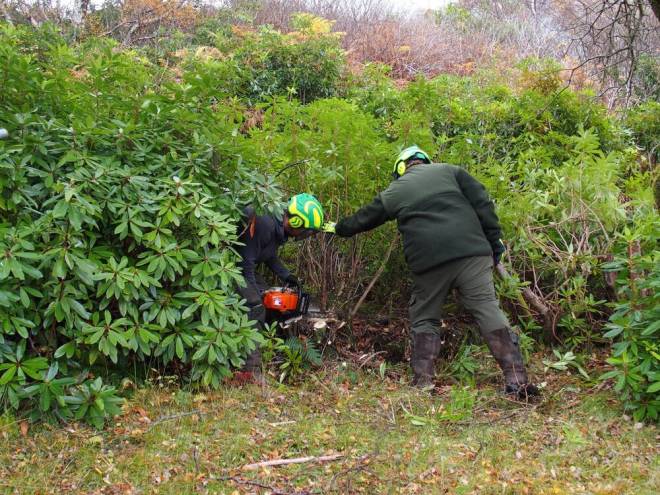
Readers will notice dense patches of dots in many places in the UK, as well as in Ireland. Western Scotland and Snowdonia in Wales have been especially badly affected. Eradication programmes are underway. But it’s hard (and therefore expensive) work.

Source
Source

And you have to come back for at least five years after you’ve cleared a patch, to ensure that no roots were left which have thrown up suckers and no seeds were left which have sprouted. And now scientists have discovered that after you’ve cleared  a patch it’s not a given that the cleared land will revert back to its original composition of plants; the balance has been disturbed and some plants may move back in faster than others and stop the slower movers from recolonising the land. So more work will be required to ensure that the original plant composition returns.

There is something really quite ironic about the common rhododendron letting rip and taking over large swathes of British, and other European, countryside. Back in the Iberian peninsula, where the plant came from originally, it is hanging on by its fingernails. It is a relict population from the the original laurissilva forests which covered the Iberian peninsula 66 million years ago, It is no longer suited to the dry climate in Iberia and has retreated into a few damp valleys. Reproduction is largely confined to the roots sending out suckers as the climate is now too dry for seedlings to survive. With climate change turning the southern part of the Iberian peninsula into a semi-desert, I suspect it will expire there. But, luckily for it, and unluckily for other plants, a bunch of ignorant plant traders brought it into an ecological niche where it just thrives, thank you very much! Of course, we can’t really blame the people who back in 1763 carried the plant to the UK, no-one then had the knowledge of what impacts there can be from moving plants around the planet. But now we do know, and yet we still do it. Are we stupid or what?!

Sorry, I can sense another rant coming on, time to stop. But if any of my readers have common rhododendrons in their gardens I beg them to rip them out without delay. If they really want rhododendrons, there are many, many equally pretty rhododendrons which do not “go forth and multiply”, as the Bible has it.

PAWPAWS, NOT PAPAYAS

Vienna, 20 July 2024

My wife and I recently had our annual check-up with our GP in Vienna. He’s been our doctor here for nigh on 20 years. The first thing he told us was that he was retiring at the end of the week. Tutto cambia, tutto su transforma, everything changes, everything is transformed, as I mournfully intoned in an earlier post. After he had given us our prescriptions for the routine blood and other tests we do every year (the results of which, though, will be reviewed this year by his partner in the medical practice), we chatted a bit about his retirement plans. He told us that he and his partner would be selling their apartment in Vienna (which is how we met him; they lived on the floor below ours), and they would be moving to a house which they have spent the last couple of years restoring, out in the countryside in southern Styria.

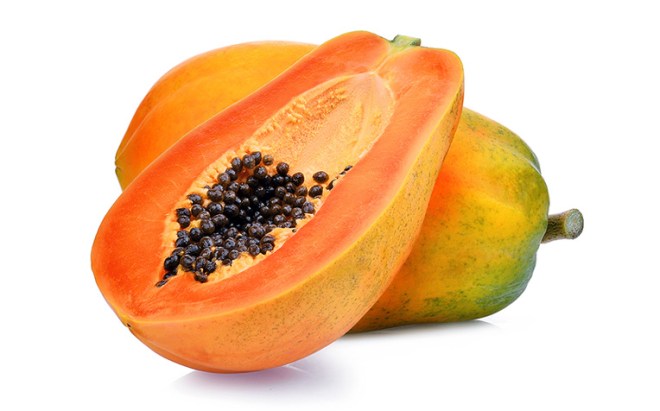
He was especially enthusiastic about its garden. He told us that he has filled it with all sorts of exotic plants, which have been flourishing. It doesn’t surprise me, he has exceedingly green fingers; we would gaze down with wonderment (and not a little envy) at the terrace of their apartment, a riot of flowers and plants, which he would lovingly curate in the evenings during the spring and summer. He told us with a note of pride in his voice that he had even successfully planted a pau-pau tree. A what tree, my wife and I both asked? After some toing and froing, we finally understood he was talking about a tree that produces a fruit called pawpaw. But the confusion wasn’t over yet. Since neither of us had ever heard of pawpaw fruits, my wife fished out her iPad and undertook a rapid Google search to see what they looked like. The search term “pawpaw” resulted in this image.

Source

You mean papaya, we asked? This is what we call this fruit. No, no, our doctor said, not papayas; pawpaws. More Google searching and my wife came up with this.

Source

Yes, the good doctor said, that’s the one.

Well, well, they say you learn something new every day (who coined that phrase, I wonder? Must Google it). My wife and I certainly did that day, along with the distressing news about our doctor’s retirement. After promising to visit the two of them in Styria one of these days, we said our emotional goodbyes.

Of course, I couldn’t leave it there. I was just like my little grandson picking at a scab (did I mention that he’s been staying with us?). I just had to find out more about this pawpaw. Which was fine, because it turned out to be a really interesting fruit.

First of all, as this map shows, pawpaws are native to the US, and more specifically to the eastern, southern, and midwestern states – the push into southern Ontario is probably man-induced, as we shall see in a minute.

Source

It’s intriguing that the pawpaw tree is found this far north, in temperate climes, because it actually belongs to a family nearly all of whose members are tropical. It’s a nice example of environmental adaptation. It would seem that the ancestor of the pawpaw developed on what is now the North American continent when the climate was tropical. As the climate cooled, the plant reacted by adapting to the chillier temperatures. Nevertheless, it never quite lost its earlier tropical “look”. Its leaves, for instance, have drip tips, a typical feature of tropical plants which are subjected to heavy rains.

Source

And the fruit itself looks quite tropical; looking at the photo above one could easily mistake it for a mango, for instance.

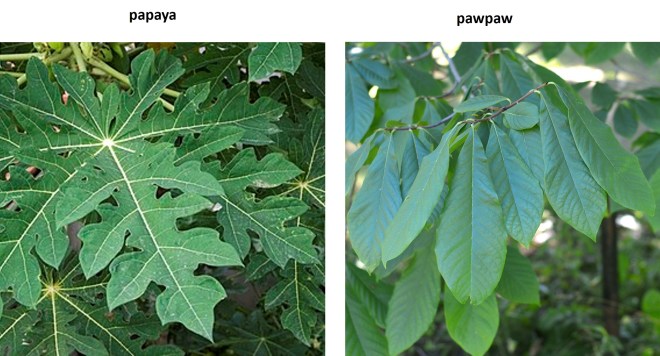
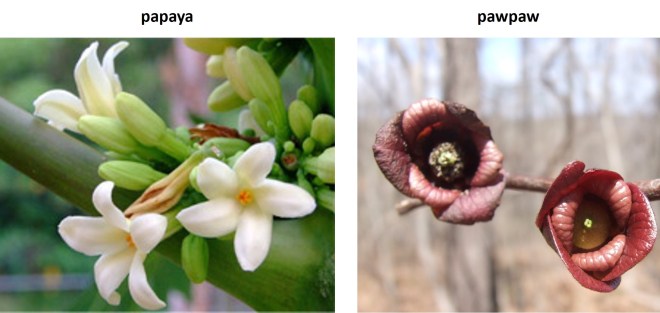
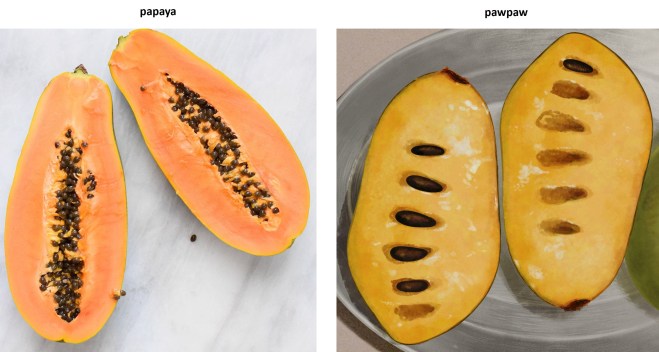
The name “pawpaw” is a bit of a puzzle. It seems that there was a confusion between the pawpaw and the papaya. Down in the British Caribbean colonies, the papaya was known as the pawpaw – and still today, in the UK and in many ex-British colonies, the papaya is called pawpaw. There was a brisk trade between the Caribbean and American colonies, and the thinking goes that when Brits coming from the Caribbean landed in the more southerly American colonies and first set eyes on this tree and its fruit they said “Ooh, look, those look like pawpaws” and the name stuck. Those Brits must have had very poor eyesight, though. In these next few photos, I invite my readers to compare various aspects of the two plants. Here’s what the tree looks like.

Source                                                                            Source

Here’s what the leaves look like

Source                                                                              Source

Here’s what the flower looks like.

Source                                                                                 Source

Here’s what the fruits look like on the outside.

Source                                                                             Source

And here is what they look like on the inside.

Source                                                                           Source

I think my readers will agree that, with the possible exception of the whole fruits, the two really don’t look like each other at all. Maybe those Brits from the Caribbean were actually comparing the taste of the two fruits? For reasons that will become clear in a minute, neither I nor my wife have ever eaten pawpaw, so I am relying here on other people’s impressions of the fruit’s taste. This description, from its entry in Wikipedia, seems to summarise quite well various attempts I have found around the internet to describe the taste : “a flavour somewhat similar to banana, mango, and pineapple”. I haven’t eaten piles of papaya, but that description doesn’t fit with my sense of the papaya’s taste. I rather agree with one person’s assessment that the papaya tastes like a cross between a cantaloupe and a mango.

So the mystery remains: what the hell were those initial namers thinking?! They just created a big confusion. Why didn’t the colonists in the American colonies adopt the name given to the fruit by the local First Nations tribes? The Virginians did it with persimmons, after  all (a transliteration of the Algonquian name for the fruit: “pessamin”).

Source

The coureurs des bois (roamers of the woods), French Canadians who traded for furs with the First Nations and who were a key figure in the North American fur trade, were often the first Europeans to explore the part of the US which is the fruit’s natural range. They sensibly adopted the Algonquian name for the fruit, “assimin”, giving it a French twist, though, coming up with “asiminier”. Here we have an etching of a heroic-looking coureur des bois which appeared in a French Canadian magazine from 1871.

Source

Taking a leaf from the Virginian colonists’ book, I shall start a campaign to have the fruit’s name changed to assimmon. Readers are welcome to join me in this futile tilting at windmills; just for the hell of it, I insert Picasso’s take on the original tilter at windmills, Don Quixote, with his faithful sidekick, Sancho Panchez.

Source

I have to say, I do have a sort-of official approval for this effort: the plant’s proper botanical name is Asimina triloba, where the first part of the name picked up the coureurs des bois’s name. In fact, I shall start right now. I shall call the fruit assimon in the rest of this post.

As readers can imagine, the pawpaw – sorry, the assimon – was very popular with the First Nation tribes who occupied the fruit’s range. Here you have what turns out to be the largest edible fruit that is indigenous to the US, and it’s delicious to boot! The tribes loved it so much that they extended the fruit’s original range by carrying it with them when they moved into new territories (as they did with the Jerusalem artichoke – and of course maize). This most probably explains the fruit’s presence in Southern Ontario, brought there, it is theorised, by the Erie and Onondaga tribes. To bring us back to those far-off times, I throw in a photo of a figure that appeared in Samuel de Champlain’s books on his voyages in what is now Canada and the US. It relates to an attack Champlain carried out together with the Hurons on an Onondaga village, situated on what is now called Onondaga lake, close to the modern city of Syracuse in the northern New York State.

Source

It’s lucky that the First Nations did move the assimon tree around, because it had evolved into a cul-de-sac. If readers go back to the photo of the open assimon fruit, they will notice its large stones. Fruit stones have evolved to be swallowed by the animals which consume the fruit, to be then expelled in a nice, fertilising pile of poo somewhere else as the animal in question wanders around. The bigger the fruit stone, the larger must be the animals eat the fruit – otherwise, they can’t swallow it. It’s been theorised that the assimon’s very large stone means that it evolved to be eaten by the American continent’s megafauna. Here is a photo of these large beasts, also showing humans, to give an idea of their enormous size.

Source

Only the omnivores amongst them ate fruit, of course, but those which did spread the assimon around.

About 10,000 years ago, though, America’s megafauna died out. Quite why this happened is hotly debated, but the arrival of human beings, the ancestors of the First Nations, from across the Bering Straits was in all probability a big factor in this wave of extinctions. The modern bear is now the only animal big enough to swallow the stones of the assimon without choking. So it was just as well for the plant that humans stepped in and moved the plant around – and it was only fair that they did so, given the role they had played in the extinction of the megafauna.

As I said earlier, even though my wife and I lived something like eight years all told in the assimon’s range, we never tried it. We never even saw it being sold in supermarkets. How can it be that the US’s largest indigenous fruit is not readily available in every supermarket in the country? How can it be that enterprising Americans didn’t bring the plant to Europe, China, Japan, and anywhere else with the same temperate climate and establish assimon orchards?

The sad fact is that the assimon, in contrast to more popular – and non-American – commercial fruits like apples, pears, or peaches, stores poorly, primarily because the fruit ripens to the point of fermentation very quickly after it is picked. An assimon only keeps for 2–3 days at room temperature, about double that if it is refrigerated. This short shelf-life and therefore difficulty in shipping the fruit any distance means that the food industry is simply not interested in it. I have commented unfavourably in an earlier post about the fact that many of the foodstuffs eaten in the US are not native there, suggesting that native foodstuffs should be eaten. But in this case it really seems that the assimon is simply unsuited to our modern way of life. The best one can hope for is to find it in farmers’ markets held in the fruit’s range. And they will only offer it during the month of September, which is when the fruit ripens (there is a niche market for the shipping of the fruit over longer distances, but it must be a risky business).

Or you plant a tree in your garden if you live in the right climate. Which brings me back to my good doctor! We said we would go and see them. Maybe we could go and see them in September, when his assimons are ripe. But we need to know very precisely when they are ripe and then immediately go down to visit them and try this delectable fruit. But how to do this without sounding crass? “Hello, are your assimons ripe? If not, we’re not interested in coming.” I shall have to discuss this with my wife and try and find a more subtle way of doing this.

BEAT-UP OLD PICKUP TRUCKS

Milan, 13 April 2024

The area of LA where my daughter and her partner live can be characterised as one of neat lawns in front of the houses and well tended cars parked on the streets. This photo from Google street view sums up the general feel of the area.

So one of the odder things which my wife and I spot as we take walks around the neighbourhood are the occasional rusty old bangers parked among the gleaming new cars. These photos, taken on a neighbourhood walkabout with our grandson a few days before we left LA, show what I mean.

my photo
my photo

Some internet surfing has told me that the first car is a Buick Wildcat.  The second I know well. It is a Jaguar E-Type which I remember admiring on the streets of London in my youth.

As I say, this habit of having cars which would look perfectly at home in a junkyard sitting on neat, clean, well tended streets appears odd to me. That being said, oddity is in the eye of the beholder, to slightly distort an old saw.

One of the oddest examples of this sub-genre of urban decor is old pickup trucks. So that my readers can understand what I’m talking about, here is a photo I took of one such pickup truck parked some ten houses down the street from my daughter’s place. I have taken it from both directions so that readers can admire its well-worn features.

My photo
My photo

As sharp-eyed readers can see, this pickup is a Ford. Our daughter’s next-door-neighbour has instead a General Motor’s Chevrolet pickup truck.

My photo
My photo

Normally, he also parks it on the street, but he must have been away when I took this photo, because it’s parked in his driveway.

It doesn’t finish there. On a neighbourhood walk my wife and I took the last time we were in LA on the nearby hill of Mar Vista (View of the Sea, and indeed you can see the ocean from the top of the hill), I spied another such pickup truck parked on the street. I didn’t take a photo of it, so readers will just have to take my word for it. That’s three old pickup trucks in a radius of a couple of kilometres or so.

I’m no expert on pickup trucks, but Google searches suggest to me that these are all from the 1940s or ’50s. Here are photos of particularly fine examples, the first from 1940, the second from 1950.

Source
Source

What on earth is going on here? Allow me to try out some hypotheses on you, dear readers.

Given the obviously poor shape these pickup trucks (and the other old bangers) are in, my first thought was that their owners were indulging in a subtle piece of Keeping Up with the Joneses retro-snobbery: “The neighbours all have the latest in swanky Teslas and what not parked in front of the house? Peuh, we have a beaten-up old pickup truck. Beat that!” Just for the hell of it, I throw in a cartoon or two on the phenomenon of Keeping Up with the Joneses.

Source
Source

But I’ve decided that I am probably being unfair to the good folk who live in the neighbourhood.

I then thought that the owners of the pickup trucks in particular were making a political statement about the days when certain segments of American society were “eating bitterness”, as the Chinese say. Certainly, when I see these trucks, all beaten up, worn and weary, they make me think of a passage from John Steinbeck’s Grapes of Wrath.

Source

The family in the story, the Joads, had to abandon their farm in the Midwest which had become part of the Dust Bowl back in the 1930s. They rode out West to California in a homemade pickup truck, a cut-down 1926 Hudson Super Six sedan, to try to find work and a new life.

“The house was dead, and the fields were dead; but this truck was the active thing, the living principle. The ancient Hudson, with bent and scarred radiator screen, with grease in dusty globules at the worn edges of every moving part, with hub caps gone and caps of red dust in their places – this was the new hearth, the living center of the family; half passenger car and half truck, high-sided and clumsy.”

This is what that pickup truck looked like in the film made in 1940 of the book, with Henry Fonda in the lead role.

Source

And then I immediately think of that famous photo taken by Dorothea Lange of a mother and her children in a camp for migrant agricultural workers in California, where the Joads ended up.

Source

But I suspect this is too high-falutin’ an explanation.

My internet readings in the little world of old car collectors suggests a simpler explanation. It seems that one important strand of car collection is made up of people who, once they reach a certain age and high enough income bracket, buy old cars and trucks to relive comforting memories of their youth (adding a little bit of political spice, when America was Great or something like that). In the case of pickup trucks, it could be youthful memories of Grandpa, and maybe even of Grandma, working on the farm with the family pickup, that spurs urban boomers of LA to buy these rusty old pickup trucks and have them quietly sit in front of their house on the street. The memories could be like this photo of a farmer in Texas unloading feed for his cattle, using what looks like a pickup truck from the 1940s or ’50s.

Source

Or maybe the memory is something like this.

Source

So that’s where my thinking currently stands on this intriguing LA phenomenon. If my readers have any better explanations, I would love to hear them. Of course, the next time we are in LA, I could just go up to the neighbour and ask him – but that’s so un-English …

THE MEANDERINGS OF MY MIND

Los Angeles, 31 March 2024 – Easter Sunday

In my previous post, I wrote about the sad end of the earliest paleochristian basilica in Roman-era Milan, the basilica vetus or – as it later came to be called – the basilica of Santa Maria Maggiore. It was torn down to make way for an even more splendid – and bigger – cathedral, today’s Duomo of Milan. What is important for my story today, the basilica’s baptistery, the baptistery of San Giovanni alle Fonti, was also torn down. All that remains of it are a few ruins buried under the Duomo’s floor.

Source

One of the most famous people to be baptised in that baptistery was Saint Augustine of Hippo. He was baptised on Easter Sunday 386 C.E., at the age of 32, by Saint Ambrose, bishop of Milan. It was Ambrose who had finally persuaded Augustine to become a Christian after a lifetime of resistance. Here, we have a fresco painting of that scene by Benozzo Gozzoli from 1464, to be found in the church of Sant’Agostino in San Gimignano.

Source

It is actually the woman at the back who interests us. She is Saint Monica, Augustine’s mother. She was from Rome’s North African province, from a city which today is in Algeria. Christian from an early age, she was married off young to an older man who was violent and unfaithful. To make matters worse, she had to keep house with her mother-in-law, who was as dissolute as her son. But she bore all her trials and tribulations with Christian fortitude. She had three children who survived infancy, Augustine, Navigius, and Perpetua. She wanted them all to be good Christians, and tried to set them on the path of righteousness. But from an early age, Augustine caused her much anguish. He was wayward, lazy, loose in his morals – at the age of 17, he started living with a woman by whom he had a child but whom never married – and worst of all he joined a heretical sect of Christianity. At some point during all these trials and tribulations, she went to see her local bishop and poured out her heart to him. He consoled her with the words, “the child of those tears shall never perish.” Mark those words, dear readers, we will come back to them.

But Augustine had one thing going for him: he was intelligent. After studying in Carthage, he taught rhetoric there, then moved to Rome to set up a school of rhetoric, and then moved again to Milan when he was offered a professorship in rhetoric by the Imperial court. Monica, now widowed, followed him, pushing him to give up his “concubine” (which he did), get properly married with a woman from a good family (which he nearly did), and – last but not least – become a Christian (which, as we’ve seen, he did, thanks to Saint Ambrose). Having become a Christian, Augustine gave up teaching rhetoric and decided to return home. Monica of course accompanied him, but having finally achieved her aim and with nothing left to live for, she died in Ostia while they were waiting for the ship to take them across to North Africa. We see her death depicted here, in the same church in San Gimignano and by the same artist

Source

Not surprisingly, given her history, Monica is the patron saint of difficult marriages, disappointing children, victims of adultery or unfaithfulness, and of lapsed Catholics (I wonder if my mother ever prayed to Saint Monica à propos of my lapsed status?). From the Middle Ages on, her cult grew and spread throughout Christendom. The story of her crying her eyes out over Augustine became part of the popular stories about her. In fact, one can still buy statues of her in tears; here is a modern example: yours, courtesy of the gift shop of the Norbertine sisters, for a mere $180.

Source

-o0o-

In 1768, as part of its attempts to shore up its claims over the Pacific coast of North America, the Spanish government ordered an expedition to set out from Baja California and lay stake to all of the territories lying between San Diego and Monterey. The expedition set out from San Diego in July 1769 and reached Monterey in October. They actually failed to recognise Monterey (the bay had been previously described by a Spanish navigator sailing up the coast, but they couldn’t match his descriptions with what they were seeing) and kept marching northwards, which led the expedition to its most momentous discovery in November, the huge bay of San Francisco. Somewhat astonishingly, ships from various nations had sailed past the mouth of the bay in the past without ever noticing it – the fog which commonly envelops the area has been given as the reason. Its job done, the expedition marched back to San Diego. The Franciscans who accompanied the expedition used it to lay the groundwork for a string of 21 Missions which they built over the next several decades all the way from San Diego to Sonoma just north of San Francisco. Here’s a photo of the mission church in Santa Barbara.

Source

But it’s not these large-scale events that interest me, it’s a small incident that happened in early August 1769 as the expedition force moved northward. On 2 August, the force arrived at the confluence of the Los Angeles river and the Arroyo Seco, very close to what is now downtown Los Angeles. The next day, the men moved on and camped a mere 4 km from where I’m writing this, at the Tongva village of Kuruvungna. The village was located close to a pair of springs which were sacred to the Tongvta people. The village has vanished, as have all the villages of the First Nations who lived in this part of California, but the springs still exist, now located in the grounds of the University High School on Texas Avenue in Los Angeles.

Source

Juan Crespí, a Franciscan friar who was with the expedition, renamed the springs San Gregorio. But the new name didn’t stick. Someone in the following decades, someone with a poetic bent, saw in those two springs the eyes of Saint Monica with tears continuously welling out of them, and so they became known as the fuentes de las Lágrimas de Santa Mónica, the springs of the Tears of Saint Monica. From there, by a sort of geographical osmosis, the general area around the springs became known as Santa Mónica. So when, in 1839, the Mexican governor of Alta California gave a certain Francisco Sepúlveda II a grant of 33,000 acres of land for a rancho, a grant which included the springs, Señor Sepúlveda called his rancho San Vincente y Santa Mónica (the San Vincente part of the name presumably came from another location on the rancho).

Fast forward another thirty years, to 1872 – California was now a US State – and the Sepúlveda family sold half of the rancho’s lands to a Col. Robert Baker, a businessman with a finger in many pies. In turn, two years later, Col. Baker sold three-quarters of his part of the rancho to another businessman, John Percival Jones, who had made a fortune in silver mining out in Nevada. In 1875, the two agreed to create a new town on part of their land holdings. Again, by geographical osmosis, they decided to call the town Santa Monica (even though the springs are not part of the township). Thus started the town which is now part of the sprawling metropolis of Los Angeles. My wife and I are on the bus from Santa Monica as I write this, having just visited the Cayton Children’s Museum with our grandson, where great fun was had by all. The bus is passing street after street of houses, which have all been built over the 33,000 acres of the rancho of Francisco Sepúlveda II. A lot of people have made a lot of money in real estate.

-o0o-

Over its lifetime, the town of Santa Monica has given its name to a variety of other things in the town. Perhaps the best known is the Santa Monica Pier, which has housed an amusement park out on the ocean’s edge since the 1920s.

Source

But it has also given its name to Santa Monica Boulevard, and this is where I will stop these meanderings of mine.

Source

Santa Monica Boulevard is the final, western end, of the mythical Route 66.

Source

Who hasn’t thrilled at the idea of travelling along Route 66? I certainly have. I’ve told my wife that one of these days, once we’ve finished visiting our daughter in LA, we’ll roar off down Route 66 all the way to Chicago. I think we’ll have to do this trip in a Corvette, a red one if possible.

Source

And of course we’ll be listening to Nat King Cole’s “Route 66” on the radio.

Source

Although we’ll do the trip in the opposite direction to Nat King Cole’s lyrics: LA – San Bernadino – Barstow – Kingman – Winona – Flagstaff, Arizona – Gallup, New Mexico – Amarillo – Oklahoma City – Joplin, Missouri – Saint Louis – Chicago
“Get your kicks
On Route sixty-six”