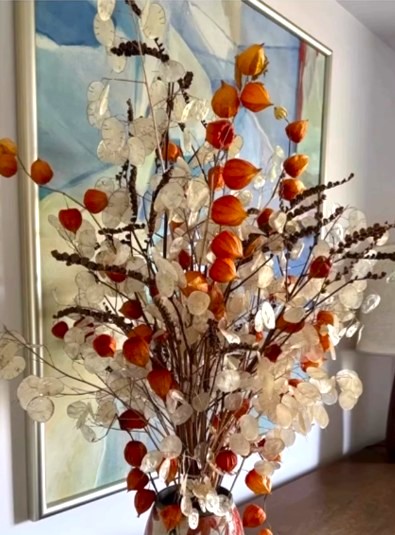
A week ago, my wife and I were passing by a florist during our afternoon walk down into the city centre when my eye was caught by one of the products the shop was selling.
My photo
It wasn’t just the pretty display that caught my attention. It just so happened that I had taken a photo of the very same plant growing along the side of the path during one of our earlier walks during the summer, in Vienna’s Tiergarten (a very nice area of woods and meadows on the edge of the city which used to be an imperial hunting ground).
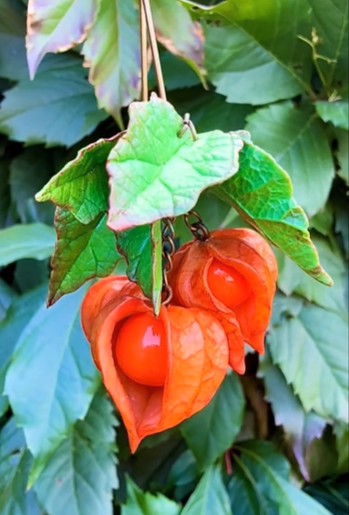
My photo
Already when I had taken this photo, I had said to myself that I should look into this plant. The clever feature on my phone’s camera told me that I was looking at a groundcherry, so at least I knew what the plant was. But, as Samuel Johnson is reported to have said, the road to hell is paved with good intentions – I hadn’t gotten around to doing anything. But that second sighting in front of the florist got me going again. And now, finally, after a few days of rain, I have cobbled together my story.
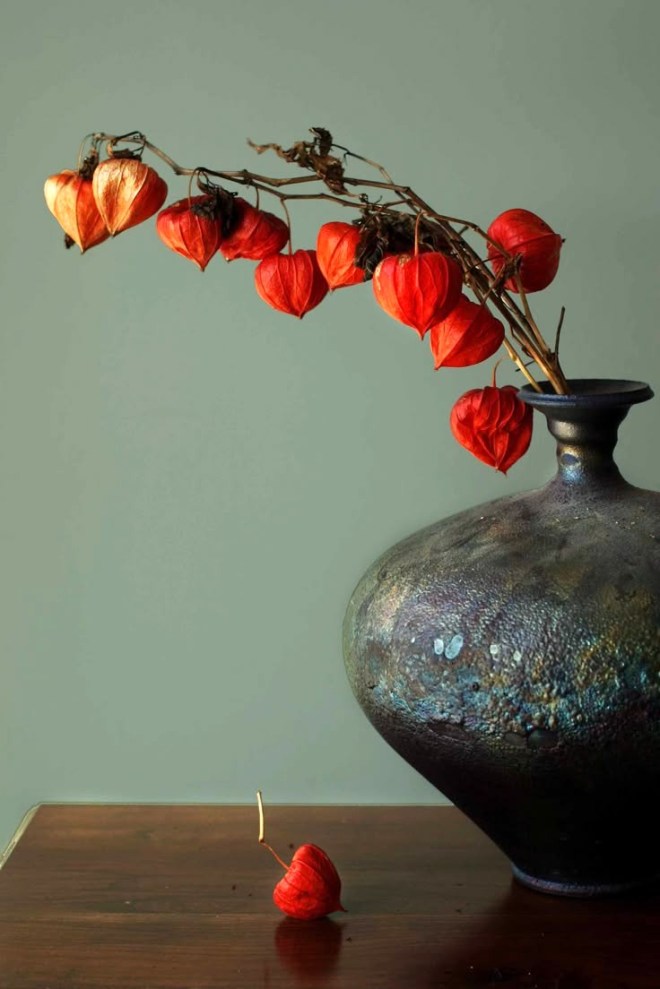
I suppose I should start with the plant’s most conspicuous feature, its bright orange to red papery calyx.
Not surprisingly, it is also this calyx which gives the plant one of its more common names in English, Chinese lantern, in German, Lampionblume or lantern flower, and in French, lanterne or lantern.
If left on the plant, much of the calyx will decompose, leaving behind only the veins of the calyx in the form of a delicately beautiful, skeletal net and revealing an orange-red berry within.
The berry’s resemblance to a small cherry has given rise to the plant’s other common name in English, the groundcherry. Having a berry trapped, as it were, inside the calyx has also given rise to other common names, like the French amour en cage, love in a cage, but the one I like best is one of its Persian names: the puppet behind the curtain.
As I have noted several times in these posts, while our ancestors no doubt saw the beauty in the world around them, they were nothing if not profoundly utilitarian: how can this thing (plant, fruit, rock, wood, animal, whatever it is) be useful to me? So of course they explored whether or not the berry of the Chinese lantern was edible; there is evidence that our Neolithic ancestors were eating the berries. The internet is not very clear on how tasty these berries are. As far as I can make out, though, they are not very tasty, having low levels of sugar and being somewhat sour. But with the addition of a lot of sugar they can be made into scrumptious jams and marmalades. Apparently, the Italians also pickle the berries, although I’ve never, ever seen this in Italy.
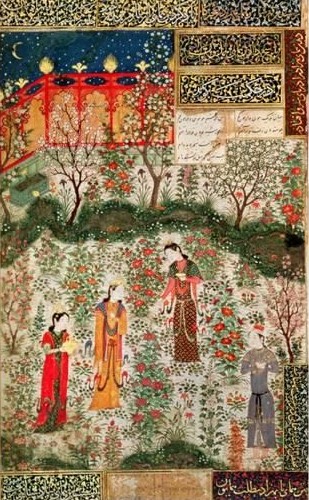
Our Medieval ancestors, and very probably even earlier ancestors, were just as interested, if not more interested, in the plant’s use as a medicine, particularly the berry. And this interest explains the plant’s rather strange scientific name, Alkekengi officinarum. It’s the plant’s generic name, Alkekengi, that’s so odd. It’s not Latin, what is it? The answer to that lies in Persia. In Persian traditional medicine, the Unani system of medicine, the dried berry was used as a diuretic, antiseptic, liver corrective, and sedative. The Persian name for the plant is kākunaj (which, by the way, I think means “balloon” or “bladder”, another common description of the plant). I throw in here a photo of a 15th Century miniature of a Persian garden.
When the Arabs overran the Persian empire, they picked up the Persians’ traditional medicine and carried it westward. This included the kākunaj berry, whose name they arabised to al-kākanj. In turn, Arabic traditional medicine was carried into Europe, where the name of the berry, and the plant, was europeanised to “alkekengi”. Another small example of the way ideas were transmitted along trade routes, something which I have written about many, many times in these posts.
The plant’s medicinal role has now died away, although there are still a lot of articles written on its pharmacological properties. So we are left with its beautiful calyx, that orange-red lantern, to enjoy. Which leads me to one lovely traditional use of the plant, in Japan. During the summer Obon Festival, the Japanese remember their deceased ancestors, believing that their spirits return to visit them. They use lanterns to guide the spirits from their graves on the first day of the festival, and back to their graves on the last day of the festival. Normally, they use paper lanterns, but in many places they also drape strings of groundcherry calyxes – called ghost lanterns in Japanese – on the shrines in temple grounds that house memorial tablets for the deceased. This photo shows a market selling strings of grouncherry calyxes.
I’ve been meaning to write this post for a while, but I could never figure out what my angle should be. The thing is, I want to write about mosses, but once you’ve said that mosses can be really beautiful, there’s nothing much more to say about them. I could blather on about their biology and ecology, but only muscophiles would find that interesting. Looking at them from a historical point of view doesn’t help much, either: as far as I can tell, they haven’t played a significant role in anyone’s history. They do have some practical uses, like bedding and wound dressings, but nothing that really stands out. And forget the dietary angle: no-one eats moss unless they are starving, so there are no interesting dishes to report on. So the post has remained unwritten.
But now, finally, I’ve decided. Since there’s not much to write about on mosses, I’ll focus on photos instead. This post will be a photo essay celebrating their beauty! (That being said, I’ll still write some stuff – I can’t stop myself – but it will be more like extended titles to the photos).
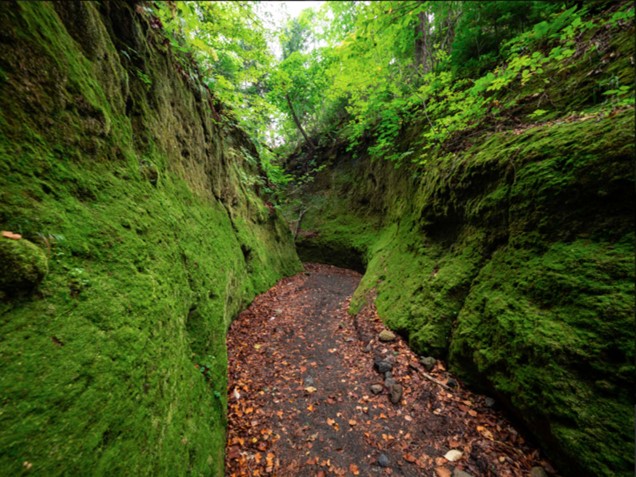
I have to start in Japan, because it is moss country par excellence: something like 1,800 species of moss, or around 15% of the world’s total, grow on its islands. It was there, back in 1985 when my wife and I toured the country for a month, that we first appreciated the beauty of mosses. Our first experience was on the island of Hokkaido, where we were taken to visit the Moss Canyon in Shikotsu-Tōya National Park. It’s more of a gorge, really, about 200 metres long with walls some 5 metres high. These walls are covered in velvety green moss.
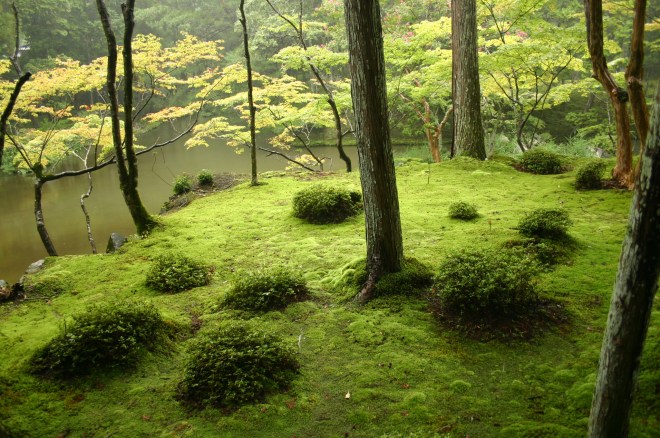
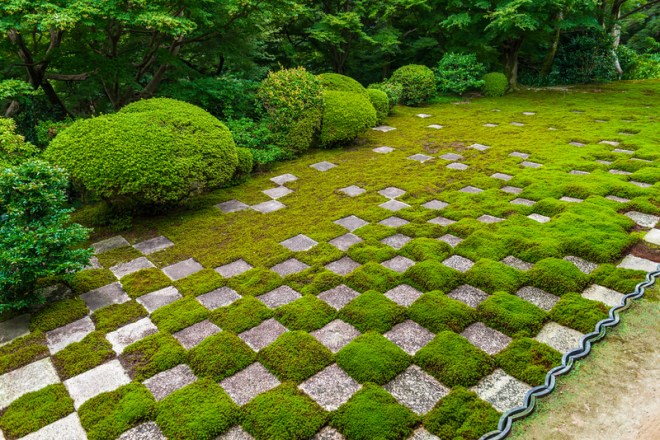
Other temples we have visited in Kyoto over the years have integrated moss into the overall design of their gardens. This example, from Tofukuji temple, is one of the more intriguing.
Many have even integrated moss into what you might think of as a most unmossy place, their dry rock gardens, where moss is often used to create islands in the sea of pebbles, like this example, also from Tofukuji temple.
But moss found out in Japan’s nature can be just as beautiful. Here are various photos I’ve taken over the last few years during our annual stay in Japan.
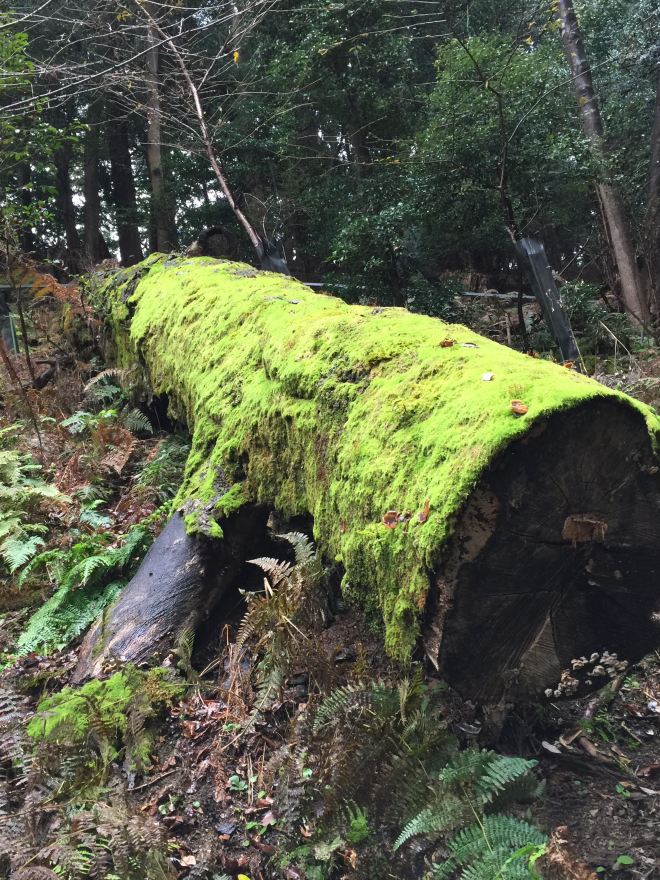
A moss-covered log on the flanks of mount Kurama, north of Kyoto.
My photo
Fallen Japanese maple leaves smothering a field of moss, out in Ararshiyama in the north-west of Kyoto.
My photo
A tree stump crowned with moss, on the Kumano kodo trail.
My photo
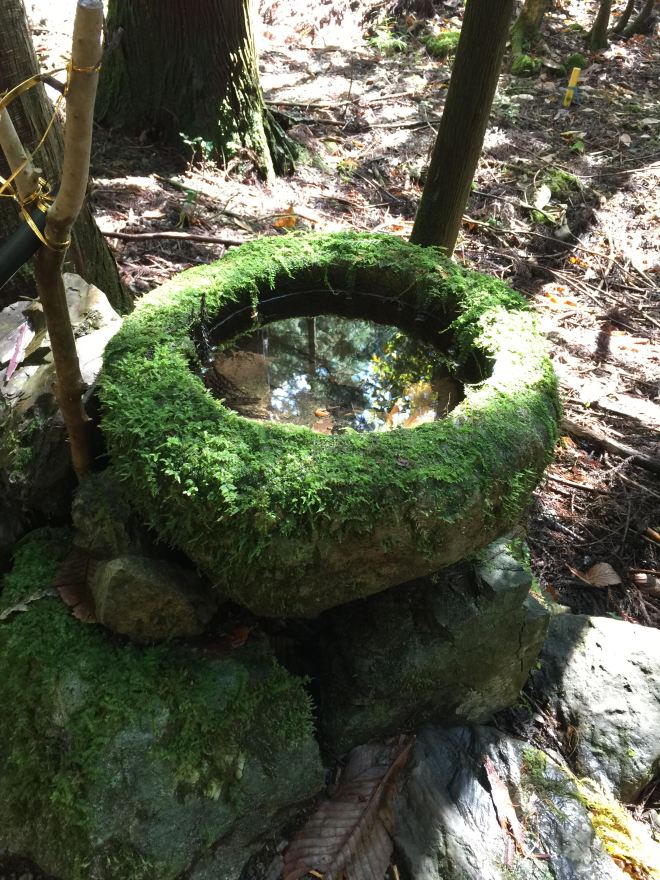
A stone basin with a moss-covered rim, seen on the same trail.
My photo
A stone lantern, being slowly colonized by moss.
my photo
An abandoned motorbike, also being slowly colonized by moss.
my photo
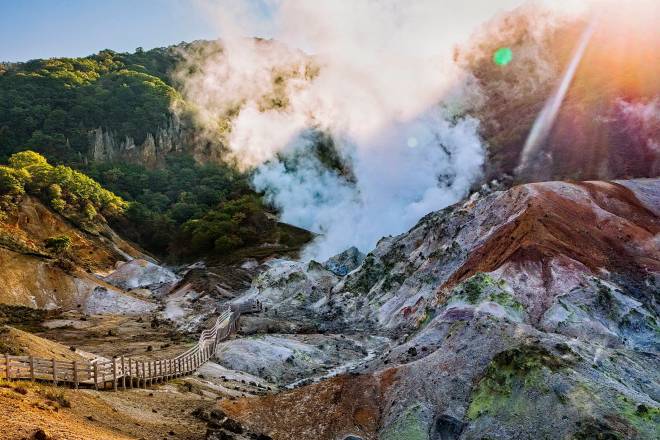
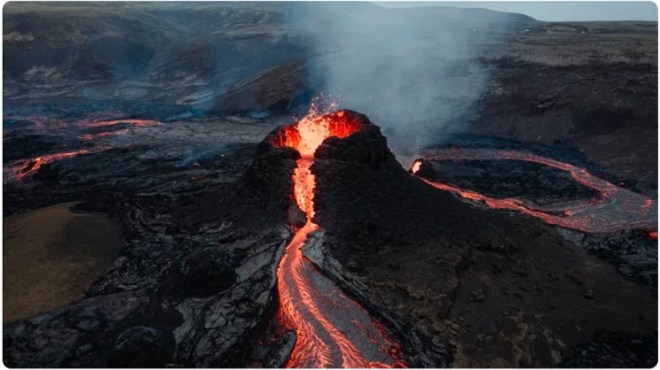
Japan is the land of moss, but it is also the land of fire, as we saw up close on that visit to Hokkaido’s Shikotsu-Tōya National Park
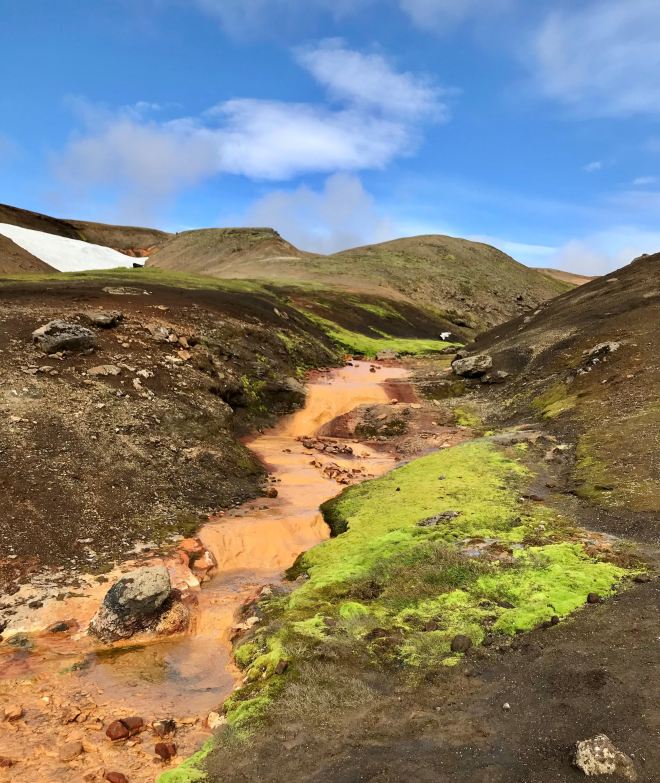
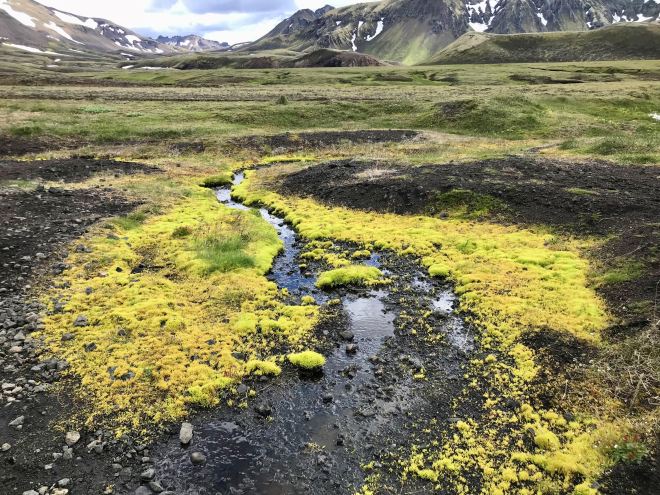
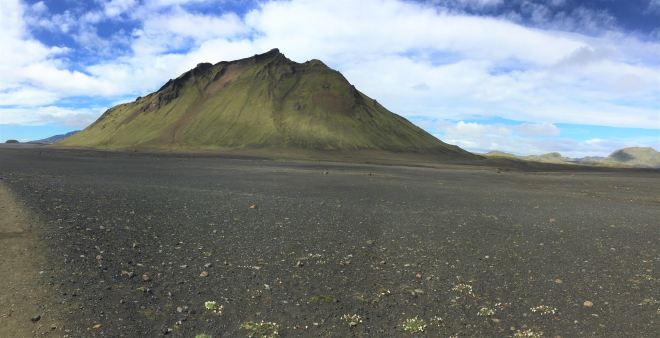
The contrast could not be starker. One island country has lush vegetation of which moss is but a part. The other has little vegetation, its climate being too harsh. And yet mosses manage to thrive. Which was just as well for us because wherever there was water they covered with ethereal green the otherwise denuded landscape which we hiked past.
My photoMy photoMy photoMy photoMy photoMy photo
Well, that’s our photo album with mosses. If we ever come across beautiful mosses elsewhere, I will add photos to the album.
Getting a coffee in Italy is a rapid affair. I go into a bar, I order my coffee (normally a cappuccino but it could be an espresso, corto, lungo, macchiato, corretto, and who knows what other combination), and I pay.
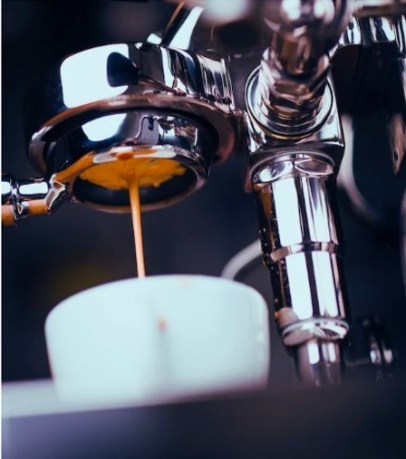
I pass the order to the barman, who, with a few rapid movements, fills the portafilter with ground coffee (no idea what coffee, whatever the bar buys), and snaps it into place onto the coffee-making machine.
That’s the yang of coffee making. Now we come to the yin.
Japan doesn’t have much of a culture of coffee drinking. When we’re in Kyoto, it’s hard to find places that sell coffee on the go. We normally have to repair to international chains like Starbucks or McDonalds to get one. We have also gone into a small number of Japanese cafes which sell coffee, but that is a completely different experience.
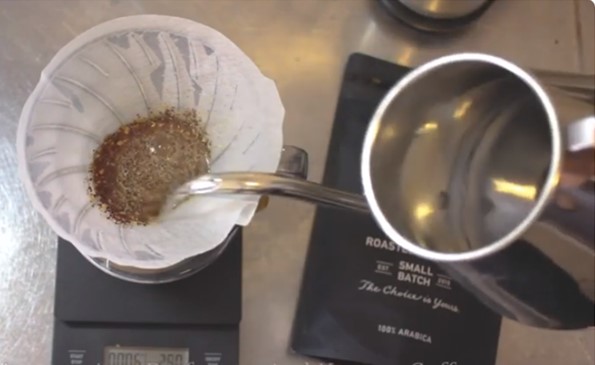
First, we have to choose our beans from a long list of various coffee beans from all around the world, each with different roasting levels. It’s so complicated it gives me a headache. I normally choose at random.
By the time my coffee is placed carefully in front of me in Japan, in Italy I would already have left the bar and be half way to Turin.
I have to say, I am irresistibly reminded of Japanese tea ceremonies when I see those Kyoto baristas going through their routine – the same attention to the minutest detail, the same choreographed moves, the same solemnity.
But hey! The world is beautiful because it’s varied, as the Italians like to say. If people want to wait 20 minutes to have a coffee made in a quasi-ceremonial way, why not? Just please point me to the nearest Italian bar.
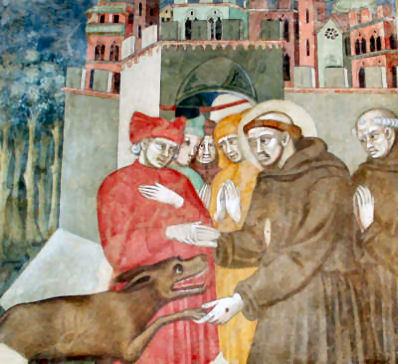
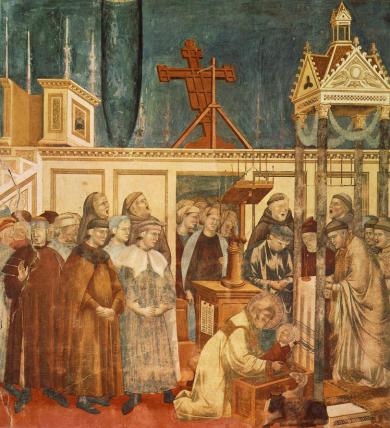
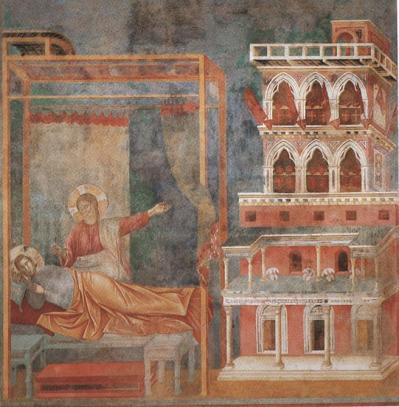
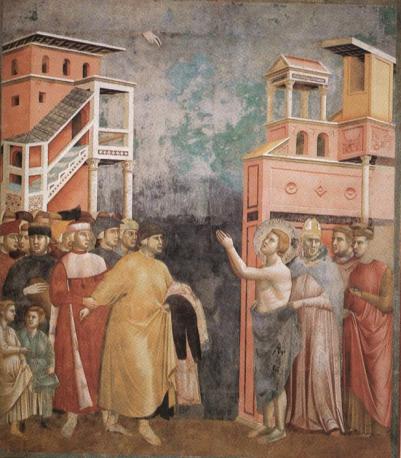
At the end of October, my wife and I did a two-day hike from Gubbio to Assisi, along the Via di San Francesco. As the trail’s name suggests, it centres around the life and times of St. Francis of Assisi. As befits any saint from the Middle Ages, he was the protagonist of a great number of stories, many of which became the subject of the late 13th Century frescoes painted in Assisi and elsewhere after his death in 1226. I will choose some of these to illustrate stories which took place in the localities linked by the trail.
To the north of Assisi, the trail starts at La Verna, where Francis received the stigmata.
As for the southern portion of the trail, it starts in Rome, where Francis went a number of times to keep his movement on the right side of the Church authorities – this fresco depicts his critical first meeting with Pope Innocent III, to receive the pope’s blessing for his nascent movement.
It goes on to Rieti, where Francis came many times. His last visit was shortly before his death, to have an operation on his eyes – he had become nearly blind (the operation failed, alas).
Nearby, while resting and preparing for his operation, he worked on his Canticle of the Sun:
“Be praised, my Lord, through all your creatures,
especially through my lord Brother Sun,
who brings the day; and you give light through him.”
He goes on to praise “Sister Moon”, “Brother Wind”, “Sister Water”, “Brother Fire”, “Sister Mother Earth”. He completed the last verse on “Sister Bodily Death” as he lay dying in Assisi soon after.
In nearby Greccio, he created the first living crèche, using locals as the actors in the drama. It was his way of telling the Christmas story to rural folk, who couldn’t understand the Latin in which the story was normally told.
And it, too, of course ends in Assisi, where Francis’s spiritual journey began and ended. Of the many stories about him that happen in the town, I choose two:
His renunciation of his father and family, stripping himself naked in the town’s piazza and giving his clothes back to his father;
And then there is the tiny church of Porziuncola down in the valley below the town, which Francis had rebuilt and where he loved to spend time. Here is an artist’s rendering of what it looked like in his day. Those two rows of little huts are where the friars stayed.
It was in that church – chapel, really – that Francis heard the priest read out from the Gospel of Matthew the passage where Christ sends his disciples far and wide to proclaim the Good News, with the following instructions: “You received without charge, give without charge. Provide yourselves with no gold or silver, not even with coppers for your purses, with no haversack for the journey or spare tunic or footwear or a staff, for the labourer deserves his keep.” Then and there, he decided that he and his followers would do the same. Thus was born the order of mendicant friars which was to take his name, the Franciscan Order.
Funnily enough, this momentous decision doesn’t feature in any of the frescoes about him – at least, none that I have found. But other stories involving Porziuncola have been the subject of frescoes. I choose three:
His welcoming of Clare when she ran away from her family to join Francis’s movement and eventually established the Order of Poor Clares;
After our two days of hiking, my wife and I spent a day in Assisi. Alas, I can’t say that I liked the town in its modern guise. It’s just a tourist trap, crowded, full of shops selling tourist tat and restaurants selling overpriced food.
Francis would have been horrified at all these shops pushing tourists to consume – and in his name at that. I rather think – I hope – that like Jesus in the Temple in Jerusalem he would have gone after all these sellers of tat. Turning once again to Matthew: “Jesus then went into the Temple and drove out all those who were selling and buying there; he upset the tables of the money-changers and the seats of the dove-sellers. He said to them, ‘According to scripture, my house will be called a house of prayer; but you are turning it into a bandits’ den.'” I throw in a painting by El Greco of Jesus wielding the whip in the Temple, one that always comes to my mind when I see these shops in places that are supposed to be havens of religion.
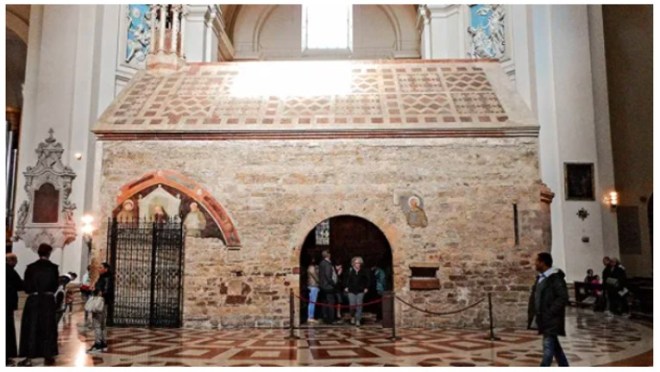
But even the basilica of St. Francis, which one reaches after braving the tourist shops and overpriced restaurants, disappointed me. Yes, it is full of art whose creation supposedly kick-started the Italian Renaissance, and I’ve used many of its frescoes above as illustrations. But I was struck by something I read. In his testament, Francis had specified where he wanted to be buried in Assisi. It was at the far end of the town, its lower end. It was here that convicts were executed and the town’s lepers and other outcasts congregated. Its noisome reputation led to the area being called the “collis Inferni”, the hill of Hell. Francis had often spent time on that hill, ministering to the wretched who eked out a living there. It was of a piece with his beliefs to want to be put to rest in a humble grave among the lowest of the low. Yet, the Church authorities, actively supported by the Franciscan Order’s hierarchy, were having none of that. It was decreed that a splendid basilica would rise on the collis Inferni, turning it into the “collis Paradisi”, the hill of Paradise.
Poor Francis must have been spinning in his coffin when he was finally interred in that basilica, four years after he died. It was a betrayal of everything he stood for.
As for Porziuncola, that humble chapel so beloved by Francis, Pope Pius V in the 16th Century ordered a huge church to be built, Santa Maria degli Angeli.
The ostensible reason for building the church was to better control the flow of pilgrims. The guide books are at pains to point out the bareness of the interior of this mastodontic church, as proof of its respect for Francis’s vows to Lady Poverty. But, standing on the square in front of the church, it is difficult not to see this as one more example of the Church authorities glorifying themselves. I’m certain that Francis would have been horrified.
As I’ve said in an earlier post, I am a great admirer of Francis – not the religious side of him; as I’ve said in another post, I am an atheist and have been since I fell off the straight-and-narrow as a student at University. But his turning away from the material side of life – a core part of the Rule he wrote for his friars being that they should own nothing – makes him truly a man for our times.
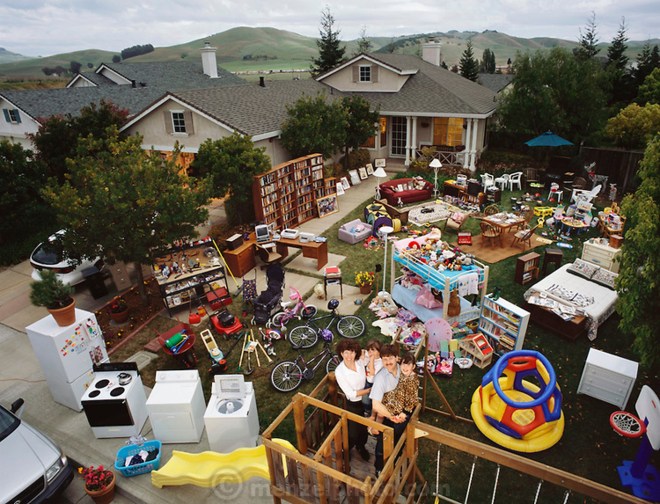
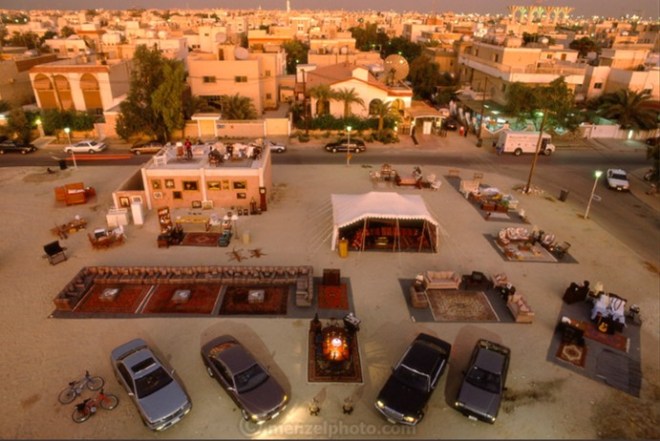
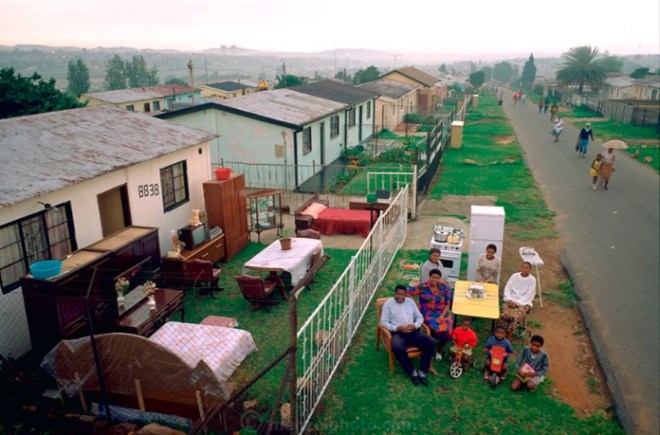
I hardly ever allow my professional work to leak into my posts, but today will be different; I suppose it’s because I’m writing this post in Kyoto where I am giving my annual course to university students on precisely this: how we can build a society that has a much smaller footprint. What I tell my students is that after working for 45 years in the environmental field, I have become convinced that our excessive consumption is literally destroying our planet. Look at these photos taken by Peter Menzel. He travelled to different countries and invited households whom he met to put everything they owned out on the street in front of where they lived. This photo is of a family somewhere in North America, a place with one of the highest levels of per capita consumption in the world.
This is all worrying enough. But what’s even more worrying is that people who live in less developed countries, whose levels of ownership and consumption of stuff are still modest, like South Africa
they want to have the same levels of consumption as the richer countries.
That impulse is perfectly understandable. But it cannot be. We cannot all consume at the levels of that North American family, or even of that Japanese family. We must heed Francis’s call to adopt a life shorn of stuff. We must – we must – reduce our levels of consumption, or else we will face an ecological catastrophe. Here, too, Francis is a man for our times because of his views on Nature. Unlike most of his contemporaries, and indeed unlike most of humanity even today, he saw the rest of Nature as equal to us humans. His Canticle to the Sun is an ode to Nature, as relevant today as it was when he wrote it 800 years ago. Of course, his reverence of Nature sprang from his reverence of God – if God created Nature, his argument went, we should revere Nature as God’s work. My position is rather different. Whether we like it or not, we are an intimate part of the world’s biosphere, and if it dies we die. Yet, because of our huge levels of consumption, growing ever huger with every passing year, we are ripping our biosphere apart, one result being that the Earth is losing species at rates which have not been seen in the last 10 million years. Francis, I’m sure, would have been appalled. If we go on like this, we are going towards a general collapse of the world’s ecosystems, which will sweep away our civilisations – for all our cleverness, we will not survive breakdowns in our biological life-support systems.
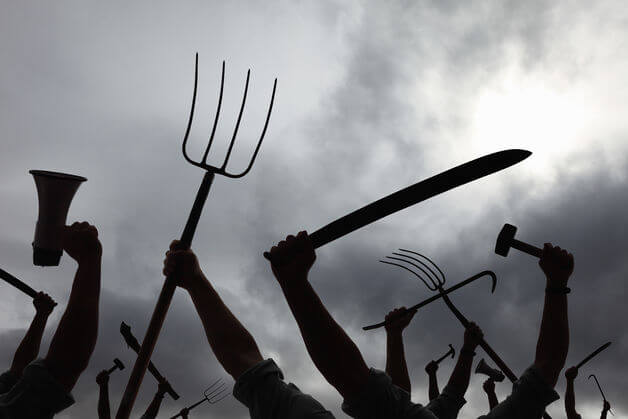
And finally Francis is a man for our times because he felt closest to the poor, the outcasts, the lowest of the low. Today, we live in a world riven by inequalities. In the photos above, I showed one type of inequality, the inequality between countries. Seemingly, this type of inequality is narrowing, but only to be replaced by a much more insidious inequality, the inequality between the citizens of these countries. Already rich individuals are getting ever richer at the expense of everyone else and don’t care anymore about their fellow citizens. We have to change that. We must – we must – pay more attention to the greater societal good rather than to our own individual desires. Frankly, this is not – as was the case for Francis – a disinterested decision, an “act of love for our fellow men”; it is very self-interested. If we don’t look after those who have been left behind, they will eventually come for us with their pitchforks.
And this should not be an average. Every one of us should have this level of consumption, from the Bezoses and Musks of this world to the homeless that haunt our streets.
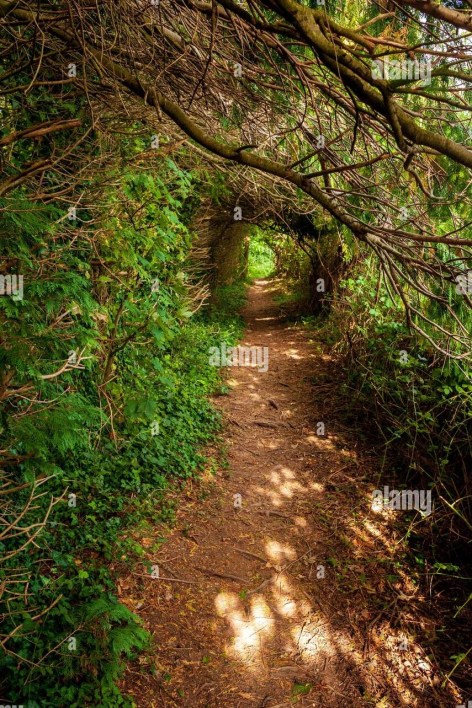
Meanwhile, my wife waits patiently at the next turn in the path, no doubt hoping that this new-found enthusiasm of mine for visiting death and destruction on passing vegetation will soon fade away.
It’s not often that I write about technologies, they are mostly workhorses of some sort without much else to commend them. But from time to time I come across a technology that catches my eye. Sometimes it’s because the technology in question is genuinely lovely to look at – solar power towers come to mind – but sometimes it’s simply because it’s quirky and fun and brings a smile to my world-weary, seen-it-all-before, been-there-done-that face. Funiculars fall into the latter category.
My wife and I have been taking funiculars quite often this last month or so. Actually, we’ve been taking one specific funicular quite often, the one between Como and Brunate, the village perched high above Como, on the steep hills – cliffs, almost – that plunge into the lake. It is the jump-off point for a number of our hikes.
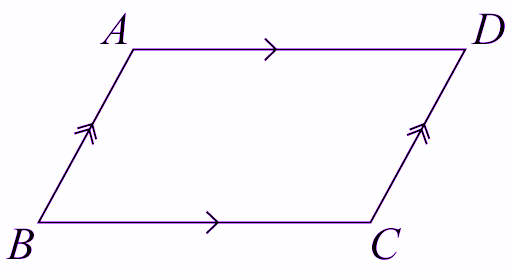
They are the only thing I’ve ever come across in the real world which look just like those parallelograms we used to draw in geometry classes at primary school.
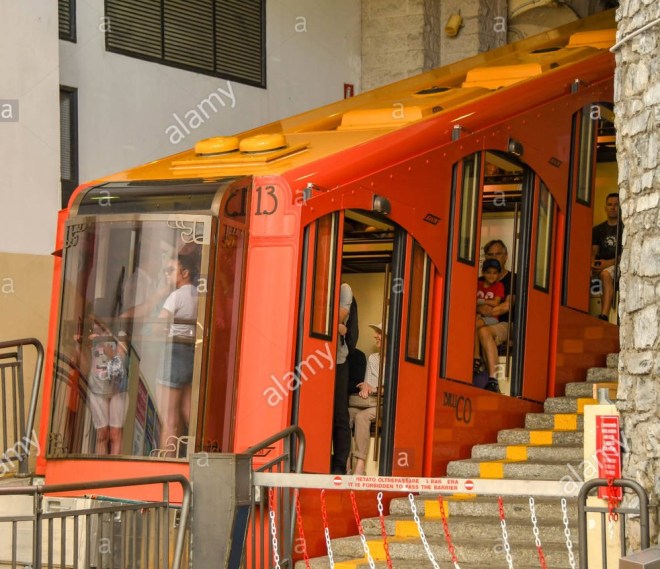
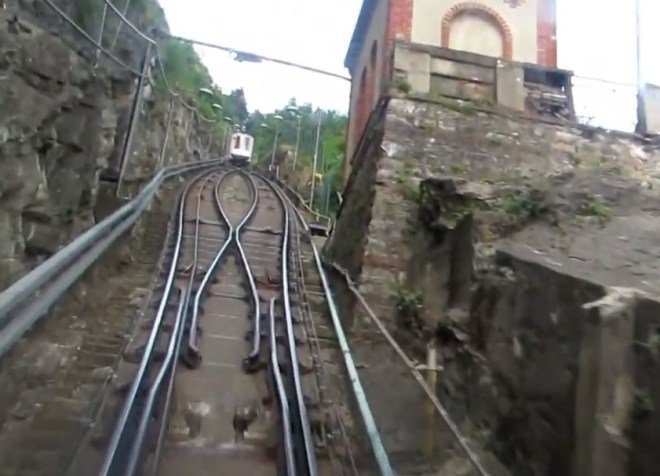
Entering a funicular carriage is like entering a world where everything leans to one side. Luckily for us, as readers can see from the picture of the carriage its’ designers have rigged up the inside into a series of flat platforms connected by steps, so we can sit in a normal position and not like those astronauts who are about to take off from Cape Canaveral.
and continue on their way. Soon after, we ease slowly into the upper station at Brunate, the doors open, and we stride off to yet another hike, after briefly stopping to admire the view.
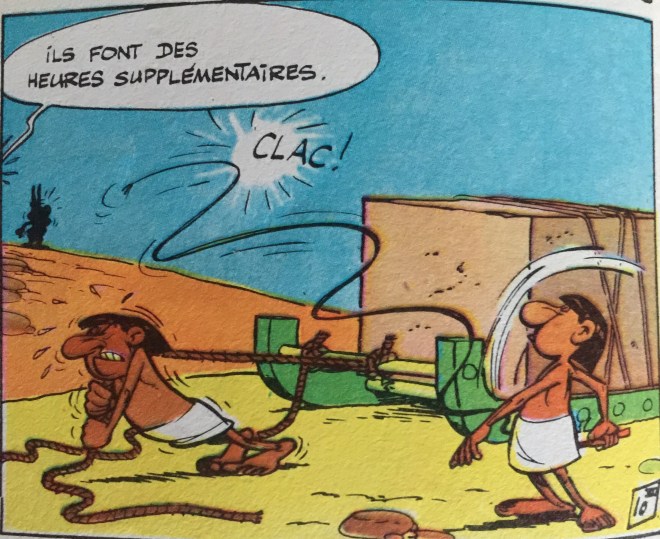
It’s not just their quirkiness that makes me like funiculars. They are also clever pieces of design. The key design principle behind them is to have two carriages attached to the same cable. I personally haven’t dragged anything up a very steep hill, but I would imagine that it’s pretty hard work, requiring the outlay of a lot of energy – and an overseer to whip the bejeezus out of me to make me pull harder. A picture from Asterix and Cleopatra shows what I mean.
my photo from the album
Attaching another carriage to the cable means that at least the weight of the carriage being dragged up the hill is now counterbalanced by the weight of the carriage sliding down it, so the only energy you need to add to the system is the energy required to drag the people sitting in the carriage up the hill. And if you can get people into the carriage going down the hill, they can pretty much balance the people coming up, reducing even more the energy required to get the upcoming carriage to the top of the hill.
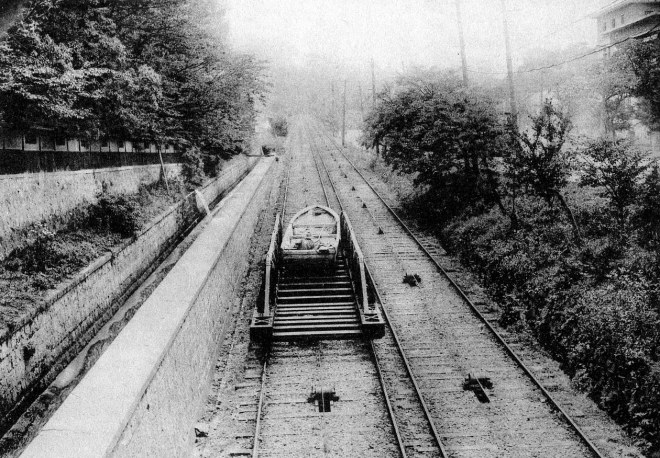
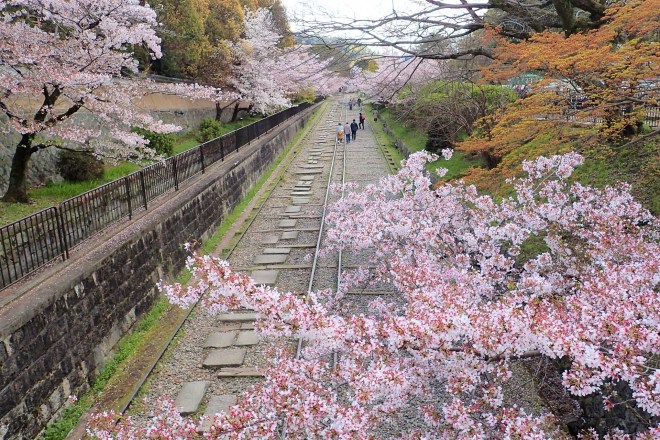
I can’t find any claim on the internet to an inventor for this key idea. I suspect it’s an old idea, with the inventor lost in the mists of time. The most immediate precursor comes from the golden age of canals, where similar systems were used to drag boats up from a lower canal to a higher one, counterbalanced by boats being let down from the higher canal to the lower one. My wife and I have walked down the slope of one such system, the Keage Incline, in Kyoto. It used to connect the canal from Lake Biwa to the canal 36 meters lower which ran through Kyoto.
It was taken out of use in 1948. Now only tourists like us use it, especially during the Spring when the cherry trees, which have been planted along it, are in bloom.
This clever idea of the counterbalancing act was taken one step further in a few funiculars, where a water tank was attached to the carriages. An operator at the top of the funicular would fill the tank of the downward-going carriage with enough water to make it just a bit heavier than the upward-coming carriage, so that the downward-moving carriage could pull the upward-coming carriage up the hill without the need for any extra energy input. At the bottom, the tank was emptied out, and the whole cycle started over. Unfortunately, this alternative to the funiculars’ basic balancing act was never very common, because it needs a good (cheap) source of water at the top of the hill, whereas most sources of water are at the bottom of hills. I also suspect these types of funiculars were more complicated to manage. Over the years, a good number have been switched to more conventional hauling engines, but a few still exist, for instance the Bom Jesus funicular in Braga, Portugal (the water tank is below the carriage)
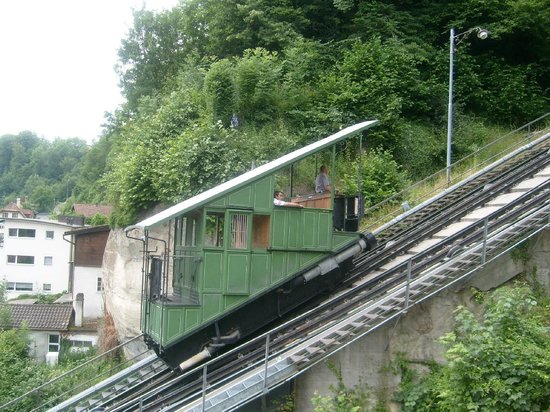
The Fribourg funicular has reached a maximum of cleverness. It uses the treated wastewater from a treatment plant located on the top of the hill to fill the tanks. At a minimum, that makes it a win-win-win solution, and I think there must be another “win” in there somewhere.
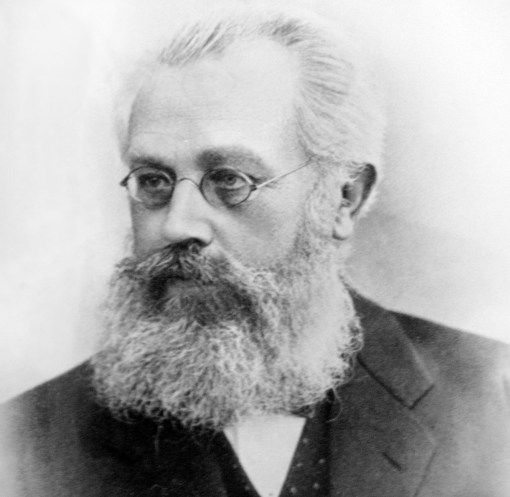
The next important invention in the funicular story does have a name and a face attached to it. Originally, cables were made of hemp or other natural fibres. As readers can imagine, they were not that strong. If the weight being pulled was too great they would snap. In practice, this meant that the hills up which things were dragged could not be too steep or the loads too heavy. This limitation was overcome when the German Wilhelm Albert figured out how to make stranded steel cables, with the first steel cable being put into use in 1834.
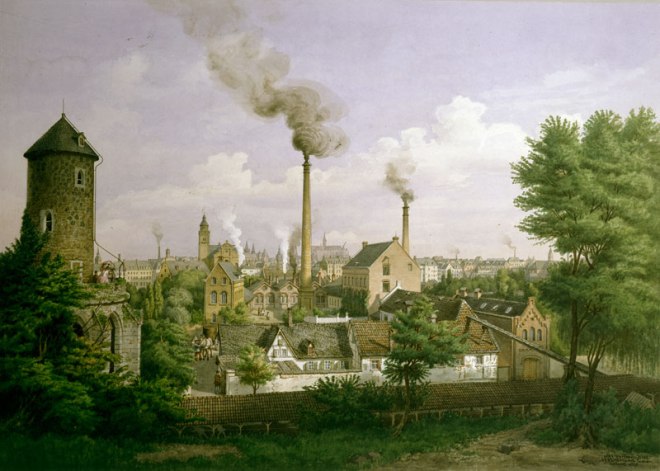
Initially, the steel cables were stranded by hand, which obviously limited output, but in 1837 an Austrian by the name of Wurm developed a machine to strand cables. The German rope-makers Felten & Guillaume then got into the game and by the 1840s were churning out more, and cheaper, steel cables. We see here their factory in Cologne in the 1860s.
This greatly expanded the scope of where funiculars – and anything else being dragged up inclines – could be used.
The final important invention had to do with track layout. In the first funiculars, each carriage had its own set of tracks. This funicular in Hastings in the UK, which was actually built quite late in the day – 1902 – shows the principle.
Two tracks laid side by side, plus four platforms – each track had to have its own top and bottom platforms – took up a lot of space, space which was often carved out of the living rock. If only one track could be used (and only two platforms), the construction costs could be lowered considerably. But how to get the two carriages past each other when they met at the midpoint? This knotty problem was solved by a Swiss engineer by the name of Carl Roman Abt.
As the diagram shows, to make it work the wheels on the left of one carriage are flanged on both sides, while it’s the other way around on the other carriage. Like that, when the carriages come to the passing point, the carriage flanged on the left always veers left, the carriage flanged on the right always veers right. The inner wheels aren’t flanged at all. Quite simple, really – although I’m sure the execution in real life is more complex than that two-sentence description.
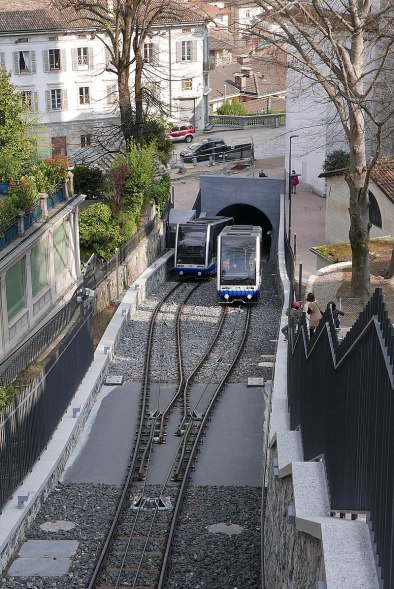
Abt first used this system in 1886 on the funicular in Lugano which connects the old town to the railway station. Which is great, because it allows me to throw in a picture of one of the funiculars which my wife and I have used in our lives. Readers can see that the cars are thoroughly modern, fruit of a makeover in 2016.
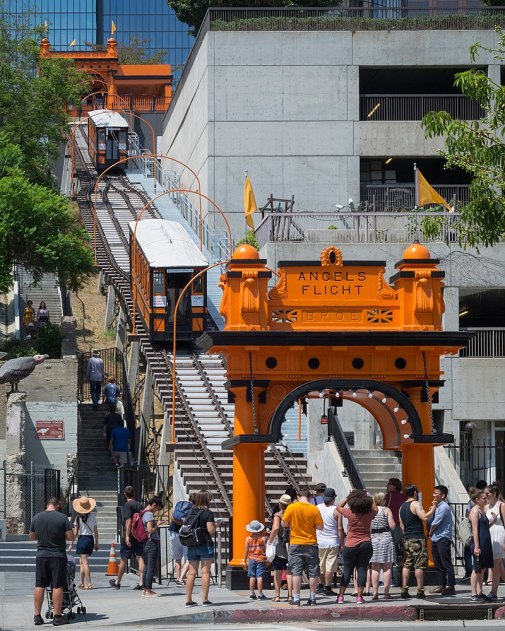
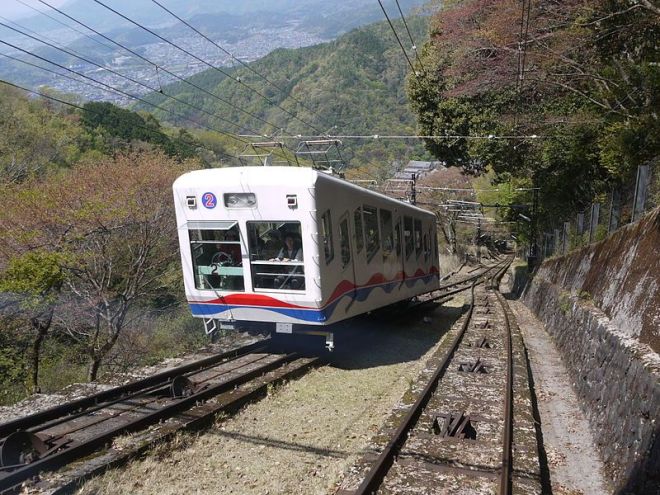
While I’m at it, I can throw in pictures of the two other funiculars we have travelled on:
The Angel’s Flight in Los Angeles (which uses a 3-rail track layout)
I’m racking my brains to think of other funiculars we’ve travelled on but I think that’s it: four in total, counting the one in Como. Not a huge number given that there are some 300 funiculars around the world. We really have to do better. I shall review with my wife Wikipedia’s list of funiculars around the world, to see which ones we should try to ride (this could be an excuse to visit places we haven’t been to yet, like Rio de Janeiro or Santiago in Chile). And then, when (if) COVID-19 is brought under control, we can be on our way!
Just look at that maple! What a magnificent yellow its leaves turned!
my photomy photo
My wife and I walked under it during a hike we did a couple of weeks ago. We were following the edge of a wood and lo and behold! there it was.
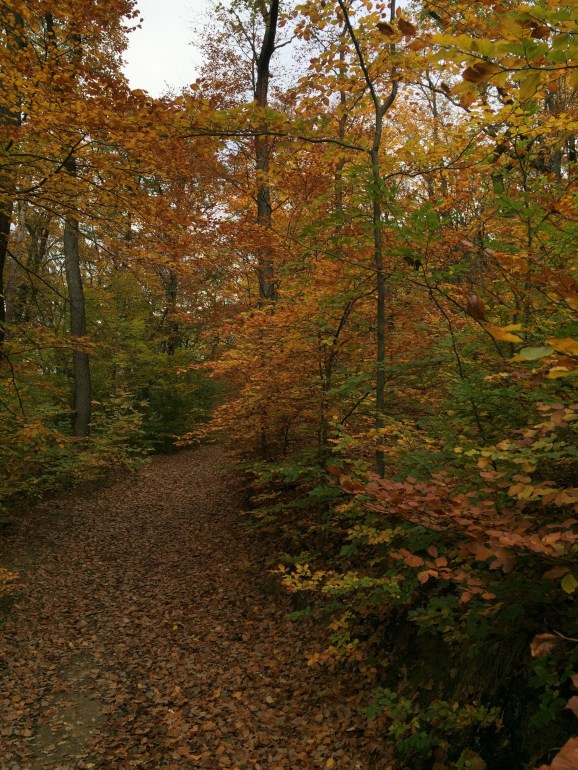
As I mentioned in an earlier post, as we have been walking the woods these last few weeks the trees have been putting on their autumnal colours. We have been bathed in yellows of all hues, turning to russet, and finally to dark brown.
My photomy photoMy photo
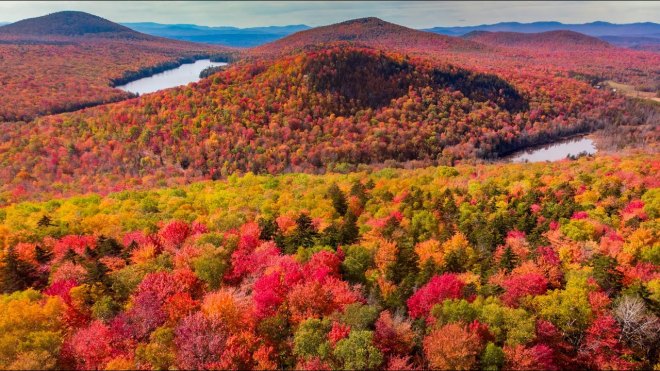
But what we have not been bathed in is reds. We have not witnessed the wonders of a North American Fall
“Why is that?” I asked myself as I sat there gazing at my photo of that yellow maple tree, “why is it that North Americans and East Asians have splendid red hues in their autumn colours and we in Europe do not?”
To answer this, we are going to use a version of Root Cause Analysis called the “5 Whys”. This was something invented by Sakichi Toyoda, the father of the founder of Toyota, who claimed that you had to ask “Why?” (more or less) five times before you got to the root cause of something. His son used it extensively in his car factories as a quality control tool, to discover the fundamental reason – the root cause – for a quality failure (and at a much more modest scale I have used it to discover the root cause of a source of pollution or waste). A simple example goes as follows:
“Why the hell isn’t my car working?!”
Because the alternator isn’t functioning.
“Well why is the bloody alternator not functioning?!”
Because the alternator belt has broken.
“Oh. Why did the alternator belt break?”
Because it was well beyond its useful service life but has never been replaced.
“Ah. Why wasn’t it ever replaced?”
Because you, idiot that you are, didn’t maintain your car according to the recommended service schedule.
“Ah, right, OK, sorry about that.”
OK, so now we can start using the method on our little problem:
“Why do the leaves of many species in North America and East Asia go red, whereas so few do so in Europe?”
We see leaves as green because of the chlorophyll they contain. But leaves also contain other pigments, which if the chlorophyll were not there would make the leaves look yellow, orange, or all hues in between. The chlorophyll simply masks them.
In Europe, when autumn comes and the chlorophyll begins to disappear, these other pigments are finally allowed to “express themselves”, giving the leaves the beautiful hues of yellow that we see. This explains the fact that the maple we came across went from green to lovely canary yellow.
In North America and East Asia, something else happens when the chlorophyll begins to disappear from the leaves. There, trees begin to produce – from scratch – a red pigment, anthocyanin, in their leaves. This pigment masks – or perhaps “mixes with” – the yellow or orange pigments already there, to give various shades of red. Thus do North American and East Asian maples go from green to red.
“OK, but why do North American and East Asian species produce this red pigment at the end of their leaves’ lives?”
Yes indeed, it does seem that the trees and bushes which do this are penalizing themselves. Just when their leaves are about to fall off, part of the general shut-down for their winter slumber, the trees start expending precious energy to pump their dying leaves full of red pigment. The reason for this apparently foolish behaviour has to do with pest control and especially control of aphids (which I happened to mention in an earlier post on wood ants). Aphids have this nasty habit (as far as trees are concerned) of sucking amino acids from them in the Fall season, and then laying their eggs on them; the eggs hibernate along with the trees and give birth to a new generation of aphids in the Spring. So the trees get hit twice: they lose precious amino acids to those pesky aphids, and then the next year they have to endure attacks by the next generation of aphids! Now, it so happens that aphids believe that a brightly-coloured tree is a tree that is chemically well defended against predators, so they tend to avoid laying their eggs on such trees. So of course trees in North America and East Asia have evolved to turn themselves bright red in the Fall, just when the aphids are laying their eggs, by pumping their dying leaves full of anthocyanin.
“Why do aphids think a brightly-coloured tree is a chemically well defended tree?”
I thought you might ask that. The answer is, I don’t know. Stop being a smart-ass and move on to the next question.
“A bit touchy are we? Well OK, why don’t European trees make their leaves go red then?”
Because they don’t they have aphids which prey on them.
“Why is that? How can it be that aphids prey on the North American and East Asian trees and not on the European trees? What’s so special about European trees?”
Yes indeed, this is where it gets really interesting. To answer this, we have to go back 35 million years. At about this time, the northern hemisphere began to go through a series of ice ages and dry spells. Most trees reacted to this by going from being evergreen to deciduous. They also retreated southwards when the ice sheets advanced and returned northwards when the ice sheets retreated. In North America and East Asia, their predators of course went with them, evolving to deal with the fact that trees now lost their leaves and went dormant during the winter. In turn, the trees evolved to fight off these predators by, among other things, turning their leaves red in the Fall. This struggle between tree and predator continued even as the trees moved northwards or southwards as the ice sheets advanced or retreated. Thus, still today, the trees in those parts of the world go a glorious red in the Fall.
But in Europe, there were the Alps and their lateral branches, which ran east-west. In North America and East Asia, the mountain ranges, where they existed, ran north-south, so the trees in their periodic advances and retreats could “flow around” these mountains. In Europe, though, as the trees moved southwards to escape the ice sheets they hit the barrier of the Alps; there, they could go no further and so perished in the piercing cold. And so of course did the predators which they harboured. Only seeds were carried southwards, by birds or the wind or in some other fashion, and of course these seeds harboured no predators. Thus it was that European trees did not need to make red leaves and so they give us glorious shades of yellow in the Autumn.
There is at least one exception to this rule, and these are dwarf shrubs that grow in Scandinavia. They still colour their leaves red in autumn. Unlike the trees, dwarf shrubs managed to survive the ice ages; in the winter they would be covered by a layer of snow, which protected them from the extreme conditions above. But that blanket of snow also protected the insect predators! So the plants had to continue their struggle with their predators, and thus evolved to colour their leaves red. We have here an example, the smooth dwarf birch.
A little while back, I wrote a post about balsamic vinegar – a disapproving post, since I don’t like the stuff. But I used the post to confess to a hankering to make my own vinegar. I attribute this to the fact that my French grandmother made her own vinegar, down in that dark cellar of hers which I’ve had occasion to describe in an even earlier post. She used the local Beaujolais wine as her raw material, putting it in a miniature barrel and leaving it there to sour to vinegar. From time to time, she would send me down the cellar to replenish the dining room’s vinegar cruet. I tried making vinegar once, in our early years in Vienna, following the rather vague instructions I had been given by a colleague. As my wife and children will attest, it was a miserable failure. The resulting liquid had a strange taste and not much of that vinegary punch. Although I put a brave face on it and determinedly continued drizzling it on my salads until it was all gone, I half expected to keel over dead at any moment, poisoned by some mysterious fermentation product I had unknowingly created. So, as readers can imagine, my hankering to make vinegar remains.
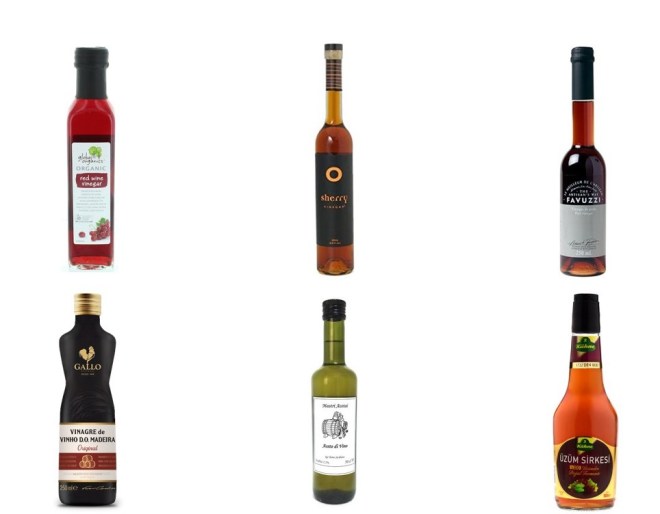
It really shouldn’t be all that difficult, I keep saying to myself. Vinegar making has been around since at least Babylonian times and it’s been made just about everywhere in the world where there is a source of sugars (the route to vinegar being first a yeast-catalyzed fermentation of sugars to alcohol and then a bacterial-catalyzed fermentation of the alcohol so produced to acetic acid, which is what gives vinegar its sour taste). In fact, it’s been truly fascinating to discover what people have made vinegar out of. Personally, I have always consumed vinegar made from grapes via wine, preferably red wine, although I’m intrigued to see that people are making vinegar with fortified wines like port, madeira, sherry, and marsala. In the Middle East, they even make vinegar with raisins (it’s famous in Turkish cuisine).
various sources
I’m also familiar with vinegars made from apples via cider and pears via perry, which have been commonly made in northern Europe. But actually just about every fruit known to man (and woman) has been used at some point to make vinegar. I just mention here the ones which intrigued me – or allowed me to create links to some of my earlier posts. The Babylonians used dates, which continue to be used for vinegar-making in the Middle East. The Israelis use pomegranates, testimony to an enduring relationship between this fruit and Judaism. The South Koreans use persimmon. The Chinese use jujube and wolfberry. The New Zealanders use kiwi fruits.
various sources
A couple of enterprising Italian and German companies even use tomato to make vinegar. I must say, I find this one strange. I know that tomato is technically a fruit, but I just can’t imagine a vinegar made from it. I would really like to try it one day, to see what it tastes like (as I would like to try tomato oil extracted from the seeds).
Sort of linked to fruit-based vinegar is honey vinegar made via the production of mead. It’s made in a couple of countries in Southern Europe (France, Spain, Italy, Romania), although it’s not all that common.
Grains of one sort or another are also used to make vinegar (an extra step is needed here, to turn the starches in the grain into sugars). This kind of vinegar is made primarily in East Asia, where rice, wheat, millet or sorghum (or a mix of these) are used. many of these vinegars are black, but there are red and white rice vinegars too.
various sources
The East Asians have been making vinegar for a very long time. Already two and a half thousand years ago, royal and noble households in China’s Zhou dynasty had a professional vinegar maker on their staff. Perhaps there were also professional vinegar tasters. Such tasters certainly became metaphors for the three main religions in China, leading to a very common depiction (the one I insert here is actually Japanese, from the Edo period, but I rather like the style).
The three men dipping their fingers in a vat of vinegar and tasting it are Confucius, Buddha, and Laozi, leaders of China’s three main religions. The expression on the men’s faces represents the predominant attitude of each religion. Confucius reacts with a sour expression – Confucianism sees life as sour, in need of rules to correct the degeneration of people. Buddha reacts with a bitter expression – Buddhism sees life as bitter, dominated by pain and suffering due to desires. Laozhi reacts with a sweet expression – Taoism sees life as fundamentally perfect in its natural state. I leave it to my readers to work out who is who in the painting I’ve inserted, based on their expressions.
But coming back to vinegar from grains, Europe also has its grain-based vinegars. For instance, the British have been making vinegar from malted barley for ever and a day. In my youth, no self-respecting fish-and-chip shop was without a bottle of malt vinegar which patrons could use to drown their fish and chips in – I cannot deny that I did this in my wild and foolish youth.
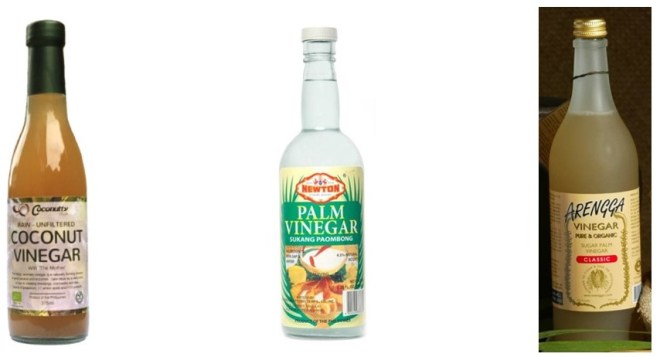
A series of vinegars which I find quite intriguing are made in South-East Asia and to some degree South Asia, from the sweet sap of various types of palms: coconut, nipa, and kaong palms (and to a lesser degree buri palms; so lesser I wasn’t able to find a picture of it).
various sources
The Philippines is the big producer and user; I read that Malaysia and Indonesia are smaller markets because the palm sap must first be transformed into an alcoholic beverage, something which is forbidden in these Muslim countries. Perhaps. But then why is Saudi Arabia, the strictest of all Muslim countries, a big producer of date vinegar?
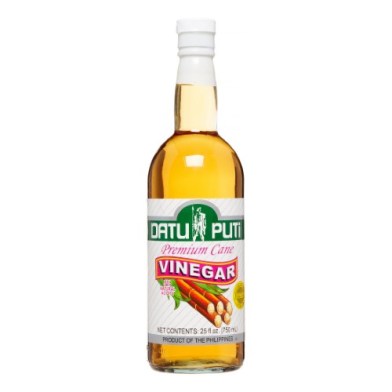
The Philippines is also a big user of sugar cane vinegar. Well, it certainly makes sense to make vinegar from the mother of all sugar sources.
I would imagine that all sugar-cane growing countries make vinegar that way. Brazil certainly does. I wonder if anyone makes vinegar from beetroots? (as opposed to pickling beetroots in vinegar) An odd vinegar that I suppose can be classified as a sugar-based vinegar is kombucha vinegar. Kombucha is a Mongolian drink. It is made by fermenting sugary tea with a SCOBY – a Symbiotic Culture of Bacteria and Yeast. This yucky slimy mat will ferment the sugar in your tea to alcohol and start fermenting the alcohol to acetic acid. Normally, you drink the fermented tea before too much acetic acid is produced, but if you let the SCOBY carry on its work all the alcohol will be turned into acetic acid and you will have a vinegar.
I find it intriguing that in all the articles on vinegars which I’ve read, there is no mention of traditional vinegars being made in Africa or the Americas (as opposed to them copying vinegars originally made in Europe). Neither continent lacks traditional alcoholic beverages. The Africans made them (and to some degree continue to make them) from fermented honey water, fermented fruits, fermented sap of various species of palm (as well as a species of bamboo), fermented milk, as well as from grains and other starch sources. As for the Americas, alcoholic beverages existed in at least Mesoamerica. There, the common alcoholic beverages were pulque, which was made out of fermented agave sap, chicha, which was a kind of maize-based beer, and fermented drinks made out of cacao beans and sometimes honey. I cannot believe that these drinks didn’t sometimes get inoculated with acetic-acid making bacteria and turn into vinegar. And I cannot believe that the Africans and Amerindians didn’t figure out ways to use this vinegar, as people everywhere else did. At a minimum, they surely would have discovered – as did everyone else – that vinegar can be used to pickle food and so extend its useful life, a vitally important discovery for societies in the days before refrigeration. If any of my readers are from Africa or the Americas and have information on this point, I would be glad to hear from them.
It’s not only the making of vinegar which I find interesting, it’s also how it’s used. But here one could write a book! (and in fact a quick whip around the internet shows me that several people already have) Since I’ve already written a couple of posts, on mustard and Lea & Perrins Worcestershire sauce, showing how vinegar can be used to make condiments, I reckon I’ve covered the use of vinegar as a condiment on food. I have also mentioned pickling in several posts, in my post on capers for instance, so I will skip the use of vinegar as a pickling agent. I will instead explore its use as a drink, for the simple reason that at first sight I find it rather incredible that anyone would ever want to drink vinegar. I certainly never have; the closest I have got to it is gargling once with vinegar when I had a sore throat, and even then I spat it out; I wasn’t going to swallow it. But people have drunk vinegar, and continue to do so.
The trick, of course, is to dilute it. Roman legionaries did this the simplest way, by just adding water (and maybe some herbs). This drink was known as posca and was drunk during military campaigns, as a thirst-quencher. There was a popular saying about posca: posca fortem, vinum ebrium facit – posca gives you strength, wine makes you drunk. No doubt these legionaries on Trajan’s column in Rome made heavy use of posca during their campaigns.
Interestingly enough, soldiers at the very other end of the Eurasian continent, the samurai in Japan, also believed in the restorative effects of drinking vinegar, in this case rice vinegar. They drank it (whether straight or diluted, I do not know) to relieve fatigue and for an energy boost.
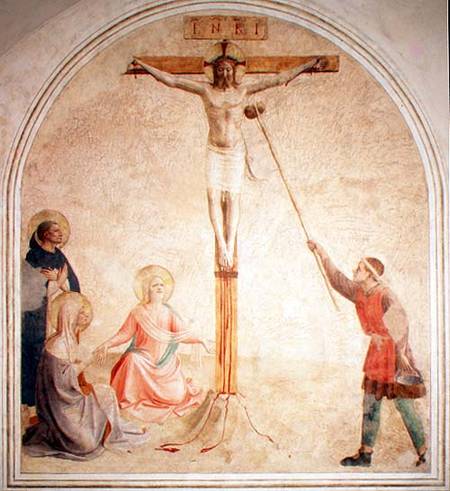
By the way, this business of posca being a drink of Roman legionaries gives quite a different slant to one of the stories in the narrative of the Crucifixion of Christ. All four Gospels say that as Jesus hung, dying, on the cross, someone put vinegar on a stick and held it to his lips to drink. Luke is the only one who says explicitly that it was one of the soldiers on guard at the crucifixion; the others say “one of the people there” or simply “they”. But it would have had to be one of the soldiers, no-one else would have been allowed to get that close. In the three synoptic Gospels, this simple gesture was turned into a gesture of mockery. John, on the other hand, has a more credible line. Jesus said “I thirst” and he was given vinegar. So now I see here a gesture of simple humanity on the part of the soldiers. They had a job to do, to crucify Jesus and the two robbers. But that didn’t stop them from trying to alleviate just a little the agony of being crucified by offering Jesus some posca for his thirst. It’s a moment in the Crucifixion story that has not often been painted, but here is a fresco by Fra Angelico.
The next step up in efforts to make vinegar drinkable is to mix the vinegar with something sweet. Here, too, the Romans had a popular drink, called mustum. It was a mix of low-quality must, fresh from the press, and vinegar. The must sweetened the vinegar, the vinegar clarified the turbid must (a case of “you scratch my back, I’ll scratch yours”).
For their part, the Ancient Greeks mixed vinegar with honey and water to make a drink called oxymel. The beverage passed into European Medieval and Renaissance medicine as a medicament, and indeed the internet is full of articles promoting the health benefits of oxymel as well as bottles of the stuff. Here is a typical example.
But the Ancient Greeks simply drank it for enjoyment. The Iranians still do. They have a drink called sekanjabin, which is a mix of vinegar and honey, to which mint leaves are often added. Apparently, a side order of fresh, crisp lettuce is a must.
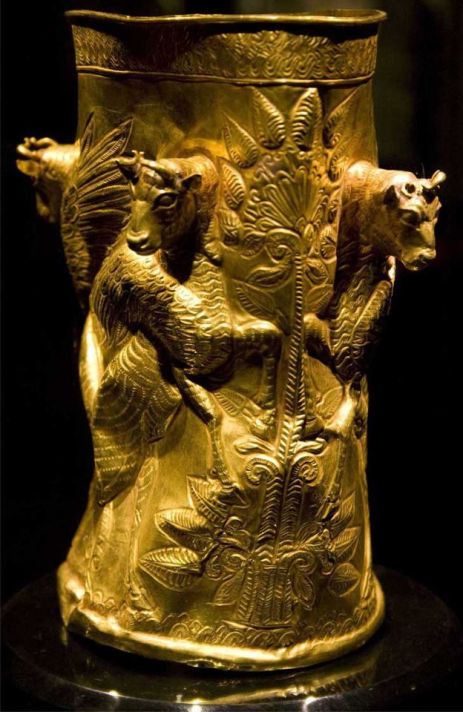
It’s an ancient drink, quaffed by Iranians when they were still called Persians. Perhaps the richest and most powerful Persians drank their sekanjabin from magnificent cups like this one (my wife and I saw similar cups in a wonderful museum near Kyoto).
It wasn’t just the Ancients who drank sweetened, diluted vinegar. Under the name of shrubs, drinks like these were drunk quite often until relatively recently in Europe and North America. It was only the rise of carbonated drinks that killed them off, and now they are a bit of a recherché drink. I suspect there is currently a bit of a comeback because apple cider vinegar is being touted widely for its supposed health benefits. As the Ancients had discovered, it’s easier to drink vinegar when it’s been sweetened. Here is one example of the current commercial offer of shrubs.
For those who, like the Iranians, want to make their own drinks, shrubs are made by simply mixing honey water or sugar water with a small amount of vinegar. Or they can be made by soaking fruit in vinegar for several days, sieving off the solid part, and adding a lot of sugar.
For those readers who, like I was, are puzzled by the name “shrubs”, allow me to explain the etymology. It is actually a corruption of the Arabic word sharab, which means “to drink”. The Arabic version of this drink hails back to the use of vinegar as a pickling agent. In cases where fruit was pickled, the vinegar drew out the taste from the fruit during the pickling. So once the pickled fruit had been consumed, people would drink the fruity vinegar – after adding water to dilute it.
I must say, I thoroughly approve of this reuse of the pickling liquid. I have been telling my wife for some time now that we should find something to do with the pickling liquid left over after we’ve eaten pickled gherkins or onions or even olives. So far, she has ignored me, pouring the pickling liquid down the drain. Perhaps I can get her to reconsider if I argue that we can turn the liquids into some kind of shrub. Of course, our pickling liquids are salty rather than sweet, but no fear, I have a solution to this! In order to explain it I have to introduce another set of soldiers, the Spartans this time.
The Roman legionaries had posca, the Spartan soldiers had melas zomos, a black brothy soup (or perhaps black soupy broth). Made of boiled pigs’ trotters, blood, salt, and vinegar, it was an integral part of their diet. We could make melas zomos! Our various spent pickling liquids could give the salt and vinegar, we would just need to find the blood and the pigs’ trotters. Of course, if we still lived in China, we wouldn’t have any problems finding these (I remember several times eating a delicious Chinese dish of pigs’ trotters in a restaurant around the corner from our place in Beijing, and I’m sure we could have found blood if we’d looked for it). But in Europe, as I’ve related elsewhere, we’ve become more fastidious about the meat products we eat, so finding these ingredients might be a problem.
Of course, even if we could find the ingredients and made the soup, would it be yummy? Well, I can only report here a comment made by a citizen of Sybaris, an Ancient Greek city located on the coast of what is now Puglia (but which has since disappeared, alas), which I’ve mentioned in passing in an earlier post. After tasting a bowl of melas zomos, this man declared disgustedly, “Now I do perceive why it is that Spartan soldiers encounter death so joyfully; dead men require no longer to eat; black broth is no longer a necessity.” Now, given that the citizens of Sybaris were famous for their luxury and gluttony (so famous that they gave us theword “sybarite”), this confrontation of polar opposites is perhaps merely an Ancient urban legend. However, it is true that the Spartans gave us the word “spartan”, which suggests that yumminess in their soldiers’ food was not necessarily high in the order of priorities of the Spartan army’s high command. The idea was to give them strength, to beat the shit out of, say, those weakling Persians who drank sekanjabin, as we saw so thrillingly in the film 300 – the Spartans in that film must have been stuffed full of melas zomos.
Luckily, if we weren’t able to find pigs’ trotters and blood (and if I wasn’t able to persuade my wife to eat the soup, a highly probable outcome since she doesn’t much like these kinds of meat products), a quick whip around the Internet has shown me that many vinegar-containing soup recipes exist which involve perfectly ordinary ingredients like vegetables (I suspect that the craze for apple cider vinegar and its purported health properties has struck again; how to find pleasant ways to ingest apple cider vinegar). I can bring to bear my skills in making soups from left-overs and find a yummy way of recycling our pickling liquids into soups. Watch this space!
This second mention of mine of apple cider vinegar makes me think that before I finish I must just touch upon the supposed medicinal benefits of vinegar. In Europe at least, this love affair with vinegar-as-medicine has been going on since the Ancient Greeks; the current touting of apple cider vinegar is merely the latest iteration in a very ancient tradition. I do not propose to go through all the health benefits that are claimed for vinegar. In this time where we are living through a modern plague, Covid-19, I will only mention vinegar’s use during the bubonic plagues that regularly swept through Europe from the 14th to the 18th centuries. For some reason, people felt that vinegar would keep the terrible distemper at bay, so anyone who came into contact with people sick with plague, or with the bodies of people who had died of it, would wash their hands in vinegar, or put towels soaked in vinegar around their heads, or cover their mouths with a handkerchief soaked in vinegar, or gargle with vinegar. It was mostly doctors or nurses who did this, as well as the poor bastards (many of them convicts) who had to load the bodies onto the carts to take them to the cemeteries. I throw in here a picture from the Italian book I Promessi Sposi by Alssandro Manzoni, which takes place during an outbreak of the plague in Milan. We see the men loading up the dead bodies onto the cart.
My wife will no doubt be thrilled to bits to see this reference to I Promessi Sposi, a book which was a Must Read for all schoolchildren of her generation. In a sillier vein, I also throw in a still from the Monty Python film The Holy Grail, where a man is trying to get rid of his old father who isn’t dead.
Anyway, it’s not clear if this use of vinegar helped at all – it indubitably has disinfectant properties, but would they have been enough to kill Yersinia pestis, the bacterium that causes the plague? At some point, people began to add herbs to the vinegar to increase its plague-killing power. Eventually, these vinegar concoctions got a name, Four Thieves vinegar, as well as a legend to go with the name. The legend goes like this: Four of the poor bastards picking up the dead bodies, who also happened to be thieves (it was a “profession” which tended to attract the criminal classes), hit upon a herb mixture which kept them safe. They therefore began robbing the houses they entered with impunity. Caught and threatened with horrible punishment, they offered to give up their secret recipe in exchange for leniency. The judge promptly accepted. Here is a recipe that was posted on the walls of Marseilles, site of the last great outbreak of the plague in Europe in 1720:
“Take three pints of strong white wine vinegar, add a handful of each of wormwood, meadowsweet, wild marjoram and sage, fifty cloves, two ounces of campanula roots, two ounces of angelic, rosemary and horehound and three large measures of camphor. Place the mixture in a container for fifteen days, strain and express, then bottle.”
And here is a modern version of the stuff, using apple cider vinegar (and with a different bunch of herbs: rosemary, sage, thyme, mint, cinnamon, pepper, garlic, clove)
Hey, you never know, it might help keep Covid-19 at bay, although the producers are careful not to claim this. Soak your face mask in the stuff before putting it on.
This post was going to be about the oleander, but as often happens when I surf the web I disappeared down some fascinating rabbit holes along the way. So while I will discuss the oleander I will also throw in a couple of disparate facts linked more or less tenuously to the oleander.
First the oleander. The walks which my wife and I have been taking recently on the Ligurian coast have led us past many an example of this fine plant, whose showy red and pink flowers have lit up our way, especially when we have been traversing urban sections of our walks.
various sources
As usual, after quietly enjoying at this display from Nature, I looked to the plant’s history, to see where it had originally come from (not believing for a minute that it could be native to Liguria). What I found was, I suppose, a testimony to its enduring attraction to humans as well as to its toughness and endurance: enduring attraction to humans because it’s been domesticated for such a long time that no-one can make out its original home – South to South-West Asia seems to the best guess; toughness and endurance because even when taken out of its native habitat it has survived and thrived and created new homes for itself – here is a picture of oleander which has gone native in northern Israel, growing along the side of streams.
It has gone similarly native in many places, from Portugal and Morocco in the west to Yunnan in China in the east.
Its toughness and endurance has made it a popular plant to use in unforgiving environments, like the median strips of highways: you can’t get much tougher than that – poor, stony soil, little water, fumes from the passing cars, collection point for all the rubbish that people throw out of their cars, or that drop off their cars. As a bonus, it almost makes highways look pretty.
One of the first things that struck me when I went to Sicily was the oleander bushes along the highways there, the flowers turning what was really a very sterile environment into a pleasure to look at as the car whizzed down the highway.
The only other thing to note about oleander is its poisonous effects on humans and other animals. Every part of the plant is poisonous: in a word, beautiful but deadly. A couple of books have had as plot devices the murder of someone with oleander. For me, the best is Dragonwyck, not so much for the book as for the 1946 film made from the book. It has Vincent Price, a slimy smoothie if there ever was one, who does in his wife with oleander. We have him here staring broodingly at the fatal oleander plant.
Actually, oleander’s deadliness has been exaggerated. It’s not really that bad. Very few people have certifiably died from ingesting oleander. The worst that normally happens is that you feel horribly sick, you vomit, you get diarrhea … I’m sure I don’t have to spell it out, readers get the picture.
And that’s it, really, for the oleander. Now I can turn to the rabbit holes I fell down!
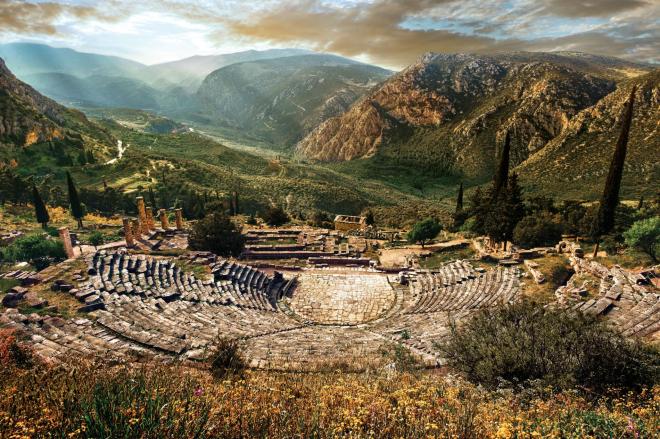
The first is related to the plant’s effects on humans. But I must start with a little bit of context. I want to take my readers to Delphi, in Greece.
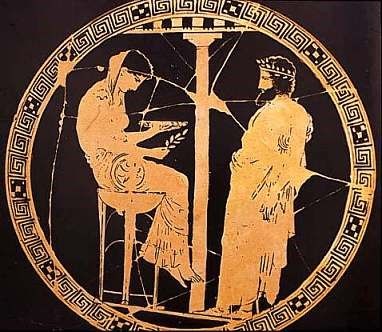
Now the place is just a mass of romantic ruins, but in its heyday, from about 600 BCE to about 200 CE, it was really famous in the Ancient World, a place to go to if you wanted divine advice about something important to you: should our city go to war with our neighbour? should we start a new colony? or, on a more personal level, should I marry her? The temple there was dedicated to the god Apollo, and one of the temple’s priestesses, the Pythia, would answer your question. After offering a splendid goat for sacrifice and paying a suitable tribute (there’s no such thing as a free lunch), supplicants would be led down into the inner sanctum of the temple, this dark small room, where they would find the Pythia sitting on a tripod and flanked by a couple of priests. The tripod was placed across a cleft in the floor through which vapours or fumes would be rising and enveloping the Pythia. She would be holding a branch of laurel in one hand (the laurel was sacred to Apollo) and a small basin of clear water from a nearby sacred stream in the other. Rustling the laurel branch and gazing into the basin of water, she would answer your question. Here is the scene depicted on the bottom of an ancient Greek drinking cup, the supplicant to the right, the Pythia to the left.
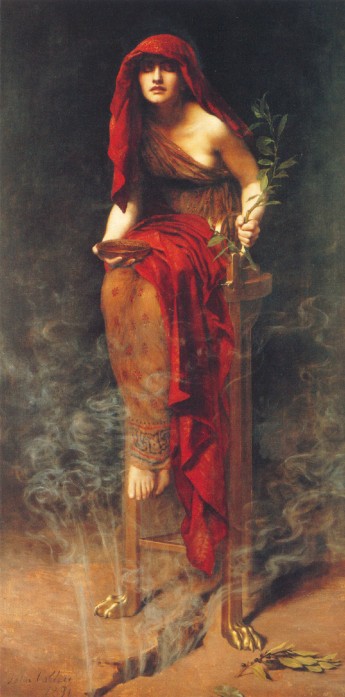
Now, this was not like having a pleasant conversation with someone. The Pythia would be pretty agitated: “her hair stood on end, her complexion changed, her heart beat hard, her bosom swelled, and her voice became seemingly more than human”. Here is a much more satisfyingly dramatic rendering, painted by a certain John Collier in 1891, of what the Pythia might have looked like.
The whole experience must have been quite unnerving and overpowering for the supplicants. On top of it, the answer they got was often quite cryptic, leaving the supplicants scratching their heads trying to understand the true meaning of what Apollo had told them through the Pythia.
Why am I recounting all this? Because there has been considerable discussion about how the Pythia got herself all worked up. What was she eating, drinking, or smoking to get herself into that state? Some of the ancient sources say that the Pythia was chewing laurel leaves. But as we all know – bay leaves, which are actually laurel leaves, being used in cooking – laurel leaves don’t have any effect on someone who eats them. Which is where oleander comes in. The Greeks were rather slipshod in their use of the name “laurel”, using it to denote several plants including the oleander (the leaves of the oleander and the laurel do look quite similar). So one clever chap has suggested that the Pythia was actually chewing oleander leaves, which could indeed give you all the symptoms the Pythias exhibited.
I would be remiss if I didn’t mention the vapours and fumes emanating from the cleft under the Pythia’s seat (and which are very evident in the painting by John Collier). Some have argued that it could have been these that (also) set the Pythia off. Given that Delphi sits on two geological faults which cross each other, it is thought in certain circles that the cleft which the Pythia sat astride was a natural opening into the bowels of the Earth. There has therefore been much discussion about what naturally formed fumes and vapors could have been seeping out from the Earth’s interior and been having this effect on the Pythia – ethylene? benzene? something else? – but it’s all been quite inconclusive. The above-mentioned clever chap suggests what seems to me a much simpler solution, that maybe under the room where the Pythia sat was another room, connected to the former through the cleft, and in which a priest was burning oleander leaves. By inhaling these fumes the Pythia was adding to the effects from chewing the leaves.
That’s one interesting rabbit hole connected to the oleander.
The other involves Hiroshima. As I would hope everyone knows, the first atom bomb ever dropped came down on Hiroshima on 6 August 1945. Here is a picture of the dreaded mushroom cloud which formed over the city.
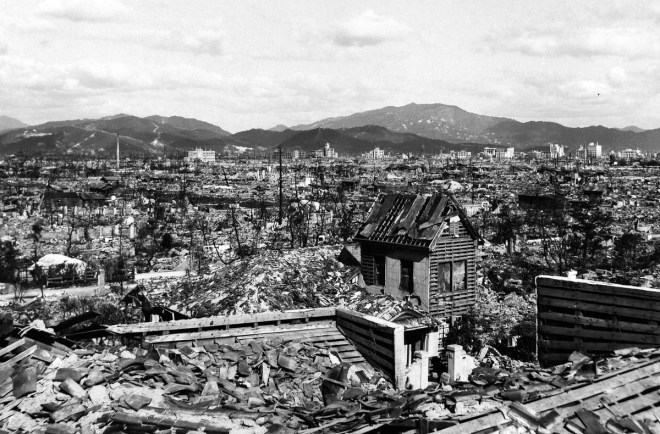
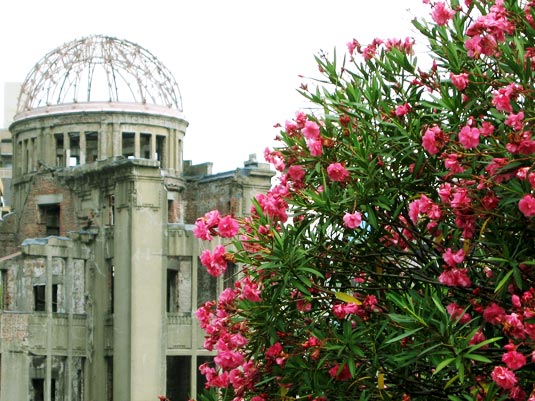
The city’s botanical gardens were not spared. So bad was the destruction that the garden’s directors thought that nothing would grow there again for decades. Yet lo and behold, the year after the bomb was dropped the oleanders in the gardens grew out from their blasted roots and flowered! The oleanders became a symbol of hope for Hiroshima’s citizens, convincing them that the city could be reborn even after this terrible catastrophe – as indeed it has. Ever since, the oleander has been the city’s official flower.
Two days to go until we can roam the streets again …
Well, having covered the animal kingdom in my last two wanderings around the apartment, it seems fair to now cover the vegetable kingdom. And here’s an interesting thing I’ve discovered on my wanders: while humans and animals often take centre stage in the pieces which I reported on earlier – they are the piece – plants are almost always – at least in this apartment – relegated to the role of mere decoration of something else. Let me show my readers what I mean.
For starters, many of our plates, bowls, and jugs are decorated with plants or flowers or fruit. Take this plate, for instance, which I bought many years ago in New York and which I’ve mentioned in previous posts.
my photo
The plate itself is a copy of an old Ottoman design, depicting a spray of wild flowers. I spy a tulip, a carnation of some sort, a sweet William perhaps. Lovely. But still, only decoration on a plate. In theory, we could cover all those flowers with a greasy meat sauce (I say in theory, because we never actually use this plate, it would feel sacrilegious to do so).
Or take this plate, which my mother-in-law bought.
my photo
Plants are much more aggressively centre stage here. We have four large leaves surrounding a small fruit. Lovely piece of design. But still only a plate. We’ve sometimes covered those leaves with olives, small onions, and other hors-d’oeuvres, to serve at table.
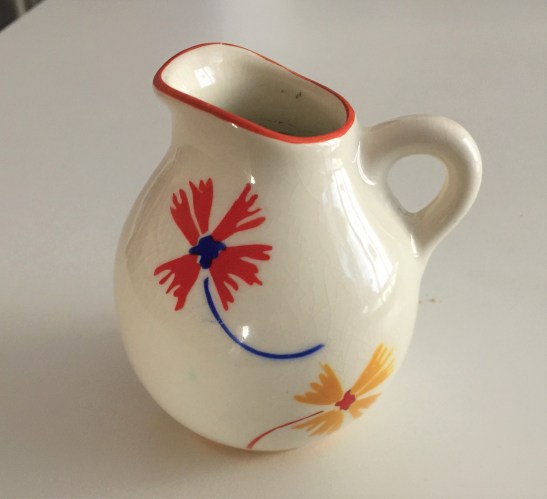
Or how about this little milk jug, which once must have been part of a larger tea set (and which I recently discovered, by studying the marks on the bottom of it, to have been made by Richard-Ginori).
my photo
Simple but beautiful design. But only decoration on a jug.
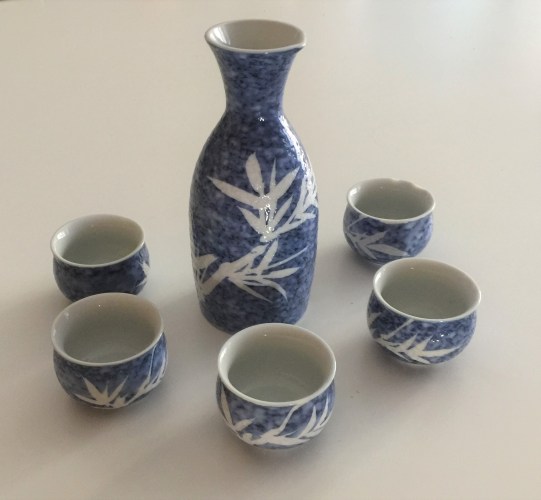
From the other side of the world but the same idea: a sake bowl and its companion cups, which my wife and picked up on our travels in Asia.
my photo
Here, we have the ever popular presence of bamboo in Asian design. Very handsome. But only there to be admired as one drinks one’s sake from them – which my wife and I have often done.
At a larger, more rustic scale, we have this series of water pitchers, all of which use plants and flowers as their decoration.
my photo
All, except for the pitcher with the wisteria, were bought by mother-in-law, who had a great fondness for pitchers. The pitcher-covered wisteria was instead given to us by a friend. They were made by her aunt, a potter. It came with a similarly decorated oil and vinegar cruet and salt cellars. Every time I shake salt on my food, I admire those wisteria, a flower I adore. Lovely – but still only decoration on a utilitarian object.
Sometimes, the vegetal decoration gets so abstract as to almost disappear from view. Take this vase, for instance, another piece which my mother-in-law bought.
my photo
It’s really very handsome. But you have to study the vase a bit to see the flowers and the leaves. The more distracted eye, using it perhaps to hold cut flowers, just sees a swirl of browns and yellows.
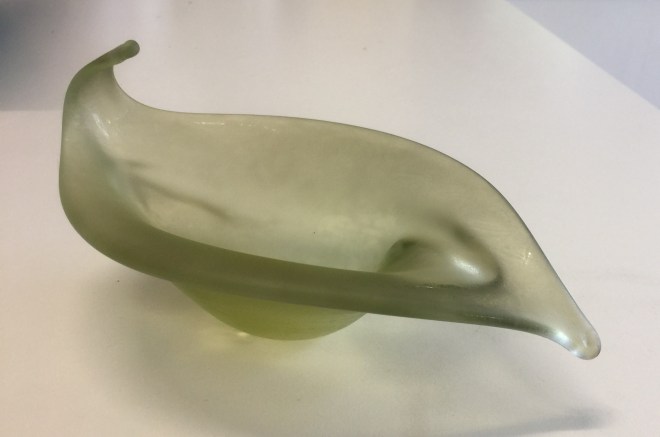
It’s the same with this glass ashtray.
my photo
Only a closer look will discern a leaf in the rippling glass. The distracted smoker will see nothing but a receptacle for his butt-ends.
The fading of vegetal decoration into abstraction is even more marked in other objects. Take this carpet, for instance (another of my mother-in-law’s purchases), which in these days of confinement my wife and I are regularly using as a exercise mat.
my photo
Only from time to time, as I groan my way through the exercises, will I focus and spy the flowers peeping out from the highly geometric design of the carpet.
It’s the same with the massive cupboard in our bedroom, inherited from my in-laws. Only sometimes, as I open one of its doors searching for a piece of clothing, will I register the rather stylized vegetal design carved in the wood.
my photo
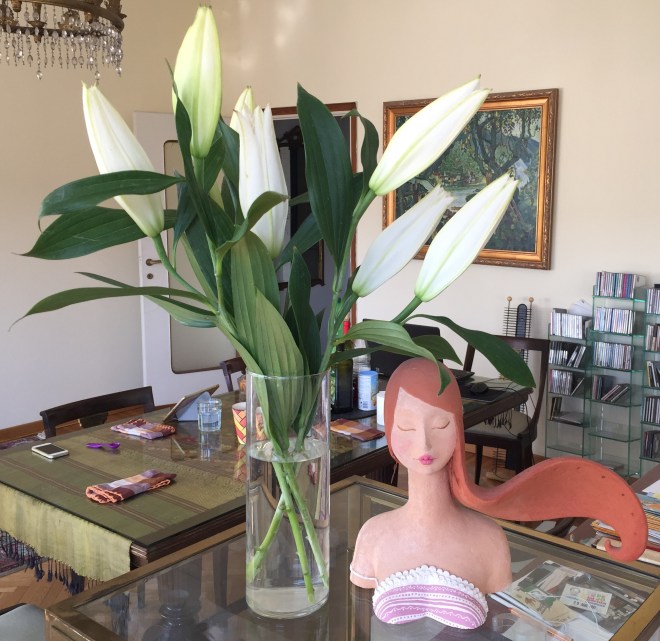
I wonder why it is that the vegetable kingdom plays such a modest, secondary role in the pieces with which we surround ourselves. Why don’t we have a statue of a flower in the apartment, for instance? Perhaps it’s because we can more easily have the real thing – the potted plant, a living statue as it were. At the moment, for example, we have this splendid bunch of flowers slowly opening up before us.
my photo
If you can have the real thing, why bother with inanimate copies?

















































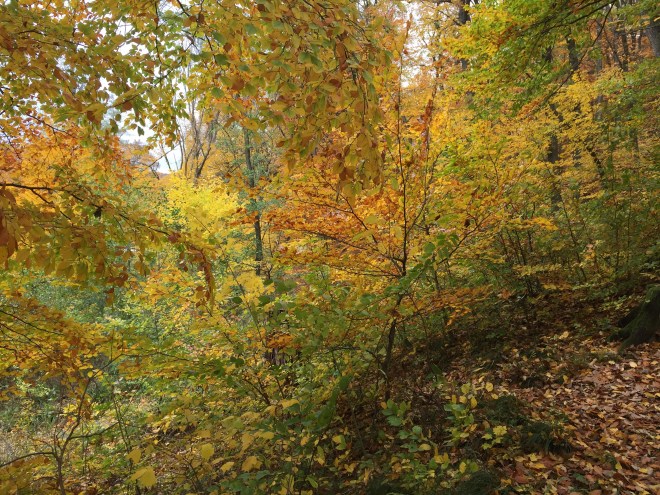



























 the heart thrills


