MIT CHAPEL

Beijing, 22 January 2013

Readers of my posts will perhaps know that I have a certain fondness for Chinese porcelain. So it should come as no surprise to them to hear that when I read in the China Daily of an exhibition at the Capital Museum on porcelain I immediately suggested to my wife that we visit it. Which we did this weekend.

The exhibition was of porcelain ordered by the Empress Dowager Cixi (the last real imperial ruler of China). I’m afraid to say that it was a disappointment. The porcelain on show was undoubtedly of the highest quality, but the designs were … well, twee is perhaps the best way to describe them. Lots of canary yellow background, and lavish use of birds and butterflies as motifs.

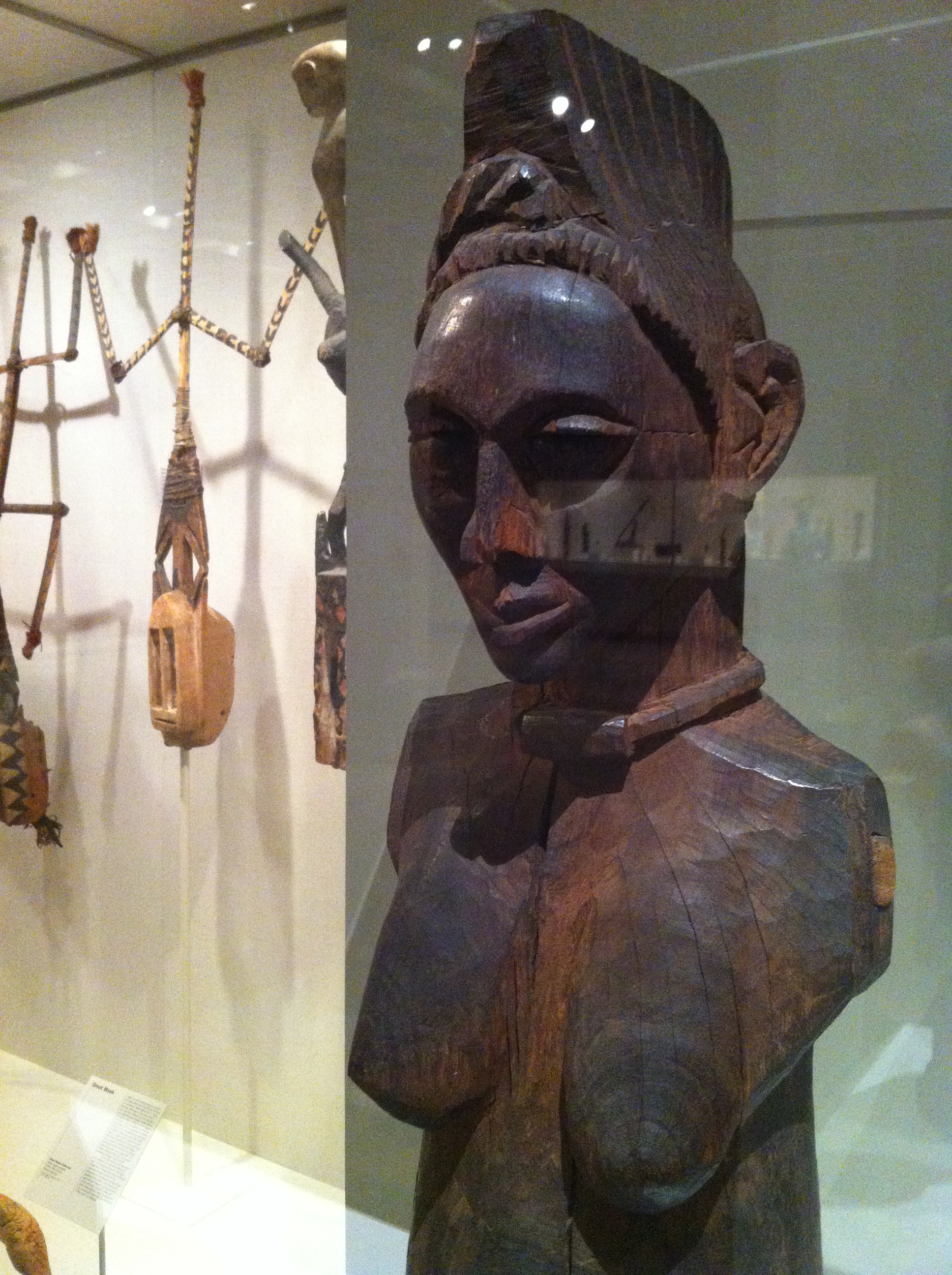
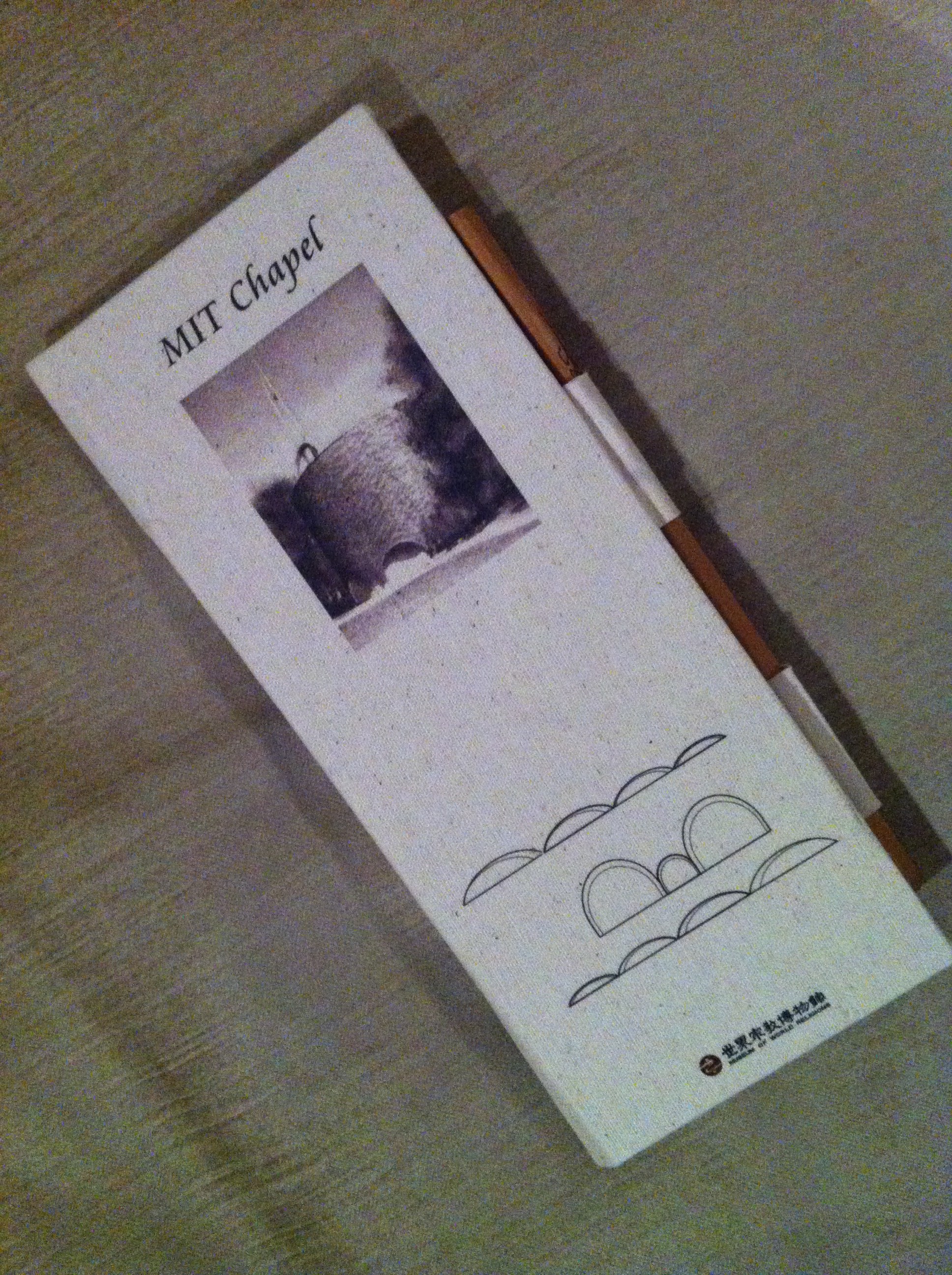
Somewhat disconsolately we went to see what else the museum was offering. There was an exhibition from Taipei, from the Museum of World Religions, and for lack of anything better we visited that. It was nothing special, just a collection of religious memorabilia from various world religions. So we left that exhibition even more disconsolate than before and went to the museum shop. We were running a listless eye over what was on offer when something caught our attention. It was a small something – we were not sure what it was – which, critically, had written on it “MIT chapel”. We had to buy it.

museum purchase 002

I should explain: my wife and I were married in that chapel, I was doing my graduate studies at MIT at the time. It’s a lovely chapel, designed by the Finnish-American architect Eero Saarinen. Probably his most well known works are the old TWA Flight Center at JFK Airport and the Gateway Arch in St. Louis, Missouri. He did many other big works for corporations and governments, but he also did a number of smaller, more intimate works like the MIT chapel.

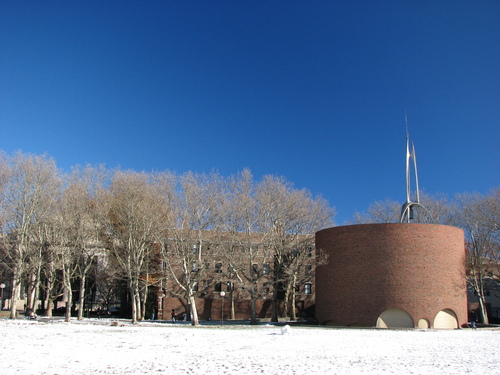
From the outside the chapel doesn’t look like much, just a small circular brick building set down on a lawn and some trees.

MIT_Chapel-2

Snow makes it more interesting.

MIT_Chapel-winter

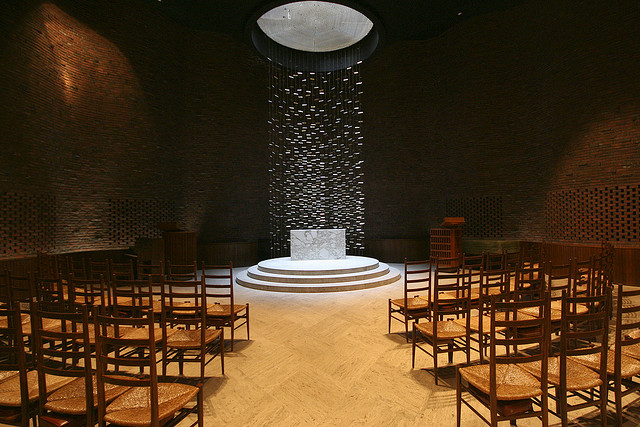
The interior, on the other hand, has a wonderful feel to it. The first thing that strikes you as you enter the chapel is the altar bathed in light streaming down from the skylight above it, while the installation over the altar leaves you very much with the sense of angel dust raining lightly down from on high.

MIT_Chapel-inside-5

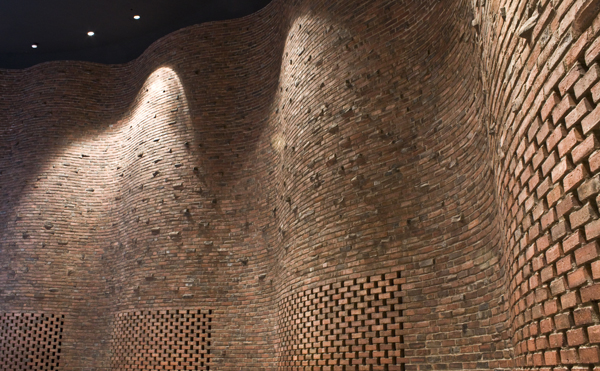
Then there is the wall. Outside, it is a normal circle. Inside, it is wavy and is roughened by bricks sticking slightly out of the wall.  It also holds a regular pattern of bricks that reminds me of the ventilation systems used in brick barns in northern Italy.

MIT_Chapel-inside-4

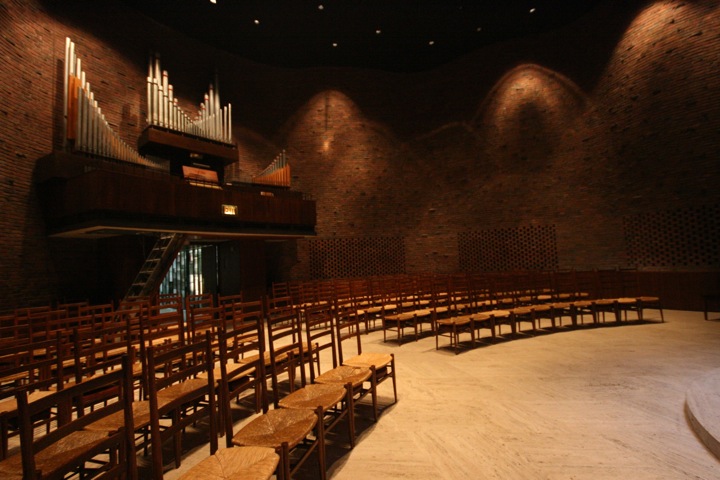
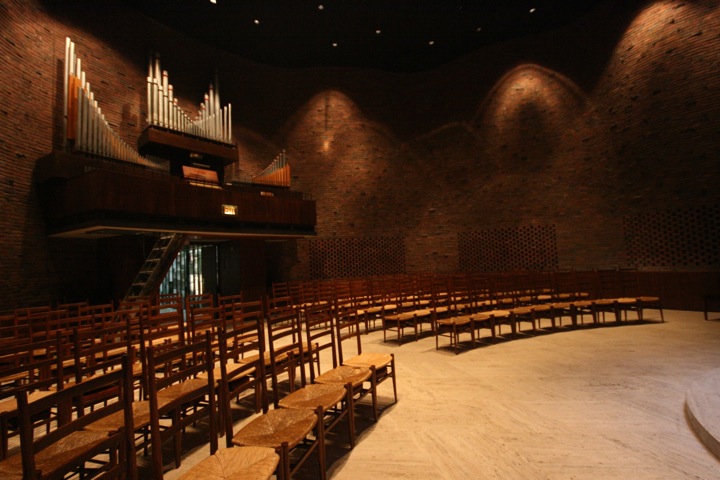
And then there is the organ, small but perfect, in its organ loft.

MIT_Chapel-organ-2

Our friend who volunteered to take the photos failed miserably (he forgot to press some button or other on the camera), so we have very few photos of the wedding. But it is all still fresh in our minds. My wife wore a pink tailleur and I a dove grey suit. She kept that tailleur for many years, while a rapidly increasing girth meant that I had to abandon the suit quite quickly. We had come up with our own vows – the parish priest had grumbled at this, asking why we wanted to abandon the beauty of the traditional vows, but we had insisted. A copy of them slumbers on together with all the rest of our stuff in storage in Vienna – we have carried them with us everywhere we have gone. We had our rings designed by a goldsmith in Milan: double gold bands, which echoed the design of the engagement ring I had given my wife from the same goldsmith. My mother-in-law, who was a great lover of music, chose the organ music (not Mendelssohn’s wedding march …). My parents and a couple of siblings had driven down from Canada, and the rest of the chapel was filled with university friends from MIT and Johns Hopkins, where my wife was doing her graduate studies. After the wedding, we had all gone downtown to a restaurant on Boston Commons for our lunch. No speeches, nothing like that; just good food. Because of timing, we had gone on our honeymoon before the wedding, in the Shenandoah Valley, together with my mother-in-law (I liked her a lot …). Immediately after the wedding, we started classes again.

So I’m sure my readers understand why we just had to buy that article with “MIT chapel” written on it (which, by the way, turned out to be a small case containing a tiny pad of ruled paper, a ruler, and an unsharpened pencil – quite where the connection was with MIT remains a mystery).

________________________

MIT chapel: http://ad009cdnb.archdaily.net/wp-content/uploads/2011/02/1297993341-mit-chapel-wikimedia-commons2-375×500.jpg
MIT chapel-winter: http://mw2.google.com/mw-panoramio/photos/medium/6339334.jpg
MIT chapel inside-altar: http://farm4.staticflickr.com/3383/3478369283_08678cfd7a_z.jpg
MIT chapel inside-wall: http://jmcvey.net/sylva/wp-content/uploads/2010/10/chapel_interior_wall2.jpg
MIT chapel-organ: http://ad009cdnb.archdaily.net/wp-content/uploads/2011/02/1297993330-mit-chapel-caribbeanfreephoto.jpg

RIVER POEMS

Beijing, 17 January 2013

There are only a few weeks to go to the Chinese New Year and the Chinese newspapers are full of articles on people’s plans for the festive period and on the country’s transportation infrastructure bracing itself for the onslaught of Chinese who will be travelling home or – more frequently now as they get richer and move into the middle classes – travelling abroad for package tour holidays. As I read, I was reminded of a wonderful piece in the New Yorker written by the magazine’s Man in Beijing, Evan Osnos. Two Chinese New Years ago, Osnos decided to join one of these package tours, the “Classic European,” a bus tour visiting five countries in ten days.  It’s a sympathetically amusing article and I would urge any of my readers with an interest in social trends in China to read it. It can be accessed at http://www.newyorker.com/reporting/2011/04/18/110418fa_fact_osnos. Here is a photo from the article.

chinese tourists-8

Osnos’s piece reminded me rather of a 1969 film, If It’s Tuesday, This Must Be Belgium, a romantic comedy about a group of American tourists doing a bus tour of nine European countries in 18 days.

If_It's_Tuesday

Osnos mentions in passing a sub-trend in Chinese tourism, that of Chinese lovers of poetry who go on a pilgrimage to Cambridge (the Cambridge in the UK) to gaze reverently at a clump of willow trees growing on the banks of the River Cam. The reason for all this is a poem which is wildly popular in China: 再别康桥 “Saying Goodbye to Cambridge Again”. It was written by Xu Zhimo, a famous romantic poet of the early twentieth-century.

Xu Zhimo

Xu travelled in the West for a number of years. He spent a year in Cambridge in 1921 and on a second trip there in 1928 wrote the poem. He died a few years later in a plane crash in China.

I don’t read (or speak) Chinese, so I’m afraid the poem in its original form is closed to me. However, there is what seems to be a standard translation (every Chinese website that I looked at carried the same one) which is really quite pleasant on the ear. But before I quote it here, I am moved to first cite the poem in its pinyin form (without tonal marks, which I find confusing and quite unhelpful since I don’t hear the language’s tones), to give other Chinese-illiterate readers like myself a small taste of its rhythm and rhyme.

Qingqing de wo zou le, zhengru wo qingqing de lai;
wo qinqing de zhaoshou, zuobie xi tian de yuncai.

Na hepan de jin liu, shi xiyang zhong de xinniang;
boguang li de yan ying, zai wo de xintou dangyang.

Ruanni shang de qing xing, youyou de zai shuidi zhaoyao;
zai Kang he rou bo li, wo ganxin zuo yi tiao shuicao!

Na yu yin xia de yi tan, bus hi qingquan,
shi tianshang hong rousi zai fu zao jian, chendianzhe caihong shide meng.

Xunmeng? Cheng yi zhi chang gao, xiang qingcao gen qing chu man su,
manzai yi chuan xing hui, zai xing hui banlan li fangge.

Dan wo buneng fangge, qiaoqiao shi bieli de shengxiao;
xiachong ye wei wo chenmo, chenmo shi jinwan de Kangqiao.

Qiaqiao de wo zou le, zhengru wo qiaoqiao de lai;
wo hui yi hui yixiu, bu daizou yi pian yuncai.

And now for the translation:

Very quietly I take my leave
As quietly as I came here
Quietly I wave good-bye
To the rosy clouds in the western sky

The golden willows by the riverside
Are young brides in the setting sun
Their reflections on the shimmering waves
Always linger in the depth of my heart

The floating heart growing in the sludge
Sways leisurely under the water
In the gentle waves of Cambridge
I would be a water plant!

That pool under the shade of elm trees
Holds not water but the rainbow from the sky
Shattered to pieces among the duckweeds
Is the sediment of a rainbow-like dream

To seek a dream? Just to pole a boat upstream
To where the green grass is more verdant
Or to have the boat fully loaded with starlight
And sing aloud in the splendour of starlight

But I cannot sing aloud
Quietness is my farewell music
Even summer insects keep silence for me
Silent is Cambridge tonight

Very quietly I take my leave
As quietly as I came here
Gently I flick my sleeves
Not even a wisp of cloud will I bring away

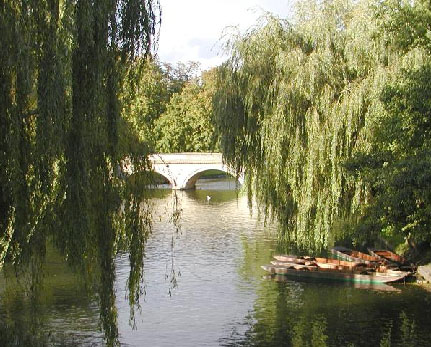
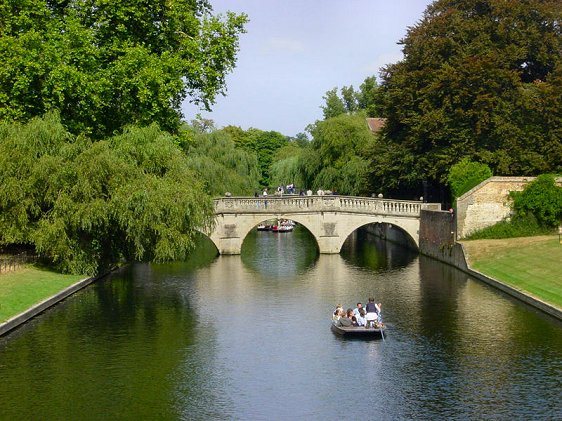
I can’t resist adding a few pictures here of the river Cam. It is a river that flows quietly through Cambridge, as quietly as the poem itself flows across the page.

Cam with willows

Henry VIII chapel and Cam

Cam-1

I came across the text of the poem for the first time through an English Lit class I held with a Chinese student (class is a big word; it was more a pleasant discussion around English literature every Saturday morning, over a cup of hot sweet soya milk). After we had gone through a few English poems he brought me this translation of  “Saying Goodbye to Cambridge Again”. I was touched and wanted to give him in return an English poem with a river as its theme. But what?

I went on a search and came across the poem “The River” by Sara Teasdale.

sara-teasdale

Teasdale, an American poet, was more or less a contemporary of Xu. She died in 1933.

I came from the sunny valleys
And sought for the open sea,
For I thought in its gray expanses
My peace would come to me.

I came at last to the ocean
And found it wild and black,
And I cried to the windless valleys,
“Be kind and take me back!”

But the thirsty tide ran inland,
And the salt waves drank of me,
And I who was fresh as the rainfall
Am bitter as the sea.

I had never heard of Teasdale, and a look at her other poems did not impress me, but this poem, at this time in my life, spoke to me. Who doesn’t reach my age and sometimes wish he could slough off the pessimism which comes with the passing years and be young again, fresh and optimistic?

____________________________

Chinese tourists: http://www.newyorker.com/online/blogs/books/assets_c/2011/04/110418_osnoschinese01_p465-thumb-465×310-68686.jpg
Film poster: http://upload.wikimedia.org/wikipedia/en/9/9f/If_It%27s_Tuesday.jpeg
Xu Zhimo: http://cfile25.uf.tistory.com/image/1768563E4F8F1F6C23B5BE
Cam with willows: http://www.baihuisoft.com/Uploads/201179154340875.jpg
Henry VIII chapel and Cam: http://ts1.mm.bing.net/th?id=H.4921582377371804&pid=1.9
Cam and Clare college: http://anyluckypeny.files.wordpress.com/2012/05/clare-college-bridge-university-of-cambridge.jpg?w=870
Sara Teasdale: http://www.poetryfoundation.org/uploads/authors/sara-teasdale/448x/sara-teasdale.jpg

9/11 MEMORIAL, NEW YORK

Beijing, 13 January 2013

They say that those of us who were alive at the time remember where we were and what we were doing when we heard about Jack Kennedy’s assassination. That is certainly true for me; I was in bed in my dormitory at boarding school with lights out when one of the older boys burst in announcing the news. The same holds for me when it comes to the attack on the twin towers of the World Trade Center in New York. I had recently come back from lunch and was working without much enthusiasm on a document when a colleague came running down the hall shouting out the news to all of us.

Since then, every time my wife and I go back to New York, we always take a trip down to ground zero, to see how things have changed. So it was this time that on the last day of our latest stay in New York, after an earlier false start (we hadn’t understood that you need to book on-line), my wife and I managed to visit the 9/11 Memorial. After collecting the tickets, finding the entrance, threading our way through an active construction site, past numerous security checks – more numerous than at an airport – we finally arrived in the area of the memorial itself.

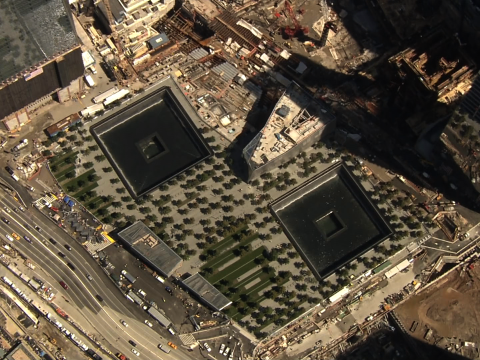
It is a somberly moving monument. First, there is the location of the two square fountains that make up the design. They have been inserted into the footprints of the two towers, thus serving as an eternal reminder of the latter’s disappearance.

aerial view-3

Then there is the design of the fountains. The water doesn’t spray up in noisy, joyous jets as is normally the case for fountains, but instead falls from the rims of the fountains, continuous lines of tears, into the dark pool far below

memorial 004

from where it disappears down into a central, apparently bottomless void, the hole left in the city’s and the in country’s heart.

memorial 006

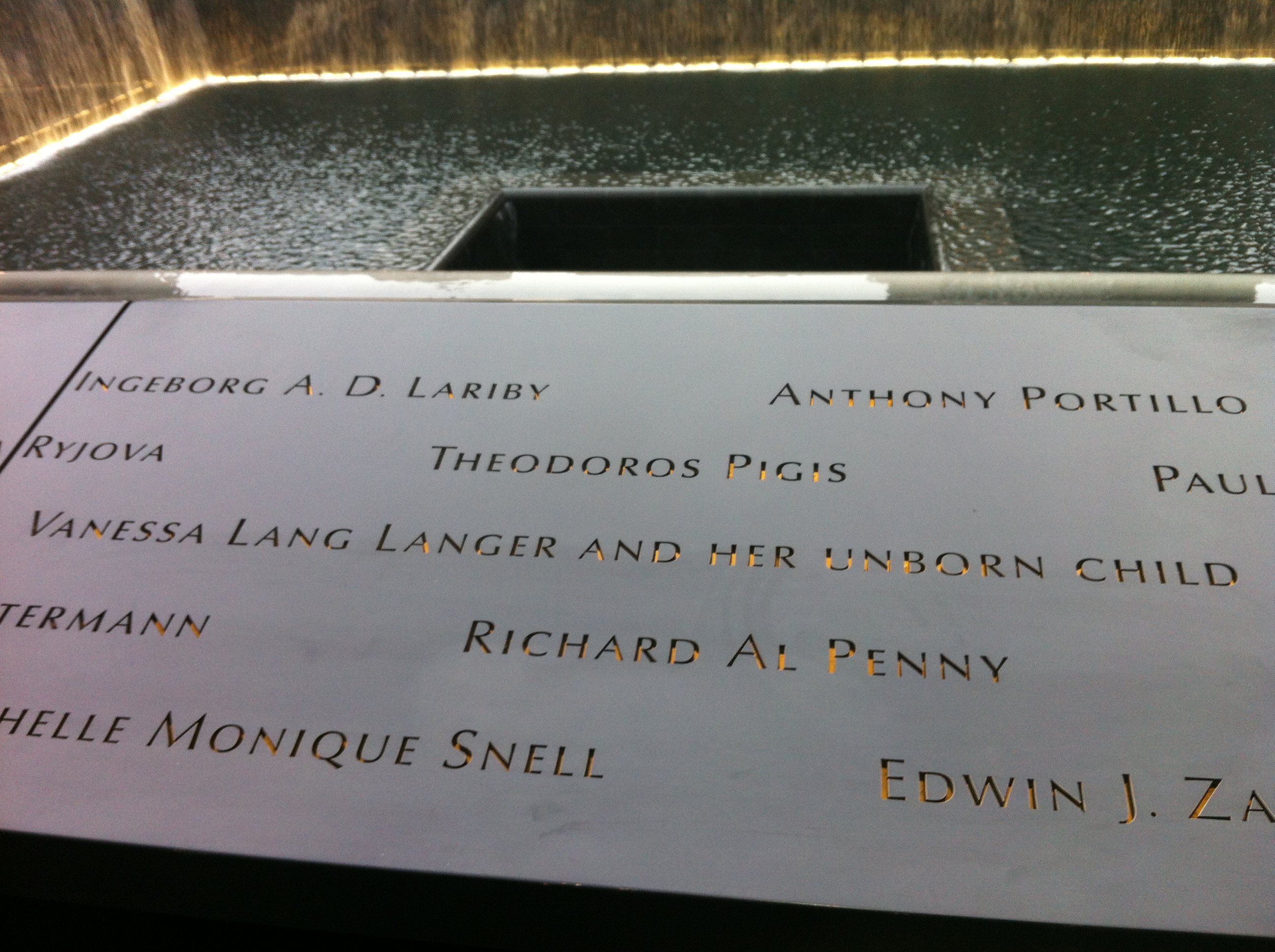
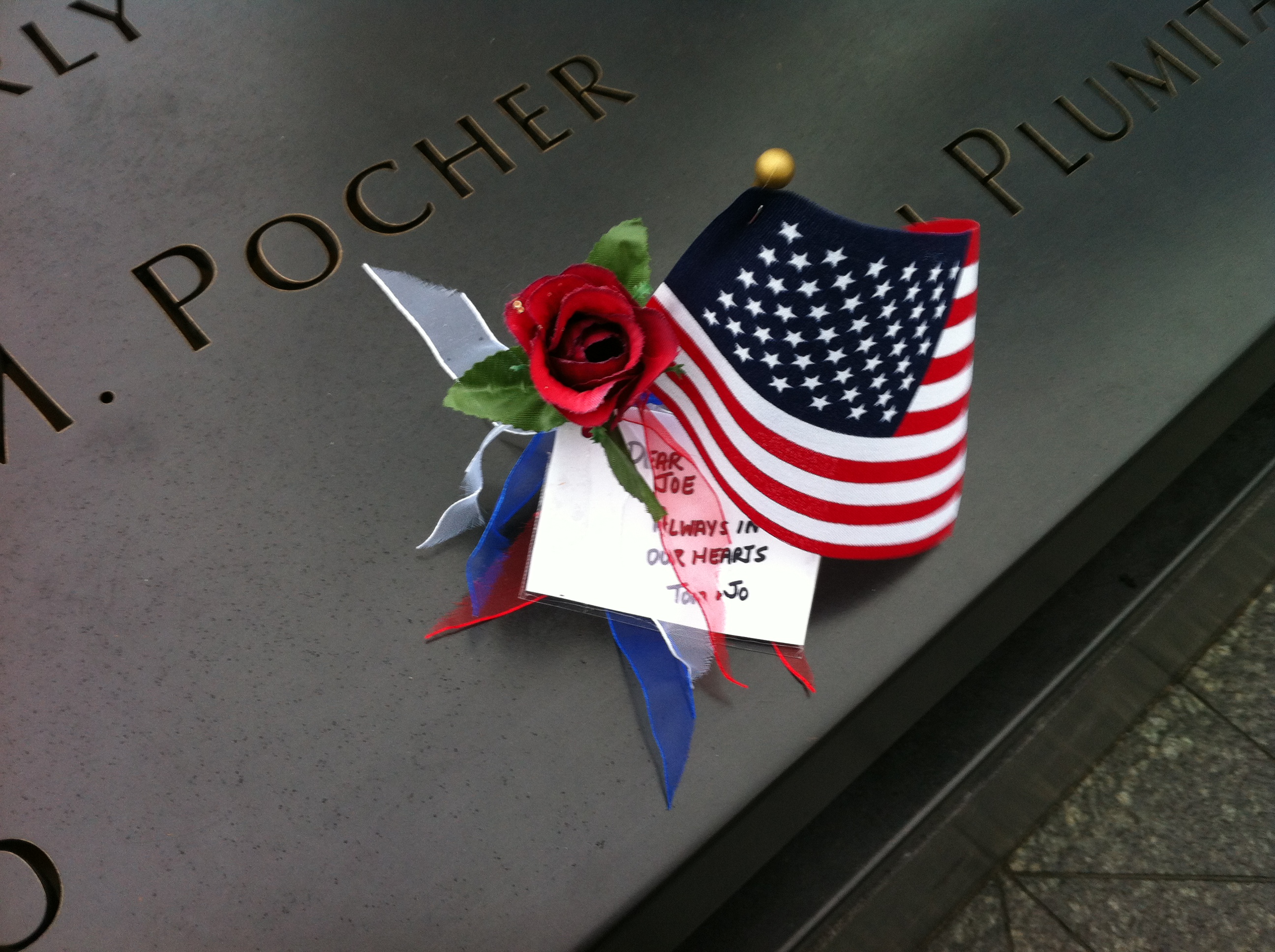
And all around the fountains’ rims, from where the water-tears flow, are inscribed the names of those who died in the attack on the towers, as well as in the attack on the Pentagon and in the airplanes that were used as the weapons.

memorial 007

Truly moving indeed.

memorial 010

_______________________

Aerial view: http://i.i.com.com/cnwk.1d/i/tim/2011/09/10/rmitchell911memorial_480x360.png

other pictures: mine

ST. MARY’S GARDEN

New York, 7 January 2013

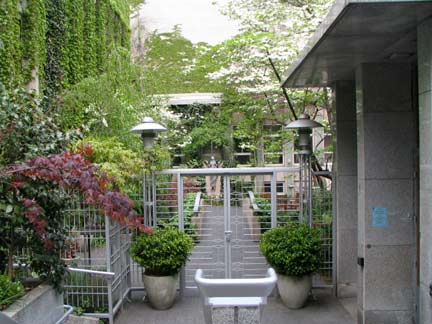
Several years ago, I had to be in New York for a period of two weeks to cover an international meeting. It was early May, a good time to be in the city. The weather is normally nice and it’s not too hot yet. The first morning, I left early to give myself plenty of time to deal with the wearisome entry procedures. My walk to the meeting took me along 47th Street. As I was walking between First and Second Avenues, I spied to my left the entrance to a little garden, open to the public.

mary's garden-2

Intrigued, I checked my watch and decided I had sufficient time to take a quick look. What I found was achingly lovely: a little pool with the quiet gurgle of a fountain to the side, a small bridge spanning the pool

mary's garden-1

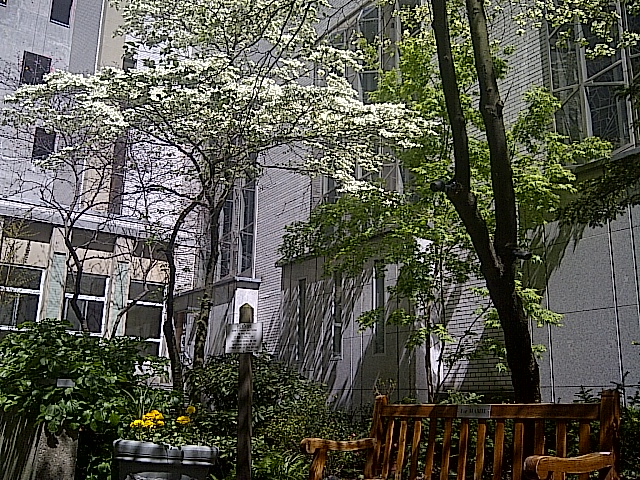
leading to three benches, and planted beds around the pool. Most magnificent of all, arching over the whole, were three dogwood trees. They were in full bloom, and the soft whiteness of their flowers, tinged with spring green, permeated the whole space. I was left without breath and sat for five minutes to absorb it all. Of a sudden, I started out of my reverie, checked my watch again, and hurried off to my meeting.

The garden must be little known, because I was unable to find any photos of it on the web other than the two above. So I later sent my daughter to take photos when the dogwood trees were in flower. Here is a sample.

IMG-20130503-01859

IMG-20130503-01863

IMG-20130503-01864

I went back several times during the next two weeks, to reflect and to rest, watching the dogwood flowers begin to fade. I learned the garden’s name – St. Mary’s garden – and that it was attached to the small church next door, the Church of the Holy Family. I brought my wife there when she joined me in the second week. We sat on one of the benches and held hands.

When yesterday I found myself by chance close by, I could not resist visiting the garden again. Given the season, it was drearer.

garden-winter 002

But it still had a dreamy quiet; the fountain gurgled softly, and a bird sang in the dogwood trees. As I sat there, a fragment of the Litany of the Blessed Virgin Mary floated up out of my boyhood memories, heard murmured by old women in dark, empty churches at the time of the Angelus:

Mystical rose,
Tower of David,
Tower of ivory,
House of gold,
Ark of the covenant,
Gate of heaven,
Morning star,
Health of the sick,
Refuge of sinners,
Comforter of the afflicted …

And then another memory fragment floated to my the surface of my mind, lines from the end of T.S. Eliot’s poem Ash Wednesday:

Blessed sister, holy mother, spirit of the fountain, spirit of the garden,
Suffer us not to mock ourselves with falsehood
Teach us to care and not to care
Teach us to sit still …

And I sat still.

_________________
Mary’s garden-1: http://www.dkimages.com/discover/previews/739/151269.JPG
Mary’s garden-2: http://forgotten-ny.com/wp-content/gallery/streetscenes_chip_07/11-holyfamily-grotto.jpg
Dogwood in bloom-1: my daughter
Dogwood in bloom-2: my daughter
Dogwood petals in the pool: my daughter
garden in winter: my picture

LA MICHELINE CHUGGING ACROSS THE COUNTRYSIDE

New York, 2 January 2013

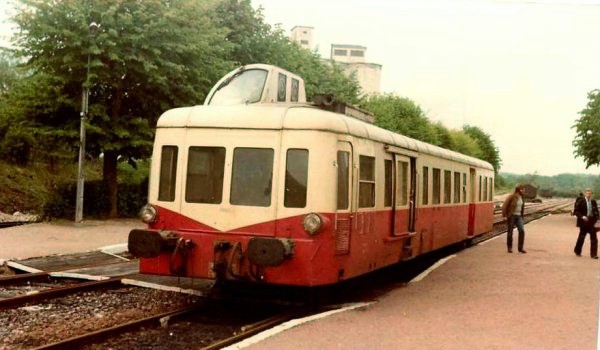
Down at the end of my French grandmother’s property ran a little train, the Micheline we called it. It was a rinky-dink train, one carriage (on rare occasions two), which chugged along at a venerable speed across the countryside from one market town to another, winding its way through vineyards and meadows, stopping at toy-town stations where stationmasters with moustaches, who smoked filterless gauloises and no doubt drank un petit rouge corsé in evenings, would agitate green flags and blow shrill whistles to let the Micheline continue on. This photo captures the rural idyll nicely.

micheline

I used to accompany my grandmother on her visits to town. We would walk down a long alley flanked first by peach and apple trees and then by black locusts, down to the end of the property where there was a big iron gate, which swung ponderously open; from there, it was a short five-minute walk to the station. In came the Micheline

micheline-5

I would help my grandmother in, the stationmaster would agitate his flag and blow his whistle, and off we went.

My mother used to tell me that during the Second World War, people were sent to my grandmother by the French Resistance for her to hide for a while; they would quietly slip in with the Micheline. My memory is instead of two old ladies, two sisters, Tante Chlothilde and Tante Marcelle, coming to visit via the train. They were first cousins to my grandmother. Both of them being widows, they always wore black. We would first see the Micheline chug by, then some ten minutes later two black silhouettes would be sighted slowly walking up the long alley. My grandmother would then walk down to greet them, speaking very loudly because one of the sisters was as deaf as a post.

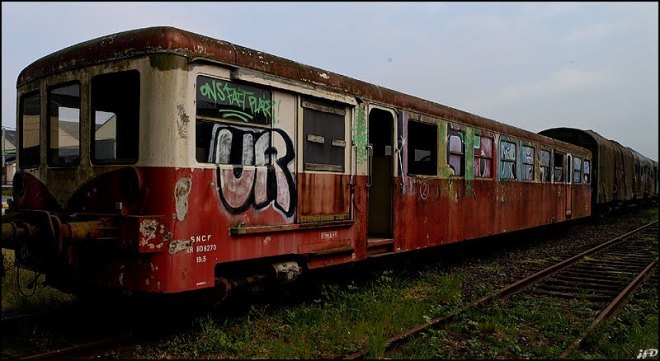
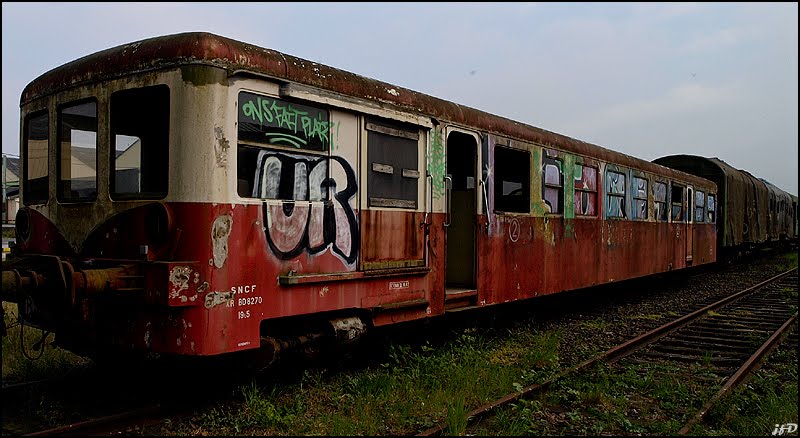
Well, things changed. The road network got better, buses took over, and the line was finally closed down. I suppose the Michelines were retired like this one was

micheline-3

The rails were pulled up, and the weeds took over.

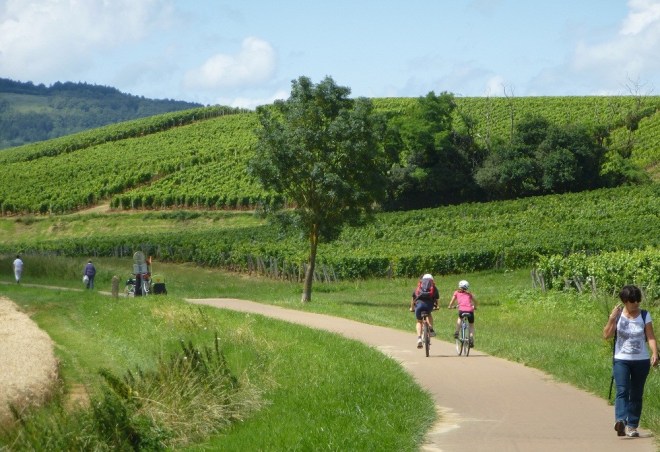
After a long period of neglect, the municipalities got their collective acts together and turned the railway line into a “Green Way”, for people to walk and cycle along. So now we have a quiet, carless, path that allows us to enjoy some of the most beautiful countryside on Earth (I admit, I’m biased).

voie-verte-1

voie-verte-3

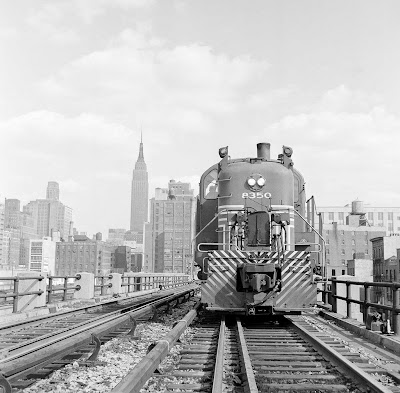
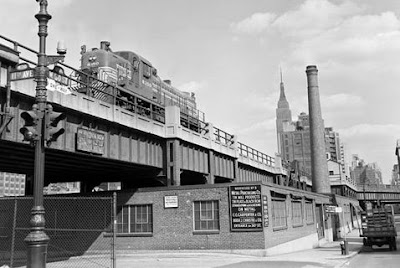
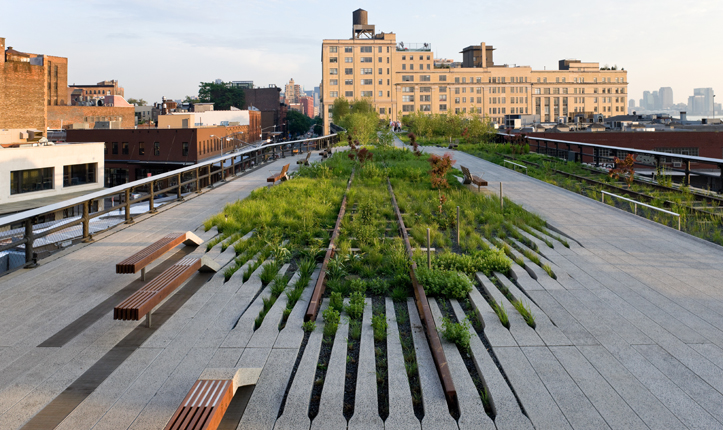
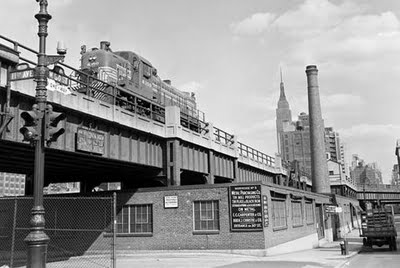
All of this came back to me yesterday while my wife and I strolled along the High Line in Manhattan. We are talking of a very different context – urban rather than rural, large-scale rather than small-scale – but the historical trajectory is the same: a rail line that was once a vital artery of the city

high-line-old-1

high-line-old-2

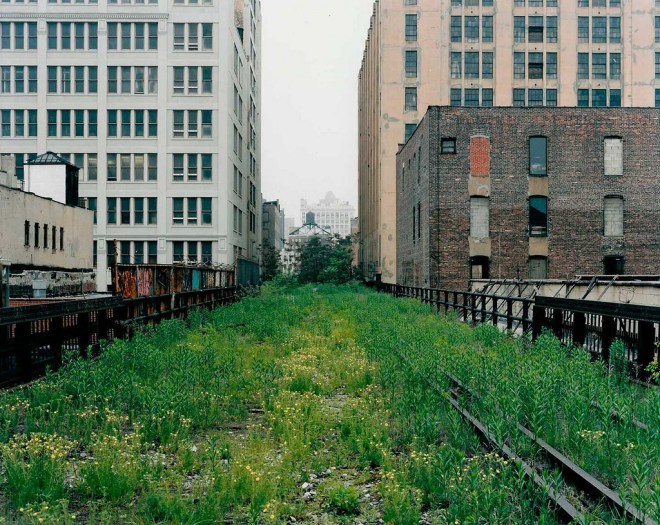
falls victim to roads and trucks and is finally abandoned. It becomes derelict, overgrown by weeds

high-line-5

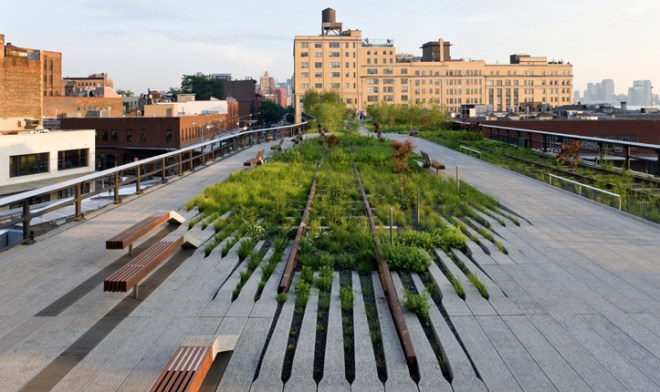
and is threatened with demolition. But good sense eventually prevails and the elevated line is turned into an elevated garden.

high-line-2

high-line-4

high-line-1

high-line-6

Magic.

____________

Micheline-1: http://www.google.fr/imgres?q=micheline+train&num=10&hl=fr&tbo=d&biw=1280&bih=683&tbm=isch&tbnid=QbpsYHDZWoAGgM:&imgrefurl=http://www.worldofstock.com/stock-photos/france-ardeche-mirabel-village-surroundings-local-micheline/TRT1500&docid=307ZNJAoHh-JTM&imgurl=http://www.worldofstock.com/slides/TRT1500.jpg&w=500&h=332&ei=hIXjUMDvFuXQ0wGh84HQCg&zoom=1&iact=rc&dur=684&sig=113446295457090783361&page=1&tbnh=140&tbnw=202&start=0&ndsp=22&ved=1t:429,r:10,s:0,i:118&tx=96&ty=67

Micheline-2: http://c1.img.v4.skyrock.net/1729/16641729/pics/3080416001_1_3_WEG0CElV.jpg

Micheline-3: Micheline-3: http://1.bp.blogspot.com/-C8L1231bJ-o/TbhQHR6dc_I/AAAAAAAAEAQ/FvpTQts0R0I/s1600/micheline01-1.jpg
Green Way-1: http://www.sortiramacon.com/media/news/voie-verte-velo.jpg

Green Way-2: http://www.velo-ravel.net/2009/2009-08-17_Bourgogne_sud_files/image020.jpg

High line 1-historical: http://1.bp.blogspot.com/-X8IIsMIF7GY/TmlooRzMZ9I/AAAAAAAAF9M/_PpGNN3xJEU/s400/Highline_train.jpg

High line 2-historical: http://4.bp.blogspot.com/-0FEWcWopww8/TmlooMh8vlI/AAAAAAAAF9E/SuXL4wcu6To/s400/HIghline_historical.jpg
High line derelict: http://2.bp.blogspot.com/-iD76YXAA-Uw/TffNNuz4gXI/AAAAAAAAAYU/KWHnUGbYjPU/s1600/High+Line+2.jpg

High line 1: http://www.asla.org/sustainablelandscapes/images/highline/Highline_6.jpg
High line 2: http://4.bp.blogspot.com/-usnFjgnfQc4/TffNIgAV6xI/AAAAAAAAAYQ/XMQA0bZJAb4/s1600/High+Line.jpg
High line 3: http://www3.pictures.gi.zimbio.com/New+York+New+High+Line+Park+Opens+Public+3B45D1SYEJcl.jpg
High line 4: http://1.bp.blogspot.com/-WbybGegkYX0/Tmlon5yO-1I/AAAAAAAAF88/LyBQFC8kMpo/s1600/Highline_above.jpg