LENTILS FOR MY FERRITIN LEVELS

Milan, 4 November 2024

It is a sad fact of life that as one gets older, the machine that is our body begins to falter. Machine parts begin to show signs of wear and tear, leading to unfavourable results in blood, urine or other samples of our vital fluids. One such unfavourable result which has been dogging me for a number of years is the levels of ferritin in my blood. My old doctor had been monitoring it, and shortly before he retired he decided that the time had probably come for me to do some regular blood-letting to bring the ferritin levels down. Luckily, the liver specialist which he sent me to – high ferritin levels being normally due to some malfunction in the liver – didn’t agree, recommending continuing monitoring. At which point, I decided to see what I could do to bring down my ferritin levels naturally, through my diet. I had already pretty much completely eliminated red meat, which is high in heme iron. That was pretty sad, but I comforted myself with the thought that it was good for the planet. My daughter found a scientific article online, which recommended a diet high on berries, especially blueberries, and the liberal use of cocoa powder – it seems that the polyphenols which these contain can help bring ferritin levels down. I did that for several months and then did the blood tests again. There was a modest decrease in my ferritin levels. I asked my new doctor what else I could do. She suggested imbibing lots of tea and eating lots of pulses – they, too, contain high levels of polyphenols. Well, my wife and I are already regular tea-drinkers, carrying on a fine British tradition.

Source

So I didn’t see much scope for improvement there. Pulses were a different story. Quite frankly, we don’t eat many of those; we’re not terribly, terribly fond of them. We’ll eat pasta e fagioli once or twice a year, normally when winter sets in; this particular version has used penne rigate and cannellini beans.

Source

And come Christmas time, we’ll often have ourselves a popular Christmas dish in northern Italy, cotechino e lenticchie, a type of sausage with lentils. I’ve already covered this dish exhaustively in a previous post, so I won’t say any more here. I just invite readers to drool over this photo.

Source

That is pretty much the sum total of our annual pulse intake. After some discussion, my wife and I agreed that I could go with lentils. I quite like lentils in salad, so I’ve been regularly eating a lentil salad for lunch and dinner. But I fear I’ll get rather bored with having this all the time, and might need to branch out. What other lentil dishes could I try?

Well, for starters, I could eat nice mixed salads like this one, of fennels and lentils.

Source

But that is really just a modest change to the original dish. What else?

Well, given that the original wild lentil plant comes from the Middle East and was domesticated there (like so many of our foodstuffs), I’m thinking I should start by looking there for a lentil dish I could try. And in fact, it so happens that there is a very popular lentil dish in the Middle East which goes by the name of mujaddara. It’s a very simple dish: it’s a mix of lentils and rice, with a topping of caramelised onions. You can season it with cumin, mint, or coriander (although I would skip the coriander, which I don’t like).

Source

It’s considered a poor person’s dish, but if you’ve got money to burn you can add meat to the mix. The dish is generally served with a side of yoghurt or a salad.

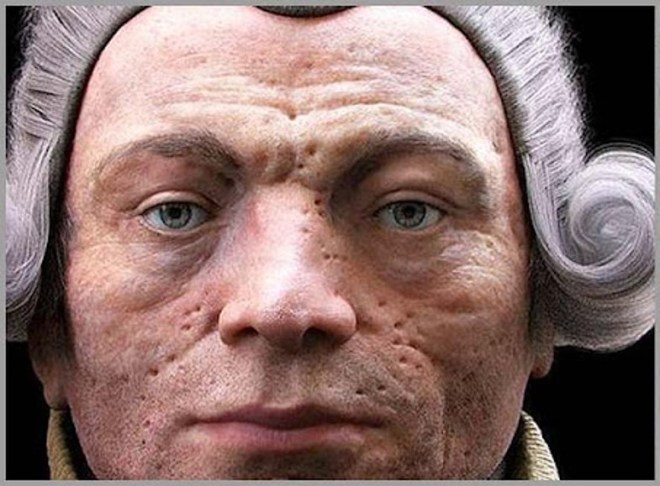
Going off on a tangent, I’m blown away by the etymology of the dish’s name. Mujaddara means “pockmarked”, a reference to the look of the dish, brown lentils pockmarking the white rice. It would be nice to think that whoever came up with this name was thinking of a face pockmarked by bad acne, but I rather fear that they were referring instead to pockmarks caused by the dreaded smallpox, like in this recreation from earlier centuries.
Source

But back to mujaddara. I have to say, I’m intrigued by the Egyptian variant, koshari. To the rice, lentils and caramelised onions, the Egyptians add pasta (macaroni or vermicelli), and tomato sauce. You can make it even more complicated, by adding other odds and ends as this photo shows.
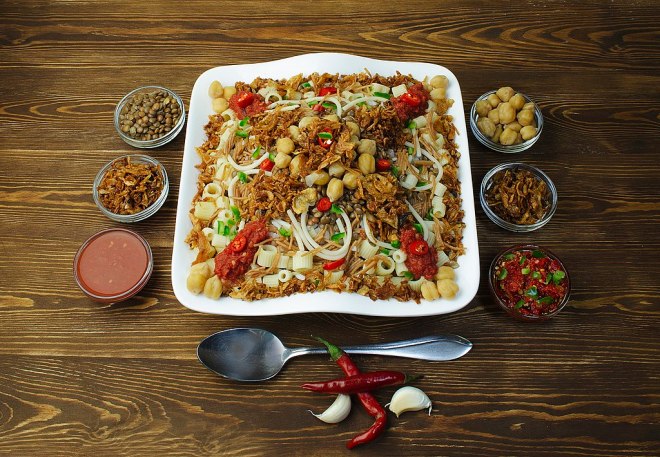
Source

In all of this, it’s the tomato sauce that attracts me, I’m a great fan of the tomato in all its forms. But this is not the type of tomato sauce I’m used to. To the basic sauce base is added garlic vinegar or even a lemon sauce. Garlic vinegar I will forget, but the addition of a lemon sauce … that’s worth considering.

Hang on, though. I think I’m getting rather far away from the lentils, which is the whole point here but which seems to be getting drowned out by all the other stuff that’s being added in. In Obelix’s day, it did indeed seem much simpler in Egypt; it was just lentils – although Obelix is finding that a tough diet to keep to.

my photo

In any event, I need to keep my eye fixed on the simpler mujaddara.

Talking of which, it seems that the simple, no-frills mujaddara has a long, long history. It looks like the Palestinian version of mujaddara is closer to the original version of this dish. Instead of the rice, they use bulgur, which is parboiled and cut durum wheat – rice probably wasn’t in common use in the Middle East until Roman times. It would seem, then, that mujaddara is a member of the broad family of pottages, where various grains are boiled up together to form a sort of porridge (various vegetables can be added, too). So it must be a descendant of the “mess of pottage” for which Esau gave away his birthright to his twin brother Jacob. Here is how the story is recounted in the King James version of the Old Testament (I always find the KJV text so much more satisfying to read; it’s rather like Shakespeare):

And Jacob sod [prepared] pottage. And Esau came from the field, and he was faint. And Esau said to Jacob, “Feed me, I pray thee, with that same red pottage; for I am faint” … And Jacob said, “Sell me this day thy birthright”. And Esau said, “Behold, I am at the point to die: and what profit shall this birthright do to me?” And Jacob said, “Swear to me this day”; and he sware unto him. And he sold his birthright unto Jacob. Then Jacob gave Esau bread and pottage of lentiles; and he did eat and drink, and rose up, and went his way. Thus Esau despised his birthright.

Just for the hell of it, I throw in a painting by the Dutch painter Jan Victors that depicts this scene; Jacob is to the right, Esau to the left.

Source

As much as domesticated rice travelled westward from India to the Middle East (and beyond), so the domesticated lentil travelled eastward from the Middle East to India. The peoples along the way continued mixing lentils with rice, with some changes to the basic recipe. Which means that there are possible mujaddara variants for me to try. For instance, Iranians have a dish they call adas polo, where dates, raisins, cinnamon and saffron are added to the basic lentil-rice mix.

Source

The sites I’ve read up on adas polo say that it has a very different flavour profile from mujaddara, which, looking at the ingredients, I can well believe. Adas polo certainly looks enticing, but I feel that, like koshari, it’s too complicated. Maybe I’ll just leave it to the next time I go to a Persian restaurant (there are some really good Persian restaurants in Vienna).

Going further east, the Indians also have their lentil-rice dish, khichdi. I mentioned khichdi in a post I wrote a number of years ago about a pale British imitation of this dish, kedgeree. Basically, you bring together rice, lentils in the form of a dal, some vegetables like cauliflower or peas or potato, and spices.
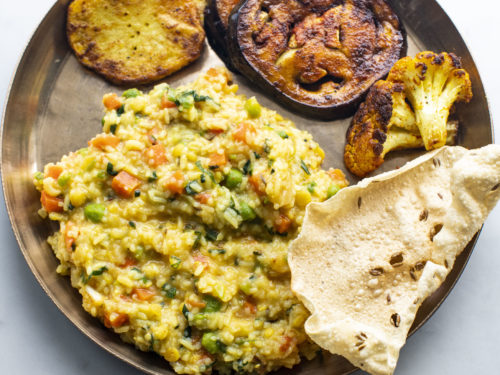
Source

Bringing in khichdi has allowed me to surreptitiously slip in that glory of Indian cuisine, dal. Quite honestly, there are probably as many variations of dal as there are Indian families. The base is always the same: lentils or other pulses like peas or beans which are cooked with turmeric until mushy. The endless variations come with the fried garnish which is added at the end of the cooking process. I throw in a photo of a moong dal, where the garnish has been made by frying asafoetida, cumin seeds, chopped green chilies, and chopped garlic in ghee.
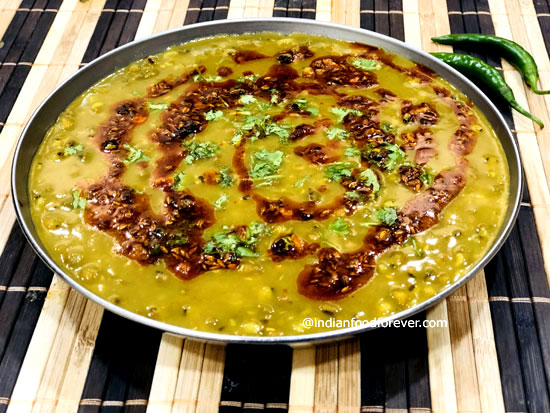
Source

If I go for dal, I would have to find a garnish with no – and I mean no – hot spices in it; as I’ve recalled several times in this blog, I actively dislike hot spices.

Which would also create me a problem with another dish, misir wot or kik wot, which hails from Ethiopia.
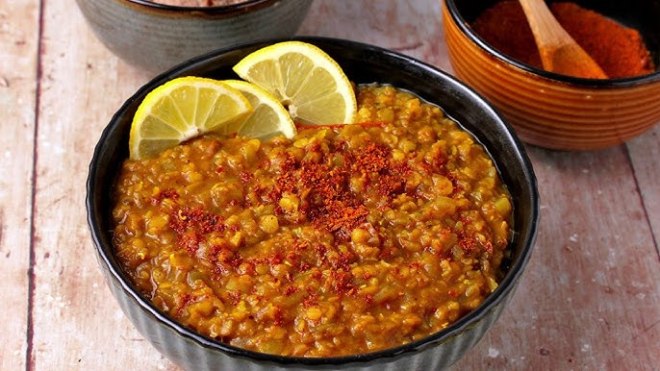
Source

Just as domesticated lentils travelled east and west out of the Middle East, they must have travelled south, too. I suspect they got to Ethiopia via Yemen. In any event, here, too, you cook the lentils (or other pulses) with a garnish made of onions, garlic, ginger, tomatoes and berbere fried in niter kibbeh (the Ethiopian equivalent to ghee). The red flag here is berbere, which is a spice mixture liberally used throughout the Ethiopian highlands and usually containing “chili peppers, coriander, garlic, ginger, Ethiopian holy basil seeds, korarima, rue, ajwain or nadhuni, nigella and fenugreek”, according to berbere‘s Wikipedia entry. I’m not sure what some of the more local spices taste like, but chili peppers … that’s bad news for me.

Stepping back here and reviewing all the alternatives I’ve mentioned makes me realise that most if not all of them are based on making a soupy or slurry-like lentil dish. Remembering the adage “East, West, Home’s best“, maybe I should just opt for a simple lentil soup like my mother used to make (she actually didn’t, but readers get the idea). The internet is stuffed with recipes for lentil soups without horrible, nasty, hot spices in them; without onions and garlic, which don’t agree with my digestive system; without a bunch of spices which, if we buy, would mean a row of bottles that would sit on our kitchen shelves for ever more. Maybe this is the way I should go when I get bored with my lentil salads. And maybe, when the world just gets too much for me, I could retreat into my infancy and eat my lentils in milk, a comfort food which my mother actually did make for me and my siblings years and years ago.

Source

LUXOR, EGYPT

Milan, 19 November 2017

My wife and I have just finished a little holiday in Egypt (I also went to do some consultancy on a project proposal in Upper Egypt, whose objective is to create small businesses around the reuse of agricultural and agro-processing waste; but that is a story for another day). We primarily visited Luxor, so the main thrust of our visit was the monuments of Ancient Egypt.

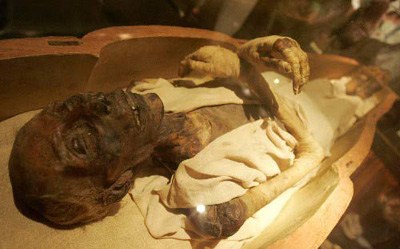
I must confess to being quite ignorant about the art, culture, and history of Ancient Egypt. Of course, I have a passing knowledge about all the usual things: the rather icky mummies

and the richly decorated Russian-doll like cases which enclose them

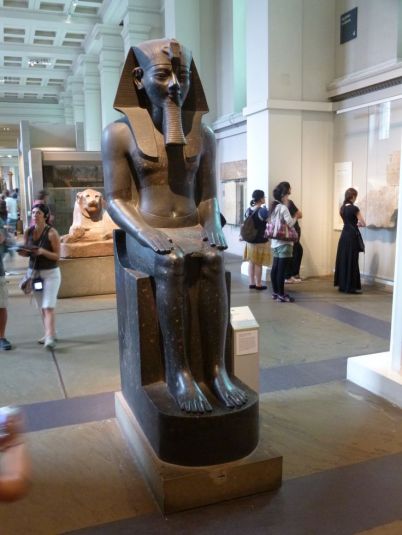
the – rather static and boringly repetitive – statues which fill halls in various Worthy Museums in Europe (here’s the British Museum’s, which I suffered through as a child).

Having read articles from time to time about King Tut and his tomb, I have of course absorbed a certain amount of his story, but to give an idea of the shallowness of my knowledge I have a very clear memory of doing a long line when I was young to visit a King Tut exhibition at the British Museum, but for the life of me don’t remember anything I saw in the exhibition itself.

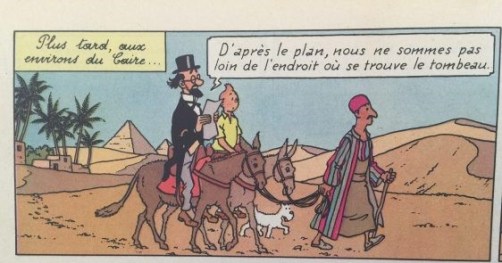
I was also entertained in my childhood by the presentation of Ancient Egypt in the comic books I read: Tintin first of all

with the amusingly absent-minded Egyptologist Philémon Siclone

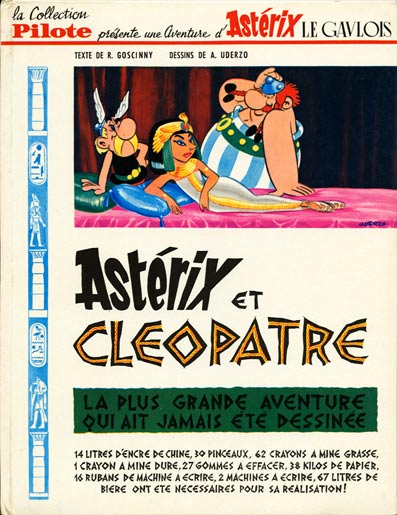
then Asterix

with the Egyptians speaking in hieroglyphics.

In more recent times, I have been tickled by films relating to various Curses of the Mummy.

And that’s about it. In short, I was really very ignorant about Ancient Egypt.

The hotel we stayed at in Luxor continued the comic-book theming of Ancient Egypt. We were staying in the Nefertiti wing, with the Cleopatra wing close by. These two pastiche statues greeted us every day as we made our way to the breakfast room


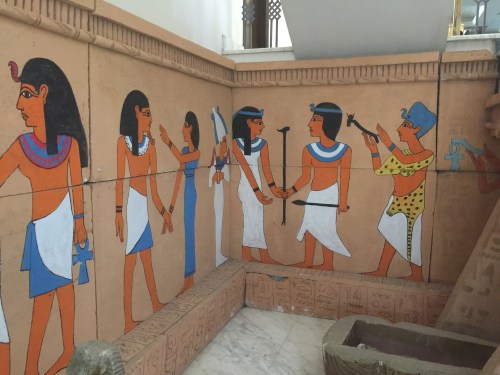
and the hotel’s walls were decorated with this kind of pastiche fresco.

Luckily, the French-speaking guide we had hired over the Internet turned out to be very competent. He had put together a nice programme which covered many of the best of the sites in and around Luxor: the temple of Karnak, with its large-scale bas-reliefs on its walls

the temple of Luxor, which we saw at night

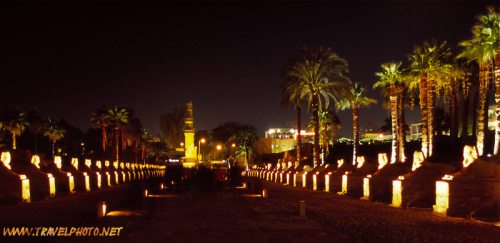
with its avenue of sphinxes

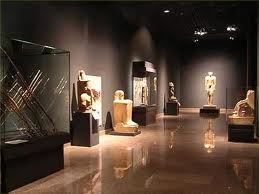
Luxor Museum, which had some lovely pieces

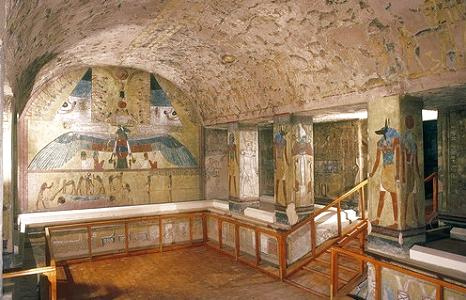
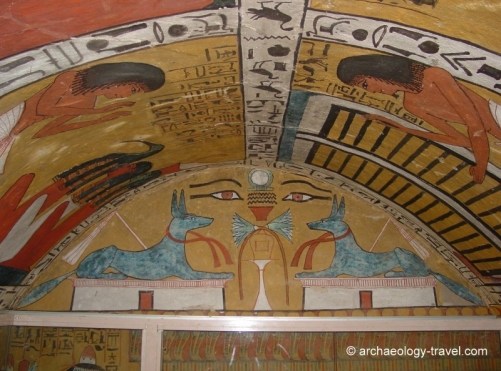
several of the tombs in the valleys of the Kings, Queens, nobles, and in the village of the artisans, with their incredibly fresh frescoes


the temple of Dendera, with its amazing astronomical ceiling

the temple of Abydos, with its lovely bas-reliefs inside the temple

the temple of Hatshepsut, with its dramatic setting

and finally the Ramesseum, with the green fields fed by the Nile’s waters lapping at its feet.

I won’t pretend that by the end of it all I was an Egyptologist, but I do think I now have a passing understanding of the history of the 18th to 20th dynasties (noting, though, the rather depressing fact that there were 30 dynasties in all before the Romans put a halt to pharaonism; I have much more to learn). I also think I have a – still very sketchy – understanding of ancient Egyptians’ religion. Finally, I have a passing knowledge of the architectural principles underlining the buildings that we saw.

I do not propose to bore readers with a breathless precis of what we saw, heard, and sort-of understood. I’ll just comment on some of the things that particularly struck me as we went along.

The sun truly dominated the thinking of the ancient Egyptians. After our two weeks there I can understand why. I saw clouds just once, and that was in Cairo. In Luxor, we had a clear, hard, lapis-lazuli sky the whole time, with the sun climbing slowly from the eastern horizon

up to its apex

and then falling slowly to the western horizon, as we moved from site to site.
It must be like this all the year round, so I can understand how the sun played a primordial role in ancient Egyptian religion. I particularly liked, then, to hear that the obelisk, that most Egyptian of things, was considered a petrified sunbeam.

What a lovely idea! A ray of the sun, congealed – frozen – in stone, driving into the earth. The equivalence would have been even stronger in the old days, when obelisks’ pyramidal capstones were covered with electrum, an alloy of gold and silver; the tips of the obelisks would have flashed and glowed in the sun.

In Cairo, we were told the same thing of the pyramids, but it was more difficult to imagine pyramids as rays of the sun in stone.

The place of the sun in Egyptian religion reached its extreme under the “heretical” pharaoh Akhenaten: he abolished all deities in the Egyptians’ pantheon except for the solar god Aten. In his frescoes and bas-reliefs, he had Aten depicted as a disc from which emanated rays that ended in hands.

The sun caressing the Earth and all that is on it … a beautiful idea! For doesn’t all life on this planet ultimately depend on the warmth of the sun?

Akhenaten was an interesting fellow, not least because of the way he had himself depicted in his official statuary, with an elongated, sensual face, quite different from everything that came before and after.

(the statues of him in the National Museum in Cairo are even more intriguing, with a body that looks distinctly feminine, to the point that some claim this is actually his wife Nefertiti)

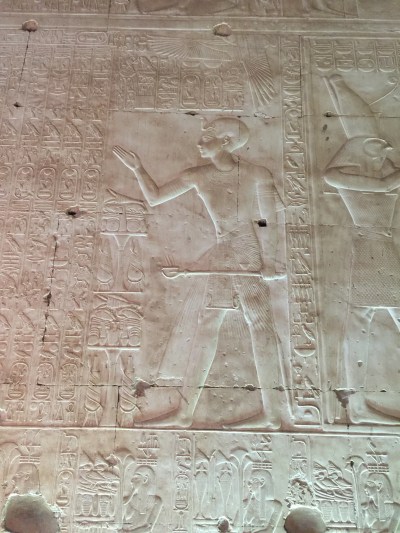
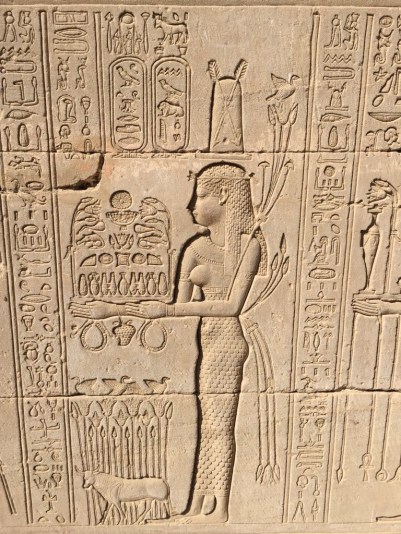
The sun even played a role in the design of the bas-reliefs which covered the walls of temples and tombs. We saw two types of bas-reliefs. The more delicate ones were true bas-reliefs, with the background cut down until the subjects were in light relief, like the ones I showed above from the temple of Abydos. The second type were created instead by cutting deep grooves along the outline of the figures and finished with some light molding of the figures. These were very striking in a raking light – in the late afternoon, for instance – when they stood out, almost like charcoal drawings on the walls.


It seems the effect was deliberate, to make reliefs that were readable in the country’s strong light.

The Egyptians held that the goddess of the sky, Nut, swallowed the sun at sunset and gave birth to him again in the morning. She was the wife (and sister) of the god of the earth, Geb. The story goes that she wanted to lie on him perpetually, but Ra ordered their father Shu, god of air, to force them apart. But Nut managed to keep her hands and feet touching Geb. I just loved the way the artists depicted these stories. The artists painted Nut – very often on ceilings, as one might expect – with her feet touching the Earth in one corner, her hands touching it in another, and her thin, lithe body curving along the edge of the ceiling between these two corners.

See how in the first of these two photos, Nut is shown giving birth to the morning sun and about to swallow the evening sun, while in the second Shu is holding Nut and Geb apart.

Originally, Nut was goddess of the night sky, and night skies are a common decoration of ceilings. We saw many ceilings painted blue and sprinkled – sprayed might be the better term – with a multitude of white stars.

It was a charming effect, and in the tombs certainly gave all those mummies lying on their backs a beautiful night sky to gaze upon for eternity – in the case of the photo above Nefertari, the main wife of Ramesses II.

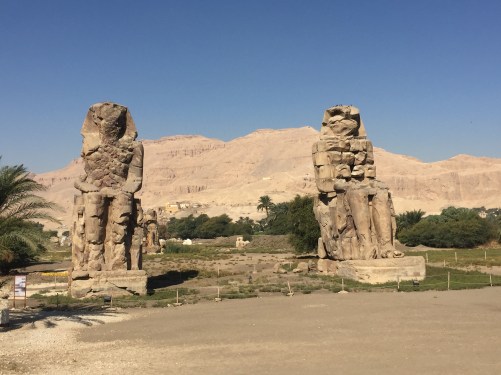
I finish with the so-called Colossi of Memnon, although actually they are statues of the pharaoh Amenhotep III. Tourists who passed through here a couple of thousand years before us – the Ancient Greeks – misnamed the statues.

Truth to tell, they are not much to look at; they have suffered much at the hands of time. As we stood there, a muezzin nearby started singing his call to afternoon prayers.

Allahu Akbar, Allahu Akbar,
Allahu Akbar, Allahu Akbar.

Ashhadu al la ilaha illa-llah.
Ashhadu al la ilaha illa-Ilah.
Ashhadu anna Muhammadar Rasulu-Ilah,
Ashhadu anna Muhammadar Rasulu-Ilah.
Hayya ‘ala-s-sala,
Hayya ‘ala-s-sala.
Hayya ‘ala-l-falah,
Hayya ‘ala-I-falah.
Allahu Akbar,
Allahu Akbar.
La illaha illa-llah.

God is great, God is great.
I bear witness that there is no god but God.
I bear witness that Muhammad is the Messenger of God.
Hasten to prayer.
Hasten to success.
God is great, God is great.
There is no god but God.

As the song floated over the shattered statues before us, I reflected on the seemingly inevitable passing away of civilizations and their religious constructs. The religion of the Ancient Egyptians was thrown onto the dust heap of history in the 3rd Century of the Common Era, after surviving 3,000 years or more, with a triumphant Christianity taking its place. After a mere 400 years, Christianity in Egypt was in turn overrun by Islam. Today, after 1,400 years, Islam stands seemingly secure in the lands of the Nile. But one day, when the statues before me will have crumbled to mere stumps of stone, Islam will no doubt have given way to something else. Nothing man-made survives the test of time.
_________________

Royal mummy: https://islampapers.com/2013/01/09/the-identification-of-the-pharaoh-during-the-time-of-moses/
Mummy cases: https://www.sciencedaily.com/releases/2013/08/130823091144.htm
Egyptian statue room, British Museum: https://www.pinterest.com/rowan925/egyptian-exhibit-british-museum-artifacts/
Cigares du pharaon cover: https://www.bedetheque.com/BD-Tintin-Tome-4-Les-cigares-du-pharaon-32559.html
Cigares du pharaon egyptologist: my photo
Asterix et Cléopatre cover: https://www.bedetheque.com/BD-Asterix-Tome-6-Asterix-et-Cleopatre-22950.html
Asterix et Cléopatre speaking hieroglyphics: my photo
The Mummy movie poster: http://www.impawards.com/1999/mummy_ver1.html
Pastiche statues and fresco: my photo
Temple of Karnak: http://www.nilecruised.com/tours/karnak-temple/
Temple of Luxor: https://www.traveladdicts.net/2011/10/karnak-temple-luxor-temple-egypt.html
Avenue of sphinxes: http://www.travelphoto.net/a-photo-a-day/wordpress/2005/04/15/sphinx-avenue-at-luxor-temple/
Luxor Museum: http://egypt-magic.com/category/luxor/
Tomb, Valley of the Kings: https://www.flickr.com/photos/shelbyroot/1164944359
Tomb, Village of the Artisans: https://archaeology-travel.com/archaeological-sites/deir-el-medina-luxor/
Temple of Dendera ceiling: https://paulsmit.smugmug.com/Features/Africa/Egypt-Dendera-temple/i-BJPQ24h
Temple of Abydos bas-reliefs: our photo
Temple of Hatshepsut: http://www.ancient-origins.net/ancient-places-africa/mortuary-temple-hatshepsut-deir-el-bahri-002777
Ramesseum: https://www.egypttoursplus.com/ramesseum-temple/
Sunrise Luxor: http://www.news4europe.eu/6369_entertainment/4797559_egypt-s-newly-discovered-artifacts-to-help-revive-tourism-in-luxor.html
Sun high in sky: http://www.psdgraphics.com/backgrounds/blue-sky-with-sun/
Sunset Luxor: my wife’s photo
Obelisk, Luxor Temple: https://commons.m.wikimedia.org/wiki/File:Luxor_Temple_Obelisk.JPG
Obelisk with golden capstone: http://www.riseearth.com/2016/08/mythical-benben-stone-landing-site-of.html?m=1
Sun rays with hands: http://www.ancient-origins.net/ancient-places-africa/art-amarna-akhenaten-and-his-life-under-sun-002587
Akhenaten head: http://www.panoramio.com/photo/2105526
Akhenaten statue: https://www.google.co.uk/amp/s/www.pinterest.com/amp/pin/312437292872997702/
Grooved bas-reliefs: our photos
Goddess Nut, Dendera: http://www.alamy.com/stock-photo-egyptdenderaptolemaic-temple-of-the-goddess-hathorview-of-ceiling-68990173.html
Goddess Nut, tomb Ramses IV: http://www.gettyimages.it/detail/news-photo/egypt-thebes-luxor-valley-of-the-kings-tomb-of-ramses-iv-news-photo/88701257
Stars on ceiling, Nefertari tomb: https://www.pinterest.com/ancha_no1/inside-egyptian-tomb/
Colossi of Memnon: our photo