Vienna, 1 August 2025
That was a low point in my annual medical check-up: my calcium values. Going into the discussion of my lab tests with our doctor, my concern had been my ferritin levels. As I’ve written in an earlier post, these have been too high for a number of years, and this year was no exception. But now I also had a problem with my calcium levels! They’ve generally been low ever since I had my thyroid removed some 15 years ago. This year, though, the levels dropped below the minimum acceptable level. But, I protested, I’ve been taking calcium supplements every day for years. Ah, the doctor replied, but if you rely too much on supplements your body doesn’t work so actively to extract calcium from your food. You have to try to meet your calcium needs through the food you eat and only take supplements if you really cannot reach the necessary values through your food. To help me, she gave me a sheet listing various foodstuffs and their calcium content.

I started looking at it. Aha, I cried, I can greatly increase my calcium content by eating a lot of cheese! As I’ve noted in an earlier post, I have a great fondness for hard cheeses from the Alps. Ah no, the doctor said, I wouldn’t rely solely on cheese, that could well have negative impacts on your cholesterol level – and here she pointed at my cholesterol results, which did indeed come in a tad high this year. You’re damned if you do, you’re damned if you don’t, I thought to myself …
Once home, I glumly took out the sheet and started scanning it again. First thing to figure out: how much calcium do I need to ingest every day? A quick surf of the net shows some discrepancy here. The Europeans suggest 950 mg/day, while the Americans suggest 1,200 mg/day for oldies like me. Given the weakening of my calcium glands after the removal of my thyroid, I decided to use the higher American value as my target. But I immediately began to panic. How am I going to meet this high daily target?
Even a cursory look at the list clearly indicates that if I can’t gorge on cheese I will need to eat other milk products. The product with the highest levels of calcium is cow’s milk (“Kuhmilch”). So I could just drink five glasses of milk a day and Bob’s my uncle (but only low-fat milk; cholesterol levels! … damned if you do, damned if you don’t).
The milk industry has certainly been pushing milk drinking for decades.



But I really, really don’t like drinking milk! I stopped knocking back glasses of milk when I was a child. So I’ve decided that unless I have my back to the wall, I will just use milk as a support, adding it to the teas and coffees which I consume during the day; I will have very milky teas and coffees from now on.
What else? Well, I see that kefir has high levels of calcium, maybe I can eat loads of that. But what on earth is kefir? I’d never heard of the stuff before looking at the list. As usual, Wikipedia has come to the rescue. It tells me that kefir is a sour, slightly carbonated, slightly alcoholic beverage, with a consistency and taste similar to a thin, drinkable yogurt. Of course, I got caught up in the Wikipedia article and continued reading. I learned that kefir is prepared by inoculating milk (cow, goat or sheep milk) with so-called kefir grains, which ferment the lactic acid. These “grains” are quite intriguing. They are actually a mix of various type of bacteria and yeasts and look like this.

It sounds like the milky equivalent to kombucha-making.
It seems that kefir was invented somewhere out in Central Asia; here is a painting of a shepherd in the Caucasus by a Russian artist.
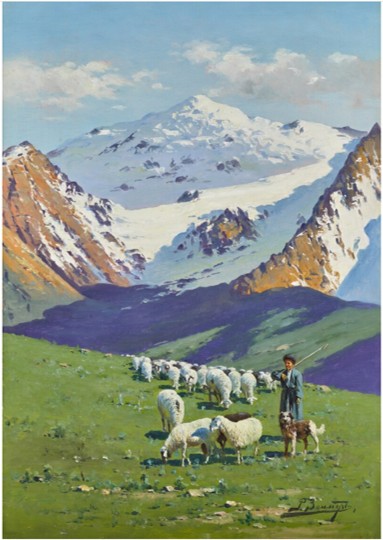
The Russians then adopted it (presumably after their conquest of Central Asia), and from there it spread to Central Europe – which no doubt is why I found it in our local supermarket in Vienna.
Could I drink this instead of milk? Not sure I could, at least not in its natural state – its sourness is not for me. However, I see that the local supermarket sells not only kefir in the natural state but also sweetened.

That sounded good. But then I had a horrible doubt: what are these kefir drinks sweetened with? I have to control my sucrose and fructose intake! Or so my doctor told me a few years ago, to avoid becoming diabetic … damned if you do, damned if you don’t … I have made a mental note to check this.
Going back to the list, I see that something called “molke” in German has pretty high calcium levels. What is molke, though? Google Translate to the rescue! Molke, it turns out, is whey.
Whey … the only connection I have ever had with whey is through the nursery rhyme:
Little Miss Muffet
Sat on her tuffet,
Eating her curds and whey;
There came a big spider
Which sat down beside her
And frightened Miss Muffet away.

Otherwise, I have never, ever seen hide nor hair of whey in my entire life. But contrary to kefir at least I know what it is, because I once wrote a post about cheese making for my daughter. Whey is basically the liquid that’s left over when you curdle milk, the curds going on to become cheese.
That’s all fine and dandy, but does my supermarket stock whey? It turns out that it does, either in natural form or sweetened.
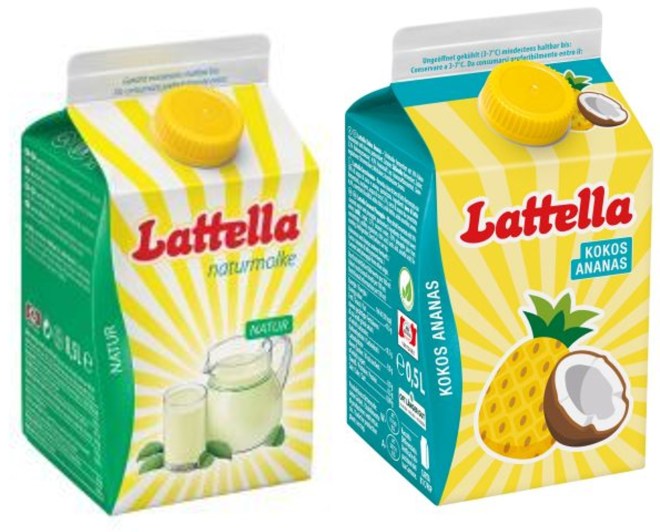
I have put it on my list of things to try (why I haven’t tried it yet will become apparent in a minute). In the case of the sweetened version, and for reasons I have just mentioned, I also have to check what it is sweetened with.
This was all very well, but how about some milk-derived product I can eat rather than drink? (apart from cheese, of course!) Well, looking at the list I have concluded that yogurt is the obvious choice, even if its calcium levels are somewhat lower than those in kefir and whey.
Yogurt is certainly a much-loved part of the cuisine of the countries running from the Balkans all the way east to the Indian subcontinent. Surely there could be some yogurt dishes for me in all those riches?
A quick whip around the internet has brought to light some intriguing possibilities. For instance, many of these countries have a “salad” where yogurt is a main ingredient, along with two other ingredients, cucumber and garlic. The Turkish version, called Cacik, simply adds mint to this trinity of ingredients. In the Lebanese and Syrian version, called Khyar bi Laban, mint is also added, but so is lemon juice. As for the Greeks, their version, which is called Tzatziki, uses the same four ingredients of Cacik (and derives its name from it) but then mirrors Khyar bi Laban by adding an acid to the mix, vinegar in this case rather than lemon juice. It goes one step further by adding dill and parsley, before drizzling the whole with olive oil. Even the Bulgarians have got into the act with a dish they call Snezhanka (which translates as snow-white salad – not surprising, given its dominant colour). It has the trinity of yogurt, cucumber and garlic. It has no mint, though, but it does – like the Greeks – include dill and (sometimes) parsley and a drizzle of olive oil.
Since these four salads all look rather similar, I decided to make a collage of photos of the four dishes, with Cacik in the top left followed, clockwise, by Khyar bi Laban, Tzatziki, and Snezhanka.
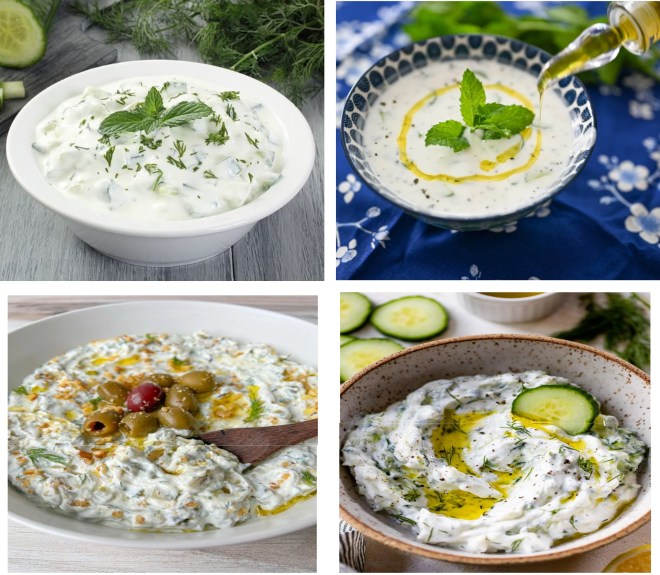
Were I to go for this dish – and I would have to see if my wife would follow me; it would be a bit sad to eat it alone – I would skip the garlic, for reasons I have given in an earlier post. I would also leave out the dill; I’m no fan of this herb. But I would, like some Bulgarians do, add roasted walnuts.
Many of these countries also have yogurt-based soups, which can be eaten either hot or cold depending on the season. Given that it is currently summer, I’ll start with some examples of cold soups. One of the simplest comes from Türkiye, where the Turks turn Cacik into a cold soup by using watery yogurt instead of a strained yogurt. Iranians have a similar soup, Abdoogh khiar, where yogurt and ice cubes are mixed together with cucumbers, raisins, salt, pepper and onions, the whole topped with some croutons made of Persian traditional bread. Bulgaria and other Balkan countries also have a similar cold soup, Tarator, where a watery yogurt is mixed with cucumber, garlic, walnut, dill, and olive or other vegetable oil. It can, like Abdoogh khiar, even be served with ice to really chill it. The peoples living in the border area between Azerbaijan and Iran eat a cold soup called Dovga, which, unlike the previous examples, does not include cucumber or garlic. Instead, the yogurt is mixed with a variety of herbs. These change seasonally and regionally, but usually will include coriander, dill, and mint; spinach can also be added. Cooks sometimes go one step further and add rice or chickpeas, or even meatballs, to the mix.
As in the case of the salads, and for the same reason, I show here a collage of these soups, with Cacik at the top left followed, clockwise, by Abdoogh khiar, Tarator, and Dovga.

Not surprisingly, all these soups can also be eaten warm in winter. Which allows me to introduce other yogurt-based soups normally eaten warm. Since we are in the Iranian-Azerbaijani border area, let me mention another soup from that region, Aash-e doogh. To the yogurt are added different kind of herbs (such as coriander, leek, tarragon, mint, and parsley), vegetables (such as spinach, purslane, chickpeas, peas, onion and garlic), but also lamb meatballs, eggs, rice, salt and several types of spices.

There are many other types of yogurt-based soup, but I think we all get the gist: take yogurt, add the herbs you like, add some vegetables if you want, or pulses, and maybe if you’re feeling adventurous some eggs or meat. Again, before starting to make yogurt-based soups, I will have to see if my wife will follow me on this culinary adventure.
There’s a whole other variety of soups from this part of the world to which yogurt is added, but in a rather special guise: the yogurt is first turned into a form appropriate for long-term storage by fermenting and drying it, and maybe mixing it with other ingredients like crushed bulgur wheat. This is popular in the cuisines of Iran, the Caucasus, and Central Asia, and known variously as kashk, kishk, qurut, qurt, kurut, kurt, qqet, jameed, shilanch, chortan, aaruul or khuruud. Here is an example of the genre.
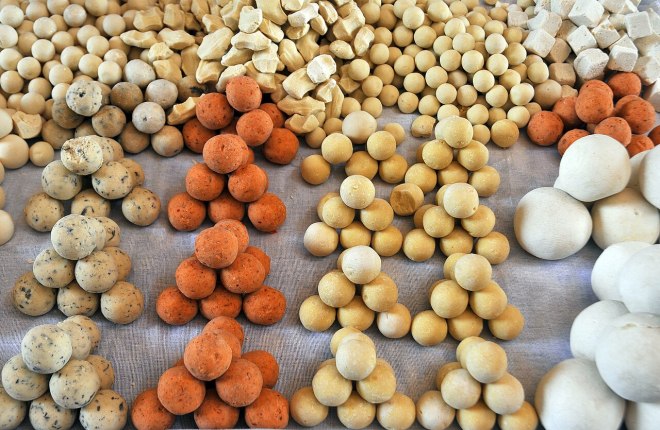
A ball of this stuff can be crumbled into soups (among other dishes) to give them some whoomph. Fascinating as it sounds, I think I’ll probably give this particular culinary exploration a miss. I’m certainly not going to start drying and fermenting yogurt, and anyway taken this way I wonder how much calcium I would be ingesting – the whole point of this exercise. I’ll just limit myself to checking if a soup prepared this way is on the menu of the next Turkish or Iranian restaurant we go to in Vienna, just to see what it tastes like (I’m not sure I’ve ever seen an Azerbaijani restaurant in Vienna).
And then there are all the dishes from the Indian subcontinent made with yogurt! They all sound incredibly delicious but require many ingredients that I would be hard-pressed to source in Vienna (or in Milan, for that matter). I’ll just mention one dish – a drink actually – from that part of the world, and that is lassi. My wife and I discovered the sweetened version of lassi several decades ago, during an outing to an Indian restaurant, and ever since we always look for it on the menu of Indian restaurants we go to. The yogurt has to be thin enough to drink, and it is sweetened with sugar and flavoured with mango or other fruit juice. Delicious!

I think I could just about manage to prepare this – although I would need to use sweetener rather than sugar.
This is all in a possible future. In the here and now, I’m eating yogurt the way I’ve always eaten it, sweetened. My wife and I have just come back from Los Angeles, where we were visiting our daughter, partner, and grandson. We arrived there shortly after that fateful visit to the doctor (which is why I still haven’t tried some of the possibilities I’ve mentioned earlier). She is very interested in nutrition and came up with a yogurt-based calcium bomb: a big dollop of low-fat yogurt (good for the cholesterol levels!), seasoned with blueberries (good for the ferritin levels!), sprinkled with a generous dose of chia seeds, and sweetened with artificial sweetener. It doesn’t look all that great but it’s really quite tasty.

The key to this mixture is the chia seeds. My daughter discovered that these seeds are absolutely packed with calcium, at levels five times higher, gram per gram, than yogurt! In fact, nuts and seeds – particularly seeds – are generally good sources of calcium, as readers can see if they go back to the sheet the doctor gave me (under the section entitled “Nüsse, Samen”).

Well, that’s a turn up for the books! I’m quite partial to nuts and am pleased to now have a good excuse to munch on them (although they also contain quite a lot of fat – cholesterol levels! … damned if you do, damned if you don’t). Seeds are even better, calcium-wise, than nuts, although I don’t see myself putting a fistful of seeds into my mouth; they’ll have to be added to something else. Looking at that list of nuts and seeds, I see that “Mohn” has very high levels of calcium, even higher than chia. What is this mohn? Time to wheel out Google Translate again! And it turns out that mohn are poppy seeds! Well now, that is interesting! I know that poppy seeds are a popular ingredient in Austrian cuisine and the cuisine of Central Europe more generally. I’ve eaten them sprinkled on pastries or cakes.

Now that I’m back in Vienna, I need to see if I can buy poppy seeds in large quantities. If I can, I’ll have them take the place of the chia seeds in my daughter’s yogurt concoction – think global, act local!
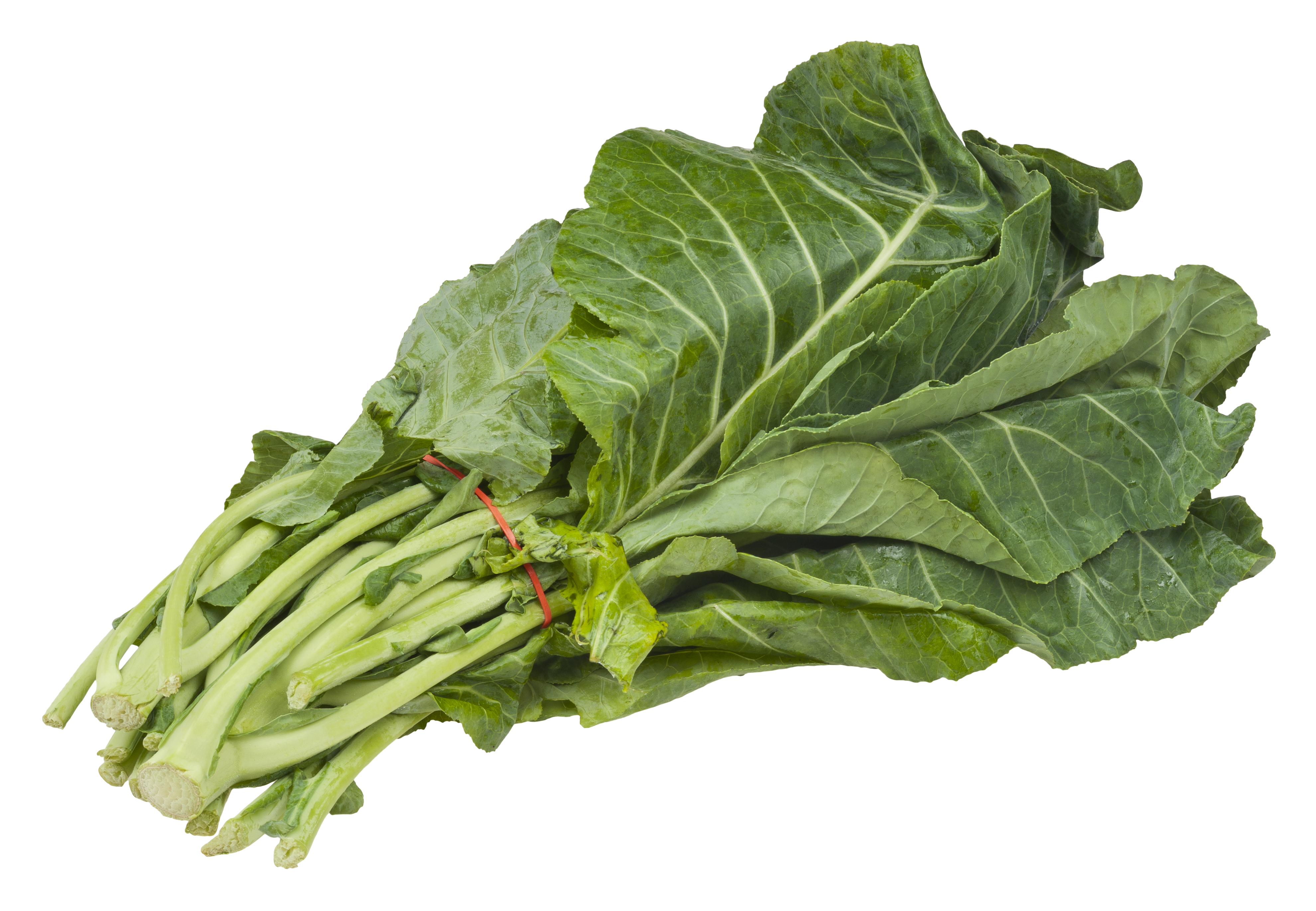
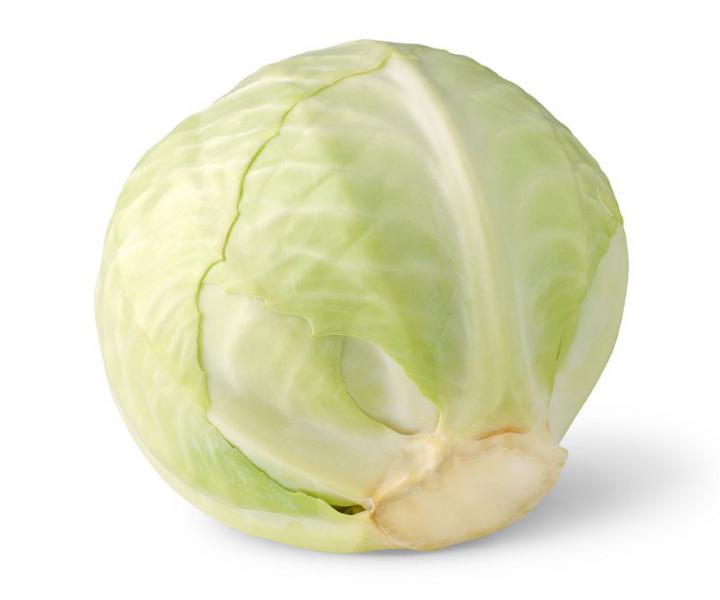
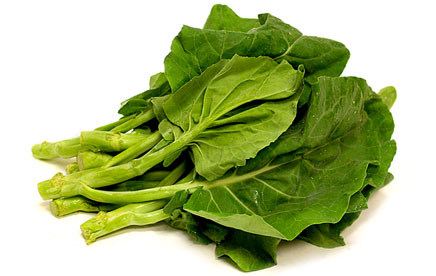
I can’t just eat yogurt, though, to maximize my calcium intake. What else could I eat? Well, I can forget about meats and fish as significant sources of calcium; there’s so little calcium in them that they’re not even on the list. My daughter said I could eat the bones of fish when they’re small, but once, when I was a boy, I got a fish bone stuck in my throat, such an unpleasant experience that I keep as far away as possible from fish bones. Fruits aren’t brilliant either. As for vegetables, a few stand out as having a good amount of calcium: fennels, broccoli, green cabbage, and chard (“mangold” in German).

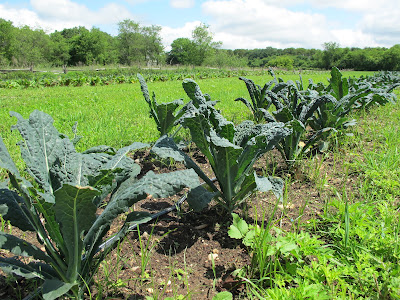
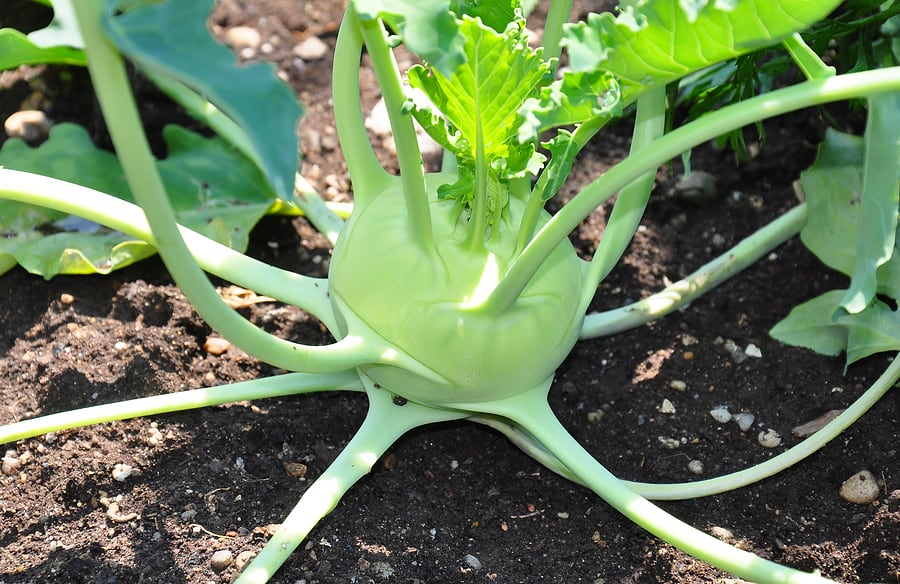
I’m pleased to see that fennels pack a good calcium punch; I’m very fond of this vegetable, as I’ve related in a previous post. I’m also extremely fond of chard, about which I’ve written enthusiastically in the past. It makes me think that other greens like beetroot greens, kale, and spinach might also be full of calcium; to be checked (but what about the iron they also contain? Ferritin levels! … damned if you do, damned if you don’t). Broccoli is also a favourite of mine, as long as it is steam-cooked. I’m doubtful about green cabbage, though; I find it too bitter to eat raw and it smells too much when cooked. Maybe red cabbage, which I will gladly eat raw in salad, also packs a good calcium punch? I will need to check; Savoy cabbage, for instance, which is on the list (“wirsing kohl” in German), has much lower calcium levels than green cabbage.
Well, it’s now time to create meals around all this that give me enough protein, that don’t exaggerate on the carbs and fats, that give me the calcium I need, that give me lots of polyphenols to help control my ferritin levels but at the same time don’t exaggerate on the iron, … It’s like solving a multi-dimensional algebraic equation. Let’s see what we can do.









 the heart thrills