PHOTO ALBUM OF A HIKE

Vienna, 8 June 2025

My wife and I recently completed a four-day hike around the Danube, in the reaches of the river some 20 km upstream from Linz. We started in the village of Ottensheim, made our way to Eferding and then to Aschach, ending the hike in the village of Sankt Martin. I can’t resist inserting here a composite photo I’ve created of the hike.

My composite

As readers can see, we wandered rather drunkenly along the Danube.

The wonderful thing about hiking is that you move slowly across the landscape, which allows you to notice things which you probably wouldn’t notice on a bike, let alone a car. I give my readers here a taste of what my wife and I came across – quite serendipitously – as we slowly crossed this Danubian landscape.

Thursday

We arrive in Ottensheim, which sits on the Danube river, in the early afternoon. We take advantage of our early arrival to go for a walk on the high lands behind the town. Here is the view of the Danube which greets us at the top. You can see the hydroelectric dam spanning the river. We’ll be passing that dam tomorrow.

My photo

We have pizza at the place we’re staying the night, down by the river’s bank. We chat with the staff, all Neapolitans, who all left Naples because of a lack of opportunities there. A story we’ve heard so many times. Such a tragedy for Naples, this steady draining away of their youth.

Friday

We’re greeted at the exit of the hotel by this strange painting on the wall of a house.

My photo

Not sure what happened to the mermaid’s nose …

We’re waiting to board the ferry, which will carry us over to the other bank.

My photo

While waiting, we spy a statue of St. Johann Nepomuk, protector of those who cross streams and rivers, so common in this part of the world. This statue is coloured, though, which is rare.

My photo

The view from the ferry’s deck, looking upstream. The hydroelectric dam is in the far distance.

My photo

We can also see a peek of Ottensheim’s local castle in that last photo. We get a better view as we start walking along the river’s bank.

My photo

Its recent history has been quite eventful. Owned by a British family in the 1930s, it was confiscated by the Nazis at the beginning of the war. They used it as a forestry office for the Wermacht. After the war, the Soviets, who occupied that side of the Danube, used it as a barracks. After they left in 1955, when Austria got back its independence, the castle reverted to its pre-war owners. By then it was in a pretty sad state, but its owners didn’t have the money to restore it. It was only in 1988, when the castle was sold to a group of families with deeper pockets, that the castle could be restored. It is still in private hands.

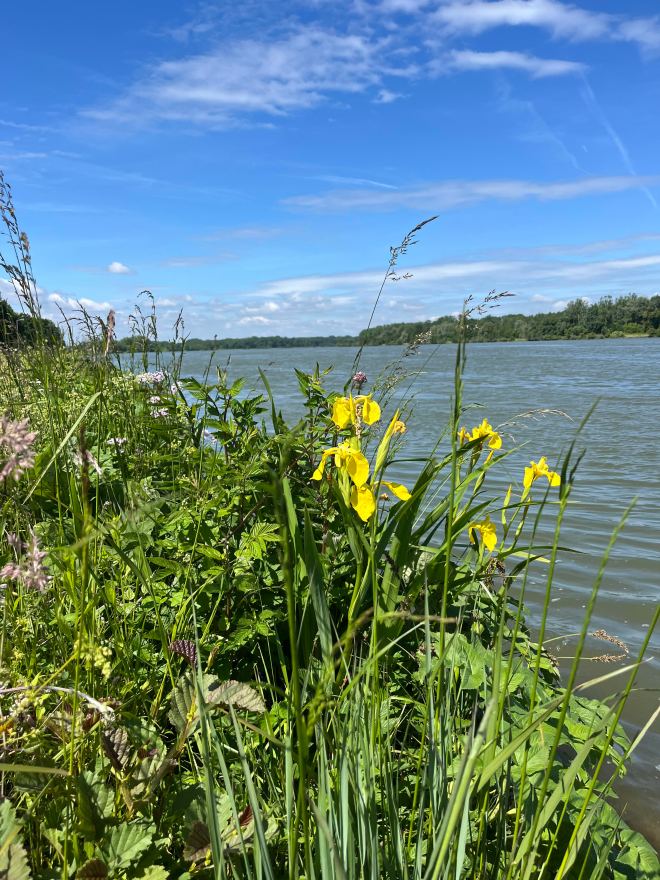
Yellow irises blooming along the water’s edge, the first of many wildflowers we will be seeing on this hike.
My photo

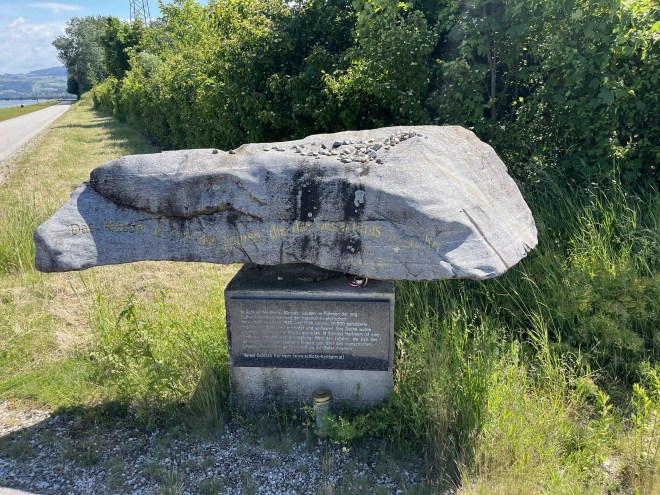
Close by, a memorial on the side of the path.
My photo

It commemorates the nearly 30,000 people murdered through poisoning with carbon monoxide by the Nazi regime in nearby Hartheim castle, between May 1940 and December 1944. Once their bodies had been cremated the ashes were brought to this spot and dumped into the Danube. Until September 1941, it was a “euthanasia” centre, where 8,000 physically and mentally handicapped people, almost all from Bavaria and Austria, were murdered. After Hitler closed down the Nazis’ euthanasia programme (because of protests from the Roman Catholic Church in Germany), the centre quickly “pivoted” to become a centre for the killing of inmates from nearby concentrations camps, primarily Mauthausen or its satellite camps, who were too sick or injured to work any longer. By December 1944, they had murdered a further 12,000 people, most of them Soviet Prisoners of War.

Wildflowers by the side of the path

My photo

Outside a fire station, an intriguing monument to firemen and women, as well as to officers of the Austrian river authority.

My photo

An old farmhouse on the edge of the road.

My photo

Eferding, the end point of today’s hike, with the parish church’s bell tower dominating the town.

My photo

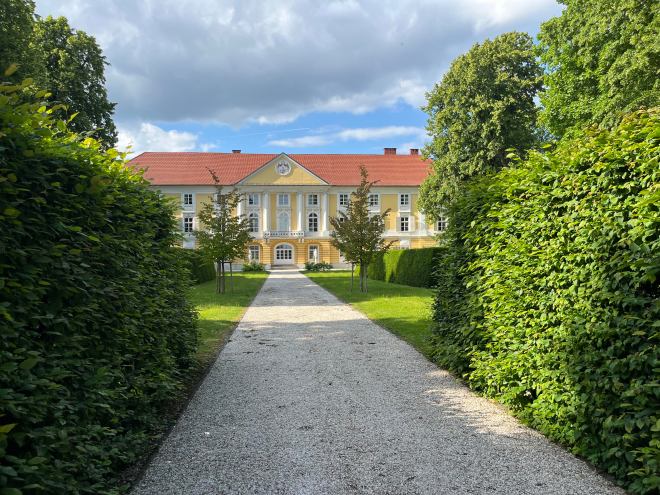
A photo of Eferding’s castle, taken by slipping my iPhone through the big gates that barred entry.
My photo

The castle is still owned by the Starhemberg family, who inherited it and the lands that came with it in 1559. Interesting family. They’ve been involved in Austrian politics for the last 1,000 years or so. The latest (in)famous member of the family was Ernst Rüdiger Prince von Stahremberg, who was born in 1899 in the castle and died in 1956 in Voralberg. He was a right-wing politician with great admiration for Mussolini’s fascism. He served in Austria’s right-wing governments from 1930 until 1936. Although fascistic, he really disliked the Nazis and made his dislike very public, so after the Anschluss of 1938 he fled to Switzerland to avoid vengeful retaliation by the Nazis (and perhaps also to protect his wife, who was Jewish). At the beginning of World War II, he served in some capacity in the British and Free French Air Forces, but he resigned in disgust after the UK and the US allied themselves with the Soviet Union in 1941 – he viewed communism and Nazism as equally evil. Thereafter, he and his wife left for Argentina; not unnaturally, he felt a great affinity with the politics of Juan Peron. In 1956, after Peron had been ousted by the army, he travelled to Austria for an extended visit, no doubt to explore the possibility of coming back. He was staying at a spa in Schruns (the bell tower of whose parish church I had so admired last year). During a walk, he was photographed by a journalist who worked at a communist newspaper. In a rage, he attacked the journalist with his walking stick, but this triggered a cardiac arrest and he died there on the pavement.

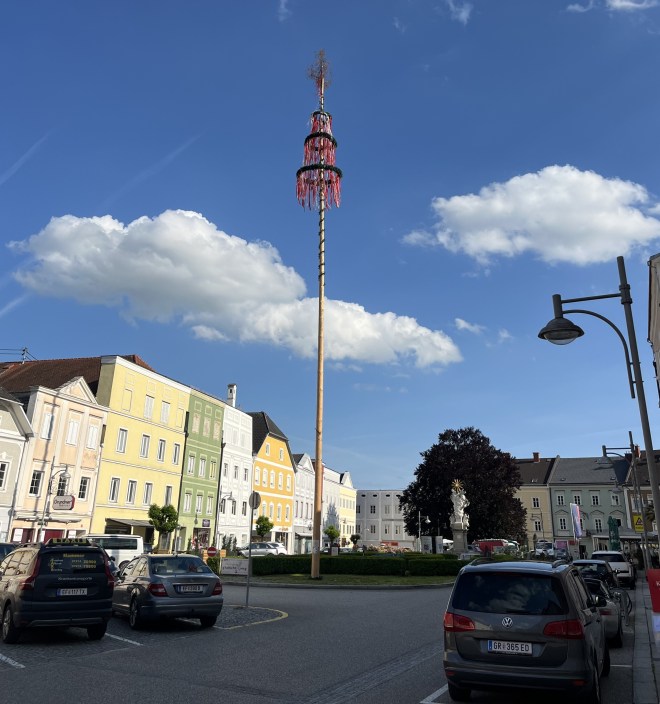
Turning my back on the Stahremberg castle, a view of Eferding’s main square

My photo

with its maypole still standing

My photo

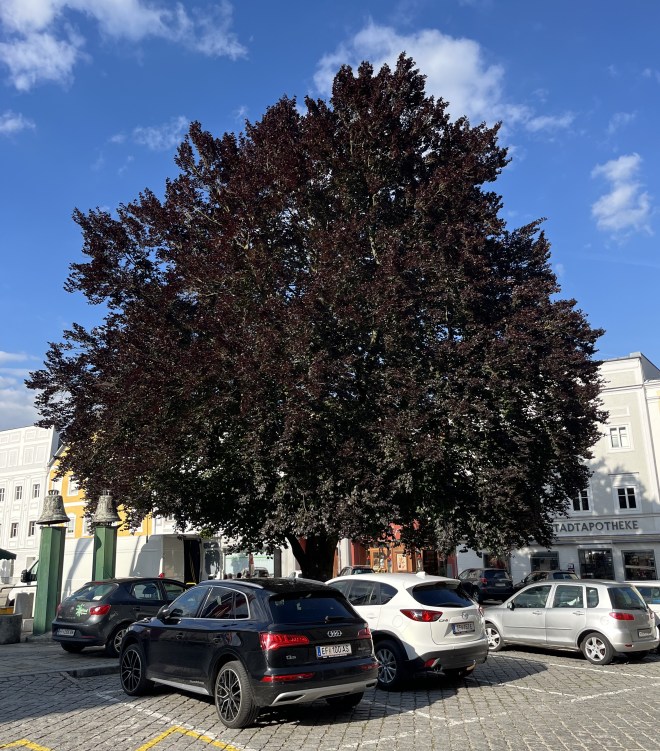
and a magnificent copper beach at the far end.
My photo

Eferding’s parish church

Source

with its beautifully carved pulpit (although not as beautiful as the one my wife and I saw in Traunkirchen several years ago)

Source

and the tombstone of some long dead knight.

My photo

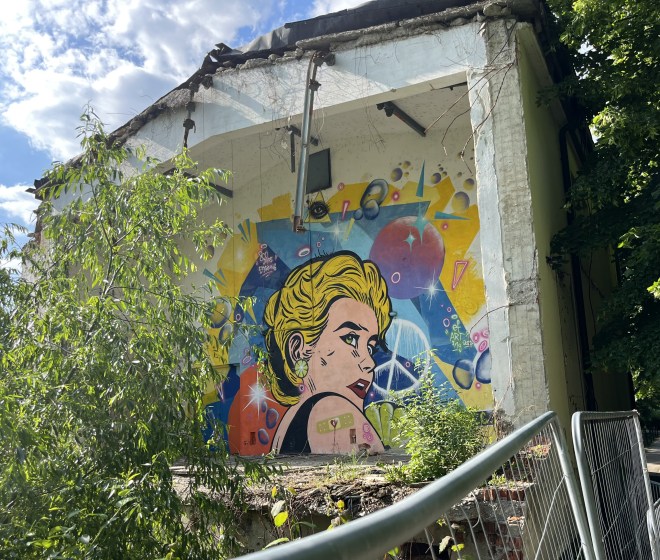
A Lichtenstein-like mural on the wall of a ruined house
My photo

An amusing ad for a shop offering orthopaedic services.

My photo

And so to dinner and bed.

Saturday

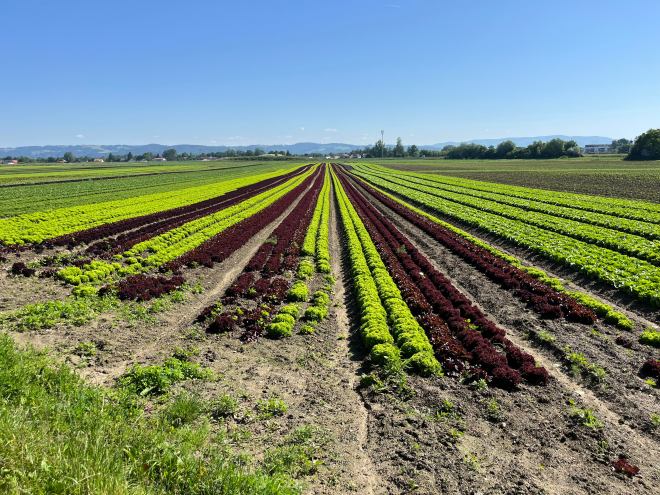
We start the day by walking over the rich farmland around Eferding. We pass these multicoloured rows of lettuces.
My photo

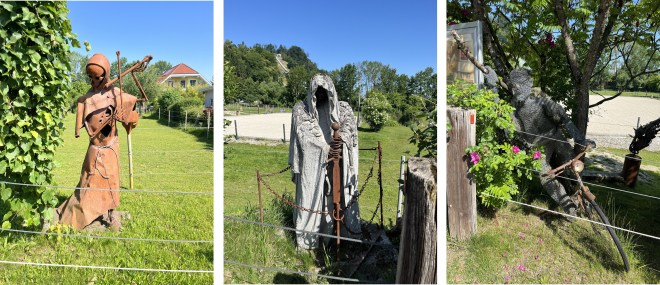
We go past a garden whose owner must be an amateur sculptor with a fondness for using scrap metal.
My photos

Nearby, beauty among the garbage.

My photo

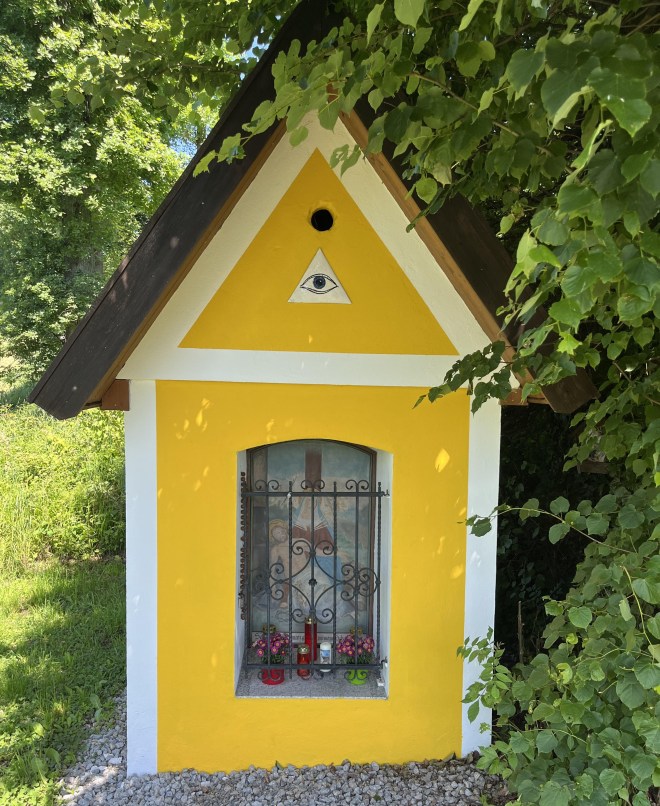
We begin to climb a steep ridge. We pass a shrine on the side of the road.
My photo

Shrines are common throughout Austria, but I notice that in this region shrines – like this one – have an eye painted on them. I suppose it represents God, the “All-Seeing Eye”. But I find it rather unnerving: “You can’t hide from me, I can see everything that you do” – just like Big Brother in George Orwell’s “Nineteen Eighty-Four”.

A chapel at the top of the ridge.
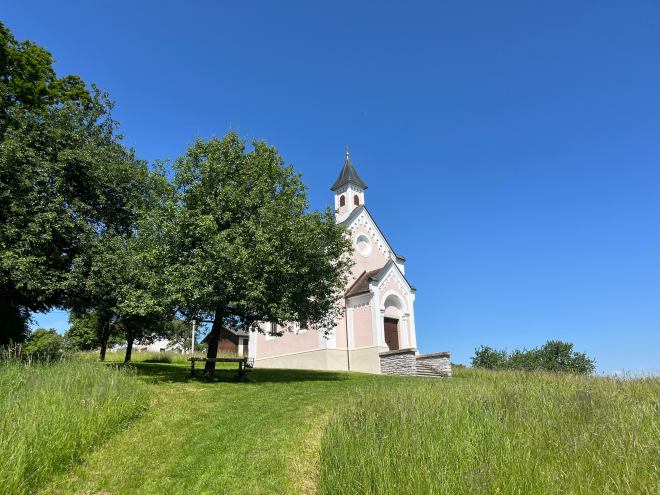
My photo

A spray of daisies on the side of the road.
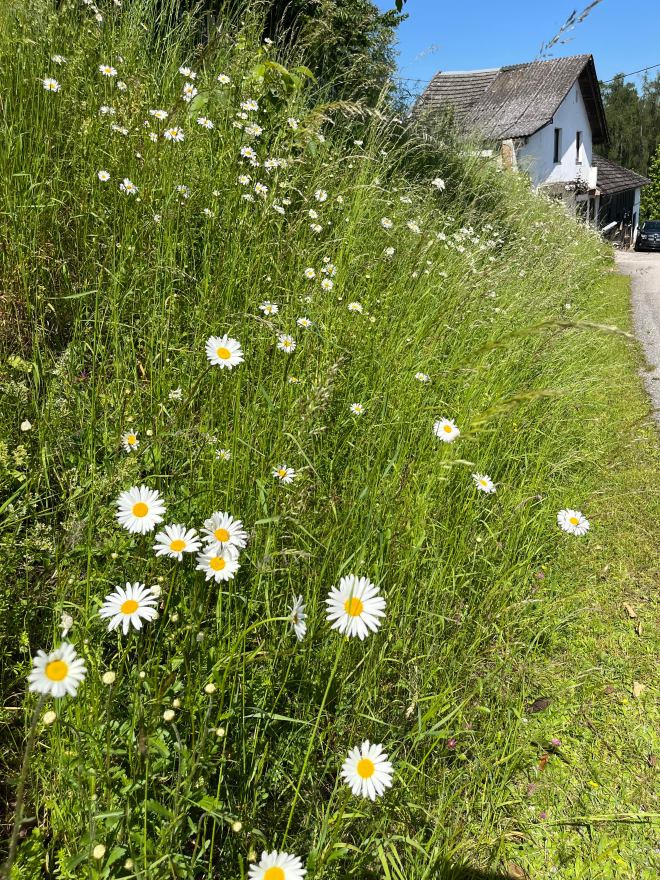
My photo

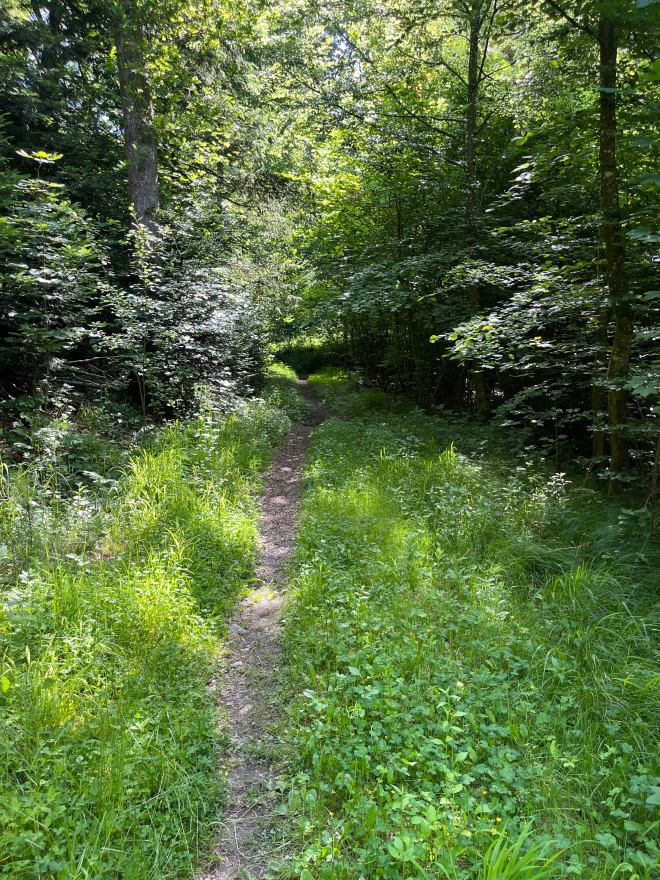
We plunge into the woods.

My photo
My photo

A view over the plain around Eferding.

My photo

We come down the ridge and pass the small airfield – literally, in this case – of a gliding club.

My photo

We have been watching the gliders soaring over us all morning; my iPhone, alas, cannot capture their ethereal beauty.

We look back at the ridge we walked along, with a castle ruin sitting on it.

My photo

We stop for lunch in the village of Pupping, finding a bench in the parish church’s garden to sit on. I, of course, cannot pass up the opportunity of visiting the church after lunch. I find a mix of old and new.

A statue of St. Wolfgang, who, it is said, died at the altar of the (original) church in 994 CE.

My photo

A statue of St. Christopher, looking less than pleased with having to carry the Child Jesus.

My photo

Four carved door lintels, displaying the symbols of the four Evangelists: clockwise from the top left, the lion of St. Mark (you have to look hard to see the lion’s face), the ox of St. Luke, the angel of St. Matthew, and the eagle of St. John.

My photos

It takes me a while to understand that Luke’s angel is represented by an eye – the eye again …

Rather pleasant stained-glass windows.
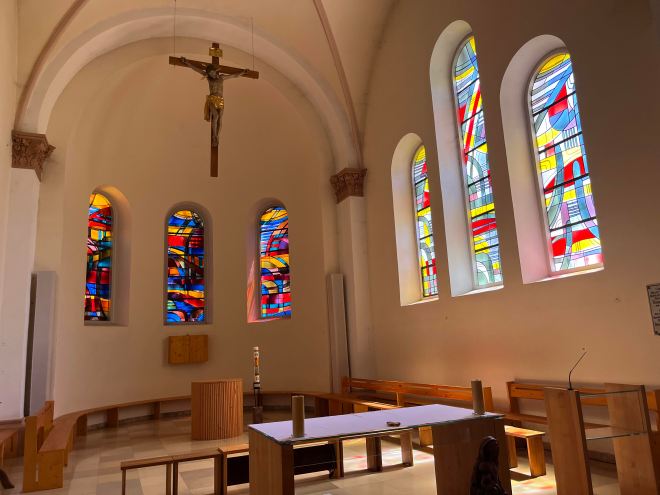
My photo

We continue the hike towards our end point today, Aschach, on the Danube. Quite by chance, our route takes us past a war cemetery.

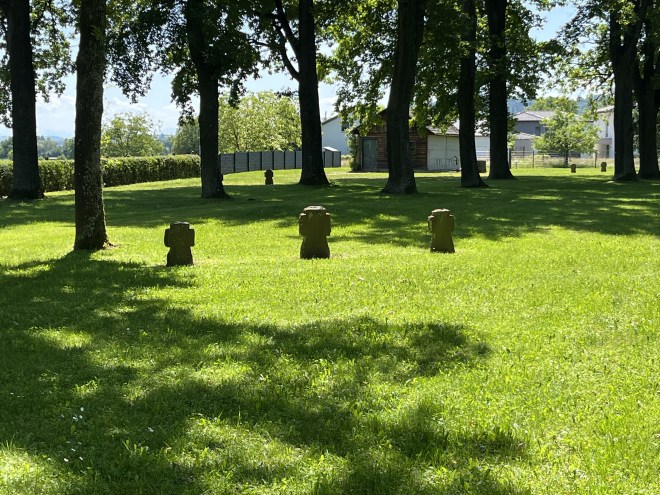
It has the look and feel of the German war cemeteries which my wife and I had visited on the Western Front: tall oak trees, shading a lawn, in which are planted stone crosses.
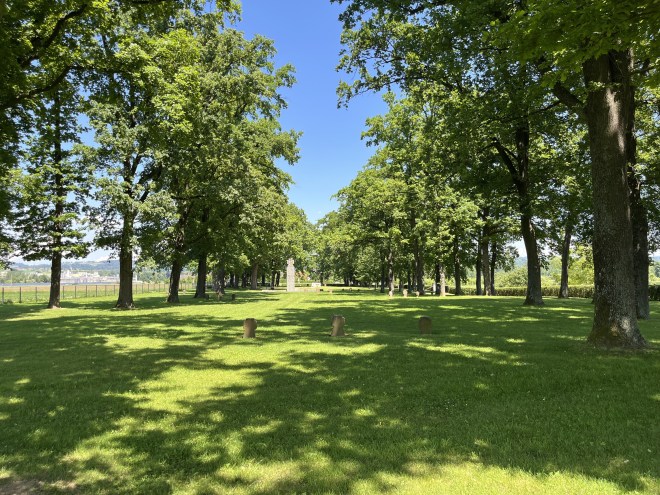
My photo
My photo
My photo

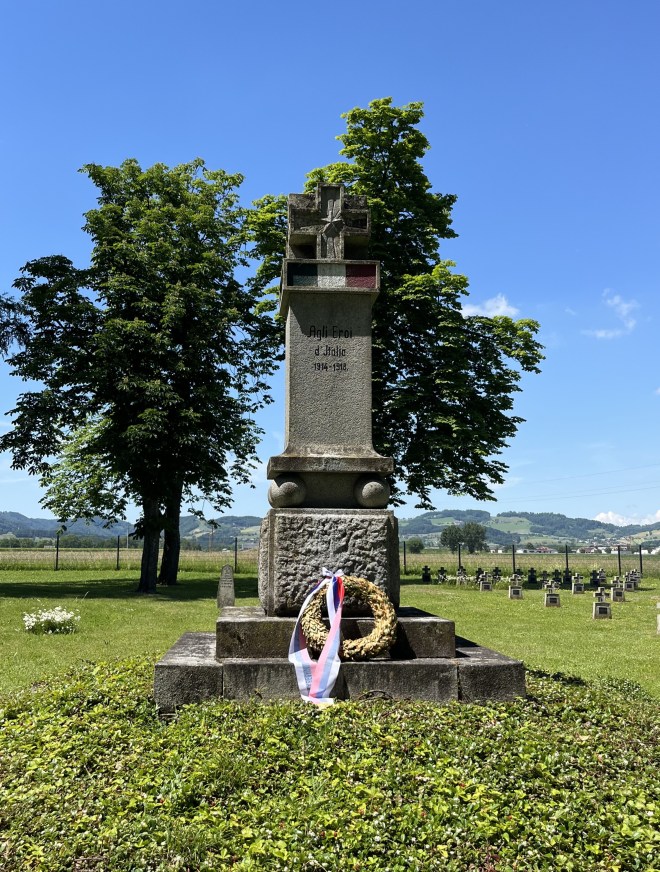
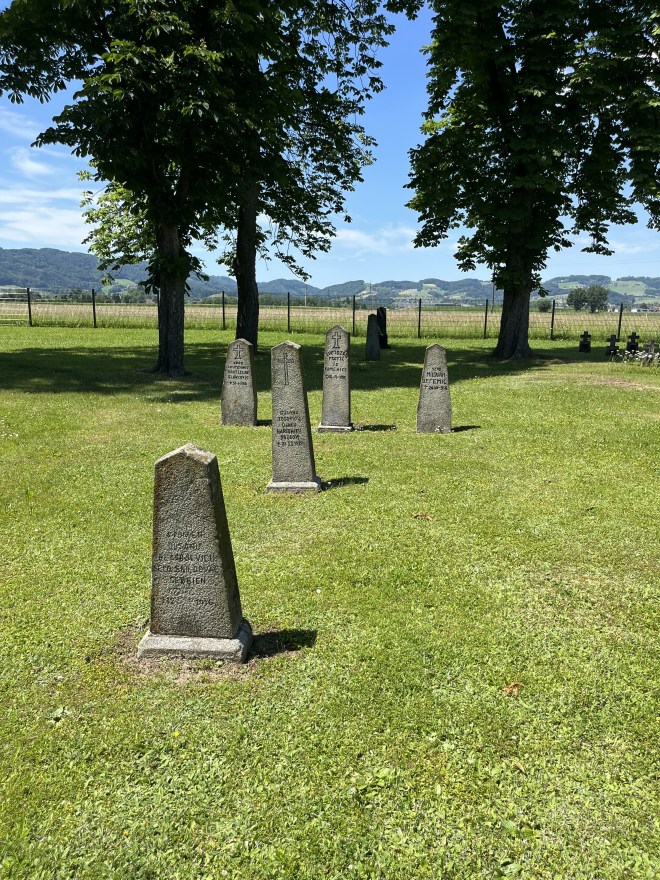
But actually, although the cemetery is looked after by the German association for war graves (hence the look), none of the soldiers buried there are Austrian or German. And none of the dead who are commemorated fell on the frontline; they were all prisoners of war who died in a POW camp which the Austro-Hungarians built close by for use during the First World War. They were mainly Italians

My photo

with their memorial

My photo

and Serbians

My photo

with theirs.

My photo

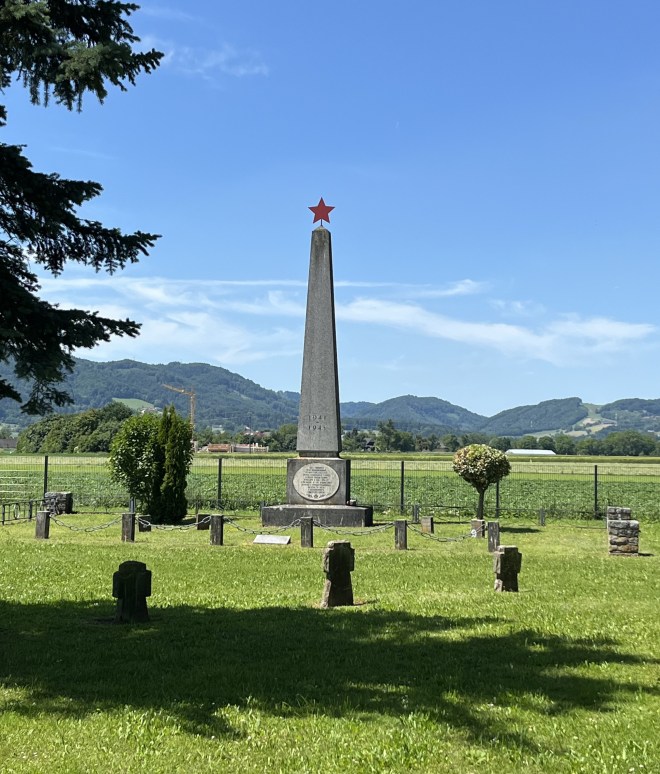
After the Second World War, the Soviets put up a memorial to their POWs who had been murdered in Mauthausen and other nearby concentration camps.
My photo

Of course, the thousands of murdered Soviet POWs didn’t get an individual grave, their names were not even inscribed on a monument. But some Russian family had come and attached a photo of one Soviet prisoner to a stone cross, with the epitaph “We remember, we love, we grieve. The grandchildren”.

My photo

We walk on to Aschach.

Sunday

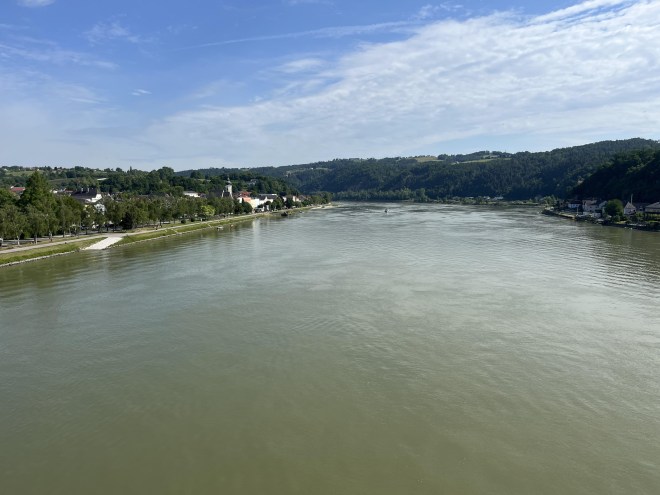
We start the day by once again crossing the Danube, but this time using a bridge rather than on a ferry.
My photo

Some purple irises catch my eye as we walked along the river bank.

My photo

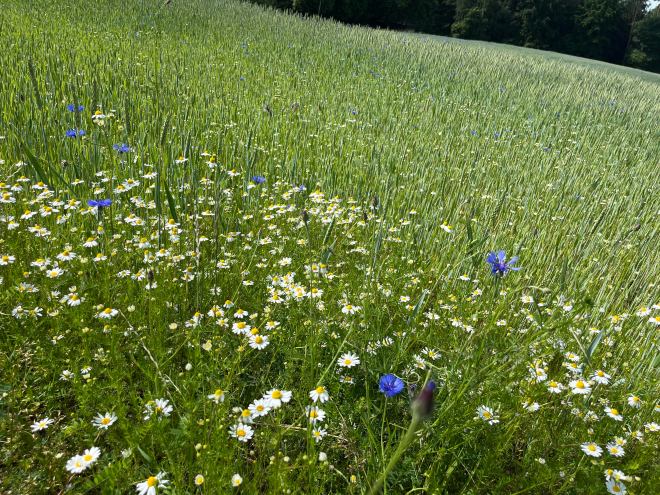
We climb up to the high lands overlooking the river, past fields of wheat studded with corn flowers and daisies.
My photo

We enter the woods.

My photo

The path eventually leads us off the high lands and down to a stream at the bottom of a valley. We start following the stream towards its source. At first, the stream cheerfully burbles along.
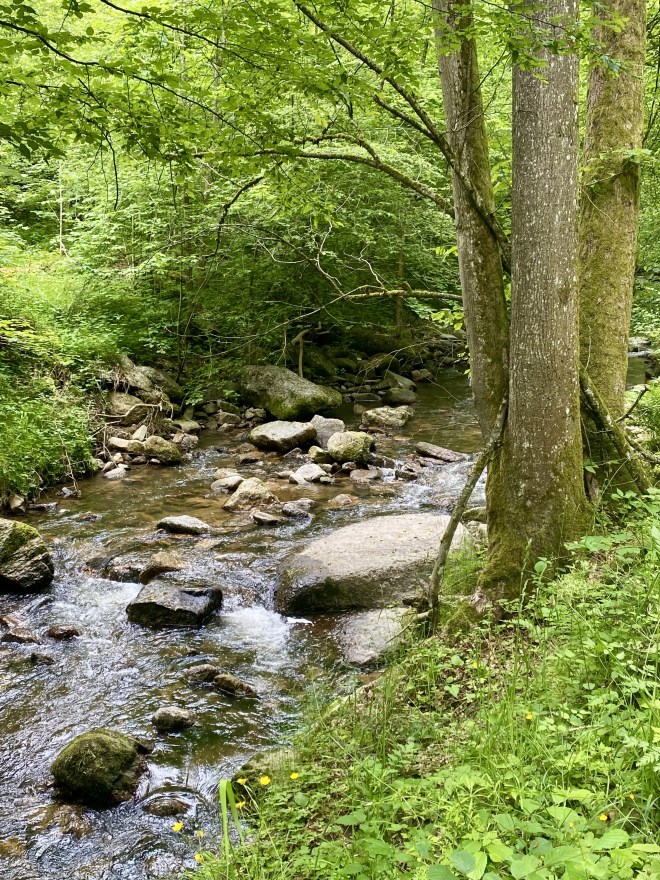
My wife’s photo

But soon the stream bed becomes rough as stones from above have tumbled down, and the water jumps around.

My photo
My photo

The path mimics the roughness of the stream.
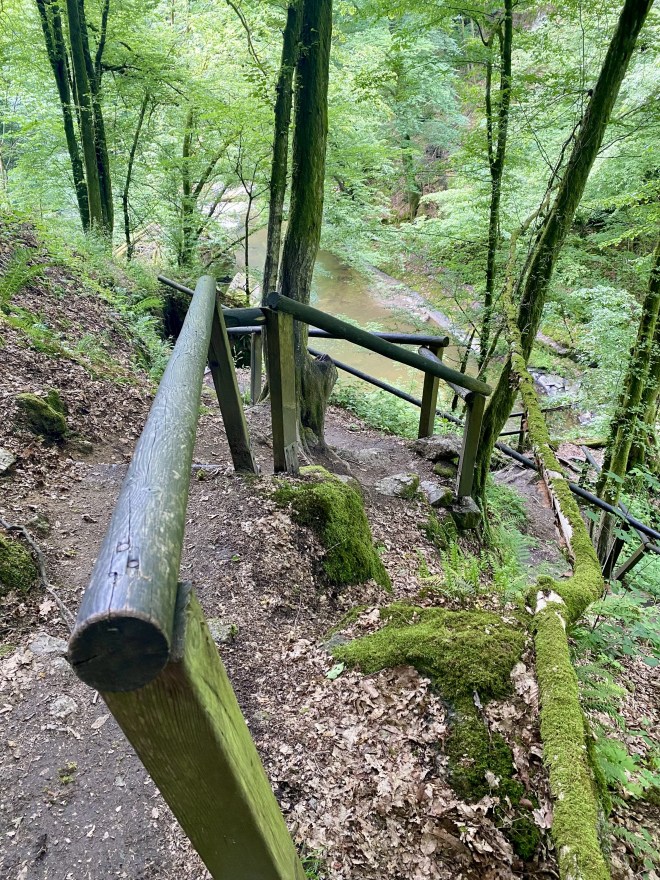
My wife’s photo

Once we reach the high lands, the stream quietens down, the path likewise.
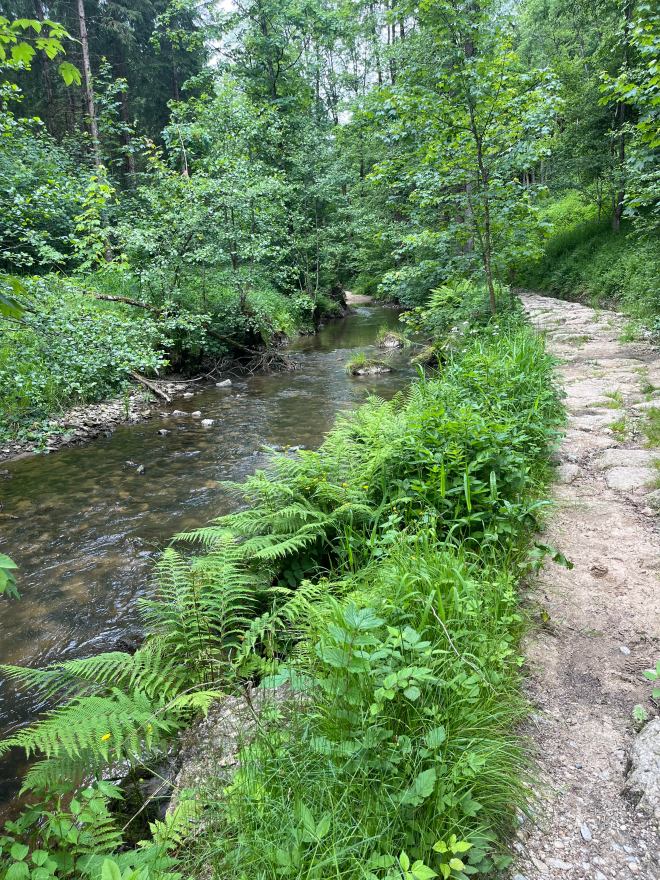
My photo

We pass meadows along the stream’s banks. Some have been turned into lawns.

My photo

Here, another anonymous sculptor has turned a tree trunk into a whimsical totem pole.

My photo

One of the meadows is carpeted in pink flowers.

My photo

Finally, we leave the stream and climb up onto a ridge. An alpine pasture falls away to our right. It is impossibly green.

My photo

We pass through Sankt Martin and start walking along a main road. This is the only way to our hotel. We pass a building site, where a riot of poppies grow: beauty clothing the ugliness.
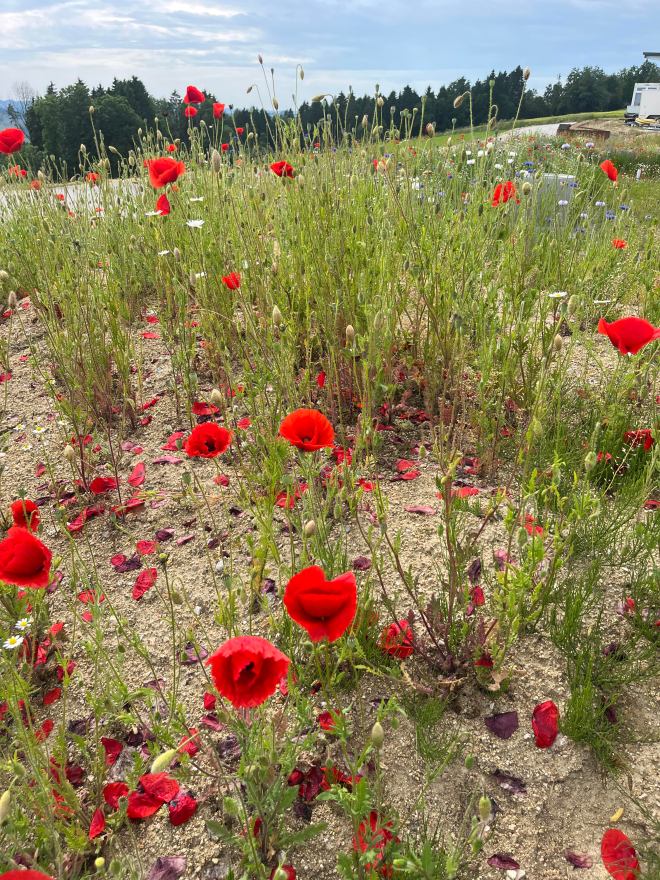
My photo

We reach the hotel. Our hike is finished.
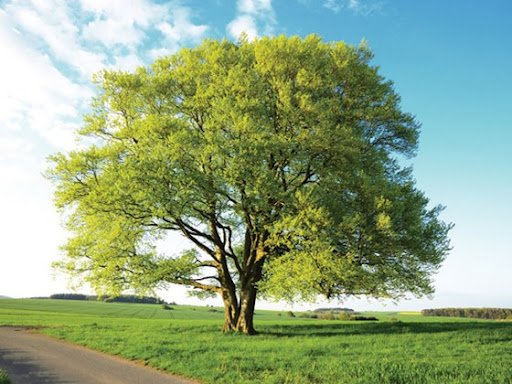
BEECH TREES

24 August, 2021

This post is a hymn of praise to the European beech tree.

Source

The tree has been a constant companion on our hikes this summer as we explore the western reaches of the Wienerwald, the woods encircling Vienna to its north and west. Apart from the odd oak, wild cherry, and conifer, the European beech reigns supreme in the Wienerwald.

My memories of the beech start at the age of 10 or so, at my Prep school (Brit-speak for a private, boarding, primary school). Just outside the school gates, at the bottom of a field, was a magnificent copper beech; we would pass it every time we made our way to the school’s playing fields which were down the road. I have no photo of this tree, it may even no longer stand, so this photo will have to stand in for it and for all these magnificent variants of the beech.

Source

I used to think the copper beech was a different species, but no, all the world’s copper beeches are fruit of a single spontaneous mutation that occurred in a beech tree in a forest in Thuringia, in Germany. It was noticed back in 1690 and was carried from there around the world. One single mutation … like blue eyes.

My next memory of beech is a long beech hedge at my Public school (Brit-speak for a private, boarding, secondary school), which bordered the campus’s entrance road. It was lovely during the summer, with that long solid block of tender green running along the road. Again, I don’t have a photo of this hedge, so this photo of a wonderful hedge somewhere in the UK will have to stand in for it.

Source

It was really only when we moved to Vienna and got to know the Wienerwald that my wife and I discovered beech woods. And what magnificent woods they are! I insert here one photo we took, where the sun dappled the trunks that stretched off into the distance.

my photo

But our iPhones can’t do these woods justice, so I’ve also picked out a few photos from the Internet taken by people who’ve got the right equipment and know what they are doing.

Source
Source
Source
Source

That last photo could be of us, following the marked paths through the woods, rather like Hansel and Gretel following Hansel’s white pebbles.

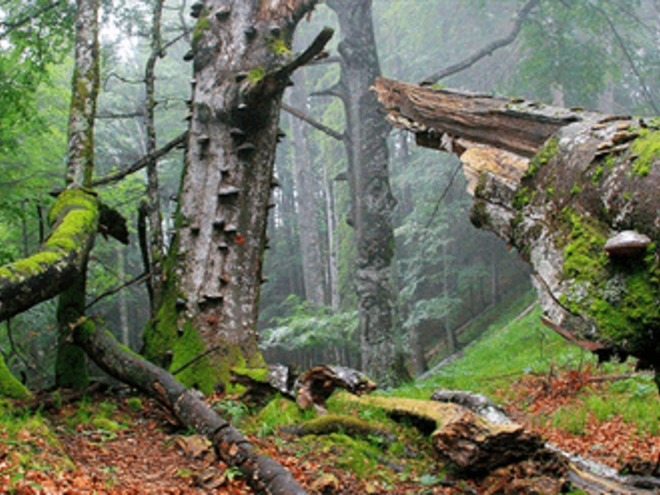
Having been enchanted by these beech woods, my wife and I have decided that some day we will visit some of Europe’s primeval beech forests. These are beech forests which have never, ever been cut or otherwise exploited by human beings, the kind of beech forests through which our hunter-gatherer ancestors would have wandered ten thousand and more years ago. There are 94 such forests in Europe, and as a group they have become a UNESCO World Heritage Site. Austria has five of the 94, Italy 13. In one way or another, we’ll figure out a way of getting to a couple of them. In the meantime, I throw in a photo of one of the Austrian forests, Hintergebirg.

Source

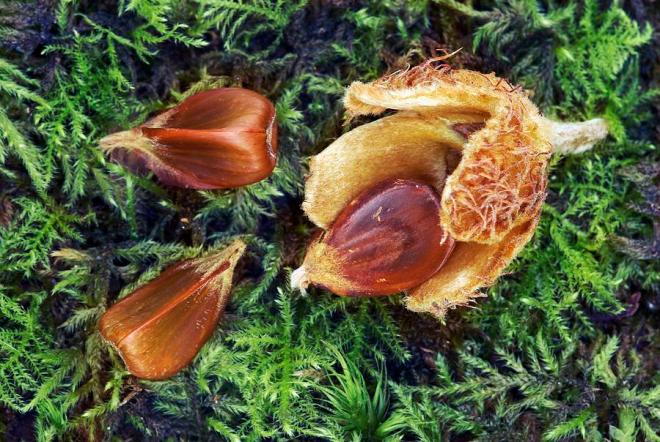
Interestingly enough, the UK has no primeval beech forests (nor does Ireland, for that matter). It could be that over the centuries the British have simply not been able to leave any of their beech forests alone, cutting them, clearing them, or otherwise fiddling around with them. Or it could be that there never were any primeval beech forests in the first place. The beech is considered natural in the southern part of the island. However, some voices have been raised wondering if this is actually correct. These voices suggest that perhaps the beech was brought to the UK by our Iron Age ancestors, who wanted to have it with them as a source of food – the food in question in this case being the beech tree’s nuts, or mast as it is called. Here we have a (very) close-up – the nuts are quite small.

Source

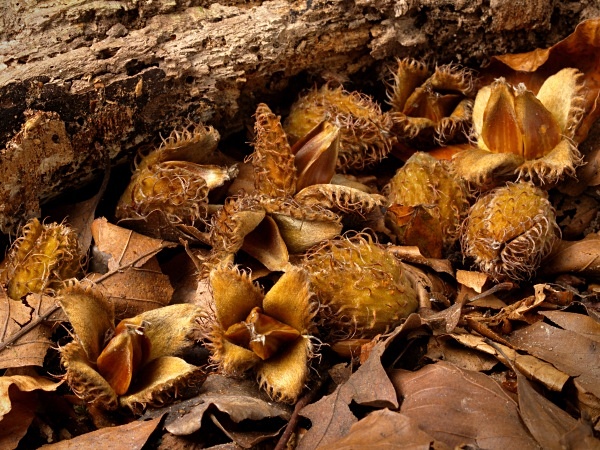
And here we see them as my wife and I would probably see them, if we went looking for them, half hidden among dead leaves on the ground.

Source

I must confess to having been surprised to read that our ancestors ate mast. But that only goes to show how alienated I have become from natural sources of food – “if it ain’t on supermarket shelves it ain’t food”. By my reckoning, it’s five generations since any of my ancestors might have foraged for beech mast. But foraging is becoming popular, with many websites dedicated to this lost art form. A good number of them mention beech mast, claiming that the nuts are good to eat (although small and time-consuming to gather). Other, probably more objective sites warn that the nuts can taste bitter because of their high levels of tannins, but that they can be ground to a flour and the tannins leached out – that’s probably how my more recent ancestors would have eaten mast, if and when they ate it. I now know that I should start looking out for fresh nuts on our hikes in a few weeks’ time; they fall in late August, early September. I’ll try a couple – and see if I can’t persuade my wife to try them too – and will report back.

Coming back to beech woods, one of their characteristics is that they are – relatively speaking – quite dark; the crown of leaves at the top of the trees are dense enough to keep out a lot of the incoming sunlight. As a result, little if anything grows in the shade of the towering beech trunks. The most common sight is a carpet of bronze-coloured beech leaves lying on the forest floor, the product of the trees losing their leaves year after year. My wife and I see this most spectacularly on the hikes we do during the winter months through a beech wood high above Lake Como, when the dead beech leaves on the ground are the only colour present.

Source

But from time to time we walk through sections of beech woods where a beautiful field of grass lies at the feet of the trees.

My photo

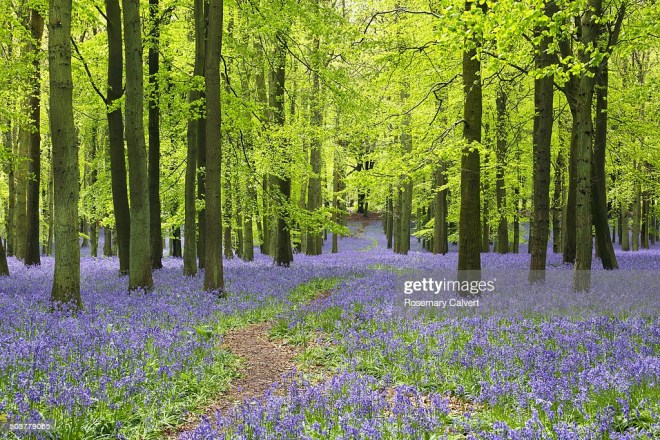
I don’t know what grass this is, or why it only grows in certain places, but the sight of these lawns stretching off into the distance between the trees is a joy to behold. But perhaps not as breathtaking as the fields of bluebells in some of the UK’s beech woods.

Source

The bluebells escape the deadly shade of the beeches by flowering before the trees are fully in leaf. I’m ashamed to say that I have never visited any of these bluebell groves – another item on our bucket list.

The other characteristic of beech woods is the trees’ smooth bark. It’s quite a striking sight to see all these pale grey, smooth trunks towering up into the sky above our heads. And one can immediately spot the lone oak or cherry or conifer skulking among the beeches; their rough barks stand out. This smoothness actually signals a fragility in the beech’s bark; it is easily scarred and the marks remain forever as the bark cannot heal. Many of the beech trees we cross are marked by scars in their bark, no doubt caused by branches of other trees or bushes scraping against them when they were young. But on our walks we also see examples of silly boys, and perhaps some silly girls, using the inability of the beech’s bark to heal to carve their initials into it, quite often combined with the initials of a loved one and the whole enclosed within a heart; they will stay, more and more distorted as the tree grows, until it is cut or blown down.

Source

Initials carved in a beech’s bark is another of my beech memories. This particular beech was in my French grandmother’s garden and the initials carved into its bark my uncle’s. He must have done it 30-40 years before I saw it. Family lore has it that my grandmother was furious with him when she discovered this disfigurement of her tree – “so vulgar!” – and gave him a good thrashing. The tree has gone, alas. It died some 15 years after my grandmother died, shaded out, I suspect, by the mighty sequoia nearby, but also probably suffering from a drop in the area’s aquifer: too much water is being pumped out.

Scratching initials on beech bark allows me to make a connection between this wonderful tree and another wonderful item of which I have many exemplars: the book. Beech and book actually come from the same root, the Old English bōc. This has the primary sense of “beech” but also a secondary sense of “book”. The connection is perhaps more obvious in other modern Germanic languages. In modern German, the word for “book” is Buch, with Buche meaning “beech tree”. In modern Dutch, the word for “book” is boek, with beuk meaning “beech tree”. In Swedish, the word bok means both “beech tree” and “book”. This connection allows me to hold forth on another favourite topic of mine, trade – or rather, the exchange of ideas that comes with trade.

When the Germanic tribes migrated into Europe, pushing out the Celts, they were illiterate, with no culture of writing and no alphabet of their own. When they met the Romans, they fought them of course, but they also traded with them and in so doing came into contact both with writing and with the waxed wooden tablets on which traders (and many others in the Roman Empire) made notes or wrote short missives. As far as the alphabet was concerned, the Germanic tribes adopted a precursor to the Roman alphabet, the old Italic alphabet, to create their runes. As for the tablets, the Germanic tribes used the tree that surrounded them, the beech, to make them, and called these tablets after the tree from which they came. Later, when the Germanic tribes shifted to using parchment, they continued to call what they wrote in books.

Being made of wood, these tablets have normally decayed away, but some examples of Roman tablets have been unearthed along Hadrian’s Wall, somehow miraculously avoiding the normal decay processes.

Source

So from now on the books which surround me will remind me every day of the beech trees which surround us on our walks in the Wienerwald.

PLEASE SAVE THE TREES

Beijing, 17 December 2012

I’m a sucker for a fine tree, as any reader of these postings will know. So it was with increasing depression that I read an article recently in Science Daily (www.sciencedaily.com) which said that large old trees – trees that are centuries old – are dying at alarming rates. The die-off seems to be happening in all types of forests worldwide and to be caused by many things: land clearance, changes in agricultural practices and in fire regimes, logging and timber gathering, insect attack, climate change, and I don’t know what else.

I suppose I should recite the critical ecological roles which large old trees play. For instance, they provide nesting or shelter for up to 30 percent of all birds and animals in some ecosystems. They store huge amounts of carbon. They recycle soil nutrients. They create rich patches for other life to thrive in. They influence local flows of water and the local climate. They supply lots of food for many animals with their fruits, their flowers, their leaves, their nectar. In agricultural landscapes, they can be focal points for restoration of vegetation. They help connect the landscape by acting as stepping stones for many animals that disperse seeds and pollen.

So large old trees are very useful. But ultimately they are beautiful.

baobab_tree

C

elm tree

oak tree

plane tree

Angkor-wat-Tree

I’ve said it before, but my life has been punctuated by a number of beautiful large old trees. Let me tell you about one of them. My maternal grandmother had a sequoia, Sequoiadendron giganteum, standing in magnificent splendour in the corner of her garden. There must have been a fad for planting sequoias in the late 19th century in this part of France because a number of older properties in the surroundings had sequoias – you could see them towering over garden walls as you drove by. I loved that sequoia. My cousins and I used to spend all our summers in that tree, or so it seems to me as I gaze back through the golden haze of more than four decades of memories. Our grandmother tried to stop us climbing it by sawing off the lower branches. But we just cut steps into the soft bark and climbed. And climbed. All the way to the top, where we would sit, talk, and look out over the pastures, woods and vineyards that surrounded us as the breeze rustled through the branches and the tree swayed slightly. We were lords of all that we surveyed.

I don’t have a photo of my grandmother’s sequoia, but here is a photo of another sequoia in a French garden somewhere. It gives you a great idea of what awaited us in the far corner of my grandmother’s garden.

sequioa-in-france

That tree seemed so huge to us, but nearly two decades ago, when the children were young, we took our summer holiday in California and visited Sequoia National Park. My God, what truly magnificent trees those were! My sequoia was a laughable midget compared to these giants. But I couldn’t climb these trees.

giant-sequoia-tree-pv

My wife has just old me that she never climbed trees when she was young. And I don’t remember our children every really climbing trees – we have become so conscious of dangers for children in the intervening decades (it is true that my younger brother and cousin fell out of a tree when a branch broke; my cousin cushioned my brother’s fall but fractured his collar bone in the process). But I think my family missed something. There is something magic about being up in a tree. Suddenly you are back to being a four-limbed creature as you have to use your arms as much as your legs. The world concentrates down to just a few branches. And the noise levels change; there is a quietness in a tree which you do not have on the ground, but also you hear noises you don’t hear so much on the ground, like the rustling of leaves. And your lines of sight change; suddenly you are a giant able to see much further around you than you normally can. And if the tree is a fruit tree, ahh … you can sit on a branch, pluck the fruit around you, and munch on them in quiet contentedness.

My memories of trees are nearly all from rural areas, although I do have some memories of beautiful trees from city parks – one of the earlier postings testifies to this. So many of us live in cities now and I’m worried we are getting cut off from trees – and this can only get worse as more and more of us live in cities. Cities and trees do not seem to mix well. As I look around Beijing streets, for instance, I do not see many great trees. The majority of the specimens look malingering. And yet … My wife and I visited Singapore recently. For her, it was the first time. For me, it was the first time in fifteen years. And the city struck me the way it had always struck me: it is so green. Not grass green, although there is certainly a lot of that. No, tree green.

01-rain-tree-06

There’s a huge number of trees in Singapore – and not small trees, either, but big, mature trees. The city always gives me the impression of the planners having carefully inserted the buildings between and around the trees which already grew there. Of course, it’s silly; it was obviously the other way round. I mean, the trees grow along the sides of straight roads … And the older parts of the city, like Little India and Chinatown, show the bare and treeless Singapore of the past, the kind of city we’re used to seeing elsewhere. But still, the impression is of a city inserted into a forest. According to National Parks Singapore there are something like 2 million trees planted in the city-state, which works out to be about one tree for every two and half people. I don’t know of any other city with such a high tree-to-citizen ratio.

So it is possible to live in close harmony with great trees. We must do it, because I think we lose part of our humanity if we don’t live near trees, if we cannot have this view every day of our lives.

01-rain-tree-04

_______________
Baobab tree: http://www.louisianagardenclubs.org/live_oak_society/photos_files/AngelOak.jpg
Copper beech tree: http://www.visualphotos.com/photo/2×4003896/copper_beech_tree_1811714.jpg
Elm tree: http://i.istockimg.com/file_thumbview_approve/1678381/2/stock-photo-1678381-elm-trees.jpg
Oak tree: http://www.louisianagardenclubs.org/live_oak_society/photos_files/AngelOak.jpg
Plane tree: http://mw2.google.com/mw-panoramio/photos/medium/14963960.jpg
Angkor wat tree: http://www.davestravelcorner.com/photos/cambodia/Angkor-Crooked-Tree.jpg
Sequoia in France: http://ts2.cn.mm.bing.net/th?id=H.4582357281933013&pid=1.9
Giant sequoia: http://www.nunukphotos.com/images/giant-sequoia-tree-pv.jpg
National Parks Singapore: http://www.nparks.gov.sg/cms/index.php?option=com_content&view=article&id=173&Itemid=161