PHOTO ALBUM OF A HIKE

Vienna, 8 June 2025

My wife and I recently completed a four-day hike around the Danube, in the reaches of the river some 20 km upstream from Linz. We started in the village of Ottensheim, made our way to Eferding and then to Aschach, ending the hike in the village of Sankt Martin. I can’t resist inserting here a composite photo I’ve created of the hike.

My composite

As readers can see, we wandered rather drunkenly along the Danube.

The wonderful thing about hiking is that you move slowly across the landscape, which allows you to notice things which you probably wouldn’t notice on a bike, let alone a car. I give my readers here a taste of what my wife and I came across – quite serendipitously – as we slowly crossed this Danubian landscape.

Thursday

We arrive in Ottensheim, which sits on the Danube river, in the early afternoon. We take advantage of our early arrival to go for a walk on the high lands behind the town. Here is the view of the Danube which greets us at the top. You can see the hydroelectric dam spanning the river. We’ll be passing that dam tomorrow.

My photo

We have pizza at the place we’re staying the night, down by the river’s bank. We chat with the staff, all Neapolitans, who all left Naples because of a lack of opportunities there. A story we’ve heard so many times. Such a tragedy for Naples, this steady draining away of their youth.

Friday

We’re greeted at the exit of the hotel by this strange painting on the wall of a house.
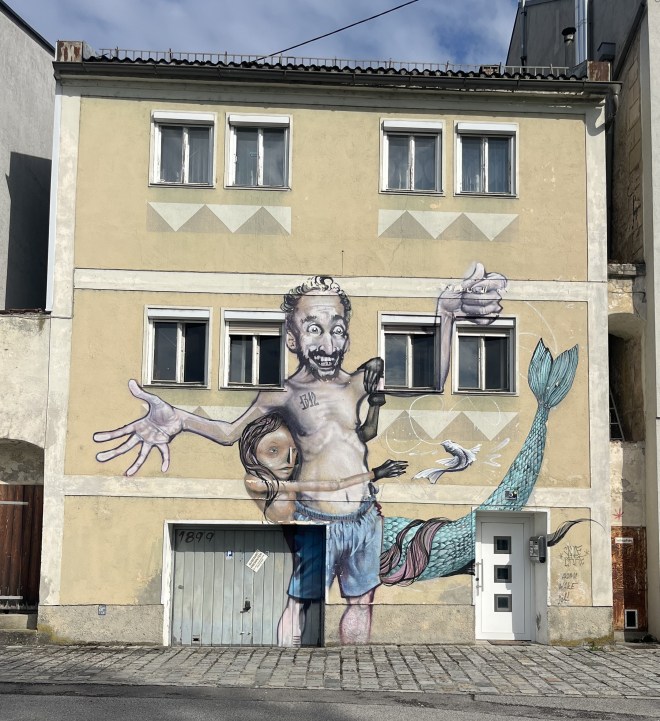
My photo

Not sure what happened to the mermaid’s nose …

We’re waiting to board the ferry, which will carry us over to the other bank.

My photo

While waiting, we spy a statue of St. Johann Nepomuk, protector of those who cross streams and rivers, so common in this part of the world. This statue is coloured, though, which is rare.

My photo

The view from the ferry’s deck, looking upstream. The hydroelectric dam is in the far distance.

My photo

We can also see a peek of Ottensheim’s local castle in that last photo. We get a better view as we start walking along the river’s bank.

My photo

Its recent history has been quite eventful. Owned by a British family in the 1930s, it was confiscated by the Nazis at the beginning of the war. They used it as a forestry office for the Wermacht. After the war, the Soviets, who occupied that side of the Danube, used it as a barracks. After they left in 1955, when Austria got back its independence, the castle reverted to its pre-war owners. By then it was in a pretty sad state, but its owners didn’t have the money to restore it. It was only in 1988, when the castle was sold to a group of families with deeper pockets, that the castle could be restored. It is still in private hands.

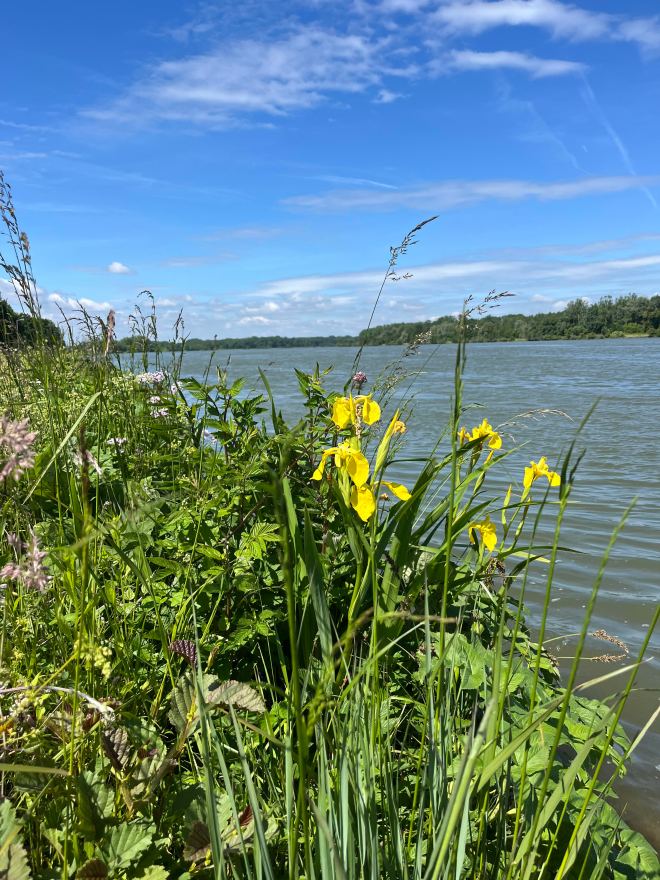
Yellow irises blooming along the water’s edge, the first of many wildflowers we will be seeing on this hike.
My photo

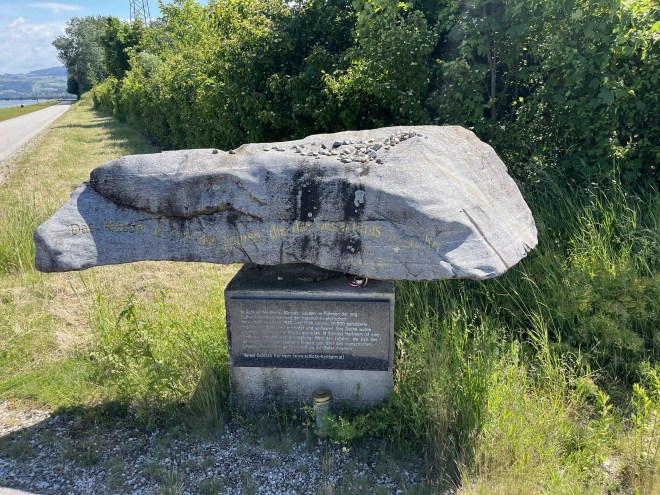
Close by, a memorial on the side of the path.
My photo

It commemorates the nearly 30,000 people murdered through poisoning with carbon monoxide by the Nazi regime in nearby Hartheim castle, between May 1940 and December 1944. Once their bodies had been cremated the ashes were brought to this spot and dumped into the Danube. Until September 1941, it was a “euthanasia” centre, where 8,000 physically and mentally handicapped people, almost all from Bavaria and Austria, were murdered. After Hitler closed down the Nazis’ euthanasia programme (because of protests from the Roman Catholic Church in Germany), the centre quickly “pivoted” to become a centre for the killing of inmates from nearby concentrations camps, primarily Mauthausen or its satellite camps, who were too sick or injured to work any longer. By December 1944, they had murdered a further 12,000 people, most of them Soviet Prisoners of War.

Wildflowers by the side of the path

My photo

Outside a fire station, an intriguing monument to firemen and women, as well as to officers of the Austrian river authority.

My photo

An old farmhouse on the edge of the road.

My photo

Eferding, the end point of today’s hike, with the parish church’s bell tower dominating the town.

My photo

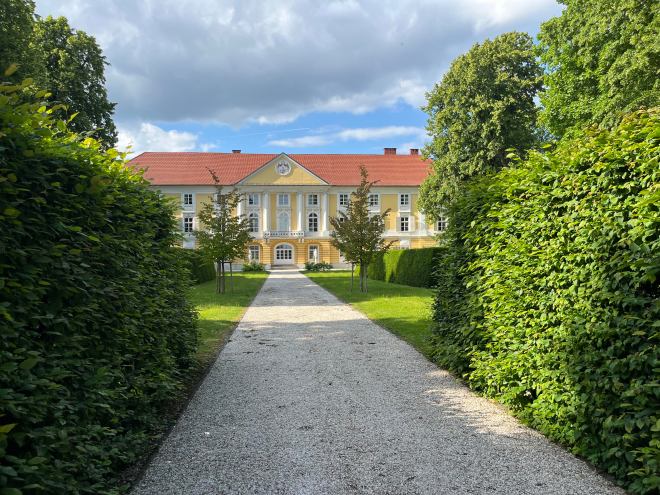
A photo of Eferding’s castle, taken by slipping my iPhone through the big gates that barred entry.
My photo

The castle is still owned by the Starhemberg family, who inherited it and the lands that came with it in 1559. Interesting family. They’ve been involved in Austrian politics for the last 1,000 years or so. The latest (in)famous member of the family was Ernst Rüdiger Prince von Stahremberg, who was born in 1899 in the castle and died in 1956 in Voralberg. He was a right-wing politician with great admiration for Mussolini’s fascism. He served in Austria’s right-wing governments from 1930 until 1936. Although fascistic, he really disliked the Nazis and made his dislike very public, so after the Anschluss of 1938 he fled to Switzerland to avoid vengeful retaliation by the Nazis (and perhaps also to protect his wife, who was Jewish). At the beginning of World War II, he served in some capacity in the British and Free French Air Forces, but he resigned in disgust after the UK and the US allied themselves with the Soviet Union in 1941 – he viewed communism and Nazism as equally evil. Thereafter, he and his wife left for Argentina; not unnaturally, he felt a great affinity with the politics of Juan Peron. In 1956, after Peron had been ousted by the army, he travelled to Austria for an extended visit, no doubt to explore the possibility of coming back. He was staying at a spa in Schruns (the bell tower of whose parish church I had so admired last year). During a walk, he was photographed by a journalist who worked at a communist newspaper. In a rage, he attacked the journalist with his walking stick, but this triggered a cardiac arrest and he died there on the pavement.

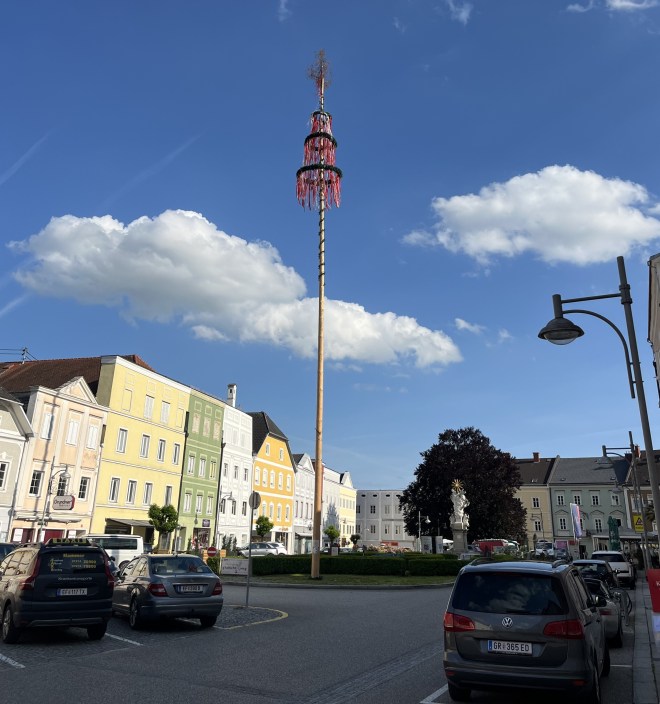
Turning my back on the Stahremberg castle, a view of Eferding’s main square

My photo

with its maypole still standing

My photo

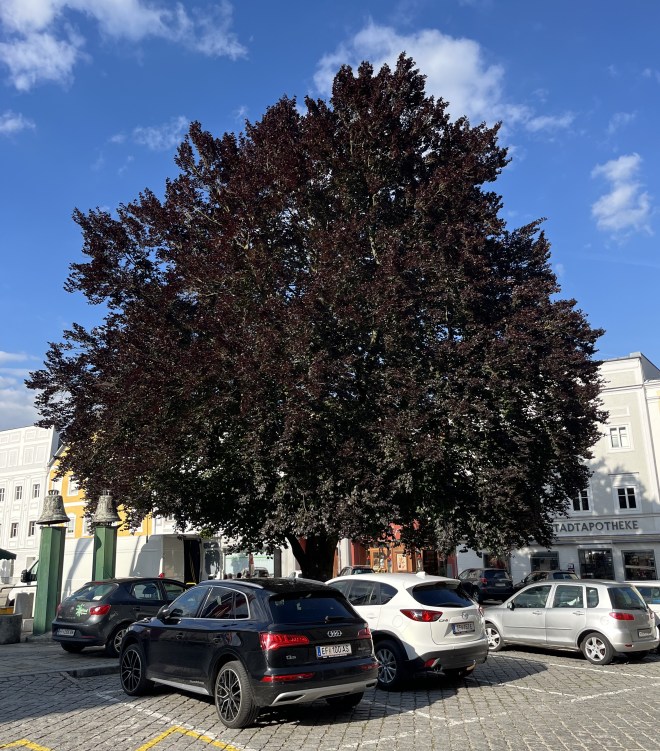
and a magnificent copper beach at the far end.
My photo

Eferding’s parish church

Source

with its beautifully carved pulpit (although not as beautiful as the one my wife and I saw in Traunkirchen several years ago)

Source

and the tombstone of some long dead knight.

My photo

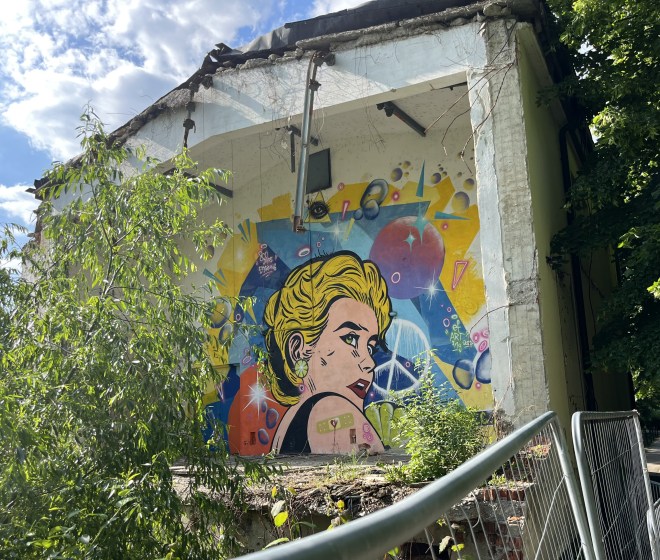
A Lichtenstein-like mural on the wall of a ruined house
My photo

An amusing ad for a shop offering orthopaedic services.

My photo

And so to dinner and bed.

Saturday

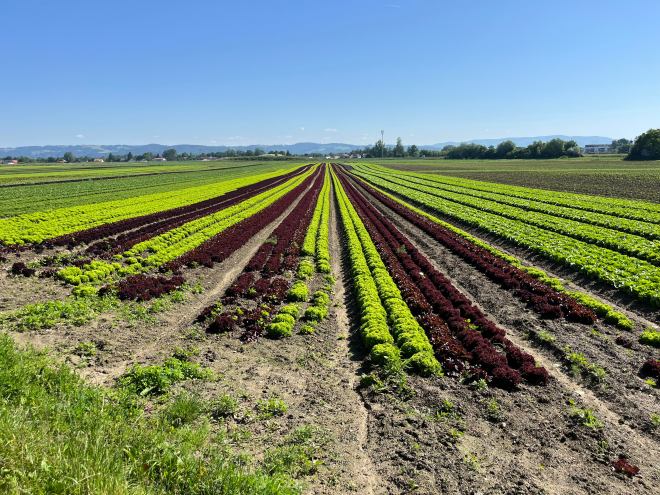
We start the day by walking over the rich farmland around Eferding. We pass these multicoloured rows of lettuces.
My photo

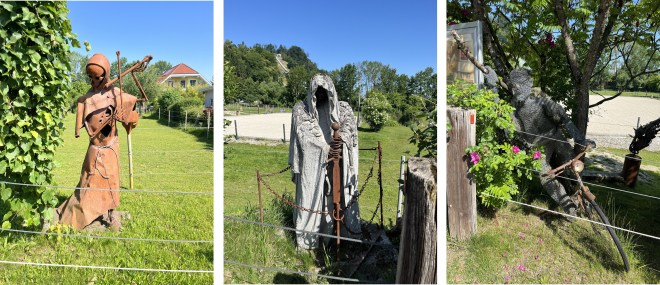
We go past a garden whose owner must be an amateur sculptor with a fondness for using scrap metal.
My photos

Nearby, beauty among the garbage.

My photo

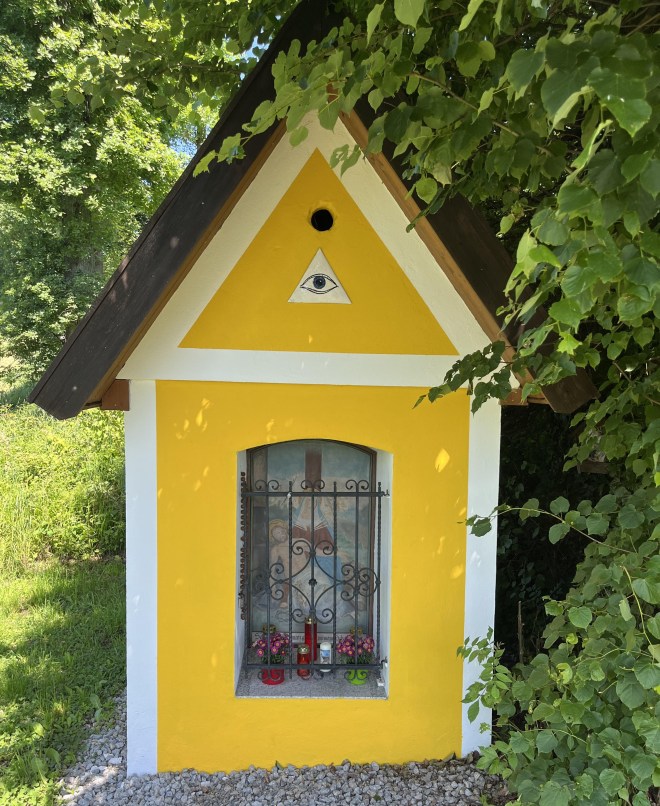
We begin to climb a steep ridge. We pass a shrine on the side of the road.
My photo

Shrines are common throughout Austria, but I notice that in this region shrines – like this one – have an eye painted on them. I suppose it represents God, the “All-Seeing Eye”. But I find it rather unnerving: “You can’t hide from me, I can see everything that you do” – just like Big Brother in George Orwell’s “Nineteen Eighty-Four”.

A chapel at the top of the ridge.
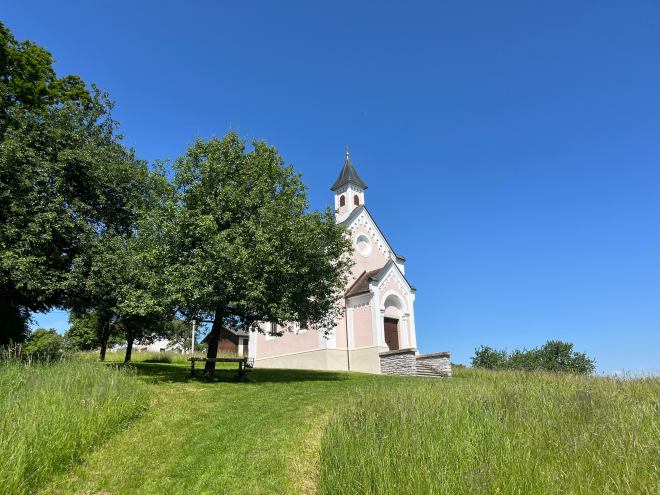
My photo

A spray of daisies on the side of the road.
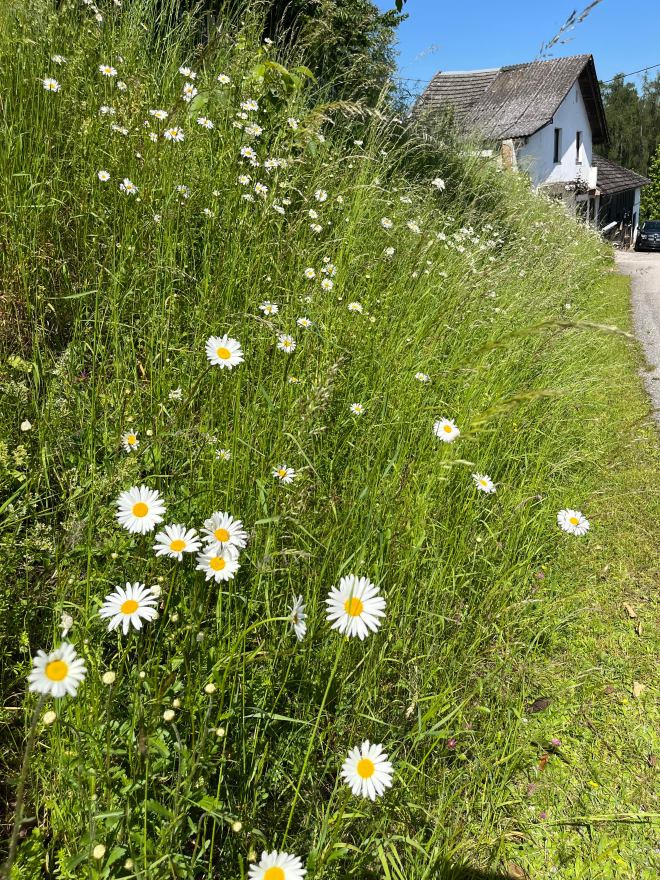
My photo

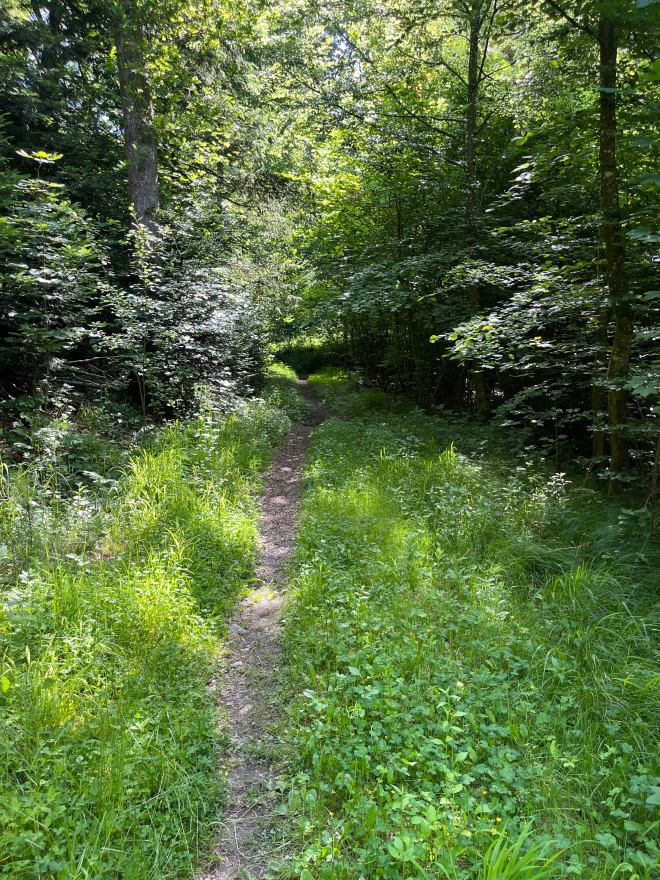
We plunge into the woods.

My photo
My photo

A view over the plain around Eferding.

My photo

We come down the ridge and pass the small airfield – literally, in this case – of a gliding club.

My photo

We have been watching the gliders soaring over us all morning; my iPhone, alas, cannot capture their ethereal beauty.

We look back at the ridge we walked along, with a castle ruin sitting on it.

My photo

We stop for lunch in the village of Pupping, finding a bench in the parish church’s garden to sit on. I, of course, cannot pass up the opportunity of visiting the church after lunch. I find a mix of old and new.

A statue of St. Wolfgang, who, it is said, died at the altar of the (original) church in 994 CE.

My photo

A statue of St. Christopher, looking less than pleased with having to carry the Child Jesus.

My photo

Four carved door lintels, displaying the symbols of the four Evangelists: clockwise from the top left, the lion of St. Mark (you have to look hard to see the lion’s face), the ox of St. Luke, the angel of St. Matthew, and the eagle of St. John.
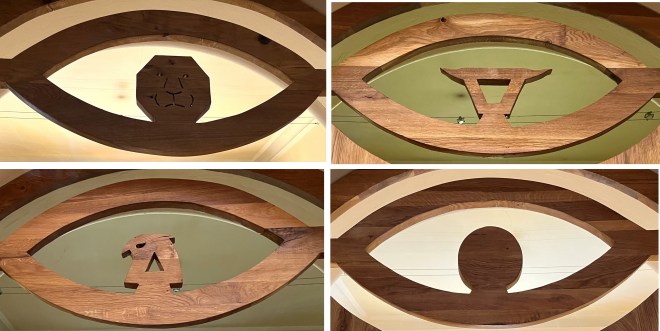
My photos

It takes me a while to understand that Luke’s angel is represented by an eye – the eye again …

Rather pleasant stained-glass windows.
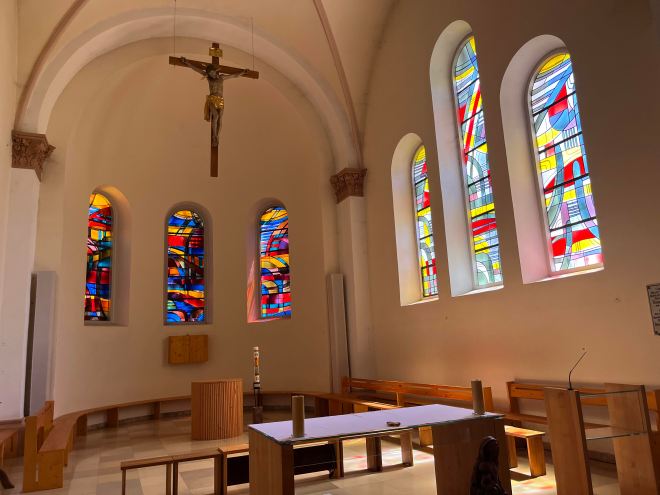
My photo

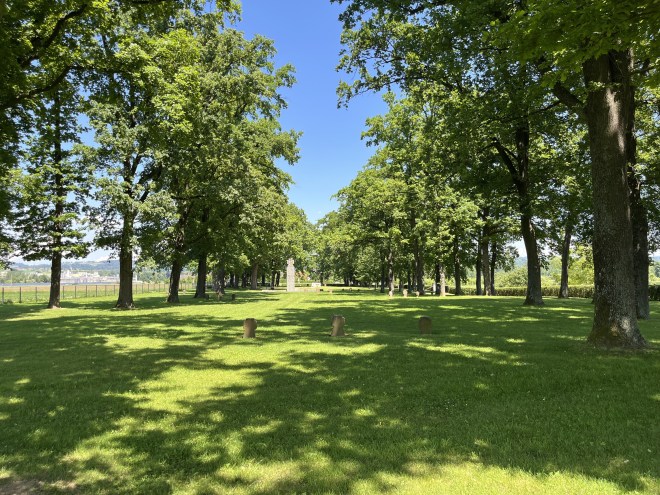
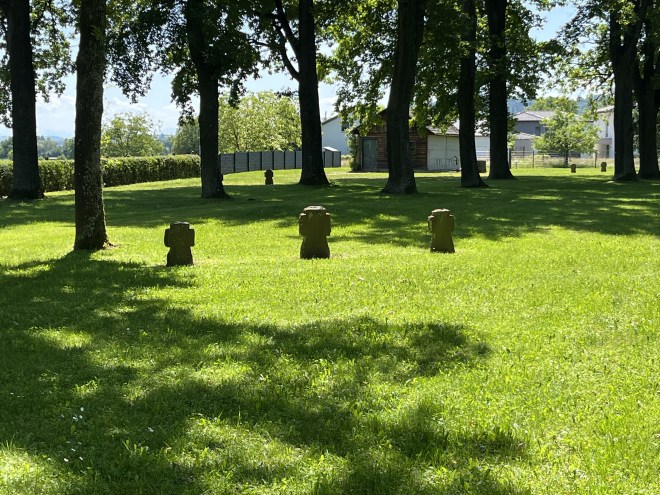
We continue the hike towards our end point today, Aschach, on the Danube. Quite by chance, our route takes us past a war cemetery.

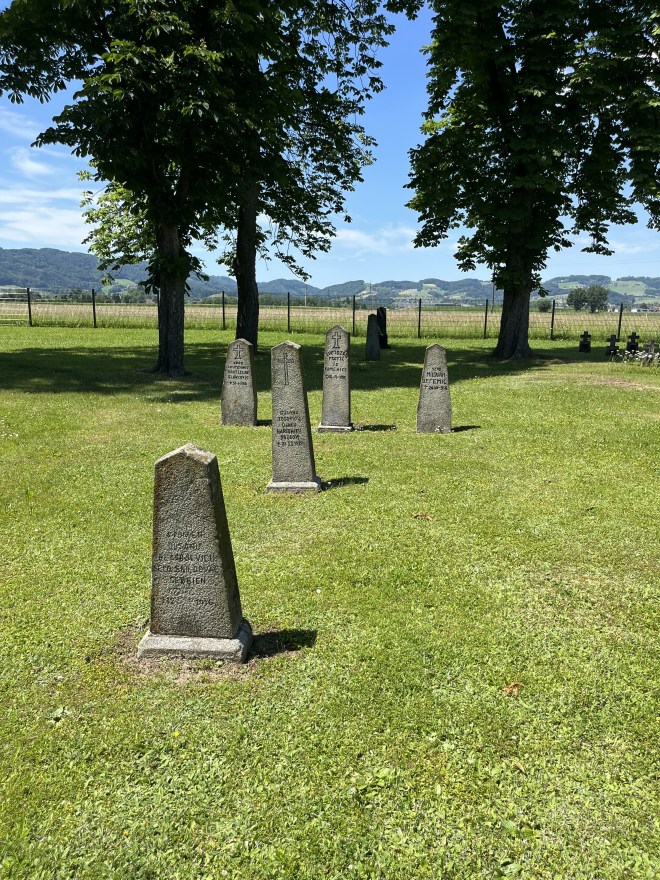
It has the look and feel of the German war cemeteries which my wife and I had visited on the Western Front: tall oak trees, shading a lawn, in which are planted stone crosses.
My photo
My photo
My photo

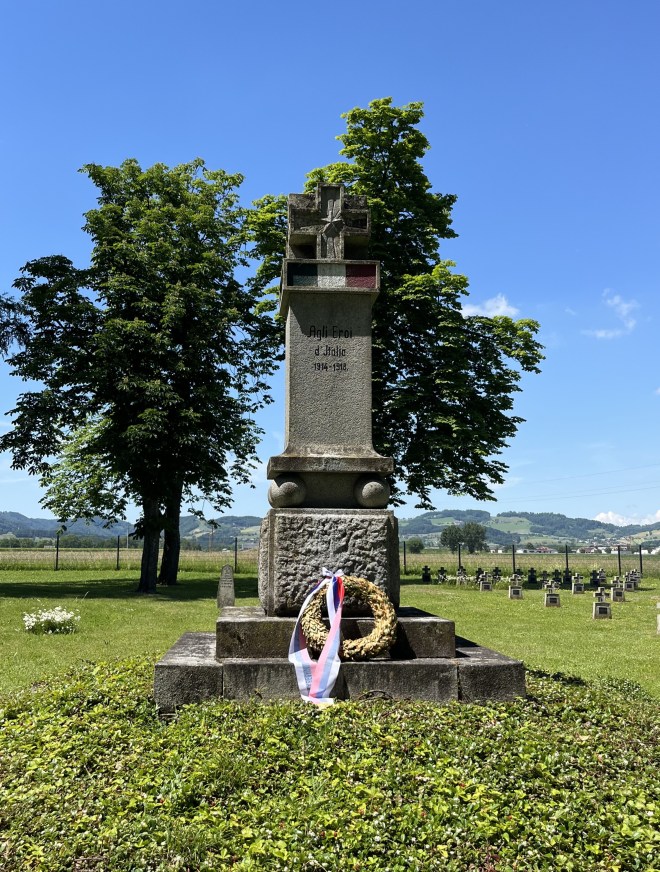
But actually, although the cemetery is looked after by the German association for war graves (hence the look), none of the soldiers buried there are Austrian or German. And none of the dead who are commemorated fell on the frontline; they were all prisoners of war who died in a POW camp which the Austro-Hungarians built close by for use during the First World War. They were mainly Italians

My photo

with their memorial

My photo

and Serbians

My photo

with theirs.

My photo

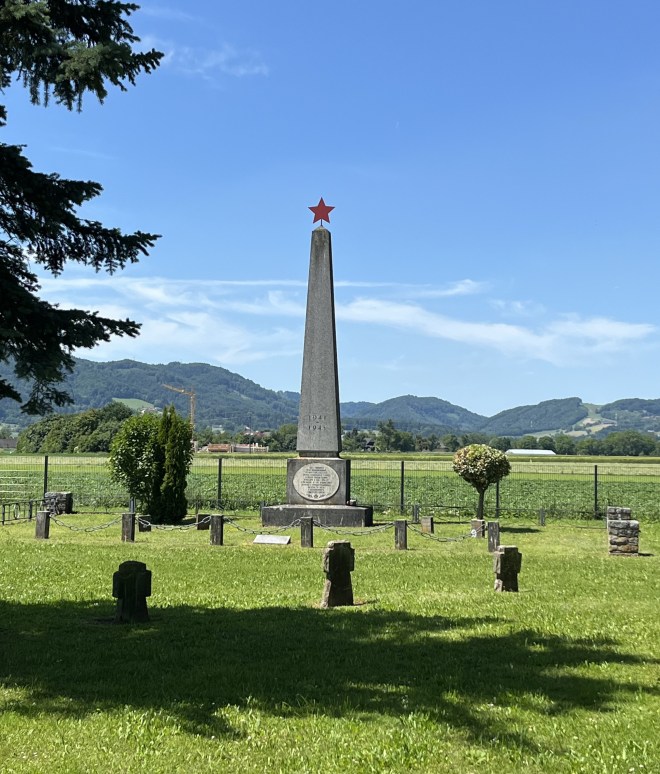
After the Second World War, the Soviets put up a memorial to their POWs who had been murdered in Mauthausen and other nearby concentration camps.
My photo

Of course, the thousands of murdered Soviet POWs didn’t get an individual grave, their names were not even inscribed on a monument. But some Russian family had come and attached a photo of one Soviet prisoner to a stone cross, with the epitaph “We remember, we love, we grieve. The grandchildren”.

My photo

We walk on to Aschach.

Sunday

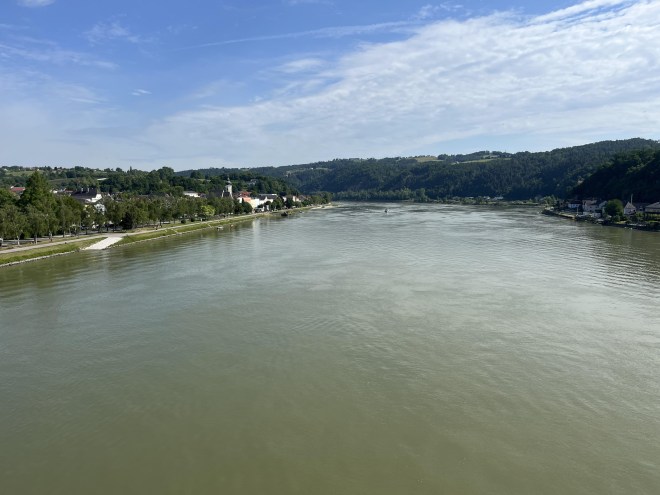
We start the day by once again crossing the Danube, but this time using a bridge rather than on a ferry.
My photo

Some purple irises catch my eye as we walked along the river bank.

My photo

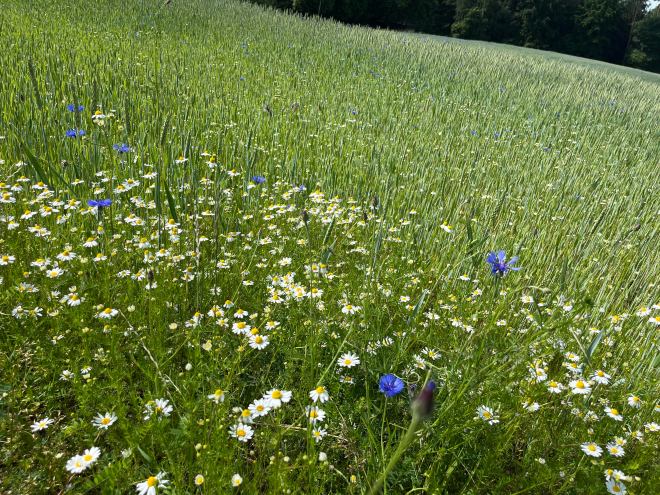
We climb up to the high lands overlooking the river, past fields of wheat studded with corn flowers and daisies.
My photo

We enter the woods.

My photo

The path eventually leads us off the high lands and down to a stream at the bottom of a valley. We start following the stream towards its source. At first, the stream cheerfully burbles along.
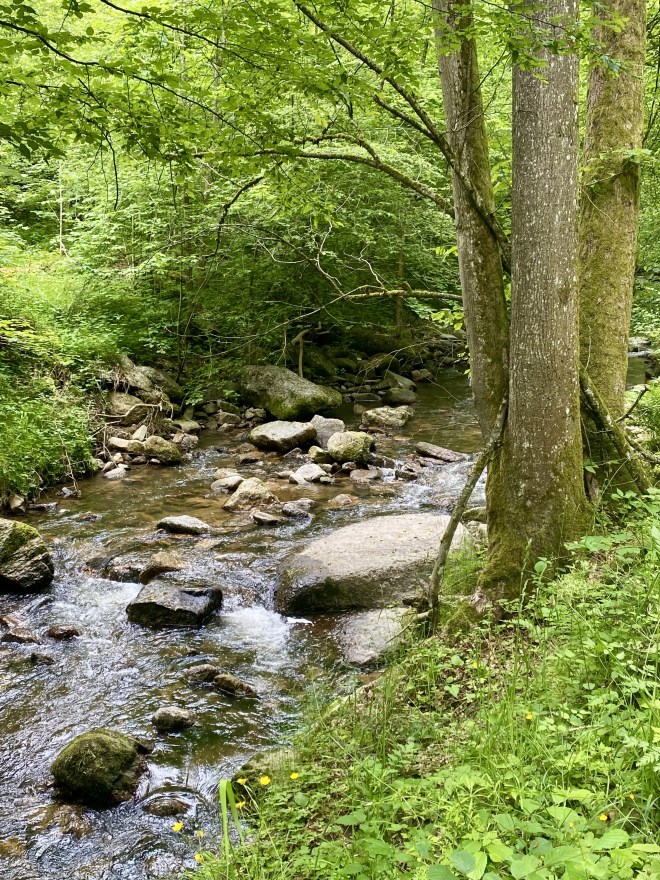
My wife’s photo

But soon the stream bed becomes rough as stones from above have tumbled down, and the water jumps around.

My photo
My photo

The path mimics the roughness of the stream.
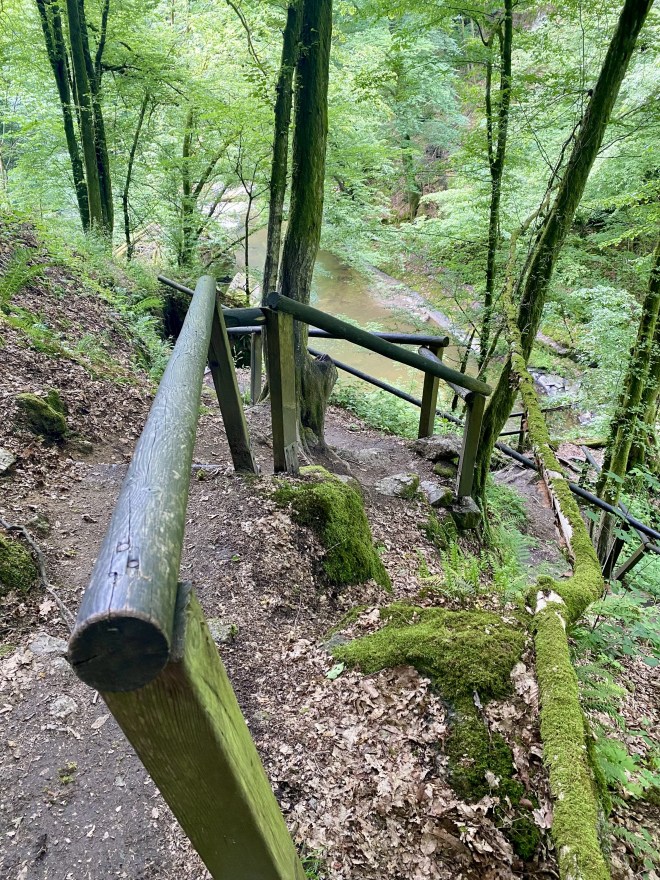
My wife’s photo

Once we reach the high lands, the stream quietens down, the path likewise.
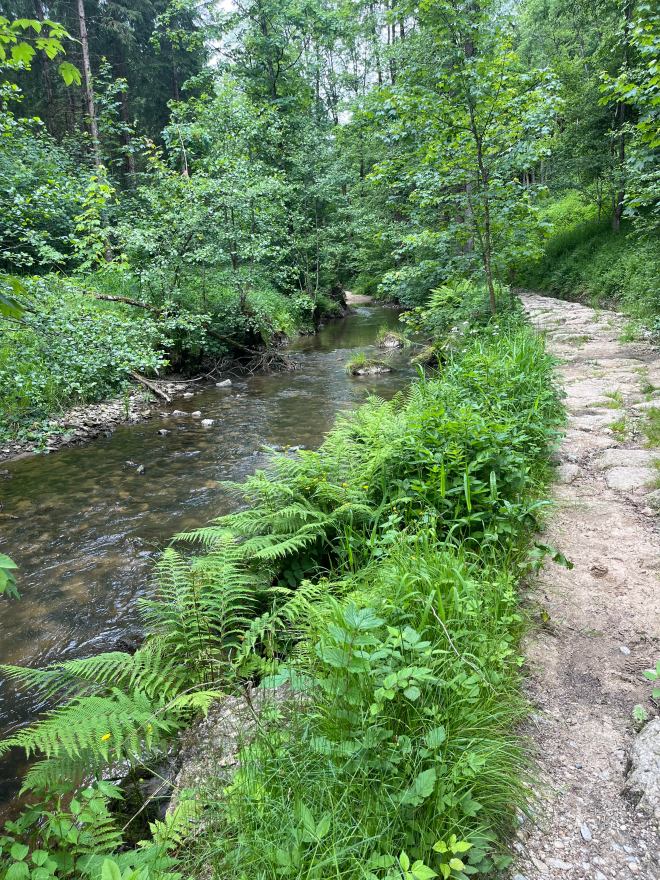
My photo

We pass meadows along the stream’s banks. Some have been turned into lawns.

My photo

Here, another anonymous sculptor has turned a tree trunk into a whimsical totem pole.

My photo

One of the meadows is carpeted in pink flowers.

My photo

Finally, we leave the stream and climb up onto a ridge. An alpine pasture falls away to our right. It is impossibly green.

My photo

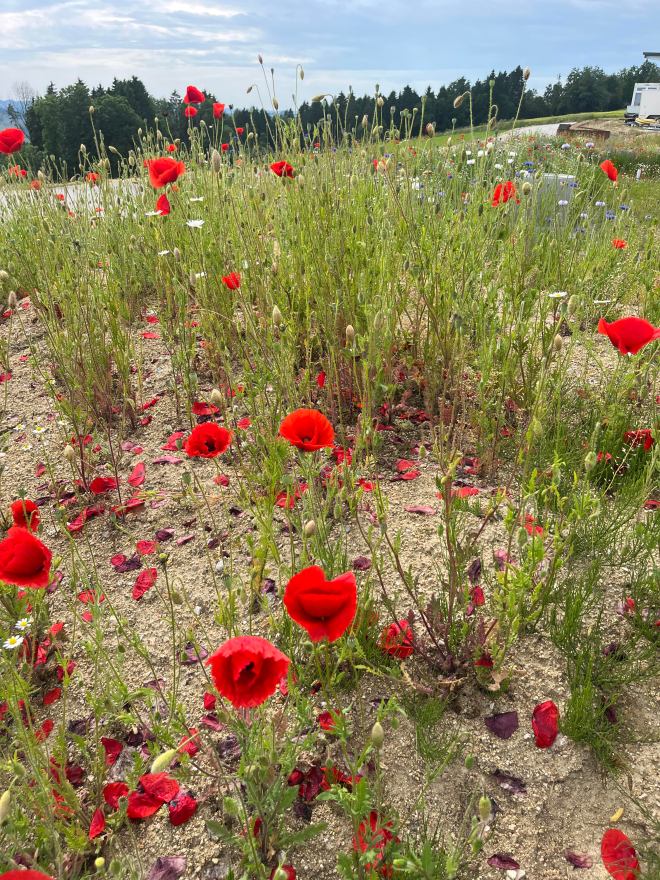
We pass through Sankt Martin and start walking along a main road. This is the only way to our hotel. We pass a building site, where a riot of poppies grow: beauty clothing the ugliness.
My photo

We reach the hotel. Our hike is finished.

AMBER AND ITS ROAD

Bangkok, 15 August 2016

I’ve just finished a fascinating book about the peopling of Europe, entitled Ancestral Journeys: The Peopling of Europe from the First Venturers to the Vikings, by Jean Manco. The book describes the various waves of people who have settled Europe, peacefully or not, from 40,000 BC to 1,000 AD.

One thread in the rich tapestry of the peopling of Europe is the trade networks which sprang up as neighbouring tribes traded whatever useful or interesting resources they controlled inside their territories. The really high-value resources could in this way travel very long distances from their point of origin, as people passed them on – at ever-increasing value, no doubt – to people further away from the original source. In an earlier post, I’ve mentioned the Stone Age long-distance trade in obsidian, which made excellent, sharp arrowheads. Gold, the subject of my next-to previous post, was also traded over long distances. Amber was another such material.

In the early days of Europe’s history, by far the richest source of amber was the Baltic coast of Poland (it probably still is), where nuggets of amber would wash up on the beach, broken off from the amber deposits on the sea bottom.
image
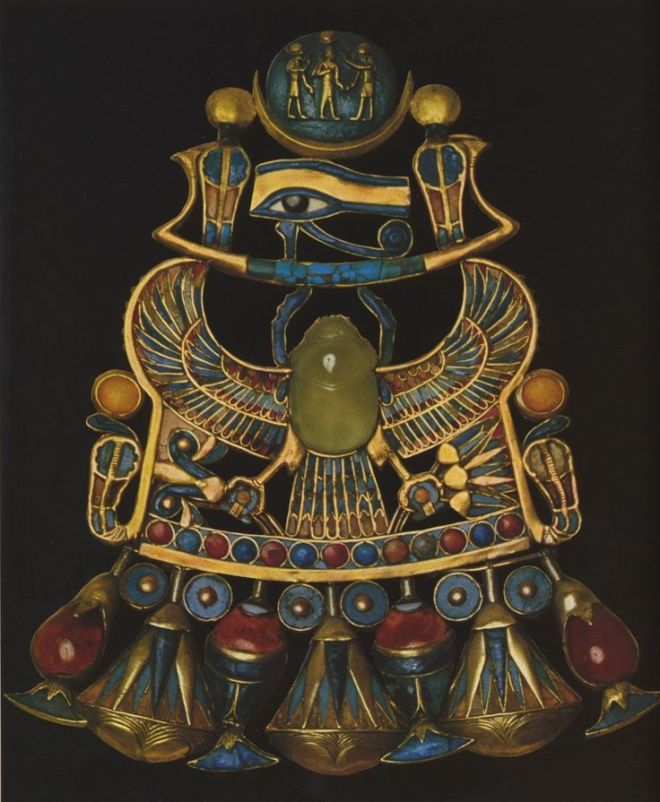
The biggest market for amber, on the other hand, and from time immemorial, were the civilizations around the Mediterranean Sea and in the Middle East. Tutunkhamun’s breast ornament contains pieces of Baltic amber, for instance
image
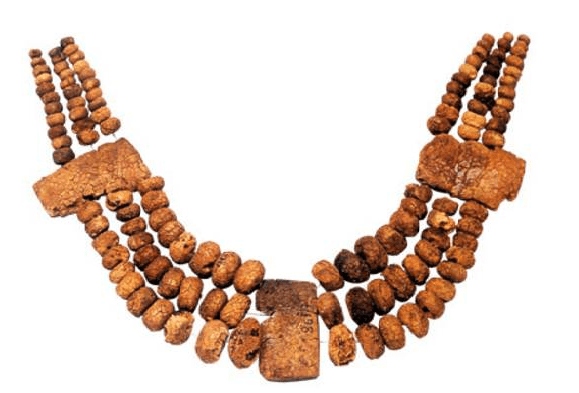
while Heinrich Schliemann found necklace beads of Baltic amber in the Mycenaean tombs he excavated.

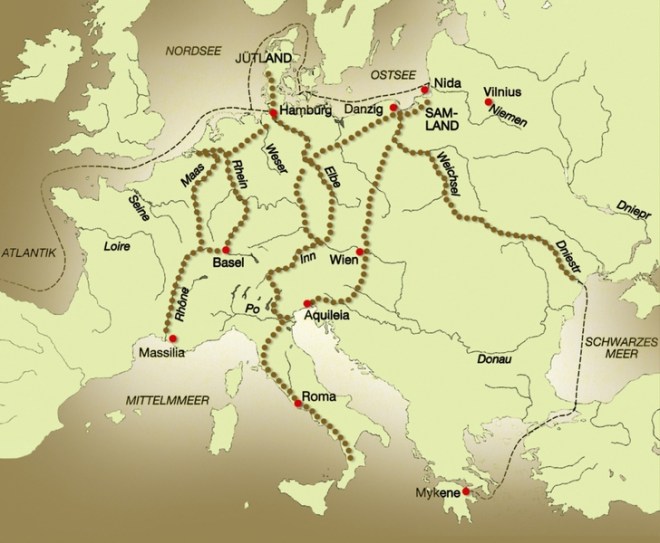
Thus sprang up several “amber roads”, trade routes which brought Baltic (and other Northern European) amber south.
image
The one that most interests me is the amber road which led from the general region of Gdansk down to the Roman provincial capital of Carnuntum on the Danube River (the Danube became the Roman Empire’s frontier in 9 BC), on down along the network of Roman roads to Aquileia in North-Eastern Italy, the terminus. This map shows, more or less, a detailed trace of this amber road.
image
I say “more or less” because while the route taken by the amber after the Danube River crossing is pretty clear – it followed the Roman roads down to the Italian peninsula – how it got to the Danube River from the Baltic coast is less so. There were just tracks through the forests and around the bogs in this part of Europe, and I’m sure every Germanic trader followed his fancy, depending on what else he was buying or selling along the way, as well as what the weather was like and who was fighting who. There seem to have been a few fixed points on the itinerary: Wroclaw (Breslau in German; the British historian Norman Davies, in collaboration with Roger Moorehouse, has written a fascinating biography of this city, Microcosm: Portrait of a Central European City), the Moravian Gate (a pass between the Carpathian and Sudeten mountains, used since remotest antiquity as a passageway), and the Morava River which flows into the Danube just across from Carnuntum.

Once the raw amber arrived in Aquileia, it was turned over to workshops which turned it into desirable luxury products. Aquileia’s amber products were famous not just in the Italic heartlands but throughout the Roman world. In his Natural History, Pliny the Elder – rather dismissively, it seems to me – says they were in demand among women only. He also says that amber was thought to have protective properties for illnesses of the throat, which might explain why so many of the amber products found in the Italian peninsula are pendants.

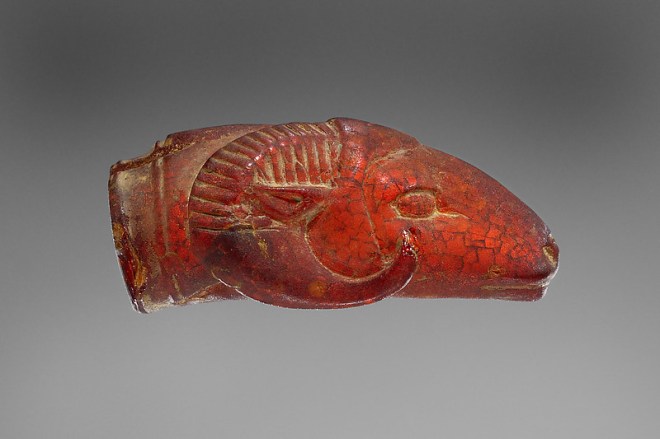
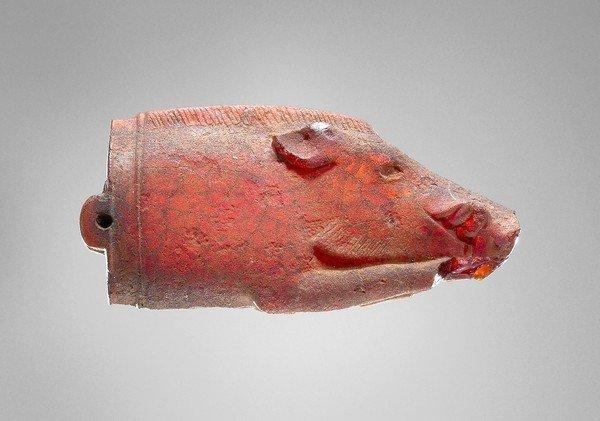
I have to say I’m not a big fan of amber, at least as used in modern jewelry. But I must admit that some of the amber pieces made in the Italian peninsula, both before its domination by Rome and after, are really very lovely. Here, in no particular order, are some pieces whose photos I found on the net. The first two are pre-Roman (Italic and Etruscan, respectively, to be precise)
image
image
while the remainder are from the Roman period; a number of them, if not all, were made in Aquileia’s workshops. This is Dionysius
image
while this must be Pan.
image
This is a perfume bottle
image
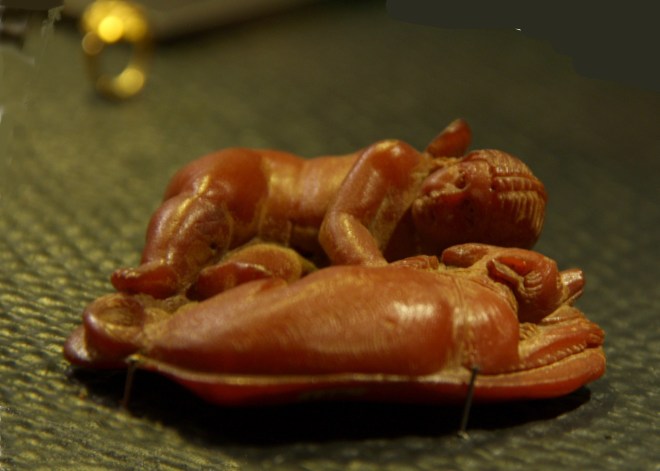
while this little set-piece is “Eros and a bitch”.
image
Lovely little pieces …

Let me go back a step now and explain my interest in this particular amber road. Or rather interests, for there are several. I first got to know about it, and the ancient amber trade in general, when my wife and I lived in Vienna. It so happens that Vienna is located close to Carnuntum. It always tickled me pink to think that Vienna, which gives itself such airs as the capital of the (defunct) Austro-Hungarian Empire, was once upon a time no more than a minor garrison town called Vindobona on the far edges of the much mightier Roman Empire. I’m sure officers and soldiers alike in little Vindobona looked with envy at their more powerful neighbour Carnunutum, which not only had the rich amber trade passing through it but also was the capital of the province. So many more important things went on there! The Emperor Marcus Aurelius chose Carnuntum as his base for three years during one of the periodic Roman campaigns against Germanic tribes across the Danube River (he also wrote part of his famous Meditations there, a copy of which graces my bookshelves). Another Emperor, Septimius Severus, was also based in Carnuntum when governor of Pannonia, and he was proclaimed Emperor there by his troops. Carnuntum hosted a historic meeting between the Emperor Diocletian and his co-emperors Maximian and Galerius, to solve rising tensions within the tetrarchy. Among other things, the meeting led to freedom of religion for the Roman Empire. And on, and on.

In contrast, like in all garrison towns, probably nothing much ever happened in Vindobona (although Marcus Aurelius’s death there in 180 AD must have caused a ripple of excitement). W.H. Auden caught well the tedium of garrison life on the Empire’s frontier for the ordinary soldier, in his poem Roman Wall Blues. The poem is about another of the Empire’s frontiers, Hadrian’s Wall, but I’m sure the tedium was the same, whichever frontier you were assigned to.

Over the heather the wet wind blows,
I’ve lice in my tunic and a cold in my nose.

The rain comes pattering out of the sky,
I’m a Wall soldier, I don’t know why.

The mist creeps over the hard grey stone,
My girl’s in Tungria; I sleep alone.

Aulus goes hanging around her place,
I don’t like his manners, I don’t like his face.

Piso’s a Christian, he worships a fish;
There’d be no kissing if he had his wish.

She gave me a ring but I diced it away;
I want my girl and I want my pay.

When I’m a veteran with only one eye
I shall do nothing but look at the sky.

But I suppose Vienna had the last laugh. It still exists, whereas Carnuntum is now but a very modest pile of ruins, having been systematically sacked by Germanic tribes in the 4th Century (I suppose in a way the Germanic tribes had the last laugh too, after all the denigration they received from the Romans). Sic transit gloria mundi, as I am ever fond of repeating: “thus passes the glory of the world”.

This particular amber road also caught my attention because it gave me an alternative route to the ones we always took to go back to my wife’s home town of Milan: either head south out of Vienna over the mountains to Graz and then over more mountains to Klagenfurt and Villach, slip through the Alps at the Tarvisio pass, then speed past Udine down to Venice, whence turn right and make for Milan; or, head west out of Vienna towards Linz, then Salzburg, and then into Bavaria, turn left at the River Inn and enter Austria again, at Innsbruck turn left again and climb up to the Brenner pass, down the other side to zip by Bolzano and Trento, exit from the Alps at Verona, and turn right there to head for Milan. Now my wife and I could take a lower road (a considerable benefit when traveling in winter, when both the other routes can be unpleasant), as well as one steeped in history. Travelling along the ghosts of old Roman roads (all of which disappeared long ago) we would head south past the tip of Lake Neusidler, shared by Austria and Hungary, to Šopron and then Szombalethy, both in Hungary, on to Ptuj, Celje, and Lubljana in Slovenia, to finally slip through the Julian Alps at Gorizia and on to Aquileia, where we would need to finally get on the A4 motorway and speed on to Milan!

Great idea, except for one slight problem – time. There is no speedy highway linking all these towns, so it would take far longer to get to Milan. Since we were working, we couldn’t afford the time; we were always time-starved. But that will all change in a mere two weeks’ time, when I retire! Then, we will have all the time in the world, and I am determined to finally follow in the footsteps of the legions and pass through what were once the Roman towns of Scarbantia, Savariensum, Poetovium, Celeia, and Emona. There’s not much Roman left in them, though. Like Carnuntum, and like the terminal point Aquileia (of whose total destruction I wrote about in an earlier post), they were all thoroughly sacked and resacked by Germanic, Gothic, Hun, Lombard, Slav, or Hungarian war parties (or some combination of these) during the period of the “Barbarian Invasions” or the “Migration of the Peoples”, the Völkerwanderung (take your pick, depending on your ideological point of view).

I always feel a point of melancholy when faced with these moments of destruction in history. And it’s not just in the remote past. On the northern end of this amber road, tremendous destruction, of places but also of people, was wreaked a mere 70 or so years ago as first, German troops swept through on their way to enacting Hitler’s policy of lebensraum, expanding the living space of the Aryan, Germanic people at the expense of Slavic people, and then again, as the Soviet troops fought their way back to Berlin. Along with many other Polish cities, Gdansk, Wroclaw, Poznan, all sitting astride the amber route, were almost totally destroyed, their Jewish populations annihilated, their Polish populations much depleted, their industrial infrastructure stripped away. What a waste … so much human creativity swept away by the animal desire to destroy.

_________________
Raw amber on a Baltic beach: https://en.m.wikipedia.org/wiki/Baltic_amber#/media/File%3ABaltic_beach_sand_containing_amber.jpg
Tutunkhamun’s breast ornament: https://hu.pinterest.com/pin/249598004324238999/
Amber necklace, Mycenae: https://sites.google.com/site/ambranathistplinio/home/etimologia-e-proprieta
Amber routes map: http://www.ambergallery.lt/en/disp.php?itm=en_museums_3%2Fen_museums_3_9
Amber road through Carnuntum: https://en.m.wikipedia.org/wiki/Amber_Road
Ram’s head, Italic, 500-400 BC: http://museumcatalogues.getty.edu/amber/intro/16/
Boar’s head, Etruscan, 525-480 BC: http://articles.latimes.com/2013/jan/19/entertainment/la-et-getty-ambers-20130119
Mask of Dionysius, Roman, 1st C AD: http://amberregina.blogspot.com/2011_03_01_archive.html
Perfume bottle, Roman, Aquileia workshop, 2nd C AD: http://www.antiquitiesexperts.com/rome138.html
Eros and bitch, Roman: https://commons.m.wikimedia.org/wiki/File:1128_-_Archaeological_Museum,_Udine_-_Ancient_Roman_amber_Eros_and_bitch_-_Photo_by_Giovanni_Dall%27Orto,_May_29_2015.jpg

FLYING FLUFF

Beijing, 1 May 2013

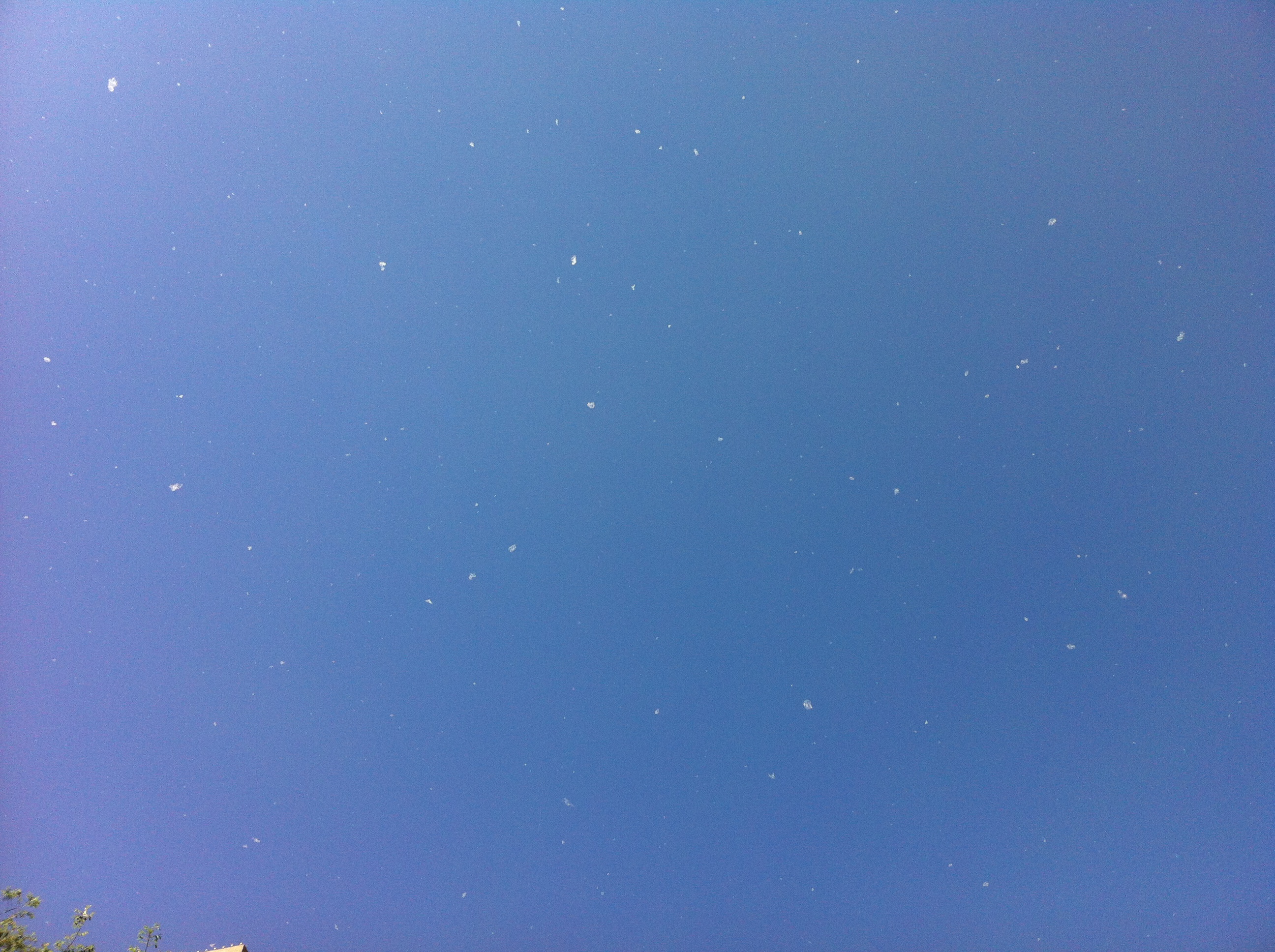
These last few days we have been suffering from an unpleasant side-effect of Spring: airborne white fluff, which trees around here are shedding in huge quantities in their eagerness to mate and to seed. The fluff drifts down, floats along on the breeze, is whirled about by passing cars, eddies in big clumps around your feet, and – most disagreeably – gets into your eyes, nose and mouth. Yesterday morning, it was so thick that looking up into the sky it seemed to be snowing.

pollen 008

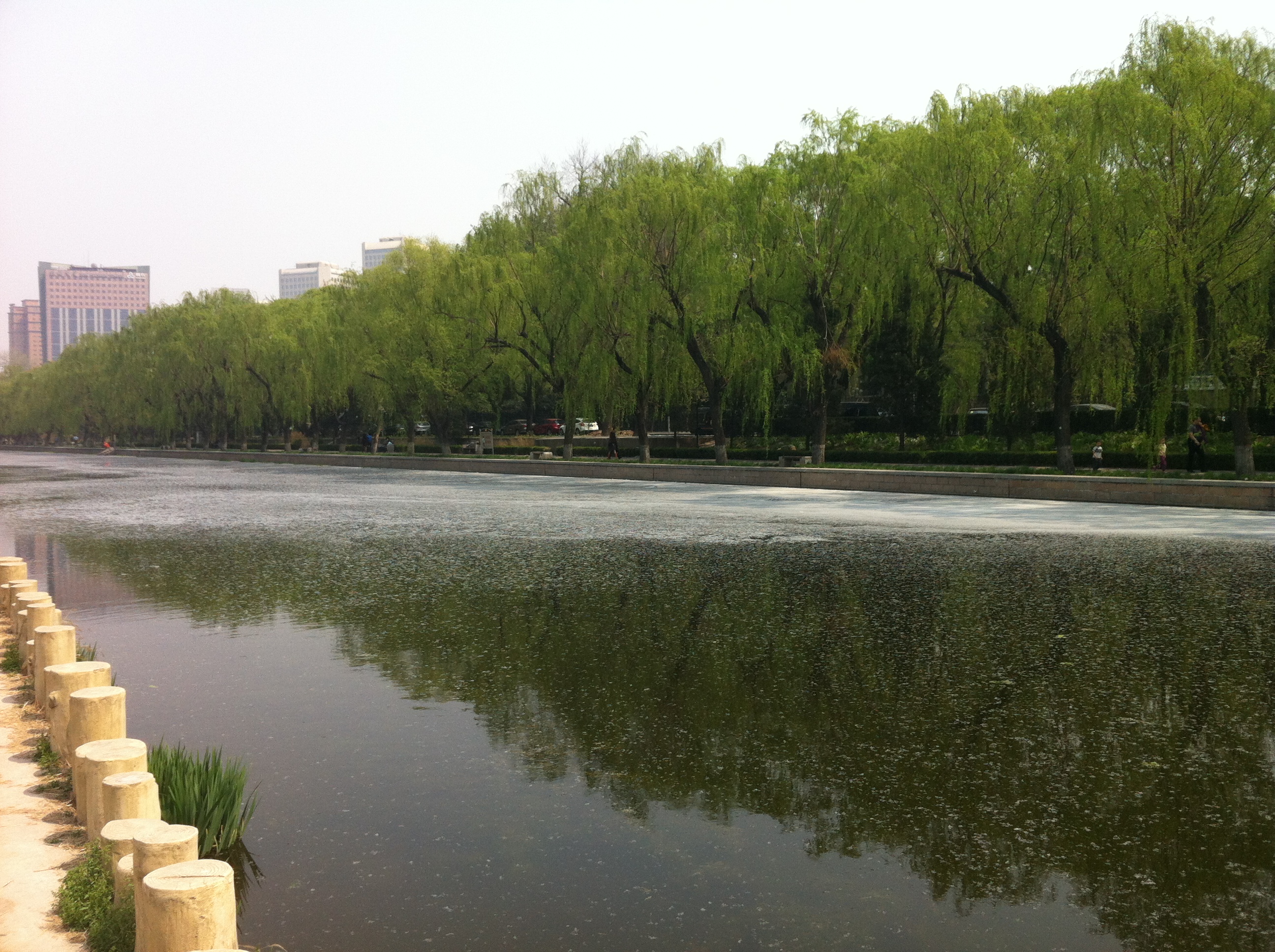
while a few days ago currents in the canal and wind interacted to create a thick layer of fluff along the far bank.

pollen on canal 002

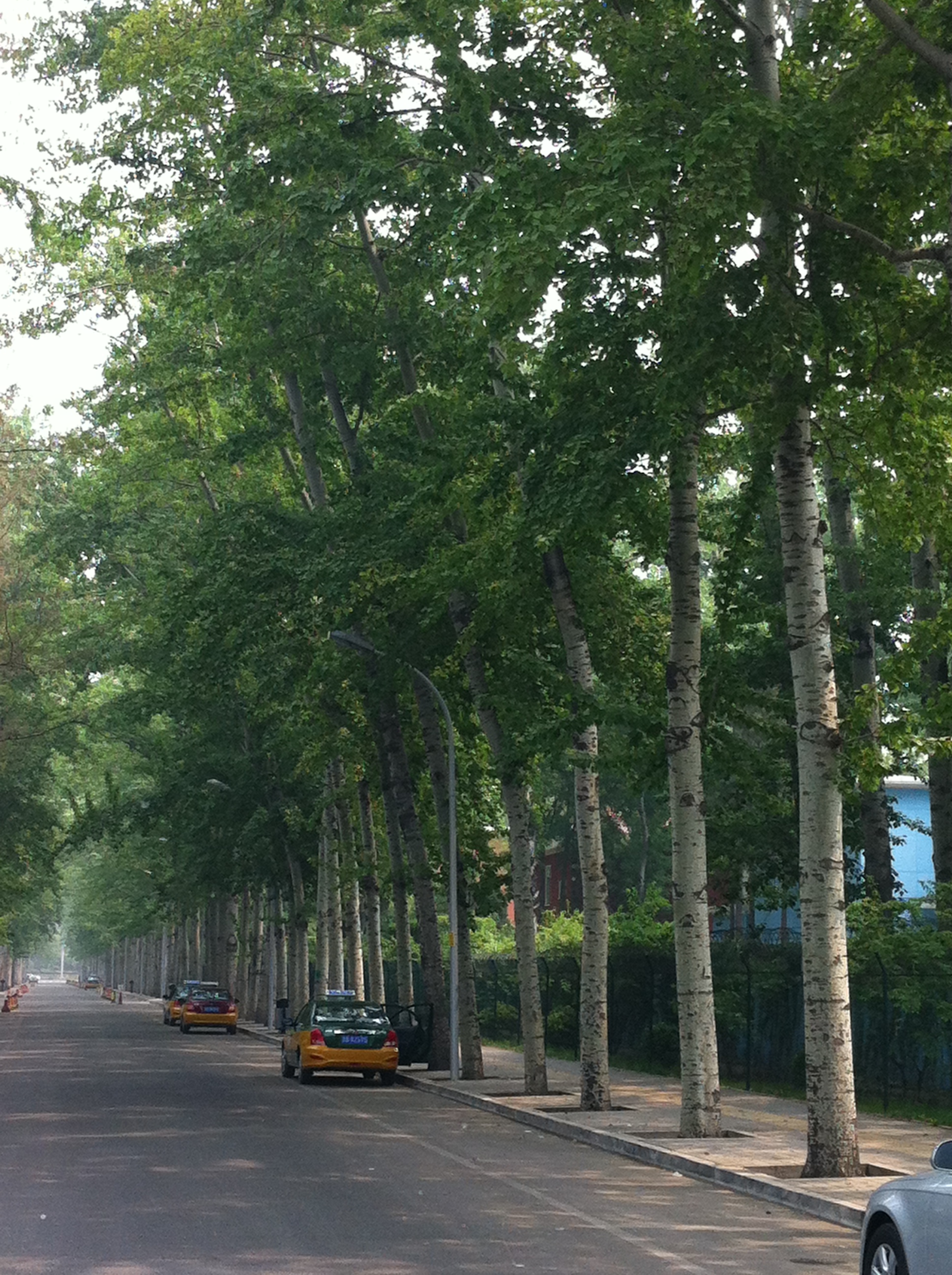
This is the offending tree, photographed in a quiet side street

poplars-Beijing 011

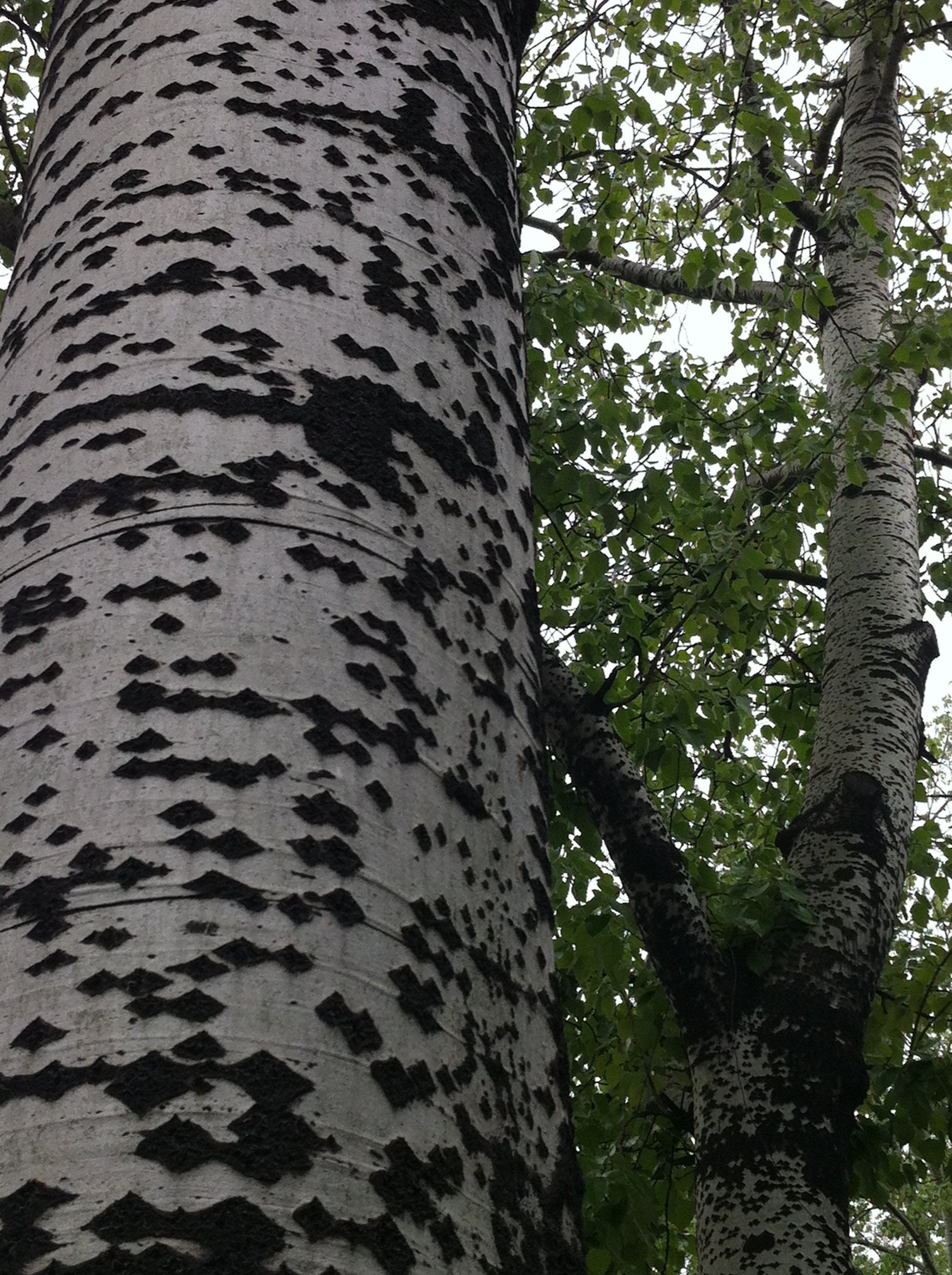
a poplar, a member of the aptly-named cottonwoods, whose more mature specimens carry these very distinctive diamond shapes on their lower bark.

pollen 013

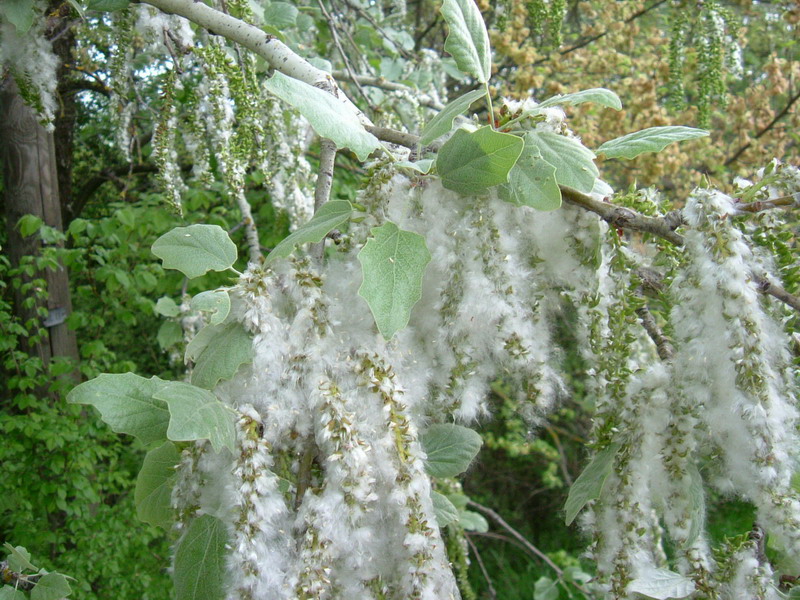
And this is where the fluff is from:

cotton on tree-1

I first became aware of this tree in Vienna, not so much because of white fluff flying around, of which there was a fair amount at this time of the year, but because of some really magnificent specimens growing in the gardens of the posher, greener parts of town. So posh and so exclusive that I have found no photos on the web.

But actually, where the tree really came into its own was down by the Danube, in the last vestiges of the river’s wetlands which land use planners and river engineers of the 19th Century had left alone.

poplars on the Danube-1

Not surprising, really. The tree loves a wet, marshy soil. Which explains why there are so many poplars around Milan and in the Po River plain generally, which is a pretty soggy place. And in Milan, the problem of flying white fluff was truly awful. These pictures are not from Milan but are from that part of the country and give a good sense of the horror of it.

Italian-image-1

Italian-image-3

It’s the poplar’s love of wet soil that makes me wonder what it’s doing here in Beijing. I mean, this city is semi-desertic; lack of water is a constant and growing problem. Yet, there are huge plantations of the tree around the city, part of the reforestation campaigns that the government is so fond of as a way of minimizing the dust storms to which this city is periodically subject. Wise policies no doubt, but surely they could have found a more suitable tree?

____________________________

pix of sky, canal, and poplar tree: mine
Fluff on tree: http://www.naturamediterraneo.com/Public/data7/ciuppy/5.jpg_200941622240_5.jpg
Poplars on the Danube: http://www.quax.at/sites/default/files/images/nationalpark_donau_auen_976_Donauufer2_Baumgartner.jpg
Italian-image-1: http://upload.wikimedia.org/wikipedia/commons/thumb/9/9f/Fioritura_pioppi.JPG/1280px-Fioritura_pioppi.JPG
Italian-image-2: http://www.parmatoday.it/~media/base/19828483952093/curiosita-fioritura-pioppi-1.jpg