ONION DOMES

Vienna, 8 August 2024

In my last post, I mentioned the brief trip my wife and I made to Schruns in the Montafon valley. We liked the Montafon valley so much that we decided to go back for some more hiking. This time, we explored new side valleys and some of the (artificial) lakes at the top of the valley. But I don’t want to talk about that, delightful though it has been. I want to talk about the view from the terrace when we were eating our dinner.
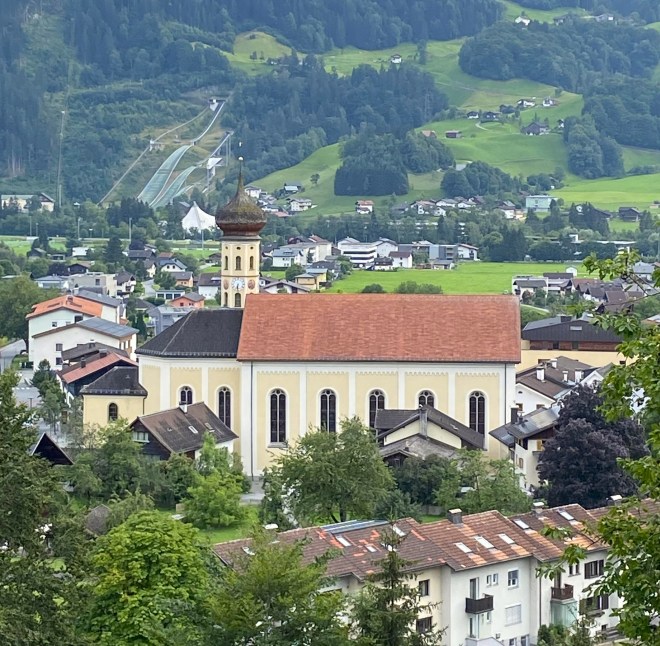
My photo

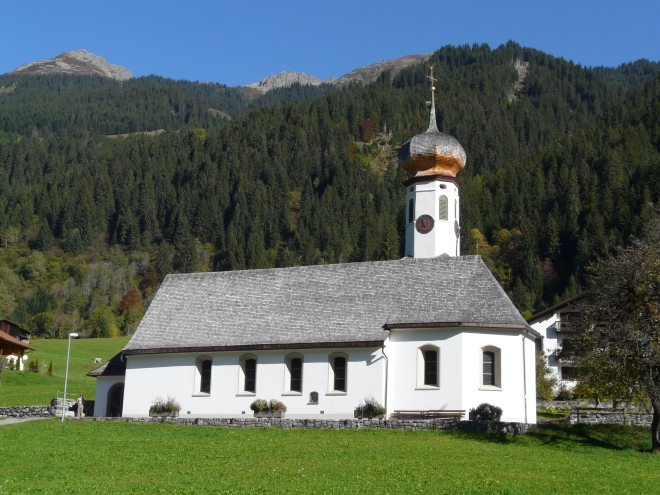
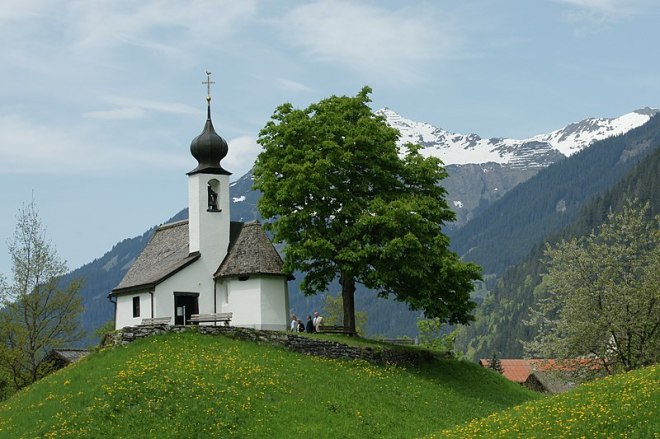
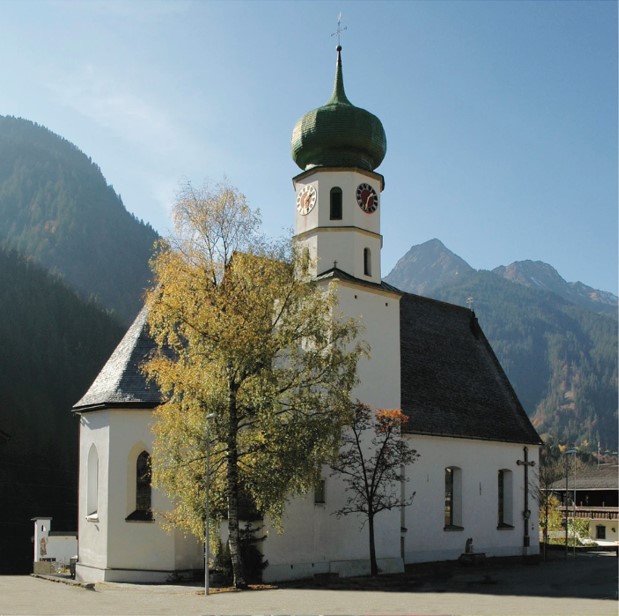
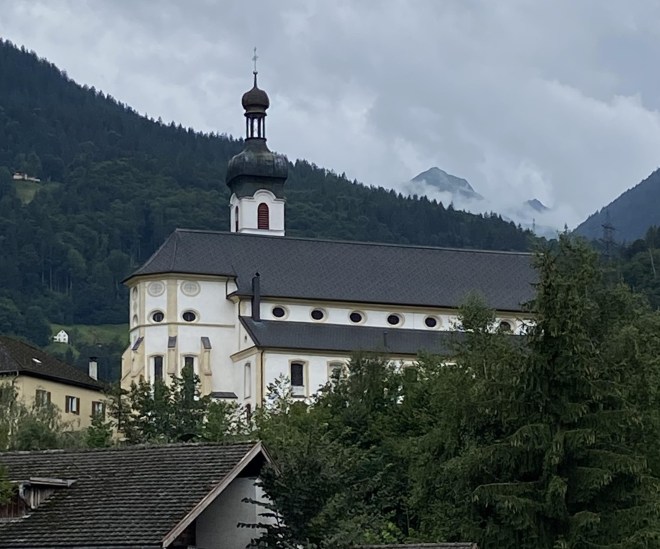
As readers can see, the town’s church tower is capped by a delightful example of an onion dome. The towers of many churches in Austria and Bavaria, as well as in other parts of the German lands, are crowned with onion domes. In the valley of Montafon alone, my wife and I saw five onion domes during our hikes or from the bus on our way to our hikes’ starting points.
Sankt Gallenkirch:
Source

Gortipohl:

Source

Gaschurn:

Source

Partenen:

My photo

And finally Tschagguns, where a lantern has been inserted into the onion:
My photo

I first remember seeing these onion domes decades ago, when one of my flatmates at University invited me to spend the Easter vacation at her mother’s place in the Alps in Austria (her mother was Austrian). We drove all the way there from the UK. At some point, we crossed into Bavaria and I began seeing these onion domes atop church towers through the car window. I was rather astonished; for me, onion domes was something you only found in Christian Orthodox lands. The example that comes to mind for most people is St. Basil’s Cathedral on Moscow’s Red Square, but I refuse to give space to the invaders of Ukraine. I shall instead insert a photo St. Michael’s monastery in Kyiv.

Source

What on earth were these onion domes doing in Germany and Austria?! I didn’t get an answer to my question at the time – even though my flatmate was studying architecture, she had never posed herself the question – and life rolled by. It wasn’t until I was sitting on that terrace staring at the tower of Schruns’s church that I posed myself the question anew. Luckily, in the intervening decades the internet has come along and Wikipedia – that splendid instrument for giving answers to the most off-the-wall questions – has been created.

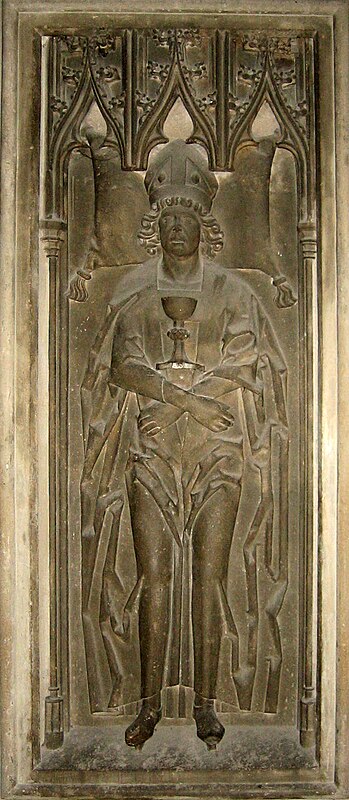
The story which Wikipedia tells is a fascinating one. First of all, this was not a question of German-speaking church builders importing a new style from further east in Europe. It seems, rather, that the answer lies with a certain Bernhard von Braidenbach, an important official in the Archdiocese of Mainz, who lived from about 1440 to 1497. He was important enough to deserve a tombstone in Mainz cathedral, of the type that brass rubbers love. I throw in a photo of his tombstone.
Source

Braidenbach is chiefly remembered today for a book he wrote in 1486, Peregrinatio in terram sanctam, in which he recounted his pilgrimage to the Holy Land undertaken in 1483-84. He was actually accompanying (i.e., keeping an eye on) the young Count Johann von Solms-Lich, so he also had a knight with him to protect the Count and the party. And, very important for us, he took along a certain Erhard Reuwich, an artist from Mainz. Why he decided to take an artist with him is unknown – at least to me. But it’s good that he did, as we shall see. Once back in Mainz (minus the count, alas, who had died on the return trip), Braidenbach wrote what was essentially a travel guide for future pilgrims to the Holy Land. What was groundbreaking about the book is that he inserted into the text some 25 woodcuts prepared by Reuwich, of views of the cities they passed through and other topics.

The book was an instant hit with European elites. It went through several editions and was translated into numerous languages. And – what is important for our story – church builders picked up on a detail in one of the woodcuts, Reuwich’s view of Jerusalem as seen from the Mount of Olives.
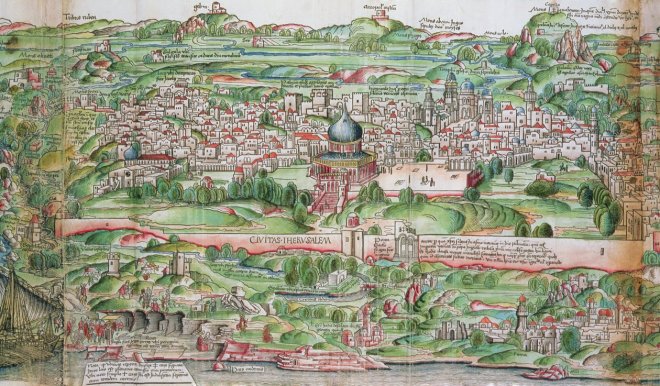
Source

Sharp-eyed readers will immediately see the unmistakably onion-shaped dome on the building in the foreground of the woodcut. I blow up the photo for those of my readers whose sight, like mine, is less than perfect.

Source

So there we have it. That little feature in one of the book’s woodcuts – admittedly of one of the holiest places in the world for Christians – seems to have inspired builders in the southern German lands to crown their church towers with onion domes.

The building whose onion dome they copied is the Dome of the Rock, an Islamic shrine at the centre of the Al-Aqsa mosque compound on the Temple Mount in the Old City of Jerusalem. This aerial photo is taken more or less from above the Mount of Olives and gives a very similar view as the woodcut.

Source

The photo shows the unmistakable octagonal arcade surrounding the dome. It also shows – shock! horror! – that the dome is not onion-shaped! From my extensive reading (in Wikipedia), it seems that it never was. As far as I can make out, the dome has kept the same shape it had when it was built back in 692 AD.

I have to assume that our friend Erhard Reuwich was taken by a fit of poetic license when he prepared the woodcut. Quite honestly, I’m glad that he was feeling poetic the day he laboured over the woodcut, because otherwise I wouldn’t have found myself staring with such pleasure at the church tower in Schruns and other places in Montafon valley.

In this day and age of hostility between the Islamic and Christian worlds, I’m also rather pleased to see that Christian church builders don’t seem to have had any scruples about copying the dome of an Islamic building for their Christian churches.

Well, I finished this post on the train back to Vienna, and as I paused and stared out of the window somewhere in Bavaria, a church tower with an onion dome flashed by.
SACRI MONTI

Kyoto, 26 November 2016

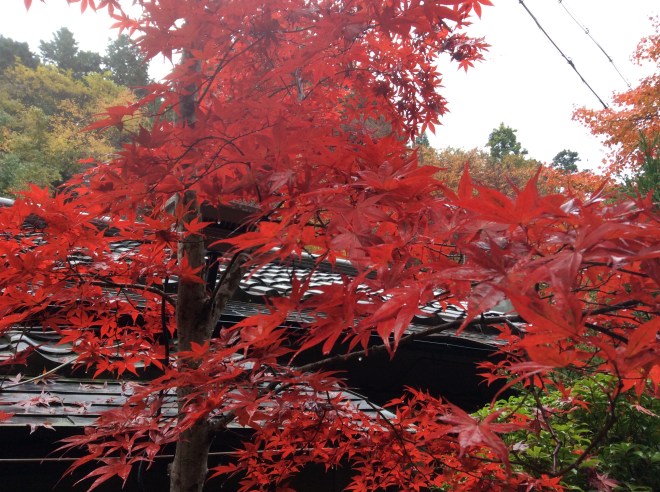
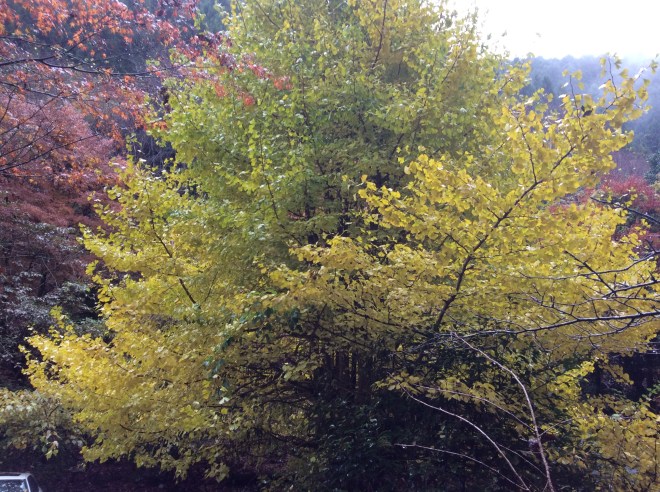
Two weeks ago, my wife and I visited the temple on mount Kurama, a mountain on the outskirts of Kyoto. We took the train to the mountain’s foot and then climbed to the top – well, “climbed” is perhaps misleading, since rather than toil all the way up using the path that snakes its way to the top we took a cable car to very near the summit and toiled lightly the rest of the way. It was the Fall colours which had brought us there, and indeed the red of the Japanese maples and the yellow of the ginkgoes were a sight to behold.
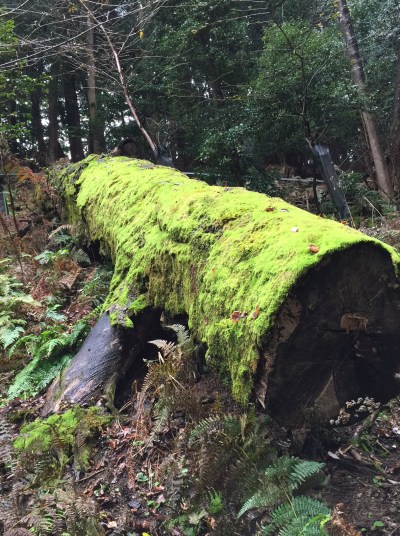
mount-kurama-2

mount-kurama-3
Since it was a cool, rainy day, the surrounding landscape was enveloped in drifting cloud and mist, strongly reminiscent of painted Japanese landscapes.
misty-japanese-landscape
At the top, we walked around the temple

and enjoyed the view.
mount-kurama-1
After which, we walked down the other side of the mountain
mount-kurama-4
to take a well-deserved lunch at the bottom.
mount-kurama-5
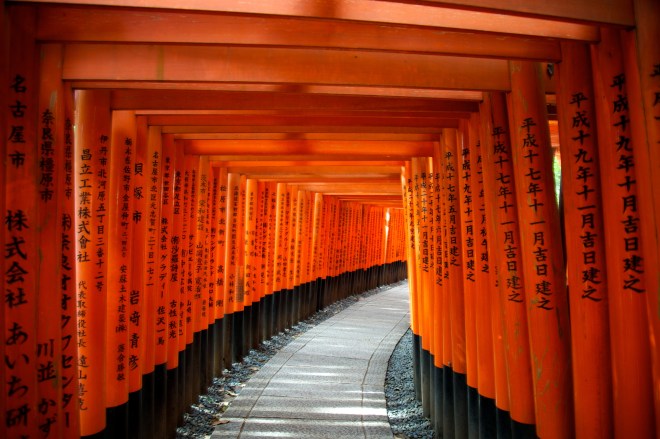
A week later, when our daughter joined us for Thanksgiving, we took her to the Fushimi Inari Shrine on the hilly eastern edge of Kyoto and hiked up the mountain behind the shrine, passing through the famed tunnel of torii on the way
Torii gates—Fushimi Inari Shrine
(although when we passed through the tunnel, it was packed with people – the disadvantage of visiting Kyoto at this time of the year).

After admiring the view at the top and inspecting the small shrines sprinkled along the path, all of which were smothered in small votive torii
http://regex.info/blog/2008-06-19/841
we made our way down again and had a well-deserved bowl of rahmen at the mountain’s foot.
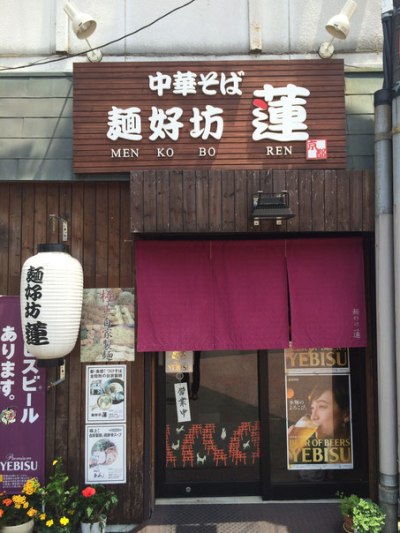
noodle-shop-inari
Ours was an admittedly very secular version of a pastime as ancient as civilization itself, the climbing of mountains to pray to the gods. I suppose it makes sense. Gods often have been thought to reside up in the sky somewhere, and mountains were as close to the sky as we humans could get before the age of aviation. And before there were 7 billion of us, working our presence into every nook and cranny of the planet, mountains were remote, mysterious places, where our ancestors could more easily commune with the divine.

So it comes as no surprise to see that all religions have their mountains. Several degrees of longitude to the west of Kyoto, the Chinese had their Four Sacred Mountains of Buddhism and their Four Sacred Mountains of Daoism, and scholars sitting at the foot of mountains is a common scene on scrolls.
scholars-under-mountain
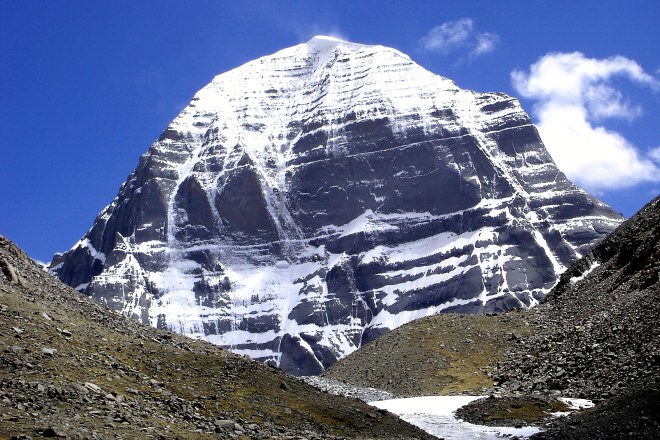
Hinduism, along with Jainism and Buddhism, has its Mount Meru, a mythological mountain, which for many believers, though, finds its material incarnation in Mt. Kailash in Tibet.

Processed by: Helicon Filter;

Many Hindus and Buddhists make the arduous journey to the mountain. Once they reach it they will reverently circle it (I highly recommend the book “To A Mountain In Tibet”, in which that great travel writer Colin Thubron relates his journey on foot to this mountain up through the high valleys of Nepal).

Moving further west, Judaism has its Mount Sinai, traditionally thought to be this mountain.
mount-sinai
The Bible tells us that Moses climbed it to commune with Yahweh in the Burning Bush, and from its top he brought down the Ten Commandments to the people of Israel. Charlton Heston gave a great performance as Moses in the Hollywood film epic “The Ten Commandments”
charlton-heston-as-moses-in-the-ten-commandments
although I personally prefer Michelangelo’s splendid Moses.
michelangelo-moses
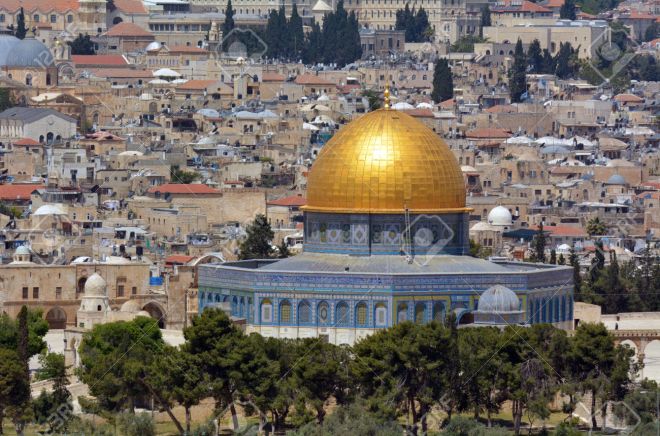
Islam also has its holy mountains; since it is a religion of the Book, many of these are linked to stories in the Bible: Mt. Sinai because of its link to Moses, Al-Judi, reputed to be where Noah’s Ark came to rest after the Flood, the mount of Olives, where the righteous will be chosen and evil abolished. But it also has mountains which are holy because of events in the life of the Prophet Muhammad. One such is the Temple Mount, the scene for Muslims of the Prophet’s ascent to heaven in his Night Journey, and on which they built the beautiful Dome of the Rock.

dome-of-the-rock

Another is Jabal Al-Nour, on the outskirts of Mecca.
jabal-al-nour
This mountain houses the Hira Cave in which Muhammad began receiving the revelations which became the Qu’ran. The cave is extremely popular with Muslim pilgrims who make the arduous trek up the mountain to reach it.

As for Christianity, Jesus was crucified on a hill, Mount Golgotha, outside Jerusalem. It’s really quite a modest hill, a hillock really, which in Christian art, though, grew into a respectable hill, as shown in this painting by Pieter Bruegel the Elder.
procession-to-calvary-by-pieter-bruegel-the-elder
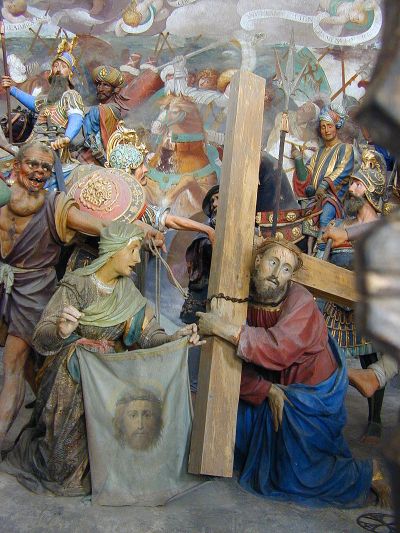
Imagining a good-sized hill gave later generations of Christians an excuse to bedeck local hills with a Via Crucis, or Way of the Cross, which would wend its way up to the top of the hill and along which would be dotted the fourteen stations. The faithful would climb the Via Crucis, stopping and praying at each station (I remember well doing this as a young boy). UNESCO has canonized as a World Heritage Site nine such hills, the Sacri Monti or Sacred Hills, which are strung along the alpine foothills of Lombardy and Piedmont, not too far from Milan where we currently reside. Their Vie Crucis were all created in the 16th-17th centuries.
sacri-monti-1
sacri-monti-2
I’m trying to persuade my wife that we should go and climb a couple. To make the suggestion more palatable, I’m suggesting that we now wait until Spring – and that we choose sacri monti that have good restaurants at their foot to which we can repair after the climbs.

____________________
Misty Japanese landscape: https://loganbalstad.wordpress.com/2013/07/20/japanese-landscape-painting/
Mount Kurama temple: http://apdl.kcc.hawaii.edu/roads/18_temples.html
Other pix of Mount Kurama: ours
Scholars under mountain: http://www.sothebys.com/en/auctions/2013/fine-classical-chinese-paintings-n09009.html
Mount Kailash: https://en.wikipedia.org/wiki/Mount_Kailash
Torii Fushimi Inari Shrine: https://commons.wikimedia.org/wiki/File:Torii_gates%E2%80%94Fushimi_Inari_Shrine_(9977683204).jpg
Fushimi Inari mouintainside shrine: http://regex.info/blog/2008-06-19/841
Noodle shop, Fushimi Inari shrine: http://www.picrumb.com/best-restaurants/inari/
Mount Sinai: https://www.lds.org/media-library/images/mount-sinai-egypt-moses-1244104?lang=eng
Charlton Heston as Moses: https://theiapolis.com/movie-20AU/the-ten-commandments/gallery/charlton-heston-as-moses-in-the-ten-commandments-1081961.html
Michelangelo’s Moses: http://syndrome-de-stendhal.blogspot.jp/2012/04/der-moses-des-michelangelo.html
Dome of the Rock: http://www.123rf.com/photo_42141970_aerial-view-the-dome-of-the-rock-on-the-temple-mount-from-the-mount-of-olives-in-jerusalem-israel.html
Jabal Al-Nour: http://dreamzs338.tumblr.com/post/132478018857/jabal-al-noor-the-mountain-of-light-in-makkah
Pilgrims to Hira Cave: http://mapio.net/pic/p-16183166/
“Procession to Calvary” by Peter Breugel the Elder: https://mydailyartdisplay.wordpress.com/2011/03/07/the-procession-to-calvary-by-pieter-bruegel-the-elder/
Sacri Monti-1: http://www.unescovarese.com/Sacri-monti-in-Piemonte-e-Lombardia
Sacri Monti-2: https://en.wikipedia.org/wiki/Sacro_Monte_di_Varallo