TUTTO CAMBIA, TUTTO SI TRASFORMA

Los Angeles, 24 March 2024
Updated, Vienna, 27 September 2025

“Tutto cambia, tutto si trasforma”, everything changes, everything is transformed. My wife intones this popular Italian saying, half jokingly, every time we come across something that has changed since we last passed this way. It seems to be happening more and more frequently now, I suppose a sign that we have clocked up decades of memories and experiences on which to draw on as we move inexorably towards the exit door (cue to my wife rolling her eyes at this latest meditation of mine on the transience of all life).

In any event, I was forcefully reminded of this saying a few weeks ago when an urban walk of ours led us past one of Milan’s earliest churches, the so-called paleochristian basilicas built before the fall of the western Roman Empire. I did what I exhort all my readers to do when a church hoves into view; I popped in to have a look around. Aïe! How much had changed since this church was first built in the 380s CE: “tutto cambia, tutto si trasforma”. In a somewhat melancholy mood, I returned home and started researching the fate of Milan’s other paleochristian basilicas.

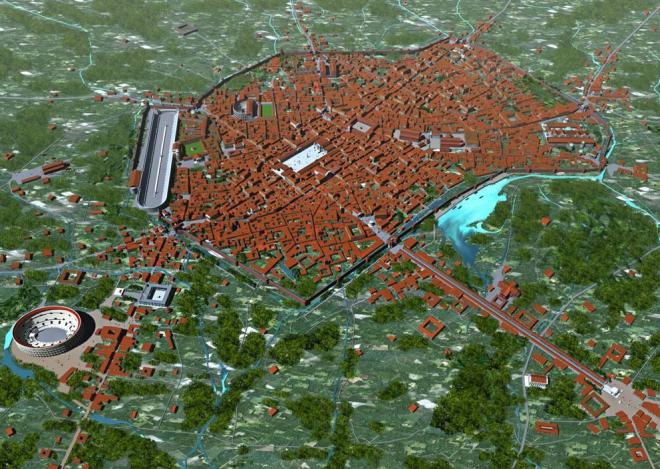
I need to give a bit of context here. Many people think that Rome was the only capital of the Roman Empire. This, as any Milanese will proudly tell you, is not so. In 286 CE, after the Roman Empire was carved into two, Milan became the capital of the western part and remained so for a little over 100 years, until 402 CE, when the capital was moved again, this time to Ravenna. There aren’t of course any pictures from that period, so I’ll throw in here a reconstruction of Milan (then known as Mediolanum) in about 300 CE.
Source

Readers will make out the white rectangle of the forum, the circus along the edge of the city walls, to which was attached the imperial palace complex (so that the Emperor could step out into the Imperial box without leaving the palace grounds and mix with the hoi polloi), and the amphitheatre down to readers’ left. Just to get down among the hoi polloi, here’s another reconstruction of a typical day in the forum.

Source

And in a rush of enthusiasm, I throw in another reconstruction of the hoi polloi doing their shopping along the cardo, the north-south street that passed through all fora in the Roman Empire.
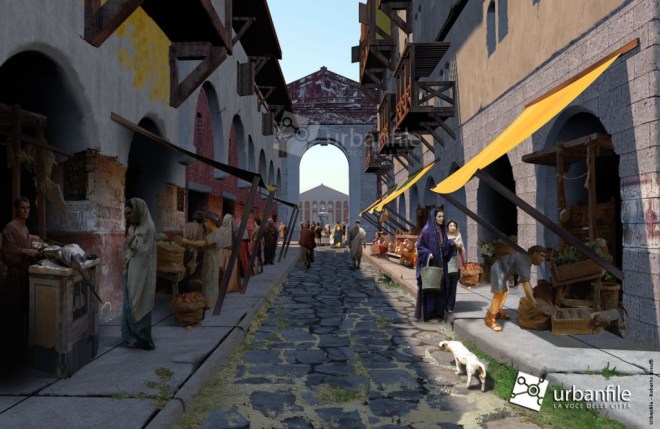
Source

The ghost of this particular street is still there, by the way. It is now called via Cantù. We see it here, looking in the same direction.
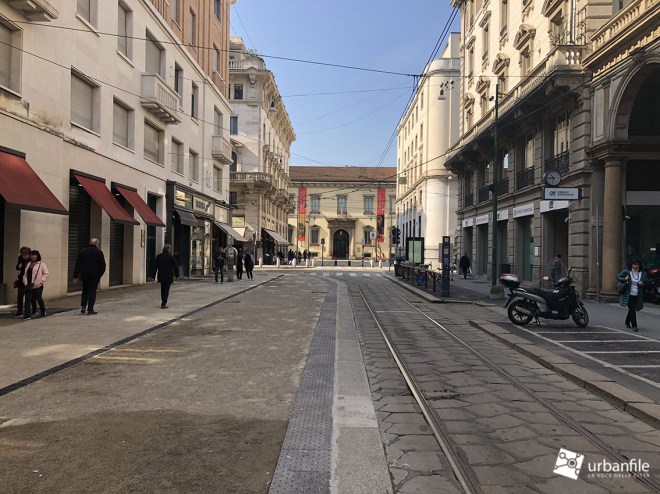
Source

“Tutto cambia, tutto si trasforma.”

In any event, Mediolanum now being the capital city, it was here, in 313 CE, that the two Emperors, Constantine and Liceus, promulgated what has come to be called the edict of Milan, which allowed the free exercise of religion throughout the Empire. While the edict formally covered all religions, it was actually aimed primarily at Christianity. The result was that Christians could finally come out of the shadows and worship freely (we’ll skip over the fact that a mere seventy years later, in 380 CE, Christians imposed their religion on everyone else in the Empire, with all other religions being forced (back) into the shadows).

Among other things, the edict of Milan meant that Christians could finally stop meeting in secret in people’s houses and build their own places of worship. They were quick to take advantage of this new-found freedom. In Milan alone, and focusing just on the big churches, within a year of the promulgation of the edict the city had its first Christian basilica. In the photo below, we have a reconstruction, in the top right, of that first basilica, while the building at the bottom left, which had been a temple dedicated to the Goddess Minerva, was converted into another basilica, which some 30 years later was knocked down to make space for a much larger church.
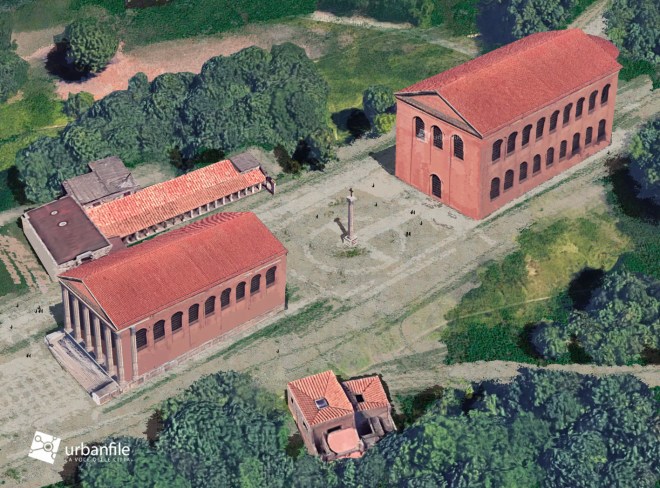
Source

By the time St. Ambrose became bishop of Milan in 374 CE, the city had added two more basilicas to the list. During his tenure, St. Ambrose ordered the construction of another four basilicas, I suppose to cater to all the newly-minted Christians now that Christianity had become the State religion. And not to be outdone by St. Ambrose, the imperial household decided to build their own basilica. So by 402 CE, the year that Milan stopped being the capital of the western Roman Empire, the city had another five basilicas on the rolls. The construction of basilicas went on even after Milan’s demotion as capital, with two more basilicas being built before the final collapse of the Western Roman Empire in 476 CE.

Of course, churches continued to be built in Milan in the centuries thereafter. But I want to focus on these eleven earliest, paleochristian, churches to show that indeed “all changes, all is transformed”.

Let me first give readers a framework for these tides of change. Any of us with the minutest interest in history will know that over the arc of history we humans have been repeatedly subjected to the four horsemen of the apocalypse: Death, Famine, War, and Conquest. Here is Albrecht Dürer’s take on these four horsemen; I leave it to the readers to work out which horseman is which.

Source

But buildings have also been subject to their own horsemen of the apocalypse. Two they share with us: War and Conquest, whole cities having been wiped out by both – and not just centuries ago. Here is a photo of Hiroshima after the atom bomb was dropped on it.
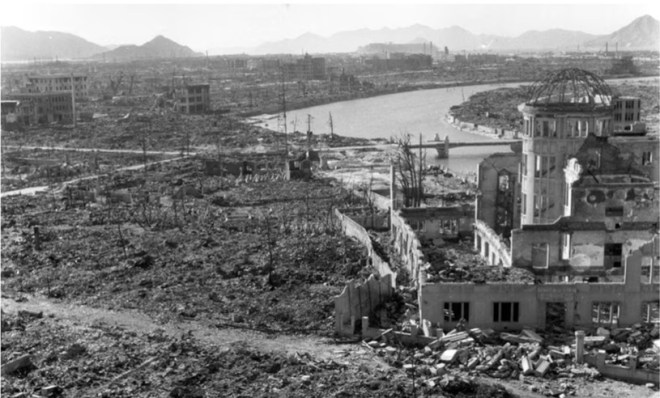
Source

While here is a photo of Dresden after it was destroyed by more “traditional” ordnance.
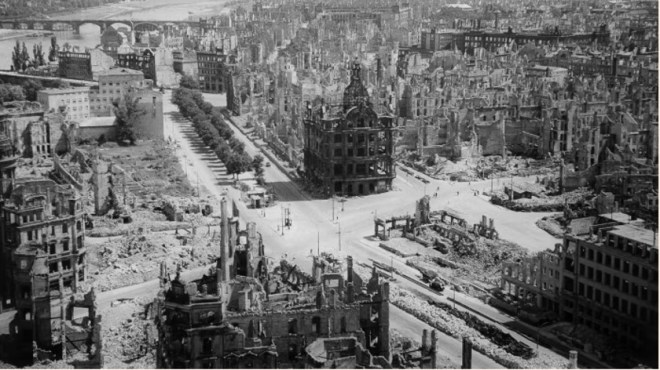
Source

A third has been Fire, a frequent companion of War and Conquest (Dresden is an eloquent memorial to that), but also a horseman that can strike alone. It, too, has wiped out whole cities. The Great Fire of London stands out in my mind, although many other cities have been laid low by fire.

Source

Since my subject is churches, readers should note Old Saint Paul’s burning fiercely (and that is London Bridge that we see, although it is not “falling down, falling down”, as the nursery rhyme has it).

For religious buildings in particular, I would add a fourth horseman of the apocalypse: Fanaticism, religious or otherwise. These buildings are particularly targeted, both by the mobs and by the State, as symbols of the Religious Other or of Religious Obscurantism. Here we have the Dutch Protestants smashing up one of their Catholic churches.
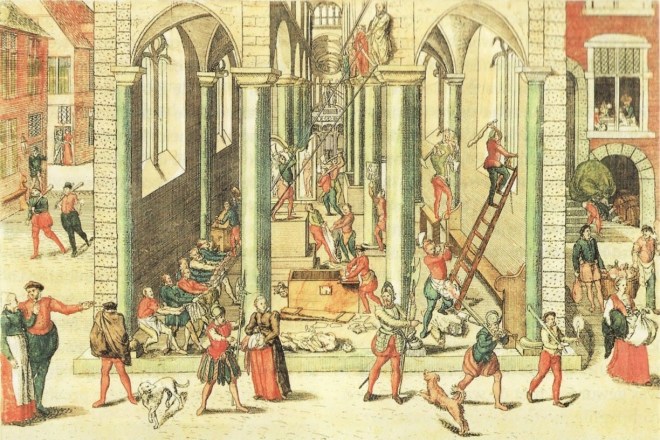
Source

While here we have the French Revolutionaries being even more thorough in their destruction of a church (the church of Saint-Barthélemy), in the name of the Cult of Reason.

Source

But buildings are also victims to the horsemen’s running dogs, to use a Maoist turn of phrase – which gives me an excuse to throw in an example from 1971 of Maoist propaganda posters: compelling art, if nothing else. The phrase at the bottom reads, I am told: “People of the world unite to defeat the American invaders and their running dogs!”
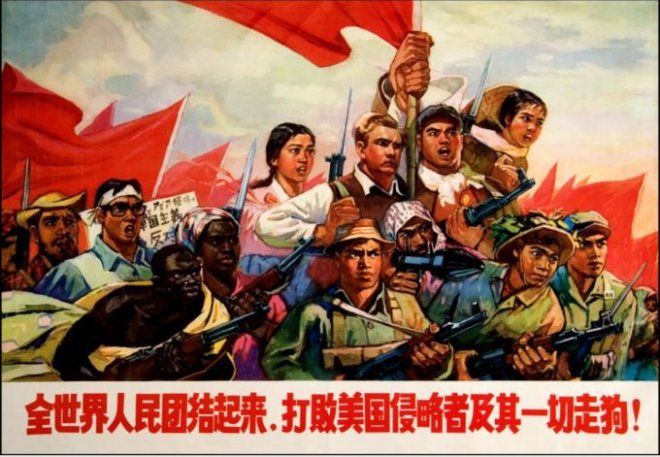
Source

These running dogs are less extreme but no less harmful forces which have disappeared buildings (to borrow a term from the violent rule in Chile and Argentina by right-wing Army putschists back in the 1970s – I wish to show myself being even-handed in my comments of Left and Right).

One is Urban Improvement. Buildings which have had the bad luck to be in the way of some Big Man’s vision of A New City, or just the municipal government’s decision to have a wider avenue for more cars, have been unceremoniously torn down.

Another running dog is Impoverishment; buildings put up when their owners had money then slowly rot and collapse when their descendants have fallen on hard times and can’t maintain them any more. Closely related has been the running dog of Indifference. The descendants have simply preferred to spend their money, inherited or otherwise, in other ways than on maintaining old buildings.

Finally, and often most damagingly for religious buildings, there is Changes in Taste. A building considered beautiful when it was put up is thought, several centuries later, to be ugly, or embarrassingly old-fashioned, or both. It absolutely needs a make-over! Closely related, again mostly for religious buildings, is Showing Off: the desire by the rich and powerful to preen their social feathers by paying for the addition of extra elements such as chapels to existing venerable structures, often to the aesthetic detriment of the whole.

So how have our eleven basilicas fared in the face of their four horsemen of the apocalypse and the five lesser running dogs? Before answering that, I think it is time to give a name to these eleven churches, to make this more personal. We have:

    • The basilica vetus (the old basilica), built in 314 CE, later renamed the basilica of Santa Maria Maggiore;
    • The basilica nova (the new basilica), built in about 350 CE, later renamed the basilica of Santa Tecla;
    • The basilica portiana (the Portian basilica), built in the first half of the 4th Century CE, later renamed the basilica of San Vittore al Corpo;
    • The basilica trium magorum (basilica of the three Wise Men), built around 344 CE, later renamed the basilica of Sant’Eustorgio;
    • The basilica prophetarum (basilica of the Prophets), built in the late 370s CE, later renamed the basilica of San Dionigi;
    • The basilica martyrum (basilica of the Martyrs), built in the early 380s CE, later renamed the basilica of Sant’Ambrogio;
    • The basilica apostolorum (basilica of the Apostles), also built in the early 380s, later renamed the basilica of San Nazaro in Brolo;
    • The basilica virginum (basilica of the Virgins), built in the 380s-390s CE, later renamed the basilica of San Simpliciano;
    • The basilica palatina (the Palatine basilica), built in the 390s-410s, later renamed the basilica of San Lorenzo Maggiore;
    • The basilica evangeliorum (basilica of the Evangelists), built in the first half of the 5th Century CE, later renamed the basilica of San Giovanni in Conca;
    • The basilica sancti Calimerii (basilica of Saint Calimerius), also built in the first half of the 5th Century CE, which kept the Italianised name of Santo Calimero.

Well, the first thing to say is that within no more than 150 years of being built, the eleven original buildings were all razed to the ground by the horseman of War, in the form of Attila the Hun. As part of his rampage through northern Italy in 451-452 CE, his army besieged Milan, broke through its defensive walls, and laid the city to waste. Of course, no-one at the time recorded this momentous event pictorially, so I throw in here a re-construction of the Huns looking suitably menacing under the walls of a city.

Source

As I’ve mentioned in a previous post, prior to arriving beneath the walls of Milan, Attila had completely destroyed the city of Aquileia. He moved on from there and meted out the same fate to the city of Padova. He richly deserved his nickname the Scourge of God. Aquileia never recovered, but Milan (and Padova) did. Among other things, the basilicas were rebuilt.

Alas! A mere 90 years later, in 538 CE, the horseman of War came galloping over the horizon again, this time in the form of an army of Ostrogoths and Burgundians under the command of a certain Uraiah. Once again, the city was besieged, the walls were eventually pierced, and the city was razed. Worse, all the male citizens were killed and all the female citizens handed over as slaves to the Burgundians, as payment for their part in the siege. Again, no-one at the time recorded these hideous events pictorially, but there is a painting in the basilica di Sant’Eustorgio from the 17th Century which formally is about the Massacre of the Innocents but is thought to actually be about the massacre of the Milanese by the Ostrogoths and Burgundians.

Source

Not surprisingly, it took Milan much longer to recover from this devastation, several centuries actually. But it did, and the basilicas were once again rebuilt.

Next on the scene was the horseman of Fire. In 1071 and 1075 CE, Milan suffered two devastating fires which burned down whole swathes of the city, much of whose houses were close-packed and built of wood. We have here a picture from an illuminated manuscript of a town going up in flames.
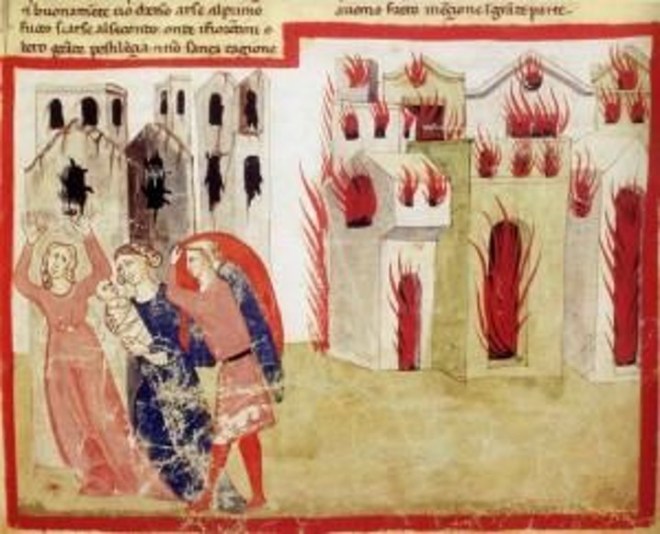
Source

In the ensuing conflagrations, the basilicas of San Lorenzo Maggiore, in 1071, and, in 1075, San Nazaro in Brolo and Santa Tecla were badly damaged.

If I use these churches’ later names it’s that by now naming habits had changed. Churches were named after a particular saint rather than a group of saints as had been the case when these churches were first built – “tutto cambia, tutto si trasforma”.

Once again, the Milanese rose to the challenge and rebuilt the burnt basilicas. But – “tutto cambia”, etc.  – building styles had evolved in the intervening centuries. The churches were now being rebuilt in the Romanesque style. Here is a reconstruction of Santa Tecla from around this time. As readers can see, the basilicas all probably looked very much like the basilicas in Ravenna, with beautiful mosaics running along the walls. Given my predilection for early Christian mosaics, I personally grieve that Milan has lost nearly all of these mosaics.

Source

A mere 90 years after these devastating fires, in 1161, the horseman of War came riding again, this time in the form of Frederick Barbarossa (Red Beard), Holy Roman Emperor. As we shall see, he also brought with him the horseman of Fire.

He had already laid siege to the city two years earlier, had starved its populace into submission, and had forced them to accept humiliating terms. Here is a painting from 1891 by a Polish artist, Jan Czeslaw Moniuszko, which shows Barbarossa and his troops attacking the walls of Milan.

Source

Once Frederick was gone, the Milanese had quickly reneged on the terms and taken up arms again. This time, Barbarossa was determined to grind Milan’s face into the dirt. In this, he was actively supported by the nearby cities of Lodi, Novara, Como, Cremona, and Vercelli, whose citizens were both afraid of, and jealous of, Milan’s growing power; they had allied themselves with Barbarossa in the hope that he would cut Milan down to size. Once again, the city was besieged, and once again its citizens were starved into submission. Here, in a 19th century imagining, we have the consuls of Milan coming before Barbarossa begging for mercy.
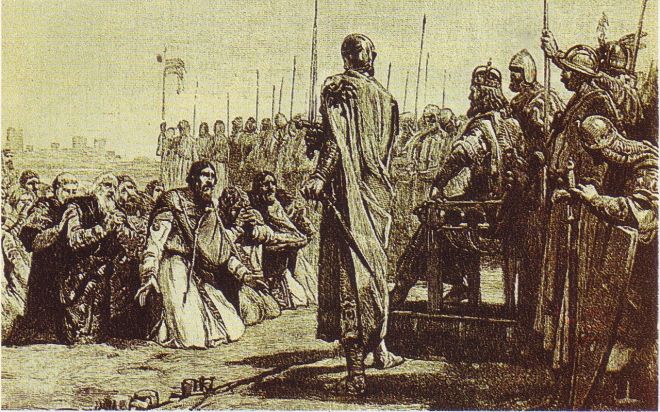
Source

But this time, not only did Frederick impose even more humiliating terms on the Milanese, he also had his allies burn Milan to the ground, with each allied city being responsible for one district (very methodical …). But he decreed one exemption, the places of worship – he was a Christian, after all. So our basilicas more or less got through this one unscathed (more or less because some of them do seem to have got badly singed).

The basilicas now got a break from the horseman of War for 800 years, but the running dogs got to work. Because of them, four basilicas never made it down to us. Two, Santa Tecla and Santa Maria Maggiore (which were very close to each other), fell victim to the running dog of Urban Improvement, in this case in the form of a desire by the City Fathers to build in their place a much bigger and more splendid cathedral, the current Duomo of Milan (the centuries-long story of its construction is the subject of an earlier post). For reasons which will become apparent in a minute, I choose a photo of a painting of the Duomo as it was in 1819.
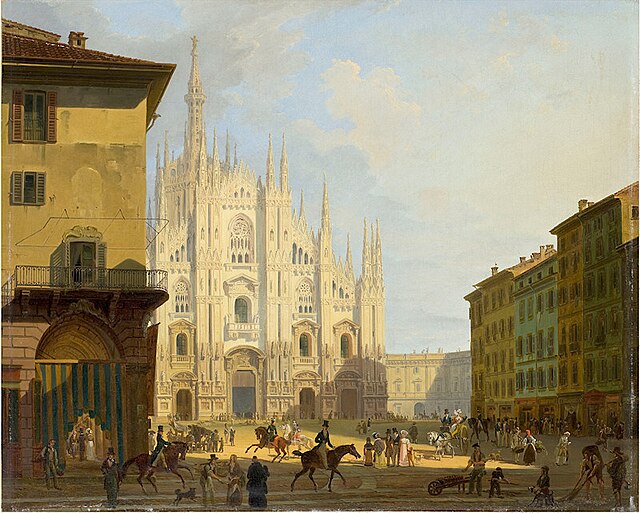
Source

Sant Maria Maggiore was completely destroyed. A very small part of Santa Tecla survived as part of the shops that crowded in on the Duomo (those shops we see on the left of the painting), but that finally also disappeared after the running dog of Urban Improvement came along again in 1865, when the city fathers decided that there was a need for a grand, and large, piazza in front of the Duomo. The buildings in the painting above were all torn down to make the grand – but rather barren – piazza that we have today.
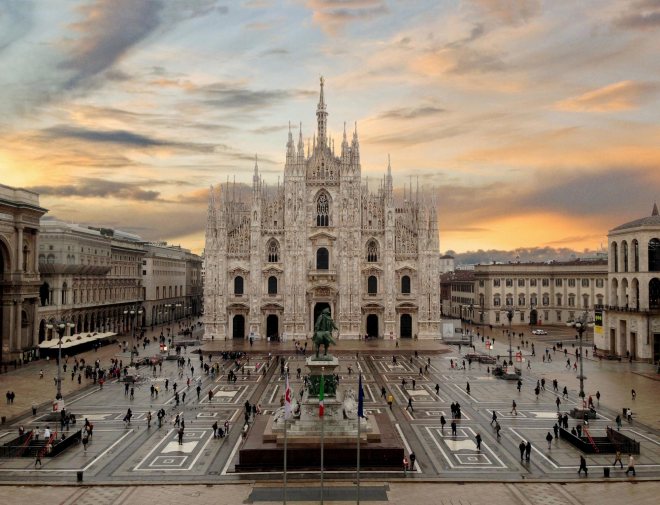
Source

Two other basilicas fell victim to the double whammy of, first, the horseman of Fanaticism, and then the running dog of Urban Improvement. Fanaticism led to the monasteries which had become attached to the basilicas being closed down and to the monks who had looked after them being kicked out. This was done by Emperor Joseph II of Austria (Milan was in Austrian hands at this time) in the name of bringing the Catholic Church to heel and modernising it. Urban improvement took different forms. In the case of the basilica of San Dionigi, it meant that church and monastery completely disappeared as all its lands were turned into a very pleasant public park which is still with us today, the giardini Indro Montanelli.
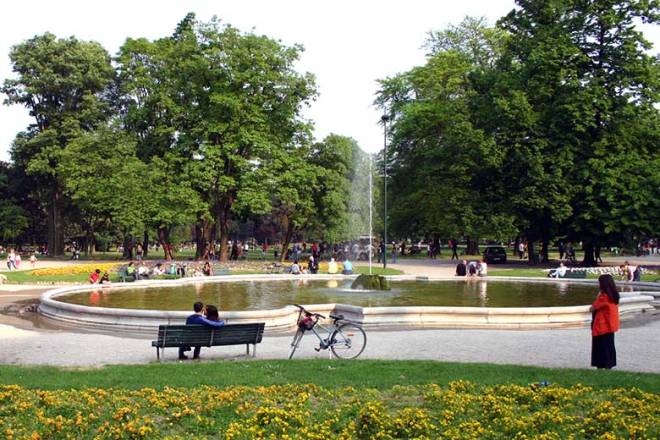
Source

In the case of the basilica of San Giovanni in Conca, Urban Improvement meant a widening of streets and a mad plan, dreamed up after World War II, to drive a new avenue right through the old city centre. The church being in the way, it was unceremoniously torn down. The new avenue was never built (luckily for us; by my calculations it would have gone right through where our apartment building is). But by then it was too late for the church. All that’s left of it is this miserable-looking ruin sitting forlornly in the middle of a busy road.
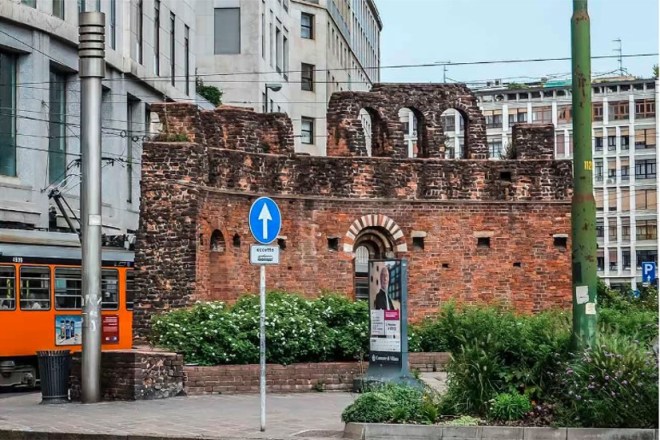
Source

At this point, I’m reminded of the American children’s counting-out rhyme “Ten Little Injuns”, whose first couple of lines go like this:
Ten little Injuns standin’ in a line,
One toddled home and then there were nine;
Nine little Injuns swingin’ on a gate,
One tumbled off and then there were eight.

And it goes on until there are no little injuns left.

To paraphrase the song:
Eleven basilicas built way back when,
Two were eaten up and then there were nine.
Nine basilicas still around,
Two were in the way and then there were seven.

So seven of Milan’s original eleven paleochristian basilicas have managed to stagger on into our modern age. But … “tutto cambia, tutto si trasforma”! None of them look anything like the original Roman-era basilicas. Not all of them even look like the Romanesque churches that replaced them after the disasters of Attila, the Ostrogoths, Barbarossa, and various fires. And even if they appear Romanesque, what we see today is someone’s guess as to what the Romanesque versions of the churches looked like. Let’s look at them one by one.

I start with the basilica di Sant’Ambrogio because it is a mere 10 minutes’ walk from where my wife and I live in Milan, and we often go by it on our various walks. It is also the one that at first glance seems to have changed the least since its rebuilding in the Romanesque style in the 1090s CE. And even in the Romanesque rebuild we see the ghost of the original Roman basilica; the 11th Century builders scrupulously maintained the original building’s floor plan. Here we have some photos of this delightful building. This first shot shows how the church is seen from the road in front of it.

Source

As readers can see, the façade of the church is obscured by some building whose immediate purpose is not clear. The visitor first has to enter this building to enter the church proper. It turns out to be an enclosed courtyard, or – to give it its Latin name – atrium.

Source

It’s interesting that this atrium has come down to us. When the original Roman basilica was built, the atrium had a precise function. At some point during the Liturgy, the catechumens, people who were not “full” Christians yet because they had not yet been baptised, had to file out into the atrium because they were not allowed to be present for the full Liturgy. By the time the church was rebuilt in Romanesque style, this function was meaningless because by then all Christians were baptised at birth. Luckily, it was decided to keep it and use it instead to hold various meetings. So this very early Christian architectural element has managed to make it down to us.

The interior shows the clean, simple lines of the Romanesque style.

Source

In this last photo, readers can glimpse the magnificent mosaic in the apse. Here is a closer look at it – because of the ciborium over the high altar, it’s difficult to get a clean view.
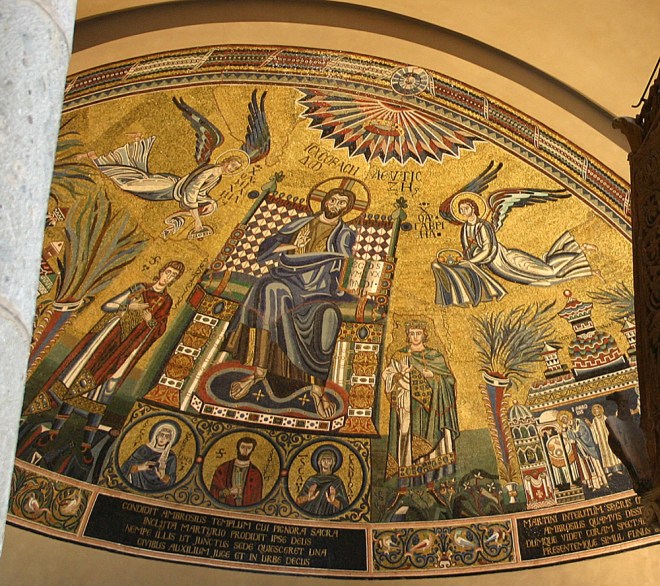
Source

It was originally laid down in the 8th Century, some three centuries after the disaster of the Ostrogoths. From a century later comes the main altar, a magnificent piece of Carolingian goldsmithing.

Source

The ciborium under which the altar sits is equally magnificent, but readers will have to go and visit Sant’Ambrogio to hear about it. I want instead to take readers to a small side chapel, San Vittore in Ciel d’Oro, where some even earlier mosaics, laid down between the sacks of the city by the Huns and the Ostrogoths, by some miracle managed to survive. We see here the cupola of this little chapel, with its mosaic field of gold surrounding a portrait of Saint Victor.

Source

Sharp-eyed readers will have noted that the walls below the cupola carry mosaics of some serious-looking fellows dressed in togas. These are various saints and early martyrs. I show one of these, the mosaic of Saint Ambrose, because contrary to the others it is said to be an actual likeness of the saint, the oldest in existence.
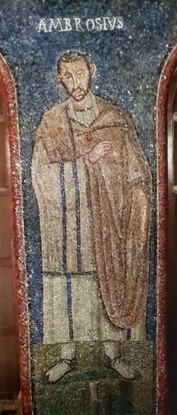
Source

Yes indeed, the basilica of Sant’Ambrogio doesn’t seem to have changed terribly much since its Romanesque incarnation. But alas! It has changed. Because a mere 80 years ago the horseman of War came riding back to Milan in the form of massive bombing raids during World War II. The first of these was on the night of 24/25 October of 1942. There was a second such raid in mid-February of 1943. The climax was four nights in August. These were all raids which, like the infamous bombing raid on Dresden in 1945, a photo of which I give above, deliberately tried to burn the city down by creating a fire storm. Luckily, by the 20th Century there wasn’t that much wood left in Milan’s buildings so a fire storm wasn’t started. Nevertheless, 50% of the city’s buildings were destroyed or damaged. And one of the buildings which was badly damaged was Sant’Ambrogio.
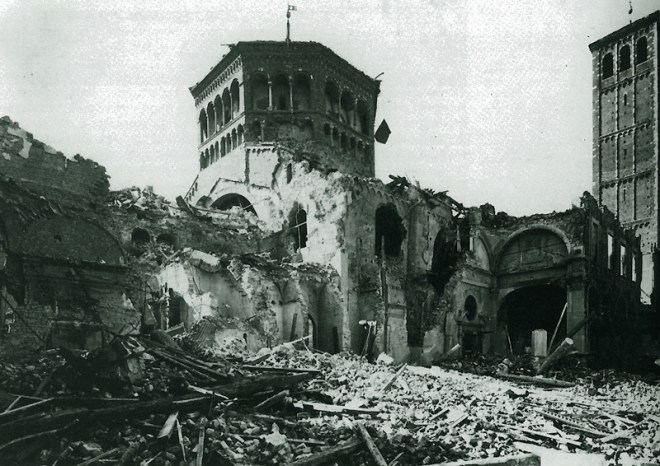
Source

Restorers did a good job after the war in putting the basilica back together again, but you can tell that much of the brickwork is new, as are many of the tesserae in that magnificent mosaic in the apse.

“Tutto cambia, tutto si trasforma”.

Normally, we would next look at the basilica of San Lorenzo. It’s even closer to our apartment in Milan, a mere five minutes’ walk away, and we go by it very often on our way down to Milan’s canals. In fact, we go by it so often that I wrote a whole post about it a few years back, so I will refer readers back to that post.

Logically, the next basilica to consider is the basilica of Sant’Eustorgio. I say logically because there is now a park, il parco delle Basiliche (or, to give it its new name, parco Giovanni Paolo II), which runs between San Lorenzo and Sant’Eustorgio (a park whose creation was much helped by the bombing during World War II; the houses standing on what is now the park were so badly damaged that it was decided to simply tear them all down and create a park in their place). When you enter the park at its northern end, you have this wonderful sight of the venerable pile of San Lorenzo behind you. But very, very little of what we see comes from the original Roman-era basilica, and even from the Romanesque version.

“Tutto cambia, tutto si trasforma”.

Source

Then the walk southwards through the park brings you to Sant’Eustorgio, which stands at the southern end of the park. There’s no striking view of the church from the park itself, so it’s best to make one’s way round to the front, where one is confronted with this view.
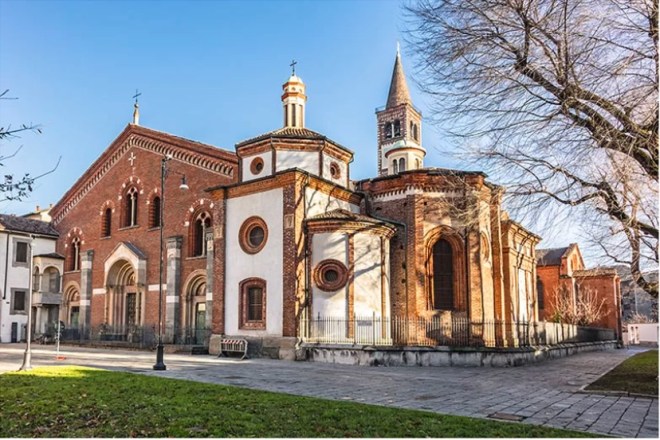
Source

The first thing one notices are the accretions on the church’s side. Unfortunately, the church has suffered badly from the running dog of Showing Off: chapels have been added to the side of the original Romanesque church, paid for by rich Milanese families who wanted to add lustre to their family name. They may be quite pretty in and of themselves; indeed, there is a very lovely one at the back of the church which has been the subject of a previous post of mine. But they have destroyed the original harmony of the church.

The second thing to notice is the façade. It looks quite original, but actually it is the result of a restoration carried out in the mid-1860s. The restoration was certainly done in the spirit of what we know Romanesque façades looked like in northern Italy from the few original examples still with us, but it’s unknown what the original façade of Sant’Eustorgio actually looked like. When all is said and done, though, it was probably better to carry out this restoration than not – this is what the façade looked like prior to the restoration.

Source

Apart from its leprous look, the façade had obviously already been manipulated in the intervening centuries.

The interior is nice enough, although there is nothing spectacular on show.

Source

It was the subject of a sensitive restoration in the late 19th Century, where the restorers simply stripped away the Baroque and Neoclassical accretions and tried to bring the structure back as closely as possible to its Romanesque forms. Of course, the Romanesque builders would never have left the church as naked as it is now, they would have covered everything with frescoes. But those are pretty much all gone. As readers can see in the photo above (especially visible on the columns), the restoration brought to light a few shards of the original frescoes. But of the original mosaics which must have graced the Roman-era basilica, nada, all gone.

“Tutto cambia, tutto si trasforma”.

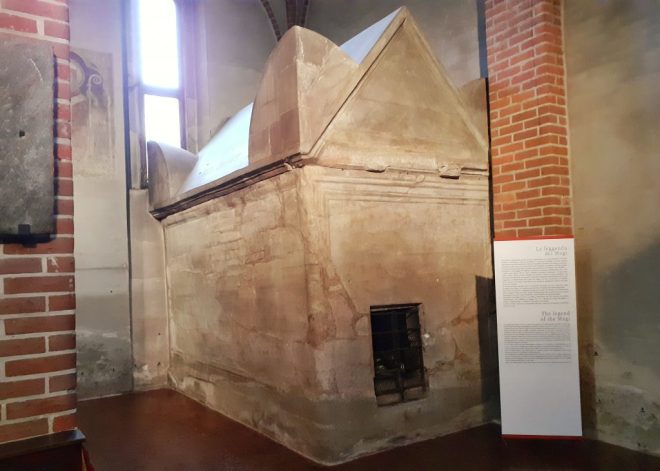
There is one curious artefact in the basilica, and it is this:
Source

“This” is claimed to be the sarcophagus of the Three Wise Men (“We three kings of Orient”, as the well-loved Christmas carol goes). It is fundamental to the basilica’s foundational story. It is said that Eustorgius went to Constantinople when the Milanese chose him to be their bishop, to obtain the approval of the Emperor. Not only did the Emperor approve the choice, but he also gave Eustorgius this enormous sarcophagus which contained the relics of the Three Wise Men, to take back to Milan. Eustorgius’s original idea was to place the relics in the basilica of Santa Maria Maggiore. But the poor oxen which were pulling the cart on which this humongously heavy sarcophagus had been placed “inexplicably” came to a stop where the basilica is now and refused to go any further. Given the weight of the sarcophagus, I think the oxen’s refusal to move another hoof is perfectly explicable, but Eustorgius took this to be a divine sign that a new basilica should be built on this spot to house the relics. Thus was the original Roman-era basilica built.

If I tell this little story, it is because in the succeeding centuries those relics made the basilica famous, attracting flocks of pilgrims (and their money, the cynical me thinks to himself). Which allows me to highlight one of the side-effects of the passage of the horsemen of War and Conquest: looting. In this case, the looting took place during the burning to the ground of Milan by Frederick Barbarossa. One of Barbarossa’s principal advisors during this campaign was Rainald von Dassel, who also happened to be the Archbishop of Cologne. He carried the relics off as war booty to grace his cathedral in Cologne, where they were brought in with much pomp and subsequently housed in this magnificent reliquary (made by Nicolas de Verdun, who also made a magnificent altarpiece housed in the Abbey church of Klosterneuberg near Vienna, which I’ve written about in an earlier post).

Source

For centuries, the religious leaders of Sant’Eustorgio pleaded to have their relics back, but successive archbishops of Cologne turned a deaf ear. It was only in 1903, after a cardinal brokered a deal, that a small portion of the relics were given back.

I shall quickly pass through the fate of the remaining four basilicas.

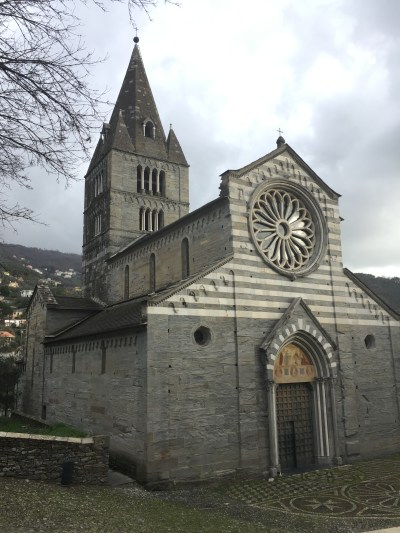
For the basilica of San Simpliciano, I refer readers to a post I’ve already written about it. Suffice to say that it went through the same treatment as Sant’Eustorgio: accretions of chapels in a completely different style, a restyling of the whole church in baroque and neoclassical style, and then a restoration – this time in the 20th Century – trying to bring it back to its essential Romanesque simplicity. I throw in a photo of the exterior and interior.

Source
Source

The best thing in this church is the painting in the apse; you can just see it in the photo. Any readers who are interested in that painting should go to my post on San Simpliciano, where I tell its story.

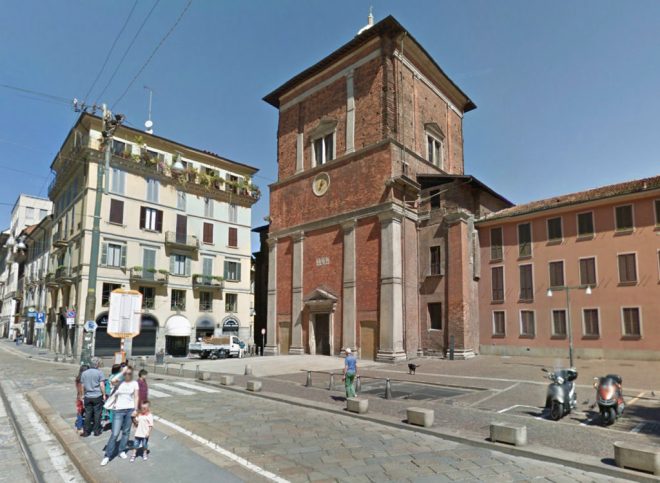
It was a visit to the basilica of San Nazaro in Brolo that started me on this post. Its Romanesque version endured the same fate as Sant’Eustorgio and San Simpliciano: remodelling and remodelling and remodelling of the interior with each successive Change in Taste (that running dog really ran wild here), followed by a stripping back during the late 20th Century to the original simple lines. But in addition, the running dog of Showing Off really sunk its teeth into the church’s structure. During the Renaissance, a family from Milan’s elites decided to attach their mausoleum to the church. And they didn’t just attach it to the side of the church, like a chapel. They attached it to the façade! So the poor church has permanently lost its façade, its place being taken by a square building housing the tombs of this elite family. To enter the church, one has to pass through the mausoleum.
Source

It’s all very well to say that the Mausoleum was designed and built by Bramantino, it’s still a terrible desecration of the church!

As for the basilica of Santo Calimero, it is a poster child to bad restoration. Like the others, its Romanesque version went through various remodellings as tastes changed. It was then “restored” in the late 19th Century into someone’s idea of Romanesque, which is more pre-Raphaelite than anything else. In great distress, I throw in a photo of the mosaic that was laid down in the apse.

Source

Which leaves the basilica San Vittore al Corpo. Well, there it wasn’t a question of remodelling. When the church, in a rather pitiful state it has to be said, was handed over to the Olivetans in 1507, they decided to simply tear down the whole building and rebuild it in the “modern” style. They also completely turned it around, with the choir where the entry used to be and the entry where the choir used to be. So it’s difficult to say that anything of the original church has remained. It is therefore with great sadness that I insert a photo of the church’s hideous façade and of its equally hideous interior.

Source
Source

“Tutto cambia, tutto si trasforma”. My wife is indeed right (as always). We cannot freeze things as they used to be, much as I sometimes would like to. We just have to be grateful that some of the wonderful things our ancestors created have come down to us in not too bad a shape and can only fervently hope that they will still be there for our descendants to admire in 2,000 years’ time.

A MAGNOLIA BEHIND THE CATHEDRAL

Milan, 9 March 2020

A virus stalks the land,  it goes by the name of Covid-19.

Source

For weeks it has been spreading quietly, behind our backs, skipping from hand to hand, riding on droplets we cough out. Now it is out in the open. The patients are pouring into the hospitals. The hospitals are struggling. The frailest – the old, the weak – are dying. The government has enacted drastic measures. Here in Milan, we are in lock-down. No-one can enter or leave the region without a good and serious reason, no-one can even move around within the region. The government exhorts us to stay home. In fact, if we have even a small temperature it orders us to stay home. If we are infected, we are to go to the hospital only if we can no longer breathe. These are anxious times for us all.

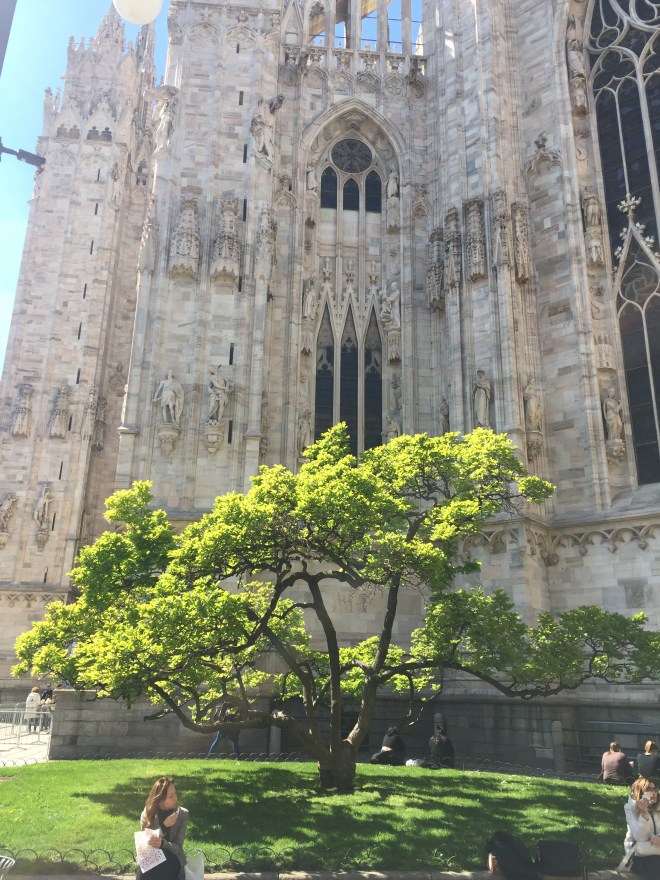
True to the philosophy behind this blog, I have been looking around me for beauty and the peace it can bring the anxious soul. I have found it, in a magnolia tree behind Milan’s cathedral.

As a previous post of mine attests, I love magnolias – who does not? I discovered this particular magnolia tree a few years ago. It grows on a small lawn tucked away between the cathedral’s gothic apse and its southern transept. Last year, I happened to pass by when it was in full bloom. Here, I took the photo with the apse behind.

My photo

Here, I took it with the transept behind.

My picture

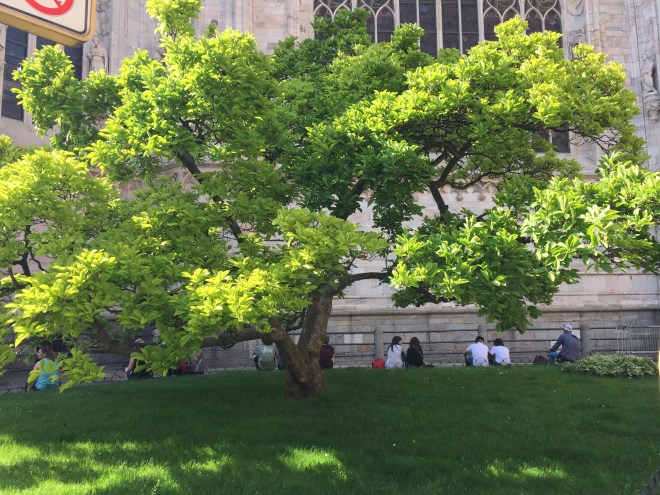
On impulse, I decided to watch the tree cycle through the seasons, finding excuses to walk this way from time to time. The next time I came by it was summer. The flowers had given way to thick foliage.

My photo

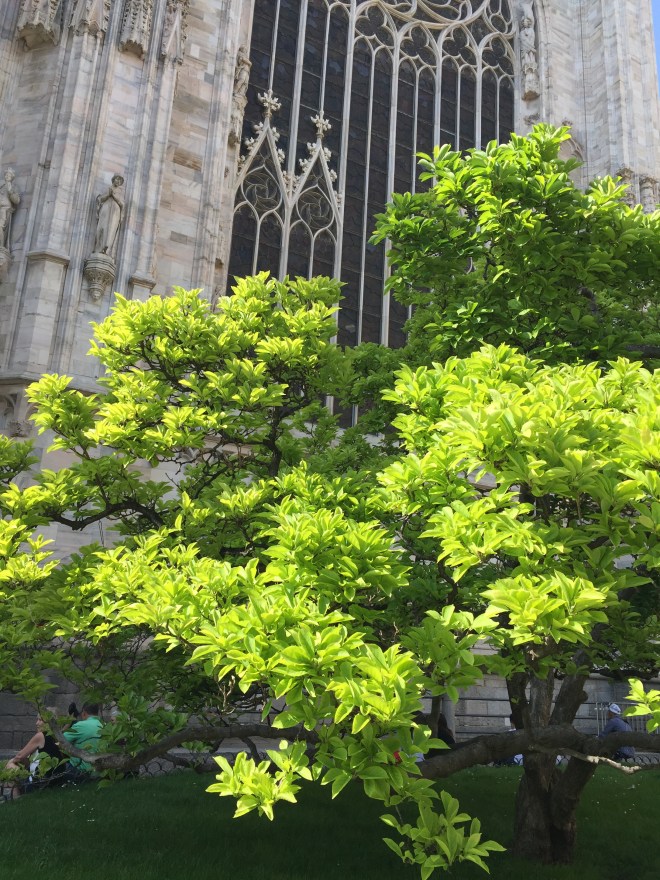
As a previous post attests, I have a weakness for this shade of green, but I found the contrast between the green of the leaves and the white of the cathedral’s stone particularly stunning.  So entranced was I that I snapped several photos of this symphony of green and white.

My photo
My photo
My photo

Shortly after taking this photo, we moved up to Vienna for the rest of the summer, and the autumn took us to Japan once more. So it was only in the dead of winter that I saw the tree again. I saw it at night, its skeleton of branches barely lit by the lights illuminating the cathedral.

My photo

The delicate tracery of the cathedral’s gothic windows took pride of place.

And now, in these dark times, I have gone back to see the tree in flower once more, to draw solace from it.

My photo


PIAZZA DUOMO, MILAN

Milan, 7 March 2018

My wife and I frequently have to go up to Piazza Duomo, Cathedral Square, in Milan, where we visit a little store in the underground station to do our printing. We can’t be bothered to buy a home printer, and anyway we need excuses to leave the house – one of the early lessons of retirement.

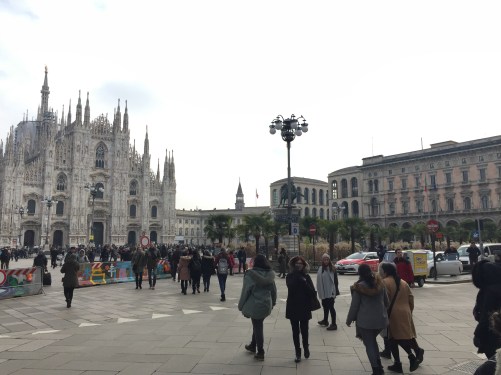
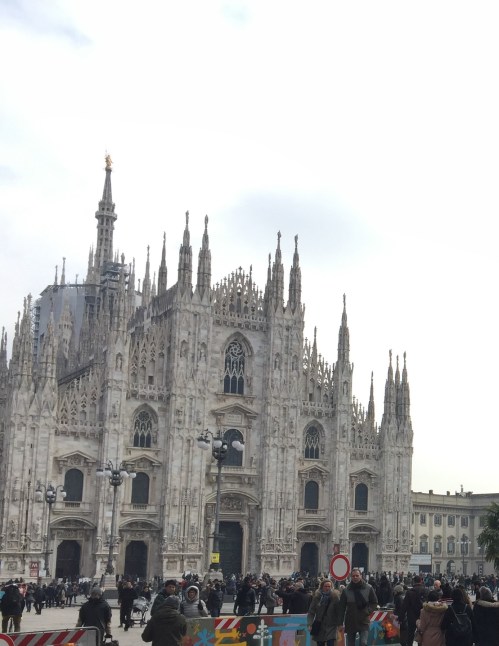
Our usual route takes us through the back streets, coming out at the piazza’s north-east corner. This is the sight that greets us:

I’m very fond of this view, because it encapsulates something like a thousand years of Milan’s architectural history. There are some even older bits of architecture scattered around the centre of the city, but at this point in time they really are just bits – some mosaic-covered arches here and there, from Milan’s early Christian period, tucked away at the back of what were once 3rd-4th century basilicas; short stretches of the city’s Roman streets, preserved in odd corners of underground stations; that sort of thing. Milan’s visible architecture really only starts in the early 1000’s AD.

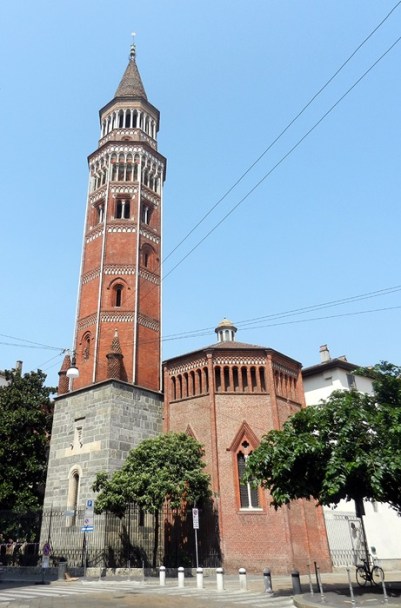
Which is more or less where I want to start unpicking my photo. I invite my readers to zoom in on the campanile poking up at the back of the photo.

This is the campanile of the church of San Gottardo, built around 1336 by order of Azzone Visconti, then Lord of Milan. Azzone dedicated the church to Saint Gotthard because this saint was invoked by those who suffered from gout and stones, and poor Azzone suffered from both. The campanile shows the typical details of the Gothic-Lombard style: red brick combined with white marble, the latter often used in a series of small columns at the top of the tower, but also used to pick out details. Here is the campanile from behind, where this lovely combination of red brick and white stone is seen clearly.

The campanile is particular in another way, in being octagonal. It is not unknown for campanili to take this shape, but the campanile of San Gottardo, in its slimness and height, is a particularly elegant example of the form. In its current format, the campanile has no clock, which is a pity because at Azzone’s orders it originally carried Milan’s (and probably Italy’s) first public clock. This caused so much excitement at the time that for centuries afterwards the area around the church was known as Quarter of the Hours.

Next in time is the massive white Duomo, the city’s cathedral, to the left in my photo.

Actually, the building took centuries to complete, so it’s a little difficult to know what century to assign it to. Going by overall style, we can say that it belongs to the late 14th, early 15th Century. And in fact the decision to build the Duomo was taken in 1386 – so some 50 years after San Gottardo was built – by the-then archbishop Antonio da Saluzzo. It was to take the place of a baptistery and two existing cathedrals – the “winter” cathedral of Santa Maria Maggiore and the “summer” cathedral of Santa Tecla (a combination I have never heard of before). Antonio da Saluzzo was thinking big; he wanted a very large church worthy of the great city of Milan. But he was still thinking traditional; he had in mind a brick and marble church along the lines of San Gottardo. But that idea was nixed by Gian Galeazzo Visconti, who had just taken over the lordship of Milan (through a treacherous attack on his uncle Barnabò, who died shortly thereafter in prison; poisoned, it was whispered, by his nephew). Milan, ever since the Roman Empire, when it became the capital city for a while, looked north across the Alps towards the Empire’s border on the Rhine as well as south. Gian Galeazzo wanted to use the new cathedral to firmly anchor Milan to northern Europe through the use of its architectural styles, which at this point meant late gothic in the Rhenish-Bohemian style. Not only did that mean a different architectural style to the ones then in vogue in Italy, it meant a stone-faced building. So the Duomo that we see today is at its core Lombard, made essentially out of brick, but northern European in look because it is faced with stone. And what a lovely stone it is! A white marble with pinkish hues from the quarries of Candoglia close to Lake Maggiore.

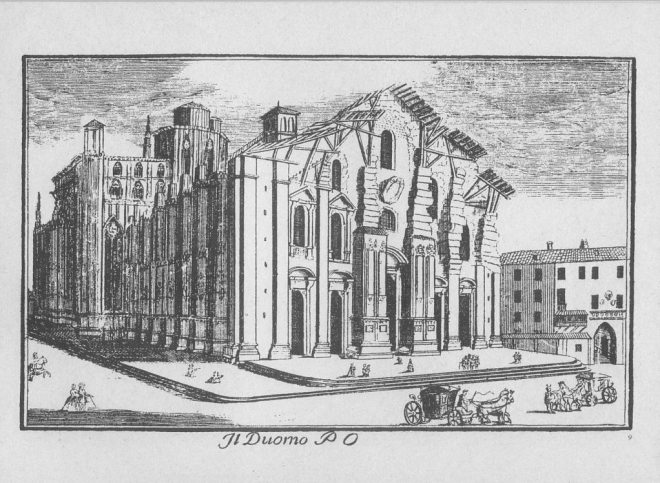
To get the style he wanted, Gian Galeazzo imported French architects, who already then behaved in that typically French manner, poo-pooing on the building techniques of their Lombard masons and generally pissing them off. Neverthless, things moved along, and by the time Gian Galeazzo died in 1402 (but not before becoming the first duke of Milan by paying Wenceslaus IV of Bohemia, King of the Romans, 1,000 florins for the privilege), half the church was complete. At that point, the whole building programme ran out of steam. Things crawled along for another century and a half, until Cardinal Carlo Borromeo took over the archbishopric. There was a spurt of activity for several decades until his death, at which point worked slowed to a crawl again. There were endless arguments about what style the facade should have, and numerous designs were proposed, accepted, then abandoned (something which seems to have been a general problem in Italy, as an earlier post of mine attests). This photo shows what the Duomo looked like in about 1745.

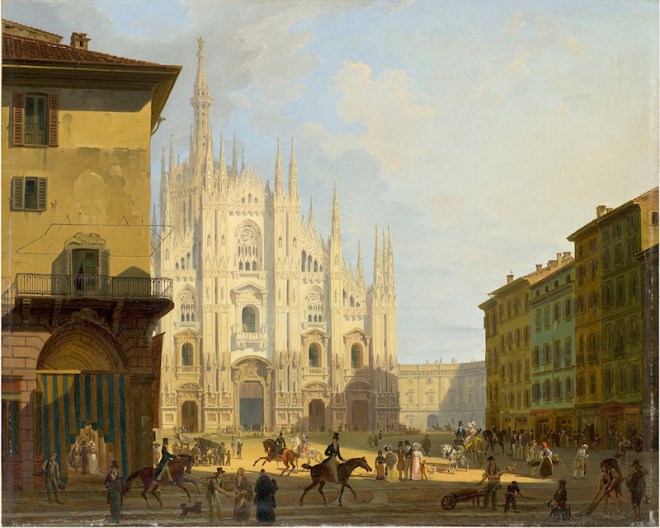
As readers can see, not only was the facade of the Duomo a mess, the cathedral itself didn’t yet have that forest of spires which give the building its distinctive look today. It took Napoleon to get the city to make the final push to get over the finish line. In 1805, he wanted to be crowned King of Italy in the cathedral and he wanted it to look worthy of this solemn ceremony. He made the rash promise that the French State would pay for the final works. This never actually happened, but the promise that someone else would pay galvanized the community and by 1819, when this painting was made, the Duomo looked pretty much how it is today.

Work still continued, and strictly speaking even today it is not finished; there are places where statues are still missing. But when the final door in the facade was installed in 1965, a mere 600 years after work was started, the Duomo was officially declared to be finished. Oof!

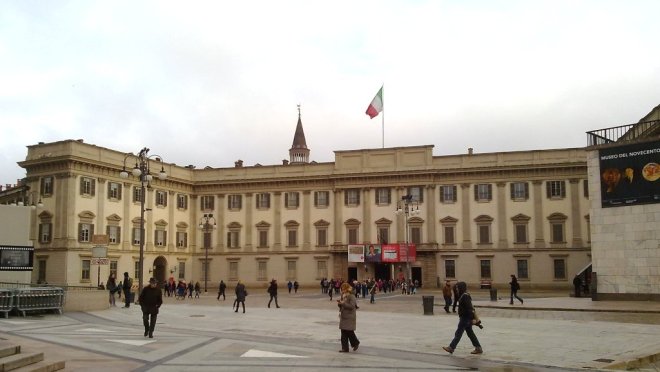
Next in time, we have the building standing in front of the campanile of San Gottardo.

Unfortunately, because of the city government’s bizarre idea of planting palm trees in the piazza, one can now hardly see the building in question from where I took my photo, so let me insert here another photo which I lifted from the internet.

This is the so-called Palazzo Reale, the Royal Palace, although it almost never had royalty staying there. Since the earliest times, this was the area where the government buildings of the Comune and then the Duchy stood. As rulers of Milan and the surrounding territories succeeded each other – the Viscontis, the Sforzas, the French, the Spaniards, the Austrians, the French again under Napoleon, back to the Austrians once Napoleon was safely locked away on St. Helena – they or the Governors they sent added, demolished, changed, extended, and remodeled the government buildings and the lodgings they inherited to fit their needs and their egos. You would think that the result would be a hodgepodge, but actually a remodeling carried out in the 1760s gave the building its defining characteristics both inside and out. The facade that we see in my photo, the first example of the neoclassical style in Milan, is the fruit of that remodeling. Its architect, Giuseppe Piermarini, had a really hard time with the work. His purported client was Archduke Ferdinand of Austria-Este, a younger son of Empress Maria Theresa of Austria (and brother to Marie-Antoinette, who lost her head in the French Revolution). Maria Theresa had packed him off to Milan to marry Beatrice d’Este and to be Vienna’s governor of Lombardy. Ferdinand had dreams of Piermarini building him a residence worthy of his status (at least as he saw it) and a building that would rival the other stately piles going up around Europe (he particularly wanted to compete with his elder brother’s Schönbrunn summer palace in Vienna). But Piermarini’s real client, because she was paying the bills, was Maria Theresa. She was famously cheeseparing and anyway didn’t see her younger son’s position in quite as grand a light as he did. She just wanted him to suitably represent the Austrian Empire in Lombardy and to leave all the decision-making to Vienna. Somehow Piermarini managed to satisfy everyone without getting the sack or having a nervous breakdown and came up with the austerely elegant building that we see today.

The building experienced numerous further vicissitudes. Its moment of greatest glory was under Napoleon, when Milan was the capital of the Kingdom of northern Italy. After the Austrians came back in 1815, Milan went back to being capital of just Lombardy. With Italian unification, the building was handed over to the House of Savoy, but they rarely used it and eventually sold it to the municipality. It got badly damaged during a bombing raid in World War II. It now houses various museums and exhibition spaces.

Then we go to the building on the far right of my photo.

This was part of a rebuilding campaign decided on in 1860 in the wake of Italian unification. In their enthusiasm, the city fathers proclaimed their intention of radically redesigning the piazza in front of the Duomo, making it bigger and grander, and of creating a new major avenue to celebrate King Victor Emmanuel II, first king of the newly-united Italy. I suspect this urban remodeling plan was also seen as a way of cleaning up some embarrassingly leprous zones of the city centre. For instance, putting up the building in my photo, the southern Palazzo dei Portici, allowed the municipality to clear away a whole neigbourhood located there which went by the name of Rebecchino and which was full of petty criminals and other louche types who preyed on the pilgrims and other assorted tourists who visited the Duomo. The remodeling of the piazza in front of the Duomo took from 1865 to 1873. Its most famous element, which you can’t see in my photo, is the Galleria Vittorio Emanuele, which runs from Piazza del Duomo to the piazza in front of the Scala theatre.

But more significantly, I think, the whole piazza in front of the Duomo now has a harmony and elegance which it definitely lacked.

For once, a rebuilding programme decided by a municipal government has left us with something better than what it replaced, especially after a much later municipal government decided to ban advertising billboards on the building opposite the Duomo, Palazzo Carmini.

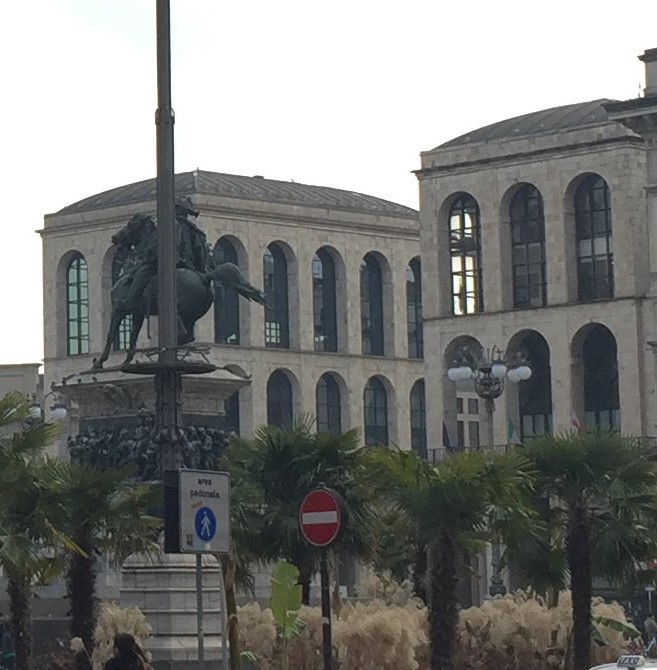
Which brings us to the final building in my photo, the one squeezed in between the Palazzo Reale and the Palazzo dei Portici.

Again, I think readers need another photo from closer by and without those silly palm trees in the way to appreciate the building.

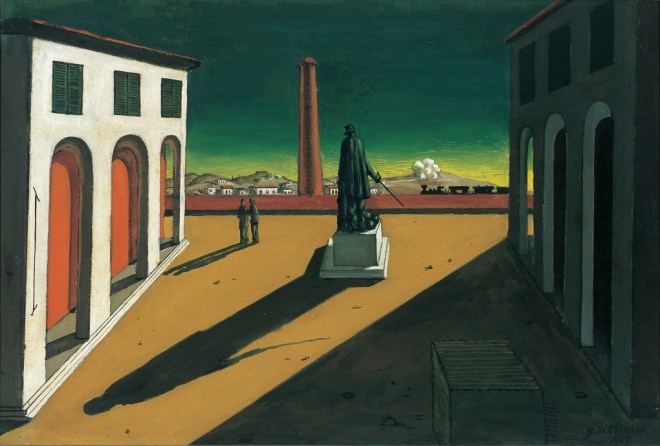
It is a building in the Fascist style, the competition for its design being held in 1937 and construction of the winning design starting in 1938. I don’t know if there is a formal definition of the Fascist style, but these buildings tend to have a “Roman” look to them: the use of white stone facing and of semi-circular arches. They also tend to have little external decoration other than massive, heroic-looking statues and bas reliefs. I don’t know if De Chirico was a Fascist, but many of his paintings have such building in them.

This particular building goes by the name of Arengario, which is an old Italian word first used in the Middle Ages to describe municipal buildings. The root of the word, “aringare”, is the same as the English word “harangue”, and in fact Arengari were buildings from which the municipal authorities addressed (or perhaps harangued) the local citizenry. In later centuries, the term Arengario fell out of use, presumably because municipal authorities couldn’t be bothered any more with the direct democracy of addressing the people. But since the Fascists, Mussolini in the lead, liked to harangue the luckless populace, they brought the word back into use. As a result, a number of Facist-built Arengari, Milan being one of them, are to be found throughout Italy. I presume the idea was that the Fascist cadre would adress Milan’s citizenry drawn up in the piazza below.

The winning design actually had as its overall objective to balance the triumphal arch at the beginning of the Galleria Vittorio Emanuele directly across the piazza, which is why there are two more-or-less identical buildings flanking the road which passes through them, rather than just the one you would need if all you were interested in was haranguing the crowds. The idea was that the road between the buildings would lead to another piazza (today Piazza Diaz) where the country’s modern (Fascist) companies would build their headquarters.

In the event, World War II intervened, construction was halted, what had been built was damaged during the bombing raid that damaged the Palazzo Reale next door, and the municipal authorities found themselves after the war with a damaged, unfinished Fascist building on their hands. The balcony from which the Fascist haranguing was meant to have taken place was quietly demolished and the rest of the buildings were completed by 1956. After various uses, the building next to the Palazzo Reale now houses Milan’s museum of 20th Century art. I highly recommend this museum to any of my readers who happen to be passing though Milan.

Well, that finishes my little tour of Piazza Duomo. Without wanting to sound too much like the local tourism office (which used to be housed in the Arengario), I highly recommend my readers who come to Italy to stop off in Milan before they hasten on to Florence, Rome, and Venice. A stop in Milan can be highly rewarding – in my case, it got me my wife.

________________

Overview and zoom-in photos: mine
San Gottardo: https://it.wikipedia.org/wiki/Chiesa_di_San_Gottardo_in_Corte
Duomo 1745 circa: https://it.wikipedia.org/wiki/Duomo_di_Milano#Contesto_urbanistico
Duomo 1819: https://it.wikipedia.org/wiki/Piazza_del_Duomo_(Milano)
Palazzo Reale: http://ciaomilano.it/e/sights/preale.asp
Galleria Vittorio Emanuele II: https://it.wikipedia.org/wiki/Galleria_Vittorio_Emanuele_II
Piazza del Duomo: https://www.youtube.com/watch?v=SRUXl0wyvLY
Palazzo Carmini, 1970s: https://it.wikipedia.org/wiki/Palazzo_Carminati
Arengario: https://www.pinterest.co.uk/pin/339177415661775996/?lp=true
De Chirico painting: https://www.arteallimite.com/backup_2017/en/2016/07/la-pintura-metafisica-de-giorgio-de-chirico/

THE GOLDEN MEAN IN CHURCH FACADES

Milan, 15 March 2017

Many years ago, when I first visited Italy, one of the things that struck me was the very flat facades which Italian churches had. In the Basilica dei Fieschi, the topic of my last post, we came across a typical example of the genre.

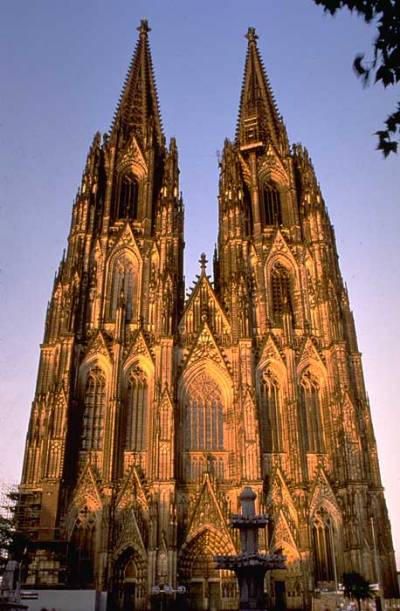
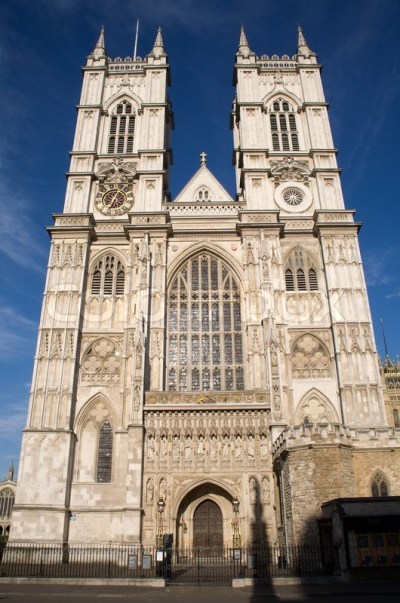
These facades were so different from the much more vertical and more articulated church facades of Northern Europe which I was used to. I throw in here pictures of la Cathédrale Notre-Dame de Paris, Cologne Cathedral, and Westminster Abbey as examples of what I mean.


Much more than these facades, I find that the facades of Italian churches, with all those acres of flatness, can be quite boring, if not downright ugly, to look at unless something is done to liven them up. Consider, for example, the facade of the Florentine Church of Santo Spirito, which my wife and I came across in our recent visit to Florence.

I mean, look at that! It’s just like staring at a blank wall from your office window. Every time we crossed the square in front of it – which, given the location of our rented apartment relative to the locations of the places we were visiting, was quite often – I would comment disapprovingly on the facade’s drabness, its flatness, its total boringness until my wife finally remarked with a touch of asperity that I was repeating myself. But I mean, look at it!

Somewhat less flat but just as drab are the facades of those Italian churches – and there are many – which for some reason never got completed, initially because of lack of money, or quarrels about proposed designs, or the start of wars, or the break-out of pestilence, and thereafter simply through inertia. The facade of the Basilica of San Lorenzo, also in Florence, is an excellent example of this type.


Those rough bricks are just crying out for an elegant, visually interesting facing to be added. That, of course, was the plan. A competition was held, which Michelangelo won. His facade that would have looked like this.

He had gone so far as to choose the marble for the facade. But the Medici pope who was paying was short of cash. So Michelangelo had to choose a cheaper stone. Then the Pope died. Then there was a war. Then Michelangelo was called to Rome by another pope, and that was the end of that. There have been at least three attempts since then to complete the facade, the latest no more than a few years ago, but all have come to naught.

Of course, it is not automatically the case that a finished facade will look better than the original bare brick. Personally, I think that Michelangelo’s facade would have been a definite improvement. But that’s because I’m a fan of simplicity in design, and Michelangelo’s has all the looks of a simple design. Take a look at this facade, though, built more or less at the same time that Michelangelo’s wasn’t.

This is the church of the Certosa di Pavia, which my wife and I visited a few days after our visit to the Basilica dei Fieschi. It was a Carthusian monastery whose creation had been ordered by Gian Galeazzo Visconti, Duke of Milan. The church was to be his family’s mausoleum, and therefore had to be suitably magnificent. For this purpose, he gave the monks access to large amounts of funds which they could only use to embellish the church. So when the Carthusian monks started on the facade, only the best was acceptable, and the more, the better. To the fundamentally sober facade, a riot of Renaissance statuary and bas-reliefs were added, covering every square centimetre of the facade’s surface. Let me zoom in on just a few of the details.


Luckily, all this hue and cry in stone does not overcome the overall effect, which is really very pleasing on the eye.

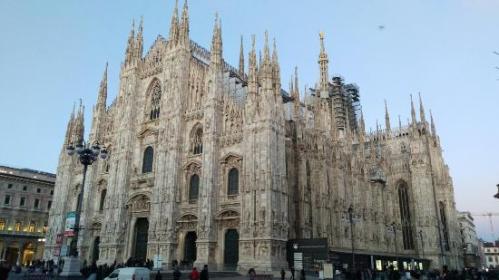
Not so in the case of Milan’s cathedral.

Here, the statuary and other embellishments on the facade have gotten completely out of hand. The effect is not helped by the over-the-top statuary and embellishments having invaded every square centimetre of the entire outer envelope. All this gives one the feeling that the cathedral is drowning in white marble froth.

So where does this all leave us? Well, I suppose we have here yet another example of Aristotle’s principle of the golden mean: we should always seek the middle ground between the extremes of excess and of deficiency. So in our case, neither facade-less nor frothy facade.

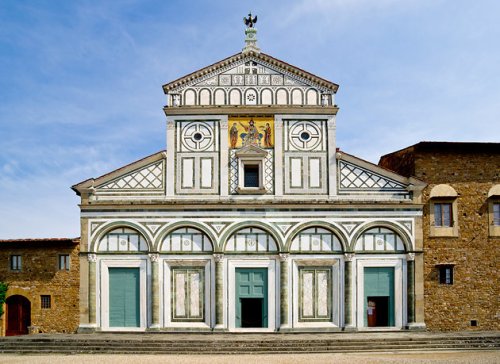
With this in mind I invite readers to go back to facade-less Basilica of San Lorenzo. What design could we propose to Florence’s city fathers? Let me immediately say that the obvious proposal of simply finally installing Michelangelo’s design won’t fly. This was there the very recent suggestion by the-then mayor of Florence, Matteo Renzi (who, fyi, went on to be briefly Prime Minister of Italy). This proposal was shot down, on the grounds that putting up Michelangelo’s facade now would be akin to making fake Louis Vuitton handbags (that precise simile was not used, I hasten to add). So a copy of an old design is out. Which is a pity, because I think that the facade of the Florentine church of San Miniato, for instance

or of Pisa’s cathedral

would both nicely fit the golden mean principle.

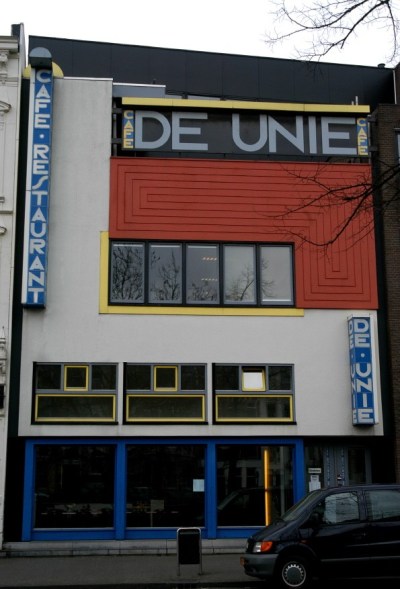
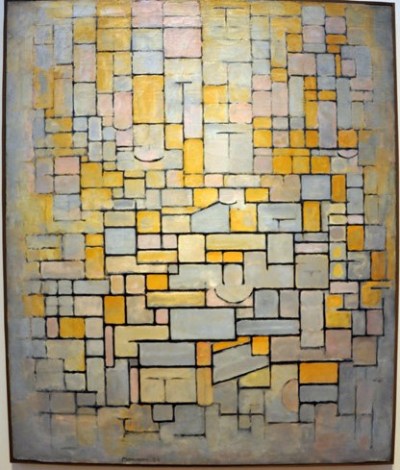
Personally, I think we should take our cue from San Miniato’s use of colored lines, although maybe to avoid the criticism of simply copying the past, we could adapt a more modern approach to line-drawing: a Mondrian style, for instance.

A follower of Mondrian’s actually adapted the style to a building facade, although in this case it was a very secular subject, a café in Rotterdam.

Given the ecclesiastical nature of our subject as well as its venerable age, I think we would need to go for more muted colours than Mondrian’s signature blues, reds, and yellows. Perhaps we could adopt the more muted hues of his earlier works.

If I had access to an app which would allow me to make architectural drawings, I would come up with a design to propose to readers. Instead, I will just leave it to their imagination as to what a Mondrian-like facade on the Basilica of San Lorenzo might look like.

____________
Facade Basilica dei Fieschi: my photo
Facade Notre-Dame cathedral: https://fr.m.wikipedia.org/wiki/Cathédrale_Notre-Dame_de_Paris
Facade Cologne cathedral: http://www.learn.columbia.edu/ma/htm/related/ma_cologne_cath_01.htm
Facade Westminster Abbey: https://www.colourbox.com/image/london-westminster-abbey-west-facade-image-3357405
Facade Santo Spirito church: https://commons.m.wikimedia.org/wiki/File:Facciata_di_santo_spirito_01.JPG
Facade of the Basilica of San Lorenzo: https://commons.m.wikimedia.org/wiki/File:San_lorenzo_Facciata.JPG
Facade of the Basilica of San Lorenzo – Michelangelo’s design: http://www.fiorentininelmondo.it/it/home/143-san-lorenzo-e-la-facciata-di-michelangelo.html
Facade Certosa di Pavia: http://www.visual-italy.it/IT/lombardia/pavia/certosa/
Detail facade Certosa di Pavia: https://it.m.wikipedia.org/wiki/Certosa_di_Pavia
Detail facade Certosa di Pavia: http://www.settemuse.it/viaggi_italia_lombardia/pavia_certosa.htm
Facade Milan cathedral: https://www.pinterest.com/mayavnt/duomo-milan/
Milan cathedral from side: http://topsy.one/hashtag.php?q=DuomodiMilano
Facade San Miniato church, Florence: https://www.gonews.it/2014/09/23/i-monaci-di-san-miniato-al-monte-chiedono-aiuto-per-il-restauro/amp/
Facade Pisa cathedral: https://www.turismo.intoscana.it/site/it/amp/Cattedrale-di-Santa-Maria-Assunta-a-Pisa/
Mondrian: https://www.themodernhouse.com/journal/from-the-archive-spruce-apartments-by-architect-amin-taha/
De Stijl café: https://www.pinterest.com/pin/264727284317842292/
Early Mondrian: http://www.pbase.com/bmcmorrow/image/143392523


VIBRAM FIVEFINGER SHOES AND FLAYING

New York, 28 December 2012

My daughter has recently bought herself a pair of Vibram FiveFinger running shoes. For those of you who might not be familiar with this latest cool product, I add here a picture of my daughter’s pair.

giusti shoes

I was not aware of the existence of these shoes until my daughter announced their purchase to me and my wife. In our university days, back in the 1970s, we had come across the-then cool new product, socks with toes, when the sister of one our roommates came to visit and turned up at breakfast time sporting them. For those of my readers who are in the Stone Age of coolness and have never even seen this product, I append a picture.

socks with toes

Intrigued by these strange-looking – but utterly cool – shoes, I visited the web site of the company which designed them, which as an Italophile I am proud to say is Italian. Only Italians could possibly have designed such a shoe. The company in question is Vibram, and I quote here part of the blurb on the shoe from the web site:

“Industrial Designer, Robert Fliri, first proposed the idea of FiveFingers footwear to Marco Bramani, grandson of Vibram founder Vitale Bramani, who immediately embraced the concept. Bramani and Fliri developed the first barefoot shoes, then showed the concept to Vibram USA president & CEO, Tony Post. As a former collegiate runner, Post quickly became a firm believer in the benefits of natural running* and fitness training. He discovered that Vibram FiveFingers were the unique solution to the knee pain and soreness he was experiencing when running.

Soon, they collaborated with the full Vibram team to position Vibram FiveFingers® as a performance product for running, fitness and outdoor sports. FiveFingers not only encouraged a more natural forefoot strike during running, but also allowed the foot to move and work in a completely natural way, while providing grip and protection over a variety of surfaces.

*Running in Vibram FiveFingers requires a significant increase in lower leg and foot strength. A gradual transition is critical to avoid overuse injuries. For more information on making a safe transition please refer to our Barefoot Running page.” (1)

The site has this picture, which shows the ample delights awaiting the purchaser of these shoes when running in them:

woman running in vibram shoes

Yet, in all this wash of coolness and delight, I have to tell you that I find these shoes rather creepy, because they remind me of Saint Bartholomew. For those of my readers who are not well versed in Catholic martyrology, Saint Bartholomew, mentioned as one of the Twelve Apostles in the three Synoptic gospels and in the Acts of the Apostles, is reputed to have been martyred in Armenia by being flayed alive and crucified upside down. Since flaying is not a common practice any more, I should further elucidate that flaying is the act of stripping the skin off a person, preferably when still alive so as to make the experience of dying all that much more excruciatingly painful.

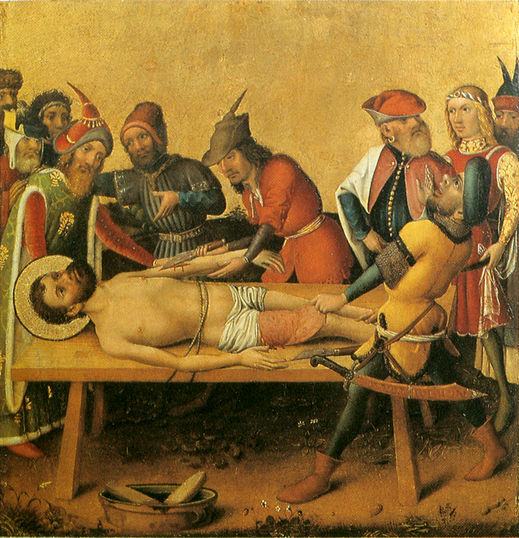
As anyone who has ever walked through the European medieval section of a good art museum will know, Medieval painters – no doubt responding to popular demand – took a morbid delight in showing in clinical detail the varied torments to which the Christian martyrs were subjected; given Saint Bartholomew’s particularly grisly end, he was a popular subject of such paintings. I show here such an example.

saint-bartholomew-painting-3

Please note the stoicism with which Saint Bartholomew is taking it all. Personally, I would have been screaming and begging and pleading and blubbering and generally carrying on. But then I am not a Christian martyr.

Usually, representations of Saint Bartholomew will show the poor man, stoic to the last, carrying his flayed skin as well as one of the knives used to flay him.

saint-bartholomew-painting-2

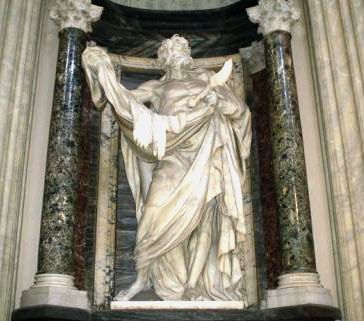
This particular representation I find quite realistic since the – hopefully – corpse at the end of a flaying presumably must be a bloody mess, although in this particular painting the bloodiness looks more like a body stocking. Indeed, as time passed the gory details tended to be dropped in favour of a more romantic representation, such as this one in St. John Lateran in Rome.
saint-bartholomew statue-5-Rome

I am particularly mystified by the fact that the Saint has recovered his skin in this representation, but presumably when one goes to heaven one becomes whole again.

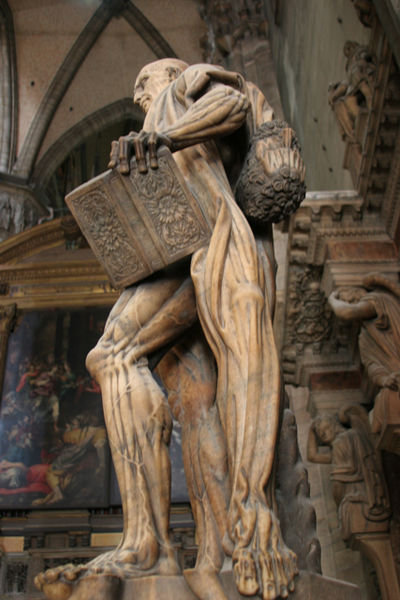
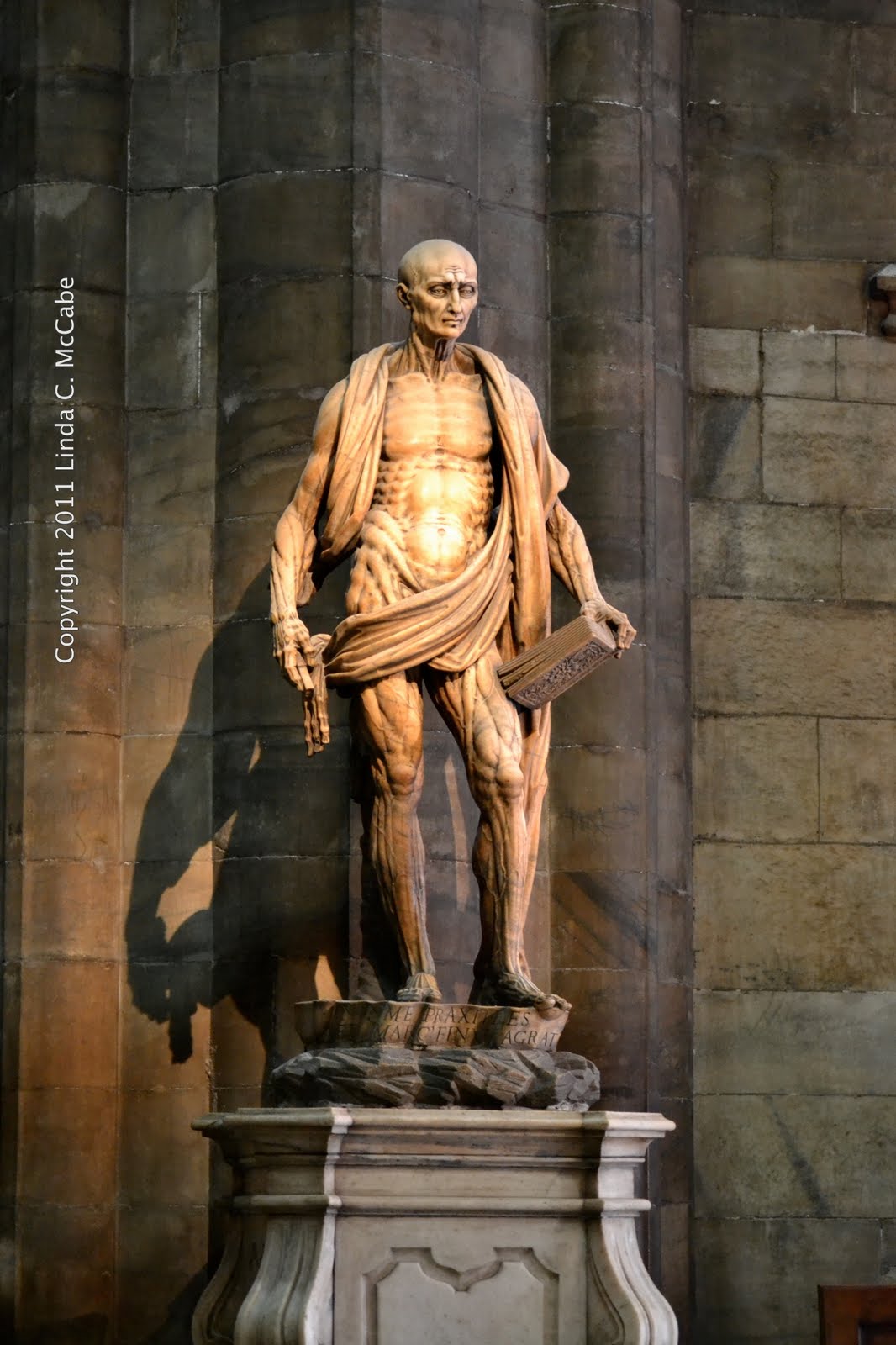
This trend towards the sucrose was spectacularly bucked by one Marco d’Agrate, who in 1562 created a gruesomely realistic statue of Saint Bartholomew which now resides in the Duomo of Milan. I happen to know the Duomo well since my wife is Milanese and as a patriotic duty we always visit the Duomo every time we go back. As this photo shows, Signor d’Agrate has benefited from the vivisections of human bodies that Renaissance scientists had managed to carry out in the face of the Church’s disapproval and he has created a good representation of the muscles and sinews of a human body after the skin has been stripped off. He has of course maintained the tradition of having the Saint hold his flayed skin but has made more of a fashion statement of it, draping it artistically around the Saint’s shoulders.

saint-bartholomew statue-1

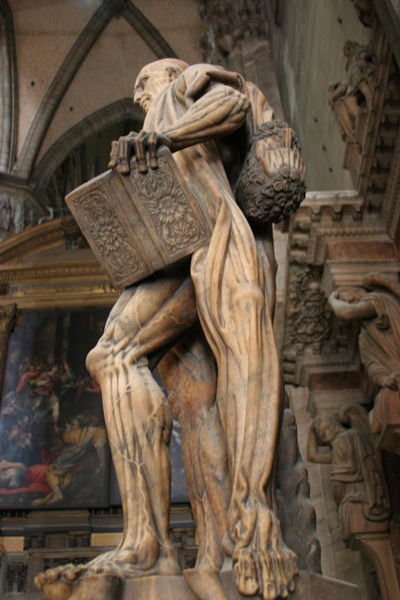
And it is now that we come to the connection with the Vibram FiveFingers shoe. This photo, taken from another angle, shows very clearly the feet of the flayed skin. I see an uncanny resemblance in these with the Vibram shoe. Hence my feeling of creepiness.

saint-bartholomew statue-3b

Happy holidays!

____________________
1. http://www.vibramfivefingers.com/about_vibram_fivefingers/

socks with toes: http://screaminglywonderful.files.wordpress.com/2011/03/26-270d242b-4a17-46e5-af00-642d212561ac1.jpg
St. Bartholomew being flayed-painting: http://tomperna.files.wordpress.com/2012/08/martyrdom-of-st-bartholomew.jpg
St. Bartholomew standing-painting: http://medievalmilanetc.files.wordpress.com/2012/07/1330-0824the-apostle-st-bartholomew-matteo-di-giovanni-about-1480-tempera-on-wood-budapest4.jpg
St. Bartholomew statue Duomo: http://1.bp.blogspot.com/-e4KglOQz_YY/TpSZV147dJI/AAAAAAAAFww/NlApP8L0T-I/s1600/Flayed%2Bsaint.jpg
St. Bartholomew statue-the feet: http://2.bp.blogspot.com/-DgRk_bNF1uQ/TgTtgrB10RI/AAAAAAAADMI/QxIB4yOl-Dc/s1600/00%2B1520978-The-statue-of-a-flayed-St-Bartholomew-wearing-his-skin-0.jpg