Milan, 23 April 2025
It was an article in the Guardian that started me off on this post. The writer was describing an expedition of his into the countryside in Kent to go foraging. He mentioned having seen dandelion, common sorrel, lady’s smock, stinging nettle, goosegrass, reedmace … plants I have never eaten; in fact, apart from dandelion and stinging nettle, I’ve never even heard of them. The writer goes on:
“Further along the hedge, the large glossy leaves of alexanders stand in ragged clumps above the dull, wintered sward; yet another superb edible and the main reason for my visit. This plant, most likely introduced by the Romans, comes from the Mediterranean where it was once known as Petroselinum Alexandrium – the parsley of Alexandria. Like many members of the carrot tribe, they present a huge amount of culinary potential – all parts of the plant can be eaten, offering complex floral flavours and harmonising notes of bittersweet. The root is particularly delicious, something akin to a fragrant parsnip once roasted. … I get to work harvesting a few alexander crowns, the burgeoning flower stems still sheathed in soft green leaves. Later I’ll roast them with feta and sun-dried tomatoes, returning the unmistakable smell of spring fare to the kitchen.”
I have to admit to also never having heard of alexanders, let alone eaten it. In the face of such ignorance, I might have moved on to another article in the Guardian were it not for the fact that something in the article’s description – the mention of a Mediterranean origin perhaps? – intrigued me, and I decided to investigate.
The first thing I did was to pull up some photos of this plant, because I had no idea what it looked like. Here’s a nice example of what I found.

As I studied this and other photos, I said to myself “hang on a minute, I think I’ve seen this plant recently. Wasn’t it at some point half choking the path on that last hike we did?” This was in Liguria, when my wife and I were taking the high path which snakes along the contours of the hills between Sori (where we have our apartment) and Recco (where we were going to eat focaccia al formaggio). As always, I turned to my go-to source, Wikipedia, for further information. I was not disappointed.
Let me start with a map of the plant’s current distribution.

It seems that it can be found throughout Italy and Greece, as well as much of the UK and Ireland. Otherwise, it is more of a coastal plant. So there is a good chance that what I saw on that walk was alexanders. There is some discussion as to whether, as suggested by the writer of the Guardian article, this is a Mediterranean plant which was brought to the UK and elsewhere in Northern Europe (the Romans being a popular possible vector as far as the UK is concerned) or whether it is actually native to all the places in Europe where it is currently found.
I’ll leave that question to the experts to hash out. What caught my eye in the Wikipedia entry instead was a sentence: “Inland [in the UK], it is often found close to the sites of medieval monastery gardens and other historical places such as castles.” And suddenly, a vision of Brother Cadfael working his herb garden floated up in my mind’s eye. For any readers who might not be familiar with Brother Cadfael, he is the main character in twenty books set in a Benedictine monastery in Shrewsbury, England. The stories take place between the years 1135 and 1145, and have Cadfael solving all sorts of murders and other Medieval mayhem. He is also the monastery’s herbalist, making up medicines for sick monks, using herbs he grows in the monastery’s herb garden where he grows the plants he needs to make up his potions. I throw in a photo of the cover of the 20th book in the series, where he seems to be in his herb garden.

I have to say, I’m extremely fond of the Cadfael stories. As the photo intimates, I have all twenty of the series. I’m not so fond of the TV show starring Derek Jacobi as Cadfael. Normally, I’m a great fan of his, but this show didn’t really grip me.
In any event, I throw in here a painting by Fra Angelico showing monks at work on their garden.
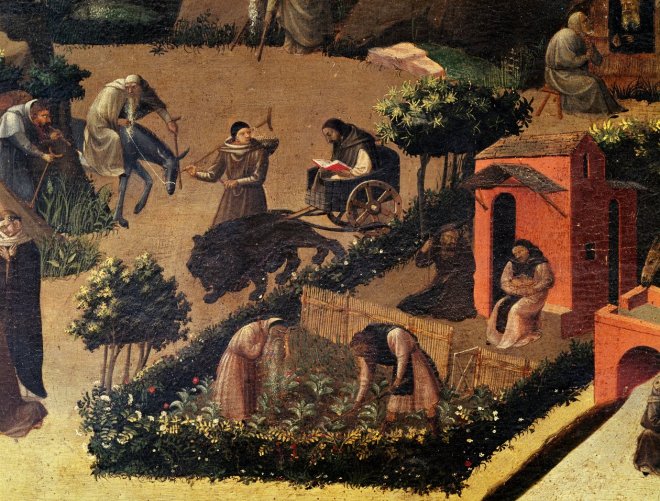
I don’t know if Cadfael would have grown alexanders in his herb garden. The plant was mostly grown to eat, but Wikipedia does say that it also had therapeutic uses. So I’m happy to think that his herb garden would have contained alexanders.
Another sentence in the Wikipedia entry caught my eye: “It was once highly valued in northern Europe as an early vegetable: one of the few fresh plants that can be eaten in February or March”. If it was so highly valued, what happened? Well, it seems that in the 18th Century (or maybe even in the century before that) it lost out to celery. John Evelyn (whom I’ve had cause to mention in an earlier post) had this to say in his book Acetaria. A Discourse of Sallets [Salads] published in 1699: “Sellery … was formerly a stranger with us (nor very long since in Italy) [It] is a hot and more generous sort of Macedonian Persley [Macedonian parsley being another name for alexanders] … and for its high and grateful Taste is ever plac’d in the middle of the Grand Sallet, at our Great Men’s tables, and Praetors feasts, as the Grace of the whole Board”. The Wikipedia entry confirms (in slightly more sober language) this similarity in taste between alexanders and celery, at least as far as the leaves are concerned: “the young foliage is intermediate in flavour between celery and parsley”.
And so, abandoned by monk and lord of the castle, domesticated alexanders went feral, spreading out from the old monastic and aristocratic herb and vegetable gardens into the surrounding countryside. I suppose in the UK in particular the tidy plantings of alexanders in monastic gardens were victim of Henry VIII’s dissolution of the monasteries in the late 1530s, which left behind only a few ruins like this one, of Byland Abbey in Yorkshire.

(I chose this particular ruin because it happens to be down the road from my old school; I did some very basic archaeological mapping there but don’t remember ever seeing any alexanders).
Is there any chance of seeing alexanders back on our plates? Well, Wikipedia holds out some hope: “It … has found some renewed use in exotic “foraged” food recipes and restaurants.” A first, timid step to its journey back onto supermarket shelves next to celery, perhaps. Maybe I should forage it and try it. But the Guardian article does contain a warning: “care must be taken with identification … [nearby] hemlock water dropwort is growing in great profusion. This deadly relative and a half-hearted imposter of alexanders is easy to distinguish with experience … but surviving long enough to gain such confidence requires a little care”. That makes me gulp. Right now, I think I’ll just take photos of the plant, like this one I took recently on a hike on the Monte di Portofino starting from San Rocco.

 the heart thrills