THE GROUP OF SEVEN

Milan, 13 January 2025

My wife and I were recently listening to an article from the New York Times about an Egyptian immigrant to New York, by the name of Armia Khalil. Mr. Khalil had been an artist in Egypt. He liked to create pieces that echoed the country’s ancient artefacts. He did so using tools he had created that were similar to those used by the Ancient Egyptians themselves. Of course, when Mr. Khalil arrived in New York, with a suitcase crammed with his tools but with hardly two nickels to rub together, he didn’t have the luxury to use them; he needed a job. But he didn’t want any old job. He wanted a job that brought him close to art. So he applied over and over again for jobs as a museum guard to the city’s many museums; he reasoned that at least this would allow him rub shoulders with art all day. Finally, after six years of trying, he managed to unhook a museum guard job at the Metropolitan Museum of Art.
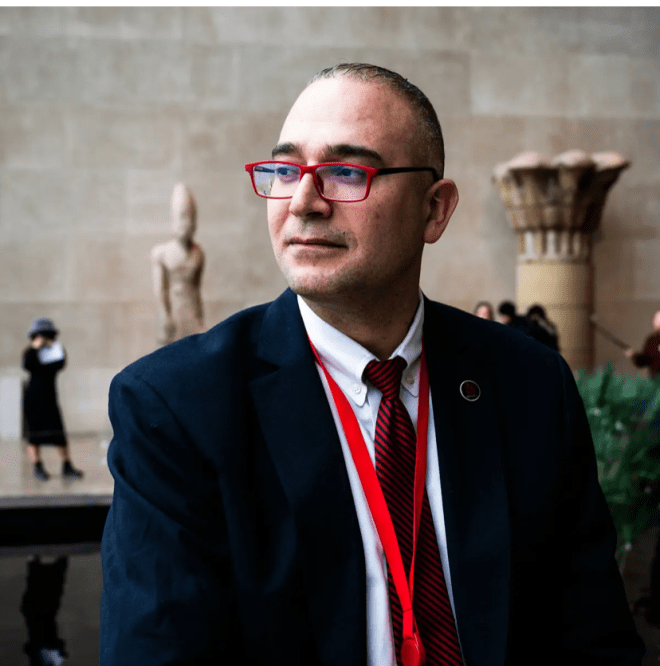
Source

Readers can read (or hear) the rest of his delightfully heart-warming story in the original New York Times article, if they can get around the paper’s firewall. If not, they can visit his WordPress blog – it gives me great pleasure to advertise a fellow WordPress blogger.

Mr. Khalil’s repeated attempts to be hired as a museum guard to get close to art brought back fond memories for me. Because I had tried to do the same many, many years ago. It was January, I was 18, I was staying with my parents in Ottawa for five months until the beginning of June, I needed to find something to do. Whenever I had spent the holidays with my parents, I had always found the time to visit Canada’s National Gallery. This is the building I used to visit, back in the early 1970s, although I see it has now moved into a sparkling new building somewhere else in Ottawa.

Source

I found the time I spent there most soothing. I thought, why not spend my five months in Ottawa, sitting on a chair in the Gallery’s exhibition rooms and admiring the art around me? So I got myself an appointment with the head of the guards and arrived promptly for the interview. It was in a dreary, windowless office somewhere in the basement of the building. He was sitting at his desk, flanked by one of his guards. He invited me to sit down. He looked me over. Then, with great frankness, he told me why he doubted that I was right for the job. He pointed out that I was much more educated than the other guards, so had I thought about what my social interactions with them would be like? (the implication being, no doubt, that I would be awfully lonely during the working day, with no colleagues to really speak to). Did I not think, he continued, that I was far too young to get stuck in what was, at the end of the day, a pretty boring job? His basic message, I felt, was that it was best to be ignorant, probably stupid, and old before accepting a dead-end job as a museum guard. His side-kick nodded throughout this analysis, which was sad because at the end of the day his chief was talking about him. Thinking about it now, he could have been describing Mr. Bean working at the Royal National Gallery in London, in the film Bean.
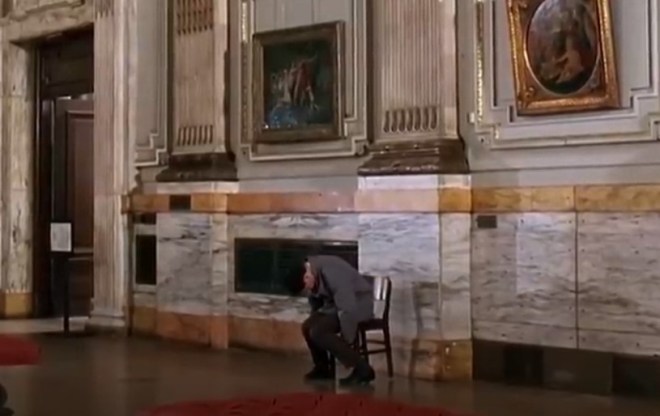
Source

My interview was terminated with a final parting shot. The chief pointed to my fashionably long hair and regretfully informed me I would have to cut it, to conform to the short-back-and-sides style sported by the (male) guards. Crestfallen, I left without a job. Unlike Mr. Khalil, I did not try other museums or art galleries in Ottawa.

It was actually just a couple of rooms in the National Gallery that I would particularly have wanted to sit in as a guard, using my time to admire the paintings. They were dedicated to the Group of Seven, a coalition of Canadian painters who came together from shortly after World War I to the early 1930s. They were looking for a style of landscape painting that was distinctly Canadian and modern. To my mind, they succeeded brilliantly, with Lawren Harris being the jewel in the crown. His iconic painting, North Shore, Lake Superior, painted in 1926, is in the National Gallery.

Source

But he painted many other wonderful paintings. Here is a selection. This first painting, Northern Lake, is from around 1923, early on in the Group of Seven’s life.

Source

This painting, from around 1924, is another whose subject is Lake Superior: Pic Island.

Source

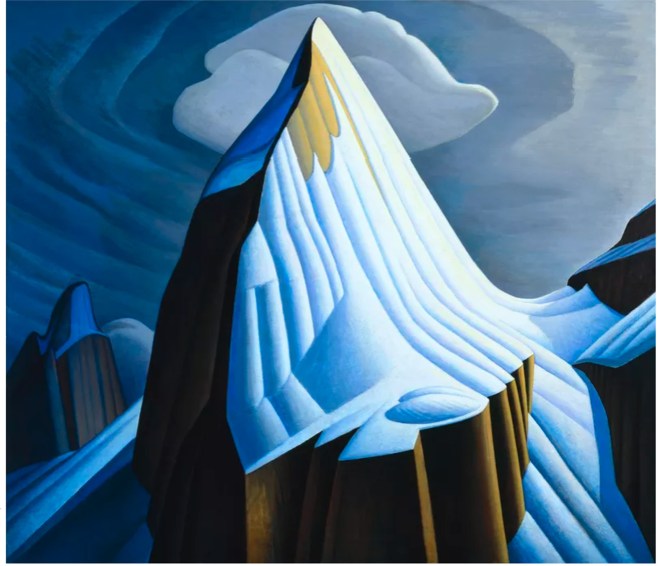
At some point in the late 1920s and early 1930s, Harris went to Canada’s far north and even to Greenland. The results of these expeditions were a long series of almost abstract paintings of great beauty. I show only three here. The first two hang on our walls in Vienna in the form of prints (I am not, alas, rich enough to be able to afford an original Lawren Harris).

This one is titled Lake and Mountains, from 1928.
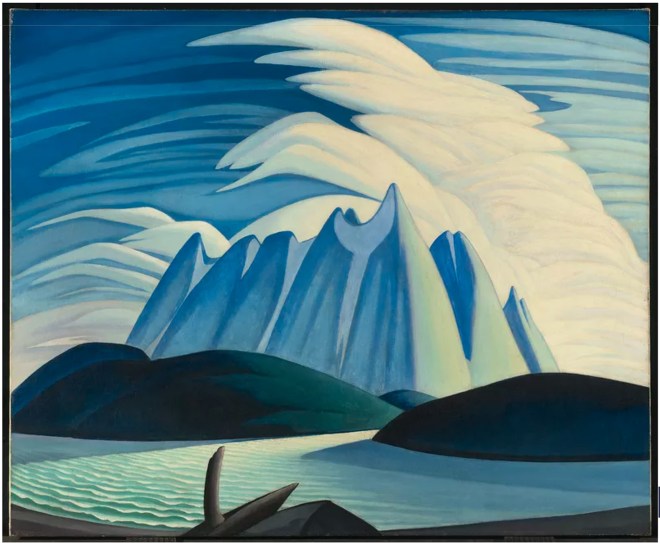
Source

And this one is Mt Lefroy from 1930.

Source

The final painting I show from Lawren Harris is Icebergs, Davis Strait, also from 1930.

Source

Perhaps not surprisingly, in later decades Harris veered off into abstraction. I haven’t followed him there; abstract art is not really my thing.

While I particularly admire Harris, the paintings of the other members of the Group of Seven are not be sniffed at. I give one example for each of them.

Franklin Carmichael, Wabajisik Drowned Lake, from 1929.
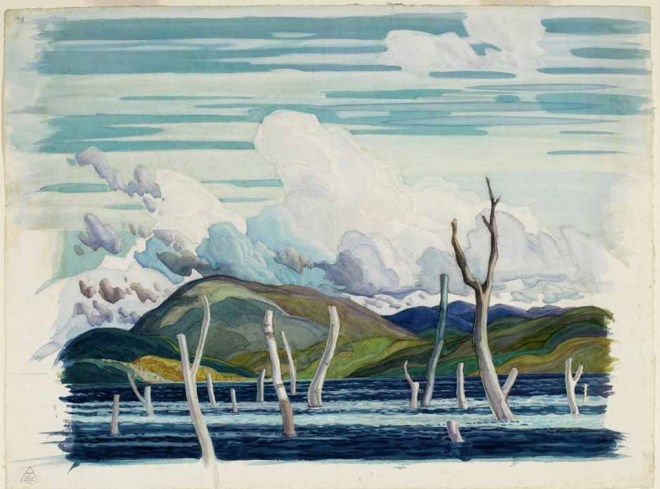
Source

A.Y. Jackson, Barns, from 1926.

Source

Frank Johnston, The Fire Ranger, from 1921.

Source

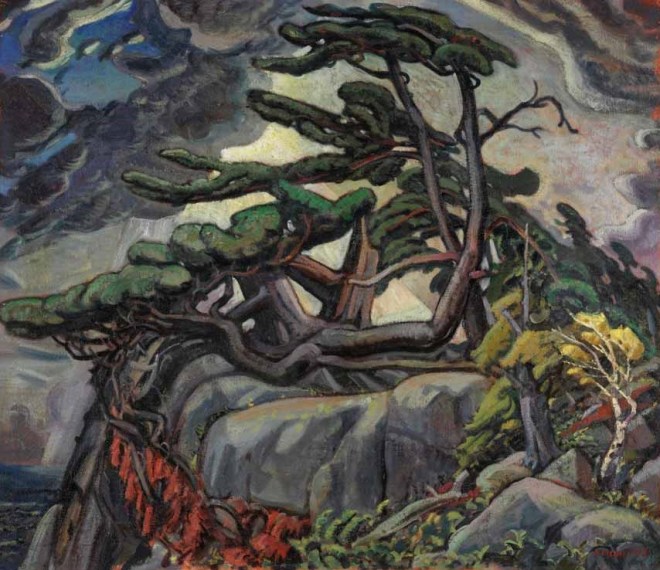
Arthur Lismer, Pine Wrack, from 1933.
Source

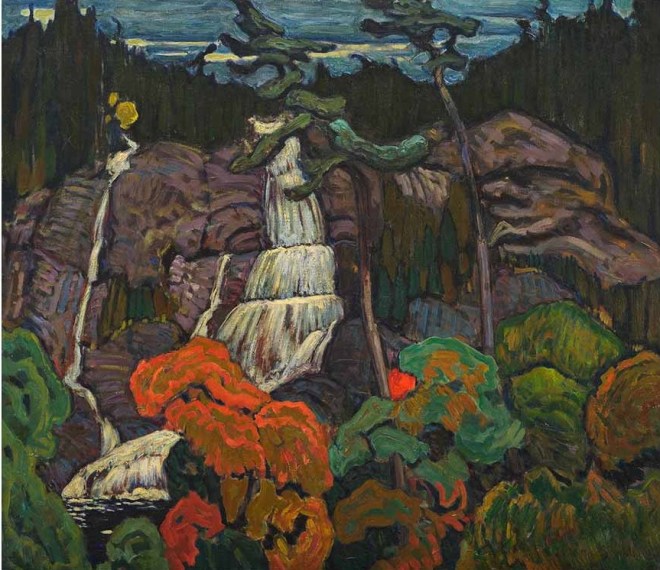
J.E.H. MacDonald, Algoma Waterfall, 1920
Source

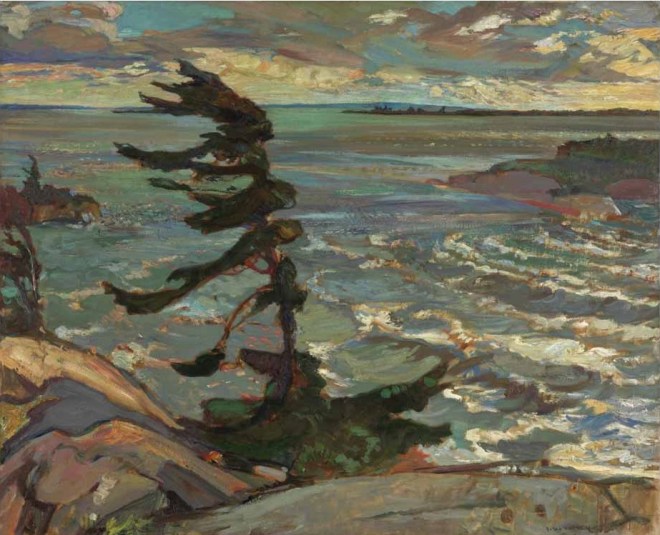
Frederick Varley, Stormy Weather, Georgian Bay, from 1921.
Source

After all these years, I still don’t know if I would have enjoyed spending five months next to the paintings of this group of artists, or if I would have been bored to tears by the company of my fellow guards, or both. For any readers who might be asking themselves what I did end up doing those five months, I can reveal that I went to work for the YM/YWCA. I replaced a guy who had to go on a long sick leave, so it was a perfect fit. My job was to hand out stationary to the staff and to print the various flyers which they produced. I became a dab hand at offset printing, even if I say so myself – a skill, alas, I was never able to put to good use again.
THREE WISE MEN

Milan, 6 January 2025

Today is 6 January, the day of the Epiphany! The day when the Three Wise Men arrive in Bethlehem to find the Child Jesus. Momentous event! In the words of St. Matthew’s Gospel (I cite the King James version)

And when they were come into the house, they saw the young child with Mary his mother, and fell down, and worshipped him: and when they had opened their treasures, they presented unto him gifts; gold, and frankincense and myrrh.

Or, as the Christmas carol puts it

Three Wise Men
We Three Kings of Orient are,
Bearing gifts we traverse afar,
Field and fountain,
Moor and mountain,
Following yonder Star.
Refrain
O Star of Wonder, Star of Night,
Star with Royal Beauty bright,
Westward leading,
Still proceeding,
Guide us to Thy perfect Light.

Gaspard
Born a King on Bethlehem plain,
Gold I bring to crown Him again,
King for ever,
Ceasing never
Over us all to reign.
Refrain

Melchior
Frankincense to offer have I,
Incense owns a Deity nigh:
Prayer and praising
All men raising,
Worship Him God on High.
Refrain

Balthazar
Myrrh is mine; its bitter perfume
Breathes a life of gathering gloom;—
Sorrowing, sighing,
Bleeding, dying,
Sealed in the stone-cold tomb.
Refrain

Three Wise Men
Glorious now behold Him arise,
King, and God, and Sacrifice;
Heav’n sings Hallelujah:
Hallelujah the earth replies.
Refrain

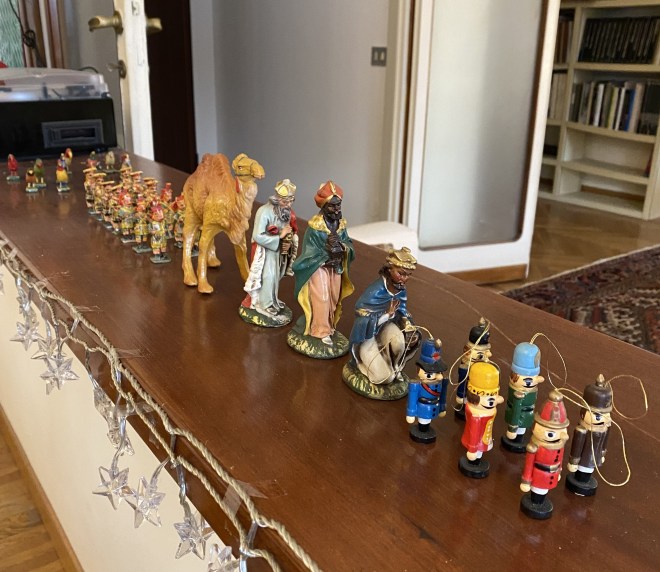
The Three Wise Men are, of course, important characters in our annual crèche. Ever since Christmas Day, they have been travelling across the furniture of our living room, on their way to Bethlehem. This year, I have had them accompanied by a retinue worthy of their rank.

My photo

I found the figurines of the retinue in a box where they had been carefully stored away by my mother-in-law many years ago. It seemed a pity not to bring them out into the light of day. I think it all looks pretty impressive! (But we have to do something about the camels; I’ve been telling my wife for years that we need to find some more camels, one camel simply isn’t enough. And we have to get a statue to replace the kneeling Wise Man; kneeling before the Baby Jesus is OK, but he can’t be on his knees the whole trip to Bethlehem …).

Here, we can see the tail-end of the cortege.

My photo

I added the birds because they were also in the box. A bit odd, but why not? Maybe the Wise Men were like St. Francis, they were listened to by the birds (boy, are we going to have fun when we set up the crèche with our grandson, possibly grandchildren, in a few years’ time! Who knows what interesting additions we could come up with!).

And now the Three Wise Men have arrived at the manger and are adoring the Baby Jesus!

My photo

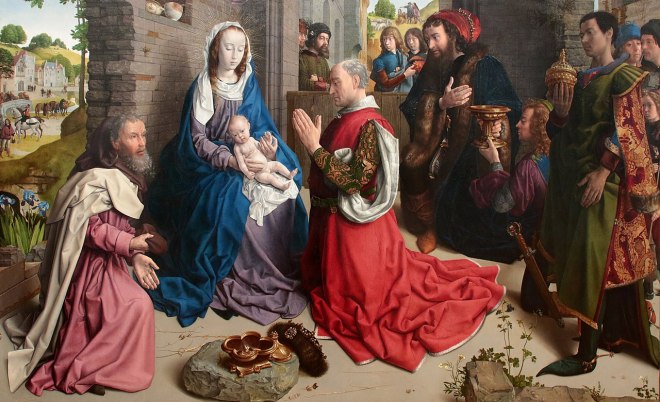
This scene of the Adoration of the Magi has been painted over and over again by European artists. I pick here just one of the many offerings. It is by the Flemish painter Hugo van der Goes, who painted it in about 1470.

Source

In truth, though, I prefer the rendering of the Three Wise Men in the mosaics of Sant’Apollinare Nuovo in Ravenna.

Source

Dressed as they are as Persians, wearing the Phrygian cap which Romans seemed to think all Persians wore, they fit better with what the Gospel of St. Matthew had to say: “behold, there came wise men from the east”. Now Matthew didn’t actually say how many Wise Men there were, but pretty quickly most Christian sects settled for three, one for each gift. Matthew also didn’t say how old they were, but clearly by the time these mosaics were laid down it was generally agreed that they represented the three ages of Man, so we have one old one, one middle-aged one, and one young one. It was only later that it was decided that they also represented the three races known to Europeans: the Europeans themselves, the peoples of the Middle-East, and the peoples of Africa. Paintings of the Magi are some of the earliest representations of Black people in European art. Here is a lovely example from an Adoration of the Magi by Hieronymus Bosch.

Source

Painters don’t seem to have been much interested in what was happening to the Three Wise Men on their way to Bethlehem. But T.S. Eliot, in his poem Journey of the Magi, did try to imagine what the trip was like. I cite here the first twenty lines of the poem.

A cold coming we had of it,
Just the worst time of the year
For a journey, and such a long journey:
The ways deep and the weather sharp,
The very dead of winter.’
And the camels galled, sore-footed, refractory,
Lying down in the melting snow.
There were times we regretted
The summer palaces on slopes, the terraces,
And the silken girls bringing sherbet.
Then the camel men cursing and grumbling
And running away, and wanting their liquor and women,
And the night-fires going out, and the lack of shelters,
And the cities hostile and the towns unfriendly
And the villages dirty and charging high prices:
A hard time we had of it.
At the end we preferred to travel all night,
Sleeping in snatches,
With the voices singing in our ears, saying
That this was all folly.

Compared to this description, our Three Wise Men have had it pretty easy: nice, warm living room, easy travel across the furniture, respectful entourage …

As told in St. Matthew’s Gospel, the arrival of the Three Wise Men was like a poke in a hornet’s nest. In Jerusalem, they asked, “Where is he that is born King of the Jews? for we have seen his star in the east, and are come to worship him.” Matthew goes on, “When Herod the king had heard these things, he was troubled, and all Jerusalem with him. And … he demanded of them where Christ should be born. And they said unto him, In Bethlehem … Then Herod … said, Go and search diligently for the young child; and when ye have found him, bring me word again, that I may come and worship him also.” But, Matthew tells us, after giving Jesus his gifts, “being warned of God in a dream that they should not return to Herod, they departed into their own country another way.” He goes on, “behold, the angel of the Lord appeareth to Joseph in a dream, saying, Arise, and take the young child and his mother, and flee into Egypt, and be thou there until I bring thee word: for Herod will seek the young child to destroy him. When he arose, he took the young child and his mother by night, and departed into Egypt.” The Flight to Egypt was also a popular theme for European painters. I show one example, by my favourite painter, Caravaggio, Rest on the Flight to Egypt, where one of the painter’s luminous angels is playing music on a viol to soothe Mary and Jesus in their slumber (the music held by Joseph is readable; it is a motet by the Flemish composer Noel Bauldeweyn dedicated to the Madonna, with a text from the Song of Songs, Quam pulchra es, “How beautiful you are”; nice touch).

Source

Alas, Herod was not a man to be crossed. Matthew tells us, “Then Herod, when he saw that he was mocked of the wise men, was exceeding wroth, and sent forth, and slew all the children that were in Bethlehem, and in all the coasts thereof, from two years old and under.” This Massacre of the Innocents was, too, a popular theme for European artists. I show here an example of the genre by Peter Breughel the Elder.

Source

I’m actually being a little economical with the truth. This is really a copy of Breughel’s painting, by his son Peter Breughel the Younger. The original was once owned by the Holy Roman Emperor, Rudolf II. For some reason – queasiness? – he had the dead children painted over. This copy retains the dead children.

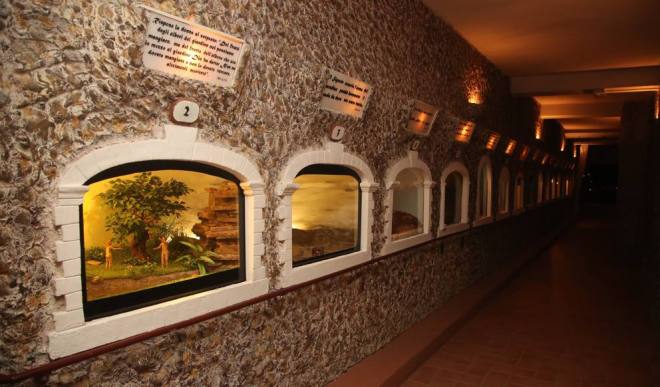
Quite by chance, just before Christmas, we stumbled across a very sophisticated crèche, in a place called Baggio, which once was a village but then got swallowed up by Milan some 150 years ago. There, in the crypt of a church, over the last forty years or so, dedicated local volunteers have created 58 scenes from the Bible, with the Nativity being the central scene. Some of the scenes have running water, others have moving figurines, … it’s very impressive. Here is a shot of the first scene, Adam and Eve in the Garden of Eden (with a delightfully slithery snake in the tree).

Source

Here is one of Moses and the parting of the waters of the Red Sea.

Source

And here is a shot of the central scene of the Nativity.

Source

As I say, very impressive … although I will admit to having been just a teeny-weeny bit jealous. We’ll soon be packing away the crèche and its figurines for another year, but I’m already thinking how we could expand the offerings next year. Running water and moving figurines is a bit beyond me. But maybe Herod in a palace in Jerusalem? The Massacre of the Innocents? Some “snow” for the Wise Men to trudge wearily through? At least let’s fix the camel problem!

A LOMBARD CHRISTMAS DINNER

Milan 31 December, 2024

It is a sad fact of life that most of the time we fail to follow through on our New Year’s resolutions. I am no different. In fact, I have such a dismal track record on this topic that I stopped many years ago making these resolutions – I did not want to add so many paving stones to my private road to Hell.

Source

But there is one end-of-year resolution on which my wife and I seem to be holding the course, one I explained in my first post of this year. Summarizing quickly, the two of us decided that we – and any children or grandchildren who may be visiting – would, for a period of eight years, use the traditional Christmas lunch or dinner to honour our mixed genetic pool: Puglia and Lombardy: the heritage of my wife; Burgundy, England, Scotland and Norway: my heritage; – and, if we are still around, Ireland and the old Pale of Settlement: the heritage of our son-in-law. Specifically, for each of those eight years, we would cook a typical Christmas lunch or dinner from each of these regions.  I decided to start at the southern end of the genetic pool and move north, so last year we cooked ourselves a Christmas lunch from Puglia, which we shared with our son.

Contrary to previous attempts, we did not forget this resolution, and so this year now found us cooking a typical Christmas dinner from Lombardy, which we shared again with our son as well as with his girlfriend. I’m so proud that we managed – at least this year – to keep to the resolution, that I’ve decided to share this year’s menu with my readers.

We started with ravioli in brodo. As far as I can make out, each province in Lombardy has its special type of raviolo, but we didn’t get that subtle. We just took a packet of ravioli stuffed with braised meat which was being sold in our local supermarket, and we cooked them in a chicken broth made with cubes. Since we are most definitely not part of the Instagram generation, we have never got into the habit of taking photos of the food we eat. We just wolf it down and then say “damn, we should have taken a photo”. So I throw in a photo I found on the internet to give readers an idea of what we were eating.

Source

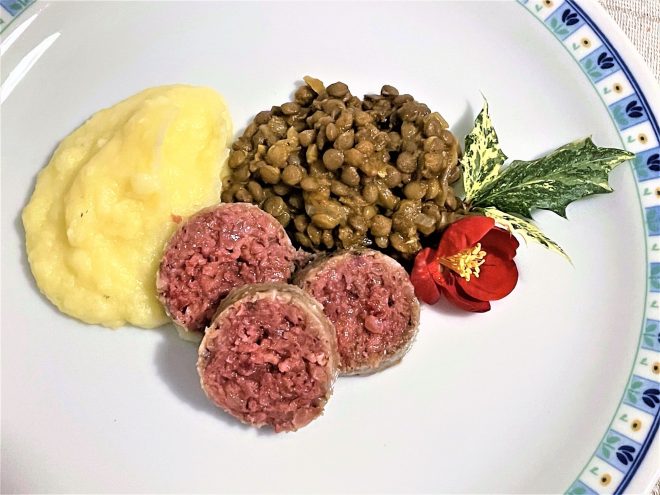
Next, as the main dish we had cotechino with lentils and mashed potatoes. I throw in another photo of this dish from the internet.

Source

I refer any of my readers who wish to know more about this typical Lombard dish to a post I wrote several years ago, where I go into probably too much detail about it; I have no desire to repeat myself here.

For dessert, we had that great, that splendid, Lombard delicacy, the panettone. I’ve also covered this miracle of Lombard cuisine in an earlier post, so I won’t go into further details here. I just refer my readers to that post and throw in a photo of a slice of panettone. I deliberately chose a photo which shows a large dollop of mascarpone, because for the first time ever, we had our panettone with mascarpone.

Source

We decided to add mascarpone because we read that the Lombards are known to slather this extra bit of yumminess onto their panettone during the Christmas season.

Since I’ve never mentioned mascarpone in any of my previous posts – for the simple reason that we hardly ever eat it – let me use this occasion to say a few words about it. It’s a Lombard cheese, originally from the area around Lodi to the south of Milan. Like cotechino, it used to be made with the left-overs from the production of more remunerative dairy foodstuffs, in this case cheeses. It is a smooth, spreadable cheese, with a an ever so slight sweet taste to it and a hint of the aroma of cream.

Mascarpone is now well-known worldwide because it is one of the main ingredients in the famous tiramisù – which, I was surprised to learn, is a very recent creation, from the 1960s, with its place of birth being somewhere in the Veneto or Friuli-Venezia-Giulia regions of Italy.

Source

Mascarpone is actually used in tiramisù in the form of crema al mascarpone, which is a mix of a syrup of sugar, egg yolk, and mascarpone. This is but one variant of sweetened mascarpone which Italians have been eating since at least the 1400s and possibly earlier.

If I am dwelling a little on crema al mascarpone it’s because I have a horrible doubt: should we have eaten our panettone with crema al mascarpone rather than just with mascarpone? Both ways are promoted by different sites on the internet. I have to say, my wife and I found that mascarpone alone combined well with panettone. But might crema al mascarpone have combined better? There’s only really one way to find out – make (or buy) crema al mascarpone and slather it on a couple of slices of panettone. Something to work on next year.

Of course, there wasn’t just food. There were wines, too! Staying in theme, we chose two Lombard wines, a red and a white. The red was a Bonarda, one of the sparkling red wines that are common in the north and centre of Italy. This is a topic I’ve covered in an earlier post, so any readers interested to find out more about this intriguing family of sparkling reds can go there. Here, I’ll just insert a photo of some of the vineyards where Bonarda’s grapes are grown.

Source

As for the white wine, we chose a Lugana, whose grapes are grown on the far eastern edges of Lombardy, looking over the southern shores of Lake Garda.

Source

I suppose we could have finished with some digestivi or some grappa made in Lombardy, but we left it at that. Sometimes, especially at our age, one can have too much of a good thing and spend the night regretting it.

So that’s Lombard Christmas dinner done! Next year, we venture into a Burgundian Christmas lunch – or maybe a Beaujolais Christmas lunch, if there is a difference; my mother was specifically from Beaujolais. We shall see, a happy year of research awaits me.

Happy New Year to all my readers! May 2025 bring you and your families peace and happiness.