VILLAGES CLINGING TO THE MOUNTAINSIDE

Milan, 25 January 2017

We were down at the seaside a week ago and, as is our wont, we went for a walk. The walk we chose this time was one we had last taken thirty or more years ago. It’s the walk which links le Cinque Terre, the Five Lands, five coastal villages occupying a very rugged piece of the coast in southern Liguria. The Cinque Terre have become very famous in these intervening years and we were reading online that hordes of tourists descend on these five luckless villages during the summer. Luckily, the tourist flow has slowed to a trickle by the middle of January. We passed hardly anyone as we walked between the villages of Vernazza and Corniglia (the only part of the full walk we did this time). One or two youngsters galloped past us; otherwise, we met and walked for a while with a very nice couple from Chile, retirees like us, who were coming to the end of a long tour of Europe.

Vernazza
Vernazza
Corniglia
Corniglia

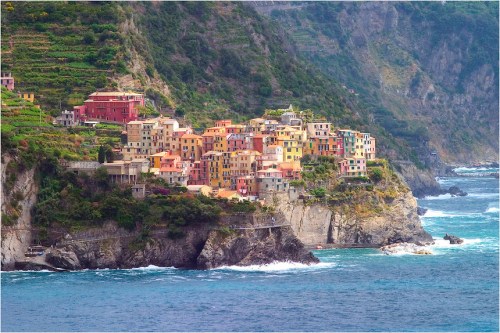
As readers can see, especially in the picture of Corniglia, the villages of the Cinque Terre are clinging on for dear life to rugged slopes that fall pretty much sheer into the sea. This is a photo of Manarola, the next village down
img_1681
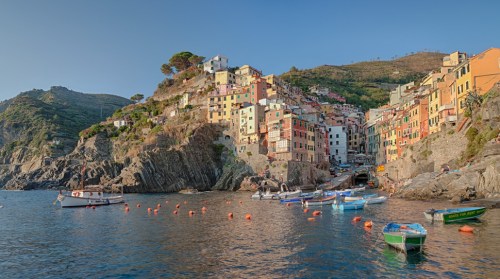
and Riomaggiore, the furthest south of the five villages.
img_1682
I love villages like these that seem to spill down a slope. They always remind me of a tumbled pile of children’s blocks
img_1707
(or perhaps like this when the villagers in question get into more adventurous architecture)
img_1708
Italy seems to have many such villages, but a quick surf around the net threw up a number of other examples around the world. There’s this village, for instance, the village of Peillon in France’s Maritime Alps.
img_1702
There’s Oia, on the Greek island of Santorini.
img_1684
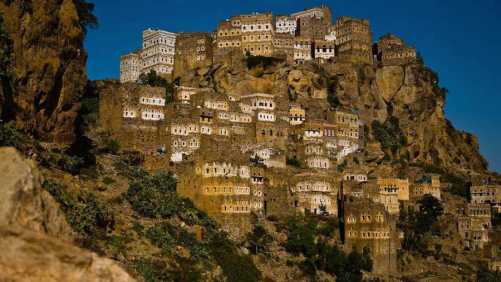
Even further afield, there’s the village of Al Hajjarah in Yemen.
img_1703
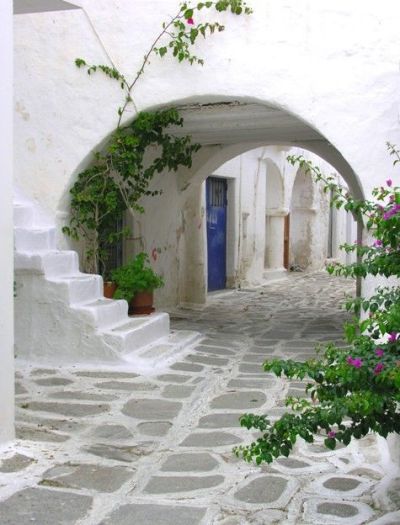
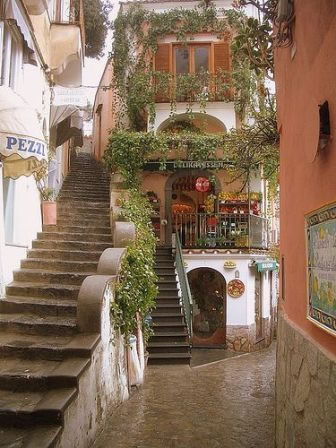
These villages are lovely to look at from a distance, but their real beauty is to be found close up. The steep terrain, the building of houses close together, means that these villages are full of winding alleys and stairways disappearing around a corner
img_1711
img_1721
leading you on to discover quiet corners.
img_1709
And no cars! Cars, the cancer of our cities … I dream of the day when they are banned from cities, where all cities are like Venice
img_1722
where people own the roads rather than cower on pavements, keeping themselves and their children safe from these one-ton steel monsters hurtling down the streets, bringing death and destruction to anyone foolish enough to step off the pavement at the wrong moment.

There, I’ve had my little rant against cars. Feel much better.

__________________
Vernazza: https://www.incinqueterre.com/en/photo-galery
Corniglia: http://www.gettyimages.it/detail/foto/corniglia-cinque-terre-italy-fotografie-stock/543796033
Manarola: http://robgreebon.photoshelter.com/gallery/Cinque-Terre-Images-Manarola-Riomaggiore-Vernazza-Corniglia-and-Monterosso-al-Mare/G0000Zi9yrR4QNtA/
Riomaggiore: http://hdr.name/cinque-terre-riomaggiore-manarola-monterosso-vernazza-corniglia/
Children’s blocks: https://www.walmart.com/search/?query=Wooden%20Childrens%20Blocks&oid=223073.1&wmlspartner=TQiP6m79tRs&sourceid=08842105053019505796&affillinktype=10&veh=aff&cat_id=0
Children’s blocks: http://affordableluxuryblog.com/2011/11/ten-wooden-toys-that-children-will-love-to-get/
Peillon: http://www.beyond.fr/villages/peillon.html
Oia, Santorini: https://www.google.co.uk/amp/santorinidave.com/santorini-photos-and-travel-info/amp
Al Hajjarah, Yemen: http://jobpakistanforfree.blogspot.it/2016/01/top-10-amazing-towns-on-cliff-tops.html?m=1
Lane in Greece: http://www.jackthedriver.com/services.asp
Alleyways in Positano: http://www.jackthedriver.com/services.asp
Lanes in Santorini: https://www.pinterest.com/pin/435582595180183853/
Venice street: http://www.charmingitaly.com/it/article/24-ore-a-venezia

FULL OF SOUND AND FURY, SIGNIFYING NOTHING

Vienna, 29 December 2016

image
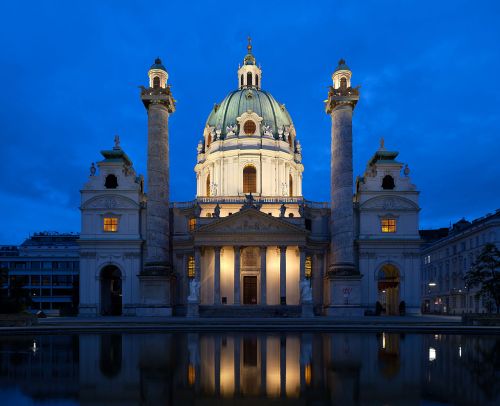
Nice, isn’t it? It’s Karlskirche, Charles Church, fronting the square of the same name, Karlsplatz, in Vienna. In this picture, the church is reflected in a large pool situated in front of it, making an even prettier picture of it all.

It’s also very nice-looking at night, when cleverly-placed lights dramatically illuminate the facade and dome.
image
It really looks like the backdrop of some Mozart opera.

It so happens that we pass through Karlsplatz every time we take the tram into the city centre, and I always give Karlskirche an admiring look as we pass by.

It was the Holy Roman Emperor Charles VI who ordered it to be built, in 1713, just after what turned out to be the last great plague epidemic had swept through these lands. He had it built as thanks for the pestilence having spared him and his family. He dedicated the new church to San Carlo Borromeo, Cardinal of Milan, who not only was his personal patron saint but was also revered as a healer of plague sufferers. The church was completed by 1737.

Karlskirche was built in pure Baroque style. A few quotes are in order here, to hopefully answer the question “what exactly is the Baroque style?”:
– a style “characterized by new explorations of form, light and shadow, and dramatic intensity”
– a style which “used exaggerated motion and clear, easily interpreted detail to produce drama, tension, exuberance, and grandeur”
– “Baroque architecture and its embellishments were on the one hand more accessible to the emotions and on the other hand, a visible statement of the wealth and power of the Church” (as well as of the secular Princes, I should add)

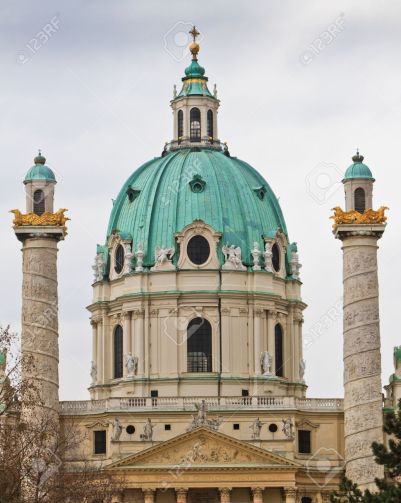
Well, Karlskirche certainly produces drama, tension, exuberance, and grandeur on the outside. We have that dominating dome with its green copper sheath, along with the two columns flanking the front.
image
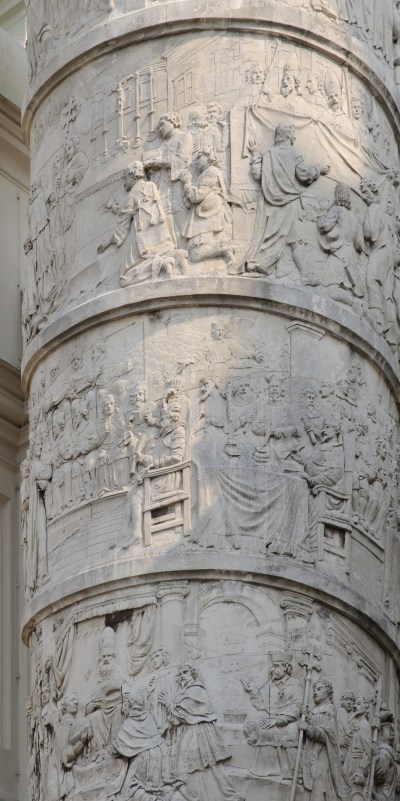
Those columns are modeled on Trajan’s column in Rome.
image
However, they substitute tales of Trajan’s victories in the Dacian wars with pious scenes from the life of that great “Prince” of the Church, San Carlo Borromeo.
image
We have the pediment crowning the front, where we see the cardinal virtues sucking up to San Carlo standing on the apex of the pediment.
image
So it is in a state of high tension and of great exuberance that one enters the church – only to find oneself in a small chapel. It is really the strangest feeling: all that architectonic might and majesty on the outside, clothing a really very modestly-sized internal space.
image
Oh, I grant you, there is also dramatic intensity on the inside: the fresco in the dome, for instance
image
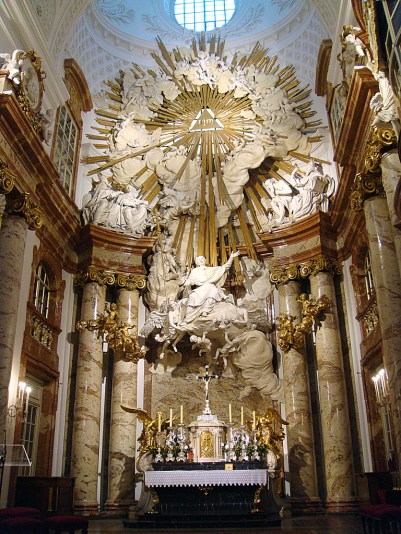
or the altarpiece portraying the ascension of San Carlo.
image
But the overall effect is: “Really? That’s all there is to this church? This tiddly little space?” I have to say, the only time I went in I felt quite cheated.

In the name of full disclosure, I should state at this point that I am anyway not a great fan of Baroque decoration. My general feeling about this style of art can be summed up in Macbeth’s words, “full of sound and fury, signifying nothing”. Even if the scale of the church’s interior had been on a par with the outside I probably wouldn’t have liked it. I find Baroque decoration, especially in Catholic churches, pompous and overblown. On top of that, for a religion that claims to value poverty, I find Baroque’s in-your-face glitter – gold and silver everywhere – particularly offensive. There is a toe-curling example of this blingy over-the-top quality in Baroque in Vienna’s Jesuit church, whose interior was completed some five years before Charles VI decided to have Karlskirche built.
image
All this being said, there is one example of church baroque that I have come across which I really loved, and that was in the cathedral of Saint Gall in the Swiss canton of Saint Gallen. Our visit to it was completely serendipitous. We were driving from Vienna to my parents’ house in France, and Saint Gallen happened to be a good place to stop for the night. The next morning, I decided that we should take the occasion to visit the cathedral and dragged a rather unwilling family with me. What a revelation!


There were the usual dramatic and intense frescoes on the ceiling, but the rest of the church was quite bare. Instead of the glittering gold, the marble, the overwrought statuary, we found ourselves in a space of mostly bare white walls carrying only a few highly curlicued decorations painted a lovely pale blue-green. It was so wonderful that it put me in a good mood for the next nine hours of driving and the thought of having to spend a long weekend with my parents.

The cathedral was remodeled into its current form in the 1750s-60s, so some 20-30 years after Karlskirche. That lapse of time might explain the more rococo style that was used, along with the fact that the cathedral stood at the border with Protestantism – literally, since the town that had sprung up around the cathedral and its abbey had turned Protestant while the abbey itself remained Catholic; Protestant baroque tends to be more restrained than the Catholic version.

Whatever the reason, Saint Gall Cathedral has partially reconciled me to baroque. Since that magic moment some 20 years ago when I first entered the cathedral, I have been inclined to simply grimace and shrug at excesses like those in Vienna’s Jesuit church rather than dream of taking the iconoclast’s hammer to it all. Or maybe I’m simply getting older and perhaps a little bit wiser.

___________
Karlskirche panoramic: http://www.thousandwonders.net/Karlskirche
Karlskirche at night: https://en.m.wikipedia.org/wiki/Karlskirche
Karlskirche dome: http://www.123rf.com/photo_13006441_dome-of-the-karlskirche-st-charles-s-church–vienna-austria.html
Trajan’s column: https://www2.bc.edu/~kenth/honors4.html
Karlskirche columns’ detail: https://commons.m.wikimedia.org/wiki/File:Karlskirche_column_detail_-_Vienna.jpg
Karlskirche pediment: http://www.panoramio.com/m/photo/93052486
Karlskirche interior: https://www.studyblue.com/notes/note/n/lecture-21/deck/5993225
Karlskirche dome fresco: https://www.pinterest.com/soledadvilchez/monumental-ceilings/
Karlskirche altar: https://www.flickr.com/photos/57669468@N00/3252233159
Jesuit church, Vienna, interior: https://www.flickr.com/photos/time-to-look/18903468079
Cathedral of St. Gall, interior: https://commons.m.wikimedia.org/wiki/File:St-gall-interior-cathedral_1.jpg

AMBROGIO DA FOSSANO DETTO IL BERGOGNONE

Milan, 13 December 2016

A week or so ago, I had an appointment just off Milan’s corso Garibaldi, to discuss a possible presentation that I could make on the UN’s Sustainable Development Goals and how companies could incorporate them into their CSR programmes. Since I had grossly overestimated the time it would take for me to walk there, I found myself at the meeting place with half an hour to spare. Looking around for some way to kill time, I spied a venerable-looking church across the road and decided to go and have a peek, to see what hidden treasures it might contain (every church in Italy beyond a certain age – 250 years, say – contains treasures to be discovered).

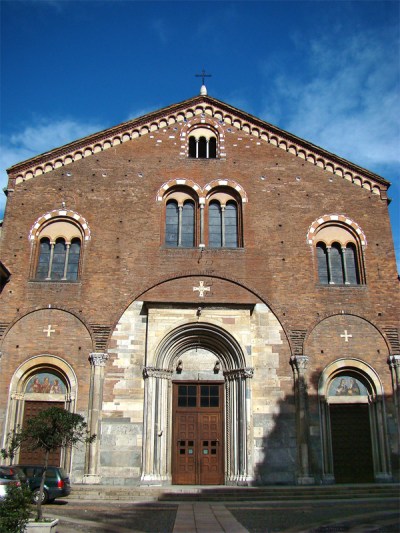
The church in question was the Basilica di San Simpliciano. As its title of basilica suggests, this is a very venerable church indeed. It was one of four basilicas wanted by the great Saint Ambrose, Doctor of the Church and bishop of Milan from 374 to his death in 397 AD.
image
Ambrose planned to have one such basilica on each of the four main roads leading out of Roman Milan.

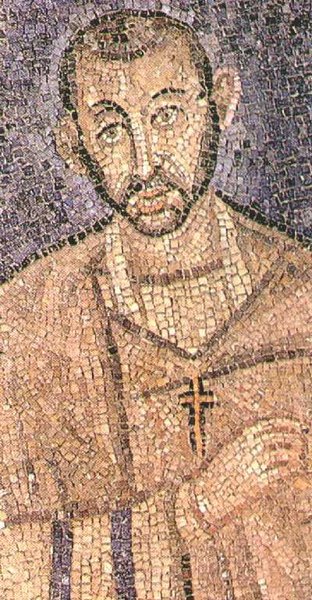
The church was completed by his successor, Saint Simpliciano, who also had himself buried here; his bones have been venerated ever since, lying under the main altar but now clothed and masked – a skeleton is not quite the thing anymore.

image

Unfortunately, very little of this original church remains. I say unfortunately because I happen to be very fond of early Christian mosaics. I’m sure the church’s interior would have been covered in mosaics like the one whose photo I give above, itself a mosaic shard which has survived because tucked away in an obscure corner of an even more venerable Milanese church, the Basilica di Sant’Ambrogio. Cluniac Benedictines took over San Simpliciano in the 800s, and by the 1200s they had completely renovated the church in the styles then all the rage, Romanesque with a little bit of early Gothic. These styles have stamped themselves on the church’s exterior appearance.
image
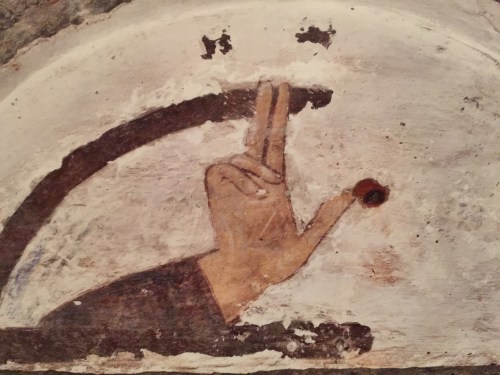
Unfortunately, hardly anything remains of this period’s internal decorations. One imagines that the walls would all have been frescoed; all that is left is this hand raised in benediction, tucked away in some obscure corner of the church.
image
Thereafter, with each passing artistic phase various alterations were made, in the process destroying the harmony of the whole. Here, for instance, a side chapel in the Baroque mode was added.

image

To all this was added more obvious vandalism. The church and the adjoining cloisters were turned into barracks by the occupying troops of Revolutionary France; no doubt the church was turned into stables for the troops’ horses (a fate common to many churches, it would seem). I’m sure the French soldiers would have taken pleasure in destroying the church’s decorations, much as ISIS troops have taken pleasure in sledgehammering and dynamiting every non-Islamic work of art that has fallen under their control, and much as Mao’s Revolutionary Guards took pleasure in smashing anything they could lay their hands on from Old China. But bad as all this was, the nadir for San Simpliciano was the 1820s, when some artist who will remain unnamed stuccoed over everything and painted scenes of a painfully sucrose sentimentality – one side chapel in this style has been kept.
image
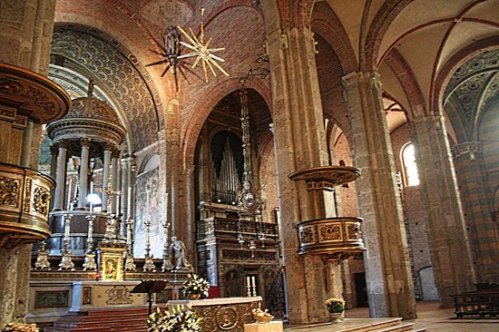
After the Second World War, it was decided that there was nothing left to do but to strip more or less everything away, down to the brickwork. This has given the church a certain rough simplicity, very pleasing to the eye (to mine at least).
image
We have to remember, though, that this is a very modern style. None of the original builders or later fiddlers would have dreamed of maintaining such a naked simplicity. Churches were built to demonstrate the glory of God, and naked brickwork definitely didn’t make the cut.

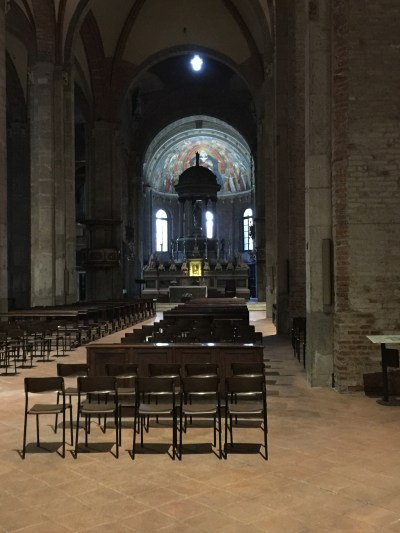
All this I learned from some posters tucked away in a corner (so tucked away that I nearly missed them). I knew none of this on entering the church. What immediately struck me instead was the fresco in the apse behind the main altar.

image
Even though it was much obscured by the 1820s main altar (something that was already fiercely criticized when the Artist who will Remain Unnamed installed it), its brilliant blues and reds amid all that raw brick jumped out at me and beckoned me to come closer. Which I did, threading a passage between the main altar and the outer walls of the church. The view was well worth the threading.
image
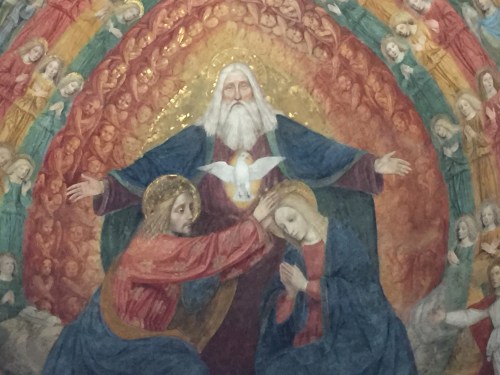
It is a fresco (I later learned from the posters) from 1508 celebrating the Incoronation of the Virgin Mary, painted by il Bergognone (or, to give him his full name and title, Ambrogio da Fossano detto il Bergognone). We see Mary, meek and mild, being solemnly crowned by her son Jesus, God the Son, in a ceremony presided over by God the Father and God the Holy Spirit, within a rainbowed arc of seraphims, cherubims and angels

image

and with saints and others laypersons (no doubt donors and other Very Important Persons) looking on.

image

Thank goodness it was placed high off the ground, otherwise those French revolutionary soldiers would no doubt have destroyed it. With my heart well warmed by its beauty, and my mind well primed by the posters, I hurried back to my meeting, arriving a little breathless but just on time.

I have to say, Bergognone is not a painter that I am at all familiar with. In writing this post, I have mugged up on him a little. He was active primarily in Lombardy, and although works of his have leaked out to many major museums in the western world the bulk of his output is still to be found in and around Milan. Since Saint Ambrose initiated my description of San Simpliciano, let me throw in here a painting Bergognone made of that saint

which hangs in Pavia’s monastery complex, the Certosa.
image
Bergognone was particularly active in the Certosa di Pavia. My wife tells me we have visited it, but I have no memory of doing so (a situation which is becoming alarmingly common). I think I will add it to my ever lengthening list of places around Milan which we will go and visit, once Spring beckons us forth like hibernating bears from the apartment.

_______________
Photos: mine, except the following
Saint Ambrose mosaic: https://it.m.wikipedia.org/wiki/Sant%27Ambrogio
San Simpliciano exterior: https://it.m.wikipedia.org/wiki/Basilica_di_San_Simpliciano
San Simpliciano interior: https://www.tripadvisor.it/LocationPhotoDirectLink-g187849-d1899819-i87445764-Basilica_di_San_Simpliciano-Milan_Lombardy.html
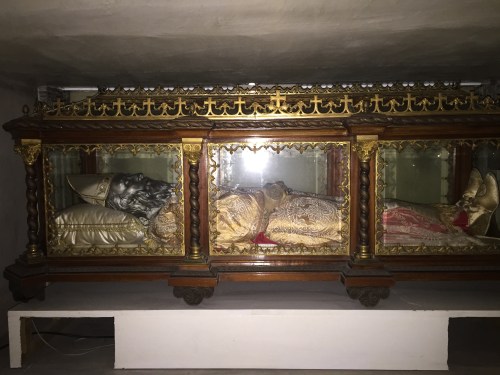
San Simpliciano Bergognone fresco overview: http://www.italiamedievale.org/sito_acim/contributi/simpliciano.html
Bergognone’s Sant’Ambrogio: https://forum.termometropolitico.it/274962-7-dicembre-s-ambrogio-vescovo-e-dottore-della-chiesa.html
Certosa di Pavia: http://www.pavialcentro.it/monumentos/monastero-della-certosa-di-pavia

OF ZEN GARDENS AND MISO SOUP

Milan, 3 December 2016

Back from Kyoto, and still with a bad case of jet lag (it’s 4 am and my wife and I are sprawled on the living room couches, wide awake), it’s time to review the three weeks we spent in that city. Apart from the misery caused by the American presidential elections and the pleasure derived from teaching a course on sustainable industrialization to a group of eager youngsters not yet affected by the pessimism of old age, what else will I take back with me from my three weeks spent in Kyoto?

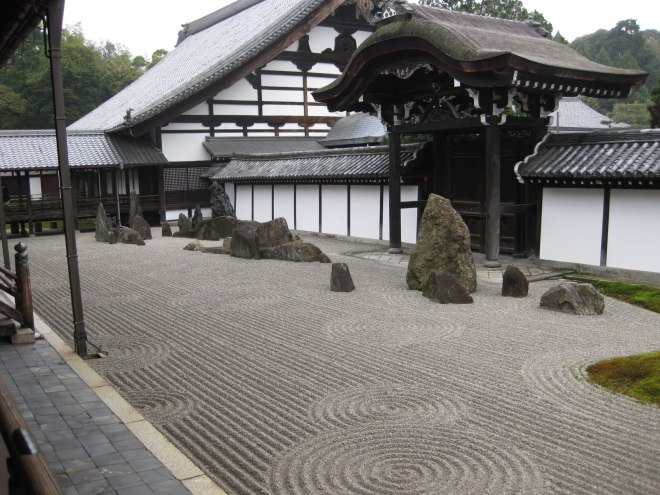
Ever since I first visited the city thirty years ago, Kyoto for me is first and foremost the place of Zen gardens. I have already written a paean to these rock gardens in a previous post, so I will not repeat myself. I will simply mention the pleasure I derived from visiting several rock gardens which I had not seen thirty years ago (or even five years ago, when we came for a brief visit from Beijing). My wife and I decided that our daughter, who came to visit us for Thanksgiving, just had to see a couple of these glorious creations: “he (or she) who has not seen a Zen garden has not lived”, to surely misquote someone famous. We took her to the gardens in Tofuku-ji Temple as well as those in Kennin-ji Temple, both at the foot of that range of hills which runs down Kyoto’s eastern edges and which is constellated with temples. The garden in Tofuku-ji was laid down a mere 75 years ago, in the last years of the 1930s. It gives one pause to think that these so very peaceful gardens were created when Japan was ramping up its war effort towards the disastrous conclusion of Hiroshima and Nagasaki five years later.

The garden was designed by Mirei Shigemori. This was his first major work and it made him famous (at least in the small world of landscape gardening). The work consists of four gardens surrounding the Abbot’s Hall. The largest, and best known, is the south garden.
tofukuji-south-garden-2
It is dominated by four clusters of massive rocks. Standing imposingly at one end of the garden, they represent the mythic, far-off isles of the immortals.
tofukuji-south-garden-1
Their shores are “washed” by a sea of raked white gravel, which leads the eye to five moss-covered mounds at the other end. These represent the five main temples in Kyoto of the Rinzai sect of Buddhism, one of whose temples is Tofuku-ji.
Unknown
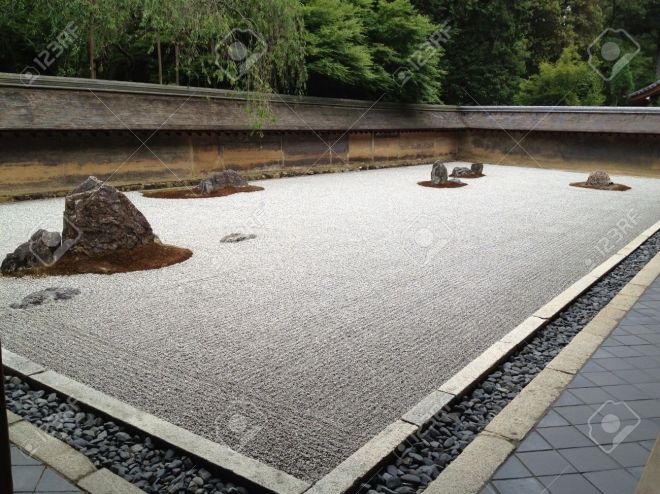
This garden obviously has its roots in the design of the far more famous zen garden at Ryoan-ji.
ryoanji-garden
Shigemori’s departures from the classical zen garden style were far more radical in the other three smaller gardens surrounding the Abbot’s Hall. The north garden has a checkerboard pattern, with square paving stones embedded in moss, that gently fades off into randomness, thus drawing the eye to the stand of Japanese maples beyond.
tofukuji-north-garden
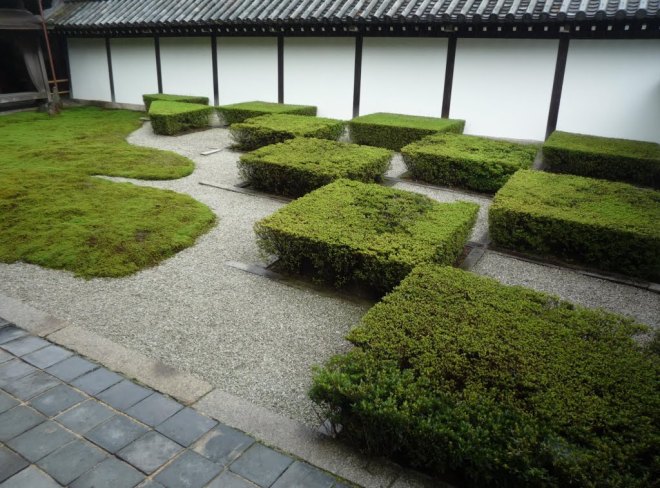
The west garden repeats the checkerboard motif, but this time with a dense array of square-cut azalea bushes.
tofukuji-west-garden
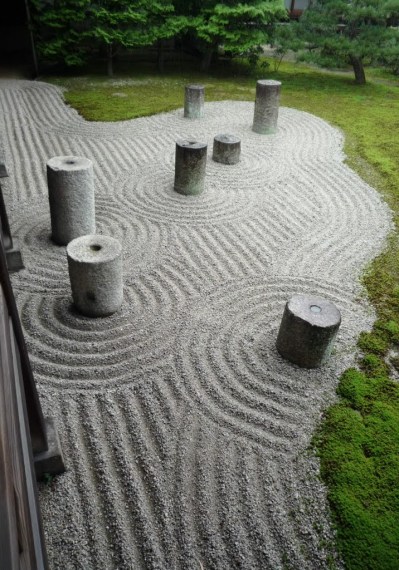
The small east garden departs from the usual use of rough stones, inserting instead seven truncated stone cylinders (recycled from the temple’s old outhouse) into the usual “sea” of raked gravel surrounded by moss. Shigemori set the pillars out like the stars of the Big Dipper, Seven Northern Stars in Japanese.
tofukuji-east-garden
These last three gardens caused much frothing at the mouth by the traditionalists but also drew much praise from the garden landscaping avant-garde. I leave it to readers to decide in which camp they want to be in. Meanwhile, I will move to the second zen garden which we visited with our daughter, the gardens in Kennin-ji. These gardens are a good deal more venerable, as befits the oldest Zen temple in Kyoto.

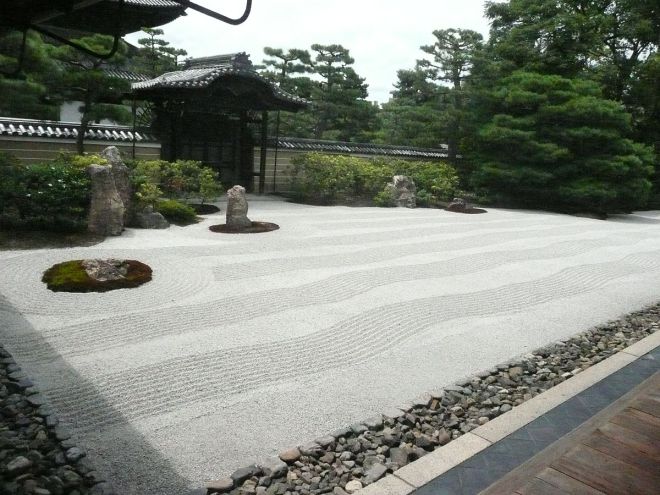
The same design of gardens surrounding the Abbot’s Hall is found here. We have here the main garden, where, in contrast to Tofuku-ji, the monk-designer allowed a fringe of vegetation along the far border of the garden.
kenninji-garden-1
On the other side of the Abbot’s Hall, we have a smaller garden that invites the visitor to step over it to a beckoning tea house.
image
(unfortunately, the path is off-limits, but the determined visitor can reach the tea-house through a more circuitous set of stepping stones).

We have a moss garden enclosed between buildings and walkways.
kenninji-garden-3
Finally, squeezed in between several buildings, we have the small, compact “circle-triangle-square” garden
Kenninji Circle Triangle Square Garden
so-called because it is said that all things in the universe can be represented by these three forms (at the risk of being irreverent, though, I see the circle and square in the garden but I don’t see a triangle).

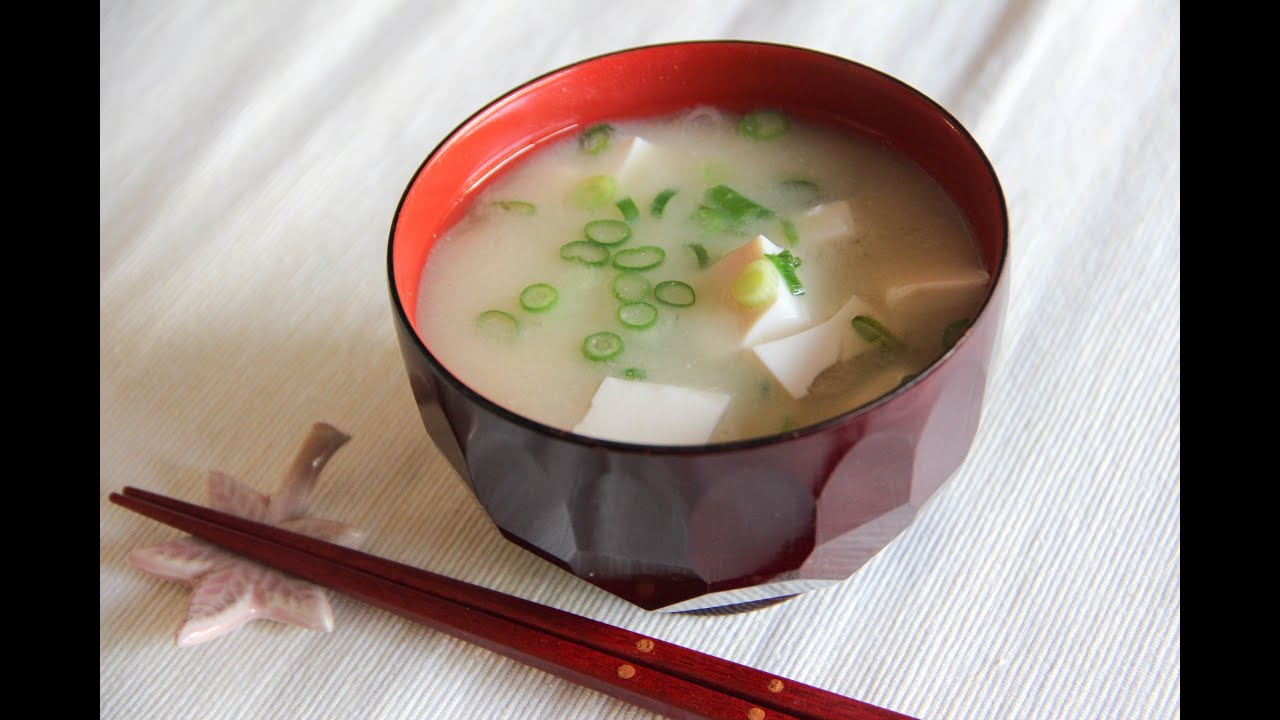
Switching gears dramatically, these three weeks in Kyoto also reanimated the love which my wife and I have for miso soup, that most Japanese of all soups.
miso-soup
Readers may think I lack gravitas turning in this way from the glories of Zen gardens to the humble miso soup, gentle handmaiden to the flashier main courses of countless Japanese meals. But I feel there is a strong affinity between the two: spare simplicity in the assemblage of the constituent elements, yet delivery of intense pleasure to the senses.

What is it about miso soup’s ingredients that give it that unique taste, to be found in no other soup? It is a question which I have asked myself every time I sip on its delights, yet it is only now, in my jet-lagged haze, that I turn to the Internet to find out.

The answer is the miso paste. It is this paste which, mixed with the traditional Japanese stock “dashi”, is at the heart of all miso soups. Other ingredients that are added, such as silky tofu cubes, finely chopped spring onions, and seaweed, are – if I may mix my culinary metaphors – merely cherries on the cake. Digging further, to my mind the magic of miso paste, what gives it that so very special taste, is the fungus Aspergillus oryzae. I should perhaps explain that miso paste is the product of a fermentation process; here we have the fermentation taking place the traditional way.
miso-fermentation-barrel
Our friend A. oryzae works its fermenting magic on a mash of soybeans and salt (to which other grains such as barley and rice are sometimes added). This is what the little critter looks like through a high-powered microscope.
miso-aspergillus
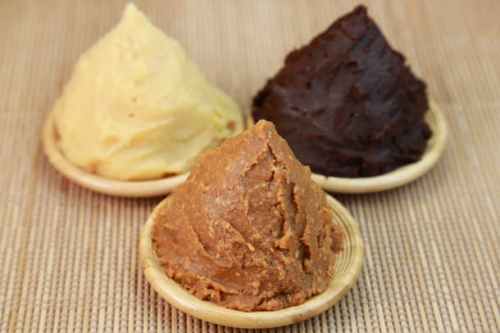
My internet searches have also turned up the interesting fact that there are many kinds of miso paste, depending on the length of fermentation. At the less fermented end of the spectrum, we have white miso, lighter in colour and taste, at the more fermented end, we have red miso, darker and with a stronger flavour, and we have different colourings in between.
miso-pastes
As one might imagine, there are regional preferences in the colour of one’s miso paste and, by extension, one’s miso soup. We must have been eating white miso soup since that is the preferred colour in Kyoto (while red miso soup is preferred in Tokyo, for instance).

After all this, my eyelids are beginning to droop. Maybe I’ll be able to get in a few hours of sleep before the new day dawns and have sweet dreams of visiting Kyoto once more. There are more Zen gardens to visit and more miso soups to try.

______________
Tofukuji-south garden-1: http://kyotofreeguide-kyotofreeguide.blogspot.it/2010/04/tofukuji-temple.html
Tofukuji-south garden-2: http://www.japan-guide.com/e/e3930.html
Tofukuji-south garden-3: https://www.artflakes.com/en/products/japan-kyoto-tofukuji-temple-landscape-garden-1
Ryoanji garden: http://www.123rf.com/photo_21419380_zen-garden-in-ryoanji-temple.html
Tofukuji-north garden: https://commons.wikimedia.org/wiki/File:Toufuku-ji_hojyo7.JPG
Tofukuji-west garden: http://www.panoramio.com/photo/121832697
Tofukuji east garden: http://www.panoramio.com/photo/121832672
Kenninji gardens-1: http://www.yurukaze.com/tag/kennin-ji/
Kenninji gardens-2: mine
Kenninji gardens-3: http://www.wa-pedia.com/japan-guide/kenninji_kyoto.shtml
Kenninji gardens-4: http://asian-images.photoshelter.com/image/I0000NbQQcA_e4yM
Miso soup: https://i.ytimg.com/vi/lH7pgsnyGrI/maxresdefault.jpg
Aspergillus oryzae: https://sites.google.com/site/microbiologiecours/support-de-cours/mycologie
Miso pastes : http://www.thekitchn.com/the-best-type-of-miso-for-miso-soup-tips-from-the-kitchn-215117

WE’RE HOME

Milan, 31 August 2016

We touched down at Milan’s Malpensa airport around 8:30 this morning. It was a beautiful day, not too hot. We took the train into Milan, passing first the town of Saronno, home of the eponymous liqueur

then Garbagnate, home of the Galbusera brand of biscuit.


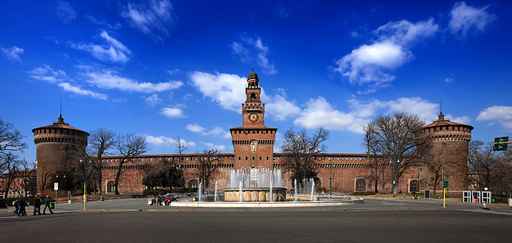
After a few more towns, we pulled into Cadorna station, which lies in the shadow of Milan’s castle.

image
We decided to walk home, so we wheeled our suitcases out, past the strange sculpture in the station square which finally, several years ago, I figured out was a needle and thread – a reference, no doubt, to the city’s place in the fashion world.

image
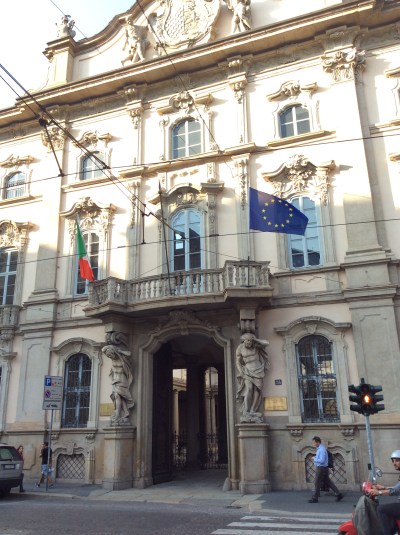
We made our way through back roads to Corso Magenta. We stopped for a well-deserved cappuccino in a caffé there. While we sipped, we admired the Baroque Palazzo Litta on the other side of the Corso.

I’ve always had a fondness for the two giants holding up the massive front door, so obviously suffering from the strain.


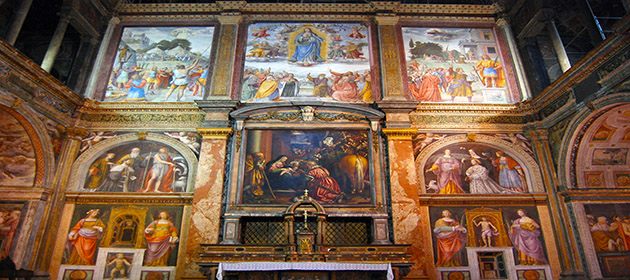
On we went down the Corso, past the Church of San Maurizio, which has magnificent 16th Century frescoes painted by Bernardino Luini and his school
image
before we turned right and threaded our way through the back roads again, past the mouldering ruins of the palace built by the 3rd century Roman Emperor Maximian

image
on past a disused church which is now a museum dedicated to the 20th century artist Francesco Messina

image
until we came to our road.

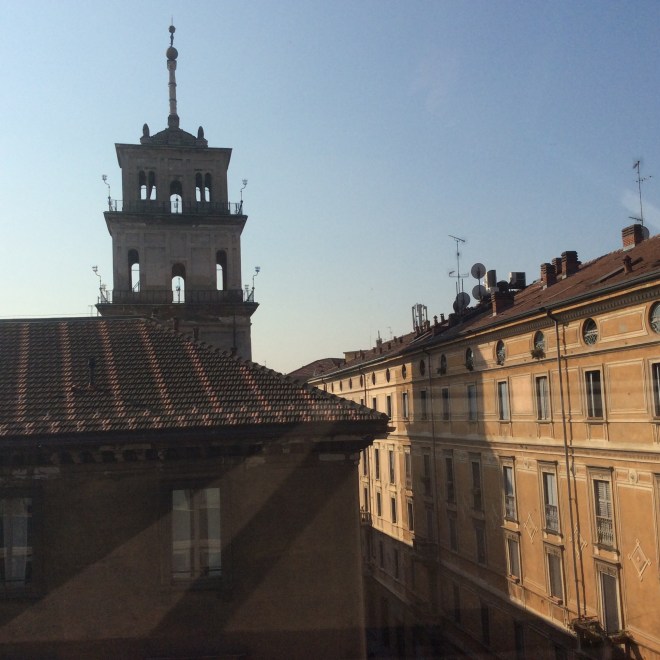
We chatted briefly with the doorman about the family as he handed us a large wad of post, accumulated since our last flying visit six months ago. We squeezed the luggage into the small elevator, manhandled it all through the apartment door, flung open the windows, and gazed over at the tower of the Palazzo Stampa-Soncino across the road.


image
After eighteen years away, it was good to finally be back home.

______________________
Liquore di Saronno: https://it.m.wikipedia.org/wiki/Liquore_amaretto
Biscotti Galbusera: http://www.galbusera.it/prodotti/senza-zuccheri-aggiunti/frollini
Castello Sforzesco, Milan: http://www.conilsud.it/2014/come-raggiungerci/
Sculpture, Piazza Cadorna: http://www.solotravel.it/29032011/piazzale-cadorna-a-milano-tra-design-e-modernita/6334
Palazzo Litta: my photo
Two statues, Palazzo Litta: my photo
Frescoes, church of San Maurizio: http://www.donnecultura.eu/?tag=chiese-di-milano
Remains Imperial Palace of Maximian: http://flickeflu.com/photos/40993657@N06/interesting
Sculpture, Francesco Messina: https://www.pinterest.com/pin/309059593155732010/
Tower, Palazzo Stampa Soncino: my photo

BAGAN, MYANMAR

Bangkok, 13 July 2016

My wife and I have just returned from a short visit to Bagan, in Myanmar. Back when Harold Godwinson received an arrow in his eye, losing his life and his English throne to William, Duke of Normandy
image
the kings of Pagan (as the kingdom was then known) had consolidated their hold on the valley of the Irrawaddy River, swallowing up their neighbouring city-states, and had created the first Burmese kingdom. The kingdom grew rich on trade but also on agriculture, harnessing irrigation for the first time in this dry region of Myanmar. As befits the capital of a prosperous kingdom, the population of Pagan swelled. The kings and the richer citizens, anxious to gain merit for their next reincarnation, used their wealth to heavily sprinkle the city and the surrounding plain with stupas, temples, monasteries, and other religious edifices. At the height of this building frenzy, more than 10,000 such edifices covered an area of some 100 square kilometres.

Alas, this well-meaning search for merit undermined the edifice of state. More and more land was donated to the Buddhist monkhood, land which then became exempt from tax, thereby gradually emptying the state coffers. The resulting internal strife weakened the kingdom, and invasions of its borderlands by the Mongol dynasty of China finished her off. By 1287, the kingdom of Pagan was no more, and its capital city had shrunk to the size of a very modest town. Sun, wind, and rain began their work. The plaster moldings with which all the religious edifices had been covered peeled off, and the exposed brick began crumbling away to mud and dust. Trees and bushes did their part, inserting roots between brick and brick and slowly leveraging them apart. Earthquakes played their part too, toppling walls and cracking open stupas. And so the religious edifices so lovingly erected by earlier generations slowly slumped back into the earth from whence they had sprung.

A score of temples and stupas, which continued to be sites of pilgrimage, were maintained, often with infelicitous results as frescoes were painted or whitewashed over and badly crafted statues took the place of the originals. In the last century, conservation work was carried out – haphazardly – under successive military regimes. This has halted, or at least slowed, the dissolution, but even so only some 2,000 edifices remain standing, more or less, today.

But 2,000 is still a big number. Climb, as we did, the Shwesandaw stupa, and you will find yourself gazing out over flat, wooded farmland thickly sprinkled with red-brick stupas and temples of every size and state of disrepair.
image

image

image

image

Get off the paved roads, as we did, and take the dirt roads and paths which crisscross this farmland, and you will come across lonely stupas brooding by the side of fields
image
where the lines of the Persian poet Ferdowsi come to mind:

The spider spins his web in the Palace of the Caesars
An owl hoots in the towers of Samarkand

(it is said that the Ottoman sultan Mehmet II murmured these lines as he visited the desolate ruins of the imperial palace after his conquest of Constantinople in 1453)

It comes spontaneous to compare Bagan to other places. Angkor Wat in neighbouring Cambodia is often cited, but the comparison doesn’t hold. Angkor has edifices which are splendid in their art and architecture.
image

image
image
The edifices of Bagan, on the other hand, now have little if any intrinsic merit. My wife and I saw nothing superlative in any of the stupas or temples we visited. Pleasant, yes, interesting sometimes, but nothing to take one’s breath away.
image
image

image

image
No, it is the overall landscape that makes Bagan noteworthy, and it is to landscapes that we must turn for comparisons. Since many of the edifices in Bagan are funerary in nature, my wife felt a certain affinity between the Italian cemeteries of her youth and Bagan, with the latter of course being on a much larger scale.
image
In such a comparison, I would perhaps lean towards the abandoned part of Vienna’s biggest cemetery, the Wiener Zentralfriedhof, which contains many of the tombs of Vienna’s Jewish community, wiped out in the Nazi concentration camps.
image
I myself favour a comparison with Ancient Rome, not the Ancient Rome of today, swallowed up in the concrete and bitumen of the modern city, but the Ancient Rome that was the subject of many a painting in the 17th to 19th centuries. This is Claude Lorrain
image

this, Piranesi
image
this, Palmer
image
and this, Lear
image
In these paintings I see an echo of the Bagan I looked out on from the heights of the Shwesandaw stupa.

As the lines I cite above show, the melancholy of ruins has always excited the imagination of poets. Rome’s ruins are no exception, with reams of poems written about them. I quote one here, by Alexander Pope.

See the wild waste of all-devouring years!
How Rome her own sad sepulchre appears,
With nodding arches, broken temples spread!
The very tombs now vanished like their dead!
Imperial wonders raised on nations spoiled,
Where mixed with slaves the groaning martyr toiled:
Huge theatres, that now unpeopled woods,
Now drained a distant country of her floods:
Fanes, which admiring gods with pride survey,
Statues of men, scarce less alive than they!
Some felt the silent stroke of mouldering age,
Some hostile fury, some religious rage.
Barbarian blindness, Christian zeal conspire,
And papal piety, and Gothic fire.
Perhaps, by its own ruins saved from flame,
Some buried marble half preserves a name;
That name the learned with fierce dispute pursue,
And give to Titus old Vespasian’s Due.

But this poem is far too frothy, as are all the poems about Rome’s ruins. I prefer the fragments of an Anglo-Saxon poem of the 8th Century, part of an anthology of Anglo-Saxon poems in the library of Exeter Cathedral, whose subject is not Rome but the Roman ruins of Bath.

Wrætlic is þes wealstan, wyrde gebræcon;
burgstede burston, brosnað enta geweorc.
Hrofas sind gehrorene, hreorge torras,
hrungeat berofen, hrim on lime,

For those of my no doubt many readers who, like me, are not conversant with Anglo-Saxon, let me continue with a translation by Siân Echard, of the University of British Columbia, with some modifications on my part.

Wondrous is this wall-stead, wasted by fate.
Battlements broken, giant’s work shattered.
Roofs are in ruin, towers destroyed,
Broken the barred gate, rime on the plaster,

Walls gape, torn up, destroyed, consumed by age.
A hundred generations have passed.
Earth-grip holds the proud builders, departed, long lost,
In the hard grasp of the grave. How often has this wall,

Hoary with lichen, red-stained, outlasted the passing reigns,
Withstanding the storms; the high arch now has fallen …

(At this point, there is a gap, for the parchment itself has suffered badly from the passage of time)

Indeed, the high arches, now fallen, of Bagan have witnessed the passing of many reigns, the last being but a few months ago, when the decades-long military government in Myanmar finally gave way to a democratically-elected civilian government. Knowing the history of neighbouring Thailand, where military meddling is a way of life, I offered a silent prayer in the Ananda temple
image
that this would be the last of the military governments in this beautiful country, which has suffered so much and deserves so much better.

________________
Photos of Bagan: ours
Harold hit by the arrow: http://www.dot-domesday.me.uk/arrow.htm
Angkor Wat-1: https://artmundus.wordpress.com/2010/05/28/the-wonder-that-is-angkor-wat/
Angkor Wat-2: https://artmundus.wordpress.com/2010/05/28/the-wonder-that-is-angkor-wat/
Angkor Wat-3: http://rwethereyetrwethereyet.typepad.com/arewethereyet/2008/04/take-your-kids.html
Cimitero monumentale, Milan: https://www.tripadvisor.it/LocationPhotoDirectLink-g187849-d243431-i28163413-Monumental_Cemetery-Milan_Lombardy.html
Jewish section, Vienna Zentralfriedhof: http://www.flickriver.com/photos/lastingimages/2924629401/
Roman ruins:http://www.bobforrestweb.co.uk/The_Rubaiyat/Galleries/Gallery_5/g5notes.htm
– Claude Lorrain
– Giovanni Battista Piranesi
– Samuel Palmer
– Edward Lear

WORLD TRADE CENTER

31 December 2015

Two years ago, when we were last in New York, we visited Ground Zero and the newly created Memorial to the victims of 9/11. Several days ago, during our current New York stay, we decided to go back to see how things have moved on.

Well, I’m glad to report that One World Trade Center is finally finished. I read up the back story to the development of the overall master plan for the area as well as for the design of the individual buildings; a veritable Shakespearean drama, with super egos confronting each other in dramatic showdowns, stabbing each other in the back, making sonorous declarations to the press, and otherwise carrying on like children in kindergarten. It’s a wonder that anything got done at all.
image
Rising serenely above all this human mayhem, WTC 1 is a very lovely, glass-sheathed building. As readers can see in the photo below, the corners have been severely shaved back. I wouldn’t know how to describe the geometrical shenanigans going on here, so I simply quote a line from the building’s entry in Wikipedia: “from the 20th floor upwards, the square edges of the tower’s cubic base are chamfered back, shaping the building into eight tall isosceles triangles, or an elongated square antiprism”. However you describe it, the effect is pretty cool.
image

WTC 2 is lagging behind. After having gone through a complete redesign, it is now being built, with a planned completion date of 2020. It should look like this once it is finished – a set of cubes stacked somewhat untidily one on top of the other.
image
Personally, I’m not sure I will like this building. Something about those poorly stacked cubes disturbs my sensibilities. But I’m willing to be convinced once 2020 rolls around.

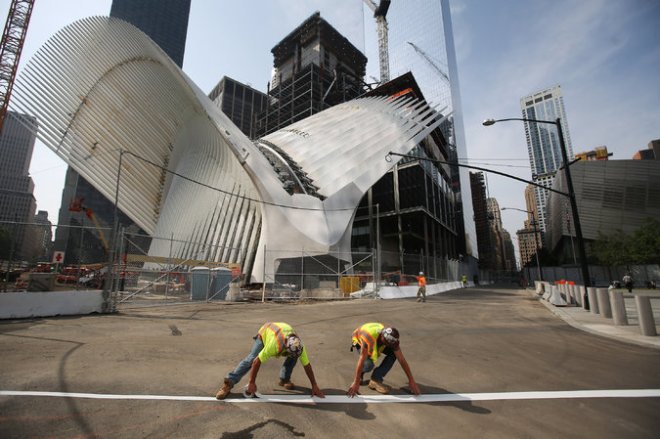
I will skip over WTCs 3, 4, 5 and 7 (WTC 6 seems to have disappeared from the roster in the new master plan), although I would draw readers’ attention to WTC 4, finished a few years ago and a very handsome building indeed. I want to focus instead on the Transportation Hub, which is a grand name for the entry to the subway lines running under the site. This, I have to say, is a rather strange-looking structure.
image
When I first caught sight of it, from the side, I was powerfully reminded of photos that came out in the immediate aftermath of September 11, showing the jagged remains of the outer sheathing of the old WTC 1 and 2 buildings which had come crashing to the ground.
APW2001091209845
I don’t know if that was also on the mind of the Hub’s designer, the Spanish architect Santiago Calatrava. In his public pronouncements, he has talked rather about it being like a bird flying out of a hand. It certainly has a bird-like quality from the back, although commentators have suggested a more stegosaurus-like look, which as the photo above shows is certainly true from the front. For those readers who may not be familiar with their dinosaurs I throw in a picture here of a reconstructed stegosaurus.
image
The similarity is even more striking when you consider a stegosaurus skeleton.
image
Frankly, I’m not completely sure how well this piece of design will withstand the test of time. Calatrava’s other design for the new World Trade Centre, the rebuilding of the tiny Orthodox Church of St. Nicholas which got flattened in the maelstrom of September 11, may weather better, at least from the models I’ve seen
image
but we will have to wait until 2017 to pass a firmer judgement.

Well, it seems that my wife and I have plenty of excuses to come back to New York in the years to come. Which is nice, because the primary current excuse for our coming, our daughter living here, is about to disappear as she moves on to greater and better things.

_____________________
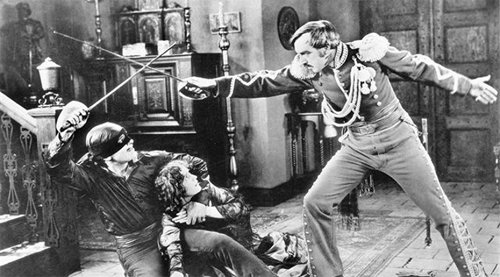
Silent film dramatic scene: http://bayflicks.net/2014/01/17/whats-screening-january-17-23/
WTC 1: http://anotherpartofme.com/the-real-reason-one-world-trade-center-1wtc-lost-its-best-features/
WTC 2: http://www.cnn.com/2015/06/12/travel/two-world-trade-center-tower-big/
Transportation Hub: http://www.nytimes.com/2015/06/25/nyregion/a-crossroads-decades-gone-will-reopen-at-the-world-trade-center.html
Ground Zero: http://www.propublica.org/article/new-docs-detail-how-feds-downplayed-ground-zero-health-risks
Stegosaurus reconstruction: https://en.m.wikipedia.org/wiki/Stegosaurus_in_popular_culture
Stegosaurus skeleton: https://digitalstore.makerbot.com/stegosaurus-skeleton
St. Nicholas Greek Orthodox Church: http://www.nytimes.com/2013/10/31/nyregion/st-nicholas-church-destroyed-on-9-11-to-rebuild-with-byzantine-design.html

IT SHOULD FIT OVER MY SOFA

New York, 28 December 2015

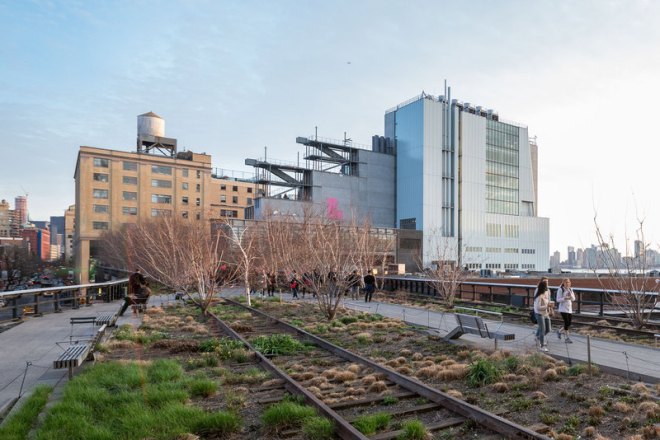
I’ve described in a previous post the beautiful, and really very unique, High Line Park in New York. On our first visit to the park, we heard that the Whitney museum was planning to relocate from uptown to new premises bang on the High Line. Now, two years later, the plans have come to fruition, and since we are once again in town to celebrate Christmas and New Year with the children we decided to go and visit.

The building itself was designed by the architect Renzo Piano, he of the Centre Pompidou in Paris (along with fellow architect Richard Rogers)
image
and, less felicitously, of the Shard in London
image
along with a string of projects in between. The new Whitney is not as spectacular as these two, giving the impression of being more of a workmanlike project – how to give the museum lots of exhibition space – and blending in quite well with its surroundings.
image
image
One also gets beautiful views across the Hudson River from its windows.
image
Perhaps it’s just as well. I mean, the main purpose of going to a museum is not so much to see the container as to see what is contained (I grant, though, that a handsome packaging can add lustre to what’s in the package). So let me focus on the contents.

Actually, I don’t really want to focus on the contents as such, but rather use them to meditate on something which gets under my skin when it comes to really modern art – let’s say, stuff produced in the last sixty years i.e., during my lifetime.

I happen to think that the primary purpose of any piece of art should be to adorn one’s abode in a way that gladdens the heart and puts a spring in one’s step. The key, though, is that the piece of art should fit through the door of one’s abode and, once in, should fit on a wall of that abode (or, if a sculpture, on a small table or shelf). The core of the Whitney’s collection, from the ’30s and ’40s, would do this admirably. For instance, there was a lovely Hopper on view which would could be passed through the door of our apartment quite easily and would fit quite nicely on one of its walls.
image
It’s one of several delectable Hoppers in the collection. Or I wouldn’t mind at all putting this painting by Charles Demuth on our wall.
image
Getting it into the apartment would be a breeze – I think it could probably even fit it into the small elevator we have in our building, thus avoiding us having to carry it up three flights of stairs.

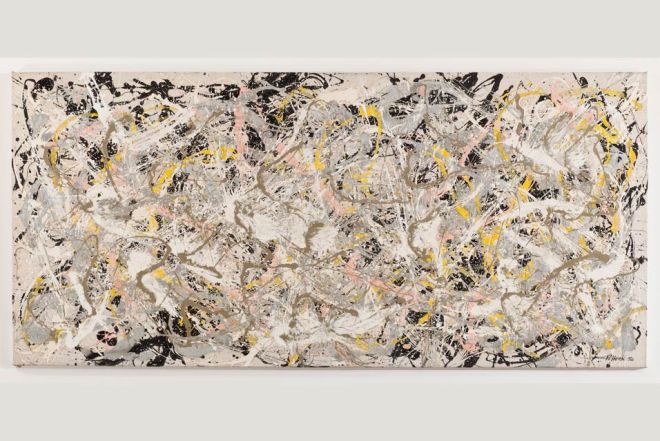
But as we get into the late ’50s, early ’60s, the pieces begin to grow. We would just about be able to manhandle this Pollock which the Whitney has through our apartment door, but I think we would have difficulty finding a place for it on the wall.
image
And this painting by his wife Lee Krasner would be impossible to hang in our apartment, it’s just too damned big let alone of a size to get through the door.
image
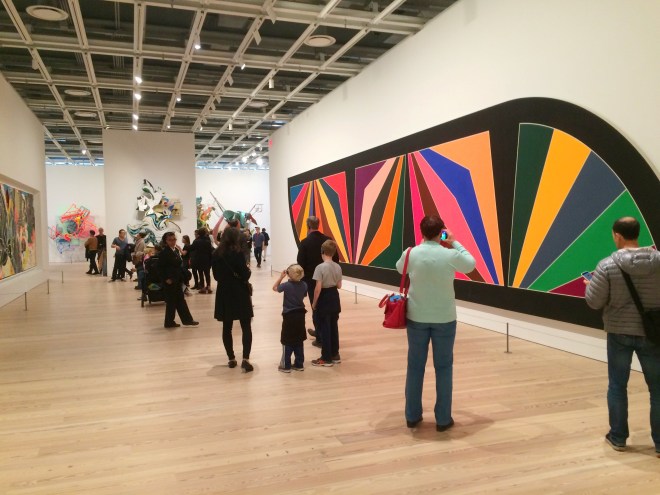
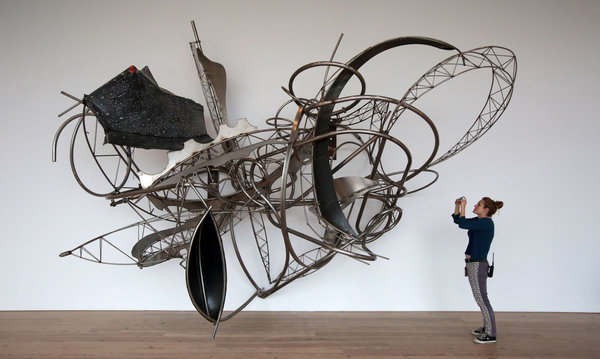
The pieces in the Frank Stella show which the Whitney is currently organizing were even worse. They were huge lumbering monsters, which would not even fit through the front doors of our apartment building, leave alone through the door of our apartment.
image

And even if by some miracle we got them into the apartment, many of his pieces jut out, making it hard to have any furniture around them.
image
Of course, given the stellar prices for modern art, only plutocrats can afford to buy these pieces. But do even they live in such palatial abodes as to make it possible for such a piece to fit snugly in the living room, say? I find it hard to believe.

I can only assume that much modern art is either made for large and powerful multinational corporations, whose huge atriums or corporate boardrooms in their Headquarters have enough space for such pieces
image

image

or it is made for museums such as the Whitney which have large exhibition spaces. Either way, art for the people it is not. And that’s a pity, because at the end of the day art should be for us, something which we can hang on our wall and admire for decades or even centuries before perhaps donating it to a museum.

I think it’s time for a new art movement, the FOTS (“Fits Over The Sofa”) movement.

image

_____________________
Centre Pompidou: http://www.leparis.pl/centre-georges-pompidou-muzeum-sztuki-wspolczesnej/
The Shard: https://en.m.wikipedia.org/wiki/Renzo_Piano
The Whitney (both views): http://whitney.org/About/NewBuilding
View across the Hudson: http://elizabethbarton.blogspot.com
Edward Hopper “Early Sunday Morning”: http://collection.whitney.org/artist/621/EdwardHopper
Charles Demuth “My Egypt”: http://collection.whitney.org/object/635
Jackson Pollock “Number 27, 1950”: http://www.allartnews.com/pollock-and-the-irascibles-the-new-york-school-opens-at-palazzo-reale-in-milan/
Lee Krasner “The Seasons”: http://www.brooklynstreetart.com/theblog/2015/04/30/the-new-whitney-opens-may-1-america-is-hard-to-see/#.VoE8i3o8KrU
Frank Stella: http://www.nytimes.com/2015/10/30/arts/design/tracking-frank-stellas-restless-migrations-from-painting-and-beyond.html?_r=0
Frank Stella: http://www.hedgefundintelligence.com/Article/3503103/Steve-Cohen-sponsors-Frank-Stella-exhibition-at-the-Whitney-Museum.html
Headquarter atrium art: http://houston.culturemap.com/news/entertainment/03-02-13-image-bending-spanish-artist-transforms-downtown-houston-office-atrium-with-iwavesi/slideshow/
Corporate boardroom art: http://www.artworks-solutions.com/news/view/corporate-art-works
Space over sofa: http://www.utrdecorating.com/blog/hanging-pictures-sofa/

CHOFAHS

Bangkok, 13 December 2015

I’m not a great fan of Thai religious art. Much of it seems to be made up of endlessly repeated and very dense geometricized forms, like on this temple door

Vine Pattern Door

or on this one, where the temple guardians or whatever they are have been surrounded by dense geometricized foliage

temple door-2

or here on a temple’s roof gable, where it is now a representation of the Buddha that is surrounded by endless curlicues

gable

and which often in Bangkok are terrifically bling, being made with reflecting coloured mosaic tesserae (I understand that only temples with royal connections can use these reflecting tesserae).
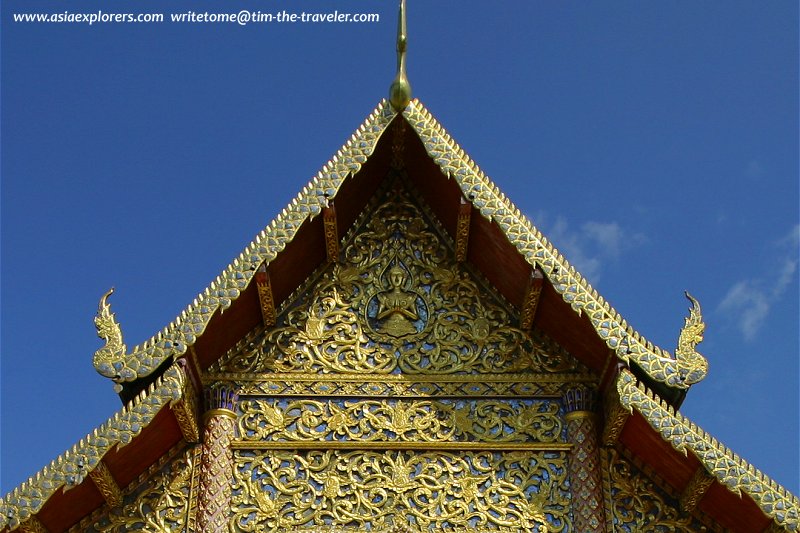
Or on the so-called bargeboards which run along the gables

bargeboards

the designs often representing, as is clearly the case here, a naga snake; the naga snake design is less obvious in this next photo.

bargeboards-2

The interiors of the temples are not much better, with the walls normally being densely carpeted either with an endlessly repeating series of Bodhisattvas or some such, or with very dense scenes of the life of the Buddha or some similarly holy personage.

temple interior-1

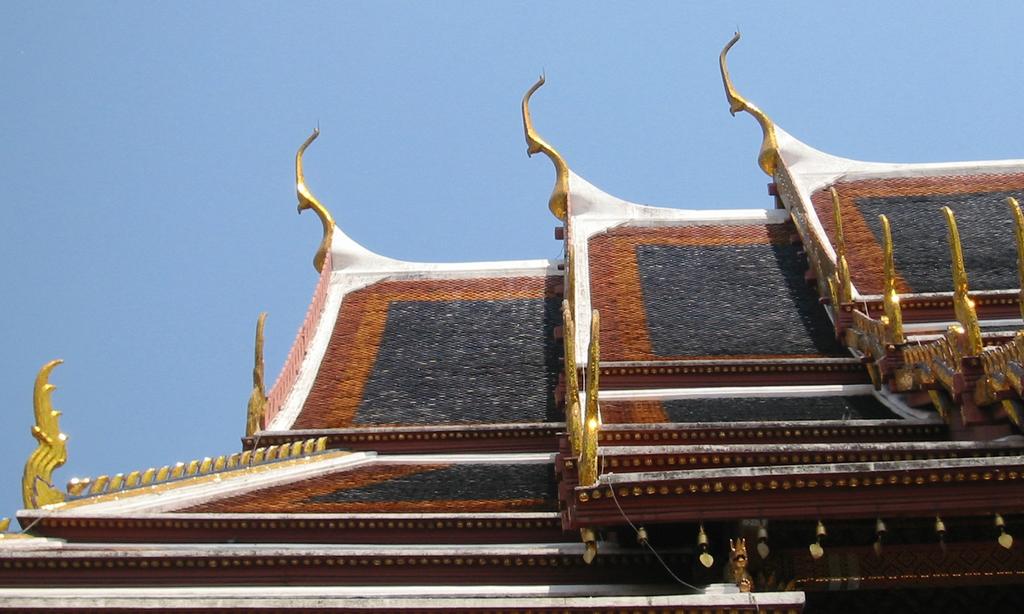
As I’ve mentioned in at least one previous posting, I’m not a great fan of busy artwork, so I generally feel uncomfortable in Thai temples. The one exception is my feelings for the chofah. Chofahs are the very distinctive finials added to the end of temple roofs, and which are quite striking, especially from a distance. Here are two views of Wat Phra Kaew in Bangkok, showing that temple’s chofahs, this one from a certain distance
Wat Phra Kaew from a distance

and this one from closer up.

Wat Phra Kaew - chofahs

What exactly are they? What do they represent? Well, the literal meaning of chofah is “bunch of air” although someone has given it the more poetic translation of “sky tassel”. The name may be poetic but I don’t feel it helps much, since I don’t see any obvious connection between what I see before me and bunches of air or tassels, skywise or otherwise. More helpfully, they are generally considered to be representations of the Garuda, the half-bird, half-man which the Indian God Vishnu is said to fly on (and which is now the national emblem of Thailand), although there is a competing theory that actually they represent the hamsa, which is a goose, or a gander, or maybe even a swan, which in Hindu mythology is the mount of the God Brahma. Whichever it is, there is a definite resemblance to a bird. Looking at the last picture, I think it’s easy to see a head, a beak, a neck, and a breast of a bird (what’s a little less birdlike is the long tuft-like extension on the head; we’ll come back to that in a minute). Contrary to the baroque ornateness of everything else in Thai temples, we have here a simple ornament, where resemblance is implied with a few graceful strokes chiseled into wood.

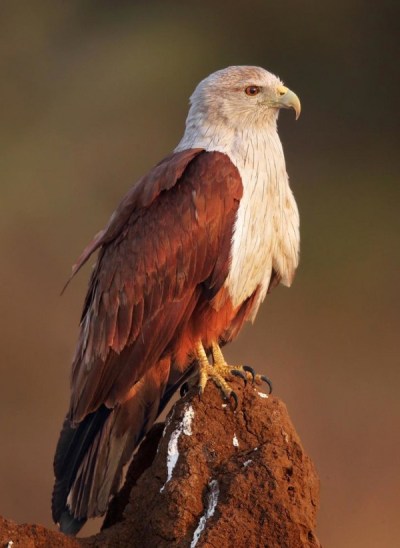
Just to make the bird connection a bit stronger, I throw in a picture here of a brahminy kite sitting on a stone.

Brahminy Kite

I choose this particular bird because it is currently considered the contemporary representation of the Garuda. More irreverently, I also throw in a picture of the cover page from one of Lucky Luke’s comic books, where the reader will note another raptor, the vulture.

Lucky Luke vulture

Vultures are always hovering around in Lucky Luke’s stories, waiting for their next meal in the form of a dead Lucky Luke or other dead meat; note the drop of saliva falling from the beak – it’s looking forward to that meal of dead meat …

If I introduce comic books, it’s because that tuft-like extension on the chofah stirs a vague memory in me of some comic-book bird with a long tuft on its head. Maybe I’m thinking of Woody Woodpecker.

woody woodpecker

But Thai temple builders definitely weren’t thinking of Woody or anyone else when they added that long tuft to their chofah design. They originally believed that the tuft would actually act as a skewer and protect the temple from flying demons by impaling them should they get too close.

So maybe the chofah is a sort of lightning conductor before its time.

____________

Temple door-1: http://static5.depositphotos.com/1031223/456/i/950/depositphotos_4560014-Golden-Buddhist-temple-door-at-Wat-Phoechai-Loa..jpg (in http://depositphotos.com/4560014/stock-photo-golden-buddhist-temple-door-at.html)
Temple door-2: http://previews.123rf.com/images/trahcus/trahcus1007/trahcus100700017/7330394-Thai-style-painted-door-Stock-Photo-door-golden-temple.jpg (in http://www.123rf.com/photo_7330394_thai-style-painted-door.html)
Roof gable: http://thumbs.dreamstime.com/x/wat-thai-temple-decorations-phra-kaew-bangkok-thailand-30782920.jpg (in http://www.dreamstime.com/stock-photo-decorations-wat-phra-kaew-details-temple-emerald-buddha-bangkok-thailand-image47184437)
Bargeboards-1: http://www.asiaexplorers.com/pics/gable-northern-thai-temple.jpg (in http://www.asiaexplorers.com/thailand/northern-thai-temple-architecture.htm)
Bargeboards-2: http://thumbs.dreamstime.com/x/buddhist-temple-roof-detail-thailand-46162088.jpg (in http://www.dreamstime.com/stock-images-buddhist-temple-thailand-phra-choeng-chum-ornate-thai-town-sakon-nakhon-image35533934)
Temple interior: my wife’s pic
Chofahs – Wat Phra Kaew from a distance: http://www.gigaplaces.com/place/144_max.jpg (in http://www.gigaplaces.com/en/gigaplace-wat-phra-kaew-144/)
Chofahs – Wat Phra Kaew: http://photos1.blogger.com/blogger/6018/1224/1600/Bangkok%20-%20Wat%20Phra%20Kaew%20301.jpg (in http://marcsala.blogspot.com/2005/09/temple-guardians-in-thailand.html)
Brahminy kite: http://voices.nationalgeographic.com/files/2013/05/Brahminy-Kite-Gururaj-Moorching-600×822.jpg (in http://voices.nationalgeographic.com/tag/macaw/feed/)
Vulture in Lucky Luke: http://1.bp.blogspot.com/-m2HaZEeDsfk/VYQHOyjtjAI/AAAAAAAASMo/NJ805YwsIWs/s1600/LuckyLuke46a.jpg (in http://mysterycomics-rdb.blogspot.com/2015/06/critique-648-lucky-luke-tomes-43-46-le.html)
Woody Woodpecker: http://vignette4.wikia.nocookie.net/woodywoodpecker/images/4/44/477098-villi.jpg/revision/latest?cb=20141107234707 (in http://woodywoodpecker.wikia.com/wiki/Woody_Woodpecker)

FADO

Bangkok, 11 June 2015

I get many invitations to diplomatic dos. I almost always bin them, but when I received one from the Embassy of Portugal to celebrate the country’s National Day, I hesitated. They do have the most wonderful Embassy here, right on the Chaophraya River.

embassy from river

My wife and I pass it very time we take the water bus down to Sathorn, and as we pass I always feel a twinge of nostalgia, to see this lovely villa from the 1870s, with its lawn sweeping down to the river, squeezed now between modern buildings of concrete, glass and steel. Ah, the Bangkok that once was …

It was decided.  I would accept the Ambassador’s invitation, to give us a chance to see this wonderful property up close.

So it was that last night, as dusk was falling, we joined a line of guests to shake the Ambassador warmly by the hand, and then were left free to wander around the lawn, with a white wine in hand. We walked over to the river, turned around, and admired the scene.

lawn of embassy 002

As we stood there, sipping our wine, from under the flame tree came the unmistakable lilting lament of fado. Song after song floated across the lawn

É meu e vosso este fado
destino que nos amarra
por mais que seja negado
às cordas de uma guitarra

Sempre que se ouve um gemido
duma guitarra a cantar
fica-se logo perdido
com vontade de chorar

Ó gente da minha terra
agora é que eu percebi
esta tristeza que trago
foi de vós que a recebi

E pareceria ternura
se eu me deixasse embalar
era maior a amargura
menos triste o meu cantar

Ó gente da minha terra

This fado is mine and yours,
A destiny that binds us,
No matter how much denied,
To the strings of a guitar

When we hear the lament
Of a guitar in song
We are instantly lost
In a desire to weep

Oh people of my land,
Now is it that I understand
This sadness which I carry.
I received it from you

And it would seem a tenderness
To allow myself to be soothed.
The bitterness would be greater
My singing less sad.

Oh people of my land

And so filled with saudade, that indefinable existential melancholy which we are told pervades the Portuguese soul, as well as with several glasses of excellent Portuguese wine, we slowly made our way inside the villa, to eat bacalhau à Gomes de Sá.

___________

Embassy from River: http://upload.wikimedia.org/wikipedia/commons/2/2a/Embassy_of_Portugal_Bangkok.JPG (in http://commons.wikimedia.org/wiki/File:Embassy_of_Portugal_Bangkok.JPG)

The other picture: mine