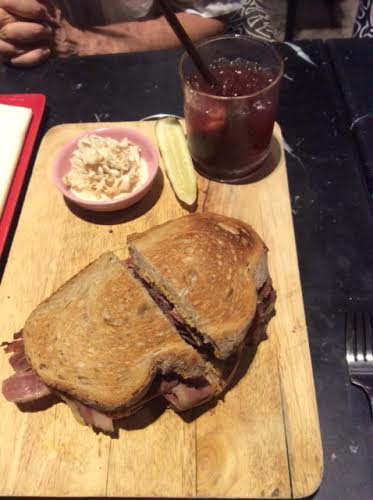
HOT PASTRAMI SANDWICH

Bangkok, 12 August 2015

Last weekend, my wife informed me excitedly that she had discovered a restaurant downtown which claimed to serve Reuben and pastrami sandwiches. Goodness me, we chirruped to each other, it had been years since we’d eaten either. We had to go back to the late 1980s, when we lived in New York for a while, for our last Reuben and pastrami sandwiches. The seminal initiation event was in a small deli to the south of Central Park, one of those places with booths where you slide into your seat (although unfortunately it didn’t have the really cool little juke box that you can see in this picture).

diner booth

We had actually gone in there because we happened to be in the neighbourhood and it happened to be lunch time. Since it also happened to be a Jewish deli, we found ourselves scanning a menu listing Jewish delicacies. After some rumination, we plumped for this thing called a Reuben sandwich and this other thing called a hot pastrami sandwich. What an experience! The deli owner looked on amusedly as we oohed and aahed over our two sandwiches. Thereafter, we ate them regularly during the rest of our stay in New York.

So even though we had had a traumatizing experience two months ago with coq au vin, we decided to risk it. This time, we were not disappointed. We were served very creditable Reuben and pastrami sandwiches. I have a picture of the Reuben sandwich we ate.

reuben sandwich

But in our haste to devour the pastrami sandwich we forgot to take a photo of it. Which is a pity, because if I have to choose between the two, I would plump for the pastrami sandwich, and in fact the rest of this post is about pastrami.
No matter, I can throw in here a photo of a pastrami sandwich from Katz’s Deli.

pastrami sandwich katz deli

This deli, which is on Houston Street in New York, is claimed in certain quarters of the internet to be “the keeper of the Jewish culinary flame” in the city.

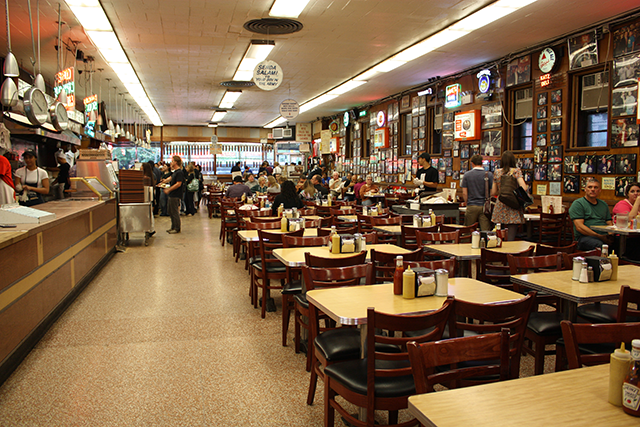
katz deli

katz deli inside

Strong claim indeed! Never having been to the establishment myself, I can’t tell you if this claim is reasonable (although I will note that my daughter has been there and was not that impressed by their pastrami sandwich – but then, she doesn’t much care for pastrami in the first place).

Before I get into rival claims, of which there are many in this field, let me quickly review the making of pastrami (something which I’d always vaguely asked myself about but had never bothered to check until I decided to write this post). Start with a cut of beef from around the animal’s navel, the so-called plate cut (you can also use brisket – more of this choice in a minute). Cure it with salt and saltpeter and let it dry for several weeks (you can also throw some herbs into the curing mix). Once cured, rub and coat your meat with a mix of herbs (as you can imagine, the precise make-up of this coating is a trade secret, jealously guarded by rival delis, but onion, garlic, black pepper, coriander seed, possibly sugar, all seem to be common ingredients). Once nicely coated, smoke it at low heat for several days (the precise wood used for the smoke being again a closely guarded trade secret).
So far, so good. This is no different from the preparation of many dried, cured meats around the world, and before the advent of refrigeration these methods had been used by human beings in one combination or another for thousands of years to preserve meat. It’s the next steps where it gets interesting. After smoking, you first boil the meat to cook it, and then steam it for some 15 minutes. These last steps seem to have to do with the cut of beef used. Initially, pastrami was a poor man’s dish. People used the plate and brisket cuts because they were the cheapest, and they were the cheapest because they are fatty and gristly. Boiling and steaming was used to soften both the meat and all those difficult-to-chew parts in the meat.

Then you serve it, fresh from the steamer, on rye bread; actually, it’s a wheat-rye bread, of a kind that the not-too-poor people used to eat in Europe (wheat bread was only eaten by the rich, while the poorest people ate horsebread, so called because it was made of the cheaper grains fed to rich men’s horses). The sandwich should always be served with a pickle (or two or three) on the side. To me, this is capital; the sharp astringency of the pickle offsets nicely the fattiness of the pastrami. It’s often served with coleslaw, but frankly that can be left out, at least the kind of commercial gooey coleslaw that tends to be served nowadays. It adds no real value to the dish that I can see.


The alert reader may have noted a stress in the last couple of paragraphs on poverty. This allows me to segue smoothly into a discussion of pastrami’s history. Pastrami researchers have concluded that its roots are to be found in New York’s community of Romanian Jews, who emigrated to the States in the late 1800s. They were escaping from Romania’s increasingly organized and ethnically-tainted anti-Semitism as well as looking for better economic opportunities. Like millions of other people, they would have transited through Ellis Island

immigrants at Ellis Island

and then been sucked into the slums of New York.

Mulberry street NYC

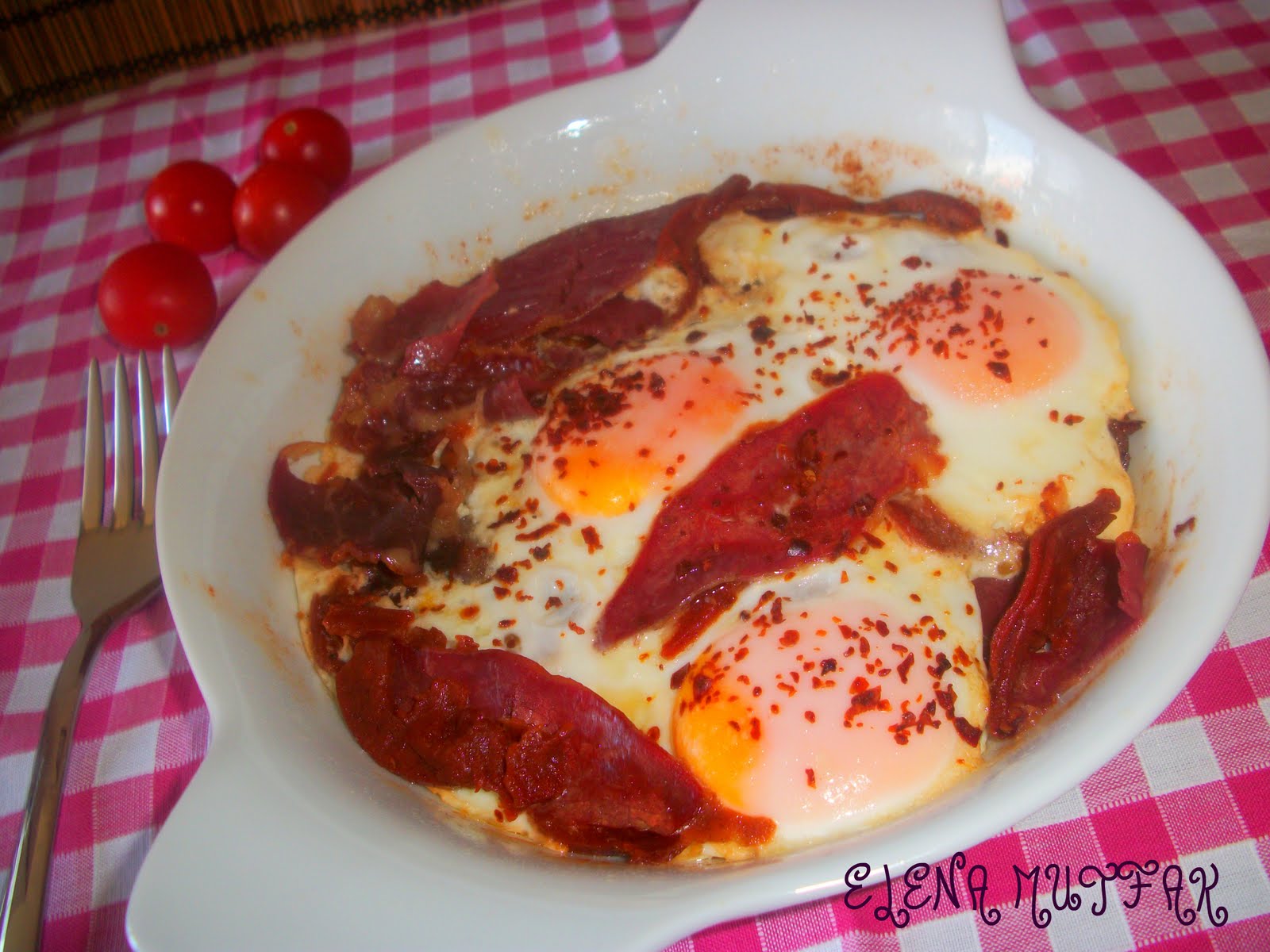
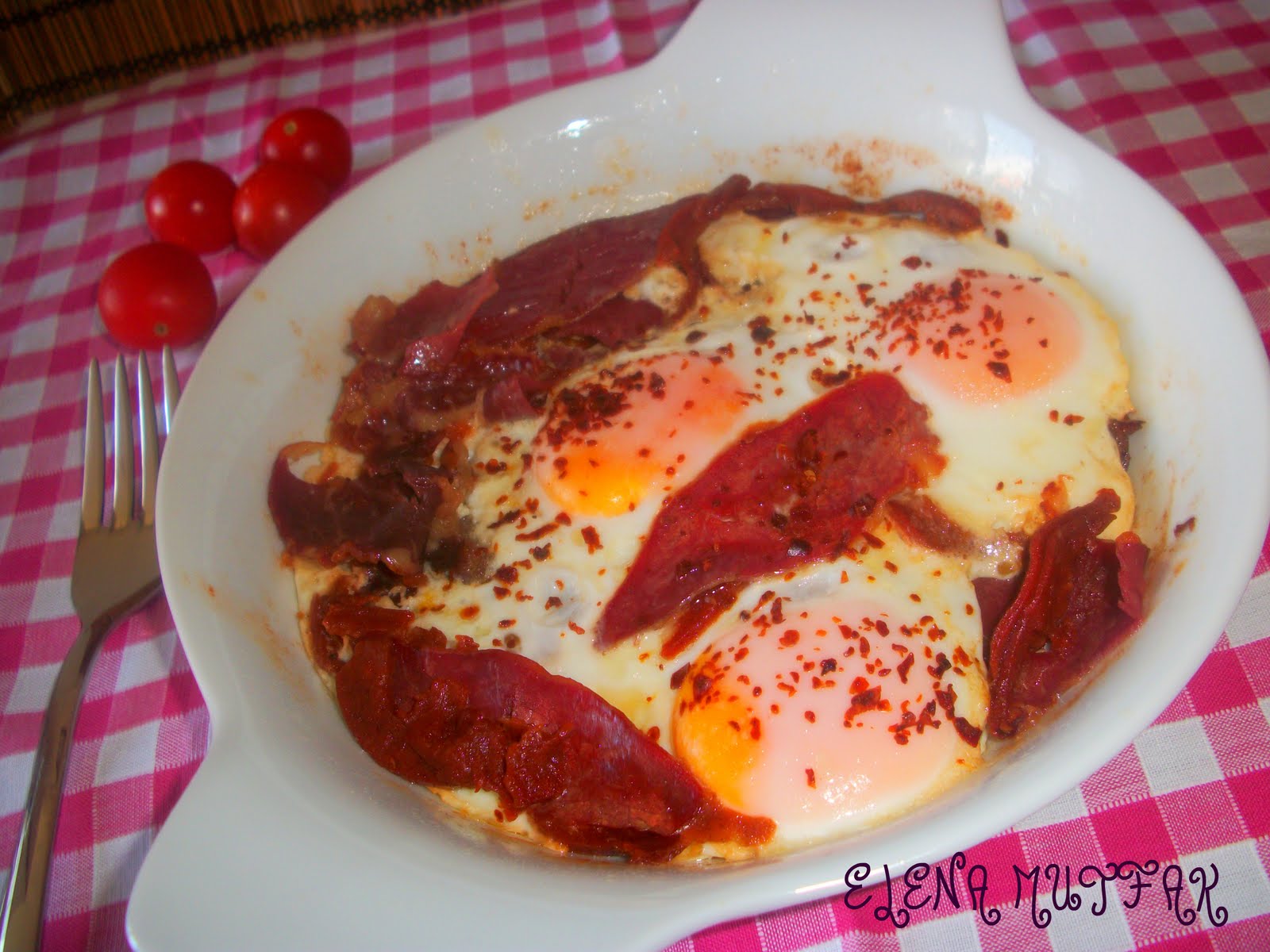
There, like all immigrants everywhere and at all times, they would have tried to maintain their culinary traditions, and one of these was a dried, cured meat called pastramă (in the early days, New York’s version was called pastrama, which was then changed to pastrami so that it could rhyme with salami, the idea being that this would help people remember it – an early form of the marketing jingle). But as is also often the case, they would have had to modify it to fit the ingredients they could find in their new homeland. And here the change was radical. In Romania, pastramă tended to be made with mutton or goose or even veal (but that must have been a rich man’s version; poor people didn’t eat veal). But what Romanians found in New York was beef (pork also, but that was non-kosher), so beef-based their pastramă became. And because they were poorer than poor, they used the cheapest cuts of beef, the plate and brisket. I suppose it was the fact that pastramă made this way was really chewy that led them to take the extra steps of boiling and steaming. The common Romanian way of eating pastramă is grilled. In fact, pastramă sounds to me like the Romanian version of bacon. Bacon, which is also a cured and dried meat (pork in this case), is also grilled before eating, and it is often eaten with eggs, as is grilled pastramă.

pastrama and eggs

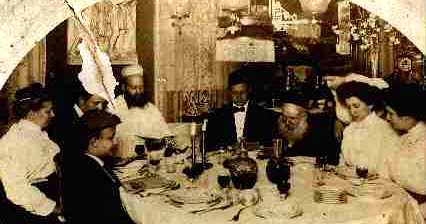
Or was it maybe this gentleman (at the back with the white headgear) who introduced the boiling and steaming steps?

sussman volk

This gentleman is Sussman Volk, an Orthodox Jew of Lithuanian ancestry. He is credited with having introduced pastrami to New York, and through New York to the rest of the world. He had emigrated to the States and had eventually opened a small butcher’s shop on Delancey Street. One day, so the story goes, a Romanian Jew came in and asked if he could store a trunk in the shop’s basement while he went back to Romania. Rab Volk agreed, and in return he got the recipe for pastrami. So Rab Volk started making pastrami, and then people wanted it on a slice of bread, and then he put chairs and tables in, and suddenly he was running a delicatessen. And the rest is history, as they say (just to close the circle, the following year Katz’s Deli opened). It could be that the recipe given to Rab Volk already included the boiling and steaming steps, or it could be that Rab Volk – reaching back into his Lithuanian culinary roots, or maybe other immigrant culinary roots – introduced the boiling and steaming steps himself.

Who knows? In the end, it doesn’t matter. This is the way pastrami is made, and that’s that.

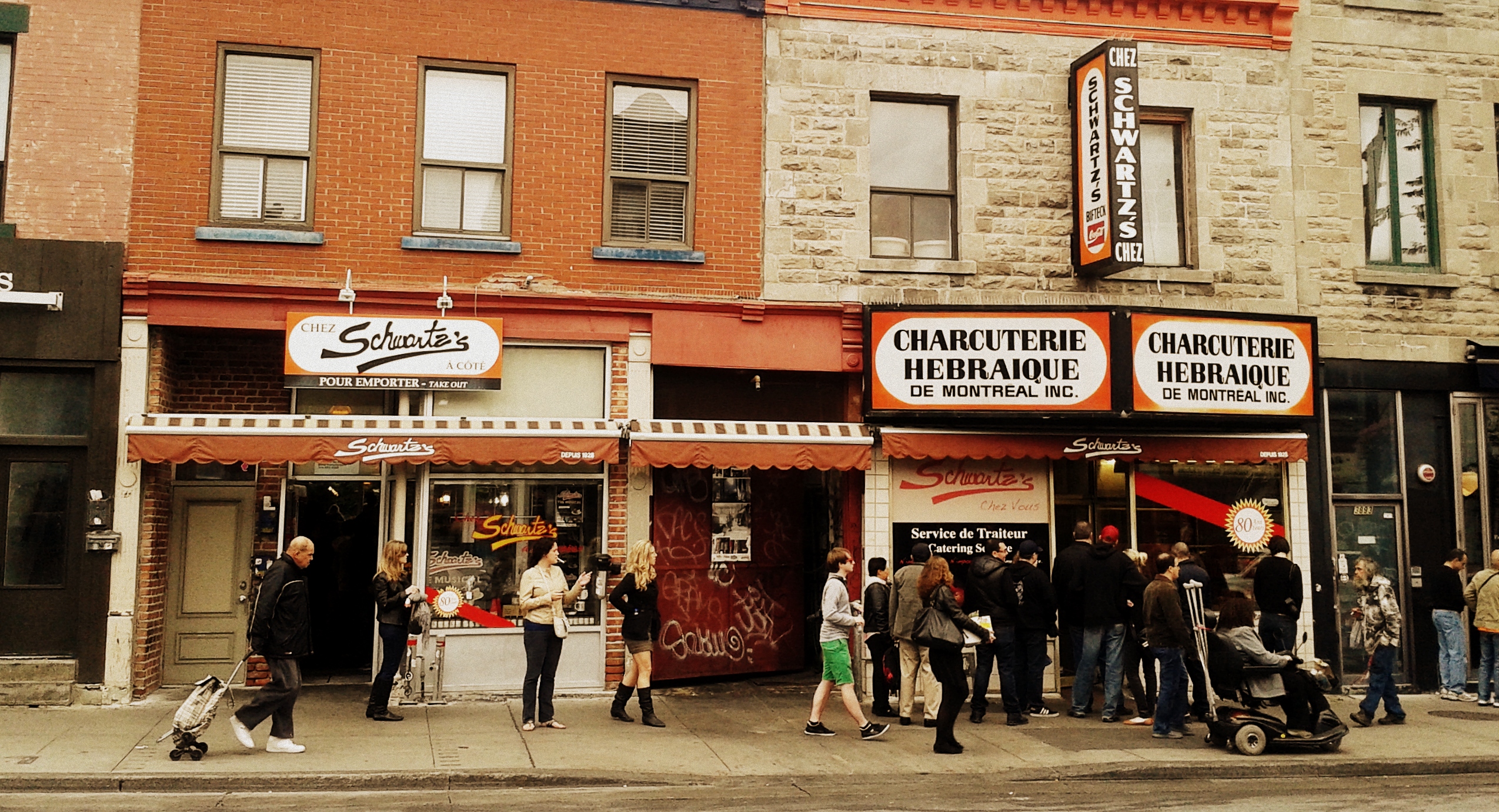
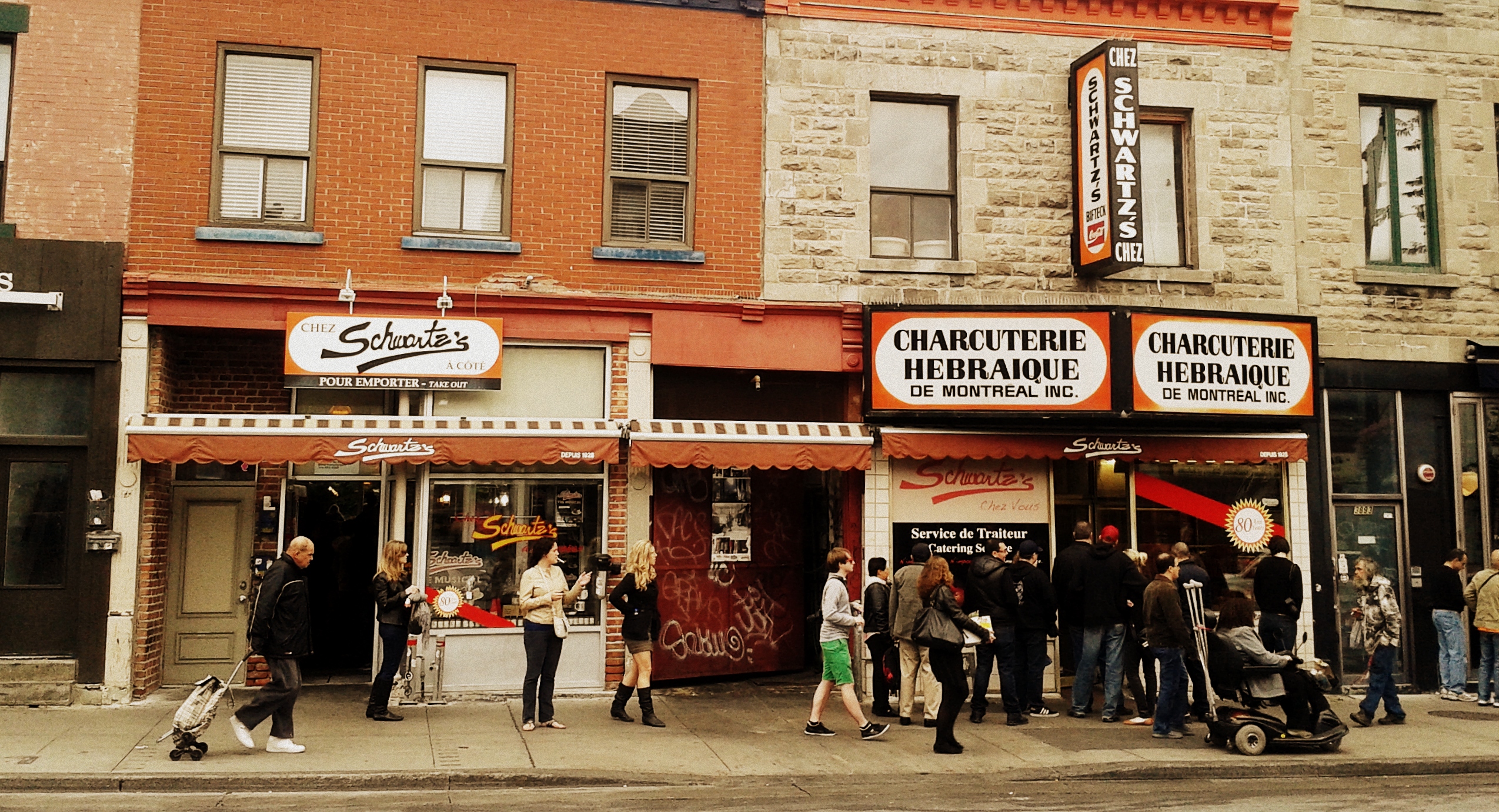
If readers were to think that the story ends here, they would be wrong. Because Romanian Jews also emigrated to Canada, settling in Montreal. And there they also introduced Montrealers to another son-of pastramă, in this case just called smoked meat. The two – relatively small – differences between the two products are the cut of beef used (smoked meat tends to use more brisket) and the mix of herbs used to rub and coat the meat (the fact that both boil/steam the meat suggests to me that these were introduced by the Romanian émigrés rather than by Rab Volk). Schwartz’s Deli in Montreal seems to be a good candidate for “the keeper of the Jewish culinary flame” in Montreal, so I’ll throw in a photo of the deli.

Schwartz deli

And here is the product

smoked meat Schwartz deli

Mmm, that looks gooood!

And now the Montrealers have boldly brought the fight to New York. A Canadian couple has set up a new Jewish deli in New York, the Mile-End deli. They’ve opened one shop in Brooklyn and another in Manhattan, in Bond Street.

mile end deli

Well, the next time my wife and I go to New York, we (or at least I) will forget about visiting the Metropolitan Museum or any other worthy institution. First stop will be Katz’s Deli and then Mile End Deli. To compare and contrast the two products.

_______________

Empty booth in a diner: https://hautevitrine.files.wordpress.com/2011/11/empty-booth-rockin-johnnys-diner-ottawa-2007.jpg (in http://hautevitrine.com/page/17/)
Reuben sandwich: our pic
Pastrami sandwich, Katz’s deli: http://ilovekatzs.com/wp-content/uploads/2011/11/pastrami1.jpg (in http://ilovekatzs.com/)
Katz’s Deli: http://animalnewyork.com/wp-content/uploads/katz_artgalll.jpg (in http://animalnewyork.com/2013/katzs-deli-opening-an-art-gallery-and-pop-up-shop/)
Katz’s Deli inside: http://www.sheilazellerinteriors.com/wp-content/uploads/2011/02/00-20-Inside-Katz.png (in https://carileee.wordpress.com/2011/11/05/dining-101-new-york-katzs-deli/)
Immigrants at Ellis Island: http://history105.libraries.wsu.edu/fall2014/wp-content/uploads/sites/3/2014/08/Ellis-Island.jpg (in http://history105.libraries.wsu.edu/fall2014/2014/08/28/jewish-immigration-in-the-1940s/)
Mulberry street NYC: https://theselvedgeyard.files.wordpress.com/2011/02/mulberry_street_new_york_city_loc_det-4a08193.jpg (in http://piedader-letspractiseenglish.blogspot.com/2011/11/jacob-riis.html)
Pastramă and fried eggs: http://3.bp.blogspot.com/_GzvYAGoAhKY/TH5bioNE7PI/AAAAAAAACW0/bto1mheJNDM/s1600/oua.jpg (in http://elenamutfak.blogspot.com/2010/09/pastrama-cu-oua-ochiuri.html)
Sussman Volk: http://astro.temple.edu/~bstavis/family/oldstavins.jpg (in http://astro.temple.edu/~bstavis/family/oldstavin.htm)
Schwartz deli: http://gottakeepmovin.com/wp-content/uploads/2013/10/20130914_151229.jpg (in http://gottakeepmovin.com/classic-montreal-schwartzs-smoked-meat-sandwiches/)
Smoked meat sandwich Schwartz deli: https://travelloafers.files.wordpress.com/2013/06/montreal-schwartz-deli-680×680.jpg (in https://travelloafers.wordpress.com/2013/06/11/celine-dion-is-the-queen-of-cured-salted-meats/)
Mile End deli Manhattan: http://mileenddeli.com/wp-content/uploads/2012/01/photo-for-web_SANDWICH.jpg (in http://mileenddeli.com/)

TOUCHING MY TOES

Bangkok, 2 August 2015

In a previous post I have mentioned the physical exercise programme which we are currently in the thick of. When I wrote it, I was discouraged by the apparent lack of progress. But now things are better. We haven’t left that vale of tears so dear to the writers of the Psalms, and probably we never will leave it – no pain, no gain, as Jane Fonda used to trill in her workout videos of the 1980s. But we are definitely out of the darkest section of the vale, and our wails and lamentations are not so shrill as they used to be.

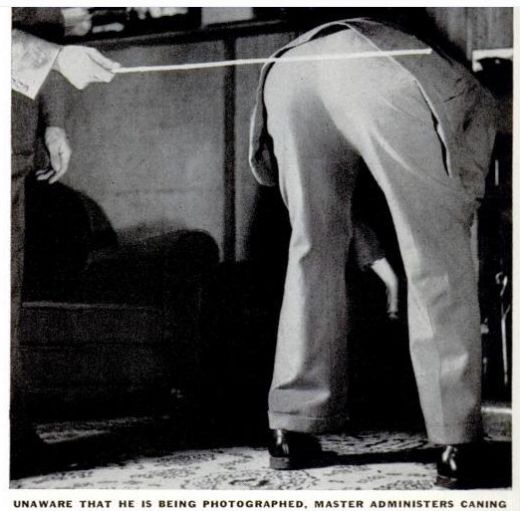
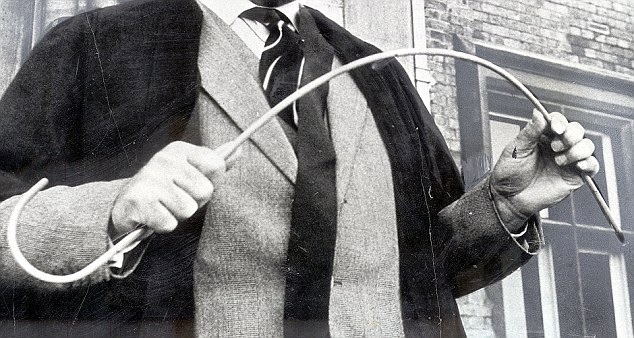
However, there is one stretching exercise which defeats me still: touching my toes. It has always defeated me. I can never remember a moment in my life when I could touch those damned toes of mine. And as I strain and heave to touch them, with our trainer urging me on but my hamstrings and every other string and tendon and muscle in my legs screeching to me not to continue, I hear in my memory another voice urging me on, that of Mr Mortimer, the Headmaster at my boarding primary school (prep school in English parlance). This was on those occasions when he was caning me, and I had to bend down in his study to receive “six of the best” (six strokes) or, more rarely, three of the best – I was a rather naughty boy. I was ten-eleven, as I recall.

The administration of the caning was done rather ceremoniously. The boys who were to be caned would get in a nervous, muttering line at the study door at the required time (after lunch, I think), and we would be called in one after the other. The Headmaster would remind you of the crime committed, state once more the number of strokes you would receive for said crime, and then invite you to stand in one particular place, and bend down and touch your toes (“Come on, boy, you can bend down further than that!” was always what I would then hear at this juncture).
image
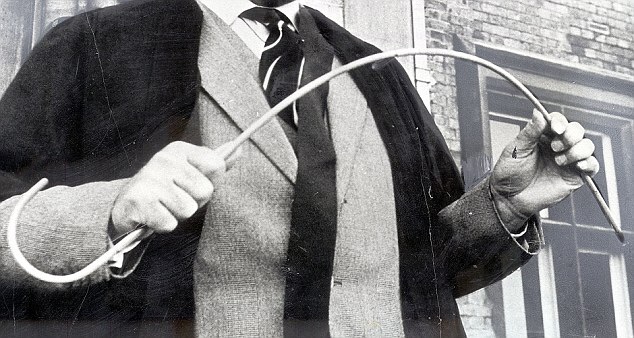
Mr Mortimer used this kind of cane, thin and flexible
image
One of my pals, Glover was his name (after all these years I still remember it … but not his first name; we called each other by our surnames), stole this cane as a memento at the end of our final term. Mr Mortimer hauled me in (I was Head Boy) and threatened to cane me with his spare if I didn’t have the original restituted. I leaned on Glover …

In any event, once you had received the caning, you politely thanked the Headmaster for it (we were English, after all), left the study, and then ran like hell. Running sort of let off the pent-up energy caused by the pain of the caning. I remember that in winter sitting on a radiator after running was also quite soothing. After the pain had dissipated you were normally left with stripes on your bottom, war wounds which you proudly displayed in the communal showers.

All this was happening at a time of great social change and ferment in the UK. We were in the mid-sixties, the Beatles were raging, the Rolling Stones were on the up-and-up, the straightened laces were being loosened: hair was growing, clothes were getting louder, skirts were getting shorter, sex was OK, drugs were coming in from the wild side. Little of this percolated through to us in primary school, buried as we were in the depths of Somerset, but when I moved to my boarding secondary school (public school in English parlance) in 1967, I found the winds of change blustering their way down the school’s corridors. Just as a small example, in my first year the Head of School would march around with a phalanx of school monitors, looking grim and army-like. By my third year, the Head of School was a nice, approachable guy who would actually smile. And beating (not caning; since we were now bigger, a bigger, thicker stick was used), which was already rare when I arrived, vanished within a few years.

But not before I was beaten! I believe I and my pal Mike Wallace (another sign of the changing times; we now called ourselves by our first names) were the last boys in the school to be beaten. It was 1969, maybe 1970. In brief, we were caught sneaking back into school with a bottle of wine which we had bought at an off-license even though we were underage. But that wasn’t why we were beaten. Our real crime was that we had skipped a meeting called by the Headmaster for all exam sitters; it had been especially emphasized that there were to be no excuses for not attending. Our Housemaster was instructed to administer the punishment. He beat Mike and me with a swagger stick, one of those things which British officers would tuck under their arm and … well, swagger about with.
image
This is what the stick looks like closer up.
image
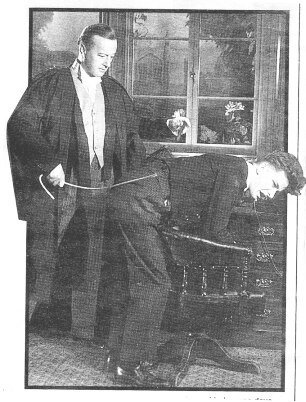
I didn’t have to touch my toes this time. An armchair was thoughtfully placed against the bookshelf whose arms we grasped as we leaned over.
imageWe got four strokes as I recall. And of course we politely thanked our Headmaster at the end.

That was my last brush with corporal punishment.

Was I psychologically scarred by my canings and beatings at school? Honestly, I don’t think so. They were not administered in a sadistic, or even in a cruel or vindictive, way. They were not administered in public. They were for crimes truly committed, so they were not unfair. The pain was neither intense nor long-lasting. They were on a par with punishments I received at home – my father used to beat me with a wooden metre ruler when I was extra-naughty as a small child, which seems to have been quite often. But, when I’m there, straining and heaving to touch my damned toes, urged on by our trainer, those memories of the little me bending over to receive my canings do come flooding back, along with the butterflies which fluttered in my stomach during the final moments before the cane came swishing down.

_________________

Caning: http://usercontent2.hubimg.com/2456657_f520.jpg (in http://wordperfect.hubpages.com/hub/Why-I-Am-For-Caning-Children-Forever)
Cane: http://1.bp.blogspot.com/-aS6kKXlL6VA/U1htg4LgSII/AAAAAAAAAFI/WPW3oZATxEM/s1600/article-2455291-0019D14100000258-114_634x338.jpg (in http://zainal-1932.blogspot.com)
Officer with swagger stick: http://www.alldressedup.net/wp-content/uploads/2012/10/img336-Copy1.jpg (in http://www.alldressedup.net/costume-list/halloween/429-2/character-costumes/costume-images/uniforms/british-army-officer/)
Swagger stick: http://usarmy.vo.llnwd.net/e2/c/images/2013/04/25/292553/size0.jpg (in http://www.army.mil/article/101913)
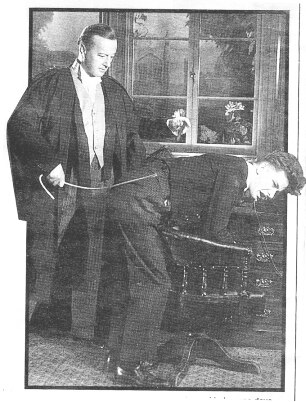
Beating over an armchair: http://www.corpun.com/16283as.jpg (in http://www.corpun.com/uks00508.htm)

TROMPE L’OEIL AND STINGINESS

Bangkok, 27 July 2015

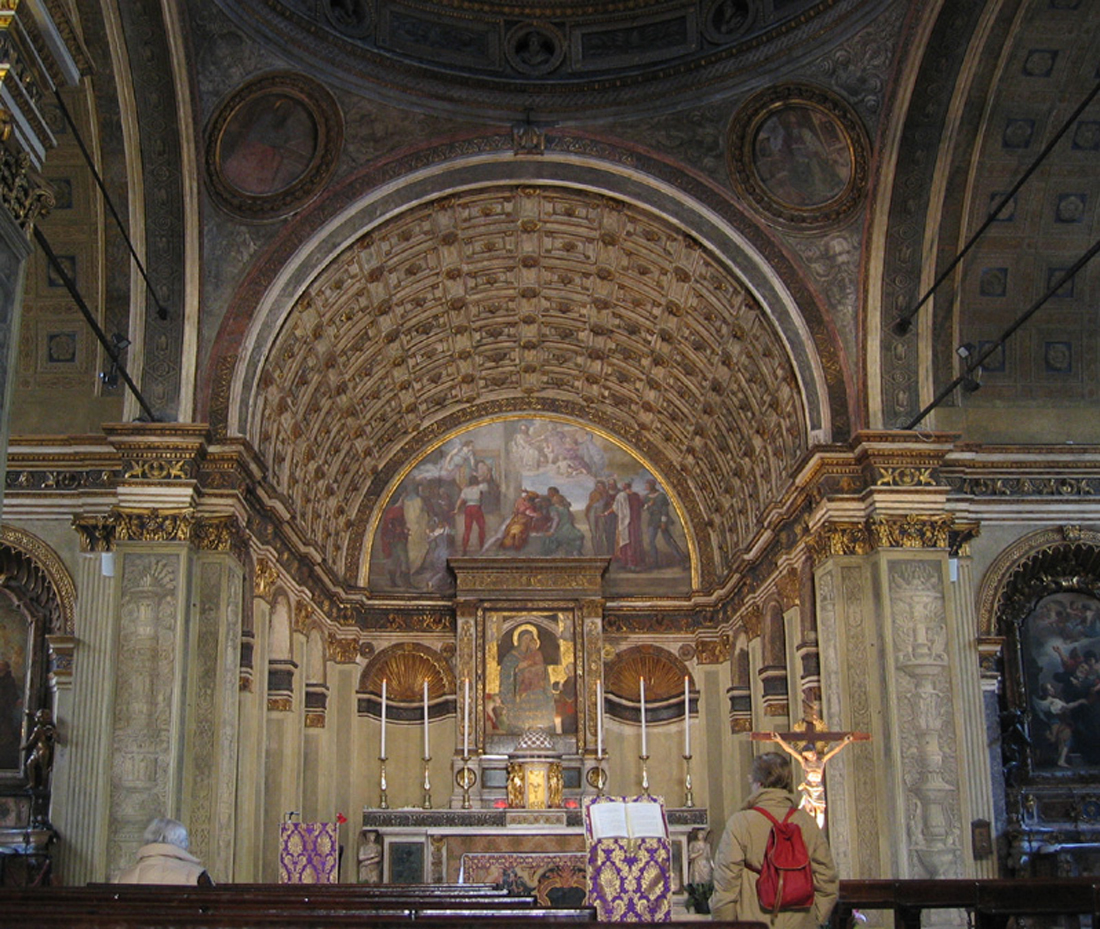
Trompe l’oeil is a very respectable art form, with a long and distinguished presence in the world of art, at least in Western art. I am told that the Greeks and Romans practiced it, although I do not recall ever having seen an example. In any event, artists took it up again with a vengeance during the Renaissance, and art thereafter is littered with pieces which “fool the eye”, tricking the viewer to see three-dimensional depth where there is none. We have a beautiful example just up the road from our apartment in Milan, in the church of Santa Maria presso San Satiro. My not-yet wife took me there on my first trip to Milan in 1975 and my eyes were indeed fooled.
image
What I had taken to be a deep apse behind the altar is actually an almost flat wall. The clever artist in question was Bramante, who painted it in the 1480s. In this case, he didn’t do it just to show how good he was, it was to give a feeling of greater depth to a church which was squeezed in between the adjoining buildings.

I could go on giving other examples from High Art, but actually I want to focus on a lower form of the art found in the province of Liguria. We’ve just come back from spending a week by the sea, near Genova, the province’s capital (and from where I managed to launch several of the previous posts).

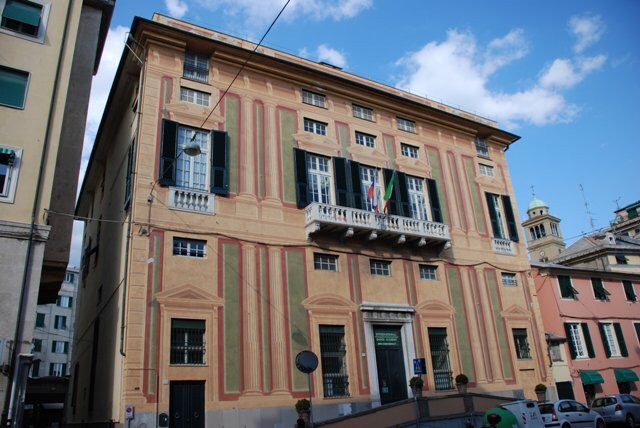
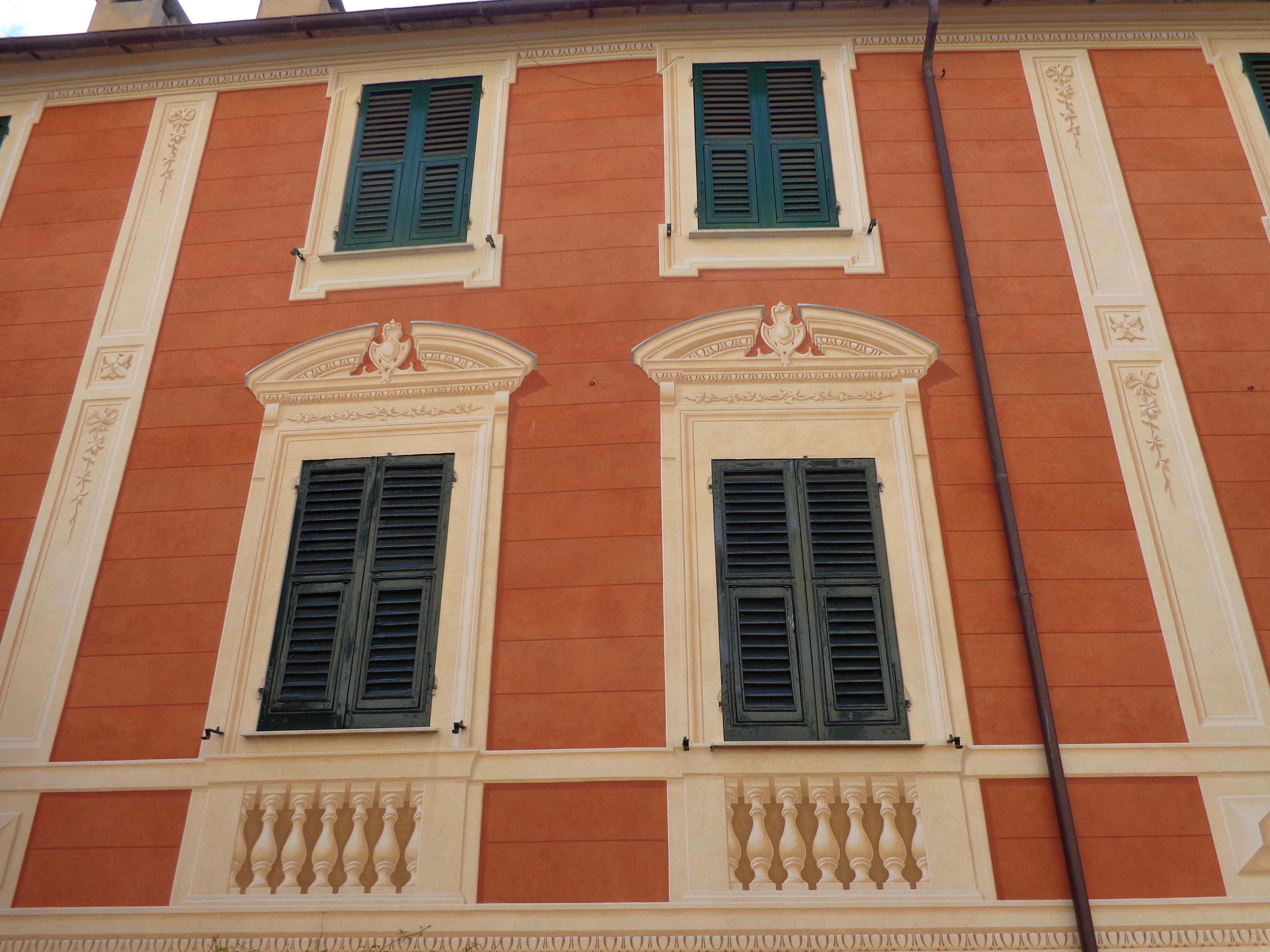
One of my recurring pleasures as I walk the streets of any conurbation in Liguria, from Genova down to the smallest village, is to come across houses like these.
image
This form of trompe l’oeil is only found in Liguria, to the extent that the practice is almost a D.O.C.. In these cases, the painter (I hesitate to call him artist) embellishes what is otherwise the drab and flat facade of a house (you see an example to the right in the photo) with architectural elements which are painted so cleverly as to fool the eye into thinking that they are three-dimensional and “real”. The result is to make an ordinary house look more imposing, which in the old days no doubt (and perhaps even today) raised the residing family’s social standing a notch or two. It is even a way of making up for unfortunate blemishes in a facade, like the absence of a window which mars the symmetry of a house.
image
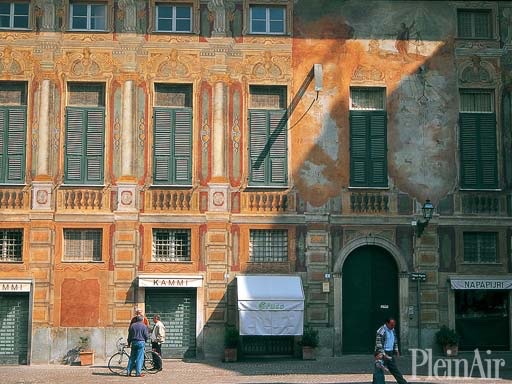
What is nice is to see is examples which run from the fresh and new to various states of weathering and finally decrepitude brought about by sun, rain, and more recently pollution.
image
image
image

image

Of course, one has to ask oneself why this art form is so popular in Liguria and nowhere else. My theory, for what it’s worth, is that it is a reflection of the well-known stinginess of the Genoese (and more generally Ligurians). In Italy, the Genoese have the same reputation as the Scots in England for being tight fisted, and there are loads of jokes about it, as indeed there are in the case of the Scots (“There was an Englishman, an Irishman, and a Scotsman in a pub. The Englishman stood a round, the Irishman stood a round, but the Scotsman just stood around”; sorry, I thought I would just quickly throw that one in). According to this theory, then, the Genoese (and by reflection the Ligurians) preferred to paint architectural elements onto their facades à la trompe l’oeil rather than go with the real things, because it cost them less.

I’m sure the Genoese must feel that this typing of them as scrooges by the rest of Italy is grossly unfair and they probably find it very irritating to be the butt of incessant jokes about it. But as they say, “there is no smoke without fire”. There must surely be some reason why they got this reputation. Curious to see what I could find out, I did an internet search on the topic (in truth, my wife did it since she’s very good at internet searches). Several suggestions popped up. One is that Liguria is in general a very poor land, made up of steep hills and little good agricultural land. People who live in such lands tend to be more careful with their hard-earned wealth scratched out of an unforgiving earth than those of us from richer lands (I’m sure this is the basis for the Scots’ reputation for stinginess). Another suggestion is that the Genoese in particular made much of their wealth in banking (they were the bankers of the Spaniards in the 16th century), and like all bankers got into the habit of not throwing their money around like we foolish non-bankers do. A third, which I like so much that I have adopted it, is a variant on the second (I have to thank Grimaldina, a citizen of Genova, for bringing it to my attention).

In 1586 or thereabouts Philip II, King of Spain, decided that he was going to invade England, to uphold the Catholic cause of course, but also to teach the damned English a lesson for attacking Spanish treasure fleets and shipping more generally. The worst offender was this gentleman, Sir Francis Drake

image

A great Englishman for the English, but nothing more than a damned pirate for the Spaniards.

To invade England, Phillip was going to need a navy, and a big one. As I said, the Genoese were the bankers of the Spaniards, so he came to them for the funds to build the necessary ships. I suspect the King made the Genoese an offer they couldn’t refuse. In any event, after much hesitation because it was a huge amount of money, and no doubt after extracting juicy concessions about trading monopolies for Genova in England once conquered, the Genoese accepted to fund the venture. Thus was built the Spanish Armada, or the Grande y Felicísima Armada, the “Great and Most Fortunate Armada”, as the Spaniards called it. And here, just for the hell of it, I throw in pictures of Philip II and Elizabeth I (it’s clear already from the pictures who’s going to win; I mean, look at Phillip II, have you ever seen such a nasty scowl?)
image

image

Alas, the Spanish Armada was perhaps great but it was not fortunate. After several engagements in the English Channel, where overall the Spaniards got the worst of it
image
the Armada was driven by the winds up into the North Sea, all the way up to Scotland. At that point, the Spanish commander decided to give up and go home. His idea was to round the top of Scotland, head out into the Atlantic, and then turn south. He turned too soon. His remaining ships found themselves too close to the west coast of Ireland, where, hit by terrible Atlantic gales, many were driven ashore. Of the 130 ships which left Spain only 67 limped home. The English cheered, but the Genoese cried; their fortunes had sunk to the bottom of the sea along with the ships. Genova went into a steep economic decline thereafter, from which it never really recovered. Thus was born the Genoese’s parsimony (and not stinginess, as stressed by Grimaldina). Like all great families which fall on hard times, it had to keep up appearances with less money in its pocket: ideal conditions for heavy adoption of trompe l’oeil.

________________

Santa Maria presso San Satiro: https://upload.wikimedia.org/wikipedia/commons/2/27/Sansatiro5.jpg (in https://it.m.wikipedia.org/wiki/Bramante#Santa_Maria_presso_San_Satiro_.281482-1486.29)
Genoese facade-1: http://www.sampierdarena.ge.it/joomla/images/phocagallery/villesamp/litoraneo/pallavicinocreditoitaliano/thumbs/phoca_thumb_l_dsc_0617.jpg (in http://www.sampierdarena.ge.it/joomla/index.php?option=com_content&view=article&id=94:villa-pallavicino-sec-xvi-via-sampierdarena-71&catid=48:litoraneo&Itemid=59)
Fake windows: https://dearmissfletcher.files.wordpress.com/2015/03/finestre-6.jpg (in https://dearmissfletcher.wordpress.com/2015/03/page/5/)
Genoese facade-2: https://timelessitaly.files.wordpress.com/2013/11/20131103-175731.jpg (in http://timelessitaly.me/tag/nervi/)
Genoese facade-3: http://rotellando.vanityfair.it/files/2015/06/IMG_6719.jpg (in http://rotellando.vanityfair.it/2015/06/16/piemonte-10/)
Genoese facade-4: http://cdn.pleinair.it/wp-content/uploads/106011.jpg (in http://www.pleinair.it/meta/viaggi-camper-l-impero-dipinto/)
Genoese facade-5: http://www.liguria.beniculturali.it/getImage.php?id=779&w=100&h=100&c=0&co=1&f=0 (in http://www.liguria.beniculturali.it/index.php?it/136/percorsi-tematici/3/5/3)
Sir Francis Drake: https://en.m.wikipedia.org/wiki/Spanish_Armada#/media/File:Gheeraerts_Francis_Drake_1591.jpg (in https://en.m.wikipedia.org/wiki/Spanish_Armada)
Phillip II: https://en.m.wikipedia.org/wiki/Spanish_Armada#/media/File:Philip_II,_King_of_Spain_from_NPG.jpg (in https://en.m.wikipedia.org/wiki/Spanish_Armada)
Elizabeth I: https://en.m.wikipedia.org/wiki/Spanish_Armada#/media/File:Elizabeth_I_(Armada_Portrait).jpg ( in https://en.m.wikipedia.org/wiki/Spanish_Armada#/media/File:Elizabeth_I_(Armada_Portrait).jpg)
Spanish Armada fighting English ships: https://en.m.wikipedia.org/wiki/Spanish_Armada#/media/File:Invincible_Armada.jpg (in https://en.m.wikipedia.org/wiki/Spanish_Armada)

LOURDES

Sori, 18 July 2015

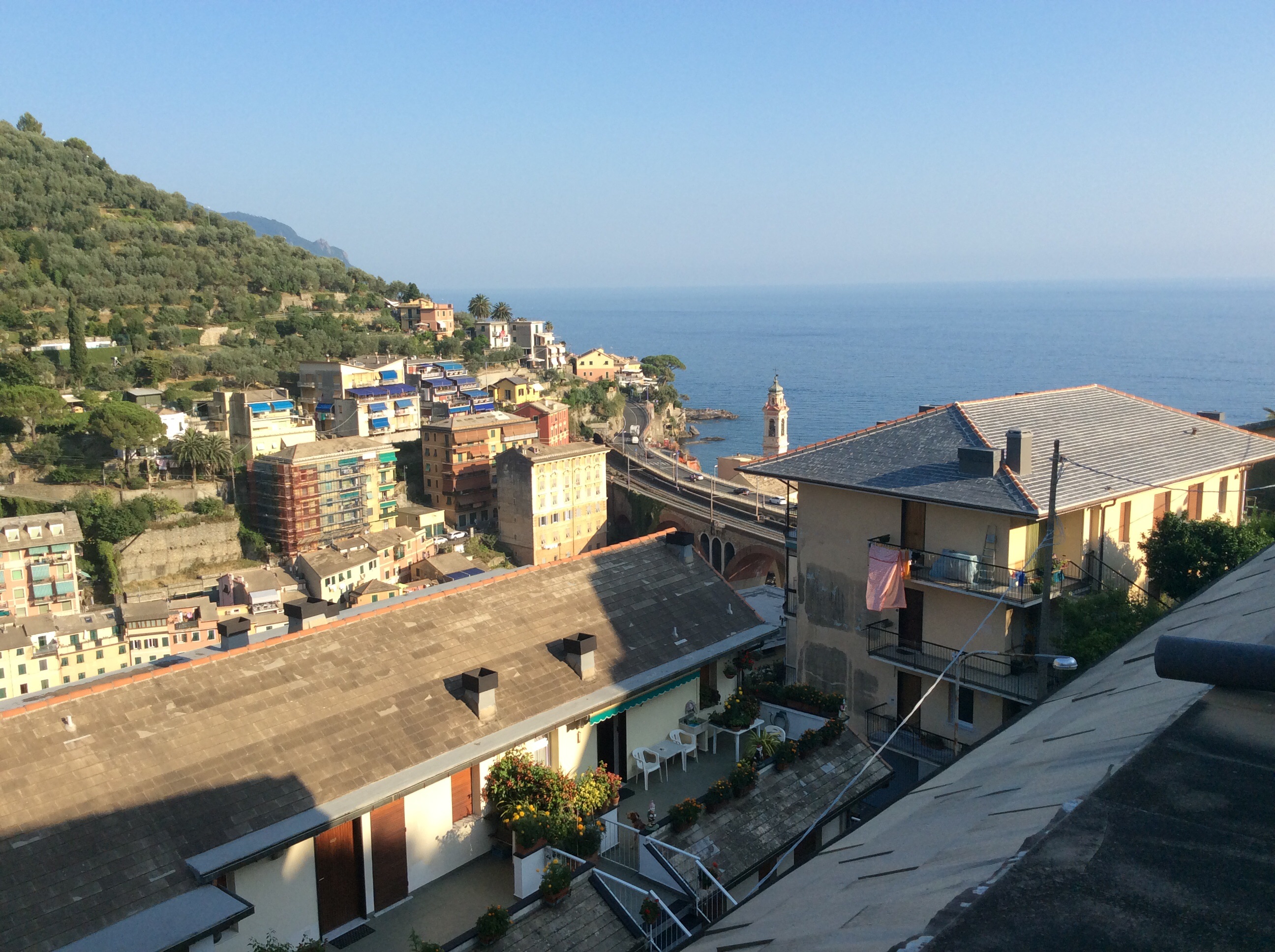
From the balcony of our little apartment in Liguria, if we look a little obliquely to the right we have a view of the sea.

image

Rather than admiring the sea, I invite readers to focus on the campanile of the village church, which we can see just behind the roof of the house in the foreground. At certain times – I haven’t really fixed in my mind when – the campanile’s bells ding out a rather out-of-tune version of the chorus to the Lourdes hymn: “Ave, Ave, Ave Maria. Ave, Ave, Ave Mari-i-a”. For the musically inclined, I attach a music sheet below with the music of the hymn (along with the lines to one of its many, many verses – sixty, I’m told). The music dinged out by the campanile is the last two bars.
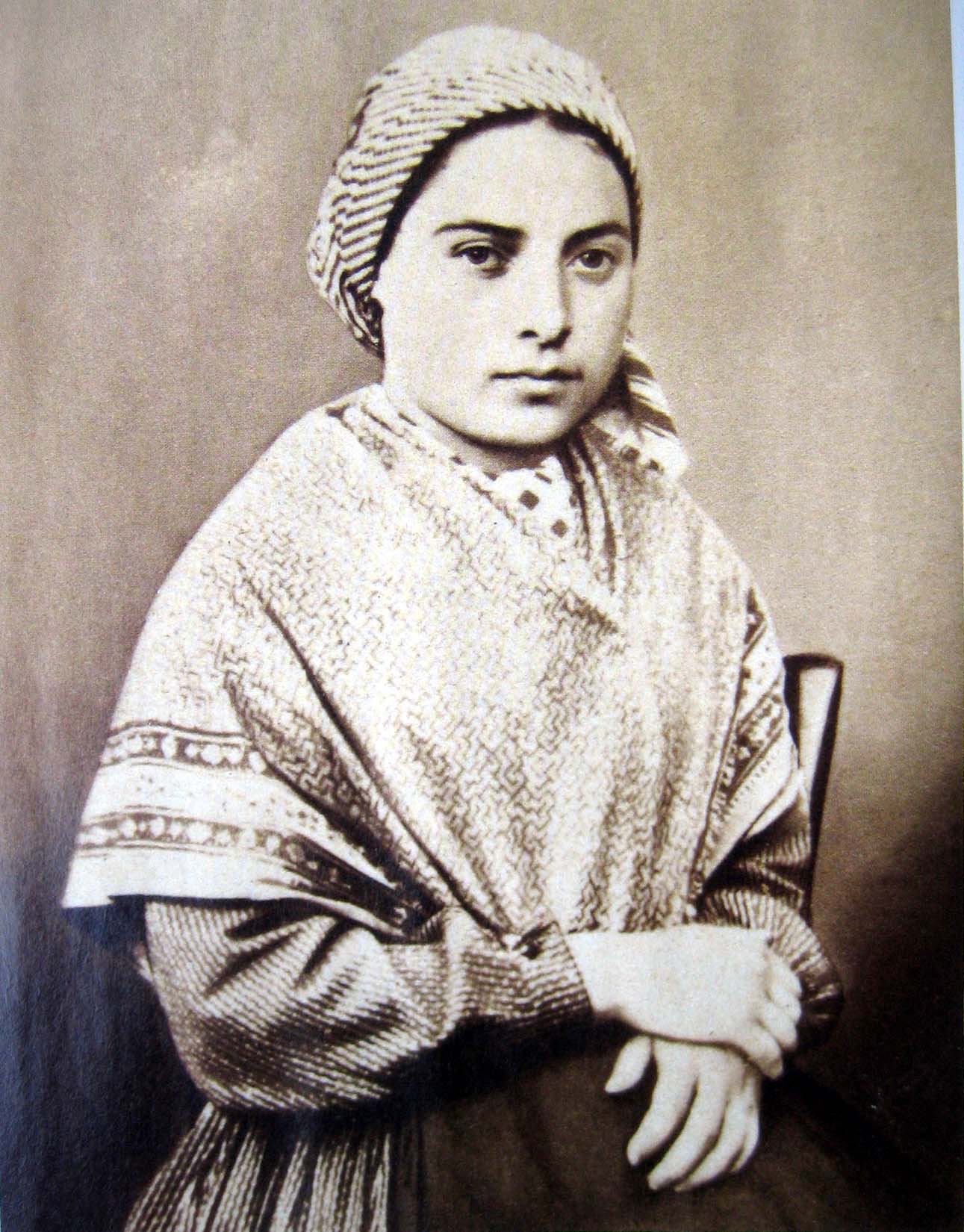
image For those of my readers who are not familiar with the Lourdes hymn, it is the “national anthem”, if I can put it that way, of the pilgrim city of Lourdes, which is located in the lower Pyrenees in France. It is there that in 1858 a 14-year old girl of humble origin, by the name of Bernadeta Sobirós
image
claimed to have seen visions in a grotto by the side of the river of uo petito damizelo (“a small young lady”; Bernadeta spoke Gascon Occitan). She was to have 18 such visions in the grotto, between February and July. In the 16th vision, after repeatedly asking the small young lady who she was, the lady finally replied Qué soï era immaculado councepcioũ (“I am the Immaculate Conception”).

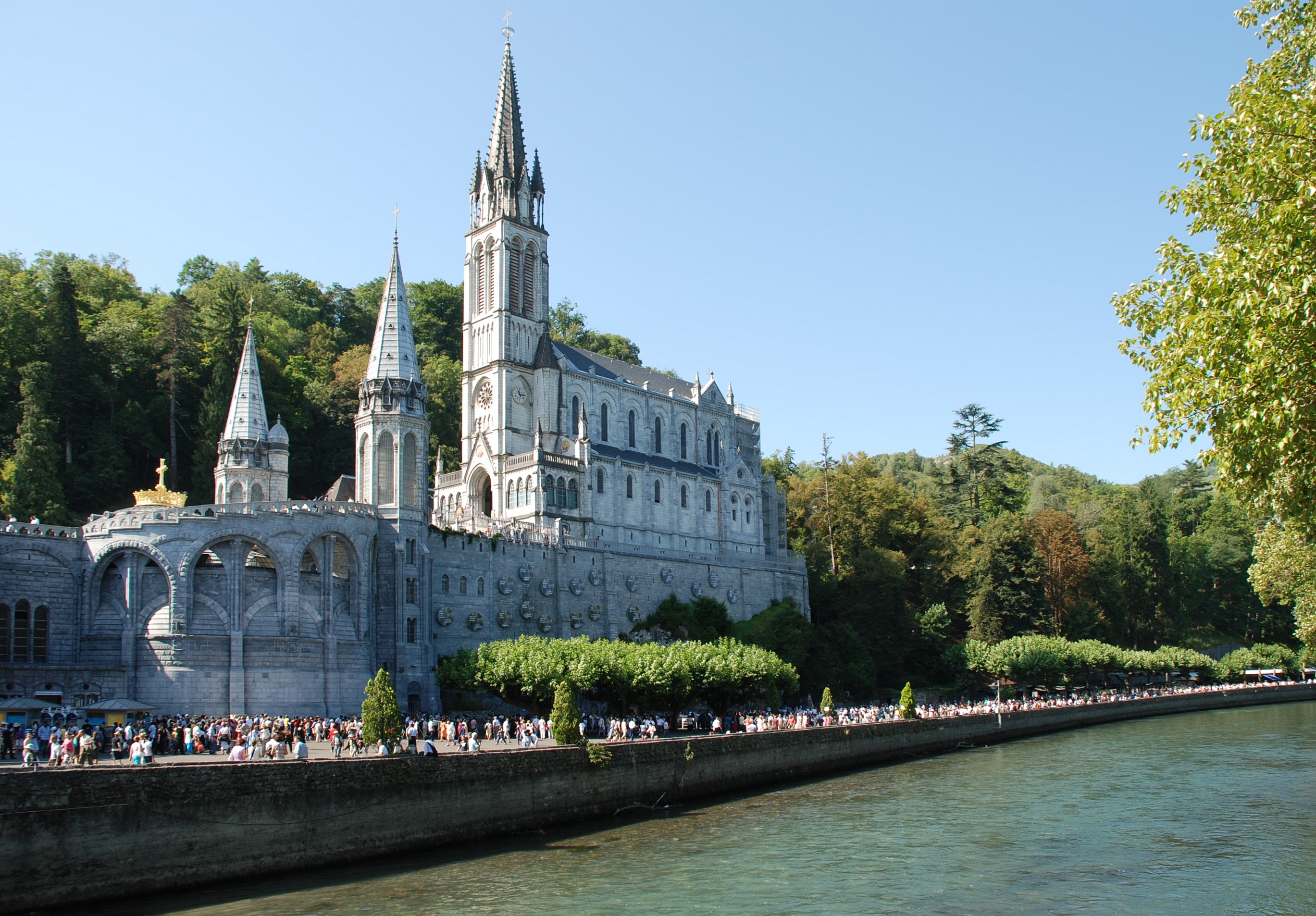
To cut a very long story short, after a good deal of initial skepticism the Catholic Church accepted Bernadeta’s visions as authentic visitations of the Virgin Mary. Pilgrimages began, cures of sick people from the spring water near the grotto were claimed, some of which were accepted by the Church as miraculous, the Lourdes hymn was penned in the 1870s, a large basilica was built
image
along with hospices for the sick, another even larger basilica was later built underground. The town itself got into the act, building hundreds of hotels to house the the ever growing number of visiting pilgrims – six million a year and counting; this, in a town of 15,000 inhabitants (as well, of course, as opening hundreds of shops selling religious tat).

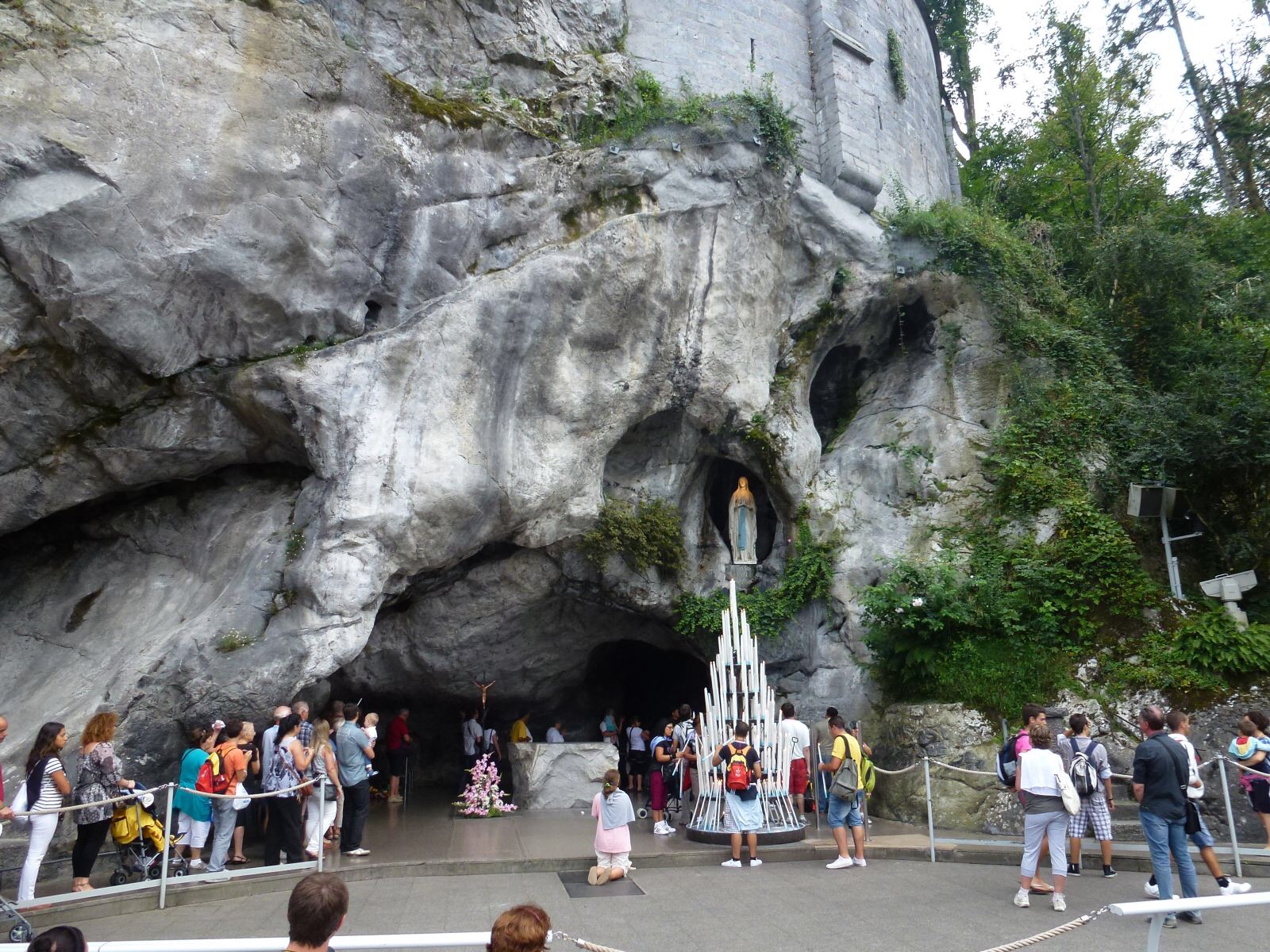
Pilgrims flock to the grotto
image
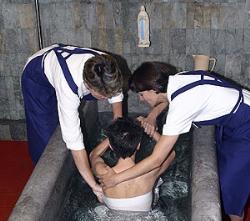
the sick take baths in the grotto’s spring water
image
and everyone joins the daytime and evening processions
image

image

during which the Lourdes hymn, among many others, is sung.

Two summers running, 1972 and 1973, I was one of those pilgrims. My school organized an annual pilgrimage during the summer holidays, and we students were encouraged to take part. They needed our strength and youthfulness to move the sick from place to place: from grotto to baths, from baths to church, from church to hospice; to literally carry into the baths those who could not walk; to do the night watch in the hospices. And I think the sick were helped by being surrounded by the innate cheerfulness of our youth.
image
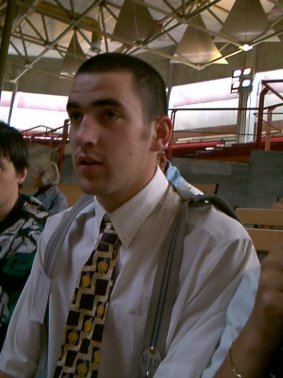
We were brancardiers, literally stretcher bearers, which I suppose was how the badly sick were moved around in the early days of Lourdes, although nowadays the sick are moved around in those nifty little wheeled chairs shown in the picture above. As a sign of our status, we wore “bretelles”, a sort of harness
image
It was a great honour to be a brancardier. Ordinary pilgrims would look at us admiringly as we walked past, something which at the age of 18 pleased me quite a bit: I was an Important Person! Of course, it meant that any sick person could call us over to help at any time and in any place: the price of fame …

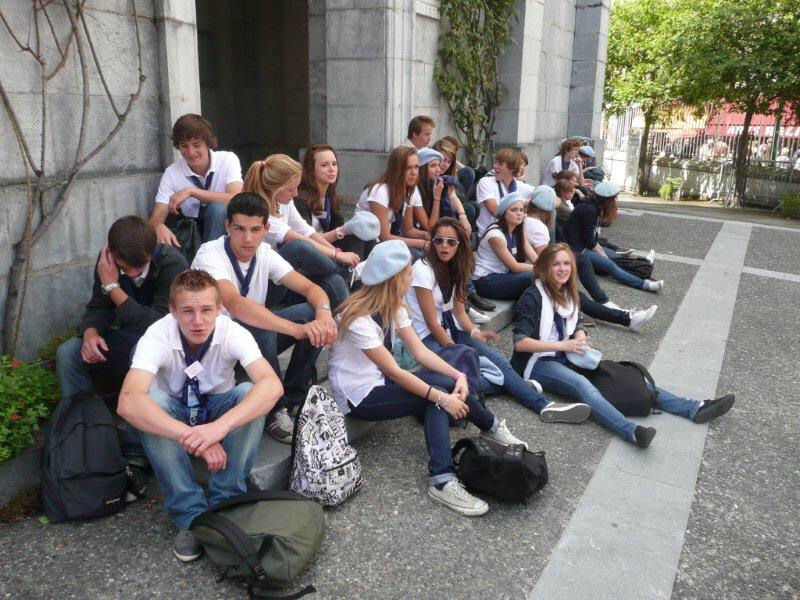
My two pilgrimages were a very intense experience for me, something which I will remember all my life. At the time, I was relatively callow, finding it all great fun like these young people from other pilgrimages did.
image

image
But I find that it marked me deeply. I am unmoved by the miraculous side of Lourdes. I have been too steeped in the natural sciences to believe in miracles. These are simply something we do not yet understand but quite likely will when the sciences have advanced enough. No, to me the real miracle of Lourdes is that it is perhaps the only place on Earth where the sick are centre stage, not on the periphery of our societies which is where they are usually relegated. Lourdes is their place, the rest of us are just guests.
image
So readers can understand why I pause and listen every time I hear the village campanile ring out, even if tinnily, the chorus lines to the Lourdes hymn.

___________________

View of the campanile: my picture
Lourdes hymn music: http://gauterdo.com/ref/aa/ave.maria.de.lourdes.html
Bernadeta Sobirós: https://en.m.wikipedia.org/wiki/Bernadette_Soubirous#/media/File:Bernadette_Soubirous.jpg (in https://en.m.wikipedia.org/wiki/Bernadette_Soubirous#Visions)
Lourdes basilica: https://upload.wikimedia.org/wikipedia/commons/3/33/Lourdes_Basilique_et_gave.jpg (in https://en.m.wikipedia.org/wiki/Our_Lady_of_Lourdes)
Lourdes grotto: https://bundytomadrid.files.wordpress.com/2011/08/grotto1.jpg (in https://bundytomadrid.wordpress.com/2011/08/24/day-2021-burgos-and-lourdes/)
The baths: http://media01.radiovaticana.va/imm/1_0_659979.JPG (in http://www.news.va/en/news/world-day-of-the-sick-a-privileged-moment-of-praye
Lourdes procession during the day: http://www.catholic-convert.com/wp-content/uploads/lourdes.jpg (in http://www.catholic-convert.com/blog/2013/07/30/stay-tuned-wednesday-teresa-tomeo-show-on-lourdes-and-my-video-tour-of-all-of-lourdes/)
Lourdes procession at night: https://fratres.files.wordpress.com/2008/01/procession_1024x768.jpg (in https://fratres.wordpress.com/2008/02/19/place-your-prayer-petitions-here-at-the-grotto-of-lourdes/comment-page-35/)
Brancardiers: http://www.jeune-catholique-moulins.cef.fr/wp-content/uploads/2013/08/L103946_HD0390545.jpg (in http://www.jeune-catholique-moulins.cef.fr/blog/category/lyceens/)
Young man with bretelles: http://pinguisite.chez.com/Image079.jpg (in http://pinguisite.chez.com/lourdes.html)
Brancardiers-2: http://pastorale.stemariebeaucamps.fr/sites/pastorale.stemariebeaucamps.fr/files/images/Lycée/Lourdes/P1030587.jpg (in http://pastorale.stemariebeaucamps.fr/?q=node/71)
Brancardiers-3: http://www.saintjo64.fr/saintjo64WP2013/wp-content/uploads/2014/10/Lourdes2014-1.jpg (in http://www.saintjo64.fr/saintjo64WP2013/actualites/aumonerie/pelerinage-a-lourdes-2014/)
A pilgrimage: http://dioceseofmenevia.org/photos/129_sick_to_lourdes.jpg (in http://dioceseofmenevia.org/news/archive07.htm)

FOOTPRINTS

Bangkok, 6 July 2015

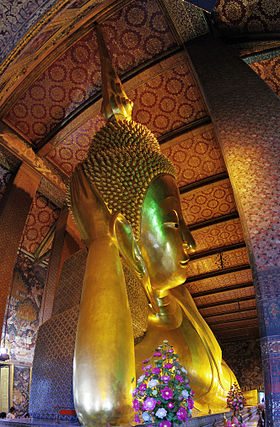
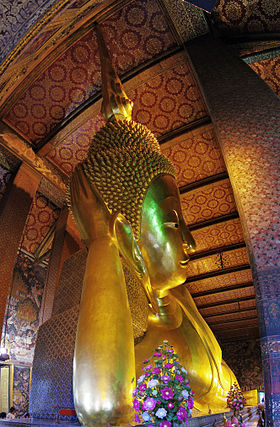
A couple of river-bus stops downriver from where my wife and I live in Bangkok stands the temple Wat Pho, whose main claim to fame is a large reclining Buddha.

wat pho reclining buddha

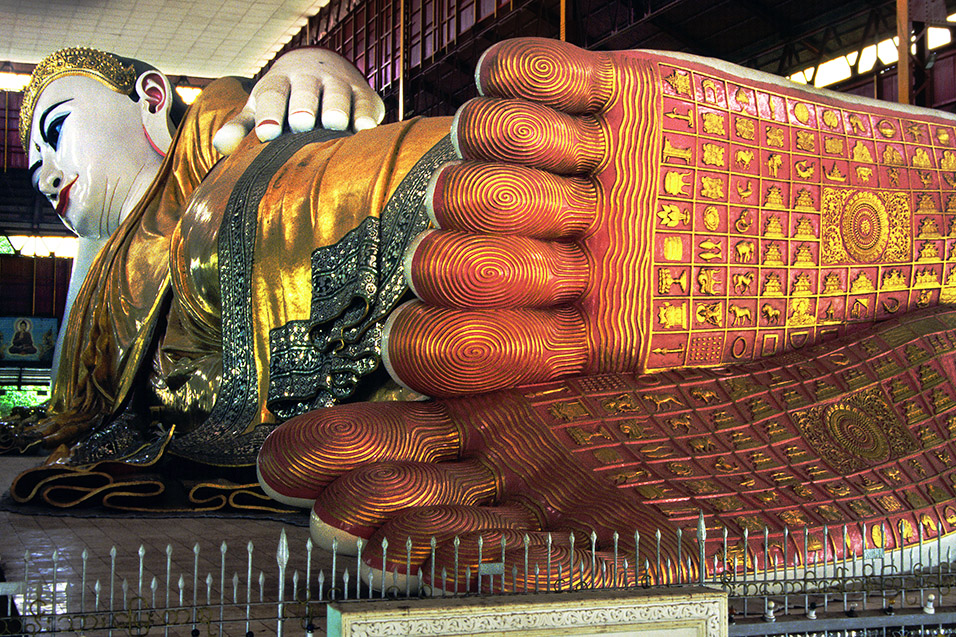
It is, I read, 46 metres long and 15 metres high, and walking along it certainly is impressive. But I much prefer the soles of the statue’s feet.

wat pho buddhas feet

These soles have been divided into 108 panels each of which contains, in the form of mother-of-pearl inlays, the 108 auspicious symbols by which the Buddha can be identified, like flowers, dancers, white elephants, tigers and altar accessories.

Wat Pho’s reclining Buddha was the first time I saw this interesting art form. But actually it is quite common for reclining Buddhas to have the soles of their feet so decorated. For instance, I find this particular reclining Buddha in Yangon in Myanmar more naturalistic – certainly the pose of the feet is more pleasing to the eye than those stiff blocks in Wat Pho.

yangon_reclining_buddha_feet

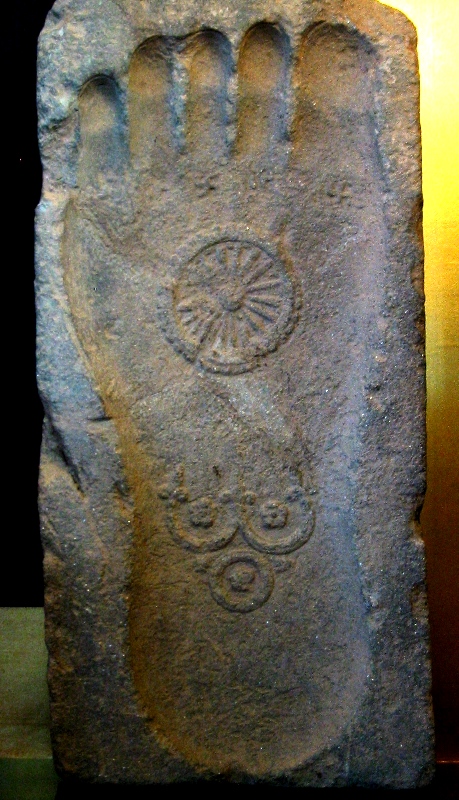
I later learned that the decorations of the feet of Buddha statues are actually a reflection – almost literally – of a much older iconography for depicting the Buddha, that of his footprint. Before anyone made statues of the Buddha, they made his footprints. They were a powerful way to remind the faithful that the Buddha had been present on earth: “the Buddha passed this way”. Quite quickly, the footprints were decorated with some of the symbols used to identify the Buddha. For instance, this footprint of the Buddha made in the 1st Century AD in the kingdom of Gandhara, in what is now the Swat valley in Pakistan, carries the Darmachakra, the “wheel of law”, and the triratna, the “triple gem” of Buddhism: Buddha (the Enlightened One), Dharma (the Teaching), and Sangha (the Community).

Buddha-Footprint

As time went on, more and more symbols were squeezed onto the footprints. And then some bright spark came up with the “positive print”, as it were, where the soles of reclining Buddhas carry the symbols of the Buddha.

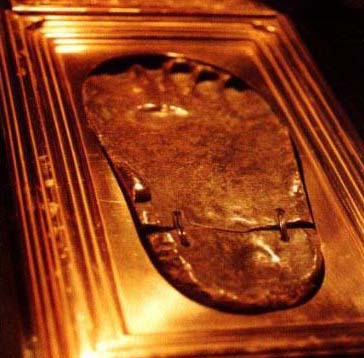
Buddhism is not the only religion that has used footprints of its religious leaders as iconography, although it surely has used them more than any other (there is an estimate of 3,000 Buddha footprints throughout the Buddhist lands). My wife and I came across a footprint of the Prophet Muhammad in the Topkapi museum in Istanbul

Muhammad footprint

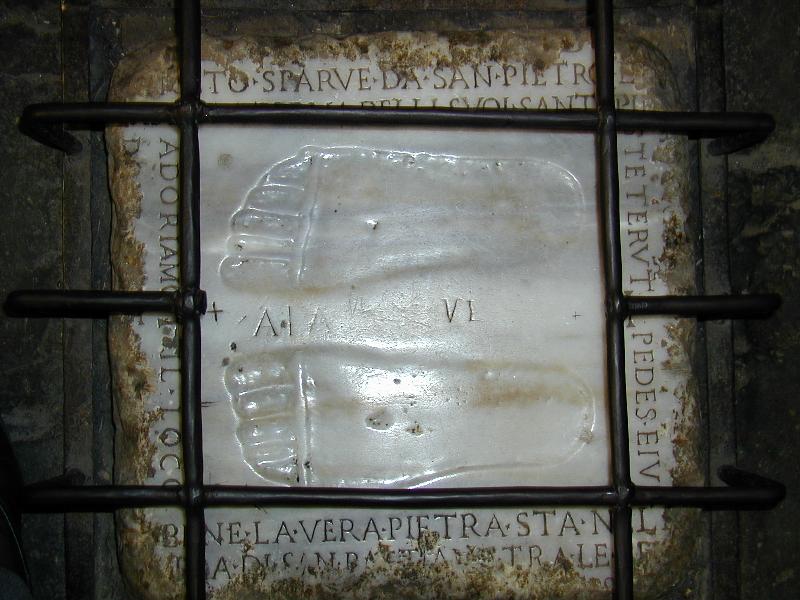
and there is a pair of footprints of Jesus in the Church of Domine Quo Vadis (“Lord, where are you going?”) on the outskirts of Rome.

jesus footprint

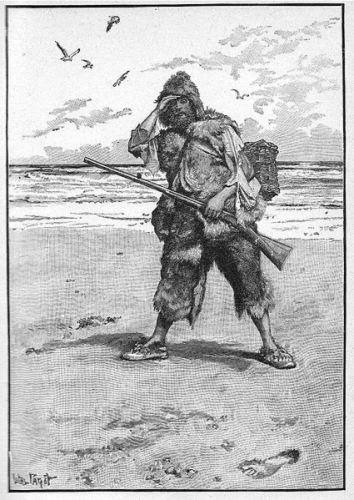
It is true to say that footprints are an incredibly powerful symbol of someone passing, of having been close by. One of the best remembered stories in Robinson Crusoe is of his finding a footprint on the beach.

crusoe and footprint

“It happened, one day about noon going towards my boat, I was exceedingly surprised, with the print of a man’s naked foot on the shore, which was very plain to be seen in the sand. I stood like one thunder-struck, or as if I had seen an apparition; I listened, I looked round me, I could hear nothing, nor see anything; I went up to a rising ground to look farther; I went up the shore and down the shore, but it was all one, I could see no other impression but that one. I went to it again to see if there were any more, and to observe if it might not be my fancy; but there was no room for that, for there was exactly the very print of a foot, toes, heel, and every part of a foot; how it came thither I knew not, nor could in the least imagine. But after innumerable fluttering thoughts, like a man perfectly confused and out of myself, I came home to my fortification, not feeling, as we say, the ground I went on, but terrified to the last degree, looking behind me at every two or three steps, mistaking every bush and tree, and fancying every stump at a distance to be a man.”

That footprint struck fear in Robinson Crusoe, fear of the unknown, fear of attack, fear of savagery. But I get a thrill when I see the footprints that some 15 people left 2,000 years ago in the ash and mud on the shore of Lake Managua in Nicaragua.

nicaragua footprints

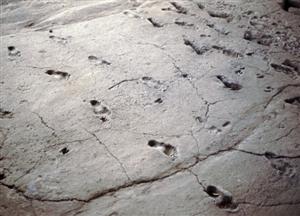
I get goose bumps on seeing the footprints left 1.5 million years ago by Homo erectus near the village of Ileret in Northern Kenya on the eastern shore of Lake Turkana.

homo erectus ileret kenya

The hairs on my neck rise at the sight of footprints left 3.7 million years ago by three members of the species Australopithecus afarensis at Laetoli in Tanzania, which show that already then bipedalism, such a distinctive feature of our species, was in place.

laetoli footprints

I find these footprints a much more powerful reminder of the Family of Man than a piece of jawbone or a tooth. I can imagine my distant, distant ancestors going about their business, as I will go about mine today.

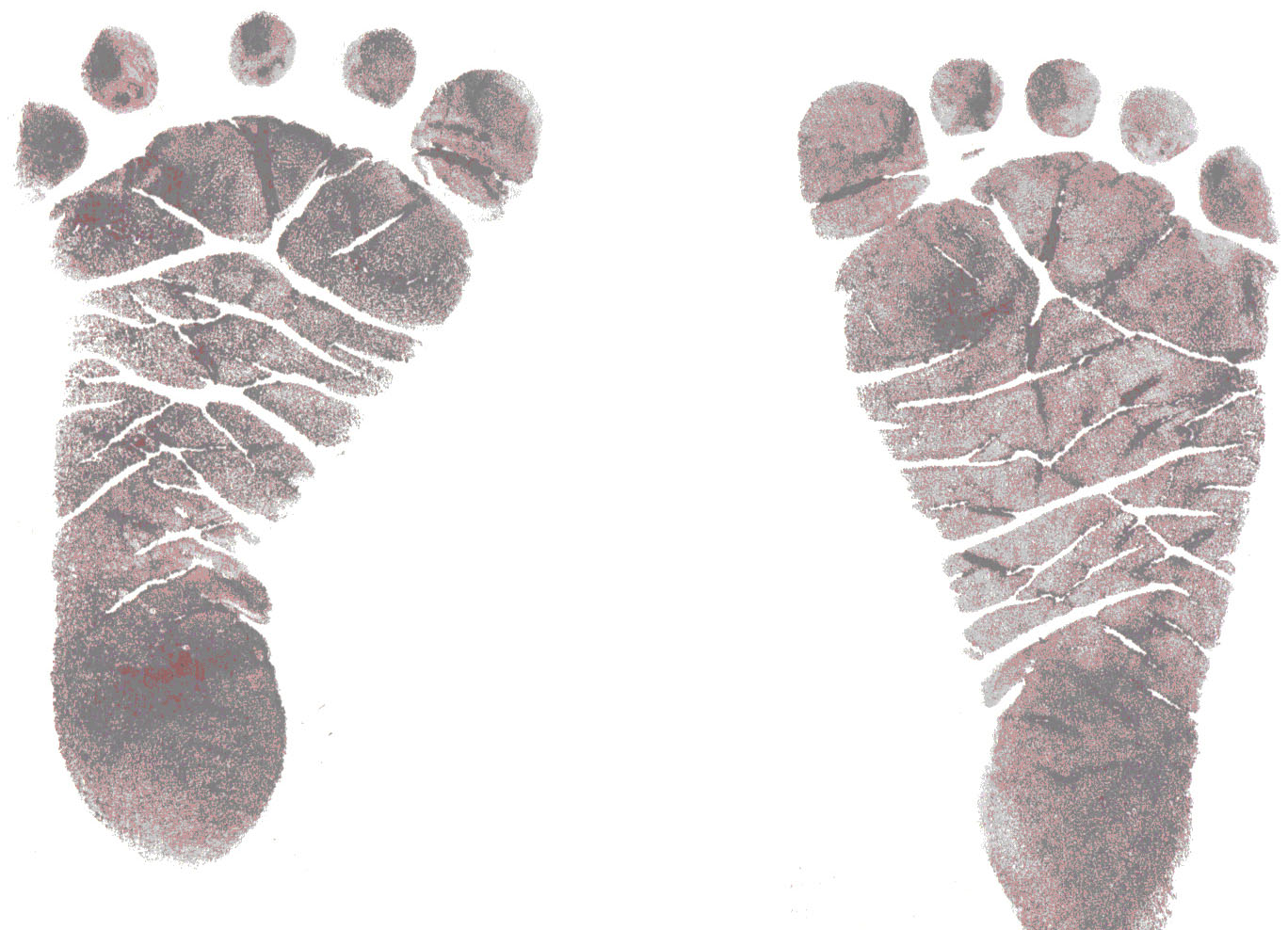
And within the much narrower circuit of my family, my wife and I have two relics, which currently slumber with all our stuff in a warehouse in Vienna but which we will keep preciously until the end of our lives. These are the footprints which the hospital gave us of our children’s feet, made just after they were born; they look like this

newborn footprints

They will forever remind us of the great joy which we experienced when our two children entered our lives and for a few decades walked with us before taking their own path in life.

___________

Reclining Buddha, Wat Pho, Bangkok: https://upload.wikimedia.org/wikipedia/commons/thumb/8/8d/Bangkok_Wat_Pho_reclining_Buddha.jpg/280px-Bangkok_Wat_Pho_reclining_Buddha.jpg (in https://en.wikipedia.org/wiki/Wat_Pho)
Reclining Buddha’s feet: http://s4.perpetualexplorer.com/wp-content/uploads/2013/03/wat_pho.jpg (in http://perpetualexplorer.com/2013/03/03/buddhist-temples/)
Reclining Buddha, Chaukhtatgyi Paya, Yangon: http://www.heybrian.com/lib/images/travels/myanmar/yangon_reclining_buddha_feet.jpg (in http://www.heybrian.com/travels/myanmar/)
Buddha footprint, 1st century, Gandhāra: https://upload.wikimedia.org/wikipedia/commons/7/73/Buddha-Footprint.jpeg (in https://en.wikipedia.org/wiki/Buddha_footprint)
Muhammad footprint, Istanbul: http://www.usna.edu/Users/humss/bwheeler/images/footistanbul.jpg (in http://www.usna.edu/Users/humss/bwheeler/footprints_pm.html)
Jesus footprints, church of Domine Quo Vadis: https://upload.wikimedia.org/wikipedia/commons/b/b1/I_piedi_del_quo_vadis.jpg (in https://en.wikipedia.org/wiki/Church_of_Domine_Quo_Vadis)
Crusoe and the footprint: http://www.bookdrum.com/images/books/92999_m.jpg (in http://www.bookdrum.com/books/the-graveyard-book/16401/bookmark/92998.html)
Nicaragua footprints: http://www.geog.cam.ac.uk/research/projects/eruptions/figures/thumbnails/05_11.jpg (in http://www.geog.cam.ac.uk/research/projects/eruptions/figures.html)
Homo erectus Ileret Kenya: https://nutcrakerman.files.wordpress.com/2014/10/ileret.jpg (in http://nutcrackerman.com/2014/10/14/the-oldest-human-footprints-by-continent/comment-page-1/)
Hominid footprints, Laetoli: http://auth.mhhe.com/socscience/anthropology/image-bank/kottak/chap07/kot37055_0705ta.jpg (in http://auth.mhhe.com/socscience/anthropology/image-bank/kottak/chap07/image7.htm)
Newborn footprints: http://semma.com/Joey/images/Joey/Joey%27s%20Footprints.jpg (in http://semma.com/Joey/photo2.html)

MYANMAR: MRAUK U

Yangon, 7 March 2015

In 1430, King Saw Mon founded a new capital at Mrauk U, in what is now the State of Rakhine, for a Kingdom of Arrakan of which he was the first ruler. Mrauk U lay at the head of several navigable tributaries of the Kaladan River, and so could command the trade routes in the Bay of Bengal, on which the kingdom’s wealth was founded. It became a transit point for goods such as rice, ivory, elephants, tree sap and deer hide from Burma, and of cotton, slaves, horses, cowrie, spices and textiles from Bengal, India, Persia and Arabia. It also lay at the edges of a broad plain, where abundant rice could be grown to feed the city’s population. The area was dotted throughout with hillocks, ideal for capping with splendid pagodas which earned their founders much merit, but also for acting as watchtowers in strong defensive walls which linked hillocks together and could keep the kingdom’s jealous or rapacious neighbours at bay. It was, in all senses, a happy choice for the new kingdom’s capital.

Exactly two hundred years after the city’s founding, a Portuguese monk, Fray Sebastian Manrique, who was to live in India for forty years, visited Mrauk U, as part of an official mission. In a book he wrote about his time in Asia, “Itinerario de las missiones del India Oriental”, he dedicated several chapters to his visit to Mrauk U. “This great city”, he starts, “stands in a lovely valley, some fifteen leagues wide, wholly enclosed by high rocky mountains, which serve as natural fortifications”. The city was bisected by a network of waterways linked to the nearby river, which were “the principal means of traffic, both public and private”. Most of the houses were thatched bamboo and wood structures, held together by “Bengal cane, as we call it in Portugal”. Even the palaces “are made of these reedy materials”. The size and ornamentation of the houses, and not their materials of construction, were what proclaimed the station and wealth of their owners. Inside, wall mats were hung “of the finest texture and of many colours”. No doubt, the richer and more important the owner, the finer and more elaborate the wall mats. The better houses and the palaces also had rooms of wood “ornamented with carving, gilt mouldings, and enamel work in various tints”. Some of the palaces went one further, having rooms of sandalwood and other aromatic woods. One of the richer palaces included a “House of Gold”, a pavilion decorated from floor to ceiling with gold, which housed golden statues, dishes and other vessels. The royal palace boasted a ceremonial hall, with a golden roof “ornamented with flowers of different colours”, supported by thirty gilded wooden pillars. The monks didn’t do too badly for themselves either. A number of the temples and monasteries in which they lived were as sumptuous as the palaces, richly endowed as they were by their wealthy and important founders, who were seeking thereby to gain merit. Most of the temples were “pyramidal in shape”, with a spire that ended in a gilt metal globe on which small bells hung that tinkled in the wind (I presume the good Friar was referring to the stupas, which sit at the centre of temple complexes). The temples’ interiors were decorated with “frescoes done in gold and colours”. Several years later, he again visited Mrauk U on an official mission, and this time he was lucky to be there when the king was crowned. He described in breathless detail all the pomp and ceremony which accompanied the crowning. This print, by the Dutchman Wouter Schouten, gives an idea of what Mrauk U looked like at this time.

mrauk u old print

The happy times did not last. Warfare between the local kingdoms was endemic, as each king tried to grow at the expense of his neighbours. In one of these local wars, King Bodawpaya of the neighbouring kingdom of Burma got the upper hand, helped along, it must be said, by vicious internecine struggles, all worthy of a Shakespearean history play, that were being played out between Arrakanese kings and their impatient heir-apparents, and between them and various usurpers. In 1784, the Burmese army attacked

war elephants

and eventually took the city, razing it to the ground. They took care, though, not to destroy the stupas and associated temples; the soldiers did not want to lose merit. But they stripped them and the rest of the city of all the movable loot they could lay their hands on. What part of the population they did not kill, they enslaved. And so, laden with vast quantities of booty and 20,000 slaves, King Bodawpaya and his army returned home to celebrate, leaving death and desolation behind them. The kingdom of Arrakan and its capital city were no more.

The site was too good to abandon completely. Gradually, people moved back into the city and partially repopulated it. But now it was just a small market town, with the modest lives and modest dreams and modest destiny of such towns. Its citizens lived out their lives in the shadow of monuments from Mrauk U’s royal past, which slowly crumbled away and were overgrown by vegetation.

But Mrauk U’s glorious past was not completely forgotten. Echoes of its history were passed down. Now that Myanmar has come out of its self-imposed isolation from the outside world, and the world has accepted the country back into the community of nations, Mrauk U has become a tourist destination. Not like Bagan, which hosts the ruins of another vanished kingdom, nor like Inle Lake, another popular tourist destination, nor even like the capital Yangon. A much more modest destination, because it has little tourist infrastructure and is hard to get to: seven hours by private boat from Sittwe, several more by the public boat; six hours by car on a spine-crushing road, several more by public bus. But a trickle of tourists do make it through.

We have just been part of that trickle. We hired bicycles, a wonderful way to move around this town whose dimensions are small and whose traffic is contained, and we slowly criss-crossed it, riding down potholed roads, side streets of beaten earth

02-mrauk u-flav 016

half-finished roads on which toiled labour gangs of women

02-mrauk u-flav 059

even across desiccated paddy fields when the half-finished roads were impassible

03-chin villages-flav 001

observing all the very rural life that passed us by. Most of the houses are still made of wood and “reedy materials”

02-mrauk u-flav 050

but from the few modern houses we saw brick and concrete are clearly now the building materials of choice for the wealthy. The network of waterways are still being used, although now sadly choked with plastic and other debris of modern life.

02-mrauk u-flav 052

Bicycles and motor bikes are the mode of transport of choice

02-mrauk u-flav 078

with two-seater bicycle rickshaws playing the role of local taxi

02-mrauk u-flav 067

and ten-seater tuk-tuks playing that of local buses (ten seats is a nominal number; the drivers seemed to be able to squeeze twice that number into them).

03-chin villages-flav 003

As in all ages and in all places, the wealthier disdain these proletarian forms of transport, although they now favour four-wheel drive cars with tinted windows rather than the palanquins and elephants of old. On the edges of town (which were reached after no more than ten minutes by bike from the town centre – and we rode slowly), chickens, pigs, and the odd cow join the human melée. And everywhere, young girls and women (never men and very rarely boys) are walking slowly to or from the wells and reservoirs which dot the town, ferrying the households’ water, no doubt as they had been doing nearly four hundred years ago when Friar Manrique criss-crossed the town – such a waste of women’s time! And the water they were collecting fitted no definition of “drinking water” that I know of.

02-mrauk u-flav 025

The town has schools, but all in a shocking state of decrepitude

02-mrauk u-flav 048

and in any case many children were put to work in various trades: child labour seems the norm here, not the exception. This country’s military dictators have much, much to answer for.

And so it was that we rode and we observed, and we meditated on what we observed, until the next stupa, or temple, or ordination hall from Mrauk U’s past loomed out in front of us. We visited many during our two days, but I will mention only three. The first is Mro U-hnauk Phara
02-mrauk u-flav 037
because it was the first temple we visited, but also because we were intrigued by the very ornate edifice constructed out of galvanized corrugated iron sheets that preceded the ancient stupa.

02-mrauk u-flav 038

The materials of construction may be humble but the designs are really quite complex. We got used to seeing these structures in front of many of the stupas in town. Both my wife and I immediately remarked on how much these constructions reminded us of the stavkirke in Norway.
Borgund_stavkirke
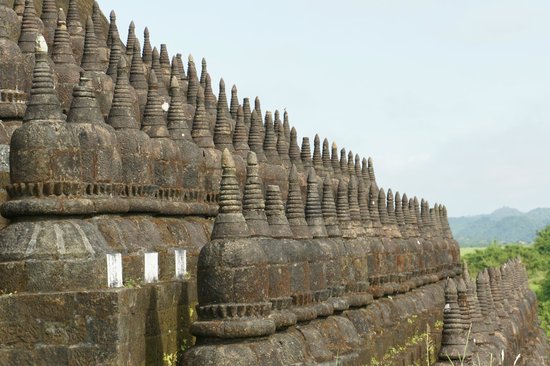
The second site I will mention is Koe Thaung temple, which sits out in the middle of paddy fields a little way out of town.
koe thaung temple
Its design is said to be based on Borobudur in Indonesia. We wouldn’t know, not having been able to visit Borobudur because of a volcanic eruption. But Koe Thaung certainly has charm, what with the serried ranks of stupas lining its terraces

koe-thaung-temple-stupas

and the hundreds of Buddhas, each with a different face, lining the galleries that encircle the edifice.

02-mrauk u-flav 107

When the rice paddies around the temple are planted and green, it must be very beautiful.

The third is actually a grouping of temples and stupas, all situated in a large open space. From the vantage point of the high terrace of one of these, I could see most of the group laid out before me.

02-mrauk u-flav 228

Immediately ahead is the Laymyekhna, with the four Buddhas in its internal gallery facing the four cardinal points, and its attendant Nyidaw Phara. Just behind it the Htukkanthein, a fortress-monastery.  At the base of the hill in the background, is the Shite-thaung temple, the most important religious edifice of the old city and known for its three encircling galleries with Buddhas and friezes.  This is where the coronation during Friar Manrique’s second visit took place. Over to the left is the Ratanabon Temple.

But what also struck me was the apparent indifference of the townsfolk to these venerable monuments. The open space was turned over to the growing of rice and vegetables. There was constant traffic along the roads and tracks which crossed the space as people went about their business. There were goats and cows cropping the grass around the edifices. And I was suddenly reminded of those paintings from the 17th and 18th Centuries, which were also recording the remains of a fallen city, ancient Rome in this case, mouldering slowly away as a new city lived its life around them
Roman forum Claude Lorrain
This particular painting, by Claude Lorrain, is a view of the Forum, with the arch of Septimus Severus in the left foreground, the three remaining columns of the Temple of Castor and Pollux in the middle ground, the arch of Titus in the background, and at the very back the Colosseum. And all around these ruins, the Romans are leading their lives.

Now I don’t want to make too much of a parallel between Rome and Mrauk U. Rome had been a huge city, many times bigger than Mrauk U had ever been. It had also held sway over a much larger territory than Mrauk U had ever done. On the other hand, the collapse of Rome, although over a longer period, was probably as total as Mrauk U’s. Medieval Rome, and perhaps even Baroque Rome, was probably no bigger than Mrauk U is today and just as backward. If it hadn’t been for the Pope, there are good chances that Rome would have disappeared. The Pope kept Europe’s attention on the town, while the pilgrims were a handy source of income, along, later, with the sons of Europe’s aristocracy. They flocked to Rome in the 18th and 19th Centuries because it was the thing for an educated young man to do, and paintings like the one above were produced for them by the hundreds.  Rome was also lucky to have become the capital of the newly unified Italy, which brought it the power (and wealth) of national government. In contrast, Mrauk U seems to have been forgotten by all once its last king fell. If the new government of Myanmar can ensure that Mrauk U shares in the country’s upcoming economic development, then it has the chance to become a prosperous little town.

__________

Mrauk U old print: http://upload.wikimedia.org/wikipedia/commons/0/0c/Vista_de_Mrauk-U,_ou_Arrakan_%28cidade_de_Arrac%C3%A3o%29_no_primeiro_plano_o_bairro_portugu%C3%AAs.jpg (in http://commons.wikimedia.org/wiki/File:Vista_de_Mrauk-U,_ou_Arrakan_%28cidade_de_Arrac%C3%A3o%29_no_primeiro_plano_o_bairro_portugu%C3%AAs.jpg)
War elephants fighting: http://ic2.pbase.com/o6/93/329493/1/131322898.yAQdtZvd.BKKAug10128.jpg (in http://www.alternatehistory.com/discussion/showthread.php?t=240558)
Stavkirke: http://upload.wikimedia.org/wikipedia/commons/b/bb/Borgund_stavkirke.JPG (in http://no.wikipedia.org/wiki/Borgund_stavkirke)
Koe Thaung Temple: http://www.vietnamjettravel.com/images/products/20147141754135.jpg (in http://www.vietnamjettravel.com/voyage-birmanie/a-travers-la-birmanie-de-yangon-a-mrauk-u.79.html)
Koe Thaung temple stupas: http://media-cdn.tripadvisor.com/media/photo-s/04/ab/0c/d1/koe-thaung-temple.jpg (in http://www.tripadvisor.com/LocationPhotoDirectLink-g1390118-d2557685-i78318801-Koe_Thaung_Temple-Mrauk_U_Rakhine_State.html)
Claude Lorrain view of the Roman Forum: http://upload.wikimedia.org/wikipedia/commons/b/ba/Claude_-_The_Campo_Vaccino,_Rome_-_Google_Art_Project.jpg (in http://commons.wikimedia.org/wiki/File:Claude_-_The_Campo_Vaccino,_Rome_-_Google_Art_Project.jpg)
All other photos by my wife

MY SPIRIT HOUSE

Bangkok, 15 February, 2015

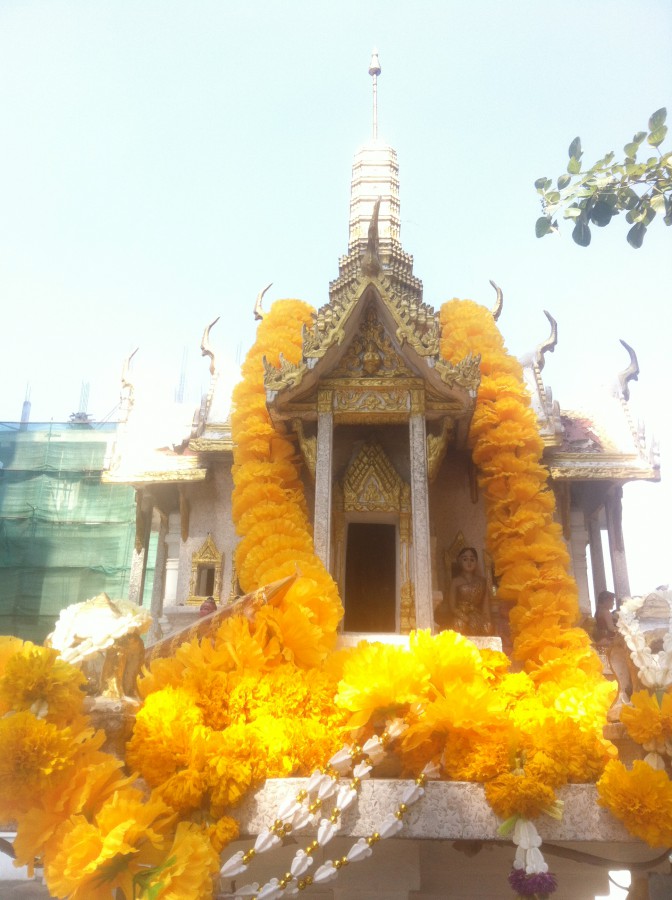
Anyone who has been in Thailand for more than half an hour begins to notice that every building, residential, commercial, governmental, whatever it happens to be, has one or more doll-like houses standing outside it in some corner of the property. To be very visible to one and all, they are set either on a tall pillar or on four somewhat smaller stilts. These, for instance, are the two which grace a corner of the parking lot at our apartment block.
spirit houses-general view-1
spirit house big

spirit house small

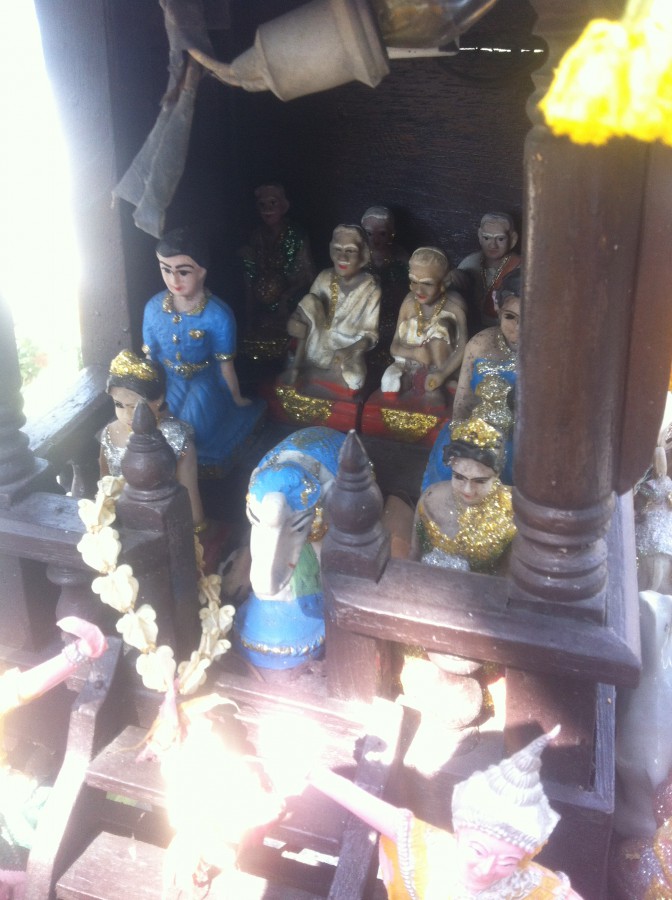
And if, finally rendered curious by constantly coming across them, one decides to have a closer look, you will find that they hold little figurines – old people, dancers, horses, elephants, cars, sometimes a Buddha. This, for instance, is a catalogue of what the bigger of our apartment block’s two little houses contains.

spirit house big-horses
spirit house big-elephants
They will often have votive offerings of food and drink as well as burning incense sticks set out in front of them along with fresh flowers

spirit houses-flowers and incense

many of them will have flower garlands draped over them

spirit house big-garland

and – at night – candles are set out or strings of lights turned on to light them up.

spirit house big-night

Quite charming. In fact, when my wife and I came to Bangkok for the first time some seven years ago, we were quite taken by these little houses and considered buying a DIY kit of one, to put up on the landing in front of the door of our then-apartment in Vienna, to house a small ivory Buddha which I had bought a few years before in Sri Lanka. But it was really too bulky, so we abandoned the idea.

But actually, why are these little houses there in the first place? I should have asked myself that the first time I saw them, before seriously considering putting one in front of my door.

A little bit of reading has informed me these houses are put up to propitiate the spirits of the land. This is a core belief of animism, that spirits reside in all the material manifestations of this world – the land, its streams, rivers, lakes, waterfalls, its trees and other plants, all animals, everything really, even man-made objects like bridges. Animism has deep, deep roots in Thailand – actually, in the whole of South-East Asia, from Myanmar down to Indonesia and across to the Philippines; the tradition of spirit houses, for instance, is found throughout the region apart possibly from the Philippines. The arrival of more rational, complex, sophisticated religions like Hinduism, Buddhism, Islam, or Christianity (or ethical systems like Confucianism in Vietnam), did not make the earlier animistic beliefs disappear, although I’m sure the leaders of these new religions tried hard to stamp them out (and at least in Thailand are still trying to, according to what I’ve read) or to absorb them (which is certainly what Buddhism has tried to do).

The sad thing is that these spirits are not nice beings. The purpose of those cute little houses is actually to make sure that the spirits of the land don’t get mad at you because you’re using their land and decide to burn down your house or give you a heart attack or bring Lord knows what other calamity down on your head. So in the house you’ll put figurines of servants to tend to the local land spirit’s every whim,  you’ll put figurines of dancing girls (geishas might be a better descriptor) to keep him happy, you’ll put horses and elephants (and cars for the more sophisticated urbanized spirits) to make sure he can go for a ride whenever he gets bored of sitting at home and watching the dancing girls gyrate, you’ll give him food and drink to make sure he doesn’t go hungry … Reading all this, it occurs to me that these spirits are really just like the mafia in Sicily: if you don’t pay this man the requested pizzo, or protection money
mafia-man

then unfortunately this will happen to your shop.
burning shop
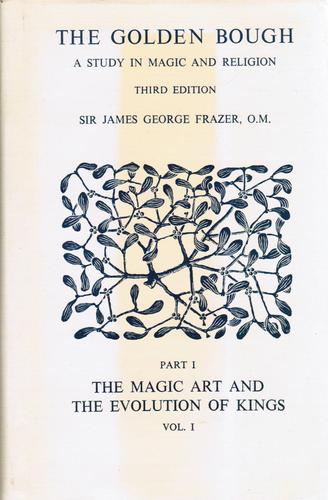
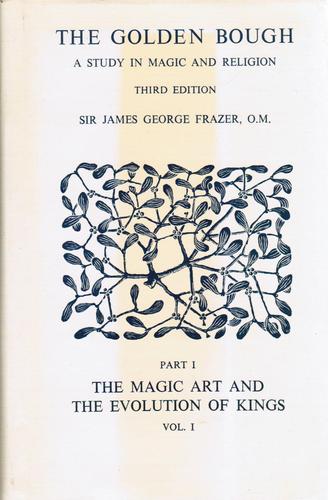
So, these pretty little houses are actually the reflection of a deep existential fear, that all around you are naughty, nasty little spirits who will hurt you if you’re not nice to them. These reflections moved me to dip into “The Golden Bough: A Study in Magic and Religion” by the Scotsman James George Frazer.
Golden_Bough
The book, first published in 1890 and republished several times thereafter, attempts to define the shared elements of religious beliefs, discussing fertility rites, human sacrifice, the “dying god”, the “scapegoat”, and many other symbols and practices. Its thesis is that old religions were fertility cults that revolved around the worship and periodic sacrifice of a sacred king (among other places, his ideas take a central role in T.S. Elliot’s poem, “The Wasteland”, which I have had cause to mention 100 posts ago and which was the reason why I originally read “The Golden Bough”). I’m sure modern anthropologists would dispute Frazer’s basic thesis, but in writing the book Frazer collected accounts from around the world of magical, animistic beliefs, which are fascinating in themselves. Here are three excerpts which he cites from other sources on the belief in spirits in South-East Asia.

“Thus the life of the Thay seems regulated down to its smallest details by custom founded on his belief in the spirits. Spirits perpetually watch him, ready to punish for his negligences, and he is afraid. Fear is for him not only the beginning of wisdom, it is the whole of his wisdom. Love has only a very moderate place in it. Even the respect in which he holds his dead, and the honours which he pays them on various occasions, seem to be dominated by a superstitious fear. It seems that the sacrifices which he offers to them aim rather at averting from himself the evils which he dreads than at honouring worthily the memory of his deceased kinsfolk and at paying them the tribute of his affection and gratitude.”

“Independently of the demons who are in hell, the Siamese recognize another sort of devils diffused in the air: they call them phi; they are, they say, the demons who do harm to men and who appear sometimes in horrible shapes. They put down to these malign spirits all the calamities which happen in this world. If the mother has lost a child, it is the phi who has done the ill turn; if a sick man is given over, it is a phi that is at the bottom of it. To appease him, they invoke him and make him offerings which they hang in desert places.”

“The desire to propitiate the good spirits and exorcise the bad ones is the prevailing influence upon the life of the Laotians. With phis to the right of him, to the left of him, in front of him, behind him, all round him, his mind is haunted with a perpetual desire to make terms with them, and to ensure the assistance of the great Buddha, so that he may preserve both body and soul from the hands of the spirit.”

The first two excerpts, written in 1907 and 1831 respectively, come from books written by French missionaries, the third from a book written by an Englishman in 1884. The first two no doubt had religious axes to grind, wishing to show how the Thai (Siamese being the old name for the Thai) were poor, benighted folk in need of Christian redemption. But even accounting for a certain amount of exaggeration, the picture which these excerpts paint is bleak indeed: a constant, haunting fear at every step.

Of course, before we shake our heads and smile and take another sip of our coffee, we should remind ourselves (as Frazer reminds us in his book) that Europe, just to take my part of the world, was also the home of naughty, nasty little spirits. Anyone like me who had to suffer through Latin and Greek in their education will remember the Roman and Greek nymphs who haunted the sacred groves and streams, and who had to be propitiated. And what about all those leprechauns, and trolls, and sprites, and ogres, who populate children’s books and popular stories? Remember Rumplestiltskin, that nasty little imp who saves the miller’s daughter from the wrath of the king by spinning straw into gold for her, but on condition that she give him her first-born child?
rumplestiltskin
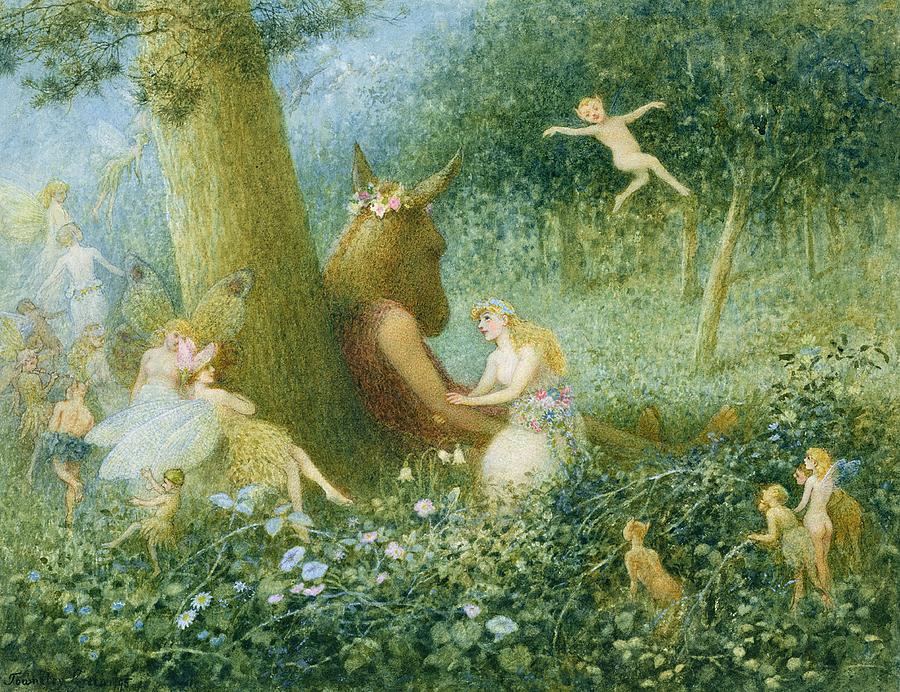
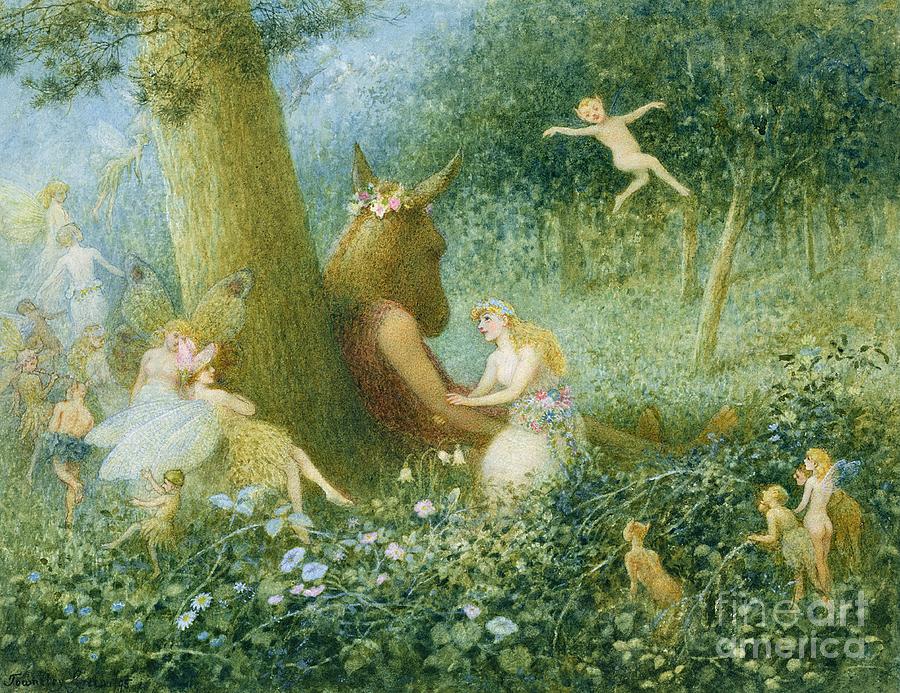
Or that “shrewd and knavish sprite” Puck in Shakespeare’s “A Midsummer Night’s Dream”, who at the behest of his master Oberon, King of the fairies, wreaks mayhem in the Athenian woods?
puck

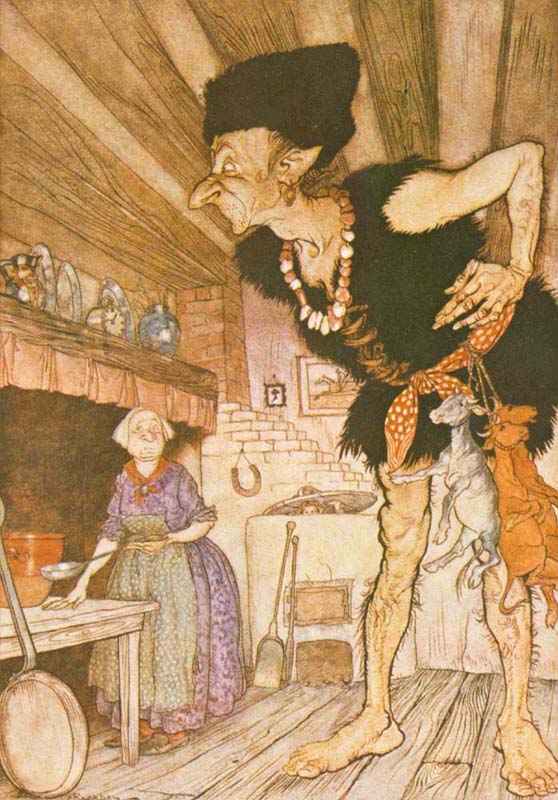
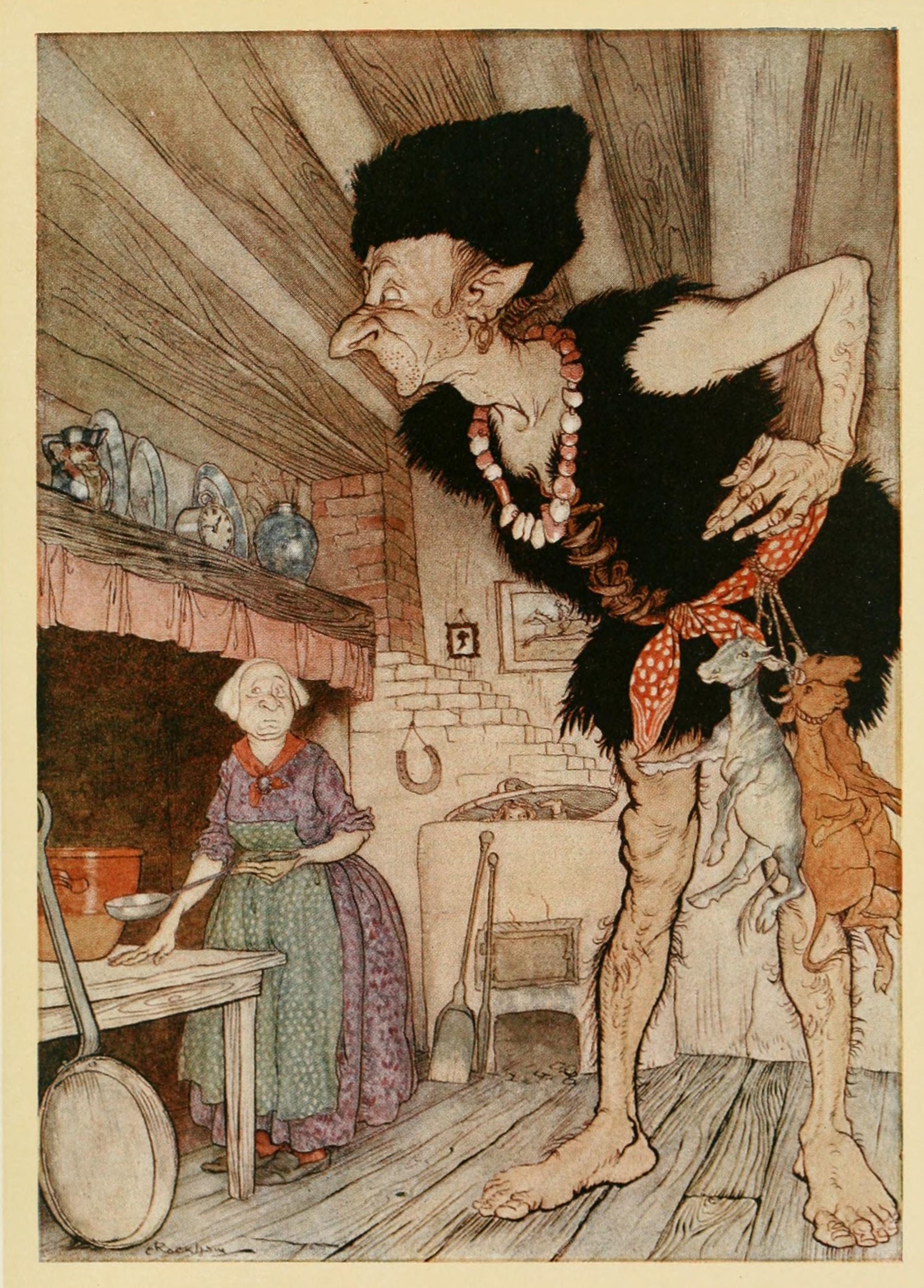
Or the ogre in Jack and the Beanstalk, who on sensing that little Jack is hiding in his house, intones

“Fee-fi-fo-fum!
I smell the blood of an Englishman,
Be he alive, or be he dead,
I’ll grind his bones to make my bread.”
ogre jack and the beanstalk

Even Tinkerbell in Disney’s sucrose version of “Peter Pan” is not a particularly nice person.
tinkerbell
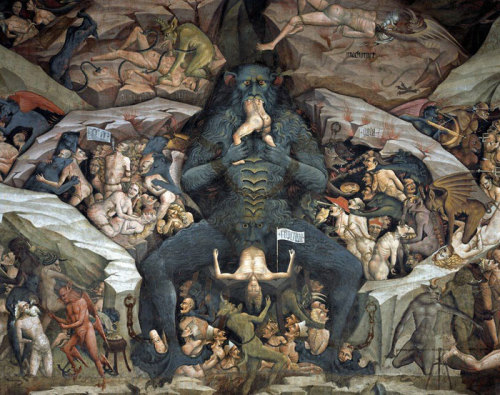
I suppose Christianity managed to reduce the strength of animistic beliefs in Europe – I won’t say stamp out, because otherwise we wouldn’t have the children’s stories – but only to replace them by another existential fear, that of suffering in hell for ever and ever.
hell
Luckily, science has come to the rescue and driven out all the religious claptrap. There is no supernatural world, it tells us, only the natural world around us. And with that, all those spirits disappear in a flash.

But now that I know all this, would I still buy a spirit house kit to assemble on the landing in front of my apartment door in Europe? Do I want to be seen, if only to myself, to believe in naughty, nasty spirits? After giving some thought to the matter, I have concluded that yes, I would, but for a very different reason. One of the houses whose photo I give at the beginning of the post is the house of the ancestral spirits of the place, the spirits – or ghosts I suppose – of the people who lived there before you. In fact this house contains figurines of old people.
spirit house small-old people
Unfortunately, these spirits also require propitiation in Thailand, since they too can turn nasty (jeez louise, what a world view!). But I would use the house differently. I would use it to house the memory of my parents and my wife’s parents. For my parents, I would have a very tall figurine stand in for my father and a very small figurine for my mother, for that indeed is how they were; one of my abiding memories of them is the two dancing together, he very tall, she very small, slowly circling the dance floor. For my wife’s parents, I would have a large figurine stand in for my mother-in-law, for she was indeed of a stout disposition. For my father-in-law, I’m not sure, I hardly knew him. I’ve mentioned before his fondness for wearing a Basque beret, so perhaps a figurine of a man with such a beret would do? But I would leave this for my wife to decide. And I would move the house into the apartment, so that their memory could be with us, rather than left out in the dark like the dog. I feel that this would be a better way of remembering them, of keeping their memory alive, than going on infrequent visits to the graveyard, and a useful complement to looking at old photos and reminiscing. And I would hope that one day my children would also have a spirit house to which they could add little figurines of us once that day arrives. As it surely will.

____________________

Spirit houses: my pictures
Mafia man: https://solo3d.files.wordpress.com/2012/09/mafia-man-by-siamak-roshani-1.jpg (in https://solo3d.wordpress.com/scenes/portraits/mafia-man/)
Burning shop: http://www.newsbiscuit.com/images/845.jpg (in http://www.newsbiscuit.com/2007/09/05/fire-brigade-turned-up-late-to-burning-pizza-shop-as-satirical-statement/)
“The Golden Bough” cover: http://3.bp.blogspot.com/-KNKUm2qVFeo/URmCSeqWMuI/AAAAAAAAMKQ/YNPwXF5oY7s/s1600/The_Golden_Bough.jpg (in http://38is.blogspot.com/2013_02_01_archive.html)
Rumplestitskin: http://www.artsycraftsy.com/goble/wg_rumplestiltskin.jpg (in http://www.artsycraftsy.com/goble/goble_rumplestiltskin.html)
Puck: http://images.fineartamerica.com/images-medium-large/a-midsummer-nights-dream-ht-green.jpg (in http://fineartamerica.com/featured/a-midsummer-nights-dream-ht-green.html)
Ogre in Jack and the Beanstalk: http://upload.wikimedia.org/wikipedia/commons/4/4c/Jack_and_the_Beanstalk_Giant_-_Project_Gutenberg_eText_17034.jpg (in http://en.wikipedia.org/wiki/Jack_and_the_Beanstalk)
Tinkerbell: http://cdn.hellogiggles.com/wp-content/uploads/2015/01/22/Walt-Disney-Screencaps-Peter-Pan-Wendy-Darling-Tinker-Bell-walt-disney-characters-34385876-4326-3237.jpg (in http://hellogiggles.com/real-life-disney-romance/walt-disney-screencaps-peter-pan-wendy-darling-tinker-bell-walt-disney-characters-34385876-4326-3237)
Hell: https://36.media.tumblr.com/20721aba85e8475adb529816d4e40a10/tumblr_n1kmegRkqx1qm5yeno1_500.jpg (in https://www.tumblr.com/search/art%20history%20hell)

PRICKLY PEAR AND THE COLUMBIAN EXCHANGE

Bangkok, 23 January, 2015

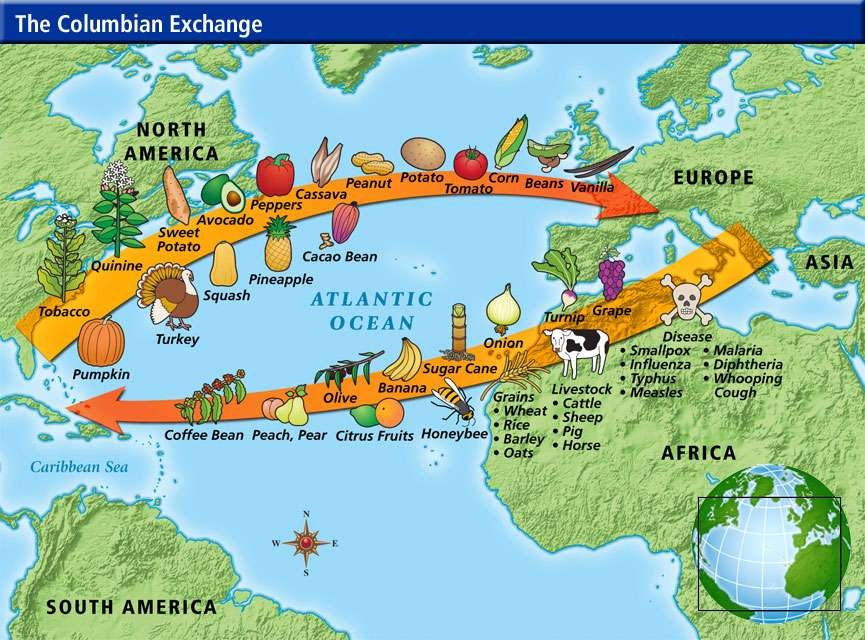
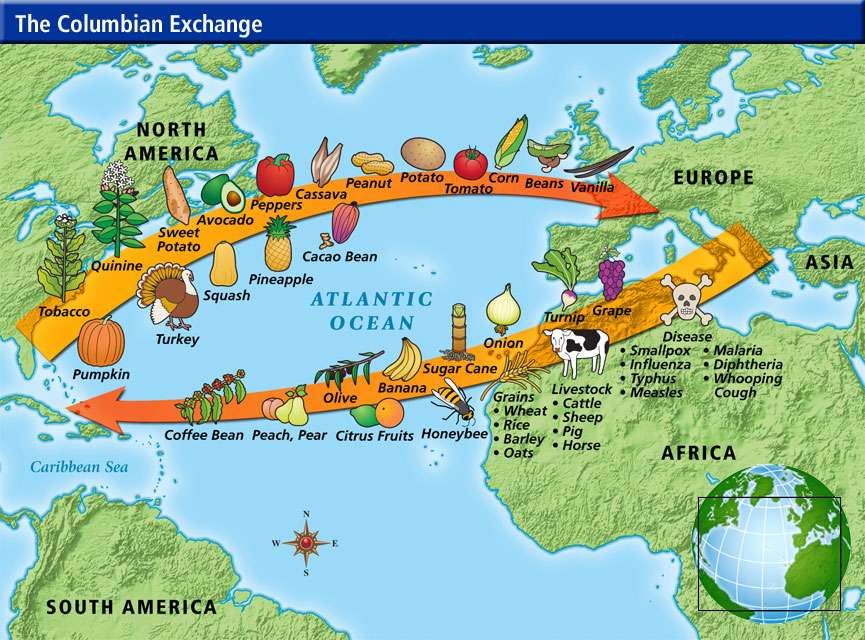
One of the most far-reaching effects of Christopher Columbus’s discovery of the Americas was the so-called Columbian Exchange, the exchange of plants and animals (and bacteria and viruses) between the Americas and the rest of the world. This map shows some of the major crops and livestock which made the journey in either direction between the Americas and Europe.
image
We see, for instance, that the tomato crossed to Europe from the Americas, along with the turkey and corn (and possibly syphilis), while the cow, the horse, and the onion, went the other way, along with smallpox, measles, typhus, and a whole series of other diseases (the diseases nearly wiping out the Amerindian populations).

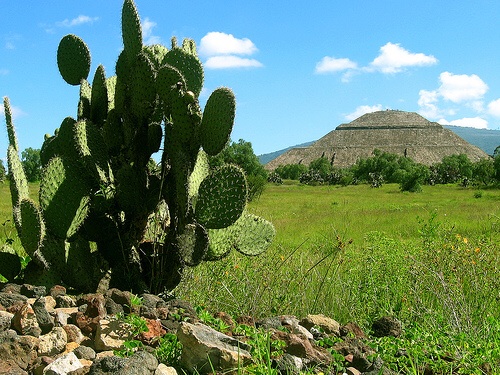
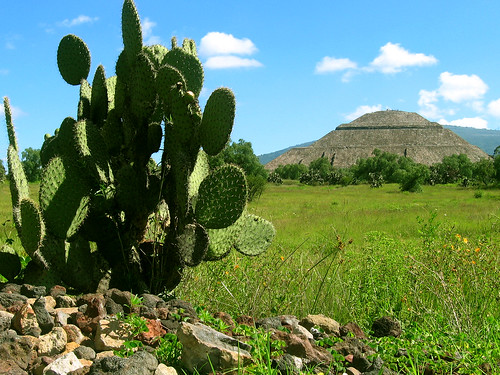
But I want to focus on a plant which normally doesn’t get mentioned in discussions of the Columbian Exchange: the prickly pear, a plant whose history is very much centered on Mexico. Here, we have an exemplar standing guard, as it were, at the site of Teotihuacan.
image
In fact, the prickly pear is so centered on Mexico that it graces the Mexican flag as part of the latter’s central emblem (for those with “mature” eyesight like mine, it’s what the eagle is grasping with its talons at the same time as it grasps that snake in its beak).
image
Maybe the prickly pear’s low profile in Columbian Exchange discussions is because it’s such a nasty, spiny plant, which really doesn’t endear itself to anyone.
image
Or maybe because it’s not much of a commercial crop; the Food and Agricultural Organization, which collects global statistics on some 160 crops, collects no statistics on the prickly pear, for instance.

Whatever the reason, I wish to right this injustice and pay tribute to the prickly pear and its role in the great Columbian Exchange. It may perhaps have played a modest economic role, but it helped to fill many an empty stomach, and it sure as hell has played an important ecological role, sometimes wreaking havoc in the ecosystems into which it was thoughtlessly thrust.

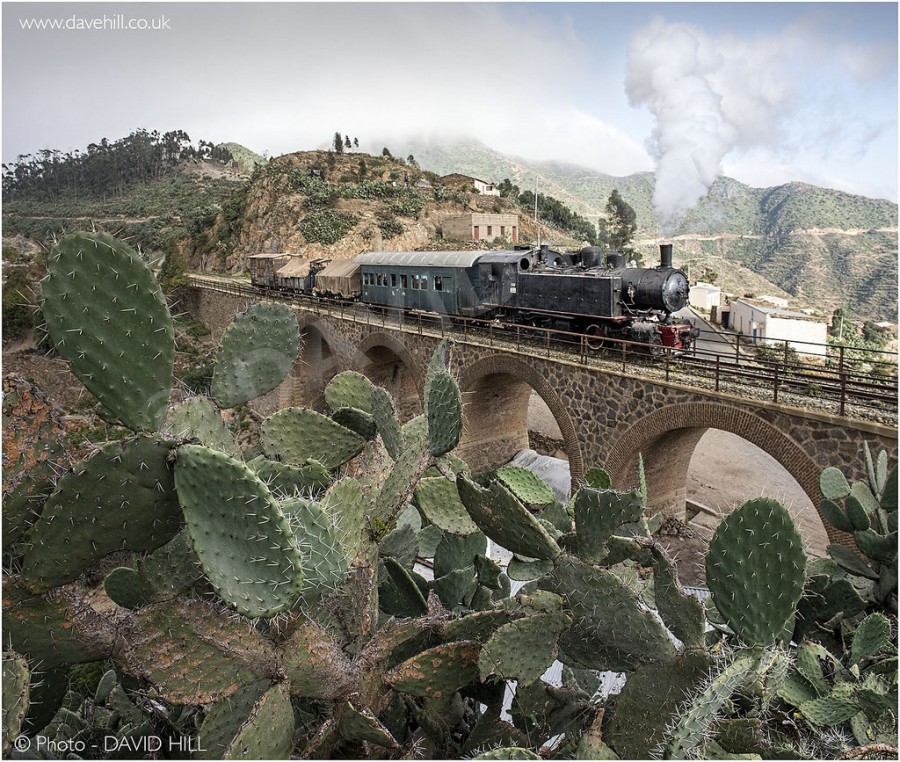
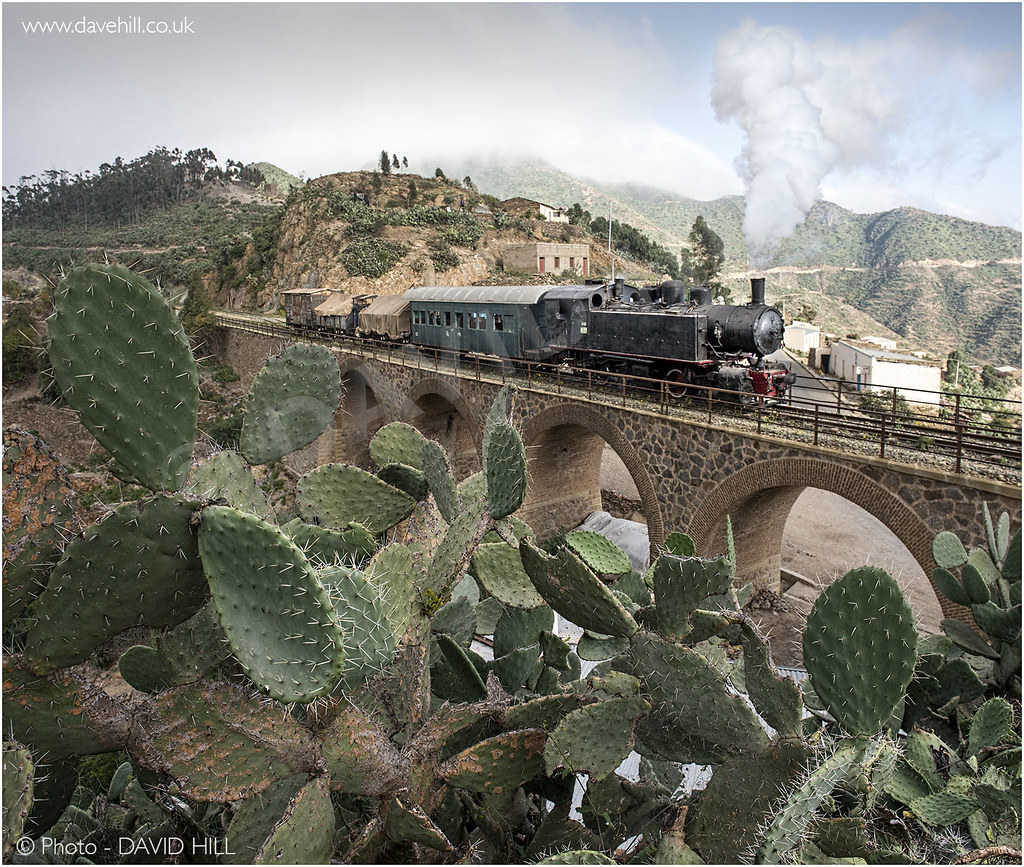
I first met our prickly friend in the country of my birth, Eritrea. Here, you see a specimen in front of the delightful little train which runs from Asmara down to the seaport of Masawa on the Red Sea.
image
I have a vivid memory of taking that train to go down to the coast for a holiday on the beach.

It was the Italians who, as colonial masters
image
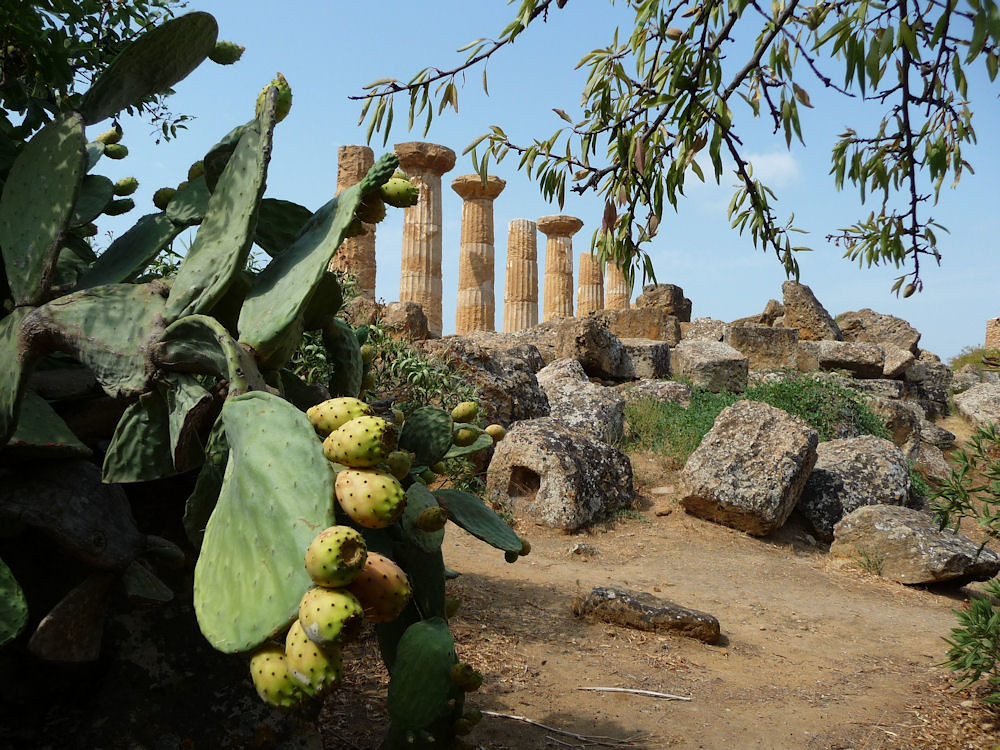
introduced the prickly pear (please note the plant waving at us from behind the colonial troops and their Italian officer). The Italian colonialists brought it from the mother country, of course, where it grows in profusion in the more arid southern regions of the country. We have here an example gracing the ruins of Agrigento in Sicily.
image
But southern Italy was just a later stop on the prickly pear’s journey out of Mexico. It must surely have reached Italy from Spain, which was the first port of call for many of the biological journeys out of the Americas. Here we have a Spanish prickly pear, nudging its way into a photo of Sagunto castle in the province of Valencia.
image
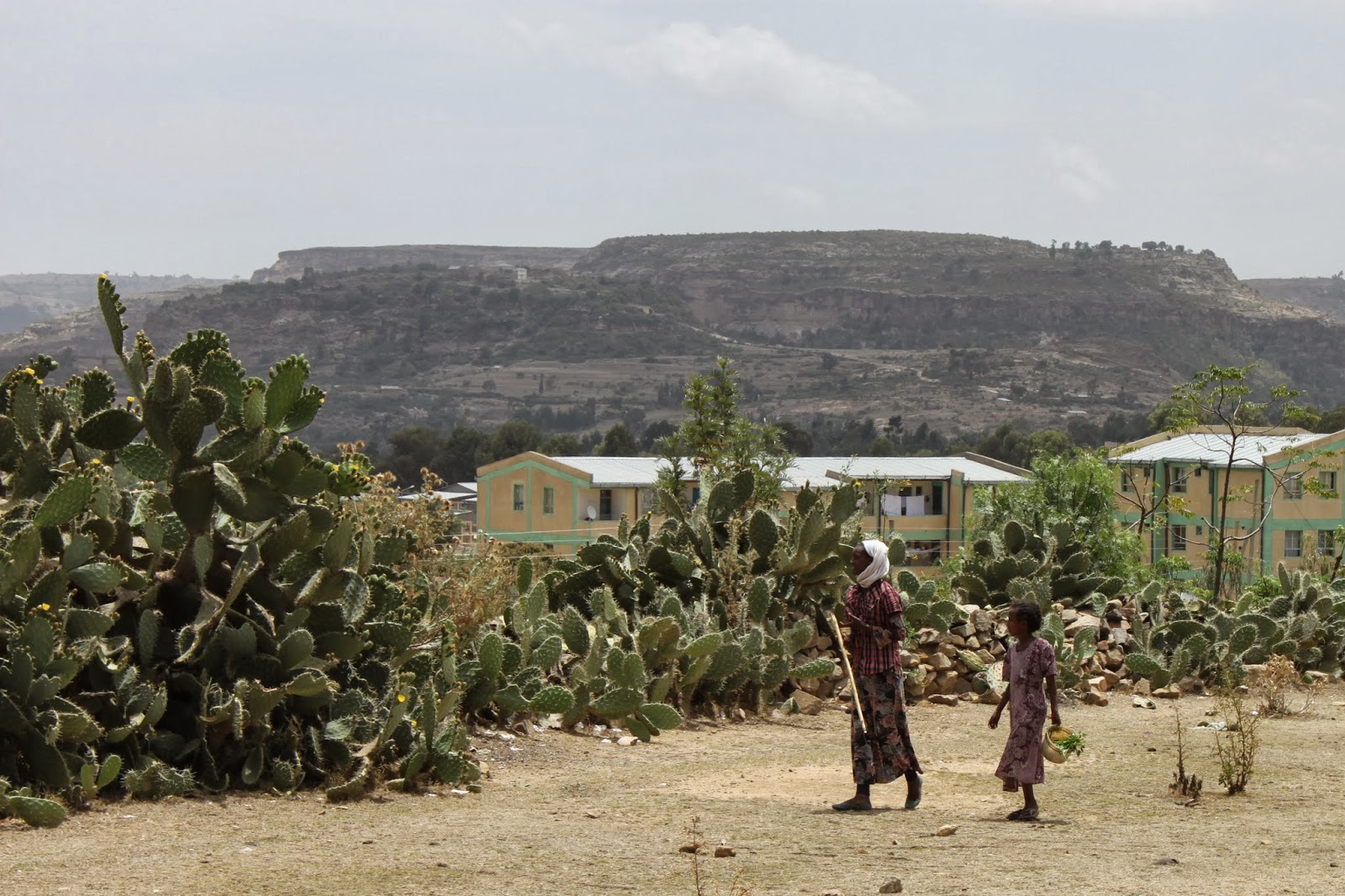
In truth, I have chosen pictures which show off the prickly pear to advantage, but normally the plant is much more unprepossessing. This photo of a ragged, messy patch of prickly pear in a village of Ethiopia is much more typical of how the plant presents itself
image
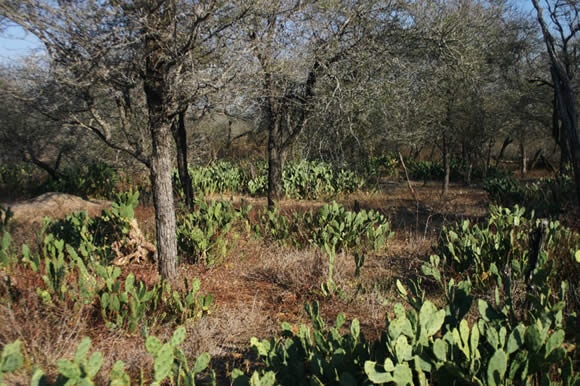
especially when its population levels begin to explode out of control in some foreign ecosystem which has no natural biological defenses against it. The Global Invasive Species Database lists several countries where the prickly pear is now considered an invasive species. Eritrea is one of them, along with the neighboring countries of Ethiopia and Somalia – the Italians, who colonized all three countries had little idea of the damage they were wreaking. But South Africa also considers it an invasive species (here is a picture of prickly pear invading the Kruger national park).
image
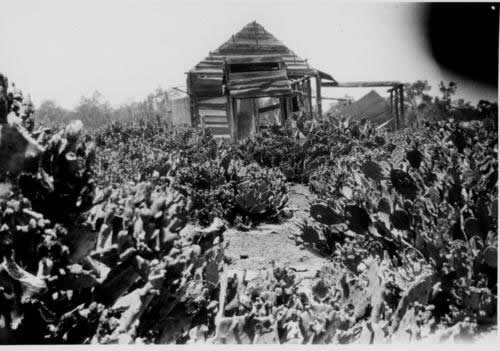
And Australia had a catastrophic invasion. The prickly pear was initially introduced as an ornamental plant for gardens. Then some bright spark thought of using the plant as natural fencing (sensibly enough, cattle and other animals desist from pushing through breaks of prickly pear because of the nasty spines, and they don’t eat them for the same reason) and to start a cochineal dye industry (the little beasties from which the dye is extracted munch the prickly pear’s pads). But the prickly pear went crazy. It eventually converted some 260,000 square kilometers of farmland (which for those readers, who like me don’t think in square kilometers, is more or less equivalent to a square 500 km by 500 km) into an impenetrable green jungle. Farmers were driven off their land by this “green hell” and their abandoned homes were crushed under the cactus growth.
image
The authorities finally managed to get the plague under control in the 1920s by introducing a South American moth, the Cactoblastis cactorum, whose larvae feast on prickly pear. This led to a crash in prickly pear populations, and while the plant has not been eradicated from Australia it has been brought under control (the Australians were lucky, by the way; there is always a risk in this kind of biological control that the agent will find another native plant much more to its liking and wipe that out instead, or once it’s dealt with the original pest will turn its hungry eye on to something else and become an invasive species in its own right).

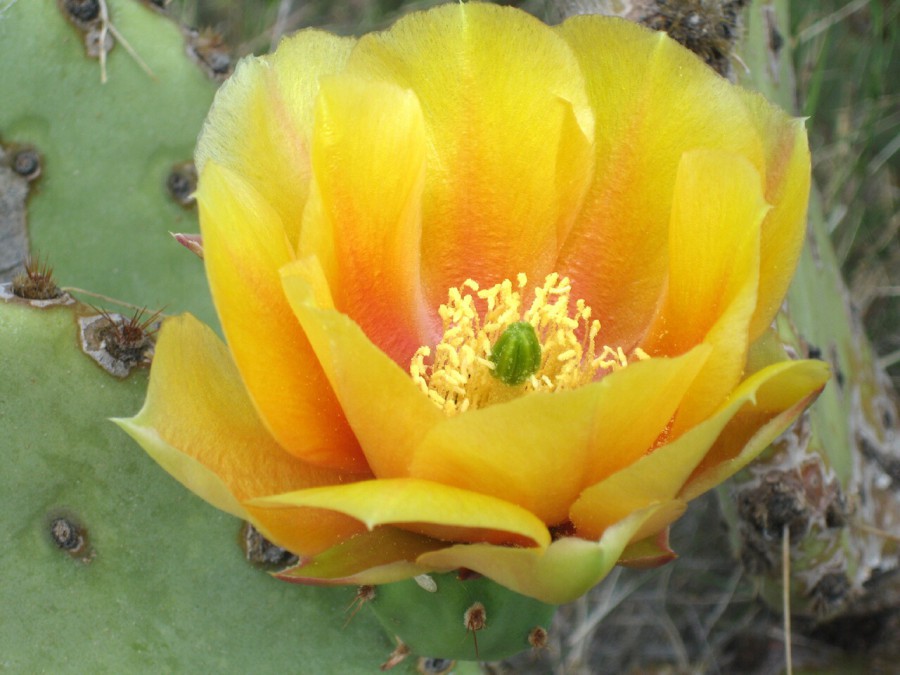
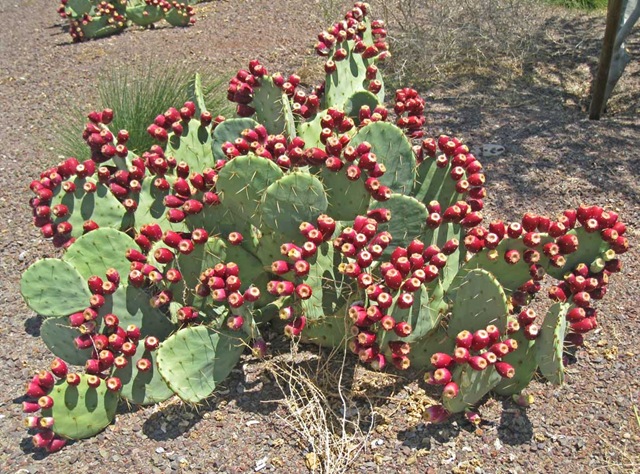
Why did some Spaniard ever bring the prickly pear back to Europe in the first place? Because, as far as I can tell, he thought he could brighten up a Spanish garden somewhere. But it cannot have been because of the beauty of the plant itself. More likely it was the flowers, for indeed the web is full of pictures of the flower of the prickly pear. Here are a few of the more pleasing examples.
image
image
image
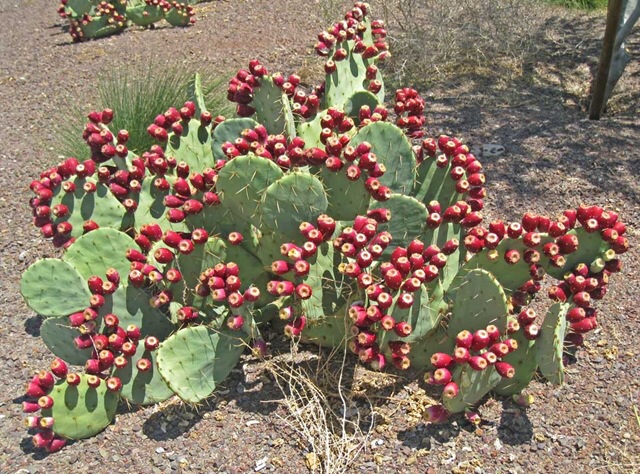
At some point, though, people, especially the poor with bellies to fill, began to also focus on the fruit, the “figs” of the prickly pear
image
These had been enjoyed by the Mesoamericans for millennia before Hernan Cortes and his conquistadores arrived and have been enjoyed by the Mexicans ever since.
image

I add here a close-up of the fruit
image
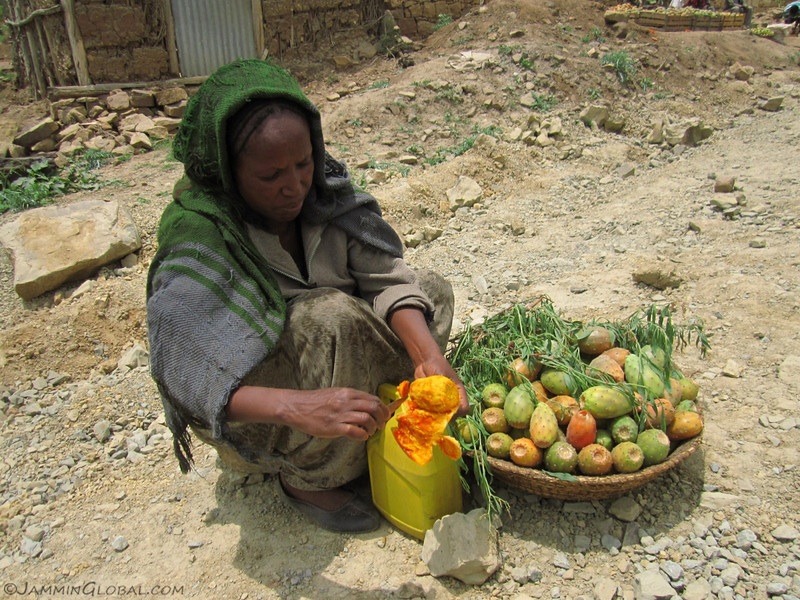
first because it’s a nice photo, but second because the sharp-eyed reader will notice the hair-thin spines which nestle lovingly around the crown of the fruit. Their scientific name is glochids. They are the nastiest little buggers imaginable. They come off easily and lodge under the skin of the unwary picker, where they cause exquisite and unending agony as the said picker tries and tries and tries again to extract them, always in vain. Bloody little bastards … Readers may have gathered from this little burst of ill humour that I have personally experienced this exceedingly painful trial. It was in Eritrea as a matter of fact, where as a young and foolish lad I tried picking the fruit.  I then ran to my Mummy to get the horrible little things out, which she eventually did after much wailing on my part and cross admonitions on her part for me to keep still. I had tried picking the fruit because my mother had earlier bought some, perhaps from a lady like this
image
and I had liked them – a little too many seeds perhaps but nicely fresh and sweet.

Personally, while I like the taste, that early brush with glochids has always made me wary of the fruit. The pain in the hands was bad enough but the thought of those things getting stuck in your tongue or gums because the fruit was badly cleaned is dreadful. And the thought of them getting stuck in your throat is simply too horrible to contemplate.

But others around the world consume the fruit without a second thought, especially around the Mediterranean rim. Here, we have some cheerful young lads selling the fruit in Egypt

image
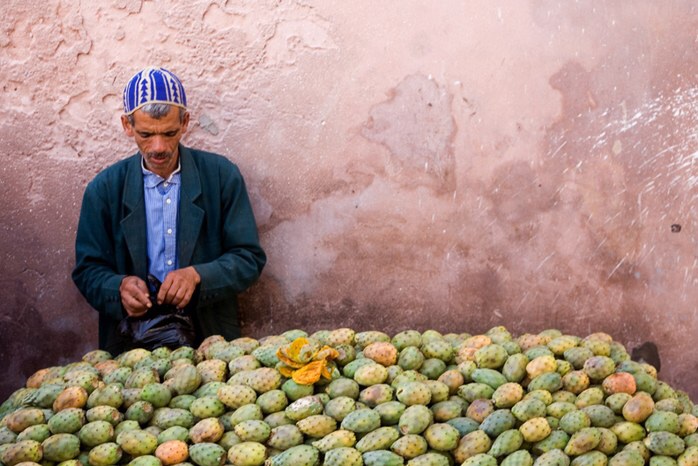
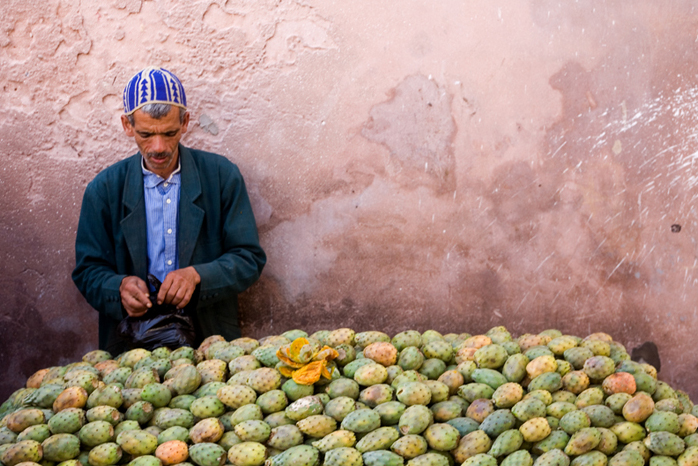
While here we have a more solemn Moroccan doing the same
image
And here a smiling Sicilian ditto
image
As readers can imagine, over the centuries people in the countries where the prickly pear was introduced eventually got around to putting the fruit into alcoholic drinks – at least in those countries where such drinks are tolerated. Thus, we have a prickly pear-flavoured liqueur called “Ficodi” in Sicily, we have a prickly-pear flavored herbal liqueur called “bajtra” in Malta (another country, by the way, where the prickly pear has been declared an invasive species), out in the lonelier reaches of the Atlantic, on the island of St. Helena (where Napoleon Bonaparte was banished), the potent “Tungi Spirit” is produced with the fruit, while prickly pear fruit is the main ingredient of a popular Christmas beverage in the British Virgin Islands called “Miss Blyden”. Looking at how all these various drinks are made, I think I would plump for Miss Blyden: prickly pear steeped in rum and sweetened with sugar. Mmm, sounds good …Yohoho, and a bottle of Miss Blyden, is what I say.

But actually, these drinks are all derivative, if I can put it that way: you just plunk prickly pear fruit in an alcoholic medium; it could actually be any fruit that is plunked. The Mesoamericans, on the other hand, came up millennia ago with colonche, an alcoholic drink using just the juice of the prickly pear fruit, fermenting it over a number of days. I have read that it is a sweet, fizzy, red beverage. Here’s a photo of a glass of colonche, together with the fruit from which it is derived.
image
I regret to say that I did not try the drink while I was in Mexico. However, I have asked my son to try it and report back. If the feedback is good, we can discuss about getting into the business of exporting it!

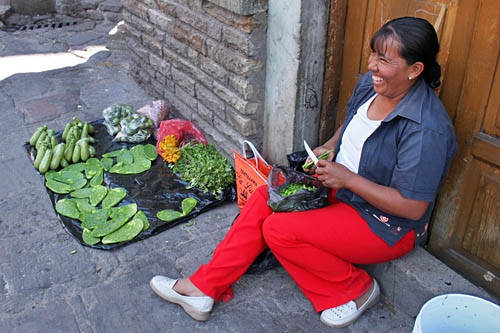
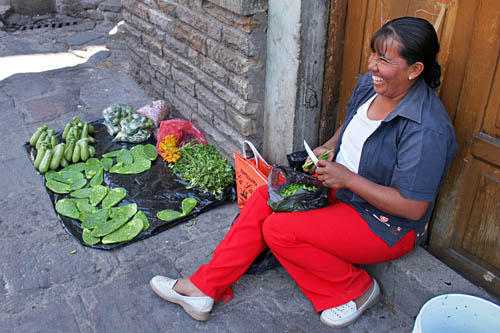
What I will not promote, through export or otherwise, is the eating of the pads (that is to say the fleshy leaves) of the prickly pear. They eat them in Mexico – and in New Mexico too (and perhaps some of the other southwestern States of the US). The original peoples of Mexico were eating them when Cortes burst in on the scene, and it’s still quite popular. I saw them sold in the supermarket around the corner from where we were staying in Mexico City and took a photo, but I prefer this more sympathetic photo of a Mexican lady on the street selling them.
image
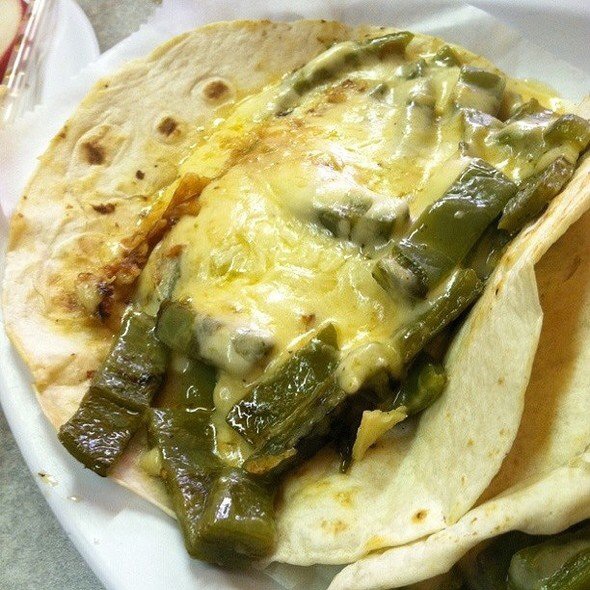
I mentioned in an earlier post that I had tried the pads, cooked and with melted cheese, in a taco. I also tried them, with cheese but without the taco. It didn’t change the taste much.
image
I’m all for trying things once (with the exception of insects). But not necessarily more than once. Pads of the prickly pear fall into the latter category.

But who knows? As the Mediterranean countries slowly go down the economic drain, and more generally as we 99 percenters slowly get poorer, perhaps we will join our Mesoamerican friends and start eating prickly pear pads – as the poor of the Mediterranean lands turned to the fruits of the prickly pear some three hundred years ago to fill their empty stomachs.

_______________
Columbian exchange: http://globerove.com/wp-content/uploads/2010/03/Columbian-Exchange.jpg (in http://www.slideshare.net/mobile/cbgobble/columbian-v-triangle)
Prickly pear in Teotihuacan: https://farm1.staticflickr.com/214/444712763_0a91a8353e.jpg (in https://www.flickr.com/photos/eternal_sunshine_of_the_spotless_mind/444712763/
Mexican flag: http://www.freepressers.com/wp-content/uploads/2011/10/mexican-flag-640.jpg (in http://www.worldtribune.com/worldtribune/WTARC/2011/k1302_10_21.asp)
Prickly pear: https://seekraz.files.wordpress.com/2012/10/prickly-pear-cacti-in-tucson-desert.jpg (in https://seekraz.wordpress.com/tag/prickly-pear-cactus/)
Prickly pear by Asmara-Masawa railway: https://c1.staticflickr.com/9/8633/16089064905_44b9e68e48_b.jpg (in https://www.flickr.com/photos/dave-hill/16089064905/)
Italian colonial masters: http://upload.wikimedia.org/wikipedia/it/6/6c/Ascari_penne_di_falco.jpg (in http://it.m.wikipedia.org/wiki/Regio_corpo_truppe_coloniali_d’Eritrea)
Prickly pear in Sicily: https://c1.staticflickr.com/9/8299/7826141194_33f0e36a8d_b.jpg (in https://www.flickr.com/photos/mari-mora/7826141194/)
Prickly pear in Spain: https://themostbeautifulplacesineurope.files.wordpress.com/2013/07/dsc_0048.jpg (in https://themostbeautifulplacesineurope.wordpress.com/tag/castle/)
Prickly pear in Ethiopian village: http://4.bp.blogspot.com/-YutF1G9Qjbo/Up44cIZUf_I/AAAAAAAAMPA/fydBOTfLCNY/s1600/00041775.jpg (in http://jhodgesagame.blogspot.com)
Prickly pear in Kruger National Park: http://academic.sun.ac.za/cib/news/images/20120611_opuntia_stricta_impacts_fig1.jpg (in http://academic.sun.ac.za/cib/news/20120611_opuntia_stricta_impacts.htm)
Prickly pear in Australia – the green hell: http://chinchillalibrary.chinchilla.org.au/Images/Local%20History/johnty%20turner’s.jpg (in http://chinchillalibrary.chinchilla.org.au/HTML/HeritagePricklyPear.html)
Prickly pear in flower-1: http://www.fotothing.com/photos/4aa/4aa38f6709881bcb9b0dc2f7bce87dea.jpg (in http://www.fotothing.com/AzViper/photo/4aa38f6709881bcb9b0dc2f7bce87dea/)
Prickly pear in flower-2: http://photosbygarth.com/travels/DesertGardens4-23-11/prickly_pear_cactus_flowers_0887.jpg (in http://photosbygarth.com/wordpress/)
Prickly pear in flower-3: http://www.summitpost.org/prickly-pear-cactus-flower/294673
Prickly pear fruit-1: http://2.bp.blogspot.com/-_NFH_ZhWJCU/T1kjB-HTOWI/AAAAAAAAA84/rBf30_8f5qg/s1600/5.jpg (in http://docsfitnesstips.blogspot.com/2012/03/prickley-pear.html)
Mexicans selling prickly pear fruit:
http://i.gonoma.net/i/destinations/1106/zacatecas-images/prickly.jpg (in http://gonomad.com/destinations-xxx/3205-zacatecas-mexico-rsquo-s-overlooked-colonial-gem)
Prickly pear fruit-2: http://cdn.c.photoshelter.com/img-get/I0000O2m8f8jI.vU/s/600/600/PPCA-021548.jpg (in http://rolfnussbaumer.photoshelter.com/image/I0000O2m8f8jI.vU)
Ethiopian lady selling prickly pear: http://jamminglobal.com/2012/05/ethiopia-part-6-historical-axum-and-mountainous-twisties.html
Prickly pear seller Egypt: http://weekly.ahram.org.eg/Media/NewsMedia/2013/7/16/2013-635095893366005272-600_resized.jpg (http://weekly.ahram.org.eg/News/3357/25/The-fruit-beneath-the-thorns.aspx)
Prickly pear seller Morocco: http://upload.wikimedia.org/wikipedia/commons/b/b1/Prickly_pear_seller.jpg (in http://en.m.wikipedia.org/wiki/Opuntia_ficus-indica)
Prickly pear seller Italy: http://www.fotografieitalia.it/foto/3126/3126-08-20-44-1557.jpg (in http://www.fotografieitalia.it/foto.cfm?idfoto=65383&idfotografo=3126&crono=1)
Colonche: http://173.236.14.43/fotos/nota/2014/9/18/4d68094af571428.jpg (in http://www.am.com.mx/aguascalientes/especiales/espiritus-de-la-republica-144117.html)
Seller of cactus pads: http://holeinthedonut.com/wp-content/uploads/2010/06/Nopal_Cactus_Seller_Mercado_Hidalgo_Guanajuato.jpg (in http://holeinthedonut.com/2010/06/01/mexico-food-nopal-cactus/)

Cactus pad and cheese: http://s3.amazonaws.com/foodspotting-ec2/reviews/846163/thumb_600.jpg?1315336866 (in http://www.foodspotting.com/150802-amandahugnkiss)/)


MEXICO: BASHING THE PIÑATA

Mexico City, 4 January, 2015

As my wife and I wandered around Mexico City this last week, we were struck by these strange ornaments which we saw hanging in many places. This particular one, for instance, was hanging in a street somewhere

pinata 002

while this one, somewhat incongruously, swung over the cars in a gas station.

image

Intrigued, I asked our son what they were. Piñata, he told us.

Ah. I had never heard of them.

Undeterred, I rolled up my sleeves and did some research (i.e., browsed the web). I am now ready to report my findings.

What we have here is an example of the strategy used by the Catholic church in the early years of the Spanish conquest of Mexico to christianize the local populations. The church adopted, with the necessary adaptations, those local religious traditions which happened to have similarities with Catholic traditions. The thinking was that this would make Catholicism more familiar, more “user friendly” for the local populations, who would therefore convert more readily (and if necessary, a little gentle pressure from the sharp end of a sword could no doubt be used to help along in the decision-making process).

In the case of the piñata, the local religious tradition in question was part of the Aztec festival for their patron god Huitzilopochtli, sun god, god of war, and god of human sacrifice.
image
The whole of the Aztec month of Panquetzaliztli, which ran from 7 to 26 December in today’s calendar, was dedicated to this festival. The people decorated their homes and trees with paper flags, there were ritual races, processions, dances, songs, prayers, and to top it all off there were human sacrifices.

Only one of the festival’s activities is of interest us here. In it, priests would place a clay pot on a pole in front of the statue of the god. The pot was filled with tiny treasures inside and decorated with colorful feathers outside. The pot would be ritually broken with a stick or club, and the treasures would fall to the feet of the statue as an offering.

It so happened that the Spaniards had a very similar custom, the Dance of the Piñata, which took place during Lent. There, too, a decorated clay pot, the piñata, was suspended and during some kind of dance routine got broken with a stick. Quite what the religious significance of this was is unclear to me, nor do I know if there was anything in the pot.

The canny Franciscan monks who were spearheading the conversion efforts in Mexico (along with Dominicans) figured that they could harness this Lenten custom from Old Spain to a new Christmas custom in New Spain and in so doing help to draw away the indigenous people from their old, “pagan”, “idolatrous”, “devil-worshipping”, etc. religion. They also borrowed from a superficially similar Mayan custom. The Mayans had a game rather like blind man’s buff, where a player was blindfolded, perhaps spun around to disorient him, and then left to try and hit and break a suspended clay pot. No doubt his blundering misses made spectators roar with laughter. Again, I don’t know if there was anything in the pot.

The Franciscans used all these threads to weave together a new, fun custom which the indigenous people were encouraged to practice, in the church grounds no doubt, in the run-up to Christmas. A clay pot, filled with sweets and other goodies, and decorated on the outside, was suspended. The “players” were blindfolded, and guided by the onlookers, would try and bash the pot and release the goodies. If successful, everyone would throw themselves on the goodies. But of course the Franciscans gave the whole thing a religious twist, using the new piñata “game” to inculcate in the locals some Christian catechism. Thus, the clay pot represented Satan, with the outer decorations now transmuted into seven colorful cones or horns representing the seven deadly sins (for those of my readers who have momentarily forgotten which these are, we have, in alphabetical order: envy, gluttony, greed, lust, pride, sloth, and wrath). The outside was made beautiful to remind the viewer that evil is tempting, and the goodies inside the pot represented the temptations of wealth and earthly pleasures. Once the game started, it became a morality play for demonstrating the three theological virtues of Faith, Hope, and Charity. The blindfolded players represented Blind Faith, groping their way towards salvation. The piñata now represented Hope. The onlookers looking up at the hanging piñata were actually gazing towards Heaven, yearning for the salvation that would come from the smashing the pot and the triumph of Faith over Evil. The sweets and other goodies that showered forth now suddenly became the rewards of maintaining the Faith. But everyone shared in the goodies, thus symbolizing Charity. After this dose of religion, it seems to me only correct to include this statue of a Franciscan monk having a bash at a piñata.

image

If any of the players impatiently waiting to have a go at smashing the pot understood any of these theological subtleties I take my hat off to them. If my own youthful experience of catechism is anything to go by, I would guess that they quietly let the priest blather on about whatever he wanted to blather on about and then they got down to the serious business of having some fun. These two photos, which I took in the Museo de Arte Popular (about which more later in a future post), capture nicely the fun aspect of this religious game.

image

image

I’m sure it is the jolliness of smashing something and scrambling around for goodies that makes older Mexicans remember piñata with fondness rather than the catalogue of the seven deadly sins and the triumph of Faith over Evil. In fact, at some point it seems to me that the piñata lost much of its religious connotations and simply became a game to play at parties, and at the same time there was a switch from a ceramic pot to hold the goodies to one made of papier-mâché or cardboard – no doubt fond mothers were worried about having their dear ones and those of their neighbors showered with pottery shards during the children’s parties they organized.
image
Indeed, I have this vague memory of a similar game being played at the birthday party of one of my son’s friends years ago in Italy. By the way, for those of you who like me are fond of useless facts, the Spaniards borrowed the piñata from the Italians, where it was called pignatta. And it seems that the ultimate source of the custom was China, although how it got from the Middle Kingdom to Italy is a bit of a mystery to me (my sources suggest Marco Polo, but he gets mentioned whenever no-one has a good idea how things got transmitted from China to Europe).

In any event, it now looks like the piñata is morphing into a simple Christmas decoration. I certainly don’t think that all the piñatas we’ve seen hung up are there to be bashed vigorously with a stick. In this new identity they have become the equivalent of those stars which seem such a popular Christmas street decoration.
image
Soon, they will morph once more, becoming tame Christmas tree decorations. Indeed, if this Christmas tree at one of Mexico City’s bus stations is anything to go by, the morphing has started already.
image
From reverent offering to the sun god to cheesy decoration on a Christmas tree, the fall has been long and hard.

_____________

Piñata: my photo
Huitzilpochtli: http://upload.wikimedia.org/wikipedia/commons/c/cb/Huitzilopochtli_telleriano.jpg (in http://en.m.wikipedia.org/wiki/Huitzilopochtli)
Franciscan monk hitting piñata: http://en.m.wikipedia.org/wiki/Piñata#/image/File:MonkPiñataAcolman1.JPG (in http://en.m.wikipedia.org/wiki/Piñata)
pix from the museo de arte popular: mine
Children hitting a piñata: http://en.m.wikipedia.org/wiki/Las_Posadas#/image/File:Las_Posadas_Pinata.jpg (in http://en.m.wikipedia.org/wiki/Las_Posadas)
Christmas street decorations: http://wallpaperest.com/wallpapers/street-outdoor-christmas-decorations_074228.jpg (in http://toplowridersites.com/iphone-5-38528-christmas-christmas-street-decoration-jpg/)
piñata on Christmas tree: my picture

MEXICO: BOUGAINVILLEA

Mexico City, 25 December, 2014

My wife and I are spending Christmas in Mexico City. Parental love is what draws us to Mexico. Our son has his business here, and this year it is his turn to hold the fort over the busy Christmas period. As the Turkish saying goes, “Dağ sana gelmezse, sen dağa gideceksin”, “If the mountain won’t come to you, you must go to the mountain”. These last few days, together with our daughter (she has been able to escape from her job in New York, but at the price of being often on FaceTime and email with her colleagues), we have been roaming the city and appreciating its delights, both visual and gastronomic. Yesterday, for instance, we visited Frida Kahlo’s house, La Casa Azul, which presents a compact collection of her paintings (including one which I’ve mentioned in a previous post) as well as of paintings by her husband Diego Rivera. And while we stood in the long, long line to get in, we tucked into an assortment of delicious tacos, including one where the filling was a mix of cheese and cactus pads. Cactus pads! That was a first for me.

Everywhere we have been in the city, we have been delighted with great clouds of bougainvillea, mauveimage

red

image
orange
image

white

image

clawing their way over roofs, snaking along balconies, tumbling over walls, strangling trees, or simply sculpted into staid bushes.

I’m very fond of bougainvillea. It’s an old friend which I’ve run into in various parts of the world, always places with the sunny, warm climates which I feel very comfortable in, like Eritrea where I was born
image
or Liguria which my wife introduced me to nearly 40 years ago and to which we return again and again
image
or Thailand where we live at the moment.
image

This latest meeting with bougainvillea in Mexico has moved me to use my free time during this holiday period, between visits to the sites and shopping for Christmas lunch and dinner, to explore this beautiful plant’s history. I had always known that its rather fancy name came from the French Admiral Louis Antoine, Comte de Bougainville.
image
France’s response to Britain’s James Cook, Bougainville was the first Frenchman to circumnavigate the globe, in the late 1760s, and it was during this trip that bougainvillea was discovered (by Europeans; the locals knew it already of course). It was actually Bougainville’s on-board botanist, Philibert Commerson, who discovered it.

image

The discovery occurred during an enforced stopover in the Bay of Rio de Janeiro, where Bougainville had decided to regroup and carry out urgent repairs to his two ships. Like most European botanists of the time, Commerson was dazzled by the huge biological diversity he found in Brazil: “this country is the most beautiful in the world”, he wrote home. Something of what he found before him can be gathered from this more-or-less contemporary painting.
image
Commerson took advantage of the stop in Rio to go out botanizing along the coast and islets of the bay. As he reported to a friend in a letter home, one day he stumbled on this vine, “a wonderful plant with big flowers of a sumptuous violet colour”. He decided to honour Bougainville by naming the plant after him (Bougainville also gave his name to a couple of islands, a couple of straits between islands, and a town in the Falkland Islands). Commerson’s dried sample eventually made it back to France, where it can still be viewed, faded but nevertheless recognizable.

image
We can leave the story of bougainvillea there; suffice to say that the first period of globalization which came with European colonialism spread the pretty plant far and wide. But its discovery in the Bay of Rio de Janeiro gives me pause. That wonderful botanical diversity which so took Commerson’s breath away has been sadly depleted. Before the arrival of the Europeans, the bay of Rio de Janeiro was enveloped by the Mata Atlântica, the Atlantic Forest. This mighty forest stretched unbroken from north-east Brazil all the way down the Atlantic coastline as far as Uruguay, and spread into north-eastern Argentina and eastern Paraguay. It once covered some one and a half million square kilometres, but three hundred years of deforestation for logging and farming have seen it become the second most threatened biome in the world, after Madagascar. Today, less than a tenth of the original forest area remains.

There is some light in all the gloom. Despite all the loss and habitat fragmentation, the region is still ranked in the top five of the world’s biodiversity hotspots. It is particularly remarkable for its bird species. In 2001, wanting to preserve what was left if not reverse some of the damage (to which his own ancestors had contributed), a farsighted owner of farmland at the base of the mountains, in the valley of the Guapiaçu river, some 80 kilometres north-east of Rio, established an ecological Reserve, the Reserva Ecológica de Guapiaçu (REGUA). REGUA’s objective is to protect the remaining forest and biodiversity from deforestation, hunting, and over-extraction of natural resources. With funds from the World Land Trust and others, REGUA has bought land to consolidate and extend the Reserve. Over 100,000 trees, all native species, have been planted, wetlands have been recreated, some animal species have been reintroduced, hunters have been turned into guides, and visitors are encouraged to come and share in this wonderful effort. If I know all this, it is because my wife and I financially supported the planting of a modest number of trees and stayed at the Reserve’s lodge for several days, going out on a birding expedition, inspecting our tree seedlings and the-then nascent wetlands, and just generally enjoying ourselves.
image
We hope to go back there one day, to see how our trees are doing. And maybe we’ll spot some bougainvillea in its natural state, ruthlessly climbing over some unfortunate tree, choking the life out of it.

_______________________________
Mauve bougainvillea: http://upload.wikimedia.org/wikipedia/commons/f/f8/Starr_030418-0058_Bougainvillea_spectabilis.jpg (in http://en.m.wikipedia.org/wiki/Bougainvillea_spectabilis)
Red bougainvillea: http://www.boethingtreeland.com/media/catalog/product/cache/1/image/1440x/9df78eab33525d08d6e5fb8d27136e95/B/o/Bougainvillea-Temple-Fire.jpg (in http://www.boethingtreeland.com/bougainvillea-temple-fire.html)
Orange bougainvillea: http://pics.davesgarden.com/pics/2007/02/01/htop/a25dea.jpg (in http://davesgarden.com/guides/pf/showimage/139848/#b)
White bougainvillea: http://www.phytoimages.siu.edu/users/paraman1/7_13_09/Upload13July09A/BougainvilleaWhite1.jpg (in http://www.phytoimages.siu.edu/imgs/paraman1/r/Nyctaginaceae_Bougainvillea_spectabilis_16879.html)
Eritrean highlands: http://4.bp.blogspot.com/_iNSpfNcQ0Sg/SmH-m6Qdw7I/AAAAAAAABk0/m6818sz2DR8/s1600-h/asmara+114.jpg (in http://www.concretegardener.com/2009/07/glimpse-of-massawa-eritrea.html)
Liguria: http://upload.wikimedia.org/wikipedia/commons/e/ea/Vernazza.JPG (in http://commons.m.wikimedia.org/wiki/File:Vernazza.JPG)
Thailand: http://ichef.bbci.co.uk/wwtravel/624_330/images/live/p0/15/w6/p015w6lz.jpg (in http://www.bbc.com/travel/feature/20130304-the-perfect-trip-thailand)
Bougainville: http://en.m.wikipedia.org/wiki/Louis_Antoine_de_Bougainville#/image/File:Louis_Antoine_de_Bougainville_-_Portrait_par_Jean-Pierre_Franquel.jpg (in http://en.m.wikipedia.org/wiki/Louis_Antoine_de_Bougainville)
Commerson: http://en.m.wikipedia.org/wiki/Philibert_Commerçon#/image/File:Commerson_Philibert_1727-1773.png (in http://en.m.wikipedia.org/wiki/Philibert_Commerçon)
Brazilian jungle: http://fr.m.wikipedia.org/wiki/Philibert_Commerson#/image/Fichier:Rugendas_-_Embouchure_de_la_riviere_Caxoera.jpg
Commerson’s dried sample: http://dsiphoto.mnhn.fr/sonnera2/LAPI/scanG/G20090518/P00169376_a.jpg
REGUA: http://media-cdn.tripadvisor.com/media/photo-s/06/3f/61/18/regua-reserva-ecologica.jpg (in http://www.tripadvisor.com.au/LocationPhotoDirectLink-g954096-d2557905-i104816920-REGUA_Reserva_Ecologica_de_Guapiacu-Cachoeiras_de_Macacu_State_of_Rio_de.html)