COTECHINO FOR CHRISTMAS LUNCH

Milan, 28 December 2017

Many posts ago, I promised that I would render public the recipe for mashed potatoes which had been handed down for generations from mother to daughter on my mother’s side (at least, that’s what I would like to think; I certainly got the recipe from my sister, who in turn got it from our grandmother). I will finally unveil it today – but first, I will dreamily describe the meal which it accompanied, which happens to have been our Christmas lunch.

The centerpiece of the lunch, the pièce de resistance as the French would say, was two cotechini. For readers who have no idea what a cotechino is, let me first say that I completely understand; I too had no idea what it was before I had slices of one put on my plate some forty years ago, when I passed my first year’s end in Italy. Let me go on to say that it is a sausage – such an ugly term for this glorious dish! the Italian term salume is so much more elegant, I will use that.

It is made with pork meat, both lean (shoulder, neck, leg, shank) and fatty (throat, cheek, bacon) as well as rind. The meat portion is chopped coarsely, the rind finely. Nowadays, the lean meats predominate in the recipe, with about a fifth each by weight of fatty meat and rind added, but I suspect that in the old days there was much more rind since the salume’s name derives from cotica, the Italian word for rind. In any event, salt, pepper, spices and herbs, and even sometimes wine, are added to the mix. The precise types and amounts of spices and herbs are of course closely guarded secrets handed down from generation to generation in the hush of rural kitchens, but nutmeg, cloves and sometimes cinnamon are present in modern recipes. This fragrant mix is then squeezed into a casing of pig’s intestines. The resulting salume is cured for about a month, after which it is ready to eat. But first it needs to be cooked, which luckily is easy though slow: place the cotechino in boiling water over low heat for some four hours, first pricking the casing to allow the fats inside to ooze out. Et voilà! (I feel I must inform those readers who are pressed for time that there are now modern pre-cooked cotechini which can be ready for the table in half an hour, but I would really urge them to make time in their busy lives to purchase a raw cotechino and cook it the full four hours).

Today, the cotechino is a very respectable dish, but I suspect this is because it has been subjected to the culinary equivalent of gentrification. It must have started life as the ingenious response by poor people to the pressing need to use every bit of their pigs, even the hard, gristly, tough bits. In fact, the region of Friuli-Venezia-Giulia, which until recently was a very poor region of Italy, has always claimed the paternity of the cotechino. In truth, though, it is found in substantially the same form throughout the whole of north-eastern Italy, and has spread west to Lombardy and south to the Apennines. Northern Italy was full of very poor people until comparatively recent times. Some years ago, riding the wave of sourcing your food locally, Modena has cannily parlayed the greater notoriety of its variant of cotechino into a certification of Protected Geographical Indication, no doubt much to the annoyance of all the regions in the north-east who believe that the cotechino was born in their region.

Well, I don’t object to this social upgrading of the cotechino. I’ve always thought that simple “peasant” food is much nicer than the fussy, overwrought creations invented for aristocrats with nothing useful to do with their lives and always looking for something new to excite their jaded palates.

In northern Italy, cotechino is the dish par excellence for Christmas and New Year meals. It is joined in this distinction by the zampone from Emilia Romagna, which is identical to the cotechino except for the casing used: the pig’s front foot rather than its intestines.
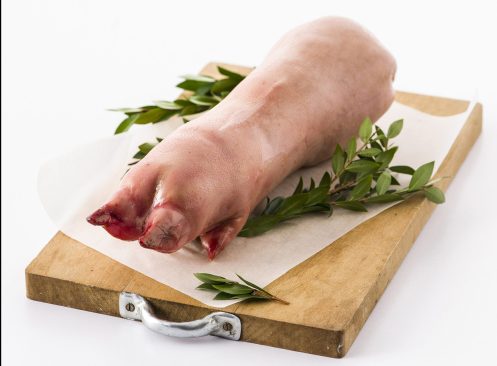
It is probably its role in year’s end festivities that has turned the cotechino into a respectable, middle-class dish. But I suspect that its place on the Christmas or New Year table in the first place is actually due to simple chance. In the old days, it was customary in the countryside to slaughter the household pig at the beginning of winter. The meat and offal were then cured or otherwise preserved to build up food supplies for the lean winter and spring months. Cotechino, which is cured within a month, would have been ready by the end of the year, just in time for the festive season. Thus did it happen to become, in my humble opinion, the centerpiece – the piece de resistance – on the Christmas or New Year table.

What of the side dishes to be eaten with cotechino? This year, we followed the time-honored tradition of eating it with lentils.

I personally think this is an excellent culinary pairing. Cotechino has rather a sharp taste, which is admirably offset by the relative blandness of lentils. The relative dryness of lentils also soaks up the cotechino’s tendency to excess fattiness. But I’m not sure this was necessarily the reason for which the pairing originally occurred. Since time immemorial, lentils have been the poor person’s food, so it seems natural to me that it should have been paired with cotechino, the poor person’s salume. It could also be that there was already a tradition of eating lentils at the new year. It seems that since at least Roman times there has been the belief that eating lentils at the new year will ensure your prosperity in the year to come. This credence is based on the shape of the lentils – they look like (very) small coins. I suppose this must be based on a belief in some sort of sympathetic magic: eat coin-shaped food and real coins will soon be clinking in your pocket. I wish it were that simple …

Which brings us back to where this post started: mashed potatoes.

We decided to add this to the basic pairing of cotechino and lentils. I feel that the gentle sweetness of mashed potatoes helps the lentils in its task of smoothing out that bite and tartness which is an essential part of the cotechino’s identity. I’m convinced that our mashed potatoes’ sweetness is enhanced by the way we prepare it (I say “we” because I have passed on the age-old secret recipe to my wife and daughter): mash the potatoes, preferably in one of those old-fashioned manual food-grinders, add enough milk to nearly liquefy the mash, add an extremely large nob of butter, stir. That’s it.

And so we all tucked into our Christmas lunch of cotechino, lentils, and mashed potatoes.
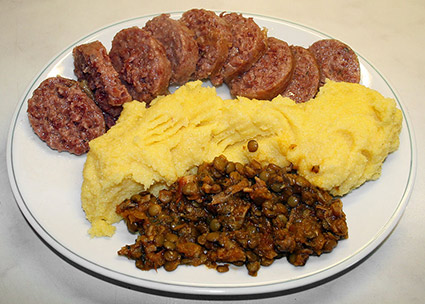

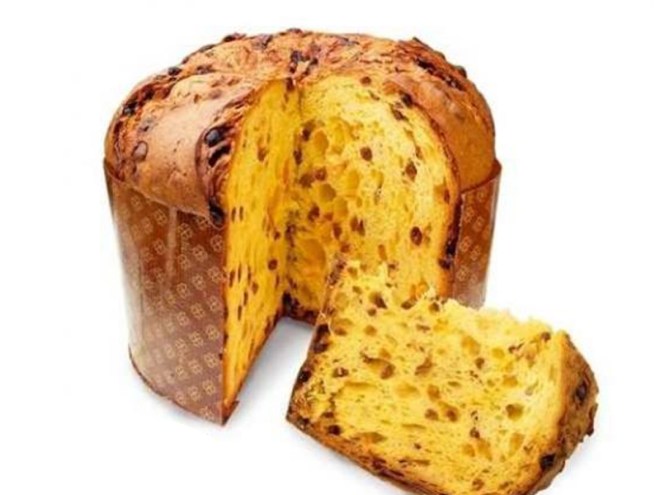
Nothing fancy, just damned good food. And of course followed by that glory of Milanese cuisine, panettone.

Well, it’s taken me a little time to prepare this post, but readers still have just enough time to rush out and buy themselves a cotechino for their New Year’s lunch or dinner. I suggest going to your nearest Italian Deli to see if they have it – you can buy a zampone if they stock that. If not, you might just have time to buy it on-line. But hurry! Time is running out!

__________________

cotechino: http://www.academiabarilla.com/italian-recipes/second-courses/cotechino-with-lentils.aspx
cotechino di Modena IGP: http://www.pubblicitaitalia.com/eurocarni/2007/2/7179.html
zampone: http://www.salepepe.it/ingredienti/tipi-di-carne/zampone/
lentils: http://www.lacasadellericette.com/2011/12/lenticchie-felice-anno-nuovo.html
mashed potatoes: http://www.cookingchanneltv.com/recipes/mashed-potatoes-with-roasted-garlic-and-mascarpone-cheese-1947695
cotechino, lentils, and mashed potatoes: https://cucina.doki.it/secondi-piatti/cotechino-pure-patate-bimby-tm31-ricetta
Panettone: http://www.alimentipedia.it/panettone.html
New Year’s dinner: http://www.grubstreet.com/2016/12/where-to-make-last-minute-new-years-eve-reservations-in-nyc.html

HARK! THE HERALD ANGELS SING

Milan, 25 December 2017

I suppose it’s a sign of old age creeping up on me that I recall with ever greater fondness the memories of my youth, and in this festive season no more so than to Christmases past – here, to get us into the spirit of things, I throw in a picture of Scrooge being visited by the ghost of Christmas Past.

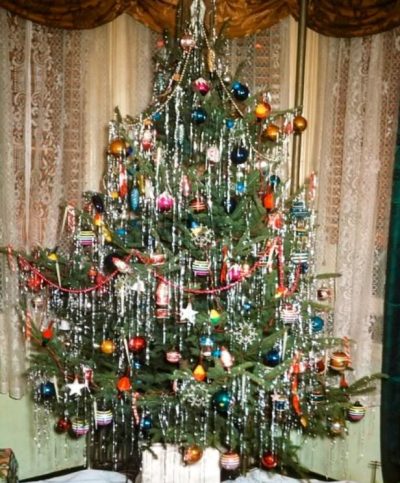
There is one Christmas in particular which comes back vividly to mind.  I must have been six years old, old enough to remember things forever more and young enough for incidents to be deeply impressed into my still malleable brain. I can still see in my mind’s eye the living room of our house in Eritrea – this was probably the last Christmas we spent there; we would be leaving it forever within the coming year. The furniture had been moved around to make room for a Christmas tree in the corner and a nativity scene along the edge of one of the walls. Following the cultural divide in our family, my British father was responsible for the tree while my French mother was responsible for the nativity scene, or crèche as she used to call it. The tree was a source of endless fascination to me, covered as it was with those glittering balls and other baubles. This picture of a Christmas tree from the 1950s captures well the glittering fantasy I beheld.

The balls in particular were a magnet for my little fingers, which was a problem because they were incredibly fragile in those days, made as they were of some very thin, very easily breakable material.  Alas, despite numerous parental warnings to keep out of the living room, I could not resist sneaking in and touching those beautiful balls, with a broken ball and a sore bottom being the inevitable result.

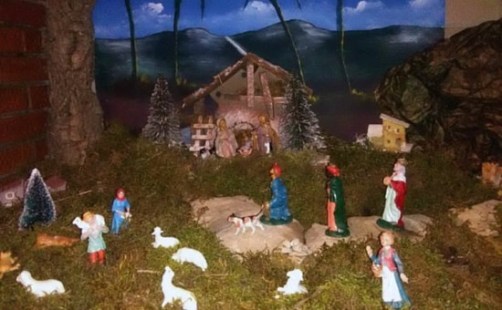
The crèche was an equal source of fascination: the little manger, the figurines of Mary and Joseph, the Mum and Dad to that little baby, Jesus, lying in the hay, the donkey and the cow, very much like the ones I saw when we went for drives in the countryside around the town, the shepherds hanging around the manger, who also looked pretty much like the shepherds I sometimes saw out in the countryside, the angel which hung by a thread over the manger, the three old fellows and a camel who, day by day, were brought closer and closer to the manger until they reached it some time after Christmas … all wonderful stuff. The crèche photographed here has the rough and ready look which ours surely had – in fact, it looks already to be one level above whatever it is that we prepared, although to my innocent eyes ours was a work of art.

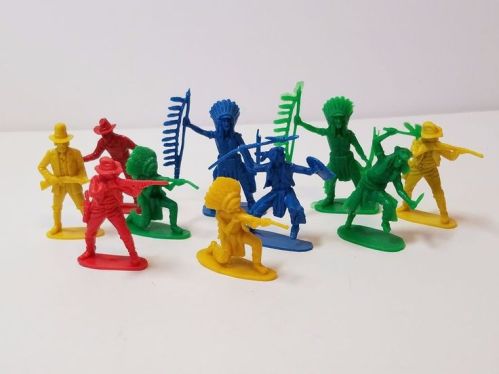
I had little understanding and, frankly, zero interest in the theological profundities which were being exposed before us. What I loved were all those little figurines which we could move around! Our mother made it even more interesting by allowing us to add our own figurines to the mix. I don’t recall what I brought but I remember that my elder brother came with his toy cowboys and indians which he proceeded to hide behind the various trees and bushes dotting the papier-maché landscape.

In all my Christmases Past, I have had a particular fondness for these Christmas trappings, even though for reasons which are now not clear to me the crèche quite quickly dropped away in my parents’ Christmases, leaving only the tree and its baubles. When my Italian wife and I started having our own Christmases the decorated pine tree also dominated, although my wife remembered with great fondness the crèche, or presepe as she calls it, which her father would create when she was young. As she described it to me, it seemed very much like the crèche of my memory, although her father had inserted a pond into the landscape using a mirror and had rigged up a little light driven by a battery which would shine in the star above the manger. Since it was very much my father-in-law’s project, I suppose that after his early death my mother-in-law never had the heart to take the presepe out and set it up, even when our children were young and might have appreciated it. But we took them along to the local churches – every self-respecting Italian church will have a presepe set up in one of the side chapels at Christmas.

This year, as I did my annual trek to the attic to bring down our Christmas tree (made of plastic and reusable; I have to walk my talk, after all, and I can’t stand those piles of dead and dying pine trees on pavements after Christmas), I spied in the corner the box where my mother-in-law had stored the presepe materials, an old box which had once contained a humidifier and which still had her handwritten note on the top of it – a message from the past.

Since it was to be a family Christmas this year, with both our children joining us, I decided on the spur of the moment to set up the presepe. I brought the box down, took everything out, and carried out a general inspection. I decided to drop the pond; I didn’t approve of this novelty. The electrical system was kaput, so I ditched that. The main actors were all there – Jesus, Mary, Joseph, the manger, the ass and the ox, the shepherds and their sheep, the angel, the three Wise Men and their camel. But I was going to need some extra characters, to make up for the cowboys and indians which in my wiser old age I recognized as very incongruous – and anyway I had no cowboy and indian figurines at hand (I had some of my son’s Warhammer figurines in the back of a cupboard, but they would have been even more incongruous).

I decided to check out the greatest of all presepi in Italy, the ones made in Naples, which had brought the art of nativity scenes to heights of splendour. I mean, look at these two!


Now that’s what I call nativity scenes worthy of kings! (and queens) Making one was to be my KPI!

A little research informed me that there are a certain number of stock characters in Neapolitan nativity scenes. There is Benino, the sleeping shepherd, a reference to the line in the gospel that the shepherds were out in the fields at night (and therefore presumably snoozing). There is the wine seller, a reference to the Eucharist, but there is also Cicci Bacco, who is a reference to earlier pagan rites. There’s the Fisherman, symbolizing the fisher of souls. Then we have the two pals Unc’ Vicienzo and Unc’ Pascale, personifying Carnival and Death. There’s the Monk, who is meant to symbolize the union between the sacred and the profane in the Neapolitan nativity scene. There’s a Gypsy Girl, whose symbolism is uncertain but who is fun to have around. There’s Stefania, around whom there is an elaborate tale which I will not relate here. There’s the Prostitute, who is there to form a contrast with the purity of the Virgin and who normally is made to hang around outside the tavern – where else? Finally, there are the sellers in the market, one for each month of the year: butcher for January, seller of ricotta or cheese for February, seller of chickens and other birds March, seller of eggs April, a married couple holding a basket of cherries and fruit for May, baker for June, tomato seller July, watermelon seller August, fig seller September, wine seller October, chestnut seller November, fishmonger December.

A rapid comparison of what I had inherited from my in-laws told me that we had a lot of gaps. I had a Benino, a fisherman, a fishmonger, a young girl with a basket who could be one half of the married couple of May, a young girl who could be Stefania. And that was about it. I had a number of other figurines who it seems are not part of the stock players in a Neapolitan nativity scene. There were a couple of figurines of men playing various instruments, maybe referring to a tradition which was still alive – just – when I first came to Italy in the 1970s and which saw men appearing a little before Christmas playing the Lombard equivalent of bagpipes and inviting donations from passers-by for their efforts. There was also a neat little figurine of a fellow making polenta, no doubt part of an effort to defend the honour of northern Italian cuisine. My wife had come across by chance a little shop which sold a medley of figurines for nativity scenes, so we stocked up on a few of our missing characters. We also bought some sheets of coloured paper to use as backdrops, a bag of moss to sprinkle around as generic vegetation, and some little houses to create a nearby Bethlehem.  Then we got to work, my wife on the tree and me on the presepe alla napoletana. The result is not so bad, even if we say so ourselves.

But there is still much to do on the presepe! Luckily, I am a believer in the philosophy of continuous improvement. Next year, we will make our presepe somewhat better, the year after that better still, and on and on. If I’m lucky enough to celebrate many more Christmases Yet to Come we will finally end up with a magnificent Neapolitan-style presepe! – with some tweaks to distinguish ourselves from our southern cousins.


Merry Christmas! Joyeux Noël! Buon Natale!

____________________

Ghost of Christmas Past: http://www.wisegeek.com/who-is-the-ghost-of-christmas-past.htm
Christmas tree: https://it.pinterest.com/suehirtle1/1950s-christmas/?lp=true
Manger: http://www.unionesarda.it/articolo/sardegna_agenda/2017/11/29/a_villamar_un_corso_per_salvare_l_arte_del_presepe-122-671332.html
cowboys and indians: https://www.pinterest.co.uk/hajosc49/toy-land/
Parish church nativity scene: http://www.valcenoweb.it/2017/12/10/chiesa-parrocchiale-di-pione-bardi-inaugurato-il-presepio-venerdi-8-dicembre-2017/
the presepe box: my photo
Warhammer figurines: http://www.sickchirpse.com/peta-campaign-against-warhammer-fur/
Presepe napoletano: https://it.wikipedia.org/wiki/Presepe_napoletano
Presepe napoletano-2: http://www.oggiroma.it/eventi/mostre/il-presepe-religiosita-e-tradizione-popolare/27671/
The finished Christmas tree: my photo
The finished presepe: my photo
Ghirlandaio, Adoration of the Shepherds: https://it.wikipedia.org/wiki/Adorazione_dei_pastori_(Ghirlandaio)

CONKERS AND CHESTNUTS

Milan, 26 September 2017

A few days ago, my wife and I decided that for our usual afternoon walk we would take the subway up towards the northwest of Milan and then walk back home. This strategy had us walk through a small park that was once part of the grounds of the royal palace. As we walked down one of the park’s shady avenues, conkers started raining down on us. Well, that may be a bit of an exaggeration. Let’s say that two or three seed balls came cannoning down from above our heads and landed with a thump on the gravel, releasing their conkers which rolled around our feet. I picked one up and rubbed it gently with my fingers. Fresh conkers are really lovely, with their brown, lustrous skin and their smooth velvety feel.

Their seed casing is also very pretty, bright green with soft spikes all over it.

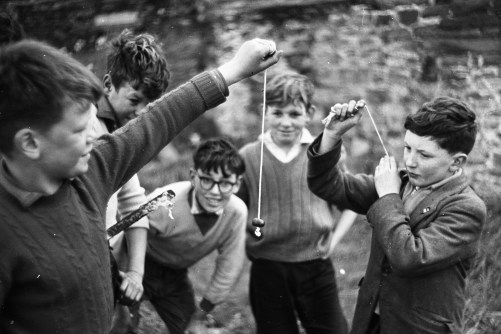
More than anything, though, conkers bring back happy memories from my childhood. I still distinctly remember during the breaks in the schoolyard fishing out my conker from my pocket and squaring off for conker duels with my friends. For those of my readers who are not familiar with this playground game, let me quickly explain how it works.
– Find a conker.
– Drill a hole through it with a nail.
– Thread a shoelace or other such string through the hole, and make a strong knot at the end.
– Face your opponent.
– One of you lets his conker dangle, let’s say your opponent.
– You swing your conker at his conker in a rather special way – see the photo below, which looks to have been taken during my boyhood years.

– If your opponent’s conker breaks, you win. If not, you dangle your conker and your opponent takes a swing at it.
And so on, until either one of the conkers breaks or the bell rings and it’s time to go back to those boring classes.

Conkers was, of course, a game of Autumn, played in the first month or so of the school term until the conkers stopped dropping off the trees and the conker supply dried up. Other games then took over the schoolyard until it was mid-September again and time to prepare that monster conker which would surely smash all other opponents in the schoolyard.

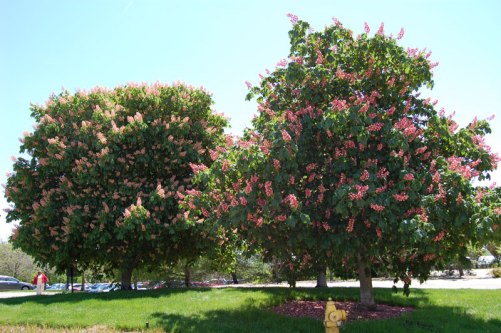
In case any of my readers are wondering, conkers come from the horse chestnut, that tree which gives lovely white or pink flowers in the Spring


and which in the last several decades have often looked distressingly mangy by summer time

the result of attack by the leaf miner moth. It seems that this disease was first noticed in Macedonia and has been marching across the globe ever since.

Perhaps, like I used to, some of my readers think that chestnut trees and horse chestnut trees are related. I mean, the nuts in both cases are so similar, as are their casings!

Yet they are not. They each belong to quite different families. I suppose this must be a case of convergent evolution.

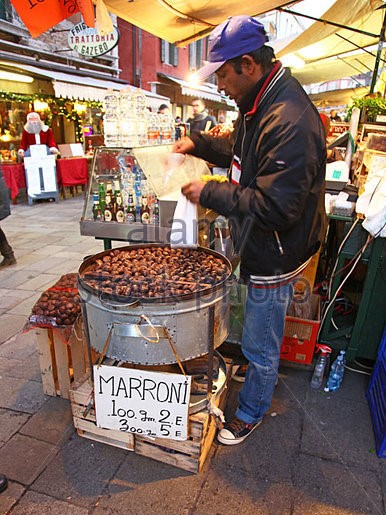
One thing which very definitely distinguishes them is that conkers are not edible, but chestnuts very much are. And in fact in this Autumn season, Milan’s shops and markets are putting out piles of chestnuts to entice you.

I haven’t yet seen chestnut roasters on street corners, though.

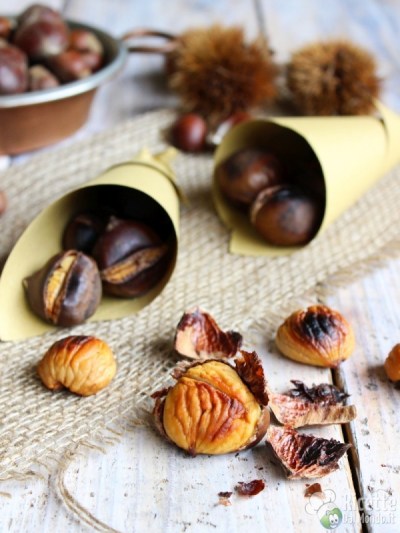
Maybe they only appear when the weather turns cooler. I await them with anticipation, so that I can buy my paper cone full of roasted chestnuts.

________________

Conkers: https://www.google.co.uk/amp/s/www.collinsdictionary.com/amp/english/conker
Conker seed case: https://www.google.co.uk/amp/www.dailymail.co.uk/sciencetech/article-3838298/amp/The-end-conker-Playground-staple-vanish-15-years-horse-chestnut-trees-felled-pests-disease.html
Playing conkers: https://www.google.co.uk/amp/s/www.pinterest.com/amp/pin/437834394994706958/
White horse chestnut tree in flower: http://www.davekilbeyphotography.co.uk/index.php/plants-landscapes/species-trees/horse-chestnut-05/
Pink horse chestnut in flower: https://ag.purdue.edu/btny/ppdl/Pages/POTW_old/6-10-13.html
Horse chestnut attacked by leaf miner: http://www.alamy.com/stock-photo-common-horse-chestnut-tree-damaged-by-the-leaf-miner-moth-cameraria-39467824.html
Chestnut and casing: http://tcpermaculture.blogspot.it/2012/09/permaculture-plants-chestnuts.html?m=1
Chestnuts in an Italian market: http://mercatidiroma.com/mercato-trionfale/trionfale
Chestnut roaster, Italy: http://www.alamy.com/stock-photo/chestnut-street.html
Cone of roast chestnuts: http://www.ricettedalmondo.it/caldarroste.html
PHILIBERT

Milan, 25 September 2017

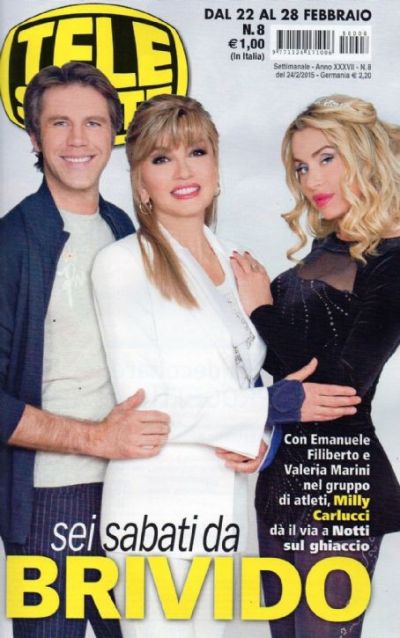
A few days ago, I was looking for a street on a map of Milan when my eye fell on a road called via Emanuele Filiberto. Now, readers need to know that my third (and last) given name is Philibert, the English – and French – equivalent of the Italian Filiberto. Readers also need to know that the current heir to the defunct Italian throne goes by the name of Emanuele Filiberto – he is the grandson of the last King of Italy, Umberto II, who was kicked out by the referendum of 1946. For the umpteenth time, I wondered why I shared a name with this twerp. Because he is a twerp. He’s the kind of guy who ends up on the cover of magazines you flip through while waiting for your appointment with the dentist.


(will you look at that stupid grin!) He has no obvious source of income. He has a vague career as a TV presenter, and has launched a food truck in LA selling pasta, all of this trading on his royal pretensions.

Finally, I decided to try and find an answer to my question: why do I share the same name with this twerp?

This quest took me up the family tree of the Kings of Italy, which quite quickly turns into the family tree of the Dukes of Savoy; it was the Dukes of Savoy who through the twists and turns of history eventually became the Kings of Italy. I thought perhaps that Filiberto was a family name and that I would find traces of it through the generations. But no. There hasn’t been a Filiberto in the family since Emanuele Filiberto, Duke of Savoy 1553-1580.

But that explains why my twerp carries the name that he does. This first Emanuele Filiberto – or more likely Emmanuel Philibert, for the family was more French than Italian at the time – towers above many of the Dukes of Savoy who came before and after him.

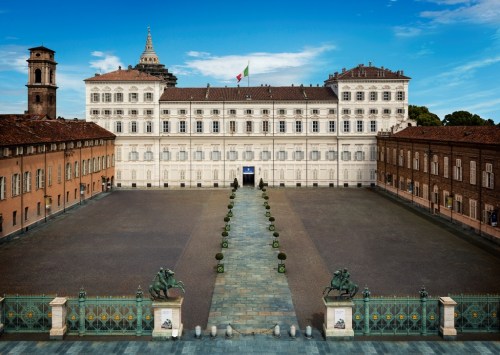
It was he who rescued the family from oblivion. His father Charles had lost all the Savoy lands both south and north of the Alps to the French king Francis I (with the Spanish helping themselves to a few pickings along the way). Refusing to accept the loss of his inheritance, Emmanuel Philibert went to work in the armies of Francis I’s enemy, the Holy Roman Emperor Charles V. He was a brilliant general, winning some key battles for Charles against the French, and earning for himself the sobriquet of Testa di Ferro, Ironhead. In gratitude, Charles V ensured that in the Peace of Cateau Cambrésis which was signed in 1559 Emmanuel Philibert got most of his lands back. It was a new lease of life for the Dukes of Savoy, although it only put off the inevitable loss of Savoy to the French, which finally occurred in 1860 during the reign of Napoleon III. Perhaps it was because he sensed that this would be the long-term outcome that Emmanuel Philibert moved the ducal capital from Chambéry in Savoy to Turin in Piedmont. This is the Royal Palace in Turin.

Obviously, the modern Emanuele Filiberto was so named by his equally twerpish father Vittorio Emanuele to bask in the reflected glory of their ancestor, and perhaps to signal that they would one day emulate his great feat and regain the crown of Italy. Fat chance of that.

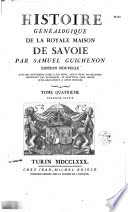
But of course this discovery simply reframed my original question: why do I then share a name with Emmanuel Philibert 10th Duke of Savoy? Here, I was helped by a book from 1778 helpfully scanned by Google and available on the internet: “Histoire Généalogique de la Royale Maison de Savoie”.

It’s essentially a hagiography of the House of Savoy, but it was very useful for my purposes. Under the entry on Emmanuel Philibert it has this to say about his two names: “Emmanuel Philibert was born in Chambéry on 8 July 1528. He was given the name Emmanuel in memory of Emmanuel King of Portugal, his maternal ancestor, and that of Philibert because of a vow made by Duke Charles his father to Saint Philibert in Tournus”.

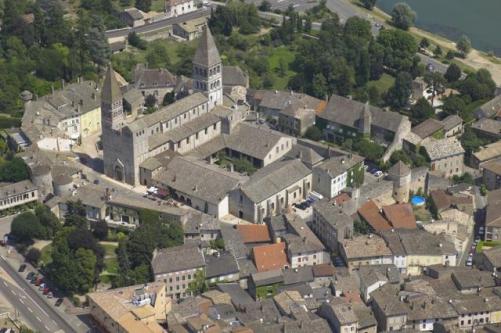
Ah! Now that was exceedingly interesting to read! To explain my excitement, I must now tell readers why I was given the name Philibert. Tournus is a small town – a very small town – in Burgundy on the river Saône, some 35 kilometers north of the somewhat larger town of Mâcon which my mother hailed from. It is famous – and indeed has been famous since the early Middle Ages – for its sanctuary to Saint Philibert. It is a glorious construction from the 11th Century and I would highly recommend my readers to visit it should they ever be in the area.


For reasons that are not clear to me, Saint Philibert is (or at least was) the saint to whom you prayed if you wanted a son. When my mother was pregnant with me, she already had three girls but only one boy. She therefore made a vow to her more-or-less local saint that if her next child was a boy she would give him the saint’s name. I was born and she honored her vow. It may just be a fancy but I suspect that Duke Charles made the same vow some time in the 1520s, especially since Tournus lay just across the river from his westernmost lands.

So there is indeed a link, however tenuous, between me and that twerp Emanuele Filiberto. Which is a pity, but there you are.

Readers might assume, since I have expended so much time on the matter, that I am proud to carry the name Philibert. I have to admit that this is not quite the case. It is, let’s face it, a bit of a silly name. When I was young, I kept it well hidden, only admitting to it when I really had to. Often, when I pronounced it, it would elicit a snicker from my listeners. I silently thank the Good Lord that my mother honored her vow but only by giving it to me as my third name. I shudder to think what my life would have been like if I had had to spend my boyhood years in the playground being called Philibert. I would probably have taken to alcohol or drugs or worse.

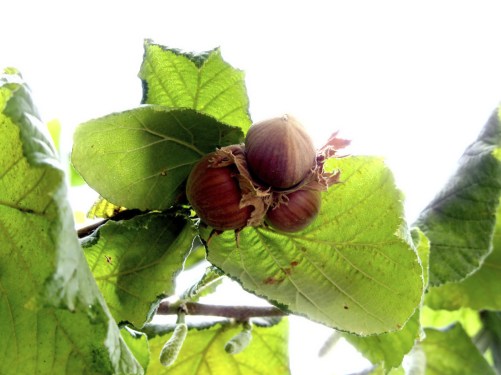
But let me finish on a more positive note. Saint Philibert’s feast day is 20th August, which happens to be peak harvest time for hazelnuts in England. So people began to call them filbert nuts, or filberts. I rather like the idea of having a connection with hazelnuts, an excellent nut which I enjoy in my morning muesli and from time time in pieces of chocolate. Better a connection with a nut than with a twerp.
___________________

Cover of Gente: http://olgopinions.blog.kataweb.it/tag/emanuele-filiberto-di-savoia/page/3/
Cover of Telesette: http://m.famousfix.com/post/valeria-marini-telesette-magazine-cover-italy-24-february-2015-51840502/p51840501?view=large
Emanuele Filiberto and his food truck: https://www.google.co.uk/amp/www.dailymail.co.uk/news/article-3690125/amp/The-prince-Italy-sells-pasta-food-truck-California-truffle-linguine-16-bowl.html
Emmanuel Philibert, Duc de Savoie: https://www.google.co.uk/amp/s/lordozner.tumblr.com/post/89144934533/frans-pourbus-the-elder-emmanuel-philibert-duke/amp
Royal Palace, Turin: http://www.turismotorino.org/mobile/
Histoire Généalogique etc. cover page: https://books.google.it/books/about/Histoire_généalogique_de_la_royale_mai.html?id=GPrH8yauF94C&redir_esc=y
Abbey church of Tournus, aerial view: http://www.tournus.fr/le-site-abbatial-de-saint-philibert
Abbey church of Tournus, interior: http://www.hotel-greuze.fr/test-a-vister
Hazelnuts: https://www.gardeningknowhow.com/edible/nut-trees/hazelnut/when-to-harvest-hazelnuts.htm

STORM CLOUDS OVER VENICE

Milan, 5 September 2017

We had come to Venice to celebrate the 65th birthday of two dear friends. They had invited a number of us from their past to share in this celebration. So there we were, some twenty in all, all slightly geriatric, stepping off the bus-boat onto the island of la Giudecca and gathering at a restaurant by the edge of the wide canal which separates this island from the rest of Venice.

As we sipped our aperitifs and later seated ourselves around two tables ranged along the edge of the canal, vast cumulo-nimbus clouds hovered to the north of us.

By the time we had finished the entrées (tris of raw fish, chopped fine, with sauces) and were tucking into the risotto cooked in a shellfish sauce, the sky had turned dark and menacing and the restaurant owner was worried that gusts of wind would carry his shade umbrellas away.


By the time we finished the main course (tuna seared briefly in the pan), the epicenter of the rain clouds sat above the campanile in St. Mark’s Square.

Once coffee was served, after a pannacotta for dessert, the clouds were dissipating and sunshine was breaking out again over Venice.

We said our goodbyes, promising, as has been the custom with these birthday parties, to meet again in five years’ time (and ignoring the little voice inside us emitting the hope that we would all still be of this world then), and went our separate ways. Ours took us through St. Mark’s Square, where the rain clouds to the west still looked menacing

but no rain fell on us as we threaded our way through the alleys back to our hotel.
__________________
Photos: all ours

WIENER SCHNITZEL vs COTOLETTA ALLA MILANESE

Vienna, 14 July 2017

As readers of my posts may know, since I retired last year my wife and I have pretty much divided our time between Vienna and Milan, having roots in both places. I therefore think it is time for me to wade into the Battle of the Wiener Schnitzel and the Cotoletta alla Milanese. As their names indicate, these delicious dishes are at home in Vienna and Milan, respectively. To get everyone’s juices flowing, I throw in here a photo of each: wiener schnitzel first

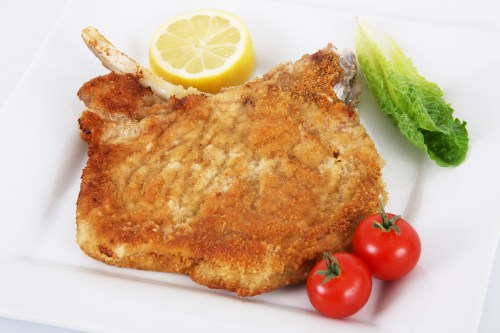
cotoletta alla milanese next.

For those of my readers who may not be conversant with one or both of these dishes, I should explain that both take a veal cutlet, dunk the veal in a beaten egg (sometimes preceded by a dunk in flour), cover it with a generous portion of breadcrumbs, and fry the result in butter (Milan) or lard (Vienna). They are for all intents and purposes the same dish, although the cognoscenti will insist on the differences: I have just mentioned the different frying medium, to which can be added: boned vs. deboned, Milan’s version still having the rib bone attached, while in Vienna’s version the bone has been detached; and as a consequence of this, different thicknesses, the Viennese version being pounded thin while the Milanese version, being still attached to the bone, is a few centimeters thick.

As I said, they are for all intents and purposes the same dish, and naturally enough the question has been raised if the chefs of one city did not at some point copy the chefs of the other. Well, let me tell you, much ink, and perhaps a little blood, has been spilled over this vital question: who copied who? Is the wiener schnitzel the son of the cotoletta alla milanese, or on the contrary did the wiener schnitzel sire the cotoletta alla milanese? Readers who think that this is an interesting academic question but surely hardly one over which to draw the kitchen knives don’t know the history of this little corner of the world. Allow me to give them a thumbnail sketch.

From 1525 to 1860, with the exception of some decades during the French Revolution and the Napoleonic Empire that followed, Milan, along with much of northern Italy, was ruled by the Hapsburgs, first the Spanish branch of the family and then, from 1706 onwards, the Austrian branch. And so, by an accident of history, the Austrian was the Enemy when the Milanese, along with many other northern Italians, rallied behind the cause of Italian unification in the first decades of the 19th Century. Things first boiled over in 1848. Every Milanese, my wife included, will tell you of Le Cinque Giornate, the glorious five days in March of that year when the Milanese rose up and drove the Austrian Governor, Field Marshal Radetzky (he of Johan Strauss’s Radetzky March), and his troops out of Milan.

Alas! A few months later, Radetsky defeated the troops of the Piedmontese King of Sardinia, who had eagerly stepped forward to help his Lombard brothers (with the idea, of course, of incorporating Lombardy into his kingdom), and regained control of Milan and Austria’s other northern Italian territories. Not surprisingly, Radetzky is not seen with a terribly favourable eye in Milan.

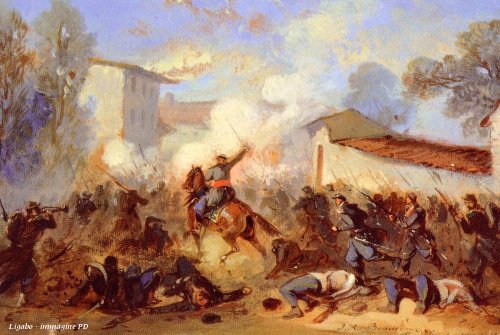
Northern Italy was forced to remain under the yolk of the Austro-Hungarian Empire for another 11 years. In the meantime, Count Cavour, Prime Minister of the Piedmontese kingdom, had cut a deal with Napoleon III, which led to a Franco-Piedmontese war against the Austrians in 1859. The Austrians were beaten at the extremely bloody Battle of Solferino (it was his witnessing of the battle that caused the Swiss Henry Dunant to found the Red Cross).

After the battle, Lombardy was incorporated into the Kingdom of Sardinia, soon to be renamed the Kingdom of Italy.

I will skip the rest of the struggle against Austria, which only really concluded at the end of World War I with the cession of Trento and Alto Adige to the kingdom of Italy after the collapse of the Austro-Hungarian Empire in 1918.

I think my potted history of Italian unification – at least its northern ramifications – will suffice to explain the sensitivities (especially in Milan, I have to say) about the relationship between the wiener schnitzel and the cotoletta alla milanese. I mean, just imagine how the Indians would feel if, for instance, someone claimed that chicken masala was actually a copy of a British dish: a dish of the ex-colonialist! The sensitivities are such that in the late 1960s a Sicilian who had emigrated to Milan and had become more Milanese than the natives published a completely fabricated story about how Radetzky, in the middle of a report to the Imperial Court about the military situation in northern Italy, had started rhapsodizing about a wonderful veal dish he had been introduced to in Milan. This piqued the Emperor’s attention, and when Radetzky next came back to Vienna to report, the Emperor packed him off to the Imperial kitchens to give the chef the recipe. Thus was born the wiener schnitzel, our Sicilian claimed, sired by the cotoletta alla milanese.

For many years, the story that Radetzky brought the cotoletta alla milanese to Vienna was widely believed, on both sides of the debate, but it has now been debunked. I won’t go into the details, suffice to say that our Sicilian’s story was a tissue of lies from one end to the other. But then this has meant that the question of which of the two dishes came first reared its ugly head again and sent food historians scrambling to do more research.

A face-saving solution seemed to have been found in the form of a French cookery book from 1749, “La Science du Maître d’Hôtel Cuisinier”.

It was pointed out that the book contained a recipe where a veal cutlet was dipped in a beaten egg, covered in bread crumbs, and fried. Surely this meant that the French had invented the dish? That was alright, after all French cuisine is the mother of all cuisines and to be descended from a French dish is an honour. After which, various theories were put forward to explain how this French dish arrived both in Milan and in Vienna.

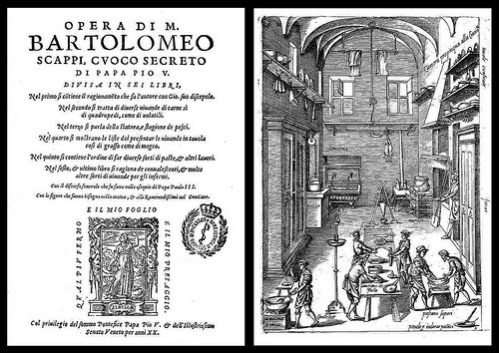
However, other – Italian – food historians have pointed out that the technique of breading and frying meat was already in use in Italy in the 16th-17th Centuries, as evidenced in the cookery book published in 1570 by Bartolomeo Scappi, noted chef to Cardinals and Popes.

The same technique is to be found in the cookery book published by the Bolognese Vincenzo Tanara in 1653.

Both cookery books give this technique as a way of using up various cuts of meat.

These food historians have gone one step further. Tanara lived all his life in Bologna and Scappi spent many years there as a cook to a Bolognese cardinal. They therefore suggest that the ancestor of the cotoletta alla milanese (and maybe by some tortuous path the wiener schnitzel) is none other than … the cotoletta alla bolognese! For those readers who, like me, had never heard of this dish before today, I can quickly report that it is a veal cutlet prepared just like a cotoletta alla milanese or a wiener schnitzel but on which slices of raw cured ham have been placed, followed by flakes of Parmesan cheese, the whole then being placed in the oven and heated until the Parmesan has melted (aficionados pop a shaving of truffle on the top at the end). This is what it looks like.

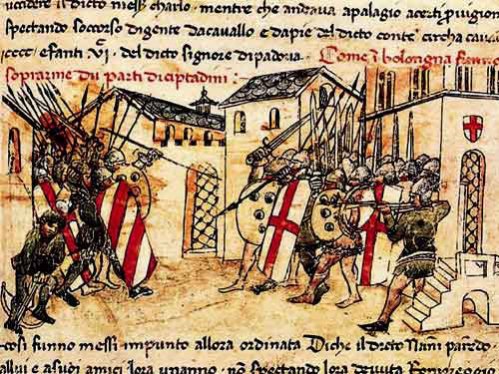
Well! Here, we will plunge into an even earlier period of the Italian peninsula’s history, when the city-states were all quarreling and fighting with each other,

a competitiveness which lingers on in Italy’s football championship; here we have Inter Milan against Bologna last year (Inter Milan won 2-1).

Will the Milanese ever be able to accept that they received anything good from Bologna? I’ve asked my wife about the cotoletta alla bolognese and she says she’s never heard of it, even though she lived a year in Bologna during her student days and the dish is reported as being a very important, very ancient Bolognese dish.

This does not bode well for how this theory will be greeted as it percolates down from the small clique of food historians to the general Milanese public. Already other food historians claim to have found evidence that a predecessor of the cotoletta alla milanese already existed in Milan in the 12th Century. There is a Milanese document which lists in macaronic Latin the dishes eaten by the cannons of the Basilica of Sant’Ambrogio in 1148. One of these dishes is “lombolos cum panitio”. No-one seems to have a problem with the word lombolos, which all agree is a cut of meat. The problem is with “cum panitio”. The more optimistic interpreters think it means breaded, and on the basis of this interpretation Milan’s city fathers passed a city decree a few years ago giving the cotoletta alla milanese a denomination of local origin. The more skeptical interpreters shrug their shoulders and say “cum panitio” could mean any one of a series of bread-based foodstuffs which were simply accompanying the lombolos.

The arguments will no doubt rage on. My personal take, for what it’s worth, is that the technique of breading a piece of meat could well have been invented in many places independently. Why couldn’t cooks in different places and at different times have figured out that bread crumbs will attach to a piece of meat when it’s been dipped in beaten egg and that the breaded meat can then be fried? I mean, we’re not talking rocket science here. But hey, who am I? Just a guy who enjoys eating wiener schnitzel and cotoletta alla milanese from time to time. What do I know about anything?

_________________

Wiener Schnitzel: http://wanderlusttips.com/2015/11/03/nhung-dac-san-khong-bo-qua-tren-khap-gioi/
Cotoletta alla Milanese: http://mangiarebuono.it/la-cotoletta-o-costoletta-alla-milanese/
Cinque Giornate: http://duomo24.it/2018/03/18/le-cinque-giornate-di-milano/
Battle of Solferino: http://www.experiences-plus.it/extra/extra_risorgimento_3.htm
Science du Maître d’Hôtel Cuisinier: https://nouveauservice.wordpress.com/category/recherche/
Opera di Bartolomeo Scappi: http://bibliodyssey.blogspot.co.at/2009/03/renaissance-kitchen.html?m=1
Vincenzo Tanara, L’economia del Cittadino I Villa: https://www.maremagnum.com/libri-antichi/l-economia-del-cittadino-in-villa-del-signor-vincenzo-tanara/105032152
Cotoletta bolognese: https://www.google.co.uk/amp/ricette.donnamoderna.com/cotolette-alla-bolognese%3Famp%3Dtrue
Battle between Italian city states: http://www.medievalists.net/2008/11/the-rise-and-decline-of-italian-city-states/
Inter Milan-Bologna, 2016: http://www.ilrestodelcarlino.it/bologna/sport/calcio/inter-bologna-2016-diretta-1.1970445

FOSSILS IN THE STAIRS

Vienna, 29 June 2017

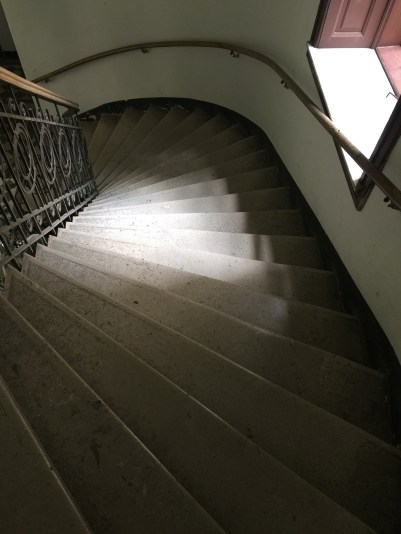
A few days ago, just as my wife and I were setting out from the apartment, it started to rain. It was my wife who had decreed that it wouldn’t rain, but it was I who went back to get the umbrellas. As readers can imagine, I was a little grumpy as I ascended the stairs, glaring at the individual steps. Perhaps it was my acute attention of the steps, perhaps it was the light; whatever it was, I suddenly noticed in the sixth step from last, which had been worn smooth by countless feet treading on it, something which I had never noticed before on my walks up and down those stairs: a fossil.

At first sight it looked like a leaf, but I now think it could be a coral of some sort. I walked up and down all six flights of stairs in our building looking intently at each step,

and I now see what I had never really noticed before, that the limestone used for them is made up of a mass of shells and other marine remains, fallen randomly on top of each other and then squeezed tight by the monstrous weight of later rocks above them.

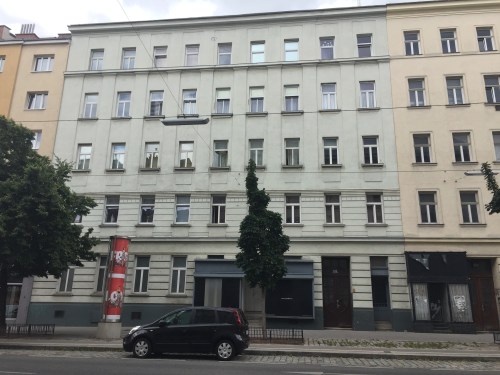
As we discovered when we bought the apartment and picked through the Land Register, our building was constructed at the turn of the century. It was, and has remained, a modest building – no Belvedere Palace for us

just a modest lower middle-class building, one of many outside Vienna’s swank 1st District.

Consequently, even at a time when long-distance travel had been made a thousand times easier by the booming rail system and nascent road system, I would imagine that the stone for our steps came from a local quarry. Which is more than possible, there being quite a number of old limestone quarries around Vienna, a number of which – I have been breathlessly informed by an Austrian fossil-hunter website – are good sources of marine fossils.

An Austrian map of the country’s geology informs me – if my rudimentary German is correct – that the rock formations in question are Late Tertiary.

Specifically, according to a mind-numbing report prepared for the 26th International Geological Congress which I leafed through electronically, they belong to the Neogene beds in the Vienna basin; these were laid down some some 10-15 million years ago, between the Upper Eggenburgian and Lower Badenian stages of the Middle Miocene epoch, as a result of at least two marine incursions into the Vienna basin.

Setting aside all the arcane – and, frankly, incomprehensible – scientific mumbo-jumbo with which this report is filled, we can happily conclude that the jumbled marine fossils locked forever more into the steps of our building’s stairway are the result of the area around Vienna twice being a sea. It must have been a nice warm sea too, since corals flourished in its waters. In fact, this map of mid-Miocene Europe shows that much of Central Europe was under water during this Epoch, this being the far western end of the wonderfully-named Tethys Sea.

In cases like these, I am always taken by a sense of wonder. Here I am, living on the edges of a rich agricultural plain 350 kilometers from the nearest sea.

Yet once upon a time there was sea all around me, probably quite like the sea which my wife and I snorkeled over a year ago in Thailand, with coral outcrops, starfish and sea urchins clinging to their rocks, crabs scuttling along the sea floor, fish flashing in and out of the coral, and from time to time the passing shadow of a shark.

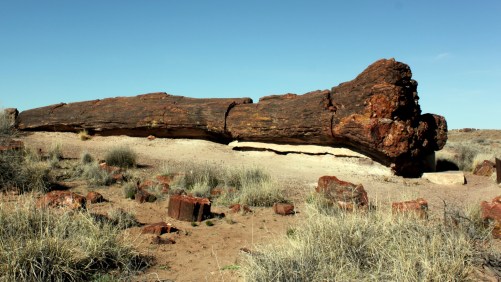
That same sense of wonder came over me many years ago, when we visited Arizona’s Petrified Forest National Park. The park sits in the middle of a harsh, dry, desert region.

Yet all around us lay the petrified remains of a once mighty forest.


Artists imagine that these 200 million year-old forests looked something like this.

All that teaming life in this now almost dead environment …

It was more with a sense of fascinated horror than awe that I first gazed on the “fossils” (mummies is perhaps the better term) of people and animals dug up at Pompeii.


They were overtaken, submerged, in the 1000°C-hot pyroclastic flow that swept down the sides of Mt. Vesuvius and howled through the city at 700 km/hr.

What a terrible, terrible death! But perhaps it was a mercifully quick death, with them being flash-cooked, basically.

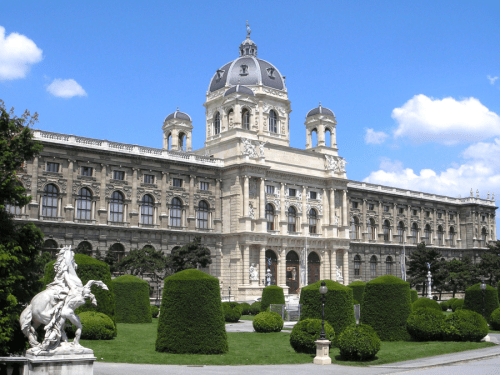
Hmm, I didn’t want to finish on this rather depressing note. But hey, that’s life! In the meantime, I need to escogitate a plan to persuade my wife join me on a visit to Vienna’s Natural Science Museum (sheathed in a very nice stone, I should add) so that I can study the area’s geology better.

_______________

Our building’s steps: our photos
Belvedere Palace: http://www.austriawanderer.com/the-belvedere-palace-in-vienna/
Our apartment building: our photo
Geological map of Europe: http://www.gifex.com/detail-en/2011-06-29-13972/Geological-map-of-Austria.html
Miocene Europe: http://www.dandebat.dk/eng-klima4.htm
Vienna plain: http://www.donau.com/de/roemerland-carnuntum-marchfeld/detail/marktgemeinde-goetzendorf-an-der-leitha/c53b2a6b0c75fed4d809b78b888830d9/
Tropical sea: https://fineartamerica.com/featured/coral-reef-in-thailand-louise-murray-and-photo-researchers.html
Petrified Forest NP: http://kids.nationalgeographic.com/explore/nature/petrifiedforest/#petrified-forest-hills.jpg
Petrified tree-1: http://www.alamy.com/stock-photo/petrified-forest-national-park-arizona.html
Petrified tree-2: http://www.van-tramp.com/wp/petrified-forest-national-park-revisit/
Forest 100 million years ago: https://jerry-coleby-williams.net/2015/02/15/bunya-prehistoric-plant-ancient-australian-food-tradition/araucaroid-forest-ca-100-million-years-ago/
Pompeii mummies-1: https://www.google.co.uk/amp/s/www.pinterest.com/amp/pin/535224736949021987/
Pompeii mummies-2: http://hesed.info/blog/pompeii-lava-statues.abp
Pompeii mummies-3: https://forums.arrowheads.com/forum/general-discussion-gc5/fossils-paleontology-old-bones-gc30/25828-reposting-pam-s-odd-rock-fossil-2nd-opinion
Pompeii and Mt Vesuvius: https://it.pinterest.com/agcinnamongirl/pompeii-italy/
Natural History Museum, Vienna: https://ictca2017.conf.tuwien.ac.at/index.php/natural-history-museum-vienna

IN THE MOUNTAINS

Sori, 24 April 2017

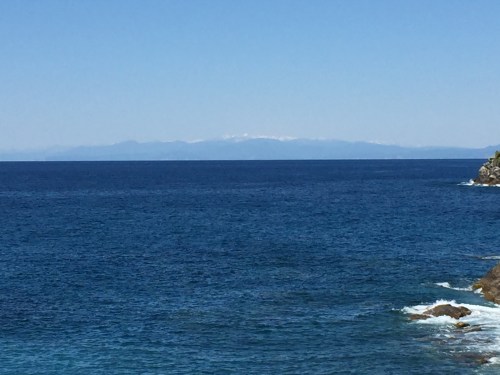
The north wind had blown hard all night, and by morning the air over the sea, the village, and the hills behind it was crystal clear. After our morning coffee, we decided to take the path along the sea cliffs which brings one to the village graveyard. Along the way, we stopped for a moment at the memorial to those villagers who have died at sea.

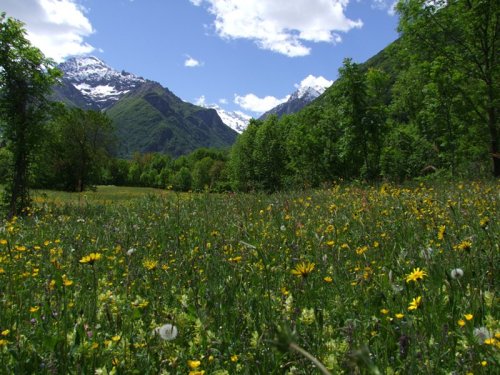
With the air so clear, though, I soon forgot the dead and let my gaze be drawn by the snow-capped mountains hovering far away on the horizon: Mounts Gelàs and Argentera, along with their acolyte peaks, in the the Maritime Alps, today enveloped in the National Park of the Alpi Marittime.

Oh, that I could skim across that lapis lazuli sea!

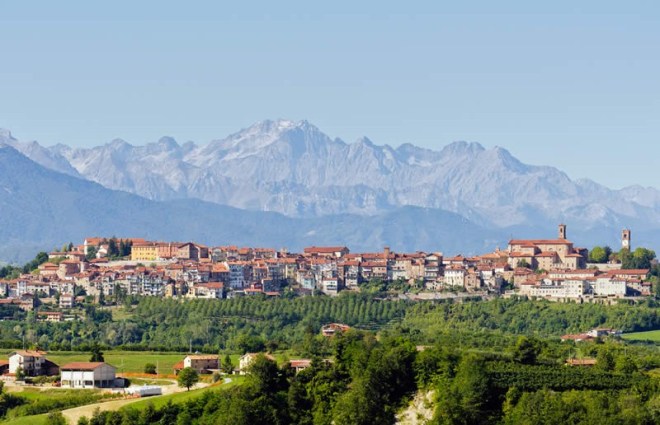
Soar over Spotorno on the opposite shore of the Gulf, waiting patiently for its summer bathers, up over the hills behind it.

Over Mondovì, racing for the mountains beckoning to me behind it.

To finally alight, high up in the park, there to enjoy all its delights.


One day we’ll go there, I tell my wife, one day – although no doubt by a more normal mode of transportation.

_____________

Pics of the memorial and the mountains behind it: ours
Flying over the sea: https://www.google.co.uk/amp/s/amp.dailytelegraph.com.au/newslocal/northern-beaches/superman-surfer-gets-birdseye-view-to-sea/news-story/90862b1d51f14ff9887116c7a5768088
Spotorno: http://www.comune.spotorno.gov.it/1822/galleriafotografica/24-06-2007-la-spiaggia-di-spotorno/
Mondovì: https://www.italiadascoprire.net/piemonte/provincia-di-cuneo/mondovi/mondovi.html
Parco alpi marittime-1: http://thetourismcompany.com/casestudy.asp?serviceid=2&projectid=921
Parco alpi marittime-2: http://www.parks.it/parco.alpi.marittime/gallery_dettaglio.php?id=17863
Parco alpi marittime-3: http://www.parks.it/parco.alpi.marittime/gallery_dettaglio.php?id=14489
Parco alpi marittime-4: http://www.parks.it/parco.alpi.marittime/gallery_dettaglio.php?id=7856
Parco alpi marittime-5: http://www.parks.it/parco.alpi.marittime/gallery_dettaglio.php?id=13402
Parco alpi marittime-6: http://www.parks.it/parco.alpi.marittime/gallery_dettaglio.php?id=9385

FRANKINCENSE AND MYRRH

Milan, 19 April 2017

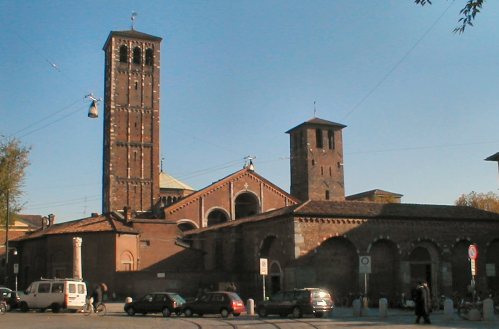
Some forty years ago, when my wife and I were just beginning our journey together through life, I came down to Milan to spend Easter with her. At her mother’s suggestion, we went to a late-night service in the nearby basilica of Sant’Ambrogio.


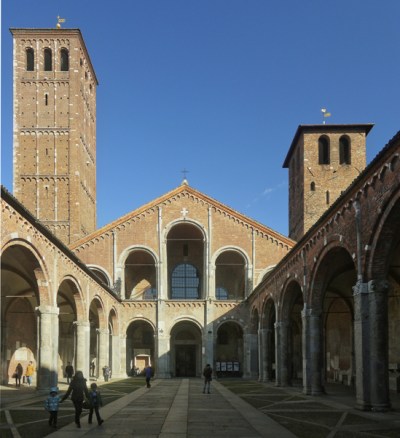
It was either on Good Friday night or Easter Saturday night (my memory is clouded on this detail). Either way, at the end of the ceremony we all trooped out into the church’s atrium.

There, the presiding bishop put a light to a nice big bonfire which had been laid down earlier, and intoned loudly several times “Christus Resurrexit!”, “Christ is Resurrected!”. Now, since the resurrection of Christ is the central tenet of Christianity – without it, there would be no Christianity – you would think that the bishop would have shouted out this message with joy and gladness, or at least with a mild level of satisfaction. Not a bit of it! The fellow intoned it so mournfully as to make you wonder if he was sorry that the resurrection had ever taken place at all. Or maybe he enjoyed Lent a lot, fasting and praying and beating his breast, and was sorry that it was all over for another year. Or perhaps his hemorrhoids were acting up. Whatever the reason, the three of us agreed afterwards that the Bish had been a douche-bag, resurrection-wise.

Ever since that ceremony long ago, it has been in the back of my mind to attend it again, if only to see if succeeding bishops were a bit more joyful about it all. But as the Italians say, fra il dire e il fare c’è di mezzo il mare, between the saying and the doing lies the sea (it sounds better in Italian, if only because it rhymes). This year I thought the time was finally ripe, but alas! either the ceremony was on Good Friday night, when we had just arrived back from Los Angeles and were in no fit state to take part in anything, or some boringly politically correct entity like the City of Milan Health & Safety Services had decided in the intervening years that open bonfires in church atria were a no-no. Whatever it was, the bottom line was that there was no ceremony on Easter Saturday.

My wife decreed that nevertheless we should at least step into Sant’Ambrogio on Easter Sunday – something to do with a sort of atavistic belief that this would be a good day and place to receive a dose of sympathetic magic – and I grouchily agreed. So some time in the afternoon of Easter Sunday we made our way to the church, weaving our way through the few Milanese left in the city who were going for their Sunday stroll. We walked through the atrium where there should have been the bonfire, and we entered the church.

Ahh! My nose was immediately greeted by the smell of incense which had been burned in earlier ceremonies, and I was transported back to my youth. I saw the boy that was me inhaling that fragrance, pungent but with sweet overtones, watching the smoke curling towards the ceiling, and generally enjoying one of the few bright spots during those weekly masses which I had to endure.

I also thought that swinging that thingy (which I later learned was called a thurible) from which all that thick smoke poured out was pretty cool.

In my teenage years, when I was finally considered responsible enough, I got to serve in High Masses as an altar boy and to swing the thurible (the idea being to pass air over the incense to keep it burning). Luckily, I never got into trouble as Edward Norton did in the film “Keeping the Faith”. Readers may remember the scene where as a young priest just starting out he gets to swing the thurible, which he does with such enthusiasm that he sets his robes alight and has to jump into the font of holy water to douse the flames.

A quick search of my favourite source of information – Wikipedia – informs me that the incense used in the Roman Catholic rites of my youth contains a varying mix of frankincense, myrrh, gum benjamin, copal, and a few other odds and ends.

Frankincense and myrrh …

The Three Wise Men
We three kings of Orient are;
Bearing gifts we traverse afar,
Field and fountain, moor and mountain,
Following yonder star.

Gaspard
Born a King on Bethlehem’s plain
Gold I bring to crown Him again,
King forever, ceasing never,
Over us all to reign.

Melchior
Frankincense to offer have I;
Incense owns a Deity nigh;
Prayer and praising, voices raising,
Worshiping God on high.

Balthazar
Myrrh is mine, its bitter perfume
Breathes a life of gathering gloom;
Sorrowing, sighing, bleeding, dying,
Sealed in the stone cold tomb.

The Three Wise Men
Glorious now behold Him arise;
King and God and sacrifice;
Heav’n sings Hallelujah:
Hallelujah the earth replies.
(I have cut the refrains)

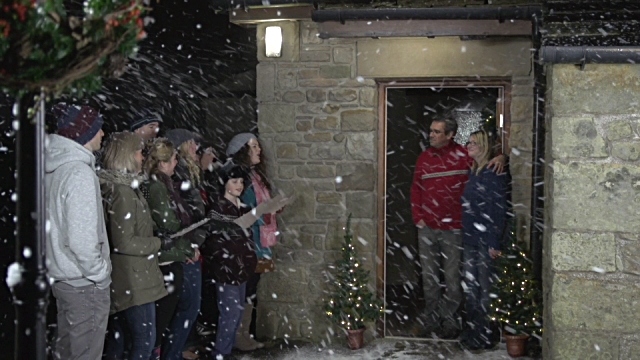
That conjures up another image of my childhood, me in the school choir at primary school, doing the rounds of houses in the neighborhood, our choir master ringing the doorbell, and us launching into this and other Christmas carols when the occupants opened.

At the end of it all, we trooped over to the choir master’s house where his wife had prepared a buffet supper for us all, and where we got to taste just a little bit of the choir master’s home brew … Good times, those were.

Frankincense and myrrh …

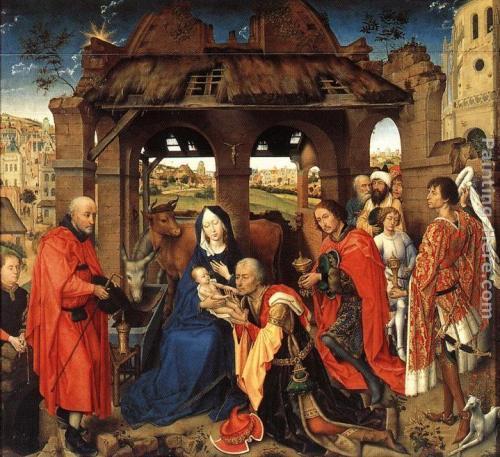
The gifts, along with gold, that those three wise men with such mysterious names – Balthazar, Caspar, and Melchior – are proffering to the child Jesus in those countless paintings of the Adoration of the Magi produced in centuries past.

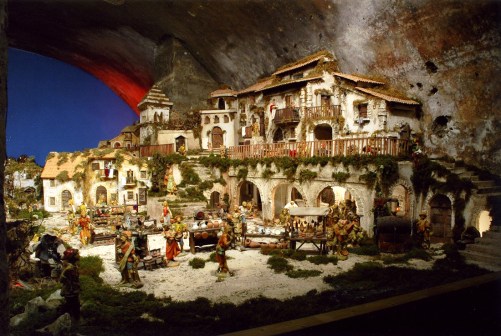
They are also players in the crèches which appear every year at Christmastime in Italian churches, ranging from the simple

to the very elaborate.

As young children we prepared one at home under the overall theological supervision of our mother – the latter meaning that we were allowed to place in the background other figurines in our possession, such as cowboys and Indians or various animals, but not in such quantities as to crowd out the essential Christian message. The three wise men on their camels were placed far away from the manger in which Baby Jesus lay, and then every day after Christmas we children brought them a little closer, to end up at the manger on 6 January, the Day of the Epiphany.

It all looked all so easy to us, but T.S. Eliot, in his poem The Journey of the Magi suggests otherwise (I quote the first twenty lines or so).

A cold coming we had of it,
Just the worst time of the year
For a journey, and such a long journey:
The ways deep and the weather sharp,
The very dead of winter.’
And the camels galled, sorefooted, refractory,
Lying down in the melting snow.
There were times we regretted
The summer palaces on slopes, the terraces,
And the silken girls bringing sherbet.
Then the camel men cursing and grumbling
and running away, and wanting their liquor and women,
And the night-fires going out, and the lack of shelters,
And the cities hostile and the towns unfriendly
And the villages dirty and charging high prices:
A hard time we had of it.
At the end we preferred to travel all night,
Sleeping in snatches,
With the voices singing in our ears, saying
That this was all folly.

Frankincense and myrrh …

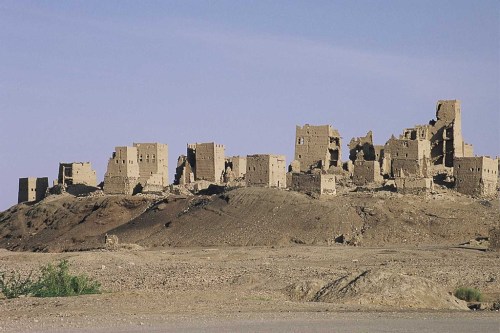
So desired throughout the Middle East and the broader Mediterranean world that its production centuries ago brought untold wealth to the Yemeni tribes which controlled the resin-bearing trees, allowing them to build cities like Shabwa, Marib, Baraqish.

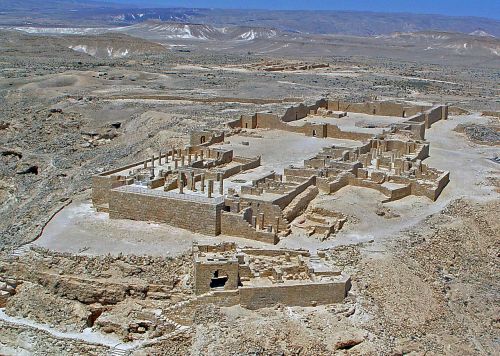
They also brought untold riches to the tribes which controlled access to the incense route. This snaked its way up the western side of the Arabian peninsula, skirting the Empty Quarter and the Nafud desert, and culminating in Gaza. The wealth generated by the trade built cities like Avdat in the Negev

and helped build Petra in Jordan.

One day, if they stop hating and killing each other in this part of the world, my wife and I will go and visit the groves of frankincense trees.

And we will travel the incense route, preferably on a camel.

____________________

Sant’Ambrogio: http://www.itmap.it/milano/basilica-di-santambrogio/
Atrium of Sant’Ambrogio: http://muse-garret.cocolog-nifty.com/blog/2018/04/index.html
Incense smoke in church: https://www.pinterest.ph/pin/321233385899973661/
Swinging thurible: http://www.diariodejerez.es/semanasanta/Lunes-Santo-Jerez_3_575672440.html
Christmas carolling: https://www.gettyimages.de/video/choir?sort=mostpopular&offlinecontent=include&phrase=choir
Adoration of the Magi: http://en.artsdot.com/@@/8BWV5K-Rogier-Van-Der-Weyden-Adoration-of-the-Magi
Simple creche: https://ask.fm/matteotesselli99_
Elaborate creche: https://collinadeiciliegi.wordpress.com/2016/12/23/er-presepe/
Ruins of Baraqish: https://en.wikipedia.org/wiki/Baraqish
Ruins of Avdat: http://weekend.knack.be/lifestyle/reizen/israel-restaureert-antieke-stad-avdat/diaporama-normal-450517.html
Ruins of Petra: https://magdalatravel.com/detalles.php?id=82
Frankincense trees: http://holistictoolbox.co.nz/product/frankincense-boswellia-rivae-organic/
Camel riding: http://thesandysnowman.com/5-lessons-life-travel/

WATT’S TOWERS

Los Angeles, 8 April 2017

There is a town on the slopes of Mt. Vesuvius that goes by the name of Nola. Although very ancient, nothing much of great historical significance has ever happened there. It did play host to three battles between Hannibal and the Romans, there was another battle of some regional significance in the Middle Ages, and that’s about it. Naples, which like all big cities has been growing outwards over the last 100 years, has finally engulfed it so that Nola is now really no more than a suburb of Naples. Sadly, Nola’s main claim to fame nowadays is that of being a hotspot of Camorra activity. On the brighter side, it is also the host to the Festa dei Gigli, the Festival of the Lilies, which, together with several similar festivals in other parts of Italy, has been listed by UNESCO as an Intangible World Heritage.

The roots of Nola’s Festival of the Lilies are very ancient, going back all the way to the 800s AD. It celebrates an even earlier moment in the city’s history, back in the 400s AD. Pope Gregory the Great, no less, relates the story. A poor widow begged the bishop of the city, Paulinus, to help her get back her only son, who had been carried off by the Vandals to North Africa after one of their frequent raids on Campania. But Paulinus had already used up his considerable fortune ransoming other Nolans enslaved by the Vandals. So the saintly bishop sailed off to North Africa and offered to take the place of the widow’s son, an offer the Vandals accepted. Some time later, the king of the Vandals discovered that this slave was the great Bishop of Nola. He at once set him free, granting him also the freedom of all the other captive Nolans which the Vandals still held. When Paulinus sailed back to Campania, the joyful citizens of Nola escorted him to his residence holding lilies.

The citizens of Nola reenact the last part of this delightful, if rather unbelievable, story every year in their Festival of the Lilies, on Paulinus’s feast day in June. They organize a lavish procession which draws thousands of people, once pious (or perhaps credulous) locals but now mostly just curious tourists. When the festival was born 1200 years ago, each person in the procession carried an actual lily. The sixth century mosaic in Sant’Apollinare in Ravenna of the procession of virgins can stand in here for this event, even though the plants in the background are date palms rather than lilies.

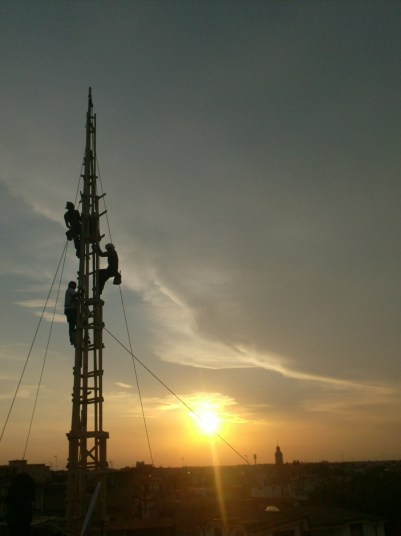
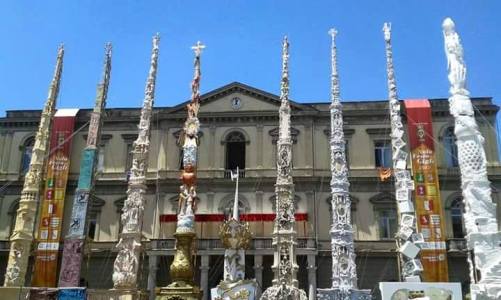
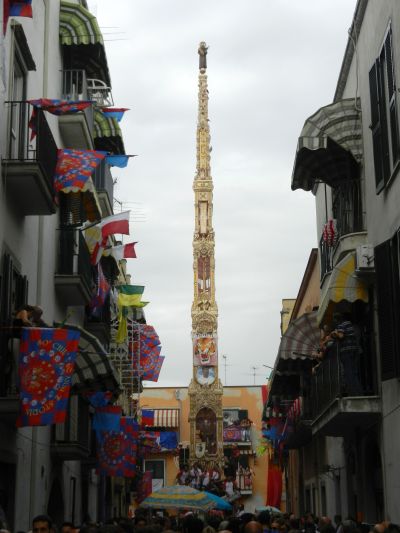
Over the centuries, however, those many long-stemmed lilies morphed into eight thin, very tall (25-meter tall) pyramids, each carried by a team of men. These towers are rebuilt every year. The structure’s wooden skeleton is first assembled

and then elaborate decorations are applied to one side of the pyramid.

A ninth team carries an effigy of the boat which brought Paulinus back to Nola.

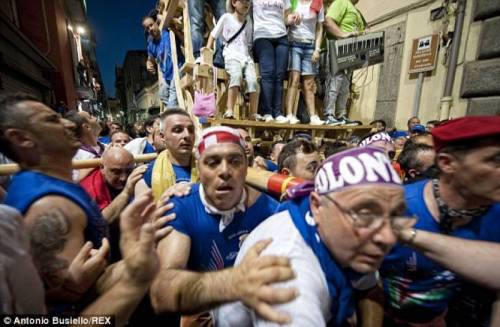
The teams carry their “lilies” and the boat through Nola, with them swaying and undulating as the teams navigate the city’s narrow streets.


Once the lilies and the boat have been brought into the piazza fronting the cathedral, they are ranged along the sides of the piazza.

The bishop, successor of Paulinus, then blesses the assembled crowds.

Now I must rewind my story more than a century. Some time in the early 1890s (as near as I can guess), a young boy called Sabato Rodia must have witnessed the Festival. He was born in 1879 in Ribottoli, a small village some 40 kilometers east of Nola. What he saw burnt itself into his mind and stayed with him all his life. The romantic in me wants to believe that he witnessed the Festival on his way down to the port of Naples: at the age of 15, his parents packed him off, unaccompanied, to America. He joined his elder brother, who had already emigrated and who was working in the coal mines of Pennsylvania. Tragedy struck when his brother was killed in a mining accident. Sabato, who had anglicized his name on entering the States to Sam, moved out to Seattle, entered the construction business, married and had three children. In 1905, when Sam was 26, he moved himself and his family to Oakland in California. Things were looking good for him, but unfortunately something went wrong inside him. He began drinking too much, lost his job, and I suspect beat his wife, or children, or both. Whatever the case, in 1912 his wife took the children and left him, and he never saw any of them again. Luckily, Sam managed to get off the bottle and to start working again, still in the construction industry but this time as an itinerant tile setter.

All the while, something was gnawing away at him. As he told an interviewer many years later, “I had in my mind I’m gonna do somethin’, somethin’ big”. Finally, in 1921, when he was 42, he bought a small plot of land, sandwiched between the railway tracks and the tram lines, in the working-class neighbourhood of Watts in Los Angeles. He lived in the plot’s small house, while in the narrow, triangular backyard he started to recreate his own very personal take on his vivid memories of Nola’s Festival of the Lilies.

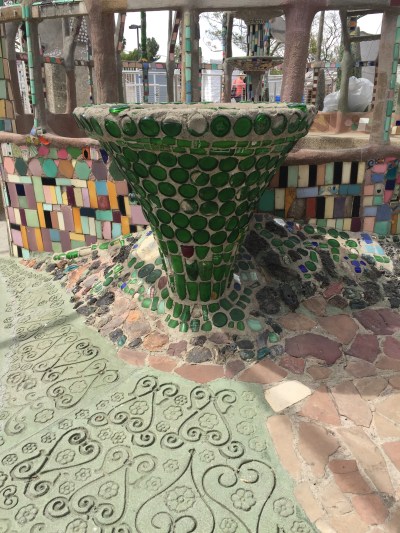
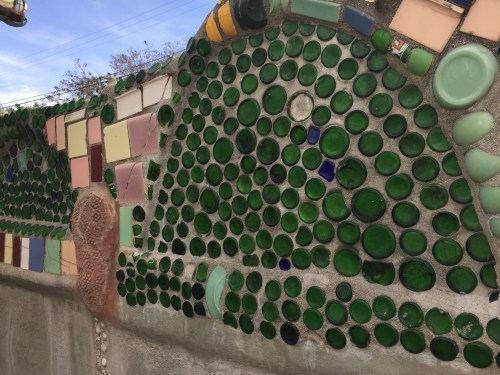
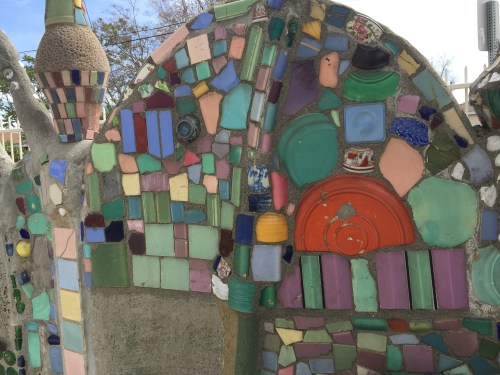
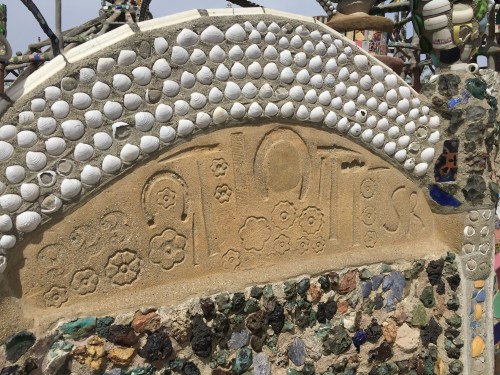
For the next 34 years, until he was 76 years old, Sam dedicated all his spare time to his project, working alone since he had no money to hire help and using nothing but the most elementary tools of the construction trade. He built in reinforced concrete, a medium he was familiar with after all his years in the construction business but also because he wanted his dream to last. Like a magpie, he picked up colorful objects wherever he came across them – broken bottles of green but also blue and brown glass, broken tiles from his tiling business, sea shells which he picked up on the nearby beaches, colored stones – and he embedded them in the wet concrete for decoration. He was happy to be squeezed in between tram and rail tracks since the passengers would be able to enjoy views of his growing creation as they passed.

Recreating Nola’s cathedral piazza in his cramped backyard, Sam built the framework of three Lilies, with an airy interconnection between the tallest.


In the site’s narrow apex, he placed the boat which brought the bishop back from the Vandals.

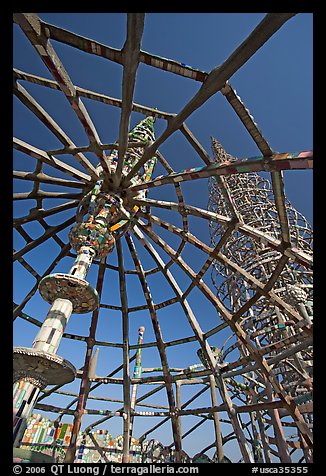
On the other side, he built his vision of Nola’s cathedral as an airy gazebo.


Outside of it, he placed the font from which the bishop of Nola would bless the procession.

All around the site, he built a wall, decorated inside and out with his colorful finds.

Like all artists, he proudly signed his work, in his case with an SR

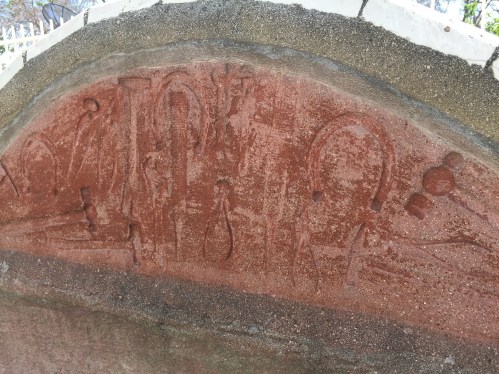
and, almost like a Medieval guild member, he showed off his tools of construction.

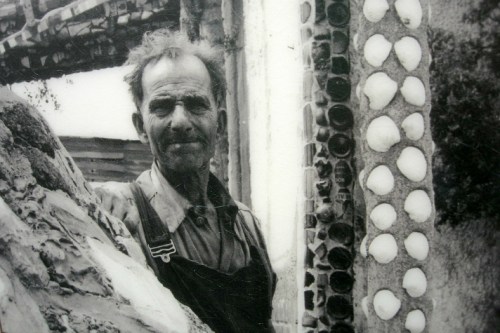
The local community must have found Sam odd, eccentric, somewhat mad, perhaps touched by God. Certainly, in a gesture of respect, the local Central American community called him Don Simon, which led to his last change of name, to Simon Rodia. In its final years, his project caught the attention of Los Angeles’s artistic community, so we finally have photos and films of Simon at work.


In 1955, Simon decided he had finished and dropped tools. Perhaps it was like the God of Genesis who on the sixth day “saw all that he had made, and it was very good”, and rested on the seventh. Or perhaps he was just tired of arguing with city officials over building permits. Whatever the reason, he deeded the property to a neighbor and moved to Martinez, California, where years before a sister of his had come out from Pennsylvania to take up residence. He lived there for another 10 years until he died at the ripe old age of 86.

As for Simon’s creation, neglect and vandalism nearly destroyed it, but good sense prevailed and the city council listed it as a Historic-Cultural Monument two years before Simon died, in 1963. Simon himself was granted the greatest of all apotheoses, a space on the cover of Sergeant Pepper’s Lonely Hearts Club Band (top right corner, near Bob Dylan).

What more could a person want?

________________
Procession of Virgins, Sant Apollinare: https://inpress.lib.uiowa.edu/feminae/DetailsPage.aspx?Feminae_ID=30725
“Lily” framework: https://gigli.jimdo.com/assegnazioni/
Building framework-1: http://www.cancelloedarnonenews.com/2009/09/16/da-brusciano-costruttori-e-cullatori-alla-festa-dei-gigli-di-mariglianella/
Building framework-2: http://ifg.uniurb.it/viaggio-nella-festa-dei-gigli-di-barra-tra-storia-passioni-e-maestosi-obelischi/
Covered lilies: http://www.lavocedelnolano.it/blog/2015/07/festa-dei-gigli-2015-il-nostro-pagellone/
The boat: http://www.fotovolpe.it/portfolio_page/i-gigli-di-nola-napoli/
Moving the lilies through the streets of Nola: http://mapio.net/s/58166915/
Carriers: http://www.dagospia.com/mediagallery/DEVOTI_E_DEFORMI_I_CULLATORI_DI_NOLA-118332/574414.htm
Lilies and boat in the cathedral’s piazza: http://www.rivistasitiunesco.it/domenica-26-giugno-si-rinnova-la-tradizione-dei-gigli-di-nola/
Simon Rodia’s lilies: our pictures
Simon Rodia’s boat: http://ca.phaidon.com/agenda/art/articles/2013/december/09/why-the-watts-towers-were-nearly-knocked-down/
Simon Rodia’s church: http://www.terragalleria.com/california/picture.usca35355.html
Simon Rodia’s font: our pics
Simon Rodia’s walls: our pics
Simon Rodia-1: https://m.discoverlosangeles.com/blog/watts-towers-story-la-icon
Simon Rodia-2: http://www.wattstowers.us/history.htm
Sergeant Pepper’s album cover: https://www.google.co.uk/amp/s/genius.com/amp/The-beatles-sgt-peppers-lonely-hearts-club-band-album-artwork-annotated