CITRON

Bangkok, 19 March 2016
updated Vienna, 5 February 2025

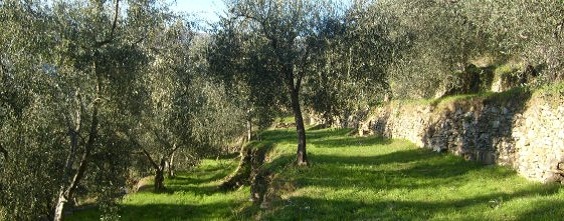
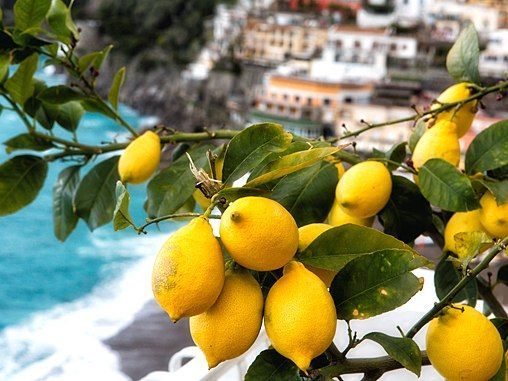
In the recent trip which my wife and I made to Italy, we managed to squeeze in a visit to our apartment near Genoa, where I was particularly delighted to see so many lemon trees in fruit. It’s wonderful to see trees heavy with lemons peeping over a wall or hanging over a garden fence.

lemons Liguria

Once back in Bangkok, I decided to do some research on the lemon and its history: how did this lovely yellow fruit end up in Liguria? But delving into the lemon’s history inevitably dragged me into the history of the citrus family. It turns out that the lemon does not have a long or distinguished pedigree. It is the citrus equivalent to a mutt, a fairly recent hybrid. In fact, most citrus fruits with which we are familiar are fairly recent hybrids. It seems that the members of this family love to hybridize, and of course humans – being intrusive busybodies by nature – have been only too willing to assist them. The result is a family tree of bewildering complexity.

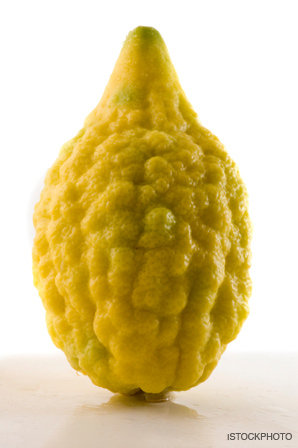
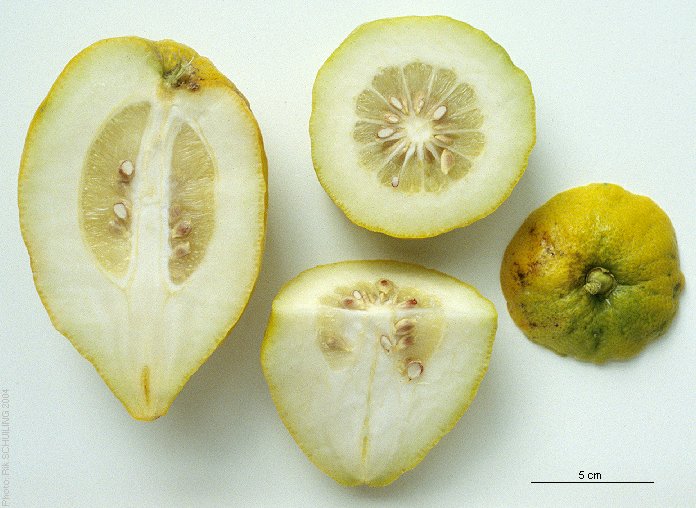
As I tried to make sense of all this, my attention was diverted by something I read about the citron. I think I need to insert here a few words about the citron, since I’m sure there are many readers who are not familiar with this citrus fruit. It is relatively difficult to find these days since it has little use – except for one very special one, which I will come to in a minute. It looks like a large, warty, lemon.citron

Coming to what I read, it seems that during a ceremony in the Temple of Jerusalem marking the Feast of the Tabernacles, or Sukkot, in one of the years around 100 BC, the Jews pelted the High Priest with citrons and got massacred for doing so. Now that was something worth finding more about! How I would have loved to use citrons, rotten tomatoes, eggs, dog-eared hymn books – anything, really – to pelt the priests with for subjecting me to excruciatingly boring sermons during the Sunday Masses of my childhood! It turns out, though, that the Jews were not horribly bored with what the High Priest was saying, but horrified by what he was doing. It is reported that he deliberately poured the water of libation over his feet rather than over the sacrificial animals. I can’t say that I can get quite as excited about this action as the Jews did, but the fact is that they did, and satisfyingly peppered the High Priest with citrons.

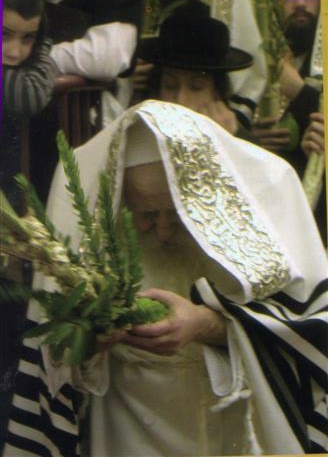
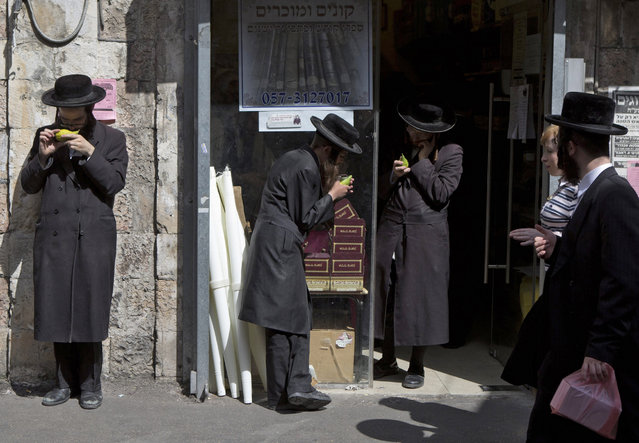
Of course, it does come spontaneously to ask oneself why on earth the Jews were carrying citrons around in the Temple in the first place. It’s certainly not the item that would immediately come to my mind as expecting to see in the hands of Jews within the sacred precincts of the Temple. It turns out that the citron plays an extremely important role in the ceremonies of Sukkot. Every morning of this seven-day Feast, Jews are required to ceremoniously wave the “four species”. Citron is one of these, the other three being the date palm, the myrtle, and the willow. We see here the Tosher Rabbi of Montreal waving the four species.

tosher rabbi of montreal

One can therefore assume that the Jews were carrying their four species when the High Priest poured the water of libation over his feet, and in the horror of the moment they blindly grabbed their citrons and threw them at the impious prelate. It seems that they must have also thrown something harder – stones, no doubt – since it is reported that the stone altar was damaged. I can’t really see citrons doing damage to a stone altar.

It’s a bit of a mystery to me why the citron ever became one of the four species, because it is not native to the Near East, whereas the other three species are. The citron, like all the original citrus fruits, originated somewhere in the region of South-East Asia-Yunnan in southern China-the Himalayan slopes of India. So how did it end up in the Near East? There is general agreement that the fruit was first cultivated in northern India. From there, it migrated, presumably along trade routes, to Persia. What happened next is a hotly debated issue – at least, in certain circles. One hypothesis has the citron migrating to Egypt, where its essential oils were used in embalming, and from whence the Jews brought it with them to the Promised Land when they escaped from bondage in Egypt. A second hypothesis has the citron being carried from Persia to the Mediterranean basin in the baggage of Alexander the Great’s returning soldiers, who somewhere along the way dropped it off in the Levant. Yet another hypothesis has the citron migrating from Persia to Babylonia, where the Jews came across it during their Babylonian captivity and brought it with them when they came back to Israel.

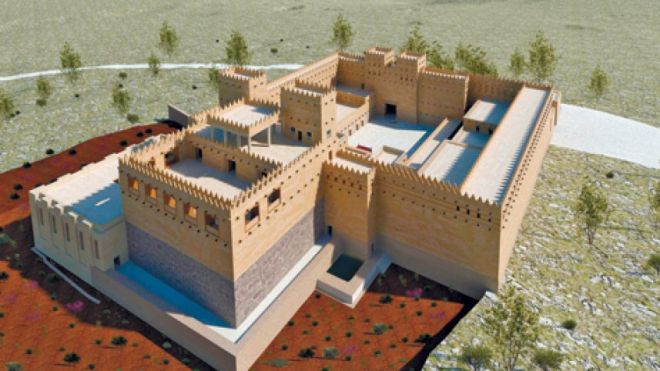
These are all suppositions, with no real evidence to back them up. A very clever piece of archaeological sleuthing suggests a more concrete hypothesis. We need to first recall that after the Persians defeated the Babylonians and allowed the exiled Jews to return home, Israel was a Persian province for several hundred years. Israeli archaeologists have been excavating a site quite close to Jerusalem which turns out to have been a Persian palace with an extensive garden around it. Here is a reconstruction of the site.

persian palace

The archaeologists wanted to see if they could find evidence of what was planted in this garden. They therefore looked for traces of ancient pollen. None could be found in the earth of the garden – whatever had been there had decomposed long ago. So they decided to try their luck in the plaster with which the walls of an ancient pool in the garden had been coated. The thinking was that pollen grains could have got stuck in the plaster while it was drying and been preserved. They were right – and one of the types of pollen they found was that of the citron. From the other types of pollen found – a number from species not present in Israel – the archaeologists deduced that this was a garden planted with rare plants, designed to show off the wealth and power of the palace’s resident, either a Persian satrap or a Babylonian Jew close to the Persians and sent there to keep an eye on the locals. Perhaps it was here that the Jerusalem Temple elites, coming to pay their respects to the Palace’s resident, first saw the citron and admired this strange and exotic fruit. Maybe it became the rage to have a citron tree in one’s garden in emulation of the Persian masters.

Assuming this is somewhere near correct, how did the chicness of the citron eventually segue into its strong religious symbolism? Here, I shall hazard an explanation which I found written nowhere but which satisfies my fertile imagination. One has to know that the adoption by the Jews of the four species in the rituals of Sukkot derives from a text in the Book of Leviticus, where it is said (in the English translation):

“And you shall take on the first day the fruit of beautiful trees, branches of palm trees and boughs of leafy trees and willows of the brook, and you shall rejoice before the Lord your God for seven days.”

The text specifically names two of the plants: the palm tree and the willow. For the other two, though, it is quite vague. Talmudic tradition eventually settled on the citron as the “fruit of beautiful trees” and on myrtle as “boughs of leafy trees”.

The choice of myrtle makes sense to me – it is satisfyingly leafy.

myrtle

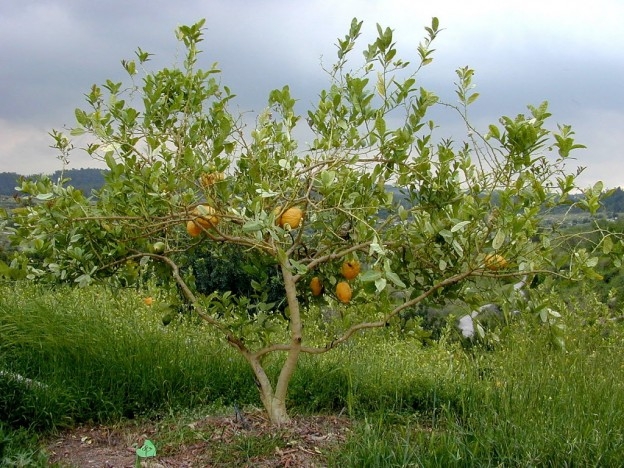
But the choice of citron as the fruit of a beautiful tree? That is really quite odd. In no way can the citron tree be considered a beautiful tree. It is low and scrubby, more bush-like.

citron tree

It seems, though, that the Hebrew text is grammatically ambiguous. Although the phrase in Leviticus is typically translated as “fruit of a beautiful tree”, it can also be rendered as “a beautiful fruit of a tree.” At first sight, this doesn’t seem to fit the citron either. As the picture above shows only too well, it is warty and knobbly, really quite ungraceful. But beauty, as they say, is in the eye of the beholder. The citron’s name in Persian, turunj, derives from the Sanskrit suranga, “beautifully coloured”. In today’s world, our lives are so saturated in bright colours that it is difficult for us to appreciate the impact on our ancestors of the few naturally brightly coloured things. As the photo above also reveals, the citron does indeed have a lovely yellow colour, and there really aren’t that many fruits that are so beautifully yellow (lemons come to mind, but that doesn’t count because they are a hybrid of the citron). Maybe the Persians, and the Indians before them, and the Jews after them, found the citron’s colour captivating.

If that explanation doesn’t satisfy my readers, let me suggest another reason. Under proper conditions, the citron is the only tree that can flower and bear fruit throughout the year. Even more distinctively, it can retain its fruit from one year to the next. So the citron tree can have buds, blossoms, and mature fruit all at the same time. This is a unique property, and one which may have aroused awe and reverence in our ancestors.

If that explanation doesn’t satisfy my readers, how about this one? Both the Greek philosopher, Theophrastos, and the Roman natural philosopher, Pliny the Elder, mention the citron in their botanical writings. And both stress the fact that the citron, fruit and leaves, has a very strong scent, that typical scent which you also get from the zest of the lemon. It is so strong, they say, that if the fruit is put among clothes it acts as a moth-repellent. This seems a little weak as a reason for nominating the citron as a “beautiful fruit”, although as every woman knows scent can be an important ingredient in beauty. And maybe the elites of India, Persia, and Israel were particularly receptive to the idea that their magnificent – and expensive – clothes could be protected from those pesky moths by the citron.

Either one of these explanations, or all three, must explain not only why the Jews adopted the citron as a religious symbol but also why anyone bothered to cultivate the citron in the first place and then bothered to carry it along to different parts of the world. From a utilitarian point of view, and our ancestors were nothing if not supremely utilitarian when it came to their natural environment, the citron really does seem a singularly useless plant. As I’ve said, the tree is low, scrubby, and bush-like, so it cannot be used as a shade tree. It is sickly and prone to disease, so is difficult to cultivate. The wood is no good for timber. Even the fruit is not much good to eat. It is mostly pith with hardly any flesh, and what flesh there is, is dry with relatively little juice.

cut citron

Whatever the reason, by the time the High Priest poured the water of libation over his feet (no doubt with a sneer on his lips) the practice of using the citron as one of the four species in the ceremonies of Sukkot was fixed.

It was this deliberately offensive act at the altar of the Temple which set me off on this quest to know more about the citron. But I can’t stop here, because the continuing history of the citron is equally fascinating. So I hope my readers will bear with me if I take them on a journey into the fruit’s more recent history.

From the fall of Jerusalem in AD 70,  the European history of the citron has been indissolubly bound up with that of the Jewish communities in Europe, so let me switch to using its Hebrew name, etrog (which, by the way, derives from the citron’s Persian name, turunj, via Aramaic, strengthening the idea that somehow it was the Persians who brought it into the lives of the Jews). The Romans’ destruction of Jerusalem, which ended Temple-centred worship for the Jews, meant that the feast of Sukkot began to be celebrated wherever the Jews happened to live. Since the citron was now indispensable in the celebrations of Sukkot, it followed the Jewish diaspora as the latter spread out through the Roman Empire into Greece, Italy, and Spain. With time, more and more attention was given to ensuring that the etrogim used in Sukkot were the most beautiful: after all, they were offerings to the Lord our God and nothing but the most beautiful should be offered. Detailed guidelines were issued about what constituted a “perfect” etrog, and considerable sums of money were paid for the most perfect ones.

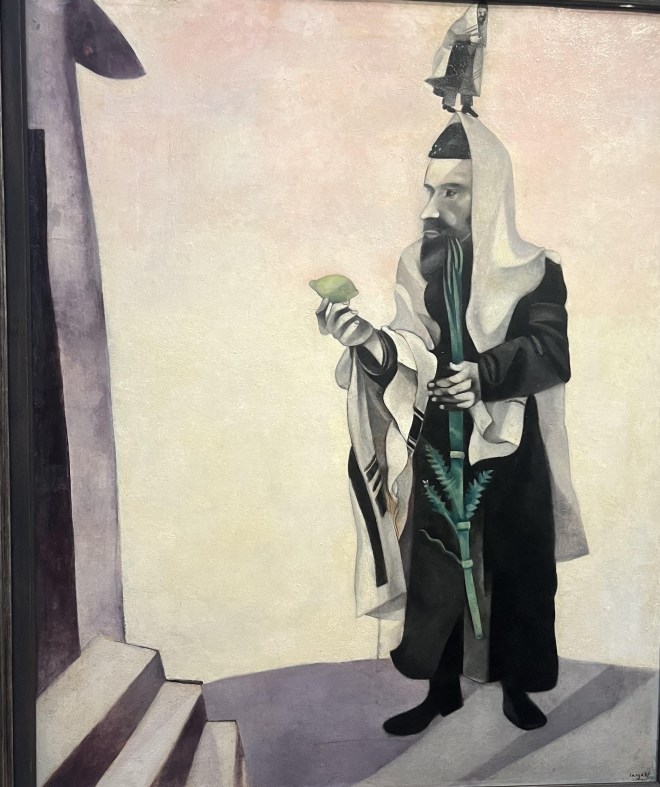
All was under control until the Diaspora began to move northwards into parts of Europe where the climate was too cool for the citron to grow. These more northerly Jewish communities therefore urgently needed etrogim to be brought to them from lands further to the south – no other fruit would do since the four species had been prescribed in the Talmud. This brings us back to where this post started, Genoa. Because of its climate, but also presumably because of its flourishing, and ancient, Jewish community, there were citron orchards around Genoa. It also happened to be a dynamic trading port, so it wasn’t long before Genoa dominated the trade in etrogim to northern Europe. With time, Genoa seems to have gotten out of the business of actually growing etrogim. Instead, it picked up etrogim as far south as Calabria, still a source of etrogim for some Jewish communities, and all points in between, as well as in Corsica, a Genoese colony, and shipped them north. Here we have a painting by Chagall from 1914, of a rabbi, presumably from Vitebsk in Bielorussia, where Chagall grew up, carrying his etrog to the synagogue (and clutching what looks like the local version of myrtle).

my photo

Genoa’s monopoly on the etrog trade began to be undermined when the Sephardic Jews, expelled from Spain, filtered eastward across the Mediterranean to Italy, Greece, and Turkey, and discovered the etrogim being grown in Corfu and other Ionian islands, presumably for the very ancient Jewish communities of Greece. These were very beautiful as defined by the guidelines on etrog beauty, and they began to seriously compete with the Genoese etrogim. At first, there was resistance in some of the Ashkenazic communities in northern Europe. To explain why, I have to go back to what started me on this post initially, the lemon. The first substantial cultivation of the lemon in Europe only occurred in the mid-15th Century, in Genoa – Genoa again (the sour or bitter orange arrived earlier, in the 11th Century, while the sweet orange arrived somewhat later, in the early 16th Century). European growers of citrons discovered – or maybe they picked it up from the Arabs – that grafting citrons onto lemon stock gave plants which were much hardier than pure citron trees. But grafting created an enormous problem for the Jews because the mixing of species was non-kosher, and etrogim used in a religious Feast had to be kosher. We now know that grafting doesn’t actually lead to a mixing of genes, or hybridization, although 400 years ago it was quite easy to think that it did; after all, everyone knew that if you crossed a horse and a donkey, you got a hybrid, the mule. Many in the Ashkenazic communities suspected that the Greek etrogim were actually so beautiful because they were grafted onto lemon trees. Various rabbis were prepared to certify that they were not, and anyway the Napoleonic wars cut off the traditional supply of etrogim from Genoa. And the Greek etrogim really were so very beautiful …

So the Greek etrog triumphed and trade from Corfu flourished. Eventually, this got the Greek farmers greedy. They calculated that they had the Jewish communities over a barrel – they needed beautiful etrogim, the etrogim from Corfu were the most beautiful, hence they would pay whatever it took to get them. In 1875, they therefore created a cartel and jacked up the price. They turned out to be wrong. The Jewish communities reacted vigorously and successfully boycotted the Greek etrogim. They bought from Calabria, from Corsica, and more importantly from Israel, to where we now turn.

As more and more European Jews immigrated to Palestine in the 1800s, they discovered a local variety of etrogim. They surmised that these must be descended from the etrogim used in Temple worship before the Temple’s destruction. A number of rabbis therefore decided to promote these etrogim from Palestine, which were surely more authentic than etrogim grown elsewhere. They also thought it would help the poverty-stricken economy of Palestine to be able to export high-priced etrogim to Jewish communities in Europe. The problem was that although these etrogim might be more authentic they weren’t nearly as beautiful as the Greek etrogim. On top of it, Sephardic communities which had immigrated to Palestine brought in seeds of Greek citron trees and started planting orchards of the beautiful Greek etrog there. The stand-off with Corfu helped boost sales in Palestine, both of the original as well as of the Greek etrogim transferred there. However, authentic Palestinian etrogim were suffering from the competition.

Coming back to Corfu, the Greek farmers eventually backed down and brought their prices down again. But they didn’t forget or forgive. Some 15 years later, when the body of an unknown woman was found just outside the Jewish quarter in Corfu, the local etrog growers claimed that the woman had been murdered by Jews. This sparked off a pogrom against the local Jewish community, which left 139 people dead. And then it was discovered that the dead woman was actually Jewish. That finished off the etrogim trade from Corfu.

Meanwhile, back in Palestine, the transplanted Greek etrog was pushing the local variety off the market. Eventually, the Greek etrog, which did not adapt very well to the climate in Israel, began to be grafted onto stock of the original etrog, a graft which is kosher. This was a marriage made in heaven: the beautiful Greek etrog with the original, Temple-era etrog. It is this variety which now dominates the modern etrog market, and is no doubt the one being intensely studied by these Orthodox Jews prior to an eventual purchase.

jews purchasing etrogim

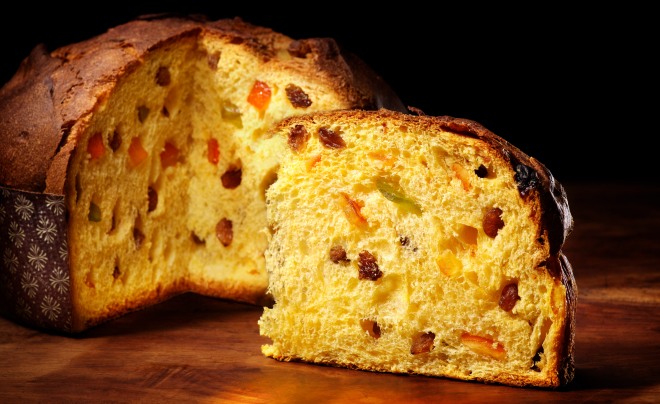
I cannot finish my story of the citron without mentioning the one way of usefully consuming it that was eventually discovered. For this, I have to back up a little and say a few words about the history of cane sugar. Cane sugar, brought west from India by, once again, Alexander the Great’s troops (they seem to have been great collectors of plants …), was first exploited in the Near East. It was the Crusaders, who came across caravans of this “sweet salt”, and who brought sugar to the attention of Europe. Until then, Europeans had only had honey as a sweetener. Genoa’s fiercest rival, Venice, was the first to make sugar available in Europe. It also brought another Arab invention, candying of fruit, to Europe. Not to be outdone by its hated rivals, the Genoese also finally got into the candying business. Somewhere along the line, someone had the idea of candying the citron, or rather its pith, of which there is so much, as the photo above shows. Leghorn (Livorno) became the centre of production: citrons from the south all the way to Sicily, from Corfu and the other Ionian islands in the east, and from Corsica in the west, were sent, de-pulped and brined, to Leghorn. There, the citron pith was de-brined and steeped in progressively more concentrated solutions of cane sugar. Once dried and chopped into small pieces, it was shipped, no doubt in Genoese ships, all over Europe to be added to cakes, sweet bread loaves, and other patisseries. I have a particular reason to mention all this because the panettone, that glory of my wife’s home town, Milan, was originally made with candied citron pith (as well as candied orange and sultana raisins).

Panettone

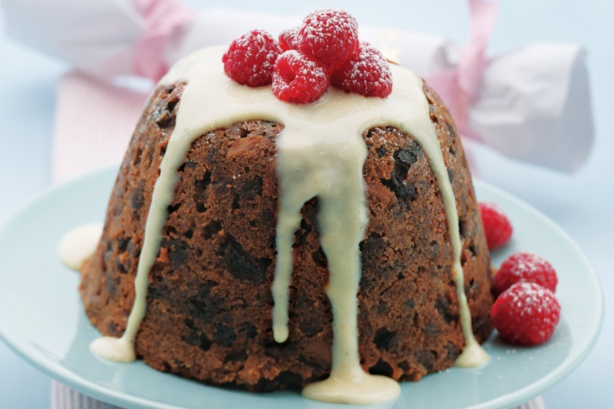
More humbly, the original recipes of the English plum pudding of my youth also called for candied citron from Leghorn.

Plum-Pudding

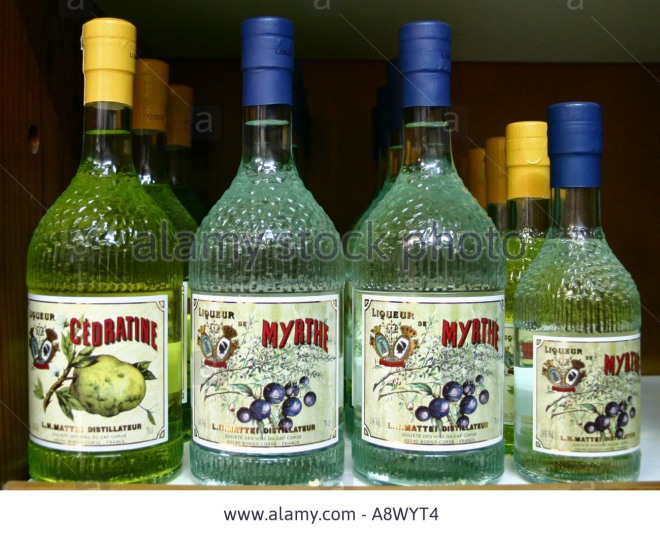
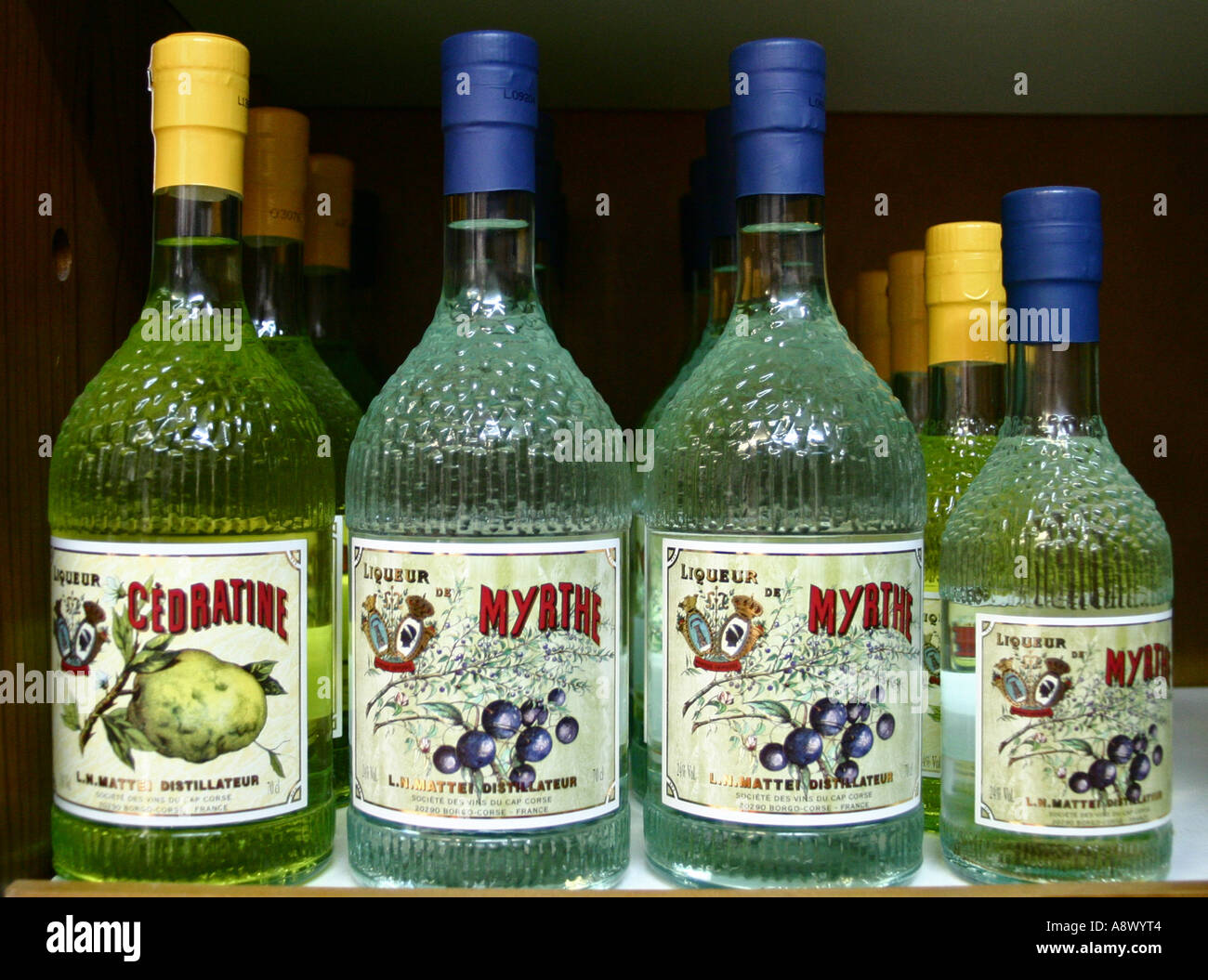
Alas! I believe this market has declined drastically – or perhaps citrons from elsewhere have cornered the candying market. The fact is, Leghorn is no longer a centre for candied citron production, the Calabrian citron hangs on by managing to keep a foot in the etrog market, while the Corsican and Corfu citron production is down almost to nothing; the few which are grown there are only used to make a local liqueur. Here’s the Corsican variety. Somehow, it seems apt that the bottle stands next to one made with myrtle, another of the four species.

cedratine and myrtheLet’s lift a glass to the citron a.k.a. the etrog! Cin-Cin!

_____________________________

Lemons in Liguria: https://i0.wp.com/www.bbfauno.com/wp-content/gallery/amalfi/limoni-amalfi-coast.jpg (in https://misshome.wordpress.com/tag/italian-language/)

Citron: http://whileshenaps.com/wp-content/uploads/2010/09/6a00d834515cdc69e20133f4767038970b-pi.jpg (in http://whileshenaps.com/2010/09/make-a-paper-mache-etrog.html)

Tosher Rabbi of Montreal: https://en.wikipedia.org/wiki/Four_species#/media/File:Fourspecies.jpg (in https://en.wikipedia.org/wiki/Four_species)

Persian palace: http://www.haaretz.com/polopoly_fs/1.410535.1328143655!/image/3938862120.jpg_gen/derivatives/headline_857x482/3938862120.jpg (in http://www.haaretz.com/jerusalem-dig-uncovers-earliest-evidence-of-local-cultivation-of-etrogs-1.410505#acid)

Myrtle: http://www.polyvore.com/cgi/img-thing?.out=jpg&size=l&tid=65106807 (in http://www.polyvore.com/outdoor_plants/collection?id=3359765)

Citron tree: in gardening.stackexchange.com

Cut citron: http://www.tropcrop.nl/citr02fr.jpg (in http://www.tropcrop.nl/citron.htm)

Orthodox Jews purchasing etrogim: http://pix.avaxnews.com/avaxnews/64/a4/0001a464_medium.jpeg (in http://avax.news/fact/Symbolic_Citrus_Israeli_Jews_Inspect_Fruit_for_Sukkot.html)

Panettone: http://www.italianfoodexcellence.com/wp-content/uploads/sites/27/2014/09/Panettone-Vergani-Enrico-Su—-Ummarino.jpg (in http://www.italianfoodexcellence.com/tag/panettone/)

Plum pudding: http://cookdiary.net/wp-content/uploads/images/Plum-Pudding_12165.jpg (in http://cookdiary.net/plum-pudding/)
Cédratine and myrthe, Corsica: http://c8.alamy.com/comp/A8WYT4/myrthe-and-cedratine-liqueurs-for-sale-in-a-shop-corte-haute-corse-A8WYT4.jpg (in http://www.alamy.com/stock-photo-myrthe-and-cedratine-liqueurs-for-sale-in-a-shop-corte-haute-corse-6963651.html)
MIRROR, MIRROR, ON THE WALL

Bangkok, 28 February 2016

Every morning, I stare at myself in the mirror as I shave, a ritual which has enslaved me these past forty odd years. And I stare at myself in the mirror as I brush my hair, or brush my teeth, or – more lately – inspect that suspicious mark on my face (is it melanoma?). And I watch as the face which stares back at me grows rounder and more creased, as the hairline recedes and the temples grow greyer, as the lips thin with the loss of back teeth, as the skin begins to sag under my chin.

I grow old, the mirror remorselessly reminds me every day.

I can’t escape my reflection. It follows me everywhere I go, staring back at me from all the mirrors which we have scattered with wild abandon over our urban landscapes: the bars, the restaurants, the public toilets, the elevators, the shops, the lobbies, … My reflection even beckons to me from the smooth, shiny sheathing and coated windows of our fancy modern buildings.

It was not always so. There was a time, not so long ago in the great arc of human history, when we hardly ever saw our own faces. We saw the faces of others: our mothers, our fathers, our siblings, our tribe, our village, and the few strangers who came from the other side of the mountain and passed through. From time to time, when drinking in a still pool, we would have seen a tremulous reflection staring back at us. But it’s not easy to see one’s reflection in water. Water bodies have this infuriating habit of giving a beautiful reflection of things far away but of being blankly clear at one’s feet.

Numa and Rainbow Peaks Reflecting in Bowman Lake, Montana

This young girl has managed to capture her watery reflection quite well

reflection in water

but I think this picture is more typical of what most of us see when we peer into water.

reflection in a puddle

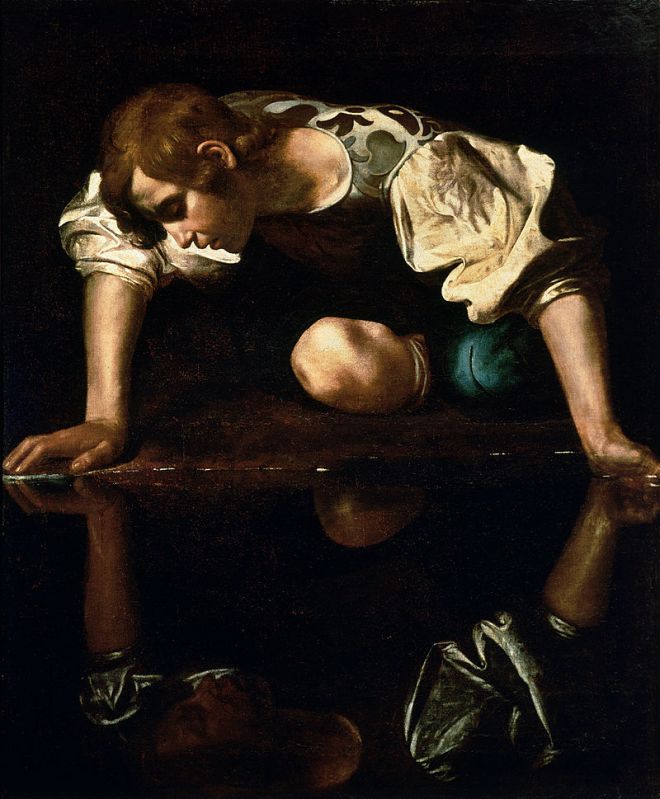
That’s why I’ve never really understood the legend of Narcissus, the beautiful boy who caught sight of his reflection in a pool, fell in love with it, and died at the pool’s edge unable to drag himself away.

Narcissus-Caravaggio

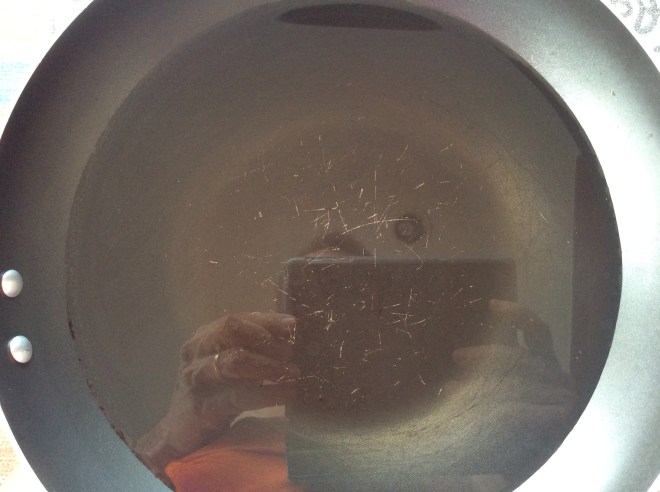
What reflection could he possibly have been so enamoured with? In my experiments in the kitchen with various pots and pans of different colours, the best reflection I got was from a black frying pan

image

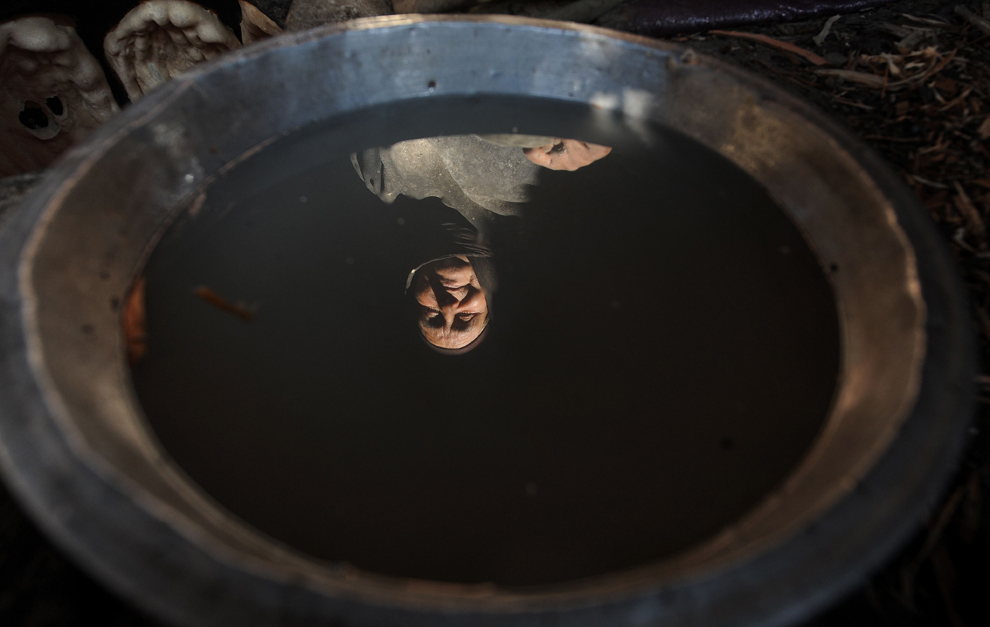
and even that reflection was, as readers can see, murky in the extreme. How could anyone, however beautiful he or she may have been, have fallen in love with this evanescent reflection? Perhaps the original teller of the tale had seen a reflection of a person in a dark pool or vase from a distance, like this photographer has

reflections in a bowl of water

and invented the story around that.

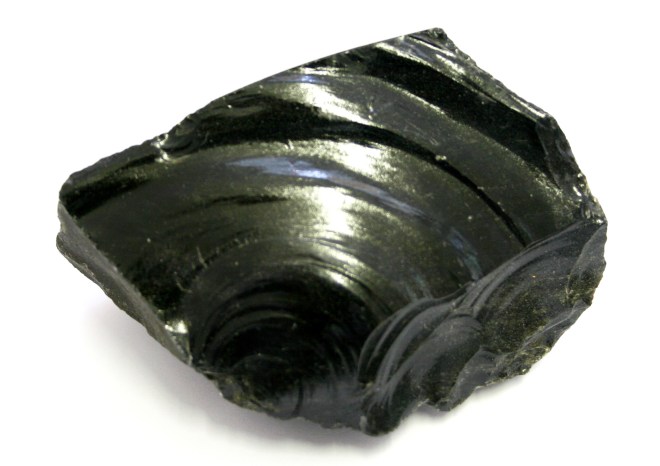
Be that as it may, eventually our ancestors found other ways to see themselves. Obsidian, that beautiful, black, glassy material, product of volcanic activity

imagewas used in the first attempts at non-aqueous mirrors, in Turkey. The country was famous in the pre-metallurgical era for its obsidian, which could be used to make razor-sharp arrow heads – such arrow heads have been found hundreds if not thousands of kilometres away from the mother lode in Anatolia. But large obsidian pieces could also be split open and the faces given a high polish to act as a mirror.

obsidian mirror

Obsidian may be beautiful, but it gives a dark reflection, almost as dark as the water in my frying pan. I am reminded of St. Paul’s famous phrase in his first letter to the Corinthians, “For now we see through a glass, darkly”.

The metallurgical age brought us one step closer to seeing ourselves, in polished copper or bronze mirrors, like this Egyptian copper mirror.

copper mirror egyptian

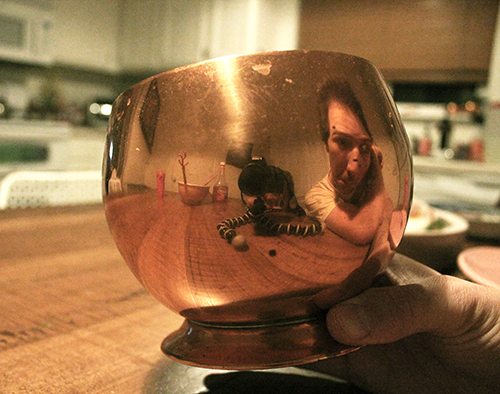
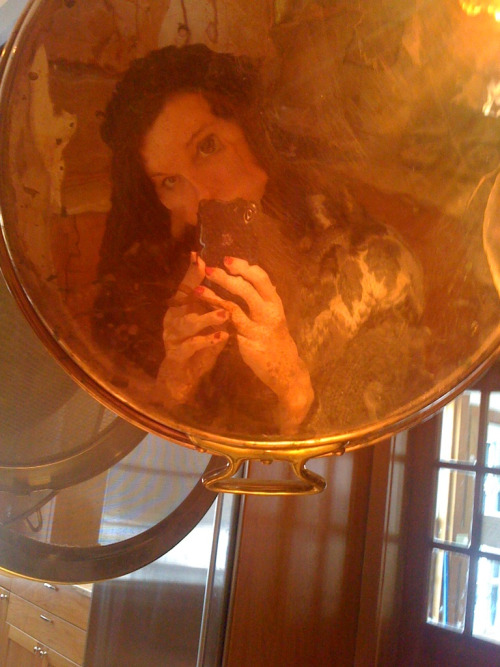
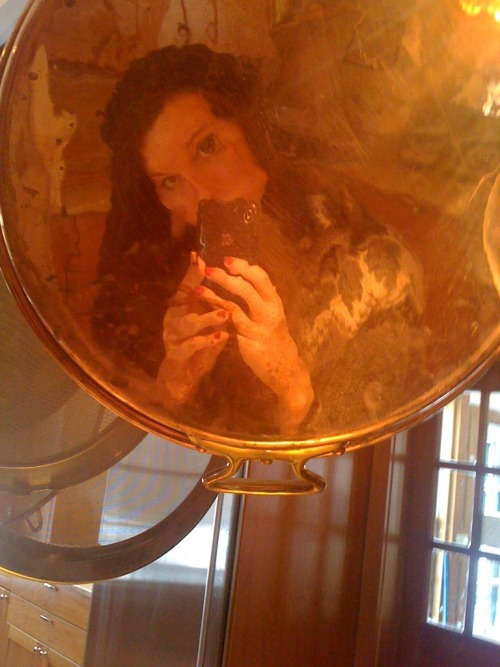
Copper mirrors would have given reddish reflections like those we see in highly polished copper pans, such as this

reflections in a copper potor this.

reflections in a copper pan

(If nothing else, both photos show the need for a uniformly flat surface for a good result …)

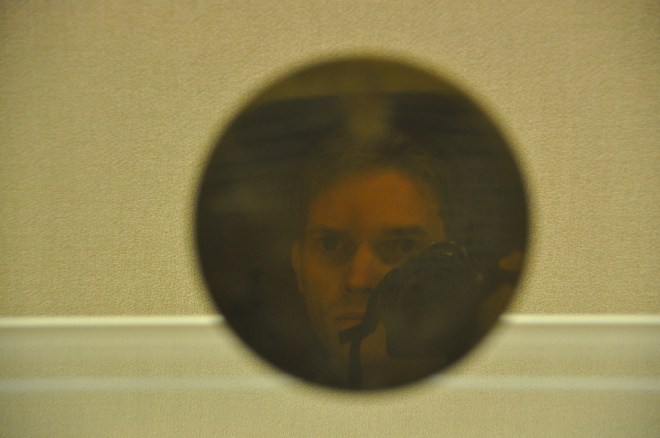
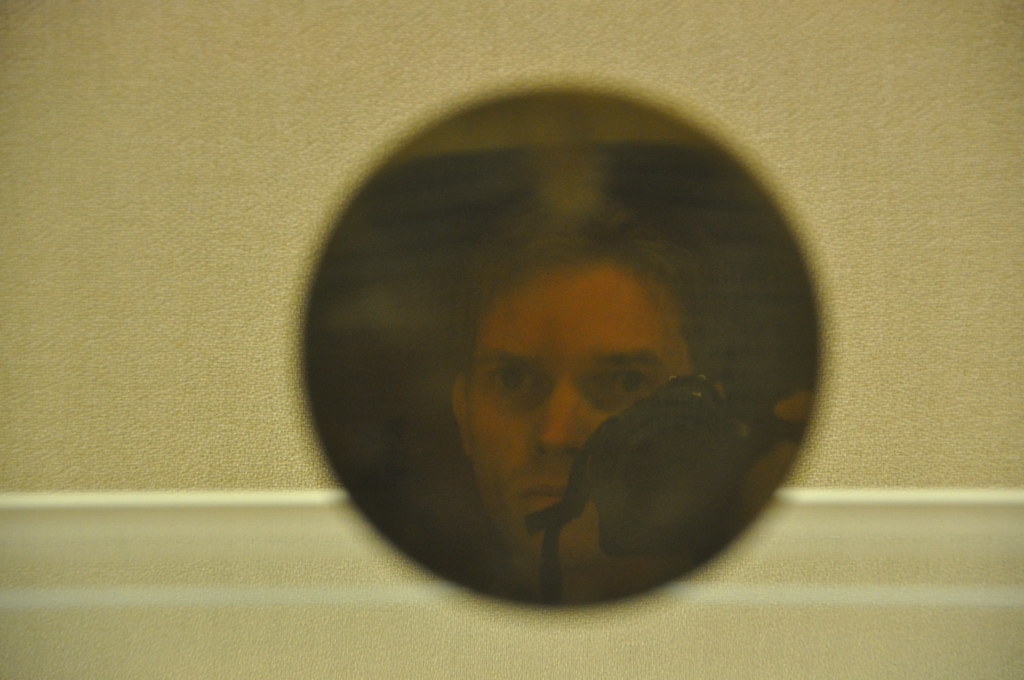
The Chinese especially made mirrors out of polished bronze. These would have given yellowish reflections, like this one

bronze mirror-2

or this one, from a Japanese bronze mirror.

bronze mirror

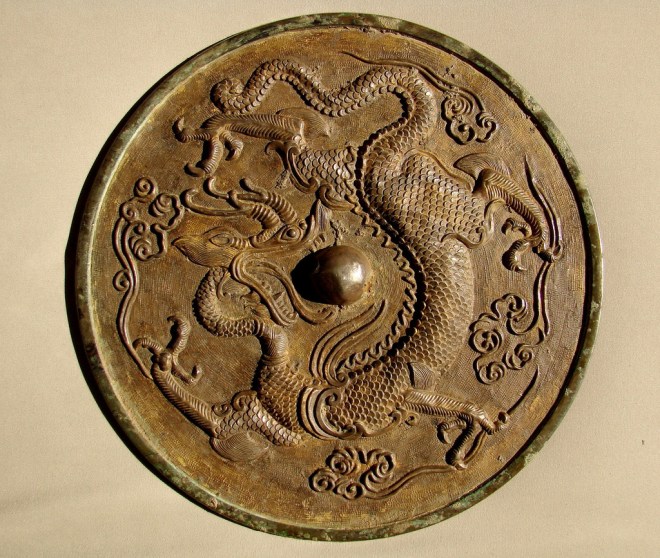
Mirrors such as these were very expensive – indeed, the Chinese turned the backs of their mirrors into admirable works of art, such as this 9th Century one from the Tang Dynasty with its admirably carved dragon.

image

So only the rich, the ancient world’s one-percenters, could afford to peer – curiously, vainly, or dolefully – at their reflection. The man and woman on the street still could only see their reflection in water.

It seems that it was the Egyptians who first thought of coating glass with metal to make glass mirrors, but their reflectivity was poor. As for the Romans, Pliny the Elder mentioned mirrors where gold leaf was applied to glass. I don’t know if any such mirror has survived the ravages of time, I certainly didn’t find a trace of one on the Internet. But very fancy gold-plated mirrors such as the one in this photo are now made, for high-tech applications.

image

I suppose a bleary-eyed Roman plutocrat staring at himself in his gold-plated glass mirror after a night of orgies would have caught such a yellowing reflection as this of his face.

It is the Venetians we have to thank – or curse – for bringing us the modern silvered mirror, which finally allowed humanity to see its own reflection in glorious, embarrassing, or painful technicolour. The glass-makers of Murano figured out a way of making flat – and clear – glass as well as depositing a thin coating of silver on the back of it (my professional self cannot but help notice that they used a silver-mercury amalgam to do this; the mercury inevitably sickened and killed off a good number of Murano mirror-makers – an interesting twist to the French saying “il faut souffrir pour être belle”, “one must suffer to be beautiful”, which here becomes “you suffer, and I admire my beauty”). Once again, it was initially the one-percenters of the European courts who enjoyed – or suffered from – a much clearer reflection of themselves. Venetian glass mirrors such as this one were worth a king’s ransom.

old venetian mirror in good shape

The French one-percenters couldn’t stand the idea that they were sending so much of their wealth southwards to the misbegotten Venetians for glass mirrors. They tried mightily to worm the secrets of mirror-making out of Murano. But La Serenissima, fully appreciating the gold mine they were sitting on, passed draconian laws forbidding these secrets from leaving the lagoon. Eventually, though, the French suborned a group of Venetian mirror-makers, persuading them to bolt from the lagoon and set up shop in the St. Gobain works. Among many other things, this gave us the Hall of Mirrors at the palace at Versailles.

image

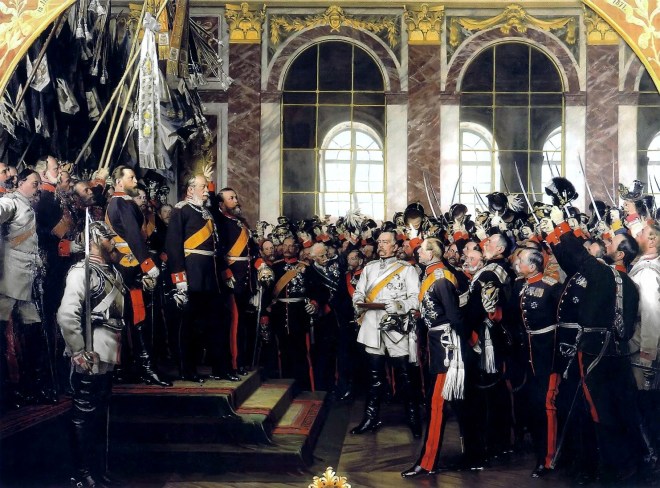
This hall has impassively reflected the fun and games of the French monarchy, but also two crucial moments in recent European history: the declaration of the German Empire in 1871 after the Prussians trounced the French in the Franco-Prussian War

image

and the signing of the Treaty of Versailles in 1919 between the Allies and the new-born German democracy

image

that humiliating “diktat of Versailles” which Hitler used to such good effect in his rise to power.

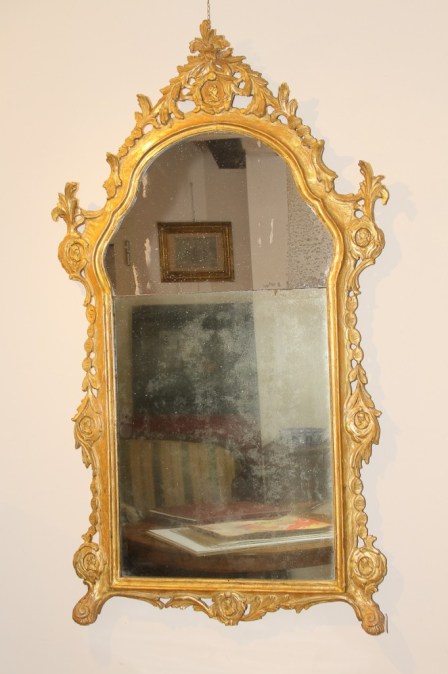
Alas! The silvering process which the Venetians invented, and the French copied, did not last forever. With time, it would crack, it would peel, it would dull, so that reflections would become evanescent once more. How many old houses contain mirrors like this one!

image

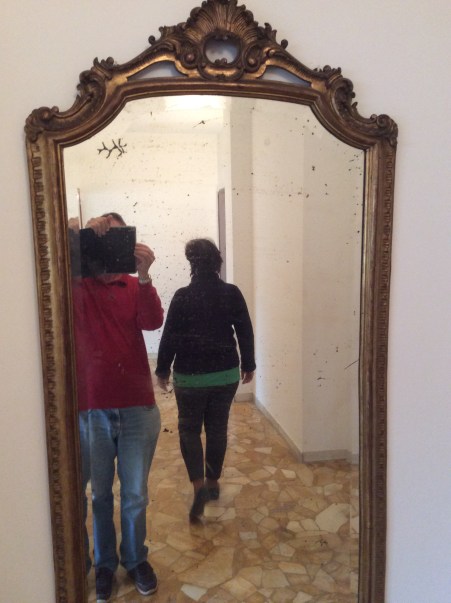
Even our apartment in Milan holds a mirror where Time has inserted its bony fingers into the silvering and has started to strip pieces off.

image

Like my face, mirrors age. But as men have found ways of making faces last longer, so have they found ways to make silvered mirrors that last longer and reflect better. And through the genius of industrialization they have found ways to make these much better mirrors much cheaper, so that 99-percenters like me can also stare, once vainly and now despairingly, at the reflection of our crumbling selves.

I need to escape from my reflection. My wife and I could have ourselves shipwrecked on some remote islet in the Pacific Ocean. Yet even there, I fear that I would find a shard of mirror on the beach, washed up together with all the plastic bottles and other flotsam and jetsam of our consumeristic life that now fill up our oceans.

__________________________________

Reflections in a lake: http://cdn.c.photoshelter.com/img-get2/I0000WnV35_OekPk/fit=1000×750/Numa-and-Rainbow-Peaks-Reflecting-in-Bowman-Lake.jpg (in http://bretedge.photoshelter.com/image/I0000WnV35_OekPk)
Reflection in water: http://www.aheadworld.org/wp-content/gallery/reflection-in-the-water/bellareflectionwater-1.jpg (in http://www.aheadworld.org/2014/07/15/reflection-in-the-water/)
Reflection in a puddle: http://www.nambya.com/wp-content/uploads/image6.jpg (in http://www.nambya.com/gallery/photography/image-7/)
Narcissus by Caravaggio: https://en.wikipedia.org/wiki/Narcissus_%28mythology%29#/media/File:Narcissus-Caravaggio_%281594-96%29_edited.jpg (in https://en.wikipedia.org/wiki/Narcissus_%28mythology%29)
Reflection in a black pan: my photo
Reflection in a bowl of water: http://inapcache.boston.com/universal/site_graphics/blogs/bigpicture/reflections/bp12.jpg (in http://www.boston.com/bigpicture/2012/02/photo_reflections.html)
Chunk of obsidian: https://www.thinglink.com/scene/504686617127026690
Obsidian mirror: https://s-media-cache-ak0.pinimg.com/736x/a0/77/4e/a0774e9d5c812c328852a4850ea59899.jpg
Egyptian copper mirror: https://assets.paddle8.com/510/266/21339/21339-1380672291-Coburn-Item%2033-xl.jpg (in https://paddle8.com/work/egyptian/21339-hand-mirror)
Reflection in a copper pot: http://www.jeffclaassen.com/photos/2013/11/copper_pot_05.jpg ( in http://jeffclaassen.com/blog/2013/11/copper-pot-selfies-in-the-kitchen-after-dinner/)
Reflection in a copper pot-2: http://www.jeffclaassen.com/photos/2013/11/copper_pot_02.jpg (in http://jeffclaassen.com/blog/2013/11/copper-pot-selfies-in-the-kitchen-after-dinner/)
Reflection in a copper pan: https://40.media.tumblr.com/e295593980f36d1411e869333c84b63f/tumblr_mgbmbnhFJl1rjg7f0o1_500.jpg (in https://www.tumblr.com/search/loppapeysa)
Reflection in a Chinese bronze mirror: https://c1.staticflickr.com/3/2601/3810835438_947331566d_b.jpg (in https://www.flickr.com/photos/chrisckemp/3810835438)
Reflection in a Japanese bronze mirror: http://1.bp.blogspot.com/_WxoUP_Y9N1A/RysHFDtbP1I/AAAAAAAAADo/smZF2ussZLo/s320/te-kagami2.JPG (in https://kgtou.wordpress.com/2007/11/02/te-kagami-hand-mirror/)
Chinese mirror – back: https://www.flickr.com/photos/asianart/405662049
Mirror coated with gold: http://www.epner.com/processes-and-products/laser-gold/
Old Venetian mirror in good shape: http://www.antiquario-dellapiana.it/esposizione-antiquariato-alba/dipinti-antichi/
Galerie des Glaces: http://www.historylines.net/history/17th_cent/versailles.html
Proclamation of the German Empire: https://fr.m.wikipedia.org/wiki/Galerie_des_Glaces
Signing of the Versailles Treaty with Germany: https://fr.m.wikipedia.org/wiki/Galerie_des_Glaces
Old Venetian mirror in bad shape: http://www.juliamarkert.com/galleria-riproduzioni-cornici-antiche-firenze/cornici-antiche-firenze/specchio-veneziano/
Reflection in Milan mirror: my photo

MIMOSA

Sori, 25 February 2016

We’re in Italy at the moment, spending a week here to get things in order for my impending retirement. We decided to make a quick visit to our apartment on the sea, by Genova, to check if all was well but also to see the mimosa in flower. The flowering of mimosa on the Ligurian coast is a wondrous sight to behold
image
especially when you’re toiling up a hill like these hikers are and find yourself in front of a flash of canary yellow, a harbinger of the Spring to come.
image
All was well with the apartment but alas! we were too late for the mimosa. It had reached its peak some two weeks before and the flowers were already very much past their best.

image

Disconsolate, I decided to do the next best thing, a little internet surfing to learn more about mimosa.

I had half expected to discover that mimosa originally came from China. After all, that had already been my experience with several plants, from wisteria to the willow. But no! I was delighted to learn that mimosa comes from south-eastern Australia. Here is a photo of it in the State of Victoria, in what is probably its natural state, cohabiting in this case with mountain gums.

image

Mimosa is actually a bit of a misnomer, for which it seems we have to thank Carl Linnaeus, the inventor of the modern system for giving scientific names to living things.
image
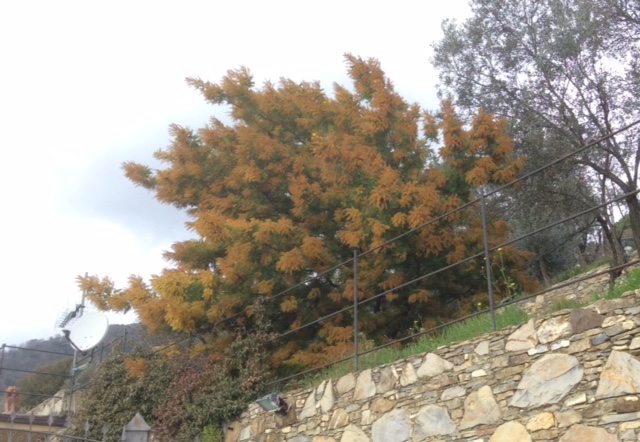
What I call mimosa is actually an acacia (or perhaps was an acacia; more on that in a moment). For some reason, Linnaeus decided to also give the genus acacia the name mimosa. The confusion was cleared up later, but not before this particular type of acacia got stuck with the name mimosa. Confusion on nomenclature doesn’t stop there, for it seems that acacia is also a misnomer in this case. I don’t follow taxonomic decisions with bated breath, but Australian acacias should apparently now be called racosperma. The august scientific body which makes these kinds of decisions decided so back in the late 1990s or thereabouts, but the Australian botanists, indignant at the thought of having to change the name of their cherished acacias, managed to get the vote reversed in 2005. However, I now understand that the vote was re-reversed. In all of this confusion, I think we should just go with the common name, the wattle. Since there are nearly 1,000 species of wattle in Australia, I have to be a little more specific and say that the “mimosa” planted here in Liguria is the silver wattle.

How mimosa got to this part of the world is not that clear – at least, I didn’t find any clear description of that journey. Another distinguished botanist, Joseph Banks
image
who accompanied James Cook on his first voyage to the Pacific and whom I have had cause to mention in an earlier post on kangaroos, brought the wattles to the attention of the Western world. But who actually brought the living plant back, or its seeds, and propagated it I don’t know. Whoever it was, the peoples from Portugal to the west all around the rim of the Mediterranean and up into the Aegean Sea and on into the Black Sea to the east have a huge debt to him (or, who knows? her). Every spring, they can enjoy magnificent bursts of yellow, like this one in Odessa in the Ukraine.

image

Actually, given that the golden wattle, another member of the large wattle tribe, is now the floral emblem of Australia, I was expecting to find a photo on the net of a mimosa in flower in the ANZAC cemeteries of Gallipoli. But no. Photos there are of the cemeteries
image
but none with a flowering mimosa. Perhaps no-one visits the cemeteries in the early Spring. But if instead it’s because mimosas are not planted in Gallipoli, I think a move in this direction is in order. Should not an earlier immigrant to Europe from Australia welcome the Spring every year in that corner of the Mediterranean where Australians lie in their eternal sleep?

___________________

Mimosa in Liguria: http://helpilivewithmyitalianmotherinlaw.com/2013/03/07/the-magic-of-liguria/
Mimosa on the hills: http://lemiegite.escursioniliguria.it/gita_per_gita/gita_per_gita_2014_2016/2015-02-01_sori_cordona_nervi.html
Mimosa in Australia: http://www.gettyimages.it/detail/foto/mountain-gums-and-silver-wattle-victoria-australia-fotografie-stock/128394637
Linnaeus: http://linnaeus.sourceforge.net
Joseph Banks: http://lggardendesign.com/it/linvasione-della-rosa-banksiae/
Mimosa in Odessa: https://www.pinterest.com/pin/365143482264046608/
ANZAC cemetery, Gallipoli: http://www.cwgc.org/find-war-dead/casualty/621860/FIGGIS,%20SAMUEL%20DOUGLAS%20JOHNSTONE

SPADES, CLUBS, HEARTS, DIAMONDS

Bangkok, 8 January 2016

In a previous post, I sketched out a rough agenda for my retirement. I think my wife was pleased with it. But she does have certain anxieties about this upcoming event. She has recently been reading about some Japanese syndrome called Retired Husbands Syndrome which attacks Japanese housewives. Suddenly, this guy whom you’ve hardly seen in the last 40 years – being a good Salaryman, he’s been leaving the house at 6 am and not getting home till midnight – is now constantly hanging around, getting in your way, messing up your routines, and expecting you to do things for him. Not unnaturally, the stress levels rocket up. While we’ve maintained a more balanced lifestyle, she does have fears of me moping around the house, lounging around on the sofa, eating natchos and watching TV all day. This dystopian view of hers is not helped by a number of films we’ve seen recently, describing exactly this situation. Nor is it helped by my fondness (my wife thinks more obsession) for playing Spider Solitaire on my iPad. She’s afraid that come retirement all I’ll do all day is compulsively play Spider Solitaire, with a little Freecell on the side.

It is true that I tend to play the game whenever I have a spare moment. I do admit that it can get a little out of hand. But I’m sure it’s good for my aging brain to carefully plot my strategy for getting the cards out. And those little electronic cards, with their glossy black spades and clubs and glowing red diamonds and hearts, and kingly Kings and queenly Queens and knavish Jacks, are really very pretty.
image
I was thinking about their prettiness the other day during a Spider Solitaire game, and when it became clear that I was dribbling towards defeat I decided to quit and do a little research on the history of playing cards, principally to understand where the suit design of hearts, diamonds, spades, and clubs originally came from. I was very pleased that I did so, because I discovered that what we have here is yet another example of the Great East-West Exchange which took place along the Silk Road and other trade routes that once criss-crossed the Eurasian continent. Of course, most of what was exchanged was traditional goods, but ideas also flowed along these routes. So did less obvious things, like the the willow tree and the pomegranate, both of which I’ve had occasion to write about in the past. Now I can with pleasure write about a third such item, playing cards.

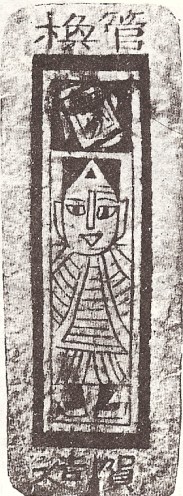
Our story starts in China. Some time in the Tang Dynasty, around the 7th-8th Century, it seems that someone in the Imperial Court came up with the idea of a pack of playing cards, divided into four suits. The suits were Coins, Strings of (1,000) coins, Myriads of strings (10,000), and Tens of myriads. Like our modern cards, each suit contained cards with different numbers of pips. Here we have a Three of Coins and a Three of Strings-of-coins.
image
These packs also included face cards, like this one from the Ming dynasty.
image
These ‘chi-pai’, which is Chinese for playing cards, are still in use. This next photo shows the cards from a three-suited variant. Note how the design of the suits became highly stylized – this is important for our story.
image
I’ve no idea what games exactly were played with these cards back in Tang Dynasty times, I’m not sure anyone knows, and actually it’s not important for our story. What is important is that the use of cards spread westward. This could have happened through trade; I can imagine Chinese merchants whipping out a pack of cards to while away their down time in the caravanserai that dotted the Silk Road.
image
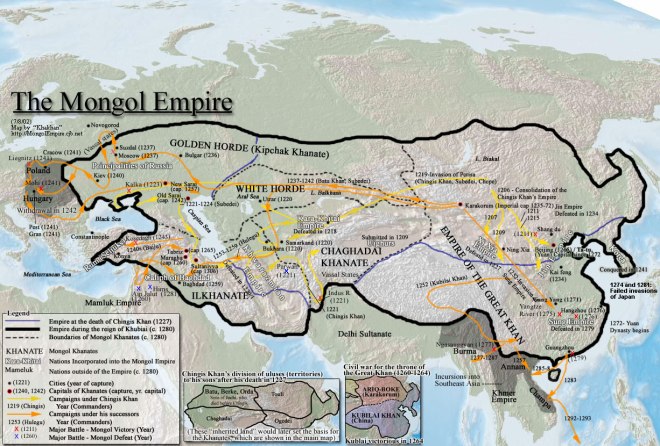
Alternatively, it could have happened through conquest, with conquering soldiers picking up new habits from the conquered. In this case, the Mongols, who conquered China in the 13th Century, seem a very good candidate. At its height, the Mongol Empire stretched from Korea to Ukraine.
image
Any new fads picked up by Mongol troops in China could have spread, through many an evening around soldiers’ camp fires, all the way to Kiev.

I don’t think the two diffusion mechanisms are necessarily exclusive. I could imagine that the Mongol conquest also amplified diffusion of card playing through trade. The two maps above superimpose quite well, and in fact the period of the Mongol Empire brought political stability to Asia which in turn encouraged a surge of trade along the Silk Road.

Whichever way, Chinese playing cards diffused westward. Some time in the 13th-14th Century, maybe earlier, so-called Ganjifa playing cards started being used in Persia. The etymology of the word Ganjifa is uncertain. Some see its root in the Persian word gunj, which connotes treasure, treasury, or money, and suggest that this connects them to the money-suited Chinese playing cards. Others see a more elaborate etymology, proposing that Ganjifa is actually a corruption of ‘han-chi-pai’, or ‘Chinese playing cards’. In this case, there would be a very clear line of descent from China. In any event, variants of Ganjifa playing cards began to be used throughout the Muslim world, as well as in India (brought there in the saddle bags of the Mughal conquerors). What interests us most is the variant used by the Mamluk in Egypt.

The Egyptian Mamluk were an interesting bunch of people. Initially, they were slave soldiers recruited by the Ayyubid dynasty. For the most part, they were drawn from the Cumans-Kipchaks, a nomadic group who controlled the steppes north of the Black Sea. They were conquered by the Mongols and then absorbed into the Mongol Empire as the Golden Horde. Some time in the 13th Century, the Mamluk slave-soldiers kicked the Ayyubids out and reigned in their place. This happy state of affairs continued until they were in turn defeated by the Ottomans and their territories subsumed into the Ottoman Empire. Luckily for them, the Ottomans kept them on as governors of Egypt.

Perhaps because of their Mongol connection, or in some other way, the Mamluk picked up this new fad of card playing and brought it to Egypt some time in the 14th Century. What is of interest to us here is the fact that Mamluk packs of cards had four suits: Coins, Polo-sticks (the Mamluks were great polo players), Cups, and Swords. In addition, each suit had three face cards, the king, the first vizir, and the second vizir. Some clever people, who know more about the history of playing cards than I do, see a link between these four suits and those used in Chinese playing cards. Their thinking goes as follows. There is no problem in seeing the Mamluk Coin suit being derived from the Chinese Coin suit, that’s an easy equivalence to envisage. After that, it gets trickier. The clever people propose that the Chinese String-of-coins suit was transformed into the Mamluk Polo-stick suit, on the grounds that a String-of-coins pip could easily be misinterpreted as a stick to those unfamiliar with this very Chinese way of dealing with coins. It is true that the String-of-coins suit in the photo of Chinese playing cards above has been so stylized as to look stick-like. Then the clever people suggest that the Chinese Myriad-of-strings suit became the Mamluk cup suit, on the grounds that the Chinese character for myriad, 万, which was often used as a sort of pip, was simply inverted by the Mamluks, at which point it does indeed look cup-like. Finally, the clever people suggest that the Chinese Tens-of-myriads suit, where the Chinese numeral for ten, 十, was often used as the pip, was simply interpreted as a sword by the Mamluk and so gave rise to their suit of Swords. The ice over which we have been scrabbling these last few sentences is indeed thin, but the romantic in me is willing to believe this wonderful story of Central Asians scratching their heads over these strange-looking cards which had come all the way from China and giving their own interpretations to the drawings on them. To enliven all this text, I throw in here a photo of one of the rare Mamluk playing cards to have survived, a Six of Coins, found in Istanbul’s Topkapi palace.
image
The next leg of our journey is somewhat easier to envisage, the transit of the Mamluk playing cards to Italy. I’m guessing that Venice was the entry point, although there could have been more than one. Until the Portuguese rounded the Cape of Good Hope and made for the Spice Islands, most of the spices which Europeans lusted for entered Europe through Venice, which in turn picked them up in Egypt. In addition to picking up spices, I can imagine Venetian sailors and merchants picking up packs of Mamluk playing cards to while away the long journeys back to Venice. Once in Italy, the use of playing cards spread rapidly, with each region having its own particularities. Here, for instance, is a pack of cards from Bergamo.
image
Italian playing cards basically adopted the Mamluk suits, except that they changed Polo-sticks to Clubs – the game of polo was unknown in Europe at that time and I suppose the polo-sticks looked club-like to the Italians. They also adopted the idea of three face cards per suit but Europeanized them into king, upper marshal, and lower marshal.

There followed a fairly rapid diffusion of playing cards throughout Europe as the craze for card playing caught on. The Southern Europeans – Spain and Portugal – kept to the Italian design for their suits, with some minor modifications. The Northern Europeans instead experimented with a lot of different suit designs. Given the aristocratic background of many players, the suits were often hunting-themed like this pack from Flanders.
image
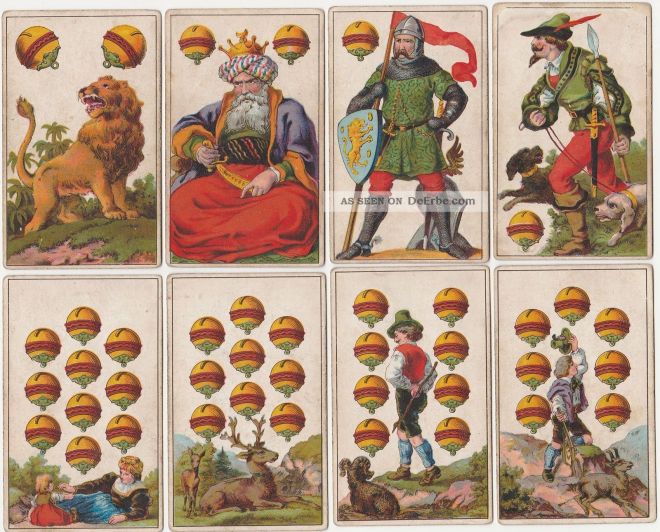
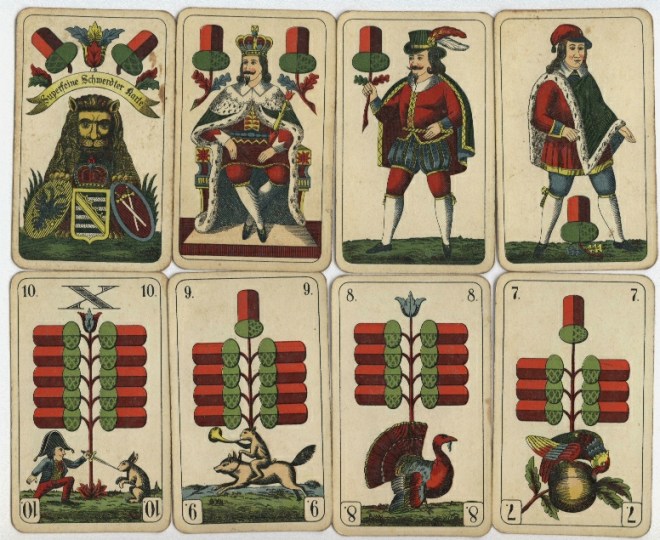
Through the newfangled technology of printing, in which they were leaders, and through which they were the first to produce cheap packs of cards, the German lands popularized the use of the following suits:
image
Personally, I don’t see much connection between these suits and the Italian versions. I think the Germans just used their fantasy. In any event, here are some old German playing cards with suits of Bells and of Acorns.
image

Not to be outdone, the French came up with a somewhat different set of suits.
image
The Hearts suit was taken as-is from the German suits. The Spades suit seems to be a slight modification of the German Leaf suit. The Clubs suit could be considered a geometric transformation of the Acorns suit – the sides of the acorn shell pulled out, the acorn itself shortened. The circular Bells suit of the Germans was replaced by a different shape, the diamond. As the cards above show, the French also introduced Queens, who displaced the upper marshal.

The French suits have since become those most used worldwide. Why that should be is not completely clear to me. I think it probably has something to do with the fact that the French suits are easier to read; I would have got really confused using those German cards I show above – “wait, is that an Eight of Acorns I have in my hand, or a Nine?” Or perhaps it was because the French were the arbiters of good taste in Europe until World War I. Or perhaps it was because the British adopted the French suits and happened to become the most powerful country in the world with the biggest colonial Empire, which allowed them to impose their choice of card suits and card games on their colonial subjects. Or perhaps it was because the Americans, who took over the title of the most powerful nation, followed the British in choosing French suits for their playing cards. For any or all of these reasons, or maybe others again, French suits now stare up at me from my games of Spider Solitaire and Freecell.

Well, now that I’ve figured all that out, I can go back to what I was doing and actually win my Spider Solitaire game.

____________________
Old Chinese cards, coins and strings of coins: http://www.gamesmuseum.uwaterloo.ca/Archives/Wilkinson/Wilkinson.html
Old Chinese cards, face card: https://en.m.wikipedia.org/wiki/Playing_card
Chi-pai three-suited cards: https://en.m.wikipedia.org/wiki/Chinese_playing_cards#Money-suited_cards
Silk Road: http://archive.silkroadproject.org/tabid/177/defaul.aspx
Mongol Empire: https://mapcollection.wordpress.com/2012/06/27/the-mongol-empire/
Mamluk card: https://en.m.wikipedia.org/wiki/Playing_card#Egypt
Bergsmasche deck: https://en.m.wikipedia.org/wiki/Italian_playing_cards#/media/File%3ACarte_bergamasche.jpg
Flemish hunting deck: https://en.m.wikipedia.org/wiki/Flemish_Hunting_Deck
German suites: https://en.m.wikipedia.org/wiki/German_playing_cards
Old German playing cards, acorn: http://www.spielkarten24.de/flohm.htm
Old German playing cars, bells: http://deerbe.com/unt/59680-___alte_spielkarten_playing_cards_dondorf_301_deutsche_spielkarte_1868___.html
Old French playing cards: http://www.culture.gouv.fr/public/mistral/joconde_fr?ACTION=CHERCHER&FIELD_98=AUTR&VALUE_98=BERGERET%20Pierre%20Nolasque&DOM=All&REL_SPECIFIC=1

WORLD TOUR WITH MINT

Bangkok, 11th October 2015

A little while back, my wife, bored with the usual round of cooking in the tiny, stuffy, hot kitchen of our apartment and longing to spice things up a bit with some change, espied a fresh herb in the vegetable section of our local supermarket which turned out to be mint. She brought it back and for several weeks now, we have been trying chicken à la mint, pork à la mint, fresh mint in green salad, and – the subject of this post – mint in tomato-based sauce for pasta.

Let me interject here that a basic difference between me and my wife is that she is adventurous, ready to try new things, and I am timorous, fearful of the new and comfortable with the true and the tried. This is as true for food as it is for any other sphere of life. I therefore approached these experiments in our usual cuisine with some diffidence if not suspicion. Actually, apart from the fresh mint in green salad, which I forcefully suggested we not try again, it worked rather well. In the case of mint in tomato-based sauce for pasta, it worked really well. The mint added a sweet overtone to the acidity of the tomato which did wonders to the palate. I have graciously allowed this variation on a theme to be added to our culinary repertoire. It’s very easy to prepare, by the way: replace basil leaves with mint, et voilà! (or you can just add the mint to the basil leaves)

A quick whip around the internet shows me that my wife is not the only one to have stumbled onto this use of mint. Martha Stewart, no less, offers a recipe where the tomato sauce contains mint. I throw in a picture from another recipe – readers are going to have to take it on faith that the little green bits in the sauce are finely chopped mint leaves.

tomato-mint sauce

One thread in these posts of mine has been to salute the humbler ingredients in our food, those which never get much publicity but are actually the ones that make each of our dishes so special. I’ve written on lemongrass recently, and capers and anise a while back (and, at the other end of the spectrum, I’ve written very disapprovingly about the use of hot spices). So I will use this occasion to also sing the praises of mint, reviewing some of its better uses in food.

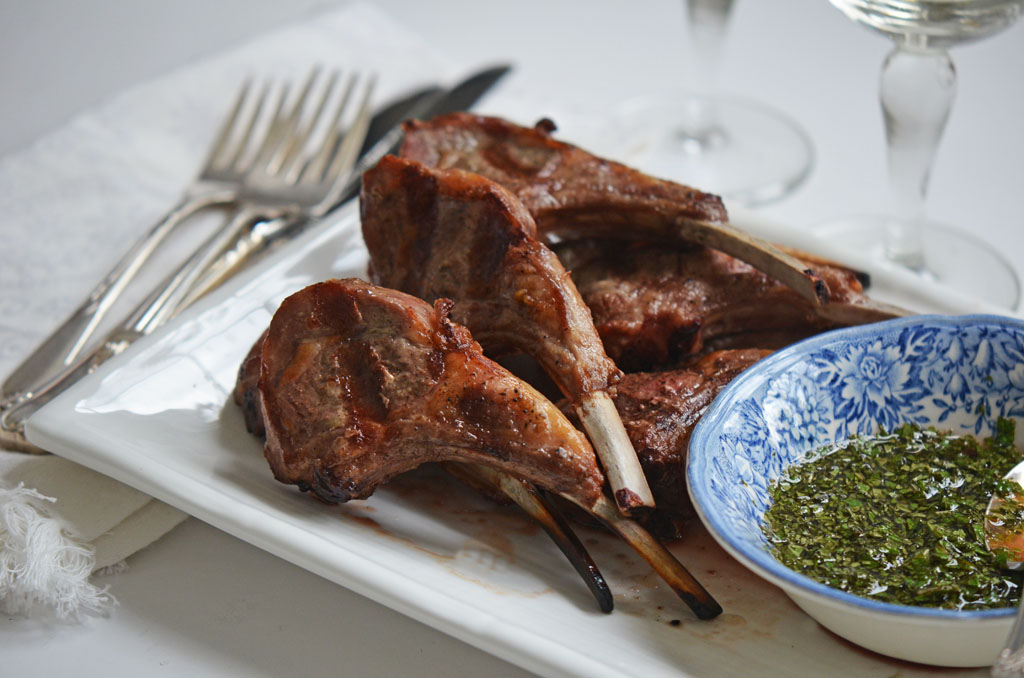
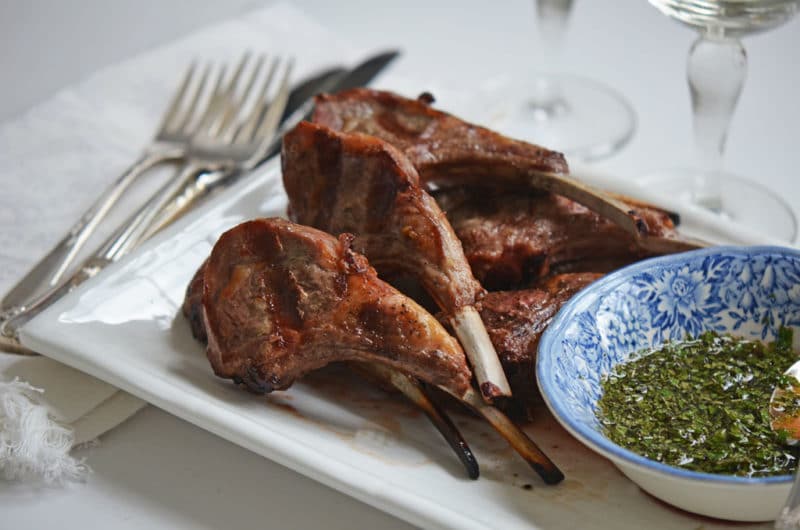
As I usually do, I began surfing around the internet to see what I could find. I was surprised to not come across a huge use of mint, at least in my part of Europe (Western Europe, to use the Cold War parlance). Of course, there is that most English of dishes, mint sauce, a wonderful, wonderful sauce to put on lamb chops. But this dish has already been the subject (or one of the subjects) of a previous post, in which I sing the praises of the sweet-and-salt combination, so I don’t feel I can go on about it again. I will leave readers to refer to that post and move on – but not before throwing in a picture of mint sauce with lamb chops.

lamb sauce and lamb

In my electronic wanderings, I stumbled across the following dish, which also seems incredibly English – at least, it involves peas, and since peas are in my mind as English as Big Ben or HM the Queen (one of the veggies in every meat and two veggies which I had in my youth seemed to be peas), I include it. We are talking of pea soup with mint (I give thumbnail recipes for this and other dishes that I mention at the end of the post).

pea and mint soup

I have a feeling that this soup would be good chilled, like gazpacho.

I also want to add here another dish that I came across as I went around raising electronic rocks to see what was hidden below them. It’s actually an eggplant dish from 16th Century Italy. I add it because I think it’s kind of cool to look at what our ancestors were eating. But it’s also an intriguing dish because it looks to be an ancestor of the modern dish we know as eggplant parmigiana. The big difference between the two is the absence of a tomato-based sauce in the old recipe. I suppose this difference reflects the fact that tomatoes were not yet current in Italian cuisine in the 16th Century. Instead, a mix of herbs (mint, sweet marjoram, salad Burnet, parsley, fresh fennel tips), crushed garlic, a couple of spices (cinnamon and cloves), pepper, and salt, are spread over the eggplant, and the whole is splashed with verjuice (I will let readers look that one up, as I had to) and sprinkled with sugar. Then, like eggplant parmigiana, cheese is spread over the whole. Here’s what it looks like, and the thumbnail recipe is at the end.

pomi sdegnosi

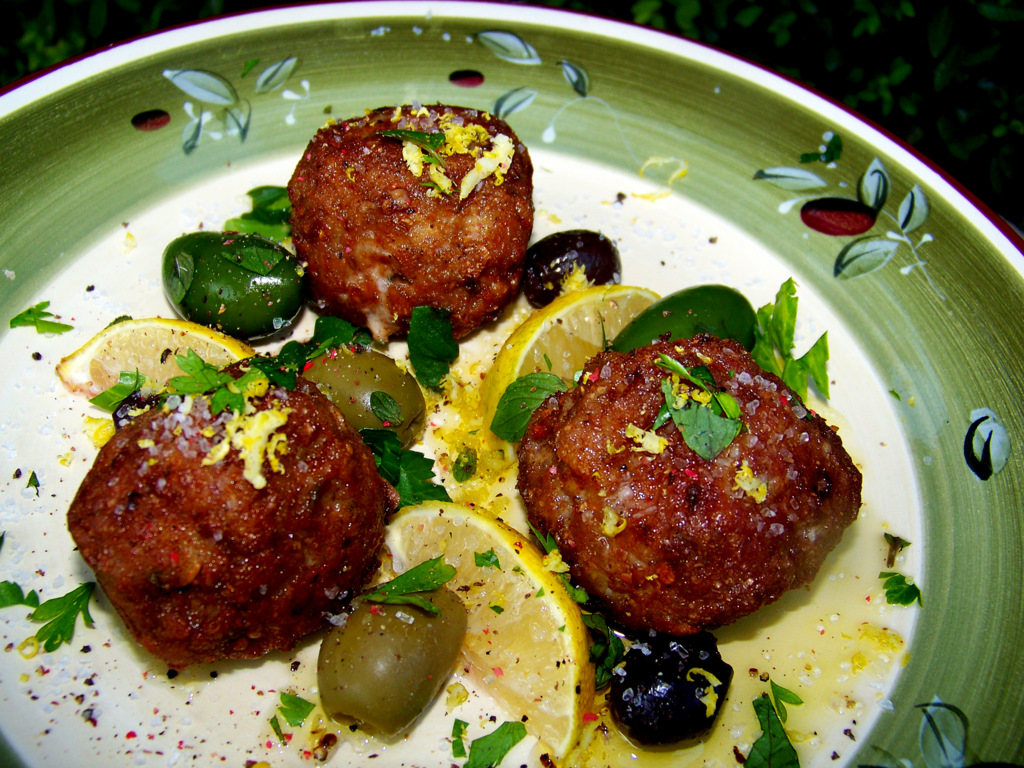
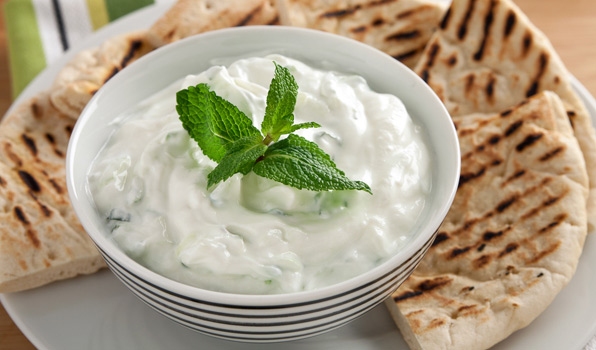
It was at this point that luck came to the rescue. As I was surfing disconsolately around the internet, I came across an interesting article entitled “Mints in Ethnic Cuisines”, written by two ladies from Texas, Madalene Hill and Gwen Barclay. I am indebted to them for much of what follows. It was they, for instance, who taught me that Greek cuisine bucks the (modern?) European trend of using little mint. It seems that Greeks use mint with wild abandon in their cuisine. The two authors mention several dishes in particular: keftedes meatballs, the yoghurt-based tzatziki sauce, the bean stew gigantes plaki, dolmas (stuffed grape vine leaves), hortopita, which is a vegetable and rice pie; even that best known of Greek dishes, moussaka, has mint in it! I give thumbnail recipes of all these dishes at the end, but here I will only post pictures of keftedes meatballs

keftedes

which can be served with the yoghurt-based tzatziki sauce as a dip

Tzatziki

I chose to put pictures of these two dishes with the hope that my wife (and I) can try to make them …

I now leave Europe behind, skimming over the waves of the Aegean Sea to the land of Lebanon, because I want to raise a cheer for that most Lebanese of dishes, tabouleh.

tabouleh

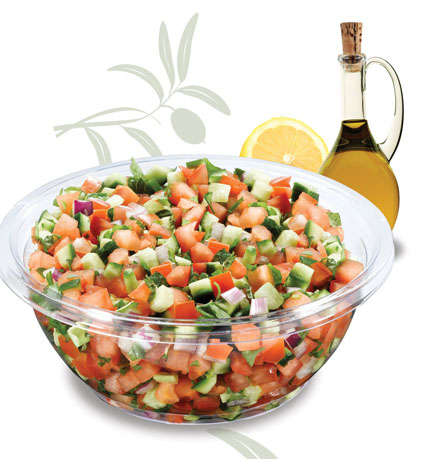
I have very fond memories of eating tabouleh in Beijing – yes, Beijing. There was a little Lebanese restaurant down the road from where we lived, run by a small, tubby Lebanese man with a twinkle in his eye. When Spring came rolling round, it was incredibly pleasant for my wife and I to sit outside the restaurant, under the barely budding trees, in the tepid heat of the midday sun, slowly working our way through a plate of tabouleh. I must say, though, I’m a little surprised that not only chopped parsley but also chopped mint is added. I’m not sure that our tubby Lebanese restaurateur was putting mint in his tabouleh. I will need to hunt down a restaurant which serves tabouleh with both mint and parsley. While I’m at it, I will also see if it serves Arab or Middle-East salad.

arabic-saladLemon segments, diced cucumber and tomatoes, the whole mixed with chopped onions, mint, and parsley. Sounds sooooo good …

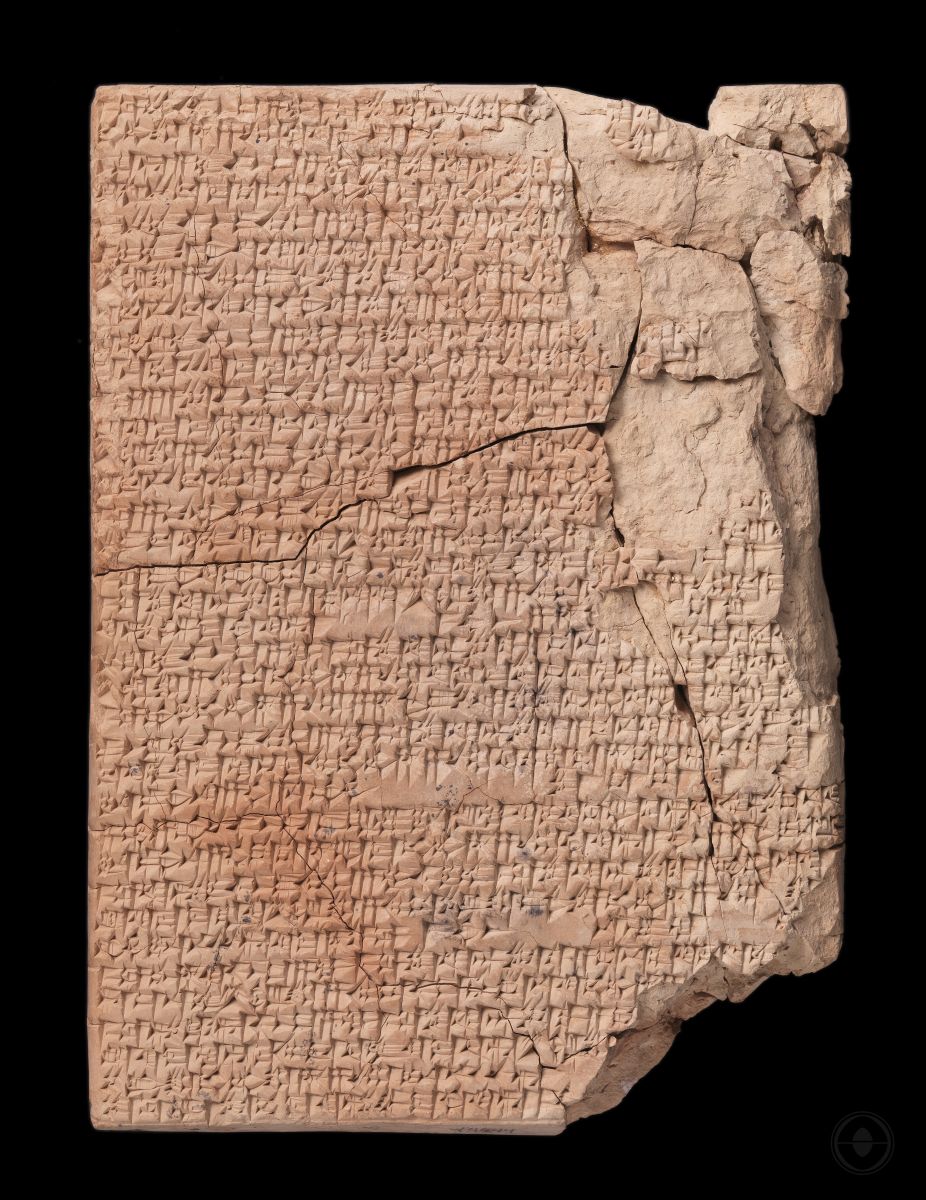
I now want to arc over to the Indian subcontinent, but not before pausing for a minute in modern-day Iraq. I’m actually stopping here for Iraq’s Babylonian past. Like any self-respecting university, Yale University has a collection of cuneiform tablets, some of which, like this one, list recipes.

YBC4644

These have been translated by a Frenchman, Jean Botéro (this immediately makes me think of the Egyptologist, Professor Philémon Siclone, in the Tintin album “Les Cigares du Pharaön”

egyptologue-siclone-jpg

but I digress).

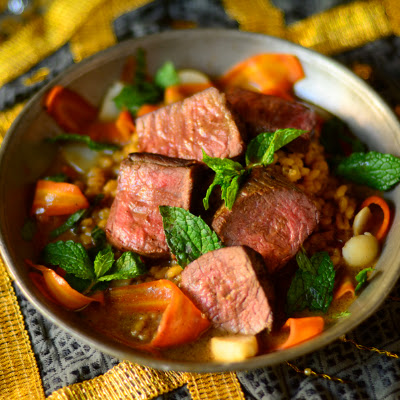
One of these, Recipe XXIII, contains mint, to whit: “Leg (of mutton) (?) meat is used. Prepare water; [add] fat […] samidu, coriander (?), cumin (?), and kanašû. Assemble (all the ingredients in the cooking vessel) and sprinkle with crushed garlic. (After cooking,) blend into the pot šuhutinnû and mint […]” As you can see, words are missing, the translation of some of the ingredients is unknown, and to make matters worse the recipe is exceedingly brief compared to our modern ones, leaving much to the skill – and imagination – of the cook. Nevertheless, Laura Kelley and a band of hardy cooks have been piecing together these telegraphic recipes from 4,000 years ago and trying them out. Many of the results are described on the web site “The Silk Road Gourmet”  I post here the picture of a modern take on Recipe XXIII, after someone concluded that šuhutinnû is probably carrot or possibly parsnip, and samidu is barley:

babylonian lamb and mint

I have added the modern version of the recipe to the thumbnail recipes below, for those who might want to try connecting gastronomically with our remote Babylonian ancestors.

After that pit stop in the fertile crescent, we go on to the Indian subcontinent, the land of chutneys – not so much the fruit-based chutneys which the colonial Brits brought back to the UK, but more vegetable-based chutneys. Here is a chutney, mint-coriander chutney, where mint takes pride of place.

mint-coriander chutney

One of the recipes I perused helpfully informs the reader that this chutney can be served with pakoras, samosas, chaat, chole, or even potato chips.

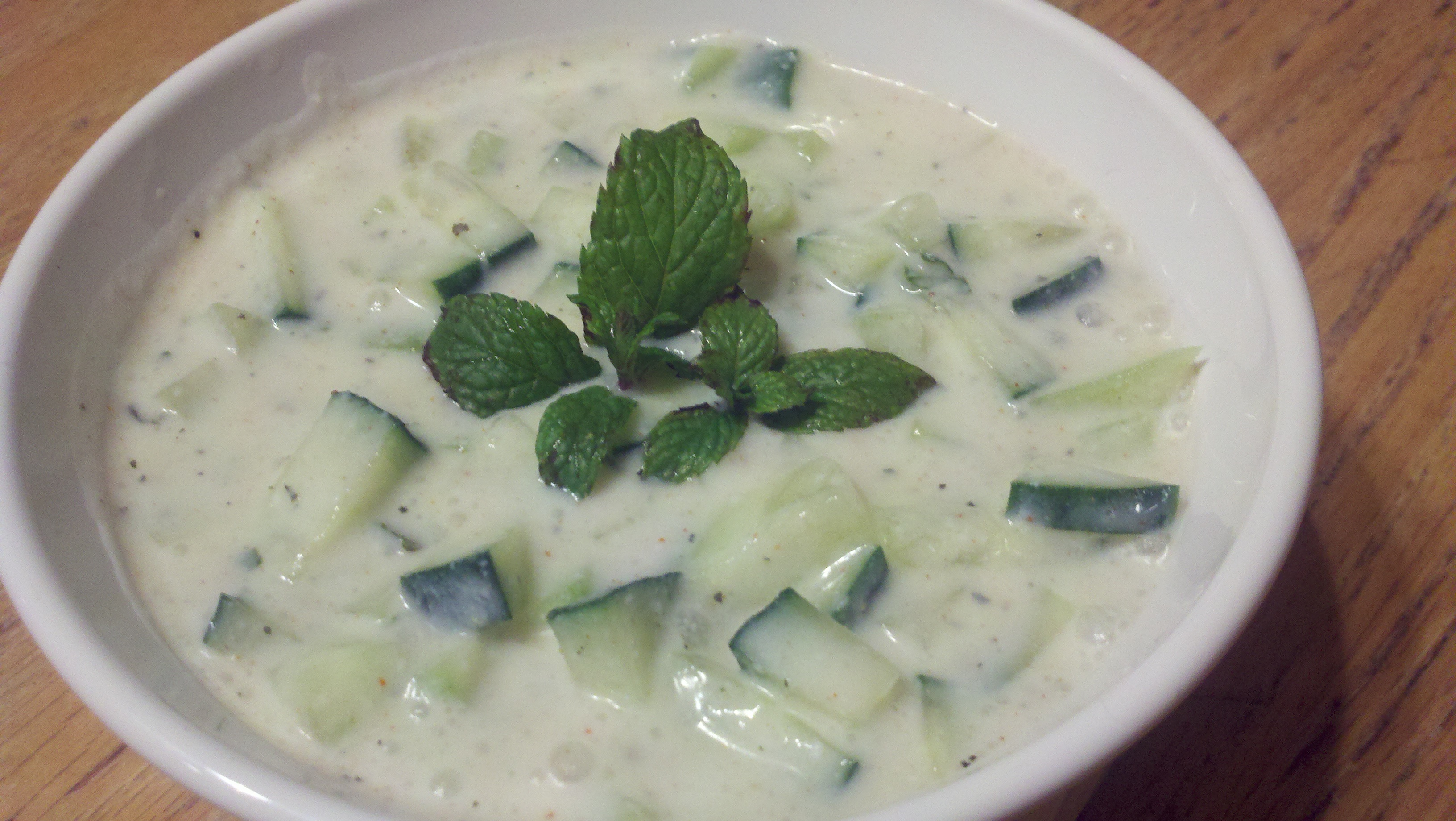
This chutney allows me to segue smoothly into another popular dish from that part of the world, raita, a cold yogurt condiment served to cut the heat of spicy dishes. And here I will throw in a picture of a cucumber-mint raita (with thumbnail recipe at the end).

cucumber-mint raita

Being based on yoghurt (or strictly speaking curds) and looking at how raitas are made, I have to think that they are (perhaps not so) distant cousins of the Greek tzatziki (which itself is part of a broader family of yoghurt-based dishes to be found from the Balkans to the Caucasus). Maybe one day I should write a post on yoghurt …

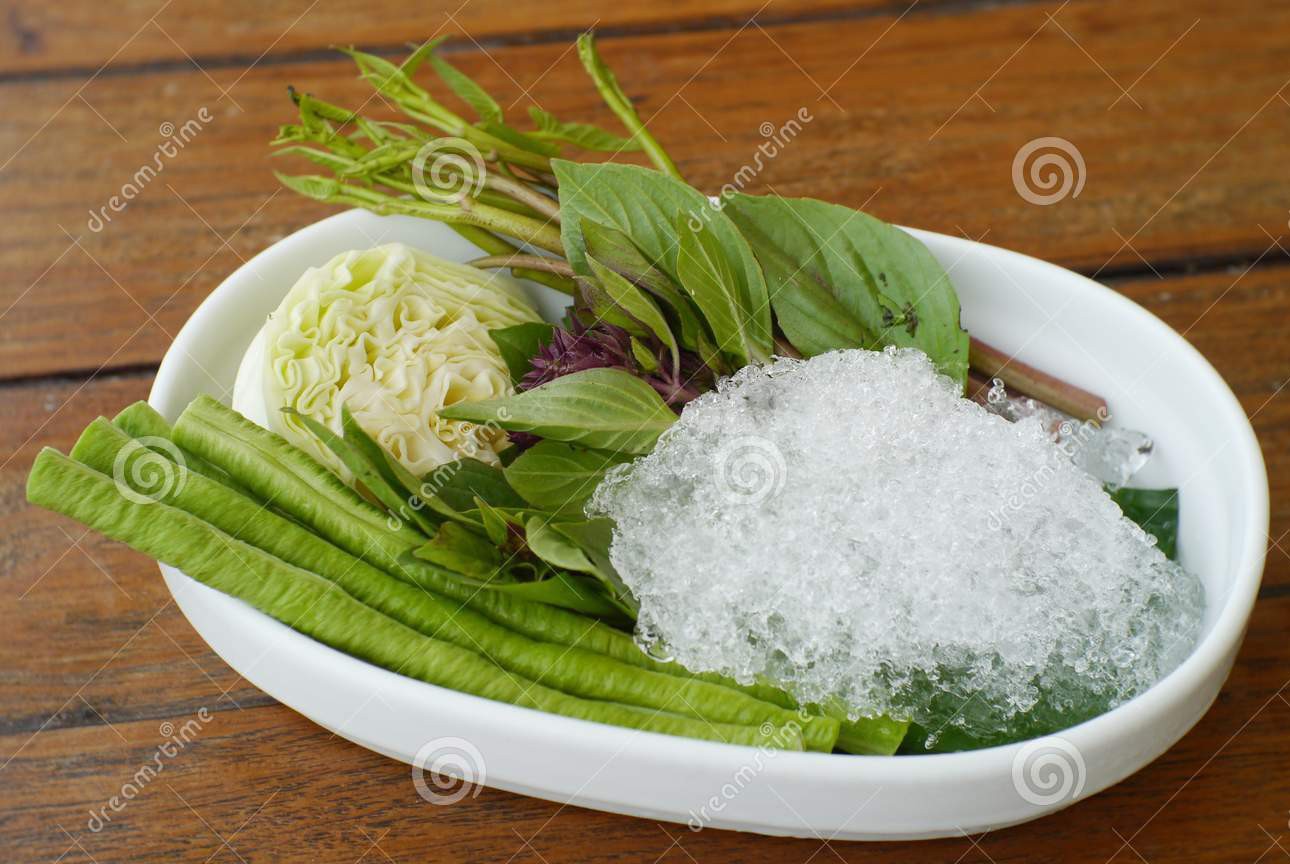
After this, I soar over the Bay of Bengal back to Thailand. Madalene Hill and Gwen Barclay say that mint is a very popular ingredient in Thai cuisine and in South-East Asian cuisine more generally. Certainly, I recently had a taste of a common use of mint here, where it joins a number of fresh vegetables being served as a side dish to be added to noodle dishes or just eaten along with other main dishes.

side dish fresh vegetables

We were saying bye-bye to a colleague and had lunch together in the office. The food was ordered from outside. My Thai colleagues informed me that most of the dishes I was trying were from the north of the country. I found it interesting to eat fresh mint leaves with some of the spicier dishes. This side dish of fresh vegetables is also common in Vietnam, and I suspect throughout South-East Asia.

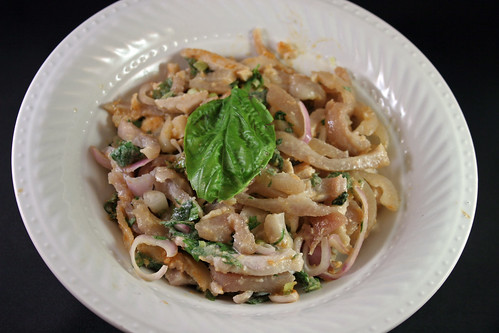
I’ll finish with a dish from Thailand, yam nang mu (pork skin salad). This is actually one of many Thai “salads” in which various cuts of meat or offal are sliced small, seasoned with spicy/sour/sweet sauces, and then mixed with herbs of one variety or another. In this particular case, you season boiled, defatted pork skin (there is a cousin to this dish using pig’s ears) with fish and shrimp sauce, lime juice, sugar, and mix it all with a large amount of mint leaves, some lemongrass, some roasted rice, and a number of other ingredients (thumbnail recipe at the end).

pork skin salad

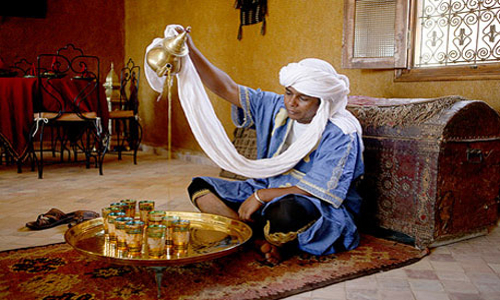
Well, that brings me to the end of my world tour following the trace of mint. There are a lot of dishes which use mint that I’ve not mentioned. I’ve also not touched on the use mint in drinks, for instance Moroccan mint tea with its spectacular pouring technique

moroccan mint tea

or the somewhat more alcoholic mint julep, a favourite of the Kentucky Derby.

mint julep

But I’ll leave these for another day. Right now, my wife is looking at her watch and at the door. Time to go.

THUMBNAIL RECIPES

Pea and mint soup: Soften some onions in a heavy pot over medium heat. Add broth and bring to a boil. Add peas, reduce heat, and simmer gently until tender. Add chopped mint leaves (and parsley if you want). Add more broth. Purée in a blender until smooth. Season with salt and pepper.

Pomi sdegnosi, or braised eggplant: Slice the eggplant lengthwise and let them steep in in lukewarm water for 30 minutes. Rinse. Submerge the eggplant slices in boiling water for about 8 minutes. Remove and drain. Dredge the eggplant slices in flour and layer the bottom of an oiled dish. Chop all of the herbs – fresh mint, marjoram, parsley, salad Burnet, fennel tips – and mix them with minced garlic, spices – cinnamon, cloves, pepper – salt, sugar, and verjuice (for which lemon juice can be substituted). Cover the eggplant with breadcrumbs, drizzle with olive oil, cover with herb/spice mixture and then with provatura cheese (mozzarella, another pulled cheese, can be substituted). Repeat for each layer of eggplant. Bake in the oven for 30 minutes. (Adapted from http://atasteofhistorywithjoycewhite.blogspot.com/2014/08/to-braise-eggplant-historic-food.html)

Keftedes: Combine ground beef, bread dunked in milk, minced onion, minced garlic, finely chopped mint and oregano, some vinegar, some beaten eggs, a small amount of grated nutmeg, salt, and pepper, and mix well. Roll the mixture into balls. Dust the balls with flour. Put them in hot oil in a pan. Brown on all sides.

Tzatziki: Peel cucumbers and dice. To draw out their water, sprinkle them with salt and let them sit for 30 minutes. Drain well. Put them in a blender, along with minced garlic, some lemon juice, some chopped mint (and some chopped dill if you wish), and a little ground black pepper. Process until well blended. Stir the result into Greek yogurt. Salt to taste. Let it stand for at least two hours before serving so flavours can blend.

Gigantes Plaki: Soak gigantes beans (giant butter beans) overnight. Cover with fresh water and bring to the boil. Simmer for a couple of hours until the beans are just tender. In parallel, gently soften chopped onions and garlic for a few minutes. Then stir in some sweet paprika, tinned tomatoes, 100ml water. Salt and pepper. Bring to the boil, then simmer for half an hour. Stir in sea kale or dandelion leaves (or chard as an alternative). Mix the cooked beans with the sauce, adding some more olive oil and chopped mint and parsley. Transfer to a casserole pan, and bake for half an hour or so until the beans are tender and the sauce thickened and bubbling. Can be served hot, warm or at room temperature.

Dolmas: In a little broth, mix ground beef and lamb with uncooked rice, minced onion and garlic, some pine nuts, chopped mint and parsley. Place rinsed grape leaves on a work surface. Place a dollop of the mixture at the center of each leaf. Tuck in the ends and roll tightly toward the leaf point. Layer the wrapped leaves in a large saucepan Cover them with broth mixed with lemon juice. Cook over low heat for three-quarters of an hour.

Moussaka: Place minced lamb, minced onions, crushed garlic, chopped mint and oregano, a couple of bay leaves and a cinnamon stick in a large frying pan and cook over a medium heat for a quarter of an hour. Stir in some flour. Add a glass of wine, canned tomatoes, some tomato purée, and bring to a simmer. Cook for half an hour, until the lamb is tender and the sauce has thickened. Season with salt and freshly ground black pepper to taste. Set aside this meat sauce. Fry eggplant slices for a couple of minutes. Set them aside. Cook potatoes in boiling water for five minutes, then cool under running water. Prepare a white sauce as follows. Melt butter in a saucepan, stir in some flour. Cook for a few seconds, then gradually stir in milk. Add some grated parmesan and grated nutmeg. Simmer the sauce gently for 5 minutes. Season to taste with salt and pepper. Remove from the heat and stir in a beaten egg. Spoon some of the meat sauce into a shallow dish. Cover with a layer of potatoes and a layer of eggplant. Repeat the layers twice more, finishing with the eggplant. Pour over the white sauce to cover the whole in a thick, even layer. Sprinkle with a bit more parmesan. Bake in the oven until deep golden-brown and bubbling.

Hortopita: Peel, seed, and shred some pumpkin. Weight it to drain its liquid. Cook it in a skillet until it wilts and most or all of its liquid has evaporated. Transfer to a bowl. Cook in the same skillet a chopped leek and onion until also wilted. Transfer to the bowl with the pumpkin. Cook chopped chard and spinach until wilted; add to the bowl. Add the herbs – mint, sorrel, hartwort, chervil, dill, fennel leaves, parsley, and oregano – to the bowl. Season to taste with salt and pepper. Roll out a first phyllo dough ball and place it inside an oiled roasting pan. Brush with olive oil. Repeat with the second piece of dough. Spread the filling evenly over the dough. Repeat with a third sheet of dough, placing it over the filling. Brush with olive oil. Roll out the last piece of dough to a slightly smaller piece, and place it over the surface of the pie. Join the bottom and top layers of dough. Brush the top of the pie generously with olive oil. Bake until the pastry is golden and crisp. Remove and serve warm or at room temperature.

Tabouleh: Stir together some bulgur and olive oil. Pour boiling water over, and let stand for a quarter of an hour. Drain well. Toss with finely chopped mint and parsley, a couple of chopped tomatoes, half a cucumber, several tablespoons of lemon and of olive oil. Season with salt and pepper.

Arab salad: Cut segments from half of lemon free from membranes and transfer segments to a cutting board, then squeeze juice from the remaining half a lemon into bowl. Put a couple of tablespoons of lemon juice in a bowl. Add finely chopped segments of lemon. Add salt, pepper, and several tablespoons of olive oil. Whisk to combine. Stir in the remaining ingredients: diced cucumber and tomatoes, finely chopped onion, finely chopped mint and parsley.

Babylonian lamb with barley and mint: Marinate lamb steaks in soy sauce for half an hour. Sauté in oil, along with the trimmings. Remove, leaving the trimmings in the pan. Stir barley into the oil and toast for a few moments. Add cumin, coriander, and chopped garlic. Simmer until the barley is cooked. Place the lamb steaks in the pan and cook the desired degree. Add finely sliced carrots and chopped mint for a few minutes. Remove the lamb and slice. Place the carrots in a serving dish, spoon the barley over carrots, add the sliced lamb, and spoon over with the sauce. (adapted from http://lostpastremembered.blogspot.com/2011/07/onions-onions-everywhere.html)

Mint-coriander chutney: In a blender, grind together chopped mint leaves, chopped coriander, a chopped green chili (personally, I would cut out the chili, but can it be Indian without it?), a piece of ginger, a small amount of cumin, and some lemon juice, until smooth, using a little water if necessary. Salt to taste.

Cucumber-mint raita: Coarsely grate a cucumber. Squeeze dry. Whisk curds (yogurt can substitute), chopped mint, a little cumin, even less cayenne pepper in medium bowl to blend. Add cucumbers and mix well. Season to taste with salt and pepper.

Yam nang mu (Pork skin salad): Boil pork skin until soft. Cool. Remove any fat from the skin. Slice the skin into thin, short slices. Mix well with a large handful of chopped mint leaves, finely minced lemongrass, lime juice, fish sauce, palm sugar, and ground roasted rice.

_______________________________

Tomato-mint sauce: http://www.seriouseats.com/images/2013/03/20130302-242913-tomato-mint-sauce.jpg (in http://www.seriouseats.com/2013/03/sauced-tomato-mint-sauce.html)
Mint sauce and lamb: http://www.maureenabood.com/wp-content/uploads/2012/03/Grilled-chops-platter-POST.jpg (in http://www.maureenabood.com/2012/03/29/grilled-lamb-lollipops-with-fresh-mint-sauce-chine-on/)
Pea and mint soup: http://www.epicurious.com/images/recipesmenus/2013/2013_april/51154900.jpg (in http://www.epicurious.com/recipes/food/views/minty-pea-soup-51154900)
Pomi sdegnosi: http://i.ytimg.com/vi/MgcFEo-S8WI/hqdefault.jpg (in https://www.youtube.com/watch?v=MgcFEo-S8WI)
Keftedes: https://rencooks.files.wordpress.com/2009/11/100_4063.jpg (in http://ediblearia.com/2009/11/05/lamb-keftedes/)
Tzatziki: http://www.cbc.ca/inthekitchen/assets_c/2012/02/Tzatziki4563-thumb-596×350-174210.jpg (in http://www.cbc.ca/inthekitchen/2012/02/tzatziki-sauce.html)
Tabouleh: http://almarahgrill.com/wp-content/uploads/2015/06/tabouleh.jpg (in http://almarahgrill.com/product/tabouleh/)
Arabic salad: http://suzyeats.com/wp-content/uploads/2011/05/arabic-salad.jpg (in http://www.snipview.com/q/Arab_salad)
Cuneiform tablet YBC 4644: http://babylonian-collection.yale.edu/sites/default/files/images/New%20Images/YBC4644_OBV_0004.jpg (in http://babylonian-collection.yale.edu/highlights)
Egyptologist in Tintin: http://s1.e-monsite.com/2009/04/06/06/46230270a-siclone-jpg.jpg (in http://univers-tintin.e-monsite.com/pages/les-personnages/philemon-siclone.html)
Babylonian lamb and mint: http://1.bp.blogspot.com/-h-K2nSXnfys/TiNFcYNVuzI/AAAAAAAACSI/5JHqnYlNzv4/s400/DSC_2266.JPG (in http://lostpastremembered.blogspot.com/2011/07/onions-onions-everywhere.html)
Mint-coriander chutney http://crumbsandtales.com/wp-content/uploads/2013/07/Hari-Green-Chutney-made-with-cilantro-and-mint-21.jpg (in http://crumbsandtales.com/mint-and-coriander-chutney/)
Cucumber-mint raita: https://familynaturally.files.wordpress.com/2012/02/2012-02-26_19-55-59_782.jpg (in https://familynaturally.wordpress.com/2012/02/26/raita-yogurt-with-cucumber-and-mint/)
Side dish fresh vegetables: http://thumbs.dreamstime.com/z/side-dish-vegetable-thai-restaurants-you-see-serves-hot-spicy-food-e-g-som-tam-green-papaya-salad-34668038.jpg (in http://www.dreamstime.com/royalty-free-stock-photos-side-dish-vegetable-thai-restaurants-you-see-serves-hot-spicy-food-e-g-som-tam-green-papaya-salad-image34668038)
Pork skin salad: https://c2.staticflickr.com/4/3038/3047383176_dbdea9103c.jpg (in https://www.flickr.com/photos/jakeslagle/3047383176)
Moroccan mint tea: http://lcmt.topdesert.com/content/photos/travel-guide/authentic-culinary-experiences/pouring-your-mint-tea-without-spilling-a-drop//lowcost-morocco-travel-pouring-your-mint-tea-without-spilling-a-drop1.jpg (in http://lcmt.topdesert.com/index.php?ref=ait-ben-haddou-and-ouarzazate-one-day)
Mint julep: http://ccattache.com/wp-content/uploads/2014/04/k17_18865809.jpg (in http://chuckcowdery.blogspot.com/2015/04/brown-forman-has-kentucky-derby-locked.html)

TROMPE L’OEIL AND STINGINESS

Bangkok, 27 July 2015

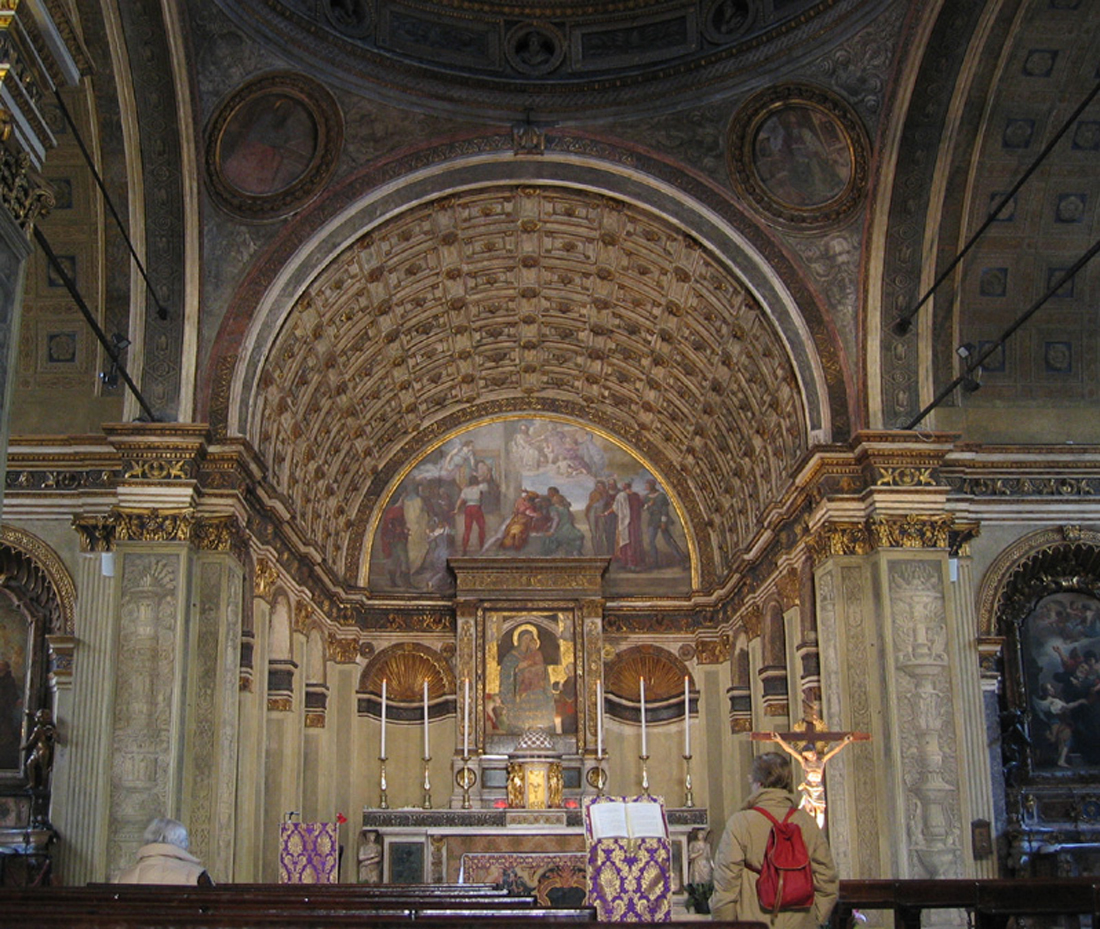
Trompe l’oeil is a very respectable art form, with a long and distinguished presence in the world of art, at least in Western art. I am told that the Greeks and Romans practiced it, although I do not recall ever having seen an example. In any event, artists took it up again with a vengeance during the Renaissance, and art thereafter is littered with pieces which “fool the eye”, tricking the viewer to see three-dimensional depth where there is none. We have a beautiful example just up the road from our apartment in Milan, in the church of Santa Maria presso San Satiro. My not-yet wife took me there on my first trip to Milan in 1975 and my eyes were indeed fooled.
image
What I had taken to be a deep apse behind the altar is actually an almost flat wall. The clever artist in question was Bramante, who painted it in the 1480s. In this case, he didn’t do it just to show how good he was, it was to give a feeling of greater depth to a church which was squeezed in between the adjoining buildings.

I could go on giving other examples from High Art, but actually I want to focus on a lower form of the art found in the province of Liguria. We’ve just come back from spending a week by the sea, near Genova, the province’s capital (and from where I managed to launch several of the previous posts).

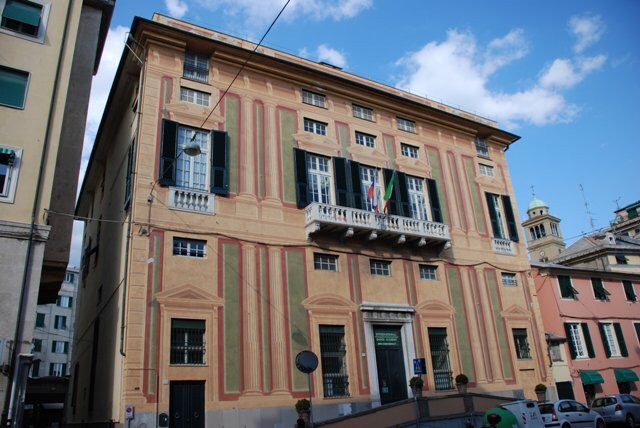
One of my recurring pleasures as I walk the streets of any conurbation in Liguria, from Genova down to the smallest village, is to come across houses like these.
image
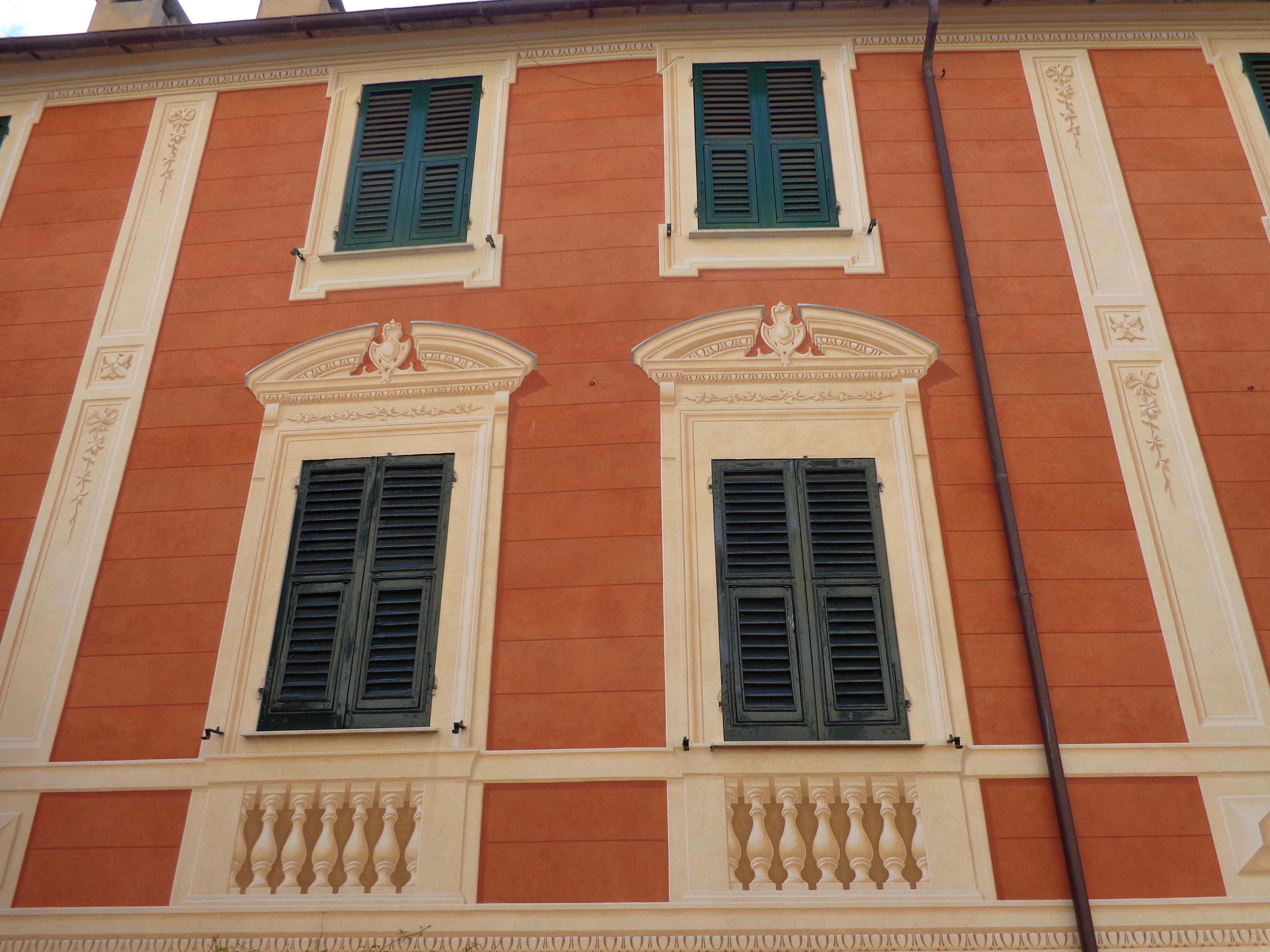
This form of trompe l’oeil is only found in Liguria, to the extent that the practice is almost a D.O.C.. In these cases, the painter (I hesitate to call him artist) embellishes what is otherwise the drab and flat facade of a house (you see an example to the right in the photo) with architectural elements which are painted so cleverly as to fool the eye into thinking that they are three-dimensional and “real”. The result is to make an ordinary house look more imposing, which in the old days no doubt (and perhaps even today) raised the residing family’s social standing a notch or two. It is even a way of making up for unfortunate blemishes in a facade, like the absence of a window which mars the symmetry of a house.
image
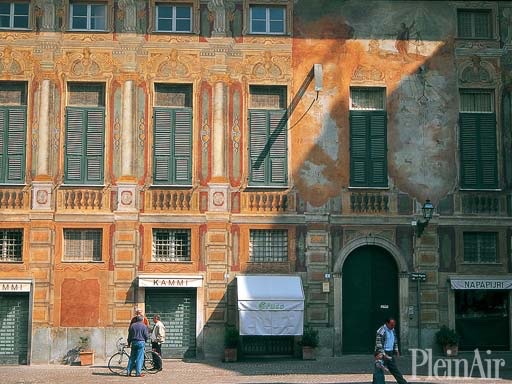
What is nice is to see is examples which run from the fresh and new to various states of weathering and finally decrepitude brought about by sun, rain, and more recently pollution.
image
image
image

image

Of course, one has to ask oneself why this art form is so popular in Liguria and nowhere else. My theory, for what it’s worth, is that it is a reflection of the well-known stinginess of the Genoese (and more generally Ligurians). In Italy, the Genoese have the same reputation as the Scots in England for being tight fisted, and there are loads of jokes about it, as indeed there are in the case of the Scots (“There was an Englishman, an Irishman, and a Scotsman in a pub. The Englishman stood a round, the Irishman stood a round, but the Scotsman just stood around”; sorry, I thought I would just quickly throw that one in). According to this theory, then, the Genoese (and by reflection the Ligurians) preferred to paint architectural elements onto their facades à la trompe l’oeil rather than go with the real things, because it cost them less.

I’m sure the Genoese must feel that this typing of them as scrooges by the rest of Italy is grossly unfair and they probably find it very irritating to be the butt of incessant jokes about it. But as they say, “there is no smoke without fire”. There must surely be some reason why they got this reputation. Curious to see what I could find out, I did an internet search on the topic (in truth, my wife did it since she’s very good at internet searches). Several suggestions popped up. One is that Liguria is in general a very poor land, made up of steep hills and little good agricultural land. People who live in such lands tend to be more careful with their hard-earned wealth scratched out of an unforgiving earth than those of us from richer lands (I’m sure this is the basis for the Scots’ reputation for stinginess). Another suggestion is that the Genoese in particular made much of their wealth in banking (they were the bankers of the Spaniards in the 16th century), and like all bankers got into the habit of not throwing their money around like we foolish non-bankers do. A third, which I like so much that I have adopted it, is a variant on the second (I have to thank Grimaldina, a citizen of Genova, for bringing it to my attention).
In 1586 or thereabouts Philip II, King of Spain, decided that he was going to invade England, to uphold the Catholic cause of course, but also to teach the damned English a lesson for attacking Spanish treasure fleets and shipping more generally. The worst offender was this gentleman, Sir Francis Drake

image

A great Englishman for the English, but nothing more than a damned pirate for the Spaniards.

To invade England, Phillip was going to need a navy, and a big one. As I said, the Genoese were the bankers of the Spaniards, so he came to them for the funds to build the necessary ships. I suspect the King made the Genoese an offer they couldn’t refuse. In any event, after much hesitation because it was a huge amount of money, and no doubt after extracting juicy concessions about trading monopolies for Genova in England once conquered, the Genoese accepted to fund the venture. Thus was built the Spanish Armada, or the Grande y Felicísima Armada, the “Great and Most Fortunate Armada”, as the Spaniards called it. And here, just for the hell of it, I throw in pictures of Philip II and Elizabeth I (it’s clear already from the pictures who’s going to win; I mean, look at Phillip II, have you ever seen such a nasty scowl?)
image

image

Alas, the Spanish Armada was perhaps great but it was not fortunate. After several engagements in the English Channel, where overall the Spaniards got the worst of it
image
the Armada was driven by the winds up into the North Sea, all the way up to Scotland. At that point, the Spanish commander decided to give up and go home. His idea was to round the top of Scotland, head out into the Atlantic, and then turn south. He turned too soon. His remaining ships found themselves too close to the west coast of Ireland, where, hit by terrible Atlantic gales, many were driven ashore. Of the 130 ships which left Spain only 67 limped home. The English cheered, but the Genoese cried; their fortunes had sunk to the bottom of the sea along with the ships. Genova went into a steep economic decline thereafter, from which it never really recovered. Thus was born the Genoese’s parsimony (and not stinginess, as stressed by Grimaldina). Like all great families which fall on hard times, it had to keep up appearances with less money in its pocket: ideal conditions for heavy adoption of trompe l’oeil.

________________

Santa Maria presso San Satiro: https://upload.wikimedia.org/wikipedia/commons/2/27/Sansatiro5.jpg (in https://it.m.wikipedia.org/wiki/Bramante#Santa_Maria_presso_San_Satiro_.281482-1486.29)
Genoese facade-1: http://www.sampierdarena.ge.it/joomla/images/phocagallery/villesamp/litoraneo/pallavicinocreditoitaliano/thumbs/phoca_thumb_l_dsc_0617.jpg (in http://www.sampierdarena.ge.it/joomla/index.php?option=com_content&view=article&id=94:villa-pallavicino-sec-xvi-via-sampierdarena-71&catid=48:litoraneo&Itemid=59)
Fake windows: https://dearmissfletcher.files.wordpress.com/2015/03/finestre-6.jpg (in https://dearmissfletcher.wordpress.com/2015/03/page/5/)
Genoese facade-2: https://timelessitaly.files.wordpress.com/2013/11/20131103-175731.jpg (in http://timelessitaly.me/tag/nervi/)
Genoese facade-3: http://rotellando.vanityfair.it/files/2015/06/IMG_6719.jpg (in http://rotellando.vanityfair.it/2015/06/16/piemonte-10/)
Genoese facade-4: http://cdn.pleinair.it/wp-content/uploads/106011.jpg (in http://www.pleinair.it/meta/viaggi-camper-l-impero-dipinto/)
Genoese facade-5: http://www.liguria.beniculturali.it/getImage.php?id=779&w=100&h=100&c=0&co=1&f=0 (in http://www.liguria.beniculturali.it/index.php?it/136/percorsi-tematici/3/5/3)
Sir Francis Drake: https://en.m.wikipedia.org/wiki/Spanish_Armada#/media/File:Gheeraerts_Francis_Drake_1591.jpg (in https://en.m.wikipedia.org/wiki/Spanish_Armada)
Phillip II: https://en.m.wikipedia.org/wiki/Spanish_Armada#/media/File:Philip_II,_King_of_Spain_from_NPG.jpg (in https://en.m.wikipedia.org/wiki/Spanish_Armada)
Elizabeth I: https://en.m.wikipedia.org/wiki/Spanish_Armada#/media/File:Elizabeth_I_(Armada_Portrait).jpg ( in https://en.m.wikipedia.org/wiki/Spanish_Armada#/media/File:Elizabeth_I_(Armada_Portrait).jpg)
Spanish Armada fighting English ships: https://en.m.wikipedia.org/wiki/Spanish_Armada#/media/File:Invincible_Armada.jpg (in https://en.m.wikipedia.org/wiki/Spanish_Armada)

BEACH BLUES

Sori, 16 July 2015

I’m not a beach person. I don’t much like spending time in places like these.

image

My fair skin, which I inherited from my Anglo-Saxon progenitors, burns immediately. So I spend all my time wearing clothes, which readers will agree is not optimal behaviour on a beach, or sloshing on 30+ sun cream and darting fearful looks at the blazing sun. In any case, I don’t see the pleasure of spending time in a micro-environment whose closest cousin is the middle of the Sahara desert, where sun beats down pitilessly on sand and pebbles, with no sight of tree or bush to give a pool of shade (beach umbrellas don’t count), or of stream of merrily burbling fresh water to give the parched mouth relief (vendors of bottled water don’t count either).

image
I should clarify that I’m talking here about the ecology of a Mediterranean beach in high summer; the UK or French Atlantic beaches of my youth are quite different micro-environments, closer to Arctic tundra – at least, my memories of these beaches are dominated by glacial seawater, howling winds, and driving rain.

image
Back to the Mediterranean beaches. There is also the issue of the pebbles. We frequent a pebble beach.

image
Nice to look at but agony for me to walk on as the pebbles drive into the arches of my feet – I have quite delicate feet, which is why, when in China, I had a foot massage only once, because after the masseuse’s vigorous manipulations I spent the rest of the week hobbling around in pain. The pebbles are also almost glowing they are so hot. Walking to the sea is like being one of those religious devotees who walk on burning coals to prove their devotion to whatever it is that they believe in.

image

It doesn’t finish when I get to the sea. As I stand there, hesitating before the thermal shock that I know awaits me when I will plunge into the sea, the ebb and flow of the waves makes me stagger back and forth, stepping heavily on those damned pebbles.

As if all this were not enough, I get so BORED on beaches. I’m past the age of building sandcastles (although I did have fun helping the children make theirs when they were young)

image
or looking for particularly smooth or beautifully coloured pebbles
image
or throwing buckets of water on people
image
or showing off beautifully sculpted pecs (and nowadays tattoos) to admiring girls and jealous boys (even assuming I had either).
image
The best I can do is to read a book, but even this is difficult to do in the oppressive heat

image

or find every excuse to escape the beach – cappuccino time, shopping for lunch and dinner, urgent need to pay parking fines in the municipal office … anything to get away from the beach.

I should clarify that I’m basing myself here mainly on my memories of spending summer holidays with the family at the seaside in Italy. Those holidays stopped some ten years ago, when the children, now grown up, were spending their summer holidays with their friends and later with their girl or boyfriend. My wife and I still came to the seaside, but not for the beach. We went for walks in the hills behind the sea

image
we wandered around the village
image
we went into Genova to admire the sites
image
we dined out in the local restaurants

image

Or we just looked at the view from our balcony.

image

But we did not visit the beach. At maximum, one evening we would go down and dip a toe in the water.

Yet, as I write this, we are actually on that beach. This year, my wife and I have had the immense luck of having both kids with us at the same time for a week and a half during our and their summer breaks. In an advanced state of gratitude, I was therefore quite happy to tag along when it was suggested that we all go down to the beach and spend the afternoon there. After a dip in the sea, which was surprisingly warm (I am very picky about the temperature of the water), we are now lying in the shade of beach umbrellas, sipping water from a bottle we have just bought at the bar. And I’m feeling surprisingly mellow about it all; the beach seems quite a nice place really, don’t know what I had against it.
image
All of which proves … what? I suppose that human beings can put up with anything as long as they are happy.

POST SCRIPTUM, 18 July 2015

The mellowness only lasted for another half day. After that, we let the children go to the beach without us.

________________

Ligurian beach: http://media-cdn.tripadvisor.com/media/photo-s/02/1a/a5/46/spiaggia-beach.jpg (in http://www.tripadvisor.it/Hotel_Review-g194849-d1933333-Reviews-Camping_dei_Fiori-Pietra_Ligure_Italian_Riviera_Liguria.html)
Desert: http://static.guim.co.uk/sys-images/Travel/Pix/pictures/2007/10/20/escape.oman460.jpg (in http://www.theguardian.com/travel/2007/oct/21/oman.yemen)
English beach: http://img.dailymail.co.uk/i/pix/2008/05_02/bmouthrainL0505_468x337.jpg (in http://murderiseverywhere.blogspot.it/2012/06/oh-i-do-like-to-be-beside-seaside-in.html)
Pebble beach: my picture
Walking on coals: http://www.slate.com/content/dam/slate/articles/life/explainer/2012/07/120723_EXP_hotcoalsEX.png.CROP.rectangle3-large.png (in http://www.slate.com/articles/health_and_science/explainer/2012/07/tony_robbins_firewalking_injuries_why_doesn_t_everyone_who_walks_on_hot_coals_get_burned_.html)
Sandcastle: http://www.vitadamamma.com/wp-content/uploads/2013/07/castello-di-sabbia.jpg (in http://www.lecivettesulsouffle.it/forum/index.php?topic=11341.15)
Looking for pebbles: http://3.bp.blogspot.com/-IH2N5FaEr9k/T2mr8Pzd_II/AAAAAAAAAhw/joKptZ4mRK8/s1600/Siria+676_ipiccy.jpg (in http://moto-perpetuo.blogspot.it/2012_03_01_archive.html)
Throwing water: http://i.dailymail.co.uk/i/pix/2011/07/20/article-0-0D144F4000000578-229_634x421.jpg (in http://www.dailymail.co.uk/tvshowbiz/article-2016716/Kendra-Wilkinson-Hank-Baskett-playful-beach-outing-son.html)
Muscled and tattooed man on the beach: https://s-media-cache-ak0.pinimg.com/736x/fa/d0/8c/fad08ce895f6a109914fe85059149dc5.jpg (in https://www.pinterest.com/pin/463448617878375391/
Asleep with book: http://38.media.tumblr.com/tumblr_m6ptoftxGM1r2dx74.jpg (in http://lindyandcaitcoffeedates.tumblr.com)
Walking in the hills: http://www.caisezionedirho.it/public/upload/latest/DSCN3681_2.jpg (in http://www.caisezionedirho.it/sito/images.asp?cat=25&id=146)
Village: http://www.iliguria.net/wp-content/uploads/2012/03/iliguria_francesco_robbiano_sori_51.jpg (in http://www.iliguria.net/sori-genova-im-sori-concerto-per-archi/)
Duomo Genova: http://www.chiesadigenova.it/genova/allegati/362159/arte_genova_001_cattedrale_san_lorenzo.jpg (in http://www.chiesadigenova.it/home_page/itinerari/00362159_Cattedrale.html)
Restaurant: http://media-cdn.tripadvisor.com/media/photo-s/07/50/92/62/edo-bar-trattoria-pizzeria.jpg (in http://www.tripadvisor.com/Restaurant_Review-g1807548-d1173493-Reviews-Edobar-Sori_Italian_Riviera_Liguria.html)
The beach: http://www.lamargheritaditeriasca.it/wp-content/uploads/2013/07/sori.jpg (in http://www.lamargheritaditeriasca.it/sori/)

DREAM JOURNEY: PART IV

Bangkok, 22 May 2015

Normally, we would be rather groggy as we drive our MG off the ferry in Bari at 8 am in the morning, coming in from Dürres and the previous post. I certainly would be; I never sleep well on ships. But this is a dream, so I decree that we are bright-eyed and bushy-tailed as we roar off the ferry. Our goal is Otranto, very near the end of Italy’s high heel. We head down the old Via Traiana, now more boringly called the Strada Statale 16, as far as Brindisi. There we take the SS 613, which follows the trace of a previous local Roman road that was too modest to have a name. We pass through Lecce, where we pause. Lecce is known for its plentiful baroque buildings constructed in the 1600s, all using a beautiful local white stone, so I throw in a picture of a square there as a visual memorial to this city.

Lecce

We continue on to Otranto, and drive straight up to the Cathedral. For this is the objective of our visit to Otranto – or rather the floor of the church is. When visitors enter the church, they are greeted by this magnificent floor.

otranto-mosaic-1

It is the largest floor mosaic in Europe. It brings me back to that other floor mosaic which we visited in the first leg of our trip in Aquileia, although eight centuries separate them. Some clever fellow took this photo from the ceiling, showing more or less the full extent of the mosaic.

otranto-mosaic-2

The subject of the mosaic is a Tree of Life, and you can indeed see the trunk of the tree working its way up the nave. Strangely enough, the narrative of this tree flows from the top down, and so near the high altar we have various scenes from the story of Adam and Eve, of which I throw in one photo.

otranto-mosaic-3-adam eve snake

Honestly speaking, the story is difficult to read, so I shall just insert a couple of photos of other parts of the floor. This is King Arthur

otranto-mosaic-4-King Arthur

and this, Satan

otranto-mosaic-5-Great Satan

while this is said to be a self-portrait of the floor’s designer, a monk by the name of Pantaleone who hailed from the monastery of San Nicola di Casole, a little to the south of Otranto.

otranto-mosaic-6-Pantaleone_ self-portrait

The mosaic was laid down in the 12th Century when this part of Italy was Norman, along with Sicily. In fact, the design of the floor rather reminds me of that other great masterpiece of Norman art, the Bayeux tapestry. I include here one photo of that tapestry, the famous scene where Harold Godwinson is killed by a Norman arrow through his eye.

Tapisserie de Bayeux - Scène 57 : La mort d'Harold

Next stop: Palermo in Sicily. We’ll get there by cutting across Italy’s heel to Taranto and then along the instep and sole of the Italian boot all the way to Reggio Calabria, where we’ll catch the ferry over to Sicily. I take the back roads to get to Taranto, because I want to drive through the small town of Copertino. As far as I know, this town is known for nothing special except a large castle and a saint. But to us, it has a great importance: my wife’s maternal grandfather came from Copertino and so it is the source of one-eighth of my children’s DNA. He emigrated to Milan in the early 1900’s, part of the massive migrations out of the south of Italy at the turn of the 20th Century. In typical migratory fashion, his departure eventually brought all his brothers and sisters up north. Family lore has it that his father ruined the family by taking the new Italian State to court over the expropriation of some of his land. He took the case all the way to the Court of Cassation, where he eventually lost the case, by which time he had also burned through all his money. Even though this is a very modest place with nothing special to write home about, I feel I must throw in a photo to commemorate it.

copertino

Onwards to Taranto, although in truth as we approach the city we turn our heads away and drive on. Taranto has been devastated by the plans of successive Italian government in the post-war period to develop the south of Italy through the implantation of heavy industry (I’ve already mentioned this in another post on Sicily). What were then the biggest steel works in Europe were plonked down here in the 1960s, and other heavy industry followed. By the 1980s, when my wife and I went to Taranto for the first time, the investment was in trouble. But the government couldn’t let it go down the tubes, it was politically too important. So money – half of it wasted through corruption and graft – was poured in to prop everything up. It’s stayed propped up – just – but in the meantime the industrial complex has poisoned half the population. Talk about sustainable development …

taranto

We are now driving through what was once Magna Graecia, Greater Greece, that string of Greek colonies which dotted the underside of the Italian boot as well as the coasts of Sicily (and even the shin and calf of that shapely Italian boot). The glittering stone in this string of cities was undoubtedly Syracuse in Sicily, where Archimedes – he of the original eureka moment – was born and was killed. But all the cities along here, from Taranto in the East to Selinunte in the West, were once flourishing and prosperous city-states. One of them, Sybaris, even became a byword for self-indulgent opulence – it was said of one of its citizens that he slept on a bed of rose petals, and if even one of them was folded over he could not sleep. The town’s name has entered the English language, a sybarite being a voluptuary or a sensualist. Now, Sybaris lies under four meters of mud. The only claim to fame of the surviving Calabrian towns is that they are infested by the ‘Ndrangheta, Calabria’s answer to Sicily’s mafia. It is said that John Paul Getty III, kidnapped in Rome back in 1973, was kept hidden in these parts. He was returned after his family forked over a ransom of $3 million – paid a good deal reluctantly (his grandfather is reported to have said, “I have 14 grandchildren. If I pay one penny now, I’ll have 14 kidnapped grandchildren”) and only after one of his ears had been cut off and sent to a newspaper. It is whispered that many a new house around here was built with Getty money.

We stop for a moment in Crotone, on the ball of Italy’s foot, not because it’s any less dreary than the other towns we’ve passed through, but because something momentous happened here: Pythagoras set up his first school and came up with all those clever mathematics, among which was his theorem which I, like every child of 11 or so, learned in geometry class: “a2 + b2 = c2“, or in plain English, “in a right triangle, the square of the hypotenuse is equal to the sum of the square of the other two sides”. At least, that’s what I was told by proud Crotonesi when I was here 20 years ago to do an environmental audit. Alas! It was not so. Pythagoras did indeed come to Crotone, but all he did was to set up some sort of mystical, esoteric sect which dabbled in the quasi-magic of whole numbers. It’s very unlikely that he personally came up with any of the mathematical cleverness attributed to him; his disciples did, but later. I think this painting, by a 19th Century Russian painter, captures nicely the strongly mystical (and to my way of thinking, rather weird) overtones of the initial Pythagorean movement.

pythagoreans celebrating sunrise

What Pythagoras and his sect did do in Crotone was to eventually take over the city’s government, and it was during his time in office that Crotone destroyed Sybaris. Several other cities in the area also espoused Pythagorean forms of government, but after a while there was a backlash. Back in Crotone Pythagoras was chased out, to end his days in nearby Metapontum, another city now lying under meters of mud. But Pythagorean schools continued, although they restricted themselves to maths and “natural philosophy” and left politics to others. Probably better that way …
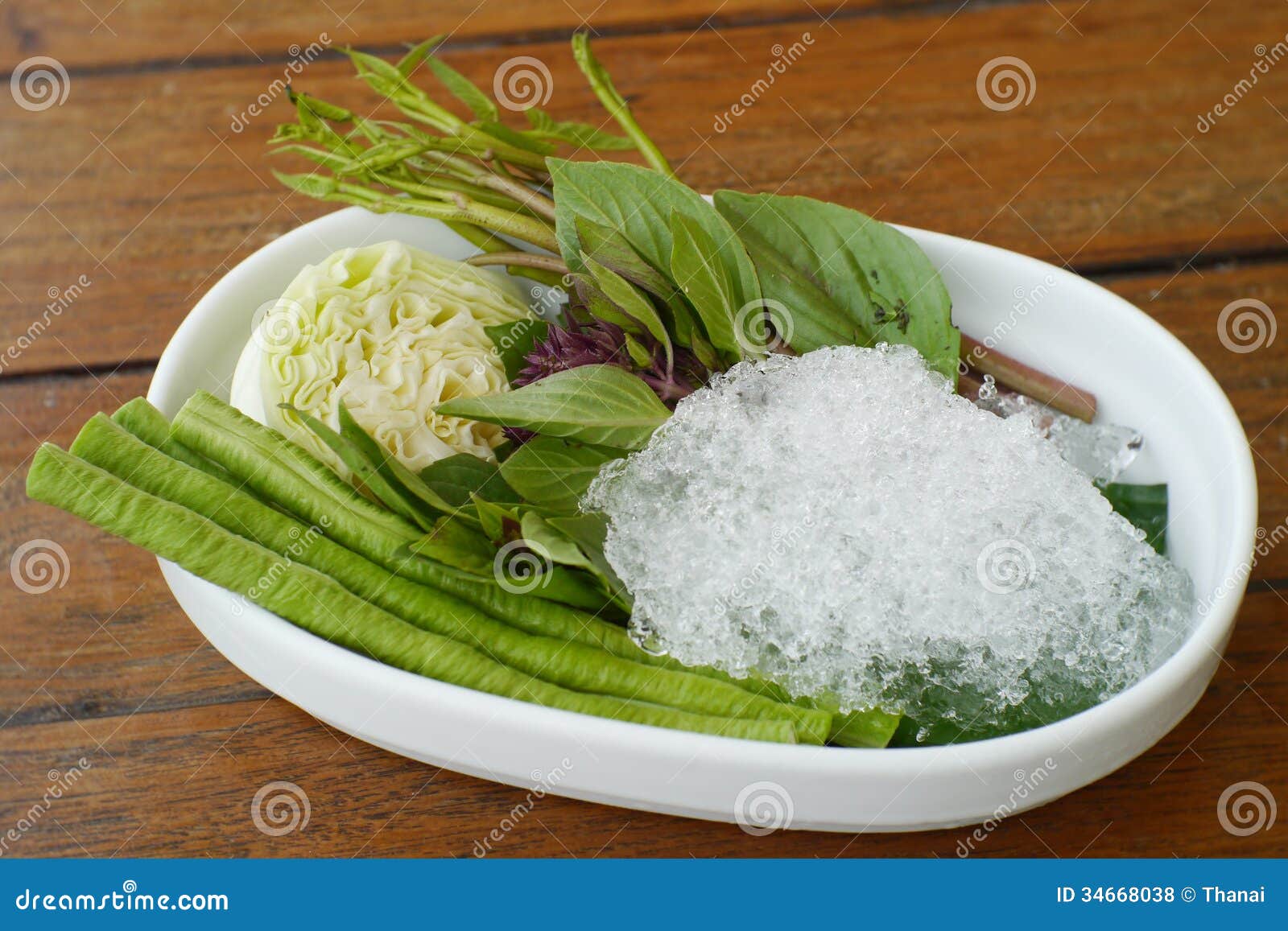
I take one last look at the industrial plant I audited all those years ago – another industrial works plonked down here, and another one that has closed, leaving nothing but bitterness in its wake.

pertusola

It’s time to move on.

When we reach Reggio Calabria, although my wife is reluctant I insist: we must go to the Museum of Magna Graecia to see the two Bronzes of Riace. Neither of us have ever seen them, and it would be a pity not to take advantage of our passing through Reggio to have a peek. I know the objective of our trip is early Christian mosaics, but other wonders along the way should not be ignored. No sooner said than done! With a click of the mouse, I have us parked in front of the museum and magically transported past the queues of people waiting to enter the climate-controlled, earthquake-proofed room where they stand.

bronzi di riace

What magnificence! And what we see today are stripped down versions of the original. Each would have been coiffed with a Corinthian-style helmet, would have carried a shield on that raised left arm, and would have held a lance in the other. The latest theories hypothesize that they represent two of the Seven Heroes who set off from Argos to fight against Eteocles, king of Thebes and son of Oedipus (he of the complex), and died at the city’s seven gates. One expert suggests that they were originally part of a group of seven statues which stood in the Agora of the city of Argos. How they ended up on the sea bed off the coast of Calabria is anyone’s guess. My guess, for what it’s worth, is that during Roman times Argos was hard up, and rich Romans, avid for Greek art, came along and offered to buy the statues. Why not … In later centuries hard-up Italians sold their Renaissance treasures to rich Englishmen, avid for Italian art, and later still these Englishmen, hard up in their turn, sold these same treasures to rich Americans. In any event, they were being shipped to Rome, but when the ship was off the coast of Calabria a violent storm blew up, and the captain, rather than losing his ship and his life, tossed the heavy stuff overboard.

Time to catch the ferry over to Sicily, home to some of the most beautiful Byzantine-style mosaics still extant, created when the Normans controlled Sicily. The web helpfully informs us that there is a ferry over to Messina every hour or so. In this dream trip, we will not have any difficulty in catching the ferry, unlike real life 30 years ago when my wife and I decided to take her mother to spend Christmas and the New Year in Sicily. We arrived in Reggio Calabria on the evening of 23 December, along with a horde of Sicilian migrant workers returning home from Northern Europe for the holidays. We discovered to our horror that the ferry boat crews had just decided to strike for more pay. Those bastards had chosen this particular time to strike because they knew it put the owners under huge pressure to settle. Settle they did, but not before we had spent a miserable night in the ferry car park. When those ferry boat crews arrive, as they assuredly will one day, before the Pearly Gates, I hope they will be kicked off down to Hell, to roast in its fires for Eternity (anyone curious to know what that might look like can refer back to the posting with which I started this dream journey and study the photo I inserted there from the back wall of the church on the island of Torcello).

Once on the other side,  we set off for Palermo. I firmly decide that we will take the normal roads to get there. In this dream we’re in no hurry, and I prefer by far the “reeling roads”, the “rolling roads”, that “ramble round the shire”, as G.K. Chesterton wrote in his most famous poem “The Rolling English Road”. Yes, I prefer by far his “merry roads” and his “mazy roads” to the smooth monotony of sterile highways. We pass Milazzo, where you can catch the boat to the Aeolian Islands – a trip for another day – and where I did yet another environmental audit 20 years ago for another struggling industrial complex, which mercifully has not closed – yet. We hum along until we arrive at the small town of Cefalù, nestling under the mighty headland which gives it its (Greek) name. We head, yet again, for the Cathedral, constructed by the Normans in the first half of the 1100s. There, some beautiful mosaics still cling to the apse and the last bay of the choir.

cefalu-duomo-1

The Pantocrator gracing the apse is “for many the greatest portrait of Christ in all Christian art”, in the words of John Julius Norwich (I am quoting from his history of Sicily).

cefalu-duomo-2

The style is clearly mature Byzantine, a style we’ve already seen in Istanbul as well as in the lagoons of Venice, and would have seen in Daphni and Saint Luke in Greece had we made the detour from Thessaloniki. The Normans got Byzantine artists, or artists trained in Byzantine workshops, to make the mosaics.

It’s time to go on to Palermo, which is our final destination on this leg of the journey. We hug the coast, coming into the city on its seaward side. Once we reach the port, we swing up Via Vittorio Emanuele (there’s one of these in every village, town, and city in Italy, along with a Via Garibaldi), which is the main thoroughfare through the city’s old center. When we get near the Martorana church, we miraculously find – free! – parking (this is a dream, after all) for our little MG and head over to the church.

The church has been much modified over the centuries, not least of which by a brutal Baroque make-over in the front part of the nave in the 17th Century. But once we get past these horrors and enter the upper nave, we are greeted by some lovely mosaics: Christ in majesty in the dome of the church

palermo-martorana-1

the annunciation

palermo-martorana-4

the nativity

palerno-martorana-7

the dormition of the Virgin Mary

palerno-martorana-6

As we leave, I want particularly to see these two mosaics. In this first one, we have the greatest of all the Norman kings of Sicily, Roger II, having himself cheekily crowned by Christ himself, as if he were a Byzantine emperor

palermo-martorana-2

It was he who first brought this Byzantine art form to Sicily.

And here we have the original donor of the church, George of Antioch, Roger II’s admiral, humbly offering his church to the Virgin Mary (much like we saw in Cariye Kamii in Istanbul)

palermo-martorana-5

A final note about this church: it belongs to the Italian-Albanian community in Sicily, the remnants of the Albanians who fled to Italy in the 15th and later Centuries as the Ottomans methodically went about conquering their home country. So it is not just geographical proximity which led the modern Albanians back in late 1990s to escape by their thousands to Italy as Albania imploded after the collapse of Communism (with many of these new arrivals squatting in and around Otranto, as it so happens).

We go back to the car and continue up Via Vittorio Emanuele to the Palazzo dei Normanni, the Palace of the Normans, which actually was originally built by the Arabs. This rather severe building houses the Cappella Palatina, which was built by Roger II as the King’s private chapel. It houses some magnificent 12th Century mosaics.

palermo-cap-palatina-1

palermo-cap-palatina-6

palermo-cap-palatina-5

This last one shows also the ceiling, a wonderful piece of Arab carpentry work, an example of which we last saw in the Alhambra palace in Granada.

palermo-cap-palatina-4

Roger II understood that in this island with large Greek and Arab populations, he had to be open to their cultures if he was going to maintain the peace. Indeed, he welcomed this mixing of cultures. It is part of Sicily’s tragedy that later rulers did not continue this practice of toleration and openness.

We are not finished yet! We vault into the car (after constant badgering by our children we’ve taken to doing a lot of exercise recently, so I can imagine ourselves vaulting jauntily over the doors and dropping into our seats) and we keep on going up Via Vittorio Emanuele, which has now morphed into Via Calatafimi. We go on and on until we hit the hills behind Palermo, at which point we start climbing and finally find ourselves in Monreale, once a village on the outskirts of Palermo but now a suburb. We head – of course – for the cathedral and casually park the car in front of the cathedral. We walk into this late 12th Century church and I suddenly feel that I am back in the church of Sant’Apollinare in Ravenna, where we started our dream journey.

monreale-duomo-1

Biblical scenes on fields of gold unfurl along upper tiers of the nave

monreale-duomo-6

OLYMPUS DIGITAL CAMERA

to reach the theological high point in the apse, with its assembled saints and angels presided over by a rather severe Pantocrator.

monreale-duomo-2

But how the styles have changed in the intervening six centuries! Then, it was still Roman art, although of a rough-and-ready sort. Now, it is early medieval art in all its stiff, hieratic splendour.

After all that gold, we go up on the roof of the church and drink in the astringent blue of the sky, which is rather like eating a lemon sorbet after a heavy main course so as to cleanse the mouth of all that richness. We gaze out across Palermo and over the “wine-dark” Tyrrhenian Sea beyond (to borrow Homer’s rather strange description of the sea’s colour).

monreale-panoramic-view

Tonight, we will catch the ferry and cross that sea to Naples – another Greek colony long, long ago – and from there drive up to Rome, our last stop on this exhaustive, and mentally exhausting, tour of early Christian mosaics.

_________________

Lecce: https://youthfullyyoursgr.files.wordpress.com/2013/05/lecce-it.jpg (in https://youthfullyyoursgr.wordpress.com/%CF%80%CF%81%CE%BF%CE%B3%CF%81%CE%AC%CE%BC%CE%BC%CE%B1%CF%84%CE%B1/get-up-stand-up-be-healthy-guys-youth-exchange-lecce-%CE%B9%CF%84%CE%B1%CE%BB%CE%AF%CE%B1-22-29072013/)
Otranto-mosaic-1: http://www.paradoxplace.com/Perspectives/Sicily%20&%20S%20Italy/Puglia/Otranto/Cattedrale/Images_Mosaics/800/Mosaic_Floor-Nov06-DC9997sAR800.jpg (in http://www.paradoxplace.com/Perspectives/Sicily%20&%20S%20Italy/Puglia/Otranto/Otranto.htm)
Otranto mosaic-2: http://www.swide.com/wp-content/uploads/2014/06/Reasons-to-travel-puglia-apulia-italy-mosaics-Otranto.jpg (in http://www.swide.com/food-travel/reasons-to-travel-to-puglia-apulia-italy-top-20-things-to-do/2014/06/30)
https://canvas.harvard.edu/courses/305/pages/the-mosaic-of-otranto
Bayeux Tapestry: http://upload.wikimedia.org/wikipedia/commons/b/bb/Bayeux_Tapestry_scene57_Harold_death.jpg (in http://en.wikipedia.org/wiki/Bayeux_Tapestry)
Copertino: http://www.amedeominghi.info/wp-content/uploads/2014/05/PiazzaMazzini.jpg (in http://www.amedeominghi.info/nuovedate/)
Taranto: http://it.wikipedia.org/wiki/Ilva#/media/File:ILVA_-_Unit%C3%A0_produttiva_di_Taranto_-_Italy_-_25_Dec._2007.jpg (in http://it.wikipedia.org/wiki/Ilva#Unit.C3.A0_produttiva_di_Taranto)
“Pythagoreans celebrating the sunrise”, by Fyodor Bronnikov(1827–1902): http://en.wikipedia.org/wiki/Pythagoras#/media/File:Bronnikov_gimnpifagoreizev.jpg (in http://en.wikipedia.org/wiki/Pythagoras)
Pertusola: http://www.ilcirotano.it/wp-content/uploads/2012/06/Ex-Pertusola.jpg (in http://www.ilcirotano.it/2012/10/09/viaggio-nella-pertusola-sud/)
Bronzi di Riace: https://news.artnet.com/wp-content/news-upload/2014/08/Riace-bronzes-e1408562456865.jpg (in https://news.artnet.com/art-world/italy-risks-priceless-riace-bronzes-for-cash-82747)
Cefalù-duomo-1: http://commondatastorage.googleapis.com/static.panoramio.com/photos/original/74677063.jpg (in https://geolocation.ws/v/P/74677063/abside-del-duomo-di-cefal-cristo/en)
Cefalù-duomo-2: http://it.wikipedia.org/wiki/Duomo_di_Cefal%C3%B9#/media/File:Cefalu_Christus_Pantokrator_cropped.jpg (in http://it.wikipedia.org/wiki/Duomo_di_Cefalù)
Palermo-Martorana-1: http://upload.wikimedia.org/wikipedia/commons/thumb/c/c0/Chiesa_della_Martorana_cupola.jpg/640px-Chiesa_della_Martorana_cupola.jpg (in http://en.wikipedia.org/wiki/Martorana#Interior)
Palermo-Martorana-2: http://it.wikipedia.org/wiki/Chiesa_della_Martorana#/media/File:Palerme_Martorana168443.JPG (in http://it.wikipedia.org/wiki/Chiesa_della_Martorana)
Palermo-Martorana-3: https://classconnection.s3.amazonaws.com/848/flashcards/3299848/jpg/palermo_chiesa_20martorana_mosaic_nativity-13F311CF74763DF1FB7.jpg (in https://www.studyblue.com/notes/note/n/ecb-final-review/deck/8598474)
Palermo-Martorana-4: http://www.wga.hu/art/zgothic/mosaics/8/2martor2.jpg (in http://www.wga.hu/html_m/zgothic/mosaics/8/2martor2.html)
Palermo-Martorana-5: http://upload.wikimedia.org/wikipedia/commons/b/b3/Chiesa_della_Martorana_Christus_kr%C3%B6nt_Roger_II.jpg (in http://commons.wikimedia.org/wiki/File:Chiesa_della_Martorana_Christus_kr%C3%B6nt_Roger_II.jpg)
Palermo-Martorana-6: http://it.wikipedia.org/wiki/Chiesa_della_Martorana#/media/File:George_of_Antioch_and_Holy_Virgin_2009.jpg (in http://it.wikipedia.org/wiki/Chiesa_della_Martorana)
Palermo-Cappella Palatina-1: http://en.wikipedia.org/wiki/Cappella_Palatina#/media/File:Cappella_Palatina_in_Palermo_Sicily.JPG (in http://en.wikipedia.org/wiki/Cappella_Palatina)
Palermo-Cappella Palatina-2: http://www.scherminator.com/italy/sicily/cappellaPalatina/cappellaPalatina5.jpg (in http://www.scherminator.com/italy/sicily/cappellaPalatina/cappellaPalatina.html)
Palermo-Cappella Palatina-3: http://www.scherminator.com/italy/sicily/cappellaPalatina/cappellaPalatina0.jpg (in http://www.scherminator.com/italy/sicily/cappellaPalatina/cappellaPalatina.html)
Palermo-Cappella Palatina-4: http://www.scherminator.com/italy/sicily/cappellaPalatina/cappellaPalatina10.jpg (in http://www.scherminator.com/italy/sicily/cappellaPalatina/cappellaPalatina.html)
Monreale-Duomo-1: http://it.wikipedia.org/wiki/Duomo_di_Monreale#/media/File:MonrealeCathedral-pjt1.jpg (in http://it.wikipedia.org/wiki/Duomo_di_Monreale)
Monreale-duomo-2: https://ofsplendourinthegrass.files.wordpress.com/2012/08/p1110054.jpg (in https://ofsplendourinthegrass.wordpress.com/2012/08/30/monreale/)
Monreale-duomo-3: http://giazza.se/wp-content/uploads/2012/05/pal-dome-2.jpg (in http://giazza.se/?p=1506)
Monreale-duomo-4: http://it.wikipedia.org/wiki/Duomo_di_Monreale#/media/File:Sicilia_Monreale2_tango7174.jpg (in http://it.wikipedia.org/wiki/Duomo_di_Monreale)
Monreale-panoramic view: http://media-cdn.tripadvisor.com/media/photo-s/07/87/3f/dc/panoramic-view-from-the.jpg (in http://www.tripadvisor.it/LocationPhotoDirectLink-g666663-d4470498-i126304220-Norman_Cathedral_of_Monreale-Monreale_Province_of_Palermo_Sicily.html)

SALT AND SWEET

Bangkok, 5 February, 2015

A few weeks ago, I visited a couple of electric arc furnaces which were recycling scrap steel. It was a very interesting visit, the first time I had seen this type of furnace in action.

EAF

They are a nice example of a vital step in what the Chinese call a “circular economy”, an economy in which the materials we use do not simply get thrown away after we’ve finished with them, but are collected, recovered, and reused.

But actually, what I want to focus on in this post is the dinner we were served during the visit, or rather on one course of that dinner. I should explain that since these furnaces work on electricity and since electricity is expensive in Thailand during the day, the furnaces are run at night. So the visit of the furnaces started at 8 o’clock in the evening, and the first company we visited kindly offered us dinner to fortify us for the hot and dusty visit which awaited us. Since this was a Chinese-owned company, we were served a Chinese-style dinner which, after my five years spent in China, brought a nostalgic mist to my eye. As is usual in China, the dinner ended with fresh fruit. But this fruit course had an interesting twist. We were served fresh pineapple with a soy sauce dip. Soy sauce! That is not something I had ever thought of combining with pineapple. But actually it was delicious.

Pineapple and Soy Sauce

This is the only photo I could find on the (English-language) web which in any way resembled what we found before us at dessert time, but even this is for a recipe where the pineapple is fried, which explains the presence in the photo of the coriander (to be used as a final garnish). I take this lack of photos to be an indicator that I may be one of the few in the English-speaking world who has tried this particular combination of sweet and salt. But readers are free to disabuse me of my belief.

In any event, as I let my taste buds deal with this interesting sweet-salt combination, I remembered a conversation we had had around the Christmas lunch table about precisely this issue: the mixing of salt and sweet. Our son had maintained that it was not natural to mix sweet and salt, and more generally that different flavours should be kept separate. Our daughter maintained that there were many dishes where salt and sweet were combined, which suggested that actually it was quite natural to mix sweet and salt. I was torn. As my long-suffering wife knows only too well, I object to mixing things on my plate: the vegetables are to be kept neatly separated from the meat and from each other, the dressing from the salad should not be allowed to leak over to the meat, etc. So on these grounds, I also feel that sweet and salt should not mix. Yet I have to acknowledge that there are dishes where the sweet and salt combination is exceedingly pleasing. After the pineapple and soy sauce dip experience, I resolved to do some research (a.k.a. web browsing) on the topic.

I’ve now done the research and am ready to report back, although I must confess to not having much to report. All agree that “common sense” suggests that salt and sweet do not mix, yet all agree that actually many of us do like to mix the two. Why is this? As far as I can make out, no-one has really figured it out. One possible answer is biochemical. The sodium ions of salt somehow enhance all taste buds: “there’s evidence that applying a sodium-channel blocker (TTX) can dramatically inhibit the activity of all taste receptors, suggesting that sodium plays a key role in the cellular detection of every taste (and not just the taste of salty things) … This would explain why food without any salt is so hopelessly boring: it might be literally harder for our various taste receptors to get excited.” So mixing salt with sweet enhances sweet because of a biochemical pathway we are born with. Just to make the whole discussion sound even more scientific, I throw in here a close-up of a taste bud on a tongue, which is what sodium ions seem to be enhancing.

tongue-taste-bud

But why would we have evolved to have that biochemical pathway? One possible answer is that because we humans are omnivores, we’re wired to desire many different foods and tastes. It’s bad for us to eat just one thing, so our sense of taste has evolved to give us greater gratification if we mix tastes. My wife will be very pleased to hear that there is a scientific underpinning to her insistence on mixing foods and tastes.

Let me celebrate this new understanding on my part of my biological processes by sharing with readers some of the wonderful sweet-salt dishes which I have stumbled across in my life. Where to start? Well, at the beginning, I guess, with the first such dish I ever remember trying, lamb with mint sauce. My English grandmother had taken me to visit an uncle and aunt and assorted cousins, and my aunt served us lamb with mint sauce for lunch.

lamb and mint

She served it with two veg, as is de rigeur for any English meat dish. In this case, I remember distinctly that the veg in question were that most English of combinations, peas and potatoes (she also made a magnificent apple crumble, by the way; no apple crumble I have ever eaten since has tasted so good).

Mint sauce is really easy to make, by the way, about as easy as lamb chops. I give an executive-summary recipe at the end of the post for those readers who are interested. What I think is important to point out here is that the recipe calls for a mix of sugar and vinegar. In my humble opinion the best combination is actually sweet, salt, and acid or tartness. To my mind, that’s what made the pineapple and soy sauce so good, the fact that the pineapple is also tart. Dragon fruit, a much milder fruit, was being served along with the pineapple. When I asked if that too should be dipped in the soy sauce, our hosts pursed their lips and gave it as their considered opinion that it wouldn’t work.

Lamb with mint sauce is incredibly English (and I mean English. I don’t think the Scots or the Welsh eat it). It is so English that the French made fun of Les Anglais because of it – the French consider the use of mint sauce to be beyond the cooking pale. Our friends Goscinny and Uderzo, who wrote the Asterix and Obelix stories, had mint sauce play a major role in our heroes’ adventures in Britain, with the governor of province at one point shouting that if his men did not find the pair (who had just disappeared from prison) he would have his commanders boiled and served with mint sauce to the lions. To which the commanders commented how horrible that would be – for the lions.

asterix sauce a la menthe

The French loved it, lapping up the fun being poked at English cuisine. But I will ignore the smirking French and concentrate on another great example of English cuisine which is also a sweet-salt dish, roast pork and apple sauce. I first had this delicious dish as a boy scout. It was summer, the end of the school year, that time in the calendar when England can often be bathed in golden light rather than be grey and sodden.  For our last outing of the year, the scout master had the brilliant idea of buying a whole pig and roasting it on a spit in the woods. I have this crystal clear memory of sitting around the spit, listening to the fat crackle, breathing in the smell of cooking meat, watching the scout master sharpen the large carving knife, while the sunlight dappled the ground all around us. It’s the closest I have ever felt to being a Cro-Magnon man.

roasted pig

And then there was the discovery of the exquisite taste of roast pork and apple sauce, a large dollop of which was dumped onto our metal field plates along with a big slab of pork meat and crackling.

roast pork and apple sauce

Those readers interested in knowing how to make this sauce should scroll down to the end of the post. I just want to note that cooking apples should be used. They are tarter than eating apples. It’s the tartness thing again. One can also add lemon zest, presumably to add yet more tartness.

Of course, the English do not have a monopoly in Europe on sweet-salt dishes. Allow me to introduce here a dish I discovered and came to love when we moved to Vienna: Tafelspitz. There is a venerable ritual to cooking Tafelspitz, but when you reduce it to its essentials it is beef meat (topside or top round) boiled slowly over many hours with a medley of root vegetables – carrot, celeriac, parsnip and the like – and a piece of marrow bone. It is normally served like this:

tafelspitz

You can start with a cup of the broth which is engendered by the boiling of the meat, just to whet your appetite. You can then turn your attention to the meat proper, which you will eat with the vegetables, possibly some fried grated potatoes, and – to spice up what is otherwise a rather bland dish – two types of sauce, a cream-based chive sauce and apple-horseradish sauce.

tafelspitz sauces

My earnest suggestion is that you ignore the chive sauce in the front of the photo and go with the apple-horseradish sauce behind it. It is just a variant of the apple sauce I described earlier; you simply add grated horseradish. If you make this sauce at home, my further suggestion is to be generous with the amount of horseradish you add. The best Tafelspitz I ever had was served with an apple-horseradish sauce that made my eyes water slightly. I don’t want to sound like a broken record, endlessly repeating myself, but tartness really helps appreciation of the sweet-salt taste.

Both the French and the Italians have a similar dish of boiled meat, pot-au-feu in the first case and bollito misto in the second. My French grandmother made an excellent pot-au-feu and I am very fond of it, but since it is normally eaten with mustard I will drop it from this discussion. We shall focus instead on bollito misto, a dish which is very popular in northern Italy and (as the name suggests) consists of a variety of boiled meats: cuts of beef and veal, cotechino (a pork-based sausage), and sections of hen or capon.

bollito misto

My wife reminisces from time to time that her father was very fond of bollito misto, eating it like most northern Italians do with a sauce called mostardaactually, mostarda di Cremona. In a country known for the fierce independence of its cities, it will come as no surprise to the readers that probably every city in northern Italy has its own variety of mostarda. Despite its name, the sauce has only a little to do with mustard. It is really a mix of candied fruit which is given a kick by the addition of mustard powder (that tartness thing again…). Those slices of fruit in the photo above are the mostarda, but I give here a more direct picture.

mostarda di cremona

My wife confesses to never having liked mostarda; she can’t even stand the smell. Personally, I have never tried it, but a number of sites do support my wife’s assertion, mentioning that the taste of mostarda is an “acquired taste”. This is normally code for saying that something tastes revolting the first several/many times you try it. In any event, if my wife says it’s not nice, then that’s good enough for me! No spoonful of it shall ever pass my lips. For those readers who will ignore these warnings and wish to try it, though, I give a brief recipe at the end of the post.

I feel that I cannot move away from mostarda without mentioning the somewhat similar chutney sauce one finds in the UK, or at least one found when I was a boy. Although “chutney” as a word has Indian roots, what I ate as a boy was several removes from things Indian. The most popular brand back then was a mango chutney which went by the name of Major Grey’s Chutney and was sold by Crosse & Blackwell. The story went that a certain Major Grey, a British officer in India, had surveyed the local Indian chutneys and then invented his own, more British, chutney, which he proceeded to bring back to the motherland when he retired, to remind him of the Good Old Days. When I was a boy I rather imagined this Major Grey to look like this

British soldier India-1

fighting heroically against savage natives on the Northwest frontier and getting a VC for his –quite literal – pains. But alas! this appears to be pure legend. It seems that something similar to mostarda, some sort of fruit conserve, existed already in the UK and the Brits in India took the idea with them and adapted it to local ingredients. So what this chutney will usually have as ingredients is mangoes, raisins, vinegar, onions, sugar, and spices. Crosse & Blackwell also include lime juice and tamarind juice. As you can imagine from the ingredients, this chutney is both sweet and tart. Again, for heroic readers who want to make this sauce from scratch, scroll to the end of the post.

I haven’t eaten this kind of chutney in many decades, but when I was young my favourite way of eating it was with slices of cold meat (the chutney is in the round bowl to the left of the photo below).

cold meat and chutney

This was an especially popular dish in pubs, where this photo was taken. Sitting here in Thailand, I feel a sudden nostalgia for the English country pubs whose bars I propped up in my youth, so I am moved to throw in a photo of a nice country pub.

Bridge Inn

Like Superman, I now vault over to the US and alight somewhere in the open ranges of the Midwest, for no better reason than having this feeling that my next salt-sweet sauce – barbecue sauce – was invented around there somewhere. That being said, my wife and I didn’t try it there. We were just discussing this point and we reckon that it was somewhere between Boston and Washington in the early 1980s. Wherever it was, we stared open-mouthed at these large racks of ribs smothered in this dark reddish brown sauce.

ribs and barbecue sauce

But very soon we were closing our mouths over those ribs. Ah, that sauce! … But I should say: those sauces. In this little research I’ve done I have discovered that there are dozens of different barbecue sauces. I thought the Italian quarrels about where the best mostarda is made were fierce, but boy! the arguments about what place in the US makes the best barbecue sauce are right up there. I’m going to keep my head low without backing any particular sauce. I’m merely going to say that wherever the sauces are made they all seem to have sugar (preferably brown), tomato ketchup, vinegar, and some salt, to which various spices are added in varying levels and in different combinations (Worcestershire sauce, pepper, paprika, mustard, chili, cayenne, and on and on). That combination of sweet and tart again, to challenge the salt of the meat. Readers can look at the end of a post for condensed recipe of an excellent sauce from Kansas City (but don’t tell anyone I said it).

Deary me, I seem to have gone on for quite a while here, and I’m sure I haven’t covered one-hundredth of the sweet-salt dishes enjoyed around the world. On top of it, I’ve only mentioned meat dishes; it makes me sound a total carnivore, red in tooth and claw. But there was that fish dish in Shanghai … and there are all those sweet salad sauces to pour on vegetables … But I have to stop. I’ll just add two final combinations of salt and sweet which show that meat (or fish) is not the only food the delight of which is heightened by the salt-sweet experience: one which probably every person on the planet has enjoyed by now, what with the prevalence of fast food joints, french fries and ketchup

french fries and ketchup

and one which I’ve mentioned in an earlier post, chocolate and French baguette

chocolate and baguette

Mmm, so good!

So give your taste buds a whirl and douse them with sugar and salt – and a dash of vinegar, or horseradish, or something tart. Enjoy!

-o0o-

Mint sauce: Strip the leaves off a bunch of mint, sprinkle them with a pinch of salt, and chop finely. Place the result in a bowl, add 1 level tablespoon of caster sugar and pour over the mix 4 tablespoons of boiling water. Stir and leave to cool. Stir in 4 tablespoons of vinegar. Add more water or vinegar to suit your taste.

Apple sauce: Take a number of cooking apples, peel them, core them, and chop them up. Put the apples in a saucepan and add water. Once can also add lemon zest. Cover and cook over a low heat until the apples have gone soft and mushy. At which point take off the heat and beat in a knob of butter and a teaspoon of sugar. Cool.

Mostarda di Cremona: Begin by washing the various fruit: pears, quinces, cherries, apricots, figs, and peaches (although I’m sure you can vary the fruit as you wish). Cut the apricots and peaches into halves or quarters (depending on their size) and remove their stones, peel. Core and quarter the pears and quinces. Dry all the fruit after preparation. Add the sugar – a lot of sugar! half a kilo for every kilo of fruit, more if you want your mostarda sweet (but for reasons suggested above, I would go easy on the sweetness and maybe go heavier on the mustard powder). Pour some squeezed orange juice over it. Let the whole rest for 24 hours, gently turning the pieces a couple of times. By the end of this time the sugar will have dissolved. Drain the fruit well – without losing the syrup! Bring the syrup slowly to a boil, and let it boil gently until its volume is reduced by half. Pour the remaining syrup back over the fruit. The sugar in the now-concentrated syrup will extract more moisture from the fruit, which will begin to shrink and firm up. Concentrate the syrup again and steep the fruit in it overnight again. Dissolve several tablespoons of mustard powder in some white wine vinegar. Bring the mixture gently to a boil and let it bubble for a few minutes. In the meantime, drain the fruit again, and concentrate the syrup again. Put the candied fruit into jars, add the mustard powder infusion, and then add the hot syrup. The amount of infusion you add will determine of course how much of a kick your mostarda will have. Cover the jars and put them on a cool dark shelf. The mostarda will be ready to eat in two weeks’ time.

Major Grey’s chutney: (this is one of many recipes for this kind of chutney) Combine 4 cups of 5-6 medium-sized chopped mangoes, 1 cup of brown sugar, half a cup of molasses, 1 cup of vinegar, 1 cup of coarsely chopped onions, three-quarters of a cup of golden raisins, half a cup of seeded and chopped limes, half a cup of peeled, seeded and chopped orange, a quarter of a cup of peeled, seeded and chopped lemon, and finally a bunch of spices: half a cup of grated ginger root , 3 cloves of minced garlic, 1 tablespoon of mustard seed, 1 tablespoon of dried red pepper flakes. Cook for about 30 minutes, stirring often. Add 2 tablespoons finely chopped fresh cilantro, 1 teaspoon of ground cinnamon, a quarter of a teaspoon of ground cloves, a quarter of a teaspoon of ground allspice. Cook for another 10 minutes or so, until chutney starts to thicken. Ladle chutney into a jar and close it air-tight.

Barbecue sauce: (from Kansas City) In a saucepan over medium heat, stir together ½ cup of ketchup, 2 tablespoons of brown sugar, 1 tablespoon of cider vinegar, 2 tablespoons of Worcestershire sauce, ¼ teaspoon of salt, ¼ teaspoon of mustard powder, 1 teaspoon of garlic powder, and a dash of hot pepper sauce. Bring to a simmer, then remove from heat and allow to cool.

_________________

Electric arc furnace: http://ih.constantcontact.com/fs163/1101151826392/img/505.jpg (in http://ricorant.blogspot.com/2014/11/fwd-dominance-of-steel-111114.html)
Pineapple and soy sauce: http://static.squarespace.com/static/51107688e4b0e3b888c1183b/t/519f0a2ee4b0bb6d74d9bdcf/1369377327493/Grilled+Soy-Sauce+Pineapple (in http://larkspurcompany.com/blog/2013/5/20/grilled-soy-sauce-pineapple)
Taste bud closeup: http://cdn1-www.webecoist.momtastic.com/assets/uploads/2010/01/tongue-taste-bud1.jpg (in http://webecoist.momtastic.com/2010/01/11/biological-photography-magnificent-microscopic-ultraminiature-photos/)
Lamb and mint sauce: http://www.thetimes.co.uk/tto/multimedia/archive/00050/table_townsend_74217_50069c.jpg (in http://www.thetimes.co.uk/tto/life/food/recipes/article2701689.ece)
Asterix sauce a la menthe: http://www.prise2tete.fr/upload/NickoGecko-Saucementhe.jpg (in
Roasted pig: http://previews.123rf.com/images/azlightning/azlightning0908/azlightning090800003/5315340-whole-golden-roasted-pig-on-a-spit-spit-roasting-is-a-traditional-hawaiian-luau-method-of-cooking-a-.jpg (in http://www.123rf.com/photo_5315340_whole-golden-roasted-pig-on-a-spit-spit-roasting-is-a-traditional-hawaiian-luau-method-of-cooking-a-.html)
Roast pork and apple sauce: http://www.growingagreenerworld.com/wp-content/uploads/2010/10/123-dishAppleSauce_Pork.jpg (in http://www.growingagreenerworld.com/pork-tenderloin-spiced-applesauce-recipe/)
Tafelspitz: http://www.plachutta.at/typo3temp/pics/1115b4ecd0.jpg (in http://www.plachutta.at/en/about/)
Tafelspitz sauces: http://thepassionatecook.typepad.com/sauces.jpg (in http://thepassionatecook.typepad.com/thepassionatecook/traditional_austrian_food/page/2/)
Bollito misto: http://www.buonissimo.org/archive/borg/XRqDUZ2JX8O3MtcV7PuMgNvG9IvTytvNm6Rhlcw8yOzcxGV4vWA1kg%253D%253D (in http://www.buonissimo.org/lericette/5685_Bollito_misto)
Mostarda di Cremona: http://www.cremonacitta.it/intranet/immagini/_resized/1/scheda/58/w/490x/Prodotti_De_Co_di_Cremona_la_Mostarda_cremonese-img58-01-1.jpg (in http://www.cremonacitta.it/it/gusto_e_sapori_a_cremona/prodotti_de_co_a_cremona_mostarda_tradizionale_sc_58.htm)
Cold meat and chutney: http://media-cdn.tripadvisor.com/media/photo-s/07/0d/d8/5a/blairs-inn.jpg (in http://www.tripadvisor.ie/LocationPhotoDirectLink-g186599-d2014376-i118347866-Blairs_Inn-Blarney_County_Cork.html)
Bridge Inn: http://www.hallflatfarm.co.uk/IMAGES/The%20local%20-%20the%20Bridge%20Inn.jpg (in http://www.hallflatfarm.co.uk/location.html)
British officer in India: http://i80.photobucket.com/albums/j199/matteaston/Afghan1.jpg (in http://www.fioredeiliberi.org/victorian/)
Ribs and sauce: http://www.cooldeals.es/Images/deal-images/eef5c31f-f992-46a5-8993-db0198715a35/20140818133044604.jpg (in http://www.cooldeals.es/Deals/Marbella-Estepona/9fd8ffad-612a-42de-8755-55153751c9e6)
French fries and ketchup: http://scms.machteamsoft.ro/uploads/photos/652×450/652x450_7b63084e7d5012a126811947191414.jpeg (in http://stiri.acasa.ro/social-125/afla-ce-alimente-ascund-sute-de-kilocalorii-110745.html)
Baguette with chocolate: http://a142.idata.over-blog.com/600×449/2/90/63/97/Autrefois-./Chocolat/Le-Bon-Chocolat–13-.JPG

PRICKLY PEAR AND THE COLUMBIAN EXCHANGE

Bangkok, 23 January, 2015

One of the most far-reaching effects of Christopher Columbus’s discovery of the Americas was the so-called Columbian Exchange, the exchange of plants and animals (and bacteria and viruses) between the Americas and the rest of the world. This map shows some of the major crops and livestock which made the journey in either direction between the Americas and Europe.
image
We see, for instance, that the tomato crossed to Europe from the Americas, along with the turkey and corn (and possibly syphilis), while the cow, the horse, and the onion, went the other way, along with smallpox, measles, typhus, and a whole series of other diseases (the diseases nearly wiping out the Amerindian populations).

But I want to focus on a plant which normally doesn’t get mentioned in discussions of the Columbian Exchange: the prickly pear, a plant whose history is very much centered on Mexico. Here, we have an exemplar standing guard, as it were, at the site of Teotihuacan.
image
In fact, the prickly pear is so centered on Mexico that it graces the Mexican flag as part of the latter’s central emblem (for those with “mature” eyesight like mine, it’s what the eagle is grasping with its talons at the same time as it grasps that snake in its beak).
image
Maybe the prickly pear’s low profile in Columbian Exchange discussions is because it’s such a nasty, spiny plant, which really doesn’t endear itself to anyone.
image
Or maybe because it’s not much of a commercial crop; the Food and Agricultural Organization, which collects global statistics on some 160 crops, collects no statistics on the prickly pear, for instance.

Whatever the reason, I wish to right this injustice and pay tribute to the prickly pear and its role in the great Columbian Exchange. It may perhaps have played a modest economic role, but it helped to fill many an empty stomach, and it sure as hell has played an important ecological role, sometimes wreaking havoc in the ecosystems into which it was thoughtlessly thrust.

I first met our prickly friend in the country of my birth, Eritrea. Here, you see a specimen in front of the delightful little train which runs from Asmara down to the seaport of Masawa on the Red Sea.
image
I have a vivid memory of taking that train to go down to the coast for a holiday on the beach.

It was the Italians who, as colonial masters
image
introduced the prickly pear (please note the plant waving at us from behind the colonial troops and their Italian officer). The Italian colonialists brought it from the mother country, of course, where it grows in profusion in the more arid southern regions of the country. We have here an example gracing the ruins of Agrigento in Sicily.
image
But southern Italy was just a later stop on the prickly pear’s journey out of Mexico. It must surely have reached Italy from Spain, which was the first port of call for many of the biological journeys out of the Americas. Here we have a Spanish prickly pear, nudging its way into a photo of Sagunto castle in the province of Valencia.
image
In truth, I have chosen pictures which show off the prickly pear to advantage, but normally the plant is much more unprepossessing. This photo of a ragged, messy patch of prickly pear in a village of Ethiopia is much more typical of how the plant presents itself
image
especially when its population levels begin to explode out of control in some foreign ecosystem which has no natural biological defenses against it. The Global Invasive Species Database lists several countries where the prickly pear is now considered an invasive species. Eritrea is one of them, along with the neighboring countries of Ethiopia and Somalia – the Italians, who colonized all three countries had little idea of the damage they were wreaking. But South Africa also considers it an invasive species (here is a picture of prickly pear invading the Kruger national park).
image
And Australia had a catastrophic invasion. The prickly pear was initially introduced as an ornamental plant for gardens. Then some bright spark thought of using the plant as natural fencing (sensibly enough, cattle and other animals desist from pushing through breaks of prickly pear because of the nasty spines, and they don’t eat them for the same reason) and to start a cochineal dye industry (the little beasties from which the dye is extracted munch the prickly pear’s pads). But the prickly pear went crazy. It eventually converted some 260,000 square kilometers of farmland (which for those readers, who like me don’t think in square kilometers, is more or less equivalent to a square 500 km by 500 km) into an impenetrable green jungle. Farmers were driven off their land by this “green hell” and their abandoned homes were crushed under the cactus growth.
image
The authorities finally managed to get the plague under control in the 1920s by introducing a South American moth, the Cactoblastis cactorum, whose larvae feast on prickly pear. This led to a crash in prickly pear populations, and while the plant has not been eradicated from Australia it has been brought under control (the Australians were lucky, by the way; there is always a risk in this kind of biological control that the agent will find another native plant much more to its liking and wipe that out instead, or once it’s dealt with the original pest will turn its hungry eye on to something else and become an invasive species in its own right).

Why did some Spaniard ever bring the prickly pear back to Europe in the first place? Because, as far as I can tell, he thought he could brighten up a Spanish garden somewhere. But it cannot have been because of the beauty of the plant itself. More likely it was the flowers, for indeed the web is full of pictures of the flower of the prickly pear. Here are a few of the more pleasing examples.
image
image
image
At some point, though, people, especially the poor with bellies to fill, began to also focus on the fruit, the “figs” of the prickly pear
image
These had been enjoyed by the Mesoamericans for millennia before Hernan Cortes and his conquistadores arrived and have been enjoyed by the Mexicans ever since.
image

I add here a close-up of the fruit
image
first because it’s a nice photo, but second because the sharp-eyed reader will notice the hair-thin spines which nestle lovingly around the crown of the fruit. Their scientific name is glochids. They are the nastiest little buggers imaginable. They come off easily and lodge under the skin of the unwary picker, where they cause exquisite and unending agony as the said picker tries and tries and tries again to extract them, always in vain. Bloody little bastards … Readers may have gathered from this little burst of ill humour that I have personally experienced this exceedingly painful trial. It was in Eritrea as a matter of fact, where as a young and foolish lad I tried picking the fruit.  I then ran to my Mummy to get the horrible little things out, which she eventually did after much wailing on my part and cross admonitions on her part for me to keep still. I had tried picking the fruit because my mother had earlier bought some, perhaps from a lady like this
image
and I had liked them – a little too many seeds perhaps but nicely fresh and sweet.

Personally, while I like the taste, that early brush with glochids has always made me wary of the fruit. The pain in the hands was bad enough but the thought of those things getting stuck in your tongue or gums because the fruit was badly cleaned is dreadful. And the thought of them getting stuck in your throat is simply too horrible to contemplate.

But others around the world consume the fruit without a second thought, especially around the Mediterranean rim. Here, we have some cheerful young lads selling the fruit in Egypt

image
While here we have a more solemn Moroccan doing the same
image
And here a smiling Sicilian ditto
image
As readers can imagine, over the centuries people in the countries where the prickly pear was introduced eventually got around to putting the fruit into alcoholic drinks – at least in those countries where such drinks are tolerated. Thus, we have a prickly pear-flavoured liqueur called “Ficodi” in Sicily, we have a prickly-pear flavored herbal liqueur called “bajtra” in Malta (another country, by the way, where the prickly pear has been declared an invasive species), out in the lonelier reaches of the Atlantic, on the island of St. Helena (where Napoleon Bonaparte was banished), the potent “Tungi Spirit” is produced with the fruit, while prickly pear fruit is the main ingredient of a popular Christmas beverage in the British Virgin Islands called “Miss Blyden”. Looking at how all these various drinks are made, I think I would plump for Miss Blyden: prickly pear steeped in rum and sweetened with sugar. Mmm, sounds good …Yohoho, and a bottle of Miss Blyden, is what I say.

But actually, these drinks are all derivative, if I can put it that way: you just plunk prickly pear fruit in an alcoholic medium; it could actually be any fruit that is plunked. The Mesoamericans, on the other hand, came up millennia ago with colonche, an alcoholic drink using just the juice of the prickly pear fruit, fermenting it over a number of days. I have read that it is a sweet, fizzy, red beverage. Here’s a photo of a glass of colonche, together with the fruit from which it is derived.
image
I regret to say that I did not try the drink while I was in Mexico. However, I have asked my son to try it and report back. If the feedback is good, we can discuss about getting into the business of exporting it!

What I will not promote, through export or otherwise, is the eating of the pads (that is to say the fleshy leaves) of the prickly pear. They eat them in Mexico – and in New Mexico too (and perhaps some of the other southwestern States of the US). The original peoples of Mexico were eating them when Cortes burst in on the scene, and it’s still quite popular. I saw them sold in the supermarket around the corner from where we were staying in Mexico City and took a photo, but I prefer this more sympathetic photo of a Mexican lady on the street selling them.
image
I mentioned in an earlier post that I had tried the pads, cooked and with melted cheese, in a taco. I also tried them, with cheese but without the taco. It didn’t change the taste much.
image
I’m all for trying things once (with the exception of insects). But not necessarily more than once. Pads of the prickly pear fall into the latter category.

But who knows? As the Mediterranean countries slowly go down the economic drain, and more generally as we 99 percenters slowly get poorer, perhaps we will join our Mesoamerican friends and start eating prickly pear pads – as the poor of the Mediterranean lands turned to the fruits of the prickly pear some three hundred years ago to fill their empty stomachs.

_______________
Columbian exchange: http://globerove.com/wp-content/uploads/2010/03/Columbian-Exchange.jpg (in http://www.slideshare.net/mobile/cbgobble/columbian-v-triangle)
Prickly pear in Teotihuacan: https://farm1.staticflickr.com/214/444712763_0a91a8353e.jpg (in https://www.flickr.com/photos/eternal_sunshine_of_the_spotless_mind/444712763/
Mexican flag: http://www.freepressers.com/wp-content/uploads/2011/10/mexican-flag-640.jpg (in http://www.worldtribune.com/worldtribune/WTARC/2011/k1302_10_21.asp)
Prickly pear: https://seekraz.files.wordpress.com/2012/10/prickly-pear-cacti-in-tucson-desert.jpg (in https://seekraz.wordpress.com/tag/prickly-pear-cactus/)
Prickly pear by Asmara-Masawa railway: https://c1.staticflickr.com/9/8633/16089064905_44b9e68e48_b.jpg (in https://www.flickr.com/photos/dave-hill/16089064905/)
Italian colonial masters: http://upload.wikimedia.org/wikipedia/it/6/6c/Ascari_penne_di_falco.jpg (in http://it.m.wikipedia.org/wiki/Regio_corpo_truppe_coloniali_d’Eritrea)
Prickly pear in Sicily: https://c1.staticflickr.com/9/8299/7826141194_33f0e36a8d_b.jpg (in https://www.flickr.com/photos/mari-mora/7826141194/)
Prickly pear in Spain: https://themostbeautifulplacesineurope.files.wordpress.com/2013/07/dsc_0048.jpg (in https://themostbeautifulplacesineurope.wordpress.com/tag/castle/)
Prickly pear in Ethiopian village: http://4.bp.blogspot.com/-YutF1G9Qjbo/Up44cIZUf_I/AAAAAAAAMPA/fydBOTfLCNY/s1600/00041775.jpg (in http://jhodgesagame.blogspot.com)
Prickly pear in Kruger National Park: http://academic.sun.ac.za/cib/news/images/20120611_opuntia_stricta_impacts_fig1.jpg (in http://academic.sun.ac.za/cib/news/20120611_opuntia_stricta_impacts.htm)
Prickly pear in Australia – the green hell: http://chinchillalibrary.chinchilla.org.au/Images/Local%20History/johnty%20turner’s.jpg (in http://chinchillalibrary.chinchilla.org.au/HTML/HeritagePricklyPear.html)
Prickly pear in flower-1: http://www.fotothing.com/photos/4aa/4aa38f6709881bcb9b0dc2f7bce87dea.jpg (in http://www.fotothing.com/AzViper/photo/4aa38f6709881bcb9b0dc2f7bce87dea/)
Prickly pear in flower-2: http://photosbygarth.com/travels/DesertGardens4-23-11/prickly_pear_cactus_flowers_0887.jpg (in http://photosbygarth.com/wordpress/)
Prickly pear in flower-3: http://www.summitpost.org/prickly-pear-cactus-flower/294673
Prickly pear fruit-1: http://2.bp.blogspot.com/-_NFH_ZhWJCU/T1kjB-HTOWI/AAAAAAAAA84/rBf30_8f5qg/s1600/5.jpg (in http://docsfitnesstips.blogspot.com/2012/03/prickley-pear.html)
Mexicans selling prickly pear fruit:
http://i.gonoma.net/i/destinations/1106/zacatecas-images/prickly.jpg (in http://gonomad.com/destinations-xxx/3205-zacatecas-mexico-rsquo-s-overlooked-colonial-gem)
Prickly pear fruit-2: http://cdn.c.photoshelter.com/img-get/I0000O2m8f8jI.vU/s/600/600/PPCA-021548.jpg (in http://rolfnussbaumer.photoshelter.com/image/I0000O2m8f8jI.vU)
Ethiopian lady selling prickly pear: http://jamminglobal.com/2012/05/ethiopia-part-6-historical-axum-and-mountainous-twisties.html
Prickly pear seller Egypt: http://weekly.ahram.org.eg/Media/NewsMedia/2013/7/16/2013-635095893366005272-600_resized.jpg (http://weekly.ahram.org.eg/News/3357/25/The-fruit-beneath-the-thorns.aspx)
Prickly pear seller Morocco: http://upload.wikimedia.org/wikipedia/commons/b/b1/Prickly_pear_seller.jpg (in http://en.m.wikipedia.org/wiki/Opuntia_ficus-indica)
Prickly pear seller Italy: http://www.fotografieitalia.it/foto/3126/3126-08-20-44-1557.jpg (in http://www.fotografieitalia.it/foto.cfm?idfoto=65383&idfotografo=3126&crono=1)
Colonche: http://173.236.14.43/fotos/nota/2014/9/18/4d68094af571428.jpg (in http://www.am.com.mx/aguascalientes/especiales/espiritus-de-la-republica-144117.html)
Seller of cactus pads: http://holeinthedonut.com/wp-content/uploads/2010/06/Nopal_Cactus_Seller_Mercado_Hidalgo_Guanajuato.jpg (in http://holeinthedonut.com/2010/06/01/mexico-food-nopal-cactus/)

Cactus pad and cheese: http://s3.amazonaws.com/foodspotting-ec2/reviews/846163/thumb_600.jpg?1315336866 (in http://www.foodspotting.com/150802-amandahugnkiss)/)