DON’T LET THEM DISAPPEAR

Beijing, 17 August 2012

I have a fondness for trees. The memories of my life are punctuated by pictures of particularly splendid specimens I have come across: a copper beech in Somerset, a poplar in a suburb somewhere, a grove of beeches in the Vienna woods, the plane trees I mentioned in an earlier posting, an oak tree on the grounds of some historic house, sequoias in California, … When I was a boy, there was nothing I liked better than to climb a tree and be high up amongst its rustling leaves; there was always a feeling of wonderful remoteness up there. I don’t climb trees any more, as much for my dignity as for my stiff limbs, but I do love standing under them looking at the way the sunlight filters through their leaves creating an infinity of green hues – my wife gently mocks me for the tons of photos I have squirreled away of “sunlight through the leaves” – or running my hands over the bark.  And there is nothing so wonderful as being outside at night in the dark and listening to the wind sighing through the trees.

This fondness of mine does not extend to pine trees. Yes, I can admire a lone umbrella pine on a rocky outcrop that plunges into the Mediterranean, but up close pine trees do not excite me in the same way that other trees do. It’s perhaps their generally more somber hue, or because the needles repel the touch rather than encourage it in the way leaves do, or the fact that sunlight doesn’t filter through the needles in the same way. Whatever it is, I am not a fan of pine trees.

This coolness of mine towards the genus pinus has been somewhat modified since my arrival in China, where I discovered, in Beijing’s parks and other public spaces, the pinus bungeana, or lacebark pine. This pine has a truly lovely bark. In the first place, it is smooth, unlike the rough, often heavily fissured, and really quite ugly, bark of the pine trees that I’m familiar with. It is also a bark that peels, like the eucalyptus or the plane tree. But the bark doesn’t hang off in unseemly strips as it can on these trees. It comes off in smaller, rounder, scale-like patches. And what is most wonderful is the colour of the underlying skin: white or pale yellow, green, brown, red-purple. It seems that the initial colour is pale but it darkens upon exposure to light. A grove of them can be a particularly lovely sight.

Picture 003

Spurred by my discovery, I read up on the lacebark pine. It is a native of northeastern and central China, which goes some way to explaining why I had never seen it before coming to this part of the world. It also has two cousins with the same smooth, multi-coloured bark. One is the Chilgoza Pine, or the Pinus gerardiana to give it its formal title, which is native to the northwestern Himalayas: northwest India, Pakistan, eastern Afghanistan.

pinus-Chilgoza-bark-3

Unfortunately, the species is under threat from excessive cutting and intensive grazing. The other cousin, the Qiaojia Pine, or Pinus squamata, is in even worse shape. It is the rarest pine species of the world, considered critically endangered, with only about 20 known trees in a single locality in a remote part of Yunnan province in China.  It was only discovered – by Science at least – thirty years ago, in 1991. I found no picture of the tree, let alone its bark.

I’m always depressed when I hear of species which are in danger of disappearing. Like they say, “extinction is for ever”. In this case, we could be losing some beautiful trees. But that’s a very selfish way of looking at it, based on the thinking that the rest of the world is made for us. Even if we were talking about some revolting insect, it would be a tragedy to lose it. Every species contributes to the fantastically diverse ecosystems around us, which are not only beautiful to look at and be part of but also vital to our own existence. Every loss is the start of a run in the web of life. One day, all those runs will merge into a gaping hole, down which we will all disappear.

MY PIECE OF CANAL

Beijing, 31 July 2012

I am lucky enough to live so close to work that I can walk to the office in the mornings and back in the evenings. It’s the first time I’ve been able to do this in the 30-some years I have been working. I can even go home for lunch!

The walk is that much more pleasant because most of it is along a canal. Many of the canals in Beijing are sorry affairs, either dry or filled with pestilential water. This is true for this canal too, except for the stretch I walk along. For some reason, this reach of the canal has been thoughtfully developed. Willows have been planted along the edge, reed beds too; a small reed island has been formed in the middle; during the spring irises, first blue then yellow, come and go; and a bed of lotuses has been planted.

I treasure that morning walk. It puts my heart at peace and allows me to face the slings and arrows of the day with fortitude. And I am not the only one. From spring to autumn, the edges of the canal are sprinkled with fishermen (and sometimes fisherwomen), meditating on the state of the world and catching a small fish from time to time. In summer, some of the older inhabitants from the nearby apartment blocks sally forth and swim slowly up, down, and across the canal.

Two autumns ago, we woke up to find that my piece of the canal was being emptied. After a brief period where mudlarks waded through the resulting black sludge picking up stranded fish and other strange things, excavators arrived, dug a large trench down the middle of the canal’s bottom, and then a swarm of migrant workers appeared to lay down a large plastic pipe – a sewer line, I would guess. What has taken me two lines to recount, it took the pipe layers a dreary six months to accomplish. But finally, the pipe was covered and silence returned. But not the water. And we waited. Another six months passed. I was terribly afraid that the canal would disappear, that they would fill it in and build a road.

But at last the water reappeared. And slowly, the old canal-side rhythms came back, and my walks to and from the office once again soothed my harried soul. But I was worried about the lotuses. I was worried that the long drought would have killed them. When we left for our vacation there was no sign of them. On my first walk to the office after coming back, I looked out anxiously for them. And they were there, flowering already, their delicate pinks and whites standing out against the dark matte green of their leaves. And all was right in the world.

flowering lotus-1

PLANE TREES

Beijing, 30 July 2012

Until a few years ago, plane trees were not high on my list of favourites. The memories of my youth were of leprous-looking trees in a ragged line along anonymous city streets, with long strands of dirty bark peeling off them, a pathetic crown often savagely chopped to allow the passage of telephone and other wires, and every passing dog peeing on them. My grandmother would say that they were used because they were the only trees that could survive in cities. But what a life, I thought. Better no life than this …

plane trees in streets-4

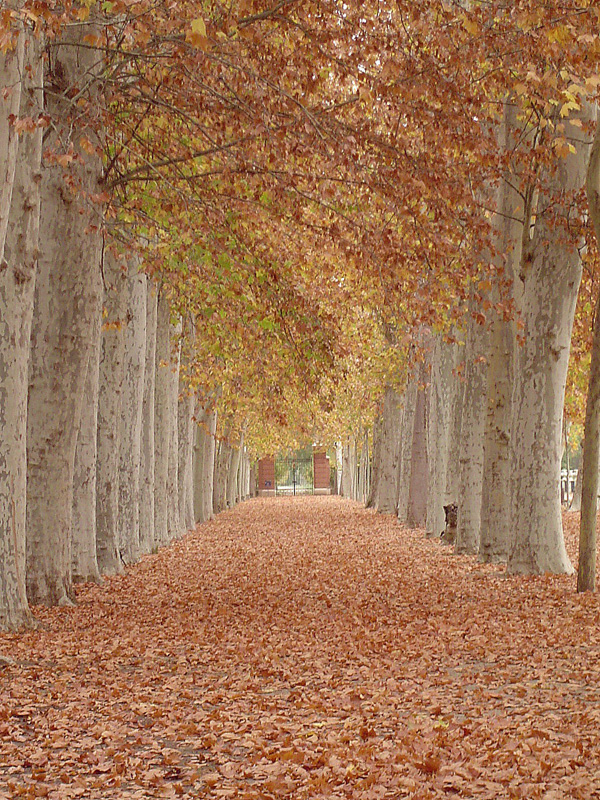
And then one day, on a holiday with my wife in Spain, we were walking through the Jardín del Príncipe in Aranjuez, near Madrid, when we came across a row of absolutely magnificent plane trees, of vast girth, with huge spreading crowns of light green sparkling leaves, and whose bark ranged in colour from pale beige through pale green to ivory white.  Simply ravishing. If we took photos, I have no record of them here. So I insert this picture of a plane tree in these gardens which I found on the web, to give the reader an idea of the beauty of these trees.

plane trees jardin del principe Aranjuez-6

I add this picture of a row of the trees in the gardens to give an idea of their girth.

plane trees jardin del principe Aranjuez-1

And I add this one simply because I like the colours!

plane trees jardin del principe Aranjuez-4

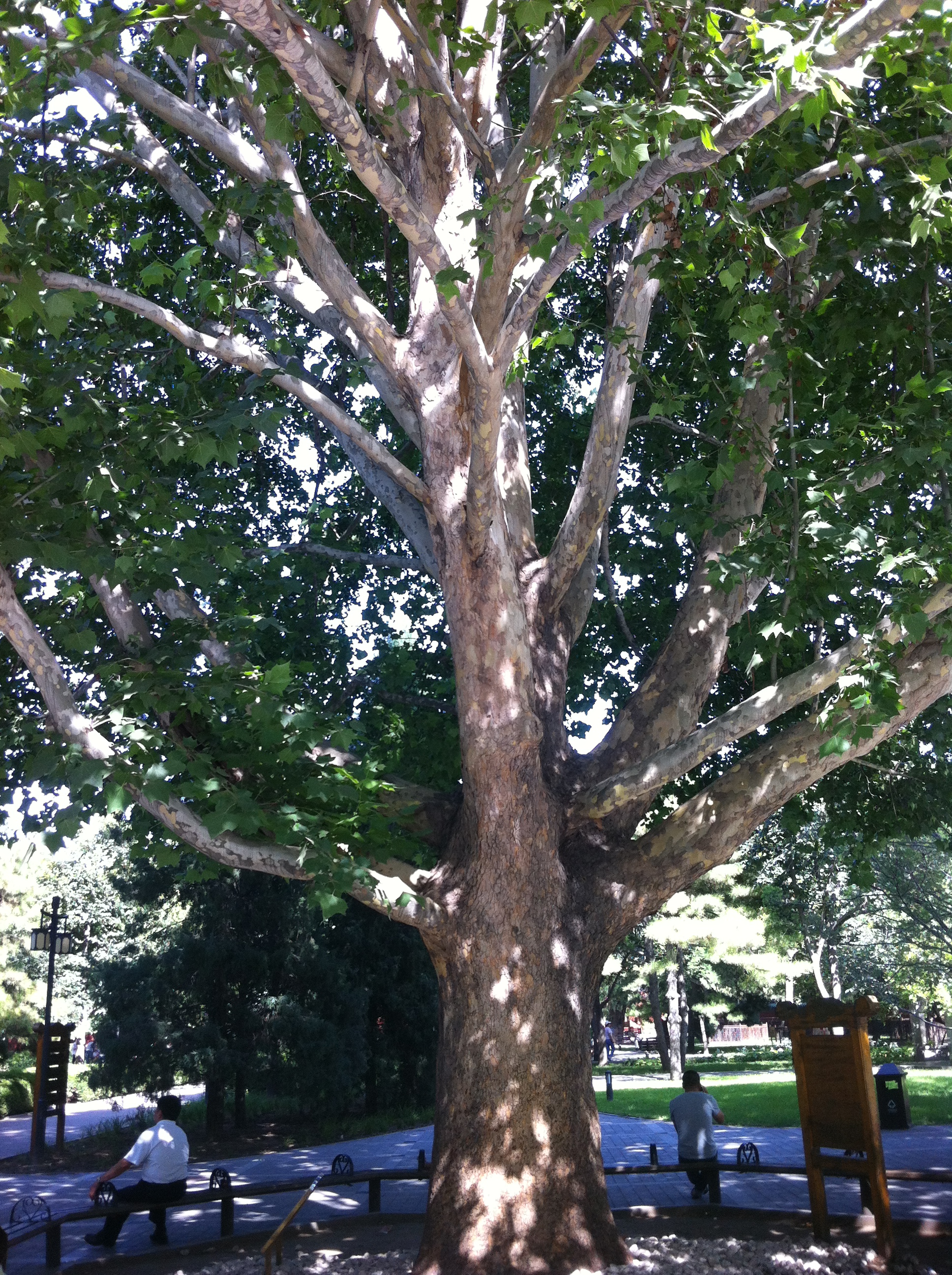
I remembered that glorious moment of discovery yesterday when, visiting Ritan Park in Beijing on a beautiful day with a blue and – that rarest of things in this city – clear sky, we found ourselves sitting in the shade of a lovely plane tree.  It was not as majestic as the specimens we had discovered in Spain, but it was still arresting. It had been manicured so that it grew more regularly in all directions, and a bench had been arranged around it in a wide circle.

ritan park 002

ritan park 003

We just sat there, drinking in the quiet beauty of it all.

POSTCRIPT:

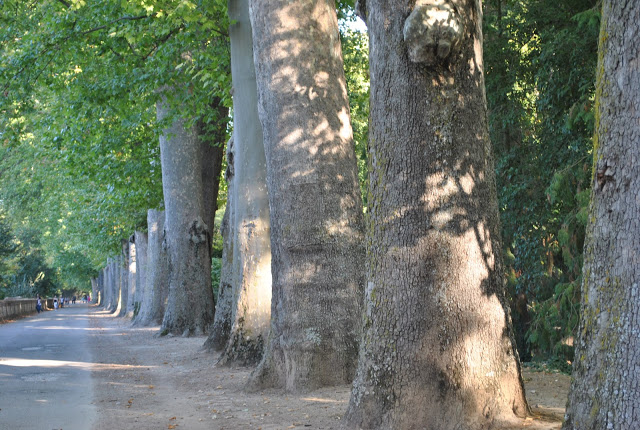
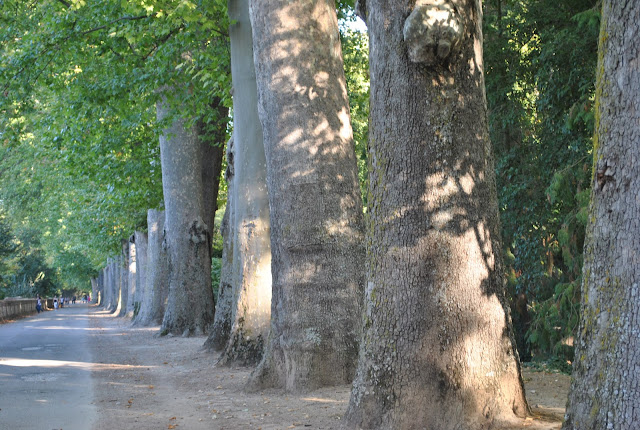
One year on from writing this, I must report the saddest of news. Seventy years ago, US soldiers disembarked in Italy, carrying with them munitions boxes made with wood of the American plane tree. That wood contained a fungus, Ceratocystis platani, unknown to the plane trees in Europe and against which they have no defence. It has left Italy now and is slowly spreading throughout the rest of Europe. Eventually, it will kill millions of plane trees throughout Europe. This was reported by the BBC, where they were saying that the thousands of beautiful plane trees planted along the Canal du Midi

canal du midi plane trees

are becoming infected and will have to be cut down and burned.

Canal du midi plane trees being burned

I fear that the same fate will soon be shared by those lovely old plane trees in the Jardin del Principe. One more tragedy caused by the global movement of goods and people – and bugs that go with them for the ride.

_____________________________
plane trees on a street: http://animestoi.midiblogs.com/media/02/01/2964573664.jpg
photos of the Plane trees in the Jardin del Principe, Aranjuez:
first: http://mw2.google.com/mw-panoramio/photos/medium/14735886.jpg
second: http://2.bp.blogspot.com/-sCRByt2Qd6s/UUsvkfma43I/AAAAAAAAZ10/eTOTJ_kaYxQ/s640/Platanos+de+sombra+Aranjuez+01.JPG
third: http://turismoenaranjuez.com/sites/default/files/otonojardinprincipe_0.jpg
photos of the plane tree in Ritan Park: mine
Canal du Midi: http://news.bbcimg.co.uk/media/images/56128000/jpg/_56128150_canalview624.jpg
Canal du Midi-plane trees being burned: http://4.bp.blogspot.com/-4yIXXHCnDRY/UYN1Ru6K3yI/AAAAAAAAAuM/16Cdm8bNqT4/s1600/Canal+du+midi+abattage+PK+143+%25287%2529.JPG