TURKEY – THE BIRD, NOT THE COUNTRY

Milan, 24 June 2022

I’m catching up with the last couple of week’s news – I’ve been much taken writing a rather heavy report on policy support for eco-industrial parks. Fascinating stuff, but pretty time-consuming.

Anyway, my eye was caught by an article about Turkey’s decision to change its official name (in English, at least) from Turkey to Türkiye. This is in line with an honourable tradition, as various places slough off names given to them during colonial times to adopt more local names. So some decades ago, for instance, Bombay became Mumbai and Madras Chennai (those are the changes I’m most familiar with in India, although I gather that quite a number of places there have localised their names). And quite recently, Swaziland became eSwatini. According to the king, the change was driven by a desire to fully break with the country’s colonial past, while ending international confusion between Swaziland and Switzerland.

In the case of Turkey, it’s not a reaction to a colonial past, or at least not obviously so. Rather, it seems that the country’s leader, Mr. Erdoğan, objects to the country having the same name as a vulgar fowl fit only to be eaten. Worse, “turkey” is used as an epithet to describe people who are (according to the Merriam-Webster dictionary) “stupid, foolish, or inept”. This is what I suspect Mr. Erdoğan – a proud and prickly person – really objects to. He senses that English-speaking people – and Americans in particular, given that this is an Americanism – unconsciously apply the epithet to his country (for the record, the epithet is also used of theatrical productions which are a flop, as in “Well, that musical is a real turkey!”, as well as of three successive strikes in bowling, as in “Wow, Bob, that’s your second turkey this evening, lucky for us you’re not on our bowling team!”).

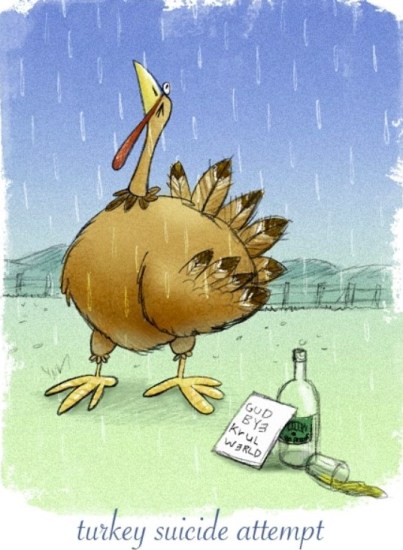
I rather suspect that the epithet is linked to the bird, since at least the domesticated variety has a reputation for being pretty dumb. I remember once reading that turkeys are so stupid that when it rains they’ll look up and drown.

Source

I’m sure this is an urban legend, but it gives readers a flavour of the generally low esteem in which the bird is held. It doesn’t help that we are shown photos like this of poor battery-raised turkeys.

Source

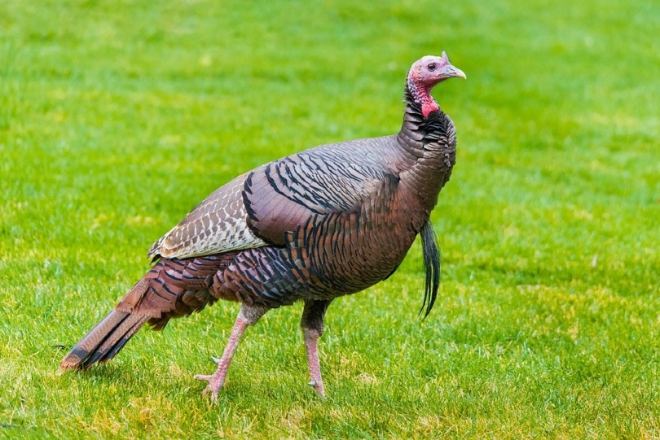
I feel moved to come to the defence of this much maligned fowl. In its natural state, out in the wild, it’s a magnificent looking bird.

Source

Here, we see a male turkey “strutting”, raising his feathers, like peacocks, as a mating ritual. The brilliantly coloured face is an absolute marvel. Here is a close-up.

Source

And by the way, these colours can change, depending on whether the bird is calm or excited.

The female, as is often the case with birds, is more modest in her appearance.

Source

Contrary to domesticated turkeys, the wild progenitors can fly  – not far, but very fast.

Source

So I really think we should stop thinking of the turkey as a stupid, dumb bird.

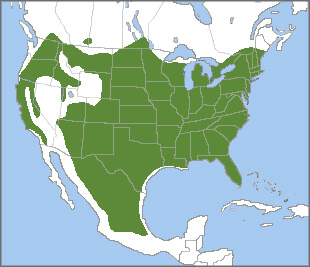
Coming back now to the issue which started this post, readers may be asking themselves why on earth the bird came to have the same name as Mr. Erdoğan’s country (well, I certainly asked myself that, which is why I’m writing this post …). It doesn’t come from Turkey or anywhere near there. The wild progenitor of today’s domesticated turkey was once very common throughout much of the United States and Central America.

Source

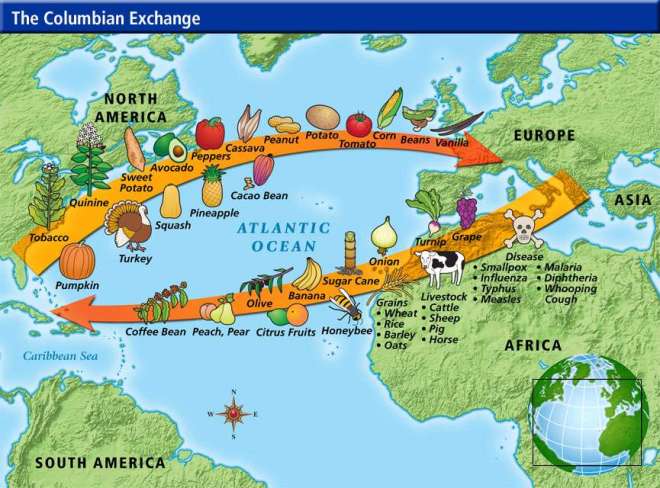
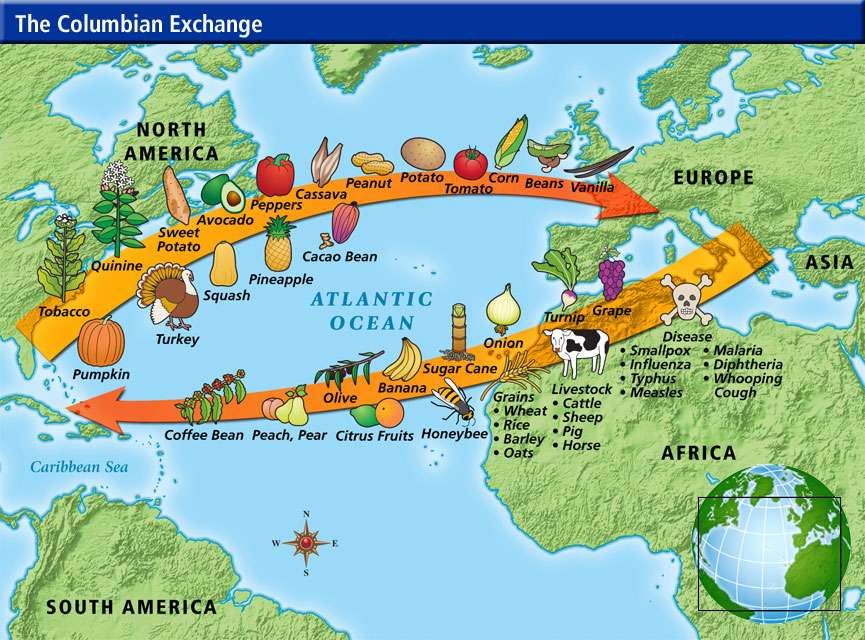
Its spread to the rest of the world is yet another example of the Columbian Exchange, which I’ve written about in several previous posts: all those foodstuffs, plants and animals which were shipped from the Americas to Europe and then to the rest of the world (and all the diseases and enslaved people which were shipped the other way).

Source

The Spaniards found an already domesticated turkey when they conquered Mexico and they brought it back to Europe, from whence it spread throughout the rest of the world.

At this point, let’s imagine that we come across new foodstuffs we’ve never seen before. Basically, there are two ways we’ll give names to these foodstuffs. Either we’ll adopt the local name (often modifying it in the process to fit our modes of speech) or we’ll give it a name based on other things we know which it reminds us of. Both approaches were used with the new foodstuffs which the Europeans discovered in the Americas. For instance, just considering English names, maize, potatoes, cassava, tomatoes, avocados, cacao, are all Anglicized versions of the local names – mahiz, batata, cazzábbi, in the language of the Taino people of the Caribbean islands (whose annihilation I alluded to a few posts ago); tomatl, ahuacatl, cacaua in Nahuatl, the language spoken in the Valley of Mexico and central Mexico at the time of the Spanish conquest. On the other hand, pineapples, peanuts, and bell peppers were given their names based on similarities in looks or tastes to known objects: pineapple was a name already used for pine cones, which look quite similar to smaller pineapples; peanuts were nuts that were pea-sized; anything with a peppery taste was called pepper.

The name “turkey” falls into the latter category. When the bird finally arrived in England, people confused it with another imported bird, the helmeted guineafowl.

Source

Originally from Sub-Saharan Africa, the guineafowl was being imported to England from the Ottoman Empire by the Turkey Company, an English chartered company. Because of that, people often called them turkey cocks or turkey hens. The new arrival from the Americas quickly displaced the guineafowl and added insult to injury by also appropriating to itself the nickname. Thus did the British start raising a bird originally from the Americas which they called “turkey”, much to the future chagrin of Mr. Erdoğan.

Source

His chagrin doesn’t finish with the British. There are of course all the other English-speaking countries which have adopted the same name for this American bird, foremost among them the United States. And then there are the other ex-British colonies; many of these have also adopted the name, suitably transliterated to fit their local languages. Thus, most of the languages from the Indian subcontinent call the bird ṭarki or turkee. So too have a number of languages used in ex-British colonies in Africa: for instance, we have toki in Igbo, tọki in Yoruba, tɔki in Krio, dɔkɔ in Ewe, uturuki in Swahili. And then we have a good number of countries which have no obvious connection to the UK but which for some reason have nevertheless adopted, with the usual linguistic adaptations, the British name for the bird: tierkei in Luxembourgish; ćurka in Serbian and Bosnian; turketi in Georgian; tirka in Kurdish; turīki in Amharic; tuorki in Khmer; tu la ki in Lao. All told, about 40% of the world’s population use the name “turkey” or some variant of it – although, in truth, some of the names have drifted so far from “turkey” as to be almost unrecognizable – some comfort, perhaps, to Mr. Erdoğan.
Luckily, another proud and prickly leader, Mr. Narendra Modi, Prime Minister of India, doesn’t seen to have noticed that a whole series of countries – including, I should note, Turkey – have instead named this “stupid bird” after India! Perhaps he has been too busy beating up on his country’s Muslim population.

Source

I think this naming is the fault of the French, who named the American bird coq d’Inde (or poule d’Inde in the feminine). Later the coq and poule were dropped, as was the apostrophe, and the French simply called the bird dinde (with, as a further modification, dindon becoming the masculine version).

As usual, the French’s logic was impeccable – if we remember that Christopher Columbus confused everyone in Europe by claiming that he had reached the Indies when actually he had stumbled across the Americas. For quite a while thereafter, everything that came from the Americas was thought to come from the Indies (and in English at least this confusion lingers on in our calling the Caribbean islands the West Indies and calling the native populations of the Americas Indians). So when the French said this new bird came from the Indies they were correct given the knowledge of the time. But they were fundamentally wrong: a great example of “rubbish in, rubbish out”.
Unfortunately for any proud and prickly Indians – the real ones, the ones from India – the French’s innocent mistake has percolated into various other languages. Two of these are languages on France’s border, Catalan and Basque, where we have gall dindi and indioilarra, respectively. Then we have a cluster of languages from the ex-Russian Empire: Polish (indyk), Russian (indeyka), Ukrainian (indychka), Belarusian (indyčka), Kyrgyz (ündük), and Armenian (hndkahav). Finally, we have three countries – Turkey, Turkmenistan, Azerbaijan – with close linguistic and cultural ties, which all use the name hindi. Luckily for Mr. Modi, only some 12% of the world’s populations use this potentially offensive name for our bird from the Americas.

That being said, there may be more here to potentially offend Mr. Modi, and we have the Dutch to thank for that. For reasons which I don’t understand at all, the Dutch called our bird from the Americas Kalkoense haan, or “chicken from Calcoen”, the then-used name for the Indian city of Calicut in the state of Kerala (which, in another example of India decolonizing its place names, is now called Kozhikodez). Calcoen-Calicut was a big trading partner in Europe’s first interactions with India, and in the early 1600s the Dutch entered into a treaty with the local ruler to boot out the Portuguese. But none of that explains – to me at least – why the Dutch seemed to think that this bird came from Calcoen. But they did.

The Dutch eventually shortened the name to kalkoen, and in closely related forms it spread far and wide. I suppose because the Dutch were very active traders in the Baltic Sea and took the bird with them on their trading ventures, almost all the countries along that sea’s shores have adopted the Dutch name in the form of kalkun or something similar. But the Dutch also took the bird with them on their colonizing ventures. Thus, Sri Lankan speakers of Sinhalese call the bird kaḷukumā (Sri Lanka was Dutch for a while, after they kicked out the Portuguese, before they were themselves kicked out by the British). For their part, the Indonesians appropriated the name from their former colonial masters and call the bird kalkun (I’ve commented on Indonesian’s cheerful appropriation of foreign words in an earlier post). As you would expect, the descendants of the Dutch settlers in South Africa, the Afrikaaners, call the bird kalkoen, and the name has percolated into at least one of the languages of southern Africa, northern Shona, as kalakune. Still, at the end of the day, only about 5% of the world’s population use this name for our bird from the Americas. On top of it, the connection to India is really not that obvious, so I think Mr. Modi can breathe easy – assuming he has spent any time at all thinking about this potential slight to Indian pride.

If Mr. Modi were ever to get exercised by the link between India and the supposedly stupid bird from the Americas, I really don’t think he could adopt the course taken by Mr. Erdoğan. I just can’t see what changes could be brought to his country’s name which would sufficiently distance it from the India-like names which have been given to our bird. It would be far better for Mr. Modi to initiate an international process (through the UN, perhaps) to change the bird’s name. And I have just the name to propose: huehxōlōtl! This is the Nahuatl name for our bird. It seems to me to fit beautifully with the general move to decolonize our languages. Each language could take this name and fit it into their way of speaking. The Spanish-speaking Latin Americans already did this a while back. Contrary to the Spaniards, who call our bird pavo, they call it guajolote, a hispanicized form of the original Nahuatl name. In English, it could be transliterated to “whexolot”. That’s a bit awkward, but knowing people’s tendency to shorten and simplify words, I’m guessing that over time this could become “whellot”. That rolls off my English tongue fairly easily: “500 grams of whellot, please. I’ll have it tonight with maize and potatoes”.

PISTACHIO

Sori, 24 May 2022

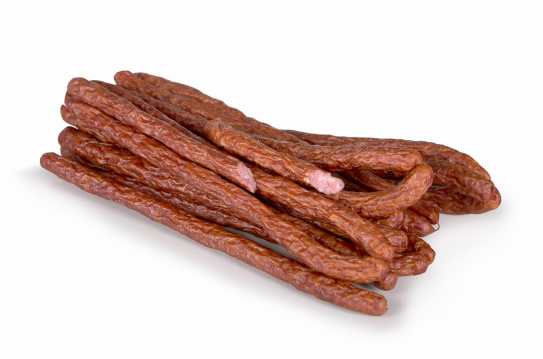
There are certain foods that somehow, without our being quite being aware of it, my wife and I will methodically demolish if they are put in front of us. Kabanosy sausages very much fall into this category for me.

Source

As for the both of us, berries definitely have this effect (it’s strawberries at the moment, they are pouring into the shops and they are cheap).

Source

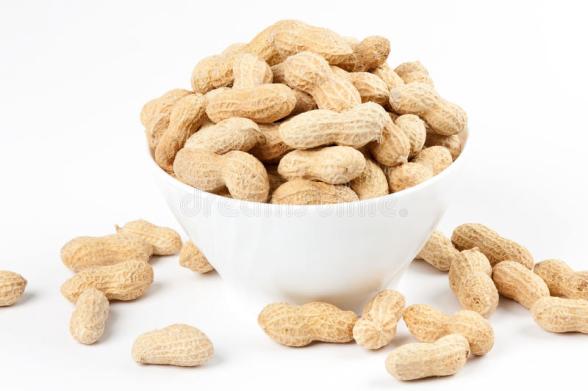
But so do peanuts.

Source

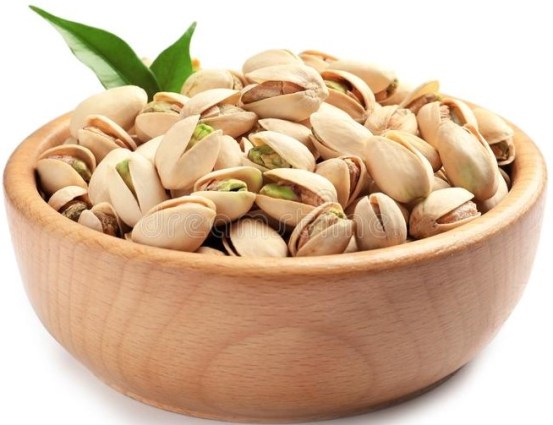
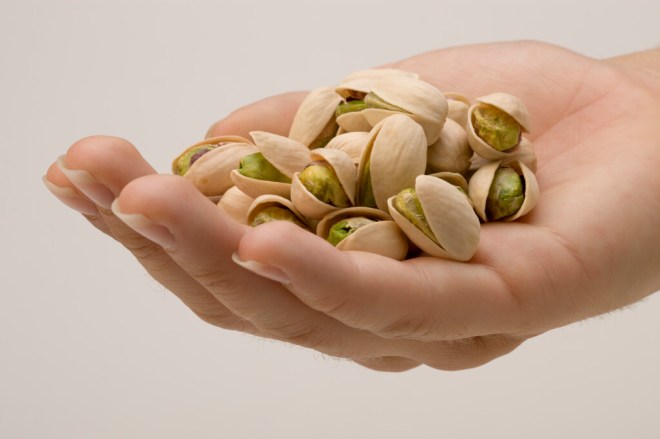
And – the subject of this post – so do pistachios.

Source

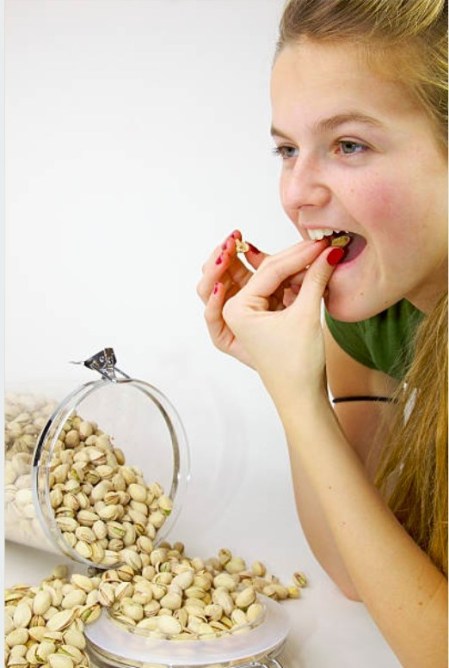
Put a bowl of pistachios in front of us and before we know it, one will smoothly follow the other until we have popped every single one of them into our mouths – except the pesky ones where the shells are firmly closed and stubbornly resist being cracked open by our aging teeth.

Source

This is really the only way I eat pistachios, and I rather sense that it is the best way to eat them if you want to truly appreciate their unique taste. Sometimes, when I’m eating a slice of mortadella (a rare occurrence in these diet-dominated days, alas!), I will come across thin slices of pistachio embedded in the mortadella.

Source

Quite honestly, it seems to be a waste of pistachios; they don’t materially alter the taste of the mortadella as far as I can make out. My wife will occasionally have pistachio as one of the two tastes she chooses for her post-hike celebratory ice creams.

Source

Researching for this post, I recently tried pistachio ice cream, twice. I was not impressed. In the first case, even though the shop claimed that the ice cream was made with high-quality Italian pistachios with a Protected Designation of Origin title – see below – I could detect no pistachio taste at all. In the second case, there was a pistachio taste but it all came from the pistachio crumbs sprinkled on the ice cream; the ice cream itself had no pistachio taste to it at all. Talking of pistachio crumbs, Middle Eastern and Indian desserts will often be sprinkled with them. For instance, this is a pistachio-sprinkled kulfi from India.

Source

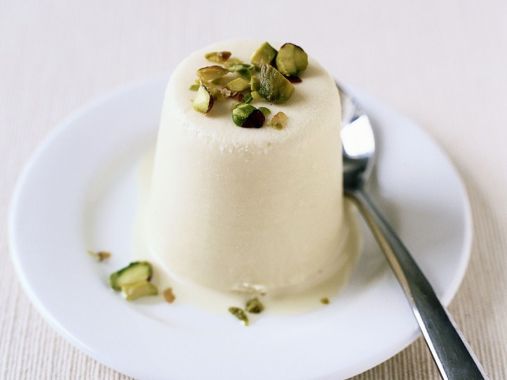
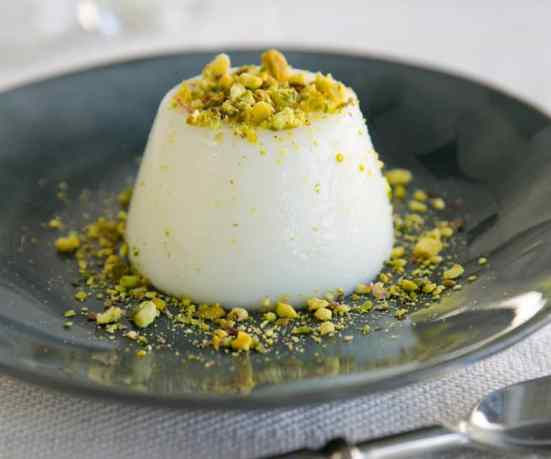
And this is a pistachio-sprinkled mouhallibieh from Turkey – although this dessert originated in Sassanid Persia.

Source

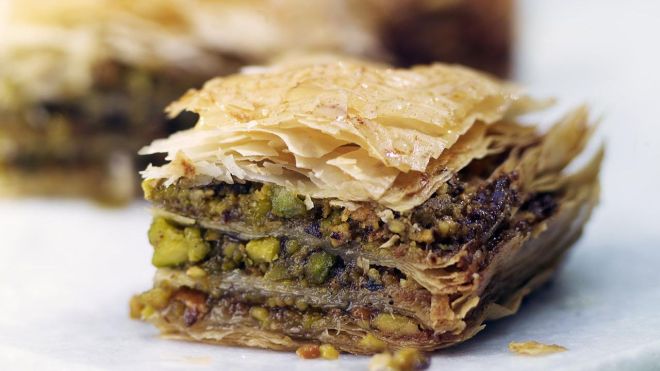
If my experience with pistachio ice cream is anything to go by I’m not sure how much the pistachios add to these desserts; they act more like a garnish. But there are lots of Middle Eastern pastries where pistachios play a more important role as a stuffing, often mixed with various other things. Baklava, for instance, will often have pistachios as the stuffing.

Source

I rather suspect, though, that all the honey and other sugary additions to these stuffings overwhelm that delicate pistachio taste.

On the salty side of things, Moroccans will add a fistful of pistachios to their tajines.

Source

But again, it seems to me that the strong tastes of the tajine will drown out the delicate tastes of the pistachios. Of course, I may be wrong; time to find a Moroccan restaurant here in Milan which makes tajine the right way, to perform a taste test. On top of it, we haven’t had a tajine in a long time – but is it diet-friendly??

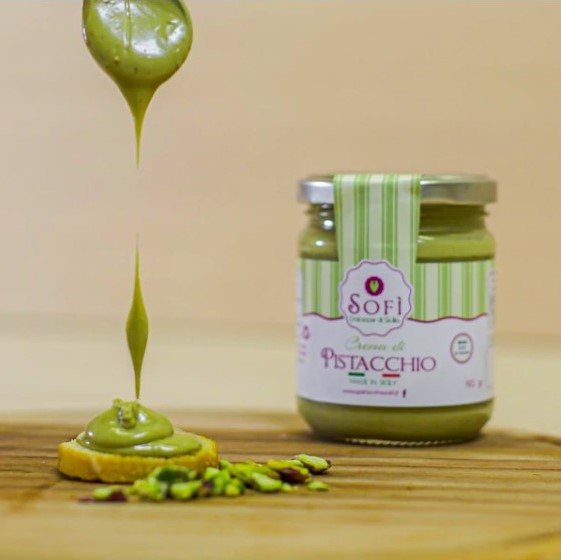
I read that Clever Persons Out There have commercialized pistachio butter, the pistachio equivalent to peanut butter. This intrigues me. As I recall from my youth, peanut butter tastes pretty peanutty, so maybe pistachio butter tastes pretty pistachio-y. This needs to be followed up – and pistachio butter definitely exists in Italy, although it goes by the much fancier name of crema di pistacchio (everything about pistachios in Italy is fancier, as we shall see).

Source

BUT, when all is said and done, what is crystal clear is that an excellent way of eating pistachios is one after another: crack open the shell, scoop out the nut, and pop it into your mouth. Mmm-mmm!

Source

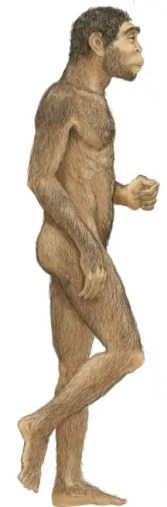
In this, we are merely following in the footsteps of our most remote ancestors. Archaeologists have discovered pistachio shells in a dig in Jordan dating back 780,000 years. We’re not even talking Homo sapiens here, but Homo erectus!

Source

So we are in very venerable company when it comes to the scarfing of pistachios off the trees (although it is true to say that we tend to eat them roasted and slightly salted, while our ancestors ate them fresh. On this point, I have read that fresh pistachios are delicious – something else my wife and I need to try; somehow, we need to be near some trees when the nuts are being picked).

I should clarify at this point that there are several species of pistachio trees and that they all offer us hungry humans edible nuts. The nuts which our Homo erectus ancestors were eating in Jordan came from the Pistacia Atlanticus tree, whereas the pistachios we find in our shops today come from the Pistacia vera tree. The nuts from P. vera are much bigger than the nuts from the other Pistacia trees (and the shell harder, which makes their transportation much easier), so no-one really eats these other types of pistachio nuts anymore.

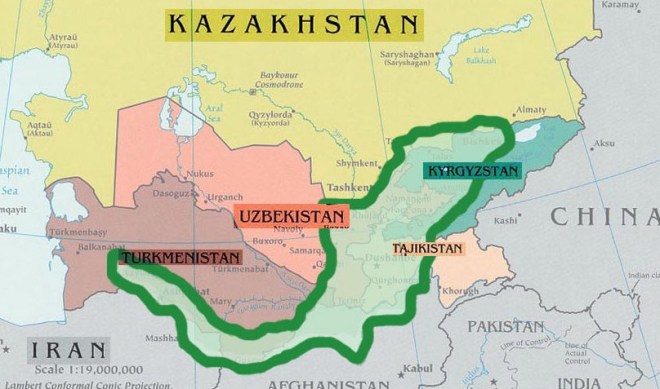
The original home of P. vera is the dry steppe lands that go from north-east Iran through southern Turkmenistan, northern Afghanistan, southern Uzbekistan, and on into Tajikistan and Kyrgyzstan – more or less the region which the Ancient Greeks called Bactria.

Source

Our hunting and gathering ancestors who lived in the area happily munched on wild P. vera nuts. There are still stands of wild P. vera in the area, although they are sadly depleted from their glory days.

Source

Then someone, or probably someones, decided to domesticate the tree. Quite when this happened is unclear, but certainly no earlier than 2000 BCE. After that came the tree’s slow westward migration. It was the Persians who were responsible for that; the eastern marches of their Empires overlapped with the tree’s western range. They brought the domesticated tree to the rest of their Empire. In the process, they gave the nut the name we all know it by: pistak was the nut’s name in Ancient Persian.

It is possible that during this drift westwards the Persians made a fundamental change to the tree’s life cycle, systematically grafting it onto the root stock of one of its cousins, either P. atlanticus or P. terebinthus. If it wasn’t them, it was people in the eastern part of the Roman Empire who did it, where the tree eventually arrived as it continued its slow shift westwards. The Ancient Greek philosopher Theophrastos, whose life saddled the 4th and 3rd Centuries BCE, mentioned the habit of grafting the tree (as well as pointing to Bactria as its original homeland). It is certainly a fact that nowadays almost all commercial orchards of P. vera the world over are grafted onto a root stock. These root stocks are hardier than P. vera, thus allowing the tree to be moved successfully out of its original ecological niche into new ones. But it does mean that all commercially grown P. vera trees are a sort of botanical Frankenstein.

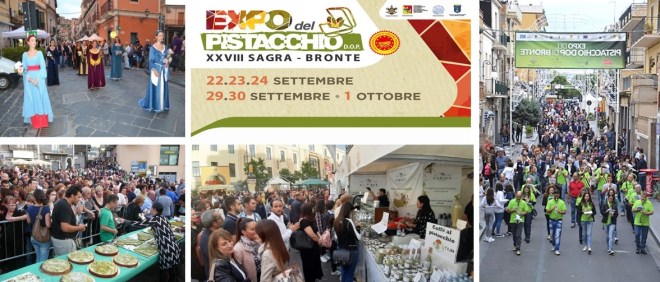
The tree was brought to Italy and Spain in the western part of the Roman Empire during the reign of the Emperor Tiberius. P. vera is still grown there commercially, although production is quite modest compared to other parts of the world. But what these orchards lack in quantity they make up for in quality. The Italians especially have turned their tiny output, mostly grown near Mount Etna, into a high quality product, which has received the EU’s Protected Designation of Origin title and is being aggressively promoted through some savvy branding and promotion.

Source

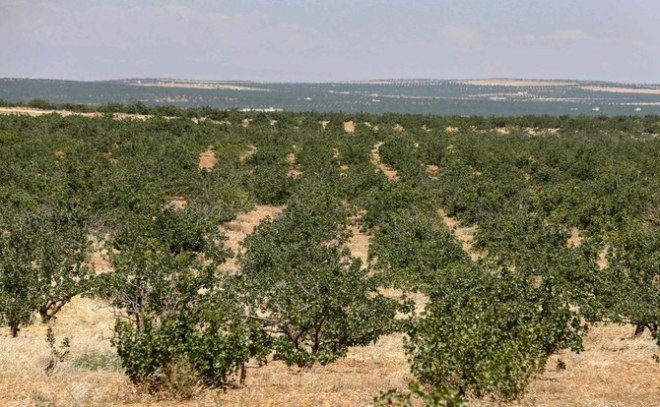
The fact is, though, that P. vera is a desert plant. The trees can survive temperatures up to 48°C in summer; in fact, the trees actively need long, hot summers for the nut to properly ripen (and of course because temperatures can plunge in desert regions the trees are equally tolerant at the other end of the temperature scale, being able to survive winter temperatures as low as −10°C). Consistent with their desert nature, the trees dislike high humidity levels and their roots prefer to receive modest amounts of water and sit in a well-draining soil. They are also highly tolerant of saline water and saline soil, a big advantage in desert-like areas. All of this to say that the Arabs first, and the Ottomans later, recognized the potential of P. vera in many of the lands they had newly conquered and promoted the tree extensively. As a result, historically the major production area other than Persia was in Syria, around Aleppo, with Turkey also getting into the act. Here is a photo of one of Syria’s pistachio orchards.

Source

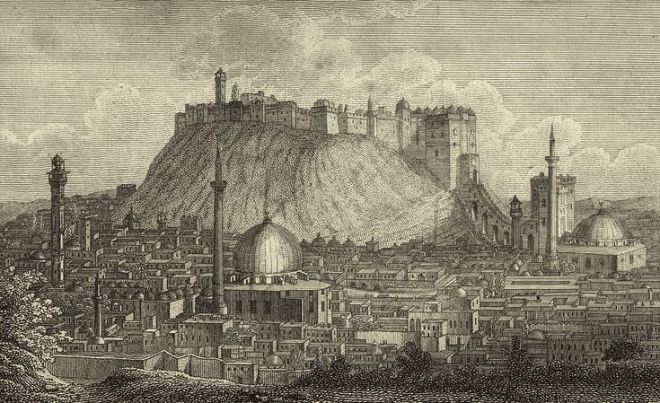
Even though, as I have said, there was modest production in southern Europe, it was from Syria that most of the pistachios eaten in Europe came from. The Venetians, those inveterate traders with the eastern rim of the Mediterranean, were the first in this trade. They delivered the Aleppo pistachios they purchased to northern and central Italy (and much later to northern European countries via trade routes across the Alps). In later centuries, when French ships out of Marseilles challenged the Venetians in their trade with the Ottoman Empire, Aleppo pistachios also began to be imported into France. I use this occasion to show what Aleppo looked like several hundred years ago. I don’t want to even think about what it looks like now.

Source

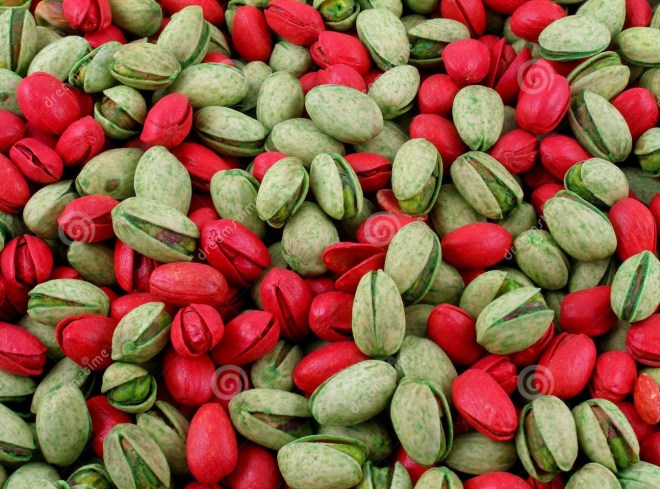
It is from this trade in pistachios – not just to Europe, but more generally – that came the habit of dyeing the shells red  or green.

Source

Now, if it’s done at all, it’s just an aesthetic touch. But in the old days, it was a way of masking stains on the shell caused by mishandling during manual harvesting.

So that’s how the global production of pistachios stood until quite recently: Persia, now called Iran, first; Syria second; Turkey third.

Then along came California.

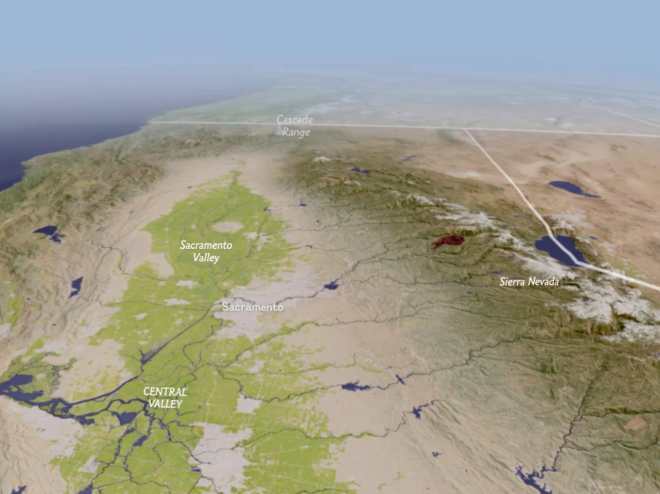
It had long been recognized that California’s Central Valley, with its hot, dry summers, moderately cold winters, and well drained soils, offered ideal growing conditions for the pistachio.

Source

Already back in 1929, an American botanist had gone to Persia to collect about 10 kilograms’ worth of various pistachio nuts from the country’s orchards, taking them back to California, and planting them. After nearly ten years (it takes that long for a pistachio tree to give its first harvest of nuts), he found that only one of his nuts had worked out. That one nut gave rise to California’s pistachio industry. But it wasn’t until the 1980s that the industry really took off – it took quite a while to find the right root stock. Since then, though, Californian production has grown meteorically. This, coupled with the sanctions on Iran (and general economic mismanagement) and the civil war in Syria, has meant that California is now Top Dog in world pistachio production.

Source

But who knows for how long? All sorts of places with the right climatic and soil conditions are looking to grow pistachios, drawn by the high value of the crop (as well as its relatively modest requirements in water). In full production, the trees guarantee more than €10,000 per hectare: I’m not a farmer, but my readings assure me that this is a very good return for an agricultural crop.

In this pistachio Gold Rush, there is one place I’m rooting for: the tree’s original homeland. I mean, doesn’t natural justice tell us that this is really where we should be getting our pistachios from? What right do these other countries have of making money from someone else’s genetic heritage? (this is basically the argument behind the Convention on Biological Diversity). In addition, the ex-Soviet republics of Central Asia need to move away from the environmentally unsustainable crops which central economic planning from the Soviet era foisted on them (think cotton, whose continued production in this region is destroying the Aral Sea). In the arid foothills where the wild P. vera originated, the raising of livestock is particularly harmful, as the animals overgraze the land and lead to desertification – all made worse by climate change. So bring it on! Here we see the land being prepared for pistachio planting in Uzbekistan.

Source

I’m particularly chuffed to see that an international fund, the Global Environment Facility, is actively involved in promoting the return of P. vera to its natural range. I should explain that there was a period in my life when I was deeply involved with this fund; I still wear a cap on my hikes which I picked up at one of their do’s.

my photo

The one cloud on the horizon that I see is that if everyone and their dog piles into pistachio growing, then of course supply will soar. So, unless the demand for pistachio soars by an equal amount, the price of pistachios will fall, thus wiping out one of the main reasons people want to grow pistachio trees. The same thing happened in the coffee business. Some two decades ago, the World Bank financed enormous increases in coffee plantations in Viet Nam, with the net result that coffee prices dropped vertiginously and coffee farmers in various parts of the developing world who had been doing quite well up to then, thank you, suddenly found they could no longer make ends meet.

With this sobering thought in mind, let me toss another handful of pistachios into my mouth.

Source

L’ORRIDO DI BELLANO

Sori, 2 April 2022

Deary me, it’s been quite a while since I posted. Initially, it was because I was flat on my back – not from Covid, as one might reasonably presume in this day and age, but from a whole series of pulled muscles in my back which all gave at the same time. Which then led me to spending a lot of time doing physiotherapy and having injections of ozone around my lower spine (sounds awful and was indeed quite awful). Then I was rushing around catching up on all the work I had had to put aside because of my back problems. The one silver lining to all this is that my time lying on the sofa allowed me to “file and folderize” (as we used to say decades ago in the office) the photos which my wife and I have taken these last few months.

One set of photos got me writing this post. They were taken in a town called Bellano on Lake Como. The place is known for three things:

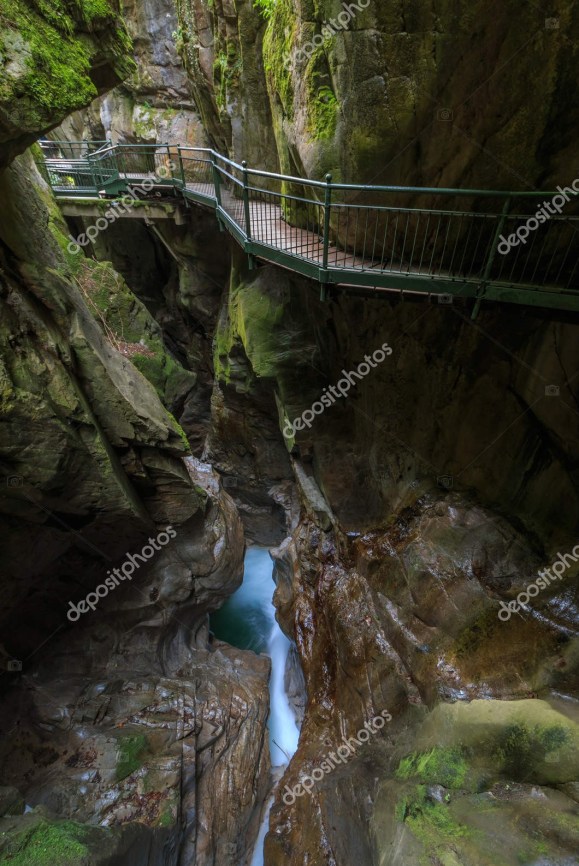
A) Being built around the mouth of the Pioverna river which, tumbling down the steep hills behind the town, has, over hundreds of thousands of years, carved a deep, narrow, and tortuous gorge for itself, before flowing swiftly through the town itself.

Source

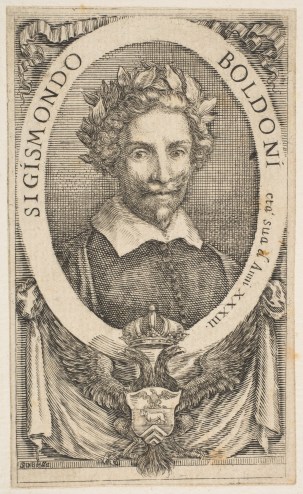
B) Being the birthplace of a writer and minor poet by the name of Sigismondo Boldoni, 1597-1630.

Source

C) Having played host from 1828 to 2004 to a large, handsomely built factory, the Cotonificio Cantoni, owned by what was once one of Italy’s largest textile manufacturers but is now sadly derelict.

Source

All three things happen to be linked. The gorge is known as the Orrido di Bellano, literally the Horrid of Bellano. It owes its name to the poet Boldoni, who was fascinated by this gorge and once described it as “l’orrore di un’orrenda orrendezza”, literally “the horror of a horrendous horrendousness”, which he then boiled down to the simpler and catchier Orrido. Finally, and more prosaically, the factory was built in Bellano to take advantage of the kinetic energy in the Pioverna river’s racing waters to drive the looms (this, in the days before electricity was commonly available to do the same thing).

It was the Orrido that got me going on this post: not the gorge itself, but the name. To my modern ear, it sounds delightfully strange. For one thing, “horrid” is an adjective, not a noun. But it was, too, when Boldoni coined the gorge’s name, so it’s not as if there has been an “adjectivizing” of a noun in the intervening centuries. I think we can just put this down to – literally – poetic license. More interesting is the change that has taken place in the meaning of the adjective “horrid”. To me, “horrid” conjures up nasty little boys – the ones who, with an evil laugh, pull the cat’s tail or their little sister’s pigtails.

Source

Or maybe some of the food that’s served in school cafeterias could be described as “horrid”.

Source

But several centuries ago, “horrid” had an extra, quite different meaning. It was said of places which were uncultivated and wild, which inspired fear or anguish. We have good examples in the diaries of the English writer and diarist John Evelyn, who was born in 1620 (10 years before Boldoni died) and died in 1706.

Source

His diaries are peppered with the word “horrid” used in this sense. For instance, on a long trip he made down through France and then on to Italy and back again, which he undertook in the late 1640s, he had this to say about various wild places he passed through (to help readers, I have bolded and italicized the “horrids” in question).

“I set forwards with some company towards Fontainebleau, a sumptuous Palace of the King’s, like ours at Hampton Court, about fourteen leagues from the city. By the way, we pass through a forest so prodigiously encompassed with hideous rocks of whitish hard stone, heaped one on another in mountainous heights, that I think the like is nowhere to be found more horrid and solitary. It abounds with stags, wolves, boars, and not long after a lynx, or ounce, was killed amongst them, which had devoured some passengers. On the summit of one of these gloomy precipices, intermingled with trees and shrubs, the stones hanging over, and menacing ruin, is built an hermitage. In these solitudes, rogues frequently lurk and do mischief (and for whom we were all well appointed with our carabines); but we arrived save in the evening at the village, where we lay at the Horne, going early next morning to the Palace.”

“We embarked in a felucca for Livorno, or Leghorn; but the sea running very high, we put in at Porto Venere, which we made with peril, between two narrow horrid rocks, against which the sea dashed with great velocity; but we were soon delivered into as great a calm and a most ample harbour, being in the Golfo di Spetia.”

“On the summit of this horrid rock (for so it is) is built a very strong fort, garrisoned, and somewhat beneath it is a small town; the provisions are drawn up with ropes and engines, the precipice being otherwise inaccessible. At one end of the town lie heaps of rocks so strangely broken off from the rugged mountain, as would affright one with their horror and menacing postures.”

“The next morning, I was furnished with an ass, … we passed through a reasonably pleasant but very narrow valley, till we came to Duomo [Domodossola], where we rested … Here, we exchanged our asses for mules, sure-footed on the hills and precipices, being accustomed to pass them. Hiring a guide, we were brought that night through very steep, craggy and dangerous passages to a village called Vedra, being the last of the King of Spain’s dominions in the Duchy of Milan. … The next morning, we mounted again through strange, horrid, and fearful crags and tracts, abounding in pine trees, and only inhabited by bears, wolves, and wild goats; nor could we anywhere see above a pistol-shot before us, the horizon being terminated with rocks and mountains, whose tops, covered with snow, seemed to touch the skies, and in many places pierced the clouds. Some of these vast mountains were but one entire stone, betwixt whose clefts now and then precipitated great cataracts of melted snow, and other waters, which made a terrible roaring, echoing from the rocks and cavities; and these waters in some places breaking in the fall, wet us as if we had passed through a mist, so as we could neither see nor hear one another, but, trusting to our honest mules, we jogged on our way …”

I’ve personally been along the same path that Evelyn took in two places, the forest of Fontainebleau and the Simplon Pass between Domodossola and Brig. Neither struck me as “horrid” in the old sense. For me, the forest of Fontainebleau was simply a welcome break from Paris’s hyperdense urbanism, while the Simplon Pass looked very pleasant as we swished along through it in the train.

The fact is, in the centuries which separate me and John Evelyn – actually, it’s only really the last two centuries, since that textile factory was built in Bellano – our species has come to so dominate Nature that what was once frightening to us puny humans has become merely intriguing to us Masters of the Universe. Where would I have to go now to feel a “horrid” Nature? Sometimes, when my wife and I are hiking high up on the mountains, with slopes falling away precipitously to our side and not a soul in sight, I feel Nature baring its teeth. Or some of the storms we experienced in Thailand – rain so dense you couldn’t see 20 metres in front of you, accompanied by wild lightning shows – filled me with awe tinged with fear at the power of Nature. Or there was that time my wife and I, with two friends, were sailing on a moonless night from Corsica to Italy. Suddenly, in all of that inky blackness, the boat seemed very frail and the sea very, very deep. If the sea had been rough, I would have been on my knees babbling prayers to the Virgin Mary as I often see sailors do in ex-votos hanging in Italy’s churches.

Source

As I write this, my decades of working on environmental issues set the alarm bells ringing. We think we’ve become Masters of the Universe, or at least of our globe, but actually we haven’t. We think all our clever gizmos have tamed Nature, but it’s not so. We’ve merely estranged ourselves from Nature, we’ve taken our finger off its pulse. If we go on like this, Nature is going to turn on us and with one massive swipe of its paw will wipe us out. Isn’t Covid a warning sign of that? We encroached on Nature too much and the virus came roaring out of the forests.

It’s time for us to show Nature some awe and fear, time to give “horrid” back its original meaning.

CHINOTTO

Milan, 20 January 2022

Dedicated to my son, who has a predilection for chinotto

My wife and I have just returned home from visiting our daughter and her fiancé in Los Angeles over the Christmas-New Year break. One of the things we did while we were there was to visit the Huntington Gardens. For any of my readers who like gardens and who happen to be in LA, I highly recommend a visit to these gardens. We’ve been to them several times now, and we never tire of going back. There is always something new to see – as was indeed the case this time, when we stumbled across this tree.

my photo

This is a Citrus myrtifolia, or the myrtle-leaved orange tree in English. Or – more importantly for this post – the chinotto in Italian. And indeed that was the name given on the plaque below the tree, which is why I took a photo of it (why I did do this will become clear in a minute). As sharp-eyed readers will notice, the fruits do indeed look quite orange-like, and in fact the chinotto came about from a spontaneous mutation at some point in the past of the bitter, or sour, orange (the one used to make orange marmalade, and which is itself probably a cross between the pomelo and the mandarin orange; as I’ve mentioned in a previous post on the citron, citrus family members absolutely love hybridising among themselves). Where precisely this mutation event took place is unclear. There is a romantic version, much repeated throughout the Internet, that it took place in China and a plant or two was brought to Italy in the late 1500s-early 1600s by an Italian sailor hailing either from Livorno in Tuscany or from Savona in Liguria. Since it is a Chinese plant, the story continues, that explains the name.  More sober-headed people have pointed out that there is no trace of this tree in China – or in South-East Asia, the original home of the sour orange, for that matter – which suggests that the mutation took place elsewhere, probably somewhere in the Mediterranean basin since it is only found there. According to this version of events, the plant got its Italian name because to the Italians it “looked Chinese-like”, referring to the fact that the fruit looks quite like a mandarin orange, which does indeed come from China. I throw in here a close-up photo of the fruit, which I think readers will agree looks quite mandarin-like.

Source

Personally, I am more inclined to the sober-headed creation story, although in the end the origin of the plant is not of any importance to the rest of my story.

Moving on, then.

As readers might surmise, since the sour orange is bitter in taste so will its offspring be. And indeed the chinotto is very bitter, even more so than the sour orange.  Given this state of affairs, I can’t quite understand why anyone would have bothered to grow the plant, but people did. Perhaps it’s because we are so inundated with sugar and sweet tastes nowadays that we can’t imagine that our ancestors might have had a greater inclination to search out sourer, bitterer tastes than we do. That being said, the use of chinotto really took off when it was combined with sugar, leading to various plays in foods and drinks between sweet and sour (a concept which was the subject of a post I wrote some years ago).

Which leads me to chinotto – the drink this time, not the tree or the fruit. It is this which my son has a predilection for and why I dedicate this post to him.

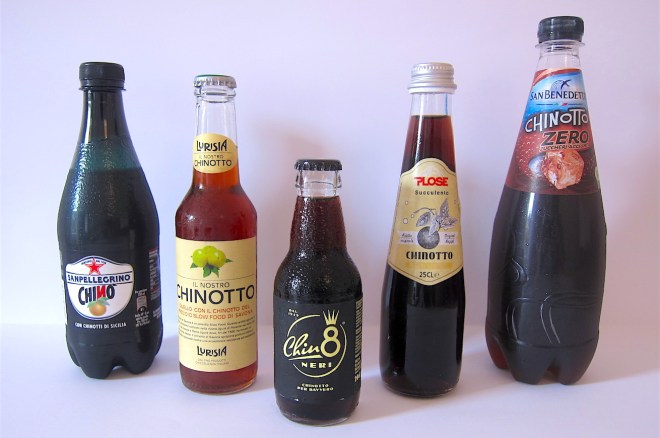
Unless my readers are Italian or have an immense curiosity about foods and drinks from around the world, they will never have heard of this drink. I certainly never had until I met my wife and arrived in Italy. One day, when we were in a bar, she suggested that I try it, which of course I did (I always do everything my wife suggests me to do …). I will be frank, I did not like it. It rather reminded me of another drink I had tried many, many years ago in Canada, root beer, which I also rapidly put aside. But in Italy, chinotto has an enthusiastic following (my son being among them). So that readers may have an idea of what we’re talking about here, I throw in a picture of several of the better known brands of chinotto currently on the Italian market.

Source

To give readers a few more details, it’s a non-alcoholic drink, fizzy, dark in colour, sweet with a hint of bitterness given to it (supposedly, as we shall see) by chinotto. In all this, it is quite similar to Coca Cola, and in fact in the initial periods of its life it was often advertised as Italy’s response to Coca Cola.

When exactly chinotto was invented is a matter of intense debate among the small band of chinotto aficionados. It might have been in the early 1930s (when it could have been a response to the Fascist government’s desire to rid Italy of all foreign barbarisms, in this case Coca Cola), or it might have been in the late 1940s (when it could have been created through a desire by local entrepreneurs to cash in on the enthusiasm for all things American, in this case Coca Cola). Whichever it was, it became immensely popular in the 1950s and 60s. Here we have a group of young men drinking chinotto at a bar in the 1950s.

Source

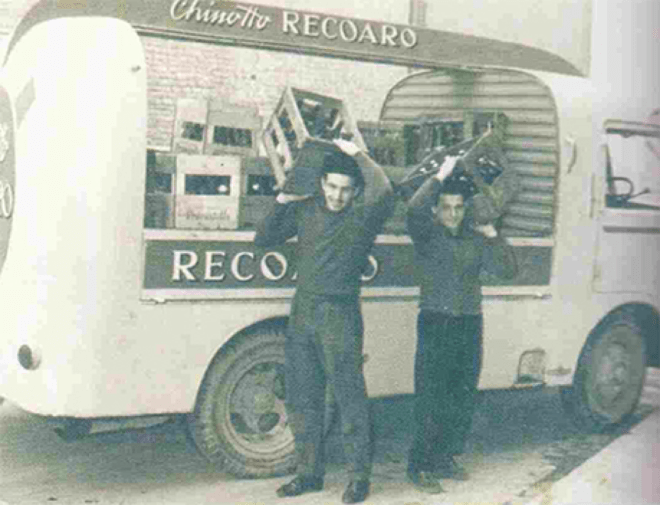
While here we have one of the more popular brands of chinotto being delivered to those bars.

Source

And here we have a photo of another of the more popular brands of chinotto advertising its wares with huge bottles installed on cars which cruised through towns and cities as they delivered their bottles to bars.

Source

Which brings me of course to the bright and cheerful posters which were used in those years to persuade people to buy chinotto; as I said in my previous post on Aperol, no-one needed to buy this kind of product, they had to be made to want it. Here is a medley of such posters, taken from the 1950s.

Sources: here, here, here, here, here, here

In the decades at the end of the last century, chinotto drinking went into decline, being viewed by the younger generations as something only yokels from the countryside would drink. But it is now having something of a comeback! And as the photo above shows, Italian drinks companies have been quick to jump on the bandwagon and offer updated versions of chinotto worthy of the 21st Century. This comeback, though, has been accompanied by a drumbeat of criticism from people who say that these commercial products actually have little if any of the chinotto fruit in them, being mostly sugar and fizzy water with lemon and orange aromas being added in the place of chinotto.  Which may well be true because at the same time there are alarms being sounded at the disappearance of the chinotto tree; it is becoming an endangered species.

All this leads me to report here a recipe for any brave souls (like my son, for instance) who would like to make their own chinotto at home.

Start by making a good strong espresso coffee (yes, I was also surprised by this, but there you go) – two espressos for a litre of chinotto should do nicely. While still hot, dissolve some 4 tablespoons of raw sugar into the coffee (yes, it’s a pretty sugary drink; you can try molasses if you can locate any). Add about 4 tablespoons of syrup of chinotto (which adds even more sugar, as we will see). Mix well. Pour into a litre bottle. Add the juice from one sweet orange and one lemon. Slowly fill up the remainder of the bottle with sparkling water. Turn the bottle upside down a few times, to mix everything – of course, you must do this slowly so as not to lose the fizziness! Put in the fridge to chill, et voilà!

Source

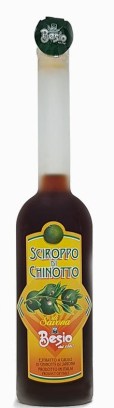
I will admit that readers may find it hard to lay their hands on syrup of chinotto. There are some companies which are devoted to the chinotto cause and still make it. Readers can try ordering it online.

Source

Here too, though, I can suggest a recipe for making the syrup at home (which does, however, presuppose having a source of chinotto fruit; all I can say is, buy a tree, it will help to save it from extinction and it makes for a very nice balcony plant). Place several green, unripe chinotti in salt water for 25 days or so, changing the water every five to six days. Fish the fruit out and shave off a thin layer of rind (this contains much of the fruit’s bitterness). Put the fruit back in salt water for another week or so, after which boil them for 30 minutes to an hour. Now place them in fresh water for four-five days, changing the water 2-3 times a day (this is to get rid of the salt). At this point, prepare a syrup of sugar – two parts sugar to every part water – boiling it to get the sugar to dissolve. Place the chinotti in the syrup for two weeks. You will end up with a sugar syrup with a sharp taste of chinotto. The now candied chinotti can be taken out and left aside or used in pastries.

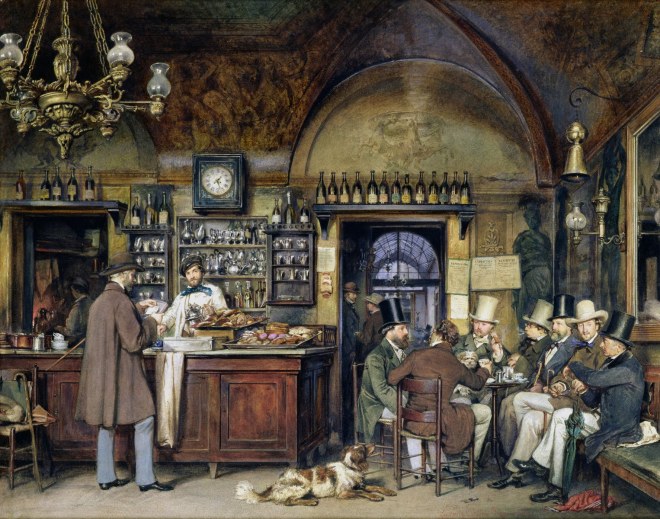
Mentioning these candied chinotti allows me to introduce what seems to me to have been a wonderful habit in Italian (and to some extent French) bars in the 19th Century. The bars would have looked something like this.

Source

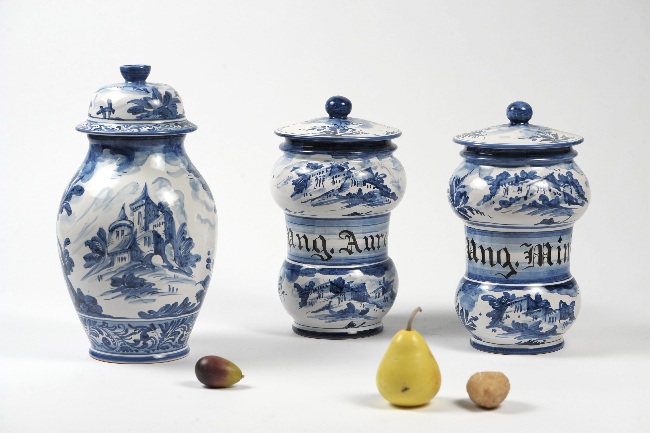
On the counter, clients would find a ceramic bowl – the best came from the Savona region with its typical blue and white designs. This photo gives an idea of what we are talking about, although I’m sure the bowls on the counters wouldn’t have been nearly so grand.

source

The bowl would contain candied chinotti drowned in Maraschino – this is a liqueur made with Marasca cherries, which are slightly sour cherries. At the end of a meal as a digestive, the client would ceremoniously fish out a candied chinotto from the bowl, using a ceramic spoon to do so, and eat the chinotto, thereby giving himself a shot of both sweet and sour.

You can make other products with chinotti: a liqueur, of course; given its relation to the sour orange, a marmalade, naturally enough; sweets; chocolate-covered candied fruit; even a perfume. I would suggest to readers to buy all these products, to save the chinotto from extinction; they are all available on-line. Savona, in Liguria, which was once a major producer of chinotti, seems to be at the vanguard of these efforts to save the plant. I will suggest to my wife that we visit Savona one of the next times we go down to the sea (it’s a train ride away), to explore all these chinotto products and do our part in saving the plant for posterity.


DEATH TO THE BRAMBLES!

Sori, 20 November 2021

I am at war!

I am Skanda

Source

Hachiman

Source

Guandi

Source

and Mars

Source

all rolled into one!

Armed with my trusty pruning shears (recently discovered gathering dust in a bag)

My photo

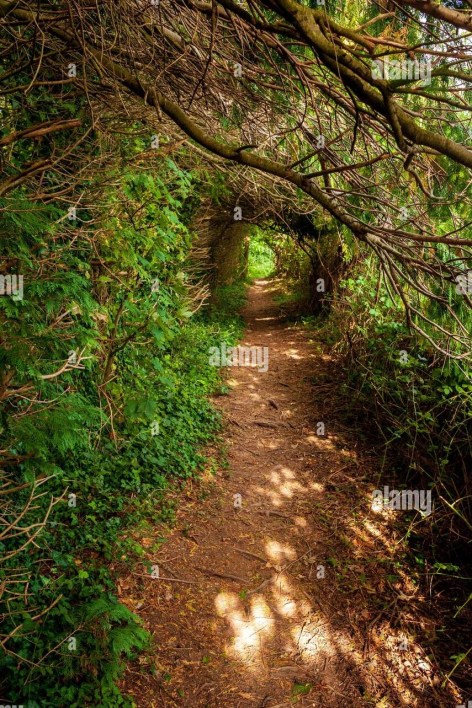
I am out on the hiking trails, attacking the brambles and other spiny weeds reaching out greedily for us as we pass

Source

as well as the overhanging branches which bump into our heads.

Source

I am Edward Scissorhands! Snip! Snip!! Snip!!!

Source

Gone! Out of the way! Vanquished!

I lunge at yet another trailing bramble. Hasta la vista, bramble!

Source

Meanwhile, my wife waits patiently at the next turn in the path, no doubt hoping that this new-found enthusiasm of mine for visiting death and destruction on passing vegetation will soon fade away.

SAINT HUBERT, PATRON SAINT OF FORESTS

Vienna, 10 October 2021
Amended 2 April 2022

My son commented to me yesterday morning that I hadn’t posted in a while, and he’s right. It’s been over a month! The fact is, I’ve been busy these days (or B-U-S-Y as my son used to write in reply when we fond parents sent him a WhatsApp message suggesting a chat; luckily, he wasn’t B-U-S-Y yesterday morning). I’ve been helping students at a school in Wales figure out how the school could reduce its carbon footprint and I’ve had to prepare and deliver quite a number lectures for webinars on the topic of Circular Economies. All fascinating stuff, but it has eaten into my blogging time.

Anyway, it seems to me that as the days shorten, the temperatures fall, and my wife and I have our last hikes in the woods around Vienna before we migrate south to Italy for the winter, it would be good to celebrate Saint Hubert, the patron saint of all things linked to forests:

– Of hunters and their hounds, here painted by Paolo Uccello.

Source

– Of archers (because they originally used their bows to hunt in the forests; Robin Hood comes to mind).

Source

– Of trappers (another type of hunter who lurked in forests trapping beavers and other animals for their furs), here seen in a painting at the Metropolitan Museum of Art.

Source

– Of loggers and other forest workers, seen here in a photo from the late 1800s.

Source

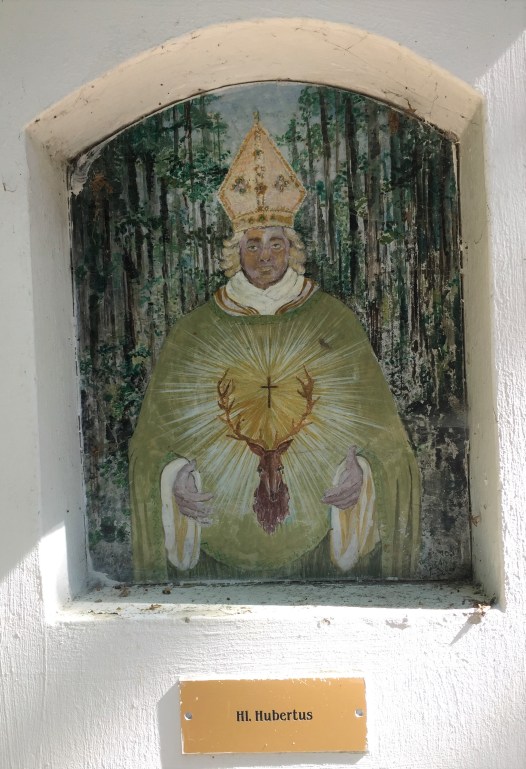
Here is a photo of Hubert on one side of a small forest shrine that we came across during one of our recent hikes.

my photo

And this is the shrine.

My photo

Hubert’s story, which explains why he was made patron saint of all things to do with forests, is quickly told. He was born in the 650s AD in Toulouse, into a family that was part of the high Frankish aristocracy. Initially, he joined the Neustrian court centered on Paris, but because of quarrels with the Mayor of the Neustrian palace he transferred to the Austrasian court centered on Metz, where he was warmly welcomed by the Mayor of the Austrasian palace, on the grounds of “the enemy of my enemy is my friend” – the two Mayors were constantly fighting each other. He seems to have quickly inserted himself into the local elites, marrying the daughter of the Duke of Leuven (if you’re a Flemish speaker, Louvain if you’re a French speaker).

Like all good aristocrats of the time (indeed, like all good aristocrats of all ages), Hubert loved to hunt, and he seems to have spent most of his time roaming the forests of the Ardennes looking for some red meat to shoot. His predilection for hunting only increased after his wife died in child birth, to the point that one Good Friday, when he really should have been in a church on his knees praying for his soul, he instead vaulted onto his horse and rode off into the forest in pursuit of game.

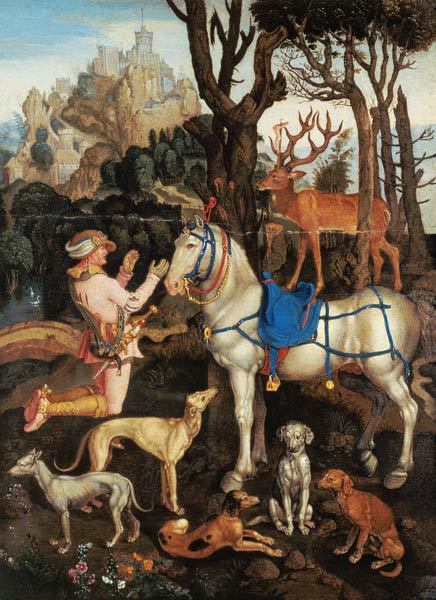
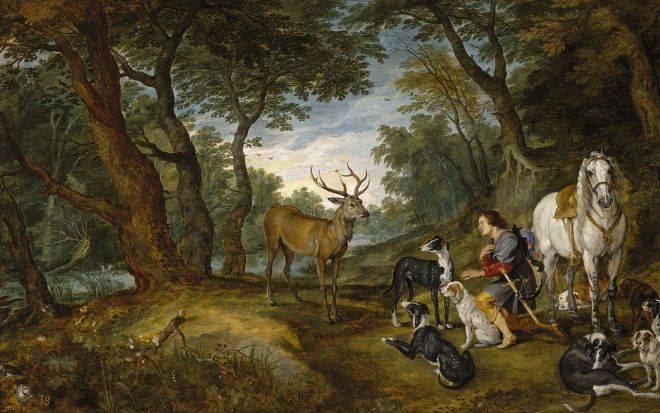
The story goes that he spied a magnificent stag and was riding full tilt after it, when the animal suddenly turned. Hubert was astounded to see a crucifix hovering between its antlers. This scene has captivated various artists over the centuries – or more probably, it captivated their clients and the artists merely executed their clients’ wishes. Here’s a version by Albrecht Dürer.

Source

Here’s one by Jan Brueghel the Elder

Source

Even Egon Schiele painted a version!

Source

In any event, the story goes on that Hubert heard a Voice, telling him to clean up his act or else he would be going straight to Hell. When he humbly asked the Voice what he should do, It told him to go find Lambert, Bishop of Maastricht, who would straighten him out.

And straighten him out he did! Under Lambert’s direction, Hubert gave away all his worldly possessions, entered a monastery, led an ascetic life, evangelized among the heathen folk who lived in the depths of the forest of Ardennes where he had once joyously hunted, etc., etc.

In about 705 AD, Lambert was assassinated, the victim of some quarrel between different Frankish factions. The event is depicted in all its gory detail in this painting by Jan van Brussel.

Source

Hubert became bishop in Lambert’s place. At some point, he moved Lambert’s remains from Maastricht to Liège, where Lambert had been killed, as we see here in this manuscript miniature.

Source

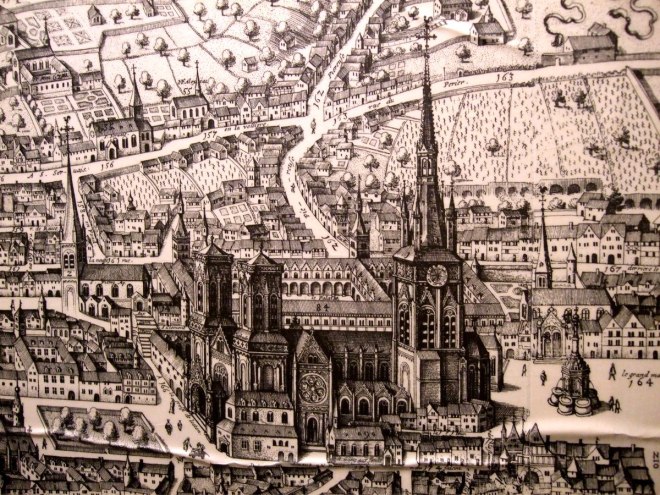
He built a magnificent basilica, which was soon turned into a cathedral, of which he naturally became the bishop (in the process, he kick-started the rise to greatness of Liège, which was then just a pissy little village). Alas, this cathedral was demolished by revolutionaries in 1794.

Source

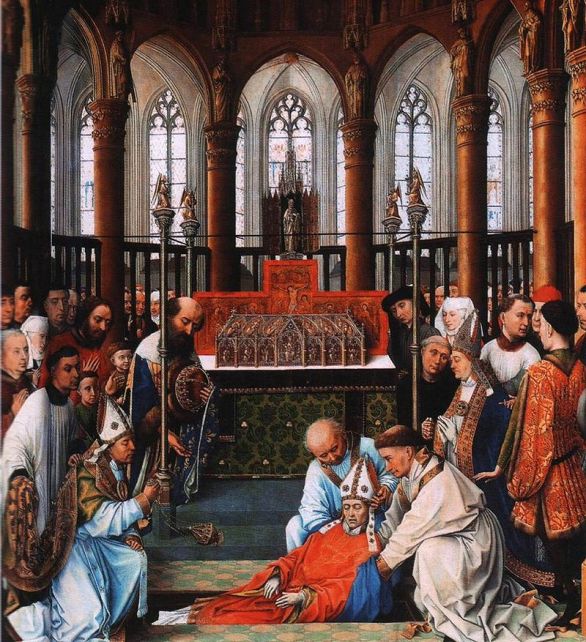
Much to his disappointment, Hubert wasn’t martyred but died peacefully in his bed in the late 720s AD. He was, as might be expected, initially buried in Liège, but about 100 years later his bones were dug up and transferred to the Benedictine Abbey of Amdain. This event was depicted in this wonderful painting by Rogier van der Weyden.

Source

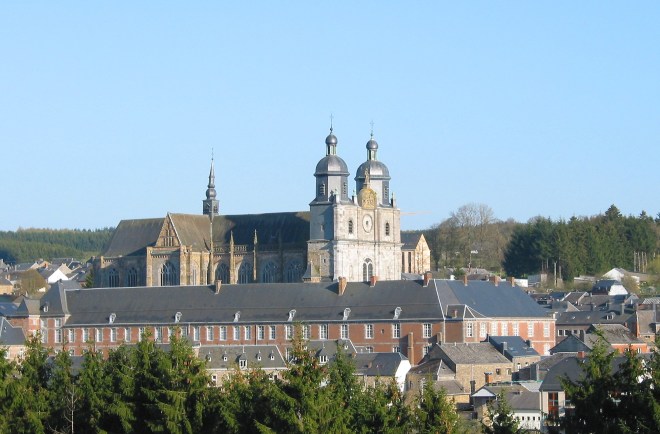
Not surprisingly, the town around the abbey renamed itself Saint-Hubert in his honour and became a focus for pilgrimages over the succeeding centuries (no doubt making the Abbey rich in the process).

Source

I think readers will now understand why Hubert is patron saint of all things forest. He was a very popular saint among the little people in the Middle Ages, probably because forests played an important role in people’s livelihoods until deforestation shrank those forests, first to woods and then to woodlots on the margins of rural lives. Not surprisingly, given his passion for hunting, Hubert was also very popular among the aristocracy, and several Noble Orders dedicated to hunting were named after him. Take, for instance, the Venerable Order of Saint Hubertus, which was founded in 1695 by Count Franz Anton von Sporck.

Source

The Order brought together the Holy Roman Emperor Charles VI and hunting enthusiasts from various other noble families throughout the Holy Roman Empire. It still exists, its current Grand Master being Istvan von Habsburg-Lothringen.

Source

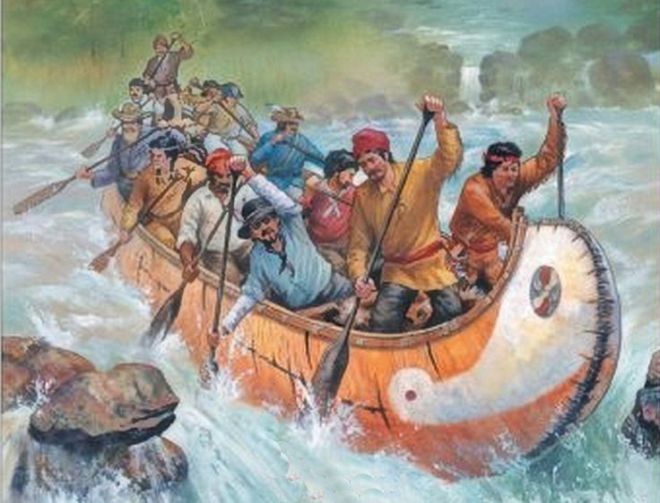
Given that in the early days of the European presence in Canada so many French Canadians were involved in the fur trade as trappers, I also now understand why Saint Hubert was a popular saint in French Canada; in the teen years I spent there, I was intrigued by the number of places called Saint-Hubert (there is even a chain of chicken restaurants in Quebec called Saint Hubert). No doubt the saint’s protection was invoked by the Catholic trappers as their canoes set off on their way to the beaver grounds out west.

Source

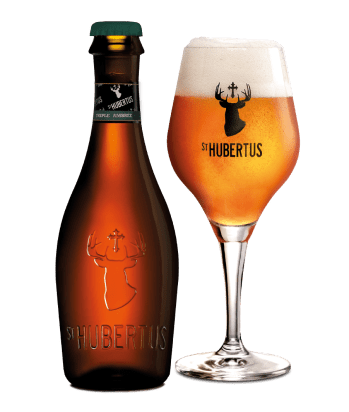
Of course, since the regions we now call Belgium and southern Netherlands were the saint’s favoured hunting grounds, both literally and figuratively, many places there are also called Saint-Hubert (French) or Sint Hubertus (Flemish/ Netherlandish). One beer has taken its name from the town of Saint-Hubert around the abbey where Hubert was eventually buried. Here is a bottle of one of the company’s brews (triple amber for any beer enthusiasts among my readers).

Source

There is also a brew that is popular here in Vienna, the Hubertus Bräu.

Source

I’m not sure why it’s called Hubert’s Brew. It’s certainly not named after the place it’s brewed in, which is Laa an der Thaya (nice area; we’ve been on a couple of hikes around there). But it has a very distinguished pedigree. The town obtained the right to brew it back in 1454, from Ladislaus Postumus, Duke of Austria (and for this privilege they had to deliver the good Duke a keg of beer on each holiday, which doesn’t sound much – but maybe there were lots of holidays back then).

As readers will note, both these beers have as a symbol the famous stag’s head with the crucifix hovering between its antlers. So does the digestive Jägermeister, that concoction of herbs macerated in alcohol, which for some strange reason became popular with the student crowd.

Source

In this case, the connection to Hubert is via its name, which means Master of the Hunt.

Of course, I understand why any alcoholic drink which has some sort of connection to Hubert would use the symbol of the stag with the hovering crucifix. But I wonder if the makers of these drinks have thought this idea through. For me, the implication is that drinking the beer or digestive will make you see things which aren’t there (rather like that hoary chestnut that alcoholics see pink elephants).

Not perhaps the best image one wants to give to an alcoholic drink. On the other hand, putting a picture of Hubert as a bishop, like the one in the photo which I started this post with, could well put a damper on one’s enthusiastic desire to drink. A tricky marketing conundrum …

With that, I lift a good glass of wine to my readers and go and join my wife to do the packing. Auf wiedersehen, arrivederci, we will see each other again once we’ve moved down to Italy!

VANILLA

This post is dedicated to my dearest wife,

the most faithful of my readers

Vienna, 4 September 2021

Some months ago, I was asked by the Student Sustainability Committee of a school in Wales which I’m involved with to help them estimate the carbon footprint of the food eaten in the school. In the case of prepared food, which made up a substantial portion of the food consumed at the school, this exercise required me to plough through a lot of recipes to understand what were the raw ingredients of these prepared foodstuffs (so as to calculate the carbon footprint of each ingredient). Apart from this being a hell of a lot of work, as my wife will testify (“have you still not finished that stuff?!”), I discovered with surprise that many, many prepared foodstuffs of the sweet variety (biscuits, cakes, chocolate, and various sundry others) have vanilla extract as one of their ingredients (and as a side note, I was very surprised to see that these sweet foodstuffs made up a large portion of all the food consumed in the school; it didn’t seem to be a very healthy diet).

These constant references to vanilla extract intrigued me, and I decided that one day I would investigate vanilla a bit more. This decision crystallized into action over the last few weeks, because it so happens that my wife is very fond of vanilla. In the Bad Old Days, before we started our rigorous dieting, she consumed a fair amount of vanilla-based ice creams, normally those covered with a chocolate casing (I will not give free publicity to her favourite brand by naming it; I will leave my readers to guess). Now, in these more virtuous times, diet-wise, her vanilla consumption mainly takes the form of vanilla-flavored yogurt, and this only for lunch on our hikes (which these summer days has meant quite frequently). For the sake of complete transparency, I should state that she still consumes a chocolate-covered vanilla ice cream from time to time, whenever a hike is judged to have been particularly strenuous.

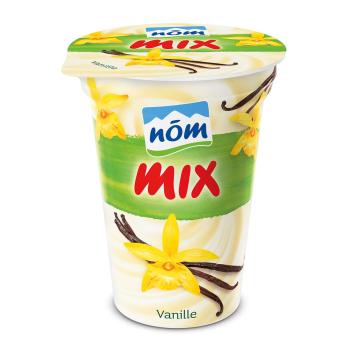
The brand of vanilla-flavored yoghurt which my wife generally favours is this one – I should add that she favours it simply because our local supermarket offers it, at a very reasonable price.

Source

Sharp-eyed readers will have noticed the flower on the tub. This is the vanilla orchid, Vanilla planifolia. Here’s a photo of the Real Thing.

Source

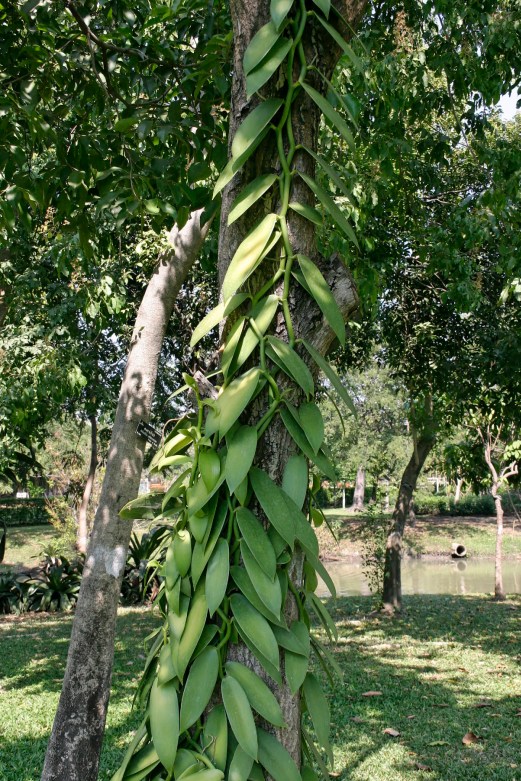
And here is the plant more or less in its natural state (readers will note that this orchid is a type of vine; in Nature it will grow up trees, like the pepper vine).

Source

It’s really a very pretty flower, but it is only of passing interest to the vanilla aficionado. She or he is after the “fruit”, a seed pod really, that the flower creates once it has been pollinated. The three dark-coloured stringy things pictured behind the flower on the yoghurt tub are these seed pods. Again, here is a photo of the Real Thing.

Source

But even the seed pod, if in its natural state, just picked from the vine, does not interest the vanilla aficionado, because it contains very low levels of vanilla flavour and aroma (these, by the way, come mostly from the chemical vanillin, although there are a number of other chemicals present which it is claimed enhance both flavour and aroma). It is only once the seed pod has been cured that the vanilla aficionado becomes interested, because now the levels of vanillin are considerably higher, high enough to add that distinct vanilla flavour and aroma to foods and drinks.

The curing of vanilla seed pods is a rather complicated, months-long process, whose purpose is to bring about an enzymatic reaction in the pods which turns the glucovanillin they contain into vanillin proper (in case any readers were asking themselves, glucovanillin has no flavour or aroma). Curing consists of four basic steps: killing, sweating, slow-drying, and conditioning. In the killing step, the seed pods are generally heated (in hot water or in an oven or by exposing the pods to the sun).

Source

This stops any further vegetative growth in the pods and initiates the necessary enzymatic reactions.

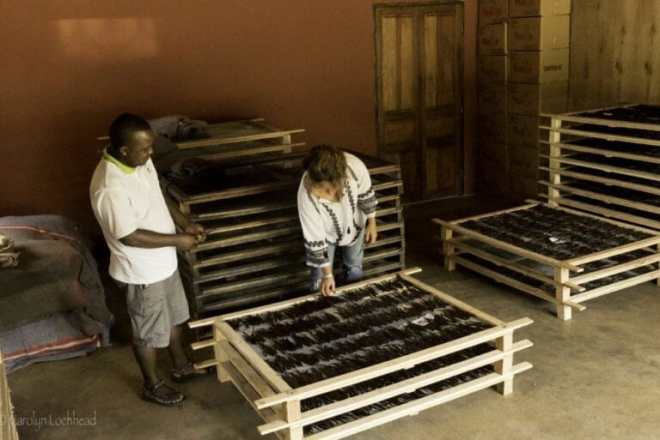
In the sweating step, the pods are kept at temperatures of 45–65°C and at high humidity levels by stacking them densely and insulating them in wool or other cloth. The pods are subjected to this Turkish bath regime for 7 to 10 days, possibly with a daily exposure to the sun or a dip in hot water.

Source

The desired enzymatic reactions love these conditions, so by the end of the sweating step the seed pods have attained much of the desired vanilla flavour and aroma. However, they still have a high moisture content. Which brings us to drying.

To prevent the pods from rotting and to lock in the vanilla aroma, drying is required. And so, over a period of three to four weeks, the pods are exposed to air and to periods of shade and sunlight.

Source

In the final, conditioning step, the dried pods are stored for five to six months in closed boxes, where the fragrance further develops.

The end result looks like this.

Source

This is what vanilla aficionados lust after, what they dream of incorporating into their dishes, from soup to sweet dishes.  And they are willing to pay top money. Vanilla is the second most expensive spice, after saffron. Those wrinkled-up beans can set you back anywhere from $50 to $500 per kilogram.

When I look at these kinds of convoluted processes, I always ask myself, “How on earth did anyone discover this process?” I mean, really, how did the first vanilla producers stand in front of those aroma-less and flavour-less seed pods and figure out that this long and complicated process would eventually lead them to seed pods with a wonderful aroma and flavour of vanilla? I would have to ask this question to the ancestors of the Totonacs, an Amerindian people who live on the east coast of Mexico. It was they who first “made” vanilla-flavoured seed pods from the vanilla orchid – the orchid’s natural habitat is in this part of the world. Here, we have Diego Rivera’s take on the Totonacs, as part of one of his murals in the National Palace in Mexico City.

Source

Unfortunately, I’m sure today’s Totonacs have no idea; I just have to accept that the answer is lost in the mists of time.

Readers might think that since the vanilla orchid is natural to Mexico’s eastern seaboard, that country would be a major producer of vanilla. Alas, not so! The reason for that is the great Columbian exchange, that massive movement of plants, animals, humans – and diseases – which took place between the New and Old Worlds after the discovery of the Americas by Christopher Columbus. The vanilla orchid was part of that exchange. The Conquistadors, like the Totonacs (and like the Aztecs) loved the flavour and aroma of vanilla and figured that people back home would love it too. They exported the pods back to Europe, where they caused a sensation, at least among the elites, who had the money to burn on this rare and expensive novelty. They put it in everything, from chocolate (also a product of Mexico) to soup. They adopted the Spanish name for it (vanilla is a corruption of the Spanish vainilla, meaning “little pod”). Other Europeans looked on enviously. Eventually, the French laid their hands on some exemplars of the plant and took them to their colonies which had similar climates to Mexico’s eastern seaboard, namely those in the Caribbean and the Indian Ocean, especially the islands of Madagascar, Réunion, and Mauritius.

For a while, Mexico continued to be the main global producer of vanilla, because this transplant of the vanilla orchid to other places was a failure. The plant flowered alright, but it never produced pods. The reason for this is an exquisite example of specialized evolution: vanilla flowers can only be pollinated by this little critter, Eulaema meriana, one of some 25 species of orchid bees.

Source

No other insect is attracted by the sex pheromones emitted by the flower, nor can any other insect successfully navigate the orchid’s complicated geometry and pollinate the flower along the way.

Once non-Mexican wannabe vanilla producers realized the problem, they tried the obvious thing, which was to transplant the vanilla-pollinating orchid bee along with the orchid. But it didn’t work; the bee couldn’t survive outside of its native habitat. The wannabe vanilla producers were stumped. Until 1841.

In that year, a 12-year old slave called Edmond (no surname, he was a slave), who had been born into slavery on the Island of Réunion, came up with a quick and easy way of pollinating the vanilla orchid flower by hand. He had been lent out by his master to a botanist by the name of Ferreol Bellier-Beaumont, to help him out. Beaumont had shown him how to hand pollinate a watermelon plant and the boy went off and successfully applied his new skills to the vanilla orchid. (For anyone considering hand-pollinating a vanilla orchid flower, here’s what you do: with a small sliver of bamboo or wood (or even a stem of grass), lift the membrane separating the flower’s anther and stigma; then, using your thumb, transfer the pollinia from anther to stigma.)

Edmond never got anything out of his discovery. Who did were all the the slave-owning planters on Réunion who now got into vanilla growing: for a while, Réunion became the world’s largest producer of vanilla. But the French authorities made sure the method was transferred to its other island colonies in the Indian Ocean and in the Caribbean. Since then, Madagascar has dominated world production (Indonesia, which muscled into the market in the 1980s, is now second in the producers’ league table). Mexico, on the other hand, has pretty much vanished from the scene, which is a crying shame.

As for Edmond, seven years after his discovery, at the age of 19, he got his freedom; the French government finally outlawed slavery in its colonies in 1848. He left the world of plantations to work as a kitchen hand in the island’s main city, and adopted the surname Albius, from the Latin alba or white, in reference to the vanilla orchid’s colour. Beaumont tried to get the governor of Réunion to give Edmond a stipend or at least a reward for his great discovery but the governor ignored the petition. No doubt, he didn’t think it was worth spending public monies on a black ex-slave.

Unfortunately, Edmond fell in with a bad crowd in his new life and got involved in a theft of jewelry. He was caught and sentenced to 10 years in jail, which, after an appeal by Beaumont to the governor, was reduced to five. After doing his time, Edmond moved back to a village close to the plantation and got married.

Edmond’s travails were not over. It seems to have been an irritation in certain quarters that where white professional botanists had failed, a black slave, and a child to boot, had succeeded. Some time in 1860s a well-known French botanist and plant collector by the name of Jean Richard claimed that actually, he had come up with this revolutionary pollination method in the late 1830s, that he had taught it to some planters in Réunion, and that Edmond must have sneaked into the meeting and heard his explanation. Luckily, Beaumont and a few others vigorously defended Edmond’s primacy to the discovery, although Richard’s false claim did get some traction for a while. May Richard’s name be damned forever …

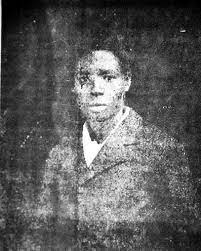
Edmond died in poverty in 1880, at the age of 51. Luckily, he left a physical trace of himself in history, rare for ex-slaves. Here we have a rather grainy photograph of him when young.

Source

And here we have a lithograph of him from a book published in 1863, standing gravely in front of a vanilla orchid vine.

Source

Wonderful story, the vanilla story, no? Except that as far as the vanilla in my wife’s yoghurt is concerned, it is all a big red herring.

Source

I’m afraid to tell her, and any other readers who might be vanilla lovers, that the vast majority of the vanillin used commercially in the world is fake – well, artificial might be a less inflammatory word. Most of the world’s vanillin is produced from crude oil derivatives in chemical plants: benzene is alkylated with propylene to form cumene, which is then oxidized to phenol. Phenol is hydroxylated into catechol, which is further methylated into guaiacol. Finally, guaiacol is reacted with glyoxilic acid by electrophilic aromatic substitution to produce vanillylmandelic acid, which is converted to vanillin by oxidative decarboxylation. The remainder of the world’s artificial vanillin is made from a waste stream generated in the sulphite process to make paper pulp.

Yes, I know, very disappointing. And the worst of it is that when Cooks Illustrated ran some taste tests which pitted natural vanilla against artificial vanillin used in baked goods and other applications, tasters could not tell the difference! Don’t know what the world is coming to … Luckily, the tasters could tell the difference where ice cream was concerned, with natural vanilla winning out; l’onore è salvo, honour has been saved, as my wife might say.

BEECH TREES

24 August, 2021

This post is a hymn of praise to the European beech tree.

Source

The tree has been a constant companion on our hikes this summer as we explore the western reaches of the Wienerwald, the woods encircling Vienna to its north and west. Apart from the odd oak, wild cherry, and conifer, the European beech reigns supreme in the Wienerwald.

My memories of the beech start at the age of 10 or so, at my Prep school (Brit-speak for a private, boarding, primary school). Just outside the school gates, at the bottom of a field, was a magnificent copper beech; we would pass it every time we made our way to the school’s playing fields which were down the road. I have no photo of this tree, it may even no longer stand, so this photo will have to stand in for it and for all these magnificent variants of the beech.

Source

I used to think the copper beech was a different species, but no, all the world’s copper beeches are fruit of a single spontaneous mutation that occurred in a beech tree in a forest in Thuringia, in Germany. It was noticed back in 1690 and was carried from there around the world. One single mutation … like blue eyes.

My next memory of beech is a long beech hedge at my Public school (Brit-speak for a private, boarding, secondary school), which bordered the campus’s entrance road. It was lovely during the summer, with that long solid block of tender green running along the road. Again, I don’t have a photo of this hedge, so this photo of a wonderful hedge somewhere in the UK will have to stand in for it.

Source

It was really only when we moved to Vienna and got to know the Wienerwald that my wife and I discovered beech woods. And what magnificent woods they are! I insert here one photo we took, where the sun dappled the trunks that stretched off into the distance.

my photo

But our iPhones can’t do these woods justice, so I’ve also picked out a few photos from the Internet taken by people who’ve got the right equipment and know what they are doing.

Source
Source
Source
Source

That last photo could be of us, following the marked paths through the woods, rather like Hansel and Gretel following Hansel’s white pebbles.

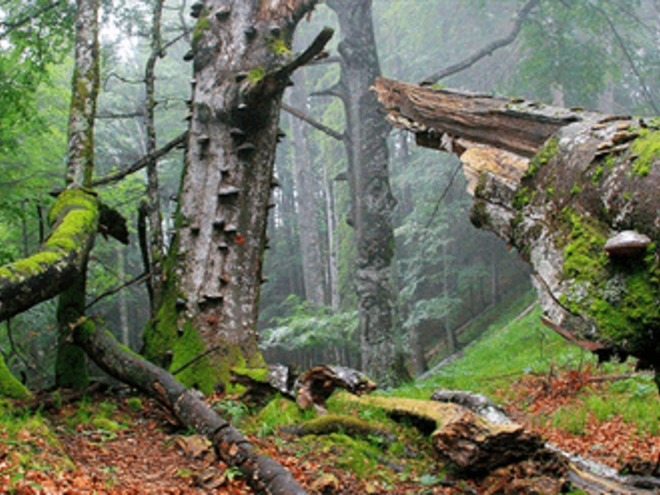
Having been enchanted by these beech woods, my wife and I have decided that some day we will visit some of Europe’s primeval beech forests. These are beech forests which have never, ever been cut or otherwise exploited by human beings, the kind of beech forests through which our hunter-gatherer ancestors would have wandered ten thousand and more years ago. There are 94 such forests in Europe, and as a group they have become a UNESCO World Heritage Site. Austria has five of the 94, Italy 13. In one way or another, we’ll figure out a way of getting to a couple of them. In the meantime, I throw in a photo of one of the Austrian forests, Hintergebirg.

Source

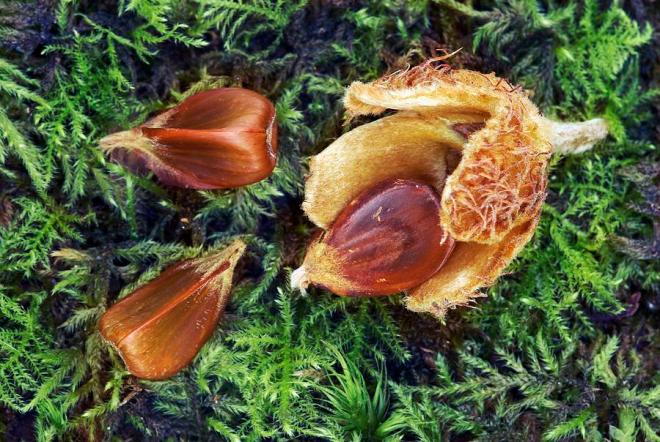
Interestingly enough, the UK has no primeval beech forests (nor does Ireland, for that matter). It could be that over the centuries the British have simply not been able to leave any of their beech forests alone, cutting them, clearing them, or otherwise fiddling around with them. Or it could be that there never were any primeval beech forests in the first place. The beech is considered natural in the southern part of the island. However, some voices have been raised wondering if this is actually correct. These voices suggest that perhaps the beech was brought to the UK by our Iron Age ancestors, who wanted to have it with them as a source of food – the food in question in this case being the beech tree’s nuts, or mast as it is called. Here we have a (very) close-up – the nuts are quite small.

Source

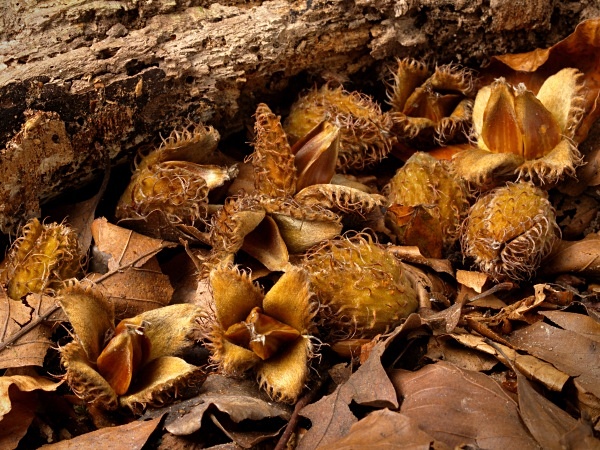
And here we see them as my wife and I would probably see them, if we went looking for them, half hidden among dead leaves on the ground.

Source

I must confess to having been surprised to read that our ancestors ate mast. But that only goes to show how alienated I have become from natural sources of food – “if it ain’t on supermarket shelves it ain’t food”. By my reckoning, it’s five generations since any of my ancestors might have foraged for beech mast. But foraging is becoming popular, with many websites dedicated to this lost art form. A good number of them mention beech mast, claiming that the nuts are good to eat (although small and time-consuming to gather). Other, probably more objective sites warn that the nuts can taste bitter because of their high levels of tannins, but that they can be ground to a flour and the tannins leached out – that’s probably how my more recent ancestors would have eaten mast, if and when they ate it. I now know that I should start looking out for fresh nuts on our hikes in a few weeks’ time; they fall in late August, early September. I’ll try a couple – and see if I can’t persuade my wife to try them too – and will report back.

Coming back to beech woods, one of their characteristics is that they are – relatively speaking – quite dark; the crown of leaves at the top of the trees are dense enough to keep out a lot of the incoming sunlight. As a result, little if anything grows in the shade of the towering beech trunks. The most common sight is a carpet of bronze-coloured beech leaves lying on the forest floor, the product of the trees losing their leaves year after year. My wife and I see this most spectacularly on the hikes we do during the winter months through a beech wood high above Lake Como, when the dead beech leaves on the ground are the only colour present.

Source

But from time to time we walk through sections of beech woods where a beautiful field of grass lies at the feet of the trees.

My photo

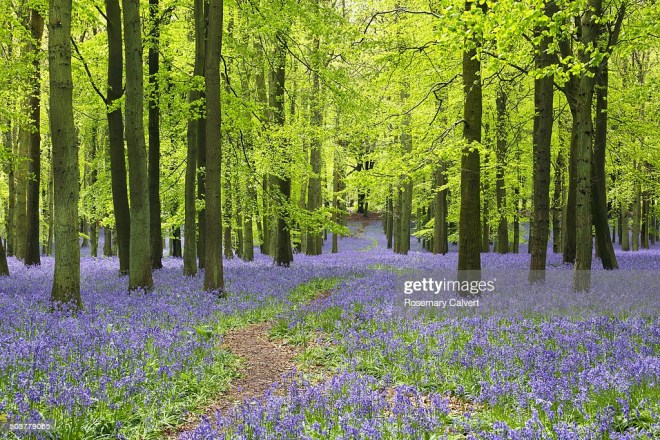
I don’t know what grass this is, or why it only grows in certain places, but the sight of these lawns stretching off into the distance between the trees is a joy to behold. But perhaps not as breathtaking as the fields of bluebells in some of the UK’s beech woods.

Source

The bluebells escape the deadly shade of the beeches by flowering before the trees are fully in leaf. I’m ashamed to say that I have never visited any of these bluebell groves – another item on our bucket list.

The other characteristic of beech woods is the trees’ smooth bark. It’s quite a striking sight to see all these pale grey, smooth trunks towering up into the sky above our heads. And one can immediately spot the lone oak or cherry or conifer skulking among the beeches; their rough barks stand out. This smoothness actually signals a fragility in the beech’s bark; it is easily scarred and the marks remain forever as the bark cannot heal. Many of the beech trees we cross are marked by scars in their bark, no doubt caused by branches of other trees or bushes scraping against them when they were young. But on our walks we also see examples of silly boys, and perhaps some silly girls, using the inability of the beech’s bark to heal to carve their initials into it, quite often combined with the initials of a loved one and the whole enclosed within a heart; they will stay, more and more distorted as the tree grows, until it is cut or blown down.

Source

Initials carved in a beech’s bark is another of my beech memories. This particular beech was in my French grandmother’s garden and the initials carved into its bark my uncle’s. He must have done it 30-40 years before I saw it. Family lore has it that my grandmother was furious with him when she discovered this disfigurement of her tree – “so vulgar!” – and gave him a good thrashing. The tree has gone, alas. It died some 15 years after my grandmother died, shaded out, I suspect, by the mighty sequoia nearby, but also probably suffering from a drop in the area’s aquifer: too much water is being pumped out.

Scratching initials on beech bark allows me to make a connection between this wonderful tree and another wonderful item of which I have many exemplars: the book. Beech and book actually come from the same root, the Old English bōc. This has the primary sense of “beech” but also a secondary sense of “book”. The connection is perhaps more obvious in other modern Germanic languages. In modern German, the word for “book” is Buch, with Buche meaning “beech tree”. In modern Dutch, the word for “book” is boek, with beuk meaning “beech tree”. In Swedish, the word bok means both “beech tree” and “book”. This connection allows me to hold forth on another favourite topic of mine, trade – or rather, the exchange of ideas that comes with trade.

When the Germanic tribes migrated into Europe, pushing out the Celts, they were illiterate, with no culture of writing and no alphabet of their own. When they met the Romans, they fought them of course, but they also traded with them and in so doing came into contact both with writing and with the waxed wooden tablets on which traders (and many others in the Roman Empire) made notes or wrote short missives. As far as the alphabet was concerned, the Germanic tribes adopted a precursor to the Roman alphabet, the old Italic alphabet, to create their runes. As for the tablets, the Germanic tribes used the tree that surrounded them, the beech, to make them, and called these tablets after the tree from which they came. Later, when the Germanic tribes shifted to using parchment, they continued to call what they wrote in books.

Being made of wood, these tablets have normally decayed away, but some examples of Roman tablets have been unearthed along Hadrian’s Wall, somehow miraculously avoiding the normal decay processes.

Source

So from now on the books which surround me will remind me every day of the beech trees which surround us on our walks in the Wienerwald.

SCENT OF A FIG TREE

Vienna, 6 August 2021

I’ve mentioned in previous posts the migratory habits which regulate our lives since we retired: when it begins to get cold in the late autumn we migrate south to Italy, when it begins to get hot in the early summer we migrate north to Austria.

It’s me, really, that’s imposed this pattern on our lives. I have a great dislike of intense cold, so I prefer to abandon Austria to its fate in the winter. But equally, I have a great dislike of intense heat, so I hasten to vacate Italy when the mercury begins to climb vertiginously. I suppose it’s my Anglo-Saxon genes that dictate this behaviour: the breeding of generations have led them to feel most at home in places with mild, not too sunny weather.

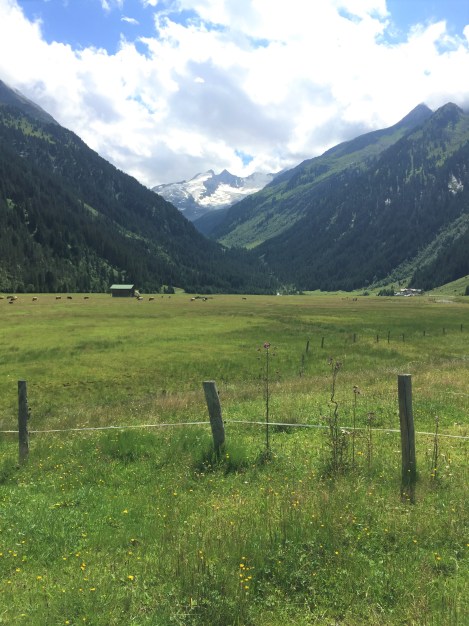
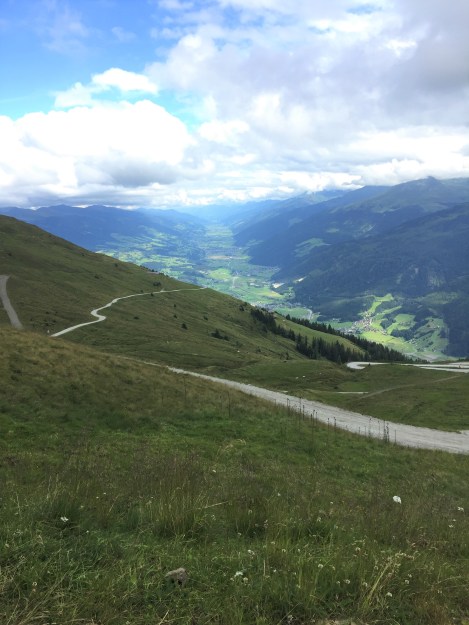
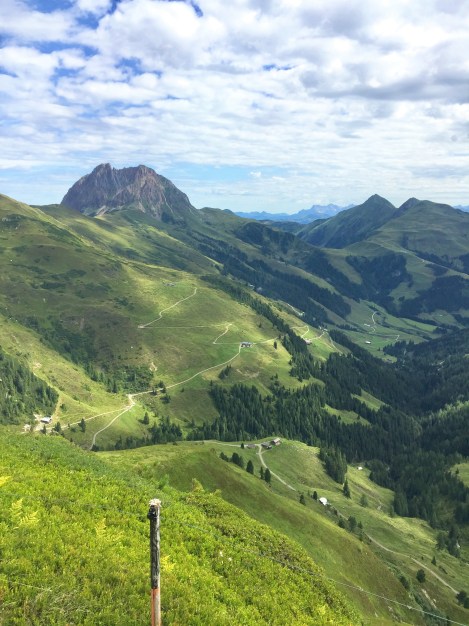
I was thinking of this as my wife and I hiked this last week in the Hohe Tauern region of Austria, high up along the edges of the Salzach valley. The weather was cool, cloudy, with patches of sun, but also a little rain now and then, ideal weather for hiking. I throw in a couple of photos which we took.

my photo
my photo
my photo

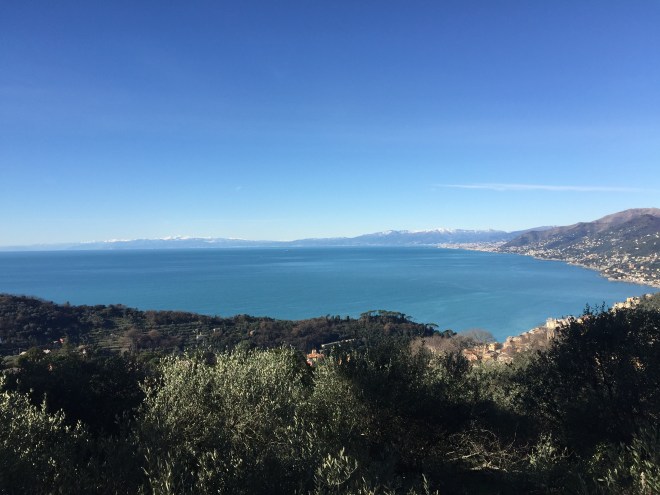
Yes, I was glad to be out of the furnace that is Italy at this time of the year. Even the lure of the Mediterranean Sea in Liguria, our favourite site for hiking, cannot overcome my dislike of Italy’s summer heat.

my photo

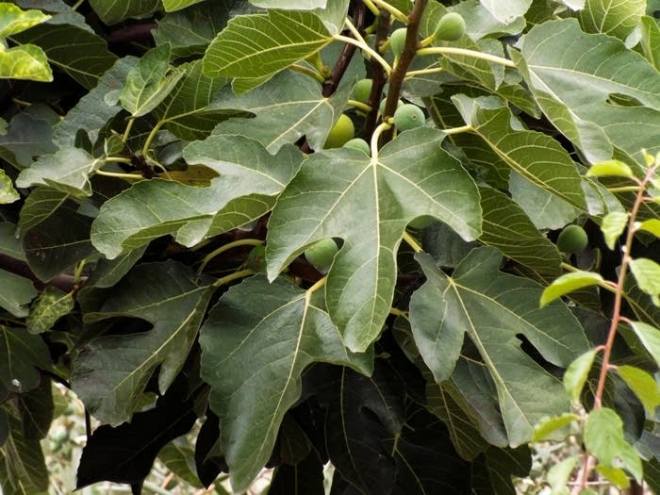
That being said, there is one thing I do miss from our hikes in Liguria: the scent of fig trees. It’s actually one tree in particular which I miss. It borders the path leading from behind our apartment up to the village of Pieve Alta.

Source

I cannot even begin to describe the cloud of scent that will suddenly envelop us as we pass that fig tree in late May, early June. It is a scent which for me evokes a dollop of fig jam dissolved in coconut milk, with a pinch of vanilla added, along – perhaps – with a sprinkling of cinnamon. It is like someone passing under my nose a plateful of very ripe figs, all cut open.

Source

I used to think that it was the fruit giving off this scent, but after reading up on fig trees I now think it is more likely to be the tree’s beautiful, deeply lobed leaves that are emitting the scent.

Source

Wherever the scent is coming from, and for whatever reason the tree is giving it off (surely not to attract me), I thank the Good Lord that I can get such pleasure from passing a fig tree. Sometimes, as I stride across high Alpine pastures or thread my way through dark stands of tall fir trees, I feel a point of nostalgia for that humble fig tree growing along the path between our apartment and Pieve Alta.

TUBING DOWN THE DRAVA RIVER

Milan, 28 June 2021

My wife and I, together with our daughter this year, have just finished our annual week-long hike in the Dolomites. We went back to the valley where we had started our hike last year, the Val Fiscalina in Alto Adige (or Sud Tirol).
I will hopefully post my usual photo-essay of the hikes we did, once our daughter sends us the photos – as she repeatedly reminded us, the camera in her iPhone is way better than ours, so she took most of the photos. But here I want to talk about something that happened during an easy hike we took on one of our five days of hiking, to give our muscles a rest. It was along the side of the valley between Sesto and Dobbiaco. Along the way, we crossed this panel.

Source

It was announcing that we were crossing the sources of the Drava River. The Drava River! … I knew this river as a tributary of the Danube, somewhere in the Balkans. Yet here was its source, some 500 km away as the crow flies. To memorialize the moment, I took this picture, just when a young boy happened to be messing around with the stream of water.
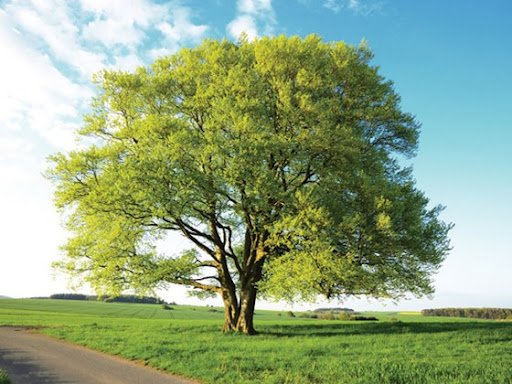
my photo

I immediately recognized that pastime from my own childhood, damming and undamming streams; I still enjoy undamming the rivulets that trickle down the side of tracks we hike along, poking away at the amassed debris with my walking sticks. I would also float sticks on streams and watch them disappear around the nearest bend. Where would those sticks end up, I wondered.

Once, when I was a bit older, I spent hours poring over maps of England, trying to figure out how I might be able to kayak down the stream which ran along the bottom of the valley in front of my school, all the way to London. Ah, the foolishness of youth! I’m not sure a kayak would have even fitted in that stream.

A few years later again – I was in my mid teens by then – I was consumed with envy when I discovered that my two cousins had spent a couple of weeks tubing down some river in France. Just the thing I had wanted to do with my kayak!

That evening, I was once again studying maps, to see where the Drava river went. And suddenly, I found myself dreaming up an imaginary tubing journey down the Drava with my wife, all the way to its mouth on the Danube. This picture gives my readers an idea of what I’m talking about, although this particular tubing expedition is taking place in Tuscany.

Source

I decide that we will start our imaginary tubing journey in San Candido. At its very beginning, the Drava is really a miserable little stream, there’s no way we could float two tubes in it – plus a third one carrying our stuff. But at San Candido, it receives the waters of the much bigger Sextner Bach.

Source

So off we go, down the Drava!

After some 8 kilometers of going east the Drava stream will carry us out of Italy at Prato alla Drava and into the province of East Tyrol in Austria.

Source

30 kilometers later, the stream will bring us to the town of Lienz. Here, the Drava meets the much more powerful Isel River, which bulks it up.

Source

After Lienz, the Drava, a river now, although still a small river, will carry us into the upper Drava valley. We’ll first pass through the Kärntner Tor, or Carinthian Gate, which is a narrowing in the Drava Valley and the entry point into the province of Carinthia.

Source

The river runs between the Kreuzeck range of the High Tauern in the north and the Gailtal Alps in the south. After carrying us past various picturesque villages like the village of Greifenburg

Source

the river will turn sharp left and squeeze through the Sachsenburger Narrows.

Source

We’ll be traveling faster on the more rapid currents and we’ll burst out of the narrows, spinning perhaps in our tubes, to find ourselves floating past Sachsenburg itself.

Source

We will have travelled some 50 km by now since we plonked our tubes down in the stream at San Candido.

Just after Sachsenburg, the river receives the Möll river, swelling it still further.

Source

Maybe a few flecks of gold will cling to our tubes at this point! The Möll, but also the Isel earlier and other streams coming out of the High Tauern Mountains, carry alluvial gold out of these mountains. For several thousand years, pan handlers have earned a modest but honest living along the Drava River downstream of the High Tauern Mountains, panning the river’s detritus for gold, all the way down into Croatia. Even today, some hardy souls try their luck.

Source

We will now be floating by Spittal an der Drau.

Source

Soon after, Villach, the biggest town we’ll have seen so far, will hove into view.

Source

After Villach, the Drava River becomes more of a lowland river, running slower and beginning to twist and turn across the landscape. Our tubes will follow it in these twists and turns, eventually entering the Rosental valley and running along the northern side of the Karawanken mountain ranges. Here, the river, and my wife and I, will end our travels in Austria. We will float gently by Völkermarkt

Source

before following the river south as it slips through a gap in the mountains and enters Slovenia. In total, we will have travelled 255 kilometres in Austria.

Onwards into Slovenia! We will soon reach our first Slovenian town, Dravograd.

Source

The river, and us, will now turn eastward, and after running through a sparsely populated area we will arrive to Maribor.

Source

After admiring the quays of Maribor as we slip by, we will let the river take us southward to Ptuj.

Source

Shortly thereafter, after traveling some 120 kilometres in Slovenia, the river will carry us across the border into Croatia.

Croatia, here we come!

We cruise by Varaždin, which we don’t really see, it being set back from the river. Quite soon after, the Drava is joined by the Mur River.

Source

For 130 kilometers or so, the river now becomes the border between Croatia and Hungary. It has become a very slow-moving river, meandering its way across the landscape, which has become a pleasant forest- and marsh-filled environment.

Source

We will patiently follow the meanders, moving sluggishly past the Hungarian border town of Barcs.

Source

From now on, we’ll have to be careful not to be run over by the ships which begin to ply the Drava for trade. Further on, we will glide past the small Croatian town of Donji Miholjac.

Source

The river now stops being the border with Hungary. On it goes, looping and relooping as it crosses the region of Slavonia.

Source

It will eventually bring us to Osijek.

Source

I think I’ll stop our imaginary journey here. We’ve already travelled some 160 kilometres through Croatia, and some 7 kilometres beyond Osijek the Drava finally flows into, and loses itself in, the Danube.

Source

I don’t think there would be anywhere for us to get off the river there, and I don’t feel like continuing all the way down the Danube to the Black Sea.

Well, that was a nice dream! Alas, I suspect that doing a trip like this in real life wouldn’t be possible. For one thing, the river has been dammed to within an inch of its life, for hydropower. There are no less than 22 hydroelectric stations along the river. Assuming one is even allowed onto the lakes behind the dams, at some point we would somehow have to schlepp our tubes around the dams and down onto the river again – assuming that there would be enough water downstream of the dams to plonk our tubes into. For another, I rather suspect that having one’s bum in the water all day, for something like two weeks (my guess as to how long this little trip would take), might not be too good for the skin of the bum. For a third, the waters of the Drava up to at least the Möll River are all from glacial or snow melt and so would be pretty damned cold. But hey! What would life be like without dreams?

I read, however, that they are constructing a bike path all the way down the river. Maybe it would be more sensible for my wife and me to simply bike down the Drava …

Source