THE SCENT OF WATER

Beijing, 12 October 2012

How would you describe the scent of water? This evening, as I reached the bridge which crosses my piece of canal a gentle breeze lifted the scent off the water’s surface and wafted it over to me. And I asked myself that question.

Let me take a leaf out of wine reviews and try a little of their purple prose: “I sense a hint of moss, with an undercurrent of peat, perhaps a whiff of algal respiration”. But actually what I was smelling was my childhood. Don’t you find that scents are a powerful trigger of memories? I do: a drift of scent will suddenly have me awash in memories. And so it was that as I crossed the bridge I was suddenly ten years old again, on my grandmother’s sail boat on the Norfolk Broads, moored at her buoy on Barton Broad. The sun has set, a light breeze is blowing off the water bringing me the scent of the Broad’s peaty water, and small waves are slapping quietly at the boat’s hull. A grebe calls out in the night.
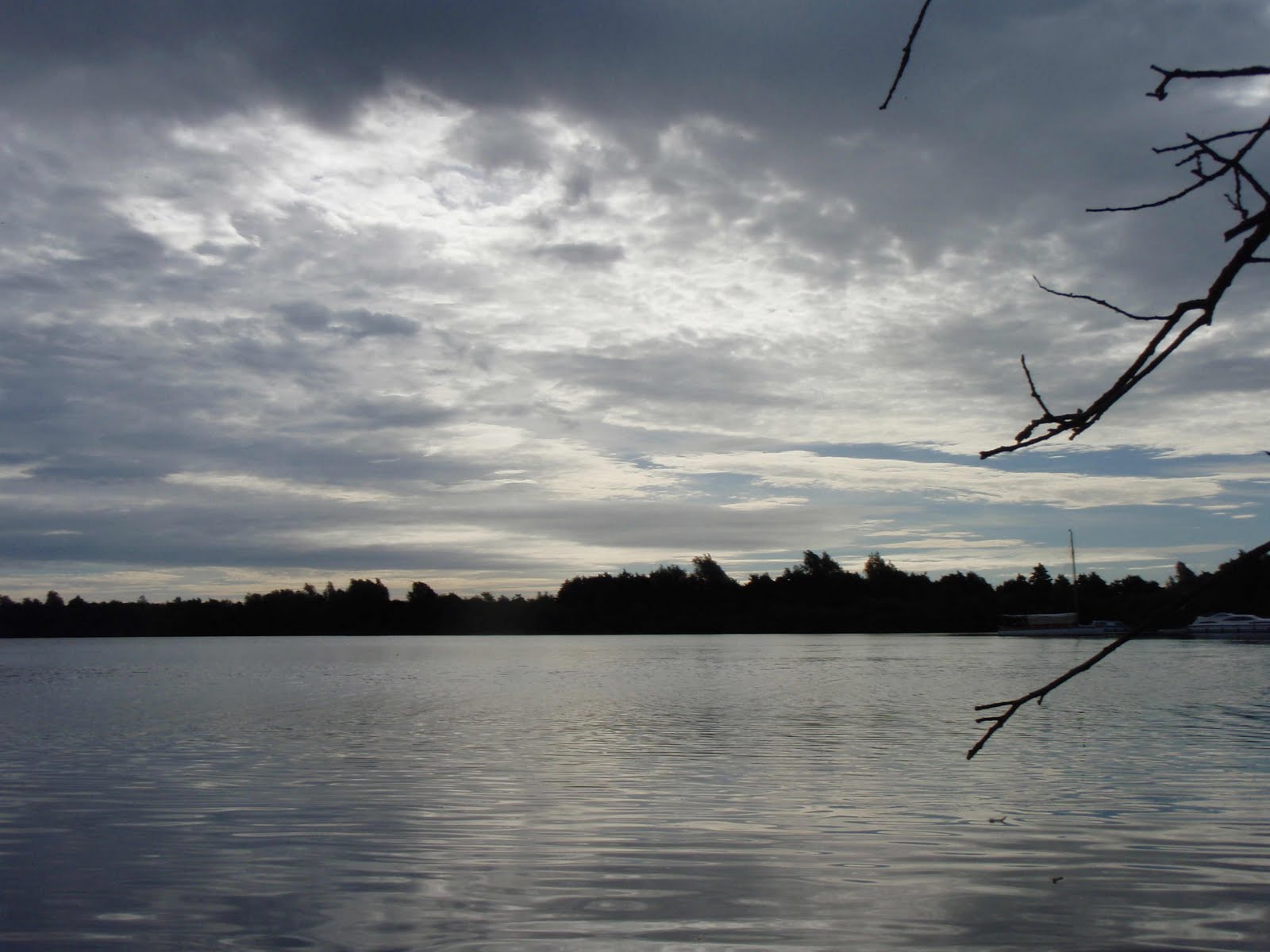
I loved the Broads. My grandmother spent most of her summer on the boat, taking her numerous grandchildren in shifts of two weeks. I must have gone five years in a row. The sailing didn’t really excite me; it was kayaking among the rushes and in the little creeks on the edges of the Broads that I loved, watching the wildlife and discovering small marsh flowers at every turn.

But I grew up, and my grandmother grew old, and life moved on.  I stopped going and haven’t been back since. Yet I am sure that the Broads made me what I am today: an environmental engineer who for more than thirty years has tried to push back the tide of waste threatening to wash away the natural beauties that are around us.
__________________
pix from:
http://maalie.blogspot.com/2010/08/kayaking-on-norfolk-broads.html
http://news.bbc.co.uk/local/norfolk/hi/people_and_places/nature/newsid_8090000/8090224.stm
LAKE KHOVSGOL: A REMOTE CORNER OF A REMOTE LAND

Lake Khövsgöl, 9 October 2012

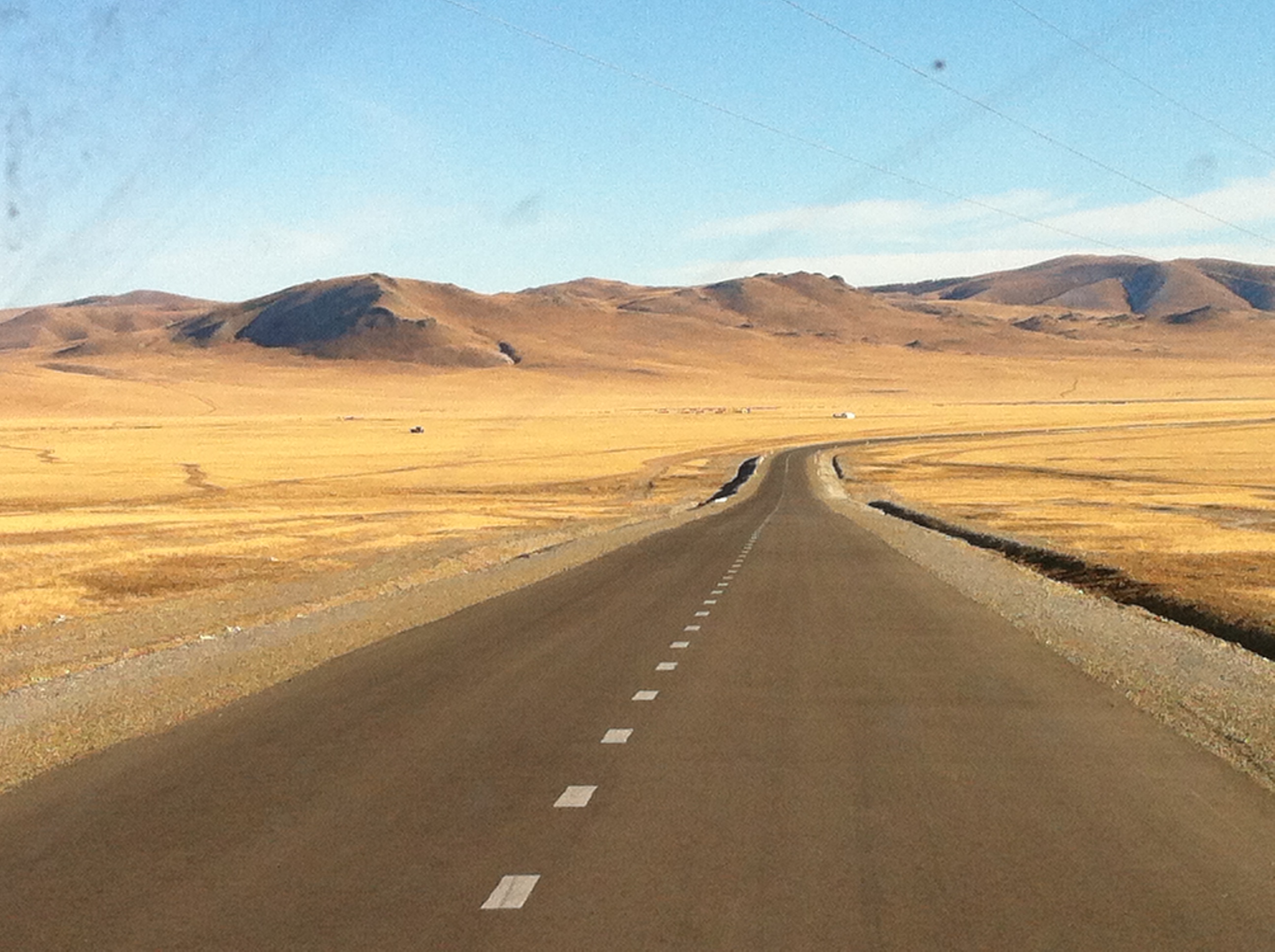
We left at 9 o’clock, with Purev driving us in a right-hand 4×4: standard fare in Mongolia, in this case imported second-hand from Japan. For two hours we drove northwards, towards Mongolia’s border with Russia. The road was tarred most of the way, although it was still being completed; there were sections where we had to career off the road and drive on the prairie alongside the road; Purev’s driving seemed more fluid and certain on these sections, he’s not in his element on tarred roads. Endless vistas of an empty land accompanied us along the way: this country, which six times bigger than the UK, is home to less than three million people, half of whom live in the capital alone.  Here and there, we would see the white ger, the traditional Mongolian tents, of herders dotting the landscape, with herds of yak or sheep browsing the dry grass.

As we drove, dark clouds started coming towards us.

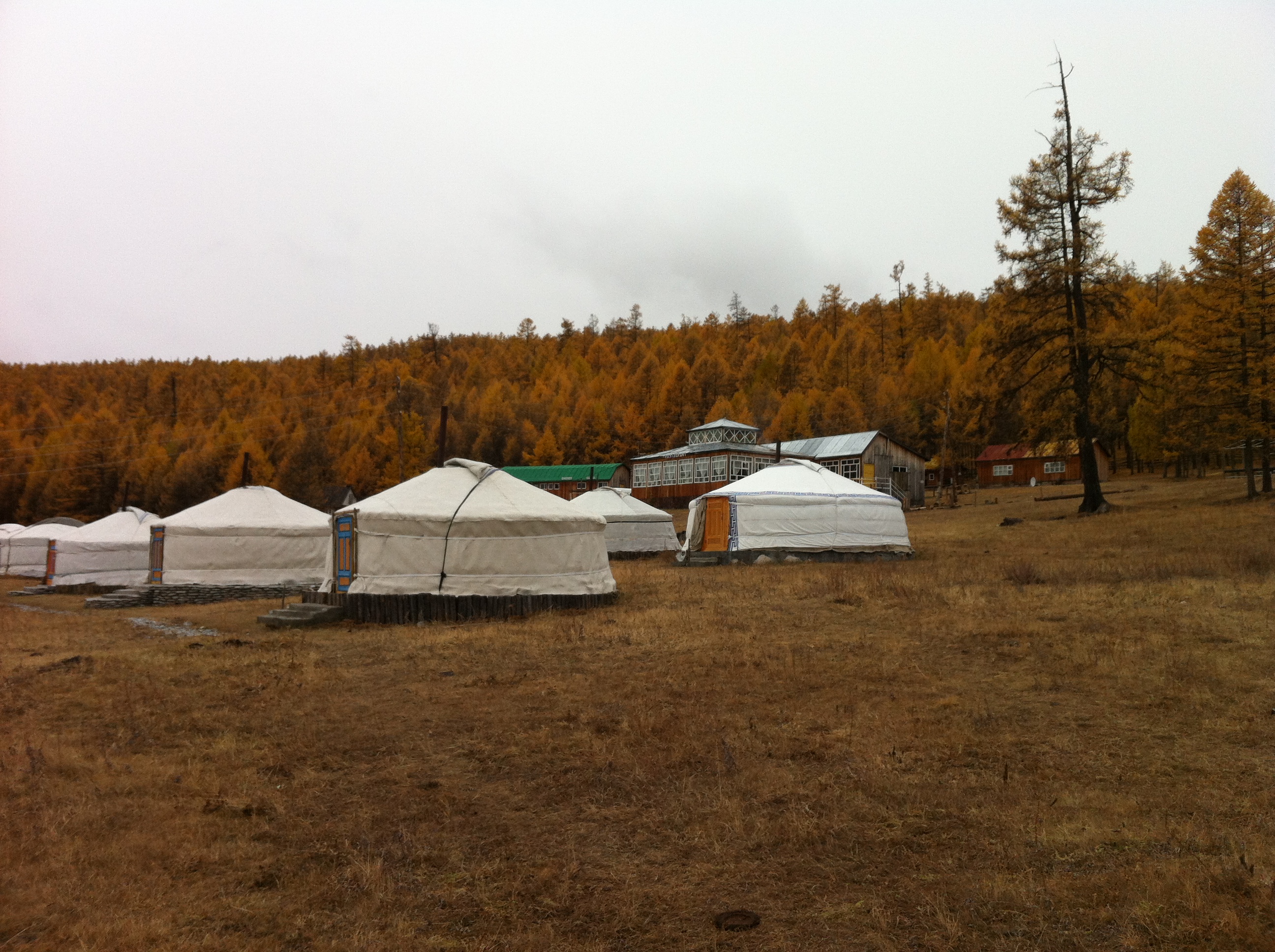
“Snow”, said Purev, but it held off. Finally, we arrived at a village. Purev swerved off the road and raced up a muddy track which coasted a nearby ridge. Down the other side, the track deteriorated rapidly and we crawled along, bumping from one puddle to another, from one rock to another. But we made it in one piece to the ger camp which was our destination.

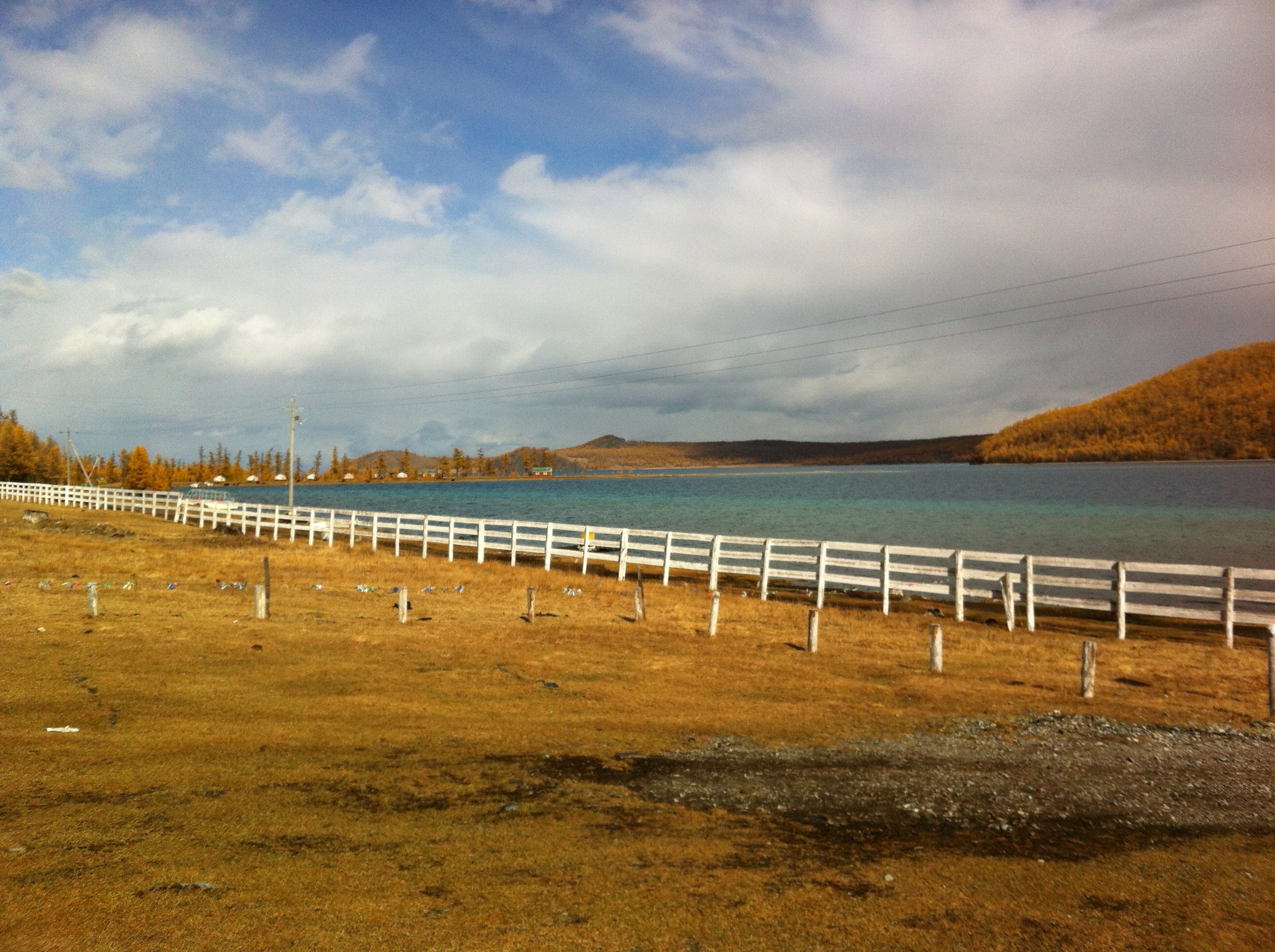
And there in front of us, lapping at the edges of the camp, was the southernmost tongue of Lake Khövsgöl, which is what had drawn us to this remote part of a remote country.

A few facts. The lake, 136 km long and 262 m deep, is the second-most voluminous freshwater lake in Asia, and holds 0.4% of all the fresh water in the world. It is one of seventeen lakes worldwide that are more than 2 million years old (nearby Lake Baikal is part of this select club, as are Lake Tahoe in the US, Lake Titicaca in Peru, and Lake Tanganyika in Africa, among others; but I digress). Lake Khövsgöl is one of the most pristine of these ancient lakes. It has very low levels of nutrients and primary productivity and so very high water clarity.

But forget the facts! Remember only that the Tuvans, a Turkic people who lived around the lake, gave it its name: Khövsgöl, “Blue Water Lake”. And startlingly blue it is indeed, the blue of the Mediterranean on a sunny day, probably because the water is so clear and the sky in Mongolia so blue.

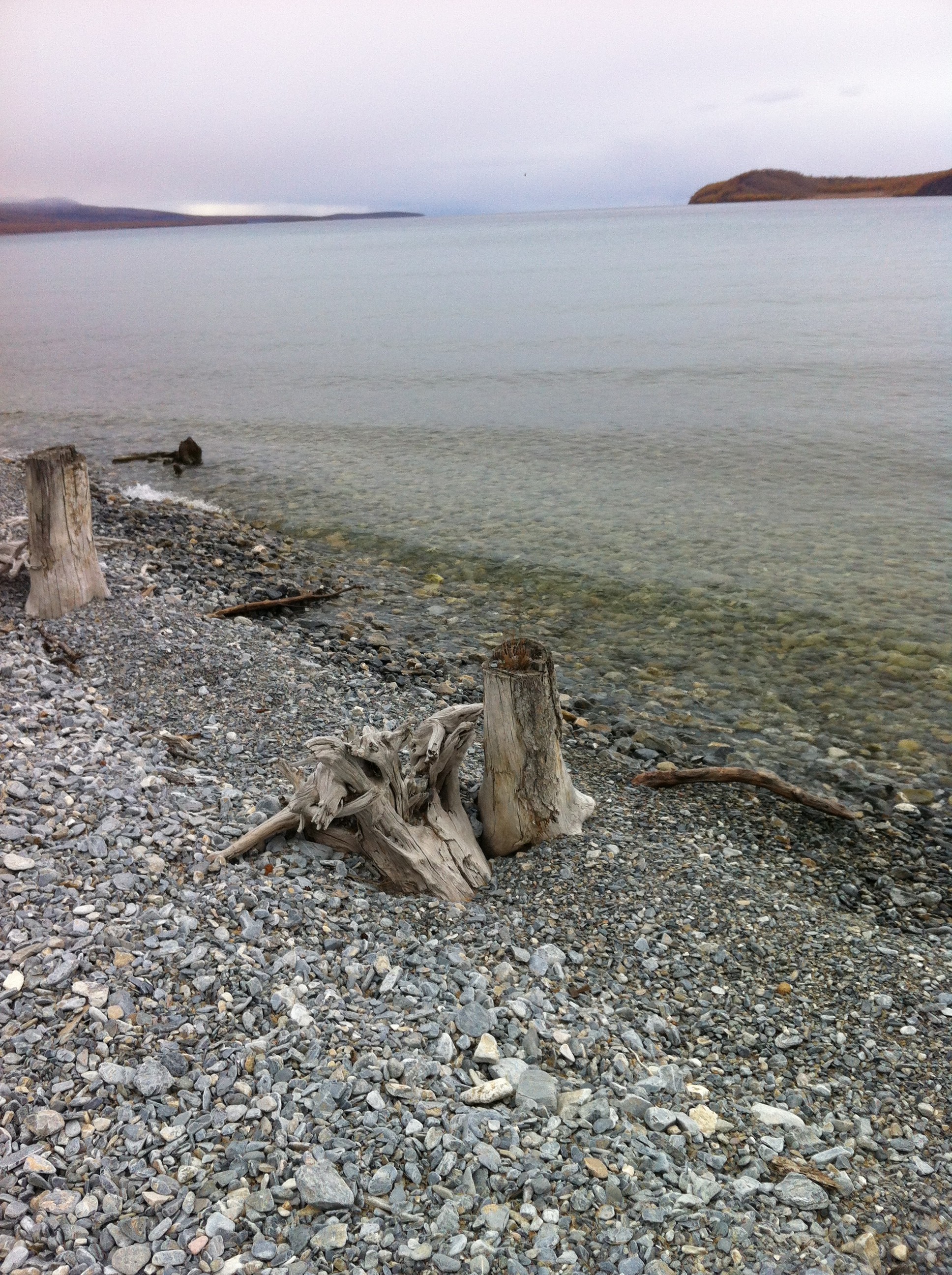
But blue was not the only colour that greeted us. There was the smooth greyness of the pebbles on the beaches, which reminded us so much of the pebble beach of our village in Liguria, echoed in the weathered, grey tree trunks that littered the shore.

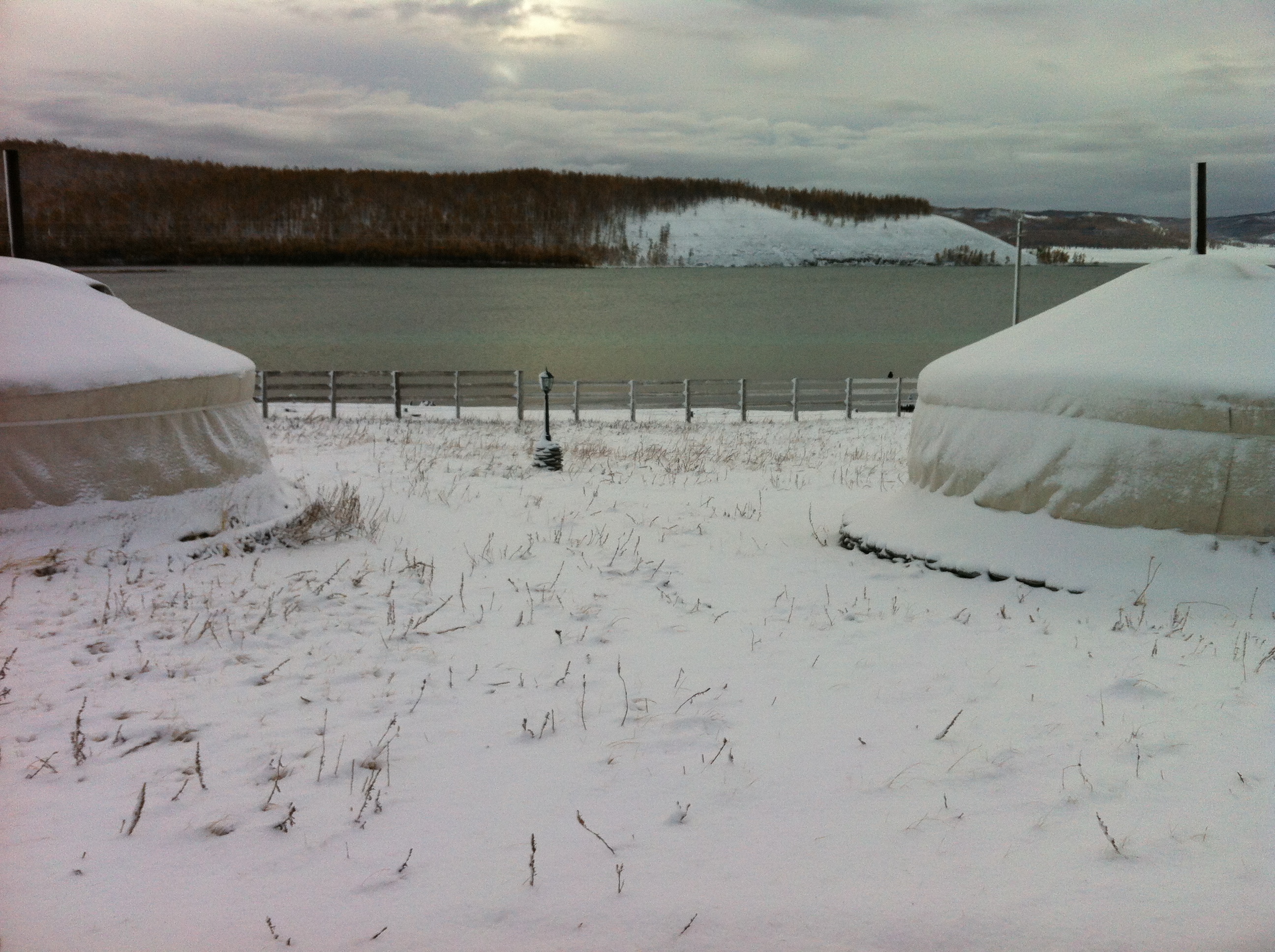
There was the white of the first snow of the year, which finally blew in with a vengeance and fell all night as we slept, huddled under the bedclothes in our ger. It greeted us under lowering clouds in the morning when we stuck our nose out.

But it was quickly melting away during the day when the clouds blew away and the sun shone in a blue, blue sky.

There was the glorious autumnal yellow, with rare light green tinges, of the Siberian larches which flowed down from the northern taiga and lapped up against the lake’s sides: golden yellow for those needles still clinging to the trees, straw yellow for those that now clothed the forest floor.

And finally, there was a droplet of violet offered by a small flower that contrary to all expectations bravely blossomed by the water’s edge.

FLYING OVER MONGOLIA

Mörön, 7 October 2012

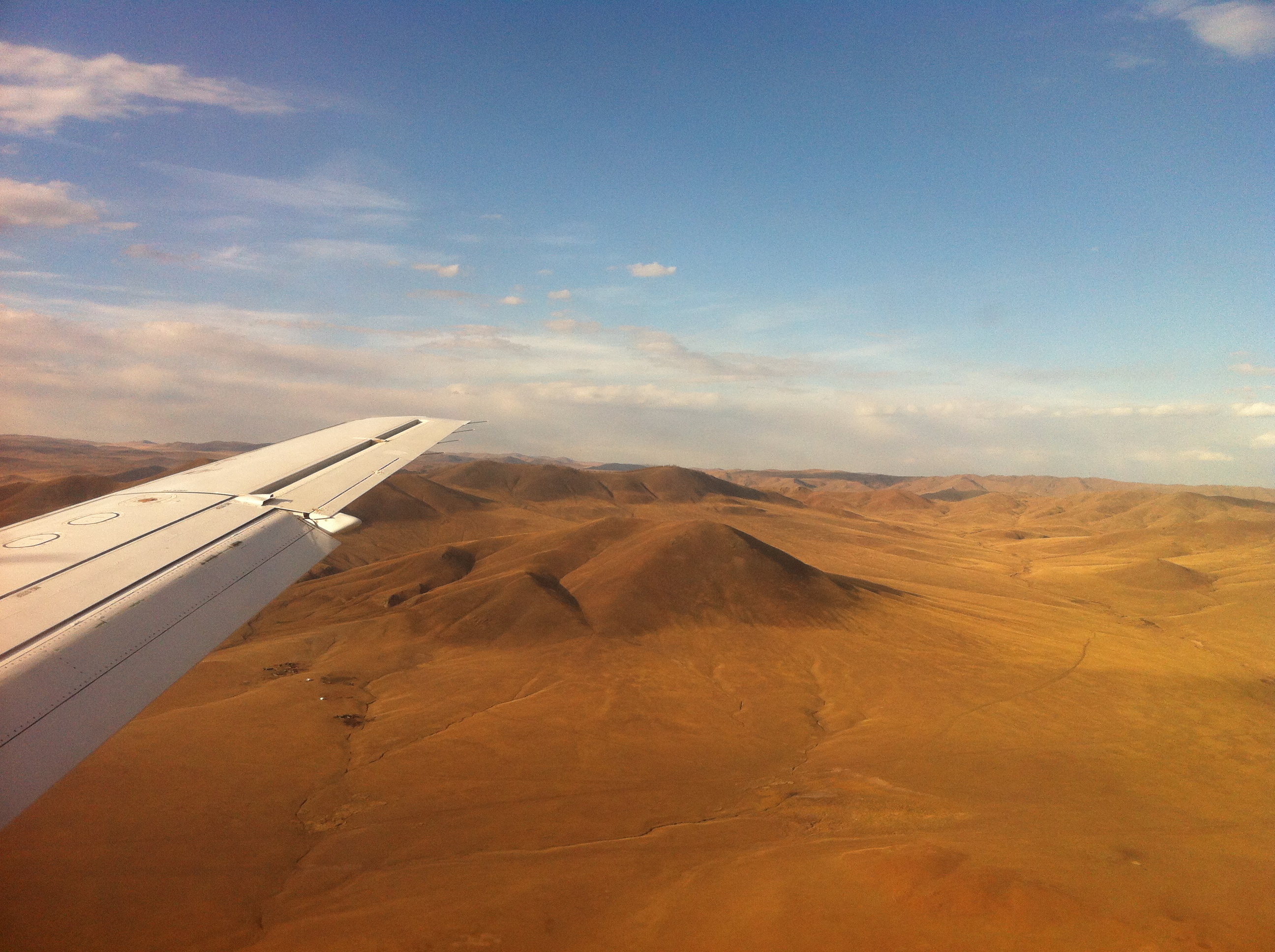
I like turbo-props, I find the deep roar their propellors emit is much more satisfying to listen to than the whine of jet engines. So I was looking forward to this flight from Ulaanbaatar to Mörön, capital of Mongolia’s northernmost province of Khövsgöl, in a little 36-seat turbo-prop. And it was a lovely afternoon, with a blue sky, so I expected to have good views from seat 9C at the back of the aircraft.

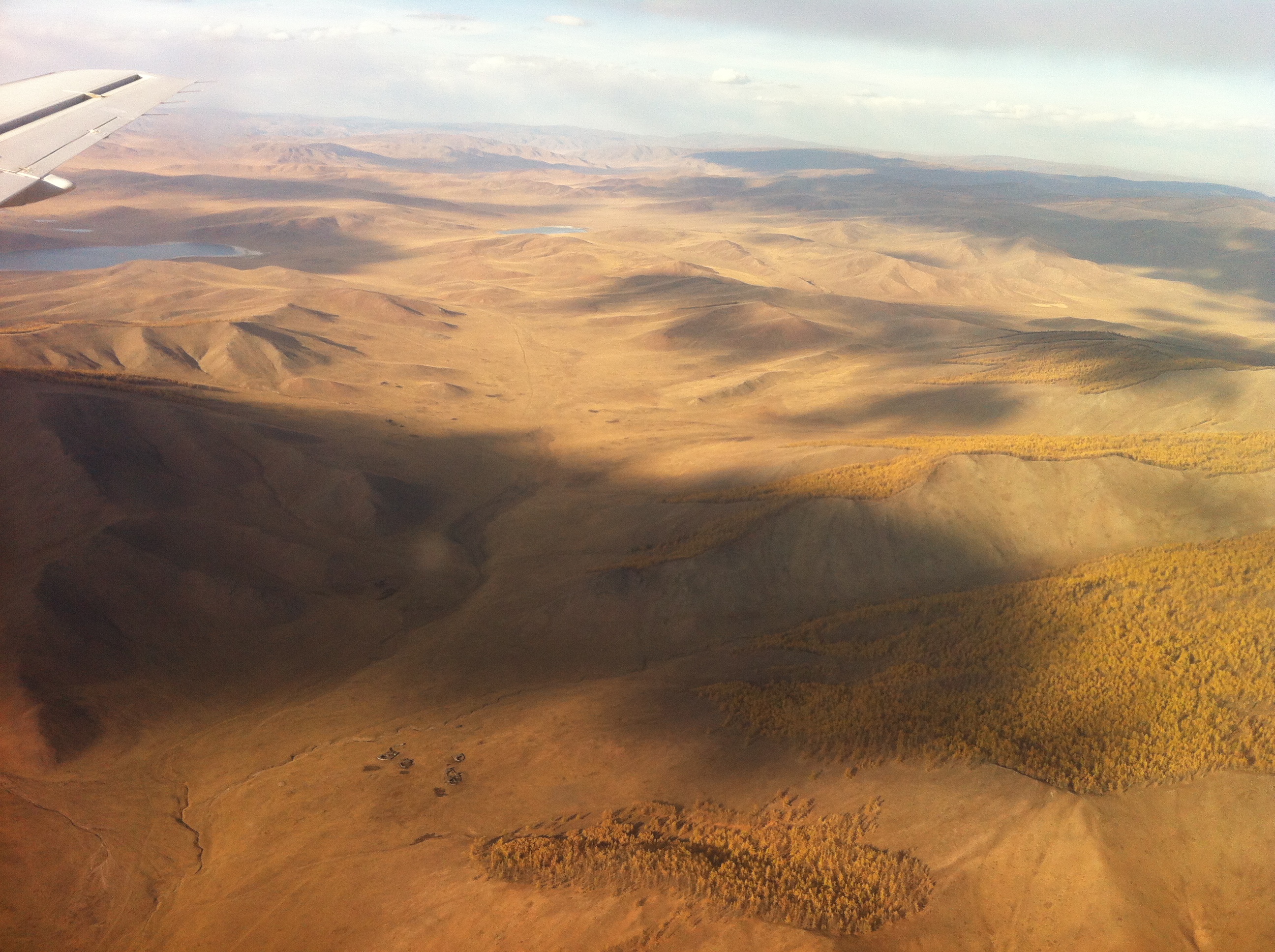
Good views we did indeed have as we took off from UB, climbed, banked, and set off north, with the propellers settling into their deeply comforting roar. The ugly outskirts of UB dropped out of site and we were now flying over a brown landscape of late autumn. Small rocky hills jutted out of valley bottoms, many of which had small rivers flowing lazily down their middle. Never have I seen such lazy rivers! They looped back and forth, fraying, rebraiding, leaving stranded oxbows behind. Mongolian valleys must be flat as a pan.

My wife, in seat 10C, remarked that the hills looked buried in dust. So true! It must have been a trick of the light on the yellow grasses sprinkling the land, but the hills really looked as if they were emerging from thick layers of powdery brown dust.

We picked up the Siberian larches, larix sibirica, quite soon after leaving UB. These are the southernmost tassels of the vast larch forests that cloak the Siberian taiga. They were always high on the hills and clustered on the latters’ northern, colder, side. In the late afternoon light, they cast long shadows. At first there were vestiges of their summer green showing through their autumnal yellows, but as we droned ever further north autumn caught up with us and their colours became uniformly yellow.

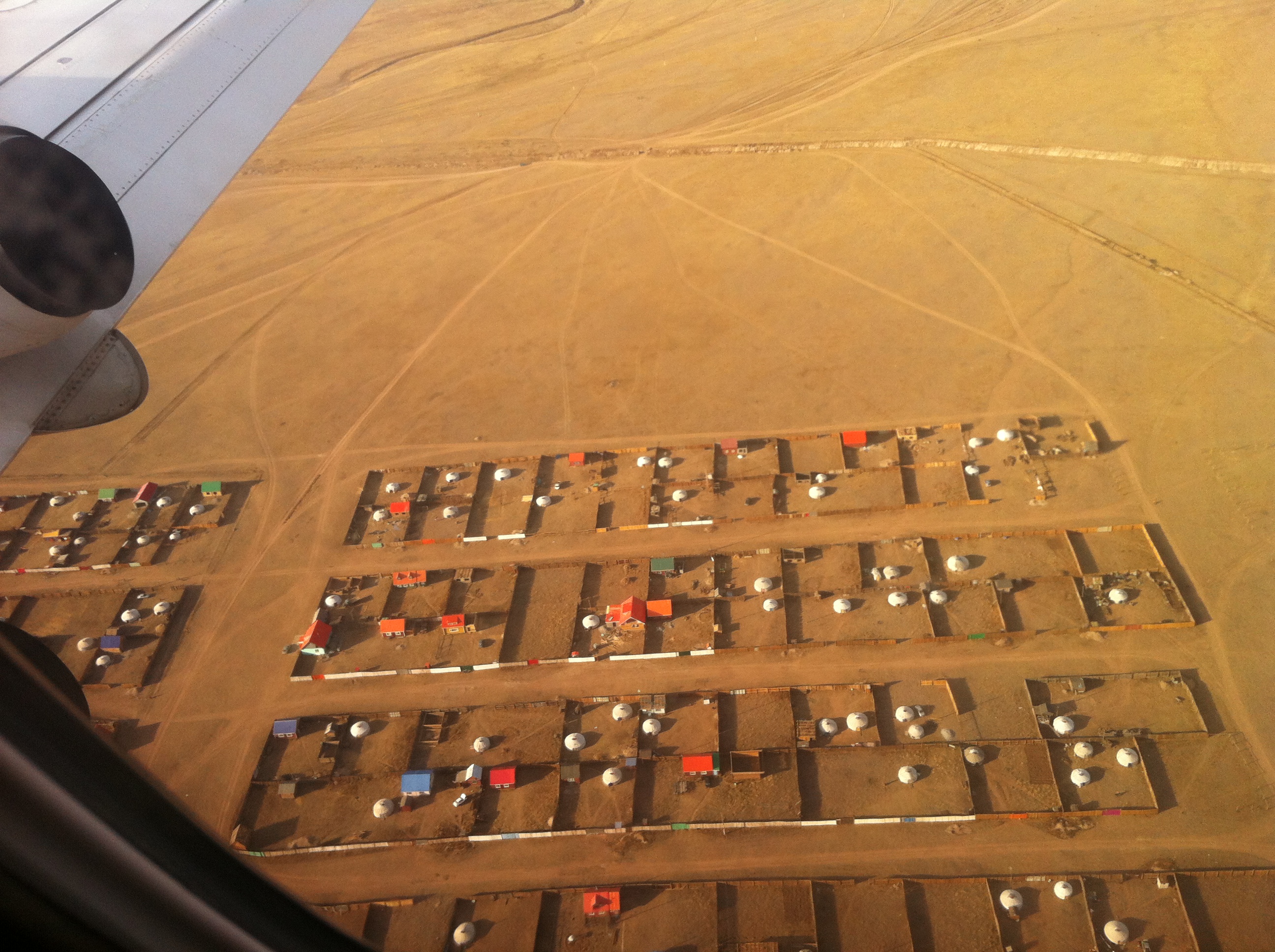
Soon after we were dropping into the vast bowl which Mörön finds itself in, flying over the town as we came in to land. Small houses with bright red or blue roofs and surrounded by a square of wooden fences hove into view and rushed by us.

And now we were down on the tarmac, with the plane’s propellers giving their last braking roar before we trundled to a halt before the terminal.

Tomorrow, we go to Lake Khövsgöl.

A CARPET OF NASTURTIUMS

San Francisco, 24 September 2012

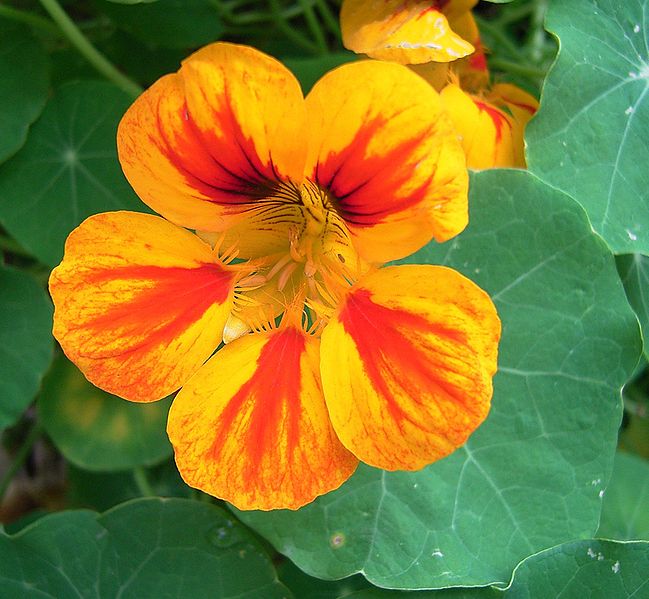
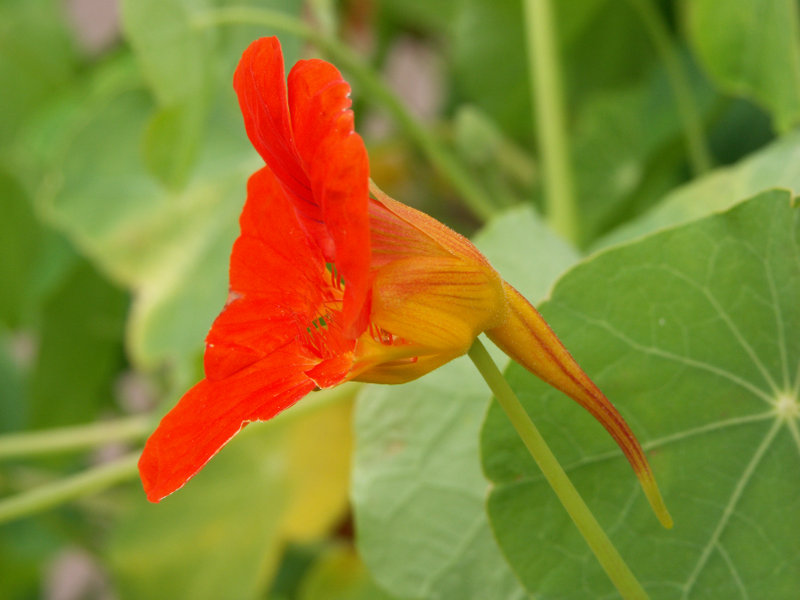
While in San Francisco (see the previous post), we did a few touristy things. One of these was a bus tour of the city. Our guide and driver, a chatty fellow prone to making politically incorrect comments, took us down to the bay shore below the Golden Gate Bridge. From there, he invited us to take advantage of the only toilet stop on the tour and admire what he intriguingly called an excellent example of industrial art nouveau – never heard of that category of art. But what I admired more was a veritable carpet of tropaeolum majus, or garden nasturtiums, tumbling down the slope on the side of the road. I had never seen so many nasturtiums before.

I love nasturtiums. In my previous post, I mentioned my childhood memory of morning glories. Another memory from the same period is of nasturtiums growing luxuriantly up the wall of our house, under my elder sister’s bedroom window (the window through which I spied on her “carrying on” with her boyfriend, who proceeded to give me money for an ice-cream to get rid of me). I fell in love with the flower’s fiery colour scheme, red, orange and yellow, against a background of smooth round green leaves. And at some point, I had learned to pick a flower and suck the nectar out of the nectar spur at its base. It gives your taste buds a delightfully tiny burst of soft sweetness.

I loved nasturtiums so much that when my mother gave me a small strip of land in the garden to plant as I wished I chose to plant nasturtium seeds. I watched carefully as the little plants emerged and started to grow. And I still remember sharply my concern when my parents decided to have a nearby tree cut down. It looked alarmingly like the tree was going to fall on my nasturtiums. I sat there with the whole family, watching the tree cutters proceed. My siblings found the whole thing exciting and chattered along happily. But I was in an agony of apprehension for my nasturtiums. Sure enough, the tree fell on them and flattened them. What misery!

I close with a recipe. I discovered recently that both the flowers and the leaves of nasturtium are edible. This particular recipe is from the following web site: http://fruitandveggieville.blogspot.com/2008/06/flowers-you-can-eat-nasturtiums.html.

“Recipe for a Nasturtium Salad
­       1 lettuce – iceberg, butter or cos
­       small bunch of nasturtiums – leaves and flowers
­       ripe red tomatoes
­       1 tablespoon capers
­       feta cheese

Decide quantities to your own taste. The nasturtium leaves are peppery and the more you put in the hotter the salad gets. Wash and dry the lettuce and tear into the size pieces you prefer. Rinse the nasturtium leaves, and tear or chop into rough strips. If you’re using baby tomatoes halve them, chop bigger ones into cubes. Cube the feta cheese and sprinkle over the salad with the capers. Top with the whole flowers and maybe one or two whole leaves. This peppery, bright salad is just right to accompany pizza, cold meats or as a starter on its own.”

Enjoy!

A CLUSTER OF MORNING GLORIES

San Francisco, 23 September 2012

We left this morning for San Francisco, to visit our son. We were up early, and since it was a beautiful morning – the sky was a cloudless clear blue – we decided to walk to the station to catch the train to the airport. The walk took us past our local supermarket, the modest housing estates that cluster around it, past the smart office buildings along the Third Ring Road, and finally along a rough semi-constructed path that follows the highway out to the airport until the stairs to the station are reached. The last stretch of our walk reminded us that Beijing is still constructing itself. It is one of those pieces of land that get left behind in urban renewal projects, stuck between new constructions – in this case, the highway on one side, modern office buildings on the other – and are fast going feral. Weeds were growing in abundance along the side of the path and covering the construction rubble underfoot, rogue trees were beginning to push up through the cracks, the fencing along the path was rusting and bent. We picked our way along, weaving to avoid the commuters streaming in to work, with the suitcase stumbling behind us over the rough paving.

Suddenly, there, in the shade of the early morning sun, was a cluster of morning glories flowering on the fence. The plant itself is nothing much to write home about; it has the weak tendril-like stalk of a climbing plant and the leaves are a drear matte green. But the flowers were magnificent – a cool, dark violet colour, almost phosphorescent in its intensity. I’m guessing they were Ipomoea purpurea, the purple or common morning glory. We stopped for a minute to admire them, but we were in a hurry now and had to move on.

As I write this, my mind’s eye suddenly whirls off half a world away and I find myself walking down the main coast road south of Genova, just as it enters the village where we used to spend our summers when the children were young. I am next to the cemetery; the village dead have the best view, out over the coast to the distant promontory. It’s a beautiful summer morning. Down in the cleft where a creek runs off the hills behind me, the morning glories have run amok, covering and smothering everything. But the flowers are open, beautiful in the morning light, cool, dark, violet.

And my mind’s eye whirls off again, this time alighting in the town in Africa where I was born. More than fifty years have passed and the memory is fading. But I see a wall – is it in a park, in a garden? – covered in morning glories, glowing in the morning light, cool – dark – violet.

OLYMPUS DIGITAL CAMERA

_____________

picture: http://georgeswebpage.com/almanac

MY LITTLE ROUND CLOUD

Urumqi, 5 September 2012

The flight started early in the morning in Beijing. It was raining hard as the airplane took off, and we climbed up through a milky whiteness. Finally we broke through and started our trek westward to Urumqi, capital of Xinjian. The cloud cover began to tear over Inner Mongolia, and through the gaps I could see wooded hills with cultivated valley bottomland. And so it went on until we came to the Ordos Loop, where the Yellow River, after flowing north-east from Langzhou for 600 kilometres, turns abruptly to flow east for 300 kilometres, and then just as abruptly turns again, flowing south for another 600 kilometres, before doing one final abrupt turn east to flow on to the sea. The northern part of the Ordos Loop over which we were now flying is home to the Ordos Desert. On cue, as if sensing the harsh land below, the clouds suddenly banked to a halt, and in the now clear sky I could make out far below me the muddy waters of the Yellow River as they started making their turn to the south. And suddenly I spied one small, round, little, cloud, wispy to the point of invisibility, bravely clinging to its space above the desert floor. I watched, fearing that it would evaporate before my eyes, unable to resist the furnace heat below. But no, it was still defiantly there when it dropped out of sight behind me. And now the southern reaches of the Gobi desert rolled into view, with not a cloud in sight to soften the hard edges of the stone plains and rolling dunes, which accompanied me all the way to the mountains that guard the eastern marches of Urumqi.

DON’T LET THEM DISAPPEAR

Beijing, 17 August 2012

I have a fondness for trees. The memories of my life are punctuated by pictures of particularly splendid specimens I have come across: a copper beech in Somerset, a poplar in a suburb somewhere, a grove of beeches in the Vienna woods, the plane trees I mentioned in an earlier posting, an oak tree on the grounds of some historic house, sequoias in California, … When I was a boy, there was nothing I liked better than to climb a tree and be high up amongst its rustling leaves; there was always a feeling of wonderful remoteness up there. I don’t climb trees any more, as much for my dignity as for my stiff limbs, but I do love standing under them looking at the way the sunlight filters through their leaves creating an infinity of green hues – my wife gently mocks me for the tons of photos I have squirreled away of “sunlight through the leaves” – or running my hands over the bark.  And there is nothing so wonderful as being outside at night in the dark and listening to the wind sighing through the trees.

This fondness of mine does not extend to pine trees. Yes, I can admire a lone umbrella pine on a rocky outcrop that plunges into the Mediterranean, but up close pine trees do not excite me in the same way that other trees do. It’s perhaps their generally more somber hue, or because the needles repel the touch rather than encourage it in the way leaves do, or the fact that sunlight doesn’t filter through the needles in the same way. Whatever it is, I am not a fan of pine trees.

This coolness of mine towards the genus pinus has been somewhat modified since my arrival in China, where I discovered, in Beijing’s parks and other public spaces, the pinus bungeana, or lacebark pine. This pine has a truly lovely bark. In the first place, it is smooth, unlike the rough, often heavily fissured, and really quite ugly, bark of the pine trees that I’m familiar with. It is also a bark that peels, like the eucalyptus or the plane tree. But the bark doesn’t hang off in unseemly strips as it can on these trees. It comes off in smaller, rounder, scale-like patches. And what is most wonderful is the colour of the underlying skin: white or pale yellow, green, brown, red-purple. It seems that the initial colour is pale but it darkens upon exposure to light. A grove of them can be a particularly lovely sight.

Picture 003

Spurred by my discovery, I read up on the lacebark pine. It is a native of northeastern and central China, which goes some way to explaining why I had never seen it before coming to this part of the world. It also has two cousins with the same smooth, multi-coloured bark. One is the Chilgoza Pine, or the Pinus gerardiana to give it its formal title, which is native to the northwestern Himalayas: northwest India, Pakistan, eastern Afghanistan.

pinus-Chilgoza-bark-3

Unfortunately, the species is under threat from excessive cutting and intensive grazing. The other cousin, the Qiaojia Pine, or Pinus squamata, is in even worse shape. It is the rarest pine species of the world, considered critically endangered, with only about 20 known trees in a single locality in a remote part of Yunnan province in China.  It was only discovered – by Science at least – thirty years ago, in 1991. I found no picture of the tree, let alone its bark.

I’m always depressed when I hear of species which are in danger of disappearing. Like they say, “extinction is for ever”. In this case, we could be losing some beautiful trees. But that’s a very selfish way of looking at it, based on the thinking that the rest of the world is made for us. Even if we were talking about some revolting insect, it would be a tragedy to lose it. Every species contributes to the fantastically diverse ecosystems around us, which are not only beautiful to look at and be part of but also vital to our own existence. Every loss is the start of a run in the web of life. One day, all those runs will merge into a gaping hole, down which we will all disappear.

MY PIECE OF CANAL

Beijing, 31 July 2012

I am lucky enough to live so close to work that I can walk to the office in the mornings and back in the evenings. It’s the first time I’ve been able to do this in the 30-some years I have been working. I can even go home for lunch!

The walk is that much more pleasant because most of it is along a canal. Many of the canals in Beijing are sorry affairs, either dry or filled with pestilential water. This is true for this canal too, except for the stretch I walk along. For some reason, this reach of the canal has been thoughtfully developed. Willows have been planted along the edge, reed beds too; a small reed island has been formed in the middle; during the spring irises, first blue then yellow, come and go; and a bed of lotuses has been planted.

I treasure that morning walk. It puts my heart at peace and allows me to face the slings and arrows of the day with fortitude. And I am not the only one. From spring to autumn, the edges of the canal are sprinkled with fishermen (and sometimes fisherwomen), meditating on the state of the world and catching a small fish from time to time. In summer, some of the older inhabitants from the nearby apartment blocks sally forth and swim slowly up, down, and across the canal.

Two autumns ago, we woke up to find that my piece of the canal was being emptied. After a brief period where mudlarks waded through the resulting black sludge picking up stranded fish and other strange things, excavators arrived, dug a large trench down the middle of the canal’s bottom, and then a swarm of migrant workers appeared to lay down a large plastic pipe – a sewer line, I would guess. What has taken me two lines to recount, it took the pipe layers a dreary six months to accomplish. But finally, the pipe was covered and silence returned. But not the water. And we waited. Another six months passed. I was terribly afraid that the canal would disappear, that they would fill it in and build a road.

But at last the water reappeared. And slowly, the old canal-side rhythms came back, and my walks to and from the office once again soothed my harried soul. But I was worried about the lotuses. I was worried that the long drought would have killed them. When we left for our vacation there was no sign of them. On my first walk to the office after coming back, I looked out anxiously for them. And they were there, flowering already, their delicate pinks and whites standing out against the dark matte green of their leaves. And all was right in the world.

flowering lotus-1

PLANE TREES

Beijing, 30 July 2012

Until a few years ago, plane trees were not high on my list of favourites. The memories of my youth were of leprous-looking trees in a ragged line along anonymous city streets, with long strands of dirty bark peeling off them, a pathetic crown often savagely chopped to allow the passage of telephone and other wires, and every passing dog peeing on them. My grandmother would say that they were used because they were the only trees that could survive in cities. But what a life, I thought. Better no life than this …

plane trees in streets-4

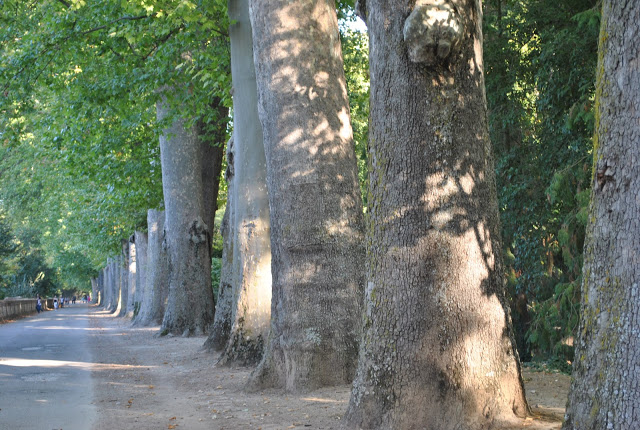
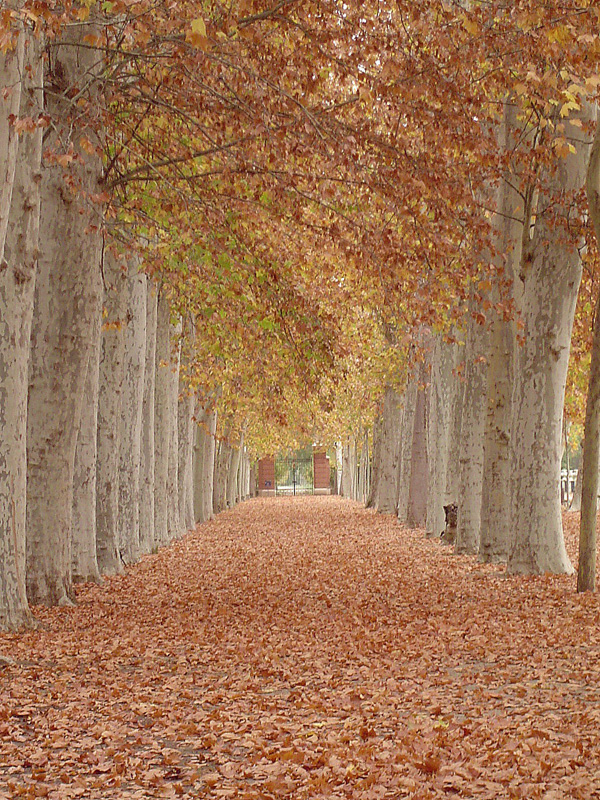
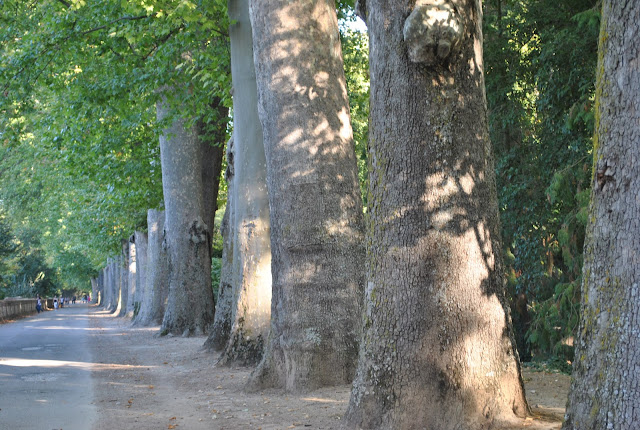
And then one day, on a holiday with my wife in Spain, we were walking through the Jardín del Príncipe in Aranjuez, near Madrid, when we came across a row of absolutely magnificent plane trees, of vast girth, with huge spreading crowns of light green sparkling leaves, and whose bark ranged in colour from pale beige through pale green to ivory white.  Simply ravishing. If we took photos, I have no record of them here. So I insert this picture of a plane tree in these gardens which I found on the web, to give the reader an idea of the beauty of these trees.

plane trees jardin del principe Aranjuez-6

I add this picture of a row of the trees in the gardens to give an idea of their girth.

plane trees jardin del principe Aranjuez-1

And I add this one simply because I like the colours!

plane trees jardin del principe Aranjuez-4

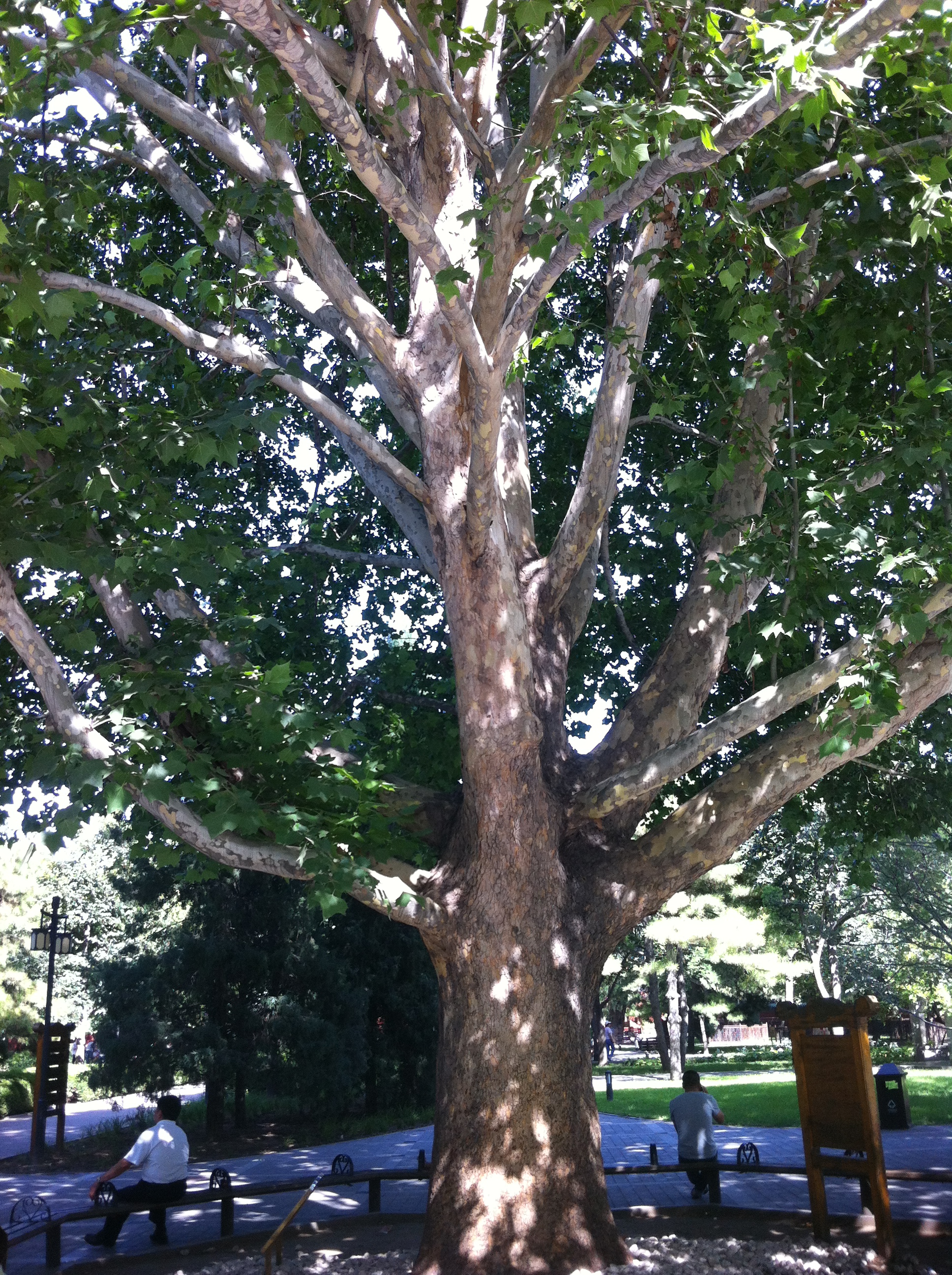
I remembered that glorious moment of discovery yesterday when, visiting Ritan Park in Beijing on a beautiful day with a blue and – that rarest of things in this city – clear sky, we found ourselves sitting in the shade of a lovely plane tree.  It was not as majestic as the specimens we had discovered in Spain, but it was still arresting. It had been manicured so that it grew more regularly in all directions, and a bench had been arranged around it in a wide circle.

ritan park 002

ritan park 003

We just sat there, drinking in the quiet beauty of it all.

POSTCRIPT:

One year on from writing this, I must report the saddest of news. Seventy years ago, US soldiers disembarked in Italy, carrying with them munitions boxes made with wood of the American plane tree. That wood contained a fungus, Ceratocystis platani, unknown to the plane trees in Europe and against which they have no defence. It has left Italy now and is slowly spreading throughout the rest of Europe. Eventually, it will kill millions of plane trees throughout Europe. This was reported by the BBC, where they were saying that the thousands of beautiful plane trees planted along the Canal du Midi

canal du midi plane trees

are becoming infected and will have to be cut down and burned.

Canal du midi plane trees being burned

I fear that the same fate will soon be shared by those lovely old plane trees in the Jardin del Principe. One more tragedy caused by the global movement of goods and people – and bugs that go with them for the ride.

_____________________________
plane trees on a street: http://animestoi.midiblogs.com/media/02/01/2964573664.jpg
photos of the Plane trees in the Jardin del Principe, Aranjuez:
first: http://mw2.google.com/mw-panoramio/photos/medium/14735886.jpg
second: http://2.bp.blogspot.com/-sCRByt2Qd6s/UUsvkfma43I/AAAAAAAAZ10/eTOTJ_kaYxQ/s640/Platanos+de+sombra+Aranjuez+01.JPG
third: http://turismoenaranjuez.com/sites/default/files/otonojardinprincipe_0.jpg
photos of the plane tree in Ritan Park: mine
Canal du Midi: http://news.bbcimg.co.uk/media/images/56128000/jpg/_56128150_canalview624.jpg
Canal du Midi-plane trees being burned: http://4.bp.blogspot.com/-4yIXXHCnDRY/UYN1Ru6K3yI/AAAAAAAAAuM/16Cdm8bNqT4/s1600/Canal+du+midi+abattage+PK+143+%25287%2529.JPG