SAINT NOTBURGA

Los Angeles, 26 September 2022

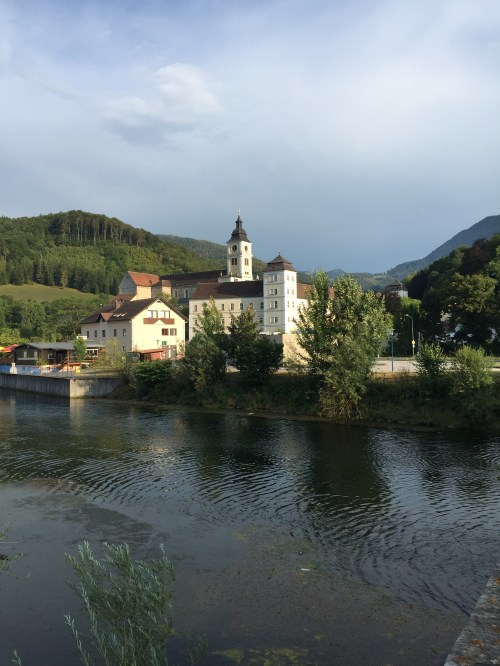
Just before my wife and I hurried over to Los Angeles to help our daughter, we spent a very pleasant long weekend in Innsbruck, celebrating our wedding anniversary. We actually weren’t visiting Innsbruck itself but rather using it as a base to do some hiking. As the city’s name indicates, it is situated on the river Inn. The valley down which the river flows is flanked on both sides by mountains, and it was these that we were there to hike, up, down and along.

Nevertheless, on the way to and from our hikes we found ourselves enjoying various parts of the old town through which we strode (on the way out) or shuffled (on the way back), and on the last morning we had time enough before our train left for Vienna to visit one museum. Being a fanatic believer in the Green Michelin Guide, I quickly looked up what museums it suggested to visit in Innsbruck, and discovered that this august publication bestowed its maximum encomium, three stars, on only one museum in the city: the Museum of Tyrolean Arts and Handicrafts. So the Museum of Tyrolean Arts and Handicrafts it was!

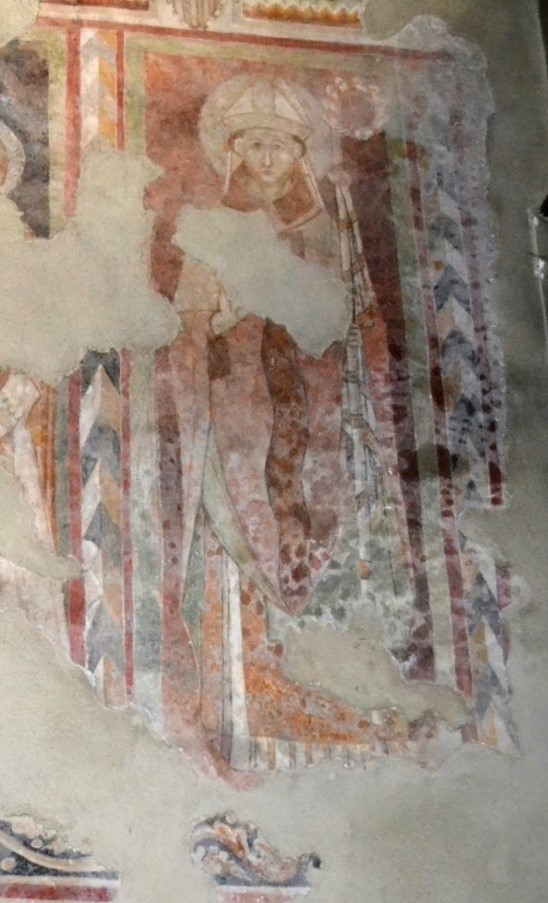
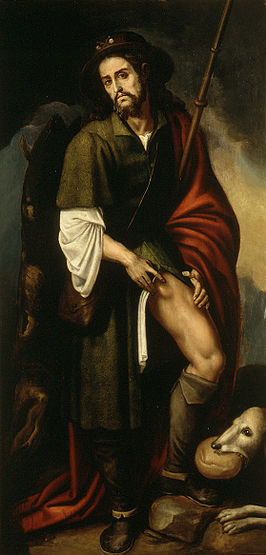
As usual, the Michelin Green Guide was spot on. I earnestly recommend any of my readers who are spending some time in Innsbruck to visit this museum. But this post is not really about the museum. It is about one particular painting which I chanced upon, of St. Notburga.

My photo

Well! As any faithful reader of my posts will know, I have a very soft spot for obscure saints, the obscurer the better. In my time, I have written posts about Saints Radegund, Pancras, Blaise (who is also, incidentally, the subject of a small painting in the museum), John of Nepomuk, Hubert, Peter of Verona, Fructuosus, and a few other odds and ends in the Saints’ Department. So it was clear from the moment I clapped eyes on the painting that I would have to write a post about her. The train journey back to Vienna gave me all the time I needed to do the background research.

St. Notburga’s story is quickly told, and hinges around three miracles. If she existed at all, and I for one have my doubts about that, she was born in 1265 or thereabouts, into a humble family living in the small town of Rattenberg situated on the river Inn some 50 kilometres downstream from Innsbruck. So she was a Tyrolean girl.

Some time in her teens, she went to work as a servant in the household of the local aristocrats, the Count and Countess of Rottenburg. She was – of course – a very good girl and was scandalized by the fact that the leftover food from the Count’s meals was fed to the pigs when there were lots of townsfolk who went hungry. So with the Count and Countess’s blessing, she collected the leftovers and distributed them to the poor. (From here on, I show, very blown-up, some of the scenes which circle the painting above. They are somewhat dark and fuzzy; if I had known about Notburga beforehand, I would have taken close-ups from the painting itself. Ah well …)

My photo

Alas! the Count died, and his son inherited his father’s title, lands, and servants. The new Count and his lady wife didn’t approve of Notburga’s good works at all. They wanted all the leftovers to go to their pigs. So the Countess, who was in charge of running the household, told Notburga to stop.

My photo

Being – of course – a very obedient girl, Notburga did as she was commanded. But how she suffered! So she decided to put aside some of her own food instead, especially on Fridays – being not only good but pious, she fasted on Fridays – and  gave this to the poor. The nasty Count and Countess didn’t like that either. As far as they were concerned, she was giving away their food, not hers, and saw this as theft. The Count decided to catch her in the act of leaving the castle with the food.

FIRST MIRACLE: So one Friday, Notburga was as usual carrying the food she had put aside for the poor in her apron and a jug of wine in her hand, when she encountered the Count and his entourage in the castle’s courtyard. He demanded to know what she was carrying. Notburga replied, “wood shavings and lye, Master”. The Count scoffed and commanded her to open her apron. Notburga obeyed, but in place of food, the Count saw only wood shavings and sawdust! Then he tried the wine, but tasted only lye!
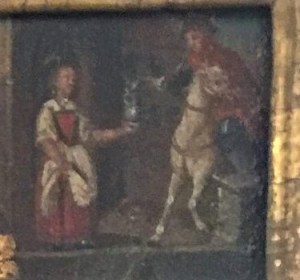
My photo

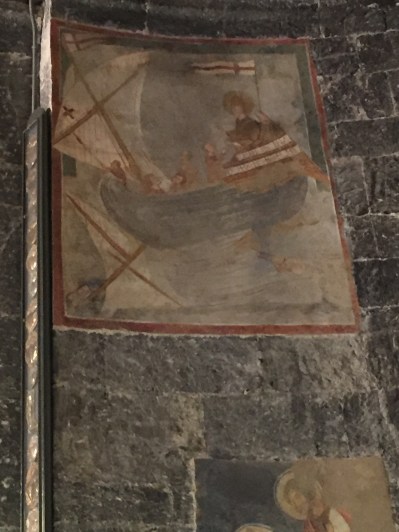
Of course, the Count being a nasty man, he suspected that Notburga had played a trick on him and fired her. She accepted her fate with forbearance, and left the castle and moved to a small village of Eben on Lake Achen, some 20 kilometres from Ratenberg. Here we have her (I think) walking to Eben.
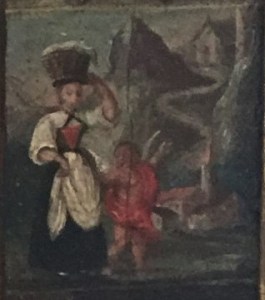
My photo

There, she was employed as a farm worker by a local farmer. She looked after the cattle and helped with the field work. Being, as I say, a very pious girl, Notburga only asked that the farmer let her stop work to pray when the bell first rang in the evening and let her go to Mass on Sunday and holy days, to which he graciously agreed.

SECOND MIRACLE: One afternoon, as always, Notburga stopped work when the first bell rang. But the weather was threatening to change, so the farmer demanded that no one stop until all the grain had been collected. Seeking divine assistance to make her case, Notburga raised up her sickle and said: “Let my sickle be judge between me and you.” She let go – and the sickle remained suspended in mid-air, caught on a ray of sunshine!
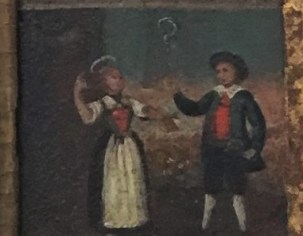
My photo

Frightened half out of his wits, the farmer let her stop working, and he never tried that one again!

In the meantime, things were going very badly for Count Rottenburg. His pigs – the ones to whom the leftover food was given – were ravaged by some mysterious disease. His wife’s half-brother set the castle on fire after a bitter quarrel. Here, we have the half-brother attacking the castle.
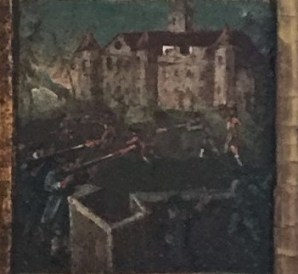
My photo

Finally, his wife sickened and died. Many residents decided that the Count had been cursed and left. The Count began to ascribe all his misfortunes to his dismissal of Notburga. He sought her out, together with his new wife, and implored her to return to work for him.

My photo

She accepted, but only on condition that he let her resume her care for the poor. The Count immediately agreed, and of course his fortunes took a great turn for the better when Notburga came back. For 18 years, she served in the castle as nanny for the Count’s children, then cook, all the while continuing her charitable good works. She also succeeded in reconciling the Count with his first wife’s half-brother, the one who had very nearly burned the castle to the ground.

THIRD MIRACLE: In September of 1313, sensing that death was approaching, Notburga requested her master to place her corpse on a wagon drawn by two oxen and to bury her wherever the oxen would stand still. The Count did as she had asked. So off went the oxen, followed by the funeral procession.
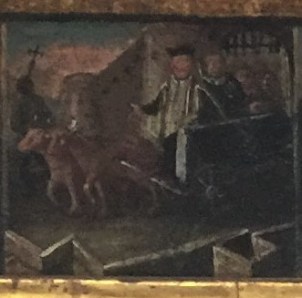
My photo

When the cart reached the Inn, the river parted and all the mourners were able to cross to the other shore without harm!
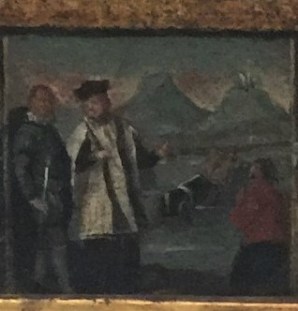
My photo

The oxen continued on their way, covering at a leisurely pace the 20 kilometres to Eben (the mourners must have all had sore feet by now). There, just outside a wayside chapel on the outskirts of Eben they finally stopped. With much pomp and ceremony, she was laid to rest in the chapel; it is even said that angels carried her coffin into the chapel.

My photo

And that’s Notburga’s life wrapped up. Readers will have noted by now the importance of the sickle in Notburga’s life. Hence her being represented in the painting above prominently waving a sickle around. I insert here a statue of her which I also came across in the museum, again waving that sickle around.
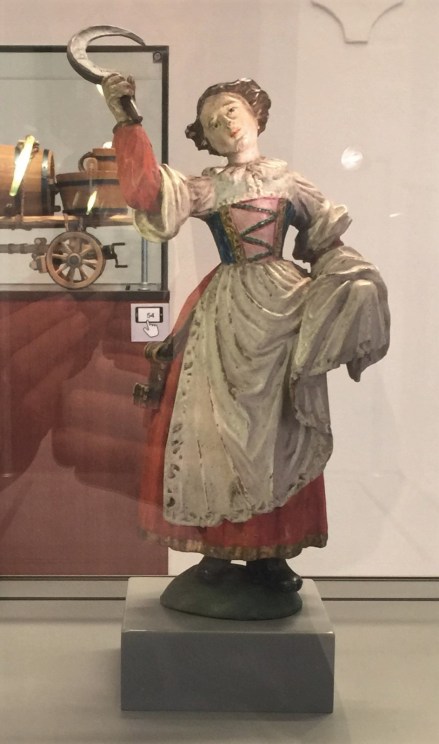
My photo

I have told her story somewhat tongue-in-cheek. Quite honestly, it’s difficult for me to see what was so saintly about her life. I find the miracles ascribed to almost akin to conjurors’ tricks. But somethings about her definitely captured the imagination of the rural folk of the Tyrol and contiguous areas. Pilgrimages to that little chapel in Eben started up and became big enough for Maximilian I (whose own mausoleum sits in the church next to the museum) to decide to have a bigger church built in the village at the beginning of the 16th Century. It got a late Baroque makeover a few centuries later. Here is an aerial view of the church, set in the beautiful Tyrolean landscape (it really is a beautiful part of the world).
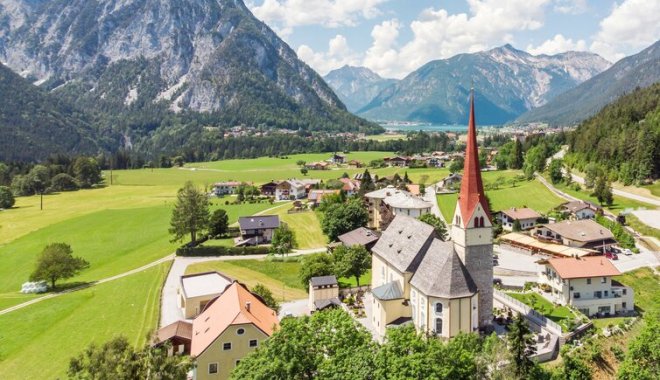
Source

And here is a view of the church’s interior.

Source

Her skeleton (or someone’s skeleton) was unearthed from the original chapel and, dressed in rich clothing, now rather macabrely presides over the church’s interior.
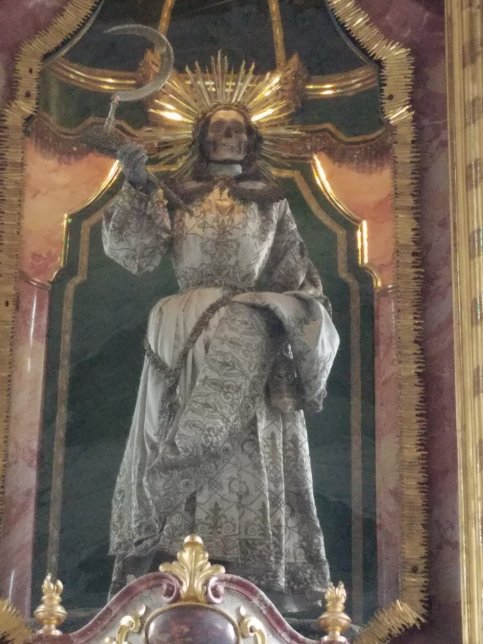
Source

Notburga was until recently one of the most revered saints in Tyrol and South Bavaria, as well as in East Styria and Slovenia (I would imagine that the general dechristianization of Europe has put paid to this, although a quick search on LinkedIn and Facebook show that there are still quite a lot of people called Notburga). Rural folk would ask for her intervention in many situations of distress, from human or animal sickness to threatening storms. Apart from her representation on religious furniture and furnishings (paintings, votive images, statues, stained glass windows, church bells, even offering boxes and holy water basins) her image could be found on all sorts of objects of everyday use like salt shakers, stove tiles, and cupboards. There are even tiny, 2 by 2.8 cm., pictures of her to be swallowed or “inhaled” from; they were used as part of religious folk medicine and belonged in the home apothecary. It was believed that consuming or breathing in from these little images would release Notburga’s healing powers. Little silver Notburga sickles were worn on watch chains and rosaries as amulets. Many songs, prayers and litanies were dedicated to her.

There are those who say that Notburga was a Christian personification of much older goddesses who were prayed to in the mountains. Her sickle, for instance, is considered as pointing to a connection with a moon goddess, a common goddess throughout Europe and indeed the world; we have here the Roman goddess Luna.

Source

Notburga’s association with fields, crops, grain and bread recalls the “grain mothers” like the Greek fertility goddess Demeter and the Roman Ceres.

Source

This could well all be true. But I see another thread in her story, the constant struggle of rural folk with hunger, linked at least in part to their exploitation by landowners, both big (aristocrats) and small (rich farmers). Those rich folk were wasting food? Ha! She took it all and redistributed it to us poor folk! The Count fired her? Ha! He sure suffered for having done that! The farmer insisted that his workers work long hours? Ha! She sure put the fear of God in him for doing that, and after that he behaved himself! It’s no coincidence that she is the patron saint of the downtrodden in rural areas: servants, female agricultural workers, and the peasantry in general. I can understand that people would pray to her to deal with the richer folk making their life miserable. Personally, though, I think unionization is the better way to go.

Source
Source

Just saying …

SAINT HUBERT, PATRON SAINT OF FORESTS

Vienna, 10 October 2021
Amended 2 April 2022

My son commented to me yesterday morning that I hadn’t posted in a while, and he’s right. It’s been over a month! The fact is, I’ve been busy these days (or B-U-S-Y as my son used to write in reply when we fond parents sent him a WhatsApp message suggesting a chat; luckily, he wasn’t B-U-S-Y yesterday morning). I’ve been helping students at a school in Wales figure out how the school could reduce its carbon footprint and I’ve had to prepare and deliver quite a number lectures for webinars on the topic of Circular Economies. All fascinating stuff, but it has eaten into my blogging time.

Anyway, it seems to me that as the days shorten, the temperatures fall, and my wife and I have our last hikes in the woods around Vienna before we migrate south to Italy for the winter, it would be good to celebrate Saint Hubert, the patron saint of all things linked to forests:

– Of hunters and their hounds, here painted by Paolo Uccello.

Source

– Of archers (because they originally used their bows to hunt in the forests; Robin Hood comes to mind).

Source

– Of trappers (another type of hunter who lurked in forests trapping beavers and other animals for their furs), here seen in a painting at the Metropolitan Museum of Art.

Source

– Of loggers and other forest workers, seen here in a photo from the late 1800s.

Source

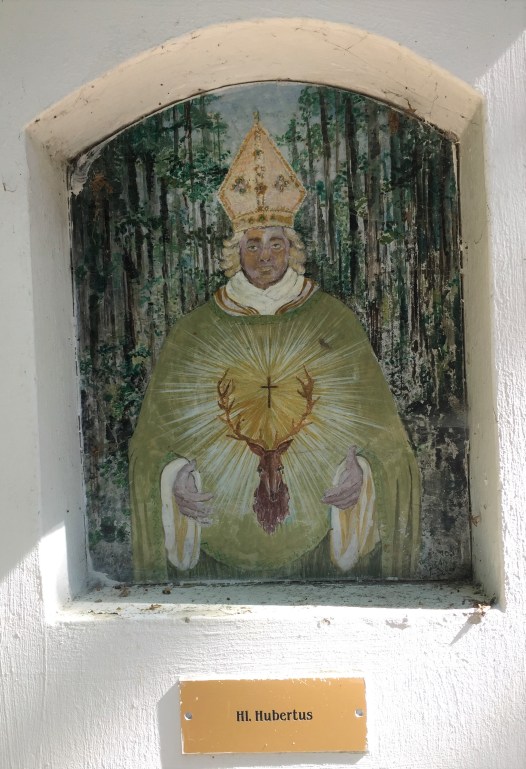
Here is a photo of Hubert on one side of a small forest shrine that we came across during one of our recent hikes.

my photo

And this is the shrine.

My photo

Hubert’s story, which explains why he was made patron saint of all things to do with forests, is quickly told. He was born in the 650s AD in Toulouse, into a family that was part of the high Frankish aristocracy. Initially, he joined the Neustrian court centered on Paris, but because of quarrels with the Mayor of the Neustrian palace he transferred to the Austrasian court centered on Metz, where he was warmly welcomed by the Mayor of the Austrasian palace, on the grounds of “the enemy of my enemy is my friend” – the two Mayors were constantly fighting each other. He seems to have quickly inserted himself into the local elites, marrying the daughter of the Duke of Leuven (if you’re a Flemish speaker, Louvain if you’re a French speaker).

Like all good aristocrats of the time (indeed, like all good aristocrats of all ages), Hubert loved to hunt, and he seems to have spent most of his time roaming the forests of the Ardennes looking for some red meat to shoot. His predilection for hunting only increased after his wife died in child birth, to the point that one Good Friday, when he really should have been in a church on his knees praying for his soul, he instead vaulted onto his horse and rode off into the forest in pursuit of game.

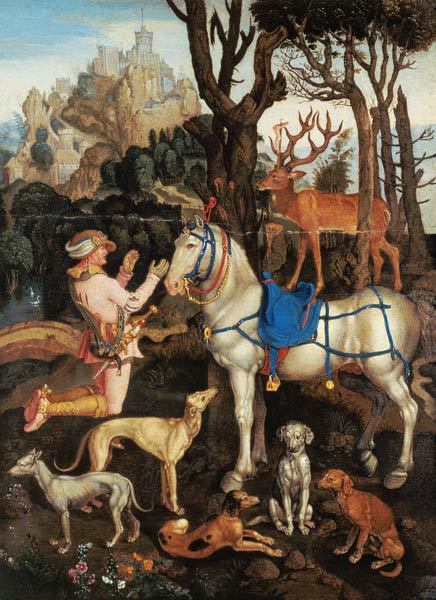
The story goes that he spied a magnificent stag and was riding full tilt after it, when the animal suddenly turned. Hubert was astounded to see a crucifix hovering between its antlers. This scene has captivated various artists over the centuries – or more probably, it captivated their clients and the artists merely executed their clients’ wishes. Here’s a version by Albrecht Dürer.

Source

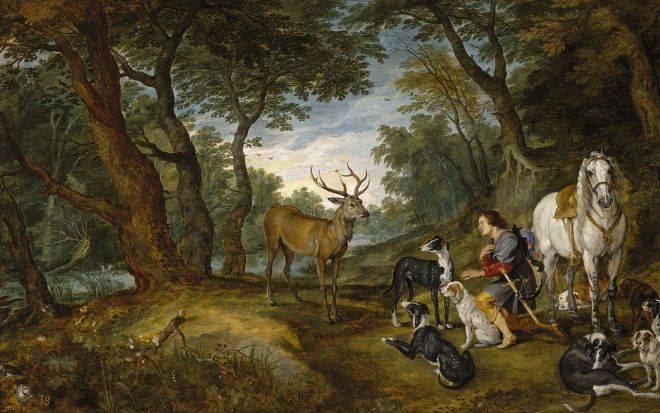
Here’s one by Jan Brueghel the Elder

Source

Even Egon Schiele painted a version!

Source

In any event, the story goes on that Hubert heard a Voice, telling him to clean up his act or else he would be going straight to Hell. When he humbly asked the Voice what he should do, It told him to go find Lambert, Bishop of Maastricht, who would straighten him out.

And straighten him out he did! Under Lambert’s direction, Hubert gave away all his worldly possessions, entered a monastery, led an ascetic life, evangelized among the heathen folk who lived in the depths of the forest of Ardennes where he had once joyously hunted, etc., etc.

In about 705 AD, Lambert was assassinated, the victim of some quarrel between different Frankish factions. The event is depicted in all its gory detail in this painting by Jan van Brussel.

Source

Hubert became bishop in Lambert’s place. At some point, he moved Lambert’s remains from Maastricht to Liège, where Lambert had been killed, as we see here in this manuscript miniature.

Source

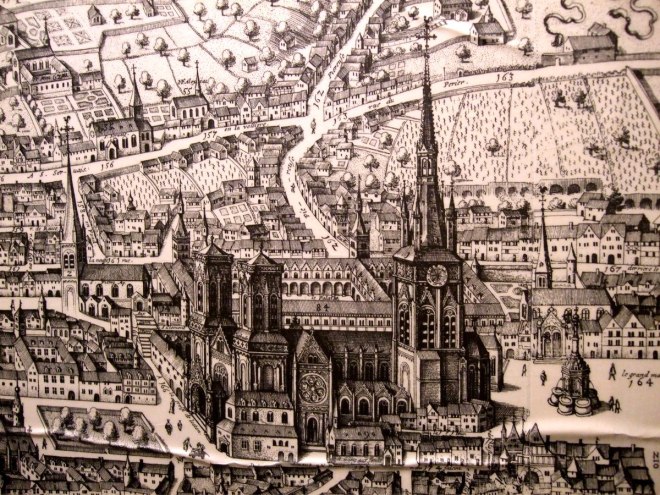
He built a magnificent basilica, which was soon turned into a cathedral, of which he naturally became the bishop (in the process, he kick-started the rise to greatness of Liège, which was then just a pissy little village). Alas, this cathedral was demolished by revolutionaries in 1794.

Source

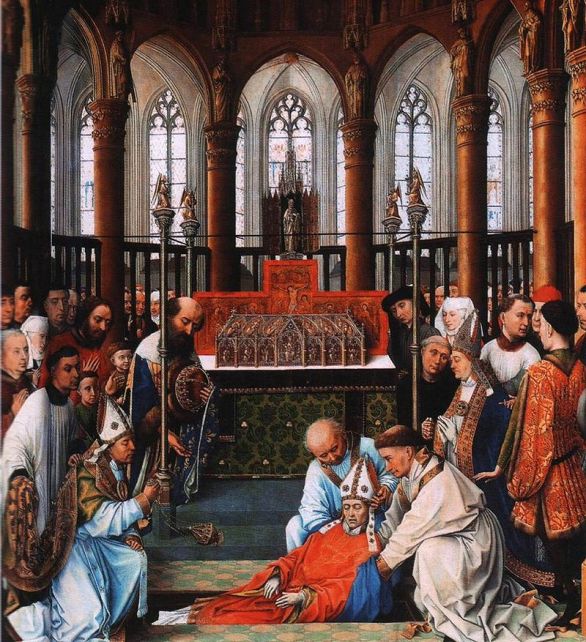
Much to his disappointment, Hubert wasn’t martyred but died peacefully in his bed in the late 720s AD. He was, as might be expected, initially buried in Liège, but about 100 years later his bones were dug up and transferred to the Benedictine Abbey of Amdain. This event was depicted in this wonderful painting by Rogier van der Weyden.

Source

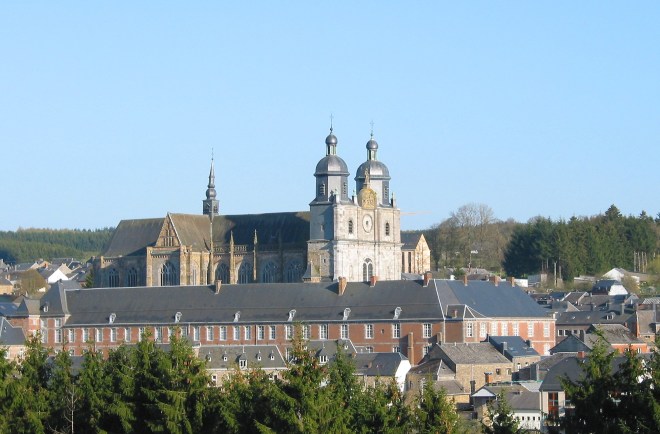
Not surprisingly, the town around the abbey renamed itself Saint-Hubert in his honour and became a focus for pilgrimages over the succeeding centuries (no doubt making the Abbey rich in the process).

Source

I think readers will now understand why Hubert is patron saint of all things forest. He was a very popular saint among the little people in the Middle Ages, probably because forests played an important role in people’s livelihoods until deforestation shrank those forests, first to woods and then to woodlots on the margins of rural lives. Not surprisingly, given his passion for hunting, Hubert was also very popular among the aristocracy, and several Noble Orders dedicated to hunting were named after him. Take, for instance, the Venerable Order of Saint Hubertus, which was founded in 1695 by Count Franz Anton von Sporck.

Source

The Order brought together the Holy Roman Emperor Charles VI and hunting enthusiasts from various other noble families throughout the Holy Roman Empire. It still exists, its current Grand Master being Istvan von Habsburg-Lothringen.

Source

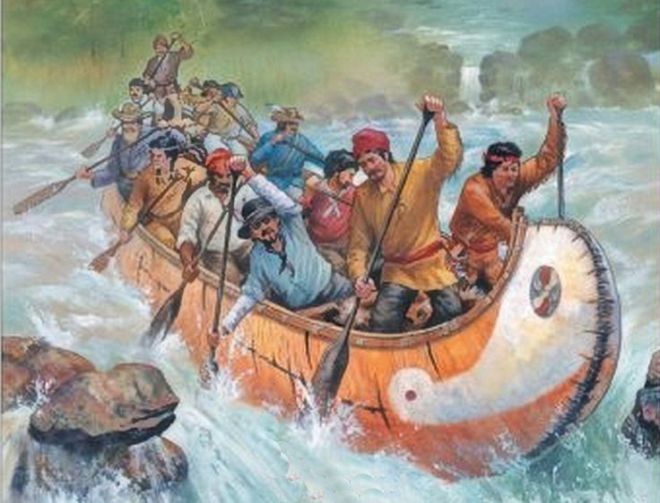
Given that in the early days of the European presence in Canada so many French Canadians were involved in the fur trade as trappers, I also now understand why Saint Hubert was a popular saint in French Canada; in the teen years I spent there, I was intrigued by the number of places called Saint-Hubert (there is even a chain of chicken restaurants in Quebec called Saint Hubert). No doubt the saint’s protection was invoked by the Catholic trappers as their canoes set off on their way to the beaver grounds out west.

Source

Of course, since the regions we now call Belgium and southern Netherlands were the saint’s favoured hunting grounds, both literally and figuratively, many places there are also called Saint-Hubert (French) or Sint Hubertus (Flemish/ Netherlandish). One beer has taken its name from the town of Saint-Hubert around the abbey where Hubert was eventually buried. Here is a bottle of one of the company’s brews (triple amber for any beer enthusiasts among my readers).

Source

There is also a brew that is popular here in Vienna, the Hubertus Bräu.

Source

I’m not sure why it’s called Hubert’s Brew. It’s certainly not named after the place it’s brewed in, which is Laa an der Thaya (nice area; we’ve been on a couple of hikes around there). But it has a very distinguished pedigree. The town obtained the right to brew it back in 1454, from Ladislaus Postumus, Duke of Austria (and for this privilege they had to deliver the good Duke a keg of beer on each holiday, which doesn’t sound much – but maybe there were lots of holidays back then).

As readers will note, both these beers have as a symbol the famous stag’s head with the crucifix hovering between its antlers. So does the digestive Jägermeister, that concoction of herbs macerated in alcohol, which for some strange reason became popular with the student crowd.

Source

In this case, the connection to Hubert is via its name, which means Master of the Hunt.

Of course, I understand why any alcoholic drink which has some sort of connection to Hubert would use the symbol of the stag with the hovering crucifix. But I wonder if the makers of these drinks have thought this idea through. For me, the implication is that drinking the beer or digestive will make you see things which aren’t there (rather like that hoary chestnut that alcoholics see pink elephants).

Not perhaps the best image one wants to give to an alcoholic drink. On the other hand, putting a picture of Hubert as a bishop, like the one in the photo which I started this post with, could well put a damper on one’s enthusiastic desire to drink. A tricky marketing conundrum …
With that, I lift a good glass of wine to my readers and go and join my wife to do the packing. Auf wiedersehen, arrivederci, we will see each other again once we’ve moved down to Italy!

WOOD AND FIRE

Vienna, 14 November 2020
Updated: 13 June 2025
Updated again: 23 September 2025

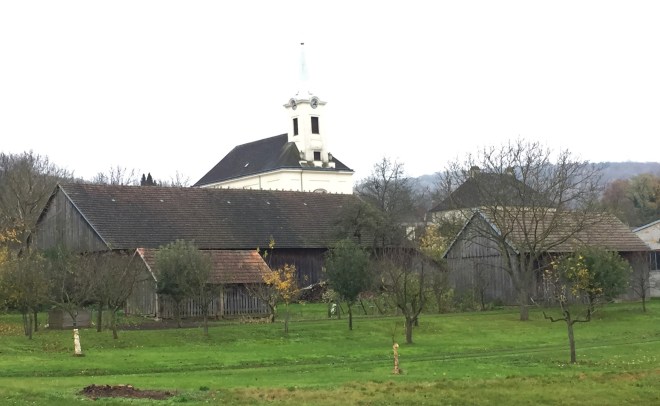
As befits a mountainous country with a coolish climate, Austria has acres of forests covering its many hills and mountains. As a consequence, it once had a vibrant tradition of building in wood. Nowadays, of course, wood as a building material has been almost completely superseded by stone, brick and concrete. The only places you still see wooden buildings are in the small villages which dot the countryside, wooden barns being still quite common there. My wife and I come across them quite often on our hikes, as these photos taken on a couple of recent hikes attest.

my photo
my photo
my photo

I love these old barns. My French grandmother had one just like them attached to the side of her house. We went in there often because that was where the bicycles and the ping-pong table were kept. It was – to the small me – a vast, cavernous place. All sorts of weather-beaten garden tools and other odds-and-ends lurked in the shadows. There was a pile of hay – quite why I don’t know; my grandmother had no animals. But it made the barn smell of hay, into which was mixed the smell of beaten earth rising from the floor. Then one summer I arrived for the summer holidays, only to find the barn gone. My grandmother told me that it had been sagging sideways and threatening to pull the rest of the house down with it. But this perfectly rational explanation didn’t take away the desolation I felt at the disappearance of this wonderful building.

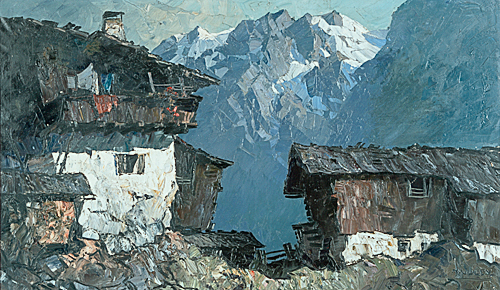
As I say, there was a time when many more buildings in this country were made of wood, especially in the mountain regions. A number of Austrian artists have captured them on their canvases. Oskar Mulley was especially assiduous in his painting of mountain huts and barns, partly or wholly made of wood.

Source
Source

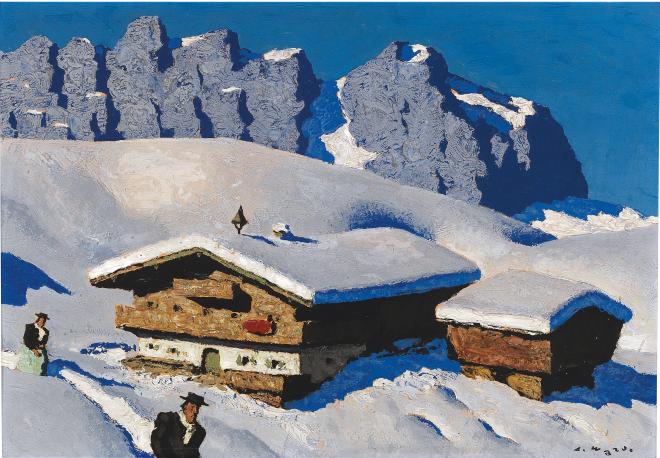
Alfons Walde also often included these buildings in his paintings, although snow was more his thing.

Source
Source

Alas, as we all know only too well, wood burns very well. The older and drier it is, the better it burns, as we all learnt watching the roof of the cathedral of Notre-Dame in Paris go up in smoke.

Source

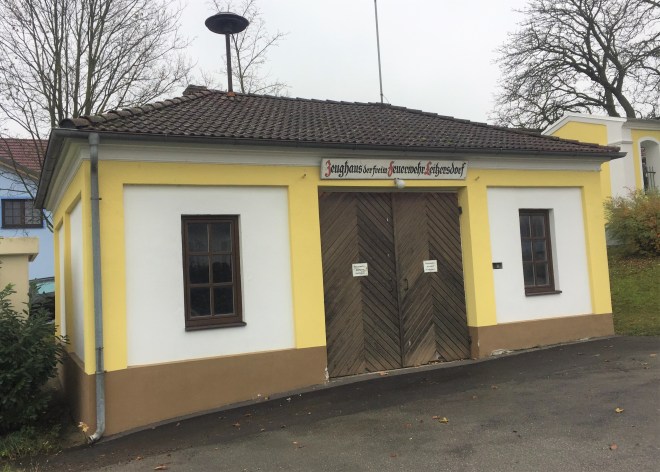
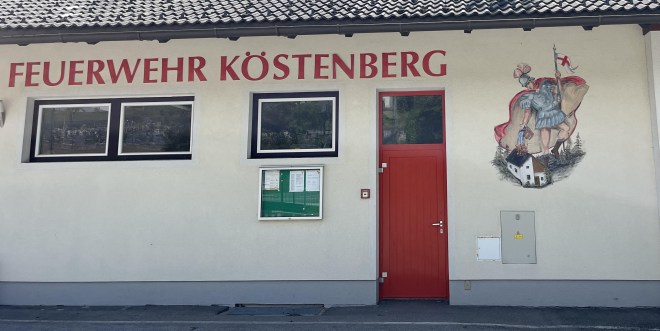
The previously common use of wood in construction in Austria and its tendency to burn well must explain why every municipality in this country, down to the smallest village it would seem, has a fire station. As an extreme example, a couple of days ago my wife and I passed through a small village on one of our hikes, which had not one

my picture

not two

my photo

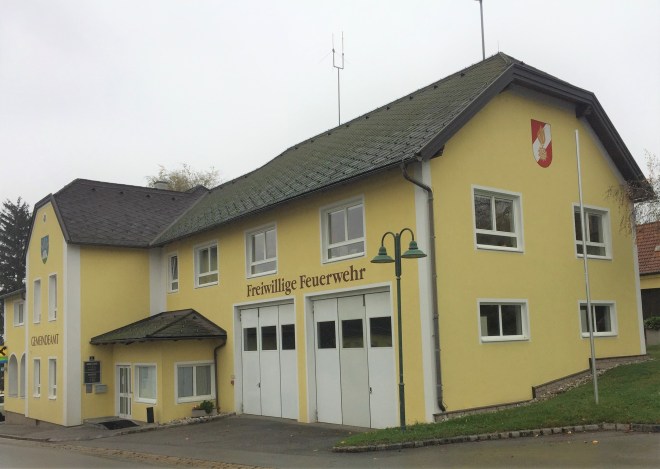
but three fire stations!

my photo

And each one is bigger than the last. Are fires getting bigger in this village, I wonder, or is it that fire engines are getting bigger and need a more spacious building to house them, or (a somewhat uncharitable thought) have municipal budgets been growing?

Of course, as befits a traditionally Catholic country, Austrians have a saint whom they can invoke to protect them from fire: St. Florian. Austrians should be particularly proud of this saint since he is a native son. The annals tell us that he was born in the latter part of the 3rd Century C.E. in Lorch, near Linz, on what was then the edges of the Roman Empire – the Danube River, which flows just north of Lorch, was the frontier of that Empire. Since so many Roman army units were garrisoned along the frontier his father could have been an army officer. Florian was active, possibly also as an army officer, in St. Pölten (or Aelium Cetium, as it was then called) when one of the periodic rounds of persecution against Christians broke out. This one occurred in 303–304 C.E., under the Emperor Diocletian (the same round of persecution that put paid to St. Pancras, about whom I wrote an earlier post). Without going into the details, which are anyway of dubious validity, it is recorded that Florian was arrested as a Christian. After a trial and various tortures, he was drowned in the Danube by being thrown off a a bridge with a stone tied around his neck. Thus did he become a martyr and a saint.

Sensibly enough, Florian was initially invoked to protect people from the dangers of water. At some point, though, he was pivoted (to use that most modern of terms) and used instead to protect people from fire. My theory – for which I have absolutely no evidence – is that another saint, John of Nepomuk, about whom I’ve written in an earlier post and who died in almost exactly the same way as Florian – thrown from a bridge and drowned – won the competition for protecting people from the dangers of water, leaving Florian without a role. Well of course, one critical use of water was to put out fires, so hey presto! he became the protector from the dangers of fire.

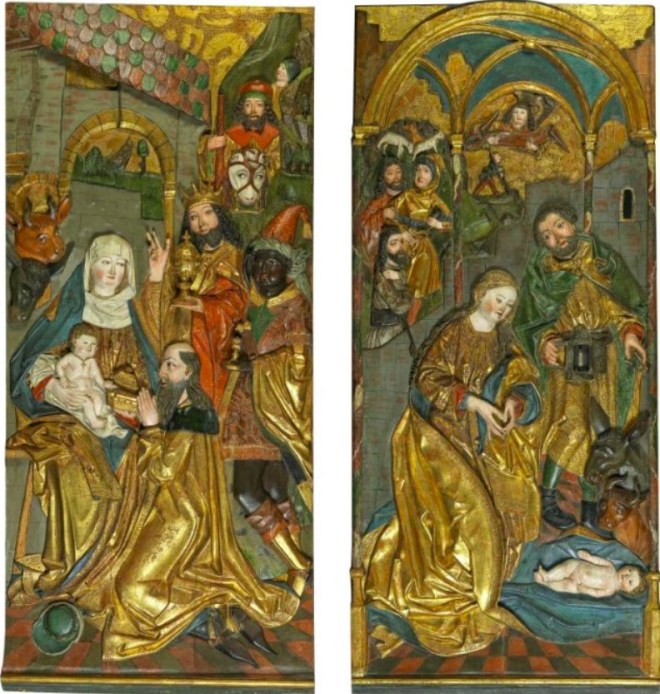
The Austrians have not only used wood to build, they have used it to carve, and their churches (and museums) are full of wonderfully carved statues and bas-reliefs. I throw in here a couple of bas-reliefs (from southern Germany in this case) which were recently auctioned at Vienna’s Dorotheum auction house.

Source

Naturally enough, the saints who got a place in churches tended to be people’s favourites, ones whom they prayed to regularly. Given the ever-present danger of fire, one of these is St. Florian. My wife and I came across this lovely example of a St. Florian statue during one of our hikes this Autumn, down by Neusidler See (the same hike where we picked up bagfuls of walnuts).

my photo

We see here all the typical attributes of such a statue. Florian is dressed as a Roman soldier and gripping a banner, he is holding a bucket of water, and he is thoughtfully pouring that water over a little burning house situated at his feet. Delightful! My wife and I have come across scores of such statues during our wanderings over Austria’s hills and dales. In fact, we came across a fresco of him on the wall of a house just this afternoon.

my photo

One statue of St. Florian which we haven’t seen, though, and which I have put on my bucket list stands in the town of Bad Tölz in Upper Bavaria. The statue was set up in a square, in front of the town’s tax office. Since the statue gave its back to the tax office the sculptor thought it fitting to have the saint flash his bum to the tax men, to show them what he – and the rest of the town – thought of them.

Source

I think we can all sympathize with the citizens of Bad Tölz, especially since St. Florian’s feast day is 4th May, a few days after 30th April, which for many in the world is the deadline for turning in their income tax returns.

Luckily, making statues of St. Florian has continued into the modern age. Down the street from us is a modern church dedicated to St. Florian. Outside the parish offices is this bronze statue of the saint.

My photo

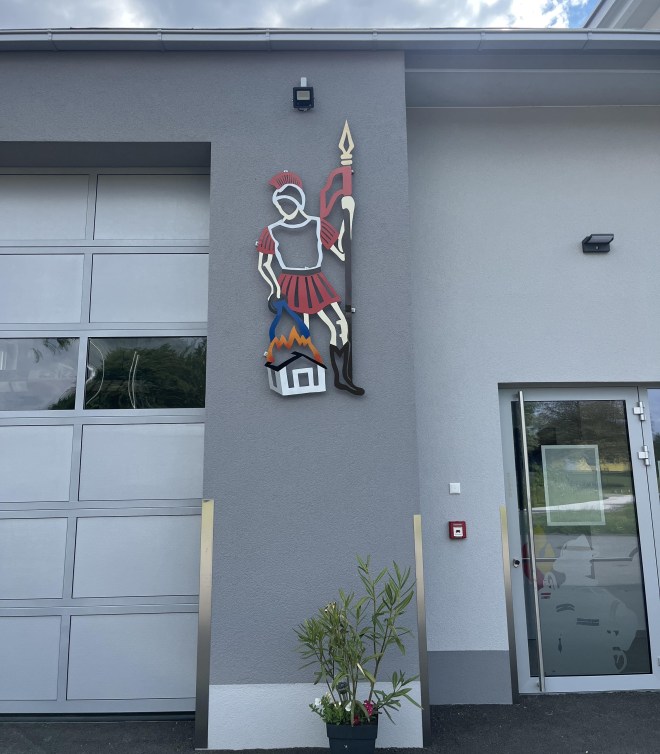
It must be obvious by now that the firemen and women of Austria (and I’m guessing Germany) have Saint Florian as their patron saint. And in fact many of Austria’s fire stations have a depiction of Saint Florian on their walls. Here’s a very traditional depiction.

My photo

Here’s a more modern take.

My photo

By extension of his duties as heavenly fireman, St. Florian is also the patron saint of many trades where fire was once used: bakers, brewers, coopers (the staves which coopers used to make barrels were steamed to make them pliable), potters, forges, soap boilers (who knew that was once a profession?). He is also, naturally enough, the patron saint of chimney sweeps, which, dear readers, contrary to coopers, soap boilers, and the rest is not a profession that has disappeared – not in Austria, at least. They are alive and well and thriving here.

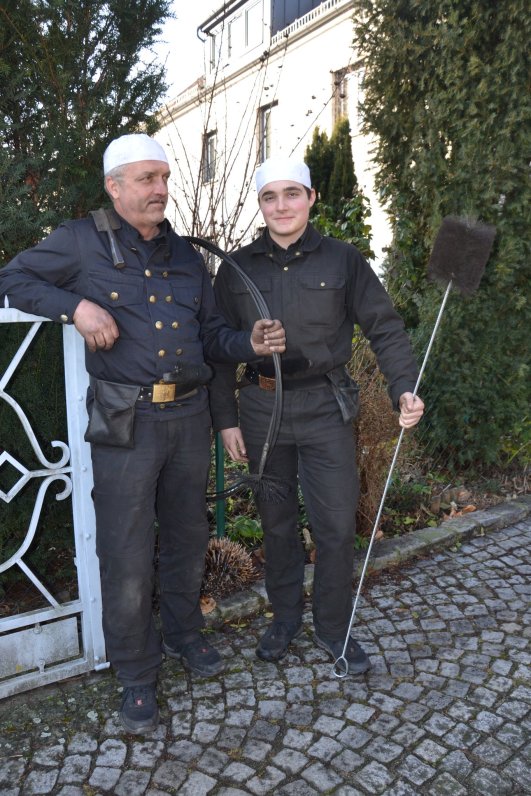
When my wife and I first came to Austria, we were struck by these young blokes we would see (there have also been some young ladies in recent years) walking the streets and wearing this strange outfit: black overalls with a white head covering.

Source

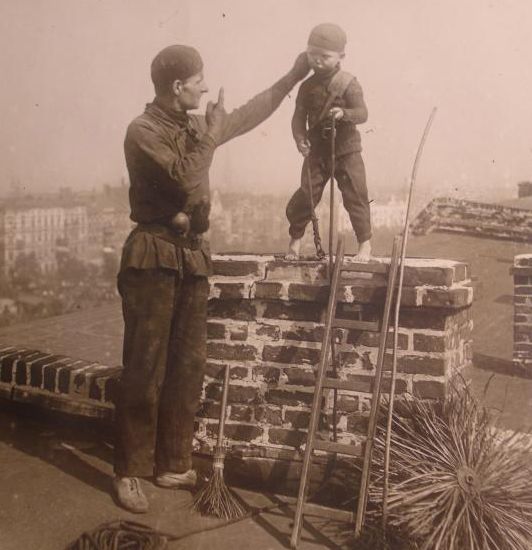
Upon enquiry, we were told that they were chimney sweeps. Chimney sweeps?! Well, both my wife and I have been around the block a couple of times (I won’t admit to how many) and neither of us have any memory of our parents calling in chimney sweeps. I don’t know about my readers, but to me the term “chimney sweeps” conjures up a Dickensian vision of little boys being forced to climb down narrow chimneys by a nasty master and getting stuck and dying.

Source

At a minimum, chimney sweeps should be dirty-looking, like coal miners.

Source

In fact, they should have died out along with the coal industry. But no, these Austrian fellows are around in large numbers and are lick-spittle clean; they don’t give the impression of ever getting within a mile of an actual chimney. What is going on here?

I don’t want to be uncharitable, but I rather get the impression that we have here a great example of a union using its political muscle to avoid extinction. The way I see it, when chimney sweeps saw that their days were numbered, they got the governments – municipal, for the most part – to pass laws requiring homeowners to have their chimneys – used for gas water heaters for the most part these days – as well as the water heaters themselves checked at least once a year by a “chimney sweep”. As a homeowner in Vienna, I have had the doubtful pleasure of having Viennese “chimney sweeps” come over, solemnly open a little trap door in the wall, perfunctorily take a look in, declare all to be well, and require to be paid handsomely for this service. And on top of it all they expect a tip at Christmas! This year, I found this “service” particularly grating because just a few days before the “chimney sweep” had come around we’d had the water heater maintained by a man who spent a good deal more time on the job and got paid proportionately a good deal less. But we can’t get out of it, because if we were to have a fire – Oh St. Florian, spare us this disaster! – and if it turned out to have been due to something the chimney sweep would have checked if we had called him, then the insurance wouldn’t pay – they have you over a barrel (made by one of those coopers who have since disappeared).

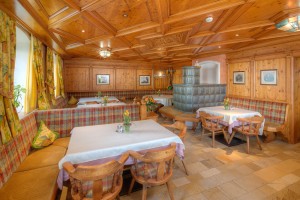
Not wishing to end on this sour note, writing about chimney sweeps reminds me that in the old days, when they really did sweep chimneys out, they would have cleaned chimneys connected to those wonderful tiled stoves which they used to have here in Austria. Some places actually still have them. We came across one this summer while staying in a hotel on a hike near Innsbruck; the stove is at the back of the room in the picture.

Source

As readers can see, they have a bench around the bottom where one can sit with one’s back against the stove wall keeping nice and warm. I understand people would even sleep on these benches. But what is really lovely about these stoves is their decoration. I throw in a few pictures of such stoves.

Source
Source
Source

Once, when we were looking for an apartment in Vienna to rent, my wife and I were shown one with such a stove. For one mad moment, we thought of taking the apartment just for the stove. But good sense prevailed; it would have been too small, the children wouldn’t have had their own rooms. Sometimes, though, my wife and I reminisce about that stove we never had. Another thing on our bucket list.

THE OBSCURE NAMES DEPARTMENT

Vienna, 14 October 2020

Question: What connects this tumbledown church, which my wife and I stumbled across during a multi-day hike we did this summer in the Wachau region of Austria

my photo

and this train station in London, well known to all those who take Eurail to go to London?

Source

Answer: Their names: they are both called Saint Pancras.

I must say, when we came across that half-ruined church and discovered its name my curiosity was piqued. I mean, Pancras is a funny name, no? I’ve never met anyone face-to-face called Pancras, I’ve never even heard of someone called Pancras. And those websites which will breathlessly list you famous persons having a certain name all came up blank for Pancras. I had only ever heard the name due to the station, and that only because it’s right next to King’s Cross Station, which I used a lot at a certain moment of my life. And I only remember the name because of its close similarity to the name of that organ we all have and whose precise purpose I have never really understood. Yet here were two places some 1,500 km apart with the same name. Yes, my curiosity was piqued, I had to investigate – “Google it!”, as my son always says. And I am now ready to report.

First of all, who was this Saint Pancras? Well, he was an obscure fellow about whom relatively little is known. Like Saint Blaise, another obscure fellow whom I have written about in an earlier post, he was born in what is now central Turkey some time in the 3rd Century. When still a boy and after his parents died, he moved to Rome to be with his guardian. There, again like Saint Blaise, he was caught up in one of the periodic persecutions against Christians, in this case by the Emperor Diocletian. It seems that he and his guardian were giving shelter to Christians and as a result he (and presumably his guardian, but he disappears from the story) were arrested. Pancras was 14. Here, the story gets fanciful. His hagiographer claims that Pancras was hauled in front of the Emperor himself, that the two had a long discussion during which Pancras impressed the Emperor with his youth and determination. Finally, annoyed (enraged, says the hagiographer) by the teenager’s refusal to refute his Christianity, he ordered Pancras’s execution. Pancras was promptly dragged off and beheaded. I find it hard to believe that the Emperor ever bothered to speak to this unknown youth; in fact, as one of the commentators diplomatically put it, it would have been very difficult for him to do so since he was not actually in Rome in the year that Pancras was beheaded. Whatever actually happened, it seems that Pancras was buried along the Via Aureliana.

For reasons that are just as obscure to me as the details of his life, his grave became a hub of pilgrimage and supposed miracles. Pope Symmachus built a basilica over the grave in 500 AD, a basilica that was expanded and much remodeled over the centuries. A church still stands on the spot (a church which, I must admit, I have never visited; perhaps the next time I’m in the Eternal City …).

Source

If things had remained there, Pancras might have ended up as simply a minor regional saint. But for reasons which are yet again obscure to me Saint Gregory of Tours in France wrote in a famous book on Christian martyrs which was published in about 590 AD, that anyone making a false oath at the saint’s tomb would be seized by a demon and would collapse and die. Well! In an age where oaths were taken incredibly seriously and where everyone believed in the existence of demons and Hell, this was equivalent to saying that Saint Pancras was a divine lie detector: who in their right minds would dare to lie if asked to take an oath on the saint’s tomb? An oath on Saint Pancras’s tomb was considered so potent that it could be held up in court as proof of a witness’s testimony.

There was one slight problem: Saint Pancras’s tomb was in Rome and Rome was far away. No matter! In an age in which trade in the relics of saints flourished, relics of Saint Pancras were considered just as potent. There was therefore a huge and urgent demand from all over Western Christendom for relics of Saint Pancras to be sent to them. The Romans were not slow to oblige, and soon relics purported to be of Saint Pancras were on their way to every corner of Western Europe. As one source I read commented: “The whole body of the Saint was apparently in at least twenty churches; the head, in at least ten cities. As for the individual bones, they were without number. Of course, only a small part of these relics could be authentic .”

Of course, such potent relics needed to be housed appropriately! As a result, many a church was built and dedicated to Saint Pancras, with his relics enclosed in the main altar. In great pomp and ceremony, swearers of oaths could be solemnly brought before the altar and required to take their oaths. In our more cynical age, we can smile at the credulity of our ancestors but I have to say if I had been around in the Middle Ages and had been required to take an oath before the relics of Saint Pancras I’m pretty sure I wouldn’t have lied. Who wants to spend eternity in Hell, even if you are being asked to swear that you didn’t kill someone?

It wasn’t just churches who owned relics. Rich aristocrats also had their collections of relics, housed in richly made reliquaries like this one.

Source

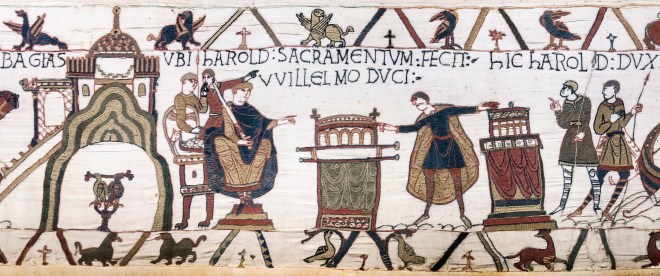
I have absolutely no basis for making the following claim, but I would like to believe that one of the most famous of all oaths taken during the Middle Ages, that taken by Harold Godwinson in Normandy in 1064 before Duke William, was taken on relics of Saint Pancras. For readers who are not familiar with this story, let me quickly summarize the salient points. In 1064, the-then king of England, Edward the Confessor, was clearly nearing the end of his life and didn’t have a son to succeed him. Various regional powers were jockeying to get into position to take the crown on Edward’s death. One of these was Duke William of Normandy, who was related to Edward, although in a rather indirect way. Another was Harold Godwinson, head of the most powerful family in England. For reasons which are not entirely clear, Harold went to Normandy (some say he was actually on his way to France but got shipwrecked on the Normandy coast). Duke William promptly laid hands on him and held him prisoner, although he went through the motions of treating him as a valued guest. Harold’s “stay” ended with him swearing an oath on a series of relics. The Bayeux tapestry captures this moment.

Source

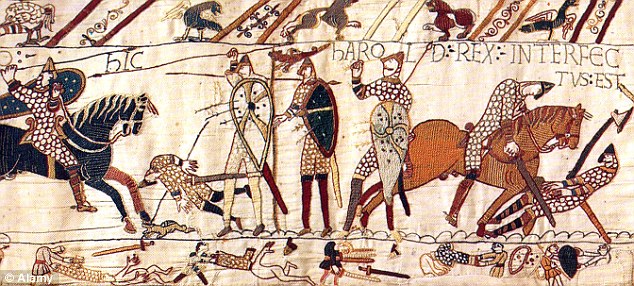
Quite what he swore is not clear. William claimed that Harold swore fealty to him and agreed that he would support him to be king. Consequently, he cried foul when Edward died and Harold took the throne. Harold retorted that he had been made to take the oath under duress and therefore (whatever it was that he was made to promise) it was not valid. William took this “betrayal” as an excuse to legitimize his invasion of England. We all know how that finished. The two armies met at Hastings, Harold took an arrow in the eye and died, and his army collapsed. Again, this key moment in English history was caught in the Bayeux tapestry.

Source

We’ll never know what oath Harold really took. As they say, history is written by the victors. But coming back to the relics that Harold took his oath on, it certainly seemed to have been important enough to have warranted the use of Saint Pancras’s relics. The poet Lord Alfred Tennyson believed that they were of Saint Pancras. In his verse-drama “Harold,” when it comes to the moment of the oath he has William exclaim:
“Lay thou thy hand upon this golden pall!
Behold the jewel of St. Pancratius
Woven into the gold. Swear thou on this!”

Continuing in the obscurity department, when the Church hierarchy got around to assigning saints to all the days in the year, something which they seemed to have done quite early on, they assigned St. Pancras to 12th May. Why St. Pancras got 12th May is completely mysterious to me. In any event, 12th May was already St. Pancras day in 896 AD, when the Holy Roman Emperor Arnulf of Carinthia conquered Rome. Arnulf belonged to that delightful period of European history when everyone had fantastic names, something I have noted in an earlier post about Saint Radegund (itself a wonderful name). His father was called Carloman, his mother Liutswind, his son Zwentibold. He deposed Charles the Fat as Holy Roman Emperor and took his place, he was saving Pope Formosus from the clutches of Lambert and his mother Ageltrude when he conquered Rome. And on and on: there are literally dozens more such colourful names attached to Arnulf’s life and times.

But I digress. Arnulf attributed his success in conquering Rome to the intercession of that day’s saint, that is to say Saint Pancras. This made Saint Pancras even more popular than he already was in the German lands, and could well explain in a roundabout way why my wife and I came across this dilapidated church in the Wachau dedicated to him.

The fact that May 12th is Saint Pancras’s day meant that for centuries he also played an important role in the agricultural calendar of large swathes of Europe, from Lombardy and Liguria as well as Slovenia and Croatia in the south to Sweden and Poland in the north, from Belgium and France to the west to Hungary in the east. He, St. Mamertus (May 11th), St. Servatius (May 13th), and St. Boniface of Tarsus (May 14th) became collectively known as the Ice Saints, and Saint Sophia (May 15th) as Cold Sophy. They were so called because the middle days of May were believed to often bring a brief spell of colder weather, and there were warnings against sowing too early in case young crops were caught in a frost. These were translated into a series of colourful sayings, no doubt repeated around the hearth by the wise men (and perhaps wise women) of the village:

Pankraz, Servaz, Bonifaz
only make way for summer.

No summer before Boniface
No frost after Sophie.

You’re never safe from night frost
Until Sophie is over.

Servaz must be over
If you want to be safe from night frost.

Pankrazi, Servazi and Bonifazi are three frosty Bazi.
And finally, Cold Sophie is never missing.

Pankraz and Servaz are two bad brothers
What spring brought they destroy again.

Never plant before Cold Sophie.

Readers get the picture. Alas, science seems to disprove peasants’ belief that there was a tendency to a cold spell in that period. In fact, science has generally stopped us from giving any credence to saints. Which is generally a good thing. But it does mean that names like Pancras, Mamertus, Servatius, and Boniface have sunk into obscurity, so much so that when I came across a church dedicated to Pancras I scratched my head and muttered to myself “Who on earth was he?” Luckily there was Google to help me find the answer.

Oh, in case any readers are asking themselves why the railway station in London is called after St. Pancras, it seems that it was so called because the surrounding district was so called, and the district was so called because there was once in the vicinity a very ancient church dedicated to Saint Pancras. So there you are.


THOMAS BECKET ON LAKE COMO

Milan, 28 May 2020

In these days of Covid-19, when the rules here in Italy forbid us from traveling from one region of the country to another, my wife and I have been cut off from the usual hikes we do at this time of the year along the sea in Liguria. We’ve had to make do with hikes in Lombardy, which in practice has meant hiking along the edges of Lake Como. Not that we’re complaining (too much), it’s a beautiful part of the world to be hiking in. Anyway, a week or so ago, my wife and I decided to retrace our steps along one of the segments of the Wayfarer’s Trail which we had first attempted back in January (for any readers who are interested, I mention our hikes along the Wayfarer’s Trail in an earlier post). Towards the end of the walk we passed through a small village called Corenno Plinio, which lies just north of a somewhat larger village by the name of Dervio, where we were planning to catch the train to go back home.

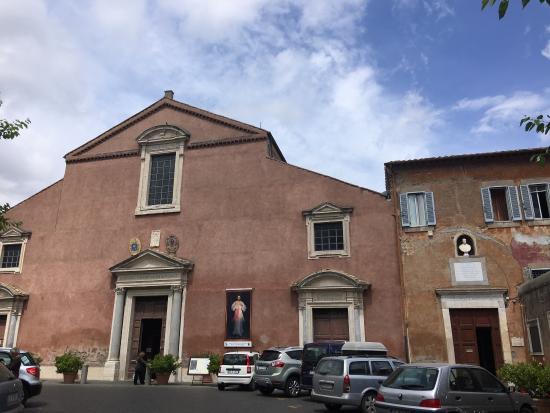
The last time we passed through Corenno Plinio, back in January, the light had been failing and we were in a hurry to get to Dervio station before dark. So we had ignored the village’s sights and pressed on. And quite some sights there are, to whit a castle from the 14th Century, a little church from the late 12th-early 13th Century attached to the castle, plus the winding cobbled streets of what was once a Medieval village huddling under the castle’s protective walls. This time, with the days being considerably longer, we decided to take a little break when we hit Corenno Plinio and at least visit the church.

Source

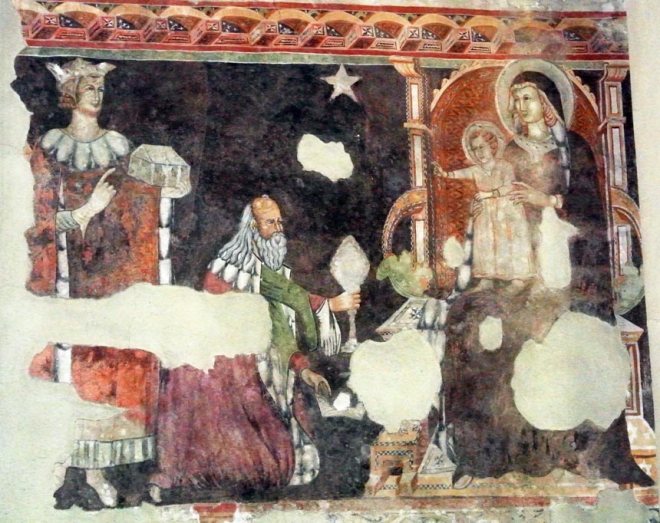
For such a little church, it was quite a treat. Before we even went inside, there were three funerary monuments, dating from the 13th and 14th Centuries, to inspect. Readers can see two of them in the photo above. As for the interior of the church, there were some charming frescoes from the 14th Centuries on both walls of the nave. I particularly liked this Adoration of the Wise Men.

Source

Opposite the Wise Men was a fresco with Saints Gotthard (he of the Gotthard Pass in the Alps) and Apollonia.

Source

I’ve mentioned Saint Gotthard in an earlier post, but I had never come across Saint Apollonia before. For those of my readers who are not up to speed on their Christian martyrology, Saint Apollonia was one of a group of virgin martyrs from Alexandria who was caught up in a riot by the Alexandrian mob against Christians in the early 200s AD. In her case, the mob pulled out her teeth. This explains that mean-looking fellow who is shoving a large pair of pliers into the her mouth (she is, by the way, the patroness of dentistry, which I find highly appropriate; I feel just like that painting every time I sit in my dentist’s chair).

Further along the same wall, there was this line of apostles. I rather liked their piercing gaze.

Source

The only one I recognized was the one holding the knife. That’s Saint Bartholomew, who met with a particularly hideous end by being flayed alive (readers who are interested in knowing more can read my post on him).

And then, next to the apostles, there was this bishop.

Source

It is St. Thomas Becket, Archbishop of Canterbury, slain on 29 December 1170 in his cathedral. In fact, I discovered, my wife and I were in the Church of St. Thomas of Canterbury.

Well! It gave me a little turn to find a church dedicated to this oh, so English saint on the shores of Lake Como. I had learned about him in my history classes many, many years ago in primary school. At University I had read T.S. Eliot’s Murder in the Cathedral and Jean Anouilh’s Honour of God, plays which both explored his tortuous relationship with his king, Henry II. It seemed such an English story. Why would the Italians be interested in Thomas Becket?

For any of my readers who might not know his story, it is quickly told. Born into a London merchant family, Thomas rose to become Chancellor to Henry II. He served the king faithfully, but more than that, he and the king were genuinely friends. When the Archbishop of Canterbury died, Henry had the bright idea of putting Thomas up for the post. He thought Thomas would enthusiastically implement his agenda of strengthening royal powers at the expense of the Church’s. Henry felt – with some merit, I would say – that the Church was too powerful and independent: a state within a state, as it were. But the moment Thomas became Archbishop, he became a zealous defender of the Church’s independence and prerogatives. Not surprisingly, Henry was outraged and relations between the two men soured rapidly, to the point where Thomas finally fled England and sought the protection of the French king. For six long years thereafter, the two men brought to bear against each other all the punitive measures in their power short of violence. Finally a peace, or rather an armed truce, was negotiated and Thomas came back to England. But just before he landed, he excommunicated three bishops for reasons which are not completely apparent. When Henry heard the news, he flew into a towering rage and is said to have cried out, “Will no one rid me of this turbulent priest?” Actually, he is more likely to have shouted, “What miserable drones and traitors have I nourished and brought up in my household, who let their lord be treated with such shameful contempt by a low-born cleric?”, which I feel sounds rather better. In any event, four knights (who play a major role in Eliot’s Murder in the Cathedral) interpreted this royal outburst as an invitation if not an order to act. They immediately saddled up and left for Canterbury.

When they arrived, they placed their weapons under a tree outside the cathedral before entering to challenge Thomas, who was on his way to Vespers. They demanded that he submit to the king’s will and come with them to Winchester to give an account of his actions. Thomas of course refused. The knights then rushed out, grabbed their weapons, and rushed back inside, shouting “Where is Thomas Becket, traitor to the King and country?!”. When they found him, one knight grabbed him and tried to pull him outside, but Thomas held fast to a pillar. One eyewitness, who was wounded in the attack, wrote this about what happened next: “…the impious knight… suddenly set upon him and shaved off the summit of his crown which the sacred chrism consecrated to God… Then, with another blow received on the head, he remained firm. But with the third, the stricken martyr bent his knees and elbows, offering himself as a living sacrifice, saying in a low voice, “For the name of Jesus and the protection of the church I am ready to embrace death.” But the third knight inflicted a grave wound on the fallen one; with this blow… his crown, which was large, separated from his head so that the blood turned white from the brain yet no less did the brain turn red from the blood; it purpled the appearance of the church… The fifth – not a knight but a cleric who had entered with the knights… placed his foot on the neck of the holy priest and precious martyr and (it is horrible to say) scattered the brains with the blood across the floor, exclaiming to the rest, “We can leave this place, knights, he will not get up again!””
Well!! That is a most satisfyingly dramatic end to a story of a Medieval bromance gone terribly, horribly wrong.

It may have been a very English story (although in truth the French were a good deal involved, as was the papacy), but this hideous murder, in a cathedral of all places, of the highest prelate in the land of all people, apparently on the orders of a king of all things, sent shock waves around Europe. Not only was it a damned good yarn, to be declaimed to a rapt audience around the evening fire, but it contained – for Medieval Europeans steeped in Christianity – the elements of sacrilege: murder in the holiest of places, of Christ’s highest representative in England. A delicious shiver of horror must have travelled up every Medieval European spine when the spines’ owners heard the tale, and many signs of the cross must have been rapidly made and prayers breathlessly uttered to keep the devil at bay.

The fallout was immediate and immense. Almost overnight, the spot where Thomas was murdered became a place of pilgrimage. The Church made the most of it and had Thomas canonized in the record time of two and a bit years. The murderers fled to safety in Yorkshire, but eventually gave themselves up and submitted to a heavy penance. As for Henry, like any modern politician he tried to distance himself from the whole affair and urged everyone to move on, but like all modern electorates no-one really believed him and didn’t want to move on. So he made peace with the Pope, swearing to go on a crusade (a promise he never kept), and scaling back some of his more anti-Church policies. And he bought off the Becket family by making Thomas’s sister the abbess of a rich nunnery. But it wasn’t enough. When his three surviving sons, Geoffrey, Richard the Lionheart, and John Lacklands, along with his estranged wife Eleanor of Aquitaine, rebelled against him, Henry found the rebels were supported by many people who were still shocked by the murder of Thomas. Henry’s difficult relations with his wife and sons is recounted in the play  Lion in Winter – I show here Christopher Walken in the first production of the play in 1966 (for no better reason than my wife is a great fan of Walken).

Source

So Henry decided that more extreme measures were required. In 1174, four and a half years after Thomas’s murder, he went to Canterbury, publicly confessed his sins, and then received five blows from a rod from each bishop present, and three blows from each of the 80 monks of Canterbury Cathedral (that seems an awful lot of blows, but I’m sure they went easy on him; I mean, how hard would you hit a king?). Then Henry offered gifts to Thomas’s shrine and spent a night at vigil at his tomb (which is where Anouihl’s Honour of God starts).

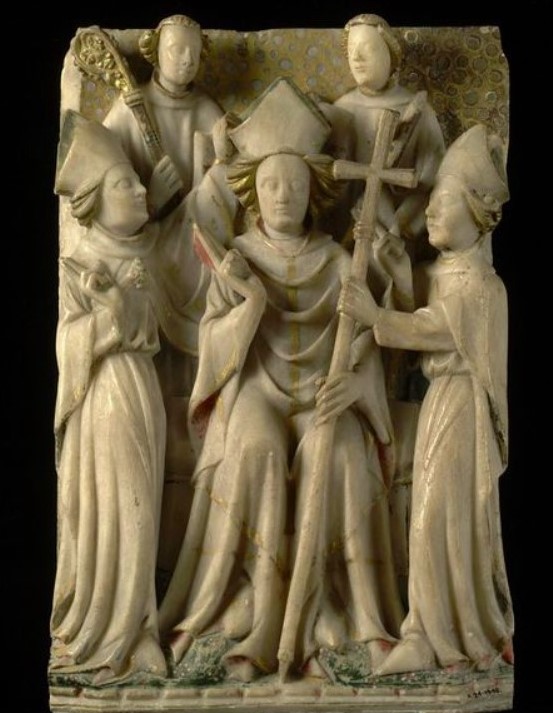
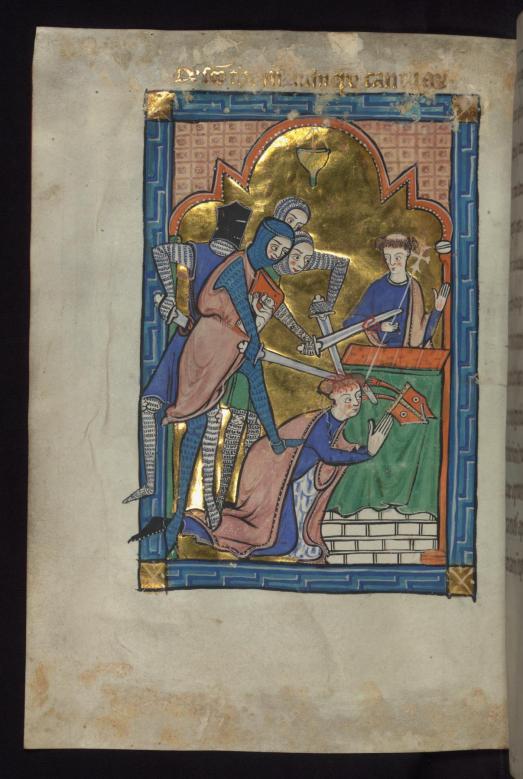
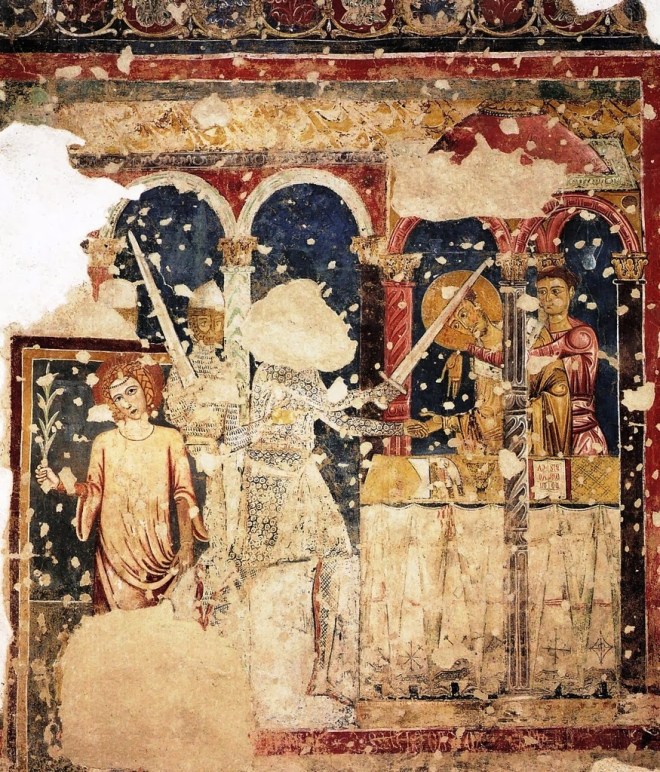
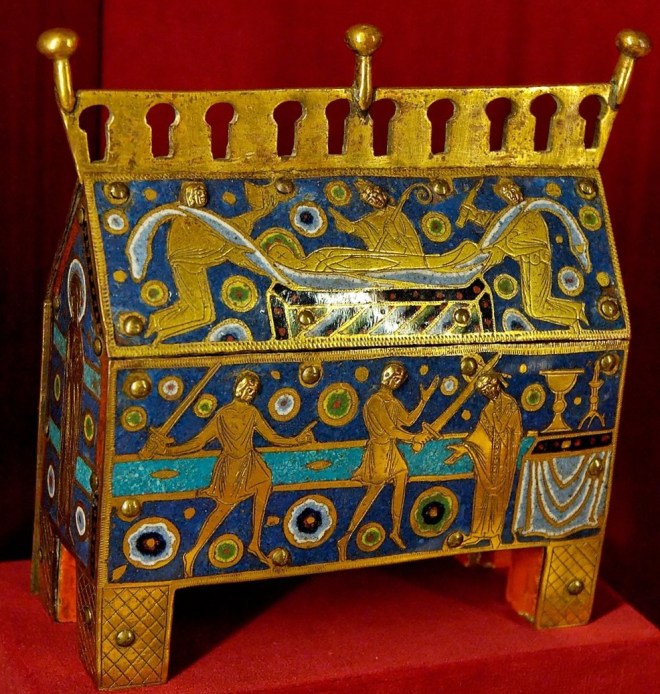
In the rest of Europe, scores of churches were dedicated to the now Saint Thomas of Canterbury, the little church in Corenno Plinio being one of them, and some wonderful artwork was created recording scenes of his life and death. In truth, his death seems to have excited artists (and no doubt their patrons) much more than his life. That seems perfectly in keeping with an age which enjoyed seeing paintings of St. Apollonia having her teeth pulled out and St. Bartholomew being flayed alive. In any case, let me run through a selection of these artworks, starting from the moment Thomas was consecrated archbishop.

Source

This panel, of alabaster, was made in the second half of the 15th Century and was originally brightly painted. Many such panels were produced in England – the country was famous for them – and exported all around Europe.

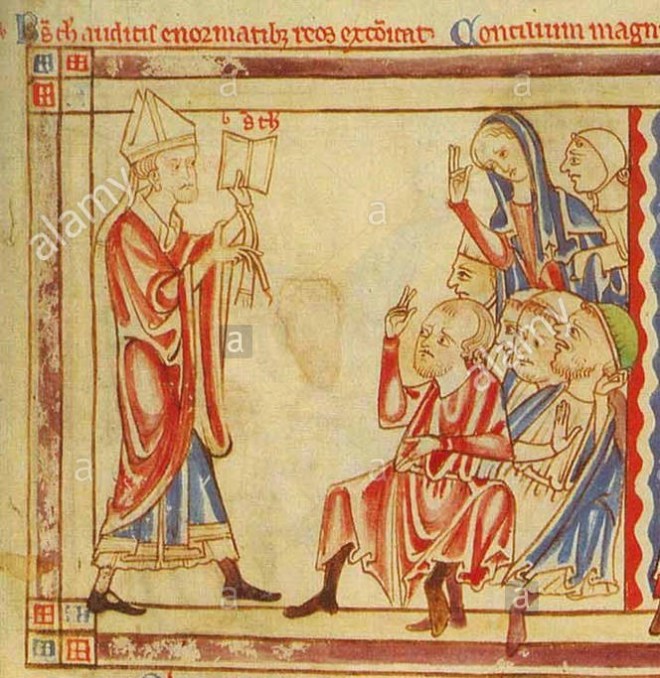
Here, in a contemporary manuscript, we have Thomas now arguing with Henry.

Source

In this other manuscript from the 1220s, the relationship between the two men has completely broken down and Thomas is excommunicating some of the king’s men.

Source

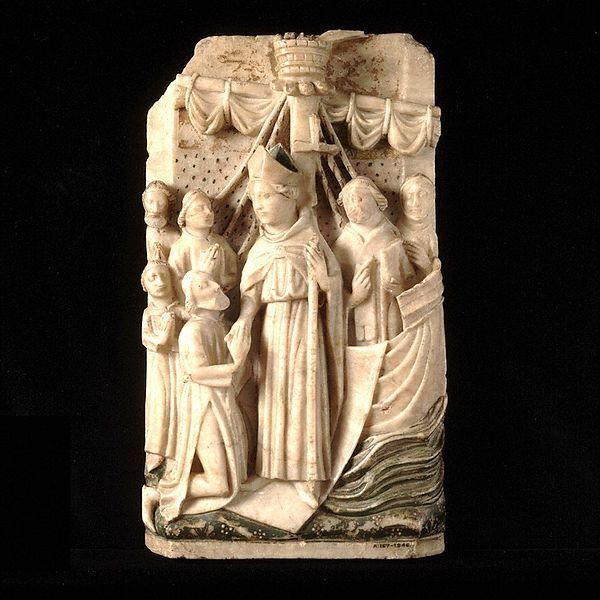
This second alabaster panel shows the moment when peace was made and Thomas finally came back to England.

Source

And now, the moment we’ve all been waiting for, Thomas’s murder in the cathedral, in full technicolor.

From a psalter made in East Anglia in the mid-thirteenth century:

Source

A fresco from the late 12th century in the Church of Saints John and Paul, in Spoleto, Italy.

Source

From a reliquary, also of the late 12th Century, decorated with champlevé enamel. It was made in Limoges, France, which was a centre for this kind of work in Europe (I mention another wonderful piece of enamel work, this time made in the north of France, in an earlier post).

Source

Finally, we have Thomas, now St. Thomas, joining the pantheon of saints in heaven, in a mosaic from the late 12th Century in the apse of the Cathedral of Monreale in Sicily (a church which I have mentioned at some length in a previous post). This is a wide view of a rows of saints on the apse’s wall – Thomas is the one in green to the right of the window.

Source

Here is a closer view of him, in the company of Saint Sylvester.

Source

Once all the fuss died down, what happened? I think the fashion of dedicating churches to Thomas died away, but Canterbury became a high place of European pilgrimage, rather like Compostella in Spain is today. I’m sure there were many people who went on pilgrimages for religious reasons. But I’m sure there were just as many who went for the fun of it – Medieval Europe’s equivalent to our mass tourism of today. Geoffrey Chaucer’s Canterbury Tales, written in the late 1300s, supports this. It follows a party of pilgrims on their way to Canterbury. To pass the time, they regale each other with stories. Some are religious. Most are not. And they are hilarious.

Then, another king came along, another Henry, Henry VIII this time. Another king who believed that the church should be a servant of the State, who broke with Rome and “nationalised” English Christianity. As readers might imagine, he didn’t care for Thomas Becket. In 1540, he had Thomas’s shrine in Canterbury Cathedral destroyed and he ordered that what was left of his bones were to be destroyed. He then had all mention of his name obliterated.

Now, all that is left in Canterbury Cathedral is this sculpture and a stone set in the floor where he was killed, bearing his name.

Source

And there still are, scattered across Europe, churches like the one in Corenno Plinio dedicated to him and some wonderful artwork in these churches or in museums celebrating his life – and death.

SAINT PETER AND MY HEADACHES

Milan, Sunday 26 April 2020

My phone gave a ping this morning. It was to remind me that the head of Saint Peter of Verona would be on view today in the basilica of Sant’Eustorgio.

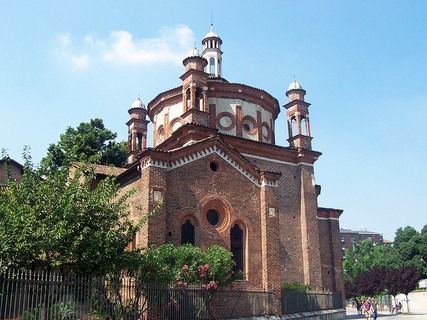
Like in those movies which start by jumping right into a scene that leaves the viewer confused and then write “24 hours earlier …” at the bottom of the screen, I must now write that in order for readers to understand this cryptic statement we need to go back some three months, to the month of January (a blessed time when we were still free to walk around and go wherever we wanted). My wife and I had gone down to the basilica of Sant’Eustorgio (a mere 15 minutes’ walk from our apartment) to visit its small museum, something which we had never done (I should note in passing that Sant’Eustorgio is one of Milan’s oldest churches, having been established in the 4th Century. One day, I might devote a post to it). In any event, the centrepiece of the museum is the Portinari chapel. It was built in Renaissance style in the 1460s, by Michelozzo, or possibly Filarete, or maybe Guiniforte Solari. As readers can see, there is a considerable degree of doubt on the question. What is not in doubt is who paid. That was Pigello Portinari, who made his money as the Medici Bank’s representative in Milan. He had it built as a family chapel cum mortuary, as well as a place to house one of the relics of St. Peter of Verona, his head (more on this later).

We see here an exterior view of the chapel.

Source

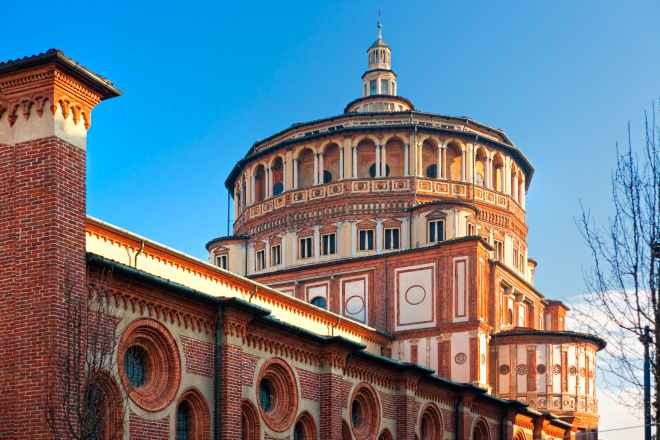
Anyone who has visited Milan will see a certain resemblance with the church of Santa Maria delle Grazie, which houses Leonardo’s Last Supper.

Source

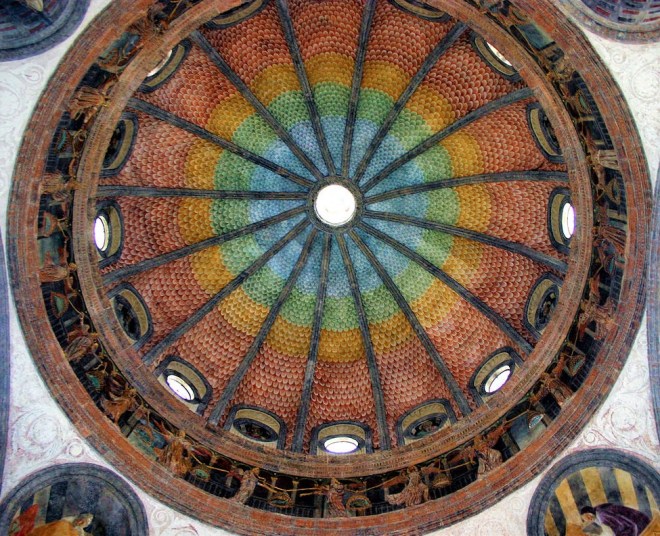
But the chapel’s real interest lies in its interior. There are lots of things to admire, but two things stood out for me. One is the interior decoration of the dome, by Vincenzo Foppa.

Source

The rainbow effect, I suppose meant to denote the ineffable beauty of heaven, is really striking. It reminds me of a fresco by Bergognone in another Milanese church, San Simpliciano, which I came across quite by chance one day (an adventure which I relate in an earlier post).

Source

The other stand-out in the chapel is the sepulchure of St. Peter of Verona, by Giovanni di Balduccio, a Pisan sculptor, said to have learned his trade under Giovanni Pisano. He was brought to Milan to sculpt this sepulchure in the later 1330s, some 80 years after the saint’s death.

source

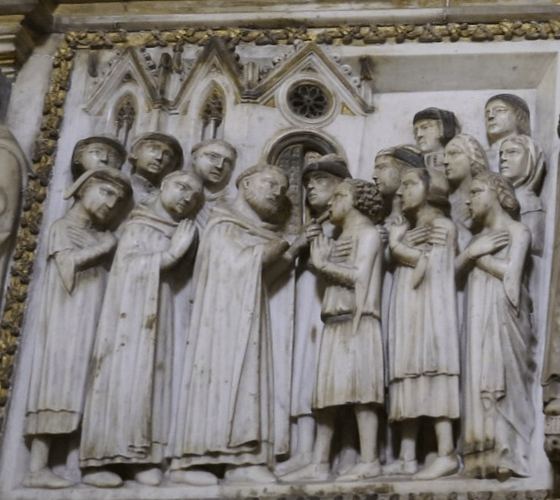
It’s a very complex sculpture, full of meanings and theological allusions, as befits a religious sculpture of the Middle Ages. I do not propose to elucidate any of the meanings or allusions, because I want to focus on what I found most enchanting about the sculpture, the bas reliefs around the centre of sepulchure, three of which we see in the photo.

These tell the story of the saint’s miracles, his death, funeral, and canonization. They are gems of storytelling. I’m sorely tempted to insert photos of all the bas reliefs, but I will control myself and only insert four.

Starting with his miracles, we have first the healing of the dumb man: a fairly mainstream depiction, with everyone looking holy.

Source

Then we have the miracle of the boat. I presume there was a storm and the saint’s intercession was invoked. Look at the man scurrying up the mast and the fear on sailors’ faces.

Source

Then we have the saint’s murder, in a forest near Seveso: look at the monk running away on the left while the assassin plunges the knife in.

Source

Finally, we have the saint’s canonization by Pope Innocent IV: look at the two grooms at the bottom holding the horses. I can almost hear one saying the other, “how long are they going to go on in there?”

Source

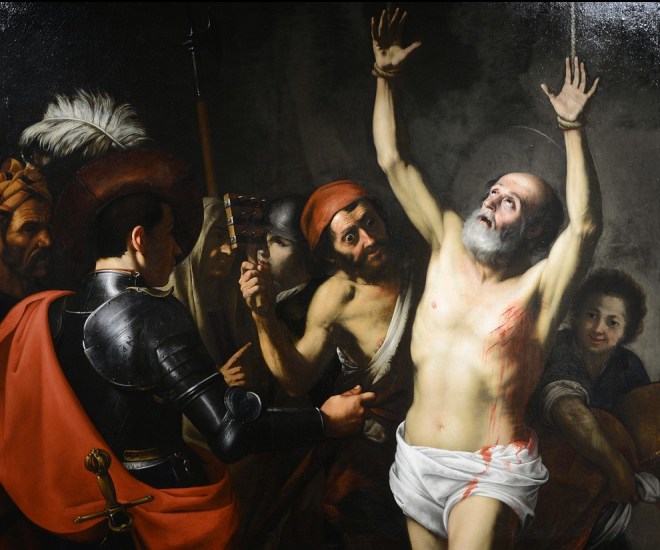
Saint Peter of Verona is one of my favourite saints, iconographically speaking (as I’ve noted in an earlier post). He was killed by having his skull split open with a sabre and having a dagger plunged into his chest. This led to a whole string of paintings over the centuries like this one by Guercino.

Source

I know it’s puerile but I find it hilarious to see these paintings with the man solemnly standing there with a sabre stuck in his head.

In any event, a strange thing happened when the saint was eventually buried in Giovanni di Balduccio’s sepulchure: the head got separated from the rest of the body. One explanation put forward is that Giovanni got the saint’s measurements wrong and made the sepulchure too short. His head was therefore taken off, and the the-then Archbishop of Milan, one of the large Visconti tribe, decided to take it. Another simply has it that the Archbishop wanted to have a piece of the saint near him and comandeered the head – which was probably considered the holiest piece because of that vicious sabre slash. Whatever the reason, the fact is that the saint’s head ended up with the Archbishop, in a nice urn. But then, the story goes, the Archbishop started suffering terrible headaches, and finally realised that he was being punished for keeping Saint Peter’s head separated from the rest of his body. He returned the head to Sant’Eustorgio and hey presto! his headaches disappeared.

Readers can imagine that this story rapidly turned Saint Peter into the saint to be invoked by those who suffer from headaches. Thus started the tradition of bringing the head out once a year, on the last Sunday of April, from the little side-chapel of the Portinari chapel in which it is stored away, and allowing people to come up and touch the casket in which it is kept.

Source

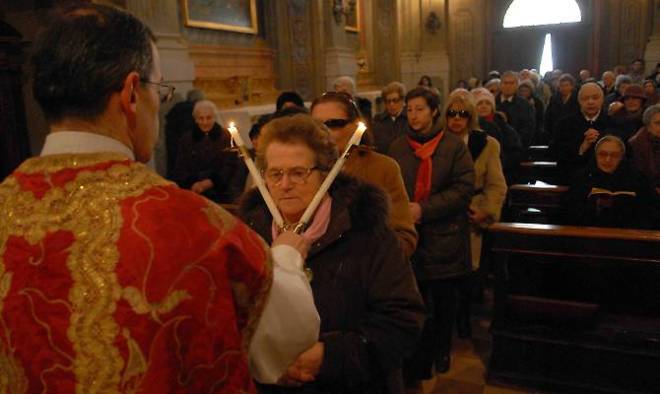
Well, this is very interesting to me! I have to tell readers that I have suffered from headaches since the age of 14. When I was young they could be very strong, now they are just a nuisance. Of course, I’m a firm believer in modern science! But still, you never know, perhaps a little touch of the saint’s casket could help …(rather like those crossed candles at the throat to protect one from sore throats on St. Blaise’s feast day). So, since today is the last Sunday in April this year, I had been hoping to take part in this ancient ritual. Thus, the reminder which I had put in my calendar way back in January. But it is not to be, Covid-19 has once again screwed up plans.

Goddamned Covid-19 …
SAINT JOHN OF NEPOMUK

Vienna, 17 September, 2019

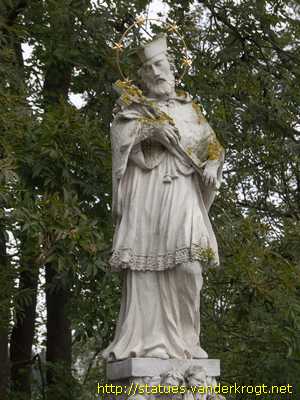
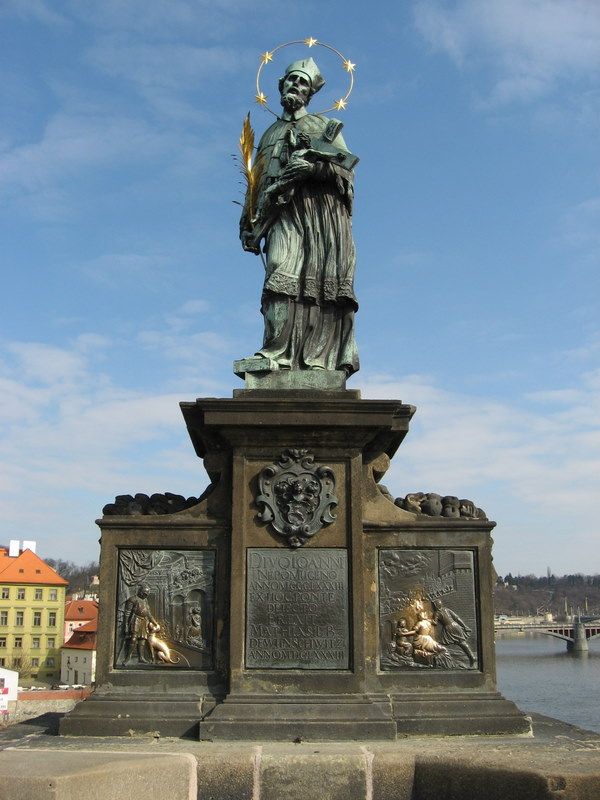
I had never heard of this particular saint until my wife and I came to this part of the world, but once here we saw him repeatedly, not only in Austria but also in the Czech Republic, in Slovakia, and in Hungary (and Wikipedia informs me that we could come across statues of his in Germany, Poland, Lithuania, and even further afield). Here is a photo of a typical statue of him.

Source

This particular photo comes from a web site devoted to statues. The site has listed a little over 200 photos of statues of John of Nepomuk, mostly from the catholic lands of Central Europe but with a smattering from elsewhere, which gives some idea of the saint’s popularity in this part of Europe. The photo shows a “typical” statue of John: bearded, clothed as a priest, wearing the priest’s three-peaked biretta, holding a cross, and with a halo of five stars around his head (what is also often found, but is missing from this particular statue, is a martyr’s palm). The statues are often found on bridges or close to them, for reasons which will become clear in a moment. They often look lost and forlorn, engulfed by modern expansions of what were once little villages.

I suppose John of Nepomuk really came into focus for me when, relatively soon after our move to Vienna, my wife and I decided to visit Prague with the children. As anyone who has been to that city knows, no visit is complete without a crossing of the Charles Bridge.

Source

The most striking thing about the bridge (apart from the fine views it affords of both the old and the less old parts of the city) is the thirty or so statues which line both parapets.

Source

For the most part, they are of various saints who presumably were important to the city – or to the donors who paid for them. One of them – actually, the oldest of them all – is a statue of St. John of Nepomuk.

Source

The reasons why some of the other saints got a privileged position on the bridge may not be entirely clear, but in John’s case it is crystal clear. He is the patron saint of the Czech Republic (and, before the Czech Republic existed, of Bohemia). As if that weren’t enough he was killed by being thrown off this very same bridge, which was nearing the end of its construction when he was summarily tipped over the parapet.

Well! It’s not every day that you stand on the very same spot (more or less) from which a saint was dispatched to his death. And such an interesting death! I don’t want to sound too morbid, but the way he was killed – according to my guide-book, sewn into a goatskin bag before being heaved into the river below – was considerably more quirky than most run-of-the mill deaths of saints I’ve come across. Thoroughly intrigued, I began asking myself what John of Nepomuk had done to deserve being declared a saint (being killed isn’t enough, otherwise we would have millions if not billions of saints).

After reading various accounts of his life, I’m afraid I have to conclude that he did nothing to deserve his title of saint. His sainthood was an act of pure politics.

Perhaps it is time for me to give a thumbnail sketch of John’s life and times. He was born in the 1340s in the Czech (Bohemian) town of Pomuk (later renamed Nepomuk). I would guess that his father – a burgher of the town – decided that his son should make his career in the Church. John must have been a bright lad because after the usual schooling he was sent to the University of Prague, completing his studies of theology and jurisprudence in 1374. Somehow he caught the eye of John of Jesentein, who later became archbishop of Prague. Here is a statue of the good Archbishop on the cathedral of St. Vitus in Prague (if this is a true likeness, he seems to have been a merry fellow).

Source

John of Jesenstein became Archbishop in 1378 and made John his first secretary. Presumably the Archbishop decided that John needed to further his studies and he went off to the University of Padua in 1383, returning home in 1387 with a doctorate in canon law in his pocket. Upon his return, he received – no doubt from the Archbishop – various positions: canon in the church of St. Ægidius in Prague, canon of the cathedral in Wyschehrad in 1389, Archdeacon of Sasz and canon of the Cathedral of St. Vitus in Prague in 1390, president of the ecclesiastical court shortly afterwards, and finally the Archbishop’s vicar-general (a sort of deputy for administrative matters) in 1393. It all sounds like the very rapid ascent of a very able fellow in the Church hierarchy. No doubt a brilliant career beckoned.

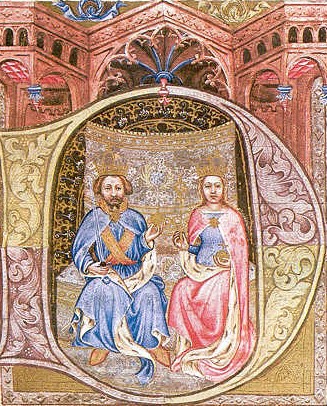
All this was taking place against a turbulent political background. Wenceslaus IV was King of Bohemia at the time. We see him here with his wife Sophia (more of her later), in a miniature from his bible.

Source

From what I read, he was a rather weak man. He certainly didn’t seem able to control his overweening family members, who were constantly undercutting him. His nobles, perhaps already restive but perhaps sensing his weakness, spent their time being obstreperous. He made matters worse by relying on favourites, something which nobles everywhere have always disliked; they feel that by reason of their birth they should be getting the positions being doled out to lower-born favourites. I have to say, Wencelsaus reminds me a lot of Richard II of England.

It was Wenceslaus wanting to reward a favourite which brought him on a collision course with the Church. The crisis came to a head pretty much immediately after John took up his post as the Archbishop’s vicar-general. Wenceslaus wanted to found a new bishopric for one of his favourites. His eyes fell on the rich and powerful Benedictine Abbey of Kladruby, an abbey which still exists. This picture gives us an idea of what a juicy piece of real estate it must have been.

Source

It so happened that its abbot was dying. Wenceslaus ordered that upon his death no new abbot was to be elected. Instead, the abbey’s territories were to be turned into a bishopric and his favourite installed as its bishop (his idea was that the bishop could then return the favour, using the abbey’s resources to support the King in his struggles with family and aristocracy). Now, if there was one thing the Church hierarchy really objected to, that was having Kings telling them who should fill what Church posts, especially when those posts carried with them rich benefices which would be lost to the Church. So when the old abbot finally copped it, the monks of Kladruby held an election post haste and chose one of their own monks to be the new abbot; John, as vicar-general, promptly confirmed the election.

When he heard the news, Wenceslaus blew his top; I am reminded of Henry II of England who, driven to distraction by his Archbishop Thomas à Becket, cried out “Will no-one rid me of this turbulent priest?”, a cry which led four knights to travel to Canterbury and slaughter Thomas on the steps of the cathedral’s high altar. In this case, Wenceslaus had John and three other top Church officials who had played some role in the decision arrested and thrown into gaol. In good medieval fashion, they were all tortured to get them to change the decision. The three others cracked and agreed. But John of Nepomuk held firm. So finally Wenceslaus ordered that he be placed in chains, paraded through the city with a block of wood in his mouth, and thrown from the Charles Bridge into the river. His executioners added the bit about being sewn into a goatskin bag. This fateful final event in John’s story occurred in March of 1393.

I’m not quite sure what the fall-out of all this was. The Archbishop certainly hot-footed it down to Rome, accompanied by the new abbot of Kladruby, to make a formal exposition of all that had happened (thus giving us the earliest written account of John’s death). In that exposition, he wrote of John being a martyr, presumably wanting to clothe in holiness a death that was really about quarrels between Church and State and who was more powerful, swirling around what was – let’s face it – a nice juicy piece of real-estate.

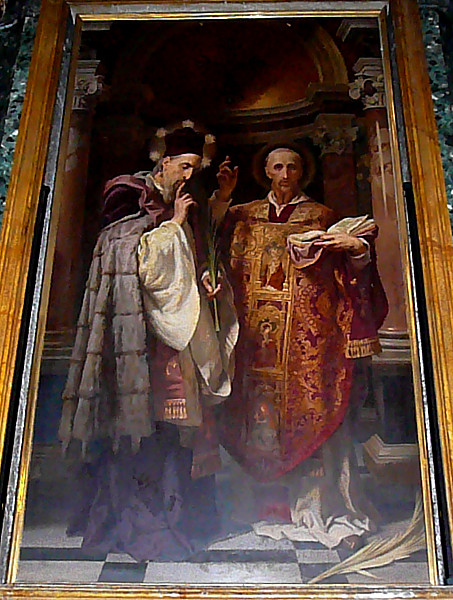
Regardless of what went on in the corridors of power, John’s death caught the imagination of the “little people” of Bohemia. A cult gradually grew up around him. By 1459, so some 70 years after John’s death, a more fanciful – and somewhat more holy – story appeared about the reason for his death; I suppose grubby little arguments about power and money didn’t seem suitable. It was now said that John had been Queen Sophia’s father confessor, that Wenceslaus had pressured him to tell if the Queen had confessed to having a lover, that John had refused to spill the beans citing the secrecy of the confessional, and that the King had lost it, leading to John being tossed into the river. This story is why John is quite often shown with his finger on his lips, as in this painting in the Church of Santa Maria Anima in Rome.

Source

When, after Emperor Ferdinand II smashed the Protestant forces of Bohemia at the Battle of White Mountain in 1620 and the forces of the Counter-Reformation were in full flow to forcibly turn Bohemia back into a Catholic state, it was decided to build on John’s popularity with the little people and push for his canonization. A very thick report was put together which emphasized the fanciful story of his death over the real reason for his death, and it was forwarded to the relevant authorities in Rome. The Roman Curia was happy to comply, so John was beatified in 1721 and canonized in 1729.

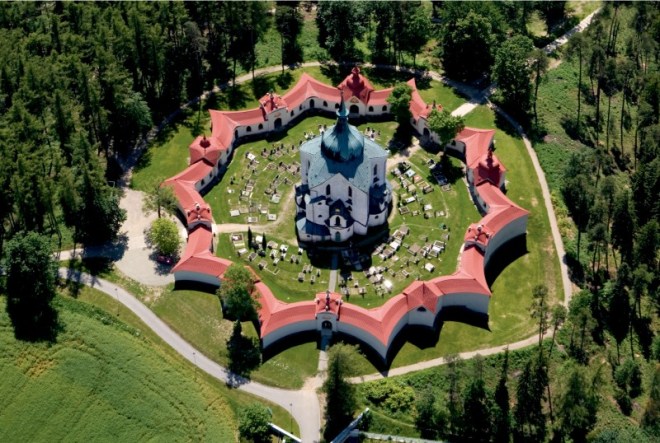
John’s sainthood of course drove the creation of art. Some of this was what we could call High Art. For instance, the years between his beatification and canonization saw the building of the Pilgrimage Church of St John of Nepomuk, a church that is famous in the Czech Republic and is now a UNESCO World Heritage Site (its rather fanciful shape is apparently based on an interpretation of the Cabbala).

Source

My wife and I have never seen this church, although it looks like a good candidate for a visit; I shall talk to her about it. On the other hand, I am firmly of the opinion that John’s Baroque tomb in the cathedral of Saint Vitus in Prague can be skipped.

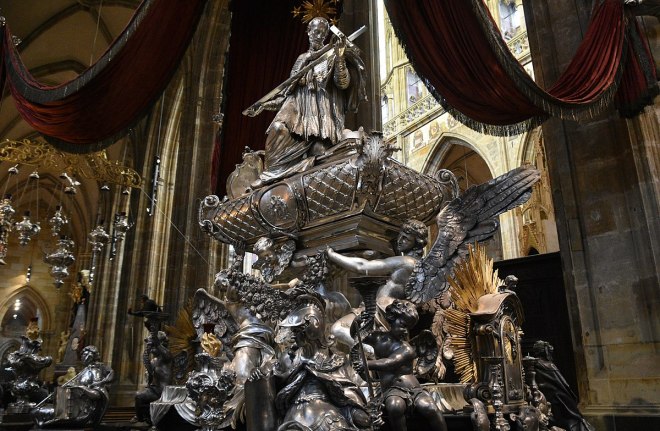
Source

Not only does it have in spadefuls all that I dislike about Baroque art – all flash and no substance – I really disapprove of the fact that two tonnes of silver were used to make the tomb; the money used to purchase the silver should have been distributed to the poor.

That’s the High Art. The Low Art generated by John are all those thousands of statues of him scattered around Central Europe and beyond. As readers can imagine, based on the fanciful explanation of his death, John of Nepomuk is the patron saint of good confession, confessors and penitents. But – more interestingly, to my mind – because of the way he died, he is also believed to protect against floods and troubled waters, and so is considered a patron saint of bridges and fords. Certainly the latest statue of him that my wife and I came across was in Lilienfeld during our walk along the so-called Via Sacra between Vienna and Mariazell. The statue was situated on the bank of a river, next to a bridge.

my photo

This statue is somewhat more exciting than most statues of this type, showing John in the act of being thrown over the bridge’s parapet by a fellow who looks quite mean and nasty.

The river itself flowed quite placidly when we crossed the bridge.

my photo

But the news is often filled with stories of rivers which have flooded and killed tens or hundreds of people. Why, only a few days ago we were treated to pictures of extreme flooding in Spain.

Source

I can imagine that the little, humble people have always had great respect for the power of rivers. They bring life-saving water to the crops, but they also unleash death and destruction when angry. I’m sure rites to propitiate the river gods are as old as civilization itself. The Greeks and Romans had their river gods and goddesses. So did the Celts. In fact, so did just about every other culture: Wikipedia has an entry on all these deities. I’m sure that the medieval Bohemians used John as a way of christianizing their age-old river gods.

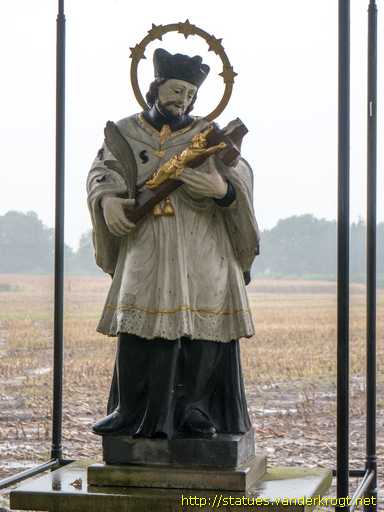
Of course, if you have a saint to whom you pray to stop floods and the heavy rain which creates them, it is not a great step to also ask him to intercede in the opposite case, the case of drought. That’s why you will also find statues of John in the middle of farmland, like this one from a place called Burlo in Germany (although the field behind looks rather sodden in this case).

Source

So there we have it. An actor in a Shakespearean drama of power and money who was, over the centuries and for various political reasons, turned into a saint. But below the official Catholic radar, a man who by chance became the means for a mostly rural population to officialize their magic to try to manage water, one of their most precious resources.

P.S. After reading this post, my wife began to see statues of John of Nepomuk everywhere we hiked. They really are common in this part of the world!

TWO PANETTONI FOR THE PRICE OF ONE

Dedicated to my son, who too often gets strep throat

Milan, 3 February 2019
updated 14 January 2020

Today is February 3rd!

This exclamation of mine will, I’m sure, leave all of my readers puzzled, so I need to explain: February 3rd is the feast day of Saint Blaise!

I fear, though, that this piece of information will still not help my readers much, so let me plough on.

Saint Blaise is one of those delightfully obscure early Christian martyrs, lost to us in the mists of time and fog of hagiography. His story is quickly told. He lived in the late 2nd, early 3rd Centuries AD. He was the Bishop of Sebastea, now Sivas, deep in the heart of modern Turkey. He was a holy man and a miracle worker. It is one miracle in particular that interests us here. A young mother came rushing to Blaise with her son, who was dying from a fish bone (or possibly a fish scale) stuck in his throat. As someone who, at the age of 12 or 13, got a fish bone stuck in my throat, I can deeply empathize with the poor boy. Luckily, I wasn’t dying but it was an incredibly painful experience. After various home remedies had been tried, I was taken to a doctor who extracted it. It so happens that Blaise had also trained as a doctor, but it seems he favored a faith-based approach to healing (I don’t know whether this was merely a reflection of his strong faith or a commentary on the parlous state of medicine at the time). So he laid his hands on the boy’s throat and uttered the – extremely sensible – words: “either come up or go down”. The fish bone (or scale) duly came up, or went down, and the boy was saved. This is the best painting I have found, by the Neapolitan painter Pacecco de Rosa, commemorating this touching scene.
Blaise was caught up in a final burst of persecution in the Roman Empire against Christians, which was the fruit of a vicious power struggle between the co-Emperors Constantine and Licinius. It is narrated that Blaise was arrested and dragged before the local governor and “invited” to abjure his faith. Here we have the scene commemorated in a stained glass window from Picardie, in northern France.
Of course, Blaise did no such thing. In fact, he used the occasion to lambaste idolatry (no doubt using strong and colourful language to make his point). At which, the governor in a fury ordered his men to torture Blaise. Which they did, with gusto, using combs or brushes with pointed metal teeth to tear his flesh to pieces. This is the best painting, by Filippo Vitale, another Neapolitan painter, which I could find of this painful event. I particularly like the Caravaggesque approach adopted by the painter. I have to say, I also find the pop-eyed torturer fantastic.
I feel moved, however, to also add a picture here of a section of the Last Judgement in the Sistine Chapel where Michelangelo painted Saint Blaise, because he made a great a depiction of the saint holding a wicked-looking pair of combs. Imagine having your skin scraped with those things!
In passing, I have to say that I am always amazed at the wonderfully inventive tortures early Christian hagiographers came up with for their martyrs. The muscular-looking lady in the green dress below Saint Blaise in the Last Judgement is Saint Catherine, holding the spiked wheel which she was meant to be broken on. I have written an earlier post about the flaying of St. Bartholomew. I went to a school whose patron saint was St. Laurence; he was basically grilled like a pork chop over a fire. The list of incredible tortures is endless …

But I digress. For some reason – no doubt because he was a saint – Blaise survived this harrowing of the flesh. He was thrown into jail, presumably to give his jailers time to think up even more hideous ways of torturing him. But they were clearly not up to the task, for the next thing we are told is that the governor ordered Blaise to be drowned in the nearby river. His men duly threw him into the river, where he miraculously floated. In frustration, they hauled him to the shore and cut off his head. And that was the end of Blaise (although I have to ask myself, if he could miraculously float in the river why could he not also miraculously stop the sword from cutting his head off? But, as they say, God moves in mysterious ways).

Blaise might have been dead but his reputation lived on. Over the centuries, he became the patron saint of various things. The one that interests us here is that he is the saint to whom one prays if one has a sore throat. Well, sore throats are a very common ailment for us humans, especially at this time of the year, but they are not life-threatening. So initially I found it somewhat surprising that people in the old days felt the need for a saint to intercede specifically for sore throats. But then it occurred to me that perhaps I was actually just reflecting the modern state of our health. Perhaps in the old days a sore throat was actually often the harbinger of something much more deadly creeping up on us, especially if we were children. For instance, scarlet fever starts with a sore throat. It predominantly strikes children between the ages of 5 and 15. Scarlet fever is now treatable with antibiotics, but in the pre-antibiotic days, i.e., any time before World War II, it could be deadly, as I have just seen in the film Little Women. Strep throat, which is a cousin of some sort to scarlet fever, also comes to mind. This is another disease that predominantly strikes children – it is responsible for as much as a third of their sore throats. It is incredibly painful, as I remember from my one run-in with the disease at the age of 10. To make the point, I throw in here a picture of a nice case of strep throat.
Strep throat is now also treatable with antibiotics, but perhaps in the pre-antibiotic days strep throat was more deadly. Then there is whooping cough, which I would assume has a component of sore throat (luckily, never having had whooping cough, I wouldn’t know). Until quite recently pretty much every child caught whooping cough and a not insignificant number died as a result (and still do in developing countries, because they don’t get vaccinated as we do in the developed world). And perhaps there are other diseases out there where sore throats are a warning signal of death around the corner, especially for children – I welcome further elucidation from any of my readers with a medical background.

In any event, my fancy tells me that early Christians had noticed a sometimes deadly correlation between youth and sore throats, and concluded – based on his miracle with the little boy and the fish bone – that Saint Blaise was the ideal saint to pray to when sore throats reared their ugly heads. Out of all this grew a custom that had the faithful flocking to churches on February 3rd, Saint Blaise’s feast day, to have their throats protected for the rest of the year with a special blessing. Although not so common now (I would say that we generally have greater faith in our doctors being able to cure us), it is a custom that lives on. And it’s not just any old blessing that one receives, no sirree! A pair of lit candles are crossed at one’s throat while the blessing is pronounced.
I have never been blessed in this way, so I don’t quite understand how it is that one’s hair isn’t set alight in the process; I would be extremely nervous about the whole thing. Where the idea of involving candles in the ceremony came from I have no idea, although it must be an old tradition. Here is a painting of Saint Blaise by Hans Memling, where readers can see that the Saint is serenely holding a candle.
All of this brings me to the real reason why I’m writing this post. It has to do with Milan, where I am currently spending the winter. The Milanese, like all other good Christians, firmly believed in Saint Blaise’s powers to cure sore throats. Indeed, there is a saying in Milanese dialect which proclaims: San Bias el benediss la gola e el nas, “Saint Blaise, he blesses the throat and the nose” (it seems that the Milanese sensibly extended the saint’s miraculous powers to the nose, or perhaps they simply wanted to make the rhyme). Nevertheless, the Milanese have added a special twist to this credence. Somewhere along the line, they concluded that eating panettone was just as good at protecting their throats as were two crossed candles and a priest’s benediction. So the ceremony in church was followed by a sit-down at home to eat a slice of panettone.

For those of my readers who are not familiar with this glory of Milanese cuisine, I throw in a picture.
Panettone is a type of sweet bread loaf. It’s been around since at least 1599, date of the first credible mention of it in the written records. What we see today, though, is not what our ancestors would have seen in 1599 or indeed at any time before 1919. In that year, the manufacture of panettone was revolutionized. An enterprising Milanese baker by the name of Motta introduced a new proofing step, where the dough was allowed to rise in not one but in three separate stages over a period of 20 hours. It is that which ensures the panettone’s tall domed shape as well as its wonderful fluffiness. A few years later, he was copied (“the recipe was adapted”) by another enterprising Milanese baker called Alemagna. The Motta and the Alemagna brands of panettone have been battling it out ever since.

I suspect that panettone originally looked more like a fruitcake (or plum cake to the English), which my French grandmother was very fond of and liked to buy for the Christmas festivities.
This too was the original role of panettone. It was a special, sweet bread that the Milanese made for Christmas. Like all these things, I would imagine that the “fruit” that Milan’s housewives and bakers added to their panettoni were closely guarded family secrets. Nowadays, as the Italian Government strives to give the panettone a DOP certification, the additions have been standardized: raisins – dry and not soaked! – as well as the candied zests of orange, lemon, and citron (the last of which I have written about in an earlier post).

I’m sure my alert readers will have noticed a problem. Panettone was originally made only at Christmas while the feast day of Saint Blaise is on February 3rd. Undeterred, the Milanese made it a habit of setting aside part of their Christmas panettone to eat on Saint Blaise’s day after they had braved their annual encounter with the crossed – and lighted! – candles. How exactly they kept their panettone from going stale in the meantime I don’t know. The web is full of suggestions on this topic for fruitcake, my favourite being to wrap it in towels soaked in brandy or wine and then in something like oiled paper. And anyway, as my wife sensibly remarked, if the panettone had become a trifle stale it could always be dunked in milk or tea or coffee.

But nowadays the Milanese don’t need to bother putting aside a piece of their Christmas panettone. No foodstuff is seasonal anymore, and panettone is no exception; you can buy it any time of the year. In fact, in a canny marketing move, sellers of panettone in Milan will offer two panettoni for the price of one on Saint Blaise’s day. Which is really why I’m so excited that it’s 3rd February today. I can buy two wonderfully delicious panettoni for the price of one! The moment I’ve posted, I’m off down the road to buy them, like this gentleman has (although he seems to have scarfed down half a panettone before even leaving the shop).
And maybe on the way back I’ll pop into a church to have my throat blessed. You never know …

____________________________________

Saint Blaise blessing the child: http://necspenecmetu.tumblr.com/post/46439176152/giovanni-francesco-de-rosa-pacecco-de-rosa-the
Saint Blaise before the governor: https://en.wikipedia.org/wiki/Saint_Blaise
Saint Blaise being harrowed: https://www.flickr.com/photos/91590072@N04/15982366258
Saint Blaise in Michelangelo’s Last Judgement: http://www.everypainterpaintshimself.com/galleries/michelangelo_last_judgment
Strep throat: https://en.wikipedia.org/wiki/Streptococcal_pharyngitis
Blessing of the throat: https://www.gazzettadiparma.it/scheda/246883/San-Biagio—la-benedizione.html
Saint Blaise holding a candle: https://fr.wikipedia.org/wiki/Blaise_de_S%C3%A9baste
Panettone: https://www.buy-me.it/panettone-classico-1kg-pasticceriabiasetto/
Fruitcake: http://dish.allrecipes.com/holiday-baking-fruitcakes/
Two panettoni: http://gateau.catamarcainfo.com/what-to-eat-with-panettone/

A WALK FROM ONE SAINT TO ANOTHER

Sori, 10 December 2016

We started in San Rocco, which is perched on a rocky spur high above Camogli.

image
The last time we visited it, we huffed and we puffed our way up the old mule track that snakes its way up from Camogli. This time, we took it easy; we took the Recco-Rapallo bus and hopped off at Ruta, which lies on the saddle between Camogli on one side of Monte di Portofino and Santa Margherita on the other, and took another little bus from Ruta to San Rocco.

A little aside on the lives of obscure saints: San Rocco, known in English – if at all – as Saint Roch (I found traces of a couple of British churches named after him), lived in the late 1200s, early 1300s, dividing his time between what is now southern France and northern Italy. He is the patron saints of dogs and bachelors (a strange combination) and was especially invoked in times of the plague – hence this painting of the saint pensively pointing to a plague bubo on his leg.
image
In any event, fresh from our relaxing bus drive, and fortified by a cappuccino and a slice of focaccia, we set off down the path which led to Punta Chiappa, a low rocky ledge jutting out into the sea at the furthest reaches of Monte di Portofino. The idea was to have lunch in a restaurant down at the water’s edge just before Punta Chiappa and, suitably fuelled up, toil our way back up to San Rocco. We started losing height through a series of long flights of steps
image
we wended our way through woods
image
through which struggled a few remaining olive groves.
image
We finally arrived at San Nicolò, a small collection of houses clustered around a pretty little 12th Century church.
image
The original monks who had ministered to the small community of fisherfolk clinging on to this steep hillside finally moved away in the face of continuing depredations by Barabary pirates (I suppose church plate was considered good loot) and the church fell into disuse. Recently, suitable renovations have been undertaken, although there was little left of the original decorations to restore.

Another quick aside on the lives of obscure saints: San Nicolò, Saint Nicholas in English, lived at the juncture of the 3rd and 4th centuries. He was a bishop in Asia Minor and was famous for working miracles (he seems to have been particularly good at this). Of relevance to this story, he is the patron saint of sailors and fishermen.
image
But he also is responsible for a whole host of other professions including coopers, archers, pharmacists and – somewhat bizarrely – broadcasters. Somewhere along the line, no doubt because he is the patron saint of children, this very worthy saint morphed into that very heathen Santa Claus.

One of the few fragments of the original decorations left is this piece of fresco.
image
It shows St. Nicholas saving two sailors from drowning as their ship founders: that nightmare of all sailors and the subject of famous paintings
image
as well as a myriad of humbler ex-votos, normally dedicated as in this case to Mary in her role as Stella Maris, Star of the Seas.
image

I am moved to insert here those lovely lines from T.S. Eliot’s “The Wasteland” in the short section of the poem entitled Death by Water:

Phlebas the Phoenician, a fortnight dead,
Forgot the cry of gulls, and the deep sea swell
And the profit and loss.
A current underseas
Picked his bones in whispers. As he rose and fell
He passed the stages of his age and youth
Entering the whirlpool.
Gentile or Jew
O you who turn the wheel and look to windward
Consider Phlebas, who was once handsome and tall as you.

From San Nicolò, we got the first good view of the Golfo di Paradiso, the woods having obscured the view in the upper reaches of the walk.
image
Hunger drove us on. We dropped still further towards the sea,
image
finally reaching the restaurant. Alas! Contrary to what we had been assured in the café where we took our morning cappuccino and focaccia, it was closed. We were mournfully counting the tangerines we had brought with us and reckoning on the number of stairs we would need to climb to get back to San Rocco on a nearly empty stomach when we saw a boat coming in to dock. We hurried forward and discovered that by sheer serendipity we had arrived just in time to catch the boat to San Fruttuoso, from whence we could get a boat back to Camogli! Light of stomach, but also light of heart, we hopped on, took a seat, and admired the passing views as we rounded Punta Chiappa
image image
motored past forbidding headlands
image
until the small fort protecting San Fruttuoso hove into sight,
image
where we turned into San Fruttuoso’s bay and chugged in towards the village itself.
image
image

image

Calling this a village is perhaps a bit of an exaggeration, composed as it is of the ancient abbey (currently under renovation)
image
a somewhat less ancient watchtower
image
and a few fishermen’s houses clustered in between.

It’s a charming site, much frequented in the summer by people who come to lie on the beach (as it was when we visited it, during a long weekend). We took the easy way in, but hardier folk can take one of a number of paths crisscrossing Monte di Portofino which pass through San Fruttuoso. Well rested and after eating our meager cache of tangerines I went off to visit the Abbey while my wife read her book on the beach.

A final note on the lives of obscure saints: San Fruttuoso, Saint Fructuosus in English (a saint so obscure in the English world that I could find no church named after him), was a bishop of Tarragona in Spain in the second half of the third century.
image
His main, in fact his only, claim to fame was that he was martyred during the reign of the Roman Emperor Diocletian. He is so obscure that no group has claimed him as their patron saint, which is a bit sad. Given his name, makers of fruit juices could perhaps apply …

How an abbey in Italy got to be dedicated to him is a bit of a mystery. The story goes that when the Vandals invaded Spain some monks from Tarragona, anxious that his remains not be despoliated, carried them off by sea. After a certain amount of wandering around the Mediterranean, they ended up on the Monte di Portofino. I find the story to have a lot of holes in it, but hey, who am I to question its veracity? Suffice to say that the Abbey grew quite wealthy from donations of land. Wealth put it in the sights of the Barabary pirates. Like San Nicolò, it went into decline after repeated depredations and was eventually abandoned.

In the early afternoon, our return boat docked. We piled in and returned to Camogli
image
for a well-deserved late lunch of focaccia al formaggio.

image
______________

All photos: mine, except as follows

San Rocco: https://commons.m.wikimedia.org/wiki/File:Camogli-chiesa_di_San_Rocco_(Ruta)-DSCF0645.JPG
Saint Roch: https://en.m.wikipedia.org/wiki/Saint_Roch
Le radeau de la méduse: https://fr.m.wikipedia.org/wiki/Le_Radeau_de_La_Méduse
Ex-voto shipwreck: http://www.ottante.it
Saint Nicholas: http://aristidhmilaqi.blogspot.it/2011/06/saint-nicholas-patron-saint-of-sailors.html?m=1
Saint Fructuosus: https://en.m.wikipedia.org/wiki/Fructuosus
Camogli: http://www.cepolina.com/Camogli-sea-beach.html
Focaccia al formaggio: http://www.italianbotanicalheritage.com/it/scheda.php?struttura=499

SAINT RADEGUND

Vienna, 19th September 2016

There is a small street which gives on to Piazza Duomo in Milan, which goes by the name of via Santa Radegonda. It’s a very modest, narrow, little street, really quite boring. Its main claim to fame is that it runs alongside the posh department store La Rinascente.

image
But I like the street, for the quite frivolous reason that I like the name. Radegonda, Radegund in the original German: now that’s a girl’s name with some whoomph to it! Not like Amelia, or Olivia, or Emily, which are currently some of the most popular names for little British girls.

This particular Radegund was a 6th Century princess from Thuringia, in what is now central Germany. Her life story was as colourful as her name. Her father, Berachtar, was one of three kings in Thuringia. Her uncle, Hermanfrid, one of the other Thuringian kings, killed her father in battle, took over his part of the Thuringian lands, and while he was at it took Radegund into his household. Hermanfrid then made a deal with the Frankish king, Theuderic, to share sovereignty of the whole of Thuringia, subject to material aid from Theuderic. Having sealed the deal, Hermanfrid attacked, defeated, and killed the third king of Thuringia, his brother Baderic. He then promptly reneged on his agreement with Theuderic. Not surprisingly, Theuderic sought revenge of this perfidy. Together with his brother Chlothar, he defeated Hermanfrid and took over Thuringia. In the ensuing carve-up, Clothar took charge of Radegund and brought her back to Gaul. All this happened before Radegund was 11, by the way.

Clothar packed Radegund off to one of his villas until she was of a more marriageable age. When she was 19 or so, he married her himself. No doubt it made his claims to Thuringia stronger to have her as his wife. She joined Clothar’s five other wives – Guntheuca, Chunsina, Ingund, Aregund, and Wuldetrada – in what may, or may not, have been a cozy concubinage. In any event, she bore Clothar no children.

By the time Radegund was 30, her only remaining brother was the last surviving male member of the Thuringian royal family. Presumably to head off any pesky competing claims to the Thuringian lands, Clothar had him murdered. At which point, either because she feared for her own life or because she was fed up with all this mayhem, Radegund fled and sought the protection of the Church, eventually founding, when she was about 40, a nunnery in Poitiers. Initially, Clothar tried to get her back but eventually left her alone and focused on expanding his lands at the expense of all those around him, including his brothers (although he had the grace not to kill them to obtain his ends, good manners which did not extend to their sons). By the time he died, he was master of a kingdom stretching from the Pyrenees to Thuringia, and from Brittany to French-speaking Switzerland.

All these Franks and Thuringians may have been a lying, traitorous, murderous lot, but they had wonderful names. This all rather reminds me of my Favourite History Book, 1066 And All That, my copy of which recently came to light, among many a delighted cry on my part, from the storage box in which it has been lying these last seven years.
image
In that book, we are reminded that Anglo-Saxon England was peopled with persons carrying wonderful names:

“Wave of Egg-Kings

Soon after this event Egg-Kings were found on the thrones of all these kingdoms, such as Eggberd, Eggbreth, Eggfroth, etc. None of them, however, succeeded in becoming memorable except in so far as it is difficult to forget such names as Eggbirth, Eggbred, Eggbeard, Eggfish, etc. Nor is it even remembered by what kind of Eggdeath they perished.”

The authors were exaggerating, but not by much.

The murderous goings-on around Radegund also remind me of that other Great Source of Early European History, Asterix. In the album Astérix chez les Goths
image
the endemic fighting among the Germanic tribes is well captured.

(Please note the authors’ take on Gothic names – they exaggerate but not by much)

But I digress, and I think my wife feels I’m letting my childish side get the upper hand here. Let us focus on the saintly Radegund. Already when queen, she was noted for her almsgiving. Once a nun, she cared for the local lepers and other infirm of Poitiers. She was also known for eating nothing but legumes and green vegetables: no fish, no eggs, not even fruit. I’m sure the vegans of today would approve (although even they might find her decision to forswear fruit a trifle extreme) but to the meat-eating Germanic elites, who spent much of their time hunting, this must have been pretty weird. Here is the most ancient representation of this saintly lady that I found, from a 10th-11th Century manuscript in the Municipal library of Poitiers, where we see Radegund getting herself to the nunnery (to misquote Hamlet).
image
As far as I can make out, though, her main claim to religious fame, at least in the Dark and Middle Ages, is that the Byzantine Emperor Justin II gave her a fragment of the True Cross. I hasten to add that he did not do so because he was much taken by Radegund’s saintliness. It was, I’m afraid, a purely political maneuver. Justin wanted to wrest control of the north of Italy from the barbarian Lombards, but for this he needed the help of the (equally barbarian) Franks. The relic, given to an ex-wife of the Frankish king who, though, was still on friendly terms with said king, was the bribe, or, to put it more kindly, the bait. Whatever the reason, the relic which Justin handed over to Radegund was a Really Good relic, and any Medieval religious institution with a Really Good relic was sitting on a goldmine as the pilgrims poured in and spent their money locally. This no doubt was the happy fate of Poitiers, helped along by the fact that Radegund was widely believed to have the gift of healing. Indeed, several miracles around her tomb greatly helped to increase the pilgrim traffic. The result was the building of a church which is a combination of Romanesque and Angevin Gothic styles.
image
Sadly, the vicissitudes of history, and more specifically a sack by Huguenots in the 16th Century and the ravages of the French Revolution, combined with some heavy-handed restoration in the 19th Century, has scarred the original splendour.

The pilgrim traffic to Poitiers had the happy side-effect of carrying Radegund’s name far and wide as the pilgrims returned home, and new churches and other religious institutions sprang up all over Europe dedicated to her name. This was certainly the case in Milan, where on the site on which now stands that temple to consumerism, La Rinascente, there once stood a nunnery dedicated to Santa Radegonda. No trace of this nunnery remains today save in the name of that modest, narrow, little street which I like so much.

I give just one further example of the many places in Europe which adopted her name, and that is the small village of Sankt Radegund in Upper Austria. In the next few years, readers will see a new film come out, with the title “Radegund”. It is the story of Franz Jägerstätter, a native of Sankt Radegund, who was the only one in his village to vote against the Anschlüss and was courageous enough to be a conscientious objector during World War II.
image
My readers will no doubt convene that this was a dangerous thing to declare oneself to be under the Nazi regime, and in fact Jägerstätter ended up being guillotined in 1943, for the crime of “undermining military morale”. The recent (German) Pope, Benedict XVI, had Jägerstätter beatified: a more appropriate saint for our age, I think.
image
Yesterday afternoon, I noticed that behind Milan’s Duomo there is a small road called via Santa Tecla. What an interesting name! I wonder who she was?

__________________
La Rinascente: http://www.nytimes.com/2014/12/25/fashion/in-milan-with-handbags-and-tongs-under-one-roof.html?_r=0
Clothar I: http://www.pearltrees.com/sirius84/francs-merovingiens/id9615614/item93489971
“1066 And All That”: http://rogerandfrances.eu/books/1066-and-all-that
“Asterix chez les Goths”: http://www.asterix.com/the-collection/albums/asterix-and-the-goths.html
Goths fighting: my photo
Radegund entering nunnery: https://en.m.wikipedia.org/wiki/Radegund
Eglise Sainte-Radégonde, Poitiers: https://www.poitiers.fr/c__244_788__Poitiers_capitale_romane.html
Franz Jägerstätter: http://voiceseducation.org/content/franz-jagerstatter-austrian-world-war-ii-resistance
Icon with Franz Jägerstätter: https://en.m.wikipedia.org/wiki/Franz_Jägerstätter